Thus The First, Last, and Always Most Important Truth We All Must Remember And Demand Of Not Only Others But Ourselves As Well is That Absolutely No One Anywhere Or At Any Time Is Even Remotely “Safe” Or “Innocent” From the Eternal Existential and Empirical Threats of Genocide, Hatred, and Pathological Mass/Self Destruction.
Fascism As Advocated, Practiced, Tolerated, and Justified by Anyone in the World Is Inherently A Monumental Crime against Humanity And the Very Conflicted and Often Delusional Idea of “Civilization” On This Planet. Always Was. Always Will Be.
Finally It Will Clearly Remain So Unless and Until We Face the “Truth and Consequences” Of Our Own Corrupted and Deeply Complicit Actions and Positions In Response To the Present Ongoing Crisis. Full Stop. Period.

VIDEO:
How Jared Kushner, Trump’s vile and thoroughly arrogant son-in-law has become a despicable foreign agent on behalf of Israel and Saudi Arabia and under the aegis of his deranged and murderous father-in-law has also become one of the most CRIMINALLY CORRUPT people in the world today...PASS THE WORD...
VIDEO:
https://youtube.com/shorts/9aqvESSiIvk?si=_wY-AjWkSJYmla3Z

In threats to civilian infrastructure, he said Tuesday “will be Power Plant Day, and Bridge Day, all wrapped up in one.”
by Julia Conley
April 6, 2026
CommonDreams

Following President Donald Trump’s Sunday morning Truth Social post detailing his intent to further break international law by bombing Iran’s power plants and civilian infrastructure, the message sent by numerous critics to White House officials, the US Congress, and US allies was the same: “Act now to stop this lawless war.”
That demand was made by Just Security editor and Rutgers University law professor Adil Haque of the international community after Trump announced on social media that this coming Tuesday “will be Power Plant Day, and Bridge Day, all wrapped up in one, in Iran.”
“There will be nothing like it!!!” the missive continued. “Open the Fuckin’ Strait, you crazy bastards, or you’ll be living in Hell – JUST WATCH! Praise be to Allah. President DONALD J. TRUMP.”
The threat was one of Trump’s most blatant yet regarding his plans to bomb Iran’s power plants and other civilian infrastructure in retaliation for Iran’s de facto blockade on the Strait of Hormuz, a key shipping route for global oil and other imports. Iran announced a deal with Iraq on Saturday to allow its shipments through the waterway and was in talks with Oman on Sunday, but about 3,000 vessels carrying shipments have been stranded in the strait since the Islamic Revolutionary Guard Corps (IRGC) in Iran began imposing heavy restrictions in retaliation for the US-Israeli invasion of the country.
Attacking power plants “could amount to a war crime,” Amnesty International said late last month as Trump ramped up threats against the critical facilities, because they are “essential for meeting the basic needs and livelihoods of tens of millions of civilians.”
April 5, 2026
“When power plants collapse, horrific consequences cascade instantly,” said Erika Guevara-Rosas, Amnesty International’s senior director of research, advocacy, policy, and campaigns last month. “Water pumping stations would stop functioning, clean water would become scarce, and preventable diseases would spread. Hospitals would lose electricity and fuel, forcing surgeries to be canceled and life-support machines to shut down. Food production and distribution networks would collapse, deepening hunger and causing widespread food scarcity. Many businesses would also shut down with devastating economic consequences including mass unemployment.”
On Sunday, Amnesty Secretary General Agnes Callamard said she was “running out of language to denounce and condemn” Trump’s escalating threats and called the Truth Social post a “revolting statement.”
“Iranian civilians will be the first to suffer from the destruction of power plants and bridges,” she said. “No heat, no electricity, no water, no capacity to move or to flee, and all that it means for their right to life.”
Trump has also threatened Iran’s water desalination plants, which could lead the country to retaliate with similar attacks across the region, impacting the water supply of millions of people across Gulf Arab states. On Saturday, Kuwait blamed Iran for an airstrike that hit a power and desalination plant, while Iranian officials blamed Israel for the attack.
Political analyst Omar Baddar warned that “Iranian civilians will pay the biggest and most immediate price of his madness, but the ripple effect will not spare much of the world.” He was among those who commented that Trump’s latest remarks on the war sounded “exceedingly desperate” as news reports pointed to mounting evidence that the US is not succeeding at Trump’s goal of defeating Iran’s military — despite the president and Defense Secretary Pete Hegseth’s persistent claims that “we are punching them while they’re down.”
As The New York Times reported Friday, US intelligence has found that Iran is swiftly returning its missile bunkers to operation following US and Israeli bombings. The country’s exact capability is unclear because the IRGC “is deploying significant numbers of decoys, and the United States is not sure how many of the apparent launchers it has destroyed were real,” the Times reported. Iran is also reportedly using a new air defense system.
“Trump is being driven insane by his inability to defeat Iran,” said UK journalist Owen Jones of Trump’s Sunday post. “This is a threat to commit unspeakable war crimes.”
On Saturday, The Wall Street Journal reported that top White House aides and officials, including Hegseth, have been advising Trump that “Iran’s power-generating facilities and bridges are legitimate military targets because destroying them could cripple the country’s missile and nuclear program.”

MORE FROM DEAN: Dean's free newsletter,
The Dean's Report: https://deanobeidallah.substack.com/ Bluesky: https://deanobeidallah.bsky.social/ 🌐
YOUTUBE:
 / thedeanobeidallahshow 📸
 INSTAGRAM:
 / deanobeidallah 👥
 FACEBOOK:
 / deanofradio
 SiriusXM’s Dean Obeidallah Show:
https://zeteo.com/p/did-iran-just-win-this-war
 |
🇮🇷 🇺🇸 Did Iran Just Win This War?
|

On this day in 2018, Hungarian Prime Minister Viktor Orbán won the general election by a landslide, securing his third consecutive term in office. The far-right authoritarian is up for reelection once again, and despite receiving support from Donald Trump and JD Vance, who traveled to Budapest this week, Orbán’s chances aren’t looking as promising this time around.
Good morning! Andrew, Swin, and Prem here, with some decent news. Donald Trump opted not to try to slaughter Iran’s “whole civilization” Tuesday evening, as he had threatened. In Trump’s disturbing second term, we must take wins where we can. Who knows how long the “ceasefire” will last, but we, of course, welcome it: No more civilians should have to die just because our president is a raging idiot, sociopath, and pawn of Benjamin Netanyahu.
In today’s ‘First Draft,’ the ceasefire framework appears to be “a strategic win” for Iran, and a major loss for Trump and Netanyahu; liberals expand their majority on Wisconsin’s Supreme Court; and Janet Mills goes dark on the air with two months left in Maine’s Senate primary.
 |
Don Backs Down
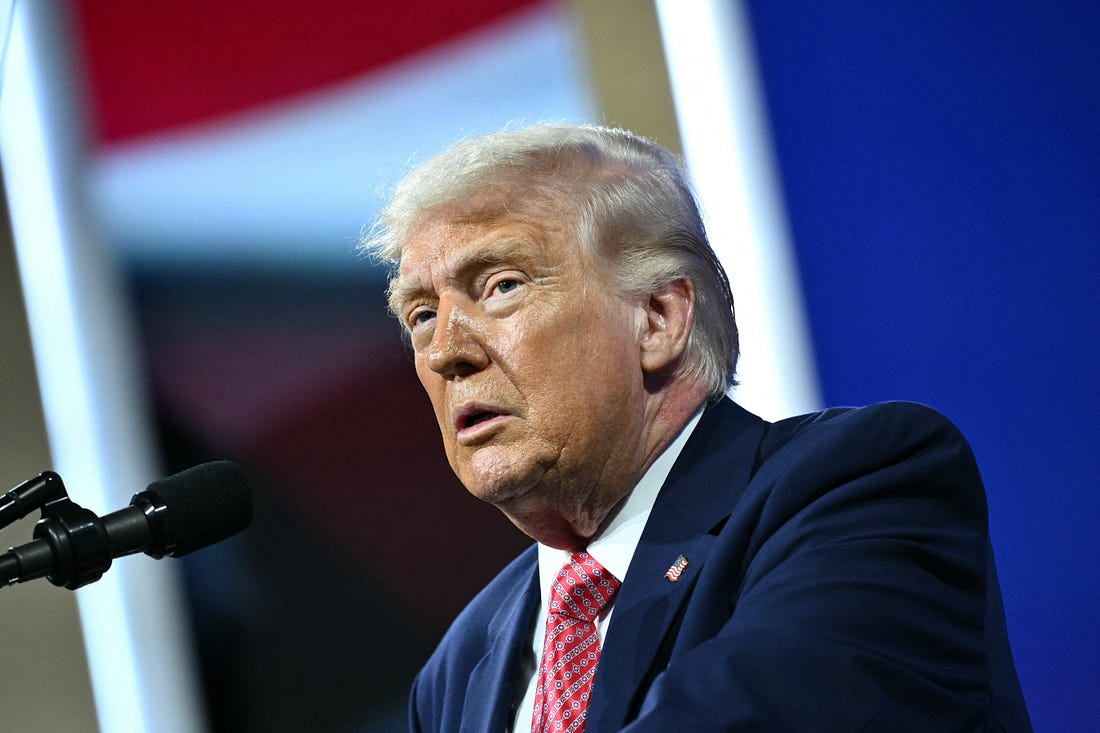
Trump speaks in Miami Beach, Florida, on March 27, 2026. Photo by Mandel Ngan/AFP via Getty Images.
Donald Trump on Tuesday threatened to destroy Iran’s “whole civilization”unless its leaders agreed to a deal to reopen the Strait of Hormuz.
By Tuesday evening – instead of trying to kill the 90 million people living in Iran, or bombing Iran’s power plants and bridges as he had promised – Trump announced “a double sided CEASEFIRE!” for two weeks. In doing so, Trump all but admitted the reality that his illegal war is going terribly – and Iran is winning.
“We received a 10-point proposal from Iran, and believe it is a workable basis on which to negotiate,” the president announced on Truth Social – apparently referring to the 10-point plan that Iran had presented to the US before he threatened to murder its entire population.
Using this 10-point plan as a framework for a deal, rather than the previous American 15-point plan, is obviously a major win for Iran – which is, indeed, declaring victory. Experts and commentators see it that way, too.
“If Iran did in fact secure guarantees based on the ‘10 principles’ Trump referenced, that is not a marginal outcome, it is a strategic win for Tehran, reinforcing its narrative and positioning,” wrote Danny Citrinowicz, a former top Israeli intelligence officer who focused on Iran. As former US State Department official and veteran Middle East negotiator Aaron David Miller put it, “Iran has won another round.”
Political scientist Robert A. Pape writes: “Huge strategic defeat for the US, biggest loss since Vietnam.”
The 10-point plan would allow Iran to continue its control over the Strait of Hormuz, the crucial waterway that Iran has closed since the start of the war, stopping the flow of oil and throttling the global economy.
Just a day earlier, Trump was fantasizing about the US “charging tolls” for ships to transit the strait. Now, it looks much more likely that Iran will keep doing this instead, and that it will get to charge “a $2M fee per ship.” In another win for Iran, the plan would involve lifting “all US sanctions on Iran.”
Some liberals will invariably revel in “TACO Trump” memes about how Trump always chickens out. But, as we reported at Zeteo on Tuesday, none of this is over. The ceasefire, as of now, is only temporary. As Trump advisers and others in the upper tiers of Trumplandia warned us, there’s still a decent chance that he escalates the war again soon.
by David Flash
February 28, 2026

Understanding what happened requires stepping back into the geopolitics of the early Cold War — and the global fight over oil.
A Popular Leader Challenges Western Oil Power
Mossadegh came to power in 1951 with strong nationalist support after Iran’s parliament voted to nationalize the country’s oil industry. For decades, Britain — through the Anglo-Iranian Oil Company (now BP) — had controlled Iranian oil, paying Iran only a small share of the profits.
Nationalization was wildly popular inside Iran but unacceptable to Britain, which responded with sanctions, a global boycott of Iranian oil and covert efforts to undermine Mossadegh’s government.
Britain soon sought help from the United States.
Cold War Fears and Operation Ajax
At first, the Truman administration hesitated to intervene. But by 1953, U.S. officials under President Dwight Eisenhower feared instability in Iran might open the door to Soviet influence — a major concern during the Cold War.
The CIA approved a covert plan with British intelligence (MI6) to remove Mossadegh from power. The operation included propaganda campaigns, funding protests, bribing officials and coordinating with military officers loyal to Iran’s monarch, Shah Mohammad Reza Pahlavi.
On Aug. 19, 1953, after several chaotic days of demonstrations and violence in Tehran, Mossadegh’s government collapsed. The shah — who had briefly fled the country — returned to power, and General Fazlollah Zahedi became prime minister.
About 200 to 300 people were killed during the unrest.
From Constitutional Monarchy to Authoritarian Rule
Before the coup, Iran functioned as a constitutional monarchy with an elected government. Afterward, the shah consolidated power, ruling with increasing authoritarian control supported by U.S. military and intelligence assistance.
His regime lasted until 1979, when the Iranian Revolution overthrew the monarchy and established the Islamic Republic that still governs Iran today.
Many historians consider the coup a turning point that fueled anti-American sentiment in Iran. Iranian nationalists saw it as proof that Western powers would undermine democracy to protect strategic and economic interests.
U.S. Acknowledgment — Decades Later
For years, the CIA’s role was denied or downplayed. But declassified documents and official statements eventually confirmed U.S. involvement.
In 2013, internal CIA records acknowledged that the coup was carried out “under CIA direction” as U.S. foreign policy.
More recently, the agency has described the intervention itself as undemocratic.
Why the Coup Still Matters
The 1953 coup remains central to how Iranians — across political factions — view the United States.
It shapes debates over:
Nuclear negotiations
Sanctions and diplomacy
Regional conflicts
Iranian distrust of Western intentions
Many experts argue that ignoring this history makes it harder to understand current tensions.
A Complicated Legacy
The coup was not solely driven by oil or imperial ambition; Cold War fears of communism were also real factors for U.S. policymakers at the time. But the outcome — removing an elected leader and empowering an autocratic monarchy — has led many scholars to rank the intervention among the most consequential and controversial decisions in American foreign policy.
More than 70 years later, the consequences are still unfolding.