Wednesday, October 15, 2014

Four Important New Books By Leading Public Intellectuals and Activists Cornel West, Naomi Klein, Bob Herbert, and Noam Chomsky On The Urgent Necessity Of A Mass Movement For Genuine Political and Economic Democracy


Black Prophetic Fire
by Cornel West (Author), Christa Buschendorf (Author)
Hardcover
ON SALE: October 7, 2014

Hardcover: 248 pages
Publisher: Beacon Press (October 7, 2014)
Language: English
ISBN-10: 0807003522
ISBN-13: 978-0807003527

Excerpt. © Reprinted by permission. All rights reserved.

CORNEL WEST
(b. 1953)

INTRODUCTION: Why We Need to Talk About Black Prophetic Fire
by Cornel West
 

Are we witnessing the death of Black prophetic fire in our time? Are we experiencing the demise of the Black prophetic tradition in present-day  America? Do the great prophetic figures and social movements no longer resonate in the depth of our souls? Have we forgotten how beautiful it is to be on fire for justice? These are some of the questions I wrestle with in this book.

Since the assassination of Martin Luther King Jr., it is clear that something has died in Black America. The last great efforts for Black collective triumph were inspired by the massive rebellions in response to Dr. King’s murder. Yet these gallant actions were met with increasing repression and clever strategies of co-optation by the powers that be. The fundamental shift from a we-consciousness to an I-consciousness reflected not only a growing sense of Black collective defeat but also a Black embrace of the seductive myth of individualism in American culture. Black people once put a premium on serving the community, lifting others, and finding joy in empowering others. Today, most Black people have succumbed to individualistic projects in pursuit of wealth, health, and status. Black people once had a strong prophetic tradition of lifting every voice. Today, most Black people engage in the petty practice of chasing dollars. American society is ruled by big money, and American culture is a way of life obsessed with money. This is true for capitalist societies and cultures around the world. The Black prophetic tradition—along with the prophetic traditions of other groups—is a strong counter-force to these tendencies of our times. Integrity cannot be reduced to cupidity, decency cannot be reduced to chicanery, and justice cannot be reduced to market price. The fundamental motivation for this book is to resurrect Black prophetic fire in our day—especially among the younger generation. I want to reinvigorate the Black prophetic tradition and to keep alive the memory of Black prophetic figures and movements. I consider the Black prophetic tradition one of the greatest treasures in the modern world. It has been the leaven in the American democratic loaf. Without the Black prophetic tradition, much of the best of America would be lost and some of the best of the modern world would be forgotten.

All the great figures in this book courageously raised their voices in order to bear witness to people’s suffering. These Black prophetic figures are connected to collective efforts to overcome injustice and make the world a better place for everyone. Even as distinct individuals, they are driven by a we-consciousness that is concerned with the needs of others. More importantly, they are willing to renounce petty pleasures and accept awesome burdens. Tremendous sacrifice and painful loneliness sit at the center of who they are and what they do. Yet we are deeply indebted to who they were and what they did.

Unfortunately, their mainstream reception is shaped according to the cultural icon of the self-made man or the individual charismatic leader. This is especially true for the male figures. This is not to say that they did not fulfill the function of leaders and speakers of their organizations. But I want to point out that any conception of the charismatic leader severed from social movements is false. I consider leaders and movements to be inseparable. There is no Frederick Douglass without the Abolitionist movement. There is no W. E. B. Du Bois without the Pan-Africanist, international workers’, and Black freedom movements. There is no Martin Luther King Jr. without the anti-imperialist, workers’, and civil rights movements. There is no Ella Baker without the anti-US-apartheid and Puerto Rican independence movements. There is no Malcolm X without the Black Nationalist and human rights movements. And there is no Ida B. Wells without the anti-US-terrorist and Black women’s movements.

There is a gender difference in regard to men’s and women’s roles assigned in social movements. This shapes their reception in history books and in popular culture. Male figures are prominent on the basis of their highly visible positions. They often are chosen to represent the movement, usually due to their charismatic qualities. Yet despite the charisma of many women leaders, it is difficult for them to be chosen to represent the movement. They are often confined to untiring efforts in organizing the movement. As a consequence, even when women give speeches, even when they contribute to the political thinking of movements, their words are not taken as seriously as they ought to be. One of the aims of our dialogues about the Black prophetic tradition is to bear witness to the fiery prophetic spirit of Ida B. Wells by presenting examples of her fearless speech and action, and to bear witness to the deep democratic sensibilities of Ella Baker, who understood better than any of the others the fundamental role of movements in bringing about fundamental social change.

This book becomes even more important in the age of Obama, precisely because the presence of a Black president in the White House complicates our understanding of the Black prophetic tradition. If high status in American society and white points of reference are the measure of the Black freedom movement, then this moment in Black history is the ultimate success. But if the suffering of Black people—especially Black poor and working people—is the ultimate measure of the Black freedom movement, then this moment in Black history is catastrophic—sadly continuous with the past. With the Black middle class losing nearly 60 percent of its wealth, the Black working class devastated with stagnating wages and increasing prices, and the Black poor ravaged by massive unemployment, decrepit schools, indecent housing, and hyperincarceration in the new Jim Crow, the age of Obama looks bleak through the lens of the Black prophetic tradition. This prophetic viewpoint is not a personal attack on a Black president; rather it is a wholesale indictment of the system led by a complicitous Black president.

The Black prophetic tradition highlights the crucial role of social movements in the United States and abroad. The Occupy Wall Street movement was a global response to the thirty-year class war from above, which pushed the middle class into the ranks of the working class and poor, and even further exacerbated the sufferings of working-class and poor people. The 2008 financial crisis, primarily caused by the systemic greed of unregulated Wall Street oligarchs and their bailout by the Wall Street–dominated US government, revealed the degree to which American society is ruled by big money. And the fact that not one Wall Street bank executive—despite massive criminality on Wall Street—has gone to jail, while any poor and, especially, Black person caught with crack goes straight to prison, shows just how unjust our justice system is. The realities of the power of big banks and corporations are hidden and concealed by a corporate media that specializes in generating weapons of mass distraction. This systemic concealment also holds for the military-industrial complex, be it the Pentagon or the CIA. Rarely are the death-dealing activities of both institutions made public to the American citizenry. And courageous whistle-blowers—such as Chelsea Manning, Julian Assange, John Kiriakou, and Edward Snowden—who reveal to the public the corrupt activities of the US government are severely punished. Even the recent discussions about drones dropping bombs on innocent civilians remain confined to American citizens. The thousands of non-American civilian victims—including hundreds of children—receive little or no attention in the corporate media. The Black prophetic tradition claims that the life of a precious baby in Pakistan, Yemen, Somalia, Haiti, Gaza, Tel Aviv, Lagos, Bogotá, or anywhere else has the same value as a precious baby in the USA.

The Black prophetic tradition accents the fightback of poor and working people, be it in the United States against big money, be it in the Middle East against Arab autocratic rule or Israeli occupation, be it against African authoritarian governments abetted by US forces or Chinese money, be it in Latin America against oligarchic regimes in collaboration with big banks and corporations, or be it in Europe against austerity measures that benefit big creditors and punish everyday people. In short, the Black prophetic tradition is local in content and international in character.

The deep hope shot through this dialogue is that Black prophetic fire never dies, that the Black prophetic tradition forever flourishes, and that a new wave of young brothers and sisters of all colors see and feel that it is a beautiful thing to be on fire for justice and that there is no greater joy than inspiring and empowering others—especially the least of these, the precious and priceless wretched of the earth!
Editorial Reviews

“Lively, heated, fighting words...”
—Kirkus Reviews

“[West’s] mini-lectures, which frequently run uninterrupted for pages at a time, and Buschendorf’s instructive set-ups for them...convey a wealth of information.”
—Publishers Weekly

“A fascinating exploration of the black prophetic genius and fire of Douglass, Du Bois, King, Ella Baker, Malcolm X, and Ida B. Wells, this book reminds us what true leadership, sacrifice, and courageous, inspirational truth-telling looks like and why it is so urgently needed in the quest for justice today.”
—Michelle Alexander, author of The New Jim Crow

About the Author
Cornel West is a prominent and provocative democratic intellectual. A current professor at Union Theological Seminary, he has also taught at Yale, Harvard, and Princeton. The recipient of more than twenty honorary degrees, he has written many important books, including Race Matters and Democracy Matters. He appears frequently on Real Time with Bill Maher, The Colbert Report, Democracy Now, CNN, C-SPAN, and other national and international media. He lives in New York City.

Christa Buschendorf is a professor and the chair of American Studies at Goethe-Universität Frankfurt am Main. She has published on the transatlantic history of ideas and on African American literature.


This Changes Everything: Capitalism vs. The Climate Hardcover – September 16, 2014
by Naomi Klein (Author)

Hardcover: 576 pages
Publisher: Simon & Schuster (September 16, 2014)
Language: English
ISBN-10: 1451697384
ISBN-13: 978-1451697384

NAOMI KLEIN
(b. 1970)
                                                                            
The most important book yet from the author of the international bestseller The Shock Doctrine, a brilliant explanation of why the climate crisis challenges us to abandon the core “free market” ideology of our time, restructure the global economy, and remake our political systems.

In short, either we embrace radical change ourselves or radical changes will be visited upon our physical world. The status quo is no longer an option.

In This Changes Everything Naomi Klein argues that climate change isn’t just another issue to be neatly filed between taxes and health care. It’s an alarm that calls us to fix an economic system that is already failing us in many ways. Klein meticulously builds the case for how massively reducing our greenhouse emissions is our best chance to simultaneously reduce gaping inequalities, re-imagine our broken democracies, and rebuild our gutted local economies. She exposes the ideological desperation of the climate-change deniers, the messianic delusions of the would-be geoengineers, and the tragic defeatism of too many mainstream green initiatives. And she demonstrates precisely why the market has not—and cannot—fix the climate crisis but will instead make things worse, with ever more extreme and ecologically damaging extraction methods, accompanied by rampant disaster capitalism.

Klein argues that the changes to our relationship with nature and one another that are required to respond to the climate crisis humanely should not be viewed as grim penance, but rather as a kind of gift—a catalyst to transform broken economic and cultural priorities and to heal long-festering historical wounds. And she documents the inspiring movements that have already begun this process: communities that are not just refusing to be sites of further fossil fuel extraction but are building the next, regeneration-based economies right now.

Can we pull off these changes in time? Nothing is certain. Nothing except that climate change changes everything. And for a very brief time, the nature of that change is still up to us.
Editorial Reviews

“This may be the first truly honest book ever written about climate change.” (Bryan Walsh Time)

"This is the best book about climate change in a very long time—in large part because it's about much more. It sets the most important crisis in human history in the context of our other ongoing traumas, reminding us just how much the powers-that-be depend on the power of coal, gas and oil. And that in turn should give us hope, because it means the fight for a just world is the same as the fight for a livable one." (Bill McKibben, author of The End of Nature and co-founder of 350.org)

“This Changes Everything is the work book for . . . [a] new, more assertive, more powerful environmental movement.” (Mark Bittman)

"Naomi Klein applies her fine, fierce, and meticulous mind to the greatest, most urgent questions of our times. . . . I count her among the most inspirational political thinkers in the world today." (Arundhati Roy, author of The God of Small Things and Capitalism: A Ghost Story)

“Naomi Klein is a genius. She has done for politics what Jared Diamond did for the study of human history. She skillfully blends politics, economics and history and distills out simple and powerful truths with universal applicability.” (Robert F. Kennedy, Jr.)

“[A]robust new polemic. . . . Drawing on an impressive volume of research, Ms. Klein savages the idea that we will be saved by new technologies or by an incremental shift away from fossil fuels: Both approaches, she argues, are forms of denial. . . . Ms. Klein is aware of the intractability of the problems she describes, but she manages optimism nonetheless.” (Nathaniel Rich The New York Times)

“If global warming is a worldwide wake-up call, we’re all pretty heavy sleepers. . . . We haven't made significant progress, Klein argues, because we've been expecting solutions from the very same institutions that created the problem in the first place. . . . Klein's sharp analysis makes a compelling case that a mass awakening is part of the answer.” (Chris Bentley The Chicago Tribune)

“Gripping and dramatic. . . . [Klein] writes of a decisive battle for the fate of the earth in which we either take back control of the planet from the  capitalists who are destroying it or watch it all burn.” (Roy Scranton Rolling Stone)

“Naomi Klein’s latest book may be the manifesto that the climate movement — and the planet — needs right now. . . . For those with whom her message does resonate — and they are likely to be legion — her book could help catalyze the kind of mass movement she argues the world needs now.” (Mason Inman San Francisco Chronicle)

“Powerfully and uncompromisingly written, the impassioned polemic we have come to expect from Klein, mixing first-hand accounts of events around the world and withering political analysis. . . . Her stirring vision is nothing less than a political, economic, social, cultural and moral make-over of the human world.” (Mike Hulme New Scientist)

“A powerful, profound, and compelling book.” (Matthew Rothschild The Progressive)

“Klein is one of the left’s most influential figures and a prominent climate champion. . . . [She] is a gifted writer and there is little doubt about the problem she identifies.” (Pilita Clark The Financial Times)

“Whatever side you take, Klein deserves credit for not sugarcoating the problem. She writes that limiting global warming won't be quick, easy or without disruptions, yet holds out hope that the end result will be better for people, the environment and even the economy. . . . This Changes Everything may motivate more people to think and act on climate change, and that’s good.” (Associated Press)

“Journalist Klein is a resolute investigator into the dark side of unchecked capitalism. . . . This comprehensive, sure-to-be controversial inquiry, one of the most thorough, eloquent, and enlightening books yet on this urgent and overwhelming subject—alongside works by Bill McKibben, Elizabeth Kolbert, and Diane Ackerman—provides the evidence and the reasoning we need to help us shift to a ‘worldview based on regeneration and renewal rather than domination and depletion.’” (Booklist (starred review))

"[Klein's] journalism won't slow down the fossil fuel companies, but it surely holds out hope for activists looking to avert a disaster. . . . A sharp analysis that is bound to be widely discussed." (Kirkus Reviews)

About the Author

Naomi Klein is an award-winning journalist, syndicated columnist, and author of the New York Times and #1 international bestseller The Shock Doctrine: The Rise of Disaster Capitalism. Her first book, No Logo: Taking Aim at the Brand Bullies, was also an international bestseller. Klein is a contributing editor for Harper’s and reporter for Rolling Stone and writes a syndicated column for The Nation and the Guardian. She lives in Toronto.


Masters of Mankind: Essays and Lectures, 1969-2013
Paperback – September 30, 2014

by Noam Chomsky (Author), Marcus Raskin (Introduction)

Paperback: 162 pages
Publisher: Haymarket Books (September 30, 2014)
Language: English
ISBN-10: 160846363X
ISBN-13: 978-1608463633
NOAM CHOMSKY
(b. 1928)

In this collection of essays from 1969 to 2013, many in book form for the first time, Noam Chomsky examines the nature of state power, from the ideologies driving the Cold War to the War on Terror, and reintroduces the moral and legal questions that all too often go unheeded. With unrelenting logic, he holds the arguments of empire up to critical examination and shatters the myths of those who protect the power and privilege of the few against the interests and needs of the many. An introduction by Marcus Raskin contextualizes Chomsky's place among some of the most influential thinkers of modern history.

Editorial Reviews

"There is no living political writer who has more radically changed how more people think in more parts of the world about political issues."
—Glenn Greenwald

"Chomsky is a global phenomenon . . . perhaps the most widely read voice on foreign policy on the planet."
—New York Times Book Review

"Considering that Chomsky’s relevance has only grown with time, and that his positions prove less radical and more prescient as years pass, the timing of his new book release, The Masters of Mankind, a retrospective of lectures and essays stretching from 1969 to 2013, is perfect... There is more than enough profound, powerful material in this collection to impress any readers unfamiliar with Chomsky’s intellectual agility."
—The Daily Beast

Praise for Hopes and Prospects:

"A revelation. . . . This is a book woven through with hope and awe at all the people who slip beyond imperial control and establish real democracy . . . a treasure-trove."
—The Independent

About the Author

Noam Chomsky is Institute Professor in the department of linguistics and philosophy at MIT. His work is widely credited with having revolutionized the field of modern linguistics. He is the author of numerous best-selling political works, which have been translated into scores of countries worldwide. His most recent books include the New York Times bestseller Hegemony or Survival, Failed States, Power Systems, Occupy, and Hopes and Prospects.

Marcus Raskin, co-founder of the Institute for Policy Studies and professor of public policy at George Washington University, is a social critic, activist, and philosopher.


Losing Our Way: An Intimate Portrait of a Troubled America Hardcover – October 7, 2014
by Bob Herbert (Author)

Hardcover: 304 pages
Publisher: Doubleday (October 7, 2014)
Language: English
ISBN-10: 038552823X
ISBN-13: 978-0385528238
Editorial Reviews

"Herbert illuminates in this masterwork of reporting."
—O Magazine

“Herbert ardently defends those being left behind in this current ‘winner-take-all’ economy. As he travels across the U.S. interviewing the jobless and wounded, as well as noted educators, economists, activists and political leaders ... what emerges from his chronicle is a devastating portrait.... Herbert ends by urging bold new leadership against an ‘intolerable status quo’ and pointing to encouraging examples of citizen groups rising up across the country.”
—Publishers Weekly, starred review

"In vivid anecdotes and moving portraits, Herbert humanizes the many problems he uncovers, and he clearly believes that Americans can, and will, band together to set the nation on a new course."
—Kirkus Reviews

“Asked by a World War II veteran, ‘What happened to us?’, Bob Herbert does what he has done all through his remarkable career as a journalist: he sets out to find the answers from the ground up. Searching out the stories and experiences of everyday Americans, and digging deep into facts and figures from ‘the high noon of capitalism’ to the widening gulf of our present vast inequalities, he takes us to the heart and core of our troubles while holding firmly to the conviction of his lifetime: that the truth shall set us free. Here is America as revealed by a great reporter whose empathy with everyday people inspires trust on their part, honesty on his, and discovery for all who make the journey with him.”
—Bill Moyers

“In a series of haunting portraits, Losing Our Way is an unforgettable reminder of the struggles facing America’s middle class today. Herbert has given us a sweeping picture of what has gone wrong in America—how we have underinvested in infrastructure, let corporate policies dominate the education debate, and fought needless wars that resulted in a tragic waste of life. A brilliant and devastating portrayal that explains how our priorities and policies have gone awry, Losing Our Way will make you angry and determined to put our country back on course"
—Joseph E. Stiglitz, winner of the 2001 Nobel Prize in Economics and author of Globalization and Its Discontents and The Price of Inequality

“Losing Our Way is a compelling account of the problems facing our country told in a riveting fashion through the eyes of people dealing with the consequences. I couldn’t put it down. It should be a mandatory read for every member of Congress and anyone who aspires to be president.”
—Ed Rendell, governor of Pennsylvania, 2003-2011

“Bob Herbert has written a terrific and important book about America. It is an incisive examination of our nation’s tragic unwillingness to address the overwhelming problems we face. We can’t go forward unless we face reality. Herbert has the courage to do that.”
—U.S. Senator Bernie Sanders
About the Author
 
BOB HERBERT, an opinion columnist for The New York Times from 1993 to 2011, is a Distinguished Senior Fellow at Demos, a public policy think tank in New York City.

BOB HERBERT
(b. 1945)

http://panopticonreview.blogspot.com/2011/10/bob-herbert-on-confronting-job-crisis.html

FROM THE PANOPTICON REVIEW ARCHIVES

(Originally posted on October 30, 2011):

Sunday, October 30, 2011

Bob Herbert On Confronting the Unemployment Crisis in the U.S.

http://www.policyshop.net/home/2011/8/30/put-america-back-to-work.html

Put America Back To Work
by Bob Herbert
The Policy Shop
Demos

The biggest domestic policy failure has been the refusal of top officials in the White House and in Congress to recognize the severity of the employment crisis that has settled like a plague over American workers.

There is no longer any excuse for believing that the Great Recession and its aftermath was a more or less typical economic downturn to be followed by a robust recovery. That’s a pipedream. What we are experiencing is an economic disaster, the worst reversal to hit the U.S. since the 1930s. The human suffering is profound. Some 14 million Americans are officially counted as unemployed. Nearly half have been out of work for six months or more, and many have been jobless for a year or two or longer.

Poverty is once again on the march, moving like Patton’s Third Army through communities that had never had more than a tenuous hold on the American dream. The few jobs now being created too often pay a pittance, the minimum wage or just above, not nearly enough to pry open the doors to a middle class standard of living.

Starved of tax revenues, the federal budget is submerged in a vast ocean of red ink. One of the tragic results is that social services are under furious attack at the same time that the need for such services has grown enormously. If dramatic steps are not soon taken to put millions of jobless Americans back to work, the quality of life for much, if not most, of the population will be irreparably damaged. The American dream itself is at risk.

Politicians have given little more than lip service to this terrible turn of events. If there was but one message that I would try to get through to the nation’s leadership, it is that we cannot begin to get the United States back on track until we begin to put our people back to work.

And there is so much work to be done. Start with the crying need to rebuild the nation’s aging, deteriorating infrastructure – its bridges and highways, airports and air traffic control systems, its sewer and wastewater treatment facilities, the electrical grid, inland waterways, public transportation systems, levees and floodwalls and ports and dams, and on and on. Lawrence Summers, until recently President Obama’s top economic adviser, has pointed out that 75 percent of America’s public schools have structural deficiencies. Twelve percent of the nation’s bridges have been rated structurally deficient and another 15 percent are functionally obsolete.

Three to four trillion dollars worth of improvements will be needed over the next decade just to bring the infrastructure into a reasonable state of repair. Meanwhile, we’ve got legions of unemployed construction workers, manufacturing workers, engineers and others who are ready and eager to step into the breach, to take on jobs ranging from infrastructure maintenance and repair to infrastructure design and new construction. It shouldn’t require a genius to put together those two gigantic pieces of America’s economic puzzle – infrastructure and unemployment.

Yes, it would be expensive. But the money spent would be an investment designed to bring about a stronger, more stable economic environment. Putting people to work bolsters the economy and the newly-employed workers begin paying taxes again. Improving the infrastructure would make American industry much more competitive overall, and would spawn new industries. Creation of a national infrastructure bank that would use government funds to leverage additional investments from the private sector to finance projects of national importance would lead to extraordinary longterm benefits.

But even rebuilding the infrastructure is not enough. The employment crisis facing the U.S. is enormous and is taking a particularly harsh toll on the less well-educated members of the society. We need to take our cue from Franklin Roosevelt who understood during the Depression that nothing short of a federal jobs program was essential. The two-pronged goal was to alleviate the suffering of the unemployed and, as the workers began spending their wages, improve the economy.

Roosevelt put millions of Americans to work, including artists, writers, photographers and musicians. It was an unprecedented undertaking, and it worked.

We need a public jobs program in America now. A number of approaches have been offered, including a particularly thoughtful and comprehensive proposal prepared for Demos by Philip Harvey, a professor of law and economics at Rutgers University. The idea is simple: “Create jobs for the unemployed directly and immediately in public employment programs that produce useful goods and services for the public’s benefit.”

As Harvey’s report explains:

“When jobs program participants spend their wages, and program administrators purchase materials and supplies for program projects, the benefits delivered in the first instance to unemployed workers trickle up to the private sector, inducing private sector job creation that supplements the immediate employment effect of the job creation program itself.”

A crucial aspect of the program is that it would begin to fill the demand gap that is hampering the economic recovery. With so many millions of people out of work, the demand for goods and services is diminished. Consumers are tapped out. Private businesses are not hiring workers because the demand is not there for the additional goods and services they would be producing.

Direct job creation would put people to work quickly, without having to wait many long months, or possibly years, for the economy to fully recover. The money from their paychecks would be pumped immediately into the economy.

Like infrastructure spending, a carefully crafted direct jobs plan would be an investment that would be repaid many times over, just as investments in Hoover Dam, rural electrification, the Works Progress Administration and the G.I. Bill delivered enormous longterm benefits to the society.

F.D.R., in his first inaugural address, told a worried nation that “our greatest primary task is to put people to work.” It was a task, he insisted, that should be treated “as we would treat the emergency of a war.”

The question today, in one of our darkest economic hours, is whether we’re smart enough to heed that essential lesson of history.

This post is part of Demos' "America Can Work Better" Week

http://www.demos.org/bob-herbert

Bob Herbert joined Demos after an 18-year career at the The New York Times as an Op-Ed columnist, writing about politics, urban affairs and social trends in a twice-weekly column.

From January 1991 to May 1993, Mr. Herbert was a national correspondent for NBC and reported regularly on The Today Show and NBC Nightly News.

A founding panelist of Sunday Edition, a weekly discussion program on WCBS-TV, Mr. Herbert was also the host of Hotline, a weekly hour-long issues program on WNYC-TV, both beginning in 1990.

Previously, Mr. Herbert worked at The Daily News beginning in 1976. His positions at The Daily News included general assignment reporter, national correspondent, consumer affairs editor, city hall bureau chief and city editor. In 1985, he became a columnist and a member of the Editorial Board. His column continued to appear in The Daily News until February 1993.

His career began in 1970 as a reporter, then night city editor in 1973, of The Star-Ledger in Newark, NJ.

Born in Brooklyn, Mr. Herbert earned a Bachelor of Science degree in journalism from the State University of New York (Empire State College). He has taught journalism at Brooklyn College and the Columbia University School of Journalism.

He has won numerous awards, including the Meyer Berger Award for coverage of New York City, the American Society of Newspaper Editors award for distinguished newspaper writing, the David Nyhan Prize from the Shorenstein Center at Harvard University for excellence in political reporting, and the Ridenhour Courage Prize for the “fearless articulation of unpopular truths.”

Mr. Herbert is the author of “Promises Betrayed: Waking Up from the American Dream,” (Times Books, 2005) and is currently at work on a new book, “Wounded Colossus.”

Mr. Herbert is married and lives in Manhattan.
Image Credit: Damon Winter/The New York Times

RECENT COMMENTARY

Unfair and Unwise
August 4, 2011
Answer This: Bob Herbert
June 28, 2011
Losing Our Way
March 25, 2011
Separate and Unequal
March 21, 2011
A Price Too High?
March 18, 2011

PUBLICATIONS

America's Middle Class and The Jobs Crisis
August 3, 2011

Posted by Kofi Natambu at 7:47 PM 


Labels: Bob Herbert, Corporate capitalism, Demos Fellow, Ideology and Politics, National Unemployment Figures, Wall Street

Friday, October 10, 2014

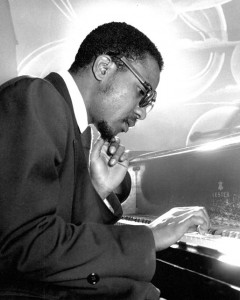
A TRIBUTE TO AND CELEBRATION OF THE LIFE AND MUSIC OF THE IMMORTAL PIANIST AND COMPOSER THELONIOUS 'SPHERE' MONK, 1917-1982


TODAY OCTOBER 10, 2014 IS THE 97th BIRTHDAY OF THE IMMORTAL PIANIST AND COMPOSER THELONIOUS MONK 1917-1982

SO LET'S CELEBRATE AND PAY HOMAGE TO THIS MUSICAL GIANT...


THELONIOUS MONK: THE JAZZ COMPOSER AS VISIONARY

by Kofi Natambu


[This essay is an excerpt from a new book-in-progress by Kofi Natambu entitled A BRAND NEW BAG: How African Americans Revolutionized U.S. Culture and Changed the World, 1955-1975]

“They were always telling me for years to play commercial, be commercial. I’m not commercial. I say play your own way. Don’t play what the public wants—you play what you want and let the public pick up on what you’re doing—even if it does take them fifteen, twenty years.”    
--Thelonious Monk

“Monk is a virtuoso of the specific techniques of Jazz, in challengingly original uses of accent, rhythm, meter, time and of musically expressive space, rest, and silence…He is a major jazz composer, the first since Duke Ellington…His repertory abounds with intriguing melodies, truly instrumental pieces…To play Monk properly, musicians justly testify, you have to know the melody and the harmony and understand how they fit together…It is a sign of the great Jazz composer that his sense of form extends beyond written structure and beyond individual improviser, to encompass a whole performance…So it is with Monk.”
 --Martin Williams


THELONIOUS MONK
(b. October 10, 1917--d. February 17, 1982)

By 1955 the legendary pianist-composer Thelonious Sphere Monk (b. October 10, 1917) had been playing music professionally for over twenty years. Like everything else about him--from his highly original name to his stubbornly independent, innovative, and utterly idiosyncratic approach to nearly every aspect of his extraordinary life and career--Monk was his “own man” from very early on. Moving with his family from North Carolina to New York at the age of five in 1922, the precocious Monk always went his own way and made his own decisions about how he wanted to live—even as a child. Thus, during his junior year in the spring of 1934 Monk left the acadmically rigorous and prestigious Stuyvesant High School in New York (which was and is a very competitive citywide magnet school which only admitted the best and most gifted students in the city) to pursue a professional career in music. He was just 17 at the time but had already impressed a number of his teachers and musical peers as a young man of great talent and potential. Coming from a very proud and independent black working-class family who loved music and insisted that their three children take music lessons (both of Monk’s parents worked and Thelonious, Sr.—Monk’s father--also played piano), Monk initially resisted his mother’s suggestions that he play violin and later the trumpet (neither of which Monk liked). However, young Thelonious was utterly fascinated by his sister’s Marion’s piano lesons which she took on the family’s upright piano and the ten year old much preferred listening to her, especially when her music teacher came to their house. By the age of 12 in 1930 Monk had already learned to play the piano very well on his own by ear and keen observation. Highly impressed, the music teacher, a Mr. Wolfe (who was then a student at New York’s famed Julliard School of Music), told Monk’s parents not to waste any more money on their daughter’s lessons since Marion had no real interest in playing music, but it was very apparent to the teacher that her younger brother Thelonious had “a prodigious talent.” This quickly led to the highly precocious youngster enrolling in music courses in school and taking professional lessons from a series of private teachers. Since Monk also excelled academically in math and physics it wasn’t long before Monk began formally composing music, using his command of harmony and melodic ideas to augment his already extraordinary rhythmic sense. By the time Monk turned 19 in 1936 he had already written a number of major compositions, most notably “Ruby My Dear,” that were destined to become Jazz classics.

In 1936 Monk began playing on the road as a touring professional with an evangelist(!) from the Sanctified church named Reverend Graham (who was known publically as “The Texas Warhorse”) who sang and preached in various churches while Monk’s trio played rollicking gospel and rhythm and blues tunes behind her. It’s important to note that as early as 1934 Monk and his trio had already worked at small gigs and dances in New York, usually earning small amounts in tips and cover charges. Monk remained with the evangelist’s troupe for over two years traveling all over the country in both cities and small rural towns alike. This day-to-day immersion in the challenging demands of black folk vernacular styles as both accompanist and ensemble leader gave the dedicated young musician very valuable experience and provided the early aesthetic foundation for his eventually unique and independent styles of composing and improvising music in the Jazz tradition.

In 1938 Monk, homesick from the lonely rough and tumble life of the road, returned to his beloved New York and soon based his own playing style on the stride piano traditions established by such living African American piano legends (and Monk’s personal idols) as James P. Johnson (who happened to live near Monk’s west side Manhattan neighborhood at the time) and Fats Waller. In addition Monk was being deeply influenced by the pianist/composer/bandleader Duke Ellington who also rooted his piano style in the stride tradition, a profound black vernacular music aesthetic of the early 1900s. It was the highly innovative modernity of Ellington’s fecund ideas in piano harmony, rhythmic structure, and orchestral arrangements that inspired Monk in a particularly special way and revealed the possibilities for him to continue and expand on his own experimental efforts.

In 1940 the now 22 year old Monk became house pianist at Minton’s Playhouse, a small Harlem nightclub and nightly gathering place for many aspiring young Jazz musicians and composers who came together on a regular basis at the club to jam and experiment with new musical ideas during afterhours at all night and early morning sessions. These sessions soon became legendary as the place where in the mid 1940s the revolutionary Jazz style ‘Bebop’ was born. Monk’s deep involvement with this movement during endless jam sessions in the early and mid 1940s made Monk’s name well known to other musicians who became very familiar with his challenging compositions and unusual solo playing. This was of course long before the general listening public became aware of his talents. From 1940-1945, an intensely creative period in which Monk wrote many new compositions including his signature classic “’Round Midnight” in 1941, Monk continued to work in relative obscurity at Minton’s and other small clubs in Harlem and in the famed midtown 52nd street clubs and bars where Monk and his angular dissonant harmonies, dynamic rhythms, and soaring, lyrical melodies quickly made him a leading and influential figure among the modernist Jazz cognoscenti. Working closely with such fellow pioneers of this exciting new music as the extraordinary drummer Kenny “Klook” Clarke, revolutionary guitarist Charlie Christian, iconic saxophonist Charlie ‘Bird’ Parker, and trumpet legend John “Dizzy” Gillespie, Monk soon became a major mentor to many young emerging musicians like the then newly arrived 19 year old Miles Davis in 1945. By this time scores of musicians were experimenting with new harmonic structures, melodic ideas, and rhythmic conceptions. The intense cross-fertilization of styles, ideas, and musical structures were deeply rooted in the modern experimentations with form and content that were sweeping all the arts of the period in literature, painting, dance, and cinema and “Bebop” (or as the musicians themselves simply called it “modern music”) was at the forefront of this cultural and aesthetic revolution.

It was abundantly clear, as Monk himself told a number of interviewers, that his style was “more original” than many of the standardized, generic, and conventional forms of the Bebop movement. Yet Monk was already one of the primary architects of the best and most creative aspects of this movement and was a major source of distilling, synthesizing, and extending the ideas and structures from the myriad of historical musical sources that this generation of modernist musicians consciously absorbed, honed, and developed: Jazz swing styles inherited from the 1920s and ‘30s (e.g. Louis Armstrong, Ellington, Art Tatum, Lester Young, Count Basie, Coleman Hawkins, etc.) both ‘popular’ and ‘avant-garde’ advances in 20th century classical music (e.g. Stravinsky, Varese, Hindemith, Ives, Bartok, Prokofiev, Ravel, Debussy, etc.), and new black vernacular uses/appropriations of the rich blues and rhythm and blues/rock ‘n roll traditions, as well as various forms of gospel/spiritual music.

All this and more went into Monk’s complex and powerful compositions that while quite intricate and even difficult in harmonic terms, somehow remained both very lyrical (if quirkily idiosyncratic) melodically, as well as creatively connected to black vernacular dance rhythms. This combination of stylistic elements became a trademark of Monk’s compositions and improvisations and led him to finally getting an offer in 1947 to record as a leader of his own ensembles. Now thirty years old and a mature young artist in many respects (though still unknown to people outside of the music), Monk recorded two albums worth of his original compositions (and a few standards) with the small recording label known as Blue Note. Boldly entitled The Genius of Modern Music, Volumes I & II these records put Monk on the mainstream music map for the first time and introduced the man often rather archly referred to in Jazz publications and the mainstream media as “The High Priest of Bebop,” to a new Jazz audience that were just beginning to respond to the innovations of the modernists in the music. Despite this new, limited recognition Monk was still barely making ends meet and was desperately struggling to stay above water economically. However, Monk categorically refused to give up his musical identity or compromise his artistic vision in any way despite many pressures to do so. His first recordings were often lauded (or greatly misunderstood) by the critics and journalists who continued to interview and write about him for a wide range of magazines and newspapers both in and outside the general Jazz world. The laconic, witty, and candid pianist was always considered great copy for the media. However Monk remained almost invisible to any mainstream audience of music lovers.

This situation of severe commercial isolation and economic marginalization during a very creative and productive period of composing and performing his music was juxtaposed to a concomitant rise in status and prestige by fellow musicians, composers, and critics that continued well into the 1950s. Monk continued to record on a regular basis for the important small recording labels Blue Note, Prestige, and Riverside. Thus he began the series of major, classic recordings that quickly established his reputation as one of the most significant Jazz composers and soloists in modern music. It was also during this time that Monk first began to be mentioned as the most important composer in the music since the great Duke Ellington revolutionized the Jazz orchestra in the 1920s. At the height of the Bebop craze from 1948-1954 and the justly rapid ascension of Charlie “Bird’ Parker and Dizzy Gillespie as living icons of the movement, Monk made an equally revolutionary breakthrough himself in an utterly independent personal style that drew from bebop conventions (as it did from swing, rhythm and blues, classical, and gospel traditions) but were at the same time completely fresh and different in form and content from his numerous influences. These recordings were made with many of the most important, original, and talented musicians in Modern Jazz--Parker, Gillespie, Miles Davis, Sonny Rollins, Milt Jackson, Art Blakey, Kenny Clarke, Percy Heath, Max Roach, and Kenny Dorham, among others--and in many ways served as the basic creative and aesthetic foundation of where Jazz was to evolve and grow after 1955.

Thus by the mid-fifties Thelonious Sphere Monk II was a man who already had a very clear and completely masterful command of the modernist and vernacular traditions that characterized the revolutions in both popular and avant-garde music during the post WWII era. This knowledge and understanding on both an innovative theoretical and performance level profoundly transformed the 1955-1975 era in Jazz and made Monk, along with Miles Davis, Sonny Rollins, Charles Mingus, Max Roach, John Coltrane, Cecil Taylor, and Ornette Coleman the leading musical figures in a particularly tumultuous and exciting period of American art and culture.

The visionary quality of Monk’s musical aesthetic lay in an intensely self conscious and self reflexive effort to simultaneously question, critique, and fundamentally rethink the traditionally specific roles and identities of harmonic structure, melodic form, and rhythmic content in modern music and reassert/reclaim SOUND itself as the most important individual and collective element in both improvisational and composed ensemble settings alike. For decades since the 1890s both African American and European/white American popular, vernacular, and (semi)classical musics had been dependent on inherited conventional modes of organizing musical patterns through the predominance of either harmony (songform structures), melody (songform lyrics), or rhythm (fixed metrical time). By the early 1900s various avant-garde practices in the United States and Europe had begun to overtly upset and challenge these conventions somewhat (by breaking up and/or distorting/rearranging the forms themselves) but still largely in terms of the central role of fundamentally Western conceptions and methodologies that favored a critical embrace (dissonance) or dismissive denial (atonality) of the diatonic scale as a ‘negative’ reference (e.g. Schoenburg, Ives, Webern, etc.). However, through the then revolutionary interventions of such major figures as Louis Armstrong and Ellington by the early 1920s, Jazz began creatively embracing and appropriating conventional music structures and ideas from a myriad of western sources while subtly transforming and subverting them with highly idiosyncratic (and African derived) methods of either using dissonant or unorthodox harmonies as well as crosscutting and constructivist architectural rhythms (a structural and expressive device known as ‘riffing’) in both compositional and improvisational contexts. It’s crucial to note that the major black Jazz composers, improvisors, and arrangers of the 1920s and ‘30s (Jelly Roll Morton, Ellington, Sidney Bechet, Art Tatum, Count Basie, Fletcher Henderson, Don Redman, Lester Young, Coleman Hawkins) were very adept at using these sources while also creating and improvising entirely new ways of expressing melodic lyricism and ‘pop’ song forms such as Louis Armstrong’s brilliant inventions of ‘scat’ singing and ‘swing’ instrumental styles.

Out of this historical maelstrom of multinational aesthetic and cultural traditions and conceptions, Monk consciously critiqued, individually reworked, and creatively extended and subverted the conventions of 20th century modernist and vernacular sources (including those of ‘Bebop’) to forge his own vision of what constituted ‘modern music.’ The first principle was a reliance and insistence on changing the sound of the piano (and by extension other instrumental voices in the ensemble) through an entirely new approach to note articulation, timbral dynamics, and use of temporal/spatial elements in his own improvisations and composing material for other musicians in his groups. As a result many early listeners to Monk’s music--musicians, critics, and general listeners alike-- thought that Monk was not a very technically accomplished pianist (again in the strictly Western European traditional/classical terms which were the canonical norm in the United States). This misunderstanding and profound ignorance of the actual sources of Monk’s methods and approach to instrumental expression and compositional structure was an impediment to many people in jazz circles until the critical and listening Jazz public (and many musicians as well) finally ‘caught up’ to many of Monk’s innovations by the late 1950s. By then Monk was already an established twenty-five year jazz veteran whose once radical contributions to voicing, phrasing, and tempo were finally the ‘new modern mainstream’ of the Jazz tradition.

The extraordinary recordings that Monk made from 1955-1965 only further solidified and cemented this reputation and suddenly made his work de rigueur for the young, emerging innovators and radicals of the period. In 1955 Monk finally began to receive the commercial attention (and monetary success) that had previously eluded him without compromising himself by ‘going commercial’ in any way as an artist. This reality completely validated Monk’s famous assertion that one must ‘play [your] own way’ and ensured that he would enter the rarefied pantheon of the greatest musicians and composers in the history of his art completely on his own terms. It was a profound lesson in artistic integrity, dedication to craft, and disciplined perseverance that would serve as a beacon for an entire new generation of gifted, ambitious players and composers in the 1960s, the ‘70s, and beyond who recognized that Monk’s greatest and most significant contributions lie not only in his fierce aesthetic commitment but in not allowing himself to be corrupted and distracted by the relentless demands and pressures of the marketplace. The result was one of the most singular, influential bodies of work in the entire canon of 20th century music.

THELONIOUS MONK
 

FROM THE PANOPTICON REVIEW ARCHIVES

(Originally posted on October 24, 2009):

Saturday, October 24, 2009

Thelonious Monk: An American Original


http://monkbook.com/about
Dr. Robin D.G. Kelley 
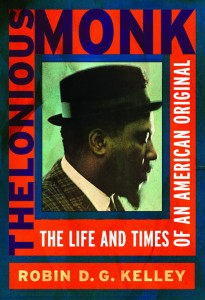
Thelonious Monk: The Life and Times of An American Original by Robin Kelley--Free Press, October 2009


All,

The book is finally out and it is simply INCREDIBLE. This is an absolutely stupendous achievement by one of the finest social historians and cultural critics in this country, the great Robin D.G. Kelley. Dr. Kelley has written the definitive biography of the legendary Thelonious Monk and it is a 600 page masterpiece. Over ten years of exhaustive historical research and writing went into this opus and it was more than worth the wait! So don't hesitate for another second. GET THIS BOOK TODAY AND TELL EVERYONE YOU KNOW AND THEIR FRIENDS TO GO COP IT NOW...

(Note: I will be doing an extensive review and analysis of Dr. Kelley's new biography on this site as soon as I finish reading the text)

Kofi

http://monkbook.com/about/

Who Is Thelonious Sphere Monk?

With the arrival Thelonious Sphere Monk, modern music—let alone modern culture—simply hasn’t been the same. Recognized as one of the most inventive pianists of any musical genre, Monk achieved a startlingly original sound that even his most devoted followers have been unable to successfully imitate. His musical vision was both ahead of its time and deeply rooted in tradition, spanning the entire history of the music from the “stride” masters of James P. Johnson and Willie “the Lion” Smith to the tonal freedom and kinetics of the “avant garde.” And he  shares with Edward “Duke” Ellington the distinction of being one of the century’s greatest American composers. At the same time, his commitment to originality in all aspects of life—in fashion, in his creative use of language and economy of words, in his biting humor, even in the way he danced away from the piano—has led fans and detractors alike to call him “eccentric,” “mad” or even “taciturn.” Consequently, Monk has become perhaps the most talked about and least understood artist in the history of jazz.

Born on October 10, 1917, in Rocky Mount, North Carolina, Thelonious was only four when his mother Barbara, big sister Marion, and baby brother Thomas, moved to New York City. Unlike other Southern migrants who headed straight to Harlem, the Monks settled on West 63rd Street in the “San Juan Hill” neighborhood of Manhattan, near the Hudson River. His father, Thelonious, Sr., joined the family three years later, but health considerations forced him to return to North Carolina. During his stay, however, he often played the harmonica, “Jew’s harp,” and an old player piano the family acquired soon after he arrived. Thelonious’s mother also played piano, mostly hymns and other sacred music, and she encouraged her children’s musical interests by taking them to hear Franko Goldman’s band perform in nearby Central Park and paying for music lessons. She arranged piano lessons for Marion and hoped Thelonious would take up violin. He chose trumpet instead, and studied the instrument briefly but was challenged by bronchial issues. He was about eleven when Marion’s piano teacher took Thelonious on as a student. By his early teens, he was playing rent parties, sitting in on piano at a local Baptist church, and was reputed to have won several  “amateur hour” competitions at the Apollo Theater.

Admitted to Peter Stuyvesant, one of the city’s best high schools, Monk dropped out at the end of his sophomore year to pursue music and during the summer of 1935 took a job as a pianist for a traveling evangelist and faith healer. Returning after two years, he formed his own quartet and played local bars and small clubs until the spring of 1941, when he became the house pianist at Minton’s Playhouse in Harlem.

Minton’s, legend has it, was where the “bebop revolution” began. The after-hours jam sessions at Minton’s, along with similar musical gatherings at Monroe’s Uptown House, Dan Wall’s Chili Shack, among others, attracted a new generation of musicians brimming with fresh ideas about harmony and rhythm—notably Charlie Parker, Dizzy Gillespie, Mary Lou Williams, Kenny Clarke, Oscar Pettiford, Max Roach, Tadd Dameron, and Monk’s close friend and fellow pianist, Bud Powell. Monk’s harmonic innovations proved fundamental to the development of modern jazz in this period. Anointed by some critics as the “High Priest of Bebop,” several of his compositions (“52nd Street Theme,” “‘Round Midnight,” “Epistrophy,” “I Mean You”) were favorites among his contemporaries.

Yet, as much as Monk helped usher in the bebop revolution, he also charted a new course for modern music few were willing to follow. Whereas most pianists of the bebop era played sparse chords in the left hand and emphasized fast, even eighth and sixteenth notes in the right hand, Monk combined an active right hand with an equally active left hand, fusing stride and angular rhythms that utilized the entire keyboard. And in an era when fast, dense, virtuosic solos were the order of the day, Monk was famous for his use of space and silence. In addition to his unique phrasing and economy of notes, Monk would “lay out” pretty regularly, enabling his sidemen to experiment free of the piano’s fixed pitches. As a composer, Monk was less interested in writing new melodic lines over popular chord progressions than in creating a whole new architecture for his music, one in which harmony and rhythm melded seamlessly with the melody. “Everything I play is different,” Monk once explained, “different melody, different harmony, different structure. Each piece is different from the other. … [W]hen the song tells a story, when it gets a certain sound, then it’s through…completed.”

Despite his contribution to the early development of modern jazz, Monk remained fairly marginal during the 1940s and early 1950s. Besides occasional gigs with bands led by Kenny Clarke, Lucky Millinder, Kermit Scott, and Skippy Williams, in 1944 tenor saxophonist Coleman Hawkins was the first to hire Monk for a lengthy engagement and the first to record with him. Most critics and many musicians were initially hostile to Monk’s sound. Blue Note, then a small record label, was the first to sign him to a contract. Thus, by the time he went into the studio to lead his first recording session in 1947, he was already thirty years old and a veteran of the jazz scene. Although all of Monk’s Blue Note sides are hailed today as some of his greatest recordings, at the time of their release in the late 1940s and early 1950s, they proved to be a commercial failure.

Harsh, ill-informed criticism limited Monk’s opportunities to work—opportunities he desperately needed especially after his marriage to Nellie Smith in 1948, and the birth of his son, Thelonious, Jr., in December of 1949. Monk found work where he could, but he never compromised his musical vision. His already precarious financial situation took a turn for the worse in August of 1951, when he was falsely arrested for narcotics possession, essentially taking the rap for his friend Bud Powell. It was his second arrest; the first, in 1948, was for possession of marijuana. Deprived of his cabaret card—a police-issued “license” without which jazz musicians could not perform in New York clubs—Monk was denied gigs in his home town for the next six years. Nevertheless, he played neighborhood clubs in Brooklyn, the Bronx, and Harlem, sporadic concerts, took out-of-town gigs, composed new music, and made several trio and ensemble records under the Prestige label (1952–1954), which included memorable performances with Sonny Rollins, Miles Davis, and Milt Jackson. In the fall of1953, he celebrated the birth of his daughter Barbara, and the following summer he crossed the Atlantic for the first time to play the Paris Jazz Festival. During his stay, he recorded his first solo album for Vogue. These recordings would begin to establish Monk as one of the century’s most imaginative solo pianists.

In 1955, Monk signed with a new label, Riverside, and recorded several outstanding LP’s which garnered critical attention, notably Thelonious Monk Plays Duke Ellington, The Unique Thelonious Monk, Brilliant Corners, Monk’s Music and his second solo album, Thelonious Himself. In 1957, with the help of his friend and sometime patron, the Baroness Pannonica de Koenigswarter, he had finally gotten his cabaret card restored and enjoyed a very long and successful engagement at the Five Spot Café with John Coltrane on tenor saxophone, Wilbur Ware and later Ahmed Abdul-Malik on bass, and Shadow Wilson on drums. From that point on, his career began to soar; his collaborations with Johnny Griffin, Sonny Rollins, Art Blakey, Clark Terry, Gerry Mulligan, and arranger Hall Overton, among others, were lauded by critics and studied by conservatory students. Monk even led a successful big band at Town Hall in 1959. It was as if jazz audiences had finally caught up to Monk’s music.

By 1961, Monk had established a more or less permanent quartet consisting of Charlie Rouse on tenor saxophone, John Ore (later Butch Warren and then Larry Gales) on bass, and Frankie Dunlop (later Ben Riley) on drums. He performed with his own big band at Lincoln Center (1963), and the quartet made a few European and world tours throughout the decade. In 1962, Monk had also signed with the gargantuan Columbia records, and in February of 1964 he became the third jazz musician in history to grace the cover of Time Magazine.

However, with fame came the media’s growing fascination with Monk’s alleged eccentricities. Stories of his behavior on and off the bandstand often overshadowed serious commentary about his music. The media helped invent the mythical Monk—the reclusive, naïve, idiot savant whose musical ideas were supposed to be entirely intuitive rather than the product of intensive study, knowledge and practice. Indeed, his reputation as a recluse (Time called him the “loneliest Monk”) reveals just how much Monk had been misunderstood. As his former sideman, tenor saxophonist Johnny Griffin, explained, Monk was somewhat of a homebody: “If Monk isn’t working he isn’t on the scene. Monk stays home. He goes away and rests.” Unlike the popular stereotypes of the jazz musician, Monk was devoted to his family. He appeared at family events, played birthday parties, and wrote playfully complex songs for his children: “Little Rootie Tootie” for his son, “Boo Boo’s Birthday” and “Green Chimneys” for his daughter, and a Christmas song titled “A Merrier Christmas.” The fact is, the Monk family held together despite long stretches without work, severe money shortages, sustained attacks by critics, grueling road trips, bouts with illness, and the loss of close friends.

During the 1960s, Monk scored notable successes with albums such as Criss Cross, Monk’s Dream, It’s Monk Time, Straight No Chaser, and Underground. But as Columbia/CBS records pursued a younger, rock-oriented audience, Monk and other jazz musicians ceased to be a priority for the label. Monk’s final recording with Columbia was a big band session with Oliver Nelson’s Orchestra in November of 1968, which turned out to be both an artistic and commercial failure. Columbia’s disinterest and Monk’s deteriorating health kept the pianist out of the studio. In January of 1970, Charlie Rouse left the band, and two years later Columbia quietly dropped Monk from its roster. For the next few years, Monk accepted fewer engagements and recorded even less. His quartet featured saxophonists Pat Patrick and Paul Jeffrey, and his son Thelonious, Jr., took over on drums in 1971. That same year and again in 1972, Monk toured widely with the “Giants of Jazz,” a kind of bop revival group consisting of Dizzy Gillespie, Kai Winding, Sonny Stitt, Al McKibbon and Art Blakey, and made his final public appearance in July of 1976. Physical illness, fatigue, and perhaps sheer creative exhaustion convinced Monk to give up playing altogether. On February 5, 1982, he suffered a stroke and never regained consciousness; twelve days later, on February 17th, he died.

Today Thelonious Monk is widely accepted as a genuine master of American music. His compositions constitute the core of jazz repertory and are performed by artists from many different genres. He is the subject of award winning documentaries, biographies and scholarly studies, prime time television tributes, and he even has an Institute created in his name. The Thelonious Monk Institute was created to promote jazz education and to train and encourage new generations of musicians. It is a fitting tribute to an artist who was always willing to share his musical knowledge with others but expected originality in return.

Book Events

Monday, October 5, 2009, 7:00 – 9:00 PM
Barnes and Noble
66th and Broadway
New York, NY
212-595-6859

Thursday, October 8, 2009, 7:30
Book party, Discussion, and Jam session
The Brecht Forum
451 West Street, New York, NY 10014 (between Bank & Bethune Streets)
Phone: (212) 242-4201 – Email: brechtforum at brechtforum.org

Saturday, October 10, 2009, 6:00 – 8:00 PM
Politics and Prose Bookstore and Coffee House
5015 Connecticut Ave., NW
Washington, DC
http://www.politics-prose.com/

Tuesday, October 13, 2009, 7:30 PM
Conversation with Robin D. G. Kelley on Thelonious Monk
With Guest, pianist Randy Weston
Center for Jazz Studies, Columbia University
Dwyer Cultural Center, 258 St. Nicholas Ave. and 123rd St.
New York

Thursday, October 15, 2009, 3:00 PM
Reading and book signing, “‘North of the Sunset’: Thelonious Monk’s L.A. Stories”
Charles E. Young Research Library, UCLA
Presentation Room
Los Angeles, CA
Free and open to the public

Tuesday, October 20, 2009, 7:00 PM
Book Soup
8818 W Sunset Blvd
Los Angeles, CA 90069-2125
(310) 659-3110
http://www.booksoup.com/

October 23, 2009, 7:00 PM
Vroman’s Bookstore
695 E Colorado Blvd
Pasadena, CA 91101
(626) 449-5320
http://www.vromansbookstore.com/

October 27, 1009, 7:00 PM
Eso Won Bookstore
4311 Degnan Blvd.
Los Angeles, CA 90008
(323) 290-1048
info@esowonbookstore.com
http://www.esowonbookstore.com/

October 29, 2009, 7:00 PM
City Lights Bookstore
261 Columbus Avenue at Broadway (North Beach)
San Francisco, California 94133
Tel (415) 362-8193
http://www.citylights.com/

Return to Main Menu.

Home
The Book
About The Author
Reviews
Sessionography
Who Is Thelonious Sphere Monk?
Photos
Videos
Book Events
Links
Contact

The Book

Thelonious Monk: The Life and Times of an American Original

“The piano ain’t got no wrong notes!” So ranted Thelonious Sphere Monk, who proved his point every time he sat down at the keyboard. His angular melodies and dissonant harmonies shook the jazz world to its foundations, ushering in the birth of “bebop” and establishing Monk as one of America’s greatest composers. Yet throughout much of his life, his musical contribution took a backseat to tales of his reputed behavior. Writers tended to obsess over Monk’s hats or his proclivity to dance on stage. To his fans, he was the ultimate hipster; to his detractors he was temperamental, eccentric, taciturn, or child-like. But, these labels tell us little about the man or his music.

In the first book on Thelonious Monk based on exclusive access to the Monk family papers and private recordings, as well as a decade of prodigious research, prize-winning historian Robin D. G. Kelley brings to light a startlingly different Thelonious Monk–witty, intelligent, generous, family-oriented, politically engaged, brutally honest, and a devoted father and husband. Indeed, Thelonious Monk is essentially a love story. It is a story of familial love, beginning with Monk’s enslaved descendants from whom Thelonious inherited an appreciation for community, freedom, and black traditions of sacred and secular song. It is about a doting mother who scrubbed floors to pay for piano lessons  and encouraged her son to follow his dream. It is the story of romance, from Monk’s initial heartbreaks to his life-long commitment to his muse, the extraordinary Nellie Monk. And it is about his unique friendship with the Baroness Nica de Koenigswarter, a scion of the famous Rothschild family whose relationship with Monk and other jazz musicians has long been the subject of speculation and rumor. Nellie, Nica, and various friends and family sustained Monk during the long periods of joblessness, bipolar episodes, incarceration, health crises, and other  tragic and difficult moments.

Above all, Thelonious Monk is the gripping saga of an artist’s struggle to “make it” without compromising his musical vision. It is a story that, like its subject, reflects the tidal ebbs and flows of American history in the twentieth century. Elegantly written and rich with humor and pathos, Thelonious Monk is the definitive work on modern jazz’s most original composer.

Advance Praise for Thelonious Monk: The Life and Times of an American Original

“Robin Kelley’s new biography Thelonious Monk: The Life And Times of an American Original is a breath of fresh air amongst the biographies of our legendary jazz musicians. This book is thorough, detailed and written with a true affinity for Monk’s humaneness and creative musical output. It fills in the missing pieces about the growth of the jazz scene in New York through the ’40s, ’50s and ’60s, detailing each step of TSM’s development – who passed through his bands, what gigs he played and what happened on those scenes. It’s an invaluable and close look at the center of the world’s most important creative musical developments in these decades: New York City.”

—Chick Corea

“Thelonious Monk: The Life And Times of an American Original is one of the most anticipated books in jazz scholarship, and well worth the wait. Robin D. G. Kelley represents one of this generation’s most important voices equipped with the knowledge, passion and respect for both jazz and jazz musicians required to interpret the many details and nuances of Thelonious Monk’s life. This compelling book will both challenge old assumptions and inspire new assessments of the life and legacy one of the world’s greatest musicians.”

—Geri Allen, pianist/composer, Associate Professor of Jazz and Contemporary Improvisation, University Of Michigan

“Powerful, enraging and enduring. . . . In Robin Kelley’s finely grained and surely definitive life-and-times study, Thelonious Monk: The Life And Times of an American Original, has found an original biographer.”

—David Levering Lewis, biographer of W.E.B. Du Bois and Pulitzer Prize winner

“An honest and eloquent treatment of one of our most important artists, Thelonious Monk: The Life And Times of an American Original is a stunning tour de force! It is the most comprehensive treatment of Monk’s life to date. Furthermore, in Monk’s story, Kelley has found the perfect medium to shed light on a nation’s, and a people’s, history and persistent quest for freedom. In so doing he has given us a book that is  as bold, brilliant and beautiful as Monk and his music.”

—Farah Jasmine Griffin, author of If You Can’t Be Free, Be a Mystery: In Search of Billie Holiday

About The Author

Robin D. G. Kelley never met Thelonious Monk, but he grew up with his music. Born in 1962, he spent his formative years in Harlem in a household and a city saturated with modern jazz. As a child he took a few trumpet lessons with the legendary Jimmy Owens, played French horn in junior high school, and picked up piano during his teen years in California. In 1987, Kelley earned his PhD in History from UCLA and focused his work on social movements, politics and culture—although music remained his passion.

During his tenure on the faculties of Emory University, the University of Michigan, New York University, and Columbia University, Kelley’s scholarly interests shifted increasingly toward music. He has written widely on jazz, hip hop, electronic music, musicians’ unions and technological displacement, and social and political movements more broadly.

Before becoming Professor of American Studies and Ethnicity at the University of Southern California, Robin D. G. Kelley served on the faculty at Columbia University’s Center for Jazz Studies, where he held the first Louis Armstrong Chair in Jazz Studies. Besides Thelonious Monk: The Life and Times of an American Original, Kelley has authored several prize-winning books, including Hammer and Hoe: Alabama Communists During the Great Depression (University of North Carolina Press, 1990); Race Rebels: Culture Politics and the Black Working Class (The Free Press, 1994); Yo’ Mama’s DisFunktional!: Fighting the Culture Wars in Urban America (Beacon Press, 1997), which was selected one of the top ten books of 1998 by the Village Voice; Three Strikes: Miners, Musicians, Salesgirls, and the Fighting Spirit of Labor’s Last Century, written collaboratively with Dana Frank and Howard Zinn (Beacon 2001); and Freedom Dreams: The Black Radical Imagination (Beacon Press, 2002). He also edited (with Earl Lewis), To Make Our World Anew: A History of African Americans (Oxford University Press, 2000), a Choice Outstanding Academic Title and a History Book Club Selection. Kelley also co-edited (with Sidney J. Lemelle) Imagining Home: Class, Culture, and Nationalism in the African Diaspora (Verso, 1994). He is currently completing Speaking in Tongues: Jazz and Modern Africa (Harvard University Press, forthcoming), and a general survey of African American history co-authored with Tera Hunter and Earl Lewis to be published by Norton.

Kelley’s essays have appeared in several anthologies and journals, including The Nation, Monthly Review, The Voice Literary Supplement, New York Times (Arts and Leisure), New York Times Magazine, Rolling Stone, Color Lines, Code Magazine, Utne Reader, Lenox Avenue, African Studies Review, Black Music Research Journal, Callaloo, New Politics, Black Renaissance/Renaissance Noir, One World, Social Text, Metropolis, American Visions, Boston Review, Fashion Theory, American Historical Review, Journal of American History, New Labor Forum, Souls, Metropolis, and frieze: contemporary art and culture, to name a few.

Video of Robin Kelley author of new biography Thelonious Monk: The Life And Times of An American Original talking about Monk and his book:


http://panopticonreview.blogspot.com/2010/01/httpwww.html

FROM THE PANOPTICON REVIEW ARCHIVES

(Originally posted on January 2, 2010):

Saturday, January 2, 2010

Women Who Had a Major Influence on Thelonious Monk's Life and Art: Barbara Monk, Nellie Smith Monk, Alberta Simmons, and Mary Lou Williams


MARY LOU WILLIAMS 

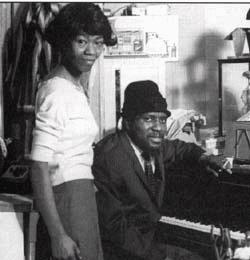
Nellie and Thelonious Monk

Nellie Monk (1921-2002)

 
http://www.npr.org/blogs/ablogsupreme/2009/12/the_women_who_made_thelonious_monk.html

All,

See what I said about "Genius and Recognition" in my previous post below about Monk, Baraka, and Robin Kelley? Well, that admonition goes DOUBLE here. So thank you, Thank you, THANK YOU Mrs. Barbara Monk, Mary Lou Williams, Alberta Simmons, and Nellie Smith Monk (the one Thelonious always "crepesculed" with) for being absolutely instrumental as well as essential in the formation and growth of one of the greatest and most important artists of the 20th century...

Kofi

The Women Who Made Thelonious Monk
by Walter Ray Watson
National Public Radio--NPR


My story about Thelonious Monk biographer Robin D.G. Kelley ran on All Things Considered yesterday. But wait! There's much more to say: Kelley's new book, Thelonious Monk: The Life and Times of An American Original, takes considerable pains to acknowledge the support of women in the life of the musician.


The photo ID of Barbara Monk, Thelonious Monk's mother, shows that she was employed by the City of New York to clean public offices. (courtesy of the Thelonious Monk Estate)

First, there's his mother, Barbara Monk, who moved to New York City with Thelonious Monk Sr., and their three children: Thomas, the eldest; his sister Marion, and Thelonious Jr., the youngest child. The family moved to New York City to escape the farm life they had known in North Carolina. Thelonious Sr. eventually returned to Carolina, and Monk's mother and sister raised the family. Barbara Monk cleaned city offices to support her kids. When the youngest Monk began skipping classes during his senior year at Stuyvesant High School -- and eventually left altogether -- it was Barbara Monk who encouraged him to take that leap of faith.

A few years earlier, she had also supported Thelonious Jr.'s decision to follow a Christian evangelist, a woman whose name was never known to the family (and whose precise religious affiliation was just as hard to pin down), on a barnstorming tour of Midwestern towns for nearly two years.

As Kelley recounts in his book, Monk's travels through Kansas and other states is the most mysterious and undocumented time in Monk's life. But they were also perhaps his most fruitful years as an itinerant artist, learning how to call tunes on the spot, and how to respond to both musicians and audiences in the moment.

There was also a piano teacher early in Monk's development named Alberta Simmons. Kelley learned about Simmons' life from her daughter, Alberta Webb; Simmons, born in 1892, died long ago. Alberta Simmons was a performer, and assimilated the stride styles of Fats Waller, James P. Johnson and Eubie Blake. She played the Clef Club, speakeasies in New York City, and even went out to Flushing, Queens for gigs. But as Webb told Kelley, "Being a woman, [Simmons] got sort of sidetracked trying to raise her children. Unfortunately things did not work out in later years."

Kelley's detective work found New York census records of Alberta Simmons at five year intervals. As time progressed, Simmons reported her career as piano teacher, and, in later years, "domestic worker." But before her earnings as a teacher dried up, Thelonious Monk learned stride piano from the woman. Monk was known to visit the home of James P. Johnson, and attend "cutting sessions" by other famed stride practitioners. But early on, Alberta Simmons showed him the way.

Kelley told me that Alberta Simmons never got the chance to make a recording, so there's no sample artifact of her playing style. Her daughter, Alberta Webb, told Kelley that she unfortunately had no photographs of her mother to share either -- and Webb died before the publication of Kelley's book. It's one of Kelley's regrets, he says. (Then again, you develop a mountain of regrets when you interview 300 people, read countless lost articles and spend 14 years on a mission that no one quite believes you would complete.) On the bright side, Kelley says that it's not much of a leap to think of Monk's 1956 solo recording of "Memories of You," the Andy Razaf/Eubie Blake song, as his tribute to Alberta Simmons. According to Kelley's research, she played this tune often, as if it were her own. Here's an excerpt (from The Unique Thelonious Monk, originally issued on Riverside Records):

Then, of course, there's his wife, Nellie Monk. She can't be underestimated for her role as partner, protector, career manager and supporter of Thelonious Monk. She gave her husband the space and time to develop his musical sense of space and time. She also cleaned private homes and worked as a seamstress in the lean years: The period when his music was dismissed or ignored by critics, thus making him a hard sell to the public, to club managers and to anyone considering him for studio recordings.

Last but not least, there's the great pianist and composer Mary Lou Williams, who defended, promoted and befriended Monk. Reportedly, she first heard him as a young man in Kansas City while he was touring with that mysterious traveling evangelist. She later helped him get gigs in New York, and introduced him to a great deal of music. Kelley writes that despite Monk's Baptist roots and travels with evangelical revivals, he attended Catholic churches with Williams. Among the home recordings Kelley was exposed to by the Monk Estate were these pieces that Williams arranged and wrote out for Monk to try. Hear Monk practice "All God's Chillun Got Rhythm."

Takes One and Two:

Take Three:

Robin Kelley also sent me an unpublished excerpt he wrote about the music.

After ending his home recording of "Body and Soul" abruptly, Mr. Monk then shuffles some papers on the piano and announces, with the enthusiasm of a kid in a toy store, "Now let me see how we make out with this now. Mmmmm!" He then proceeds to tentatively work through an arrangement of "All God's Chillun Got Rhythm" -- a Gus Kahn and Bronislau Kaper composition Mr. Monk never recorded nor included in his repertoire. The initial choruses sound a lot like Mary Lou Williams' 1946 trio recording (Classics Records 1050) of the song, which I confirmed when archivist Ann Kuebler helped me locate the arrangement (titled simply "Chillun") in Ms. Williams' papers at the Institute for Jazz Studies. It is likely that Mr. Monk had a copy of her arrangement from the 1940s since they exchanged quite a bit of music during the early days of bebop. In particular, Mr. Monk takes from the arrangement Ms. Williams' rephrasing of the melody, the ascending arpeggios in the third and fourth bar of the song's A section, and the key signature: A-flat ... By the second take, he begins to incorporate more of his own unique phrases and improvised lines, including a striding left hand and dissonant clusters in the piano's upper register. Perhaps as a tribute to Mary Lou Williams, his final six bar cadence incorporates the kind of "boogie woogie" left hand figures Ms. Williams often used. By the third take, "Chillun" is entirely his own. Opening rubato, almost ballad-like, Mr. Monk throws in an unusual bass line in bars 9-12 and shifts into stride piano, over which he plays several high register phrases over and over to see what they sound like. By the time he returns to the melody, Mrs. Nellie Monk adds her singing voice and Mr. Monk closes with a tag similar to what he plays at the end of Gershwin's "Nice Work if You Can Get It."

Also, Mary Lou recorded this [arrangement] on October 7, 1946 (three days before Monk's 29th birthday). Unique are her phrasing of the melody and, most importantly, the bass line, in bars 3 and 4 of the A section; those ascending arpeggios. Notice how he echoes her phrasing throughout, especially in early takes of the song.


Here's the first 'A' section of Mary Lou's version:


Now go back and listen to Monk's versions with this information: The context makes a huge difference.

As long as Monk's legacy still rings in our ears, the women who contributed to Monk's development as a child, student, artist and man are to be honored. (And then there's the Baroness Pannonica de Koenigswarter, but that's another story in itself.) Thanks to Robin Kelley for keeping their gifts to the music alive, if not unearthing them altogether.

7:45 PM ET | 12-30-2009 | permalink

Posted by Kofi Natambu at 2:13 AM

Labels: Alberta Simmons, Barbara Monk, Jazz history, Jazz piano, Mary Lou williams, Nellie Monk, NPR, Thelonious Monk, Walter Ray Watson


Jazz Icons: Thelonious Monk- Live In '66 + Other Monk videos in Japan, Germany, France, Denmar, Holland, England, and the United States

http://www.youtube.com/watch?v=LR-7Mo8IZsI&index=20&list=RDvz0w3Bx8M2Y


http://revive-music.com/2012/04/05/thelonious-monk-straight-no-chaser/

Documentary film: Thelonious Monk Straight, No Chaser, 1988
Directed by Charlotte Zwerin


Thelonious Monk was one of the true, undisputed innovators of jazz. His influence, both in playing and composition, altered all of us as musicians and even more fans of the art form. Straight, No Chaser primes itself as the definitive film documenting Monk’s life. With insight from family, friends, and collaborators such as John Coltrane, Teo Macero, Johnny Griffin, and more the picture the film paints is one of incredible talent and collaborative spirit. Early on Monk took notice from fellow jazz legends Fats Waller, Charlie Parker, Dizzy Gillespie, and more, which only furthered his vibe and energy. Check out the entire film below and comment with your thoughts!


Thelonious Monk Documentary -- 1/10:

http://www.youtube.com/watch?v=s2z67tTQIvI


Monk Documentary--2/10:

http://www.youtube.com/watch?v=5hN-hY_PYqM


Monk Documentary--3/10:

http://www.youtube.com/watch?v=JOVpjHX4j_8


Monk Documentary--4/10:

http://www.youtube.com/watch?v=a2X_bsgbOdM


Monk Documentary--5/10:

http://www.youtube.com/watch?v=52n-swe78G8


Monk Documentary--6/10:

http://www.youtube.com/watch?v=oskRTxtP4ts


Monk Documentary--7/10:

http://www.youtube.com/watch?v=q2c0nLhrsCg


Monk Documentary--8/10:

http://www.youtube.com/watch?v=oK6D8w_VM_M


Monk Documentary--9/10:

http://www.youtube.com/watch?v=-qYi375P0NM


Monk Documentary--10/10:

http://www.youtube.com/watch?v=vz0w3Bx8M2Y


Jazz Icons: Thelonious Monk- Live In '66 + Other Monk videos in Japan, Germany, France, Denmar, Holland, England, and the United States

http://www.youtube.com/watch?v=LR-7Mo8IZsI&index=20&list=RDvz0w3Bx8M2Y


http://www.thetribeonline.com/2011/04/a-monks-life-thelonious-monk/

A Monk’s Life: Thelonious Monk


A mystery man, to most of us, the Monk is widely considered one of the most innovative and creative musicians of the 20th century. Who was this man? Why the hat? Why the jacket? Why the beard? To give you a rough idea – Duke Ellington wrote, recorded, produced and released over 1,000 songs in his career. Monk composed around 70. But Monk is the next most frequently recorded jazz composer after Ellington. With 930 less songs, he has been as widely recorded as the biggest name of 20th century jazz. That’s the gist. But beyond the statistics, the man was one of flamboyance, energy, creativity, originality, and above all – style. His early work in shaping the bebop genre, his later work in changing conceptions of jazz performance and improvisation, and his crazy dance moves combined to create one of the most powerful people in jazz history. This is how it happened.

Monk was born in 1917 in North Carolina. His family relocated to Manhattan, where he began to play the piano around 1923. He was mostly a self-taught musician, although he sometimes snuck in on his sister’s lessons. His first performance experience was in gospel and church music, playing small and large church organs. But he eventually found interest (and work) in jazz, which was the thing in 1930s Manhattan. His practice and playing eventually landed him a job at a local nightclub, Minton’s Playhouse, as the resident pianist. Playing in the work hours was more of a chore for Monk – as the real music went on after hours. Monk participated in ‘cutting contests’ with other jazz solo artists. These were musical battles, basically improvisational competitions, ‘fought’ between contemporary pianists. They were meant to determine the mastery of a new musician on the scene, competing against regional masters.

These musical battles led to the formation of a new style of jazz – bebop. Developing from roots in stride piano, common at the time. The bebop that Monk was beginning to carve out was a common style with other leading artists, like Charlie Parker and Dizzy Gillespie. This new genre was a result of the need to create innovative forms of playing to ‘survive’ in the Manhattan jazz scene. Monk knew this from the start, and his musical innovations ensured that he could play the survival-of-the-fittest game with supreme confidence. His improvisational style flourished with bebop, but he quickly grew away from it. His writing style and improvisation included very dissonant chord choices and scale use, sharp and unusual rhythms, abrupt silences, and odd heavily syncopated geometric melodies. These features were revolutionary in the 1940s and even more so when fully developed in the 60s.

After establishing himself on the Manhattan scene in the early 40s, he gained a reputation and began playing and performing studio recordings with the Coleman Hawkins Quartet. As things were picking up, in 1951 he became entangled in a narcotics case, which resulted in his New York City Cabaret Card removed – the card which allowed him to play alcoholic establishments in the city. With this gone, he lost his residency, and his audience, and his performances. He spent time in the mid-50s writing, practicing, and playing out-of-town gigs from time to time. During this intermission, he began meeting and producing records with other well-known jazz musicians, including saxophonist Sonny Rollins and Miles Davis. Davis, one of the most well respected jazz performers in the world, ran into problems with Monk because he found Monk’s playing simply too difficult to play over. Rumour has it that Davis asked Monk to sit out and stop accompanying, which caused extreme tension between the two that almost led to violence.

Ready to put his past troubles (and Manhattan) behind him, Monk visited Europe in 1954 where he performed and recorded in Paris. Although trouble didn’t leave him, as he was again caught up in narcotics difficulties over marijuana possession. Luckily a close friend took responsibility and he got off clean. He was still finding trouble, while trying to avoid it. Luckily for him, things were about to turn up.

Riverside Records was ready to take Monk on. He recorded with the label from 1955-1961. Although Monk arrived highly regarded, producers found his music too ‘difficult’ for mass consumption. He was coerced to produce several albums of covers (of the basic jazz standards) to spread his music to public audiences. By 1956, he began to produce his original music in ‘Brilliant Corners’, which was very complex (requiring Sonny Rollins, on the title track, to have to paste together separate tracks because the saxophone part was so difficult).  But it was considered a success for Monk, and it propelled him to produce more originals and more albums. After receiving back his New York City Cabaret Card, he put himself back on the Manhattan circuit, where (revitalized with his original music), he established a place and an image for himself.

And his image was as unique as his playing style. He was well known for his eccentric hats, suits and sunglasses. He was one of the first who began the beret and sunglasses look that we are so familiar with in jazz cafés today. His hats ran the gamut from trendy berets to ridiculous fez hats. Monk’s manner matched his style – frequently he would leave the piano and just stand up to walk around or dance before sitting down again. These touches made him stand out in the jazz community as more than just another musician – he was a character. With musical talent to match. Monk continued to play in other jazz groups with John Coltrane and (yes, really) Miles Davis, before being signed to Columbia Records in 1962. He produced and released many live albums and studio recordings up until the mid 1970s, when he disappeared from the jazz scene. Many believe that he finally fell to mental illness that had haunted him his whole life – either manic depression or schizophrenia. He retired to a friend’s New Jersey home, where he lived until he died of a stroke in 1982.

What else can be said of such a jazz legend? Not much, I’m afraid. The only thing to do now is to listen to the music that made his life – the music that was Thelonious Monk. Below are links to recordings to some of his most famous songs. Get a taste for one of the 20th century’s best musicians. A Tribe article could hardly do him justice.


Blue Monk: http://www.youtube.com/watch?v=SmhP1RgbrrY&feature=related

‘Round Midnight: http://www.youtube.com/watch?v=OMmeNsmQaFw&feature=related

Straight No Chaser: http://www.youtube.com/watch?v=hIkmNNmAnAM&feature=related

Well You Needn’t: http://www.youtube.com/watch?v=FOvKLvWuZjg

Epistrophy: http://www.youtube.com/watch?v=dZ9El7k4mNo