Showing posts with label Globalization. Show all posts

Wednesday, January 4, 2017

How Donald Trump Will Make America White Again and the Fight To Stop Steve Bannon and Jeff Sessions Now

https://www.thenation.com/article/how-donald-trump-will-make-america-white-again/

Immigration Policy
Donald Trump
Feature


January 30, 2017 issue

How Donald Trump Will Make America White Again

His plan for fixing the legal immigration system is simple and disturbing: Bring back 1890.

by Julianne Hing
January 4, 2017
The Nation


PHOTO: US Citizenship Ceremony
A new America: By 2065, nearly one in five US residents will have been born abroad, thanks to the 1965 immigration-reform law. (Reuters / David Ryder)

Donald Trump’s plans for undocumented immigrants are what get all the headlines. There’s the wall, of course, and his promises to dismantle deportation-relief programs for undocumented young people, known as Dreamers. There are his proposals to detain and deport millions of noncitizens. But lurking behind the president-elect’s frightening promises to crack down on people who live in the United States without documentation is a much larger ambition: to slow the nation’s massive demographic change by curtailing our legal-immigration system as well.
“Within just a few years, immigration as a share of the national population is set to break all historical records,” Trump said during an immigration address in Phoenix this past August. The goal of his presidency, he continued, would be “to keep immigration levels measured by population share within historical norms.” He added that the country ought “to choose immigrants based on merit—merit, skill, and proficiency. Doesn’t that sound nice?”
The reference to “historical norms” was an unusually circumspect choice of words for the president-elect, but it’s a phrase that ought to worry many. What Trump’s hint meant was a return to an explicitly racist immigration system put in place in the 1920s.
David FitzGerald, a professor of sociology at the University of California at San Diego, described the thinking among early-20th-century US lawmakers, who were alarmed by the unprecedented waves of poorer, swarthier immigrants coming to the nation at the time. “There was a near-consensus among policy-makers of the day,” FitzGerald told me in a conversation this past summer, “that the more Northwestern European immigrants there were, the more they would improve the stock [of the US population]. And the more they were from Southern and Eastern Europe, [the more] they would degrade the stock and contribute to crime.”
So Congress created a system designed to curb immigration from Southern and Eastern Europe. Through a series of laws passed in the 1920s, lawmakers set annual quotas for immigrants from European nations. Using the 1890 Census as a benchmark, they capped the number of future immigrants from any given country at just 2 percent of the foreign-born population from that nation living in the United States in that year. Pegging the quotas to the 1890 Census was important, since it represented a time before the large flow of Southern and Eastern European immigrants to the United States commenced. Until the system was reformed in the 1960s, immigrants from the United Kingdom, Germany, and Ireland were entitled to fully 70 percent of the visas under this quota scheme, according to the Pew Research Center. What’s more, the Asian Exclusion Act of 1924 completely barred immigration from East and South Asia.
These policies had their intended effect: a precipitous drop in the nation’s foreign-born population, from a high of 14.8 percent in the 1890s to its lowest level on record—less than 5 percent—in 1970. These pre-1890/post-1920s levels are presumably the “historical norms” to which Trump was referring on the campaign trail. In short, he was pledging to halt the demographic trajectory that the country has been on since the 1970s. In 2013, 13 percent of the US population was foreign-born. Current projections suggest that by 2065, nearly one in five people in the United States will have been born outside the country.

Trump’s reference to “historical norms” is a phrase that ought to worry many.
But slowing this trend will require Trump to do more than simply deport people who are here without authorization: It will mean slashing the numbers of those who immigrate legally as well. As it stands, there are two main avenues by which people can apply to become US residents. The first is through family: reunifying with family members who are US citizens already living in the country. The second is through “merit”: by happening to have the education and skills deemed attractive by US employers. After the election, Trump again stressed which of the two groups he’d prefer the legal-immigration system to serve.
“We’re going to have people coming in,” he told Time (in the same issue that anointed him “Person of the Year“), “but we’re also going to have them coming in based to a certain extent on merit.” That would mean inverting the current legal-immigration system. The immediate relatives of US citizens made up 41 percent of the roughly 1 million green cards issued in 2014. Those who came based on employer preferences? Just 15 percent of the total.

* * *
Trump’s perspective on immigrationreform is troubling not solely because of its inherent elitism, or the way in which it reduces immigrants to widgets of labor, mere economic actors. It’s also one more plank in the far right’s direct attack on the civil-rights era.
Everything about Trump’s rhetoric and the cabinet he’s assembling suggests that the new administration plans to push an immigration-reform agenda in the Republican-led Congress that will mirror the far right’s approach to the Voting Rights Act. The 1965 Immigration and Nationality Act is the landmark law that replaced the discriminatory national-origin quotas of the 1920s with a more egalitarian, family-focused system. There is widespread agreement that this law desperately needs an update: Its own system of allocating an equal number of visas to all countries has created an insurmountable backlog for those that account for the vast majority of applications, among other problems. Years’ worth of bipartisan efforts at reforming the system have failed. But Trump’s leading advisers and allies have articulated a “reform” agenda that would roll back, rather than update, the law.
When President Lyndon Johnson signed the Immigration and Nationality Act into law at the foot of the Statue of Liberty in October 1965, he acknowledged its racial-justice mission. The act “does repair a very deep and painful flaw in the fabric of American justice,” Johnson said. “It corrects a cruel and enduring wrong in the conduct of the American nation.”
And it is that correction, far more than the much-discussed presence of undocumented immigrants, that set the country’s enormous demographic shift in motion. White people will likely cease to be the majority in the United States by 2042.
Slowing demographic change by curbing legal immigration is one thing; stopping it is another.
So it’s perhaps not surprising that Trump has zeroed in on the legal-immigration system. His threat is more than just rhetoric: There already exists a clear blueprint for rolling back the 1965 law. Much of it comes from Senator Jeff Sessions, Trump’s pick for US attorney general, who has a long history as a hard-line anti-immigration zealot. In the last two decades, according to The Washington Post, Sessions has opposed nearly every immigration-reform bill that has included some pathway to citizenship for undocumented immigrants. But he’s also fought to curb avenues for legal immigration. In a 2015 op-ed for the Post, Sessions called the current system “the primary source of low-wage immigration into the United States.” He opened the piece with a wistful recollection of the era of the national-origin quota system, presenting it as smart policy-making that protected American workers.
Trump has also repeatedly consulted with Kris Kobach, Kansas’s secretary of state and an architect of Arizona’s notorious 2010 anti-immigration law, SB 1070. Kobach has also served as counsel for the legal arm of the Federation for American Immigration Reform, or FAIR, a far-right anti-immigration group that can be expected to play a prominent role in Trump’s Washington.
The federation released a position paper just after the election setting out its immigration-policy wish list for the new administration. In it, the group called on lawmakers to dramatically cut the numbers of those allowed to enter the country legally, decrying a system that admits “immigrants who already have family members in the country. We do not make immigration decisions based on whether or not an immigrant can contribute to our economy.” Lawmakers ought to “implement a merit-based immigration system,” the paper urged.
Once a fringe group, the Federation for American Immigration Reform has now been brought into the mainstream of political discourse. The group has often been deemed too xenophobic and racist even for many conservatives. Its postelection position paper also included calls to end birthright citizenship, which was granted as part of the 14th Amendment; penalize sanctuary cities; expand the immigrant-detention system and aggressively prosecute the act of entering the country without papers as a felony; and further deputize local police to enforce immigration-law violations. Now its suggestions are likely moving straight to the president-elect’s ear via Kobach.
Slowing down demographic change by curbing legal immigration is one thing; stopping it is another. Already, more babies of color are being born in the United States than white babies. Between 2012 and 2016, 3.2 million US-born Latinos turned 18; these citizens make up the bulk of the Latino electorate’s growth. Fifty years after the immigration law that paved the way for the demographic remaking of the United States, it’s not likely that shutting down legal immigration will stop the changes now under way.
But that doesn’t mean Donald Trump won’t try. 


We, the undersigned, oppose and condemn in the strongest of terms President-Elect Donald Trump’s appointment of Stephen Bannon as chief strategist and senior counselor. Bannon’s anti-Semitic, Islamophobic, racist, sexist, homophobic, and xenophobic agenda deserves no place in the White House, let alone second-in-command to the most powerful office on the planet.


Steve Bannon

45149 total signers.

First Name* 
Last Name*
Email*

Zip/Postal Code*
I'd like to hear more from:
CPD Action
Jewish Voice for Peace 
Bannon was the executive chairman of one of the country’s most prominent far-right news sources, Breitbart News. Bannon has used his platform for constant and dangerous attacks against people of color, women, Muslims, LGBTQ people, immigrants, Jewish people, and people with disabilities.
As one of Trump’s first moves, the appointment affirms the President-Elect will follow through on the most dangerous promises that brought him to office, including a pledge to ban Muslims from entering the country and plans to forcefully deport immigrants by the millions.
Too few politicians have acknowledged the harm Bannon would inflict on this country. Rep. Paul Ryan (R-WI) and others have feigned ignorance when asked what they know about Stephen Bannon, a claim that stretches credulity. But whatever elected officials do or don’t know, we are certain of this: A man like Stephen Bannon cannot be allowed to drive US policy.
By fighting this appointment we are delivering a vital message to Trump: We will meet you in the streets and in the halls of Congress. We will meet you with our protests and campaigns. We will keep fighting for equality, dignity, and liberation. You have us to answer to.
Bannon’s appointment is not normal, and we will refuse to treat it as business as usual.
We demand Trump rescind this appointment before the damage is done; we demand congressional lawmakers take up their responsibility to protect all Americans from discrimination, bias and harm; and we call on all others of conscience to refuse to cooperate with the appointment of a white nationalist to one of the highest offices in the country.
Organizational signers

If you'd like to add your organization to this list, click here to sign up.

African American Ministers In Action
Alameda Labor Council, AFL-CIO
America's Voice
American Jewish World Service
American Muslims for Palestine
Arab American Institute
Asian Americans Advancing Justice
Border Action Network
California Immigrant Policy Center
Center for Jewish Nonviolence
Center for New Community
Citizens for Justice in the Middle East
ClimateTruth.org
Council on American-Islamic Relations
Courage Campaign
CREDO
Detention Watch Network
El Centro de Igualdad y Derechos
Fellowship of Reconciliation
Friends of Sabeel North America
Grassroots Leadership
Hand in Hand
Human Rights Campaign
Illinois Coalition for Immigrant and Refugee Rights
Immigrant Advancement Matters
Immigrant Defense Project
Immigration Center for Women and Children
Indiana Center for Middle East Peace
Israel/Palestine Mission of the Presbyterian Church (U.S.A.)
Jewish Community Action
Jewish Voice for Peace
Jews for Racial and Economic Justice
Kadima Reconstructionist Community
Kairos USA
League of United Latin American Citizens
Long Beach Immigrant Rights Coalition
Main Street Alliance
Make The Road NY
Massachusetts Immigrant and Refugee Advocacy Coalition
Media Mobilizing Project
Michigan United
MPower Change
National Asian Pacific American Women's Forum
National Black Justice Coalition
National Center for Lesbian Rights
National Committee for Responsive Philanthropy
National Domestic Workers Alliance
National Immigration Law Center
National Network for Arab American Communities
New York Immigration Coalition
Partnership for Working Families
PICO National Network
Power Shift Network
Presbyterian Peace Fellowship
Puentes: Advocacy, Counseling & Education
Reconstructionist Rabbinical Association
Reformed Church of Highland Park
Resource Generation
Showing Up for Racial Justice
Southeast Asia Resource Action Center
SumOfUs
Texas Organizing Project
Tuesday Night Project
Tzedek Chicago
UC Davis School of Law, Immigration Law Clinic
Unitarian Universalist Association
Unitarian Universalist Service Committee
Vigilant Love

© Jewish Voice for Peace 2016

Jewish Voice for Peace
1611 Telegraph Ave, Suite 1020
Oakland, CA 94612
(510) 465–1777
info@jewishvoiceforpeace.org


Dear MoveOn member,

I'm Benard Simelton, the Alabama State Conference president of the NAACP.

I was arrested last night while taking part in a nonviolent sit-in at Senator Jeff Sessions' Mobile office in Alabama to oppose his nomination for attorney general. He is wholly unqualified to be the nation's top law enforcement official, as demonstrated by his long and troubling record in opposition to civil and human rights.1

JEFF SESSIONS

Will you click here to sign and share my petition asking Congress to reject Sessions' nomination? It's urgent: congressional hearings to approve his appointment start next week.

Members of Congress must reject the nomination of Jeff Sessions as attorney general. As a known racist with a long record of opposing civil rights and equality, it is unimaginable that he could be entrusted to serve as the nation's top law enforcement official. 

Sign the petition


As the highest law enforcement official, the attorney general has the responsibility to protect the civil and human rights of Americans of all races, colors, and genders. Senator Sessions is not that person and presents an extreme danger to the equality, diversity, and inclusiveness that the U.S. has achieved over the last decade.

There are just days left to urge your members of Congress to block the appointment of Sessions. Click here to sign the petition.

There are many reasons for Congress to block the appointment of Jeff Sessions:
He has a long history of opposing civil rights enforcement and making racist statements.2
He has championed voter suppression.3
He opposes hate crime protections for LGBTQ victims.4
He has opposed multiple efforts to address pay equity for women.5
He is a staunch opponent of legal immigration.6
...and so much more. In the words of U.S. Representative Luis V. GutiƩrrez, "If you have nostalgia for the days when Blacks kept quiet, gays were in the closet, immigrants were invisible and women stayed in the kitchen, Senator Jefferson Beauregard Sessions is your man."7
Diversity, equality, and compassion make America stronger. We must stand together and resist any effort to divide us up and strip away the progress that we've made.

Click here to add your name to this petition, and then pass it along to your friends.

Thanks!
—Benard Simelton

Sources:

1. "Civil Rights Activists Arrested For Protest Over Jeff Sessions As Attorney General," NPR, January 4, 2017 http://act.moveon.org/go/7378?t=6&akid=175761.9442574.ee66sg
2. "Jeff Sessions’ Record on Civil Rights, Race Revisited After Trump’s Attorney General Tap," The Associated Press, November 19, 2016 http://act.moveon.org/go/7379?t=8&akid=175761.9442574.ee66sg
3. "Donald Trump’s atrocious attorney general pick: Jeff Sessions will roll back voting rights and civil rights," Salon, November 18, 2016 http://act.moveon.org/go/7380…
4. "Jeff Sessions Fought Against Hate Crime Protections for LGBT Victims," Mother Jones, November 22, 2016 http://act.moveon.org/go/7381…
5. "Senator Jeff Sessions’ Problematic Record on Women’s Rights," National Women's Law Center, December 20, 2016 https://act.moveon.org/go/7382…
6. "Sessions' Anti-Immigration Influence Will Go Far Beyond His Role as Attorney General," Mother Jones, November 18, 2016 http://act.moveon.org/go/7383…
7. "Trump picks Sen. Jeff Sessions for attorney general," Los Angeles Times, November 18, 2016 http://act.moveon.org/go/7384…
You're receiving this petition because we thought it might interest you. It was created on MoveOn.org, where anyone can start their own online petitions. You can start your own petition here.

Want to support our work? The MoveOn community will work every moment, day by day and year by year, to resist Trump's agenda, contain the damage, defeat hate with love, and begin the process of swinging the nation's pendulum back toward sanity, decency, and the kind of future that we must never give up on. And to do it we need your ongoing support, now more than ever. Will you stand with us?

Tuesday, May 8, 2012

Noam Chomsky On the National and Global Crisis of Capitalism And Its Critical Impact on Social and Economic Policy in the United States

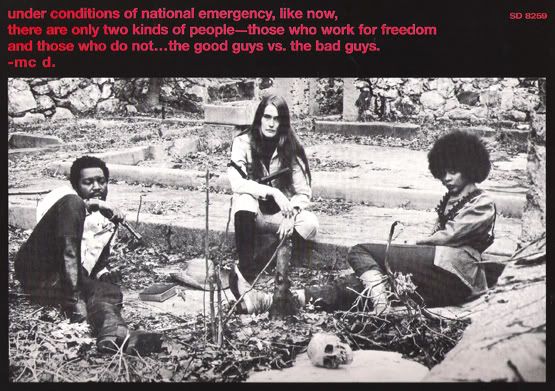
--Eugene McDaniels, 1935-2011
(popularly known as the Left Reverend McD)
From: Outlaw, 1970 (Atlantic SD 8259)

http://www.alternet.org/story/155281/noam_chomsky_on_america%27s_economic_suicide

"Take 9-11. That means something in the United States. The “world changed” after 9-11. Well, do a slight thought experiment. Suppose that on 9-11 the planes had bombed the White House… suppose they’d killed the president , established a military dictatorship, quickly killed thousands, tortured tens of thousands more, set up a major international terror center that was carrying out assassinations , overthrowing governments all over the place, installing other dictatorships, and drove the country into one of the worst depressions in its history and had to call on the state to bail them out Suppose that had happened? It did happen. On the first 9-11 in 1973. Except we were responsible for it, so it didn’t happen. That’s (Salvador) Allende’s Chile. You can’t imagine the media talking about this."
--Noam Chomsky

All,

The relentlessly brilliant, absolutely tireless, and always deadly accurate Noam Chomsky--unlike far too many public intellectuals and activists these daze--is virtually incapable of telling anything but the WHOLE truth whenever he speaks or picks up the pen (even some extraordinary 40 books later!). At 82 years young the man simply remains more than ever what he has always been-- a towering force, fearless leader-by-example, and a true inspiration no matter what. Holla!

Kofi


Noam Chomsky on America's Economic Suicide:
Interview on GRITtv
By Laura Flanders and Noam Chomsky
May 5, 2012
AlterNet


Noam Chomsky has not just been watching the Occupy movement. A veteran of the civil rights, anti-war, and anti-intervention movements of the 1960s through the 1980s, he’s given lectures at Occupy Boston and talked with occupiers across the US. His new book, Occupy, published in the Occupied Media Pamphlet Series by Zuccotti Park Press brings together several of those lectures, a speech on “occupying foreign policy” and a brief tribute to his friend and co-agitator Howard Zinn.

From his speeches, and in this conversation, it’s clear that the emeritus MIT professor and author is as impressed by the spontaneous, cooperative communities some Occupy encampments created, as he is by the movement’s political impact.

We’re a nation whose leaders are pursuing policies that amount to economic “suicide” Chomsky says. But there are glimmers of possibility – in worker co-operatives, and other spaces where people get a taste of a different way of living.

We talked in his office, for Free Speech TV on April 24.

LF: Let’s start with the big picture. How do you describe the situation we’re in, historically?

NC: There is either a crisis or a return to the norm of stagnation. One view is the norm is stagnation and occasionally you get out of it. The other is that the norm is growth and occasionally you can get into stagnation. You can debate that but it’s a period of close to global stagnation. In the major state capitalists economies, Europe and the US, it’s low growth and stagnation and a very sharp income differentiation a shift — a striking shift — from production to financialization.

The US and Europe are committing suicide in different ways. In Europe it’s austerity in the midst of recession and that’s guaranteed to be a disaster. There’s some resistance to that now. In the US, it’s essentially off-shoring production and financialization and getting rid of superfluous population through incarceration. It’s a subtext of what happened in Cartagena [Colombia] last week with the conflict over the drug war. Latin America wants to decriminalize at least marijuana (maybe more or course;) the US wants to maintain it. An interesting story. There seems to me no easy way out of this….

LF: And politically…?

NC: Again there are differences. In Europe there’s an dangerous growth of ultra xenophobia which is pretty threatening to any one who remembers the history of Europe… and an attack on the remnants of the welfare state. It’s hard to interpret the austerity-in-the-midst-of-recession policy as anything other than attack on the social contract. In fact, some leaders come right out and say it. Mario Draghi the president of the European Central Bank had an interview with the Wall St Journal in which he said the social contract’s dead; we finally got rid of it.

In the US, first of all, the electoral system has been almost totally shredded. For a long time it’s been pretty much run by private concentrated spending but now it’s over the top. Elections increasingly over the years have been [public relations] extravaganzas. It was understood by the ad industry in 2008 -- they gave Barack Obama their marketing award of the year. This year it’s barely a pretense.

The Republican Party has pretty much abandoned any pretense of being a traditional political party. It’s in lockstep obedience to the very rich, the super rich and the corporate sector. They can’t get votes that way so they have to mobilize a different constituency. It’s always been there, but it’s rarely been mobilized politically. They call it the religious right, but basically it’s the extreme religious population. The US is off the spectrum in religious commitment. It’s been increasing since 1980 but now it’s a major part of the voting base of the Republican Party so that means committing to anti-abortion positions, opposing women’s rights… The US is a country [in which] eighty percent of the population thinks the Bible was written by god. About half think every word is literally true. So it’s had to appeal to that – and to the nativist population, the people that are frightened, have always been… It’s a very frightened country and that’s increasing now with the recognition that the white population is going to be a minority pretty soon, “they’ve taken our country from us.” That’s the Republicans. There are no more moderate Republicans. They are now the centrist Democrats. Of course the Democrats are drifting to the Right right after them. The Democrats have pretty much given up on the white working class. That would require a commitment to economic issues and that’s not their concern.

LF: You describe Occupy as the first organized response to a thirty-year class war….

NC: It’s a class war, and a war on young people too… that’s why tuition is rising so rapidly. There’s no real economic reason for that. It’s a technique of control and indoctrination. And this is really the first organized, significant reaction to it, which is important.

LF: Are comparisons to Arab Spring useful?

NC: One point of similarity is they’re both responses to the toll taken by the neo lib programs. They have a different effect in a poor country like Egypt than a rich country like the US. But structurally somewhat similar. In Egypt the neoliberal programs have meant statistical growth, like right before the Arab Spring, Egypt was a kind of poster child for the World Bank and the IMF [International Monetary Fund:] the marvelous economic management and great reform. The only problem was for most of the population it was a kind of like a blow in the solar plexus: wages going down, benefits being eliminated, subsidized food gone and meanwhile, high concentration of wealth and a huge amount of corruption.

We have a structural analogue here – in fact the same is true in South America – some of the most dramatic events of the last decade (and we saw it again in Cartagena a couple of weeks ago) Latin America is turning towards independence for the first time in five hundred years. That’s not small. And the Arab Spring was beginning to follow it. There’s a counterrevolution in the Middle East/North Africa (MENAC) countries beating it back, but there were advances. In South America [there were] substantial ones and that’s happening in the Arab Spring and it has a contagious effect – it stimulated the Occupy movement and there are interactions.

LF. In the media, there was a lot of confusion in the coverage of Occupy. Is there a contradiction between anarchism and organization? Can you clarify?

NC: Anarchism means all sort of things to different people but the traditional anarchists’ movements assumed that there’d be a highly organized society, just one organized from below with direct participation and so on. Actually, one piece of the media confusion has a basis because there really are two different strands in the occupy movement, both important, but different.

One is policy oriented: what policy goals [do we want.] Regulate the banks, get money out of elections; raise the minimum wage, environmental issues. They’re all very important and the Occupy movement made a difference. It shifted not only the discourse but to some extent, action on these issues.

The other part is just creating communities — something extremely important in a country like this, which is very atomized. People don’t talk to each other. You’re alone with your television set or internet. But you can’t have a functioning democracy without what sociologists call “secondary organizations,” places where people can get together, plan, talk and develop ideas. You don’t do it alone. The Occupy movement did create spontaneously communities that taught people something: you can be in a supportive community of mutual aid and cooperation and develop your own health system and library and have open space for democratic discussion and participation. Communities like that are really important. And maybe that’s what’s causing the media confusion…because it’s both.

LF: Is that why the same media that routinely ignores violence against women, played up stories about alleged rape and violence at OWS camps?

NC: That’s standard practice. Every popular movement that they want to denigrate they pick up on those kind of things. Either that, or weird dress or something like that. I remember once in 1960s, there was a demonstration that went from Boston to

Washington and tv showed some young woman with a funny hat and strange something or other. There was an independent channel down in Washington – sure enough, showed the very same woman. That’s what they’re looking for. Let’s try to show that it’s silly and insignificant and violent if possible and you get a fringe of that everywhere.

To pay attention to the actual core of the movement — that would be pretty hard. Can you concentrate for example on either the policy issues or the creation of functioning democratic communities of mutual support and say, well, that’s what’s lacking in our country that’s why we don’t have a functioning democracy – a community of real participation. That’s really important. And that always gets smashed.

Take say, Martin Luther King. Listen to the speeches on MLK Day – and it’s all “I have a dream.” But he had another dream and he presented that in his last talk in Memphis just before he was assassinated. In which he said something about how he’s like Moses he can see the promised land but how we’re not going to get there. And the promised land was policies and developments which would deal with the poverty and repression, not racial, but the poor people’s movement. Right after that (the assassination) there was a march. [King] was going to lead it. Coretta Scott King led it. It started in Memphis went through the South to the different places where they’d fought the civil rights battle and ended up in Washington DC and they had a tent city, Resurrection Park and security forces were called in by the liberal congress. The most liberal congress in memory. They broke in in the middle of the night smashed up Resurrection Park and drove them out of the city. That’s the way you deal with popular movements that are threatening…

LF: Thinking of Memphis, where Dr. King was supporting striking sanitation workers, what are your thoughts on the future of the labor movement?

The labor movement had been pretty much killed in the 1920s, almost destroyed. It revived in the 1930s and made a huge difference. By the late 1930s the business world was already trying to find ways to beat it back. They had to hold off during the war but right after, it began immediately. Taft Hartley was 1947, then you get a huge corporate propaganda campaign a large part if it directed at labor unions: why they’re bad and destroy harmony and amity in the US. Over the years that’s had an effect. The Labor movement recognized what was going on far too late. Then it picked up under Reagan.

Reagan pretty much informed employers that they were not going to employ legal constraints on breaking up unions (they weren’t not strong but there were some) and firing of workers for organizing efforts I think tripled during the Reagan years.

Clinton came along; he had a different technique for breaking unions, it was called NAFTA [the North American Free Trade Agreement.] Under NAFTA there was again a sharp increase in illegal blocking of organizing efforts. You put up a sign – We’re going to transfer operations to Mexico… It’s illegal but if you have a criminal state, it doesn’t make a difference.

The end result, is, private sector unionization is down to practically seven percent. Meanwhile the public sector unions have kind of sustained themselves [even] under attack, but in the last few years, there’s been a sharp [increase in the] attack on public sector unions, which Barack Obama has participated in, in fact. When you freeze salaries of federal workers, that’s equivalent to taxing public sector people…

LF: And attacks on collective bargaining?

NC: Attacks on collective bargaining in Wisconsin [are part of] a whole range of attacks because that’s an attack on a part of the labor movement that was protected by the legal system as a residue of the New Deal and Great Society and so on.

LF: So do unions have a future?

NC: Well, it’s not worse than the 1920s. There was a very lively active militant labor movement in the late part of the 19th century, right through the early part of 20th century. [It was] smashed up by Wilson and the red scares. By the 1920s right-wing visitors from England were coming and just appalled by the way workers were treated. It was pretty much gone. But by 1930s it was not only revived, it was the core element of bringing about the New Deal. The organization of the CIO and the sit-down strikes which were actually terrifying to management because it was one step before saying “O.K. Goodbye, we’re going to run the factory.” And that was a big factor in significant New Deal measures that were not trivial but made a big difference.

Then, after the war, starts the attack, but it’s a constant battle right though American history. It’s the history of this country and the history of every other country too, but the US happens to have an unusually violent labor history. Hundreds of workers getting killed here for organizing at a time that was just unheard of in Europe or Australia…

LF: What is the Number One target of power today in your view? Is it corporations, Congress, media, courts?

NC: The Media are corporations so… It’s the concentrations of private power which have an enormous, not total control, but enormous influence over Congress and the White House and that’s increasing sharply with sharp concentration of private power and escalating cost of elections and so on…

LF: As we speak, there are shareholder actions taking place in Detroit and San Francisco. Are those worthwhile, good targets?

NC: They’re ok, but remember, stock ownership in the US is very highly concentrated. [Shareholder actions are] something, but it’s like the old Communist Party in the USSR, it would be nice to see more protest inside the Communist Party but it’s not democracy. It’s not going to happen. [Shareholder actions] are a good step, but they’re mostly symbolic. Why not stakeholder action? There’s no economic principal that says that management should be responsive to shareholders, in fact you can read in texts of business economics that they could just as well have a system in which the management is responsible to stakeholders.

LF: But you hear it all the time that under law, the CEO’s required to increase dividends to shareholders.

NC: It’s kind of a secondary commitment of the CEO. The first commitment is raise your salary. One of the ways to raise your salary sometimes is to have short-term profits but there are many other ways. In the last thirty years there have been very substantial legal changes to corporate governance so by now CEOs pretty much pick the boards that give them salaries and bonuses. That’s one of the reasons why the CEO-to-payment [ratio] has so sharply escalated in this country in contrast to Europe. (They’re similar societies and it’s bad enough there, but here we’re in the stratosphere. ] There’s no particular reason for it. Stakeholders — meaning workers and community – the CEO could just as well be responsible to them. This presupposes there ought to be management but why does there have to be management? Why not have the stakeholders run the industry?

LF: Worker co-ops are a growing movement. One question that I hear is — will change come from changing ownership if you don’t change the profit paradigm?

NC: It’s a little like asking if shareholder voting is a good idea, or the Buffet rule is a good idea. Yes, it’s a good step, a small step. Worker ownership within a state capitalist, semi-market system is better than private ownership but it has inherent problems. Markets have well-known inherent inefficiencies. They’re very destructive. The obvious one, in a market system, in a really functioning one, whoever’s making the decisions doesn’t pay attention to what are called externalities,effects on others. I sell you a car, if our eyes are open we’ll make a good deal for ourselves but we’re not asking how it’s going to affect her [over there.] It will, there’ll be more congestion, gas prices will go up, there will be environmental effects and that multiplies over the whole population. Well, that’s very serious.

Take a look at the financial crisis. Ever since the New Deal regulation was essentially dismantled, there have been regular financial crises and one of the fundamental reasons, it’s understood, is that the CEO of Goldman Sachs or CitiGroup does not pay attention to what’s calledsystemic risk. Maybe you make a risky transaction and you cover your own potential losses, but you don’t take into account the fact that if it crashes it may crash the entire system. Which is what a financial crash is.

The much more serious example of this is environmental impacts. In the case of financial institutions when they crash, the taxpayer comes to the rescue, but if you destroy the environment no one is going to come to the rescue…

LF: So it sounds as if you might support something like the Cleveland model where the ownership of the company is actually held by members of the community as well as the workers…

NC: That’s a step forward but you also have to get beyond that to dismantle the system of production for profit rather than production for use. That means dismantling at least large parts of market systems. Take the most advanced case: Mondragon. It’s worker owned, it’s not worker managed, although the management does come from the workforce often, but it’s in a market system and they still exploit workers in South America, and they do things that are harmful to the society as a whole and they have no choice. If you’re in a system where you must make profit in order to survive. You are compelled to ignore negative externalities, effects on others.

Markets also have a very bad psychological effect. They drive people to a conception of themselves and society in which you’re only after your own good, not the good of others and that’s extremely harmful.

LF: Have you ever had a taste of a non market system — had a flash of optimism –– oh this is how we could live?

NC: A functioning family for example, and there are bigger groups, cooperatives are a case in point. It certainly can be done. The biggest I know is Mondragon but there are many in between and a lot more could be done. Right here in Boston in one of the suburbs about two years ago, there was a small but profitable enterprise building high tech equipment. The multi-national who owned the company didn’t want to keep it on the books so they decided to close it down. The workforce and the union, UE (United Electrical workers), offered to buy it, and the community was supportive. It could have worked if there had been popular support. If there had been an Occupy movement then, I think that could have been a great thing for them to concentrate on. If it had worked you would have had another profitable, worker-owned and worker managed profitable enterprise. There‘s a fair amount of that already around the country. Gar Alperovitz has written about them, Seymour Melman has worked on them. Jonathan Feldman was working on these things.

There are real examples and I don’t see why they shouldn’t survive. Of course they’re going to be beaten back. The power system is not going to want them any more than they want popular democracy any more than the states of middle east and the west are going to tolerate the Arab spring… .They’re going to try to beat it back.

LF: They tried to beat back the sit-in strikes back in the 1930s. What we forget is entire communities turned out to support those strikes. In Flint, cordons of women stood between the strikers and the police.

NC: Go back a century to Homestead, the worker run town, and they had to send in the National Guard to destroy them.

LF: Trayvon Martin. Can you talk for a few minutes about the role of racism and racial violence in what we’ve been talking about? Some people think of fighting racism as separate from working on economic issues.

NC: Well you know, there clearly is a serious race problem in the country. Just take a look at what’s happening to African American communities. For example wealth, wealth in African American communities is almost zero. The history is striking. You take a look at the history of African Americans in the US. There’s been about thirty years of relative freedom. There was a decade after the Civil War and before north/south compact essentially recriminalized black life. During the Second World War there was a need for free labor so there was a freeing up of the labor force. Blacks benefitted from it. It lasted for about twenty years, the big growth period in the ‘50s and ‘60s, so a black man could get a job in an auto plant and buy a house and send his kids to college and kind of enter into the world but by the 70s it was over.

With the radical shift in the economy, basically the workforce, which is partly white but also largely black, they basically became superfluous. Look what happened, we recriminalized black life. Incarceration rates since the 1908s have gone through the roof, overwhelmingly black males, women and Hispanics to some extent. Essentially re-doing what happened under Reconstruction. That’s the history of African Americans – so how can any one say there’s no problem. Sure, racism is serious, but it’s worse than that…

LF: Talk about media. We often discern bias in the telling of a particular story, but I want you to talk more broadly about the way our money media portray power, democracy, the role of the individual in society and the way that change happens. …

NC: Well they don’t want change to happen….They’re right in the center of the system of power and domination. First of all the media are corporations, parts of bigger corporations, they’re very closely linked to other systems of power both in personnel and interests and social background and everything else. Naturally they tend to be reactionary.

LF: But they sort of give us a clock. If change hasn’t happened in ten minutes, it’s not going to happen.

NC: Well that’s a technique of indoctrination. That’s something I learned from my own experience. There was once an interview with Jeff Greenfield in which he was asked why I was never asked ontoNightline. He gave a good answer. He said the main reason was that I lacked concision. I had never heard that word before. You have to have concision. You have to say something brief between two commercials.

What can you say that’s brief between two commercials? I can say Iran is a terrible state. I don’t need any evidence. I can say Ghaddaffi carries out terror. Suppose I try to say the US carries out terror, in fact it’s one of the leading terrorist states in the world. You can’t say that between commercials. People rightly want to know what do you mean. They’ve never heard that before. Then you have to explain. You have to give background. That’s exactly what’s cut out. Concision is a technique of propaganda. It ensures you cannot do anything except repeat clichĆ©s, the standard doctrine, or sound like a lunatic.

LF: What about media’s conception of power? Who has it, who doesn’t have it and what’s our role if we’re not say, president or CEO.

NC: Well, not just the media but pretty much true of academic world, the picture is we the leading democracy in the world, the beacon of freedom and rights and democracy. The fact that democratic participation here is extremely marginal, doesn’t enter [the media story.] The media will condemn the elections in Iran, rightly, because the candidates have to be vetted by the clerics. But they won’t point out that in the United States [candidates] have to be vetted by high concentrations of private capital. You can’t run in an election unless you can collect millions of dollars.

One interesting case is right now. This happens to be the 50thanniversary of the US invasion of South Vietnam – the worst atrocity in the post war period. Killed millions of people, destroyed four countries, total horror story. Not a word. It didn’t happen because “we” did it. So it didn’t happen.

Take 9-11. That means something in the United States. The “world changed” after 9-11. Well, do a slight thought experiment. Suppose that on 9-11 the planes had bombed the White House… suppose they’d killed the president , established a military dictatorship, quickly killed thousands, tortured tens of thousands more, set up a major international terror center that was carrying out assassinations , overthrowing governments all over the place, installing other dictatorships, and drove the country into one of the worst depressions in its history and had to call on the state to bail them out Suppose that had happened? It did happen. On the first 9-11 in 1973. Except we were responsible for it, so it didn’t happen. That’s Allende’s Chile. You can’t imagine the media talking about this.

And you can generalize it broadly. The same is pretty much true of scholarship – except for on the fringes – it’s certainly true of the mainstream of the academic world. In some respects critique of the media is a bit misleading [because they’re not alone among institutions of influence] and of course, they closely interact.


Former Air America Radio host, Laura Flanders is the host and founder of GRITtv with Laura Flanders, a daily talk show for people who want to do more than talk. She is the author of the New York Times bestseller BUSHWOMEN: Tales of a Cynical Species (Verso, 2004) and Blue GRIT: True Democrats Take Back Politics from the Politicians (Penguin Press, 2007). A regular contributor on MSNBC, Flanders has appeared on shows from Real Time with Bill Maher to The O’Reilly Factor. Flanders is the editor of At the Tea Party: The Wing Nuts, Whack Jobs and Whitey-whiteness of the New Republican Right… and Why we Should Take it Seriously (October 2010, OR books). For more information, go to LauraFlanders.com or GRITtv.org.


© 2012 GRITtv All rights reserved.
View this story online at: http://www.alternet.org/story/155281/