Showing posts with label Mass media. Show all posts

Thursday, November 30, 2023

What the Reactionary Tag Team of Richard Nixon and Henry Kissinger Did in the Corrupt and Delusional Name of 'American Exceptionalism' aka U.S. Foreign Policy

PHOTO: Richard Nixon and Secretary of State/National Security Advisor Henry Kissinger. Nixon congratulates Henry Kissinger after he's sworn in as secretary of state in 1973 at the White House, making the German-born Jewish refugee who fled Nazi Germany in 1938 the first foreign-born American citizen to hold the diplomatic U.S. role. Photo: Via Getty Images
 
“...Most important of all the reactionaries was Nixon, without whom Kissinger would have lacked power, and from whom Kissinger would withstand any indignity.

Nixon was one of the original Cold War demagogues, the men who never hesitated to identify communism with Black people and the “Eastern Establishment” liberals who postured as allies. His escalation in Vietnam, along with the secret bombing in Cambodia he revealed in a televised address, prompted a resurgence of the antiwar movement. Nixon exploited the mass protests by contrasting them with the “silent majority” of loyal Americans. Instead of ending the war, as he had campaigned on doing, and silencing or co-opting the antiwar movement in the process, Nixon inflamed a culture war to distract from it. It was an echo of his infamous “Southern Strategy” to harness for the Republican Party the electoral benefits of white backlash to the civil rights movement.

Nixon was not subtle about who he meant by the Eastern Establishment. When the media seized upon the U.S. massacre at My Lai, Nixon remarked, “It’s those dirty rotten Jews from New York who are behind it.” Nixon’s White House counsel, John Erlichman, recalled Nixon talking about “Jewish traitors” in front of Kissinger, including “Jews at Harvard.” Kissinger would assure the boss he was one of the good ones. “Well, Mr. President,” Erlichman quoted him responding, “there are Jews and Jews.”

Kissinger maintained his standing in part by savaging the Eastern Establishment from which he emerged. It was not entirely cynical. Kissinger shared with Nixon a contempt for the “defeatism” and “pessimism” of those who flinched at the unsavory Vietnam War they once supported. He rationalized his purges of the National Security Council bureaucracy and his marginalization of the State Department — measures that made him indispensable to foreign policy, and to Nixon — as protecting American power from those who lacked the confidence to wield it. It is revealing that among those who make U.S. foreign policy, Kissinger’s perspective is not considered ideological.

Kissinger’s consolidation of bureaucratic control was punitive and paranoid. He used the fear of internal leaks to get the FBI to wiretap his staff and the journalists he suspected of receiving their information. Yet the Eastern Establishmentarians around Kissinger, on his staff or in the press, followed him like a puppy seeking an ear scratch. His coldblooded American exceptionalism was the perfect tone for speaking to a shaken ruling class. Anthony Lake, who would go on to become national security adviser to Bill Clinton, finally quit in May 1970, alongside his colleague Roger Morris. Their breaking points were the Vietnam escalation, Nixon’s alcoholism, and the surreptitious White House wiretaps that Nixon also pursued to enforce loyalty. But Lake and Morris opted not to go public. “I consider the failure to do so to be the biggest failure of my life,” Morris told Hersh for The Price of Power. “We didn’t do so on the single calculation that it would destroy Henry.” Weeks later, Kissinger, via Haig, had the FBI wiretap Lake.

IN SOUTHEAST ASIA, KISSINGER DESTROYED. But in Chile, he helped build a template for the world in which we currently live.

On September 4, 1970, Chileans elected the democratic socialist Salvador Allende president. Allende’s program was more than redistributionist. It demanded reparation from the U.S. for exploiting it. Chile is rich in copper, and by the mid-1960s, 80 percent of its copper production was controlled by American corporations, particularly the firms Anaconda Copper and Kennecott. When Allende nationalized mining assets held by the two companies, Allende informed them he would deduct estimated “excess profit” from a compensatory package he was willing to pay the firms. It was this sort of unacceptable policy that prompted Kissinger to remark, during an intelligence meeting about two months before Allende’s election, “I don’t see why we need to stand idly by and watch a country go communist due to the irresponsibility of its own people.”

Kissinger meant that there must never be an example of a country in America’s sphere of influence delivering socialism through the ballot. “Henry saw Allende as being a far more serious threat than Castro,” Kissinger staffer Morris told Hersh. “Allende was a living example of democratic social reform in Latin America.”

Kissinger and the CIA had decided to overthrow Allende just days after Allende’s election. Upon learning what was in motion, the U.S. ambassador in Santiago, Edward Korry, who was second to none in opposing Allende, cabled Kissinger that “to actively encourage a coup could lead us to a Bay of Pigs failure.” An “apoplectic Kissinger” told Korry to stay out of the way, according to Tim Weiner’s Legacy of Ashes: The History of The CIA. When the CIA failed at what Korry termed a Rube Goldberg gambit to get the Chilean Congress to stop Allende from taking office — that’s right, the CIA tried a January 6 in Chile — Haig urged his boss to purge “the key left-wing dominated slots” in the agency.

Korry was wrong in the end. Kissinger’s policy of overthrowing Allende — “Why not support extremists?” he spitballed in a December 1970 White House meeting with the CIA’s covert-operations chief, Tom Karamessines — paid off on September 11, 1973, when a military junta took power, prompting Allende’s suicide. He would be among the first of 3,200 Chileans to die violently under the 17-year regime of Augusto Pinochet and his Caravana de la Muerte, to say nothing of the tens of thousands tortured and imprisoned. “In the Eisenhower period, we would be heroes,” Kissinger told Nixon in a telephone conversation days after the coup. The same week he denied at his Senate confirmation hearings that the U.S. played any role in it.

The coup was only the beginning. Within two years, Pinochet’s regime invited Milton Friedman, Arnold Harberger, and other economists from the University of Chicago to advise them. Chile pioneered the implementation of their agenda: severe government budgetary austerity; relentless assaults on organized labor; privatization of state assets, including health care and public pensions; layoffs of government employees; abolition of wages and price controls; and deregulation of capital markets. “Multinationals were not only granted the right to repatriate 100 percent of their profits but given guaranteed exchange rates to help them do so,” Grandin writes in his book Empire’s Workshop. European and American bankers flocked to Chile before its 1982 economic collapse. The World Bank and Inter-American Development Bank loaned Pinochet $3.1 billion between 1976 and 1986. As Corey Robin has documented, Friedrich von Hayek’s neoliberal Mont Pelerin Society held a 1981 meeting in the very city where the junta plotted the replacement of democratic socialism with a harbinger of today’s global economic order.

Pinochet’s torture chambers were the maternity ward of neoliberalism, a baby delivered bloody and screaming by Henry Kissinger. This was the “just and liberal world order” Hillary Clinton considered Kissinger’s life work.

He was no less foundational in pushing the frontiers of where American military power could operate. It turned out the secret bombing of Cambodia and Laos, which lasted years, represented a template. When Nixon in 1970 revealed the secret bombings, it was a step too far even for Thomas Schelling, one of the Pentagon’s favorite defense academics, who called them “sickening.” As Grandin writes in Kissinger’s Shadow, the Cambridge-to-Washington set was not prepared in 1970 to accept that the U.S. had the right to destroy an enemy “safe haven” in a country it was not at war with and to do it all in secret, thereby shielding a war from basic public scrutiny. After 9/11, those assertions became accepted, foundational pillars of a War on Terror permitting four presidents to bomb, for 20 years, Pakistanis, Yemenis, Somalis, Libyans, Syrians, and others.

Kissinger met with Pinochet in Santiago in June 1976. It was a time of rising U.S. congressional anger at Pinochet’s reign of terror. Kissinger informed the general that he was obliged to make an anodyne criticism of Pinochet to forestall adverse legislation. “My evaluation is that you are a victim of all left-wing groups around the world,” Kissinger said, according to a declassified cable, “and that your greatest sin was that you overthrew a government which was going Communist.” Three months later, U.S. diplomats warned Kissinger about Operation Condor, an international campaign of right-wing assassinations pursued by the anticommunist regimes of Chile, Argentina, and Uruguay. Kissinger “has instructed that no further action be taken on this matter,” according to a September 16, 1976 cable. Five days later, a car bomb emplaced by Pinochet’s agents detonated along Washington D.C.’s Embassy Row, killing Orlando Letelier, Allende’s foreign minister, and his American co-worker, Ronni Moffitt.

In 1999, Pinochet was arrested in London through an effort by Baltazar Garzon, a Spanish judge investigating Operation Condor. Kissinger urged the British not to extradite the general. “​​I would be very happy if Pinochet was allowed home,” he told an interviewer. “This episode has gone on long enough and all my sympathies are with him.” Two years later, the administration of George W. Bush responded contemptuously to the Chilean Supreme Court’s efforts to compel Kissinger to testify. “It is unjust and ridiculous that a distinguished servant of this country should be harassed by foreign courts in this way,” an official told the Daily Telegraph. The paper noted that Kissinger was an “informal adviser” to Bush, as he was to many presidents.

Bush’s declaration of protection for Kissinger, coupled with his rejection of the Rome Treaty on the International Criminal Court, extinguished a glimmer of hope that Kissinger would someday join Pinochet under arrest. It was always a fantasy. The international architecture that the U.S. and its allies established after World War II, shorthanded today as the “rules-based international order,” somehow never gets around to applying the same pressure on a hegemonic United States as it applies to U.S.-hostile or defiant powers. It reflects the organizing principle of American exceptionalism: America acts; it is not acted upon. Henry Kissinger was a supreme architect of the rules-based international order.

In that regard, Kissinger was singular but was by no means unique. Kissinger built upon foundations constructed by Henry Morgenthau, Dean Acheson, George Kennan, Paul Nitze, the Dulles brothers, the Bundy brothers, JFK — you could go back to Albert Thayer Mahan and Teddy Roosevelt if you wanted; or James Monroe; or, depending on how fundamental you think empire is to America, 1619. He and Nixon chose to escalate in Vietnam and pursue the destruction of Cambodia. But the Pentagon Papers showed that the Vietnam War was the result of compounding decisions made in the Eisenhower, Kennedy, and Johnson administrations. The Vietnamese guerilla and justice minister Truong Nhu Tang writes in his Viet Cong Memoir that Kissinger, whose intellect he praises, “inherited a conceptual framework from his American and French predecessors … that led him to disaster.”

Kissinger and Nixon turned that into Watergate — as Grandin pointed out earlier in this story, Watergate began with a demand for vengeance on Daniel Ellsberg, the anti-Kissinger, for leaking the Pentagon Papers. Watergate was a grim demonstration, for neither the first nor the last time, that the crimes America commits abroad have a dialectical relationship with the crimes that America commits at home. Infamy has as many fathers as victory.

That, ultimately, is why Kissinger died a celebrity, with the wealth necessary to get taken in by Theranos. It is why Roger Morris and Anthony Lake opted against telling the country that the commander-in-chief was an alcoholic who was secretly surveilling his real and imagined critics. Whatever Kissinger’s origins, whatever rants about Jewboys he had to endure, Kissinger was an exemplar of the self-confident geopolitical potency that America’s elites, whatever they might personally think of Henry Kissinger, want America to make the world respect. When the Roger Morrises and Anthony Lakes and Hillary Clintons see Henry Kissinger, they see, despite what they will rotely and euphemistically acknowledge as his flaws, themselves as they wish to be.

Kissinger lived for over half a century in the world he had made. He was its hubris. He could see that the Iraq war would be a disaster, but he went along with it anyway, declaring: “the case for removing Iraq’s capacity of mass destruction is extremely strong.” Kissinger’s calculation, expressed in the noblest possible way, is that acceptance of an impending disaster is the price of influencing and hence mitigating it. His accommodation to the inevitability of political decisions he thought were folly hearkened back to his 1968 embrace of Nixon. What were the lives of Vietnamese, Cambodians, or Iraqis compared to Kissinger’s opportunity to help shape history?


But Iraq, and the broader War on Terror that Kissinger wanted expanded lest it “pete[r] out into an intelligence operation while the rest of the region gradually slides back to the pre-9/11 pattern,” presaged the world Kissinger made coming apart at the foundations. The man who repositioned U.S. foreign policy as a wedge between Russia and China lived long enough to see the February 4 Declaration uniting Moscow and Beijing. The reactionary forces he encouraged at home and abroad are showing the world that the rules-based international order is about capitalism, not democracy.

Whatever bitterness Kissinger, in his final days, experienced over the erosion of his enterprise is little comfort to his millions of victims. America denied them the closure Kathleen Treanor experienced when America, declaring justice, ended Timothy McVeigh.”

-- Spencer Ackerman, "Henry Kissinger, War Criminal Beloved by America’s Ruling Class, Finally Dies”, Rolling Stone, November 29, 2023

Wednesday, March 2, 2016

The Central Role of Mythology, White Supremacy, Capitalist Hegemony and Ideological Hubris in Modern American Politics Since 1945

NOTE: The following piece is an excerpt from a much longer forthcoming essay-in-progress on the cumulative societal effects of Modern American Political History since 1945:

THE NEW CONFEDERACY IS EXACTLY LIKE THE OLD ONE (PLUS IT TOO HAS ACCESS TO SOCIAL MEDIA...)
by Kofi Natambu
The Panopticon Review


...There are many debilitating myths about American history in general and American politics in particular. In fact it could be said that the widespread intellectual and social reliance, even obsessive dependency, on this enormous cobweb of lies, distortions, half truths, misrepresentations, and fallacies have contributed to an atmosphere of social discourse that is often drowning in a cesspool of rhetorical evasions and blatantly false assertions. One of the most dangerous and paralyzing of these myths has to do with the alleged progressive attitudes and values of the national white American electorate—especially in the so-called modern era since the end of World War II. One of the persistent articles of faith of this mythology has it that since the popular notion of the ‘American Century’ (which we now often rather arrogantly refer to as the recent history of ‘Amercian exceptionalism’) emerged as a slogan following the collective defeat by the Allies of the United States, Europe, (and ironically by the then Soviet Union) of the global forces of fascism led of course by the German Nazi Party, there has been an endless promotion in the media, popular culture, and in academia of the idea that the United States is fundamentally a progressive, forward looking nation that deeply loves and supports democracy and is a firm believer in the systemic eradication of all forms and vestiges of such virulently anti-democratic, repressive, and reactionary ideas and practices as institutional and structural racism, sexism, class oppression and exploitation, homophobia, and imperial militarism. However even a cursory examination of the actual history of the U.S. since 1945 indicates that this reading of a substantial majority of the white American electorate is not merely inaccurate and off the mark but delusional.

For a stark and very significant example consider what the national voting record of white Americans in presidential elections has been since 1948. It was in that year that former Vice President Harry Truman first ran for the office as the Democratic Party candidate following the untimely death of his predecessor President Franklin Delano Roosevelt in April of 1945 (who in November 1944 had won the presidency for an unprecedented fourth term—a future possibility that was eliminated by the passage of the twenty second amendment to the constitution in 1947 which stated that no presidential incumbent could henceforth serve more than two terms). However despite this new ruling and the fact that both the far left and far rightwing segments of the national Democratic Party bolted from Truman candidacy and ran their own independent campaigns (i.e. former Vice President in Roosevelt’s last administration in 1944 Henry Wallace of the Progressive Party and then Democratic Senator Strom Thurmond of the openly racist and segregationist “Dixiecrat” Party) Truman was still able to garner 53% of the white vote nationally, that along with the heavily truncated 71% of the black vote was barely enough to provide Truman with a surprising but very narrow victory over his Republican opponent New York Governor Thomas Dewey, whom the media and most political pundits had erroneously predicted would easily beat Truman.

What’s also significant about the national presidential election of 1948 is that except for only ONE other occasion in the past 64 years(!) the Democratic candidate for President (whether he was an incumbent or not) has failed to receive anywhere near a majority of the national white vote. Please allow me to repeat this harrowing statistic: In the last 16 presidential elections following Truman’s victory in 1948 and going back 64 years to the next presidential election in 1952, a substantial majority of white American voters have voted for the Republican candidate--again whether he was the incumbent or not--15 times. The ONLY exception in the past six decades is 1964 when former Vice President Lyndon Johnson, who assumed the presidency following John F. Kennedy’s assassination in November of 1963, ran on his own for the office a year later vs. arch conservative and rightwing political reactionary Barry Goldwater. Clearly, in what was essentially a national sympathy vote for the successor of the slain President Kennedy, Johnson received a whopping 60% of the national white vote, a figure that hasn’t been reached by any presidential candidate in the Democratic Party in the fifty years since; one would have to go back 70 years to 1944 in Franklin’s Roosevelt’s last presidential victory to find any Democratic Party candidate who won as large of a percentage of the white vote. In fact in the last 16 presidential elections Democratic Party candidates have only won a cumulative national average of 38% of the white vote. 

So the obvious question looms: What do these dramatic statistics tell us about the modern white American electorate since 1945? Well for starters it clearly tells us that the average white voter in general since 1945 has not supported and does not currently support a progressive social and economic agenda by the government. Of course this may change at some point in the near future (say in a decade from now) but I highly doubt it will change anytime soon in the foreseeable future (i.e. the next two national presidential election cycles leading up to and probably including 2020)...

Thursday, February 26, 2015

IN MEMORY OF DORI J. MAYNARD, 1958-2015: Outstanding Journalist, Editor, Activist and Pioneering Force in the National Advocacy of Justice, Equality , and Self Determination for Journalists and Editors of Color in Mass Media


Dori J. Maynard, Who Sought Diversity in Journalism, Dies at 56
By MARGALIT FOX

FEBRUARY 25, 2015
New York Times


All,

The shocking and tragic early death of Dori Maynard at the age of 56 from lung cancer is yet another MAJOR LOSS for black people in this country and for American journalism in general. Like her beloved father the legendary journalist, editor, and publisher Robert Maynard (1937-1993) who also died at 56,  Ms. Maynard was one of the leading and most effective figures in the United States in the ongoing struggle for genuine racial equality and diversity in U.S. print and electronic media, as well as one of major leaders in the fight for true independence and self determination for African American journalists, editors, and publishers in the industry. To say that this visionary GIANT is going to be greatly missed is a huge understatement. To lose someone of Dori's intellectual, spiritual, and professional depth, clarity, strength, and passionate commitment at so early an age is simply overwhelming and another disturbing indication that we are presently losing major black leadership and creative talent in a wide range of fields generally at an alarming rate in this relentlessly cruel and debased society.

Our hearts and deep condolences go out to the Maynard family in their time of grief.  RIP Ms. Maynard.  We will deeply miss you and your inspiring pioneering work.

Kofi

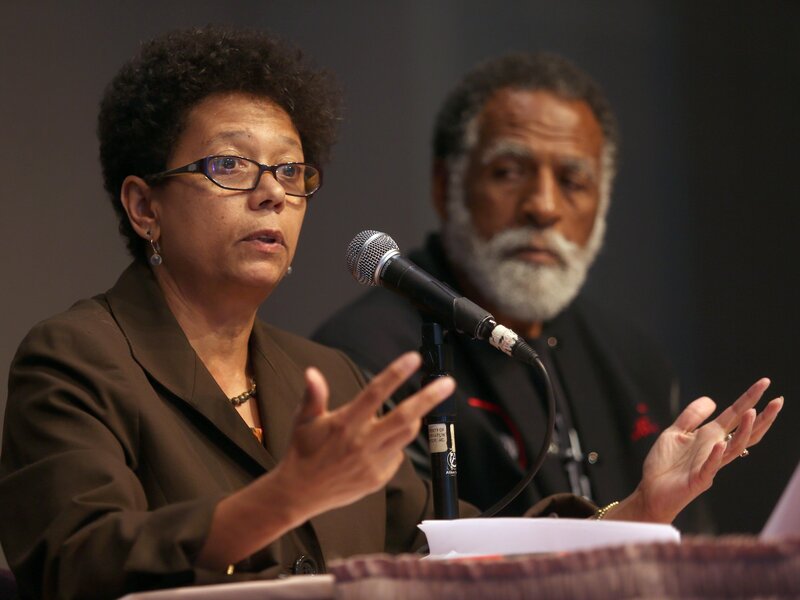
Dori J. Maynard speaking in 2013 at a public forum about the trial of George Zimmerman. Credit Jane Tyska/Bay Area News Group

Dori J. Maynard, a journalist who was at the forefront of the campaign to make the American news media a more accurate mirror of American diversity, died on Tuesday at her home in Oakland, Calif. She was 56.

The cause was lung cancer, her mother, Liz Rosen, said.

At her death, Ms. Maynard was the president and chief executive of the Robert C. Maynard Institute for Journalism Education, a nonprofit organization based in Oakland and named for her father, a former editor and publisher of The Oakland Tribune. Mr. Maynard, who died in 1993, was the first black person in the United States to own a general-circulation daily newspaper.

A former newspaper reporter, Ms. Maynard joined the Maynard Institute not long after her father’s death and became its president in 2001.

There, she continued her lifelong interest in exploring the often rocky landscape where race, class, ethnicity and the news media converge. She lectured frequently on the subject and contributed articles to The Huffington Post, American Journalism Review and other publications.

During Ms. Maynard’s tenure, the institute’s purview included professional development, recruitment, a media watchdog program and a news service, America’s Wire, which provides articles on racial inequity and related subjects to newspapers, magazines and websites. To date, the institute has trained more than 5,000 minority journalists and newsroom managers around the country.

Dolores Judith Maynard was born in Manhattan on May 4, 1958; her parents divorced when she was 5. Her father’s second wife, Nancy Hicks Maynard, was one of the first black women to work as a reporter at The New York Times.

With colleagues, Robert and Nancy Maynard founded the Maynard Institute, originally known as the Institute for Journalism Education, in 1977; after Mr. Maynard’s death, it was renamed in his honor.

Dori Maynard earned a bachelor’s degree in American history from Middlebury College in Vermont and was later a reporter at The Bakersfield Californian; The Patriot Ledger, in Quincy, Mass.; and The Detroit Free Press, where her beats included City Hall and the coverage of poverty.

She and Mr. Maynard became the first father-daughter pair to be named Nieman fellows in journalism at Harvard, he in 1966 and she in 1993. Ms. Maynard was also a fellow of the Society of Professional Journalists.

With her father, she was the author of “Letters to My Children” (1995), a collection of his newspaper columns, for which she wrote introductory essays.

Ms. Maynard’s husband, Charles Grant Lewis, whom she married in 2006, died in 2008. Besides her mother, survivors include two brothers, David and Alex Maynard, and a sister, Sara-Ann Rosen. Her stepmother, Nancy Hicks Maynard, died in 2008.

Under Ms. Maynard’s stewardship, the Maynard Institute sought to educate not only aspiring journalists but also the profession of journalism itself, prodding news organizations to cast a wider net when it came to subjects deemed worthy of coverage.

“The conversation that goes on in the newsroom,” Ms. Maynard told NPR in 2005, “determines not only what stories get into the newspaper or onto your television or radio shows, but also determines all the elements that go into those stories.” She added:

“If that conversation is not managed in a way that allows the diversity of opinion that may be in your newsroom to be reflected in your coverage, important elements of those stories are left out, so that they become not only less relevant to communities of color, but they also shortchange the white community, because they are not finding out what’s going on in neighborhoods and communities other than their own.”

http://www.mercurynews.com/…/oakland-dori-maynard-journalis…

Oakland: Dori Maynard, journalist and diversity champion, dies at 56
By David DeBolt
San Jose Mercury News

 
Dori J. Maynard of the Robert C. Maynard Institute for Journalism Education, left, speaks during a forum at Preservation Park's Nile Hall in Oakland, Calif., on Thursday, July 18, 2013. To the right is Arnold Perkins, of the Alameda County Public Health Department.

OAKLAND -- Dori J. Maynard, a journalist and longtime champion of diversity in news coverage and among the people who report the news,  died Tuesday at her West Oakland home, friends and family said.

Maynard was 56. The cause of her death was complications from lung cancer.

"Dori was an amazing force for good in journalism," said Dawn Garcia, managing director of the Knight Fellowships at Stanford University. "She was the voice that must be heard.

"When others were shying away from speaking about race, Dori was fearless. She made an amazing difference for so many people and was just a fabulous person, quirky in the best sense of the word. She will be remembered in every newsroom where journalists are trying to make a difference for diversity and for equity in coverage."

The Oakland Tribune and the Maynard Institute held the free public forum to discuss coverage of the Zimmerman trial and how media images impact perception. (Jane Tyska/Bay Area News Group) ( JANE TYSKA )

The daughter of trailblazing Publisher Robert C. Maynard, the former owner of the Oakland Tribune and the first African-American man to own a major U.S. newspaper, Dori Maynard knew from an early age she, too, wanted to be a journalist, her mother Liz Rosen said Tuesday.

Once asked what her middle initial "J" stood for, she quipped: "Journalism." After graduating from Middlebury College in Vermont with a bachelor's degree in American history, she went on to work at the Detroit Free Press, the Bakersfield Californian, and The Patriot Ledger, in Quincy, Massachusetts.

Along with her father, she was a Nieman fellow at Harvard University in 1993. She found her calling at the Robert C. Maynard Institute for Journalism Education, founded by her father and his wife Nancy Hicks Maynard. Dori Maynard had served as president of the institute since 2001.

Before her death, she had overseen the institute's Fault Lines training program, which taught journalists to recognize their own blind spots when it came to covering the stories of diverse communities. She was on the Advisory Board of the Journalism and Women Symposium, a national group supporting women in journalism.

"She's the kind of person who understood how this idea of diversity was so vital today and continues to be vital and needed to change from our old ways of thinking of what that meant and how to implement it in the production of news and the way we think about news," said longtime friend Sally Lehrman. "She was always thinking about work because she loved it and it was such a part of her."

Martin Reynolds, community engagement editor for the Tribune, said Maynard was a mentor and friend, who kept a presence at the Tribune even after her father sold the paper. She was a key part of Oakland Voices, an outlet for residents to tell the stories they want to tell.

Maynard was a mentor to many young journalists, Reynolds and friends said.

"I don't know what I'm going to do without her," Reynolds said.

Bob Butler, president of the National Association of Black Journalists and a reporter at Bay Area radio station KCBS, said, "It's hard to fathom how the institute is going to go on, but it's got to go on."

In a statement posted to its site Tuesday, the institute said, "Maynard advocated tirelessly for the future of the institute and its programs, reminding all that the work of bringing the diverse voices of America into news and public discourse is more vital than ever.

"Under her leadership, the Institute has trained some of the top journalists in the country and helped newsrooms tell more inclusive and nuanced stories. New programs are empowering community members to voice the narrative of their own lives. On the morning of her death, she was discussing plans with a board member to help the institute thrive and to attract funding to support that work."

Funeral services for Maynard are still being planned.

Staff writer Karina Ioffee contributed to this report. David DeBolt covers breaking news. Contact him at 510-208-6453. Follow him at Twitter.com/daviddebolt.


Dori J. Maynard, of the Robert C. Maynard Institute for Journalism Education, speaks during a forum at Preservation Park's Nile Hall in Oakland, Calif., in 2013.

'Her Calling Was To Help People Understand One Another': Remembering Dori Maynard
February 25, 2015
by Kenya Downs
Code Switch--NPR
 
In a heartfelt tribute, Fusion Voice's deputy editor Latoya Peterson recalled her seven-year relationship with journalist Dori Maynard as one of "an advisor, a mentor, and a beloved friend." Maynard, president of the Robert C. Maynard institute for Journalism Education, died Tuesday night at her home in Oakland, Calif. She was 56.

Peterson, a prominent feminist activist who runs the popular blog Racialicious, wrote that while Maynard's accomplishments are endless, it's her lasting impact on diversity initiatives in the newsroom that is most notable:

"It isn't enough to say that Dori was a tireless champion for diversity. Her calling in life was to help people understand one other. She never minimized the role of race in society, and courageously brought the subject up again and again. She countered every excuse she could find, always holding journalism to a higher standard, to truly represent the people of the United States of America. She often stressed [that] the path to accuracy and fairness in journalism required a commitment to broadening the ranks of the press corps."

She argues that more than ever, we need to heed Maynard's fierce insistence that the journalism industry should reflect the diversity of the world it covers:

"Dori knew that changing the tone, tenor, and composition of newsrooms was key to advancing racial justice across the nation. As long as the news peddled in stereotypical and discriminatory imagery, as long as it played a role in stoking the fear and mistrust of nonwhite citizens, our nation could never be whole."

Peterson continued her tribute online, where she cautioned young journalists to appreciate the mentors helping them find their voice.
Racialicious founder Latoya Peterson has a tearjerker of a tribute to journalism diversity pioneer Dori Maynard.
npr.org


It's Time to Recognize All Dads on Father's Day
Send by email
Dori Maynard
June 13, 2013

Dear Sheryl Sandberg,

You advise women to lean in and speak up. I’m taking your advice.

I can’t tell you how disappointed I was in the Father’s Day feature on which your Lean In Foundation collaborated with Time magazine. Not one African-American father appears on the Time website. I know it shouldn’t have shocked me.
Content audits, such as one by The Opportunity Agenda, tell us that even in the age of President Obama, the media continue to pigeonhole black men, consigning them to coverage about crime, sports and entertainment, out of proportion with their actual involvement. Equally important, the media rarely show black men in all of their humanity as doctors, lawyers, entrepreneurs, politicians, and yes, fathers.

Sadly, this feature is a stark example of the gap between coverage and reality, and not just because it ignores black fathers. There were also no Asian-American or Native American fathers in Time. I note that the magazine did a good job of presenting a cross section of white and Latino fathers.

Unfortunately, the other dads of color— one black and the other Asian-American — are relegated to your foundation’s website.

The problem with portraying such a narrow slice of fatherhood is threefold.

My first reaction on reading the list of fathers was, “Oh, no.” This is why I don’t read Time very often. It’s not that I don’t like Time; it’s just that it’s rarely relevant to my life. In today’s world, I don’t think any publication wants to so visually remind potential readers why they don’t read it.
I wasn’t alone. A quick look at the comments section finds others also clearly disappointed.

A commenter identifying herself as Claire Rodman wrote:
“TIME, it's been said, but it's worth saying again: There are plenty of black dads with daughters, and famous ones to boot: Mr. Poitier, Mr. Cosby, Denzel Washington, etc. Did you think we were all raised by single mothers? A lost opportunity, and likely some lost subscribers/online readers.”

The second problem is inaccuracy. As Rodman and other commenters noted, there are plenty of prominent African-American fathers. The same is true of Asian-American and Native American men with daughters. Yo-Yo Ma and Ben Nighthorse Campbell, the Senate’s first Native American, come to mind. Not including the wide range of fathers in this country perpetuates false stereotypes and gives readers a misleading sense of how their neighbors live and interact with family.

That brings us to the third reason. We’re in the business of giving the public credible, reliable information. A feature suggesting that only some men participate in raising daughters fails to meet our ethical and moral standards.
For those who question the necessity of diversity, this should be a reminder that having people with different perspectives in the room can help us see what we are missing. In 2011, Richard Prince, a columnist for the Maynard Institute for Journalism Education, noted that Time magazine was losing its only black correspondent.
That loss increased the chance that no one at Time would flag the omissions. All of us need someone to prod us because it is so easy for us to fall in with people who reinforce our world view. It’s called homophily, otherwise known as “birds of a feather” or “love of the same.” I work in diversity every day and still find that I must push myself not to make that same mistake. Nevertheless, I sometimes do.

I have also developed a diverse network of people willing to call me on mistakes so I can fix them. That’s really why I’m writing to you. The beauty of online features means that they can easily and quickly be fixed.

Sheryl, it’s not too late to remedy this by reminding African-American, Asian-American and Native American girls that they, too, have fathers who love them and are worth noting.

Sincerely,
Dori Maynard


Dori J. Maynard
From Wikipedia, the free encyclopedia
 
Dori J. Maynard, 2008

Born May 4, 1958
Died February 24, 2015
Education Middlebury College; Nieman Fellow
Home town Oakland, CA
Title President and CEO
Spouse(s) Charles Grant Lewis, deceased
Website:  http://www.mije.org

Dori J. Maynard (May 4, 1958 – February 24, 2015) was the President of the Robert C. Maynard Institute for Journalism Education in Oakland, California, the oldest organization dedicated to helping the nation's news media accurately and fairly portray all segments of our[who?] society. In its 33 year history,[when?] the Institute has trained thousands of journalists of color, including the national editor of the Washington Post, the editor of the Oakland Tribune and the only Latina[citation needed] to edit a major metropolitan newspaper. She was the co-author of "Letters to My Children," a compilation of nationally syndicated columns by her late father Robert C. Maynard, with introductory essays by Dori. She served on the board of the Sigma Delta Chi Foundation, as well as the Board of Visitors for the John S. Knight Fellowships.

Past experiences

As a reporter, she worked for the Bakersfield Californian, and The Patriot Ledger in Quincy, Massachusetts, and the Detroit Free Press. In 1993 she and her father became the first father-daughter duo ever to be appointed Nieman scholars at Harvard University; Bob Maynard won this fellowship in 1966.

She received the "Fellow of Society" award from the Society of Professional Journalists at the national convention in Seattle, Washington on October 6, 2001 and was voted one of the "10 Most Influential African Americans in the Bay Area" in 2004. In 2008 she received the Asian American Journalists Association’s Leadership in Diversity Award.

Maynard graduated from Middlebury College in Vermont with a BA in American History.

External links

www.mije.org
Dori on Diversity
Huffington Post

 
Robert C. Maynard: Life and Legacy
 
                              Robert C. Maynard
(1937-1993)

Robert C. Maynard, a charismatic leader who changed the face of American journalism, built a four-decade career on the cornerstones of editorial integrity, community involvement, improved education and the importance of the family.

He was the co-founder of the Institute for Journalism Education, a nonprofit corporation dedicated to expanding opportunities for minority journalists at the nation's newspapers. In the past 25 years, it has trained hundreds of America's journalists of color, more than any other organization. In December 1993, following Maynard's death, the Institute was renamed the Robert C. Maynard Institute for Journalism Education.

In the 1980s, Maynard began a twice-weekly syndicated newspaper column, in which he transformed national and international issues into dinner table discussions of right and wrong. His views were widely broadcast through regular appearances on "This Week With David Brinkley" and the "MacNeil Lehrer Report."

He was a board member of the industry's most prestigious organizations, including the Pulitzer Prize, The Associated Press, and the American Society of Newspaper Editors. It was his lobbying in the 1970s that nudged the ASNE to adopt the goal of diversifying America's newsrooms by the year 2000.

"This country cannot be the country we want it to be if its story is told by only one group of citizens. Our goal is to give all Americans front door access to the truth," he said in May of 1993 during his last public address, to college students at The Freedom Forum, in Arlington, Va.

Robert C. Maynard: A Tribute

View the video about Bob Maynard which was shown at the Free Spirit Award Dinner, held at the Paramount Theater, in Oakland, Calif., on June 14, 1994.

In 1979, Maynard took over as editor of The Oakland Tribune, which just a few years earlier had been labeled "arguably the second worst newspaper in the United States." He bought the paper in 1983, taking the title of editor and president in the first management-leveraged buyout in U.S. newspaper history. By doing so, he became the first African American to own a major metropolitan newspaper.

After a decade of ownership by Bob and Nancy Maynard, the newspaper had won hundreds of awards for editorial excellence. One media critic described the change: "The Tribune covers the Oakland area with far more insight than do its wealthier competitors in nearby San Francisco and the suburbs, and the paper has become a kind of journalistic farm team for larger papers such as the Los Angeles Times. The Tribune won a Pulitzer Prize in 1990 for its coverage of the Loma Prieta earthquake, and its coverage of the Oakland Hills fire was nothing short of superb."

It was the earthquake and fire, combined with the national recession and a troubled city economy, that finally forced the Maynards to sell The  Tribune in 1992.

When the paper was sold, its most valuable assets were its loyal readers and advertisers, its scrappy editorial product and the most diverse newsroom of any major metropolitan newspaper in America.

Robert C. Maynard standing in front of the Oakland Tribune, 1993

"The Maynards devoted a decade of their lives to saving the newspaper when no one else would. They brought journalistic excellence and diversity to the newspaper unmatched in its previous century of publication," wrote competitor Dean Singleton in December 1992 after the MediaNews group purchased The Tribune.

"Bob Maynard's journalistic talents and dedication are of course well known. But he does not get the plaudits he deserves for business acumen. It is doubtful that The Oakland Tribune would be alive today if not for Bob's keen ability to maneuver through economic mine fields day after day, year after year."

Maynard, the son of an immigrant from Barbados who founded a New York moving company, dropped out of a Brooklyn high school at the age of 16 to become a writer in Greenwich Village in the 1950s. He had a photographic memory, and mastered myriad subjects through reading and inquiry. Ultimately, he held eight honorary doctorates. "My credentials," he told a sister on the day he decided to quit school, "will be my work."

His early role models, writers Langston Hughes and Ernest Hemingway, later gave way to his hero, Dr. Martin Luther King. But he did not want people to follow his path away from formal education. "I say to young people today that they must stay in school," he wrote in a column.  "Autodidacts, self teachers, are of another age, I tell them. School today is imperative. All the same, my adventures suited me and served me well. My sisters even agree, grudgingly."

Maynard was most proud of the Elijah Parish Lovejoy award he received from Colby College in Maine. The national honor is named for the owner of an abolitionist newspaper in Alton, Ill., who was killed by a pro-slavery mob in 1837.

"You have rallied employees in the face of uncertainty and citizens in the aftermath of disaster, fighting for the heart and soul of your adopted community the way Elijah Parish Lovejoy once did in his, with faith, nerve and a printing press," Colby President William R. Cotter said as he presented the award in November 1991.

Maynard's formula for community involvement was simple: Just do it. He taught at local high schools, attended community forums, organized  relief for babies of cocaine-addicted mothers and for victims of the Loma Prieta earthquake and the East Bay hills firestorm, and helped establish youth forums in the city's churches in the aftermath of the Rodney King verdict. His newspaper crusaded for improved schools, trauma care centers, economic development and better communication across cultural lines. A newspaper, he wrote in 1979, in his first Letter from the Editor column, should be "an instrument of community understanding."

Robert C. Maynard, York Pennsylvania, USA

His journalism career began in 1961 at a daily newspaper in York, Pa. In 1965, he received a Nieman fellowship to Harvard University. In 1992, his daughter, journalist Dori J. Maynard, became the first woman to follow her father to Harvard as a Nieman scholar. After Harvard, Bob Maynard covered civil rights and urban unrest as a national correspondent for The Washington Post. He later became the newspaper's ombudsman, and later still, joined the staff of the editorial page.

It was in Washington, D.C., that he met his bride-to-be, then New York Times reporter Nancy Hicks. They were married in 1975.

Maynard was first diagnosed with prostate cancer in 1988. It went into remission twice, but returned a third time in 1992 and was a factor in the family's decision to sell the newspaper. Even through his illness, Maynard was the quintessential optimist.

"The country's greatest achievements came about because somebody believed in something, whether it was in a steam engine, an airplane or a space shuttle,'' he once wrote. "Only when we lose hope in great possibilities are we really doomed. Reversals and tough times inspire some people to work harder for what they believe in."


Robert C. Maynard
From Wikipedia, the free encyclopedia


                              Robert C. Maynard
 
Born Robert Clyve Maynard
June 17, 1937
Brooklyn, New York, U.S.
Died August 17, 1993 (aged 56)
Oakland, California, U.S.
Nationality American
Education Harvard University
Known for Journalist
Editor of Oakland Tribune
Maynard Institute co-founder
Notable credit(s) The Oakland Tribune
Spouse(s) Nancy Hicks Maynard (1975–1993)
Children Dori J., David and Alex

Robert Clyve Maynard (June 17, 1937 – August 17, 1993) was an American journalist, newspaper publisher and editor, former owner of The Oakland Tribune, and co-founder of the Robert C. Maynard Institute for Journalism Education in Oakland, California.

Contents

1 Biography
1.1 Early years
1.2 Career
1.3 Personal life
2 Bibliography
3 References
4 External links

Biography
Early years

Maynard was one of six children to Samuel C. Maynard and Robertine Isola Greaves, both immigrants from Barbados. At 16 years old, he dropped out of Brooklyn High School to pursue his passion for writing. Maynard became friends with influential New York writers James Baldwin and Langston Hughes and later acknowledged Martin Luther King, Jr. as a hero.
Career

Maynard's career in journalism began in 1961 at York Gazette & Daily in York, Pennsylvania. In 1966, he received a Nieman Fellowship to Harvard University and joined the editorial staff of the Washington Post the following year.

In 1979, Maynard took over as editor of The Oakland Tribune and became the first African American to own a major metropolitan newspaper after purchasing the paper four years later. He is widely recognized for turning around the then struggling newspaper and transforming it into a 1990 Pulitzer Prize-winning journal.

Maynard greatly valued community involvement. He taught at local high schools and frequently attended community forums. His positive, proactive outlook helped many in need, including children of cocaine-addicted mothers and earthquake and firestorm victims. Maynard used the outreach of his newspaper to better the community by pushing for improved schools, trauma care centers, and economic development.

The Robert C. Maynard Institute for Journalism Education

In 1977, Maynard co-founded the Institute for Journalism Education, a nonprofit organization dedicated to training journalists of color and providing accurate representation of minorities in the news media. For more than thirty years, the Institute has trained over 1,000 journalists and editors from multicultural backgrounds across the United States.
Personal life

The Institute he co-founded with his second wife Nancy Hicks Maynard (1947–2008) was renamed in his honor after his death from prostate cancer in 1993. His daughter, Dori J. Maynard, has since become president and CEO of the Robert C. Maynard Institute for Journalism Education.
Bibliography

Maynard, Robert C. (1968). Nationalism and Community Schools. Washington: The Brookings Institution. OCLC 80975022.
Maynard, Robert C. (1982). Ralph McGill's America and Mine. Athens: The University of Georgia. OCLC 11822319.
Maynard, Robert C. (1989). Earthquakes, Freedom and the Future. Tucson: The University of Arizona. OCLC 22919891.
Maynard, Robert C. (1989). Communication in the (Shrinking) Global Village. Bridgetown: Central Bank of Barbados. ISBN 976-602-035-3.
Maynard, Robert C. (1992). Reflections on the Post-Cold War Era. Honolulu: East-West Center. OCLC 34489231.
Maynard, Robert C.; Maynard, Dori J. (1995). Letters to My Children. Kansas City, MO: Andrews and McMeel. ISBN 0-8362-7027-4.

References

"Robert C. Maynard: Life and Legacy". Maynard Institute. 2008. Retrieved 2008-09-22.
Mark Kram (2008). "Black Biography: Robert Maynard". Contemporary Black Biography. The Gale Group. Retrieved 2008-09-22.

External links

Robert C. Maynard Institute for Journalism Education official website
Robert C. Maynard at the African American Registry (archived by the Wayback Machine

Sunday, August 31, 2014

The Structural, Institutional, Systemic, and Visceral Dominance of White Supremacy, the Real National History Of the United States, And the Ongoing Ominous Lessons Of Ferguson, Missouri--PART 3

WELCOME TO THE UNITED HATES OF HYSTERIA: LAND OF THE SPREE, HOME OF THE KNAVE, AND ETERNAL DOMAIN OF THE 3H CLUB: HATRED HUBRIS AND HYPOCRISY: 2014 EDITION


http://www.counterpunch.org/2014/08/29/bad-apples-in-ferguson/

WEEKEND EDITION AUGUST 29-31, 2014

The Media: When in Doubt, Blame Blacks

Bad Apples in Ferguson
by ISHMAEL REED
CounterPunch
 
ISHAMEL REED

Given the fact that the Jim Crow media are dominated by the POVs of middle and upper-class whites, mostly males, it was no surprise that most of the commentary and reporting about Ferguson was managed by people who never experienced racial profiling. People like CNN’s Jeffrey Toobin, Harvard graduate and Harvard married, who has said that the charges of prosecutorial misconduct are ridiculous. Another know-it-all-nik named Marc Fernich, appearing on Al Jazeera on August 24,2014 called “preposterous,” a claim made by the St.Louis NAACP head, Adolphus Prultt, 2nd, that the police occupation of Ferguson was similar to how Palestinians had been greeted by the forces of occupation. He was unaware that Palestinians were sending advice to the residents of Ferguson about how to handle tear gas. Palestinian writer, Amer Zahr, in his article, August 17th,” BEING BLACK, BEING PALESTINIAN wrote “It is hard for me to see Ferguson through anything other than Palestinian eyes.

“The killing of 18-year-old Michael Brown, as he was unarmed and reportedly surrendering, has triggered protests in Missouri against aggressive police action.  The protests have been met, quite expectedly, with aggressive police action.  This aggressive police action will be met with more protests and on and on we go.  Sound familiar?

“The similarities between Ferguson and Palestine are stark.  Shared experiences, sentiments, and anger abound.  As it turns out, being black here and being Palestinian over there aren’t really that different.”

The smarmy Joe Klein waded in for Time about how black culture was responsible for the death of Michael Brown. He used the same argument in New York magazine   May 7,1989 that was typically lengthy and pompous piece about the Central Park Five. All about our morals from a man who lied about his authorship of “Primary Colors.” Of course, the five were innocent. Is there such a thing in journalism as plagiarizing oneself and getting paid by an organization like Time for engaging in this practice, repeatedly? No wonder FAIR calls Klein, “the media spokesperson for white people,” well he’s not quite white to young whites, who, according to The New York Times article about how the American Nazis are recruiting them. Klein is the guy who claimed, recently, and unopposed, that black men were responsible for the country’s rape problem. Black girls get raped by their mother’s boyfriends according to him. Tell that to the white co-eds who are raped by white men in college on a regular basis. Black men aren’t in college. They’re in jail.

We can’t get Joe to comment on the domestic violence against Jewish women in the United States and Israel. He’s part of the cover-up. How about a lengthy piece about this problem for New York magazine?

Predictably, just as the media were stenographers for the Pentagon during the Iraq war, they, like Marc Fernich, behaved as a sort of a press agent for Ferguson law enforcement and a cheering section for Darren Wilson, who might have shot an unarmed Michael Brown twelve times.  The media concentrated on the violence committed by a few, who were present in the mostly peaceful demonstrations and not on the violence of the police, who putout a lower case tonkin gulf propaganda spiel, which the media also fell for. All about Molotov cocktails provoking them into action. Three black ministers who were present where one Molotov cocktail incident was supposed to have taken place said that they didn’t see any. This gave the police, which was armed as though they were in Afghanistan, to assault men women and children with tear gas, while calling them “niggers.” Those who called 911 to report Michael Brown’s death, his body being allowed to lie in the sun for four hours (to show what happens when you fuck with the police), said that the dispatchers called them monkeys.

Fox News, Goebbels America, picked up a rumor about Wilson having his eye socket damaged by Brown. This lie was repeated by the Zimmerman/Wilson network, CNN. Their regular, Mark O’Mara, the character who lied about Trayvon Martin’s past and threatened the white women on the jury with the specter of black rape if they didn’t vote for an acquittal of Zimmerman. You could understand why some of the media would support Wilson, but The New York Times, whose editorial page, except for Paul Krugman, and Ishmael Reed from time to time, reads like a Tea Party Rally, was reprimanded twice by its Public Editor for behaving as a kind of pro bono defense counsel for Darren Wilson. First, Lawrence O’Donnell found support from the public editor of the Times when he accused the Times of floating a misleading line in its efforts to keep the right wing among its readership happy. O’Donnell said the Time’s report that there were “sharply” different versions among those who witnessed the shooting was false. In one front page Time’s story the murderer was called “well-mannered…soft-spoken…a good kid “while Michael Brown, who never killed anybody was “a teenager grappling with problems and promise.” When a cop killed Oscar Grant out here, a local paper called the cop, “a gentle giant.” Next the Times got into trouble when a black reporter wrote that Michael Brown “was no angel.” Answering “the storm” of protests that followed his comment, Times Public Editor Margaret Sullivan wrote in a post on Monday afternoon that the “no angel” term was “an ill-chosen phrase”: ”In my view, the timing of the article (on the day of Mr. Brown’s funeral) was not ideal. Its pairing with a profile of Mr. Wilson seemed to inappropriately equate the two people. And “no angel” was a blunder,” Sullivan wrote.

Sullivan also interviewed the reporter who wrote the article, John Eligon, who said he agrees “no angel” was a poor choice of words. Eligon also said he pressed editors on another part of the article that’s drawn criticism – Brown’s interest in rap.

I tried to weigh in as someone who has experienced racial profiling, most recently when walking with my companion in the historic Mountain View Cemetery in Oakland. The people in the cemetery office called the police. They got there promptly. We had a hard time getting them to solve the drug traffic in our neighborhoods. Sometimes they didn’t even show up. Elderly members at our Crime Council meetings question, regularly, why the police are so chummy with the drug dealers. Wonder why. But they showed up about five minutes after I entered the cemetery. Maybe I was going to rob some graves? The Oakland police run the city. Though racial profiling is rampant, The East Bay Express has accused the current crop of mayoral candidates of supporting racial profiling. That’s because they brought police Chief Bratton out here to advise them on “stop and frisk,” and paid him a $200,000 consultant fee.

The Times told me that they had enough comments about Ferguson. The majority was written by white men. The police show them their Dr.Jekyll side. We get Mr. Hyde. These commentators are the ones who put out the lie that only a few bad apples in police departments are responsible for racial profiling; thirty police were involved in a scandal in Harlem Precinct in the 1990s.

I wanted to challenge the media’s use of polls to show that the issue of police brutality reflected disagreements between whites and blacks, when the police kill and beat the shit of Hispanics and Native Americans as well. Do the pollsters exclude the view of other ethnic and religious minorities like the Muslims who were spied upon by the notorious NYPD, because including them would challenge the views of their white readers and viewers? The people that Jeff Zuker of CNN and Comcast of MSNBC and Rush Limbaugh of Bain Capital’s  Clear Channel wish to woo. The people whom they depend upon to buy their shiny gas guzzlers and Viagra. Are the media again protecting whites from the charge that they’re ignorant of what’s happening between the police, to whom they give carte blanche to handle minorities anyway they wish, and the black Hispanic and Native Americans men and women who get murdered by the police on a regular basis. Unlike the toned down types, the black college professors whom MSNBC use to avoid paying full-time professional journalists like Michel Martin, black commentators like Earl Ofari Hutchinson and  Brooklyn-born rapper Talib Kweli were able to give a different account of what happened in Ferguson.

Davey D’s on KPFA’s “Hard Knock Radio,” and Amy Goodman’s “Democracy Now” had the best coverage because they aren’t beholden to media bosses to provide them with expense accounts and car. They interviewed people from the community and activists whose accounts on the ground were different from the accounts given by the police and the police friendly media. One woman told Amy Goodman that the Ferguson police broke down their apartment door and put 9 millimeter guns against her children’s heads because one of the kids didn’t tell his mother that he had received a citation for the theft of a Snicker’s bar. The three 10,11, and 12 spent thirty days in jail, while the criminals at Bank of America and Wells Fargo get to negotiate their fines. She said that her mother had warned her that the Ferguson police was a KKK outfit.

It took Davey D, Rose Clemente and Atty. John Burris to connect the police killings of Hispanics to that of blacks, which was ignored by the mainstream media.

After my Wednesday Aug.20th swim at the Berkeley YMCA, I ran into a retired 83 year old Hispanic judge. The situation in Ferguson came up. He said that there had been clashes in East L.A. between the police and Hispanics over police shootings.

On Thursday, Aug.21, Civil Rights Atty. John Burris, appearing on KPFA’s “Letters and Politics,” said there had been four shootings of Hispanics by Salinas, California’s police since March. In one case, a Hispanic man, Carlos Mejia, was attempting to solicit some gardening work. According to Burris, he carried the gardening shears in his hand. Someone called the police. The police shot him when he turned toward them after walking away. The video is eerily similar to the Michael Brown. After this May 20,2014 shooting, Hispanic demonstrators protested. Some threw rocks and bottles at the police.

On August 27,even Joy Reid, one of the best commentators, said that police shootings of black men represented a Racial Divide between blacks and whites and that it wasn’t of concern for other minorities. She should travel west of the Rockies from time to time or is she just following the memos from higher ups?

Predictably, Jeff Zucker’s CNN even rushed on a Town Meeting about a rating driven Black and White divide. No Hispanics appeared on the panel even though the police have used lethal against them as well. Apparently nuance doesn’t draw ratings. Native Americans have issues with police brutality as well. Joy Reid should read the online Native American news service, Indian Country, from time to time. But for the men who own and whose POVs dominate the media, we lie.

One of the origins of the term “Indian Summer,” is that Indians lie so much that an Indian Summer is a false summer.

One could conclude that since the word of whites has more credibility, historically, than that of blacks, not to include the testimony by Hispanics, Native Americans and Muslims about their sometimes terrifying encounters with the police is to isolate blacks and cast them as unreasonable malcontents. Paranoid even and whining about “victimization,”and set up for a mismatch.

Finally, E.J.Dionne and Eugene Robinson of The Washington Post discussed one of those White/Black polls on MSNBC.

You can understand why the regular pundits and their producers like Jeff Zucker might want to stage an opinion UFC match between Blacks and Whites for the entertainment of their viewers, but that these men of intellectual heft would cling to an outmoded model for race relations is depressing. The United States is no longer just Black and White.

Ishmael Reed is the publisher of Konch.  His information is at IshmaelReed.org.

Sources

1 Pacifica’s Mitch Jeserich hosts “Letters & Politics,” a look at burning political issues and debates, and their historical context, within the US and worldwide.(Burris interview was aired).

2 www.latinorebels.com/…/full-video-of-salinas-police-shooting-unarmed-,https://www.youtube.com/watch?v=qLK0eo26MgE

3 http://indiancountrytodaymedianetwork.com/2014/08/21/separate-and-unequal-ferguson-has-implications-all-ethnicities-156516

4 http://fair.org/extra-online-articles/joe-klein-media-spokesperson-for-white-people/

5 http://www.nydailynews.com/archives/news/bratton-slams-dirty-30-sgt-article-1.728555

copyright© 2014 Ishmael Reed


Ishmael Reed is the internationally acclaimed author of over twenty-five books (novels, essays, plays, and poetry)—including Mumbo Jumbo, The Last Days of Louisiana Red, and Yellow Back Radio Broke-Down. He is also a publisher, television producer, songwriter, radio and television commentator, and lecturer. Founder of the Before Columbus Foundation, he taught at the University of California, Berkeley for over thirty years, retiring in 2005. In 2003, he received the coveted Otto Award for political theater. He is also the publisher of Konch, an online literary and cultural arts magazine that he founded in 1990.

Two of Reed's books have been nominated for National Book Awards, and a book of poetry, Conjure, was nominated for a Pulitzer Prize. His New and Collected Poems, 1964–2007, received the Commonwealth Club of California's Gold Medal. A poem written in Seattle in 1969, "beware : do not read this poem", has been cited by Gale Research Company as one of the approximately 20 poems that teachers and librarians have identified as the most frequently studied in literature courses. Reed’s novels, poetry and essays have been translated into French, Spanish, Italian, German, Japanese, Hebrew, Hungarian, Dutch, Korean, Chinese and Czech, among other languages.

Since 2012, Ishmael Reed has maintained the honor of being the first SF Jazz Poet Laureate from SF JAZZ, the leading non-profit jazz organization on the West Coast. An installation of his poem “When I Die I Will Go to Jazz” appears on the SFJAZZ Center’s North Gate in Linden Alley. LitQuake, the annual San Francisco Literary Festival, honored him with their 2011 Barbary Coast Award

Among Reed's other honors are writing fellowships from the Guggenheim Foundation and National Endowment for the Arts. In 1995, he received the Langston Hughes Medal, awarded by City College of New York; in 1997, the Lila Wallace Reader’s Digest Award, establishing a three-year collaboration with the Oakland-based Second Start Literacy Project in 1998.

In 1998, he also received a John D. and Catherine T. MacArthur Foundation Fellowship award. In 1999, he received a Fred Cody Award from the Bay Area Book Reviewers Association, and was inducted into Chicago State University’s National Literary Hall of Fame of Writers of African Descent. Other awards include a Rene Castillo OTTO Award for Political Theatre (2002); a Phillis Wheatley Award from the Harlem Book Fair (2003); and in 2004, a Robert Kirsch Award, a Los Angeles Times Book Prize, besides the D.C. Area Writing Project’s 2nd Annual Exemplary Writer’s Award and the Martin Millennial Writers, Inc. Contribution to Southern Arts Award, in Memphis, Tennessee. A 1972 manifesto inspired a major visual art exhibit, NeoHooDoo: Art for a Forgotten Faith, curated by Franklin Sirmans for The Menil Collection in Houston, where it opened on June 27, 2008, and subsequently traveled to P.S. 1 Contemporary Art Center in New York City, and the Miami Art Museum through 2009. Buffalo, New York, celebrated February 21, 2014, as Ishmael Reed Day, when he received Just Buffalo Literary Center's 2014 Literary Legacy Award.
ISHMAEL REED
b. 1938