Showing posts with label Free speech. Show all posts

Tuesday, May 28, 2024

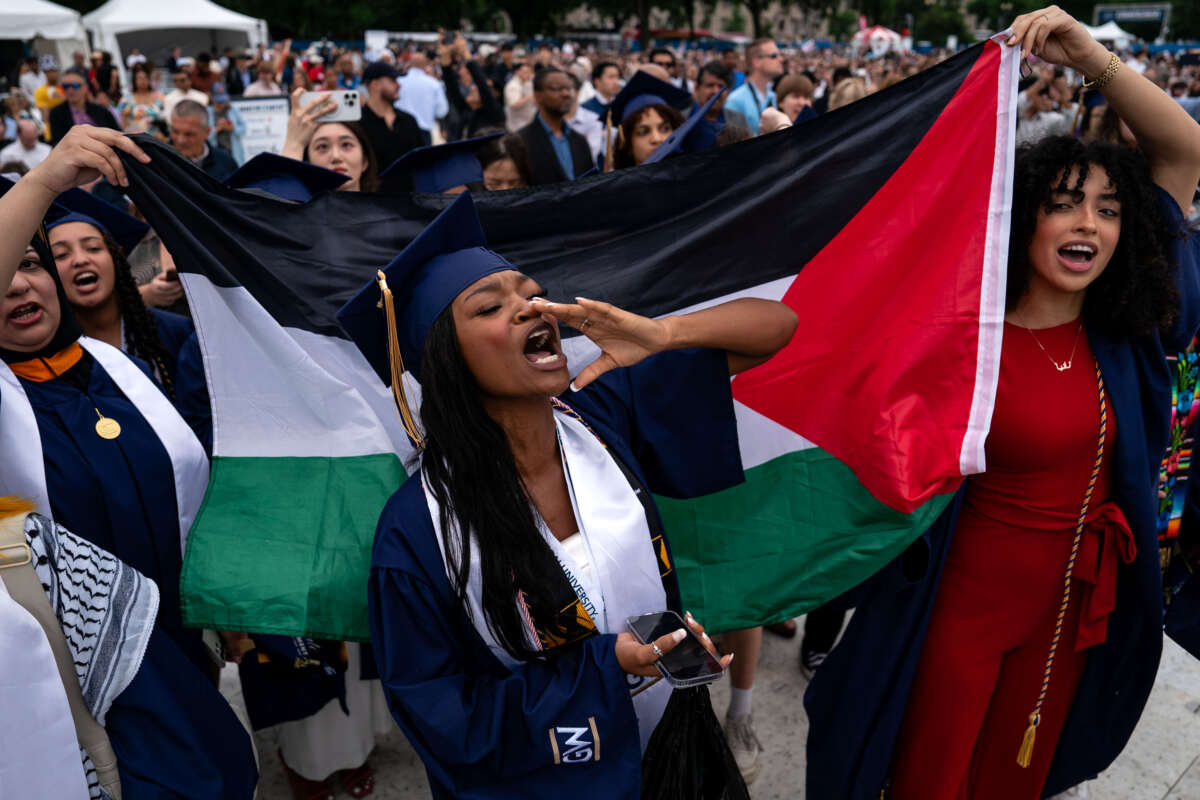
A New Generation of Activists and Students in Solidarity with the People of Gaza Will Not Be Deterred, Censored, Marginalized, or Intimidated Either on college campuses or in the streets on behalf of the liberation and self determination of Palestine in their and our collective struggle against the scourges of Genocide and Apartheid

https://truthout.org/articles/our-gaza-encampments-may-fall-but-theyve-already-radicalized-a-generation/

Wednesday, May 1, 2024

Pulitzer Prize Winning Author, USC Professor, Public Intellectual, and Activist Viet Thanh Nguyen On What is Happening--And Why-- on American College Campuses in Response to the Genocidal War in Gaza and the vital issues of Free Speech, State Censorship, and the Constitutional Right of Students to Protest in the United States

https://zeteo.com/p/a-student-rebellion-against-the-hypocrisy

[Zeteo is a new media organization that seeks to answer the questions that really matter, while always striving for the truth. Founded by Mehdi Hasan, Zeteo is a movement for media accountability, unfiltered news and bold opinions.]

"A Student Rebellion Against the Hypocrisy of Their Elders" - USC Prof & Pulitzer Prize-Winning Author Viet Thanh Nguyen

The students protesting against Israel's genocidal war in Gaza are on the right side of history, as other student movements were in the past.

by Viet Thanh Nguyen
May 1, 2024
Zeteo

Student and other protesters calling for a ceasefire in Gaza gather at the University of Southern California's Alumni Park on April 24, 2024. Photo by David Swanson/Reuters

The violent crackdown on students protesting against Israel’s genocidal war on Gaza reveals the stark hypocrisy of political and academic leaders at our colleges and universities, including my own. Instead of first turning to dialogue and debate – the very skills and values universities should promote – school administrators have turned to police, extreme discipline, and complying with a mainstream consensus that seems more interested in suppressing criticism of Israeli and American policy than protecting students.

From Columbia University to my own University of Southern California, peaceful student encampments in common university areas have been dismantled by city police, with hundreds of students arrested. Some have been suspended, evicted from dormitories, and threatened with expulsion and criminal conviction. At UT Austin, state troopers threw a Fox cameraman to the ground and arrested him. At Emory University, the chair of philosophy, Noelle McAfee, was arrested by a police officer wearing a balaclava, as if he were conducting an antiterrorism raid. Another Emory professor, Caroline Fohlin, who sought to protect students being arrested, was wrestled to the ground by two police officers, handcuffed, and charged with battery.

These student protests against a war that has killed over 34,000 Palestinians, at least two-thirds of whom are women and children, are what professors and administrators love to call a “teachable moment.” Unfortunately, most universities and colleges are failing their academic principles, their students, and their faculty. I wish I could say I was surprised, but after three decades in academia, I am not.

I was arrested twice in college for political protests more than 30 years ago. Along with other Asian Americans and our allies, I participated in sit-ins and occupied the chancellor's office, calling for a more diversified curriculum and faculty that better represented our community. I graduated with four misdemeanors – two each for resisting arrest and trespassing. I was lucky I was not expelled or suspended, but I was also at UC Berkeley at a time when the administration understood that these were not appropriate punishments for young people who were committed to the very principles of truth, justice, debate, and open-mindedness that universities represent. I wish I could say the same for the administrators at universities and colleges today, including my own. But too many administrators have chosen to deploy police clad in riot gear and wielding tear gas, tasers, sniper rifles, and armored vehicles against students.

(Viet Thanh Nguyen at UC Berkeley. Courtesy of Viet Thanh Nguyen)

On my own campus, the USC administration canceled the speech of its valedictorian, Asna Tabassum, after pro-Israel groups on and off campus labeled her antisemitic for including a link on her Instagram to a website that called for the abolition of Israel. Tabassum minored in resistance to genocide, offered through the Advanced Center for Genocide Research. The center’s founding director, Wolf Gruner, called Tabassum one of the most empathetic students he had ever taught. Tabassum said she planned to speak to the commencement audience about hope and human rights. She might or might not have brought up Gaza and Palestine, war and genocide, but even if she did, should that have been a reason to cancel her?

The university administration offered unspecified threats to safety so severe that it felt it could not protect Tabassum or the commencement ceremony, even though former President Barack Obama had attended the commencement the year before and presumably required heightened safety measures. It is difficult not to believe that safety was a pretext for the university to avoid controversy that might antagonize pro-Israel students, family members, and outsiders. But the real consequences of such a controversy would not have been community protest; instead, it would have been political blowback from Congress, donors, and trustees.

viet_t_nguyen

A post shared by @viet_t_nguyen

This strategy of avoidance and appeasement is doomed to failure. Columbia University president Minouche Shafik submitted completely to Republican demands to discipline her faculty and students, but this did not prevent Rep. Elise Stefanik and House Speaker Mike Johnson from demanding her resignation.

Republicans will not be satisfied until students are being clubbed and tear-gassed in a law-and-order spectacle that will please Benjamin Netanyahu and the GOP base. But the right-wing reaction against student protesters is not only about their stance on Israel and Gaza, which includes their willingness to declare the war a genocide and to demand divestment from Israel and the ending of further military aid. Instead, the right wing is stirring a moral panic around antisemitism, using Jewish students and their feelings of being uncomfortable and threatened as a reason to crack down on protesting students.

Racist and antisemitic threats are wrong and should be treated appropriately, which is to say, through academic disciplinary and legal methods targeted at the individuals who issue such threats, not through the deployment of riot police against masses of peaceful protesters. But a big difference exists between being threatened and being uncomfortable, and critics of the protesters – and the anti-war movement in general – blur the two.

This happens by conflating criticism of Israel with antisemitism, even though many student protesters are themselves Jewish. It’s what some have called a “weaponized antisemitism,” which places more value on how some Jewish students feel uncomfortable than how Palestinians are actually being killed en masse by an Israel whose weapons are supplied by the U.S.

Being uncomfortable is not necessarily a problem, and certainly not enough of a problem to shut down free speech and academic debate. Discomfort can be useful, and is even necessary, for us to argue and question our assumptions and those of others, leading to greater intellectual, moral, and political clarity. These are the things that are supposed to happen on college campuses and what Tabassum’s speech at USC might have provoked.

Police confront a pro-Palestine protester at the University of Southern California on April 24, 2024. Photo by Robert Hanashiro/USA TODAY/Reuters

The suppression of student protests today should worry all of us, including those who might support Israel but who are otherwise convinced about the need for free speech and the mission of universities. This is because the moral panic over antisemitism being stoked by the right is only the latest manifestation of a decades-long campaign to discipline and possibly capture academia.

Over the last few decades, American academia has undergone a painful transformation. Tenured faculty have been replaced in ever-greater numbers by faculty without job security. The humanities and social sciences have been depleted. Tuition and loan debt has spiraled rapidly. University presidents – who are increasingly CEOs, politicians, and generals instead of academics – have become ever more beholden to boards of trustees that are often composed of the wealthy and politically connected. Meanwhile, the right has fought to eliminate affirmative action for racial diversity but sought to demand the equivalent of affirmative action for ideological diversity.

In universities, the lack of democracy and transparency is more of a norm than an exception. Faculty and students are routinely ignored by university administrations when it comes to the most serious issues, which is to say those that involve money. This is perhaps why students have felt that their only recourse when it comes to demanding divestment and the end of military aid to Israel was through protest, carried out in public spaces, rather than the futile road of privately appealing to administrators.

The student protesters are on the right side of history, as they were in the 1960s and 1970s, demonstrating against the immoral and racist war the U.S. was waging in Viet Nam, Laos, and Cambodia. The students were right again in the 1980s, campaigning against apartheid and forcing universities to divest from South Africa.

It is amazing how institutions teach idealism, including these cases of opposition to war and apartheid, and are then astonished that students are idealists. We are now witnessing a student rebellion against the hypocrisy of their elders and the powerful, who tell them they have to accept the lesser of two evils, and who weaponize antisemitism to justify genocide.

Student protesters face real penalties in terms of their reputations and job prospects, as well as their physical and emotional well-being. School administrators who stand up for academic principles and defend their students and faculty may lose their positions, but they would return to the ranks of the faculty, and with tenured security. This is the choice the university leaders face, and it is quite different in consequence to what the students face, which makes their cowardice even more disturbing.

The saying “those who can’t do, teach” seems all too true now in this moment. Instead, it is the students who are teaching their professors and the public at large. Through their actions, the students are showing what idealism and conviction actually look like.


ABOUT THE AUTHOR:
 

Zeteo contributor Viet Thanh Nguyen is the Aerol Arnold Chair of English and a professor of English, American Studies and Ethnicity, and Comparative Literature at the University of Southern California. His novel, The Sympathizer, won the Pulitzer Prize for Fiction and numerous other awards. Subscribe to Zeteo to get more from Viet and other Zeteo contributors straight to your inbox.

Friday, April 19, 2024

What the Dangerous Impact of Neo-McCarthyism, repression, and Censorship of Pro-Palestinian Views and Positions on Gaza and Self Determination for Palestine in Gaza and Beyond Means for 'Academic Freedom and 'Free Speech' in the United States

The Palestine Exception: The crackdown on Israel criticism on US campuses | Fault Lines Documentary

March 25, 2024

#Aljazeeraenglish #israel #documentary 

Fault Lines investigates what the crackdown on Palestine advocacy means for academic freedom in the United States. Doxxing. Blacklists. Terminations. Investigations. Hate mail and death threats. And accusations of anti-Semitism and material support for terrorism. These are some of the ways in which pro-Israel advocacy groups have tried to silence and intimidate pro-Palestinian voices in the US for years. But since October 7, these kinds of attacks have intensified. Constitutional rights advocates have called this a McCarthy-era moment for speech, suppression, and university campuses are on the front lines.

VIDEO:
https://www.youtube.com/watch?v=ziccxuAwJd4


Wednesday, April 17, 2024

University of Southern California openly violates and denies the free speech rights of their valedictorian who was slated to speak at her 2024 graduation because of her Pro-Palestinian views and her support of the people of Gaza in their struggle against Genocide

"...Tabassum, who said she has participated in pro-Palestinian activism at USC but “not taken a public role,” said the controversy has made her more strident in her views on the Israel-Hamas war and student activism.

“It’s no longer about free speech. It’s no longer about me. It is about when the university silences me, they are silencing all these people,” she said, referring to pro-Palestinian activists at USC and outside the campus.

“When you silence us, you make us louder. You make louder the aims of imparting hope and commitment to human rights and the responsibilities of graduates to use our education ... to make the world a better place,” said Tabassum, 21.

A hijab-wearing Muslim who grew up in San Bernardino County in an Indian American family, Tabassum said she feels singled out by critics for her race and faith.

“I’m not ignorant of who I am or what I believe in and the time we are in or the place we are in,” she said. “I am not ignorant of the context or environment, at the end of the day.”

Tabussam, who minored in “resistance to genocide,” suggested her opponents were mistaken about her views and her studies.

The program, an official minor at USC, requires students to enroll in five courses from a list that includes several on the Holocaust as well as on the Armenian genocide and other genocides, such as targeted killings of Tutsis in Rwanda in 1994.

Tabussam said she “studied the Holocaust extensively in multiple classes” but “did not take a class exclusively on the Holocaust.”

She tied the minor to her major in biomedical engineering.

“I see my work as using health technologies that could preserve access to health for all people who have been subjugated to evil. That includes, at its most extreme, genocide,” Tabussam said."
--"USC valedictorian’s grad speech is canceled": ‘The university has betrayed me’, by Jaweed Kaleem Los Angeles Times, April 16, 2024
 

USC valedictorian’s grad speech is canceled: ‘The university has betrayed me’

PHOTO:  Asna Tabassum, a graduating senior at USC, was selected as valedictorian and offered a traditional slot to speak at the 2024 graduation. After on-and-off campus groups criticized the decision and the university said it received threats, it pulled her from the graduation speakers schedule. Tabassum, photographed on the USC campus on April 16, 2024, opposes the decision. (Genaro Molina / Los Angeles Times)


by Jaweed Kaleem
April 16, 2024
Los Angeles Times


When Asna Tabassum learned that USC had barred her from speaking at next month’s graduation, she hadn’t yet planned what she would say in her remarks, beyond that she would convey a message of hope.

University leaders who announced the decision Monday, after pro-Israel groups criticized a link on Tabassum’s Instagram page as evidence of her being antisemitic, didn’t know the theme of her speech because she hadn’t shared it with them, the class valedictorian said an interview with the Times on Tuesday.Tabassum, a biomedical engineering major, said that in addition to hope, she was thinking of touching on “how we must continue to use our education as a privilege to inform ourselves and ultimately make a change in the world.


In barring Tabassum from giving a three to five minute speech in front of 65,000 people during the May 10 ceremony, USC Provost Andrew T. Guzman cited the need to “maintain campus safety and security.” The university alluded to unnamed threats but has not publicly detailed them.

The move was unprecedented for a ceremony where students regularly make political and cultural statements through written message on their graduation caps and sashes, as well as through the traditional valedictory speech.


California

  
Citing safety concerns, USC cancels pro-Palestinian valedictorian’s graduation speech

April 15, 2024

The backlash against Tabassum, who was chosen as valedictorian by a university committee from nearly 100 applicants with GPAs of 3.98 or above, was unusual, even at a time of intense campus strife between pro-Palestinian and pro-Israel activists, because it didn’t involve anything she said or did. The opposition appeared to stem mostly from a link on her Instagram profile to a website she did not create.

The site, “Free Palestine Carrd,” features a photo of a woman raising a Palestinian flag above plumes of smoke during a 2018 protest near the Israel-Gaza border. A series of links explains how to “learn about what’s happening in Palestine.”

The links include statements that Zionism is a “racist settler-colonialist ideology” and that founders of Zionism thought “Palestinians needed to be ethnically cleansed from their homes.” The website explains proposals for two-state and one-state solutions to the Israeli-Palestinian conflict.

“One Palestinian state would mean Palestinian liberation, and the complete abolishment of the state of Israel,” it says, adding that “both Arabs and Jews can live together.”

Speaking to The Times on Tuesday, Tabassum defended herself, saying she is not antisemitic. She said she supports the pro-Palestinian cause that has grown at college campuses since the Oct. 7 Hamas attack on Israel, which killed 1,200 people and took more than 240 hostage before Israel’s retaliatory war in Gaza, which health authorities there say has killed more than 33,000 Palestinians and the United Nations says has left 2 million Gazans in near-famine conditions.

“The university has betrayed me and caved into a campaign of hatred,” Tabassum said of online attacks against her demanding that the university rescind its invitation for her to speak at the graduation.

She said the university did not share any details with her about its security concerns and that it did not offer her an alternative method of participating in the commencement, such as a video appearance.

In an interview Monday, Guzman said he did not consult Tabassum before rescinding the invitation and that he saw the decision as solely a safety issue and not a free speech issue.

On Tuesday, Joel Curran, USC’s senior vice president of communications, said the “final decision” on the matter rested with University President Carol Folt.

Folt was not available for an interview.

“Whenever there is a question of safety and security of the campus, the president always makes the final decision,” Curran said. “This decision was made in the best interests of campus security. There has been no change from the Provost’s letter on Monday.”

Tabassum, who said she has participated in pro-Palestinian activism at USC but “not taken a public role,” said the controversy has made her more strident in her views on the Israel-Hamas war and student activism.

“It’s no longer about free speech. It’s no longer about me. It is about when the university silences me, they are silencing all these people,” she said, referring to pro-Palestinian activists at USC and outside the campus.

“When you silence us, you make us louder. You make louder the aims of imparting hope and commitment to human rights and the responsibilities of graduates to use our education ... to make the world a better place,” said Tabassum, 21.

A hijab-wearing Muslim who grew up in San Bernardino County in an Indian American family, Tabassum said she feels singled out by critics for her race and faith.

“I’m not ignorant of who I am or what I believe in and the time we are in or the place we are in,” she said. “I am not ignorant of the context or environment, at the end of the day.”

Tabussam, who minored in “resistance to genocide,” suggested her opponents were mistaken about her views and her studies.

The program, an official minor at USC, requires students to enroll in five courses from a list that includes several on the Holocaust as well as on the Armenian genocide and other genocides, such as targeted killings of Tutsis in Rwanda in 1994.

Tabussam said she “studied the Holocaust extensively in multiple classes” but “did not take a class exclusively on the Holocaust.”

She tied the minor to her major in biomedical engineering.

“I see my work as using health technologies that could preserve access to health for all people who have been subjugated to evil. That includes, at its most extreme, genocide,” Tabussam said.

She said she is interested in going to graduate school but, for now, is focused on her final exams the first week of May.

Tabussam, who wrote a statement about the matter, declined to say whether she will still attend the graduation ceremony


Opinion: USC got it wrong in canceling valedictorian’s speech. Here’s what the school should do now

April 17, 2024


More to Read:


Editorial: USC was wrong to silence its valedictorian

2 hours ago


Opinion: USC got it wrong in canceling valedictorian’s speech. Here’s what the school should do now

April 17, 2024


Columbia University’s president rebuts claims she has allowed school to become a hotbed of hatred

April 17, 2024 

https://www.kcrw.com/news/shows/press-play-with-madeleine-brand/usc-gop-abbott-elementary-hilton-carter/asna-tabassum

Thursday, January 4, 2024

The Real Reasons Why Dr. Claudine Gay Was Made a Scapegoat by the White Supremacist Right at Harvard University And What It Means

"It was a political attack on a symbol. It was a campaign of abrogation. It was and is a project of displacement and defilement meant to reverse progress and shame the proponents of that progress."

--Charles M. Blow,"The Persecution of Harvard’s Claudine Gay", New York Times,  January 3, 2024 

All,

For the record:  My personal take on this obviously grotesque and utterly predictable public attack on and defamation of Dr. Gay---and by all too easy extension African American scholars, teachers, intellectuals and artists in general who categorically refuse or otherwise inadvertedly fail to toe the vicious white supremacist rightwing line of meek submission to their demagogic rule and domination--is that her entire tenure as President of Harvard (both before and after the brutal attack of the terrorist group Hamas on Israel on October 7, and since then the even more brutal mass genocidal assault by the Israeli government on thousands of innocent Palestinian civilians in Gaza) was yet another attempt on the part of Harvard University to cynically use Dr. Gay as a mere token surrogate as the president of their institution which she was originally chosen for in December, 2022 and actually began serving as president on July 1, 2023 where just two days later the heinously racist and also utterly predictable decision of the Supreme Court to end Affirmative Action at Harvard and the University of North Carolina was made, thereby permanently gutting the reform minded academic program on a national level.

As a result Dr. Gay was brought in from day one of her presidential appointment by the aptly named Harvard Corporation to stand all too obviously as a feeble attempt by the governing board of Harvard to give the fake, gaslighting and cringe inducing "impression" that Harvard "still cared" about the fate of its black students, faculty, and staff administrators and their own besieged and deeply scapecoated by the right larger DEI initiatives on the campus in light of the national frankly openly fascist attacks on both public and higher education generally led by the GOP, Donald Trump, and his craven political acolytes and fellow racist assholes like Ron DeSantis and Vivek Ramaswamy. 

However the fact that Dr. Gay still took the gig despite all the rabbit hole chaos, bad faith, and stomach turning hypocrisy demonstrated by the white supremacist right as well as the  clueless 'gliberals'/neoliberals indicates perhaps a certain personal overriding ambition on Dr. Gay's part, and which wound up via the obvious trap set by GOP demagogue Rep. Stefanik of making her at least partly complicit with what the University was doing and why contrary to whatever good intentions she may have had otherwise to make a go of an obviously deeply fraught and dangerously toxic situation Dr. Gay was as she clearly stated in her NYT op-ed today foremost a victim of the wider rightwing war on diversity and equality that white supremacists and rightwing activists have been ruthlessly engaged in for many years now and especially since the Israeli-Hamas war broke out in October 2023.

That being said it's very important that we all continue to make the very necessary effort to fully contextualize and critique what this entire episode actually says and represents both ideologically and politically about the overall direction of this country. These clearly fascist and massively organized forces on the right are in fact the essential reason why Dr. Gay and so many others like her in this society who are either/or black, female, and progressive are being bullied, ridiculed, defamed, and dismissed in the public sphere in the name as always  of an egregiousy indefensible system of oppression and exploitation on the basis of race, class, and gender.  

Stay tuned because we haven't seen anywhere near the end of these vile rightwing propaganda campaigns both in our educational institutions as well as the larger society writ large...

For the gory details and the varied responses to the social and cultural fallout emanating from this public attack  check out the following commentary below by Dr. Gay and others on this debacle and what it really means.

Kofi


https://www.nytimes.com/2024/01/03/opinion/claudine-gay-harvard-president.html 

Guest Essay

Claudine Gay: What Just Happened at Harvard Is Bigger Than Me
January 3, 2024
New York Times 

A gate at Harvard.
PHOTO:  Credit:  Adam Glanzman for The New York Times

[Dr. Gay is a former president of Harvard University, where she is a professor of government and of African and African American studies.]

On Tuesday, I made the wrenching but necessary decision to resign as Harvard’s president. For weeks, both I and the institution to which I’ve devoted my professional life have been under attack. My character and intelligence have been impugned. My commitment to fighting antisemitism has been questioned. My inbox has been flooded with invective, including death threats. I’ve been called the N-word more times than I care to count.

My hope is that by stepping down I will deny demagogues the opportunity to further weaponize my presidency in their campaign to undermine the ideals animating Harvard since its founding: excellence, openness, independence, truth.

As I depart, I must offer a few words of warning. The campaign against me was about more than one university and one leader. This was merely a single skirmish in a broader war to unravel public faith in pillars of American society. Campaigns of this kind often start with attacks on education and expertise, because these are the tools that best equip communities to see through propaganda. But such campaigns don’t end there. Trusted institutions of all types — from public health agencies to news organizations — will continue to fall victim to coordinated attempts to undermine their legitimacy and ruin their leaders’ credibility. For the opportunists driving cynicism about our institutions, no single victory or toppled leader exhausts their zeal.

Yes, I made mistakes. In my initial response to the atrocities of Oct. 7, I should have stated more forcefully what all people of good conscience know: Hamas is a terrorist organization that seeks to eradicate the Jewish state. And at a congressional hearing last month, I fell into a well-laid trap. I neglected to clearly articulate that calls for the genocide of Jewish people are abhorrent and unacceptable and that I would use every tool at my disposal to protect students from that kind of hate.

Most recently, the attacks have focused on my scholarship. My critics found instances in my academic writings where some material duplicated other scholars’ language, without proper attribution. I believe all scholars deserve full and appropriate credit for their work. When I learned of these errors, I promptly requested corrections from the journals in which the flagged articles were published, consistent with how I have seen similar faculty cases handled at Harvard.

I have never misrepresented my research findings, nor have I ever claimed credit for the research of others. Moreover, the citation errors should not obscure a fundamental truth: I proudly stand by my work and its impact on the field.

Despite the obsessive scrutiny of my peer-reviewed writings, few have commented on the substance of my scholarship, which focuses on the significance of minority office holding in American politics. My research marshaled concrete evidence to show that when historically marginalized communities gain a meaningful voice in the halls of power, it signals an open door where before many saw only barriers. And that, in turn, strengthens our democracy.

Throughout this work, I asked questions that had not been asked, used then-cutting-edge quantitative research methods and established a new understanding of representation in American politics. This work was published in the nation’s top political science journals and spawned important research by other scholars.

Never did I imagine needing to defend decades-old and broadly respected research, but the past several weeks have laid waste to truth. Those who had relentlessly campaigned to oust me since the fall often trafficked in lies and ad hominem insults, not reasoned argument. They recycled tired racial stereotypes about Black talent and temperament. They pushed a false narrative of indifference and incompetence.

It is not lost on me that I make an ideal canvas for projecting every anxiety about the generational and demographic changes unfolding on American campuses: a Black woman selected to lead a storied institution. Someone who views diversity as a source of institutional strength and dynamism. Someone who has advocated a modern curriculum that spans from the frontier of quantum science to the long-neglected history of Asian Americans. Someone who believes that a daughter of Haitian immigrants has something to offer to the nation’s oldest university.

I still believe that. As I return to teaching and scholarship, I will continue to champion access and opportunity, and I will bring to my work the virtue I discussed in the speech I delivered at my presidential inauguration: courage. Because it is courage that has buoyed me throughout my career and it is courage that is needed to stand up to those who seek to undermine what makes universities unique in American life.

Having now seen how quickly the truth can become a casualty amid controversy, I’d urge a broader caution: At tense moments, every one of us must be more skeptical than ever of the loudest and most extreme voices in our culture, however well organized or well connected they might be. Too often they are pursuing self-serving agendas that should be met with more questions and less credulity.

College campuses in our country must remain places where students can learn, share and grow together, not spaces where proxy battles and political grandstanding take root. Universities must remain independent venues where courage and reason unite to advance truth, no matter what forces set against them.

The Times is committed to publishing a diversity of letters to the editor. We’d like to hear what you think about this or any of our articles. Here are some tips. And here’s our email: letters@nytimes.com.

Follow the New York Times Opinion section on Facebook, Instagram, TikTok, X and Threads.

A version of this article appears in print on Jan. 4, 2024, Section A, Page 19 of the New York edition with the headline: What Happened at Harvard Is Bigger Than Me. Order Reprints | Today’s Paper


The Persecution of Harvard’s Claudine Gay
by Charles M. Blow
January 3, 2024
New York Times
 
An illustration that includes a photo of Claudine Gay.       Credit:  Illustration by The New York Times

Claudine Gay, the president of Harvard who announced her resignation on Tuesday after her problematic congressional testimony about antisemitism and mounting questions about missing citations and quotation marks in her published work, was, in part, pushed out by political forces beyond academia and hostile to it.

But the campaign against her was never truly about her testimony or accusations of plagiarism.

It was a political attack on a symbol. It was a campaign of abrogation. It was and is a project of displacement and defilement meant to reverse progress and shame the proponents of that progress.

As Janai Nelson, the president of the NAACP Legal Defense and Educational Fund Inc., posted online, “The project isn’t to thwart hate but to foment it thru vicious takedowns.”

When Gay and the presidents of M.I.T. and the University of Pennsylvania botched their responses before Congress, some on the political right sensed a weakness, and it quickened them. This was their chance not only to burn a witch but to torch a coven.

The presidents’ failure to provide clear, simple answers to questions whose answers would seem obvious — opting instead for halting, overlawyered responses — was pilloried as a symptom of a disease, the descent of liberalism into a form of cultural insanity driven by an obsession with identities and protection of the perverse.

When Bill Ackman, a billionaire investor and Harvard alumnus, published a Nov. 4 letter to then-President Gay, a month before the congressional testimony, he gave away the game with a swipe at Harvard’s Office for Equity, Diversity, Inclusion and Belonging, complaining that it “does not support Jewish, Asian and non-L.G.B.T.Q.I.A. white students.”

Diversity, equity and inclusion, or D.E.I. — the effort to assist and support the underrepresented — turns out to be the ultimate target.

And to underscore that the vilification of the college presidents was about something more than their remarks about antisemitism, just two weeks after Ackman published his letter, he defended Elon Musk, saying that the controversial electric car maker “is not an antisemite,” even after Musk replied approvingly, on his social media platform, X, to the statement that Jewish communities “have been pushing the exact kind of dialectical hatred against whites that they claim to want people to stop using against them.”

When I spoke with the U.C.L.A. Law and Columbia Law School professor Kimberlé Crenshaw last year about the battle in Florida over the teaching of Black history, she warned that this scapegoating of academics would spread to D.E.I. efforts beyond academia, including in corporate America. “This thing will not be satisfied by one victory,” she said. “This is just one skirmish in a wider, broader battle” to make discussions about the legacy of racism in this country taboo and “to contain the power of Black folks, queer folks, women and pretty much everybody else who doesn’t agree to the agenda of reclaiming this country that the MAGA group claims.”

At the time, I didn’t fully appreciate just how prescient her words were.

When the plagiarism allegations against Gay arose, the campaign against her went from being something survivable into something that wasn’t. Her problems could now be labeled multifactorial, her appointment fundamentally flawed — misguided cultural elites had bent the puzzle to make the piece fit, and now it was coming undone.

Conservatives would be the sun to Gay’s Icarus, demonstrating just how hot they could make things for her.

At a time when Black women are ascendant in the culture, they have become, for some, the emblems of unwelcome change; their presence in positions of power represents a threat to the power traditionally clustered in the hands of a few.

As such, Black women see their credentials relentlessly attacked, their characters impugned, their lives scoured. The issue is not that the bar is lowered for them to succeed but rather raised so that any imperfection can be inflated into a fundamental flaw. These women are trapped in prisons of others’ demands for perfection.

Call it the Wonder Woman requirement.

And these attacks are unceasing: In 2020, President Donald Trump amplified the racist theory that then-Senator Kamala Harris wasn’t eligible for the vice presidency because her parents were immigrants. She was born in California.

Trump also used the racist conspiracy theory that Barack Obama was not a natural-born American citizen to begin his foray into presidential politics.

On the day that President Biden nominated Ketanji Brown Jackson to serve on the Supreme Court, Kevin Roberts, the president of the Heritage Foundation, called her a “radical judge” and said that the Senate should reject her because “her limited judicial record” revealed that she “consistently ignored the Constitution.” Now a think tank run by a former Trump administration official has called for an ethics investigation into the source of her husband’s income and funding for an event held to mark her swearing-in.

Where is that energy when it comes to Clarence Thomas’s multifarious ethical issues?

The Democratic governor of California, Gavin Newsom, committed to appointing a Black woman to the Senate if Dianne Feinstein’s seat became vacant. After she died, one headline from the far-right publication The Federalist blared, “Dianne Feinstein’s Senate Replacement Will Be Defined by the Racist, Sexist Criteria She Fits.”

Even private attempts to lift Black women are under attack: Edward Blum, the man behind the case against Harvard and the University of North Carolina that led to the end of affirmative action in college admissions, filed a lawsuit last year against an Atlanta venture capital fund that gave grants to businesses owned by Black women. The suit claims that the grants violate the Civil Rights Act of 1866.

As Black women have raised their profiles, they’ve raised some right-wing hackles, making them targets of political aggression. And unfortunately, Gay’s resignation will be like blood that further chums the water. As Crenshaw put it, this thing will not be satisfied.


Source photographs by Tristan Spinski for The New York Times and The Boston Globe, via Getty Images.

The Times is committed to publishing a diversity of letters to the editor. We’d like to hear what you think about this or any of our articles. Here are some tips. And here’s our email: letters@nytimes.com.

Follow the New York Times Opinion section on Facebook, Instagram, TikTok, X and Threads.

ABOUT THE AUTHOR:

Charles M. Blow is an Opinion columnist for The New York Times, writing about national politics, public opinion and social justice, with a focus on racial equality and L.G.B.T.Q. rights. @CharlesMBlow • Facebook

How a GOP Campaign Ousted Harvard’s Claudine Gay

 
He says plagiarism became a “pretext” to oust Gay, and discusses the larger right-wing war on education aimed at undoing progress on race, gender and addressing inequality. 
 
 
Democracy Now! is an independent global news hour that airs on over 1,500 TV and radio stations Monday through Friday. Watch our livestream at democracynow.org Mondays to Fridays 8-9 a.m. ET.
 

Plagiarism charges downed Harvard’s president. A conservative attack helped to fan the outrage

VIDEO:  Harvard President Claudine Gay resigned Tuesday amid plagiarism allegations and outrage that came not from her academic peers but from her political foes, led by conservatives who put her career under intense scrutiny.

WASHINGTON (AP) — American higher education has long viewed plagiarism as a cardinal sin. Accusations of academic dishonesty have ruined the careers of faculty and undergraduates alike.

The latest target is Harvard President Claudine Gay, who resigned Tuesday. In her case, the outrage came not from her academic peers but her political foes, led by conservatives who put her career under intense scrutiny.

Reviews by Harvard found multiple shortcomings in Gay’s academic citations, including several instances of “ duplicative language.” The university concluded the errors “were not considered intentional or reckless” and didn’t rise to misconduct. But the allegations continued, with new ones as recently as Monday. 

A passer-by walks through a gate to the Harvard University campus, Tuesday, Jan. 2, 2024, in Cambridge, Mass. Harvard University President Claudine Gay resigned Tuesday amid plagiarism accusations and criticism over testimony at a congressional hearing where she was unable to say unequivocally that calls on campus for the genocide of Jews would violate the school's conduct policy. (AP Photo/Steven Senne)

PHOTO:  A passer-by walks through a gate to the Harvard University campus, Tuesday, Jan. 2, 2024, in Cambridge, Mass. (AP Photo/Steven Senne)

Conservatives zeroed in on Gay amid backlash over her congressional testimony about antisemitism on campus. Her detractors charged that Gay — who has a Ph.D. in government, was a professor at Harvard and Stanford and headed Harvard’s largest division before being promoted — got the top job in large part because she is a Black woman.

Christopher Rufo, a conservative activist who helped orchestrate the effort against Gay, celebrated her departure as a win in his campaign against elite institutions of higher education. On X, formerly Twitter, he wrote “SCALPED,” as if Gay was a trophy of violence, invoking a gruesome practice taken up by white colonists who sought to eradicate Native Americans and also used by some tribes against their enemies.

“Tomorrow, we get back to the fight,” he said on X, describing a “playbook” against institutions deemed too liberal by conservatives. His latest target: efforts to promote diversity, equity and inclusion in education and business.

“We must not stop until we have abolished DEI ideology from every institution in America,” he said. In another post, he announced a new “plagiarism hunting fund,” vowing to “expose the rot in the Ivy League and restore truth, rather than racialist ideology, as the highest principle in academic life.”

In a New York Times op-ed published Wednesday, Gay acknowledged making mistakes. She said her published work contained passages where “some material duplicated other scholars’ language, without proper attribution.” But she said she never had claimed credit for others’ work, and she stands by her original research. And at the December congressional hearing that started the onslaught of criticism, she wrote, “I neglected to clearly articulate that calls for the genocide of Jewish people are abhorrent and unacceptable.”

Her departure comes just six months after becoming Harvard’s first Black president.

As the figureheads of their universities, presidents often face heightened scrutiny, and numerous leaders have been felled by plagiarism scandals. Stanford University’s president resigned last year amid findings that he manipulated scientific data in his research. A president of the University of South Carolina resigned in 2021 after he lifted parts of his speech at a graduation ceremony.

People pause for photographs, Tuesday, Jan. 2, 2024, on the campus of Harvard University, in Cambridge, Mass. Harvard University President Claudine Gay resigned Tuesday amid plagiarism accusations and criticism over testimony at a congressional hearing where she was unable to say unequivocally that calls on campus for the genocide of Jews would violate the school's conduct policy. (AP Photo/Steven Senne)
People pause for photographs, Tuesday, Jan. 2, 2024, on the campus of Harvard University, in Cambridge, Mass. (AP Photo/Steven Senne)
FILE - Harvard University President Claudine Gay speaks during a hearing of the House Committee on Education on Capitol Hill, Dec. 5, 2023, in Washington. Gay resigned Tuesday, Jan. 2, 2024, amid plagiarism accusations and criticism over testimony at a congressional hearing where she was unable to say unequivocally that calls on campus for the genocide of Jews would violate the school’s conduct policy. (AP Photo/Mark Schiefelbein, File)
Claudine Gay speaks during a hearing of the House Committee on Education on Capitol Hill, Dec. 5, 2023, in Washington. (AP Photo/Mark Schiefelbein, File)

In Gay’s case, many academics were troubled with how the plagiarism came to light: as part of a coordinated campaign to discredit Gay and force her from office, in part because of her involvement in efforts for racial justice on campus. Her resignation came after calls for her ouster from prominent conservatives including Rep. Elise Stefanik, a Harvard alumna, and Bill Ackman, a billionaire hedge fund manager who has donated millions to Harvard.

The campaign against Gay and other Ivy League presidents has become part of a broader right-wing effort to remake higher education, which has often been seen as a bastion of liberalism. Republican detractors have sought to gut funding for public universities, roll back tenure and banish initiatives that make colleges more welcoming to students of color, disabled students and the LGBTQ+ community. They also have aimed to limit how race and gender are discussed in classrooms.

Walter M. Kimbrough, the former president of the historically Black Dillard University, said what unfolded at Harvard reminded him of an adage from his mother, a Black graduate of the University of California, Berkeley, in the 1950s.

As a Black person in academia, “you always have to be twice, three times as good,” he said.

“There are going to be people, particularly if they have any inkling that the person of color is not the most qualified, who will label them a ‘DEI hire,’ like they tried to label her,” Kimbrough said. “If you want to lead an institution like (Harvard) … there are going to be people who are looking to disqualify you.”

FILE - Then-Edgerley Family Dean of Harvard's Faculty of Arts and Sciences Claudine Gay addresses an audience during commencement ceremonies, May 25, 2023, on the school's campus in Cambridge, Mass. Gay, Harvard University's president, resigned Tuesday, Jan. 2, 2024, amid plagiarism accusations and criticism over testimony at a congressional hearing where she was unable to say unequivocally that calls on campus for the genocide of Jews would violate the school’s conduct policy. (AP Photo/Steven Senne, File)

FILE - Then-Edgerley Family Dean of Harvard’s Faculty of Arts and Sciences Claudine Gay addresses an audience during commencement ceremonies, May 25, 2023, on the school’s campus in Cambridge, Mass. (AP Photo/Steven Senne, File)

The allegations against Gay initially came from conservative activists, some who stayed anonymous. They looked for the kinds of duplicated sentences undergraduate students are trained to avoid, even with citation.

In dozens of instances first published by The Washington Free Beacon, a conservative website, Gay’s work includes long stretches of prose that mirror language from other published works. A review ordered by Harvard acknowledged she duplicated the language without using quotation marks.

Harvard previously said Gay updated her dissertation and requested corrections from journals.

Among her critics in conservative circles and academia, the findings are clear evidence that Gay, as the top academic at the pinnacle of U.S. higher education, is unfit to serve. Her defenders say it isn’t so clear-cut.

In highly specialized fields, scholars often use similar language to describe the same concepts, said Davarian Baldwin, a historian at Trinity College who writes about race and higher education. Gay clearly made mistakes, he said, but with the spread of software designed to detect plagiarism, it wouldn’t be hard to find similar overlap in works by other presidents and professors.

The tool becomes dangerous, he added, when it “falls into the hands of those who argue that academia in general is a cesspool of incompetence and bad actors.”

John Pelissero, a former interim college president who now works for the Markkula Center for Applied Ethics, said instances of plagiarism deserve to be evaluated individually and that it’s not always so cut and dried.

“You’re looking for whether there was intentionality to mislead or inappropriately borrow other people’s ideas in your work,” Pelissero said. “Or was there an honest mistake?”

Without commenting on the merits of the allegations against Gay, President Irene Mulvey of the American Association of University Professors said she fears plagiarism investigations could be “weaponized” to pursue a political agenda.

“There is a right-wing political attack on higher education right now, which feels like an existential threat to the academic freedom that has made American higher education the envy of the world,” Mulvey said.

She worries Gay’s departure will put a new strain on college presidents. In addition to their work courting donors, policymakers and alumni, presidents are supposed to protect faculty from interference so they can research unimpeded.

“For presidents to be taken down like this, it does not bode well for academic freedom,” she said. “I think it’ll chill the climate for academic freedom. And it may make university presidents less likely to speak out against this inappropriate interference for fear of losing their jobs or being targeted.”

Balingit reported from Sacramento.


Clarence Thomas hallucinated a ‘high-tech lynching.’ Claudine Gay — a black woman hounded by pro-Israel plutocrats, rightwing politicians, and resentful whites posturing as champions of academic rigor—lost her job to one. A terrible precedent for higher ed in our ‘democracy’.
 
2,555
Views
 

The Rise and Fall of Harvard President Claudine Gay

Six months ago, Claudine Gay was celebrated as an obvious choice to serve as Harvard’s 30th president. On Tuesday, she resigned, ending the tenure of Harvard’s first Black president less than 200 days after it began.
 
 
January 3, 2024
The Harvard Crimson

Six months ago, Claudine Gay was celebrated as an obvious choice to serve as Harvard’s 30th president. On Tuesday, she resigned, ending the tenure of Harvard’s first Black president less than 200 days after it began.

Gay announced her resignation in an email to Harvard affiliates Tuesday afternoon, though a source close to the former president said she reached the decision last week. University Provost Alan M. Gaber ’76 will act as interim president until a search selects a permanent successor.

Gay’s brief presidency, a historic first, will be remembered as taking place during a particularly difficult and controversial moment in the University’s 388-year history.

Gay’s first national crisis was confronting the future of Harvard’s admissions policies after the Supreme Court’s ruling on affirmative action just two days before she assumed office. But it was the University’s response to the Israel-Hamas war and the emergence of allegations of plagiarism that would prove fatal for Gay’s presidency.

Gay first faced calls to resign just days after she marked her 100th day as Harvard’s president. Though Gay — and Harvard — tried to move past the numerous controversies she faced over her brief tenure, the criticism ultimately proved impossible to brush off.

In the weeks leading up to her resignation, Gay’s personal scholarly integrity and the merits upon which she was selected to serve as Harvard’s president have all been called into question.

Before the Presidency

When Gay was officially announced as Harvard’s next president in December 2022, her appointment was seen as the beginning of a hopeful new era for the University. Many believed Harvard found its leader for at least the next decade.

Gay was born in New York City to Haitian immigrant parents, and attended Phillips Exeter Academy — an elite private school — before college.

After graduating from Stanford, Gay completed her Ph.D. at Harvard, receiving the Toppan Prize for best political science dissertation in 1998.

The dissertation would later come under scrutiny as Gay faced allegations of plagiarism toward the end of her tenure. She requested three corrections to her dissertation in December, following a review by the Harvard Corporation and an independent panel.

Since writing her dissertation, Gay has published 11 peer-reviewed academic articles, two of which she has also requested corrections on.

After joining Harvard’s faculty in 2006, Gay rose quickly in Harvard’s ranks, rising from dean of Social Sciences to dean of the Faculty of Arts and Sciences — a position widely considered the most important deanship at the University — to president all within a decade.

As FAS dean, Gay steered the faculty through numerous sexual misconduct scandals, the Covid-19 pandemic, and championed the development and expansion of ethnic studies at Harvard.

Harvard Corporation Senior Fellow Penny S. Pritzker '81 expressed optimism for Gay's leadership when she was first announced as president in December 2022.
Harvard Corporation Senior Fellow Penny S. Pritzker '81 expressed optimism for Gay's leadership when she was first announced as president in December 2022. By J. Sellers Hill

“I am also filled with hope for our students, who can now take from Dean Gay as president a shining example of what ethical, impactful leadership can be,” wrote Taeku Lee, a Government professor hired in 2022 as part of Gay’s ethnic studies cluster hire, in a statement to The Crimson last year.

When Gay was tapped to lead Harvard after the shortest presidential search in the University’s history, her appointment came as no surprise to her colleagues. Having previously occupied the most powerful deanship at the University, she was a top contender for the presidency.

“We are confident Claudine will be a thoughtful, principled, and inspiring president for all of Harvard, dedicated to helping each of our individual schools thrive, as well as fostering creative connections among them,” Harvard Corporation Senior Fellow Penny S. Pritzker ’81 wrote in a December 2022 email announcing Gay’s appointment.

While Gay faced a looming Supreme Court decision on affirmative action and the task of spearheading fundraising post-Covid 19, her selection as president was widely considered a sign of positive change in the coming years.

Israel-Palestine Backlash

When Gay assumed the presidency on July 1, she was tasked with maintaining Harvard’s commitment to diversity after a Supreme Court’s ruling effectively ended the use of race-conscious admissions practices.

“Our commitment to that work remains steadfast, is essential to who we are, and the mission that we are here to advance,” Gay said in a video message following the decision.

Rethinking Harvard’s admissions practices was Gay’s first major challenge as president. But the landmark Supreme Court ruling against Harvard would later pale in comparison to crises Gay would face just months later.

On Oct. 7, Hamas — which the U.S. designates a terrorist organization — launched an attack on Israel, killing an estimated 1,200 people. Israel responded by declaring war on Hamas, and has since killed more than 20,000 people in Gaza.

In the days following the attack, eyes turned toward Harvard when more than 30 student groups signed onto a statement from the Harvard Undergraduate Palestine Solidarity Committee holding Israel “entirely responsible” for the violence that occurred on Oct. 7.

Harvard’s first official statement, two days after Hamas’ initial attack, was widely criticized as being too ambiguous and too slow. Gay’s administration never fully recovered from the backlash to its initial statement.

Garber, who became interim president upon Gay’s resignation on Tuesday, acknowledged that the first statement did not go far enough in an interview with The Crimson on Nov. 9.

In a slew of subsequent statements, Gay took a more definitive stance against Hamas and the student groups’ statement, but also alienated multiple student groups and professors by condemning the phrase “from the river to the sea” as campus tensions continued to rise.

Then, Gay appeared before the House Committee on Education and the Workforce on Dec. 5 for a hearing about antisemitism on college campuses, in what has now become known as one of the most damaging congressional testimonies in years.

Gay's testimony before Congress marked the beginning of the end for her presidency.
Gay's testimony before Congress marked the beginning of the end for her presidency. By Miles J. Herszenhorn

In response to a line of questioning from Rep. Elise M. Stefanik ’06 (R-N.Y.), Gay said that calls for genocide of Jewish people would not automatically be in violation of Harvard’s code of conduct, instead insisting that it depended on the context.

Her response, for which she later apologized, went viral just hours after the hearing, and amplified calls for Gay’s resignation. Less than a month later, just one of the three presidents who testified at the hearing — MIT President Sally A. Kornbluth — remains in her position.

The Crimson also reported that the Corporation’s former Senior Fellow William F. Lee ’72 played an outsized role in Gay’s testimony preparation alongside other lawyers from WilmerHale, a law firm where Lee is a partner. WilmerHale’s involvement in preparing Gay for her testimony sidelined external public relations and communications experts.

After the testimony, the House of Representatives passed a resolution calling for Gay’s resignation and the House Committee on Education and the Workforce launched an investigation into both the administration's response to antisemitism and later, allegations of plagiarism against Gay.

After staying silent for a week, the Corporation, Harvard’s top governing body, released a statement of unanimous support for Gay, following what they said was “extensive deliberation.” Gay’s position was temporarily secured.

Allegations of Plagiarism

But it was allegations of plagiarism which emerged following Gay’s congressional testimony that may have dealt the final blow to her presidency.

Before the allegations were made public, the University attempted to prevent the New York Post from publishing an article about the charges of plagiarism, days before opening their own investigation into the claims.

That investigation later concluded that Gay’s scholarship contained multiple instances where quotation marks or authors’ names needed to be added.

While the allegations themselves ranged from no more than three repeated words to numerous repeated lines without attribution, the conservative activists at their root made close to 50 plagiarism allegations in total.

Christopher F. Rufo, a right-wing activist known for popularizing — and demonizing — the phrase “Critical Race Theory,” was one of the first to publish the allegations online, claiming in a Substack post with journalist Christopher Brunet that Gay had plagiarized portions of her dissertation on Dec. 10. Rufo wrote in a post on X that the announcement, which came as the Corporation met to deliberate on Gay’s fate, was timed so it would do the most damage to Gay and her presidency.

Additional allegations of plagiarism followed soon after in reports from the Washington Free Beacon and the New York Post, calling into question articles from across Gay’s academic career.

After Tuesday’s announcement, Rufo wrote on X that he would next attempt to “abolish the DEI bureaucracy, expand viewpoint diversity on the faculty, adopt the Kalven principle, restore colorblind equality,” referencing the 1967 University of Chicago “Kalven report” which recommends institutional neutrality.

Both Gay and the Corporation addressed the effect race had on Gay’s treatment in their statements Tuesday. Gay wrote that she has been “subjected to personal attacks and threats fueled by racial animus” and the Corporation added that she had privately been the subject of “repugnant and in some cases racist vitriol directed at her through disgraceful emails and phone calls.”

Numerous public figures have since questioned if the level of scrutiny on Gay’s scholarly work would have been as intense if she were not a Black woman in the University’s most prestigious and high profile position.

In an X post following Gay’s resignation, author Ibram X. Kendi wrote that the backlash against Gay was fueled by racism and criticized media outlets for platforming such claims.

“The question is whether all these people would have investigated, surveilled, harassed, written about, and attacked her in the same way if the Harvard president in this case would have been White,” he wrote.

“I. Think. Not,” Kendi added.

NAACP Legal Defense and Educational Fund President Janai Nelson also wrote on X that Gay’s resignation sets a “dangerous precedent” for higher education.

“Attacks against Claudine Gay have been unrelenting & the biases unmasked,” Nelson wrote. “This protects no one,” she added.

Gay served as Harvard president for 185 days.

—Staff writer Emma H. Haidar can be reached at emma.haidar@thecrimson.com. 

Follow her on X @HaidarEmma.

—Staff writer Cam E. Kettles can be reached at cam.kettles@thecrimson.com. 

Follow her on X @cam_kettles or on Threads @camkettles.