Showing posts with label philosophy. Show all posts

Friday, May 17, 2024

Professor Cornel West delivers the 2024 Gifford Lecture Series at the University of Edinburgh, titled ‘A Jazz-soaked Philosophy for our Catastrophic Times: From Socrates to Coltrane’. This is the first of six lectures, titled ‘Philosophic Prelude’. In this first lecture, Prof. West asks: How do we emerge from the bleakness of our catastrophic times?

Professor Cornel West - Lecture One: Philosophic Prelude

May 14, 2024 

THE UNIVERSITY OF EDINBURGH 

[NOTE:   Dr. West's remarks begins @9:00]

VIDEO:  

https://www.youtube.com/watch?v=cAXjezpNKIU

Professor Cornel West delivers the 2024 Gifford Lecture Series at the University of Edinburgh, titled ‘A Jazz-soaked Philosophy for our Catastrophic Times: From Socrates to Coltrane’. This is the first of six lectures, titled ‘Philosophic Prelude’. In this first lecture, Prof. West asks: How do we emerge from the bleakness of our catastrophic times? He summarises: ‘In seeking a way forward, I will proceed on three philosophic levels – the genealogical, existential and pedagogical. The genealogical, or historical, level of my analysis will set the stage, and my period will be broadly the Age of Europe (1492-1945) and Age of America (1945-2024). The existential level of my analysis will embrace the lived experiences of struggling, suffering creatures. The pedagogical level will be classical in character and musical in content. My overall theme will resonate with the three pillars of jazz – blues (tragicomic catastrophe lyrically expressed), swing (myopic time opened to new possibilities) and improvisation (practical wisdom and timely interventions unleashed).’

Prof. West is the Dietrich Bonhoeffer Professor of Philosophy & Christian Practice, Union Theological Seminary, New York. His teaching and publications focus on roles of race, gender, and class struggle in American society, synthesizing influences from Christianity, the Black Church, democratic socialism, left-wing populism, neopragmatism and transcendentalism. A musician and spoken word artist, Prof. West has collaborated with acts across the rap, hip-hop and funk genres, as well as appearing in the Matrix series and many documentary films. The prestigious Gifford Lectureships, held at the Universities of Edinburgh, Glasgow, Aberdeen, and St Andrews, have been delivered annually since 1888 by a succession of distinguished international scholars. The Lectureships were established by Adam Lord Gifford (1820-1887) to ‘promote and diffuse the study of Natural Theology in the widest sense of the term – in other words, the knowledge of God’, and have enabled a most notable field of scholars to contribute to the advancement of theological thought. 

Find out more about the Gifford Lectures: https://www.ed.ac.uk/arts-humanities-... 

Gifford Lectures blog: https://blogs.ed.ac.uk/gifford-lectures/ Please note that the captions have been automatically generated.

Friday, May 3, 2024

Writer, Public Intellectual, Scholar, Historian, Philosopher, and Activist Eddie Glaude, Jr. On the Major Questions, Challenges, Responsibilities, and Contradictions, In Struggle With the Murderous Obstacles Of Our Time As We Fight on a Political, Ideological, Moral, and Ethical Level For Freedom, Justice, Equality, and Self Determination in the 21st Century

Eddie Glaude, Jr. — We Are the Leaders We Have Been Looking For 

With Clint Smith

May 2, 2024 

VIDEO:  

Watch author Eddie Glaude's book talk and reading at Politics and Prose bookstore in Washington, D.C.  We are more than the circumstances of our lives, and what we do matters. In We Are the Leaders We Have Been Looking For, one of the nation’s preeminent scholars and a New York Times bestselling author, Eddie S. Glaude Jr., makes the case that the hard work of becoming a better person should be a critical feature of Black politics. Through virtuoso interpretations of Martin Luther King, Jr., Malcolm X, and Ella Baker, Glaude shows how ordinary people have the capacity to be the heroes that our democracy so desperately requires, rather than outsourcing their needs to leaders who purportedly represent them. Based on the Du Bois Lectures delivered at Harvard University, the book begins with Glaude’s unease with the Obama years. He felt then, and does even more urgently now, that the excitement around the Obama presidency had become a disciplining tool to narrow legitimate forms of Black political dissent. This narrowing continues to undermine the well-being of Black communities. In response, Glaude guides us away from the Scylla of enthusiastic reliance on elected leaders and the Charybdis of full surrender to a belief in unchanging political structures. Glaude weaves anecdotes about his own evolving views on Black politics together with the writings of Ralph Waldo Emerson, John Dewey, Sheldon Wolin, Toni Morrison, James Baldwin, and Ralph Ellison. Narrated with passion and philosophical intensity, this book is a powerful reminder that if American democracy is to survive, we must build a better society that derives its strength from the pew, not the pulpit. Eddie S. Glaude Jr. is the author of several books, including Democracy in Black and the New York Times bestseller Begin Again: James Baldwin’s America and Its Urgent Lessons for Our Own, winner of the Harriet Beecher Stowe Book Prize. He frequently appears in the media as an MSNBC contributor on programs like Morning Joe and Deadline: White House. A native of Moss Point, Mississippi, Glaude is the James S. McDonnell Distinguished University Professor at Princeton University. Glaude is in conversation with Clint Smith, a staff writer at The Atlantic. He is the author of the narrative nonfiction book, How the Word Is Passed: A Reckoning With the History of Slavery Across America, which was a #1 New York Times Bestseller, and the poetry collections Counting Descent, which won the 2017 Literary Award for Best Poetry Book from the Black Caucus of the American Library Association and was a finalist for an NAACP Image Award and most recently Above Ground. His poetry collection, Above Ground, was recently published on March 28th. Smith is also the host of the YouTube series "Crash Course Black American History." Born and raised in New Orleans, he currently lives in Maryland with his wife and their two children.
 
PURCHASE BOOK HERE:


Monday, March 18, 2024

In Homage and Tribute To Dr. Clyde Taylor (1931-2024): Outstanding Scholar, Historian, Film Critic, Writer, Cultural Theorist, Public Intellectual, Activist, Curator, and Educator

“...The work of African American cultural critic, NYU professor, and film historian Clyde R. Taylor, whose extraordinary book The Mask of Art: Breaking the Aesthetic Contract—Film & Literature (Indiana University Press, 1998) is a major, groundbreaking advance in U.S. cultural studies, poetics, and critical theory, is crucial to a fresh perspective and analysis of this highly complex subject. In his book Taylor aggressively takes on the present crisis of knowledge in the United States by directly engaging in a historically informed critique of the aesthetic from a breathtaking interrogation of its many theoretical, ideological, and political uses in Western literature, film, painting, sculpture, and philosophy since the Renaissance, with a special emphasis on investigating and analyzing these uses and the myriad counter-modalities of radical resistance, opposition, and self-determining alternatives within the context of 20th century America. This necessarily brief survey cannot possibly do justice to the profound contributions that Dr. Taylor makes to our understanding and knowledge of the meaning of the “cultural politics of representation” and the political economy of art, but it does indicate that in the past forty years alongside such original and exciting contemporary African American thinkers, writers, artists and critics as Greg Tate, Nathaniel Mackey, Imani Perry, Yusef Komunyakaa, Paul Beatty, Harryette Mullen, Tricia Rose, Erica Hunt, DJ Spooky (aka Paul Miller), Brent Hayes Edwards, Will Alexander, Fred Moten, Robin D. G. Kelley, Nelson George, bell hooks, Robert O'Meally, Mark Anthony Neal, Kara Walker, Saidiya Hartman, George E. Lewis, Steve Coleman, Frank B. Wilderson III, Ta-Nehisi Coates, Michelle Wallace, Jayne Cortez, Amiri Baraka, Ishmael Reed, Julius Hemphill, Henry Threadgill, Anthony Braxton, Roscoe Mitchell, Tyshawn Sorey Wadada Leo Smith,  Muhal Richard Abrams, Charles Mills, and Kevin Young, among many others a strikingly new sensibility is making itself known. One that simultaneously embraces, critiques, and goes far beyond previous myopic and ultimately reductive white and black modernist notions of the ‘avant-garde.’…”
–From the introduction to What is An Aesthetic?: Writings On American Culture (1980-Present) by Kofi Natambu. © 2024
 
The Mask of Art
Clyde Taylor, Literary Scholar Who Elevated Black Cinema, Dies at 92

A leading figure in the field of Black studies in the 1970s, he identified work by Black filmmakers as worthy of serious intellectual attention.


PHOTO: Clyde Taylor in the 1970s, when he was at the epicenter of a push to bring the study of Black culture into academia. Credit: via Taylor family

by Clay Risen
February 6, 2024
New York Times


Clyde Taylor, a scholar who in the 1970s and ’80s played a leading role in identifying, defining and elevating Black cinema as an art form, died on Jan. 24 at his home in Los Angeles. He was 92.

His daughter, Rahdi Taylor, a filmmaker, said the cause was chronic obstructive pulmonary disease.

As a young professor in the Los Angeles area in the late 1960s — first at California State University, Long Beach, and then at the University of California, Los Angeles — Dr. Taylor was at the epicenter of a push to bring the study of Black culture into academia.

Black culture was not merely an appendage to white culture, he argued, but had its own logic, history and dynamics that grew out of the Black Power and Pan-African movements. And filmmaking, he said, was just as important to Black culture as literature and art.


Dr. Taylor in 1958 when he was a student at Howard University, where he earned bachelor’s and master’s degrees in English. Credit:  via Taylor family

He was especially taken by the work of a circle of young Black filmmakers in the 1970s that he would later call the “L.A. Rebellion.” Among them were the directors Charles Burnett, Julie Dash, Haile Gerima and Billy Woodberry, all of whom went on to have immense impact on Black directors like Spike Lee and Ava DuVernay.

As Dr. Taylor documented, these directors created their own, stripped-down approach to narrative and form. They borrowed from French New Wave, Italian neorealism and Brazil’s Cinema Novo to offer an unblinkered look at everyday Black life, often filming in Watts and other Black neighborhoods in and around Los Angeles.

“He was doing the work on the ground, discovering new filmmakers and bringing them into the academic conversation,” Ellen Scott, a professor of film studies at U.C.L.A., said in a phone interview.

To these directors, film was more than just art; it was a tool that used the camera to illuminate the ways in which racial disparities shaped the lives of Black Americans.

Dr. Taylor praised their work as a vital part of the revolutionary changes underway across Black America. In an essay accompanying a 1986 exhibit on Black filmmakers at the Whitney Museum of Art in New York, he wrote that their “bold, even extravagant innovation sought filmic equivalents of Black social and cultural discourse.”

“These young filmmakers made a commitment to dramatic films,” he added, “a commitment fired by the discomfort of dwelling in the belly of the beast: Minutes away, Hollywood was reviving itself economically through a glut of mercenary Black exploitation movies.”

Clyde Russell Taylor was born on July 3, 1931, in Boston, the youngest of eight children. Both parents were active in the civil rights movement. His father, Frank Taylor, was a Pullman train porter and a member of the Brotherhood of Sleeping Car Porters, one of the country’s largest Black unions; his mother, E. Alice (Tyson) Taylor, was an entrepreneur and a longtime board member of the N.A.A.C.P.’s Boston chapter.

Dr. Taylor attended Howard University, receiving a bachelor’s degree in English in 1953 and a master’s in the subject in 1959. Howard was the country’s premier historically Black university, and he met a long list of future artistic luminaries there, including the novelist Toni Morrison and the playwright Amiri Baraka.

He also fell under the sway of one of Howard’s leading intellectual lights, the philosopher Alain Locke, whose concept of “the New Negro” and promotion of Blackness as a social and cultural category helped shape the Harlem Renaissance of the 1920s and ’30s — and would later prove influential to Dr. Taylor’s own work.


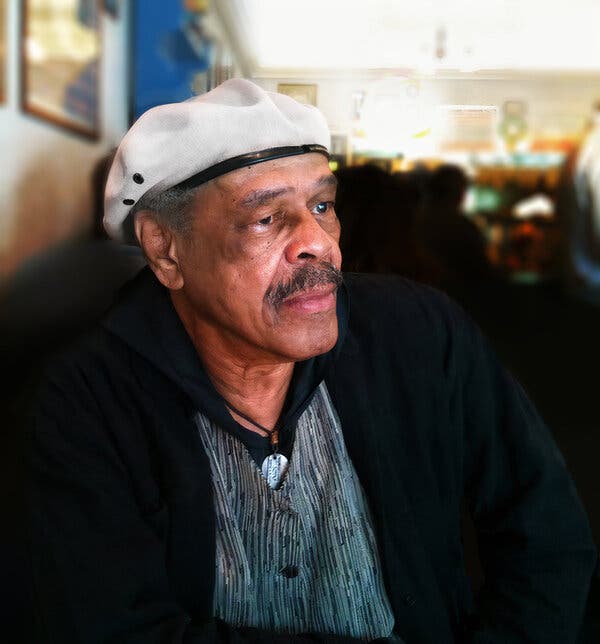
Dr. Taylor in 2010. His extensive work in the academic world and beyond made him a lodestar for generations of younger scholars. Credit: via Taylor family

He attended Wayne State University in Detroit for his doctorate, which he received in 1968 with a dissertation on the English poet and painter William Blake.

By then he was teaching at California State University, Long Beach, where he became chairman of the Black studies department in 1969. He later taught at U.C.L.A.; the University of California, Berkeley; Stanford; and Mills College (now a part of Northeastern University) in Oakland, Calif., before moving east to Tufts in 1982. He retired from N.Y.U. in 2008.

Dr. Taylor married JoAnn Spencer in 1960; they divorced in 1970. His second marriage, to Marti Wilson, also ended in divorce. Along with his daughter Ms. Taylor, he is survived by a granddaughter. Another daughter, Shelley Zinzi Taylor, died in 2007.

Although he wrote just one major book, “The Mask of Art: Breaking the Aesthetic Contract — Film and Literature” (1998), Dr. Taylor was prolific in other ways.

With Beth Deare, he wrote the script for the documentary “Midnight Ramble” (1994), about the early Black filmmaker Oscar Micheaux. He also curated several major museum exhibits, wrote extensively in journals like Jump Cut and Black Film Review, and appeared as a commentator in documentaries about Black actors like Paul Robeson and Sidney Poitier.

Such work made him a lodestar for generations of younger scholars, and a gravitational center of Black cultural studies even today.

“You have to deal with Clyde if you talk about Black cinema,” Manthia Diawara, a professor of film studies at New York University, said by phone, “just as you have to deal with certain people if you talk about African-American literature.”

Clay Risen is a Times reporter on the Obituaries desk. More about Clay Risen

A version of this article appears in print on Feb. 8, 2024, Section B, Page 12 of the New York edition with the headline: Clyde Taylor, 92, Scholar Who Elevated Black Cinema. Order Reprints | Today’s Paper


https://amsterdamnews.com/news/2024/02/13/eminent-literary-and-film-scholar-dr-clyde-taylor-dies-at-92/


Obits
 
Eminent literary and film scholar Dr. Clyde Taylor dies at 92

by Herb Boyd
February 13, 2024
Amsterdam News


PHOTO: Clyde Taylor courtesy of NYU Gallatin School

“We live in days of Great Change, a shuffling of status and symbols,” Dr. Clyde Taylor wrote in 1973. “Yeats’ cry ‘Things fall apart, the centre cannot hold’ is good news in the Third World; a ferment rises in the young bloods in the bush. And stepping out of the shelter of their place in the shadows of American exceptionalist rationalizations.”

Taylor, an example of the activist scholars of his day, composed this as part of an essay about “Black Consciousness in the Vietnam Years,” reflective of his stance against the Vietnam War. That strong voice of the Black liberation movement took a final breath on January 24. He was 92 and died in Los Angeles. According to his daughter, Rahdi Taylor, the cause of his death was chronic obstructive pulmonary disease.

Born Clyde Russell Taylor on July 3, 1931, in Boston, he was the youngest of eight children of his parents, Frank and E. Alice (Tyson) Taylor. His father was a member of the legendary Brotherhood of Sleeping Car Porters, and his mother was an entrepreneur who was active with the NAACP’s Boston chapter.

Not much is known of Taylor’s formative years, although we do know that he was a graduate of English High School and later Howard University, where he received his B.A. degree in 1953 and six years later, his master’s in the same subject. It was there that he met several Black literary and political activists, including Toni Morrison and Amiri Baraka.

After graduation from Howard, Taylor enlisted in the Air Force as an intelligence officer and left service as a first lieutenant; he was honorably discharged with a National Defense Service Medal. At Wayne State University in Detroit, he earned his doctorate with a dissertation on the works of William Blake and the ideology of art. In 1960, he married JoAnn Spencer and they had two daughters, Rahdi and Shelley Zinzi Taylor. They divorced in 1970.

Two years later, Taylor moved to San Francisco and married Martella Wilson. Together, they founded the African Film Society. By the mid-’90s, the marriage had dissolved. Taylor moved to New York City and began teaching at New York University.

Throughout these turbulent times, Taylor was on the ramparts of the Black studies movement, particularly at UCLA, with a critical role in advancing revolutionary cinema, most notably as a presenter and commentator: “The making of ‘O Povo Organizado’ [‘The People Organized’] in Mozambique by Bob Van Lierop, an African American, or of ‘Sambizanga,’ about Angola by Guadoupian Sara Maldoror, or the Ethiopian Haile Gerima’s ‘Bush Mama,’ set in Los Angeles, or Pontecorvo’s ‘The Battle of Algiers,’ or the several Latin American and African films created by Cubans, or the many Third World films made by Europeans and white Americans––all suggest the cross-fertilizations of an embryonic transnational Third World cinema movement.” Taylor figured prominently in this development.

A book certainly could have been forged from Taylor’s extensive study of cinema, and one was published: “The Mask of Art: Breaking the Aesthetic Contract––Film and Literature in 1988.”

In one of his last essays, Taylor expounded on the differences between Africa and Hollywood: “Africa stands today (2021) at the other end of the spectrum from Hollywood. If Americans view cinema from the center of profitable, monopolistic production and distribution, Africa is a laboratory for the study of film’s relation to society from the vantage point of the exploited.”

Right down to the end of his extraordinary life, Clyde Taylor possessed a keen analysis and passionate commitment to the world of cinema and its prospects here and abroad.


https://gallatin.nyu.edu/news/2024/02/clyde-taylor--nyu-gallatin-professor-emeritus--passes-away.html
 
 
Clyde Taylor, NYU Gallatin Professor Emeritus, Passes Away
February 12, 2024
New York University


Clyde Taylor, Professor Emeritus at the NYU Gallatin School of Individualized Study, and a scholar whose work was integral to elevating Black cinema as an art form, died on January 24, 2024. He was 92.

At the beginning of his career as a professor in the late 1960s in the Los Angeles area, Dr. Taylor was a leader in bringing the study of Black culture, including Black film, into the academy. He saw Black culture as having its own logic, history, and dynamics, and he felt that filmmaking was as integral to Black culture as art and literature. According to e. Frances White, Professor Emerita of Individualized Study and former Dean at Gallatin, "Dr. Taylor's work on Black cinema helped students and young filmmakers see a way to produce Black art when there appeared to be no way for them to express themselves."

Dr. Taylor was especially intrigued by a group of young Black filmmakers in the 1970s that included Charles Burnett, Julie Dash, Billy Woodberry, and Haile Gerima. A circle he would come to call the “LA Rebellion,” these directors innovated their own approach to narrative and form—an approach that would eventually have an outsized impact on the likes of Ava DuVernay and Spike Lee.

Dr. Taylor joined the NYU Gallatin community in the Fall of 1997 having already established himself as a pioneer in the field of Black Cinema Studies. As an exemplar of the School’s interdisciplinary approach to teaching, learning, and research, his interests ranged from art criticism and curation to political theory and social movements, from literature to epistemology, and so much more. Founding Gallatin Professor Emerita Sharon Friedman shares that Dr. Taylor “was always challenging us to think more adventurously,” an apt reflection on his own academic range.

The courses he taught at Gallatin were a wonderful showcase of this range, with such titles as “Slavery and Culture in the US and Brazil,” “Narratives of African Civilization,” and “Modernism and Imperialism: Objects of Transcultural Desire.” Dr. Taylor’s professional work also highlighted his broad focus of scholarship, inquiry, and exploration. His book The Mask of Art: Breaking the Aesthetic Contract - Film and Literature (1998) is a cornerstone text across disciplines, as are his edited collections Vietnam and Black America (1973) and Black Genius (2000), his documentary on Oscar Micheaux (1994), and his curation of exhibits at the Whitney Museum of American Art and the Brooklyn Museum.

Following Dr. Taylor’s retirement in 2008, and in recognition of his contributions to the School and the fields he helped define, Gallatin created the Clyde Taylor Award for Distinguished Work in African-American and Africana Studies. This honor is offered to one graduating BA student and one graduating MA student each year to recognize their high-caliber work in African American or Africana Studies.

We at Gallatin were fortunate to benefit from Dr. Taylor’s groundbreaking work, scholarship, and teaching, and we join his loved ones and those who he impacted in celebrating his life and mourning his loss.

https://en.wikipedia.org/wiki/Clyde_Taylor

Dr. Clyde Taylor
1931-2024


Born
July 3, 1931


Boston, Massachusetts, U.S.

Died
January 24, 2024 (aged 92)


Los Angeles, California, U.S.

Citizenship: American

Occupation(s): Film scholar, writer, and cultural critic

Children:  2


Clyde Russell Taylor (July 3, 1931 – January 24, 2024) was an American film scholar, writer and cultural critic who made contributions to the fields of cinema studies and African American studies. He was an emeritus professor at New York University. His scholarship and commentary often focused on Black film and culture.
 
Career

Clyde Taylor wrote and published numerous scholarly articles, essays, and reviews.[1] Taylor is best known for coining the term 'L.A. Rebellion', which refers to the group of African American filmmakers who emerged from the UCLA School of Theater, Film and Television in the 1970s.[2][3][4] This movement was characterized by its emphasis on social realism and its rejection of Hollywood conventions.

Clyde held faculty positions at UC Berkeley, Stanford University, and Mills College, then returned to Boston for a position in the Department of English at Tufts University.[5][6][7] After over a decade at Tufts University, Taylor accepted a position at New York University.[8] He remained at NYU in the Gallatin School of Individualized Study and the Department of Africana Studies, until he retired, Professor Emeritus in 2008.

Taylor was the author of the book, The Mask of Art: Breaking the Aesthetic Contract – Film and Literature (Indiana University Press, 1998), which was awarded the PEN Oakland/Josephine Miles Literary Award in 1999.[9][10] He co-wrote the screenplay for Midnight Ramble, a seminal feature documentary about the work and legacy of Oscar Micheaux released by American Experience on PBS in 1995.[11] He was a frequent contributor to journals such as Black Film Review and Jump Cut.[12][13][14][15][16][17]

Other accolades for Taylor included induction into the National Literary Hall of Fame for Writers of African Descent, by the Gwendolyn Brooks Cultural Center; the 1982 Callaloo Creative Writing Award for Non-Fiction Prose, an "Indie" Award for critical writing on cinema of people of color from the Association of Independent Video and Film (AIVF); and the Richard Wright Award for Literacy Criticism from Black World.[18][19] He was the recipient of a FulbrightFellowship, as well as Fellowships from the Rockefeller Foundation (Whitney Scholar-in-Residency Fellowship), the Ford Foundation Fellowship (DuBois Institute, Harvard University), the Rockefeller Foundation (Fellowship, NYU Center for Culture, Media and History), as well as two Fellowships from the National Endowment for the Humanities.
 
Early life

Clyde Taylor was born in Boston, Massachusetts on July 3, 1931, the youngest of eight children, to E. Alice Taylor and Frank Taylor. He graduated from The English High School and later from Howard University.

Once at Howard University, Clyde studied in the Department of English in collegial engagement with fellow students like Amiri Baraka and Toni Morrison. At Howard he studied under professors such as Alain LeRoy Locke. Taylor earned both Bachelor’s and Master’s degrees in English.

After graduation, Taylor enlisted in the United States Air Force as an intelligence officer, earning the rank of First Lieutenant. He was honorably discharged and recognized with a National Defense Service Medal. He continued his studies, pursuing a graduate degree in English at Wayne State University in Detroit, MI. He wrote his dissertation on the works of William Blake and the Ideology of Art, and earned a Ph.D.[20]
Personal life

While at Wayne State University, he met student JoAnn Spencer from Detroit, pursuing her degree in education. They married in June 1960 in Detroit and had two children, daughters Shelley Zinzi Taylor and Rahdi Taylor. Their marriage dissolved in 1970. In 1972, Taylor moved to the San Francisco Bay Area, where he went on to marry Martella Wilson, a young leader in the world of philanthropy and social impact charities. Together they co-founded and led the African Film Society, which hosted screenings of cinema from Western Africa and discussions of their aesthetic and social vision. In the mid 90s, the couple dissolved the marriage but continued living and working in Boston until Taylor moved to Manhattan for a position at New York University in 1998.

Taylor died on January 24, 2024, at the age of 92.[21]


Saturday, March 2, 2024

What's (Really) Happening in America in 2024 As Susan Sontag So Courageously Expressed it in 1967--Whether We "Like It Or Not"...Then Or Now

“What’s Past is Prologue…"

“What's Happening in America” (1966)
by Susan Sontag
Partisan Review, 1967


[This searing, profound, and very prescient piece was later republished in Sontag’s second book of essays Styles Of Radical Will in 1969 and created a firestorm of "controversy" and negative criticism in many political and literary circles throughout the country. However as is so often the case whenever ugly truths about America are told in public, it certainly did not mean--either then or especially now-- that Susan was wrong. Far from it...]


PHOTO: American writer Susan Sontag (1933-2004) in 1972. Photograph: Jean-Regis Rouston/Roger Viollet/Getty Images


Styles of Radical Will is a collection of essays by Susan Sontag published in 1969. Among the subjects discussed are film, literature, politics, and pornography.  It is Sontag's second collection of non-fiction after Against Interpretation, which was published in 1966.


Contents

I.

"The Aesthetics of Silence" (1967)

"The Pornography of Imagination" (1967)

"Thinking Against Oneself": Reflections on Cioran" (1967)

II.

"Theatre and Film" (1966)

"Bergman's Persona" (1967)

"Godard" (1968)

III.

"What's Happening in America" (1966)

"Trip to Hanoi" (1968)

Everything that one feels about this country is, or ought to be, conditioned by the awareness of American power: of America as the arch-imperium of the planet, holding man’s biological as well as his historical future in its King Kong paws. Today’s America, with Ronald Reagan the new daddy in California and John Wayne chawing spareribs in the White House, is pretty much the same Yahooland that Mencken was describing. The main difference is that what’s happening in America matters so much more in the late 1960s than it did in the 1920s. Then, if one had tough innards, one might jeer, sometimes affectionately, at American barbarism and find American innocence somewhat endearing. Both the barbarism and the innocence are lethal, outsized today.

First of all, then, American power is indecent in its scale. But also the quality of American life is an insult to the possibilities of human growth; and the pollution of American space, with gadgetry and cars and TV and box architecture, brutalizes the senses, making gray neurotics of most of us, and perverse spiritual athletes and strident self-transcenders of the best of us.

Gertrude Stein said that America is the oldest country in the world,. Certainly its most conservative. It has the most to lose by change (sixty percent of the world’s wealth owned by a country containing six percent of the world’s population). Americans know their backs are against the wall: “they” want to take all that away from “us.” And, I think, America deserves to have it taken away.

Three facts about this country:

America was founded on a genocide, on the unquestioned assumption of the right of White Europeans to exterminate a resident, technologically backward, colored population in order to take over the continent.

America had not not only the most brutal system of slavery in modern times but a unique juridical system (compared with other slaveries, say in Latin America and the British colonies) which did not, in a single respect, recognize slaves as persons.

As a country – as distinct from a colony – America was created mainly by the surplus poor of Europe, reinforced by a small group who were just Europamude, tired of Europe (a literary catchword of the 1840s). Yet even the poorest knew both a “culture,” largely invented by his social betters and administered from above, and a “nature” that had been pacified for centuries. These people arrived in a country where the indigenous culture was simply the enemy and was in the process of being ruthlessly annihilated, and where nature, too, was the enemy, a pristine force, unmodified by civilization, that is, by human wants, which had to be defeated. After America was “won,” it was filled up by new generations of poor and built up according to the tawdry fantasy of the good life that culturally deprived, uprooted people might have at the beginning of the industrial era. And the country looks it.

Foreigners extol the American “energy,” attributing to it both our unparalleled economic prosperity and the splendid vivacity of our arts and entertainment. But surely this is energy bad at its source and for which we pay too high a price, a hypernatural and humanly disproportionate dynamism that flays everyone’s nerves raw. Basically it is the energy of violence, of free-floating resentment and anxiety unleashed by chronic cultural dislocations which must be, for the most part, ferociously sublimated. This energy has mainly been sublimated into crude materialism and acquisitiveness. Into hectic philanthropy. Into benighted moral crusades, the most spectacular of which was Prohibition. Into an awesome talent for uglifying countryside and cities. Into loquacity and torment of a minority of gadflies: artists, prophets, muckrakers, cranks, and nuts. And into self-punishing neurosis. But the naked violence keeps breaking through, throwing everything into question.

Needless to say, America is not the only violent, ugly, and unhappy country on this earth. Again, it is a matter of scale,. Only three million Indians lived here when the white man arrived, rifle in hand, for his fresh start. Today American hegemony menaces the lives not of three million but of countless millions who, like the Indians, have never even heard of the “United States of America,” much less of its mythical empire, the “free world.” American policy is still powered by the fantasy of Manifest Destiny, though the limits were once set by the borders of the continent, whereas today America’s destiny embraces the world. There are still more hordes of redskins to be mowed down before virtue triumphs; as the classic Western movies explain, the only good Red is a dead Red. This may sound like an exaggeration to those who live in the special and more finely modulated atmosphere of New York and its environs. Cross the Hudson. You find out that not just some Americans but virtually all Americans feel that way.

Of course, these people don’t know what they’re saying, literally. But that’s no excuse. That, in fact, is what makes it all possible. The unquenchable American moralism and the American faith in violence are not just twin symptoms of some character neurosis taking the form of a protracted adolescence, which presages an eventual maturity. Thy constitute a full-grown, firmly installed national psychosis, founded, as are all psychoses, on the efficacious denial of reality. So far it’s worked. Except for portions of the South a hundred years ago, America has never known war. A taxi driver said to me on the day that could have been Armageddon, when America and Russia were on collision course off the shores of Cuba : “Me, I’m not worried. I served in the last one, and now I’m over draft age. They can’t get me again. But I’m for letting ‘em have it right now. What are we waiting for? Let’s get it over with.” Since wars always happen Over There, and we always win, why not drop the bomb? If all it takes is pushing a button, even better. For America is that curious hybrid – an apocalyptic country and a valetudinarian country. The average citizen may harbor the fantasies of John Wayne, but he as often has the temperament of Jane Austen’s Mr. Woodhouse.
But to answer some of the questions:

1.

I do not think that Johnson is forced by “our system” to act as he is acting: for instance, in Vietnam, where each evening he personally chooses the bombing targets for the next day’s missions. I think there is something awfully wrong with a de facto system which allows the President virtually unlimited discretion in pursuing an immoral and imprudent foreign policy, so that the strenuous opposition of, say, the Chairman of the Senate Foreign Relations Committee counts for exactly nothing. The de jure system vests the power to make war in Congress – with the exception, apparently, of imperialist adventures and genocidal expeditions. These are best left undeclared.

However, I don’t mean to suggest that Johnson’s foreign policy is the whim of a clique which has seized control, escalated the power of the Chief Executive, castrated the Congress, and manipulated public opinion. Johnson is, alas, all too representative. As Kennedy was not. If there is a conspiracy, it is (or was) that of the more enlightened national leaders hitherto largely selected by the Eastern-seaboard plutocracy. They engineered the precarious acquiescence to liberal goals that has prevailed in this country for over a generation – a superficial consensus made possible by the strongly apolitical character of a decentralized electorate mainly preoccupied with local issues. If the Bill of Rights were put to a national referendum as a new piece of legislation, it would meet the same fate as New York City’s Civilian Review Board. Most of the [people in this country believe what Goldwater believes, and always have. But most of them don’t know it. Let’s hope they don’t find out.

2.

I do not think white America is committed to granting equality to the American Negro. So committed are only a minority of white Americans, mostly educated and affluent, few of whom have had any prolonged social contact with Negroes. This is a passionately racist country; it will continue to be so in the foreseeable future.
 
3.

I think that this administration’s foreign policies are likely to lead to more wars and to wider wars. Our main hope, and the chief restraint on American bellicosity and paranoia, lies in the fatigue and de-politicization of Western Europe, the lively fear of America and of another world war in Russia and the Eastern European countries, and the corruption and unreliability of our client states in the Third World. It’s hard to lead a holy war without allies. But America is just crazy enough to try to do it.

4.

The meaning of the split between the Administration and intellectuals? Simply that our leaders are genuine yahoos, with all the exhibitionist traits of their kind, and that liberal intellectuals (whose deepest loyalties are to an international fraternity of the reasonable) are not that blind. At this point, moreover, they have nothing to lose by proclaiming their discontent and frustration. But it’s well to remember that liberal intellectuals, like Jews, tend to have a classical theory of politics, in which the state has a monopoly of power; hoping that those in positions of authority may prove to be enlightened men, wielding power justly, they are natural, if cautious, allies of the “establishment.” As Russian Jews knew they had at least a chance with the Czar’s officials but none at all with marauding Cossacks and drunken peasants, liberal intellectuals more naturally expect to influence the “decisions” of administrators than they do the volatile “feelings” of masses. Only when it becomes clear that, in fact, the government itself is being staffed by Cossacks and peasants, can a rupture like the present one take place.

When (and if) the man in the White House who paws people and scratches his balls in public is replaced by a man who dislikes being touched and finds Yevtushenko “an interesting fellow”, American intellectuals won’t be so disheartened. The vast majority of them are not revolutionaries. Wouldn’t know how to be if they tried. Mostly a salaried professoriat, they’re as much at home in the system when it functions a little better than it does right now as anyone else.

5.

Yes, I do find much promise in the activities of young people. About the only promise one can find anywhere in this country today is the way some young people are carrying on, making a fuss. I include both their renewed interest in politics (as protest and as community action, rather than as theory) and the way they dance, dress, wear their hair, riot, make love. I also include the homage they pay to Oriental thought and rituals. And I include, not least of all, their interest in taking drugs – despite the unspeakable vulgarization of this project by Leary and others.

A year ago Leslie Fiedler, in a remarkably wrongheaded and interesting essay titled “The New Mutants,” called attention to the fact that the new style of young people indicated a deliberate blurring of sexual differences, signaling the creation of a new breed of youthful androgens. The longhaired pop groups with their mass teenage following and the tiny elite of turned-on kids from Berkeley to the East Village were both lumped together as representatives of the “post-humanist” era now upon us, in which we witness “radical metamorphosis of the Western male, a “revolt against masculinity,” even “a rejection of conventional male potency.” For Fiedler, this new turn in personal mores, diagnosed as illustrating a “programmatic espousal of an anti-puritanical mode of existence,” is something to deplore. (Though sometimes, in his characteristic have-it-both-ways manner, Fiedler seemed to be vicariously relishing this development, mainly he appeared to be lamenting it.) But why, he never made explicit. I think it is because he is sure such a mode of existence undercuts radical politics, and its moral visions, altogether. Being radical in the older sense (some version of Marxism or socialism or anarchism) meant to be attached still to traditional “puritan” values of work, sobriety, achievement, and family founding. Fiedler suggests, as have Philip Rahv and Irving Howe and Malcolm Muggerridge among others, that the new style of youth must be, at bottom, apolitical, and their revolutionary spirit a species of infantilism. The fact that the same kid joins SNCC or boards a Polaris submarine or agrees with Conor Cruise O’Brien and smokes pot and is bisexual and adores the Supremes is seen as a contradiction, a kind of ethical fraud or intellectual weak-mindedness.

I don’t believe this is so. The depolarizing of the sexes, to mention the element that Fiedler observes with such fascination, is the natural, and desirable, next stage of the sexual revolution (its dissolution, perhaps) which has moved beyond the idea of sex as a damaged but discrete zone of human activity, beyond the discovery that “society” represses the free expression of sexuality (by fomenting guilt), to the discovery that the way we live and the ordinarily available options of character repress almost entirely the deep experience of pleasure, and the possibility of self-knowledge. “Sexual freedom” is a shallow, outmoded slogan. What, who is being liberated? For older people, the sexual revolution is an idea that remains meaningful. One can be for or against it; if one is for it, the idea remains confined within the norms of Freudianism and its derivatives. But Freud was a puritan, or “a fink,” as one of Fiedler’s students distressingly blurted out. So was Marx. It is right that young people see beyond Freud and Marx. Let the professors be the caretakers of this indeed precious legacy, and discharge all the obligations of piety. No need for dismay if the kids don’t continue to pay the old dissenter-gods obeisance.

It seems to me obtuse, though understandable, to patronize the new kind of radicalism, which is post-Freudian and post-Marxian. For this radicalism is as much an experience as an idea. Without the personal experience, if one is looking in from the outside, it does look messy and almost pointless. It’s easy to be put off by the youngsters throwing themselves around with their eyes closed to the near-deafening music of the discotheques (unless you’re dancing ,too), by the long-haired marchers carrying flowers and temple bells as often as “Get Out of Vietnam” placards, by the inarticulateness of a Mario Savio. One is also aware of the high casualty rate among this gifted, visionary minority among the young, the tremendous cost in personal suffering and in mental strain. The fakers, the slobs, and the merely flipped-out are plentiful among them. But the complex desires of the best of them: to engage and to “drop out”; to be beautiful to look at and touch as well as to be good; to be loving and quiet as well as militant and effective – these desires make sense in our present situation.

To sympathize, of course, you have to be convinced that things in America really are as desperately bad as I have indicated. This is hard to see; the desperateness of things is obscured by the comforts and liberties that America does offer. Most people, understandably, don’t really believe things are that bad.. That’s why, for them, the antics of this youth can be no more than a startling item in the passing parade of cultural fashions, to be appraised with a friendly but essentially weary and knowing look. The sorrowful look that says: I was a radical, too, when I was young. When are these kids going to grow up and realize what we had to realize, that things never are going to be really different, except maybe worse?

From my own experience and observation, I can testify that there is a profound concordance between the sexual revolution, redefined, and the political revolution, redefined. That being a socialist and taking certain drugs (in a fully serious spirit: as a technique for exploring one’s consciousness, not as an anodyne or a crutch) are not incompatible, that there is no incompatibility between the exploration of inner space and the rectification of social space. What some of the kids understand is that it’s the whole character structure of modern American man, and his imitators, that needs re-hauling. (Old folks like Paul Goodman and Edgar Z. Friedenberg have, of course, been suggesting this for a long time.) That re-hauling includes Western “masculinity,” too. They believe that some socialist remodeling of institutions and the ascendance, through electoral means or otherwise, of better leaders won’t change anything. And they are right.

Neither do I dare deride the turn toward the East (or more generally, to the wisdoms of the non-white world) on the part of a tiny group of young people –however uninformed and jejune the adherence usually is. (But then, nothing could be more ignorant than Fiedler’s insinuation that Oriental modes of thought are “feminine” and “passive,” which is the reason the de-masculinized kids are drawn to them.) Why shouldn’t they look for wisdom elsewhere? If America is the culmination of Western white civilization, as everyone from the Left to the Right declares, then there must be something terribly wrong with Western white civilization. This is the painful truth; few of us want to go that far. It’s easier, much easier, to accuse the kids, to reproach them for being “non-participants in the past” and “drop-outs from history.” But it isn’t real history Fiedler is referring to with such solicitude. It’s just our history, which he claims is identical with “the tradition of the human,” the tradition of “reason” itself. Of course, it’s hard to assess life on this planet from a genuinely world-historical perspective; the effort induces vertigo and seems like an invitation to suicide. But from a world-historical perspective, that local history which some young people are repudiating (with their fondness for dirty words, their peyote, their macrobiotic rice, their Dadaist art, etc.) looks a good deal less pleasing and less self-evidently worthy of perpetuation.

The truth is that Mozart, Pascal, Boolean algebra, Shakespeare, parliamentary government, baroque churches, Newton, the emancipation of women, Kant, Marx and Balanchine ballets don’t redeem what this particular civilization has wrought upon the world. The white race is the cancer of human history; it is the white race and it alone –its ideologies and inventions –which eradicates autonomous civilizations wherever it spreads, which has upset the ecological balance of the planet, which now threatens the very existence  of life itself. What the Mongol hordes threaten is far less frightening than the damage that Western “Faustian” man, with his idealism, his magnificent art, his sense of intellectual adventure, his world-devouring energies for conquest, has already done, and further threatens to do.

This is what some kids sense, though few of them could put it in words. Again, I believe them to be right. I’m not arguing that they’re going to prevail, or even that they’re likely to change much of anything in this country. But a few of them may save their own souls. America is a fine country for inflaming people, from Emerson and Thoreau to Mailer and Burroughs and Leo Szilard and John Cage and Judith and Julian Beck, with the project of trying to save their own souls. Salvation becomes almost a mundane, inevitable goal when things are so bad, really intolerable.

One last comparison, which I hope won’t seem farfetched. The Jews left the ghetto in the early nineteenth century, thus become a people doomed to disappear. But one of the by-products of their fatal absorption into the modern world was an incredible burst of creativity in the arts, science, and secular scholarship – the relocation of a powerful but frustrated spiritual energy. These innovating artists and intellectuals were not alienated Jews, as is said so often, but people who were alienated as Jews.

I’m scarcely more hopeful for America than I am for the Jews. This is a doomed country, it seems to me; I only pray that, when America founders, it doesn’t drag the rest of the planet down, too. But one should notice that, during its long elephantine agony, America is also producing its subtlest minority generation of a decent and sensitive, young people who are alienated as Americans. They are not drawn to the stale truths of their sad elders (though these are truths). More of their elders should be listening to them.

Partisan Review, Winter, 1967