Showing posts with label Political and economic elites. Show all posts

Thursday, January 18, 2024

How To Systematically Kill Critical Thought, Ethical Outrage, and Political Dissent While Pretending That The Killers/Liars Are the Actual Victims: The Deadly Tragedy of the Fred Dube Story And What It Continues To Mean Today


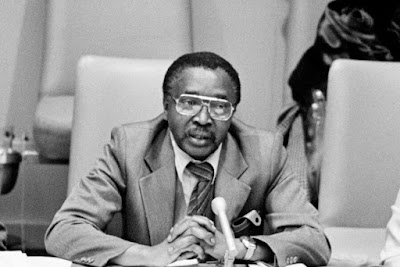
PHOTO: Fred Dube at a 1981 UN meeting, “South African Women and Labour under Apartheid.” Image: UN Photo

Politics

Africa, Anti-Semitism, Education, Israel and Palestine, Race
 
The Silencing of Fred Dube

Forty years ago, the exiled South African activist dared to teach Zionism critically. A furious backlash ensued.

by Abena Ampofoa Asare
January 18, 2024
Boston Review


At the State University of New York at Stony Brook, the syllabus for an Africana Studies summer course entitled The Politics of Race includes prompts for students in need of term paper guidance. The twelve optional topics are deliberately provocative: “Can a Christian or a democrat be a racist?” “I.Q. tests are a means for blaming the victim.” “Zionism is as much racism as Nazism was racism.” A historian visiting from Israel’s Ben-Gurion University complains that the latter topic, thus the course, thus the professor are examples of anti-Semitism. An uproar ensues.

This year is 1983. The professor under scrutiny is Ernest Frederick Dube, the South African anti-apartheid activist, Robben Island survivor, Cornell-trained psychologist, husband, and father. Branded as an anti-Semite, he will be gone from the Stony Brook campus by 1987.

The fear and silencing on college campuses today is not arbitrary or new. It is rigorously and virulently inculcated.

When I began teaching at Stony Brook, my colleagues in Africana Studies told me Dube’s story in different ways. Each time, I understood the lesson: the politics of Israel-Palestine are cordoned-off; they are an arena where you dare not tread. Even when, like Dube, your faculty peers support you, students lead protests against your dismissal, and you are a hero of the South African anti-apartheid movement, you may still end up losing your home and position.

Colleagues outside my department do not know of the Dube affair, but they, like faculty across the United States, are inexorably caught in its gravity. House Resolution 894, eight-hour congressional hearings, push-outs of university presidents, and draconian university policies make it plain: a political firestorm awaits American professors, university administrators, and students who refuse the reductive scripts of Israeli nationalism in public. Before Israel’s latest siege on Gaza and the atrocities of October 7, before the existence of Hamas, before the Canary Mission’s doxxing campaigns, there was Fred Dube.

His story is a spectacular example of how mere complaints can morph into crises when they trigger levers of power. Over the decades, there have been many Fred Dubes, a parade of losses that testifies to the cost of speaking out about Israel’s nationalist violence (which, of course, is endemic to the nation-state and is neither religiously rooted nor exceptional). Cultural theorist Ariella Aisha Azoulay speaks of an “ideological campaign of terror” weaponizingaccusations of anti-Semitism against those who refuse to unsee the region’s violence. Decades of reprisal have produced a practice of stilted sentences, empty platitudes, and maddening silence in institutions that would be bastions of critical thought.

The fear and silencing on college campuses today is not arbitrary or new. It is a policy passed down from generation to generation; it is rigorously and virulently inculcated, dangerous both because of whom it harms and what it buries.

In 1983 a student shared the syllabus from Dube’s summer class with a visiting historian from Israel’s Ben-Gurion University. Incensed, the scholar fired off a two-page letter to Stony Brook’s Dean of Social and Behavioral Sciences, the Vice Provost, the Provost, and fourteen members of the faculty, accusing Dube of the “sloganeering that is practiced by the anti-Semite.” Before doing so, the historian never broached his concern with Dube or attended any of Dube’s classes, which he had taught at the university since 1977 without any complaint. The allegations against Dube were launched on the visiting historian’s very last day at the school; his moment of outrage, though, generated enough heat to explode Dube’s career and send shockwaves through the campus.

Shortly after it was sent, the complaint escalated into a national controversy. The Long Island chapter of the Anti-Defamation League (ADL) of B’nai B‘rith, which had gotten hold of the letter, mounted a publicity and lobbying campaign insisting that Dube’s course and teaching were anti-Semitic and should not be allowed to continue. In 1975 the same ADL chapter had lodged a complaint about the university’s affirmative action policy and successfully pushed Stony Brook to back away from a commitment to matriculate “women, minorities, and low-income applicants” at the new health sciences center. This time, the ADL’s concerns were not met with immediate acquiescence. A faculty committee investigated the summer course and found that “the bounds of academic freedom had not been crossed”; campus administrators concurred.

The Long Island ADL’s regional director, Rabbi Arthur Seltzer, was not pleased with the conclusion. Days after the findings were announced, he ushered the matter directly to Albany. At the state capital, governor Mario Cuomo responded swiftly, issuing a statement. Dube’s teaching was a “justification for genocide” and “intellectually dishonest,” he declared; the faculty support for him was unfathomable. Once Albany had spoken, Stony Brook president Marburger also published a letter declaring the linkage between Zionism, racism, and Nazism “abhorrent,” and calling for circumspection and sensitivity.

When a faculty committee found that “the bounds of academic freedom had not been crossed,” an ADL regional director escalated the case to governor Mario Cuomo.

For the communities mobilized against Dube, this was still not enough. The newspaper Jewish Press recommended “a complete investigation of the credentials of every member of the Stony Brook faculty.” The secretary of the Long Island Association of Reform Rabbis called for President Marburger’s resignation. In an op-ed, Yeshiva University vice president Emanuel Rackman lamented that at Stony Brook, “anti-Semitism was made intellectually respectable in the name of academic freedom.” Rackman’s strongest criticism was reserved for Stony Brook’s Jewish faculty, who had largely affirmed Dube’s freedom to teach critically. These colleagues, Rackman averred, were “act[ing] just as did the wealthy Jews of Germany when Hitler rose to power.” Ironically, a syllabus sentence that referenced the Nazis to question the trajectory of Zionism was publicly outrageous; an opinion article that referenced the same to question the morality of Stony Brook’s Jewish faculty was publicly acceptable.

During this time, letters started flooding President Marburger’s office from alumni claiming that they would withhold donations and warn Jewish students to avoid Stony Brook. State lawmakers threatened the university budget. The SUNY Board of Trustees chairman, Donald Blinken, issued a public statement “denouncing the comparison of Zionism and Nazism as a ‘reprehensible distortion of reality.’” In the face of a recognizable storm—donors, politicians, alumni—President Marburger acted. He issued a new statement officially “divorcing” the university from the views in Dr. Dube’s course and began attending public relations meetings with community members at local synagogues. His administration appointed a special Commission on Faculty Rights and Responsibilities to “review courses dealing with race and sex.” Later, the university sponsored a symposium on “Academic Freedom, Academic Responsibility and Society” featuring Rabbi Arthur Seltzer as one of the panelists. Marburger even promised to establish a new Stony Brook Regional Relations Advisory Council, a development that the ADL praised as an opportunity to “provide significant community input” into the university’s academic mission. In the 1983–84 academic year, Dube’s faculty peers offered affirmations of academic freedom, the program of Africana Studies held teach-ins, and there were passionate student marches and glowing interviews with students enrolled in his classes. However, from the first complaint against Dube through his tenure application, appeal, and eventual tenure denial and termination, Blinken and Chancellor Clifton Wharton would receive a steady stream of direct correspondence urging the university to deal with the problem of Fred Dube.

The threats facing Dube were not limited to his professional reputation or his department’s budget. In the same year, the Jewish Defense League, a radical organization that the Southern Poverty Law Center says “preaches a violent form of anti-Arab, Jewish nationalism” and its more militant wing, the Jewish Defense Organization (JDO), came onto the Stony Brook campus, organizing protests and putting up flyers about Dube. In November, Mordecai Levy of the JDO entered the offices of the Africana Studies department demanding that Dube either apologize or resign.

Before leaving campus, the JDO handed out leaflets bearing their symbol, a machine gun inside a star of David, accompanied by the text “Fire Dube or Else.” In the student newspaper, the Statesman, Levy promised that the pressure was only beginning. “We plan to make it as unhealthy as possible to be an anti-Semite. Dube’s phone number and address have been given out. We are going to drive him crazy,” he wrote. Several days later, a member of the JDO entered and attempted to disrupt an Africana Studies class. Then, alongside harassing phone calls and threats, Dube’s home in Uniondale was broken into and vandalized. Throughout this period, Fred Dube continued teaching, speaking, and building his profile; soon he would be up for tenure.

When SUNY Stony Brook Dean Robert Neville vetoed Dube’s tenure in 1985, he did so against the recommendation of the university’s faculty committees. Neville argued that his decision did not reflect acquiescence to the “outsiders who call me at home in the middle of the night to insist I fire him because he says the wrong things about Zionism.” Dube maintained that the administration had caved in to external pressures. Faculty reviewers of Dube’s tenure file noted that he hadn’t published as much as was expected at a research university, even as they recommended tenure. This “lack” of sufficient publications then became the Stony Brook administration’s public justification for his termination. When the campus supported Dube, noting that he was a beloved teacher who brought with him enormous political and cultural resources, the administrators could note that his publications were thin. When Dube appealed his case, the university administrators insisted that his publications were lacking. But to his students (who at one point formed a united front organization and collected over five hundred signatures to send to the Chancellor), Dube was irreplaceable.

If the Dean was still receiving phone harassment about Dube two years after the summer course, what might Dube and his family be facing? During this period his wife, Melta, lost her job and struggled to find another. They abruptly sent their youngest daughter to live with relatives in England. “They needed a scapegoat,” Dube told a crowd of hundreds at a 1985 Stony Brook rally. “I am refusing to be their sacrificial goat!” Still, political pariahdom comes with public and private consequences. The ransacked house, the abrupt move, the charity boxes of food—how do these settle into a family’s story? They can stretch it in unexpected ways: a recurring argument, another bottle of beer, a wrecked car. When the Jewish Defense League claimed responsibility for firebombing the Long Island home of an alleged Nazi war criminal in 1985, Dube and his family had seen enough. They moved out of Uniondale to New York City.


“We are going to drive him crazy,” the JDO promised.

In the 2014 essay “What This Poet’s Body Knows,” Kwame Dawes explores the politics of U.S. racism as a type of “cynical jujitsu,” where the accusation “racist!” becomes the epithet, not the word “n—”. This topsy-turvy weaponization of outrage, for Dawes, is linked to his body. The poet is a “black body exposed and vulnerable” even at the very moment he is said to be a threat, an attacker. The Palestine exception on U.S. campuses depends on a similar “cynical jujitsu”: the suffering of Palestinian bodies, and the harm meted out against those bodies who dare to see it and speak it, is automatically reframed as a threat. The “retort has become the obscenity, the act of violence, the attack.” From the 1980s until today, Fred Dube’s harrowing experience at Stony Brook is unaccounted for.

Twenty years before the Stony Brook summer course, Dube was inside a cell in the infamous Robben Island, caught in the apartheid South African government’s desire to incarcerate, impoverish, and kill Black South Africans’ fight for freedom and equality on their own soil. He spent four years in prison, then left the country as an exile to pursue higher education. Now, in the United States, living for the first time in a country where freedom of speech and academic freedom were valued, at least in name, Dube was “deprived of his job on the basis of the false accusation of anti-Semitism,” an Albany anti-apartheid group argued in 1987. The group, which usually uplifted the cause of freedom fighters in places like Pretoria or Namibia, directed its people to write the SUNY acting chancellor on Dube’s behalf.

This irony of again falling foul of the government, again becoming a political target, did not escape Dube, who remarked to his friends that life as a persona non grata in New York was worse than his situation as a political target in apartheid South Africa. At least in South Africa, he said, everyone understood the reality of life under a repressive government: you and your family didn’t suffer alone. In this peculiar U.S. political milieu, repressive forces used “bureaucracy rather than barbed wire” to bridle free speech, argued Amiri Baraka, then Dube’s colleague. Here there was no cadre with which to traverse this terrain of blacklisting and politicized targeting; his had been made to be an isolated case.

Dube’s political consciousness had been forged outside of the United States, in an entirely different setting. Since the 1960s, he had been part of the African National Congress (ANC), the vanguard political organization that presided over the end of South African apartheid just ten years after the syllabus uproar. Even from his place in exile in the United States, Dube’s scholarship and teaching were part of the struggle: he wanted people to understand that racism blighted both the oppressor and the oppressed.

In the Philosophical Forum, Dube wrote about the multidirectional violence of apartheid’s racism: “The Afrikaner child is in fact the victim, privileged as he may be in other respects, of systematic indoctrination; and the correlative inhibition of critical or independent thinking.” The scholar’s exploration was never solely theoretical. He referenced an unexpected friendship with a prison guard at Robben Island to demonstrate how apartheid psychologically limited white Afrikaners, turned them into cogs in a violent system. Understanding that racism harms both oppressed and oppressor, that these systems have two categories of victims, not just one, was foundational to the reconciliation at the end of South Africa’s apartheid system.

Dube’s challenging and humanizing revolutionary politics were also present in his 1983 SUNY course, The Politics of Race. In one class lecture, Dube discussed a concept he called “reactive racism,” which he defined as “racism that comes from people who are under oppression or were under oppression and use it in self-defense.” He was concerned with how oppressed peoples may come to embrace some of the violent and negative ideologies that they fought against. In his course, he offered two illustrations: the anti-white sentiments of some of his ANC cadre, and the unfolding history of political Zionism.

Both examples were deeply important to Dube. He had watched Israel’s relationship to the South African anti-apartheid struggle shapeshift in his lifetime. The radical core of the ANC’s activists and leaders included many Jewish South Africans, among them some staunch Zionists. Arthur Goldreich, a member of the Jewish Nationalist Movement and veteran of Israel’s war of independence, was also a member of Umkhonto we Sizwe, the armed wing of the ANC. He and Nelson Mandela studied together, drawing military lessons from Zionism, which some ANC members initially viewed as a national liberation movement.

In his work, Dube was concerned with how oppressed peoples may come to embrace some of the violent ideologies they fought against.

In the 1950s and early ‘60s, Israel occasionally criticized South Africa’s racist policies at the United Nations. Apartheid South Africa was quick to retort that this was rank hypocrisy. “They took Israel away from the Arabs after the Arabs lived there for a thousand years. . . . Israel, like South Africa, is an apartheid state,” insisted South African Prime Minister Hendrik Verwoerd. 1948 was both the year of Israel’s founding and the year when Verwoerd’s racist National Party entrenched apartheid as the policy of the South African state. With the occupation of Palestinian territories in 1967, Israel’s relationship to the anticolonial world shifted. The two countries—occupying Israel and apartheid South Africa—began to approach each other diplomatically. By 1976, the South African prime minister John Vorster, a former Nazi sympathizer, was invited for a state visit to Jerusalem. The National Party regime in Pretoria articulated its growing bond with Israel in this way: “Israel and South Africa have one thing above all else in common: they are both situated in a predominantly hostile world inhabited by dark peoples.”

In response to the emerging South Africa–Israel alliance, and amid much controversy, the United Nations passed Resolution 3379 in 1975, which “determined that Zionism is a form of racism and racial discrimination.” In the United States, elected officials like Senator Daniel Patrick Moynihan denounced this resolution as an anti-Semitic Soviet ploy, insisting that the African countries in support were pawns of the USSR.

It was from this vantage point that Dube created a syllabus steeping undergraduates in the complex histories of the ANC, South African apartheid, the UN, and the politics of racism. In his 1983 summer course, Dube referenced UN Resolution 3379 and encouraged students to analyze its validity or invalidity. However, conservative forces on U.S. campuses brook no context or complexity where Israel is concerned.

Four decades after the political firestorm, the scars of Fred Dube’s experience are fresh and weeping. Donald Blinken, the SUNY Board of Trustees chairman who publicly condemned Fred Dube, has passed away. His son Antony, as the U.S. Secretary of State, circumvents Congress to rush weapons to Israel to continue a siege on Gaza that has slaughtered over ten thousand children in one hundred days and counting. Mario Cuomo, the governor who denouncedDube’s teaching and reviled UN Resolution 3379 as a lie “second only to the myths of Nazism,” is also gone. But his son, former governor Andrew Cuomo, calls for the National Guard to be deployed against protesters calling for ceasefire in Gaza. The Israeli-American historian who first accused Dube has lost beloved family members to the atrocities of the October 7 Hamas attack. The International Court of Justice recently held public hearings over ANC-led South Africa’s application accusing Israel of genocide in Gaza.


The question posed on Dube’s syllabus—about the relationship between Zionism and racism—remains as relevant as it was then, although in many places, it still cannot be explored without fear of reprisal. The UN resolution labeling Zionism a form of racism was revoked in 1991 in an effort to get Israel to participate in a peace process. In the United States today, college presidents have lost their jobs over accusations of tolerating anti-Semitism; student groups have been disbanded for daring to speak in support of Palestine; student protesters have been blacklisted from future jobs. In November, three Palestinian college students were shot in the streets of Vermont for wearing a keffiyeh, for speaking Arabic.

Forty years later, Zola Dube remembers losing her father to bitterness over the Stony Brook ordeal. Am I afraid, she asks me, to write about Fred Dube? The cycles continue: the impermissibility of critical dialogue about Israel-Palestine is a lesson that we—faculty, administrators, neighbors, citizens—all learn through experience. The time has come again for Dube’s humanizing analysis. What cannot be named cannot be healed. What we cannot speak of, we can never solve.

Abena Ampofoa Asare
 

ABOUT THE AUTHOR:


Abena Asare is Associate Professor of Modern African Affairs at Stony Brook University. She is author of Truth Without Reconciliation: A Human Rights History of Ghana and When Will the Joy Come: Black Women in the Ivory Tower.

Sunday, January 7, 2024

The Insidious Ongoing Role of Higher Education Elites in the Corrupt Expansion of Censorship, White Supremacy, and Settler Colonialism in Israel, Palestine, and the United States

https://truthout.org/articles/harvard-presidents-ouster-makes-visible-the-rising-power-of-the-far-right/

Harvard President’s Ouster Makes Visible the Rising Power of the Far Right

The same forces targeting Palestine solidarity work are trying to end all campus discussions of anticolonial politics.

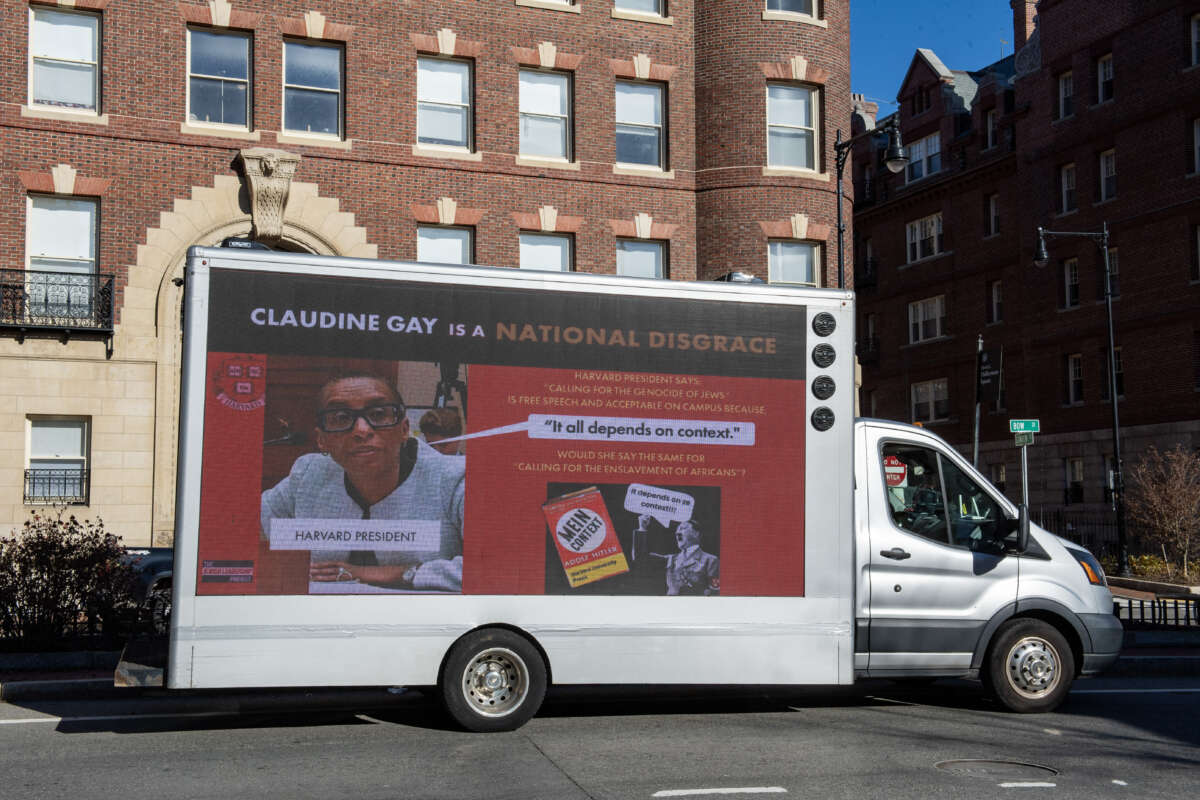
A truck calling the president of Harvard a "national disgrace" drives around Harvard University in Cambridge, Massachusetts, on December 12, 2023. JOSEPH PREZIOSO / AFP via Getty Images

The recent resignation of Harvard’s first African American president, Claudine Gay, which was brought on by an orchestrated campaign mobilized by the far right, made visible the threat of organized fascism on university campuses. Claiming victory, the far right propagandist Christopher Rufo posted on social media: “SCAPLED: Harvard President Claudine Gay Resigns” (and quickly clarified that he meant to write “SCALPED”).

Antisemitism across the U.S., including at universities, is a critical concern. But attempts to identify and counter actual antisemitism are now being muddied by a disingenuous Zionist campaign to suppress all who express solidarity with Palestine by falsely labelling any criticism of the settler-colonial state of Israel and its policies as antisemitism. The organizing logic of this far right project is to surveil, silence and discipline those on university campuses across the U.S. who are speaking up against Zionist settler colonialism and witnessing the violence carried out by Israel. This is done by threatening students and faculty and by targeting their current or prospective employment. Students and faculty who express solidarity with Palestinians have been consistently doxxed and harassed, turned into objects of far right and Zionist hate campaigns.

On October 7, 2023, fighters from Gaza took control of Beit Hanoun crossing and breached the wall Israel had erected alongside the Gaza Strip to keep its 2.3 million residents under permanent imprisonment. Israel responded by bombarding Gaza, and protests emerged across the globe in solidarity with Palestine. Across university campuses, student protests sought to draw attention to the apartheid conditions imposed by Israel’s colonial occupation, outlined the role of colonization as the foundational driver of violence, and called for a ceasefire. In a statement authored by the Harvard University Palestine Solidarity Committee and signed by 33 other student organizations, Israeli settler colonialism has been described as the root cause of the violence. This analysis is aligned with the analysis of the violence offered by Amnesty International: “The root causes of these repeated cycles of violence must be addressed as a matter of urgency. This requires upholding international law and ending Israel’s 16-year-long illegal blockade on Gaza, and all other aspects of Israel’s system of apartheid imposed on all Palestinians.” 

An organized campaign by Zionists, working alongside far right propagandists, has targeted protests that stood in solidarity with Palestine and critiqued Israeli settler colonialism, manufacturing a campus crisis. At the City University of New York (CUNY), the chancellor deployed additional security on campus in spaces where Arab, Muslim and Jewish students gather, and several events expressing solidarity with Palestine were cancelled. The chancellor’s letter to the campus community noted, “University property and platforms, including CUNY computers and email addresses, cannot be used to promote political activities or agendas.”

Frank Wu, the president of Queens College at CUNY flagged a social media post by the school’s Muslim Student Association to the New York City Police Department. At Columbia, the student chapter of Jewish Voice for Peace and local Students for Justice in Palestine group were both suspended.

Related Story:

Ivy League Presidents at Congress Hearing Threw Student Protesters Under the Bus

Not one of the university leaders questioned the baseless premises of many claims, says professor Nivedita Majumdar.

It is critical to note here that a range of students, organizations and activists speaking in solidarity with Palestine have issued statements challenging the disinformation crafted around them. For instance, they have debunked the lies that have circulated falsely alleging that Palestine protest groups have called for genocide of Jews. Devoid of facts, however, the disinformation campaign waged by Zionists has continued to amplify affect to create a moral panic, mobilizing the organizing forces of Zionists alongside the repressive tactics of the far right to target academic freedom, police organizing and crush dissent.

Responding to the protests, the hedge fund billionaire Bill Ackman wrote a post on X calling on Harvard to release the names of the student members of the organizations that had signed onto the statement, building a campaign of fear by threatening their career prospects.

Zionist donors are driving efforts to target students and faculty who express support for Palestine, exerting pressure on universities by pulling funding or threating to pull their funding for allowing pro-Palestine protests. Consider the role of the Wexner Foundation in pulling funding from Harvard. The foundation produced the “Wexner Analysis: Israeli Communication Priorities 2003” as a strategic blueprint for pro-Israel activists seeking to covertly influence U.S. public opinion around Israel, working in conjunction with the public relations firm the Luntz Research Companies and The Israel Project.

The Zionist billionaire donor Seth Klarman, owner of the investment company The Bauman Group, with a building on Harvard’s campus named after him, wrote an open letter with Mitt Romney criticizing the Harvard leadership. The letter noted: “The expressions of hate and vitriol against Jews have continued and strengthened over the last week on Harvard’s campuses. The threatening, violent protests by pro-Palestinian groups on Harvard campuses become more heinous with each passing day.”

Klarman runs the Klarman Family Foundation, and is the co-founder and chair of the right-wing Israeli newspaper, The Times of Israel. The Klarman Foundation donates to a range of pro-Israel and Zionist advocacy organizations including The Israel Project, The David Project, Anti-Defamation League, Friends of the Israel Defense Forces, the Jewish National Fund, the Simon Wiesenthal Center, Stand With Us, the United Israel Appeal and the Zionist Organization of America. He was one of the largest donors to the 2020 Biden campaign.

For the far right, a crisis is an opportunity. Over the last three years, the GOP has been organizing a repressive campaign across university campuses targeting the teaching of critical race theory, starting with Donald Trump’s memo ordering the Office of Management and Budget to stop funding training for federal employees. According to CRT Forward (an initiative launched by the UCLA School of Law Critical Race Studies Program), since September 2020, across 44 states in the United States, far right extremist politicians have been running campaigns seeking to censor the teaching of critical race theory, having introduced 783 “anti-Critical Race Theory bills, resolutions, executive orders, opinion letters, statements, and other measures.”

Far right propagandists are trying to broaden the current repression of Palestine solidarity activists to escalate the repression of all scholars and activists who discuss postcolonial and anti-colonial politics, arguing that calls for Palestinian sovereignty on Western university campuses emerge from the pedagogy of postcolonial and decolonization studies. Here’s Christopher Rufo, tweeting on October 14:

Conservatives need to create a strong association between Hamas, BLM, DSA, and academic “decolonization” in the public mind. Connect the dots, then attack, delegitimize, and discredit. Make the center-left disavow them. Make them political untouchables.

The narrative is reiterated by Bari Weiss. In a speech to the Federalist Society titled “The last line of defense,” Weiss pins the crisis of protests demonstrating solidarity with Palestine to decolonization. She states:

In other words, everyone can now see how very deep these ideas run, and we see clearly that there are not just metaphors. Decolonization isn’t just a clever turn of phrase, or a new way to read novels. It is the sincerely held political view that serves as a predicate to violence.

Claudine Gay’s resignation comes as a result of an orchestrated racist campaign that started with a hearing before the House Committee on Education and the Workforce on December 5, 2023, when the presidents of Harvard, the University of Pennsylvania and the Massachusetts Institute of Technology were pressed on the policies of the universities in addressing antisemitism on their campuses. This had earlier led to the resignation of the University of Pennsylvania President Liz Magill. The hearing, one of the most watched hearings of all time, sends out a warning to other higher education institutions about the consequences for not repressing campus support for Palestine.

The architecture of the hearing was based on the false premise that since October 7, there have been widespread calls for Jewish genocide across U.S. university campuses. There is no empirical evidence to back this up, and the politicians participating in the December 5 hearing couldn’t provide evidence to substantiate the claim.

Critical to the manufactured frenzy around the hearing was the questioning and subsequent social media posts produced by the far right MAGA politician, Elise Stefanik, who has platformed the extremist antisemitic Great Replacement theory (the same ideology that resulted in the Buffalo mass shooting), peddled in antisemitic narratives, circulated QAnon conspiracy theories and actively disseminated the Trump lie about a stolen election.

The structure of Stefanik’s questioning sets up a discursive trap, repeating “Does the call for the genocide of Jews on your campus constitute harassment, yes or no?”

Implicitly referring to Palestinian solidarity protests, and mislabelling slogans voiced in the protests — “From the river to the sea, Palestine will be free,” and “Intifada” (some version of it) — as calls to genocide, the five-hour questioning was built to censor campus speech in solidarity with Palestine. The communicative act of mislabelling Palestinian slogans for freedom as antisemitic, terrorist, and as calls to genocide forms the racist discursive infrastructure of white settler colonialism that works actively to erase the voices of the colonized claiming sovereignty while carrying out genocidal violence. At the core of the questioning was the demonization of Palestinians and solidarity with the Palestinian struggle.

For large cross-sections of Palestinian and Global South voices, the call “From the river to the sea, Palestine will be free” expresses the human right to justice and liberty, challenging the apartheid condition and Israeli occupation of Palestine. Similarly, the reference to Intifada is a call for resistance, mobilized to challenge a colonial occupation and protected by international law.

Once the campaign saw its first trophy with the resignation of the University of Pennsylvania President Liz Magill, a victorious Stefanik posted on social media: “One down. Two to go.”

Stefanik claimed that this is the first of more congressional hearings on “all facets of their institutions’ negligent perpetration of antisemitism including administrative, faculty, and overall leadership and governance.” In a piece published in the right-wing British tabloid The Daily Mail, she states, “We must DEFUND the rot in America’s higher education.”

Claiming credit for the resignation of President Gay, Stefanik tweeted: “TWO DOWN,” accompanied by three red siren emojis. She further tweeted “I will always deliver results…” By falsely framing pro-Palestinian protests as antisemitic, by falsely identifying the cause of antisemitism as diversity, equity and inclusion (DEI) programs, and by stoking manufactured frenzy around DEI diversity, equity and inclusion programs, Stefanik seized the opportunity to consolidate her position within the Republican Party.

The manufactured crisis over false rumors about “calls to Jewish genocide” is synergized with the broader far right campaign attacking the teaching of critical race theory on university campuses, turning to DEI programs.

Rufo claimed that, “Powerful forces — including Elon Musk, Bill Ackman, and many others behind the scenes — are boosting our story about the Claudine Gay plagiarism scandal. They do not want to let this one go. They realize that DEI is death to merit, accomplishment, and the American spirit.” Weiss chimes in, arguing that, “Lots of organizations claim to be defending young Jews on campus. Simple litmus test: do they oppose DEI? If not, do not take them seriously.”

Yet what continues to be ignored is the actual threats against antisemitism across the U.S. — which arise not from support for Palestine but from white supremacy. In 2014, the white supremacist Frazier Glenn Miller Jr. shot and killed three people outside a Jewish community center and retirement home in suburban Kansas City. In 2019, the white supremacist John Earnest opened fire, attempting a mass killing of Jews attending services inside a synagogue in Poway, California, killing one person and injuring several. The white nationalist Robert Bowers shot and killed 11 worshippers at the Tree of Life synagogue in 2018, the deadliest antisemitic attack in U.S. history. Each of these attacks was driven by white supremacy, with Bowers specifically drawing on Great Replacement theory, blaming Jews in the U.S. for catalyzing “an invasion of nonwhite immigrants who would slaughter the white race.” Note the mainstreaming of the Great Replacement theory, an extremist ideology that has resulted in a growing wave of white extremist terrorism in the U.S. and abroad, including in Norway and Christchurch.

The study and discussion of anti-colonial theory at universities exists in continuity with anti-colonial struggles in communities and on the streets. In spite of the far right extremism seeking to terrorize universities, the actual work of decolonization will continue. As long as conditions of oppression, exploitation, apartheid and occupation continue, the voices of the global majority will stand in resistance.


Saturday, January 6, 2024

A FINAL WORD ON THE LARGER MEANING AND SIGNIFICANCE OF THE DR. CLAUDINE GAY DEBACLE AT HARVARD UNIVERSITY AND THE HEGEMONIC POLITICS OF WHITE SUPREMACY IN ELITE AMERICAN EDUCATIONAL INSTITUTIONS

"As a Black woman, I am furious for her — for the way she was made a victim of racist vitriol and bullying.

But as a supporter of Palestinian liberation, I am furious at her..."

--


https://truthout.org/articles/claudine-gay-faced-racism-and-zionist-ire-she-also-failed-palestinian-students/

Claudine Gay Faced Racism and Zionist Ire — She Also Failed Palestinian Students

Racism is built into Harvard’s foundation. As president, Gay was both a victim and an agent of white supremacy.

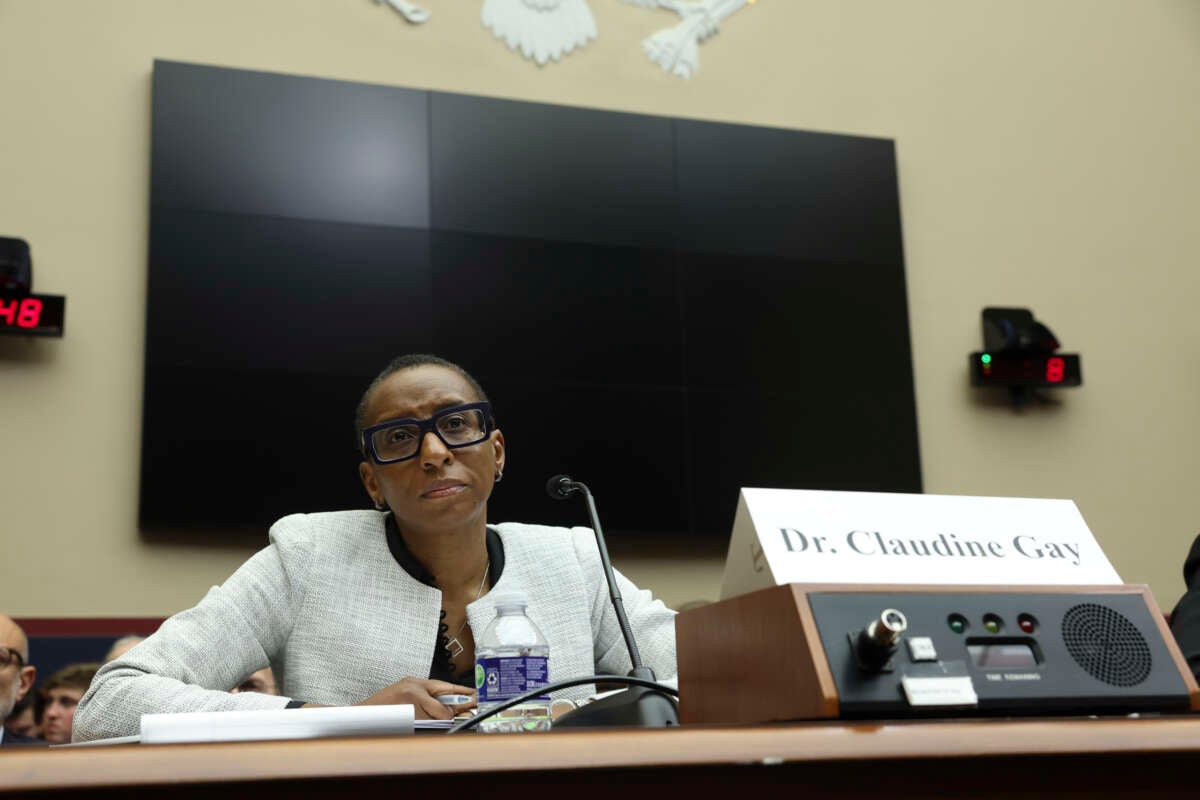
Dr. Claudine Gay, president of Harvard University, testifies before the House Education and Workforce Committee at the Rayburn House Office Building on December 5, 2023, in Washington, D.C.

On January 2, 2024, Claudine Gay became the shortest-serving president of Harvard University. What could have been a presidential tenure of transformative actions befitting of the hopeful promises of Harvard’s first Black woman president has instead ended in frustration and controversy. I watched and experienced her tumultuous six-month tenure as a Black woman alumna. As we begin to decide how we want to remember her presidency, one glaringly obvious truth persists: Harvard will always protect white supremacy. In suppressing pro-Palestine students, President Gay was doing the job of a Harvard president and carrying out the University’s commitment to white supremacy. But ultimately, when she failed to do this well enough, she became a victim of the same racism she had tried to uphold. The interdependency of anti-Black racism and Zionism cannot be more clear than through President Gay’s tenure and resignation.

As a Black woman who has ascended through the ranks of some of academia’s most lauded institutions, President Gay is not a stranger to racist, misogynistic abuse from critics and colleagues. She would have become used to demonstrating the extent of her qualifications, aptitude, and credibility far beyond what was expected of her white counterparts. In a world that works tirelessly to undermine Black women, it is no surprise that the first one appointed to lead an institution built on and funded by white supremacy would be the victim of racist attacks.

The accusations of plagiarism levied against President Gay cannot be separated from her identity as a Black woman. They did not come from scholars with an earnest commitment to academic integrity but from political opponents intent on scrutinizing her entire career and leadership. Bill Ackman saw her appointment as a prime opportunity to accelerate his right-wing vision for Harvard. His attacks against her made obvious use of anti-Blackness and were folded into a broader anti-DEI campaign that highlights his commitment to preserving Harvard’s whiteness. Ackman’s thinly-masked racist attacks have attempted to undermine Gay as a person and qualified professional. Labeling her a diversity hire implies she lacks the skills and experience to serve as a university president; amplifying initial allegations of plagiarism provides him “evidence” to support his racist claim. 

While plagiarism should be treated seriously and dealt with fairly, the rhetoric around the allegations and investigation against President Gay’s reduce her to a villian and make clear that they are the final stage of a sustained and calculated campaign. Finding a seemingly legitimate reason to attack a Black woman is a grossly familiar tactic used to discredit our voices and expertise and preserve white supremacy.

Related Story:

Harvard Has Become a Tax Shelter for Billionaires as Public Education Languishes

Massachusetts needs to reevaluate the tax-exempt status of its private universities with endowments over $1 billion.

As a Black woman, I am furious for her — for the way she was made a victim of racist vitriol and bullying.

But as a supporter of Palestinian liberation, I am furious at her.

President Gay repeatedly failed to listen to and protect Palestinian and pro-Palestinian students on campus. Her administration failed to unequivocally condemn the targeted harassment and doxxing of students, many of whom are Palestinian, Black, Arab, South Asian, Muslim, undocumented, and/or international. The task force established to address the doxxing operated with limited personnel, resources, and mandate; when harassment persisted, President Gay claimed that the university had “done enough” and she was “satisfied” with their response. After severe intimidation, death threats, and hateful encounters on campus, the Palestine Solidarity Committee demanded “a committee to investigate anti-Palestinian racism and suppression of pro-Palestine voices.” This demand — and the repeated requests for Palestinians and the committee to meet with the President — were met with no response. But just a day afterward, President Gay attended a Shabbat dinner at Harvard Hillel and announced the Antisemitism Advisory Group, providing institutional support, resources, personnel, and legitimacy to address antisemitism on Harvard’s campus.

President Gay failed to acknowledge that the safety of Jewish students is inextricably linked to the safety of Palestinian and other students. In repeatedly ignoring Palestinian and anti-Zionist Jewish voices, she made it clear that Harvard was unwilling to commit to ending all forms of racism — and that she would play an active role in upholding the university’s commitment to white supremacy. Furthermore, in failing to respond to meeting requests from anti-Zionist Jewish students, President Gay made it clear that she was not committed to protecting all Jewish students; her commitment was to protect Zionists.

But Zionists demanded that she do more. It was not enough that she failed to respond to and protect pro-Palestinian students; she also needed to make actively suppressing pro-Palestinian voices a defining mark of her tenure. President Gay condemned the slogan “from the river to the sea” and oversaw the initiation of disciplinary action against student activists. For me, the most painful evidence of this has been the eviction of former first-year proctor Elom Tettey-Tamaklo after he peacefully confronted and de-escalated an attempt to compromise the safety of protesters at a die-in at the Harvard Business School.

How can we reflect on the selection of Harvard’s first Black president as a victory if such an appointment did not result in a safer and more just campus for Black students and staff? Why should we celebrate representation when our community members who come to hold such platforms of authority — that have historically been denied to us — fail to use them to uplift the voices of other marginalized people?

Since October 7, most campus activists and alumni who support them have not called for her resignation. Rather, students and alumni implored President Gay to defend pro-Palestinian voices on campus and stand in solidarity with Palestinians in Gaza, the West Bank, and around the world. Personally, I hoped that she might see herself and her son in the mothers of Gaza, just as she saw herself in the mothers of George Floyd and Ahmaud Arbery, and act with empathy and a commitment to justice. I was ready to celebrate President Gay if she placed herself on the right side of history and took the first steps towards ending Harvard’s complicity in maintaining Israeli apartheid.

Let me be clear: President Gay was forced out not because she is antisemitic and/or anti-Zionist but because she is not Zionist enough. The Congressional hearing on December 5 was little more than political theater in which right-wing leaders created and seized an opportunity to undermine core tenets of liberal arts institutions and divert attention from the genocide in Gaza. The hearing was never going to be a meaningful intervention to address the real and harmful threat of antisemitism or a forum for President Gay to redeem herself in the eyes of right-wing provocateurs. Rather, she was accused of providing unsatisfying answers to questions about a course on settler colonialism in Palestine and made to state her belief in Israel’s right to exist. Furthermore, the country watched as President Gay — the lone Black woman on the panel — was interrupted and belittled more than the others in a routine display of misogynoir.

In reading her resignation letter, it horrifies me that she has faced racist threats to her safety. But it does not surprise me. It should not surprise any of us that the same people who refuse to call for a ceasefire in Gaza and who support the genocide of Palestinians are the same people who would threaten the safety of a Black woman. All of these actions are motivated by racism. Zionism, just like anti-Black racism, is a product of white supremacy. They motivate and reinforce each other.

Many Palestinian, Black, Arab, South Asian, Muslim, and otherwise marginalized students and alumni deeply wanted President Gay to be different. I would have hoped that she — as a Black woman descended from anti-imperial revolutionaries who has built her career on scholarship about minority politics and Black American political behavior — might challenge Harvard’s commitments to white supremacy. I hoped that she would take historic steps towards aligning the office of the President with social justice movements deeply similar to and intertwined with her personal history and professional interests. But I knew that no matter her personal convictions, she would center the interests of donors just as the office of the president requires. And I knew that no matter her actions, she would receive racist and sexist hate every step of the way.

I had hopes of a transformative tenure that would match and meaningfully surpass the significance of her appointment as the first Black woman president of Harvard. But rather than ally with those ready to ally with her and call out instances of misogynoir against her, President Gay chose to ally herself with traditional axes of power: with Zionists and racists who would pave the way for her resignation.

Harvard will continue to be an institution that protects and relies on white supremacy. President Gay attempted to appease its most powerful professors, donors, and alumni by participating in white supremacy herself — silencing pro-Palestinian voices and failing to protect marginalized students. She was rewarded with the gifts white supremacy bestows on Black women who do not conform well enough: undermining her expertise, villainizing her character, threatening her safety, and eventually discarding her wholesale.

Her presidency makes clear that there will always be limits to representation at institutions deeply embedded in white supremacy. These appointments do not suddenly make us acceptable to racists, nor can these institutions offer us protection from themselves.

The liberation of Black women is impossible without the liberation of Palestine. Black women deserve far better than to be victims of witch hunts and puppets of white supremacist projects, and the Palestinian people deserve unwavering, unequivocal, and explicit solidarity from every marginalized person who is given a powerful platform. We should mourn President Gay’s tenure because she was both a victim and an agent of white supremacy. We should be disappointed because we wanted both better for her and from her.  


ABOUT THE AUTHOR: 


Aaryan Morrison is a South African-American from Indiana. She is a graduate of Harvard College and a current master’s student at the University of Oxford.


Thursday, June 4, 2015

Senator Bernie Sanders and the Ongoing Fight For a Progressive Agenda vs. the Mythology of Progressive Politics in the U.S. Today

All,

During the so-called 'Age of Obama' (2008-Present) there has been an insufferable amount of sheer nonsense and brazenly dishonest assertions made by far too many people regarding what genuinely constitutes progressive politics' and even more idiocy has been expressed regarding what a truly 'progressive politician' is. In many quarters it's as if too many otherwise reasonably intelligent and concerned citizens have lost touch with what these terms even mean in today's corrupt and polluted political climate of crass opportunism, hubris, and the celebrity fixated commercial branding of individual politicians and their often hazy and manipulative self serving agendas.

Given this ugly and often depressing reality it is refreshing that we still at least attempt to not only remember but actually identify exactly what determines progressive politics and a progressive politician. One of the very few remaining exemplars of this still very proud but unjustly maligned legacy is Senator Bernie Sanders, the socialist independent from Vermont who along with Senator Elizabeth Warren of Massachusetts has a great career long track record of proven outstanding and PROGRESSIVE service to the masses of poor, working, and middle class people in this fading oligarchic Republic we all tragicomically and rather inexplicably still refer to as the "United States."

The fact that a man of the undeniable quality, integrity, honesty, intelligence, and compassion of Senator Bernie Sanders doesn't have a snowball's chance in hell of securing the Democratic Party's nomination for the Presidency in 2016 is a huge indictment of this country and its general political system which--as always--would much rather promote, support, and enable the selfish personal ambitions of bourgeois politicians like the ones presently controlling the White House, Congress, and the Supreme Court who--as always--promote, support, and enable the corporate capitalist control of Wall Street and the general relentless institutionalized criminality of the financial sector of our hijacked economy at the massive expense of the masses of poor, working, and middle class people who make up 99% of the American population. Meanwhile BILLARY, INC. and the straightup reactionary MadMen of the venal Republican right contend for the spoils left by the current managers of the political economy. That's not Senator Sander's fault of course.  IT'S OURS...

Kofi


What Kind of Mayor Was Bernie Sanders?
Peter Dreier and Pierre Clavel
June 2, 2015
The Nation

Bernie Sanders sits in his office at City Hall in Burlington, Vermont in 1981. (AP Photo/Donna Light)

John Davis remembers a meeting in 1986 when Bernie Sanders, then the mayor of Burlington, Vermont, confronted the owners of the city's largest affordable-housing complex. The federal program that had subsidized the Northgate Apartments for 20 years had a loophole that allowed the landlords to convert the buildings into market rentals or luxury condos.

"Bernie pounded his fist on the conference table in his office and told the owners, ‘Over my dead body are you going to displace 336 working families. You are not going to convert Northgate into luxury housing,'" recalled Davis, who was Sanders's key housing aide.

Under Sanders's leadership, the city adopted a number of laws to stifle the owners' plans. One ordinance required apartment owners to give residents two years' notice before a condo conversion. Others gave residents a pre-emptive right to buy the units and prohibited landlords from bulldozing buildings unless they replaced them with the same number of affordable units. (These measures lowered the selling price of the property.) Sanders then worked with the state government and Senator Patrick Leahy to get the $12 million needed to purchase and rehabilitate the buildings. The city allocated funds to help the tenants hire an organizer, form the Northgate Residents Association, and start the process of converting the complex to resident ownership. Today, Northgate Apartments is owned by the tenants and has long-term restrictions to keep the buildings affordable for working families.

The battle over Northgate Apartments illustrates Sanders's general approach to governing. In addressing this and many other issues, he encouraged grassroots organizing, adopted local laws to protect the vulnerable, challenged the city's business power brokers, and worked collaboratively with other politicians to create a more livable city.

Now that Sanders is running for president, the eight years he spent as Burlington's chief executive (1981–89) will be under close scrutiny. Although President Obama recently joked at the White House Correspondents' Association dinner that Sanders is a "pot-smoking socialist," he was actually a hardworking, pragmatic, effective mayor who helped transform Vermont's largest city (population: 38,000) into a thriving town.

Thanks to the enduring influence of the progressive climate that Sanders and his allies helped to create in Burlington, the city's largest housing development is now resident-owned, its largest supermarket is a consumer-owned cooperative, one of its largest private employers is worker-owned, and most of its people-oriented waterfront is publicly owned. Its publicly owned utility, the Burlington Electric Department, recently announced that Burlington is the first American city of any decent size to run entirely on renewable electricity.

* * *

Sanders grew up in Brooklyn and attended the University of Chicago, where he was active in the civil-rights movement. After a short stint living on an Israeli kibbutz, in 1964 he moved to Vermont, where he worked as a carpenter, filmmaker, writer, and researcher, and got involved in radical politics. In the 1970s, after joining the antiwar Liberty Union Party, Sanders ran for several statewide offices, including governor, US Senate, and the US House (Vermont has only one seat). He never garnered more than 4 percent of the vote, but he did better in Burlington than in Vermont's rural areas, which gave him hope that he had a shot at winning office in the local government.

In 1981, Sanders ran for mayor of Burlington as an Independent and defeated six-term Democratic Party  incumbent Gordon Paquette by ten votes in a four-way contest. Voters re-elected Sanders three times by increasingly wider margins: 52 percent in 1983, 55 percent in 1985, and 56 percent in 1987.

Burlington was no hippie counterculture enclave. Although the city attracted many young, educated people because of its natural beauty and the presence of the University of Vermont, it has always had a large working-class population (many of them from French Canadian stock) who, until Sanders came on the scene, tended to vote for moderate Democrats and Republicans. Each time he ran for mayor, Sanders attracted increasing support from the city's blue-collar precincts.

In his first two years in office, the City Council refused to allow Sanders to hire more than a handful of staff, while the entrenched bureaucrats in City Hall sought to thwart his initiatives. Randy Kamerbeek, the city's planning director, "tried to sabotage everything that Bernie proposed," recalled Michael Monte, who worked in that agency. "He told us not to allow Bernie to have any visible successes. He figured Bernie would be out of office after his first term."

After he was re-elected in 1983, and voters swept in a more progressive City Council, Sanders gained a stronger foothold in City Hall. With the support of local Republicans and business leaders, he created the Community and Economic Development Office (CEDO) to carry out his vision for more affordable housing, more locally owned small businesses, greater community engagement in planning, and job development.

When Sanders took office, Burlington's Lake Champlain waterfront was an industrial wasteland. Tony Pomerleau, an influential local businessman, planned a mega-project that included a 150-room hotel, retail space, a 100-slip marina, and 240 condominiums in 18-story buildings. In his first campaign, Sanders pledged to kill that plan. After Pomerleau withdrew his proposal, Sanders backed another waterfront plan that included some commercial development, affordable housing, and generous public access. But after voters defeated a bond measure for this proposal, Sanders went back to the drawing board to envision a "people's waterfront."

According to Monte, who worked on the waterfront project for Sanders and was CEDO director for 12 years, "Bernie wanted to make sure that it was a place with plenty of open space and public access, where ordinary people could rent a rowboat and buy a hot dog. That wasn't just for the elite. It was Bernie who set the tone that the waterfront wasn't for sale."

Thanks to Sanders, the Burlington waterfront now has a community boathouse and other facilities for small boats. There's also a sailing center and science center, a fishing pier, an eight-mile bike path, acres of parkland, and public beaches. The commercial development is modest and small-scale. On May 26, Sanders kicked off his presidential campaign with a rally at Waterfront Park.

Most of Burlington's business leaders initially distrusted Sanders. They didn't know what a socialist would do once he held the reins of power. But even many of Sanders's early opponents came to respect and even admire his willingness to listen to their views and his efforts to adopt progressive municipal policies.

Pomerleau was then—and remains today, at 97—one of Burlington's richest residents. A longtime Republican, he made his money developing supermarkets, hotels, and shopping centers, and he owns much of Burlington's commercial real estate. For decades, he has wielded considerable political influence, served as chair of the city's police commission, and been its most generous philanthropist.

"When [Sanders] first ran for mayor, he was running against guys like me," Pomerleau recalled in a recent interview.

Pomerleau, who voted against Sanders in 1981, knocked on his door the day after that election. "I said, ‘You're the mayor, but it's still my town,'" he recalled.

Pomerleau wasn't happy when Sanders opposed his waterfront development plan, but he gradually got to know the mayor and came to admire his pragmatism, his bulldog tenacity to get things done, and his support for the local police.

"Bernie and I worked very well together for the betterment of the town," Pomerleau said. "We were the odd couple."

Pomerleau voted for Sanders in his three successful bids for re-election. And Sanders frequently called Pomerleau to ask his advice. They stayed in close contact, even after Sanders was elected to Congress.

Pomerleau expressed his pleasure that for the past 35 years Sanders has never missed one of his annual Christmas parties for underprivileged children. He also praised Sanders for being a stalwart supporter of America's military veterans.

"If more rich people were like me," Pomerleau said, "Bernie would feel better about the wealthy."

* * *

"When Bernie first got elected, the local media said he was anti-business," recalled Bruce Seifer, an architect of Sanders's economic development efforts. "They called us the ‘Sanderistas.'"

After Sanders's re-election victory in 1983, business groups concluded they could not defeat him and thus had to work with him. But many businesspeople also saw that Sanders shared their interest in "development"—what he saw as "good development"—while opposing projects that would hurt middle- and working-class neighborhoods or victimize low-wage workers.

"Bernie was never anti-growth, anti-development, or anti-business," explained Monte. "He just wanted businesses to be responsible toward their employees and the community. He wanted local entrepreneurs to thrive. He wanted people to have good jobs that pay a living wage. If you could deal with that, you could deal with Bernie and Bernie would deal with you."

The Sanders administration provided new firms with seed funding, offered technical assistance, helped businesses form trade associations (including the South End Arts and Business Association and the Vermont Convention Bureau), focused attention on helping women become entrepreneurs, funded training programs to give women access to nontraditional jobs, and lobbied the state government to promote business growth.

When Sanders took office, Burlington had no supermarket in the downtown area. The major grocery chains told city officials that they would invest in a new store only if they could build a mega-market that residents believed was too large. Instead, the Sanders administration put its hopes in the local Onion River Cooperative. With 2,000 members in its former location, some thought it was a risky venture. It turned out to be a good investment, and under Sanders's successor it became City Market, a thriving enterprise with more than 9,000 members.

Under Sanders, Burlington became a magnet for attracting and incubating locally owned businesses, many of which expanded into large enterprises. Burton, the nation's largest snowboard company, has its headquarters (as well as a snowboard museum) in Burlington. The city assisted Seventh Generation, a green cleaning-products firm, when it started in 1988. Today, with its downtown waterfront headquarters in a LEED-certified building and over $300 million in annual sales, it is one of Burlington's largest employers. With the city's help, Gardeners Supply Company, which sells environmentally friendly gardening products, moved to Burlington in 1983. Four years later, its founder, Will Raap, began the process of selling the firm to its workers. It now has over 250 employee-owners.

As he was transitioning Gardeners Supply to employee ownership, Raap also began organizing volunteers to clean up a largely derelict floodplain north of the store. Eventually CEDO, Sanders's development agency, helped arrange the purchase of the area and provided the capital for irrigation systems, farm vehicles, and washing stations for vegetables. By the end of the 1990s, it was home to a dozen urban farms, annually producing over 500,000 pounds of food for local homes and stores. Today it generates over 10 percent of the food sold in Burlington.

"Bernie realized that the economy doesn't have to be dominated by bad guys," explained Raap, a founder of the 750-member Burlington-based Vermont Businesses for Social Responsibility, an alternative trade association. "He saw that and he fostered it."

Burlington's strong economy and population growth put pressure on the city's housing supply, threatening to displace low- and middle-income families. Under Sanders, the city adopted policies to create permanently affordable housing. The city channeled a large portion of its federal block grant funds to nonprofits committed to that goal, and cultivated a constituency of these small development organizations. The first key move was support for the Burlington Community Land Trust with an initial $200,000 grant. Now named the Champlain Housing Trust, the nonprofit has over $290 million in assets;  manages a portfolio of 2,800 price-controlled houses, condos, co-ops, and rentals; and owns over 120,000 square feet of commercial space and nonprofit facilities.

To provide funding for new housing initiatives, the Sanders-led city created a housing trust fund, capitalized in part by a 1 percent increase in property taxes. A year after Sanders left office, the coalition he built successfully pushed the City Council to enact an inclusionary zoning law. Market-rate residential projects were required to set aside 10–25 percent of the units at rents and prices affordable to families with modest incomes and to keep them affordable for 99 years.

The Sanders administration carefully nurtured neighborhood planning assemblies (NPA) in each of the city's six wards, providing them with modest budgets to deliberate and advise on projects affecting their neighborhoods. The NPAs had a voice over the use of federal Community Development Block Grant funds in their neighborhoods. Today, Burlingtonians credit the NPAs with raising the level of resident participation and discussion in local politics.

Sanders jump-started the city's participatory energies in other ways as well. Early on he established a Youth Office, an Arts Council, and a Women's Council, whose first major initiative was an ordinance requiring 10 percent of all city-funded construction jobs to be filled by women.

* * *

Sanders's track record as mayor was so successful that Burlington voters elected his CEDO director, Peter Clavelle, to succeed him in 1989. (He was voted out in 1993 but re-elected in 1995, and served until 2006.) During his 16 years in the mayor's office, Clavelle expanded Sanders's agenda. A Republican held the office from 1993 to 1995, and another independent progressive, Bob Kiss, served from 2006 through 2012. After a controversy erupted over the city-owned Burlington Telecom, Kiss declined to run for re-election.

In 2012, for the first time since Sanders's first campaign in 1981, Burlington elected a Democrat—Miro Weinberger—to serve as mayor. Although more conservative than Sanders, Clavelle, and Kiss, he has been reluctant to reverse their policies because they've been so popular. Burlington's progressives have not only held on to their main policy achievements but, after the most recent election, have gained seats on the City Council and catapulted Progressive Party member Jane Knodell into the presidency of that body.

In the 1970s and '80s, Sanders was one of a handful of mayors—including Paul Soglin of Madison, Wisconsin; Gus Newport of Berkeley, California; Ruth Goldway of Santa Monica, California; Chicago's Harold Washington; and Boston's Ray Flynn—who sought to use the levers of local government to adopt enlightened progressive policies. More than in any other city, Burlington's progressives consolidated those reforms over the long haul. The coalition that coalesced around Sanders in 1981 governed Burlington for all but two of the next 31 years.

Burlington is now widely heralded as an environmentally friendly, lively, and livable city with a thriving economy, including one of the lowest jobless rates in the country. Burlingtonians give Sanders credit for steering the city in a new direction that, despite early skepticism, proved to be broadly popular with voters.

A growing number of cities—including Seattle, New York, Phoenix, Pittsburgh, Los Angeles, Minneapolis, Newark, and others—are now led by progressive mayors. They are adopting municipal minimum wage laws, requiring developers to build mixed-income housing, strengthening regulations against corporate polluters, and enacting other policies to address the nation's growing economic inequality and environmental crises.

What they can learn from Sanders is that good ideas are not sufficient. Creating more livable cities requires nurturing a core of activist organizations that can build long-term support for progressive municipal policies.

http://www.truth-out.org/news/item/31168-global-capitalist-crisis-and-the-north-american-free-trade-agreement-reflections-twenty-one-years-on

Global Capitalist Crisis and the North American Free Trade Agreement: Reflections 21 Years On
Thursday, 04 June 2015
by William I. Robinson
Truthout | News Analysis   

 
Recent US Senate approval won by President Obama for "fast-track" negotiation of the Trans-Pacific Partnership (TPP) trade deal has thrust "free trade" and capitalist globalization again into the headlines. Often referred to as "NAFTA on steroids," the TPP is but the latest in more than two decades of "free trade" agreements that have helped open up the world to transnational corporate plunder.

If we want to understand such deals we would do well to reflect on the first of these, the North American Free Trade Agreement, or NAFTA, which went into effect in January 1994. We cannot understand NAFTA without understanding the larger picture of which NAFTA and the TPP form part: the new system of global capitalism and the crisis of that system.

NAFTA, and by extension, capitalist globalization, were outcomes of the last great crisis of world capitalism, that of the 1970s. Emergent transnational capital responded to that crisis by "going global," which paved the way for NAFTA. To understand NAFTA and the TPP, we must grasp four novel features of world capitalism in this epoch of globalization:

1. The rise of truly transnational capital and the integration of every country into a new globalized production and financial system. NAFTA served as a midwife for Mexico's integration into this system;

2. The appearance of a new transnational capitalist class, a class group grounded in the new global control over national circuits of accumulation. NAFTA and Mexico's globalization involved the rise of a powerful group of Mexican capitalists, epitomized by Carlos Slim, currently the richest man in the world. These emergent transnationally oriented Mexican elites led the charge in Mexico's globalization and used NAFTA to join the ranks of the transnational capitalist class.

3. The rise of transnational state apparatuses, comprised of dense networks of nation-states and supranational and transnational institutions that promote transnational over national accumulation in each country and act as the collective authority of the transnational capitalist class - as the new global ruling class. NAFTA was drawn up and imposed on the peoples of North America by this transnational state;

4. The appearance of novel relations of inequality and domination in global society, including the spread of new transnational class inequalities, the farcical wars on drugs and terrorism, as well as the wars on immigrants, youth "gangs" and social movements, all part and parcel of capitalist globalization in North America and elsewhere.

Capitalist Crises and "Free" Trade

Capitalism experiences major episodes of crisis about every 40 to 50 years as obstacles emerge to ongoing accumulation and profit-making. These are "structural" or "restructuring" crises because the system must be restructured in order to overcome the crisis. As opportunities for capitalists to profitably invest dry up, the system seeks to open up new outlets for surplus capital, typically through violence, whether structural or direct. NAFTA constitutes one such form of structural violence, whereas the "drug wars" and US militarization on both sides of the border are a form of direct violence. Both have the function of opening up new opportunities for capitalist expansion and control in North America.

Structural crises of capitalism involve social upheavals, political and military conflict, and ideological and cultural changes. The last major crisis of world capitalism prior to the 2008 global financial collapse began in the late 1960s and hit hard in the early 1970s.

"Free trade" and neoliberalism are fundamentally programs of transnational capital liberated from the nation-state through globalization.

The year 1968 was a turning point. That year saw the assassination of Martin Luther King Jr. in the United States in the midst of expanding Black and Chicano liberation movements, the countercultural and antiwar movements, and an escalation of militant worker struggles. The Tlatelolco massacre of students took place in Mexico City that same year, at a time of great campesino, worker and student upheavals across the country. Further away, 1968 saw the Prague Spring, the uprising of students and workers in Paris, the height of the Cultural Revolution in China, the Tet Offensive in Vietnam, which marked the beginning of the first major defeat for US imperialism, and the spread of anti-colonial and armed liberation movements throughout Africa and Latin America.

All this reflected a crisis of hegemony for the system - a crisis in its political and cultural domination. Then came the economic dimension. By 1973, the US government had to abandon the gold standard; the recently formed Organization of Petroleum Exporting Countries (OPEC) imposed its oil embargo, which sent shock waves through the world economy; and stagflation (stagnation plus inflation) set in everywhere. This was, in a nutshell, a severe structural crisis of world capitalism, a crisis of 20th century nation-state capitalism.

Stepping back even further in history, at the time of the 1970s crisis, working and popular classes all around the world had accumulated a significant amount of power relative to dominant groups. Why? The  world had seen a prolonged period of international conflict involving world wars and social and class struggles from the 1890s into the 1960s. Working and popular classes were able to make social and economic gains in many countries, leading to the so-called social-democratic "class compromise" of the mid 20th century, whereby the capitalist system was forced to make a number of concessions to significant sectors of the international working class. By the early 1970s, a pre-revolutionary situation was percolating in many countries and regions. The popular classes were able to resist attempts by the dominant groups to shift the burden of the 1970s crises on to their shoulders.

But as the crisis intensified, these dominant groups sought ways to liberate themselves from the "class compromise." Analytically speaking, capital sought to free itself of any reciprocal responsibility to labor in the capitalist system and capitalist states sought to shed themselves of the social welfare systems that were established in preceding decades. Elites in the rich countries also sought ways to integrate emergent Third World elites into the system.

NAFTA was but one small part of a vast restructuring of world capitalism.
These dominant groups launched the "neoliberal counterrevolution," an attempt to roll back the social welfare state, to resubordinate labor and to reconstitute their hegemony at the global level through a newfound transnational mobility of capital and a transformation of the interstate system. The roots of NAFTA are to be found in this response of economic and political elites to the 1970s crisis.

The model of "savage" global capitalism that took hold in the late 20th century involved a new capital-labor relation based on the deregulation, informalization, deunionization and flexibilization of labor as more and more workers have swelled the ranks of the "precariat" - a proletariat existing in permanently precarious conditions. NAFTA and other trade agreements along with neoliberal policies have played a key role in the subordination of labor worldwide and the creation of this global flexible labor market.

The new model of global capitalism has also involved a renewed round of extensive and intensive expansions of the system. The former socialist countries and the revolutionary states of the Third World were integrated into the world market in the late 20th century. Free trade agreements such as NAFTA and neoliberal programs have lifted restrictions to this expansion of transnational capital. A third aspect of the new model is the creation of a legal and regulatory structure for the global economy, characterized by such agreements as NAFTA and the creation of the World Trade Organization. "Free trade" and neoliberalism are fundamentally programs of transnational capital liberated from the nation-state through globalization.

Opening North America for the Transnational Capitalist Class

US, Mexican and Canadian elites turned to negotiating and implementing NAFTA so as to open up new opportunities for expansion in the face of stagnation and to appropriate resources in Mexico and beyond. Capitalist globalization in North America created outlets for a mass of accumulated capital following the stagnation and decline in the profit rate as a result of the 1970s crisis and helped to reverse the worldwide correlation of social and class forces that throughout the 1960s and 1970s had become adverse to capitalist expansion and elite interests.

Yet NAFTA was but one small part of a vast restructuring of world capitalism. NAFTA and free trade are components of neoliberalism, which in turn is an integral component of the project of transnational elites in North America to restructure the system, restore the class power of an emergent transnational capitalist class, and lift obstacles and barriers to new transnational circuits of accumulation opened up by capitalist globalization. NAFTA must be seen in this larger context of capitalist globalization as an attempt to resuscitate the North American and world economy and to restore capitalist hegemony after the great crisis of the 1970s. It is not separate from other free trade agreements around the world; NAFTA is simply the North American regional variant of the project of capitalist globalization.

"To a certain extent, we are armoring NAFTA."
As many have documented, global capitalism has produced an unprecedented concentration of wealth in Mexico and the rise of 24 new billionaires, some of the wealthiest people in the world. Carlos Slim's worth went from $6.6 billion in 1994 to $73 billion in 2014. It generated a high consumption Mexican middle class that identifies more with its counterparts in the United States and elsewhere than it does with the mass of impoverished Mexicans.

At the same time, living conditions for most in Mexico plummeted in the wake of NAFTA's implementation. From 1992 to 1999, extreme poverty increased from 16 to 28 percent of the total population, and in 2012, the poverty rate stood at 52.3 percent, slightly higher than it was at the time of NAFTA's approval. Some 2 to 3 million families were thrown off their land in the wake of NAFTA and millions more were made unemployed in urban areas, creating a mass labor force for maquiladoras, agribusiness projects, mining operations and service sectors. A major portion of those displaced became transnational migrants, servicing the US and global economy outside of Mexico.

NAFTA thus generated for transnational corporate capital new pools of exploitable labor and access to vast new reserves of land and resources in Mexico. The treaty opened up new markets in Mexico and access to Mexican resources for the transnational capitalist class, but also allowed this transnational capitalist class to attack the working class throughout the region. It allowed the transnational fraction of the Mexican capitalist class and elite to globalize and consolidate its hegemony over the Mexican political system. In this sense, NAFTA has been an incubator of the transnational capitalist class in Mexico.

The War on Drugs and Immigrants as Counterparts to NAFTA
 

NAFTA has its counterpart in the ongoing militarization of North America, including the militarization of borders, the drugs wars, the war against immigrants and the repression of social movements. North America is "a shared economic space," declared then-US Assistant Secretary of State for Western Hemisphere Affairs Thomas Shannon in 2005, when the Security and Prosperity Partnership of North America went into effect. "To a certain extent, we are armoring NAFTA." In 2007, the Security and Prosperity Partnership was replaced by Plan Merida, also known as Plan Mexico, a more sweeping program for militarizing Mexico, including the country's southern and northern borders, with hundreds of millions of dollars in US military and security assistance.

The "drug war" has been a critical mechanism for accumulation and social control in both Mexico and the US.

It is noteworthy that the Security and Prosperity Partnership and Plan Merida brought leading transnational corporations, especially from the military-industrial complex, into coordination with US and Mexican military and security forces, and provided new opportunities for militarized accumulation throughout North America.

The so-called "drug war" has been a critical mechanism for accumulation and social control in both Mexico and the United States, and highly functional for the transnational capitalist class. As Canadian journalist Dawn Paley shows in her important new study, Drug War Capitalism, this war is an instrument of primitive accumulation, social cleansing and profit-making through militarization and conflict. It has allowed, among other things, for:

--the social control of the North American working and popular classes; 
--repression of Mexican social movements;
--vast profit-making through military forms of transnational corporate accumulation, such as the production and deployment of military equipment and forces, border walls, surveillance systems, prison-industrial and immigrant detention complexes;
--the expulsion of communities from rural and urban conflict areas, the appropriation of lands, and establishment of agribusiness and mining operations in place of small-scale agriculture;
--the creation of a system of mass incarceration in the United States disproportionately targeting the African-American population as surplus labor.
 
This "war on drugs" is reciprocal to the war on immigrants, itself an integral part of the story of NAFTA. The campaign of control and repression against Mexican (and Central American, Asian and other) immigrants in the United States has three key functions for transnational elites. First, it is a system for criminalizing this population, and therefore making it a cheap and tightly controlled labor supply. Second, it allows more generally for control over the transnational working class, including political, cultural and ideological mechanisms of social control; the conversion of immigrants into scapegoats for the crisis; and the sublimation of social tensions that may otherwise be directed against systemic sources of the crisis. And third, together with the farcical wars on drugs and terrorism, the war on immigrants justifies ongoing militarization and "securitization," generating widespread opportunities for transnational corporate profit-making through militarized accumulation.

NAFTA has had the effect, in sum, of generating an almost limitless supply of immigrant labor for the North American economy, in the context of the restructuring of global labor markets. Criminalization of immigrants in the United States has played a key role in pushing immigrant workers underground, making them more vulnerable to super-exploitation and less able to resist, and keeping them deportable.  Racist anti-immigrant laws, the immigrant detention complex and militarized borders all reproduce a reserve army of immigrant labor and at the same time open up new sources of profit-making for the transnational corporations that are actually contracted to build border walls, supply military equipment to the state military and security forces, and establish and run surveillance systems and detention centers.

US Colonization or Transnational Capitalist Class Conquest?
 

Some have argued that NAFTA aimed to close off North America from other regions and to allow US capital to face European and Asian competitors. This thesis of "regionalization" and a tripolar world in competition, however, does not correspond to reality over the past 20 years. The evidence shows that NAFTA has served as a platform for ever-greater transnational integration and globalization of North America. Transnational corporations from all over the world have poured into Mexico (as well as the United States and Canada) over the past two decades in order to have direct access to North American labor and consumer markets. NAFTA opened the region to greater integration with Asia. China, in fact, is currently funding the "NAFTA super highway," that is, the construction of vast new highway and rail networks integrating the entire North American region.

With the collapse of the Doha round of negotiations at the World Trade Organization, the strategy pursued by the transnational capitalist class has been to negotiate a multiplicity of bilateral and multilateral regional and interregional trade deals, the latest of which is the TPP. We have seen an accelerated transnationalization of the entire North American region since NAFTA went into effect.

We have seen an accelerated transnationalization of the entire North American region since NAFTA went into effect.

Others have portrayed NAFTA as a recolonization of Mexico by the United States. But this image, too, is demonstrated to be false. NAFTA allowed the transnational fraction of the Mexican capitalist class to transnationalize. The Mexican contingent of the transnational capitalist class has been just as much a protagonist and beneficiary of NAFTA and capitalist globalization as has its US and Canadian counterparts.

The Mexican-based Cemex conglomerate, the largest producer of cement in the world, not only operates on every continent, but also is the principal supplier of cement to the US market. While mining companies from the United States and Canada, as well as from Asia, Europe and elsewhere, have poured into Mexico over the past two decades, the largest of these companies are actually owned wholly or in part by Mexican capitalists. Carlos Slim's Grupo Mexico and Grupo Carso conglomerates hold major shares in Saks Fifth Avenue, Best Buy, The New York Times, Philip Morris, Apple and Alcatel, not to mention holdings in companies on every continent.

The case of the "corn tortilla circuit" is instructive. Those who say NAFTA represents a US takeover of Mexico point to how US-based agribusiness subsidized by the US state has flooded the Mexican market with cheap corn and displaced millions of small farmers. This is true. However, these lands have been taken over as much by Mexican and transnational agribusiness, mining and other concerns from around the world as by US-based investor groups. Mexican agro-export and mining capitalist groups have proliferated in Mexico.

Specifically, when NAFTA went into effect, the price of bulk corn dropped - yet the price of tortillas actually rose. This is because NAFTA allowed Mexican transnational capitalists to gain monopoly control  of the corn tortilla market. Just two Mexican companies, GIMSA and MINSA, captured 97 percent of the industrial corn flour market in the country, with the help of Mexican state subsidies. These two companies also control major shares of the US tortilla market (e.g. Mission brand is owned by GIMSA). NAFTA facilitated a shift from small-scale to transnational corporate control of the corn tortilla circuit on both sides of the border, with both Mexico and the US, as transnational state apparatuses, subsidizing both Mexican and US members of the transnational capitalist class.

Twenty-one years into NAFTA, world capitalism is again in deep crisis. Globalization, free trade and neoliberalism may have facilitated a renovated round of capitalist expansion, but they have also generated new contradictions that the system has not been able to resolve. These processes have helped to bring about a transnational working class in North America and globally that is increasingly moving from the defensive to the offensive. The great challenge for transnational elites is how to contain the real and potential rebellion of this mass of dispossessed humanity. As the battle heats up around the TPP, reflections on NAFTA 21 years on can be instructive.

This article is an edited version of a speech William I. Robinson gave at the National Autonomous University of Mexico on April 16, 2015. The analysis is drawn from his latest book, Global Capitalism and the Crisis of Humanity (Cambridge University Press, 2014). Thanks to Steven Osuna and Kevin Robinson for their contributions to this article.

Copyright, Truthout. May not be reprinted without permission.


William I. Robinson is professor of sociology, global studies and Latin American studies at the University of California at Santa Barbara. His most recent book is Global Capitalism and the Crisis of Humanity.

 
Related Stories:

 
NAFTA Is Starving Mexico
By Laura Carlsen, Foreign Policy in Focus | Report
NAFTA: 20 Years of Regret for Mexico
By Mark Weisbrot, The Guardian | Op-Ed
NAFTA at 20: "A Vehicle To Increase Profits at the Expense of Democracy"
By Dave Johnson, Campaign for America's Future | News Analysis
