Discourse that allows us to express a wide range of ideas, opinions, and analysis that can be used as an opportunity to critically examine and observe what our experience means to us beyond the given social/cultural contexts and norms that are provided us.
Showing posts with label cultural criticism. Show all posts
Showing posts with label cultural criticism. Show all posts
Professor Cornel West delivers the 2024 Gifford Lecture Series at the University of Edinburgh, titled ‘A Jazz-soaked Philosophy for our Catastrophic Times: From Socrates to Coltrane’. This is the first of six lectures, titled ‘Philosophic Prelude’.
In this first lecture, Prof. West asks: How do we emerge from the bleakness of our catastrophic times?
He summarises: ‘In seeking a way forward, I will proceed on three philosophic levels – the genealogical, existential and pedagogical. The genealogical, or historical, level of my analysis will set the stage, and my period will be broadly the Age of Europe (1492-1945) and Age of America (1945-2024). The existential level of my analysis will embrace the lived experiences of struggling, suffering creatures. The pedagogical level will be classical in character and musical in content. My overall theme will resonate with the three pillars of jazz – blues (tragicomic catastrophe lyrically expressed), swing (myopic time opened to new possibilities) and improvisation (practical wisdom and timely interventions unleashed).’
Prof. West is the Dietrich Bonhoeffer Professor of Philosophy & Christian Practice, Union Theological Seminary, New York. His teaching and publications focus on roles of race, gender, and class struggle in American society, synthesizing influences from Christianity, the Black Church, democratic socialism, left-wing populism, neopragmatism and transcendentalism. A musician and spoken word artist, Prof. West has collaborated with acts across the rap, hip-hop and funk genres, as well as appearing in the Matrix series and many documentary films.
The prestigious Gifford Lectureships, held at the Universities of Edinburgh, Glasgow, Aberdeen, and St Andrews, have been delivered annually since 1888 by a succession of distinguished international scholars. The Lectureships were established by Adam Lord Gifford (1820-1887) to ‘promote and diffuse the study of Natural Theology in the widest sense of the term – in other words, the knowledge of God’, and have enabled a most notable field of scholars to contribute to the advancement of theological thought.
“...The work of African American cultural critic, NYU professor, and film historian Clyde R. Taylor, whose extraordinary book The Mask of Art: Breaking the Aesthetic Contract—Film & Literature (Indiana University Press, 1998) is a major, groundbreaking advance in U.S. cultural studies, poetics, and critical theory, is crucial to a fresh perspective and analysis of this highly complex subject. In his book Taylor aggressively takes on the present crisis of knowledge in the United States by directly engaging in a historically informed critique of the aesthetic from a breathtaking interrogation of its many theoretical, ideological, and political uses in Western literature, film, painting, sculpture, and philosophy since the Renaissance, with a special emphasis on investigating and analyzing these uses and the myriad counter-modalities of radical resistance, opposition, and self-determining alternatives within the context of 20th century America. This necessarily brief survey cannot possibly do justice to the profound contributions that Dr. Taylor makes to our understanding and knowledge of the meaning of the “cultural politics of representation” and the political economy of art, but it does indicate that in the past forty years alongside such original and exciting contemporary African American thinkers, writers, artists and critics as Greg Tate, Nathaniel Mackey, Imani Perry, Yusef Komunyakaa, Paul Beatty, Harryette Mullen, Tricia Rose, Erica Hunt, DJ Spooky (aka Paul Miller), Brent Hayes Edwards, Will Alexander, Fred Moten, Robin D. G. Kelley, Nelson George, bell hooks, Robert O'Meally, Mark Anthony Neal, Kara Walker, Saidiya Hartman, George E. Lewis, Steve Coleman, Frank B. Wilderson III, Ta-Nehisi Coates, Michelle Wallace, Jayne Cortez, Amiri Baraka, Ishmael Reed, Julius Hemphill, Henry Threadgill, Anthony Braxton, Roscoe Mitchell, Tyshawn
Sorey Wadada Leo Smith, Muhal Richard Abrams, Charles Mills, and Kevin Young, among many others a strikingly new sensibility is making itself known. One that simultaneously embraces, critiques, and goes far beyond previous myopic and ultimately reductive white and black modernist notions of the ‘avant-garde.’…”
Clyde Taylor, Literary Scholar Who Elevated Black Cinema, Dies at 92 Aleading figure in the field of Black studies in the 1970s, he identified work by Black filmmakers as worthy of serious intellectual attention.
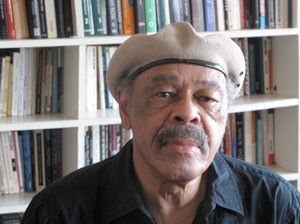
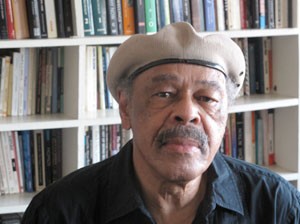
PHOTO: Clyde Taylor in the 1970s, when he was at the epicenter of a push to bring the study of Black culture into academia. Credit: via Taylor family by Clay Risen February 6, 2024 New York Times Clyde Taylor, a scholar who in the 1970s and ’80s played a leading role in identifying, defining and elevating Black cinema as an art form, died on Jan. 24 at his home in Los Angeles. He was 92. His daughter, Rahdi Taylor, a filmmaker, said the cause was chronic obstructive pulmonary disease. As a young professor in the Los Angeles area in the late 1960s — first at California State University, Long Beach, and then at the University of California, Los Angeles — Dr. Taylor was at the epicenter of a push to bring the study of Black culture into academia. Black culture was not merely an appendage to white culture, he argued, but had its own logic, history and dynamics that grew out of the Black Power and Pan-African movements. And filmmaking, he said, was just as important to Black culture as literature and art.
Dr. Taylor in 1958 when he was a student at Howard University, where he earned bachelor’s and master’s degrees in English. Credit: via Taylor family He was especially taken by the work of a circle of young Black filmmakers in the 1970s that he would later call the “L.A. Rebellion.” Among them were the directors Charles Burnett, Julie Dash, Haile Gerima and Billy Woodberry, all of whom went on to have immense impact on Black directors like Spike Lee and Ava DuVernay. As Dr. Taylor documented, these directors created their own, stripped-down approach to narrative and form. They borrowed from French New Wave, Italian neorealism and Brazil’s Cinema Novo to offer an unblinkered look at everyday Black life, often filming in Watts and other Black neighborhoods in and around Los Angeles. “He was doing the work on the ground, discovering new filmmakers and bringing them into the academic conversation,” Ellen Scott, a professor of film studies at U.C.L.A., said in a phone interview. To these directors, film was more than just art; it was a tool that used the camera to illuminate the ways in which racial disparities shaped the lives of Black Americans. Dr. Taylor praised their work as a vital part of the revolutionary changes underway across Black America. In an essay accompanying a 1986 exhibit on Black filmmakers at the Whitney Museum of Art in New York, he wrote that their “bold, even extravagant innovation sought filmic equivalents of Black social and cultural discourse.” “These young filmmakers made a commitment to dramatic films,” he added, “a commitment fired by the discomfort of dwelling in the belly of the beast: Minutes away, Hollywood was reviving itself economically through a glut of mercenary Black exploitation movies.” Clyde Russell Taylor was born on July 3, 1931, in Boston, the youngest of eight children. Both parents were active in the civil rights movement. His father, Frank Taylor, was a Pullman train porter and a member of the Brotherhood of Sleeping Car Porters, one of the country’s largest Black unions; his mother, E. Alice (Tyson) Taylor, was an entrepreneur and a longtime board member of the N.A.A.C.P.’s Boston chapter. Dr. Taylor attended Howard University, receiving a bachelor’s degree in English in 1953 and a master’s in the subject in 1959. Howard was the country’s premier historically Black university, and he met a long list of future artistic luminaries there, including the novelist Toni Morrison and the playwright Amiri Baraka. He also fell under the sway of one of Howard’s leading intellectual lights, the philosopher Alain Locke, whose concept of “the New Negro” and promotion of Blackness as a social and cultural category helped shape the Harlem Renaissance of the 1920s and ’30s — and would later prove influential to Dr. Taylor’s own work.
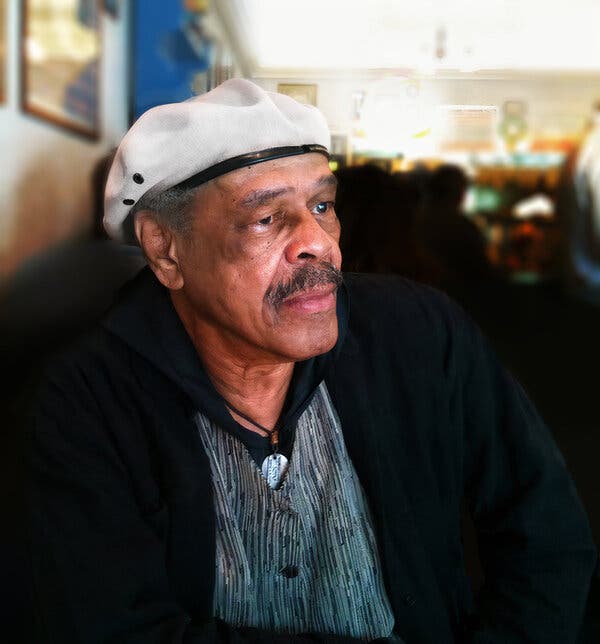
Dr. Taylor in 2010. His extensive work in the academic world and beyond made him a lodestar for generations of younger scholars. Credit: via Taylor family He attended Wayne State University in Detroit for his doctorate, which he received in 1968 with a dissertation on the English poet and painter William Blake. By then he was teaching at California State University, Long Beach, where he became chairman of the Black studies department in 1969. He later taught at U.C.L.A.; the University of California, Berkeley; Stanford; and Mills College (now a part of Northeastern University) in Oakland, Calif., before moving east to Tufts in 1982. He retired from N.Y.U. in 2008. Dr. Taylor married JoAnn Spencer in 1960; they divorced in 1970. His second marriage, to Marti Wilson, also ended in divorce. Along with his daughter Ms. Taylor, he is survived by a granddaughter. Another daughter, Shelley Zinzi Taylor, died in 2007. Although he wrote just one major book, “The Mask of Art: Breaking the Aesthetic Contract — Film and Literature” (1998), Dr. Taylor was prolific in other ways. With Beth Deare, he wrote the script for the documentary “Midnight Ramble” (1994), about the early Black filmmaker Oscar Micheaux. He also curated several major museum exhibits, wrote extensively in journals like Jump Cut and Black Film Review, and appeared as a commentator in documentaries about Black actors like Paul Robeson and Sidney Poitier. Such work made him a lodestar for generations of younger scholars, and a gravitational center of Black cultural studies even today. “You have to deal with Clyde if you talk about Black cinema,” Manthia Diawara, a professor of film studies at New York University, said by phone, “just as you have to deal with certain people if you talk about African-American literature.” Clay Risen is a Times reporter on the Obituaries desk. More about Clay Risen A version of this article appears in print on Feb. 8, 2024, Section B, Page 12 of the New York edition with the headline: Clyde Taylor, 92, Scholar Who Elevated Black Cinema. Order Reprints | Today’s Paper https://amsterdamnews.com/news/2024/02/13/eminent-literary-and-film-scholar-dr-clyde-taylor-dies-at-92/ Obits
Eminent literary and film scholar Dr. Clyde Taylor dies at 92 by Herb Boyd February 13, 2024 Amsterdam News
PHOTO: Clyde Taylor courtesy of NYU Gallatin School
“We live in days of Great Change, a shuffling of status and symbols,” Dr. Clyde Taylor wrote in 1973. “Yeats’ cry ‘Things fall apart, the centre cannot hold’ is good news in the Third World; a ferment rises in the young bloods in the bush. And stepping out of the shelter of their place in the shadows of American exceptionalist rationalizations.” Taylor, an example of the activist scholars of his day, composed this as part of an essay about “Black Consciousness in the Vietnam Years,” reflective of his stance against the Vietnam War. That strong voice of the Black liberation movement took a final breath on January 24. He was 92 and died in Los Angeles. According to his daughter, Rahdi Taylor, the cause of his death was chronic obstructive pulmonary disease. Born Clyde Russell Taylor on July 3, 1931, in Boston, he was the youngest of eight children of his parents, Frank and E. Alice (Tyson) Taylor. His father was a member of the legendary Brotherhood of Sleeping Car Porters, and his mother was an entrepreneur who was active with the NAACP’s Boston chapter. Not much is known of Taylor’s formative years, although we do know that he was a graduate of English High School and later Howard University, where he received his B.A. degree in 1953 and six years later, his master’s in the same subject. It was there that he met several Black literary and political activists, including Toni Morrison and Amiri Baraka. After graduation from Howard, Taylor enlisted in the Air Force as an intelligence officer and left service as a first lieutenant; he was honorably discharged with a National Defense Service Medal. At Wayne State University in Detroit, he earned his doctorate with a dissertation on the works of William Blake and the ideology of art. In 1960, he married JoAnn Spencer and they had two daughters, Rahdi and Shelley Zinzi Taylor. They divorced in 1970. Two years later, Taylor moved to San Francisco and married Martella Wilson. Together, they founded the African Film Society. By the mid-’90s, the marriage had dissolved. Taylor moved to New York City and began teaching at New York University. Throughout these turbulent times, Taylor was on the ramparts of the Black studies movement, particularly at UCLA, with a critical role in advancing revolutionary cinema, most notably as a presenter and commentator: “The making of ‘O Povo Organizado’ [‘The People Organized’] in Mozambique by Bob Van Lierop, an African American, or of ‘Sambizanga,’ about Angola by Guadoupian Sara Maldoror, or the Ethiopian Haile Gerima’s ‘Bush Mama,’ set in Los Angeles, or Pontecorvo’s ‘The Battle of Algiers,’ or the several Latin American and African films created by Cubans, or the many Third World films made by Europeans and white Americans––all suggest the cross-fertilizations of an embryonic transnational Third World cinema movement.” Taylor figured prominently in this development. A book certainly could have been forged from Taylor’s extensive study of cinema, and one was published: “The Mask of Art: Breaking the Aesthetic Contract––Film and Literature in 1988.” In one of his last essays, Taylor expounded on the differences between Africa and Hollywood: “Africa stands today (2021) at the other end of the spectrum from Hollywood. If Americans view cinema from the center of profitable, monopolistic production and distribution, Africa is a laboratory for the study of film’s relation to society from the vantage point of the exploited.” Right down to the end of his extraordinary life, Clyde Taylor possessed a keen analysis and passionate commitment to the world of cinema and its prospects here and abroad. https://gallatin.nyu.edu/news/2024/02/clyde-taylor--nyu-gallatin-professor-emeritus--passes-away.html
Clyde Taylor, NYU Gallatin Professor Emeritus, Passes Away February 12, 2024 New York University
Clyde Taylor, Professor Emeritus at the NYU Gallatin School of Individualized Study, and a scholar whose work was integral to elevating Black cinema as an art form, died on January 24, 2024. He was 92. At the beginning of his career as a professor in the late 1960s in the Los Angeles area, Dr. Taylor was a leader in bringing the study of Black culture, including Black film, into the academy. He saw Black culture as having its own logic, history, and dynamics, and he felt that filmmaking was as integral to Black culture as art and literature. According to e. Frances White, Professor Emerita of Individualized Study and former Dean at Gallatin, "Dr. Taylor's work on Black cinema helped students and young filmmakers see a way to produce Black art when there appeared to be no way for them to express themselves." Dr. Taylor was especially intrigued by a group of young Black filmmakers in the 1970s that included Charles Burnett, Julie Dash, Billy Woodberry, and Haile Gerima. A circle he would come to call the “LA Rebellion,” these directors innovated their own approach to narrative and form—an approach that would eventually have an outsized impact on the likes of Ava DuVernay and Spike Lee. Dr. Taylor joined the NYU Gallatin community in the Fall of 1997 having already established himself as a pioneer in the field of Black Cinema Studies. As an exemplar of the School’s interdisciplinary approach to teaching, learning, and research, his interests ranged from art criticism and curation to political theory and social movements, from literature to epistemology, and so much more. Founding Gallatin Professor Emerita Sharon Friedman shares that Dr. Taylor “was always challenging us to think more adventurously,” an apt reflection on his own academic range. The courses he taught at Gallatin were a wonderful showcase of this range, with such titles as “Slavery and Culture in the US and Brazil,” “Narratives of African Civilization,” and “Modernism and Imperialism: Objects of Transcultural Desire.” Dr. Taylor’s professional work also highlighted his broad focus of scholarship, inquiry, and exploration. His book The Mask of Art: Breaking the Aesthetic Contract - Film and Literature (1998) is a cornerstone text across disciplines, as are his edited collections Vietnam and Black America (1973) and Black Genius (2000), his documentary on Oscar Micheaux (1994), and his curation of exhibits at the Whitney Museum of American Art and the Brooklyn Museum. Following Dr. Taylor’s retirement in 2008, and in recognition of his contributions to the School and the fields he helped define, Gallatin created the Clyde Taylor Award for Distinguished Work in African-American and Africana Studies. This honor is offered to one graduating BA student and one graduating MA student each year to recognize their high-caliber work in African American or Africana Studies. We at Gallatin were fortunate to benefit from Dr. Taylor’s groundbreaking work, scholarship, and teaching, and we join his loved ones and those who he impacted in celebrating his life and mourning his loss. https://en.wikipedia.org/wiki/Clyde_Taylor Dr. Clyde Taylor
Occupation(s): Film scholar, writer, and cultural critic
Children: 2
Clyde Russell Taylor (July 3, 1931 – January 24, 2024) was an American film scholar, writer and cultural critic who made contributions to the fields of cinema studies and African American studies. He was an emeritus professor at New York University. His scholarship and commentary often focused on Black film and culture.
Career
Clyde Taylor wrote and published numerous scholarly articles, essays, and reviews.[1] Taylor is best known for coining the term 'L.A. Rebellion', which refers to the group of African American filmmakers who emerged from the UCLA School of Theater, Film and Television in the 1970s.[2][3][4] This movement was characterized by its emphasis on social realism and its rejection of Hollywood conventions.
Taylor was the author of the book, The Mask of Art: Breaking the Aesthetic Contract – Film and Literature (Indiana University Press, 1998), which was awarded the PEN Oakland/Josephine Miles Literary Award in 1999.[9][10] He co-wrote the screenplay for Midnight Ramble, a seminal feature documentary about the work and legacy of Oscar Micheaux released by American Experience on PBS in 1995.[11] He was a frequent contributor to journals such as Black Film Review and Jump Cut.[12][13][14][15][16][17]
Other accolades for Taylor included induction into the National Literary Hall of Fame for Writers of African Descent, by the Gwendolyn Brooks Cultural Center; the 1982 Callaloo Creative Writing Award for Non-Fiction Prose, an "Indie" Award for critical writing on cinema of people of color from the Association of Independent Video and Film (AIVF); and the Richard Wright Award for Literacy Criticism from Black World.[18][19] He was the recipient of a FulbrightFellowship, as well as Fellowships from the Rockefeller Foundation (Whitney Scholar-in-Residency Fellowship), the Ford Foundation Fellowship (DuBois Institute, Harvard University), the Rockefeller Foundation (Fellowship, NYU Center for Culture, Media and History), as well as two Fellowships from the National Endowment for the Humanities.
Once at Howard University, Clyde studied in the Department of English in collegial engagement with fellow students like Amiri Baraka and Toni Morrison. At Howard he studied under professors such as Alain LeRoy Locke. Taylor earned both Bachelor’s and Master’s degrees in English.
After graduation, Taylor enlisted in the United States Air Force as an intelligence officer, earning the rank of First Lieutenant. He was honorably discharged and recognized with a National Defense Service Medal. He continued his studies, pursuing a graduate degree in English at Wayne State University in Detroit, MI. He wrote his dissertation on the works of William Blake and the Ideology of Art, and earned a Ph.D.[20] Personal life
While at Wayne State University, he met student JoAnn Spencer from Detroit, pursuing her degree in education. They married in June 1960 in Detroit and had two children, daughters Shelley Zinzi Taylor and Rahdi Taylor. Their marriage dissolved in 1970. In 1972, Taylor moved to the San Francisco Bay Area, where he went on to marry Martella Wilson, a young leader in the world of philanthropy and social impact charities. Together they co-founded and led the African Film Society, which hosted screenings of cinema from Western Africa and discussions of their aesthetic and social vision. In the mid 90s, the couple dissolved the marriage but continued living and working in Boston until Taylor moved to Manhattan for a position at New York University in 1998.
Taylor died on January 24, 2024, at the age of 92.[21]
I saw and heard you and Robin Kelley speak with a quiet yet fiercely intelligent insight as well as an exhilarating explosive stillness at Bethany church last night. Your mutually creative and scholarly work (yours and Robin's) I have read and treasured deeply for nearly two decades now prior to last evening but I was still not wholly prepared for the sheer verification/validation/vindication of your inspiring remarks and analyses and the visceral as well as “intellectual” impact of their (myriad) meanings and active possibilities. So thank you for the CLARITY and the calm, measured grace, generosity, and intensity of your considerable (and ongoing) thought and practice. What you shared with the audience (and myself) was much more than a public “rallying of the troops” for the clearly and as always o so necessary battles and engagements to come, but you managed the far rarer feat (I was gonna say ‘treat’) of making the complex and intricate connections that were always already there in our collective hearts and minds that much more real, energizing, and purposeful through your open commitment to confronting the “difficult” challenges and requirements of actual political, intellectual, and aesthetic engagement—which is to say, STRUGGLE. Like Monk’s “Ugly Beauty” you not only nailed it but gave us all something to genuinely work and strive for in our own thought and practice(s)…Not bad for a couple hours on saturday night! So thank you again brother for the ‘WORK' (another Monk classic with Sonny Rollins on board). We all need to sweat more than a little if we are going to find what we really need and what we’re all still restlessly searching for (truth, justice, peace, love, community)…
Radical Theorist Fred Moten Among the 2020 MacArthur ‘Genius’ Grant Winners by Helen Holmes 10/7/20 Observer
PHOTO: Theorist and poet Fred Moten. John Hope Franklin Center at Duke University / YouTube. Fred Moten (b. August 18, 1962)
In an extremely turbulent year rife with a proliferation of badly-executed and harmful ideas, it’s a comfort that people with good ideas are once again being honored with the annual distribution of MacArthur fellowships. Awarded each year by the John D. and Catherine T. MacArthur Foundation and amounting to $625,000 that’s distributed to each awardee over the course of five years, the MacArthur “Genius” grant is an extremely coveted honor for creatives in many different kinds of fields. This year, the recipients include Larissa FastHorse, a Native American playwright and choreographer and cofounder of the consulting firm Indigenous Direction, the conceptual artist Ralph Lemon and the theorist and poet Fred Moten.
In addition to producing books of poetry that that interrogate themes of universality, fugitivity, suppression and liberation, Moten has also produced some of the most influential theoretical texts in recent memory. These texts include In the Break: The Aesthetics of the Black Radical Tradition, I ran from it but was still in it and The Undercommons: Fugitive Planning and Black Study, the latter of which being a comprehensive exploration of “an array of concepts: study, debt, surround, planning, and the shipped.”
Moten is also a professor in the Department of Performance Studies at the Tisch School of the Arts at NYU, and is especially lauded for his development of new ways of understanding the intersection of joy and pain in Black social and cultural life. “I’m trying to do that in the interest of always trying to advance joy, over against the conditions that produce pain,” Moten told the MacArthur foundation.
“Upward Mobility means getting closer and closer to the people who want to kill you”
Do Black Lives Matter?: Robin D.G. Kelley and Fred Moten in Conversation
January 8, 2015 · by admin · in Events
On December 13, 2014 Critical Resistance was honored to host Fred Moten and Robin D.G. Kelley for a conversation on the impacts of the prison industrial complex on Black communities. The conversation was a collaboration with Oakland’s Bethany Baptist Church and was skillfully moderated by Maisha Quint. Here is video footage from that powerful event. Many thanks to Lucas Gilkey for video documentation and Nicole Deane for editing.
FRED MOTEN: I’m going to start off just very briefly. First of all what Robin Kelley says in that piece that Rachel just quoted from seems to me to be absolutely true and so true and sometimes so obscure that it needs to be repeated again and again, which is that we’re in a state of war. George W. Bush declared a war on terror and that war on terror quickly came to be understood as a permanent war but the war on terror that’s a permanent war is just an extension of a war we’ve always been in. And I think that in fact insurgent social life, black social life, has always been as terrible to the likes of George W. Bush as anything Osama Bin Laden did or thought about doing. It’s important to understand that the drones that are sent into our communities that go by the names of Darren Wilson or Daniel Panteleono (sp.). or Justin Bulby or Stacy Coon etc., represent a longstanding tradition of brutal inviolate technological innovation visited upon us in the most horrific ways. And I think it’s important to understand that this state of war has always existed and in a weird way the drones that are sent into our community imagine themselves to be self defensive. Settlers always think they’re defending themselves. That’s why they built forts on other people’s land and then they freak out over the fact that they are surrounded—and they’re still surrounded. It’s important to understand that this doesn’t constitute justification for the violence they commit, but it’s an important thing for us to remember because it gives us some indication of the forces that we actually represent. And we need to know something about who we are and what we are. And with that in mind I think it’s really important to understand not only these sort of intense continuities that what it is we’ve seen over these last few weeks and months is an extension of what Ida B. Wells called lynch law. When I was in college I had these friends and we were naive enough to think that—well I don’t even know if that was it, I don’t know if we were naive, but we certainly believed that some historical force had sent us to Harvard to plot revolution (laughter) and so we would walk around with that in mind. I remember we used to talk about the fact that during what the black historian Rayford Logan called “the nadir” that period really after Reconstruction between 1880 and 1920, that someone black was lynched at the rate of roughly one person every forty one hours and we used to cite that statistic all the time. And I think what was naive about what we were doing was that we somehow thought that that statistic had waned or it had been somehow eclipsed after 1920. And I actually think that the rate has increased since then. Which is again indicative of the fact that we are in a state of war. But it’s not enough to say that or to understand that it seems to me because we need to understand what it is the state is “defending itself” from. And I think in this respect the particular instances of Michael Brown’s murder and Eric Garner’s murder are worth paying some attention to because what the drone Darren Wilson shot into that day was insurgent black life walking down the street. I don’t think he meant to violate the individual personhood of Michael Brown. He was shooting at mobile black sociality walking down the street in a way that he understood implicitly constituted a threat to the order that he represents and that he is sworn to protect. Eric Garner on an everyday basis initiated a new alternative kind of marketplace, another mode of social life. That’s what they killed, OK?
So when we say that black lives matter I think what we do sometimes is obscure the fact that in fact it is black life that matters. That insurgent black social life still constitutes a profound threat to the already existing order of things. And part of the reason that it constitutes such a profound threat is its openness. Its unfixity. The fact that anyone can claim it. The fact that it can claim anybody, it seems to me, and I’ll just close with this. I was just thinking about a couple things on the plane coming up here today. Clearly, both in the instance of Michael Brown and the instance of Eric Garner these are manifestations of ‘broken windows’ policing. And what they make clear is we are the broken windows. We constitute this threat to already existing normative order. And I think that the police have this regulatory function that’s designed to destroy broken windows. Even in a weird way to fix them by destroying them. I study literature and philosophy and I guess about ten or twelve years ago I became obsessed with this passage in a book that is sort of the culmination of the philosophical work of a figure who most folks claim to be the most important modern philosopher in the Western tradition, Immanuel Kant. And the book is called 'The Critique of Judgement.’ And in that book Kant writes “The imagination in its lawless freedom produces nothing but nonsense. It must have its wings severely clipped by the understanding.” He opposes the lawlessness of the imagination with the regulatory policing function of the understanding. And there’s a whole complicated but not very surprising way in which imagination is both racialized and gendered and sexualized in all these profound ways all throughout the Western philosophical tradition. Kant’s interesting because he understands that you can’t do without imagination but he definitely wants its wings clipped. He demands that it be regulated. In the history of English poetry the window has often been conceived of as a figure for imagination, as a kind of lens through which we see, through which we envision. And part of what’s at stake is that I think to fix a broken window is to fix another way of imagining the world. To literally fix it, to destroy it, to regulate it, to exclude it, to incarcerate it. But also at the same time to incorporate it, to capitalize upon it, to exploit it. To accumulate it. This state can’t live with us and they can’t live without us. It’s important to recognize too that the 'broken window', the alternative unfixed window through which we see the world is not just the way in which we see something that doesn’t exist but it’s also the way in which we see and imagine that which does exist. It’s important to imagine how things might be otherwise but it’s also really important to see and understand who and what we are right now. Because I think they see who and what we are. They see who and what we are through the sights of their guns. Through their surveillance mechanisms. I sometimes think they know more about who we are and what we can do than we do. Emancipation produced two problems or kind of extended a problem, deepened it. The enslaved persons were protected property. And at the same time they constituted a threat in their conscious activity every minute of the day to the very idea of property. So that in the aftermath of Emancipation when that property was no longer protected a new set of innovations and regulations had to emerge. Again under the rubric of policing. That’s lynch law. ‘Broken windows’ is an extension of that. So I think it’s really important to be able to understand just enough about what they do so that it can give us a little bit more clear understanding about what we do and what we are. How we need to act. How we need to behave. Not in response to them but in the deepest and the most radical extension of a historical tendency of black social life. To constantly imagine and enact another way of living on earth. So I’m very happy to be here today with you all to talk a little about that…(Applause)…
Fred Moten’s Radical Critique of the Present by David S. Wallace
April 30, 2018 The New Yorker
The philosopher, essayist, and poet Fred Moten. Photograph by Kari Orvik
When
I met the poet, critic, and theorist Fred Moten for lunch near
Washington Square Park recently, he ordered a hamburger, and asked the
waiter to hold the aioli. When the food arrived, it was clear that his
request had not been followed. After a brief, disappointed examination
of the bun, Moten, who recently became a professor at N.Y.U. after a few
years at the University of California, Riverside, found an idea.
“I think mayonnaise—actually, sorry, this is stupid, this is crazy,” he said.
“Not at all,” I said.
“I think
mayonnaise has a complex kind of relation to the sublime,” he said. “And
I think emulsion does generally. It’s something about that
intermediary—I don’t know—place, between being solid and being a liquid,
that has a weird relation to the sublime, in the sense that the
sublimity of it is in the indefinable nature of it.”
“It’s liminal also,” I offered.
“It’s liminal, and it connects to the body in a certain way.”
“You have to shake it up,” I said. “You have to put the energy into it to get it into that state.”
“Anyway,” Moten said, “mostly I just don’t fucking like it.”
Moten
had agreed to meet so that I could ask him about his newest books,
three dense volumes of critical writing, written in the course of
fifteen years, and gathered under the name “consent not to be a single
being.” The first volume, “Black and Blur,” has writings on art and music: Charles Mingus, Theodor Adorno, David Hammons, Glenn Gould. The second, “Stolen Life,” focusses on ideas that Moten describes as, broadly, “sociopolitical.” The third, “The Universal Machine,”
deals with something like “philosophy proper,” as he put it to me, and
is broken into “three suites of essays” on Emmanuel Levinas, Hannah
Arendt, and Frantz Fanon.
Moten speaks softly and,
once he gets going, in long, complex paragraphs. He is drawn to
in-between states: rather than accepting straightforward answers, he
seeks out new dissonances. On the page, this can take a complex and even
forbidding form. “Black studies,” he writes in an essay collected in
“Stolen Life,” “is a dehiscence at the heart of the institution on its
edge; its broken, coded documents sanction walking in another world
while passing through this one, graphically disordering the administered
scarcity from which black studies flows as wealth.” A reader may need
to sit with that sentence for a while, read it over once or twice,
perhaps look up the word dehiscence (“a surgical complication in which a
wound ruptures along a surgical incision”).
In
person, though, Moten’s way of thinking and speaking feels like an
intuitive way of seeing the world. Moten was born in 1962, and he grew
up in Las Vegas, in a thriving black community that took root there
after the Great Migration. His mother was a schoolteacher, and books
were always present in the house, from works of sociology to anthologies
of black literature. Moten went to Harvard, but falling grades led to a
year off, back home, which he spent, in part, working at the Nevada
Test Site. Out in the desert, he got a lot of reading done. “I like to
read, and I like to be involved in reading,” he said. “And for me,
writing is part of what it is to be involved in reading.”
Moten’s 2003 book, “In the Break,”
a study of the “black radical tradition” through the notion of
performance, took up the ideas of such pioneering black-studies scholars
as Saidiya Hartman, exploring them within a freewheeling discourse on
phenomenology and jazz. For Moten, blackness is something “fugitive,” as
he puts it—an ongoing refusal of standards imposed from elsewhere. In
“Stolen Life,” he writes, “Fugitivity, then, is a desire for and a
spirit of escape and transgression of the proper and the proposed. It’s a
desire for the outside, for a playing or being outside, an outlaw edge
proper to the now always already improper voice or instrument.” In this
spirit, Moten works to connect subjects that our preconceptions may have
led us to think had little relation. One also finds a certain
uncompromising attitude—a conviction that the truest engagement with a
subject will overcome any difficulties of terminology. “I think that
writing in general, you know, is a constant disruption of the means of
semantic production, all the time,” he told me. “And I don’t see any
reason to try to avoid that. I’d rather see a reason to try to
accentuate that. But I try to accentuate that not in the interest of
obfuscation but in the interest of precision.”
In 2013, Moten published “The Undercommons,”
a slender collection of essays co-written with his former classmate and
fellow-theorist Stefano Harney. For a book of theory, it has been
widely read, perhaps because of its unapologetic antagonism. “The
Undercommons” lays out a radical critique of the present. Hope, they
write, “has been deployed against us in ever more perverted and reduced
form by the Clinton-Obama axis for much of the last twenty years.” One
essay considers our lives as a flawed system of credit and debit,
another explores a kind of technocratic coercion that Moten and Harney
simply call “policy.” “The Undercommons” has become well known,
especially, for its criticism of academia. “It cannot be denied that the
university is a place of refuge, and it cannot be accepted that the
university is a place of enlightenment,” Moten and Harney write. They
lament the focus on grading and other deadening forms of regulation,
asking, in effect: Why is it so hard to have new discussions in a place
that is ostensibly designed to foster them?
They suggest alternatives: to gather with friends and
talk about whatever you want to talk about, to have a barbecue or a
dance—all forms of unrestricted sociality that they slyly call “study.”
The book concludes with a long interview of Moten and Harney by Stevphen
Shukaitis, a lecturer at the University of Essex, in which Moten
explains the idea.
We
are committed to the idea that study is what you do with other people.
It’s talking and walking around with other people, working, dancing,
suffering, some irreducible convergence of all three, held under the
name of speculative practice. The notion of a rehearsal—being in a kind
of workshop, playing in a band, in a jam session, or old men sitting on a
porch, or people working together in a factory—there are these various
modes of activity. The point of calling it “study” is to mark that the
incessant and irreversible intellectuality of these activities is
already present.
Moten
maintains that this kind of open-ended approach can be brought to bear
everywhere, and can address even those subjects that might seem most
traditionally academic. Over lunch, we spoke about Moten’s essay
“Knowledge of Freedom,” collected in “Stolen Life.” It’s a critique of
Kant that considers the philosopher’s ideas about the imagination and
his “scientific” racism alongside a close reading of “The Interesting
Narrative of the Life of Olaudah Equiano,” an autobiography published,
in London, in 1789, the year after Kant published his “Critique of
Practical Reason” and the year before he published “Critique of
Judgment.” Equiano was enslaved in what is now Nigeria, worked for years
on British ships, and later, in the United States, bought his freedom.
“I neither want to refute Kant nor put Kant in his
place,” Moten said. “I want to think about Kant as a particular moment
in the history of a general displacement.” This, he added, “requires
recognizing that Kant is a crucial figure in the development of the very
concept of race on something like a philosophically rigorous level.
But, of course, the fact that the incoherence that we call race can
somehow be compatible with something like philosophical rigor lets us
know something about the limits of philosophy, you know?”
Moten’s
poetry, which was a finalist for a National Book Award, in 2014, has a
good deal in common with his critical work. In it, he gathers the
sources running through his head and transforms them into something
musical, driven by the material of language itself. The poem “all
topological last friday evening,” collected in Moten’s 2015 book, “The Little Edges,” begins:
taken to bridges from lula to lela to lena to eula to ayler to tala to
tore up
but untorn and bend
like fenders breathe, felder’s or fielder’s, that family, man, that
recess.
so much more than air and world and time.
The poem unfolds as a chain of references, from free-jazz saxophonist Albert Ayler to Andrew Marvell. We may not know exactly how we moved from one to the other, but there’s pleasure in getting lost in the dance.
When
we discussed his poetry, Moten, citing Amiri Baraka, made a distinction
between voice and sound. “I always thought that ‘the voice’ was meant
to indicate a kind of genuine, authentic, absolute individuation, which
struck me as (a) undesirable and (b) impossible,” he said. “Whereas a
‘sound’ was really within the midst of this intense engagement with
everything: with all the noise that you’ve ever heard, you struggle
somehow to make a difference, so to speak, within that noise. And that
difference isn’t necessarily about you as an individual, it’s much more
simply about trying to augment and to differentiate what’s around you.
And that’s what a sound is for me.”
As
we finished lunch, I asked Moten what his next projects might be. He
began, typically, with everyday things: unpacking from the move to New
York, getting his two children enrolled in school, adjusting to walking
everywhere again instead of driving. Then, in the same casual tone, he
said that he was working on two new books, and that he might try his
hand at opera soon—perhaps write some librettos. And he’s still trying
to figure out how to teach a good class, he said. He wasn’t sure that it
was possible under the current conditions. “You just have to get
together with people and try to do something different,” he said. “You
know, I really believe that. But I also recognize how truly difficult
that is to do.”
A
couple of weeks later, on a Saturday afternoon, I attended a reading
that Moten gave at Zinc Bar, on West Third Street, with the poet Anne
Boyer. A large audience had crammed into the bar’s back room, shoulder
to shoulder and sweating to hear the two readers. Moten recited an
excerpt from a new work, somewhere between essay and poem, that had
recently been published by The New Inquiry, called “come on, get it!”
“Improvisation is how we make no way out of a way,” he read.
“Improvisation is how we make nothing out of something.” Moten was
elegant onstage. He read with an ease that somehow harmonized the
complex counterpoint and references of the work.
Midway
through his reading, Moten paused, and asked for some water. Promptly, a
tall, full glass was passed from the bar, hand to hand, over shoulders,
down the stairs, and up to the stage. But by the time it got there,
Moten had already been offered a bottle of water by someone else. He
acknowledged the gesture, took a sip, and resumed his performance.
ABOUT THE AUTHOR:
David S. Wallace is a member of The New Yorker’s editorial staff.
WHO IS FRED MOTEN?
Fred Moten (born August 18, 1962) is an American poet and scholar whose work explores critical theory, black studies, and performance studies. Moten is professor of performance studies at New York University and has taught previously at University of California, Riverside, Duke University, Brown University, and the University of Iowa. His scholarly texts include The Undercommons: Fugitive Planning & Black Study which was co-authored with Stefano Harney, In the Break: The Aesthetics of the Black Radical Tradition, and The Universal Machine (Duke University Press, 2018).[1] He has published numerous poetry collections, including The Little Edges, The Feel Trio, B Jenkins, and Hughson’s Tavern.[2]
Biography
Fred Moten was born in Las Vegas in 1962 and was raised in the segregated black neighborhood on the western end of the city. His parents were among the black families that made up the Great Migration, the period in US history when many black families moved from the deep south to seek out new prospects in the northern and western parts of the country. His parents were originally from Louisiana and Arkansas and after resettling in Las Vegas, his father found employment at the Las Vegas Convention Center (and later worked for Pan American Airlines), and his mother worked as a grade school teacher.[3]
Moten enrolled in Harvard University in 1980 hoping to pursue a degree in economics. His interest in sociopolitical discourse, the work of Noam Chomsky, civic outreach, and political activism led him away from his studies. At the end of his first year, Moten was required to take a year leave. During this time, he worked as a janitor at the Nevada Test Site, wrote poetry, and discovered the works of T.S. Eliot and Joseph Conrad, among many others.[4] His return to Harvard was more successful and led to developing his understanding of prose and finding more inspiration for his own work. It was also during this time that he met his would-be collaborator Stefano Harney. After graduating from Harvard, Moten went on to pursue his PhD at University of California, Berkeley.[3]
Critical work
Moten makes considerable intellectual contributions to the discourses of black studies, poetry and poetics, critical race theory and contemporary American literature. He has been profiled by Harvard Magazine, The Brooklyn Rail, and LitHub.com about his life and work in scholarship. In 2016, he was awarded a Guggenheim Fellowship and the Stephen E. Henderson Award for Outstanding Achievement in Poetry by the African American Literature and Culture Society. Moten's work The Feel Trio (2014) was awarded the Los Angeles Times Book Prize, and was a poetry finalist for the National Book Award.[2] He also received a Foundation for Contemporary Arts Roy Lichtenstein Award (2018).
He has served on numerous editorial boards including American Quarterly, Callaloo, Social Text, and Discourse. He has served on advisory boards for Issues in Critical Investigation at Vanderbilt University, the Critical Theory Institute at the University of California, Irvine, and was on the board of directors of the Center for Lesbian and Gay Studies at City University of New York.[5]. As of September 2018, Moten is an associate professor in the Department of Performance Studies at New York University's Tisch School of the Arts, where he teaches courses in Black studies, poetics, music and critical race theory. [6]
One of his most well-known works is a series of essays he published with Stefano Harney in a book called The Undercommons. Throughout these works he criticizes academia's drive to professionalize the student, logistical capitalism, debt–credit hierarchies, and state-based institutions. He offers a theory of hapticality and to stay in debt to one another as a means of understanding one's own relationship to the world and to others.
In 2009, Moten was recognized as one of ten “New American Poets” by the Poetry Society of America. Poet and nonfiction author Maggie Nelson writes of Moten’s work, “With insistence, music, and a measured softness, Fred Moten’s poems construct idiosyncratic, critical canons that invite our research and repay our close attention. … It is hard to make poetry that shimmers on such an edge. Moten does so, and then some.”
Moten was a member of the Board of Managing Editors of American Quarterly from 2004 to 2007 and has been a member of the editorial collectives of Social Text and Callaloo, and of the editorial board of South Atlantic Quarterly. He is also cofounder and copublisher of the small literary press Three Count Pour.
Statement:
"Black studies is a dehiscence at the heart of the institution on its edge; its broken, coded documents sanction walking in another world while passing through this one, graphically disordering the administered scarcity from which black studies flows as wealth."
Works:
The Universal Machine (series: Consent not to be a single being; Duke University Press, 2018)
Stolen Life (series: Consent not to be a single being; Duke University Press, 2018)
Black and Blur (series: Consent not to be a single being; Duke University Press, 2017)
The Service Porch (Letter Machine Editions, 2016)
A Poetics of the Undercommons (with Harney, Stefano; Sputnik and Fizzle, 2016)
Who touched me? (with Wu Tsang; If I Can’t Dance, I Don't Want to be Part of Your Revolution, 2016)
The Little Edges (Wesleyan University Press, 2015)
The Feel Trio (Letter Machine Editions, 2014)
The Undercommons: Fugitive Planning and Black Study (with Harney, Stefano; Minor Compositions/Autonomedia, 2013)
B. Jenkins (Duke University Press, 2010)
Hughson’s Tavern (Leon Works, 2009)
I ran from it but was still in it (Cusp Books, 2007)[8]
In the Break: The Aesthetics of the Black Radical Tradition (University of Minnesota Press, 2003)
Poems (with Behrle, Jim; Pressed Wafer, 2002)[8]
Arkansas (Pressed Wafer, 2000)
References
Moten, Fred (2018). The Universal Machine. Duke University Press. p. 305. ISBN 9780822370550.
Moten, Fred (7 November 2014). "Fred Moten". Fred Moten. Retrieved 21 January 2018.
"The Low End Theory". harvardmagazine.com. 8 December 2017. Retrieved 21 January 2018.
Stasio, Nicole Campbell, Frank. "Duke Professor Carries On Tradition Of Black Radical Poetry". wunc.org. Retrieved 21 January 2018.
"Fred Moten – UCR – Department of English". english.ucr.edu. Retrieved 21 January 2018.
Moten, Fred. "Professor". Tisch Directory. Retrieved March 20, 2019.
Wallace, David. "Fred Moten's Radical Critique of the Present". The New Yorker. Retrieved 2020-02-11.
Poets, Academy of American. "About Fred Moten Academy of American Poets". poets.org.
Fred Moten is author of In the Break: The Aesthetics of the Black Radical Tradition, Hughson’s Tavern, B. Jenkins, The Undercommons: Fugitive Planning and Black Study (with Stefano Harney), The Feel Trio and The Little Edges. A new poetry collection, The Service Porch and a new collection of essays, consent not to be a single being are forthcoming. Moten lives in Los Angeles and teaches at the University of California, Riverside.
Presented by the Pearl Andelson Sherry Memorial Fund and the Program in Poetry & Poetics
October 6, 2020
UPDATE: Fred Moten is a 2020 MacArthur Grant receipient/"Genius" (see below):
Creating new conceptual spaces to accommodate emerging forms of Black aesthetics, cultural production, and social life.
Title: Cultural Theorist and Poet
Affiliation: Department of Performance Studies, New York University
Location: New York, New York
Age: 58
Area of Focus: Art History/Theory/Criticism and Visual Culture
Website: New York University: Fred Moten
Published October 6, 2020
About Fred's Work:
Fred Moten is a cultural theorist and poet creating new conceptual spaces that accommodate emergent forms of Black cultural production, aesthetics, and social life. In his theoretical and critical writing on visual culture, poetics, music, and performance, Moten seeks to move beyond normative categories of analysis, grounded in Western philosophical traditions, that do not account for the Black experience. He is developing a new mode of aesthetic inquiry wherein the conditions of being Black play a central role.
Moten’s diverse body of work coheres around a relentless exploration of sound and its importance as a medium of Black resistance and creativity. His first book, In the Break: The Aesthetics of the Black Radical Tradition (2003), offers seminal insights that emerge from taking sound, as opposed to visual or textual imagery, as the point of departure for interpretation. For example, in considering Frederick Douglass’s famous account of the “terrible spectacle” of slavery, Moten identifies the screams of Douglass’s Aunt Hester as the materialization in sound of Black resistance, thus opening onto a new way of understanding the trauma of slavery as something not just seen but emphatically heard as well. Moten’s recently completed three-volume theoretical treatise, collectively called consent not to be a single being (2017–2018), includes essays written over the course of fifteen years. The breadth of his theoretical insights in these volumes extends across the arts and humanities—from the music of Curtis Mayfield and Billie Holiday to the critical philosophy of Immanuel Kant and Theodor Adorno—as he explores notions of performance and freedom and formations of Black identity.
Moten continues the project of his theoretical work in his poetry. In his 2014 collection, The Feel Trio, for instance, language hovers at the edge of sense so that sound rises to the fore and the reading of the poem approaches musical performance. Through his writing and lectures, Moten is demonstrating the power of critical thinking to establish new forms of social actualization and reconfiguring the contours of the cultural field broadly.
BIOGRAPHY:
Fred Moten received an AB (1984) from Harvard University and a PhD (1994) from the University of California at Berkeley. Since 2017, he has served as a professor in the Department of Performance Studies at New York University. He has taught previously at the University of California at Riverside, Duke University, and the University of Iowa. Moten’s additional publications include All That Beauty (2019), The Service Porch (2016), The Little Edges (2015), B Jenkins (2010), and Hughson’s Tavern (2009); and he is co-author, with Stefano Harney, of The Undercommons: Fugitive Planning & Black Study (2013).
Posted by Charlene Elsby | July 9, 2019 | Book Reviews
THREE BOOKS BY FRED MOTEN:
Fred Moten, Black and Blur. Durham: Duke University Press, 2017; 360 pages. ISBN: 978-0822370161.
Fred Moten, Stolen Life. Durham: Duke University Press, 2018; 336 pages. ISBN: 978-0822370581.
Fred Moten, The Universal Machine. Durham: Duke University Press, 2018; 312 pages. ISBN: 978-0822370550.
Reviewed by J. Moufawad-Paul, York University.
Fred Moten’s theory trilogy, Consent Not To Be A Single Being,
defies easy categorization. On one level, this project is a series of
separate essays organized into three books,fragments given an
organizational totality by the convention of the book and the category
of trilogy. But on another level, structured according to themes
expressed in the prefaces of all three books, there is a unity to the
multiplicity–a “fugitive” unity, to use one of Moten’s dominant themes
that becomes more apparent and coherent as the trilogy progresses.
Perhaps the closest analogue to this project is Deleuze and Guattari’s A Thousand Plateaus that, purporting to be akin to a record, exhorted the reader to cut in at any track–but this comparison is unfair to Moten. If Consent Not To Be A Single Being is
a record (or three related records), it is not the record imagined by
Deleuze and Guattari. Rather, these books are records akin to those used
in hip-hop, sampled and recursively themed, where the haptics of the
hand locating the space in the break is more significant than dropping a
needle on another track. More than simply the apprehension of the
record as an artifact, this trilogy is theory as jazz experimentation,
Schoenberg’s twelve-tone dissonance, hip-hop elaboration, Gould’s Goldberg Variations.
It is theory as music, even when it is not talking about music, guided
by the singular understanding “that the Atlantic slave trade and settler
colonialism…are irreducible conditions of global modernity–that is, of
the very idea of the global and the very idea of modernity. These ideas
include and project modernism, which is also to say postmodernism.” (Black and Blur,
198) Moreover, this theory trilogy is a prolonged and polyphonic
attempt to think blackness as “the name that has been given to the
social field and social life of an illicit alternative capacity to
desire.” (The Universal Machine,
234) The relationship between the “irreducible conditions of global
modernity” and “an illicit alternative capacity to desire” is a response
to a recurring foil in all three books: the anti-blackness of Kant’s Critique of Judgment–a key text in the project of modernism and known for ascribing an illicit imagination to blackness.
Reviewing a trilogy that theorizes
according to an experimental musicality is difficult. How can we think
Moten’s project in a single review, when it samples and plays with
multiple thinkers and aesthetic expressions? Theorists such as Hartman,
Marx, Adorno, Robinson, Fanon, Althusser, Spillers, Glissant (from which
the trilogy’s title is taken), and others cut across a vast plethora of
aesthetic landscapes from J.S. Bach and T.S. Eliot to Samuel R. Delany
and Thornton Dial. Moten’s project is thus a fugitive poetics of
assemblage; theory as aesthetics, aesthetics as theory. Or, put another
way, this trilogy translates the sensibility of music to theory, and so
we can speak of themes, movements, refrains, elisions, motifs, etc.
The first question that needs to be
answered in a review of a theory trilogy is structural. That is, how do
these three books work together as discrete but overlapping? Consent Not To Be A Single Being moves from disunity to unity. Whereas Black and Blur (BB) functions as a patchwork assemblage that travels quickly and playfully across numerous terrains, Stolen Life (SL) begins to draw the various themes into focus, and The Universal Machine (UM)
concludes the trilogy with the highest level of formal unity. In some
ways, this feels like a particular musical tactic, where seemingly
disparate movements gain a progressive logic as the work proceeds–or the
tactic of a particularly long novel that approaches denouement.
I will do my best to address each of the three books below but, due to
the immensity of this project and its formal structure, there will be
much I cannot discuss in even an extended review.
Beginning with Black and Blur,
we can possibly locate the dominant theme of this poetics of assemblage
in a sentence that, in its Preface, Moten indicates was meant to be the
first sentence of his 2003 work, In The Break: “Performance is the resistance of the object.” (BB,
vii) In order to perform an act of fugitive theory that traces the
nocturnal economy (to use Mbembe’s terminology) of modernity through
aesthetic representation, Moten is engaged in a resistance to the object
of his analysis as it is given by dominant ideology. “Our resistant,
relentlessly impossible object,” he writes, “is subjectless predication,
subjectless escape, escape from subjection, in and through the
paralegal flaw that animates and exhausts the language of ontology.” (BB,
vii) This exhaustion of the language of ontology is what he will call,
as his own theoretical terms emerge and cohere over the course of this
project, “paraontology.” Through black aesthetics, Moten works to
excavate the neglected aspect of the being imbricated by modernity and
post-modernity’s ontological proclamations–the being of the slave trade
and settler-colonialism–that exists beside, beneath, and between what is
claimed to be existence. This project is not a “remembering” but
instead “a perpetual cutting, a constancy of expansive and enfolding
rupture and wound, a rewind that tends to exhaust the metaphysics upon
which the idea of redress is grounded.” (BB, ix)
Hence, Black and Blur
proceeds with a relentless cutting into the metaphysics of modernity,
so as to reveal its wound. It is the crawlspace of Harriet Jacobs,
“above the main floor of her grandmother’s house, where she confined
herself for more than seven years in order to escape mastery’s sexual
predation.” (BB,
69) The first book of the trilogy indeed feels like a fugitive crawl
through modern aesthetics–both the aesthetics deemed acceptable by
modernity and their underbelly, as well as the ways in which this above
and below meet in the crawlspace. Directly before Moten’s chapter on
Jacobs and the film apparatus predicated on the parasitical apprehension
of a black girl, for example, he explores Girard’s Thirty Two Short Films About Glenn Gould and the ways in which Gould’s translation of modernity’s high art moved downwards, pointing to the fugitive crawlspace.
The entirety of this first book in
the trilogy works to connect the above-ground instantiations of
modernity with their critical underbelly, a relationship of value
determined by slavery and settler-colonialism, in a kind of theoretical
crawlspace. Hence Moten’s habitual return to Adorno who, despite
claiming to be an opponent of the culture industry’s business as usual,
sought to oppose contemporary expressions of art by valorizing avant-garde
modernity. Rather than simply dismissing Adorno’s theory of music
(which has been rightly criticized for its racist rejection of jazz),
Moten enlists it so as to read it against Adorno’s own racist investment
in the illusions of modernity. That is, what Adorno privileged as music
resistant to the culture industry, “will have already been anticipated
not only in the very music that Adorno dismisses but also in the style
of his dismissal. Adorno never talks as cogently about the interplay of
development and stasis, or even development and regression, as when he
speaks of it in relation to blackness, to femininity, to black
femininity in and as jazz.” (BB, 131-2)
The second book, Stolen Life, begins with a long chapter interrogating the passages in Kant’s Critique of Judgment
that deal with the lawlessness of imagination. Since Kant’s analysis of
imagination is driven by his anti-black racism (and was foundational
for modern European racist philosophy), Moten reads this conception of
lawlessness against Kant, connecting it to the themes of fugitivity and
refusal that guide the former’s project. Central to this book is the
theme of a lawless imaginary against a white supremacist legislation of
thought–synonymous with the legislation of enfleshed bodies and thus the
legislation and theft of life itself–that becomes “an irrationalization
of the social.” (SL, 89)
In Stolen Life,
the theme of fugitivity is forced into further coherence, emerging
against the foil of Kant’s legislation of imagination. Moten defines
this theme as, “a desire for and a spirit of escape and transgression of
the proper and the proposed.” (SL,
131) Against the white supremacist home of rationality, “that can be
inhabited even by those who think they are calling the very idea of
home, let alone that particular home, into question” (SL,
107)–since whiteness can be at home everywhere in an imaginary it has
constructed–fugitivity is “a desire for the outside, for a playing or
being outside… it moves outside the intentions of the one who speaks and
writes, moving outside their own adherence to the law and to
propriety.” (SL,
131) From this fugitive imaginary emerges “the ongoing possibility of a
general, often gestural refusal [that Moten has] been trying to think
under the rubric of abolitionism.” (SL, 103) Against the lawful imagination, we are asked to think a politics of fugitive refusal.
This tension between the white
supremacist imaginary of legislation, a fear of a lawlessness that is
racialized, and the insurgent black imaginary of lawless fugitivity that
is operationalized through the experience of stolen and oppressed
existence is also the tension within modernity and enlightenment. The
trilogy began, as aforementioned, by proposing to think the underbelly
of modernity. Stolen Life
thinks through enlightenment categories, with Kant front and centre,
guided by the claim that “the unfinished project of enlightenment is not
but nothing other than the unfinished project of abolition.” (SL, 113-4)
If slavery and settler-colonialism are “irreducible conditions of global modernity,” as Moten exhorted us to think in Black and Blur,
then what does it mean to think modernity’s underbelly from the
crawlspace of slave ships, plantations, and colonial killing fields?
That is, to think the global stolen life that was foundational to the
enlightenment cosmopolitanism celebrated by Kant? One answer is to
celebrate a kind of new cosmopolitanism derived from that historical
experience: this is Paul Gilroy’s answer, and it is not one that Moten
finds particularly satisfying. (See BB,
293-5, n. 3) Nor does Moten find it theoretically salient to designate
slavery as “social death,” as Orlando Patterson does. To seek another
form of cosmopolitanism is to resort to “the claim of the citizen, the
democratized sovereign, in such a way as to confirm the already given
requirement that the relation of blackness to the nation-state be
understood as analogous to that between a stubborn monolith and a
finally irresistible solvent.” (SL, 197) Otherness does not persist to challenge the processes that made it other
to begin with but is instead appropriated by, and disappeared in, these
very predatory processes. But to understand the violent othering as a
complete social death, where any form of subjectivity is obliterated,
implies that there are no voices and experiences to excavate that can
found an alter-enlightenment project of unfinished abolition:
There are those who act
as if the only way to speak or fathom or measure the unspeakable,
unfathomable, immeasurable venality of the slavers is by way of the
absolute degradation of the enslaved. But such calculation is faulty
from the start insofar as we are irreducible to what is done to us, that
we were and remain present at our own making, even in the hold of the
ship, and that this making, that presence, this presence in that void,
this fugitive avoidance in and of and out of nothing, nowhere,
everything, everywhere, is inseparable from fantasy. (SL, 196)
The problem for Moten, then, is that
“what Gilroy figures as moribund” and “what Patterson figures as tragic”
cannot cognize the fugitive subjectivity that white supremacist
legislation has either sought to disappear, by subtracting it from the
condition of modernity, or render insensible, by dismissing it to the
realm of lawless imagination. (SL,
198) If there is a cosmopolitanism to be found in fugitive resistance,
it is “the hope for an undercosmopolitanism that might abolish the
Kantian line.” (SL, 194) Here we find a clear echo of Moten’s earlier work on “the undercommons.” (See Stefano Harney and Fred Moten’s The Undercommons.)
As noted above, The Universal Machine
is the most focused volume of this trilogy. The various threads are
pulled together in three long chapters that ostensibly focus on Levinas,
Arendt, and Fanon. Here the themes of the previous two books are worked
out through an engagement with a “swarm” found in “phenomenology’s
exhaust and exhaustion.” (UM,
ix) This “exhaust and exhaustion” of phenomenology is located in the
aforementioned philosophers, each representing possible end points of
the discipline. The implicit question guiding these three meditations is
what can be salvaged from the most radical expressions of
phenomenology. Moten’s examinations of Levinas and Arendt, though
occasionally sympathetic, demonstrate that both inherit, as much as they
struggle against them, the Kantian categories critiqued in Stolen Life.
With Levinas, this inheritance is
revealed by “his embrace of the homogeneous medium–the abstract and
general equivalent known as Europe or European Man.” (UM,
50) Levinas’ valorizaton of the Bible and the Greeks as “the only
serious issues in human life” because “everything else is dancing,” (UM, 1)
for example, echoes Kant’s claims about the lawless imagination. The
fact that Levinas delivers such statements while talking about Africans
dancing to mourn the dead–referring to Africans as “a dancing
civilization” and claiming that Africans “weep differently”–demonstrates
the a priori
assumptions behind his supposedly radical phenomenological project,
underscored by his defensive additive: “no racism intended.” (UM,
1) Moten’s excavation of Levinas’ philosophy reveals that, far from
being a philosophy of the other or a phenomenology of alterity that it
presumes to be, it in fact preserves Eurocentric categories of being.
That is, Levinas’ “disavowal of and/or escape from being…[are] submitted
to the commitment to the European.” (UM,
23) At best, Levinas points us towards “the philosophical realization
that being tends towards escape, in a fugitive practice of animation.” (UM,
64) Such a realization, however, is only indicated by the Levinasian
project, which is ultimately constrained by all that it has inherited
from Heidegger, Husserl, and the European monologue.
Moten’s critique of Arendt is much more pointed and direct than his exploration of Levinas. Indeed, the second chapter of The Universal Machine
is the most focused and polemical. While some philosophers have
attempted to establish a radical philosophy on an Arendtian foundation,
the tradition to which Moten belongs has long been aware of the
“antiblackness that infuses and animates Arendt’s work.” (UM,
66) Arendt’s liberal defense of Jim Crow era USA, her opposition to
forced desegregation, and her inability to understand what was at stake
during the Civil Rights era were not, as her defenders claim,
anachronistic; they were essential to her understanding of the human
condition. Hence her horrendous essay, “Reflections on Little Rock,”
where she ventriloquizes both Elizabeth Eckford and Eckford’s mother,
arguing that their participation in desegregation was violence to them
as well, is consistent with Arendt’s understanding of violence in On Violence, her theory of the social in The Human Condition, and her understanding of politics and slavery in The Origins of Totalitarianism.
For Arendt, violence is understood as a violation of the state of
affairs; the fact that this state of affairs, particularly US white
supremacist society, is itself the worse kind of violence cannot be
grasped, because her entire approach (which is just a translation of
liberalism into the register of phenomenology) lacks the theoretical
categories to cognize such thought. Hence, her assumption that
desegregation was a violent state imposition (despite her cringe-worthy
attempts to claim this violence was not white supremacist, that it was
visited upon the Black community as well) could not grasp that
“[s]eparation’s constant and violent assault on equality is always most
emphatically an assault on black social life. Segregation is the
modality through which that assault is carried out.” (UM,
100) Although Moten recognizes that Arendt possesses an “attitude of
rejection” against “the ongoing administration of this world,” he also
demonstrates that she “share[s] it against her will and against her
thought.” (UM, 138)
The final section of The Universal Machine,
and thus the trilogy as a whole, is Moten’s meditation on Fanon. This
section is simultaneously the most interesting and the most frustrating
of all three books. It is nteresting because, against Levinas and
Arendt, it attempts to locate a phenomenology of blackness in a
heterodox reading of Fanon; it is frustrating, because this reading is
itself frustrated by a pathologization of Fanon in the very act of
examining Fanon’s discussion of colonial pathologization. In this
chapter, Moten occasionally seems to claim that Fanon’s critiques of
culturalism are simultaneously a critique of blackness, due to Fanon’s
many statements about how the colonized’s past is determined by the
colonial present, that attempts to retrieve it are pathological, and
that it is better to focus on an anticolonial future. While Moten’s
assertion that “flights of fantasy in the hold of the [slave] ship,” and
the “parantological totality” of these flights of fantasy cannot be
dismissed as pathological, since they prove that the slave was not truly
subjected to social death, (UM, 198) this more has to with the theme developed in Stolen Life
in response to Patterson than an engagement with Fanon. Indeed, Fanon’s
interrogation of colonized culture in these passages was concerned with
the actual political danger of cultural nationalism. This danger was
something that every revolutionary anticolonial movement at that time
was dealing with, because culturalism had destroyed, and would continue
to destroy, multiple revolutions. (There is a reason, for example, that
the problem of cultural nationalism was one of the main themes of Ngũgĩ
wa Thiong’o’s novels in that period.) At the same time, however, it is
clear that Moten’s meditation on Fanon is of a different order than his
meditations on Levinas and Arendt. His engagement with Fanon, after
clearing away the pseudo-radicalism of Levinas and Arendt, is an
engagement with a fellow traveler. In fact, my frustrations with this
chapter were also evinced by Moten:
Earlier, I assert that
Fanon is saying that there is no and can be no black social life. What
if he’s saying that is all there can be? The antephenomenology of spirit
that constitutes Black Skin, White Masks
prepares our approach to sociological or, more precisely, sociopoetic
grounding…by way of the description of the impossibility of political
life, which is, nevertheless, at this moment and for much of his
career, Fanon’s chief concern. The social life of the black, or of the
colonized, is, to be sure, given to us in or through Fanon, often in his
case studies, sometimes in verse, or in his narrative of the career of
the revolutionary cadre. (UM, 233)
Hence, there is a marked ambiguity in
the way that Moten engages with Fanon, while drifting in and out of
other exploratory registers, which is echoed in his parallel claim that
“[b]lack optimism and Afro-pessimism are asymptotic…their nonmeeting is
part of an ongoing manic depressive episode called black
radicalism/black social life.” (UM,
234) Rather than attempting to uncover a lost cultural essence, Moten
is trying to think the social life that precedes and survives as
fugitive refusal, the supposed “social death” of slavery and
colonialism. In Black Skin, White Masks,
in thinking the “fact” or “lived experience” of blackness in a white
supremacist world, Fanon comes to the recognition that blackness is an
othering constructed by the white world–that, as a black man in Paris,
he is “overdetermined from the outside.” (Black Skin, White Masks,
95) While this othering is indeed a fact and lived
experience–categories of race were historically determined by the
European colonial powers as a process of racialization–for Moten, this
generates a set of shadow questions that animate the final sequence of
his trilogy, the central one being: “if, as Fanon suggests, the black
cannot be an Other for another black, if the black can only be an Other
for a white, then is there ever anything called black social life?” (UM,
141) That is, according to phenomenology, there needs to be a circuit
between self and other in order for there to be social recognition and
thus social life. But for Fanon, black life is othered to such a degree
within the confines of racist social formations that the othering and
the non-other are already determined; there can be no black life outside
of this circuit that counts as a fully social life. Fanon would of
course respond that, yes, this is the point, which is why his solution
was always a revolutionary one: destroy the confines that dehumanize
racialized life. Although Moten is not at all opposed to such a violent
solution, as his critique of Arendt’s notion of violence demonstrates,
he is also concerned with recovering the sense of a social life in the
break, the crawlspace, the hold. Such a task is extremely challenging,
because it is difficult to cognize something that has rendered opaque
slavery and settler-colonialism, the underbelly of modernity. The
difficulty of such a recovery partially explains Moten’s obliqueness:
how do you enunciate the thought of something that cannot be fully
thought, that is a fugitive and outlaw possibility, battered by a
history of erasure?
If I have one significant criticism
about these books, then it is a criticism with the way in which Moten
adopts contemporary theories of sovereign power. That is, occasional
exceptions notwithstanding, Moten tends to uncritically adopt the
Foucault-through-Agamben conception of sovereignty that mystifies social
relations, due to its inability to break from the conception of social
power inherited from Hobbes and classical liberalism. In Stolen Life,
for example, he writes that “[w]hat remains necessary are the ongoing
imperatives of exodus from the genocidal construct of human sovereignty
that ceaselessly consumes what it is meant to protect.” (SL,
226) Such a claim is a recurrent theme throughout the trilogy. What
results is a conflation of the state and nation with sovereignty, which
is common for this type of analysis, and this prevents him from being
able to conceptualize what a state or nation are beyond being sites of sovereignty–which is tantamount to declaring power is power.
This understanding of social power
results in a possible lacuna in his interest in furthering the black
radical tradition: Black Nationalism was central to the black radicalism
of the 1960s/70s and, however we might judge it now, was significant in
revealing which radicals were the allies of Black Liberation. When Hal
Draper called Black Nationalism, “Jim Crow in reverse,” radicals knew
which side of history he stood on, regardless of his Marxism. And what
do demands for an “exodus” from sovereignty–which are identical to
claims made by Agamben who, as Weheliye has argued, ignored both slavery
and settler-colonialism–mean for radical Indigenous struggles that have
generally understood national sovereignty as central to their
existence? Due to such an understanding of social power, therefore,
Moten makes the occasional strange claim, such as when he claims that
the “subprime debtor…is also a freedom fighter” (UM, 245), which I am sure would be news for many subprime debtors.
Moreover, the fact that this
contemporary understanding of sovereign power has been theoretically
developed according to the work of Carl Schmitt, with his reactionary
“blood and soil” understanding of sovereignty, should render it
immediately suspicious. Unfortunately, and partially because of Agamben,
Schmitt’s conception of juridical power has been assimilated by an
entire host of radical theorists, and Moten is being pulled along by
this academic fad. This fad, in my opinion, needs to be challenged,
because we should not accept fascist categories to understand the
political. Thankfully, the strength of his work transcends this
problematic adoption.
The greatest difficulty of this
theory trilogy is its linguistic opaqueness. To be fair, much of
so-called “continental philosophy” is equally opaque, if not downright
obscurantist, so it is not as if Moten is any more or less difficult to
apprehend than Derrida, Deleuze and Guattari, or any éminence grise
in the continental tradition. The difference between Moten and these
thinkers is that the difficulty of Moten’s style and engagement has less
to do with a failure to write clearly and more to do with the
difficulty of his subject matter. How does one think the underbelly of
modernity, a fugitive sensibility that emerges against the predatory
legislation of colonial history and yet still strives for its own
intelligibility as the project of unfinished abolitionism? As Fanon
tells us, colonialism functions to render the colonized insensible to
thought itself. Thus, against what is deemed “stupid” by “the
regulators” of thought, Moten advances a “contrarational” poetics that
is wagered as the basis for a new “universal machine.” (UM, 246) Even at its most oblique points, Moten’s expansive theory trilogy is always a poetics of resistance.
Additional Works Cited
Frantz Fanon (2008), Black Skin, White Masks, tr. Richard Philcox. New York: Grove Press.
Stefano Harney and Fred Moten (2013), The Undercommons: Fugitive Planning & Black Study. Wivenhoe: Minor Compositions.
Fred Moten (2003), In the Break: The Aesthetics of the Black Radical Tradition. Minneapolis: University of Minnesota Press.
"I'm for truth, no matter who tells it. I'm for justice, no matter who it's for or against."
W.E.B. DuBois (1868-1963)
"There is but one coward on earth, and that is the coward that dare not know."
Dr. Martin Luther King, Jr. (1929-1968)
"Change does not roll in on the wheels of inevitability, but comes through continuous struggle. And so we must straighten our backs and work for our freedom. A man can't ride you unless your back is bent. "
James Baldwin (1924-1987)
"Precisely at the point when you begin to develop a conscience you must find yourself at war with your society."
Aimé Césaire (1913-2008)
"A civilization that proves incapable of solving the problems it creates is a decadent civilization. A civilization that chooses to close its eyes to its most crucial problems is a stricken civilization. A civilization that uses its principles for trickery and deceit is a dying civilization."
Nina Simone (1933-2003)
"There's no other purpose, so far as I'm concerned, for us except to reflect the times, the situations around us and the things we're able to say through our art, the things that millions of people can't say. I think that's the function of an artist and, of course, those of us who are lucky leave a legacy so that when we're dead, we also live on. That's people like Billie Holiday and I hope that I will be that lucky, but meanwhile, the function, so far as I'm concerned, is to reflect the times, whatever that might be."
Amilcar Cabral (1924-1973)
"Always bear in mind that the people are not fighting for ideas, for the things in anyone's head. They are fighting to live better and in peace, to see their lives go forward, to guarantee the future of their children ....Hide nothing from the masses of our people. Tell no lies. Expose lies whenever they are told. Mask no difficulties, mistakes, failures. Claim no easy victories..." .
Angela Davis (b. 1944)
"The idea of freedom is inspiring. But what does it mean? If you are free in a political sense but have no food, what's that? The freedom to starve?”
Duke Ellington (1899-1974)
“Jazz is the freest musical expression we have yet seen. To me, then, jazz means simply freedom of musical speech! And it is precisely because of this freedom that so many varied forms of jazz exist. The important thing to remember, however, is that not one of these forms represents jazz by itself. Jazz simply means the freedom to have many forms.”
Amiri Baraka (1934-2014)
"Thought is more important than art. To revere art and have no understanding of the process that forces it into existence, is finally not even to understand what art is."
Frederick Douglass (1817-1895)
"Power concedes nothing without a demand. It never did and it never will. Find out just what any people will quietly submit to and you have found out the exact measure of injustice and wrong which will be imposed upon them, and these will continue till they are resisted with either words or blows, or both. The limits of tyrants are prescribed by the endurance of those whom they oppress.” --August 3, 1857
Cecil Taylor (1929-2018)
“Musical categories don’t mean anything unless we talk about the actual specific acts that people go through to make music, how one speaks, dances, dresses, moves, thinks, makes love...all these things. We begin with a sound and then say, what is the function of that sound, what is determining the procedures of that sound? Then we can talk about how it motivates or regenerates itself, and that’s where we have tradition.”
Ella Baker (1903-1986)
"Strong people don't need strong leaders"
Paul Robeson (1898-1976)
"The artist must take sides. He must elect to fight for freedom or for slavery. I have made my choice. I had no alternative."
John Coltrane (1926-1967)
"I want to be a force for real good. In other words, I know there are bad forces. I know that there are forces out here that bring suffering to others and misery to the world, but I want to be the opposite force. I want to be the force which is truly for good."
Miles Davis (1926-1991)
"Jazz is the big brother of Revolution. Revolution follows it around."
C.L.R. James (1901-1989)
"All development takes place by means of self-movement, not organization by external forces. It is within the organism itself (i.e. within the society) that there must be realized new motives, new possibilities."
Frantz Fanon (1925-1961)
"Now, political education means opening minds, awakening them, and allowing the birth of their intelligence as [Aime] Cesaire said, it is 'to invent souls.' To educate the masses politically does not mean, cannot mean, making a political speech. What it means is to try, relentlessly and passionately, to teach the masses that everything depends on them."
Edward Said (1935-2003)
“I take criticism so seriously as to believe that, even in the midst of a battle in which one is unmistakably on one side against another, there should be criticism, because there must be critical consciousness if there are to be issues, problems, values, even lives to be fought for."
Antonio Gramsci (1891-1937)
“The challenge of modernity is to live without illusions and without becoming disillusioned. There must be pessimism of the intellect and optimism of the will.”
Susan Sontag (1933-2004)
"Do stuff. Be clenched, curious. Not waiting for inspiration’s shove or society’s kiss on your forehead. Pay attention. It’s all about paying attention. Attention is vitality. It connects you with others. It makes you eager. Stay eager."
Kofi Natambu, editor of The Panopticon Review, is a writer, poet, cultural critic, and political journalist whose poetry, essays, criticism, reviews, and journalism have appeared in many literary magazines, journals, newspapers, and anthologies. He is the author of a biography MALCOLM X: His Life & Work (Alpha Books) and two books of poetry: THE MELODY NEVER STOPS (Past Tents Press) and INTERVALS (Post Aesthetic Press). He was the founder and editor of SOLID GROUND: A NEW WORLD JOURNAL, a national quarterly magazine of the arts, culture, and politics and the editor of a literary anthology NOSTALGIA FOR THE PRESENT (Post Aesthetic Press). Natambu has read his work throughout the country and given many lectures and workshops at academic and arts institutions. He has taught American literature, literary theory and criticism, cultural history and criticism, film studies, political science, creative writing, philosophy, critical theory, and music history and criticism (Jazz, Blues, R&B, Hip Hop) at many universities and colleges. He was also a curator in the Education Department of Detroit’s Museum of African American History. Born in Detroit, Michigan, Natambu currently lives in Berkeley, California with his wife Chuleenan.