Discourse that allows us to express a wide range of ideas, opinions, and analysis that can be used as an opportunity to critically examine and observe what our experience means to us beyond the given social/cultural contexts and norms that are provided us.
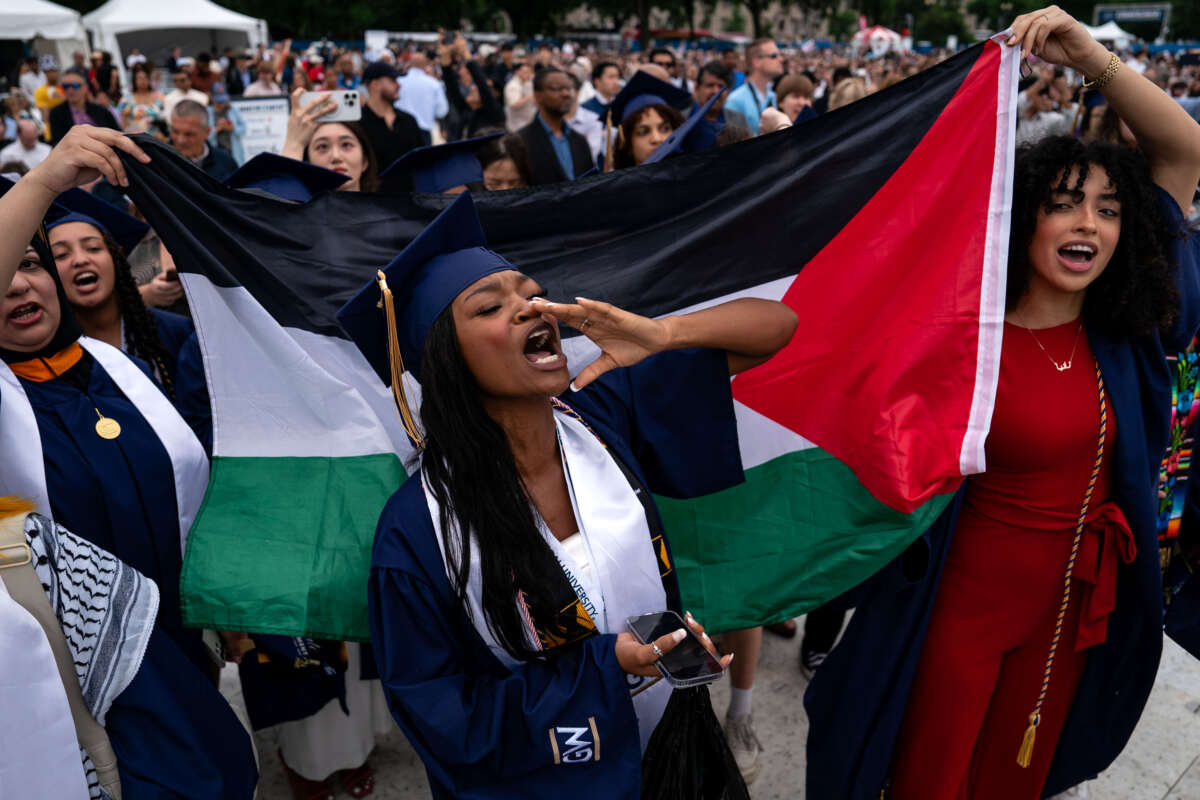
PHOTO: Students protest as they walk out from the George Washington University (GWU) commencement ceremony as GWU President Ellen Granberg speaks on the National Mall on May 19, 2024, in Washington, D.C. Kent Nishimura / Getty Images
At 4:45 am on May 8, the University of Chicago Police Department
arrived at the UChicago Popular University of Gaza, a Gaza solidarity
encampment organized by a coalition of student organizations called
UChicago United for Palestine, and destroyed it.
Within 15 minutes, the most beautiful, abundant, diverse iteration of
university life many of us had ever experienced was gone. All the
participants in the encampment — including me, an assistant professor —
were left to wonder, did we win?
By now, many of the almost 200 encampments that sprung up across the
country have been raided and destroyed by police. How do we make sense
of the legacy of the encampments? This question is fundamentally about
how we process the rise and fall of revolutionary moments within
reactionary times.
First, we must celebrate the triumph of revolutionary thinking and
practice — even when its material manifestations are brief. The
encampments already won something simply by existing.
Liberal and centrist forces within U.S. politics are always working
to co-opt and defang social movements in the United States by pushing
them into silos of reformist single-issue campaigns. Too much of the
energy of the movement for gay liberation got poured into the campaign
for gay marriage for this reason. And too much of the energy associated
with the movement for women’s liberation got poured into distilled
milquetoast logics of white, middle-class feminism. Everywhere,
movements of power and liberation have too often fizzled into bids for
representation in compromised institutions or within more narrow spaces,
and little more.
The liberal forces that seek to co-opt radical grassroots energy into
the logic of single-issue campaigns usually try to persuade us that
fundamentally the world is moving in the right direction. They argue
that the institutions that rule our world — the government, the
university, the market etc. — are replete with justice at their core and
only need small tweaks to reach their equitable potential. They try to
persuade us that to win those changes, we need to work only within our
identity groups and stay within the system. Eventually, those who
embrace this strategy may eke out some limited progress, usually in the
form of increased representation. And this is held up as a promise that
all will be well because the people in power will look like us, and the
wealthy and privileged of our group will have all the benefits to which
the wealthy and privileged are generally entitled.
The recent wave of student-led Palestine solidarity encampments at
universities across the U.S. rejected these liberal logics. Students,
faculty and organizers recognized the devastation of Gaza as a direct
result of the capitalist world order under which we all live, a world
order whose core logic is profit over people, that protects us so long
as we are profitable and discards us when we are not.
Many encampments paired demands for divestment from Israeli apartheid
with demands for repair of their university’s harms to local
communities. For example, the UChicago United for Palestine coalition
demanded reparations for members of the South Side community and a halt
to the ravenous expansionism to which the university has long subjected
the neighborhood. Demanding these reparations acknowledges the simple
fact that the same logic that displaces Palestinians also works to
displace the University of Chicago’s Black neighbors.
The encampment was not only a triumph of revolutionary thinking, it
was also a triumph of revolutionary practice. In a reactionary present
whose days are clearly numbered, each encampment was a practice run for a
revolutionary future. Every time we seize a space in this world and
decide to run it for ourselves, decide to feed ourselves, to shelter
ourselves, to keep each other safe — we beckon to a revolutionary
horizon. We open a window and look out onto a liberated future. We
practice the hope that fuels our movements, wave after wave.
The encampments have been revolutionary, but they have not been the
revolution itself. At the UChicago Popular University for Gaza, campers
had to face the difficult work of debate and consensus building over
strategy and tactics. Some questioned whether students should negotiate
with the administration at all, while others debated what material gains
would feel acceptable. After long discussions with the camp, students
negotiated with the administration. These negotiations would come to
naught when the administration suspended them on Sunday. In the
processes of decision-making, many were eager to live out the
abolitionist ideal for which the Popular University stood — an ideal
where every voice in the camp had equal weight. But of course, we were
not in the revolution. We were still on the campus of the University of
Chicago, a private institution with a large and violent police force. We
could act horizontally within the camp, but different people had
different stakes in the outcomes of the encampment. Some could lose
hundreds of thousands in tuition dollars or their livelihoods, others
could walk away unscathed.
We must not mistake revolutionary moments for the revolution. If we
do, then defeats — an unmet demand or a dispersed encampment — begin to
feel like the end of the road. We have to treat every revolutionary
moment as that — a moment. Moments are, by definition, ephemeral. It is
in their nature to pass. But they matter because they leave us
transformed in their wake. They give us a taste of freedom. Once we
taste freedom, we hunger for it for the rest of our lives.
I learned civil rights activist and revolutionary Assata Shakur’s
chant at a police abolitionist encampment in New York a decade ago named
Liberation Square. I recited it again with my students at the UChicago
Popular University for Gaza, then again with students at the University
of Arizona’s Gaza solidarity encampment while in Tucson on a visit.
It is our duty to fight for our freedom.
It is our duty to win.
We must love each other and support each other.
We have nothing to lose but our chains.
Liberation Square in New York did not win its direct aims, nor did
many of the encampments demanding dignity for Black lives that
proliferated across the country. Along the way to liberation, we always
suffer many defeats. For my generation, some defeats have included
watching the Arab Spring turn into a winter, or watching the fall of
Occupy Wall Street or watching the police continue to kill Black people
despite the uprising in Ferguson, Missouri. But this generation of
uprisings has the imprints of everything we learned during these earlier
waves of movement, just as our uprisings had lessons from our elders
imprinted within them. We never lose in struggle. Every action we take
toward liberation plants a seed, but sometimes harvests take a long
time.
Irish poet Seamus Heaney said:
History says, don’t hope On this side of the grave. But then, once in a lifetime The longed-for tidal wave Of justice can rise up, And hope and history rhyme.
We must practice hope until hope and history rhyme. As we move
through seasons of struggle, we practice hope by creating revolutionary
space, by continuing to sample freedom and continuing to feed our hunger
for it. In doing so, we beckon to our liberated future, the future we
deserve. We have a world to win, and truly, we have nothing to lose but
our chains.
For our Memorial Day special broadcast, we speak with Jerusalem-based journalist and author Nathan Thrall, who discusses Israel's ceasefire talks with Hamas and Israel's intensified crackdown in the West Bank, and responds to the cancellation of some of his book talks in Germany.
Then, we revisit an earlier conversation with Thrall and Abed Salama, the subject of the book for which Thrall just won a Pulitzer Prize. A Day in the Life of Abed Salama: Anatomy of a Jerusalem Tragedy focuses on the 2012 death of Salama's son, 5-year-old Milad, who was killed in a fiery bus crash during a school field trip to a theme park. What followed was a desperate daylong search by Salama and his family to locate Milad's body across different cities and hospitals, encountering numerous barriers due to the Israeli occupation system, like different ID cards giving varying levels of access through military checkpoints, and lack of help from any Israeli authorities.
Democracy Now! is an independent global news hour that airs on over 1,500 TV and radio stations Monday through Friday. Watch our livestream at democracynow.org Mondays to Fridays 8-9 a.m. ET.
Aid agencies are running out of food in southern Gaza amid Israel’s ongoing offensive in Rafah and the shutdown of the two main border crossings in the south. Some 1.1 million Palestinians are on the brink of starvation, according to the United Nations, while a “full-blown famine” is taking place in the north. Meanwhile, some Israelis have been blocking aid from reaching the Gaza border, including a violent attack on trucks carrying humanitarian relief through the occupied West Bank earlier this week, when settlers threw food packages on the ground and set fire to the vehicles at the Tarqumiyah checkpoint near Hebron. “They did whatever they want,” says Israeli lawyer and peace activist Sapir Sluzker Amran, who documented the attack on the aid convoy. She says Israeli soldiers appeared to be working with the settlers, refusing to intervene. “They were just standing aside like there is nothing that they can do, like it’s normal, what’s happening.”
Democracy Now! is an independent global news hour that airs on over 1,500 TV and radio stations Monday through Friday. Watch our livestream at democracynow.org Mondays to Fridays 8-9 a.m. ET.
Palestinians across the globe are marking the 76th anniversary of the Nakba — which means "catastrophe" in Arabic — when those establishing the state of Israel violently expelled over 700,000 Palestinians. Palestinian historian Abdel Razzaq Takriti says closer to 900,000 Palestinians were forced out or massacred during Israel's founding, which is being celebrated inside Israel with calls to ethnically cleanse and settle the Gaza Strip and the occupied West Bank. "The Nakba is continuing. This is a colonial continuum," says Takriti. "It's not enough to commemorate. It's not enough to talk about it. We have to stop it right now. … The first step to doing that is to stop the genocide in Gaza."
Takriti lays out four principles for Nakba education: refuting Nakba denialism, recognizing the Nakba is part of an ongoing process of settler colonialism, stopping that process, and then reversing it by restoring Palestinian national rights.
Democracy Now! is an independent global news hour that airs on over 1,500 TV and radio stations Monday through Friday. Watch our livestream at democracynow.org Mondays to Fridays 8-9 a.m. ET.
Israel’s Genocide in Gaza Is a World Historical Crime When Jews were being slaughtered by the Nazis, the world turned away. Now, the world has awakened to Israel’s crimes.
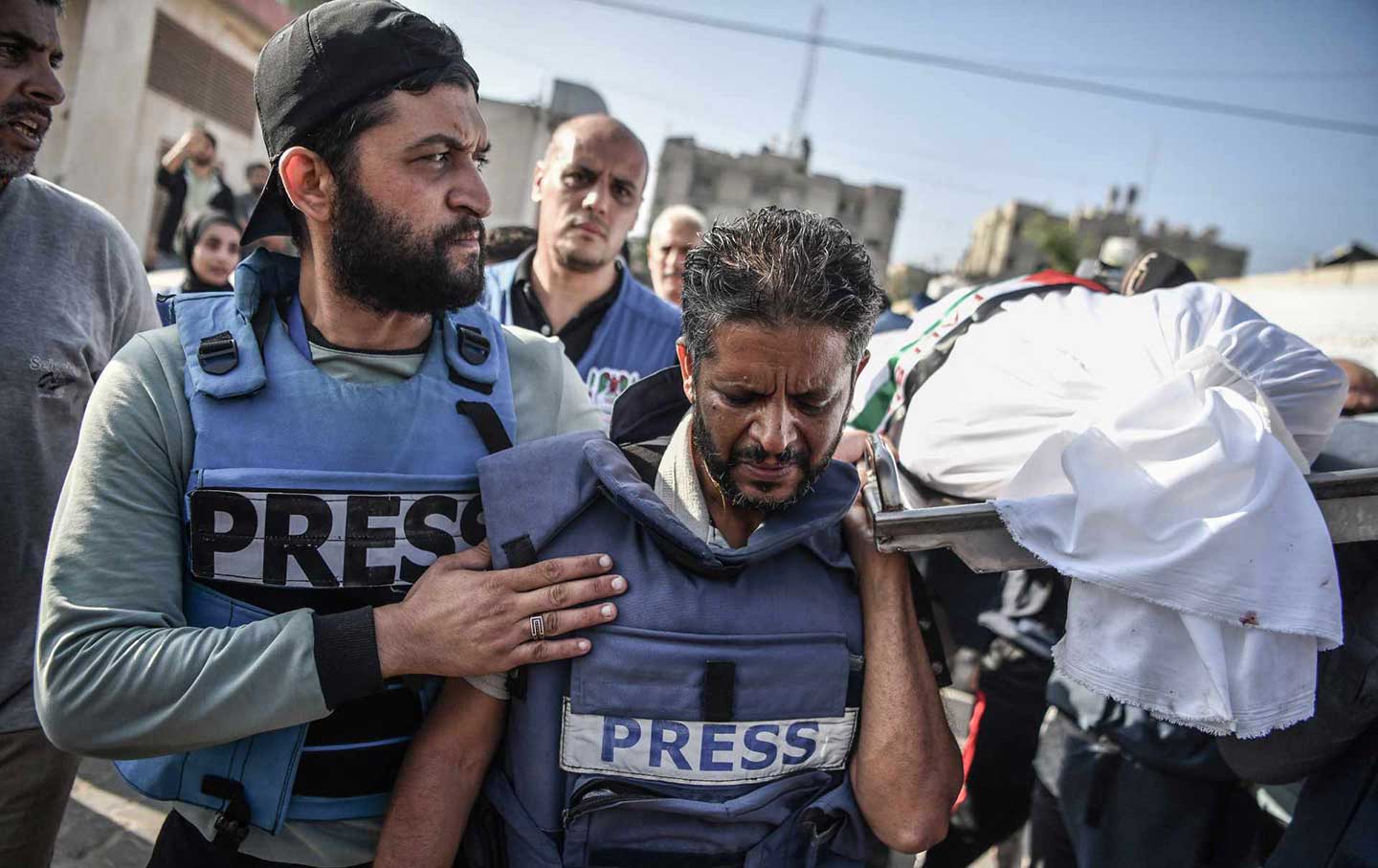
PHOTO: A funeral ceremony is held for Palestine TV correspondent Mohammed Abu Hatab, who was killed along with his family members in an air strike on his home in Khan Yunis, Gaza, on November 3, 2023. (Abed Zagout / Anadolu via Getty Images)
[This article originally appeared at TomDispatch.com. To stay on top of important articles like these, sign up to receive the latest updates from TomDispatch.com. ]
Words can’t express the horrors of Israel’s genocide in Gaza. To actually feel the nightmare, you would have to be there under the bombs, fleeing with Palestinians desperately seeking a safe place that doesn’t exist; seeing building after building destroyed; treading through blood in one of the few, only partially standing hospitals; and witnessing children and other patients sprawled on hospital floors, limbs amputated without anesthesia (Israel having blocked all medical supplies).
It has taken the Jewish state’s savagery to break decades of silence about its history of crimes against humanity. US military historian Robert Pape has called the onslaught against Gaza “one of the most intense civilian punishment campaigns in history.” Former UN assistant secretary general for human rights Andrew Gilmour has said that we are witnessing “probably the highest kill rate of any military…since the Rwandan genocide of 1994.”
An Unsent Letter
Palestine is finally an international cause. Outrage surges via global demonstrations. Israel has become a pariah in the Global South. In the United States, organizations including A Jewish Voice for Peace, Code Pink, and the US Campaign for Palestinian Rights have been marching against the horrors now underway.
Within this charged atmosphere, the 66th reunion of my 1958 Philadelphia High School for Girls graduating class will take place in June 2024. Girls’ High was that city’s leading academic public high school of my time, together with its brother school, Central High (attended by Noam Chomsky). It was stellar not only for its academic excellence but for its integration of Black and white students at a time of deep segregation elsewhere. My mother, who graduated from Girls’ High in 1924, sent me there because of its policy of racial inclusiveness.
I recently began preparing an open letter to my classmates about the genocide in Gaza and the ongoing settler pogroms of ethnic cleansing on the West Bank—houses burned, olive trees uprooted, Palestinians made to flee. Ours is the prototypical Zionist generation and I particularly wanted to address my former classmates, some of whom still cling stubbornly to their allegiance to Israel. I was told, however, that there wouldn’t be time to read the letter at our reunion which lasts just a few afternoon hours. What follows, then, is based on the letter I was preparing to read then, had the time been available. Zionism and the Six-Day War
In the early 1950s, my best childhood friend collected money to plant trees in Israel. At one point, her synagogue, which sponsored that project, needed “straight pins.” Somehow, I heard “shraypins” instead, a mysterious Hebrew word my imagination concocted and that her friends would find funny indeed. Zionism, in other words, was simply foreign to me.
The first time I recall a thrill from it came right after Israel’s triumph in the 1967 Six-Day War. I was then actively involved in the anti-Vietnam War movement on my graduate school campus and, on a trip to Paris that year, didn’t want to identify as American. I spoke French quite well and not being able to tell from my slight accent that I was an American, someone asked me where I was from. Searching for a nationality I wouldn’t be ashamed of, I blurted out that I was an “Israelite.”
“Oh, your people!” he exclaimed. “Such a small people, but such a brave people!” For the first time, I felt deeply proud of being Jewish, not the sort of Jew who had (to my mind) cowered in a ghettoized Europe, but a strong, triumphant Jew with a powerful army. Soon after, my husband told me about Israel’s history—its 1948 expulsion of 750,000 Palestinian Arabs and its exploitation of the territories it illegally occupied after the 1967 war. Not long after that, I read Noam Chomsky’s first book about Israeli settler-colonialism, Peace in the Middle East?, and never looked back.
Settler Violence in the 1970s
My husband, Louis Kampf, taught in the humanities department of MIT. Chomsky was a colleague and became a good friend. It was under his influence that, in 1979, I first went to Israel and visited the occupied West Bank. I had an assignment to write about Israeli women—I was then a feminist columnist for Cambridge’s The Real Paper—and also agreed to do pieces for New York’s Village Voice and Liberation magazine. For the Voice I wrote about Gush Emunim—the Bloc of the Faithful, the ancestor of the Jewish settlers’ movement. For Liberation, I wrote about a Palestinian village, Halhul, two of whose teenagers were murdered by Israeli settlers from nearby Kiryat Arba.
I stayed in Kiryat Arba, thanks to a distant cousin of my husband’s who got me there in an undercover fashion. One of my interviewees assured me that she believed in “a great chain of being,” Jews on top, all other humans below, with Arabs at the very bottom, just before animals, vegetables, and minerals. Her husband referred to the Talmudic injunction to “rise and kill first.” Another settler assured me that the Arabs could stay on the West Bank only if they would “bow their heads.”
Muhammad Milhem, Halhul’s mayor, led me to the highest hill in his village and, pointing toward Kiryat Arba, said, “This is a cancer in our midst.” I wonder if he realized how tragically prophetic his words would prove to be. Genocide in the 2020s
Since October 8, I’ve been riveted by the genocide in Gaza being perpetrated by the Israeli military, which had prepared for it in a retrospectively unsettling fashion by decades of dehumanizing Palestinians. Hamas clearly committed war crimes on October 7, but international rules still govern war. A nation’s reprisal for acts against its population must still be proportional to the original crime, which Israel’s war on Gaza isn’t—not faintly! Instead, it’s been distinctly genocidal. On March 28, Reuters reported that, according to Gaza’s health ministry, at least 32,552 Palestinians had been killed and 74,980 injured in Israel’s post-October 7 military offensive in the Gaza Strip, while more than 7,000 Gazans are missing, many likely buried under the rubble.
Israel has cut off most food and water to the region. A March 18 Oxfam press release announced that Gaza hunger figures are the “worst on record.” The World Health Organization (WHO) reports that famine, a rare and catastrophic circumstance, is imminent. Usually caused by extreme natural events, the famine in Gaza is wholly human-made. Famine leaves the body prone to all sorts of horrendous diseases. Reports NPR:
In Gaza, the World Health Organization warns that illness may ultimately kill more people than Israel’s offensive. Infectious diseases are “soaring,” says the WHO. Over 100,000 cases of diarrhea have been reported, with rates among children 25 times higher than before the war.
Were I able to show my classmates scenes from the hell that is now the Gaza Strip, where would I begin? Would it be the infant whose face was partially blown off by an Israeli strike? Would it be the 12-year-old with burns over 70 percent of his body? Would it be the countless unarmed civilians, including children, shot in the head and upper body with murderous intent? Would it be a baby with both legs amputated, who will never learn to walk?
Dr. Yasser Khan, an ophthalmologist specializing in eyelid and facial plastic and reconstructive surgery, spent 10 days in Gaza and, in an interview with a reporter from The Intercept, described what he had seen in the European Gaza Hospital, now barely functioning, where 35,000 people were reportedly sheltering. People were cooking in the hallways of a building in which no sterile environment was possible because there was nothing with which to sterilize. The medical workers were still often performing 14 or 15 amputations on children daily. Khan saw patients like an eight-year-old girl, rescued from the rubble with a fractured leg, all of whose family—mother, father, aunts, uncles—was wiped out. And there are thousands more like her, suffering from trauma that coming generations will undoubtedly inherit. They have given rise to a new acronym: WCNSF, or Wounded Child No Surviving Family. Khan removed the eyes of patients whose faces had been damaged by shrapnel, leaving an appearance he dubbed “shrapnel face.”
Aid Workers Targeted
I would have wanted to remind my classmates that Israel has frequently targeted aid workers, killing seven World Central Kitchen (WCK) employees in early April. The Israelis claimed that it was an accident and fired the officers it held responsible. But chef José Andrés, WCK founder, insisted that the attack was purposeful, that Israel had targeted the aid convoy “car by car.”
“This was not just a bad luck situation where ‘oops’ we dropped the bomb in the wrong place,” Andrés said. “This was over 1.5, 1.8 kilometers, with a very defined humanitarian convoy that had signs in the top, in the roof, a very colorful logo that we are obviously very proud of. It’s very clear who we are and what we do.”
“WCK is not just any relief organization,” wrote Jack Mirkinson in The Nation magazine. “Andrés is a global celebrity with ties to the international political establishment. WCK had been working closely with the Israeli government both in Gaza and in Israel proper. It would be difficult to think of a more mainstream, well-connected group.” It was as if Israel were showing off, Mirkinson added, “flaunting its ability to cross every known line of international humanitarian law and get away with it.”
The International Court of Justice (ICJ) ruled on January 26 that Israel’s slaughter in Gaza is a plausible case of genocide and additional testimony from Francesca Albanese, the UN’s Special Rapporteur on Palestine, “Anatomy of a Genocide,” only emphasized that point, given how little is left but rubble in so much of Gaza. The majority of its homes no longer exist, nor do its schools, universities, libraries, or music conservatories.
Violating the 49th Geneva Convention, Israel has fired on ambulances and killed more than 685 health workers, while wounding about 900 of them. It has destroyed all but a few of Gaza’s 36 formerly flourishing hospitals, claiming that Hamas fighters are hiding in tunnels under the buildings. Against the civilian population Israel has used weapons like white phosphorous, which burns to the bone and cannot be easily extinguished. In the past, the Israeli military has been known for using Gaza as a laboratory for weapons experiments and the same is true of the current round of fighting.
Israel’s “war” against Gaza did not, of course, start on October 7. In 2006, after Gazans elected Hamas to govern them, Israel imposed a siege on the Strip. As lawyer Dov Weisglass, then an aide to the prime minister, said at the time, he wanted to keep Gazans just below starvation level—not enough to kill them, but not enough to fill them either. The present siege has turned Gaza into what’s been called the largest open-air prison on earth, a virtual concentration camp. A UN commentatordescribed this as “possibly the most rigorous form of international sanctions imposed in modern times.” Such conditions helped produce the October attack.
Occupying the West Bank since 1967, Israel has distinctly contravened international law. Article 49 of the Fourth Geneva Convention stipulates that “the Occupying Power shall not deport or transfer parts of its own civilian population into the territory it occupies.” It also prohibits “individual or mass forcible transfers, as well as deportations of protected persons from occupied territory.” Israel, however, has settled about 700,000 Israeli Jews in the West Bank. Once upon a time, there was indeed room for a separate Palestinian state. No more. Arabs to the Gas Chambers
When I visited the West Bank city of Hebron in the 1980s, I saw graffiti on walls that proclaimed: “ARABS TO THE GAS CHAMBERS.” Back then, the renowned Israeli public intellectual Yeshayahu Leibowitz warned that Israel was turning its soldiers into Judeonazis. Recent YouTube videos of soldiers mocking their victims bear out his prophecy. Fascism is now pervasive in Israel. There are courageous exceptions, like journalists Amira Hass and Gideon Levy, who write for the newspaper Haaretz, and the group Combatants for Peace. But all too many Israelis have supported their country’s assault on Gaza, or even wanted something worse. I wish I could have told my classmates that, should they care about Israel, it’s their responsibility to speak out now.
The genocide in Gaza has been enabled, of course, by President Biden, who continues to send billions of dollars’ worth of weaponry, including devastating 2,000-pound bombs, to Israel. Without those arms, the government of Prime Minister Benjamin Netanyahu couldn’t be acting as it is. While it purports to be searching for and killing Hamas perpetrators of the October 7 atrocities, it’s actually gone to war against the entire population of Gaza. Israeli historian Ilan Pappesees it as “a massive operation of killing, of ethnic cleansing of depopulation.”
When Jews were being slaughtered by the Nazis, the world turned away. Now, the world has awakened to Israel’s crimes. Many American Jews, like those in A Jewish Voice for Peace (whose demonstrations I’ve attended) are indeed speaking out.
It’s often asked how a people who suffered so much could cause such suffering. In fact, almost all the survivors of the Holocaust are dead. Obviously, none of the perpetrators of the genocide in Gaza and the ethnic cleansing of the West Bank were in European concentration camps. In a 1979 interview, renowned Israeli dissident, Hebrew University chemistry professor Israel Shahak pointed out that no Holocaust survivor had ever been a member of the Israeli government. Israel frequently uses the Holocaust to justify its actions in the Palestinian territories. This is a sacrilege, while one of history’s great crimes is being committed, and this member of the class of 1958 knows it.
ABOUT THE AUTHOR:
Ellen Cantarow, musician and writer, reported from the West Bank and Israel during the 1980s for the Village Voice, Mother Jones, Grand Street and other publications. She has visited and written about the region periodically since 2000.
Anti-Arab Racism and the U.S. and Israeli War Machines
The West’s dehumanization of Arabs has helped to normalize war crimes.
Hammer & Hope No. 3 Spring 2024
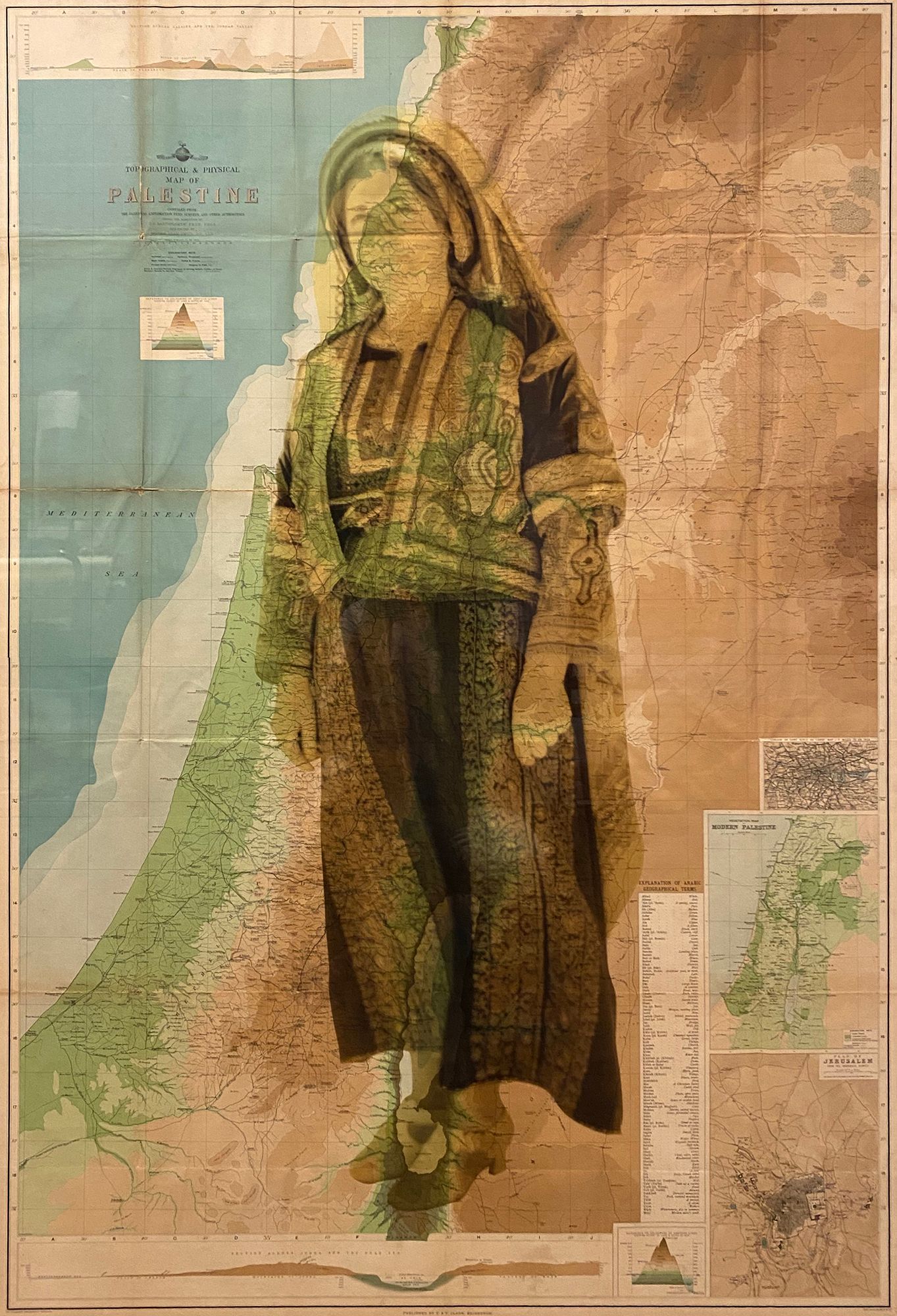
Hazem Harb, The Mother Land, 2023.
The state of Israel has unleashed the most brutal military bombardment since World War II on the Palestinians of the Gaza Strip. This siege came in response to Hamas’s breach of the wall that delineates the Israeli occupation and the group’s subsequent attacks on Israeli soldiers and civilians.
Israel’s more than 45,000 air strikes since October have far exceeded the nearly 15,000 air strikes the U.S. carried out on Iraq in its campaign against the Islamic State from 2014 to 2017. In December, U.S. intelligence sources divulged to CNN that 40 to 45 percent of the 29,000 missile strikes against Gaza were “dumb bombs,” or unguided missiles, which can be more dangerous to civilians in densely populated areas.
“When a 3-year-old girl is killed in a home in Gaza, it’s because someone in the army decided it wasn’t a big deal for her to be killed — that it was a price worth paying in order to hit [another] target,” an Israeli military source told reporters as part of a bombshell report attributing the virulence of Israel’s assault in part to an increased reliance on artificial intelligence to generate targets. “Everything is intentional. We know exactly how much collateral damage there is in every home.”
Intense anti-Arab racism, Islamophobia, and what the Palestinian American intellectual Edward Said described as “Orientalism” has underwritten the West’s perpetual wars, sieges, and onslaughts against the Middle East, wars that America’s client state, Israel, has helped manage for multiple generations. This racism has normalized America’s and Israel’s war crimes in the Middle East.
But this is far more than a simple ideological project. As the largest recipient of U.S. aid in the region, to the tune of more than $3 billion each year, Israel has long been of use to the West as the Zionist project of building a state on the dispossession of the indigenous Palestinian population. The U.S. disguises its geopolitical designs to control access to the region’s oil supply under the guise of rooting out terrorism. Though America’s “war on terror” failed, its afterlife of security theater, surveillance, and abject racist demonization of a perpetual Arab or Muslim “other” lives on.
Soon after Israel began its siege, Joe Biden made a mockery of Palestinian grief and death. “I have no notion that the Palestinians are telling the truth about how many people are killed,” he said, echoing the Israeli government. His statement recognizing 100 days of the war on Gaza made no mention of the thousands of Palestinians whom Israel had killed. More recently, Biden enjoyed an ice cream cone with a late-night talk show host while blithely suggesting the possibility of a cease-fire. A week later, The Washington Post revealed that the United States has quietly delivered 100 weapons packages to Israel over the course of its assault, including thousands of precision-guided munitions, small-diameter bombs, and bunker busters.
Of course, the U.S. has long licensed Arab death. Consider the Clinton era. In 1996, when Lesley Stahl on “60 Minutes” asked UN Ambassador Madeleine Albright about the deaths of half a million Iraqi children caused by U.S.-backed sanctions on Iraq, Albright infamously said, “The price is worth it.” Activists confronted her the next year, and she responded, “I am as concerned about the children in Iraq as any person in this room.” But, she added, “Saddam Hussein is the one who has the fate of his country in his hands. … He is the one responsible for starving children, not the United States of America.”
George W. Bush claimed after the attacks on Sept. 11 that “the face of terror is not the true faith of Islam,” and “Islam is peace.” But the indiscriminate targeting of Arabs and Muslims abroad through various war efforts and domestically by federal and local police during the Bush presidency contradicted such overtures. The federal government’s gearing up for war reverberated across the country and fomented an atmosphere of fear, anxiety, and extraordinary racism. Polls taken soon after Sept. 11 found 58 percent of Americans supported “intensive security checks” for Arabs, 49 percent favored special identification cards for them, and 32 percent approved of “special surveillance” of Arabs.
The media played a significant role in providing bigoted justifications for racial profiling. Richard Cohen, then a columnist for The Washington Post, argued: “We have become driveling idiots on matters of race and ethnicity. One hundred percent of the terrorists involved in the Sept. 11 mass murder were Arabs. Their accomplices, if any, were probably Arabs, too — at least Muslims. Ethnicity and religion are the very basis of their movement. It hardly makes sense, therefore, to ignore that fact and, say, give Swedish au pair girls heading to the United States the same scrutiny as Arab men coming from the Middle East.”
Indeed, less than a month after the attacks, Bush sang a different tune from his earlier overture:
"They hate us because we love the idea that people can worship an Almighty God any way he or she sees fit. They hate us because we love political discourse and a free society. They hate us because of our free press. They hate everything about us, because of our freedom. And there’s another — there are a lot of distinguishing features, but one of the most clear ones to me is this: We value life in America. We say everybody is precious, everybody counts, every life has worth, every life has dignity. They don’t value life."
An emboldened American security state was activated. In the weeks after Sept. 11, the FBI and other law enforcement agencies rounded up and detained more than 1,200 people, mostly Arabs and Muslims. The Department of Justice initiated a program of “voluntary interviews” with 5,000 “non-immigrant” men who claimed citizenship from countries the U.S. insisted harbored Al Qaeda. Two years later, in preparation for war with Iraq, a new Iraqi Task Force, created by the FBI, interviewed 11,000 people of Iraqi origin living in the United States, many of them citizens.
The swell of anti-Arab suspicion and racism shaped the lead-up to America’s baseless war of aggression against Afghanistan and Iraq. Politicians’ xenophobia obscured the brutality of a war that killed between 150,000 and perhaps as many as 600,000 Iraqis. The widespread destruction of civilian infrastructure, already weakened by a decade of brutal U.S.-backed sanctions, resulted in even more deaths of Iraqis. It also helped to foment the conditions that allowed for the creation of the U.S. gulag in Guantánamo Bay — a military space controlled by the U.S. absent any rights or freedom. The climate of war allowed for torture and abuse of detainees at Abu Ghraib, too. Tens of thousands more were killed in Afghanistan — the longest war in U.S. history, ending only in 2021.
According to a 2023 report from Brown University, researchers estimated that more than four million people were either killed or eventually died in the War on Terror. From Afghanistan to Iraq, Syria, Libya, Somalia, and Yemen, millions have died from what The Washington Post described as “waves of violence, hunger, the devastation of public services, and the spread of disease.” In fact, it was anti-Palestinian bigotry that drove the creation of and shaped the development of anti-terrorism laws, according to a new report by Palestine Legal and the Center for Constitutional Rights. In 1969, the first-ever mention of terrorism in a federal law “dealt specifically with restricting humanitarian aid to Palestinians and inaugurated a pattern of rendering Palestinians synonymous with terrorism.”
The characterization of Arabs and Muslims as forever enemies was built into politics and disseminated through popular culture, which endlessly portrayed brown-skinned men as terrorists.
Republicans have long worn their derision of Arabs and Muslims openly. The far right concocted a mass hysteria over the conspiracy theory that Muslims sought to implement Shariah law in the U.S. Since 2010, state legislatures have introduced at least 201 anti-Shariah bills. Breaking with longstanding international consensus, Trump moved the U.S. embassy from Tel Aviv to the contested land of Jerusalem. And he implemented a ban on entry into the United States from a handful of majority Muslim countries after he was inaugurated as president, a ban the Supreme Court upheld. More recently, in the weeks after Hamas’s attacks, Montana Representative Ryan Zinke introduced legislation (with 10 cosponsors) that would ban Palestinians from entering the United States. “I don’t even want to call it the Palestinian flag because they’re not a state,” Republican Representative Max Miller of Ohio complained after Michigan Representative Rashida Tlaib pinned a Palestinian flag to her office door. “They’re a territory that’s about to probably get eviscerated and go away here shortly, as we’re going to turn that into a parking lot.”
We have come to expect such racist dreck from the Republican Party. But this is the Democratic Party’s war. Democrats have mastered the art of performing grief even while Biden’s intersectional and multiracial cohort of UN ambassadors and functionaries oppose cease-fire resolutions that could immediately end the war. When Tlaib spoke out early in favor of a cease-fire and for an end to Israeli atrocities in Gaza, Biden press secretary Karine Jean-Pierre, a queer Haitian American, described as “repugnant” and “disgraceful” statements from Tlaib and others in the Squad calling for a cease-fire or criticizing Israel.
Meanwhile, Nancy Pelosi told Palestine solidarity protesters to “go back to China” and declared that calls for a cease-fire are “Mr. Putin’s message.” As if time-traveling back to the Cold War, she pressed on without evidence. “This is directly connected to what he would like to see,” she said. “Some of these protesters are spontaneous and organic and sincere,” but others “are connected to Russia.” Kathy Hochul, the Democratic governor of New York, joked that if Canada attacked Buffalo, N.Y., in the way that Hamas attacked Israel on Oct. 7, “there would be no Canada” — an apparent endorsement of collective punishment and the right of Israel to annihilate Gaza.
Beyond such crass rhetoric, in early February, 46 Democrats voted for a $17.6 billion aid package put forth by Republicans to finance Israel’s siege of Gaza; it failed to pass. Instead of pressuring Israel to allow more aid trucks into Gaza, which is on the brink of famine, the Biden administration has dropped parachutes of food aid, some of which failed to open midair, killing people upon landing, and rushed to create a temporary port off Gaza’s coast for humanitarian aid shipments, a theatrical, cumbersome workaround.
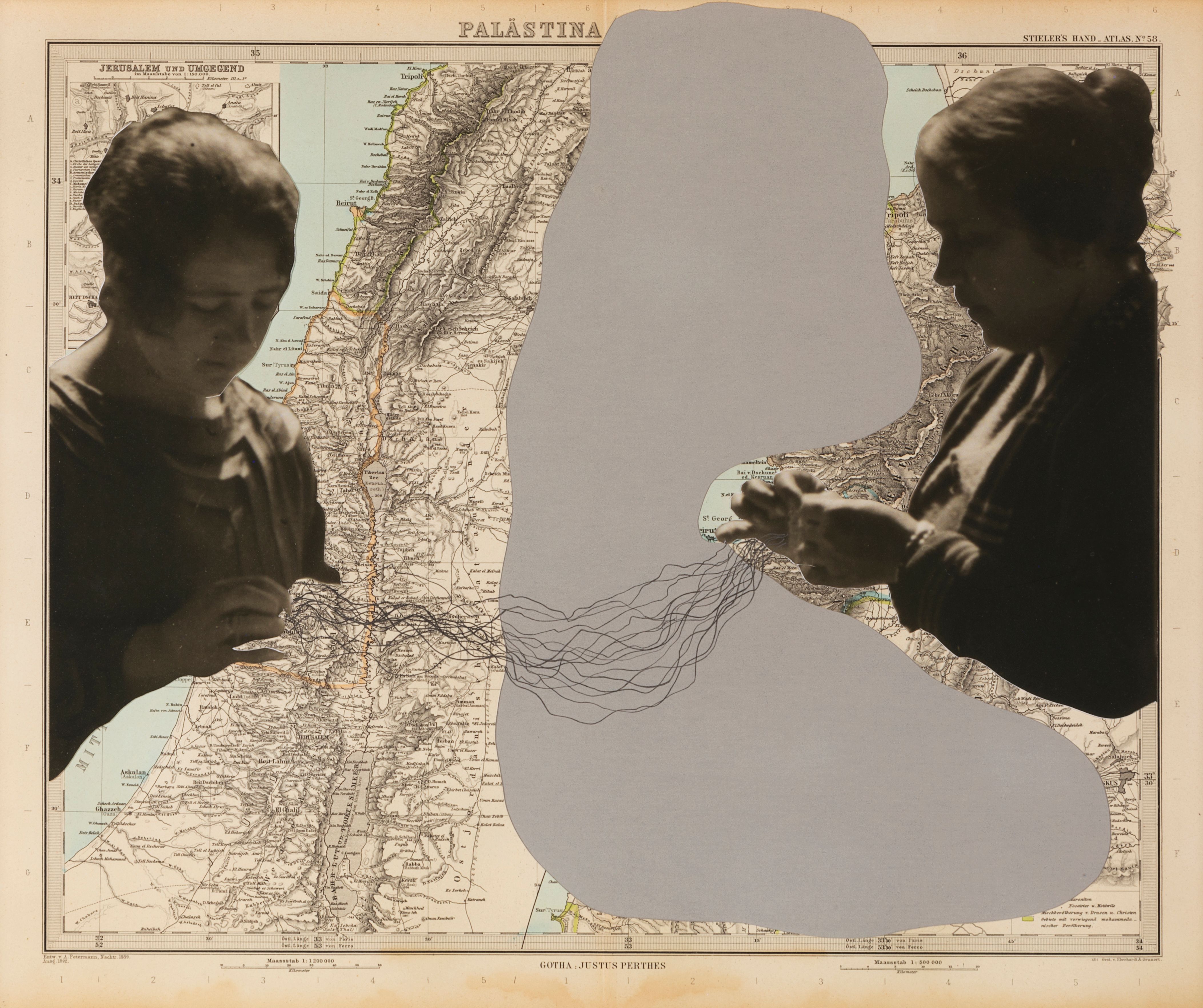
Hazem Harb, Map of Land Series, #4, 2019.
But we are in a new moment. For the short life of this war, millions across the globe have roared in opposition, demanding a cease-fire, along with medical aid and food for Palestinians. The protests spurred a campaign spearheaded by South Africa at the International Court of Justice to make a surprising intervention, holding that Israel’s actions may constitute genocide. Opposition to Israel’s siege has activated a Palestine solidarity movement in the U.S. led largely by Palestinian Americans and young Jews. U.S. financing and arming of this war has made Biden politically vulnerable even as he continues to stand by it.
Biden’s polling among Arab Americans voters has plummeted from 59 percent to 17 percent, while progressives have threatened to withhold their votes in the fall’s presidential contest. His political future is further imperiled by widespread opposition to Israel’s actions in Gaza among Democratic voters, especially the young. Most recently, tens of thousands of Democratic Party primary voters in Michigan, Minnesota, and elsewhere voted “uncommitted” as a protest vote against Biden’s Gaza policy. The Democratic establishment downplayed the Michigan vote in public, but when Vice President Kamala Harris was dispatched to commemorate the 59th anniversary of the Selma civil rights march, she called for an “immediate cease-fire,” then paused for applause, “for at least the next six weeks.” Of course, the movement demands an immediate and permanent cease-fire and an end to the occupation. Harris’s use of “cease-fire” instead of Biden’s “pause” is the administration’s effort to co-opt an antiwar movement that has spiraled beyond their control or their imaginations. But that rhetorical shift is also evidence that the “uncommitted” movement is unsettling the party’s consensus, as was Senator Chuck Schumer’s surprising excoriation of Benjamin Netanyahu in a speech.
Palestinians have challenged the U.S.-Israeli war machine. The U.S. war in Vietnam was the first to be broadcast widely in the homes of Americans, and the Israeli onslaught in Gaza is the first genocide to be watched live on people’s smartphones across the globe. The sheer determination of the Palestinian people to document their own suffering has transformed our understanding of this lopsided war, slicing through state-generated propaganda that has, since Vietnam, sought to shield the public from the death and destruction that is the reality of all war.
As the West has moved toward remote war conducted by drones, the human costs have become more abstract. Mainstream media outlets reinforce that remove, refusing to show the extent of the carnage, obliquely sanctioning the dubious claims of “smart bombs” and other euphemisms meant to assuage the public’s concern about the deaths of innocents. Because Israel has locked Gaza’s doors, courageous Palestinian journalists have risked their lives to broadcast Israel’s atrocities, and dozens have died doing so. It is because of Palestinians that we know of the hunger they are experiencing, visible in the gaunt bodies of their children. We know of the sniper attacks outside hospitals, the bombings of residential housing, mosques, and universities. Palestinians have learned how to circumvent the mainstream media’s equivocation about the value of their lives. They have seized the technology to show the world the consequences of Israel’s actions. Activists around the world emulated those techniques to document global movements like Occupy, the Arab Spring, Fees Must Fall, and the Black Lives Matter movement during the Ferguson uprising in 2014.
But today it is not only Palestinians who document their genocide in real time. For months, Israeli soldiers have filmed their atrocities. There are the group selfies of soldiers huddling, smiling in the foreground of the smoldering remains of apartment buildings and neighborhoods. Male Israeli soldiers fondling the underwear and nightwear of Palestinian women. A soldier in a tank bragging about running over a Palestinian man. Israeli soldiers beating, degrading, belittling Palestinians on camera, as if to showcase their hatred as well as their imperviousness to human rights, international law, or the rules of warfare. Israel has made a mockery of all of it, as settlers build illegal housing units across the West Bank at record pace, murdering Palestinians in the process and arresting thousands to be held in indefinite detention. In doing so, it has betrayed the fake piety of U.S. officials who defend Israel’s every action while deflecting queries about a cease-fire or humanitarian aid for Palestinians. That these bureaucrats feel obliged to explain this particular foreign policy is because of the mass movement and Palestinians who, from a tiny strip, occupy the center of its moral universe.
The longevity of the Palestinian movement in Gaza and beyond allowed a core of activists to immediately jolt into action after Israel began to strike Gaza. Student activism organized around the boycott, divestment, and sanctions (BDS) campaign has been a staple of the Palestinian solidarity movement for years. Now there are almost 100 new Faculty for Justice in Palestine chapters. The political atmosphere is still charged by a decade of Black Lives Matter activism and just three years removed from the paroxysmal marches in the summer of 2020. Solidarity activism replaced the political ennui brought about by an adrift Biden administration.
Even as young Jews and many of their parents have rejected Israel’s war, Israel’s propaganda machine has denounced the movement as antisemitic. Those accusations have created an academic year like no other, with student activists taking courageous action week to week, while being doxxed by right-wing activists and surveilled by paranoid college administrators. The punishment of Palestinian solidarity and activism can’t be attributed only to “Islamophobia.” In the U.S., Zionists and conservatives attack the language of decolonization along with Palestinian demands for self-determination, as captured in the old slogan “From the river to the sea,” as antisemitism. (The far-right Likud party used a version of that slogan in its original platform.) They seek to marginalize and ban Palestinian solidarity on college campuses. Here, the work of the right, liberal college administrators, and the donor class converge. There is little doubt that antisemitism is on the rise. But its ascendance must be understood alongside the simultaneous growth of anti-Arab racism and Islamophobia that Israel’s ruthless assault on Gaza has encouraged, and fear of the loss of a significant portion of young Jews for the Zionist project.
Today, the reputation of the United Nations is in tatters because of both Israel’s relentless criticism of the organization and America’s ability to unilaterally undo the sentiment of a body that claims to represent the international community. Of course, the U.S. has always used or ignored the UN for its own purposes, but never under a spotlight this searing. Consider how the U.S. relied upon the UN to launch its illegal war in Iraq after the specious claim that the country harbored weapons of mass destruction. As the world longs for a cease-fire, we all watch in astonishment as U.S. Ambassador Linda Thomas-Greenfield erases the will of the world with a mere wave of her hand.
What will become of international law as Israel continues to flout every postwar convention intended to constitute a new global order based on human rights in the aftermath of the Holocaust? All were intended to prevent exactly the kinds of atrocities that Israel is carrying out in Gaza. Of course, we have never enjoyed such a global peace. The global north instrumentalized these legal frameworks to police and control the global south. But now the emperor has no clothes — the hypocrisy of Israel’s barbarism, bankrolled by the United States, has been exposed before a global audience not just on the internet but in the Hague itself, the embodiment of the supposed sacrosanctity of international law.
Israel is a state forged in the aftermath of the traumatic experience of the Holocaust. But it has long weaponized this trauma and displaced it from Europe onto Arabs. In this siege, Israel is not satisfied with only territorial conquest and the defeat of its enemies; its military and state leaders also seek to torture, humiliate, and revel in the murder of Palestinians and the ruin of Palestinian society. Despite the gruesome suffering of Gazans, in a December poll of Israeli Jews that asked “to what extent should Israel take into consideration the suffering of the civilian population of Gaza when planning the continuation of the fighting there,” over 80 percent said a very small or fairly small extent. Nearly 75 percent of Israeli Jews supported the invasion of Rafah in a March poll. Israel projects its own violence and hatred onto Palestinians in an orgy of racism, mass murder, and wanton destruction, while Western states, led by the United States, claim to be powerless to stop this madness.
But even amid a powerful backlash that conflates demands for a cease-fire and support of Hamas’s attacks, the power of Palestinians has propelled a global antiwar movement and in turn made the Western world finally see them and their righteous demands for freedom as legitimate — even urgent. No one in any country that has been colonized or invaded or occupied by Western imperialism needs to be told about either the atrocities or the hypocrisies of the world’s greatest democracies. Vietnam, India, Congo, Namibia, Mexico, Brazil, Chile, Iraq, Yemen, Egypt, Belfast, and beyond do not need to be reminded of the compromised freedom of imperial democracy. Their own colonial and imperial histories, and their legacies of resistance, are being remembered by and for a new generation.
In the United States, disapproval of Biden’s handling of the Israeli-Palestinian conflict continues to rise — now among 79 percent of Republicans and 30 percent of Democrats. According to one poll, a stunning 67 percent of Americans support “calling for a permanent cease-fire and a de-escalation of violence in Gaza,” including 56 percent of Republicans. This may not translate into immediate support for Palestinian freedom, but Palestinian liberation is being seen in the new light of day.
This is the challenge for the left now, the one we are all focused on and the one we must think most sharply about. We are living through a revival of internationalism and another extended moment of mass protest. Even as we tire in the face of exhausting odds, a hulking imperial ship that refuses to acknowledge our power as it trembles, we must persist. A victory against the systems that oppress Palestinians is a victory against the systems that oppress us all. We hope this special edition of Hammer & Hope on Palestine provides some measure of the history, politics, and solidarity needed to support any liberation movement in its quest for freedom.
Scholar and activist Angela Davis joins Frank Barat to discuss the importance of solidarity with Palestinians as they face a genocide in Gaza by Israel.
Prof. Angela Davis is the Distinguished Professor Emerita in the History of Consciousness and Feminist Studies Departments at the University of California, Santa Cruz.
The project "Viva Palestina Libre-Subtitles against the Occupation" collaborates by preparing the Spanish subtitles of several of the interviews. These are usually added 2 to 3 days after the original interview is uploaded. Every time the subtitles of an interview are available, they are announced on their Instagram account (@viva_palestina_libre). On their blog, you can find all the subtitled interviews: https://memoriapresente.net/subtitulo...
After October
7, this question has become a matter of grave importance, amid
crackdowns on free speech and protest. Five writers reflect on the state
of Palestinian life today.
For generations, the voices of Palestinians
have been routinely overlooked. When we do turn to them, it is usually
to ask them to justify their despair or prove their worthiness as
humans—and to teach us the very basics of a generations-long crisis of
forced exile and violent displacement.
Instead of making Palestinians play out that endless cycle one
more time, we wanted to get to the heart of a question that feels more
vital, more essential, in our moment.
The contributors to this section are Palestinians living in the
US, where the war reverberates with terrifying intimacy even though the
bloodshed is thousands of miles away. It is also where the need to hear
from Palestinians—and to listen to what they have to say—has never been
as critical, or as fraught.
So what does it mean to be Palestinian now? It’s a question whose
answer we know will keep changing in the months and years ahead. But we
have to keep asking it. —The Editors
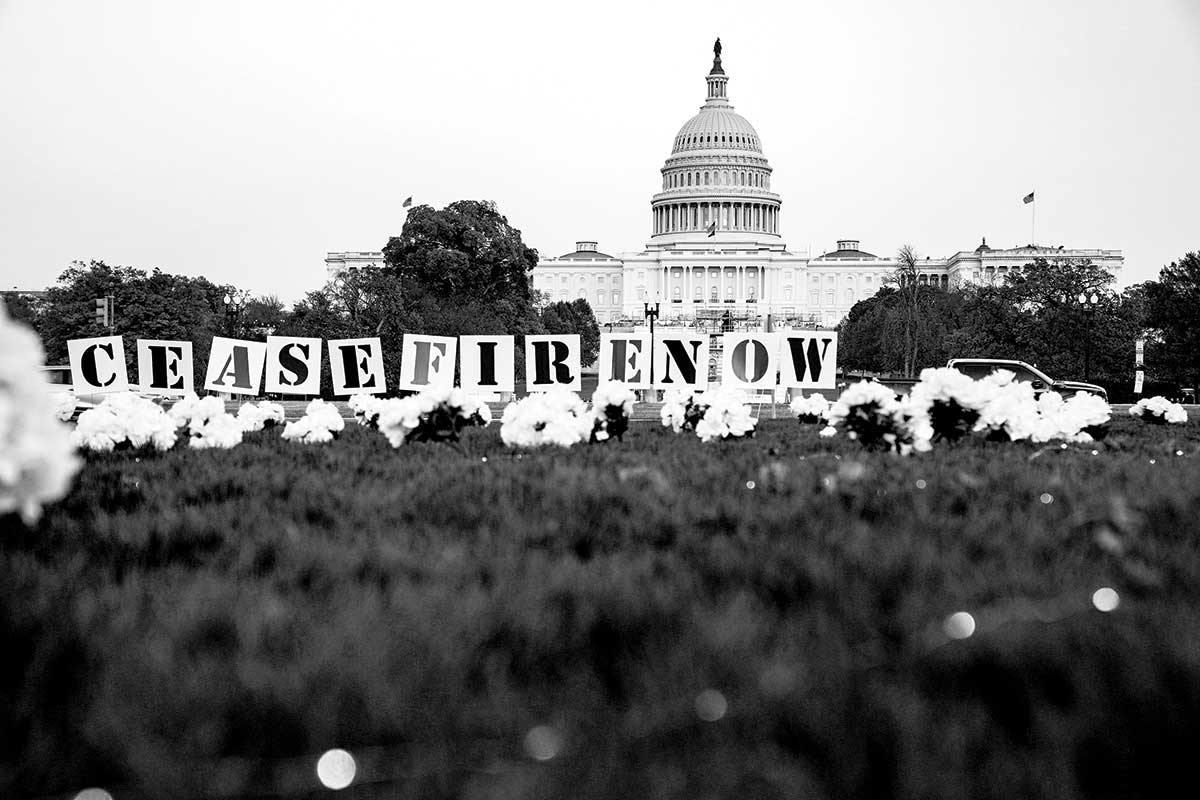
Cease-fire now: An installation at the National Mall in Washington, D.C. (Leigh Vogel / Getty Images )
A Day in the Life
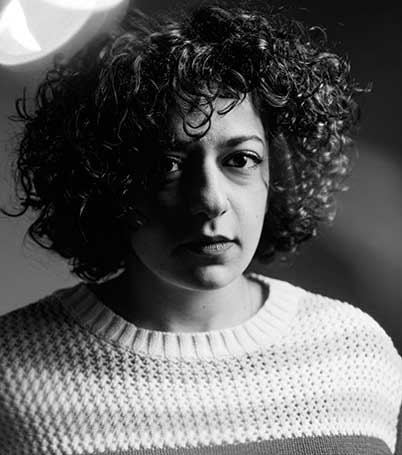
Noura Erakat
(Leigh Vogel/Getty Images)
It’s the sound that guts me. The mama
grasping her baby boy wrapped in a white shroud, moaning in shock. A
little girl curled up next to the wheels of a stretcher holding her
father. Between her cries, we hear her implore, “Baba!” There is also
the father with skinny arms, still in his slippers, covered in ash,
screaming his children’s names one by one. He turns over a piece of
shattered concrete searching for his babies, but there is nothing but
wreckage.
Palestinians are certainly not the first people to endure genocide,
but they are most certainly the first to have it broadcast in real time.
How pathetic that we can’t stop this. Every night I make a single wish:
Please let us wake to news of a cease-fire. But in the morning, when I
pick up my phone, I already know what I see will keep me up another
night.
I’m barely up, and my phone is already ablaze with requests. I won’t be
able to respond to all of them. My title—human rights attorney—gives the
impression that I have a law practice. A Palestinian family from Gaza
has arrived in Cairo; 46 members have been killed. They want to sue
Israel and need help. A journalist friend writes from Gaza. His employer
is demoting him for being “anti-Israel,” as he and his family scramble
to find food and shelter. What can he do? I frantically try to respond.
It never feels like enough.
Besides work and protests, I only leave home for my daughter’s sake.
She always asks me to put away my phone. She explains her poor test
score is a result of her baba and me “talking about the war too much.”
I broke my self-imposed isolation to take her to a school Halloween
party. I joked with one of the parents that my costume was a Palestinian
pretending to be OK. She didn’t laugh. Ever since 6-year-old Wadea
Al-Fayoume was stabbed 26 times by his family’s landlord, I have been
acutely afraid for my daughter’s safety and anxious that my
public-facing work could cause her harm. I stay in costume and pretend
everything is OK.
I marvel at the sky: How lucky we are it does not fall and crush us without announcement.
The requests for comment from journalists and TV producers start to
pile up. I wade through them on my commute to campus. I’m usually calm
with the media, but these days I’ve been livid about their coverage and
exhausted by the cable networks that have blacklisted me or refused to
post my interviews. A TV producer who invites me to appear on his show
several times but then never has me on writes to share that he is
“trying to connect with Hamas leaders Ghazi Hamad and Osama Hamdan.” He
asks, “Do you have their contact info?” I am boiling.
In my pre-interview prep with the BBC, a producer asks me how
Palestinians feel about Hamas, and I snap: “You know that’s a racist
question, right?”
“I’m just trying to help,” she says, “because not all Palestinians are Hamas.”
“What does it matter what Palestinians feel? Their ideas don’t alter
their civilian status; nothing justifies a genocide. You’ve never asked
a single Israeli what they feel about their government. You didn’t even
ask if Americans supported Bush when his administration invaded Iraq…”
“OK, thank you. I’ll talk to the team and get back to you.”
I know she won’t call back. So I send a text suggesting other
Palestinians she should call. I’m so mad at myself that I may have lost
this opportunity for Palestinians to be heard.
In class, I walk a tightrope. I want my students to ask me about
what’s happening. I want to tell them how lucky we are to have
classrooms, how hundreds of schools in Gaza have been destroyed or
turned into makeshift shelters and 100 percent of the students don’t
have access to education, how “too much reading”—their standard
complaint—is a wonderful problem to have. But no one asks. They are
reluctant to speak in a charged environment. So I open space for them to
share. At the very least, discussing Palestine will not be a taboo.
In our critical race theory class, we’re covering the last chapter of Ruth Wilson Gilmore’s Golden Gulag.
My voice cracks as I read to them: “If the twentieth century was the
age of genocide on a planetary scale, then in order not to repeat
history, we ought to prioritize coming to grips with dehumanization.”
Though my university likes to boast about its faculty in the news, it
has avoided mentioning me for the past three months. I’m grateful it’s
not worse. Despite 12,000 complaints and congressional interventions,
our teach-in on “Race, Liberation, and Palestine”
in early December was not canceled. Meanwhile, at UPenn, donors are
calling for the resignation of my colleagues for chanting for freedom
“from the river to the sea.” At Harvard, protesting students have been doxxed by roaming trucks plastered
with their faces and names. Our Students for Justice in Palestine
chapter became the first to be suspended at a public university.
Suspensions, punishments, and threats mount at nearly every campus in
the country.
After the last student leaves, I put down my mask. I pretend to be OK here, too.
On my commute home, I take calls: about a campaign to address the
United Nations’ inefficacy from within; about a nascent effort to
organize artists; about legal strategies to supplement and amplify our
International Criminal Court petition… I’ll never be able to respond to
everyone.
Once home, I rush to set up a makeshift studio for a live TV interview. Even before I am done, the angry e-mails are pouring in.
“Poor Hamas, right? You are a morally depraved black hole.”
“You are like poison…. Thank goodness my children are not exposed to you.”
“Go to Palestine so we can kill you too.”
I also receive remarkable messages. People around the world,
enthusiastically supporting freedom, who ask over and over again: “What
can I do?”
I’m late again. I rush to pick up my daughter, who is embarrassed by
my tear-stained face. She likes to joke that I sound the same when I
laugh and cry. That always makes me laugh. At the park, we find the
sidewalk colorfully chalked with the words “Kids say no to genocide.” My
heart pops with the promise of the generations to come.
The evening is filled with Al Jazeera Arabic, a refreshing reprieve
from US media coverage. I tape a podcast, jump on an emergency Zoom.
More e-mails come in, more speaking invitations, some that I know will
be canceled. History didn’t begin on October 7, so why are we asked to
teach everything from scratch again?
It’s past midnight. I get into bed and back on my phone. I witness
and listen intently. I cry with my eyes shut, and I wish to wake to the
news of a cease-fire.
We Were Children Once
Ahmed Moor
Anyone who has been to Gaza knows it’s a
place of children. They are everywhere. Little girls and boys underfoot,
in the streets, arrayed on sandy curbs. They reach into your pockets
and make fun of you. Boys on carts pulled by donkeys, peddling goods in
tattered clothing and barefoot, baked brown by an unrelenting summer
sun. That’s the Gaza I remember.
I was born in Rafah in 1984, in the refugee camp there. My family
moved when I was young. My father, an orphan who started kindergarten at
an UNRWA school at the age of 9 and worked as a child porter for
Egyptian soldiers before picking oranges in Israel after 1967, got us
out. He finished school and university in Beirut—the only passport
available to the Palestinians, then and now—and secured a job with an
American NGO. But we went back to Gaza every summer until I was 15, when
the Second Intifada started. I haven’t been back since.
My earliest memories of Gaza: I remember summer evenings fragrant
with jasmine, bright with the Milky Way and the sodium lights of Rafiah
Yam, the nearby Jewish settlement, a different kind of bright, searing
against the darkness of the Strip. I remember rushing off into the night
with other boys, to build plastic bonfires in the dunes and smoke dried
molokhia stems, pretending we had cigarettes. And by day, sledding down
those same dunes on discarded corn oil containers.
I remember the summer a boy was buried alive when a dune collapsed in his wake. An apocryphal story, or a portentous one…
I remember trudging through the sandy lanes with my mother to the
local telephone operator to call my father, who could rarely join us on
those trips home. And I recall, years later, the thrill of watching as
the first crew of laborers built a network of telephone exchanges in our
corner of Gaza. I remember riding my bike past those high dunes, past
Rafiah Yam, and through the checkpoint where Israeli men, armed then, as
now, to the teeth, plied small cruelties for fun. I remember “Shlomo’s
bar” on the beach, which served Palestinian laborers Heineken beer in
glass bottles. The prickly pear groves with their fruit—so much like
Gaza—sweet, but too often painful.
The dunes are gone now. The sand was used for cinder blocks, the
ubiquitous building material in Gaza, where the number of small children
has only grown with time. My memories come back to me, relentlessly,
with the force of guilt and loss, as I watch the videos of what’s being
done to those children, more than 10,000 of them now. In one, a
cameraman sweeps past a collection of small feet, the only visible parts
of small bodies, crushed to death under a collapsed roof in Gaza as
they slept. The dunes of my youth turned to cinder blocks, children
buried alive under their weight. A timeless story for the children of
Gaza, not apocryphal at all.
Lately, I catch myself thinking strange thoughts. I imagine a dying
sun, eight billion years from now, swallowing the earth and turning
everything to ash. I know I am not alone, and I recognize the dark
fantasies of a broken spirit.
And then my children, alive, beautiful, and vivacious—three little
girls—wake me from my grim reveries. They pull me back from the
precipice. Unknowingly, they hold the genocide at bay. They are too
young to know what’s being done to their family, so far away from
everything in their lives. I write this love letter to Gaza’s children,
whose lives are brief and whose deaths are meaningless. I write this
letter for all the people in Gaza, who were children once, if only
briefly, before the awareness of their own worthlessness crept into
their lives. I write this letter for myself, and I wonder, when all the
children in Gaza are dead, who will pull us back from the precipice?
A scene from Dearborn, Mich.: In one of Michigan’s Arab American strongholds, a pro-Palestine protest greeted a visit from Joe Biden. (Seth Herald / AFP via Getty Images)
Occupied by Hope
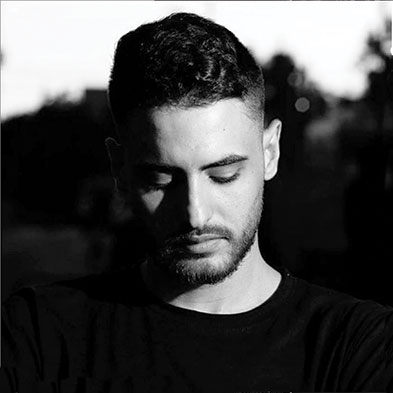
Noor Hindi
(Jeffrey Smith)
Recently, I asked my father a simple question: “Is there hope?”
I was standing in my kitchen in Dearborn, Mich., slicing mangoes.
Peering through the doorway, I saw him as I’ve always seen him:
squinting at his phone, his body collapsed on a couch, a tired look on
his face.
He had already turned on the news.
I have never been to Palestine. But the chaos of headlines about our
homeland is something I am all too familiar with. So is the history that
haunts us.
As a child, I was lulled to sleep by the sound of Al Jazeera as I lay
on my father’s lap. At family gatherings, I listened to our stories: my
grandmother surviving the Nakba at 5 years old; my father’s upbringing
in the Qalandia refugee camp; the trees my great-grandfather planted
around his house in Al-Qubab (now Ramleh), one of 418 Palestinian
villages destroyed between 1948 and 1949.
One night last year, I dreamed of Palestine. In the dream, I was
kneeling alongside my father, a handful of Palestine’s soil in my mouth.
I awoke gasping for water, an emptiness in my throat, a hollowness in
my body.
I am familiar with emptiness, the cavities of its grief, its hands around my neck. I called my dad later that day.
“We are going to Palestine,” I said. “October 2024.”
He made one simple demand: He wished to go in August. “For fig season,” he said, and I could hear his smile through the phone.
I want to taste Palestine’s bitter earth. For years, I have grieved
its soil without ever having touched it. I want to find the exact
location of my hurt, the coordinates of my emptiness. I want and I want.
Lately, I have been demanding.
At a recent protest in Dearborn, I detached myself from the crowd and
stood under a tree. I was trying to catch my breath. I played
hide-and-seek with my body, begging my feet to find the ground they were
standing on, to find comfort in a country I am not built for.
I watched a father chase after his son. The boy was barefoot.
Hysterical with laughter. He picked up a single red leaf. He flung it in
the air. He was a mess of joy, of life.
I don’t know what future we are leaving him.
For months, Gazans have made the violence they are facing at the
hands of Israel indisputable. Before mourning, before reckoning with all
they have lost, before even allowing Allah himself to bear witness to
such tragedy, they point their cameras.
I refuse to re-create most of these images here. To describe what is indescribable. But here is what I can say.
In October, doctors in Gaza held a press conference at Al-Ahli
Baptist Hospital. A sea of dead Gazan children, their tiny bodies
wrapped in white cloth, surrounded them. And yet, Israel continues to
kill thousands more. The world watches.
In November, Gazan children held their own press conference in front
of Al-Shifa Hospital. They spoke in English. They begged us to protect
them. And yet, Israel continues to kill thousands more. The world
watches.
On Instagram, Gazans like Motaz Azaiza and Bisan Owda, armed only with their phones and their voices, are broadcasting their own genocide—the
constant bombardment, the mass displacement, the poisoning of the
water, the starvation of the people, the endless grief. And yet, Israel
continues to kill thousands more. The world watches.
What more needs to be seen?
Palestinians do not get to mourn our dead. We must argue our
humanity, must make our trauma irrefutable, must prove over and over
again that we do not deserve our fate. It has been 75 years and
counting.
This is the genesis of my frustration, the private anguish lurking in
the background of my everyday movements: We have nothing but the
stories we use as shields. And this is not enough.
There is little that is more dislocating than witnessing the genocide
of your own people: on Twitter, on Instagram, in waiting rooms at
doctors’ offices, on the radio, and during all the mundane tasks of
survival. There is little that is more demoralizing than watching the
world deny a violence that is so simply seen, heard, and broadcast by
the people experiencing it themselves.
I have become impatient with the headlines. With “solutions.” With
the empire’s demand that we treat this crisis as “complex”—a demand that
only seems to arise when the people dying are Palestinian. With the
insistence that every conversation start with October 7, when we know
that was far from the beginning of this crisis.
I refuse. I want my country back. This is not complicated.
I am writing for a future I no longer know is possible. I am making
art for a future I no longer know is possible. I am dreaming of a
Palestine I may never encounter.
Yet still, I am dreaming.
When I ask my father, “Is there hope?,” his response is swift.
“Of course there is hope.”
“From where?” I ask.
“I haven’t let go of my hope.”
Here is the truth about being Palestinian: In this lifetime, and the
one after, and the one thereafter, we will always choose Palestine.
There is little that endures more than our hope.
In the face of the unimaginable, this is what I hold on to.
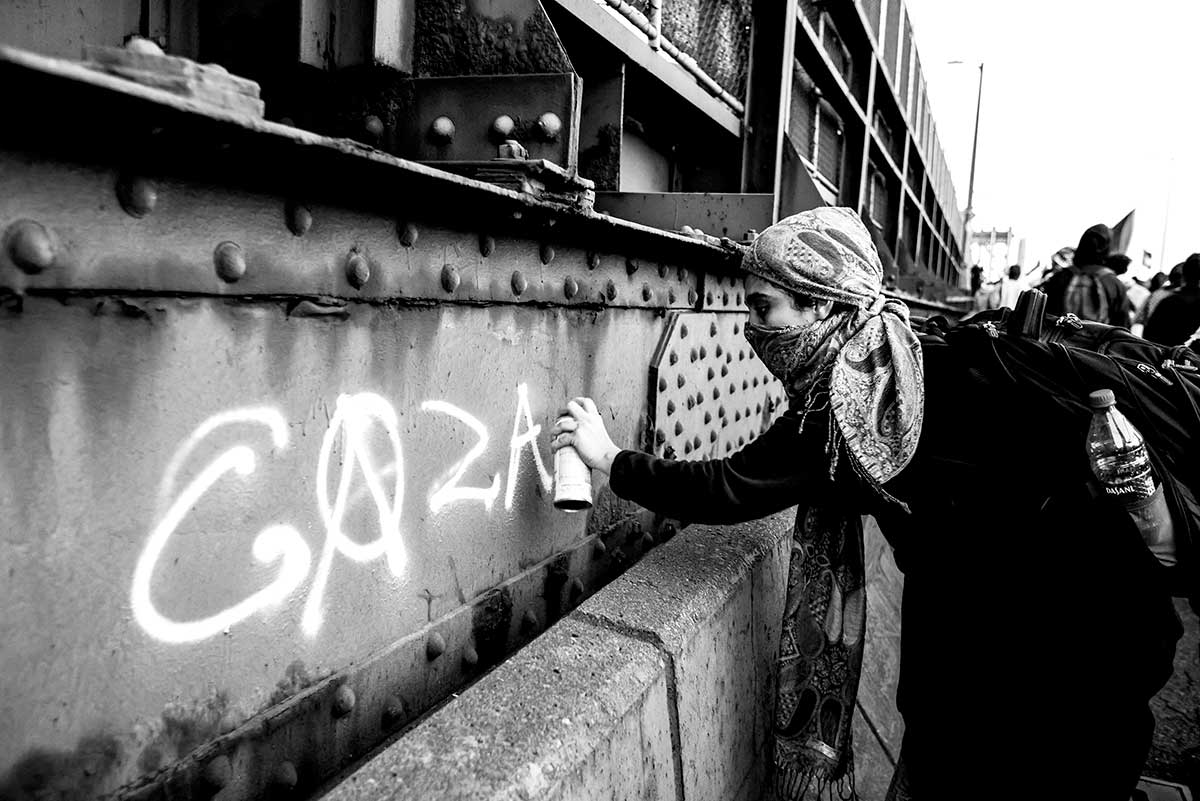
Sending a message: Protesters occupying the Manhattan Bridge in New York City. (Kena Betancur / AFP via Getty Images)
The Question
Mohammed El-Kurd
(Ryan Brand)
At a recent closed-door meeting in London to
discuss BDS with various publishers and writers, a well-intentioned,
well-known author asked me if Zionism could hold a double meaning: To
some, it is a settler-colonial movement motivated by expansion and
racial elimination, and to others it is a movement for Jewish
self-determination. “No,” I said. “Zionism is best defined by its
material manifestations—the most recent being genocide. It is irrelevant
whether it could contain multitudes.” At the time, the death toll in
the besieged Gaza Strip was approaching 20,000, and our martyred friend and poet Refaat Al-Areer
was among the thousands yet to be retrieved from the rubble. The
suggestion that I would have the patience for theoretical discussions
felt profane.
Yet conversations about Palestine in the West are steered by
abstractions and hypotheticals—about the meaning of Zionism, about the
threat level of words, about a logistically impossible yet impossibly
imminent genocide of the Jewish people. (Apparently, I am supposed to
clarify that I do believe the Holocaust happened.) You almost feel as
though you are the victim of an elaborate, callous joke.
The morning I sat down to write this, a nurse and journalist named
Yousef Mema published photos of the decomposing corpses of Palestinians
murdered in the north of Gaza—a skull, a rib cage, and foot bones
protruding through jeans. They had been exposed to the harsh elements
for the past 80 days, he explained, because heavy Israeli bombardment
and ground incursions had “prevented paramedics from reaching the
martyrs.”
Meanwhile, in another world, Zionist college students were busy
decrying the threat posed by pro-Palestinian demonstrations on campus,
then testifying about this threat in front of Congress, while young
Palestinians were being gunned down or stabbed by white supremacists. At
first, I had Norman Finkelstein in my ear,
accusing these students of crocodile tears. Of feigning fear. But it
cannot only be performance: despite the nukes and the promised homeland,
their fear is so visceral it can conjure the Gestapo in the halls of
the Ivy Leagues.
To be Palestinian today is to feel like you are caught in a fever
dream—trapped in someone else’s hallucination, where the question “What
happens to the settlers?” is offered with more urgency than questions
about the welfare of six million stateless Palestinian refugees who are
scattered around the world. It is to be interrogated about the hidden
insidiousness of our chants, while Israeli politicians boast about
ethnically cleansing Gaza in newspapers and interviews. It is to be
shouted over, silenced, by people who claim to fear for their lives from
the safety of apartments that have never been blistered by white
phosphorus—that have endured nothing fiercer than a US winter—while
people in another corner of the planet dig for loved ones buried beneath
the rubble of demolished buildings.
Such details are not minor. In situating the Holocaust outside of
history, in placing it not just in the past but in an eternal future,
Zionism today has created a status quo in which the possibility of a
second holocaust is given primacy over a holocaust happening in the
present. I am certain some readers will find those previous lines
uncomfortable or even incendiary, but that is precisely the point:
Language comparing Zionists to Nazis is scrutinized—even penalized—more
than the government policies and military actions that beg for the
analogy to be made.
Distracting questions—“Can Zionism mean different things?”; “Is
anti-Zionism antisemitism?”—feed the discursive loop that prioritizes a
conjectural “day after” over the material present. But here, in the
present, there are more pressing questions: What are the mental and
muscular consequences of being forced to transform a taxi into a hearse?
What becomes of the nurse whose shift is interrupted by the arrival of
her husband’s corpse on a stretcher? What about the father carrying what
remains of his son in two separate plastic bags? What happens to him
after all of this death, once he is alone and away from the cameras?
What kind of man will the boy carrying his brother’s limbs in a bag grow
up to be?
We on the outside simply do not understand what life inside Gaza does
to a person. We know the facts: The 2.3 million Palestinians in Gaza—which has been declared “uninhabitable” by the UN—have
been under siege for 16 years. Two-thirds of them are refugees or the
descendants of dispossessed refugees; half of them are children; and
many of them have lived their entire lives under blockade, their
calendars marked by routine bombardments. Sometimes these facts are
produced to contextualize and historicize the violence coming out of
Gaza; more often they are obfuscated to depoliticize and mystify that
violence.
But in either case, neither the well-intentioned nor the
ill-intentioned truly contend with the magnitude of these facts or the
truth they lay bare: Gaza is a place like no other. Here is a world
governed solely by its severed geography. People here live encircled by
an abundance that they are owed, and yet within this world, the water is
most likely undrinkable, passage is impossible, and food—like the
people themselves—needs a passport. Massacres are both televised and
denied. And all the while, the world’s superpowers aid and abet our
annihilation—explicitly, institutionally, and materially—then berate us
about the meaning of human rights and the myth of Israeli self-defense.
We are, to them, an unfortunate complication of an otherwise acceptable
status quo.
As long as this status quo persists, as long as Palestinians are
subjected to colonial violence and erasure, as long as the people of
Gaza continue to defy the genocide being waged against them, we who are
living outside the concentration camp certainly can, and should, refuse
indignity as a state of being, refuse to shrink ourselves and our
aspirations, refuse to assuage the hallucinations of our colonizers or
be silenced or shouted over. In the last three months, the world changed
forever. We all should act accordingly.
Do You See What I See?
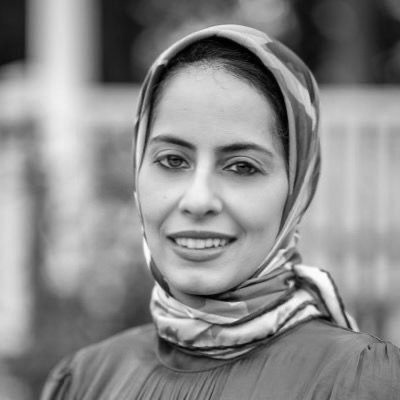
Laila Al-Arian
(Courtesy of Laila Al-Arian)
I put down my phone just before closing my
eyes to sleep, a final break from the endless stream of horrific news
from Gaza. The last posts I see are chilling: Palestinians in Gaza
describing the ferocity of Israel’s bombing campaign, many of the posts
declaring “This is the worst night” yet. Then there are the videos. The
screams of terror as 2,000-pound bombs hit homes, the flares of bright
orange illuminating Gaza’s night skies, and the billowing smoke that
follows.
The cycle repeats as night turns into day. I reach for my phone as
soon as I wake up and see posts of Gazans taking stock of the events of
the previous night: who was killed, who was rescued from the rubble, who
was shot by snipers while fleeing for their safety and waving a white
flag.
In the videos, children shake uncontrollably, covered in dust after
an air strike, silent and bewildered. The number of children killed and
wounded, their limbs amputated, without anesthesia in far too many
cases, is so massive that the UN has called Gaza “a graveyard for children.”
Gaza is where Palestinian children go to sleep hungry, where they hold a
press conference to beg the world to stop their killing, and where
parents write their children’s names on their arms and legs in case they
need to find them beneath the rubble.
Every time I see a video, photo, or post, I wonder if others are
seeing it too—especially Americans, whose tax dollars provide much of
the arms for Israel’s bombardment. Are they seeing what I’m seeing? I ask over and over again, as each day brings a new brutality that I didn’t think was possible.
Israel cut off food, water, fuel, and electricity to Gaza.
I know that if this were happening somewhere else, it would merit
wall-to-wall coverage in the United States. Instead, much of what I
learn comes from social media and independent or international news
outlets.
Israel has barred foreign journalists from entering Gaza unless they
are embedded with their military, but even that fact, which would
provoke outrage if another country were doing it, has barely made a
ripple. Instead, it has fallen on Palestinians to tell their own
story—the reporters targeted and killed in record numbers, and the
citizen journalists using their phones to capture displacement,
starvation, injuries, and death, all evidence of war crimes for which
Israel will almost certainly never be held accountable.
It’s difficult enough to see the terror unleashed on Gaza’s 2.3
million people, nearly half of whom are children. But the complicity and
justification from Western countries that have lectured others about
human rights for decades makes it unbearable. And then there is the
gaslighting, those who deny that any of this is happening at all and
claim, for instance, that a dead Palestinian baby is actually a doll.
I am consumed by my feelings—of sadness, grief, and rage—but feel
guilty for dwelling on them and even for living life, eating while
people are starving, drinking while they are thirsty, sleeping in a warm
bed while they are bombed in theirs or sleeping outside in the cold. We
Palestinians in the diaspora know that it is fate alone—decisions made
by or for our grandparents—that separates us from those in Gaza who are
once again enduring Israel’s brutality.
In October, I watched a video of two young brothers in the aftermath
of an Israeli air strike. The older one, whose face was stained with
blood, stood over his younger brother, who was lying down, his head
bandaged and face and chest covered in blood. The older boy, no more
than 10, was whispering to him to say the declaration of faith that
Muslims say when they’re dying. This was one of countless videos of
Palestinians confronted with the violent deaths of their loved ones,
saying goodbye, crying over them in disbelief, and kissing their dead
bodies over and over again.
These moments of horrific intimacy are filmed because those who suffer and witness them want to show the world that this really happened.
But as the death toll reaches 25,000 (the number is likely much higher
given the bodies under the rubble), I wonder if there is a cost to all
the images we’re seeing, if they inure people to Palestinian death, if
there’s no point in intruding on their most vulnerable moments, since
those in power have not been moved to stop the carnage.
The day after I saw the video of the two brothers, their images still
running through my mind, I asked a member of Congress if he would
support the call for a cease-fire. “They’ve been fighting each other for
thousands of years,” he responded. It was galling. “That’s not true,” I
responded. “It’s been 75 years. My grandparents became refugees after
Israel was created.” “Thousands of years,” he responded, walking away.
This level of ignorance can only come from decades of demonizing
Palestinians as “human animals” and “children of darkness” to justify
killing them en masse even in the face of the indisputable fact that 70
percent of those killed are children, women, and the elderly. Are they seeing what I’m seeing?
Most of the videos from Gaza show graphic horror and heartbreaking loss: a child, whose face is covered in blood, writhing and screaming in pain; a father shouting the names of his children as he searches for them under the rubble; a mother screaming in disbelief that her children were killed while they were hungry.
But I have found that mundane and familiar footage of everyday life
before this onslaught is haunting in its own way. In one video, a young
dental school graduate named Abdallah Baghdadi sits in the back of a
jeep, wearing a black baseball cap, while on vacation in Turkey,
a brief respite from the weight of living under Gaza’s blockade. He is
smiling, carefree, full of life. Abdallah’s grieving friend posted it
after he was killed on October 30, to remember him as she knew him.
In the first three weeks of Israel’s bombardment of Gaza, I found out
that my mother lost 17 members of her extended family in two separate
strikes. We had never met them because of Israel’s 17-year siege of
Gaza, which has cut off the tiny strip from the world and made it nearly
impossible for anyone to visit. I’ve learned that it’s possible to
mourn people I’ve never met, like the poet and professor Refaat Alareer,
who was killed along with members of his family. Refaat was one of the
founders of “We Are Not Numbers,” a nonprofit that cultivated young
writers from Gaza to tell their stories to make sure they don’t become
statistics. But in the face of so much relentless death, it feels
daunting to make sure that each person Israel has killed does not become
just a number. How long does it take to recite 25,000 names?
We even worry about the dead in Gaza, as Israel attacks cemeteries
throughout the strip. I think about what will become of my late
grandfather, who returned to Gaza in 2004 after living abroad as a
refugee for much of his life because he wanted to die in his homeland.
My grandfather survived Israeli bombardments in 2008, 2012, and 2014.
But he can’t rest even in death.
What will be left for the people of Gaza when Israel finally ends its
campaign of terror? It has destroyed everything that makes a place
livable in its determination to end life itself in Gaza, to separate the
people from the land. How does life go on when you’re surrounded by
rubble and mass graves, by children who lost their limbs before they
learned to walk, who lost their parents before they learned how to say
their names?
Outside of Gaza, to be a Palestinian in this moment is to go through
the motions of life while feeling dead inside. It feels like it should
be a state of emergency, but all around us life goes on. People do their
grocery shopping, gather for the holidays, and blow out their birthday
candles, while we are overcome by powerlessness and grief. To be
Palestinian right now is to feel betrayed by those who remain silent,
whatever their reasons, and to feel gratitude and hope from those who
have spoken up.
It’s not just Palestinians, though. So many people have told me that
this is a life-defining moment for them that has shaped their views in
profound ways. Those people have seen what I’ve seen.
Something has broken in all of us, and we will never be the same.
Noura Erakat (@4noura on
Twitter), a human rights attorney and activist, is an associate
professor at Rutgers University—New Brunswick, and a contributing editor
of Jadaliyya. She is the author of Justice for Some: Law and the Question of Palestine (Stanford University Press).
Noor Hindi is a Palestinian-American poet and reporter. Her debut collection of poems, Dear God. Dear Bones. Dear Yellow, was an honorable mention for the Arab American Book Award.
Mohammed El-Kurd is a writer and poet from Jerusalem, occupied Palestine, currently serving as The Nation's first-ever Palestine Correspondent. He is the author of RIFQA (Haymarket) and the forthcoming nonfiction project tentatively-titled A Million States In One (Haymarket). His 2023 Edward Said Memorial Lecture at Princeton will be adapted into a book.
"I'm for truth, no matter who tells it. I'm for justice, no matter who it's for or against."
W.E.B. DuBois (1868-1963)
"There is but one coward on earth, and that is the coward that dare not know."
Dr. Martin Luther King, Jr. (1929-1968)
"Change does not roll in on the wheels of inevitability, but comes through continuous struggle. And so we must straighten our backs and work for our freedom. A man can't ride you unless your back is bent. "
James Baldwin (1924-1987)
"Precisely at the point when you begin to develop a conscience you must find yourself at war with your society."
Aimé Césaire (1913-2008)
"A civilization that proves incapable of solving the problems it creates is a decadent civilization. A civilization that chooses to close its eyes to its most crucial problems is a stricken civilization. A civilization that uses its principles for trickery and deceit is a dying civilization."
Nina Simone (1933-2003)
"There's no other purpose, so far as I'm concerned, for us except to reflect the times, the situations around us and the things we're able to say through our art, the things that millions of people can't say. I think that's the function of an artist and, of course, those of us who are lucky leave a legacy so that when we're dead, we also live on. That's people like Billie Holiday and I hope that I will be that lucky, but meanwhile, the function, so far as I'm concerned, is to reflect the times, whatever that might be."
Amilcar Cabral (1924-1973)
"Always bear in mind that the people are not fighting for ideas, for the things in anyone's head. They are fighting to live better and in peace, to see their lives go forward, to guarantee the future of their children ....Hide nothing from the masses of our people. Tell no lies. Expose lies whenever they are told. Mask no difficulties, mistakes, failures. Claim no easy victories..." .
Angela Davis (b. 1944)
"The idea of freedom is inspiring. But what does it mean? If you are free in a political sense but have no food, what's that? The freedom to starve?”
Duke Ellington (1899-1974)
“Jazz is the freest musical expression we have yet seen. To me, then, jazz means simply freedom of musical speech! And it is precisely because of this freedom that so many varied forms of jazz exist. The important thing to remember, however, is that not one of these forms represents jazz by itself. Jazz simply means the freedom to have many forms.”
Amiri Baraka (1934-2014)
"Thought is more important than art. To revere art and have no understanding of the process that forces it into existence, is finally not even to understand what art is."
Frederick Douglass (1817-1895)
"Power concedes nothing without a demand. It never did and it never will. Find out just what any people will quietly submit to and you have found out the exact measure of injustice and wrong which will be imposed upon them, and these will continue till they are resisted with either words or blows, or both. The limits of tyrants are prescribed by the endurance of those whom they oppress.” --August 3, 1857
Cecil Taylor (1929-2018)
“Musical categories don’t mean anything unless we talk about the actual specific acts that people go through to make music, how one speaks, dances, dresses, moves, thinks, makes love...all these things. We begin with a sound and then say, what is the function of that sound, what is determining the procedures of that sound? Then we can talk about how it motivates or regenerates itself, and that’s where we have tradition.”
Ella Baker (1903-1986)
"Strong people don't need strong leaders"
Paul Robeson (1898-1976)
"The artist must take sides. He must elect to fight for freedom or for slavery. I have made my choice. I had no alternative."
John Coltrane (1926-1967)
"I want to be a force for real good. In other words, I know there are bad forces. I know that there are forces out here that bring suffering to others and misery to the world, but I want to be the opposite force. I want to be the force which is truly for good."
Miles Davis (1926-1991)
"Jazz is the big brother of Revolution. Revolution follows it around."
C.L.R. James (1901-1989)
"All development takes place by means of self-movement, not organization by external forces. It is within the organism itself (i.e. within the society) that there must be realized new motives, new possibilities."
Frantz Fanon (1925-1961)
"Now, political education means opening minds, awakening them, and allowing the birth of their intelligence as [Aime] Cesaire said, it is 'to invent souls.' To educate the masses politically does not mean, cannot mean, making a political speech. What it means is to try, relentlessly and passionately, to teach the masses that everything depends on them."
Edward Said (1935-2003)
“I take criticism so seriously as to believe that, even in the midst of a battle in which one is unmistakably on one side against another, there should be criticism, because there must be critical consciousness if there are to be issues, problems, values, even lives to be fought for."
Antonio Gramsci (1891-1937)
“The challenge of modernity is to live without illusions and without becoming disillusioned. There must be pessimism of the intellect and optimism of the will.”
Susan Sontag (1933-2004)
"Do stuff. Be clenched, curious. Not waiting for inspiration’s shove or society’s kiss on your forehead. Pay attention. It’s all about paying attention. Attention is vitality. It connects you with others. It makes you eager. Stay eager."
Kofi Natambu, editor of The Panopticon Review, is a writer, poet, cultural critic, and political journalist whose poetry, essays, criticism, reviews, and journalism have appeared in many literary magazines, journals, newspapers, and anthologies. He is the author of a biography MALCOLM X: His Life & Work (Alpha Books) and two books of poetry: THE MELODY NEVER STOPS (Past Tents Press) and INTERVALS (Post Aesthetic Press). He was the founder and editor of SOLID GROUND: A NEW WORLD JOURNAL, a national quarterly magazine of the arts, culture, and politics and the editor of a literary anthology NOSTALGIA FOR THE PRESENT (Post Aesthetic Press). Natambu has read his work throughout the country and given many lectures and workshops at academic and arts institutions. He has taught American literature, literary theory and criticism, cultural history and criticism, film studies, political science, creative writing, philosophy, critical theory, and music history and criticism (Jazz, Blues, R&B, Hip Hop) at many universities and colleges. He was also a curator in the Education Department of Detroit’s Museum of African American History. Born in Detroit, Michigan, Natambu currently lives in Berkeley, California with his wife Chuleenan.