Showing posts with label language. Show all posts

Thursday, February 1, 2024

Scholar, Activist, Critic, and Historian Henry A. Giroux On the Grave Necessity of Speaking Out Against, Standing Up To, and Defeating Fascism in the 21st Century--At Home and Abroad

 WHAT IS FASCISM?
"Fascism is a system of political authority and social order intended to reinforce the unity, energy, and purity of communities in which liberal democracy stands accused of producing division and decline...a form of political behavior marked by obsessive preoccupation with community decline, humiliation or victimhood and by compensatory cults of unity, energy and purity, in which a mass-based party of committed nationalist militants, working in uneasy but effective collaboration with traditional elites, abandons democratic liberties and pursues with redemptive violence and without ethical or legal restraints goals of internal cleansing and external expansion.”
—Robert Paxton, “The Anatomy of Fascism"


Silence Is Dangerous in the Current Age of Rising Fascism in the US

Social movements are creating powerful new languages for confronting tyranny. We must resist the plague of silence.
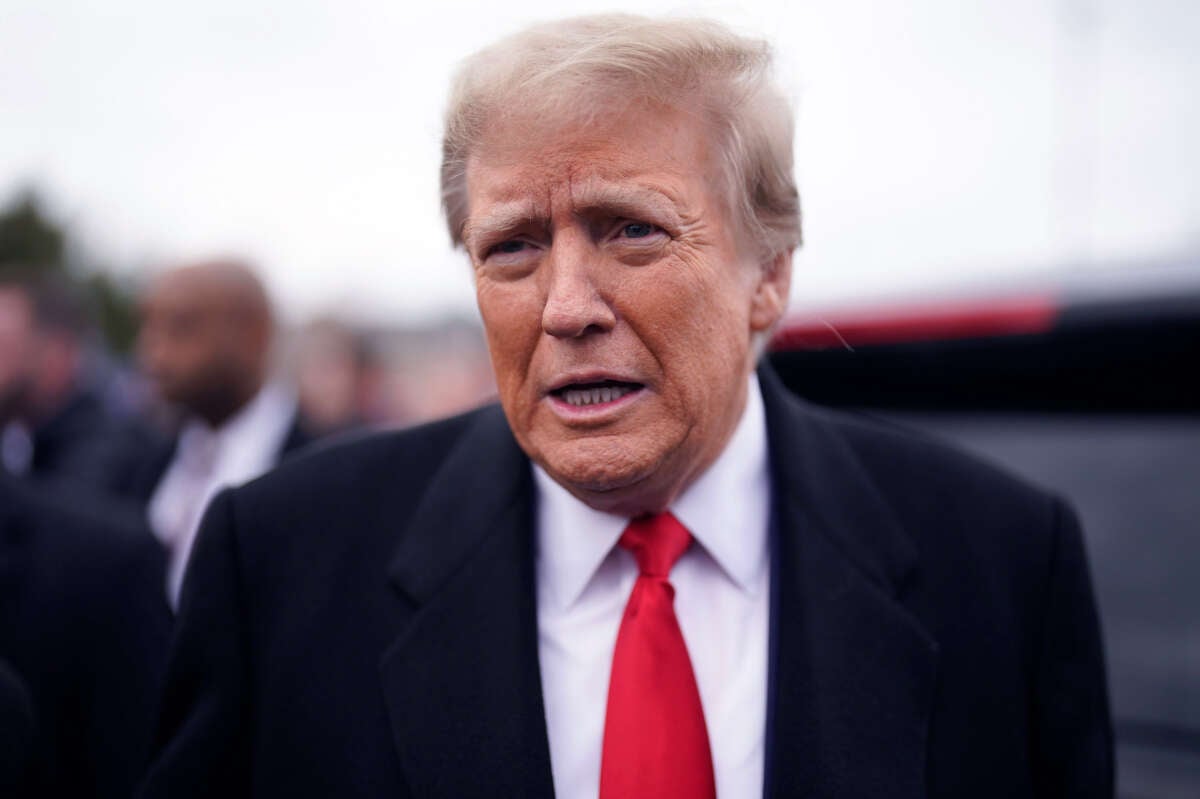
PHOTO: Former president Donald Trump speaks to the media outside a polling location at Londonderry High School in Londonderry, New Hampshire, on January 23, 2024. Jabin Botsford / The Washington Post via Getty Images

This week’s revelation that Donald Trump is already plotting new ways to try to put himself permanently above the law is just the latest reminder of the looming threat of lawless and emboldened right-wing forces in the United States. Trump’s new scheme to expand a Nixon-era policy memo to prohibit the Justice Department from prosecuting presidents, even after they leave office, is just a tiny hint of the greater threat. In recent months, several scholars have sounded the alarm that the United States is “sleepwalking towards authoritarianism.” The concern is not unfounded given that in his run for the presidency in 2024, Trump has boldly telegraphed his aspirations to impose an authoritarian future on the United States. He has repeatedly injected authoritarian language, extremist ideas and threats of violence into the mainstream. Moreover, he has done so to “create a climate of trepidation and powerlessness that discourages mobilization by the opposition,” in the words of scholar Ruth Ben-Ghiat. Forecasting his authoritarian intentions, Trump has openly stated that he intends to terminate portions of the U.S. Constitution, calls his political enemies “vermin” and boldly proclaims he will make himself a dictator “on day one.” On Truth Social, he claimed without irony that a president should have blanket authority and total immunity “even for events that ‘cross the line.’” He has repeatedly stated that if he regains the White House, “it will be a time for retribution” and revenge.

Taking pages from Hitler’s speeches, Trump has also said that the biggest threat to the United States “is from within.” In this instance, he reproduces a version of McCarthyite slander with his claim that the country is being overrun by “communists, Marxists, fascists and the radical left thugs that live like vermin within the confines of our country, that lie and steal and cheat on elections, and need to be rooted out.” His constant attacks on what he labels as the “enemy within” are meant to incite his MAGA followers to wage violence against people of color, critics, progressives, LGBTQ+ Americans, news networks, immigrants, feminists, and any other group that does not buy into Christian nationalist, white supremacist views.

Trump’s discourse overflows with the genocidal language used in the Third Reich. The historian Heather Cox Richardson rightly notes that Trump’s “use of language referring to enemies as bugs or rodents has a long history in genocide because it dehumanizes opponents, making it easier to kill them. In the U.S., this concept is most associated with Hitler and the Nazis, who often spoke of Jews as ‘vermin’ and vowed to exterminate them.”

Trump has claimed that immigrants “are poisoning the blood of our country” and polluting his notion of white Christian culture, and he’s indicated that, if reelected, he plans to make them undergo “ideological screening” in order to enter the country legally (assuming here that he wants to make sure they would not vote for the Democratic Party). If his vision were carried out, millions of undocumented immigrants would be barred from the country while others would be rounded up, put into what amount to Gulag camps, and subjected to unimaginably harsh policies. Given Trump’s calls to shoot shoplifters, impose death penalties on drug dealers, and his suggestion that his former chair of the Joint Chiefs of Staff, Mark Milley, “deserves to be executed,” there is no reason to doubt Trump’s authoritarian designs.

On the campaign trail, Trump repeatedly echoes the language of autocrats such as Hungarian Prime Minister Viktor Orbán, who embraces the concept of “illiberal democracy,” and claims, as The Guardian points out, that the biggest threat to Hungary and other nations is “the ‘mixing’ of European and non-European races.” Trump and the GOP, like many of the authoritarian politicians they admire, believe that equality is a weakness endemic to democracy and destroys society. Trump’s contempt for the law and desire for absolute power is not only evident in his remarks about wanting to be a dictator; it was also on full display when his legal team argued before a D.C. Circuit Court that unless Trump is impeached, he could not be held responsible for “selling pardons, military secrets, or simply having people assassinated.” As Thom Hartmann put it, “Trump’s lawyer argued before the DC Appeals Court that if Trump became president again, he could order SEAL Team Six to assassinate Joe Biden or Liz Cheney and nobody could do anything about it.” While Trump’s lawlessness is central to his grab for unchecked power, there are also displays of the delusions and aspirations of a Nazi-infested politics.

What is especially disturbing about the emerging fascism in the United States is the lack of general public outrage that accompanies it. Such silence extends from almost the entirety of the Republican Party, the mainstream media, 84 percent of white Evangelicals, and a number of the wealthiest American billionaires and corporate tycoons. While the Democratic Party, including President Joe Biden, have called out Trump as a fascist, they have been silent about their support for decades of neoliberal economic policies, the ravages of deindustrialization, a staggering rise in economic inequality and cuts to social programs. Such policies have produced the conditions that have accelerated the rise of authoritarianism in the United States. Wedded to the interests of the banks, corporate ideology and the financial elite, their silence should come as no surprise. At the same time, such policies have produced enormous economic hardships and a diminished sense of agency that creates an enforced silence among the most impoverished populations and often results in their inevitable retreat from politics, especially in relation to voting in national elections.

In the current historical moment, language has increasingly forfeited its obligation to a politics of truth, justice, equality and freedom, and in doing so has turned cannibalistic and cruel. As political horizons and public life wither under the assault of an emerging fascism and a mainstream media that refuse to confront it, language appears to fail in the presence of what Zygmunt Bauman called “the emergence of modern barbarity.” A continuing series of crises — political, cultural, economic and ecological — are translated into emotional plagues of fear, lies and violence produced by right-wing spectacles that have undermined the ability of the U.S. public to address critically the endless attacks by tyrannical forces on democratic ideas, values and institutions. Matters of historical context, interconnections, informed judgment and critical analysis that refuse to divorce themselves, in the words of Winifred Woodhull, “from social institutions and material relations of power and domination” are either ignored or disappear from public view. Language in the age of gangster capitalism and fascist politics is under siege, functioning less as a vehicle of audacious truth and moral witnessing than as a tool to purge democracy of its ideals. In the face of a politics of enforced silence, the United States is experiencing an era marked by what Brad Evans calls “a closing of the political,” grounded in the assumption that “nothing can be done.”

The poisonous shadow of authoritarianism has entered the public imagination in spectacular fashion as a normalized political discourse. A boisterous creed of “annihilating nihilism” marked by a politics of vacuousness, resentment, historical amnesia, self-interest and freedom from responsibility has become a dominating force in U.S. politics. A right-wing vocabulary of hatred, bigotry, lies and conspiracy theories has produced a brutalizing politics whose rhetoric and polices echo a dark and horrifying period of history unlike anything we have seen since the 1930s in Europe. The mobilizing passions of fascism are now being produced, circulated and legitimated though all aspects of the mass media, which are increasingly under the control of a billionaire class. How else to explain not only Trump’s public courting of white supremacists and antisemites, such as Nick Fuentes and Kanye West, but also Nikki Haley’s claim that slavery was not the cause of the Civil War? Such comments reveal the GOP’s fascist tendency not only to whitewash and seek to erase the relevance of the history of racism, but also to endorse the poisonous ideologies of white nationalism and white supremacy. As Czech dissident Václav Havel once remarked, “the disorder of real history is replaced by the orderliness of pseudo-history.… Instead of events, we are offered non-events.”

Diverse social movements … produced a language that allows us to recognize ourselves as agents, not victims.

Extremist language that was once considered unimaginable and relegated to fringe groups has been elevated to the center of power, politics and everyday life. For instance, billionaire Elon Musk’s recent racist comments echo the racial eugenicist movements in the U.S. in the 19th and 20th centuries, from which Hitler took inspiration. Yet, little is said in the mainstream press connecting Musk’s comments to a shameful past that gave us the Tuskegee experiments and provided a rationale for Jim Crow and racial segregation laws. Enforced silence is a tool for the repression of history and the wiping out of historical consciousness and memory, especially those moments in history we associate with segregation, exploitation, disposability and genocide. Fascist discourse is currently abetted and affirmed by ongoing public displays of the detritus of fascist politics, which makes visible that which the United States has forgotten and of which it should be ashamed — that is, a society in which collective morality and the ethical imagination appear to no longer matter.

Beyond bold and unapologetic public displays of fascist rhetoric, beliefs and policies, there are relentless right-wing assaults against democracy that are barely recognized in the media and in public discourse for the danger they pose to democracy. A short list includes book censorship, turning libraries into student detention centers, voter suppression laws, threatening election workers, assaulting reproductive rights, enacting cruel policies against queer and trans people and harassing critical educators. In addition, schools are turned into indoctrination centers, torrents of propaganda replace facts, history is whitewashed, dissent is suppressed and those who provide medical care to trans people and people in need of abortions are criminalized.

These authoritarian aggressions have become embedded in United States culture to the degree that they fail to garner any alarm or concern from the wider public. As fascist beliefs, values and language multiply, so do attacks by far right politicians, reactionary pundits and white supremacists against diversity, equality and inclusion, all the while promoting a white nationalist notion of who counts as a citizen. As Toni Morrison once noted, this is a language constrained by the “weary and wearying vocabulary of racial domination.” It is “a dead language” trapped in sordid silence regarding the racist ideology that drives its claims to “exclusivity and dominance.”

A dangerous silence now often accompanies a language at war with democratic ideals and the public imagination. This is an enforced silence among the larger public that purposely mutes matters of critical agency, moral responsibility, reason, justice and the demands of keeping alive a substantive democracy. It is a language where moral outrage disappears, is silenced or both, while concealing the danger that this fascist language portends. This is a depoliticizing silence that clouds lies and untruths in mindless theater, spectacles and a flood of evasions. Under such circumstances, community is emptied of any substance, reduced to notions of the social organized around the merging of lies and violence. The loneliness and social atomization produced under neoliberalism provide fodder for the dictatorial energies that offer forms of the false promise of community rooted in hate, bigotry and lies, often resulting in habitual ignorance to justice. Mainstream institutions such as schools, the media and online platforms that should trade in imaginative ideas and provide a critical culture are under siege. One consequence is the breakdown of civic culture, egalitarian values and politics itself. What many Americans fail to realize is that this reactionary mode of silence is a form of complicity that creates a political climate marked by cruelty, violence and lawlessness. How else to explain the lack of public outrage against an extremist Republican Party that rejects free summer lunch programs for food-insecure youth, weakens child labor laws and restricts voting rights?

Liberal and conservative Americans are immersed in a crisis of silence that ignores the fact that politicians such as Trump embrace totalitarian values — the language of dictators — and advocate for violence as a tool of political opportunism. This is not to suggest that all forms of silence function to erase the scourge of racism, white supremacy and the misery imposed by neoliberal capitalism.

Silence can be contemplative, offer consolation, and provide the space for close analysis, thinking critically and mobilizing modes of critical agency. However, in an era marked by a massive flight from ethical and political responsibility, a particular kind of administered silence emerges, one that subverts any sense of critical agency and abandons a more noble message regarding a warning of the dangers to come and the lessons to be addressed. Under such conditions, silence operates increasingly within oppressive relations of power. Tyrannical relations of power are now at the center of U.S. politics and radiate a contempt for dissent, integrity, compassion and liberty which, as Bauman notes in his book Babel, ejects “any sense of critical agency and [refuses] to recognize the bonds we have with others.”

In the face of injustice, silence has become ethically mute, and exhibits a dehumanizing indifference to human suffering in the midst of dangerous politics. Enforced silence, both as a subjective stance and as a political space of organized moral irresponsibility and self-deception, increasingly legitimates and helps to produce a society that has lost its moral bearings and wallows in a repudiation of civic courage and human rights. This current politics of enforced silence is happening at a time when many Americans seem oblivious to the threat posed to democracy by Trump, the GOP, far right foundations, reactionary cultural apparatuses and neoliberal educational institutions.

Silence today has become part of a politics of disappearance where critical ideas are buried along with dangerous memories, and the bodies of journalists, poets and those who lead the fight against oppression in its diverse modes. As Spanish painter Francisco Goya once warned of the degree to which truth and informed judgments are overcome by ignorance, superstition and falsehoods, “the sleep of reason produces monsters.” Martin Luther King Jr. gave a contemporary valence to Goya’s warning in his famous 1967 speech, “Beyond Vietnam: A Time to Break the Silence.” His words alerted Americans to the dangers of refusing to speak out in the face of militarism, racism and massive poverty. Stating that “a time comes when silence is betrayal,” King was clear regarding how the refusal to speak out eviscerates both the idea of democracy and the promise of resisting the mobilizing passions of fascism, especially militarism, poverty and racism. The challenge posed by King’s call to resist a complicitous silence in the face of injustice is exceptionally relevant today. At the heart of this challenge is the need to not only make detectable the current threats to democracy but also to understand how silence in the face of tyranny legitimates authoritarianism along with the risks it poses to any viable notion of justice, equality and freedom.

It is important to note that fascism not only arrives through the language of hate, bigotry, dehumanization and military dictatorships as it did in Chile and Argentina in the 1970s; it also arrives through the everyday acceptance of an ethically debilitating silence. In the current moment, such silence accompanies authoritarian threats to democracy. A politics of silence facilitates a tsunami of manufactured ignorance advanced by the repression of dissent, the cowardice of the mainstream media, the unaccountability of social media platforms steeped in the astonishing toxicity of hatred, and a disdain for equality, freedom and truth in a society, notes Jonathan Crary, governed by the corrupting force of the billionaire elite.

Given the current threat posed to U.S. democracy, enforced silence should be analyzed within the uniquely current threats to liberty, basic human rights and equality that sabotage any viable notion of democracy. Such a challenge is especially crucial at a time when the habits of democracy are being replaced by what David Graeber called the “habits of oligarchy, as though no other politics are possible.” The politics of silence increasingly works through multiple sites and seemingly contrasting impulses, often aligning itself with a reactionary disdain for the public good. In part, it does so by refusing to address the growing (yet to some, seemingly unrelated) issues of Trump’s full embrace of fascist politics, the growing attacks on freedom of expression and the struggle for social justice.

This is all the more reason to reclaim the language of the common good; to protect public and higher education from a fascist takeover; to reject the privatization of public goods; expand the power of unions and the rights of workers, people of color, women, immigrants, queer and trans people, and all those others considered excess and disposable. The plague of silence has to be broken so as to inject the struggle for human rights back into the language of politics, and to fight for a socialist democracy built on the anti-capitalist values of equality, social justice, liberty and human dignity. The words of Frederick Douglass are prescient here and worth remembering. He writes:

If there is no struggle, there is no progress. Those who profess to favor freedom and yet deprecate agitation are men who want crops without plowing the ground. They want rain without thunder and lightning. They want the ocean without the roar of its mighty waters.

If the plague of silence is to be overcome, Americans need to tap into a language that makes clear that they will not look away or refuse to stand up in the face of fascist aggression. The brilliant writer Maaza Mengiste argues for such a language with his call for a vocabulary that “will take us from shock and stunned silence toward a coherent, visceral speech, one as strong as the force that is charging at us.”

Fortunately, especially since the Occupy movement in 2011, a number of social movements have emerged to provide a language that both exposes and makes the ruthless power of the financial elite and other anti-democratic forces accountable through a discourse of critique and hope. The Occupy movement made the discourse of inequality and class differences a more central part of a national political narrative. In the last decade, workers have used the language of economic justice, solidarity and fair play to reenergize the labor movement. The resurgence of the labor movement provided a discourse that exposes how neoliberalism benefits the wealthy and privileged.

Silence has become the language through which people are either depoliticized or are willingly complicit with the economic and racial forces of totalitarianism.

Meanwhile movements such as the movement for Black lives have highlighted the language of structural racism along with making visible a history of slavery, racial abuse and police violence, and crafting a nuanced and multidimensional discourse of liberation.

The #MeToo movement created new discourses to make visible the pervasive extent of sexual assault, violence and harassment across a wide variety of sites and greatly advanced gender justice.

The abolitionist movement has provided a contextual and relational language highlighting the punitive nature of highly racialized criminal legal system and the carceral state while instituting a national movement to defund the police.

Trans and queer people have invigorated a movement and language that critiques the right-wing weaponization of marginalized and ostracized identities.

Climate activists have exposed the danger fossil fuels pose to the planet, and how the most vulnerable populations, especially Black and Brown communities, pay a heavy price for the abuses of the oil and gas industries. In doing so, they have inserted the language of climate justice into the public sphere and made clear how capitalism is creating a murderous future for human beings by destroying the environment.

Black and Brown theorists working with the idea of intersectionality have provided a new language highlighting how every social movement is “shaped by multiple intersecting inequalities and power dynamics,” which draw “attention to unmarked categories” of both oppression and resistance. All of these movements have imaginatively offered a new language of politics and continue to further expand and sharpen such discourses.

Equally promising is the increased political activism of young people, who are voicing a language and pedagogy of disruption, critique and possibility. As I stated more than a decade ago in Truthout, theirs is a language “that recognizes that there is no viable politics without will and awareness and that critical education motivates and provides a crucial foundation for understanding and intervening in the world.” Young people recognize that they have been written out of the script of democracy for too long and are now creating spaces and enacting a language in which to expand individual and social agency through collective forms of resistance as starting points to build a new democratic social order.

Fortified with the energy and language of these dynamic movements, it is incumbent upon the broader left and its various social movements to continue to develop a language that not only highlights social injustices but also includes a vocabulary that moves people, allows them to feel compassion for “the other” and gives them the courage to talk back. Beyond highlighting the wide range of social injustices, all of us on the left must continue to develop a vocabulary that speaks to people’s needs in a way that is moving, affirming, recognizable and enables them to confront the burden of conscience in the face of the unspeakable, and to do so with a sense of dignity, self-reflection and the courage to act individually and collectively in the service of a radical democracy.

One important contribution of these diverse social movements is that they all produced a language that allows us to recognize ourselves as agents, not victims. In doing so, they have expanded the discourse of radical democratic politics. Of course, there is more at stake here than a struggle over meaning; there is also the struggle over power, over the need to create a formative culture that will produce new modes of critical agency and contribute to a broad social movement that will translate meaning into a fierce struggle for economic, political and racial equality. While there is a new energy among youth and a number of powerful social movements, there is the ongoing challenge of confronting with renewed vigor a culture of silence and indifference that has become the most powerful educational force of the emerging fascism.

Writing about the civil rights struggles of the ‘60s, Martin Luther King Jr. was prescient in acknowledging that the tyranny and violence of authoritarianism feeds on silence, moral apathy and the collapse of conscience. Given the fierce urgency of the times, the struggle against an enforced silence is especially crucial when people refuse to speak up in the face of injustice. Silence has become the language through which people are either depoliticized or are willingly complicit with the economic and racial forces of totalitarianism. As King notes, it is the language of those “who accept evil without protesting against it.”

The new social movements in the face of an emerging fascism have done us a great theoretical and political favor in making clear that any viable mode of resistance must embrace a language that translates into power — a critical language that expands the power of education, agency and resistance. This is a language that imaginatively rethinks the forces of militarism, capitalism, racism and sexism in light of the dramatic changes taking place technologically, culturally and politically. There will be no justice or democracy in the United States unless a mass multiclass social movement emerges that combines political and individual rights with economic rights — that joins a movement for gender and racial equality with a movement for economic justice.

At the same time, many new social movements need to further a language that is not only theoretical and critical but also passionate. In many ways, they do this, but a politics of passion needs a greater place in their politics. Central to such a language is a politics of emotion that addresses what Ruth Ben-Ghiat refers to as communities of belonging. This is a language that invites joy while mobilizing emotions that embrace compassion, justice and hope. What might be called a politics of identification and emotion is particularly important at a time when many people living in a neoliberal society are atomized, feeling alienated, lonely, invisible, and subject to far right emotional appeals to forms of allegiance rooted in hatred, bigotry and a poisonous nationalism.

Anand Giridharads claims that today’s left is often too cerebral and too suspicious of what he calls empowering emotional appeals. He writes that much of the left today is “suspicious of the politics of passion” and “doesn’t do emotional appeals,” adding:

Can those who defend the rule of law and pluralism and economic justice and human rights not only articulate those ideas but also appeal to the more basic human needs to belong, to have anxieties soothed, to have fears answered, to feel hope, or just to feel something at the end of bleak and tedious days?… In an era [of anxiety and future dread] such as this, leaving the politics of emotion, of passion, to aspiring autocrats is a dangerous abdication.

It is worth emphasizing that the struggle against fascism and for a socialist democracy will not take place if education is not made central to politics. Any attempt to further the language of social, economic and racial justice will not be effective if it does not construct a language of critique, possibility and desire. We need a language that pedagogically moves people, makes power visible and creates communities of belonging, justice and compassion. We need to continue to fight aggressively the plague of silence with what Gayatri Chakravorty Spivak argues is “the power to think the absent.” It is only then that a critical public consciousness can be awakened, and a multiracial working-class movement can begin to bring into fruition a democratically socialist society.


ABOUT THE AUTHOR:


Henry A. Giroux currently holds the McMaster University Chair for Scholarship in the Public Interest in the English and Cultural Studies Department and is the Paulo Freire Distinguished Scholar in Critical Pedagogy. His most recent books include: American Nightmare: Facing the Challenge of Fascism (City Lights, 2018); The Terror of the Unforeseen (Los Angeles Review of books, 2019), On Critical Pedagogy, 2nd edition (Bloomsbury, 2020); Race, Politics, and Pandemic Pedagogy: Education in a Time of Crisis (Bloomsbury 2021); and Pedagogy of Resistance: Against Manufactured Ignorance (Bloomsbury 2022). Giroux is also a member of Truthout’s Board of Directors. 


Thursday, April 10, 2014

Nate Chinen On the Humanity, Depth, Power, and Clarity Of Amiri Baraka


The Gig:   Amiri Baraka, Blues Person 
By Nate Chinen
March 15, 2014
JazzTimes
Remembering a poet and playwright of incandescent power

There were a lot of contested vantage points in the appraisals that surfaced in the wake of Amiri Baraka’s death, on Jan. 9, at 79. This was probably inevitable, and possibly fitting. Not to imply that Baraka—a poet and playwright of incandescent power, and a critic of dauntless conviction—should be reduced in memoriam to a firebrand. While he inhabited that role at times with a kind of fearless relish, his was a far more thoughtful, nuanced and necessary voice than any of his detractors could allow. The mere fact of that dissonance speaks to the central preoccupation of his life, which was the struggle of African-American society against systemic forces of oppression—and all of the ways in which black art held the tools of transformation, or resistance. How you received that message had a lot to do with how you saw the struggle.

Amiri Baraka
Photo by Jimmy Katz

Baraka was a jazz man to the bone; he recognized in the music an unsurpassingly potent and radical means of cultural expression. His writings on jazz, especially in the landmark 1968 essay collection Black Music, shed penetrating light on both the art form and its social context, which he understood to be more or less inextricable. His poems often made use of jazz rhythm, whether they were conveyed on the page or onstage. No one was ever better at bringing modern verse into performative contact with improvised music, as I was reminded most recently by portions of the superb five-LP set Call It Art: New York Art Quartet (1964-65) (Triple Point). (Reading his poem “Western Front,” Baraka sounds dispassionate but urgent, his intensity stretched taut just beneath the surface.) He had little patience for fashions du jour, and even less for the structural biases that slipped by under the guise of conventional wisdom. When he was wrong—everybody has his or her own tally of these moments—there was usually some value in determining precisely how wrong, and why.

He was born Everett Leroy Jones in Newark, N.J., a student of musical and literary inclination practically from the start. He served time at Howard University and the U.S. Air Force, taking away different dissatisfactions from each institution, before he settled into Greenwich Village, where he became known by his byline, LeRoi Jones. He married the former Hettie Cohen, a fellow writer, and they became a fixture in downtown bohemian circles, aligning with poets from the Beat generation (Allen Ginsberg), the Black Mountain scene (Robert Creeley) and the New York School (Frank O’Hara). Baraka’s subsequent repudiation of these relationships, including Hettie Jones, was a result of his deep dive into late-’60s black cultural nationalism. Feelings were hurt, and some in his previous white cohort judged him all the more harshly for it.

The common complaint was that Baraka, as he renamed himself, had jackknifed from the bluffs of poetry into the roiling sea of politics. There was some truth in this. “His writing didn’t go cold unattended (quite the opposite),” observes critic-bandleader Greg Tate, one of Baraka’s many heirs, in Ebony magazine, “but his writing career, as such, became enmeshed if not subordinate to his political fervor.” This enmeshing, made manifest in the Black Arts Movement, could produce riveting results—like Baraka’s immortal poem “AM/TRAK,” which claims John Coltrane as a kindred revolutionary spirit, “Malcolm X in New Super Bop Fire.” And if some of his politically charged jazz essays seem confined to their era, others stubbornly retain their relevance. A recent fracas over Terry Teachout’s biography Duke: A Life of Duke Ellington (Gotham) sent me back to Baraka’s 50-year-old essay “Jazz and the White Critic,” and especially one of its chief assertions: “In jazz criticism, no reliance on European tradition or theory will help at all.”

It so happens that I met Baraka on my first-ever feature assignment, a 1997 profile of a journeyman alto saxophonist named Julian Pressley for the Philadelphia City Paper. I was 20, an English major marking time between junior and senior years, and thought I knew what I was in for. I’d pored over Baraka’s more anthologized poems, along with Black Music and its historic precursor, Blues People. Partly because of my reading and partly because of his extra-literary reputation, I was expecting a bristly reception.

But when I visited Baraka’s house in Newark, I was struck by its air of warmth and inclusion, which probably had something to do with his second wife, Amina, a poet herself. Pressley had been booked to play Kimako’s Blues People, a monthly series in the basement. I remember the delight on his face when he sidled up to the stereo console and noted a CD on which he’d appeared, by the Odean Pope Saxophone Choir. (Baraka had reviewed it, pegging it as “the kind of item you press on people who don’t know it to show how hip you are, digging out the deep ones, the unknown ones.”) I also remember Baraka’s introspection as we conversed in his laundry room, where he spoke quietly, a can of Miller Lite in hand. Regarding the series, he said: “We’re trying to foster a self-reliant alternative culture as a reaction to popular culture.”

It’s instructive to recall the terms of that statement, delivered not as a provocation but merely a principled stance. I subsequently heard Baraka speak in public more than a dozen times, and always kept it in mind. Two years ago, reporting a story, I took bassist-singer Esperanza Spalding to a Baraka reading in Lower Manhattan. With Adegoke Steve Colson on piano, he delivered poems of scathing wit and earnest sentiment, including “Play Dat,” for the memory of pianists John Hicks and Hilton Ruiz. Spalding seemed as transfixed as I was, marveling afterward at his vitality.

More recently, at last year’s awards ceremony for the Jazz Journalists Association, Baraka gave remarks to induct a fellow lifetime achievement honoree, Willard Jenkins, invoking the related legacies of slavery and black literary achievement. When it was my turn at the podium, I thanked him for the challenge he laid bare, calling it “something that we dismiss at our great peril.” Baraka caught my eye as I left the stage, wearing a smile of sly bemusement. But I meant what I said then, and I mean it now.


Tuesday, September 22, 2009

The Politics of Lying and the Culture of Deceit in Obama's America: The Rule of Damaged Politics

http://www.truthout.org/092109R?n

by Henry A. Giroux
t r u t h o u t | Perspective

21 September 2009


Lies are often much more plausible, more appealing to reason, than reality, since the liar has the great advantage of knowing beforehand what the audience wishes or expects to hear.
--Hannah Arendt[1]


In the current American political landscape, truth is not merely misrepresented or falsified; it is overtly mocked. As is well known, the Bush administration repeatedly lied to the American public, furthering a legacy of government mistrust while carrying the practice of distortion to new and almost unimaginable heights. Even now, almost a year after Bush left office, it is difficult to forgot the lies and government-sponsored deceits in which it was claimed that Saddam Hussein had weapons of mass destruction, Iraq was making deals with al-Qaeda and, perhaps the most infamous of all, the United States did not engage in torture. Unlike many former administrations, the Bush administration was engaged in pure political theater,[2] giving new meaning to Hannah Arendt's claim that "Truthfulness has never been counted among the political virtues, and lies have always been regarded as justifiable tools in political dealings."[3] For instance, when the government wasn't lying to promote dangerous policies, it willfully produced and circulated fake news reports in order to provide the illusion that the lies and the policies that flowed from them were supported by selective members of the media and the larger public. The Bush deceits and lies were almost never challenged by right-wing media "patriots," who were too busy denouncing as un-American anyone who questioned Bush's official stream of deception and deceit. Ironically, some of these pundits were actually on the government payroll for spreading the intellectual equivalent of junk food. And some of them were actually being paid by the Bush government to make such claims.

In such circumstances, language loses any viable sense of referentiality, while lying, misrepresentation and the deliberate denial of truth become acceptable practices firmly entrenched in the wild West of talk radio, cable television and the dominant media. Fact finding, arguments bolstered by evidence and informed analysis have always been fragile entities, but they risk annihilation in a culture in which it becomes difficult to distinguish between an opinion and an argument. Knowledge is increasingly controlled by a handful of corporations and public relations firms and is systemically cleansed of any complexity. Lying and deceitfulness are all too often viewed as just another acceptable tactic in what has become most visibly the pathology of politics and a theater of cruelty dominated by a growing chorus of media hatemongers inflaming an authoritarian populist rage laced with a not too subtle bigotry.[4] Truth increasingly becomes the enemy of democracy because it does not support the spectacle and the reduction of citizens either to mere dupes of power or commodities. Ignorance is no longer a liability in a culture in which lying, deceit and misinformation blur the boundaries between informed judgments and the histrionics of a shouting individual or mob. Talk radio and television talk show screamers, in particular, seem to delight in repeating claims that have been discredited in the public arena, demonstrating a barely disguised contempt for both the truth and any viable vestige of journalism. These lies and deceits go beyond the classic political gambit, beyond the Watergate-style cover up, beyond the comic "I did not have sex with that woman." The lies and deceptions that are spewed out everyday from the right-wing teaching machines - from newspapers and radio shows to broadcast media and the Internet - capitalize on both the mobilizing power of the spectacle, the increasing impatience with reason and an obsession with what Susan J. Douglas describes as the use of the "provocative sound bites over investigative reporting, misinformation over fact."[5] Lying and deception have become so commonplace in the dominant press that such practices appear to have no moral significance and provoke few misgivings, even when they have important political consequences. In the age of public relations managers and talk show experts, we are witnessing the demise of public life. At a time when education is reduced to training workers and is stripped of any civic ideals and critical practices, it becomes unfashionable for the public to think critically. Rather than intelligence uniting us, a collective ignorance of politics, culture, the arts, history and important social issues, as Mark Slouka points out, "gives us a sense of community, it confers citizenship."[6] Our political passivity is underscored by a paucity of intellectual engagement, just as the need for discrete judgment and informed analysis fall prey to a culture of watching, a culture of illusion and circus tricks. Shame over the lying and ignorance that now shape our cultural politics has become a source of national pride - witness the pathetic response to Joe Wilson's outburst against President Obama. Or, for that matter, the celebrated and populist response to Sarah Palin's lies about death panels, which are seized upon not because they distort the truth and reveal the dishonesty and vileness of political opportunism - while also undermining a viable health care bill - but because they tap into a sea of growing anger and hyped-up ignorance and ratchet up poll ratings. Lying and deceit have become the stuff of spectacle and are on full display in a society where gossip and celebrity culture rule. In this instance, the consequences of lying are reduced to a matter of prurience rather than public concern, becoming a source of private injury on the part of a Hollywood star or producing the individual humiliation of public figure such as John Edwards.

The widespread acceptance of lying and deceit is not merely suggestive of a commodified and ubiquitous corporate-driven electronic culture that displays an utter contempt for morality and social needs: It is also registers the existence of a troubling form of infantilization and depoliticization. Lying as common sense and deceit as politics-as-usual joins the embrace of provocation in a coupling that empties politics and agency of any substance and feeds into a corporate state and militarized culture in which matters of judgment, thoughtfulness, morality and compassion seem to disappear from public view. What is the social cost of such flight from reality, if not the death of democratic politics, critical thought and civic agency? When a society loses sight of the distinction between fact and fiction, truth-telling and lying, what happens is that truth, critical thought and fact finding as conditions of democracy are rendered trivial and reduced to a collection of mere platitudes, which in turn reinforces moral indifference and political impotence. Under such circumstances, language actually becomes the mechanism for promoting political powerlessness. Lying and deceit are no longer limited to merely substituting falsehoods for the truth; they now performatively constitute their own truth, promoting celebrity culture, right-wing paranoia and modes of government and corporate power freed from any sense of accountability.

While all governments resort to misrepresentations and lies, we appear to have entered a brave new world in which lies, distortions and exaggerations have become so commonplace that when something is said by a politician, it is often meant to suggest its opposite, and without either irony or apology. As lies and deceit become a matter of policy, language loses its grip on reality, and the resulting indeterminacy of meaning is often used by politicians and others to embrace positions that change from one moment to the next. Witness Dick Cheney, who once referred to torture as "enhanced interrogation" so as to sugarcoat its brutality, and then appeared on national television in 2009 only to defend torture by arguing that if such practices work, they are perfectly justified, even if they violate the law. This is the same Cheney who, appearing on the May 31, 2005, "Larry King Live" show, attempted to repudiate charges of government torture by claiming, without irony, that the detainees "have been well treated, treated humanely and decently." This type of discourse recalls George Orwell's dystopian world of "1984" in which the Ministry of Truth produces lies and the Ministry of Love tortures people. Remember when the Bush administration used the "Healthy Forest Initiative" to give loggers access to protected wilderness areas or the "Clear Skies Initiative" to enable greater industrial air pollution? President Obama also indulges in this kind of semantic dishonesty when he substitutes "prolonged detention" for the much maligned "preventive detention" policies he inherited from the Bush-Cheney regime. While Obama is not Bush, the use of this type of duplicitous language calls to mind the Orwellian nightmare in which "war is peace, freedom is slavery, and ignorance is strength."

When lying and deceit become normalized in a culture, they not only serve as an index of how low we have fallen as a literate society, but also demonstrate the degree to which language and education have become corrupted, tied to corporate and political power and sabotaged by rigid ideologies as part of a growing authoritarianism that uses the educational force of the culture, the means of communication and the sites in which information circulate to mobilize ignorance among a misinformed citizenry, all the while supporting reactionary policies. Especially since the horrible events of 9/11, Americans have been encouraged to identify with a militaristic way of life, to suspend their ability to read the word and world critically, to treat corporate and government power in almost religious terms and to view a culture of questioning as something alien and poisonous to American society. Shared fears rather than shared responsibilities now mobilize angry mobs and gun-toting imbeciles, who are praised as "real" Americans. Fear bolstered by lies and manufactured deceptions makes us immune to even the most obvious moral indecencies, such as the use of taser guns on kids in schools. Nobody notices or cares - and one cause and casualty of all of this moral indifference is that language has been emptied of its critical content just as the public spaces that make it possible are disappearing into the arms of corporations, advertisers and other powerful institutions that show nothing but contempt for either the public sphere or the kind of critical literacy that gives it meaning.

Obama's presence on the national political scene gave literacy, language and critical thought a newfound sense of dignity, interlaced as they were with a vision of hope, justice and possibility - and reasonable arguments about the varied crises America faced and civilized. Such practices as Obama compromised, if not surrendered, some of his principles to those individuals and groups that live in the vocabulary of duplicity, the idealism that shaped his language began to look like just another falsehood when measured against his continuation of a number of Bush-like policies. In this case, the politics of distortions and misrepresentations that Obama's lack of integrity has produced may prove to be even more dangerous than what we got under Bush because it wraps itself in a moralism that seems uplifting and hopeful while it supports policies that reward the rich, reduce schools to testing centers and continue to waste lives and money on wars that should have ended when Obama assumed his presidency. Obama claims he is for peace, and yet the United States is the largest arms dealer in the world. He claims he wants to reduce the deficit, but spends billions on the defense industry and wars abroad. He says he wants everyone to have access to decent health care, but makes backroom deals with powerful pharmaceutical companies. Orwell's ghost haunts this new president and the country at large. Reducing the critical power of language has been crucial to this effort. Under such circumstances, democracy as either a moral referent or a political ideal appears to have lost any vestige of credibility. The politics of lying and the culture of deceit are inextricably related to a theater of cruelty and modes of corrupt power in which politics is reduced to a ritualized incantation, just as matters of governance are removed from real struggles over meaning and power.

Beyond disinformation and disguise, the politics of lying and the culture of deceit trade in and abet the rhetoric of fear in order to manipulate the public into a state of servile political dependency and unquestioning ideological support. Fear and its attendant use of moral panic not only create a rhetorical umbrella to promote right-wing ideological agendas (increased military spending, tax relief for the financial and corporate elite, privatization, market-driven reforms and religious intolerance), but also contribute to a sense of helplessness and cynicism throughout the body politic. The collapse of any vestige of critical literacy, reason and sustained debate gives way to falsehoods and forms of ignorance that find expression in the often racist discourse of what Bob Herbert calls "the moronic maestros of right wing radio and TV,"[7] endlessly haranguing the public to resist any vestige of reason. How else to explain the actions of parents who refuse to let their children listen to a speech on education by - Should I say it? - an African-American President? How else to fathom the dominant media repeating uncritically the views of right-wing groups that portray Obama as Hitler or Lenin, or consistently making references that compare him to a gorilla or indulge in other crude racist references - in recent days, these groups have been given ample media attention, as if their opinions are not simply ventriloquizing the worst species of ignorance and racism.

The politics of lying and the culture of deceit are wrapped in the logic of absolute certainty, an ominous harbinger of a kind of illiteracy in which one no longer has to be accountable for justifying opinions, claims or alleged arguments. Stripped of accountability, language finds its final resting place in a culture of deceit in which lying either is accepted as a political strategy or is viewed as simply another normalized aspect of everyday life. The lack of criticism surrounding both government practices and corporations that now exercise unparalleled forms of power is more than shameful; it is an utter capitulation to an Orwellian rhetoric that only thinly veils an egregious form of authoritarianism and racism. In the face of such events, we must develop a critical discourse to address the gap between rhetoric and deeds of those who hold economic, political and social power. As Hannah Arendt has argued, debate is central to a democratic politics, along with the public space in which individuals can argue, exercise critical judgment and clarify their relationship to democratic values and public commitments. Critical consciousness and autonomy are, after all, not merely the stuff of political awareness, but what makes democratic accountability possible in the first place. They are also the foundation and precondition for individuals, parents, community groups and social movements to mobilize against such political and moral corruptions. Democracy is fragile, and its fate is always uncertain, but during the last decade we have witnessed those in commanding political and corporate positions exhibit an utter disregard for the truth, morality and critical debate. The Enron template of lying and deception has turned an ethos of dialogue and persuasion into its opposite: dogmatism and propaganda. In doing so, the American public has been bombarded by a discourse of fear, hate and racism, coupled with a politics of lying that undermines any viable vestige of a democratic ethos. We now find ourselves living in a society in which right-wing extremists not only wage a war against the truth, but also seek to render human beings less than fully human by taking away their desire for justice, spiritual meaning, freedom and individuality.

Politics must become more attentive to those everyday conditions that have allowed the American public to remain complicitous with such barbaric policies and practices. Exposing the underlying conditions and symptoms of a culture of lying and deceit is both a political and a pedagogical task that demands that people speak out and break through the haze of official discourse, media-induced amnesia and the fear-producing lies of corrupt politicians and the swelling ranks of hatemongers. The politics of lying and deceit at the current historical moment offers up the specter of not just government abuse, mob hysteria and potential violence, but also an incipient authoritarianism, one that avidly seeks to eliminate intelligent deliberation, informed public discussion, engaged criticism and the very possibility of freedom and a vital democratic politics. The spirit of critique is meaningless without literacy and an informed public. For such a public to flourish, it must be supported with public debate and informed agents capable of becoming both a witness to injustice and a force for transforming those political, economic and institutional conditions that impose silence and perpetuate human suffering. The distortions, misrepresentations and lies that have become an integral part of American culture present a serious threat to an aspiring democracy because they further what John Dewey called the "eclipse of the public," just as they empty politics of its democratic values, meanings and possibilities. The hate, extremism and pathology that have come to define our national political and popular landscapes - heard repeatedly in the prattle of Rush Limbaugh and Glenn Beck, to name only two of the most popular examples - are legitimated by an appeal to absolute certainty, which becomes the backdrop against which a politics of lying and a culture of deceit, fear, cruelty and repression flourish. We are witnessing in the politics of lying and the culture of deceit a disconnection between language and social responsibility, politics and critical education, market interests and democratic values, and privately felt pain and joys and larger public considerations. And this undermining of the value of human dignity, truth, dialogue and critical thought is the offspring of a debate over much more than simply meaning and language, or even the widespread legitimacy of individual and institutional ignorance and corruption. At its core, it is a debate about power and those corporate and political interests that create the conditions in which lying becomes acceptable and deceit commonplace - those forces that have the power to frame in increasingly narrow ways the conventions, norms, language and relations through which we relate to ourselves and others. How we define ourselves as a nation cannot be separated from the language we value, inhabit and use to shape our understanding of others and the world in which we want to live. As the language of critique, civic responsibility, political courage and democracy disappears along with sustained investments in schools, media, and other elements of a formative culture that keeps an aspiring democracy alive, we lose the spaces and capacities to imagine a future in which language, literacy and hope are on the side of justice, rather than on the side of hate, willful ignorance and widespread injustice.

NOTES

1. Hannah Arendt, "Lying in Politics," in "Crisis of the Republic" (New York: Harvest/HBJ Books, 1969), p. 6

2. Frank Rich, "The Greatest Story Ever Told" (New York: Penguin, 2007).

3. Ibid., Hannah Arendt, "Lying in Politics," p. 4.

4. See Bob Herbert's courageous article, "The Scourge Persists," New York Times (September 19, 2009), p. A17.

5. Susan J. Douglas, "Killing Granny with the Laziness Bias," In These Times (September 17, 2009). Online at: www.inthesetimes.com/main/article/4897.

6. Mark Slouka, "A Quibble," Harper's Magazine (February 2009), p. 9.

7. Ibid., Herbert, "The Scourge Persists," p. 17.
»


Henry A. Giroux holds the Global TV Network chair in English and Cultural Studies at McMaster University in Canada. Related work: Henry A. Giroux, "The Mouse that Roared: Disney and the End of Innocence" (Lanham: Rowman and Lilttlefield, 2001). His most recent books include "Take Back Higher Education" (co-authored with Susan Searls Giroux, 2006), "The University in Chains: Confronting the Military-Industrial-Academic Complex" (2007) and "Against the Terror of Neoliberalism: Politics Beyond the Age of Greed" (2008). His newest book, "Youth in a Suspect Society: Beyond the Politics of Disposability," will be published by Palgrave Mcmillan in 2009. Henry A. Giroux's latest book, "Youth in a Suspect Society: Democracy or Disposability?," has just been published by Palgrave Macmillan


THE REAL CRISIS FACING PRESIDENT OBAMA'S ADMINISTRATION

http://www.truthout.org/092109E?n

All,

An excellent, accurate, and fair analysis. I hope the President is listening for both his sake and ours. Otherwise we will all soon be in even deeper trouble than we already are...


Kofi


Obama's Presidency Isn't Too Big to Fail
by Robert Scheer
t r u t h o u t | Perspective
21 September 2009


A president has only so much capital to expend, both in tax dollars and public tolerance, and Barack Obama is dangerously overdrawn. He has tried to have it all on three fronts, and his administration is in serious danger of going bankrupt. He has blundered into a deepening quagmire in Afghanistan, has continued the Bush policy of buying off Wall Street hustlers instead of confronting them and is now on the cusp of bargaining away the so-called public option, the reform component of his health care program.

Those are not happy sentences to write for one who is still on the e-mail list of campaign supporters urged to back the president in the face of attacks that are stupidly small-minded. But to remain silent about his errors, just because most of his critics are so vile, is hardly an example of constructive concern for him or the country.

Yes, Obama was presented with a series of crises not of his making but for which he is now being held accountable. He is not a "socialist" who grew the federal budget to astronomical proportions. That is the legacy of George W. Bush, who raised the military budget to its highest level since World War II despite the end of the Cold War and the lack of a formidable military opponent — a legacy of debt compounded by Bush's decision to first ignore the banking meltdown and then to engage in a welfare-for-Wall-Street bailout. And it was Bush who gave the pharmaceutical companies the gift of a very expensive government subsidy for seniors' drugs.

But what is nerve-racking about Obama is that even though he campaigned against Bush's follies, he has now embraced them. He hasn't yet managed to significantly reduce the U.S. obligation in Iraq and has committed to making a potentially costlier error by ratcheting up America's "nation-building" role in Afghanistan.

Just as he was burdened with the Afghanistan situation, Obama was saddled with a banking crisis he didn't cause, and the worst that can be said of his attempted solutions to the financial mess is that they were inherited from Bush Treasury Secretary Henry Paulson. But Obama, who raised questions before his election about the propriety of a plan that would rescue the banks but ignore the plight of ordinary folks, has adopted that very approach as president. He elevated Lawrence Summers and Timothy Geithner, the two Democrats most closely aligned with Paulson's policy, to top positions in his government.

Obama's proposed new regulations, while containing some kind words about better informing consumers, do not portend any breakup of the "too big to fail companies" whose problems were permitted to fester by previous deregulatory measures. His answer is to increase the regulatory capacities of the Federal Reserve, which failed to use its already existing and considerable powers to avoid the debacle.

The promise is that next time the Fed will behave better. As Obama put it Monday, "So our plan would put the cost of a firm's failures on those who own its stock and loaned it money. And if taxpayers ever had to step in again to prevent a second Great Depression, the financial industry will have to pay the taxpayer back every cent."

Why not now? And why has he accepted the Wall Street line that all this represents a "collective failure," as if the con men and the conned had equal responsibility? According to Obama: "It was a failure of responsibility that led homebuyers and derivative traders alike to take reckless risks that they couldn't afford to take. It was a collective failure of responsibility in Washington, on Wall Street and across America that led to the near-collapse of our financial system one year ago."

Hogwash. The chicanery of the financial system, securitizing highly suspect mortgages, was codified into laws that made the hustle legal.

That insistence on equating the swindled with the swindlers is also what is wrong with the evolving health care reform plan. The assumption from the beginning, when Obama reached out to insurance companies to come up with a deal, was that they had the interest of their customers at heart. They don't, and it is the purpose of government regulation in the area of health as well as banking to even the scales between the powerful corporations and the consumers from whom they profit. That is the purpose of a public option worth its name.

Without a government program as a check on medical costs, Obama will end up with a variant of the Massachusetts program, one that forces consumers to sign up with private insurers and costs 33 percent more than the national average. He will have furthered the Bush legacy of cultivating an ever more expensive big government without improving how the people are served.


--------

Saturday, June 28, 2008

George Carlin: The Sheer Fearlessness of Laughter, 1937-2008


http://www.nytimes.com/2008/06/24/arts/24carlin.html?_r=1&oref=slogin&ref=obituaries&pagewanted=all

All,

George Carlin (1937-2008) one of the most profound, creative, insightful and deeply funny comedians in American history died June 22 at age 71. Satirist, linguist, raconteur, social and cultural critic, actor, political gadfly, atheist, and fierce public advocate and defender of free speech Carlin was, along with fellow comedic legends Lenny Bruce (1926-1966) and Richard Pryor (1940-2005) one of the most iconic and influential artists in modern comedy who, like his fellow highly innovative contemporaries, revolutionized and fundamentally transformed the very form and content of standup comedy. Possessing a scathing and deadly accurate quick-fire wit as well as a fearlessly perceptive and ruthlessly honest take on human and social behavior and institutions, Carlin was an unsurpassed master of the complexities, ambiguities, and absurdities of language as well as an adroit and very shrewd observer of its liberating and deceptive uses in society. Many of the targets of Carlin’s highly barbed, often furious, and yet sometimes paradoxically gentle and empathetic wit were the ignorant, corrupt, and dishonest mythologies and lies embedded in the endlessly destructive distortions and manipulations of history, religion, and political/cultural ideology. Taking an excoriating and gleeful all-holds- barred approach to the social and cultural questions of race, class, sex, gender, and identity, Carlin not only relentlessly and hilariously attacked all forms of racism, sexism, class domination, and homophobia in his act but he also absolutely refused to let anyone (including himself) off the hook when honing in on the flaws, foibles, pretensions, hypocrisies, idiocies, insecurities, poses, delusions, and deceptions of human beings in general in any given social or historical context. It was this absolute refusal to privilege or cater to the egos and/or bigotries of any one group or individual when making his comedic observations and analyses that made Carlin (again like Pryor, like Bruce) one of the truly most fearless and scathingly honest performers in the history of the demanding art of comedy. Carlin was never afraid to say what he thought or mean what he said in any setting and it was and is this bedrock integrity and foundational sense of independence in harmony with an extraordinary intelligence and a quintessentially blues and Jazz based prophetic understanding and appreciation for the intricacies and demands of experience in all of its many dimensions that made Carlin one of the most important and consistently laugh-out-loud-till-you- can’t-do-anything-but-cry-and-wonder-why comedians to ever rock the mic. To say he and his powerful legacy of public truth telling will be sorely missed yet surely never die as long as the human species can still laugh and simultaneously dig what the laughter means is not only a great understatement but a seemingly absurd paradox that George Carlin would have both understood and happily and derisively laughed at. Thanks for everything Mr. Carlin. You were a straightup genius. You were also, as Miles and many others throughout the globe would say, “a very funny muthafucka.”

Kofi


June 24, 2008
George Carlin, Comic Who Chafed at Society and Its Constraints, Dies at 71 By MEL WATKINS and BRUCE WEBER
New York Times

Correction Appended

George Carlin, whose astringent stand-up comedy made him an heir of Lenny Bruce, who gave voice to an indignant counterculture and assaulted the barricades of censorship on behalf of a generation of comics that followed him, died on Sunday in Santa Monica, Calif. He was 71 and lived in Venice, Calif.

The cause was heart failure, said his publicist, Jeff Abraham. Mr. Carlin, who performed earlier this month at the Orleans hotel in Las Vegas, had a history of heart problems.

“By and large, language is a tool for concealing the truth,” read a message on Mr. Carlin’s Web site, GeorgeCarlin.com, and he spent much of his life in a fervent effort to counteract the forces that would have it so. In his always irreverent, often furious social commentary, in his observations of the absurdities of everyday life and language, and in groundbreaking routines like the profane “Seven Words You Can Never Say on Television,” he took aim at what he thought of as the palliating and obfuscating agents of American life — politicians, advertisements, religion, the media and conventional thinking of all stripes.

“If crime fighters fight crime and firefighters fight fire, what do freedom fighters fight?” he asked in a 1980s routine, taking a jab at the Reagan administration’s defense of the Nicaraguan Contras.

During a career that spanned five decades, Mr. Carlin emerged as one of the most popular, durable, productive and versatile comedians of his era. He evolved from Jerry Seinfeld-like whimsy and a buttoned-down decorum in the ’60s to counterculture hero in the ’70s.

By the ’80s, he was known as a scathing social critic, wringing laughs from the verbal tics of contemporary language like the oxymoron “jumbo shrimp” (and finding another oxymoron in the term “military intelligence”) and poking fun at pervasive national attitudes. He used the ascent of football’s popularity at the expense of the game he loved, baseball, to make the point that societal innocence had been lost forever.

“Baseball is a 19th-century pastoral game,” he said. “Football is a 20th-century technological struggle. Baseball is played on a diamond, in a park. The baseball park! Football is played on a gridiron, in a stadium sometimes called Soldier Field or War Memorial Stadium.”

Through the 1990s and into the 21st century, Mr. Carlin, balding but still pony-tailed, prowled the stage — eyes ablaze with intensity — as the comedy circuit’s most splenetic curmudgeon, raging over the shallowness of a “me first” culture; mocking the infatuation with camcorders, hyphenated names and sneakers with lights on them; lambasting white guys over 10 years old who wear their baseball hats backwards, baby boomers “who went from ‘do your thing’ to ‘just say no’ ” and “from cocaine to Rogaine”; and foes of abortion rights. “How come when it’s us it’s an abortion,” he asked, “and when it’s a chicken it’s an omelet?”

George Denis Carlin was born in New York City on May 12, 1937. His mother, Mary, a secretary, separated from his father when he was an infant, and he grew up with his mother and his older brother, Patrick, on West 121st Street in Manhattan.

“I grew up in New York wanting to be like those funny men in the movies and on the radio,” Mr. Carlin said. “My grandfather, mother and father were gifted verbally, and my mother passed that along to me. She always made sure I was conscious of language and words.”

He dropped out of high school and joined the Air Force, and while stationed in Shreveport, La., he worked as a radio disc jockey. Discharged in 1957, he moved to Boston for a radio announcer’s job, then to Fort Worth, where he was a D.J.

Along the way he met Jack Burns, a newscaster and comedian. They worked together in Fort Worth and Los Angeles, performing on the radio and in clubs and even appearing on “The Tonight Show” with Jack Paar. The comedian Mort Sahl, whose penchant for social commentary Mr. Carlin came to share, dubbed them “a duo of hip wits.”

Still, the Carlin-Burns team was only moderately successful, and, in 1960, Mr. Carlin struck out on his own.

He made his first television solo guest appearance on “The Tonight Show” in 1962, in the interim between Paar’s departure and Johnny Carson’s arrival; the host that night was Mr. Sahl. His second wasn’t until 1965, when he made the first of 29 appearances on “The Merv Griffin Show.”

At that time, he was primarily known for his clever wordplay and reminiscences of his Irish working-class upbringing in New York. But there were intimations of an anti-establishment edge. It surfaced, for example, in a parody of television newscasts, for which he invented characters like Al Sleet, “the “hippy-dippy weatherman”: “Tonight’s forecast: Dark. Continued mostly dark tonight turning to widely scattered light in the morning.”

Mr. Carlin released his first comedy album, “Take-Offs and Put-Ons,” to rave reviews in 1967. He also dabbled in acting, winning a recurring part as Marlo Thomas’s theatrical agent in the 1960s sitcom “That Girl” and a supporting role in the 1968 movie “With Six You Get Eggroll.” He made more than 80 major television appearances during that time, including on the Ed Sullivan Show and Johnny Carson’s “Tonight Show”; he was also regularly featured at nightclubs in New York and Las Vegas.

He was one of America’s most popular comedians, but as the convulsive decade of 1960s ended, he’d had enough of what he considered a dinky and hollow success.

“I was entertaining the fathers and the mothers of the people I sympathized with, and in some cases associated with, and whose point of view I shared,” he recalled later, as quoted in the book “Going Too Far” by Tony Hendra (Doubleday, 1987). “I was a traitor, in so many words. I was living a lie.”

In 1970, Mr. Carlin staged a remarkable reversal of field, discarding his suit and tie, as well as the relatively conventional and clean-cut material that had catapulted him to the top. He reinvented himself, emerging with a beard, long hair, jeans and a routine steeped in drugs and insolence. A backlash followed; in one famous incident, he was advised to leave town when an angry audience threatened him at the Playboy Club in Lake Geneva, Wis., for joking about the Vietnam War. Afterward, he temporarily abandoned nightclubs for coffee houses and colleges, where he found a younger, hipper audience that was more attuned to both his new image and his material.

By 1972, when he released his second album, “FM & AM,” his star was again on the rise. The album, which won a Grammy Award as best comedy recording, combined older material with his newer, more acerbic routines.

One, from “Class Clown,” Mr. Carlin’s third album, became part of his “Seven Words You Can Never Say on Television,” with its rhythmic recitation of obscenities. It was broadcast on the New York radio station WBAI. Acting on a complaint about the broadcast, the Federal Communications Commission issued an order prohibiting the words as “indecent.” In 1978, the Supreme Court upheld the order, establishing a decency standard that remains in effect; it ensnared Howard Stern in 2005, precipitating his move to satellite radio.

Mr. Carlin refused to drop the bit and was arrested several times after reciting it onstage.

By the mid-’70s, like his comic predecessor Lenny Bruce and the fast-rising Richard Pryor, Mr. Carlin had emerged as a cultural renegade. In addition to his jests about religion and politics, he talked about using drugs, including LSD and peyote; he kicked cocaine, he said, not for moral or legal reasons but because he found “far more pain in the deal than pleasure.”

Three of Mr. Carlin’s comedy albums of the 1970’s — “Class Clown,” “Occupation: Foole” and “An Evening With Wally Lambo” — sold more than a million copies. In 1975, he was chosen to host the first episode of the late-night comedy show “Saturday Night Live.” And two years later, he found the perfect platform for his stinging and cerebral, if sometimes off-color, humor in the fledgling world of cable television: the first of his 14 HBO comedy specials, “George Carlin at U.S.C.” was aired in 1977, the last, “George Carlin: It’s Bad for Ya,” in March.

During the course of his career, Mr. Carlin overcame numerous personal trials. His early arrests for obscenity (all of which were dismissed) and his problem with cocaine were the most publicized. But he also weathered serious tax problems, a heart attack and two open-heart surgeries; his health problems cost him five years of productivity between 1977 and 1982. Though he had been able to taper his cocaine use on his own, he said, he continued to abuse alcohol and also became addicted to Vicodin. In December 2004 he entered a rehabilitation center.

“Stand-up is the centerpiece of my life, my business, my art, my survival and my way of being,” Mr. Carlin once told an interviewer. And while it did always take center stage in his career, Mr. Carlin also acted in films, among them “Car Wash” (1976), “Bill and Ted’s Excellent Adventure” (1989), “The Prince of Tides” (1991), and “Dogma” (1999).

He also wrote books, expansions on his comedy routines, including “Brain Droppings” (1997), “Napalm & Silly Putty (2001) and “When Will Jesus Bring the Pork Chops?” (2004), all published by Hyperion. A 1994 sitcom, “The George Carlin Show,” lasted a single season. He also did a stint narrating the children’s television show “Thomas the Tank Engine and Friends.”

Mr. Carlin won a total of four Grammy Awards. He was recently named the recipient of the Mark Twain Prize for American Humor, which he was to receive in November at the John F. Kennedy Center for the Performing Arts in Washington. The Kennedy Center said Monday that the prize would be given posthumously and that the evening would be a tribute to his life and work.

In addition to his brother, Patrick, Mr. Carlin is survived by his wife, Sally Wade, and a daughter, Kelly Carlin McCall. His first wife, Brenda Hosbrook, died in 1997.

Mr. Carlin’s most recent work was especially contentious, even bitter, full of ranting against the stupid, the fat, the docile. But he defended the material, insisting that his comedy had always been driven by an intolerance for the shortcomings of humanity and society.

“Scratch any cynic,” he said, “and you’ll find a disappointed idealist.”

Anahad O’Connor contributed reporting.

This article has been revised to reflect the following correction:

Correction: June 25, 2008

Because of an editing error, an obituary on Tuesday about the comedian George Carlin misstated the location of the Playboy Club where he angered an audience by joking about the Vietnam War. It was Lake Geneva, Wis. (There is no town named Lake Geneva in New York.)

Copyright 2008 The New York Times Company


George Carlin: A Funny Man in an Unfunny World By Amy Goodman
King Features Syndicate
Posted on June 26, 2008, Printed on June 28, 2008

http://www.alternet.org/story/89551/

The world lost one of its great comedians this week with the death at age 71 of George Carlin. Carlin had a career as a stand-up comic that spanned a half-century, in which he continually broke new ground, targeting those in power with his wit and genius. He impacted our culture, our media and our nation with a stream of material that skewered institutions of the left and right, from government to business and the church. He released 22 comedy albums, earning him five Emmy nominations and winning four Grammys. He was the first guest host of "Saturday Night Live," in 1975, and appeared on "The Tonight Show" 130 times. He starred in 14 HBO specials and authored three best-selling books. He also left an indelible mark on the radio station where I got my start in broadcast journalism, Pacifica station WBAI 99.5 FM in New York City.

On Oct. 30, 1973, WBAI broadcast Carlin's "Filthy Words" routine. Carlin wrote on his Web site, georgecarlin.com: "Lone professional moralist complains to FCC which issues a Declaratory Order against station. Station goes to court." That court battle would last five years, end at the U.S. Supreme Court and set the standard for broadcast indecency laws that are hotly debated to this day. It was neither accident nor coincidence that this iconoclastic comic would have some of his most controversial material broadcast over Pacifica Radio's WBAI. The Pacifica Network was founded in Berkeley, Calif., in 1949, with KPFA as the first truly listener-sponsored radio station.

Back then, radio was so overwhelmingly commercial that Pacifica founder Lew Hill and others found it worthless. As Hill wrote in his "Theory of Listener Sponsored Radio," "If we want an improvement in radio, the basic situation of broadcasting must be such that artists and thinkers have a place to work -- with freedom."

On July 3, 1978, the Supreme Court ruled that the Federal Communications Commission could punish WBAI for its broadcast of Carlin's routine, arguing that words relating to sex or excretion (i.e., piss) when children might be listening were prohibited. Supreme Court Justices William Brennan and Thurgood Marshall dissented, noting the court's "depressing inability to appreciate that in our land of cultural pluralism, there are many who think, act, and talk differently from the Members of this Court, and who do not share their fragile sensibilities." Remarkably, 30 years later, the same issues are before a decidedly more conservative Supreme Court.

Recent episodes of "fleeting expletives" from the mouths of celebrities like Bono, Cher and Nicole Richie have prompted the FCC to seek enhanced power to punish broadcasters. George Carlin pointed out what in our society was truly indecent: the behavior of the powerful.

Yes, he spiced his delivery with expletives. He was angry. He, like Pacifica, gave voice to essential, dissident perspectives that have been almost entirely blocked from mainstream media. He said: "We were founded on a very basic double standard. This country was founded by slave owners who wanted to be free. Am I right? A group of slave owners who wanted to be free, so they killed a lot of white English people in order to continue owning their black African people, so they could wipe out the rest of the red Indian people and move west and steal the rest of the land from the brown Mexican people, giving them a place to take off and drop their nuclear weapons on the yellow Japanese people. You know what the motto of this country ought to be? You give us a color, we'll wipe it out."
His prolific output will continue to inspire for generations to come.

Amy Goodman is the host of the nationally syndicated radio news program, Democracy Now!
© 2008 King Features Syndicate All rights reserved
.View this story online at: http://www.alternet.org/story/89551/


HBO plans encores programs of George Carlin comedy Tue Jun 24, 2008

LOS ANGELES (Reuters) - In a tribute to irreverent comedian George Carlin who died this week, cable television network HBO said on Tuesday that it will air encore specials of more than 30 years of his comedy shows starting this week.

Carlin began giving performances on HBO as far back as 1977, almost since the network's inception, and the network will air the first "George Carlin at USC" as well as the final "It's Bad for Ya."

Sister network HBO2 will show 11 of his specials over two nights.

"Because HBO has had such a long and close relationship with George Carlin, his passing is like losing one of our own," HBO Entertainment Senior Vice President Nancy Geller said in a statement. "No performer was more important to helping our network define itself in its early years."

Carlin was 71 years-old when he died of heart failure on Sunday in a Los Angeles-area hospital. He had enthralled the country for nearly 50 years with his provocative humor.

In 1978, a radio broadcast of Carlin's routine "Seven Words You Can Never Say On Television," fueled a battle with the Federal Communications Commission over indecent language on U.S. airwaves.

The U.S. Supreme Court later ruled that Carlin had used words that were indecent, and that the FCC could ban them from being aired when children were listening.

Still, Carlin continued with his no-holds-barred style of comedy that inspired several generations of young comedians to push the boundaries of what audiences considered funny.

"(No) performer was more committed to the ideal of freedom of speech, a principle he embodied for the 50 years he performed with his trademark wit," Geller said.

Apart from presenting 14 shows on HBO, Carlin wrote three best-selling books, won four Grammy Awards, and recorded 22 comedy albums.

The John F. Kennedy Center recently announced Carlin the winner of the prestigious Mark Twain Prize for American Humor, which he was to receive in November this year.

Reuters/Nielsen


Award-winning comedian George Carlin dies
CNN.com
June 23, 2008

LOS ANGELES, California (CNN) -- George Carlin, the influential comedian whose routines used profanity, scatology and absurdity to point out the silliness and hypocrisy of human life, has died. He was 71.

George Carlin, here in 2007, kept up a busy schedule, performing as recently as last weekend in Las Vegas.

Carlin, who had a history of heart trouble, died of heart failure Sunday, according to publicist Jeff Abraham. Carlin went to St. John's Health Center in Santa Monica on Sunday afternoon, complaining of chest pain, and died at 5:55 p.m. PT.

Carlin performed as recently as last weekend at the Orleans Casino and Hotel in Las Vegas, Nevada, and maintained a busy performing schedule, which included regular TV specials for HBO.

"He was a genius and I will miss him dearly," Jack Burns, who was the other half of a comedy duo with Carlin in the early 1960s, told The Associated Press.

Carlin was "a hugely influential force in stand-up comedy. He had an amazing mind, and his humor was brave, and always challenging us to look at ourselves and question our belief systems, while being incredibly entertaining. He was one of the greats," actor and comedian Ben Stiller said in a statement. Slideshow: The life of George Carlin »

Carlin was often quoted, his best lines traded like baseball cards. "Have you ever noticed that anybody driving slower than you is an idiot, and anyone going faster than you is a maniac?" began one famous routine. Another pointed out the differences between the pastoral game of baseball and the militaristic game of football: "Baseball is played on a diamond, in a park. The baseball park! Football is played on a gridiron, in a stadium, sometimes called Soldier Field or War Memorial Stadium."

Then there were the non sequiturs: "The bigger they are, the worse they smell," he observed. Watch Carlin in action »

He filled three best-selling books, more than 20 record albums and countless television appearances with his material. Time.com: How Carlin changed comedy

He appreciated the impact his words made on fans.

"These are nice additional merit badges that you earn if you've left a mark on a person or on some people," he told CNN.com in 2004. "I'd say it's flattering, but flattery implies insincerity, so I call it a compliment."

Carlin was probably best known for a routine that began, "I was thinking about the curse words and the swear words, the cuss words and the words that you can't say." It was a monologue, known as "Seven Words You Can Never Say on Television," that got Carlin arrested and eventually led to the U.S. Supreme Court.

The "Seven Dirty Words" bit prompted a landmark indecency case after New York's WBAI-FM radio aired it in 1973.

The case was appealed to the Supreme Court, which ruled 5-4 that the sketch was "indecent but not obscene," giving the Federal Communications Commission broad leeway to determine what constituted indecency on the airwaves.

"So my name is a footnote in American legal history, which I'm perversely kind of proud of," Carlin said. "In the context of that era, it was daring.

"It just sounds like a very self-serving kind of word. I don't want to go around describing myself as a 'groundbreaker' or a 'difference-maker' because I'm not and I wasn't," he said. "But I contributed to people who were saying things that weren't supposed to be said." Watch the impact of Carlin's seven dirty words routine »

In November, Carlin was slated to receive the 2008 Mark Twain Prize for American Humor, given by the Kennedy Center for the Performing Arts.

"In his lengthy career as a comedian, writer and actor, George Carlin has not only made us laugh, but he makes us think," Kennedy Center Chairman Stephen Schwarzman said in a statement. "His influence on the next generation of comics has been far-reaching."

In a typically wry response, Carlin said, "Thank you, Mr. Twain. Have your people call my people." Watch an appreciation of Carlin »

Carlin was born on May 12, 1937, in New York. He dropped out of high school in the ninth grade and joined the Air Force, where his misfit ways continued -- he received three courts-martial and several punishments.

After leaving the military, he spent a few years in radio, where he met Burns. In 1960, the pair left to pursue a comedy career in Los Angeles. Burns told the AP that the Carlin of those years was "fairly conservative," but things changed when the two saw Lenny Bruce in the early '60s.

"It was an epiphany for George," Burns told the AP. "The comedy we were doing at the time wasn't exactly groundbreaking, and George knew then that he wanted to go in a different direction."

Carlin remembered a similar feeling, he told CNN.com.

"[His career] represented a lot of such honesty on the stage, the willingness to confront a lot of sacred cows and expose them," he said of Bruce. "He did it with a great deal of irreverence and with a lot of brilliance."

Carlin went solo in 1962. For most of the decade, he was a conservative-looking presence: clean-shaven, attired in jacket and tie, making his amused observations to audiences on "The Tonight Show" and "The Ed Sullivan Show."

But as the times changed, so did Carlin. He let his hair down, grew a beard and dressed in jeans and tie-dyed T-shirts. It was this Carlin who became a hit with college audiences in the early '70s and made such albums as "FM & AM" and "Occupation: Foole."

Carlin hosted the first broadcast of "Saturday Night Live" in October 1975.
He also appeared in movies, including "Bill and Ted's Excellent Adventure" (1989), Kevin Smith's "Dogma" (1999) and "Cars" (2006). For the latter, he was the voice of Fillmore, the Volkswagen bus.

He starred as a cabdriver in his own sitcom, "The George Carlin Show," which ran from 1993 to 1995. He also played the character of Mr. Conductor on the PBS series "Shining Time Station" and lent his voice to two episodes of "The Simpsons."

Carlin was blunt about his own struggles. He suffered several heart attacks, one at Dodger Stadium during a baseball game. He also underwent treatment for drug and alcohol abuse.

He was relentlessly amused by humanity -- in one of his most famous lines, he pointed out that "if you're born in this world you're given a ticket to the freak show. If you're born in America, you're given a front-row seat" -- but refused to consider himself a cynic. He preferred "disappointed idealist."

It all went into his comedy. He was fascinated by language and euphemism, noting that "there's a reluctance to confront reality and a desire to soften unpleasant realities." In a different life, he said, he may have been a teacher.

Which he was, anyway.


"Part of what my impulse is with things I've said or done, I think it is an attempt to demystify these things, to take them out of the realm of the forbidden and the disgusting and the off-base, and to at least bring them into the discussion," he told CNN.com.

He is survived by his wife, Sally Wade; daughter Kelly Carlin McCall; son-in-law Bob McCall; brother Patrick Carlin; and sister-in-law Marlene Carlin. Carlin's first wife, Brenda, died in 1997.
