Showing posts with label Capital and Labor. Show all posts

Monday, June 9, 2014

Ta-Nehisi Coates On Reparations, White Supremacy, The Real History of African Americans, And the Social Destiny of the United States


 Ta-Nehisi Coates is a national correspondent at The Atlantic, where he writes about culture, politics, and social issues. He is the author of the memoir The Beautiful Struggle.

All,

This is the most intellectually comprehensive, exhaustively detailed, thoroughly researched, and thus vitally important article ever written on the crucial issue of reparations for African Americans.  If you don't believe me please read this 15,000 word masterpiece very carefully and PLEASE PASS THE WORD.  Brother Coates is a MONSTER JOURNALIST and an outstanding writer as well--which as we all know are not exactly the same thing, and at 38 years of age Coates is already by far one of the very best young political journalists in this country)...What follows below is only a partial section of this masterful essay.  To download and read the entire piece please click on the following link: 

 http://www.theatlantic.com/features/archive/2014/05/the-case-for-reparations/361631/

Kofi

The Case for Reparations

Two hundred fifty years of slavery. Ninety years of Jim Crow. Sixty years of separate but equal. Thirty-five years of racist housing policy. Until we reckon with our compounding moral debts, America will never be whole.

by Ta-Nehisi Coates
MAY 21, 2014
The Atlantic

Chapters:

I. “So That’s Just One Of My Losses”
II.  “A Difference of Kind, Not Degree”
III. “We Inherit Our Ample Patrimony”
IV. “The Ills That Slavery Frees Us From”
V. The Quiet Plunder
VI. Making The Second Ghetto
VII. “A Lot Of People Fell By The Way”
VIII. “Negro Poverty is not White Poverty”
IX. Toward A New Country
X. “There Will Be No ‘Reparations’ From Germany”

"And if thy brother, a Hebrew man, or a Hebrew woman, be sold unto thee, and serve thee six years; then in the seventh year thou shalt let him go free from thee. And when thou sendest him out free from thee, thou shalt not let him go away empty: thou shalt furnish him liberally out of thy flock, and out of thy floor, and out of thy winepress: of that wherewith the LORD thy God hath blessed thee thou shalt give unto him. And thou shalt remember that thou wast a bondman in the land of Egypt, and the LORD thy God redeemed thee: therefore I command thee this thing today."
— Deuteronomy 15: 12–15
"Besides the crime which consists in violating the law, and varying from the right rule of reason, whereby a man so far becomes degenerate, and declares himself to quit the principles of human nature, and to be a noxious creature, there is commonly injury done to some person or other, and some other man receives damage by his transgression: in which case he who hath received any damage, has, besides the right of punishment common to him with other men, a particular right to seek reparation."
— John Locke, “Second Treatise”
"By our unpaid labor and suffering, we have earned the right to the soil, many times over and over, and now we are determined to have it."
— Anonymous, 1861

I. “So That’s Just One Of My Losses”

Clyde Ross was born in 1923, the seventh of 13 children, near Clarksdale, Mississippi, the home of the blues. Ross’s parents owned and farmed a 40-acre tract of land, flush with cows, hogs, and mules. Ross’s mother would drive to Clarksdale to do her shopping in a horse and buggy, in which she invested all the pride one might place in a Cadillac. The family owned another horse, with a red coat, which they gave to Clyde. The Ross family wanted for little, save that which all black families in the Deep South then desperately desired—the protection of the law.

In the 1920s, Jim Crow Mississippi was, in all facets of society, a kleptocracy. The majority of the people in the state were perpetually robbed of the vote—a hijacking engineered through the trickery of the poll tax and the muscle of the lynch mob. Between 1882 and 1968, more black people were lynched in Mississippi than in any other state. “You and I know what’s the best way to keep the nigger from voting,” blustered Theodore Bilbo, a Mississippi senator and a proud Klansman. “You do it the night before the election.”

The state’s regime partnered robbery of the franchise with robbery of the purse. Many of Mississippi’s black farmers lived in debt peonage, under the sway of cotton kings who were at once their landlords, their employers, and their primary merchants. Tools and necessities were advanced against the return on the crop, which was determined by the employer. When farmers were deemed to be in debt—and they often were—the negative balance was then carried over to the next season. A man or woman who protested this arrangement did so at the risk of grave injury or death. Refusing to work meant arrest under vagrancy laws and forced labor under the state’s penal system.

Well into the 20th century, black people spoke of their flight from Mississippi in much the same manner as their runagate ancestors had. In her 2010 book, The Warmth of Other Suns, Isabel Wilkerson tells the story of Eddie Earvin, a spinach picker who fled Mississippi in 1963, after being made to work at gunpoint. “You didn’t talk about it or tell nobody,” Earvin said. “You had to sneak away.”

“Some of the land taken from black families has become a country club in Virginia,” the AP reported.

When Clyde Ross was still a child, Mississippi authorities claimed his father owed $3,000 in back taxes. The elder Ross could not read. He did not have a lawyer. He did not know anyone at the local courthouse. He could not expect the police to be impartial. Effectively, the Ross family had no way to contest the claim and no protection under the law. The authorities seized the land. They seized the buggy. They took the cows, hogs, and mules. And so for the upkeep of separate but equal, the entire Ross family was reduced to sharecropping.

This was hardly unusual. In 2001, the Associated Press published a three-part investigation into the theft of black-owned land stretching back to the antebellum period. The series documented some 406 victims and 24,000 acres of land valued at tens of millions of dollars. The land was taken through means ranging from legal chicanery to terrorism. “Some of the land taken from black families has become a country club in Virginia,” the AP reported, as well as “oil fields in Mississippi” and “a baseball spring training facility in Florida.”

Clyde Ross was a smart child. His teacher thought he should attend a more challenging school. There was very little support for educating black people in Mississippi. But Julius Rosenwald, a part owner of Sears, Roebuck, had begun an ambitious effort to build schools for black children throughout the South. Ross’s teacher believed he should attend the local Rosenwald school. It was too far for Ross to walk and get back in time to work in the fields. Local white children had a school bus. Clyde Ross did not, and thus lost the chance to better his education.

Then, when Ross was 10 years old, a group of white men demanded his only childhood possession—the horse with the red coat. “You can’t have this horse. We want it,” one of the white men said. They gave Ross’s father $17.

“I did everything for that horse,” Ross told me. “Everything. And they took him. Put him on the racetrack. I never did know what happened to him after that, but I know they didn’t bring him back. So that’s just one of my losses.”

The losses mounted. As sharecroppers, the Ross family saw their wages treated as the landlord’s slush fund. Landowners were supposed to split the profits from the cotton fields with sharecroppers. But bales would often disappear during the count, or the split might be altered on a whim. If cotton was selling for 50 cents a pound, the Ross family might get 15 cents, or only five. One year Ross’s mother promised to buy him a $7 suit for a summer program at their church. She ordered the suit by mail. But that year Ross’s family was paid only five cents a pound for cotton. The mailman arrived with the suit. The Rosses could not pay. The suit was sent back. Clyde Ross did not go to the church program.

Elegant Racism


“If you sought to advantage one group of Americans and disadvantage another, you could scarcely choose a more graceful method than housing discrimination.”

It was in these early years that Ross began to understand himself as an American—he did not live under the blind decree of justice, but under the heel of a regime that elevated armed robbery to a governing principle. He thought about fighting. “Just be quiet,” his father told him. “Because they’ll come and kill us all.”

Clyde Ross grew. He was drafted into the Army. The draft officials offered him an exemption if he stayed home and worked. He preferred to take his chances with war. He was stationed in California. He found that he could go into stores without being bothered. He could walk the streets without being harassed. He could go into a restaurant and receive service.

Ross was shipped off to Guam. He fought in World War II to save the world from tyranny. But when he returned to Clarksdale, he found that tyranny had followed him home. This was 1947, eight years before Mississippi lynched Emmett Till and tossed his broken body into the Tallahatchie River. The Great Migration, a mass exodus of 6 million African Americans that spanned most of the 20th century, was now in its second wave. The black pilgrims did not journey north simply seeking better wages and work, or bright lights and big adventures. They were fleeing the acquisitive warlords of the South. They were seeking the protection of the law.

Clyde Ross was among them. He came to Chicago in 1947 and took a job as a taster at Campbell’s Soup. He made a stable wage. He married. He had children. His paycheck was his own. No Klansmen stripped him of the vote. When he walked down the street, he did not have to move because a white man was walking past. He did not have to take off his hat or avert his gaze. His journey from peonage to full citizenship seemed near-complete. Only one item was missing—a home, that final badge of entry into the sacred order of the American middle class of the Eisenhower years.

In 1961, Ross and his wife bought a house in North Lawndale, a bustling community on Chicago’s West Side. North Lawndale had long been a predominantly Jewish neighborhood, but a handful of middle-class African Americans had lived there starting in the ’40s. The community was anchored by the sprawling Sears, Roebuck headquarters. North Lawndale’s Jewish People’s Institute actively encouraged blacks to move into the neighborhood, seeking to make it a “pilot community for interracial living.” In the battle for integration then being fought around the country, North Lawndale seemed to offer promising terrain. But out in the tall grass, highwaymen, nefarious as any Clarksdale kleptocrat, were lying in wait.

From the 1930s through the 1960s, black people across the country were largely cut out of the legitimate home-mortgage market.

Three months after Clyde Ross moved into his house, the boiler blew out. This would normally be a homeowner’s responsibility, but in fact, Ross was not really a homeowner. His payments were made to the seller, not the bank. And Ross had not signed a normal mortgage. He’d bought “on contract”: a predatory agreement that combined all the responsibilities of homeownership with all the disadvantages of renting—while offering the benefits of neither. Ross had bought his house for $27,500. The seller, not the previous homeowner but a new kind of middleman, had bought it for only $12,000 six months before selling it to Ross. In a contract sale, the seller kept the deed until the contract was paid in full—and, unlike with a normal mortgage, Ross would acquire no equity in the meantime. If he missed a single payment, he would immediately forfeit his $1,000 down payment, all his monthly payments, and the property itself.

The men who peddled contracts in North Lawndale would sell homes at inflated prices and then evict families who could not pay—taking their down payment and their monthly installments as profit. Then they’d bring in another black family, rinse, and repeat. “He loads them up with payments they can’t meet,” an office secretary told The Chicago Daily News of her boss, the speculator Lou Fushanis, in 1963. “Then he takes the property away from them. He’s sold some of the buildings three or four times.”

Ross had tried to get a legitimate mortgage in another neighborhood, but was told by a loan officer that there was no financing available. The truth was that there was no financing for people like Clyde Ross. From the 1930s through the 1960s, black people across the country were largely cut out of the legitimate home-mortgage market through means both legal and extralegal. Chicago whites employed every measure, from “restrictive covenants” to bombings, to keep their neighborhoods segregated.

Their efforts were buttressed by the federal government. In 1934, Congress created the Federal Housing Administration. The FHA insured private mortgages, causing a drop in interest rates and a decline in the size of the down payment required to buy a house. But an insured mortgage was not a possibility for Clyde Ross. The FHA had adopted a system of maps that rated neighborhoods according to their perceived stability. On the maps, green areas, rated “A,” indicated “in demand” neighborhoods that, as one appraiser put it, lacked “a single foreigner or Negro.” These neighborhoods were considered excellent prospects for insurance. Neighborhoods where black people lived were rated “D” and were usually considered ineligible for FHA backing. They were colored in red. Neither the percentage of black people living there nor their social class mattered. Black people were viewed as a contagion. Redlining went beyond FHA-backed loans and spread to the entire mortgage industry, which was already rife with racism, excluding black people from most legitimate means of obtaining a mortgage.

Explore Redlining in Chicago:

A 1939 Home Owners’ Loan Corporation “Residential Security Map” of Chicago shows discrimination against low-income and minority neighborhoods. The residents of the areas marked in red (representing “hazardous” real-estate markets) were denied FHA-backed mortgages. (Map development by Frankie Dintino)

“A government offering such bounty to builders and lenders could have required compliance with a nondiscrimination policy,” Charles Abrams, the urban-studies expert who helped create the New York City Housing Authority, wrote in 1955. “Instead, the FHA adopted a racial policy that could well have been culled from the Nuremberg laws.”

The devastating effects are cogently outlined by Melvin L. Oliver and Thomas M. Shapiro in their 1995 book, Black Wealth/White Wealth:

Locked out of the greatest mass-based opportunity for wealth accumulation in American history, African Americans who desired and were able to afford home ownership found themselves consigned to central-city communities where their investments were affected by the “self-fulfilling prophecies” of the FHA appraisers: cut off from sources of new investment[,] their homes and communities deteriorated and lost value in comparison to those homes and communities that FHA appraisers deemed desirable.


In Chicago and across the country, whites looking to achieve the American dream could rely on a legitimate credit system backed by the government. Blacks were herded into the sights of unscrupulous lenders who took them for money and for sport. “It was like people who like to go out and shoot lions in Africa. It was the same thrill,” a housing attorney told the historian Beryl Satter in her 2009 book, Family Properties. “The thrill of the chase and the kill.”

reporter’s notebook
The American Case Against a Black Middle Class:
“When a black family in Chicago saves up enough to move out of the crowded slums into Cicero, the neighborhood riots.”

The kill was profitable. At the time of his death, Lou Fushanis owned more than 600 properties, many of them in North Lawndale, and his estate was estimated to be worth $3 million. He’d made much of this money by exploiting the frustrated hopes of black migrants like Clyde Ross. During this period, according to one estimate, 85 percent of all black home buyers who bought in Chicago bought on contract. “If anybody who is well established in this business in Chicago doesn’t earn $100,000 a year,” a contract seller told The Saturday Evening Post in 1962, “he is loafing.”

Contract sellers became rich. North Lawndale became a ghetto.

Clyde Ross still lives there. He still owns his home. He is 91, and the emblems of survival are all around him—awards for service in his community, pictures of his children in cap and gown. But when I asked him about his home in North Lawndale, I heard only anarchy.

“We were ashamed. We did not want anyone to know that we were that ignorant,” Ross told me. He was sitting at his dining-room table. His glasses were as thick as his Clarksdale drawl. “I’d come out of Mississippi where there was one mess, and come up here and got in another mess. So how dumb am I? I didn’t want anyone to know how dumb I was.

“When I found myself caught up in it, I said, ‘How? I just left this mess. I just left no laws. And no regard. And then I come here and get cheated wide open.’ I would probably want to do some harm to some people, you know, if I had been violent like some of us. I thought, ‘Man, I got caught up in this stuff. I can’t even take care of my kids.’ I didn’t have enough for my kids. You could fall through the cracks easy fighting these white people. And no law.”

Blacks were herded into the sights of unscrupulous lenders who took them for money and for sport.

But fight Clyde Ross did. In 1968 he joined the newly formed Contract Buyers League—a collection of black homeowners on Chicago’s South and West Sides, all of whom had been locked into the same system of predation. There was Howell Collins, whose contract called for him to pay $25,500 for a house that a speculator had bought for $14,500. There was Ruth Wells, who’d managed to pay out half her contract, expecting a mortgage, only to suddenly see an insurance bill materialize out of thin air—a requirement the seller had added without Wells’s knowledge. Contract sellers used every tool at their disposal to pilfer from their clients. They scared white residents into selling low. They lied about properties’ compliance with building codes, then left the buyer responsible when city inspectors arrived. They presented themselves as real-estate brokers, when in fact they were the owners. They guided their clients to lawyers who were in on the scheme.

The Contract Buyers League fought back. Members—who would eventually number more than 500—went out to the posh suburbs where the speculators lived and embarrassed them by knocking on their neighbors’ doors and informing them of the details of the contract-lending trade. They refused to pay their installments, instead holding monthly payments in an escrow account. Then they brought a suit against the contract sellers, accusing them of buying properties and reselling in such a manner “to reap from members of the Negro race large and unjust profits.”

In return for the “deprivations of their rights and privileges under the Thirteenth and Fourteenth Amendments,” the league demanded “prayers for relief”—payback of all moneys paid on contracts and all moneys paid for structural improvement of properties, at 6 percent interest minus a “fair, non-discriminatory” rental price for time of occupation. Moreover, the league asked the court to adjudge that the defendants had “acted willfully and maliciously and that malice is the gist of this action.”

Ross and the Contract Buyers League were no longer appealing to the government simply for equality. They were no longer fleeing in hopes of a better deal elsewhere. They were charging society with a crime against their community. They wanted the crime publicly ruled as such. They wanted the crime’s executors declared to be offensive to society. And they wanted restitution for the great injury brought upon them by said offenders. In 1968, Clyde Ross and the Contract Buyers League were no longer simply seeking the protection of the law. They were seeking reparations.

II.  “A Difference of Kind, Not Degree”

According to the most-recent statistics, North Lawndale is now on the wrong end of virtually every socioeconomic indicator. In 1930 its population was 112,000. Today it is 36,000. The halcyon talk of “interracial living” is dead. The neighborhood is 92 percent black. Its homicide rate is 45 per 100,000—triple the rate of the city as a whole. The infant-mortality rate is 14 per 1,000—more than twice the national average. Forty-three percent of the people in North Lawndale live below the poverty line—double Chicago’s overall rate. Forty-five percent of all households are on food stamps—nearly three times the rate of the city at large. Sears, Roebuck left the neighborhood in 1987, taking 1,800 jobs with it. Kids in North Lawndale need not be confused about their prospects: Cook County’s Juvenile Temporary Detention Center sits directly adjacent to the neighborhood.

North Lawndale is an extreme portrait of the trends that ail black Chicago. Such is the magnitude of these ailments that it can be said that blacks and whites do not inhabit the same city. The average per capita income of Chicago’s white neighborhoods is almost three times that of its black neighborhoods. When the Harvard sociologist Robert J. Sampson examined incarceration rates in Chicago in his 2012 book, Great American City, he found that a black neighborhood with one of the highest incarceration rates (West Garfield Park) had a rate more than 40 times as high as the white neighborhood with the highest rate (Clearing). “This is a staggering differential, even for community-level comparisons,” Sampson writes. “A difference of kind, not degree.”

Wednesday, June 4, 2014

AN IMPORTANT NEW BOOK BY LEADING HISTORIAN AND SOCIAL THEORIST DAVID R. ROEDIGER

 
The Production of Difference: Race and the Management of Labor in U.S. History 
by David R. Roediger and Elizabeth D. Esch
Published:   April 10, 2014

Paperback: 300 pages
Publisher: Oxford University Press 
 
ISBN-10: 0199376484
ISBN-13: 978-0199376483

DAVID R. ROEDIGER
(b. July 13, 1952)
Foundation Distinguished Professor of American Studies and History, University of Kansas

In 1907, pioneering labor historian and economist John  Commons argued that U.S. management had shown just one "symptom of originality," namely "playing one race against the other."

In this eye-opening book, David Roediger and Elizabeth Esch offer a radically new way of understanding the history of management in the United States, placing race, migration, and empire at the center of what has sometimes been narrowly seen as a search for efficiency and economy. Ranging from the antebellum period to the coming of the Great Depression, the book examines the extensive literature slave masters produced on how to manage and "develop" slaves; explores what was perhaps the greatest managerial feat in U.S. history, the building of the transcontinental railroad, which pitted Chinese and Irish work gangs against each other; and concludes by looking at how these strategies survive today in the management of hard, low-paying, dangerous jobs in agriculture, military support, and meatpacking. Roediger and Esch convey what slaves, immigrants, and all working people were up against as the objects of managerial control. Managers explicitly ranked racial groups, both in terms of which labor they were best suited for and their relative value compared to others. The authors show how whites relied on such alleged racial knowledge to manage and believed that the "lesser races" could only benefit from their tutelage. These views wove together managerial strategies and white supremacy not only ideologically but practically, every day at workplaces. Even in factories governed by scientific management, the impulse to play races against each other, and to slot workers into jobs categorized by race, constituted powerful management tools used to enforce discipline, lower wages, keep workers on dangerous jobs, and undermine solidarity.

Painstakingly researched and brilliantly argued, The Production of Difference will revolutionize the history of labor and race in the United States.

Editorial Reviews

Review
 
Winner of the International Labor History Association Book of the Year Award

Honorable Mention, C.L.R. James Award of the Working Class Studies Association

"Well told and conceptualized... [A] provocative and useful book." --Joe R. Feagin, Monthly Review

"A work of considerable scholarship, which convincingly documents the pervasiveness of racial and ethnic distinctions that plagued American society and shaped many workplace practices." --CHOICE

"In this bold, captivating study, Roediger and Esch detail the U.S. history of racial management from the antebellum plantation to the building of the Panama Canal, and from the domestic household to Taylorist factory assembly lines. With historical depth and concise analyses, they demonstrate how racialized divisions of labor were as much the modern means for maximizing profit as they were the means to foster competition among different racial, national, and ethnic groups. In doing so, they provide the most compelling case for the necessity of cross-racial workers' solidarity." --Lisa Lowe, University of California, San Diego

"Fascinating... highly readable... The book's wide scope gives it a bold and provocative edge, and should make it of interest to scholars in several fields." --Indiana Magazine of History

"A remarkable and provocative book that breaks new ground in the study of racial and class formation in American history .. A powerful and timely contribution, The Production of Difference should provoke new debates on the role of management in the construction of race from the nineteenth century to today." --Chris Rhomberg, Journal of American History

"This wide-ranging account of management-by-race-from southern slave plantations and the construction of the transcontinental railroads to Frederick Winslow Taylor's factories and the Philippines' Benguet Road-convincingly documents that discrimination (albeit sometimes mixed with race development theory) has long formed a central strand of American business practice." --Leon Fink, University of Illinois at Chicago

"The Production of Difference is a masterful work that should revolutionize the research and teaching of U.S. management history. Breaking much new ground, Roediger and Esch's book vividly demonstrates that the management of U.S. labor originated not with Frederick Taylor and scientific management but instead with U.S. slavery's plantation system. Destined to become a classic, it is essential reading for every serious scholar, and should be assigned for all courses, in U.S. management history." --Victor G. Devinatz, Illinois State University

"In these well-documented case studies David Roediger and Elizabeth Esch convincingly show how the rise of the United States from a semi-peripheral economy in the early nineteenth century to capitalism's hegemonic power in the twentieth century was attended by an increasingly sophisticated strategy of 'race management'-building on methods first tried out on slave plantations, and playing different segments of the working class off against each other. The book opens up a whole new field of research." --Marcel van der Linden, International Institute of Social History

"This book is a marvel of historical research. It puts new light on how slavery and westward expansion helped to embed racial thinking in 'labor management' and how racial thinking continued as a means to divide and rule and to maximize profits. The Production of Difference requires us to rethink root causes of the persistent perpetuation of racism in American life." --Michael Honey, author of Going Down Jericho Road: The Memphis Strike, Martin Luther King's Last Campaign

About the Authors:

David R. Roediger is Babcock Professor of History, University of Illinois, Champagne-Urbana, and the author of How Race Survived U.S. History and The Wages of Whiteness, among other titles.

Elizabeth D. Esch is Assistant Professor of History and American Studies and a member of the Consortium for Critical Interdisciplinary Study at Barnard College-Columbia University.

Wednesday, August 28, 2013

The Real Legacy of the Civil Rights Movement: Why True Democracy Will Only Come From A Mass-Based Grass Roots Struggle For Jobs, Justice, and Fundamental Social Change

http://www.nytimes.com/2013/08/28/opinion/what-happened-to-jobs-and-justice.html?_r=0

OP-ED CONTRIBUTOR

What Happened to Jobs and Justice?

By WILLIAM P. JONES
August 27, 2013 

New York Times

MADISON, Wis. — ON Aug. 28, 1963, nearly a quarter of a million people thronged the nation’s capital for the March on Washington for Jobs and Freedom, the largest civil rights demonstration in American history. Its impact on American politics was tremendous: in addition to building support to pass the civil rights bill that President John F. Kennedy had recently proposed, marchers succeeded in strengthening and expanding the scope of the bill far beyond what the president had envisioned.

Related in Opinion:

Op-Ed Contributor: The Global March on Washington (August 28, 2013)
Op-Ed Contributor: Mahalia Jackson, and King’s Improvisation (August 28, 2013)
Opinionator | The Great Divide: How Dr. King Shaped My Work in Economics (August 27, 2013)
Editorial: The Fight for Voting Rights, 50 Years Later (August 28, 2013)


For many, the most important addition was Title VII, which prohibited employers and unions from discriminating on the basis of race, color, religion, national origin and sex. The ban on sex discrimination was itself a further amendment, introduced in January 1964 by Southern Democrats who hoped it would impede the bill’s progress through Congress. Their plan backfired: not only did they fail to scuttle the bill, but their amendment also provided a critical legal tool in the fight for women’s equality.

The message of the march still resonated in 1965, when Congress passed the Voting Rights Act, Medicare and Medicaid, key features of President Lyndon B. Johnson’s proposal to bring “an end to poverty and racial injustice.”

The march was so successful that we often forget that it occurred in a political environment not so different from our own. Kennedy’s victory over Richard M. Nixon in 1960 signaled a break from the conservatism of the 1950s. But like the election of Barack Obama in 2008, hope for a return to the liberalism of the 1930s was dampened by an administration that rejected “old slogans” like wage increases and public works in favor of tax cuts and free trade to stimulate growth.

That disillusionment gave rise to sit-ins and freedom rides against segregation in the South, but those protests proved powerless in the face of entrenched conservative power. In contrast, the grass-roots movements that gained political influence in the Kennedy years were White Citizens Councils, the John Birch Society and other forces that, much like today’s Tea Party movement, shifted the political spectrum to the right.

Given those obstacles, how did the March on Washington help drive support for such sweeping civil rights and domestic policy measures?

First, it linked the protest movements of the 1960s to institutions with longstanding roots in working-class communities. The initial call for the 1963 demonstration came from the Negro American Labor Council, an organization of black trade unionists that used local networks to plan for the march months before it was officially announced.

The Southern Christian Leadership Conference and the Student Nonviolent Coordinating Committee played similar roles in the South, mobilizing local civil rights groups, black churches and students. Support also came from the National Council of Negro Women and other elements of the black women’s movement that had battled poverty and discrimination since the 19th century.

At the same time, organizers rallied supporters around a broad and ambitious set of demands. A. Philip Randolph, the veteran trade unionist who had first called for a march on Washington to protest employment discrimination in 1941, wanted the demonstration to focus on the shortcomings of Kennedy’s economic policies. Pointing out that black workers were restricted to entry-level jobs that were most vulnerable to the automation and offshoring of manufacturing under way in the 1960s, he warned that without measures to end discrimination and create more jobs, blacks would be condemned to struggling for survival “within the grey shadows of a hopeless hope.”

Other black leaders shared that concern, but some worried that a “march for jobs” would compete with the movement that the Rev. Dr. Martin Luther King Jr. and others were leading against legalized discrimination and disfranchisement. Anna Arnold Hedgeman, a prominent leader of the black women’s movement, persuaded the men to plan a demonstration that would address “both the economic problems and civil rights.”

Finally, while Randolph, King, Hedgeman and others expanded the mobilization to include a broad and multiracial coalition, they resisted pressure to moderate their tactics or demands.

Both black and white liberals worried that an angry protest would turn moderates in Congress against Kennedy’s civil rights bill, but Randolph and King convinced the leaders of the N.A.A.C.P., the United Auto Workers and the National Urban League that the demonstration would be peaceful and effective.

It was the combination of these stalwart positions and rich institutional networks with the sheer number of peaceful black and white marchers that persuaded so many Americans of the rightness of civil rights and antipoverty legislation.

As we celebrate the 50th anniversary of the march, however, its central achievements are more imperiled than ever. This summer the Supreme Court upheld the principles behind the Civil Rights Act and the Voting Rights Act while severely weakening authority to enforce them. We have a charismatic liberal president and inspiring protest movements dedicated to racial equality and economic justice — but, as in the Kennedy years, they have proved no match for well-organized conservatives.

The solution may not be another march on Washington. But real changes in policy, and the defense of previous victories, require the combination of institutional backing, coalition building and ambitious demands that brought so many people to the National Mall in 1963.

William P. Jones is a professor of history at the University of Wisconsin and the author of “The March on Washington: Jobs, Freedom and the Forgotten History of Civil Rights.”

http://www.nytimes.com/2013/08/28/opinion/the-fight-for-voting-rights-50-years-later.html


EDITORIAL

The Fight for Voting Rights, 50 Years Later

By THE EDITORIAL BOARD
August 27, 2013
New York Times


On the 50th anniversary of the March on Washington, the country can take pride in progress made toward the guarantee of equal rights for all. Yet it is disheartening to watch the continuing battles over the right to vote, a core goal of the civil rights movement and the foundation of any functioning democracy.


The latest fights, over harsh new voting restrictions in Texas and North Carolina, have only made the need for comprehensive and lasting protection of voting rights that much clearer. In June, the Supreme Court hobbled the Voting Rights Act of 1965, one of the most effective civil rights laws in American history. A central element of that law required certain states and jurisdictions with a history of discrimination to obtain federal permission before making changes to their election laws. Finding that “things have changed dramatically,” the court struck down that part of the act.

Within hours, it became clear that things had not changed as much as the court seemed to think. Texas, one of the states covered by the act, was first out of the gate, announcing it would immediately begin enforcing a photo-identification requirement for voters that a federal court had blocked last year. Defenders of that state law — which accepts a concealed-handgun license for identification but not a student ID card — said it was necessary to prevent in-person voter fraud, even though state officials have identified only a handful of such cases. The new North Carolina voter ID law, enacted earlier this month, is similarly disconnected from reality.

These laws, supported by Republican lawmakers trying to suppress Democratic votes, may not be uniquely targeted at racial minorities — they also burden the poor, the elderly, students and others — but that does not change their racial effect. Either way, what reason is there to keep eligible citizens from voting unless you are afraid of the outcome?

Last week, the Justice Department sued Texas over the voter ID law, arguing that it discriminated against minority voters. In a separate case last month, the department joined a lawsuit seeking to place Texas back under federal oversight, because of its discriminatory state-redistricting maps. Both actions relied on surviving sections of the Voting Rights Act, and Attorney General Eric Holder Jr. promised that the administration would “take action against jurisdictions that attempt to hinder access to the ballot box, no matter where it occurs.” Given a Supreme Court that appears increasingly antagonistic to claims of voting discrimination, maintaining rights in practice will require more than just aggressive and persistent lawsuits by the Justice Department or aggrieved voters.

A more robust and lasting solution would include Congress requiring states to improve the accuracy of voter registration databases. Federal laws began this process in the 1990s and early 2000s, but many states’ voting rolls remain woefully unreliable. Making registration easier — for example, by obligating states to identify and register eligible voters or by allowing voters to update their registrations online — would also make a real difference.

As the marchers who converged on Washington 50 years ago understood, it will take a people’s movement to beat back state laws that disenfranchise the most vulnerable Americans. Congress and the courts heard the voice of the people then; it is up to this generation to make sure they hear it now.

Wednesday, August 21, 2013

The Sustained Capitalist and Racist Assault On Detroit, Michigan And Its Lethal Consequences

 
https://www.facebook.com/pages/The-Panopticon-Review/342702882479366

Detroit Residents on Bankruptcy -We Have No Democracy!
15 August 2013
By David Bacon, 
Truthout | News
(Photo: David Bacon)

DETROIT - On July 18, 2013, Kevyn Orr, the city emergency manager appointed by Republican Gov. Rick Snyder, declared Detroit bankrupt under Chapter 9 of the bankruptcy code. According to official accounts, Detroit is $18.5 billion in the hole, making this the largest of several recent bankruptcies declared by US cities and counties.

In theory, such a declaration means that all the city's creditors will suffer and will have to accept only a fraction of what they're owed. But when a bankruptcy judge decides who will have to make sacrifices, those making the most painful ones will be Detroit's 21,000 retired city employees and its 9,000 current ones.

"Everything they've been promised, both contractually and kind of a social contract, is being pulled out from under them. It's morally indefensible," Michael Mulholland, vice president of Local 207 of the American Federation of State, County and Municipal Employees told journalist Jane Slaughter. "I was told if I worked here I'd have a steady job and in my old age not be in poverty." Mulholland's pension as a retiree is $1,600 a month, not an income that can support a family, even in a city like Detroit, where housing prices have plunged.

The Detroit bankruptcy, while huge, is the latest of several that have had their sharpest impact on city workers. The city of Stockton, California, declared bankruptcy two years ago. In a court settlement this month, it forced its 1,100 retirees to accept a lump sum of $5.1 million to compensate them for canceling their previously guaranteed medical insurance. If each retiree gets an equal share amounting to $4,636, it would buy health insurance for only a year or two at current prices. In the US, there is no national health service, and people must buy insurance to pay the cost of medical care.

Huge US corporations have a long history of trying to shed obligations for pensions and health care for retired workers. In the most recent case, the Patriot Coal Company, created by mining giants Peabody Energy and Arch Coal, declared bankruptcy while corporate creators continued to amass large profits. Patriot is responsible for the pensions and health care for 23,000 retirees and dependents who previously worked for Peabody and Arch before the spin-off. The new company says it can't sustain the payments for the benefits workers earned over years of labor in the mines.

While cities like Stockton and Vallejo in California have used bankruptcy law to accomplish this same end, legislators in Michigan have gone one large step farther. Michigan first passed Public Act 101 in 1988, when Democrats still controlled the legislature and governor's office. It allowed temporary emergency control of cities but barred canceling the contracts or benefits of employees. Then Public Act 72 in 1990 allowed the appointment of emergency managers to take control of school systems.

Finally, in 2011, Republicans took control of the Legislature and governorship. They passed Public Law 4, which was much more radical and gave virtually unlimited powers to emergency managers appointed by the governor. Those managers could completely displace elected local city councils, mayors, school boards and other public bodies. Newly elected Gov. Snyder then ended collective bargaining rights and employee status for almost 26,000 child-care workers belonging to the United Auto Workers and the American Federation of State, County and Municipal Employees.

Schools in Highland Park and Pontiac have had three emergency managers, and one manager in Highland Park has been indicted for embezzling. In Benton Harbor, the emergency manager sold off the sports arena built with $55 million of public funds to a developer for $583,000. He even barred the mayor from entering his own office. In Hamtramck, the financial manager stopped paying the mayor and City Council and told the council members to stop meeting. In Ecorse and Highland Park, financial managers made major layoffs to the fire and police departments, outsourcing many jobs to neighboring cities.
In Detroit's schools, part of the agenda has been privatization. By the end of the 2009-10 school year, 50,139 students (36 percent) in Detroit already were attending charter schools. Robert Bobb was then brought in from Oakland, California, as emergency manager and unveiled a plan to covert an additional 41 schools (30 percent of the district) serving 16,000 students into charter schools. Bobb's plan was linked to the Deficit Elimination Plan - an agreement he made with the state. It required the district to close 70 schools over two years and raise class sizes to 60 students at the high school level.
(Photo: David Bacon)

Voters rebelled and repealed Public Law 4 in 2012. The legislature grew even more radical, however, passing a law forbidding contracts that require union membership as a condition of employment (a so-called "right to work" law) then passed Public Law 4 again in a slightly modified form, as Public Act 436.

In March 2013, Snyder appointed Orr as Detroit's emergency manager. And on July 18, Orr forced the city into bankruptcy. City unions charged that he was unwilling to negotiate with them about the move and that his assistants would simply show them PowerPoint presentations during meetings in which they were supposed to bargain.

Anticipating what was to come, lawyers representing public union pension funds went to court to enforce a provision of the Michigan Constitution. It says, according to Ingham County Circuit Court Judge Rosemarie Aquilina, that the governor can't "diminish or impair pension benefits." Hearing that the judge was about to make her ruling invalidating any pending bankruptcy, Snyder and Orr declared bankruptcy a few minutes before she acted. The judge condemned the move, because it gives all authority to a bankruptcy judge and removes review by the normal court system. "It's cheating, sir, and it's cheating good people who work," the judge told Brian Devlin, assistant state attorney general. On July 23, however, the state Court of Appeals granted a motion by Attorney General Bill Schuette to stay Aquilina's order to stop bankruptcy proceedings because they violate the state constitution.
Veteran Detroit Congressman John Conyers, one of the most progressive in the House of Representatives, said the judge's ruling mandated congressional hearings to determine whether Snyder and Orr were misusing bankruptcy to slash pensions and medical insurance. The chairwoman of the Congressional Black Caucus, Marcia Fudge (D-Ohio), called for Detroit to be provided federal aid like cities recovering from natural disasters. "Some want to unfairly make city workers and their pensions the scapegoats, but they are not the problem," she said.

In another lawsuit, the National Association for the Advancement of Colored People made an even deeper challenge to the emergency manager law. In US District Court, it charged that the law discriminates against African-Americans. More than half of Michigan's 1.4 million black residents live under rule by emergency managers - which effectively nullifies their right to vote. By contrast, only 1 percent of white residents live under managers.
(Photo: David Bacon)

That disparity is a result of Detroit's history and its consequent financial crisis. The city shares a common history of the devastation of its industrial base with most of the largest US cities. To a greater or lesser degree, they all have suffered the same fate. If Detroit's is deeper than most, it is in large part the result of its past as one of the most heavily industrialized places on the planet.

In the 1930s, the Ford River Rouge plant alone, in nearby Dearborn, employed more than 100,000 workers. Counting their families, direct employment at the plant supported perhaps half a million people. And for each assembly plant job, four or five more were created in parts plants, or in the businesses serving the needs of the workers. Those workers had families as well. One plant gave work and life to well over a million people, at least.

"The Rouge" was just the largest of many auto assembly factories in the metropolitan area. Detroit was a monoculture growing one crop - cars - and its workers were among the most skilled anywhere.

Detroit grew to be one of the country's most African-American cities as well, at one time rivaling Washington, the Chocolate City, in the size and demographic weight of its black community. That also was a product of the auto industry, which together with the Midwest's steel mills, drew people from the South in one of the largest internal migrations of modern times.

From 1940 to 1943, more than 200,000 migrant workers made their way to the city. Many blacks and whites from the South took with them the South's racial attitudes and even racist organizations. Because that tension was used to set workers against each other and make the organizing of unions in the factories difficult, the union had to find ways to bring workers together. One was the celebrated "checkerboard marches" of the 1930s, where vast parades of workers were organized in such a way that black and white workers alternated in their ranks, walking beside each other in a show of racial solidarity.

Black workers, however, were given the dirtiest, lowest-status jobs. Rapid migration resulted in extreme housing shortages. That, plus rampant discrimination and segregation, led to tension between white and black residents. In June 1943, the tension exploded in the Detroit Race Riot, which lasted for three days before federal troops restored order.

(Photo: David Bacon)

By 1950, many union members believed in workplace integration but still lived and socialized in segregated neighborhoods. White residents worried that black newcomers would harm property values. Black families had to fight racial covenants, redlining and hostile neighbors. Many white residents fled to segregated suburbs in Wayne, Oakland and Macomb counties.

During the 1960s, racial tension grew. On July 23, 1967, a police raid on an after-hours bar triggered one of the biggest riots in American history. Conditions in inner-city plants were the worst in the industry. Black and white workers often felt neglected by union leadership. A new generation of militant black workers organized the Dodge Revolutionary Union Movement (DRUM) and accused Chrysler of recruiting common labor from the black ghetto while going to white suburbs to recruit supervisors and skilled workers. Its efforts collapsed in 1971, but the turmoil it created forced companies to hire more black foremen and the UAW to hire more black staff members. Many local unions elected black presidents.

Migration took place also from Mexico and the Middle East. The first wave of Mexicans went into the plants in the 1920s. They were then caught in mass deportations that shipped them back across the border in 1930, often in railroad cars. Yet thousands returned to Detroit as soon as they could. Some families, like that of Elena Herrada, came back as early as 1932. When they returned, she said, some families realized that their children actually were American citizens - babies who had been born before their parents were deported.

Then another wave came with the passage of the North American Free Trade Agreement in 1993 - part of a migration that totaled more than 8 million people over the next 15 years. "There wasn't anybody new here for a long time, until NAFTA," Herrada told journalist Julie Bally.

People came from the Middle East as well: first, a wave of Chaldeans (from what later became Iraq) and Palestinians before World War I. Then Yemenis came right afterward, with another wave from Lebanon and Syria. Today people from the Middle East number over 300,000 in Detroit and perhaps half a million in Michigan.
(Photo: David Bacon)

"Everywhere in the country and in the world, people left their beloved homelands to try their luck in this cold, faraway place where all you had to do was be willing to work," Herrada wrote in 2009. She is a member of the Detroit School Board and one of the most vocal opponents of the bankruptcy. "Whether one came from the segregated South, post-revolutionary Mexico, Europe, Kentucky or the Virginia mines, everyone who came here was ready to work. And there was plenty of work to go around."

They were the base of the United Auto Workers and helped create a union culture with deep roots. "We grew up walking every picket line in town, whether my parents worked there or not," she remembers. "We took food to strikers, talked Union at the dinner table, and to hear my family tell it, the working class would save the human race."

Active UAW membership peaked in the 1970s at 1.5 million, falling to 540,000 in 2006. After the restructuring of the automobile industry from 2008 and 2010, UAW membership fell to 390,000, with more than 600,000 retired members.

Today most of Detroit's auto plants are closed. Jobs that paid a wage that allowed parents to send their children to college disappeared as auto manufacturers moved production to countries with wages that don't allow such "luxuries."

"All that is gone now," Herrada mourned. "No longer is longevity rewarded; older workers are run out, replaced by employees who must work for less. Two-tier contracts are the rule now, not the exception. Older workers in high-wage industries under collective bargaining agreements are an endangered species. They will not reproduce. They are nearly extinct."

And today a greater percentage of African-Americans are part of the population of Mississippi (in the heart of the deep South) than any other state, as the great migration reverses itself and people leave Detroit and other cities in the north to go back to the land where their ancestors were owned as slaves 150 years ago.

By the 1950 census, Detroit's population had reached its highest point - 1,849,568 people living within the city limits, with many more in Flint, Dearborn and the other satellite auto towns around it. The Southeast Michigan Council of Governments estimates Detroit's population today at much less than half - 772,419 - and says it has lost 2,000 residents each month since downsizing began in the 1960s.


(Photo: David Bacon)

Just from 2000 to 2010, Detroit lost one-quarter of its population; 273,500 people. After New Orleans, which lost 29 percent of its population in the wake of Hurricane Katrina, Detroit's 25 percent loss is the largest percentage drop in the history of an American city with more than 100,000 people. Ten years ago, Detroit was the tenth-largest city in the country. Demographers at the Brookings Institute now believe it might be the 18th. That's the smallest it's been since 1910, just before the automotive boom brought millions of well-paid jobs and turned Detroit into the Motor City.

In 1960, Detroit had the country's highest per-capita income. Today, while Detroit makes up only 23 percent of the metropolitan region's population, it is home to nearly half of the people living in poverty. Median household income for Detroit residents ($26,098) is less than half that of residents in the suburbs ($54,688), and 52 percent of that of US residents generally ($50,221).

Another consequence of the crisis was the concentration of African-Americans, Mexican-Americans and Arab-Americans in Detroit's urban core, while more affluent white people left for the suburban areas that surround it. Half of Michigan's black population now lives in the city of Detroit. In the suburbs, only 9.6 percent of residents are black.

In October 2009, the Bureau of Labor Statistics found the city's unemployment rate was 27 percent. Detroit Mayor Dave Bing, however, argued that this number was an undercount, because it doesn't include people who have given up looking for work or those working part-time jobs because they can't find full time ones. He said that one of every two working-age Detroit residents was unemployed or couldn't find enough work to support themselves. In any city with high unemployment and precarious jobs for those working, an economic downturn wreaks much more havoc than it would in a more stable community. The Detroit News estimated that when the current recession began, Detroit's official unemployment rate jumped 7.2 percent in one year.
(Photo: David Bacon)

High rates of unemployment, in turn, produce widespread poverty. Michigan, even counting communities far from Detroit that aren't as affected by the decline of the auto industry, has one of the highest poverty rates in the country. Detroit ranks last in median family income, per capita income and the number of families and individuals living below the poverty line. During the past decade, median household income dropped by 31 percent, and the region around the city by 24 percent.

To a large degree, the public sector became the major employer in the absence of industry. More than a quarter of the city's workers are employed in health, education and social assistance, more than twice the number in any other cluster of occupations. Those jobs, however, are heavily dependent on the tax base and vulnerable to economic downturns that erode tax revenues. A lower percentage of people work in management and professional positions than any other city in the Great Lakes region.

The declining tax base eroded the ability of the city to supply basic services, and it can no longer maintain and manage its public works, its water system, its buses or its parks. Detroit Public Schools lost half its students in the past decade, a rate even faster than the loss of population generally. Only 65 percent to 70 percent of high school seniors make it to graduation, according to the Detroit Literacy Coalition.

The DLC has trained more than 200 tutors at the Detroit Public Library to help people learn to read. Dreams of better jobs, however, have to contend with the deterioration of the city in which students have grown up. Detroit occupies 138.7 square miles of land, with 375,000 homes. While there are plenty of apartments, the city was one of the places where the postwar dream of the single-family home was realized by large numbers of working-class families. Today 66,000 properties are vacant, with 78,000 in foreclosure, amounting to 30 percent of the city.

So many homes lie vacant that proposals have been made for 20 years that the city wall off "dead zones," moving out the residents and demolishing their homes, and supplying city services only in the remaining populated areas. 

Meanwhile, Orr has announced that he plans to sell major Detroit assets, including Belle Isle Park, the largest public park island in the country, and the huge Water and Sewage Department, as well as cutting almost half the city's street lighting. Rumors in the city say its world-famous art museum, with murals by Diego Rivera and paintings by Picasso, also is up for sale.

(Photo: David Bacon)

In addition to challenging these plans in court, protest demonstrations and civil disobedience are spreading. Four community leaders were arrested as hundreds of others disrupted an April City Council meeting, charging that they were turning over control of city finances to a law firm tied to the banks holding the city's loans. One of those arrested was Herrada, a former union organizer among cafeteria workers. "We should oppose the emergency manager at every turn," she said at a meeting of the Detroit library commission. "We have no one but ourselves to depend on and our own resources to fight with."

On  July 4, 2013, a long line of marchers showed up at the swank Cadillac Hotel, where Orr has been living since arriving in Detroit. The marchers demanded independence from city managers. One of them, Elder Helen Moore of the Keep the Vote No Takeover Coalition, founded in 1999 to combat the takeover of Detroit Public Schools, said, "There is no reason to celebrate the Fourth of July, because Detroit is not free. We have no democracy. Our school system has been practically destroyed by state takeovers. We are crying out today for freedom for our people, black, white and Latino. We don't do second-class citizenship very well."

"When you hear that the service is terrible in Detroit," Herrada laughed in a telephone conversation with Truthout, "imagine us raising our collective glass in cheer, because we did not come here to serve anyone."

The photos accompanying this article were taken by David Bacon in auto plants in Detroit and around the country.  They are reproduced here to acknowledge the importance of their work in building Detroit and other cities, and the physical and mental effort expended by millions of people in these factories. These workers created the enormous wealth of this industry, yet the communities where they labored are often now in ruins because the plants have closed, the jobs taken elsewhere.

Copyright, Truthout. May not be reprinted without permission.


David Bacon is a writer and photographer. His new book, "Illegal People - How Globalization Creates Migration and Criminalizes Immigrants," was just published by Beacon Press. His photographs and stories can be found at http://dbacon.igc.org.
RELATED STORIES

Detroit Loves Good Mileage At Last
By Froma Harrop, Truthout | Op-Ed
Detroit MC Speaks Truth to Problems of Ailing City
By Steve Furay, The Michigan Citizen | Report
Detroit Citizens Prepare to Fight Their Corporate Master
By Mark Vorpahl, Occupy.com | Report

Saturday, February 2, 2013

Robert Reich On Why the U.S. Economy Is Stagnant, What Structural Forces Are Responsible, and Who Should Be Held Accountable For Fixing It

(Image: Jared Rodriguez / Truthout)
All,

Far too many politicians, journalists, policy analysts, so-called 'pundits', and even some unduly awestruck citizens are wasting our precious time telling us only what we want to hear or conversely telling us only what they think we (according to them) should be hearing. Thankfully, there are still some real social critics, organizers, progressive activists, and dedicated educators around who insists only in telling us what we NEED to hear, and doing it with actual knowledge, insight, integrity, intellectual honesty, and political courage. One of those always useful and valuable individuals is the renowned labor economist, teacher, and genuine public intellectual Robert Reich.  Please read what he has to say and pass the word.  Why?  BECAUSE IT'S THE TRUTH...We are in very deep trouble and there's no end in sight.  Reich reminds us exactly what nefarious forces are responsible and who should be held completely accountable and why--aside from ourselves...

Kofi  


The Jobs Report, and Why the Recovery Has Stalled
Saturday, 02 February 2013
By Robert Reich, Robert Reich's Blog | Op-Ed

 
We are in the most anemic recovery in modern history, yet our political leaders in Washington aren’t doing squat about it.

In fact, apart from the Fed – which continues to hold interest rates down in the quixotic hope that banks will begin lending again to average people – the government is heading in exactly the wrong direction: raising taxes on the middle class, and cutting spending.


The Bureau of Labor Statistics reported Friday that American employers added only 157,000 jobs in January. That’s fewer than they added in December (196,000 jobs, as revised by the Bureau of Labor Statistics). The overall unemployment rate remains stuck at 7.9 percent, just about where it’s been since September.

The share of people of working age either who are working or looking for jobs also remains dismal – close to a 30-year low. (Yes, older boomers are retiring, but the major cause for this near-record low is simply the lack of jobs.)

And the long-term unemployed, about 40 percent of all jobless workers, remain trapped. Most have few if any job prospects, and their unemployment benefits have run out, or will run out shortly.

Close to 20 million Americans remain unemployed or underemployed.

It would be one thing if we didn’t know what to do about all this. But we do know. It’s not rocket science.

The only reason for employers to hire more workers is if they have more customers. But American employers have not had enough customers to justify much new hiring.

There are essentially two sources of customers: individual consumers, and the government. (Forget exports for now; Europe is contracting, Japan is a basket case, China is slowing, and the rest of the world is in economic limbo.)

American consumers – whose purchases constitute about 70 percent of all economic activity – still can’t buy much, and their purchasing power is declining. The median wage continues to drop, adjusted for inflation. Most can’t borrow because they don’t have a credit record sufficient to allow them to borrow much.

And now their Social Security taxes have increased, leaving the typical worker with about $1,000 less this year than last.

The Conference Board reported last Tuesday consumer confidence in January fell its lowest level in more than a year. The last time consumers were this glum was October 2011, when there was widespread talk of a double-dip recession.

The only people doing well are at the top – but they save a large part of what they earn instead of spending it.

Overall personal income soared by 8 percent in the final three months of 2012 compared to an increase of just over 2 percent in the third quarter, but this income didn’t go into the pockets of the middle class. It went into the pockets of people at the top.  Wages and salaries grew a measly six-tenths of one percent.

Most of the rise in personal income in the last quarter was from companies rushing to pay dividends before taxes were hiked in 2013, and from an upturn in personal interest income. Both these sources of income went mostly to the well-to-do.

This explains why consumer spending is dropping. The Commerce Department said Thursday consumers’ spending rose 0.2 percent last month. That’s slower than the 0.4 percent increase in November.

So if we can’t rely on consumers to stoke the economy, what about government? No chance. Government spending is dropping, too.

The major reason the economy contracted between the start of October and end of December 2012 was a major reduction in government spending in the fourth quarter.

Government spending has declined in nine of the last ten quarters, but it took a precipitous drop in the last quarter. This was mainly because military spending fell 22.2 percent. That’s the largest fall-off since 1972 (mainly due to reduced spending on the war in Afghanistan, and worries by military contractors about further pending cuts). State and local spending also continued to fall.

Personally, I’m glad we’re spending less on the military. It’s the most bloated part of the government. Major cuts are long overdue. But the military is America’s only major jobs program. Cutting the military without increasing spending on roads, bridges, schools, and everything else we need to do simply means fewer jobs.

What’s ahead? More of the same. So what possible reason do we have to suspect the recovery will pick up speed? None.


Don’t count on consumer spending. Wages and benefits continue to drop for most people, adjusted for inflation. States are hiking sales taxes, which will hit the middle class and the poor hardest. Deficit hawks in Washington are contemplating additional tax hikes on the middle class.

Housing prices are stabilizing, thankfully. But one out of five homeowners is still underwater, and the ranks of people renting rather than owning are rising. Health-care costs are also rising for most people in the form of higher co-payments, deductibles, and premiums.

Don’t count on government, either. Government spending continues to head downward. The White House has already agreed to major spending cuts, some to go into effect this year. Coming showdowns over the next fiscal cliff, appropriations to fund government operations, and the debt ceiling will likely result in more cuts.

More jobs and faster growth should be the most important objectives now. With them, everything else will be easier to achieve – protection against climate change, immigration reform, long-term budget reform. Without them, everything will be harder.

Yet we’re moving in the opposite direction — following Europe’s sorry example of failed austerity economics.


This piece was reprinted by Truthout with permission or license. It may not be reproduced in any form without permission or license from the source.

 
ROBERT B. REICH, Chancellor’s Professor of Public Policy at the University of California at Berkeley, was Secretary of Labor in the Clinton administration. Time Magazine named him one of the ten most effective cabinet secretaries of the last century. He has written thirteen books, including the best sellers “Aftershock" and “The Work of Nations." His latest, "Beyond Outrage," is now out in paperback. He is also a founding editor of the American Prospect magazine and chairman of Common Cause.


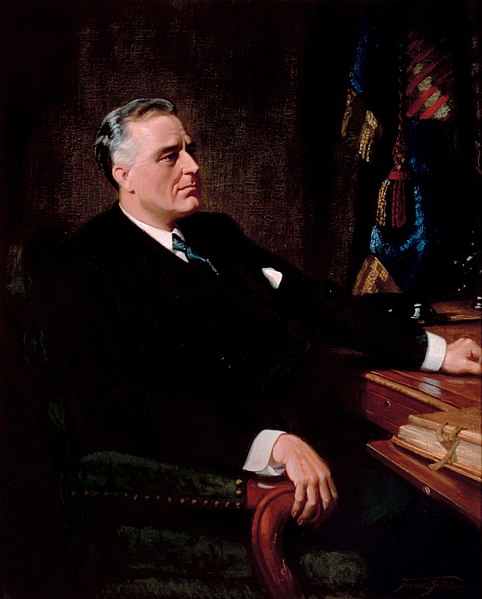
Official Presidential portrait of Franklin Delano Roosevelt. (Photo: Frank O. Salisbury

http://truth-out.org/opinion/item/14016-what-a-second-term-obama-can-learn-from-fdr 

All,

This article is equally important--and for the exact same reasons.  Please read carefully and pass the word...

 
Kofi

What a Second-Term Obama Can Learn From FDR
Saturday, 19 January 2013
By David Woolner, Next New Deal | Op-Ed


To achieve progress in his second term, President Obama must recognize that his opponents aren't really interested in a "grand bargain."

"My fellow countrymen. When four years ago we met to inaugurate a President, the Republic, single-minded in anxiety, stood in spirit here. We dedicated ourselves to the fulfillment of a vision—to speed the time when there would be for all the people that security and peace essential to the pursuit of happiness. We of the Republic pledged ourselves to drive from the temple of our ancient faith those who had profaned it; to end by action, tireless and unafraid, the stagnation and despair of that day. We did those first things first.

Our covenant with ourselves did not stop there. Instinctively we recognized a deeper need—the need to find through government the instrument of our united purpose to solve for the individual the ever-rising problems of a complex civilization… To do this we knew that we must find practical controls over blind economic forces and blindly selfish men. —Franklin D. Roosevelt, Second Inaugural Address, January 20, 1937

Just over three-quarters of a century ago, in his second inaugural address, Franklin Roosevelt, reflecting on the accomplishments of the New Deal in mitigating the worst effects of the Great Depression, noted that “the greatest change we have witnessed [over the past four years] has been the change in the moral climate in America.” Among “men of goodwill,” he went on, “science and democracy together offer an ever-richer life and ever-larger satisfaction to the individual. With this change in our moral climate and our rediscovered ability to improve our economic order, we have set our feet upon the road of enduring progress.”

FDR based this assumption on the idea that what had transpired over the course of his first term—a first term which brought us, among other things, Social Security, unemployment insurance, the right of workers to engage in collective bargaining, the separation of commercial and investment banking, the establishment of the Securities and Exchange Commission (SEC), the establishment of the Federal Deposit Insurance Corporation (FDIC), the largest single drop in the unemployment rate in the nation’s history to date, and an average annual economic growth rate of 14 percent—was directly tied to a new understanding of the role of government. This new understanding, he noted, was based on the “fulfillment of a [collective] vision…to speed the time when there would be for all the people that security and peace essential to the pursuit of happiness.”

Equally important, however, was FDR’s assertion that in arriving at this new vision of government the people understood that it was critical to find “practical controls over blind economic forces and blindly selfish men,” to recognize the “need to find through government the instrument of our united purpose to solve for the individual the ever-rising problems of a complex civilization.”

In essence, what FDR offered the American people was a new vision for the future. This new vision was based the fundamental idea that it was only the power of democratic government that could provide the means to counter “the blind economic forces” and “blindly selfish men” who had profaned democracy and brought the country to ruin in the dark days of the early 1930s.

There is much in this speech that still holds relevance for Americans today. In the massive loss of manufacturing jobs and the globalization of the world’s economy in the last few decades, we can see at work “the blind economic forces” of which FDR spoke. And in the wake of the 2008 financial crisis, the power of the “blindly selfish men” on Wall Street is all too familiar. So too—thanks to the onset of the Great Recession—is the anxiety, fear, and bewilderment that he noted plagued the American people on the eve of his first inaugural. What is missing, sadly, is the contravening narrative, the covenant that FDR made with the American people, the understanding that the reforms achieved in his first term had made the exercise of all power more democratic by bringing:


…private autocratic powers into their proper subordination to the public’s government. The legend that they were invincible—above and beyond the processes of a democracy—has been shattered. They have been challenged and beaten.


President Obama has for the most part shied away from the idea that the real challenge to our democracy stems not from the dysfunctional nature of Congress, but rather from the forces of wealth and privilege who see themselves as “above and beyond the process of democracy.” Rather than take on these forces directly, he speaks instead of asking the wealthy to “pay their fair share in taxes,” of building a consensus, of taking a “balanced approach,” of striking a “grand bargain” that would “make sure that middle-class folks aren’t bearing the entire burden and sacrifice when it comes to some of these big challenges.” In taking this approach, the president argues that he is following the will of the American people, who made it clear through his re-election that they want compromise and action. These may be noble sentiments, but they fall far short of expressing what the American people truly want from their president, which above all else is leadership.

The sad fact is that we now live in a society where the income disparity between the rich and the rest of us now stands at its worst level since the late 1920s—just before the onset of the Great Depression. The Congressional Budget Office, for example, recently reported that between 1979 and 2007 the top 1 percent of households doubled their share of pretax income while the bottom 80 percent of American households actually saw their share of income decline. In a similar study, a recent Census Bureau report notes that the average white male worker earns roughly the same hourly wage that he would have made in 1978, adjusted for inflation, while the average CEO’s pay has increased by roughly 600 percent.

As was the case in the 1920s, such a drastic mal-distribution of wealth is clearly not sustainable, as it makes it very hard for the average worker to sustain the level of purchases necessary to maintain our largely consumer-based economy. Hence, if we truly want to find a way to grow our economy—as the president insists he does—then we must find a way to address this critical structural imbalance in our economy. And this means real reform, the type of reforms we saw in the New Deal, reforms that brought about the birth of the post-1945 modern American middle class that now seems to be so rapidly disappearing.


So rather than beat about the bushes, President Obama might do well to recognize—as FDR did—that the forces of wealth and privilege weighted against him are not really interested in a compromise or a “grand bargain.” What they want is to maintain the economic and political status quo in what FDR once rightly called the “false belief” that happiness can only be achieved “in the mad chase of evanescent profits.”

To overcome these entrenched forces, President Obama will need to provide the country with much more than his somewhat vague efforts to meet the other side halfway. He must learn to recognize that above all else it is his responsibility to give voice to the common aspiration of the people and provide them with a vision for the future -- a vision that recognizes government’s fundamental responsibility to fashion a more just and equitable society, a vision based on the truism, as FDR said in his second inaugural, that:

"We have always known that heedless self-interest was bad morals; we know now that it is bad economics. Out of the collapse of a prosperity whose builders boasted their practicality has come the conviction that in the long run economic morality pays. We are beginning to wipe out the line that divides the practical from the ideal; and in so doing we are fashioning an instrument of unimagined power for the establishment of a morally better world."


This piece was reprinted by Truthout with permission or license. It may not be reproduced in any form without permission or license from the source.


David Woolner is a Senior Fellow and Hyde Park Resident Historian for the Roosevelt Institute, and associate professor of history at Marist College, in Poughkeepsie, New York. A specialist in Anglo-American relations and U.S. foreign and economic policy under Franklin D. Roosevelt, Dr. Woolner has delivered papers on FDR’s foreign and domestic policy in Canada, the United States, France, Russia, England, Wales, Ireland, Scotland and Korea.