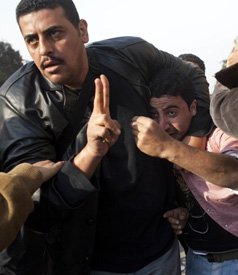
An anti-government protester holds a pro-Mubarak protester in a headlock on the edge of Tahrir Square in Cairo on Wednesday. Hours before the violence erupted in the square, antigovernment protesters had been chanting: “We are not going to go; we are not going to go.” (Photo: Scott Nelson / The New York Times)
http://www.truth-out.org/clashes-erupt-cairo-between-mubaraks-allies-and-foes67391
Clashes Erupt in Cairo Between Mubarak's Allies and Foes 02 February 2011 by Anthony Shadid, David D. Kirkpatrick and Kareem Fahim, The New York Times News Service | Report
An anti-government protester holds a pro-Mubarak protester in a headlock on the edge of Tahrir Square in Cairo on Wednesday. Hours before the violence erupted in the square, antigovernment protesters had been chanting: “We are not going to go; we are not going to go.” (Photo: Scott Nelson / The New York Times)
Cairo - President Obama’s calls for a rapid transition to a new order in Egypt seemed eclipsed on Wednesday as a choreographed surge of thousands of people chanting support for the Egyptian leader, Hosni Mubarak, fought running battles with a larger number of antigovernment protesters in and around Cairo’s Tahrir Square.
Both sides exchanges volleys of Molotov cocktails and rocks, while the military restricted itself mostly to guarding the Egyptian Museum and using water cannons to extinguish the flames.
The mayhem and chaos — with riders on horses and camels thundering through the central square — offered a complete contrast to the scenes only 24 hours earlier when hundreds of thousands of antigovernment protesters turned it into a place of jubilant celebration, believing that they were close to overthrowing a leader who has survived longer than any other in modern Egypt.
Also: Watch live coverage of the situation in Egypt from Al Jazeera.
Such was the nervousness across the Arab world, spreading from its traditional heart in Egypt, that the leader of Yemen offered on Wednesday to step down by 2013 and offered assurances his son would not succeed him — the latest in a series of autocratic leaders bending to the wave of anger engulfing the region.
Late on Tuesday, Mr. Mubarak himself offered to step down in September but that was not enough for the protesters — or for Mr. Obama and the European Union, who both urged speedier change. But those calls were later rebuffed by the Foreign Ministry, which released a statement over state news media saying that calls from “foreign parties” for an immediate political transition had been “rejected and aimed to incite the internal situation in Egypt.”
On Wednesday, the enduring standoff between Mr. Mubarak and his adversaries took an explosive and perilous turn, offreing further proof that Mr. Mubarak had no intention of exiting earlier than he had announced. Hours after a call from Egypt’s powerful military for the president’s opponents to “restore normal life,” thousands of men, some carrying fresh flags and newly printed signs supporting Mr. Mubarak, surged into Tahrir Square.
For several hours in the afternoon, from a base in Talaat Harb Square, northeast of Tahrir Square, pro-Mubarak supporters wielding rebar, knives, pliers, long sticks and even a meat cleaver surged towards the anti-government protesters, under cover of rocks thrown by their confederates in the rear and from a roof of a nearby building.
At regular intervals, men were carried away from the fight bleeding.
A red car and a motorcycle traveled to the front, by the historic Groppi’s café, and shuttled the injured men away to a makeshift medical clinic staffed by dozens of doctors. At about 4 p.m., agitated young men started throwing rocks at the windows of residents, without explanation. Men also threw rocks at the offices of an opposition figure, Ayman Nour, that overlooks the square.
A block away, at Champollion Street, a similar battle raged. Several people tried to stop two young men as they hauled a case of empty Pepsi bottles to their car and tore rags, apparently attempting to make Molotov cocktails. The young men brushed those efforts off.
Throughout the afternoon, the president’s supporters emerged in a throng dragging men, presumably from the other side, away. In one case, it was a man in a colorful sweater who was held by a large man who pressed a knife to his captive’s throat. Another time, a mob surrounded a terrified man with a long beard, as soldiers tried to intervene. “God is great!” yelled the man with the beard, as the mob pressed forward.
Some of the Mubarak supporters were working class men who arrived in buses. Some headed to the battle with their sticks or their knives stuffed in their pants. One was a doctor who wore spectacles and held a club wrapped in electrical tape and armored with tacks.
Some were men like Mohamed Hassan, an accountant, who had actually attended Tuesday’s antigovernment demonstration. “Of course we needed a change,” said Mr. Hassan, standing on the Corniche not from the Egyptian Museum. Mr. Mubarak’s speech to the nation had changed his mine. “I think all of our demands were filled. We need change, but step by step.”
Bystanders watched in shock and anger. One pointed to a bearded man calling people to prayer. "He did this to us," the man said. Another man, watching the battle in Talaat Harb, said: "Mubarak lit the world on fire." His friend told him to be quiet.
The pro-Mubarak forces were outnumbered by the protesters, who have spent nine days in the square insisting on his ouster. Clashes erupted close to the Egyptian Museum housing a huge trove of priceless antiquities.
There, the two sides traded volleys of rocks and engaged in hand-to-hand fighting. Many were led or carried away with bleeding head wounds. Antigovernment protesters organized themselves into groups, smashing chunks of concrete into smaller projectiles that they hurled at their adversaries. The violence was the most serious since the antigovernment protesters laid claim to Tahrir, or Liberation, Square days ago as they pursued what seemed to be a largely peaceful campaign for Mr. Mubarak’s ouster.
Hours before the violence erupted in the square, antigovernment protesters had been chanting: “We are not going to go; we are not going to go.”
In counterpoint, demonstrators supporting Mr. Mubarak chorused back: “He’s not going to go; he’s not going to go.” Some protesters reported that they had been approached with offers of 50 Egyptian pounds, about $8.50, to carry pro-Mubarak placards. “Fifty pounds for my country?” one woman said, in apparent disbelief.
But the mood changed as plumes of smoke, apparently from tear gas, rose above the rival crowds surging back and forth as the two sides fought for the upper hand.
“Where’s the Egyptian army?” antigovernment demonstrators chanted.
“They are trying to create chaos,” said Mohamed Ahmed, 30. “This is what Mubarak wants.”
The army took no immediate action as the skirmishes intensified, leaving the competing demonstrators to press toward one another. But troops with bayonets fixed to their AK-47 assault rifles fanned out near the museum as antigovernment protesters sought to build makeshift barricades to keep their foes at bay. And eventually, several tanks maneuvered into position between the two clashing crowds, and soldiers tried to calm both.
Some antigovernment protesters used the shelter of the tanks to launch rocks, and others said they believed their foes were agents of the authorities. At one point, they began calling for the soldiers to fire into the air to disperse their opponents.
Mohamed Gamil, a 30-year-old dentist in the crowd of antigovernment protesters, said their enemies wanted to “take the revolution from us.”
“Never, never, never,” he cried. “We are ready to die for the revolution.”
Pro-government demonstrators, too, vowed a fight to the end.
“With our blood, with our souls, we sacrifice for you, oh Mubarak,” some of the president’s supporters chanted, waving Egyptian flags. Among the pro-government demonstrators, 18 men on horseback and two on camels charged against their adversaries.
Signs that the pro-Mubarak forces were organized and possibly professional were rife. When the melee broke out, a group of them tried to corner a couple of journalists in an alley to halt their reporting. Their assaults on the protesters seemed to come in well timed waves.
A 25-year-old who had just completed his compulsory military duty, Islam Hessomen, denounced the violence. “A few thousand people throwing rocks at each other is destroying the peaceful revolution of millions,” he said. “Mubarak doesn’t deserve to be president anymore.”
Earlier, on state television, a military spokesman had asked the government’s foes: “Can we walk safely down the street? Can we go back to work regularly? Can we go out into the streets with our children to schools and universities? Can we open our stores, factories and clubs?”
“You are the ones able to restore normal life,” he said.
“Your message was received and we know your demands,” the spokesman said. “We are with you and for you.”
The army’s role and its ultimate game plan have remained opaque, with soldiers seeming to fraternize with protesters, without moving against the elite to which its officers belong. While the military has said it will not use force against peaceful protesters, the signs on Wednesday suggested that any gap between it and Mr. Mubarak was narrowing.
The announcement by a military spokesman appeared to be a call for demonstrators, who have turned out in hundreds of thousands in recent days, to leave the streets. It came as high-powered diplomacy between Cairo and Washington unfolded at a blistering pace and reverberations from the protest continue to rumble through the Arab world.
On Tuesday, after a 10-minute television address in which Mr. Mubarak pledged to step down within months, Mr. Obama strongly suggested that Mr. Mubarak’s concession was not enough, declaring that an “orderly transition must be meaningful, it must be peaceful, and it must begin now.”
While the meaning of the last phrase was deliberately vague, it appeared to be a signal that Mr. Mubarak might not be able to delay the shift to a new leadership.
On Wednesday, the White House released a statement saying the United States “deplores and condemns the violence that is taking place in Egypt.”
The statement, from the president’s spokesman, Robert Gibbs, added: “We are deeply concerned about attacks on the media and peaceful demonstrators. We repeat our strong call for restraint.”
In Tahrir Square, some pro-Mubarak supporters appeared genuinely convinced by his speech. At the same time, there were widespread, though uncorroborated, allegations that many of those supporters were paid government plants.
In a separate development, Internet access, denied for days by official restrictions, began to return.
Hundreds of pro-Mubarak protesters converged on a square in the upscale Mohandiseen neighborhood on Wednesday morning, many of them carrying identical signs and banners praising the Egyptian president. Others carried a gold-framed portrait of the president.
Messages sent to Egyptian cellphone users on Wednesday seemed intended to reinforce the official line. “Youth of Egypt beware of the rumors and listen to the voice of reason,” read one message. “Egypt is above all. Preserve it.”
The developments were part of a fast-moving sequence of events that could open a new and unpredictable chapter as Mr. Mubarak seeks to reclaim the initiative after days of protests that have turned the center of the capital into a huge and sometimes festive display of opposition that almost left Washington behind.
In a 30-minute phone call to Mr. Mubarak just before his public remarks late on Tuesday, Mr. Obama was more forceful in insisting on a rapid transition, according to officials familiar with the discussion.
Mr. Mubarak’s speech announcing he would step down came after his support from the powerful Egyptian military began to look uncertain and after American officials urged him not to run again for president.
But Mr. Mubarak’s offer fell short of the protesters’ demands for him to step down immediately and even face trial, and it could well inflame passions in an uprising that has rivaled some of the most epic moments in Egypt’s contemporary history. The protests have captivated a broader Arab world that saw a leader fall in Tunisia last month and growing protests against other American-backed governments.
Mr. Mubarak, 82, said he would remain in office until a presidential election in September and, in emotional terms, declared that he would never leave Egypt.
“The Hosni Mubarak who speaks to you today is proud of his achievements over the years in serving Egypt and its people,” he said, wearing a dark suit and seeming vigorous in the speech broadcast on state television. “This is my country. This is where I lived, I fought and defended its land, sovereignty and interests, and I will die on its soil.”
In Tahrir Square, crowds waved flags as the speech was televised on a screen in the square. “Leave!” they chanted, in what has become a refrain of the demonstrations.
“There is nothing now the president can do except step down and let go of power,” said Mohammed el-Beltagui, a leader of the Muslim Brotherhood, Egypt’s most powerful opposition group, which has entered into the fray with Mr. Mubarak. Those sentiments were echoed by other voices of the opposition, including Mohamed ElBaradei, a Nobel laureate, and Ayman Nour, a longtime dissident.
Reporting was contributed by Liam Stack from Cairo; Nicholas Kulish from Alexandria, Egypt; Alan Cowell from Paris; and David E. Sanger from Washington.
This article "Clashes Erupt in Cairo Between Mubarak’s Allies and Foes" originally appeared at The New York Times.
© 2010 The New York Times Company
Clashes Erupt in Cairo Between Mubarak's Allies and Foes 02 February 2011 by Anthony Shadid, David D. Kirkpatrick and Kareem Fahim, The New York Times News Service | Report
An anti-government protester holds a pro-Mubarak protester in a headlock on the edge of Tahrir Square in Cairo on Wednesday. Hours before the violence erupted in the square, antigovernment protesters had been chanting: “We are not going to go; we are not going to go.” (Photo: Scott Nelson / The New York Times)
Cairo - President Obama’s calls for a rapid transition to a new order in Egypt seemed eclipsed on Wednesday as a choreographed surge of thousands of people chanting support for the Egyptian leader, Hosni Mubarak, fought running battles with a larger number of antigovernment protesters in and around Cairo’s Tahrir Square.
Both sides exchanges volleys of Molotov cocktails and rocks, while the military restricted itself mostly to guarding the Egyptian Museum and using water cannons to extinguish the flames.
The mayhem and chaos — with riders on horses and camels thundering through the central square — offered a complete contrast to the scenes only 24 hours earlier when hundreds of thousands of antigovernment protesters turned it into a place of jubilant celebration, believing that they were close to overthrowing a leader who has survived longer than any other in modern Egypt.
Also: Watch live coverage of the situation in Egypt from Al Jazeera.
Such was the nervousness across the Arab world, spreading from its traditional heart in Egypt, that the leader of Yemen offered on Wednesday to step down by 2013 and offered assurances his son would not succeed him — the latest in a series of autocratic leaders bending to the wave of anger engulfing the region.
Late on Tuesday, Mr. Mubarak himself offered to step down in September but that was not enough for the protesters — or for Mr. Obama and the European Union, who both urged speedier change. But those calls were later rebuffed by the Foreign Ministry, which released a statement over state news media saying that calls from “foreign parties” for an immediate political transition had been “rejected and aimed to incite the internal situation in Egypt.”
On Wednesday, the enduring standoff between Mr. Mubarak and his adversaries took an explosive and perilous turn, offreing further proof that Mr. Mubarak had no intention of exiting earlier than he had announced. Hours after a call from Egypt’s powerful military for the president’s opponents to “restore normal life,” thousands of men, some carrying fresh flags and newly printed signs supporting Mr. Mubarak, surged into Tahrir Square.
For several hours in the afternoon, from a base in Talaat Harb Square, northeast of Tahrir Square, pro-Mubarak supporters wielding rebar, knives, pliers, long sticks and even a meat cleaver surged towards the anti-government protesters, under cover of rocks thrown by their confederates in the rear and from a roof of a nearby building.
At regular intervals, men were carried away from the fight bleeding.
A red car and a motorcycle traveled to the front, by the historic Groppi’s café, and shuttled the injured men away to a makeshift medical clinic staffed by dozens of doctors. At about 4 p.m., agitated young men started throwing rocks at the windows of residents, without explanation. Men also threw rocks at the offices of an opposition figure, Ayman Nour, that overlooks the square.
A block away, at Champollion Street, a similar battle raged. Several people tried to stop two young men as they hauled a case of empty Pepsi bottles to their car and tore rags, apparently attempting to make Molotov cocktails. The young men brushed those efforts off.
Throughout the afternoon, the president’s supporters emerged in a throng dragging men, presumably from the other side, away. In one case, it was a man in a colorful sweater who was held by a large man who pressed a knife to his captive’s throat. Another time, a mob surrounded a terrified man with a long beard, as soldiers tried to intervene. “God is great!” yelled the man with the beard, as the mob pressed forward.
Some of the Mubarak supporters were working class men who arrived in buses. Some headed to the battle with their sticks or their knives stuffed in their pants. One was a doctor who wore spectacles and held a club wrapped in electrical tape and armored with tacks.
Some were men like Mohamed Hassan, an accountant, who had actually attended Tuesday’s antigovernment demonstration. “Of course we needed a change,” said Mr. Hassan, standing on the Corniche not from the Egyptian Museum. Mr. Mubarak’s speech to the nation had changed his mine. “I think all of our demands were filled. We need change, but step by step.”
Bystanders watched in shock and anger. One pointed to a bearded man calling people to prayer. "He did this to us," the man said. Another man, watching the battle in Talaat Harb, said: "Mubarak lit the world on fire." His friend told him to be quiet.
The pro-Mubarak forces were outnumbered by the protesters, who have spent nine days in the square insisting on his ouster. Clashes erupted close to the Egyptian Museum housing a huge trove of priceless antiquities.
There, the two sides traded volleys of rocks and engaged in hand-to-hand fighting. Many were led or carried away with bleeding head wounds. Antigovernment protesters organized themselves into groups, smashing chunks of concrete into smaller projectiles that they hurled at their adversaries. The violence was the most serious since the antigovernment protesters laid claim to Tahrir, or Liberation, Square days ago as they pursued what seemed to be a largely peaceful campaign for Mr. Mubarak’s ouster.
Hours before the violence erupted in the square, antigovernment protesters had been chanting: “We are not going to go; we are not going to go.”
In counterpoint, demonstrators supporting Mr. Mubarak chorused back: “He’s not going to go; he’s not going to go.” Some protesters reported that they had been approached with offers of 50 Egyptian pounds, about $8.50, to carry pro-Mubarak placards. “Fifty pounds for my country?” one woman said, in apparent disbelief.
But the mood changed as plumes of smoke, apparently from tear gas, rose above the rival crowds surging back and forth as the two sides fought for the upper hand.
“Where’s the Egyptian army?” antigovernment demonstrators chanted.
“They are trying to create chaos,” said Mohamed Ahmed, 30. “This is what Mubarak wants.”
The army took no immediate action as the skirmishes intensified, leaving the competing demonstrators to press toward one another. But troops with bayonets fixed to their AK-47 assault rifles fanned out near the museum as antigovernment protesters sought to build makeshift barricades to keep their foes at bay. And eventually, several tanks maneuvered into position between the two clashing crowds, and soldiers tried to calm both.
Some antigovernment protesters used the shelter of the tanks to launch rocks, and others said they believed their foes were agents of the authorities. At one point, they began calling for the soldiers to fire into the air to disperse their opponents.
Mohamed Gamil, a 30-year-old dentist in the crowd of antigovernment protesters, said their enemies wanted to “take the revolution from us.”
“Never, never, never,” he cried. “We are ready to die for the revolution.”
Pro-government demonstrators, too, vowed a fight to the end.
“With our blood, with our souls, we sacrifice for you, oh Mubarak,” some of the president’s supporters chanted, waving Egyptian flags. Among the pro-government demonstrators, 18 men on horseback and two on camels charged against their adversaries.
Signs that the pro-Mubarak forces were organized and possibly professional were rife. When the melee broke out, a group of them tried to corner a couple of journalists in an alley to halt their reporting. Their assaults on the protesters seemed to come in well timed waves.
A 25-year-old who had just completed his compulsory military duty, Islam Hessomen, denounced the violence. “A few thousand people throwing rocks at each other is destroying the peaceful revolution of millions,” he said. “Mubarak doesn’t deserve to be president anymore.”
Earlier, on state television, a military spokesman had asked the government’s foes: “Can we walk safely down the street? Can we go back to work regularly? Can we go out into the streets with our children to schools and universities? Can we open our stores, factories and clubs?”
“You are the ones able to restore normal life,” he said.
“Your message was received and we know your demands,” the spokesman said. “We are with you and for you.”
The army’s role and its ultimate game plan have remained opaque, with soldiers seeming to fraternize with protesters, without moving against the elite to which its officers belong. While the military has said it will not use force against peaceful protesters, the signs on Wednesday suggested that any gap between it and Mr. Mubarak was narrowing.
The announcement by a military spokesman appeared to be a call for demonstrators, who have turned out in hundreds of thousands in recent days, to leave the streets. It came as high-powered diplomacy between Cairo and Washington unfolded at a blistering pace and reverberations from the protest continue to rumble through the Arab world.
On Tuesday, after a 10-minute television address in which Mr. Mubarak pledged to step down within months, Mr. Obama strongly suggested that Mr. Mubarak’s concession was not enough, declaring that an “orderly transition must be meaningful, it must be peaceful, and it must begin now.”
While the meaning of the last phrase was deliberately vague, it appeared to be a signal that Mr. Mubarak might not be able to delay the shift to a new leadership.
On Wednesday, the White House released a statement saying the United States “deplores and condemns the violence that is taking place in Egypt.”
The statement, from the president’s spokesman, Robert Gibbs, added: “We are deeply concerned about attacks on the media and peaceful demonstrators. We repeat our strong call for restraint.”
In Tahrir Square, some pro-Mubarak supporters appeared genuinely convinced by his speech. At the same time, there were widespread, though uncorroborated, allegations that many of those supporters were paid government plants.
In a separate development, Internet access, denied for days by official restrictions, began to return.
Hundreds of pro-Mubarak protesters converged on a square in the upscale Mohandiseen neighborhood on Wednesday morning, many of them carrying identical signs and banners praising the Egyptian president. Others carried a gold-framed portrait of the president.
Messages sent to Egyptian cellphone users on Wednesday seemed intended to reinforce the official line. “Youth of Egypt beware of the rumors and listen to the voice of reason,” read one message. “Egypt is above all. Preserve it.”
The developments were part of a fast-moving sequence of events that could open a new and unpredictable chapter as Mr. Mubarak seeks to reclaim the initiative after days of protests that have turned the center of the capital into a huge and sometimes festive display of opposition that almost left Washington behind.
In a 30-minute phone call to Mr. Mubarak just before his public remarks late on Tuesday, Mr. Obama was more forceful in insisting on a rapid transition, according to officials familiar with the discussion.
Mr. Mubarak’s speech announcing he would step down came after his support from the powerful Egyptian military began to look uncertain and after American officials urged him not to run again for president.
But Mr. Mubarak’s offer fell short of the protesters’ demands for him to step down immediately and even face trial, and it could well inflame passions in an uprising that has rivaled some of the most epic moments in Egypt’s contemporary history. The protests have captivated a broader Arab world that saw a leader fall in Tunisia last month and growing protests against other American-backed governments.
Mr. Mubarak, 82, said he would remain in office until a presidential election in September and, in emotional terms, declared that he would never leave Egypt.
“The Hosni Mubarak who speaks to you today is proud of his achievements over the years in serving Egypt and its people,” he said, wearing a dark suit and seeming vigorous in the speech broadcast on state television. “This is my country. This is where I lived, I fought and defended its land, sovereignty and interests, and I will die on its soil.”
In Tahrir Square, crowds waved flags as the speech was televised on a screen in the square. “Leave!” they chanted, in what has become a refrain of the demonstrations.
“There is nothing now the president can do except step down and let go of power,” said Mohammed el-Beltagui, a leader of the Muslim Brotherhood, Egypt’s most powerful opposition group, which has entered into the fray with Mr. Mubarak. Those sentiments were echoed by other voices of the opposition, including Mohamed ElBaradei, a Nobel laureate, and Ayman Nour, a longtime dissident.
Reporting was contributed by Liam Stack from Cairo; Nicholas Kulish from Alexandria, Egypt; Alan Cowell from Paris; and David E. Sanger from Washington.
This article "Clashes Erupt in Cairo Between Mubarak’s Allies and Foes" originally appeared at The New York Times.
© 2010 The New York Times Company