Showing posts with label Social revolution. Show all posts

Tuesday, November 21, 2023

The Transformative Power of African American History in the United States

A BRAND NEW BAG:  How African Americans Revolutionized U.S. Culture And Changed the World 1955-1975 (excerpt)


by Kofi Natambu

The Panopticon Review 


© November, 2023 
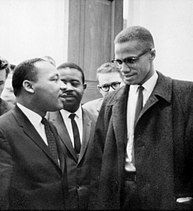
 

Dr. Martin Luther King (1929-1968), Jr. and Malcolm X (1925-1965) following  King's press conference at the U.S. Capitol about the Senate debate on the Civil Rights Act of 1964.  Photo taken on March 26, 1964.  It was the only time these two giants met in person.
 
"Every generation, out of relative obscurity, must discover its mission, fulfill it or betray it."


--Frantz Fanon (1925-1961)

"Of all our studies history is best qualified to reward our research"
--Malcolm X  (1925-1965)
 
THE REVOLUTION BEGINS (AGAIN):  1955-1965                
For an entire century prior to the mid-1950s an extraordinary number of black political and cultural activists, intellectuals and writers, musicians and composers, visual artists and athletes, entertainers and workers waged an intense, unrelenting, and bitterly fought public battle for political, economic, and human rights, cultural autonomy, and social respect and recognition in a highly segregated, ruthlessly capitalist, and profoundly racist nation that actively resisted this movement through a pervasive and deeply entrenched apartheid system that legally sanctioned and promoted racial discrimination, oppression, exploitation, censorship, and exclusion in every area of U.S. life, society, and culture. The post-slavery era after emancipation in 1863 was marked by the pervasive denial of voting rights, brutal economic peonage and exploitation of black workers, widespread and extreme forms of overt physical violence by white mobs (i.e. lynchings, beatings, arbitrary imprisonment, rapes, assaults, assassinations, bombings, arson, shootings, etc.) against black people in general, and a distinctly separate and highly unequal social, educational, and economic structure that gave not only white elites but whites in general great punitive power and control over the national black population. Thus in employment, education, health care, housing, access to public institutions and facilities, and the equal opportunity to compete for jobs, wages, and the distribution of resources (as well as enforced legal protections against discrimination and exclusion), African Americans were forced to endure immense suffering, repression, and neglect for many generations after slavery officially ended in January, 1863. Most of these imposed structural, institutional, systemic, and ideological restrictions on the freedom, mobility, and self determination of African Americans lasted well into the 1960s, and of course, many of them are still very prevalent and intact today.

It was this ongoing historical reality that such major and legendary black political and cultural figures as Sojourner Truth (1797-1883) Frederick Douglas (1818-1895), Harriet Tubman (1822-1913), W.E.B. DuBois (1868-1963), Ida B. Wells-Barnett (1862-1931), William Monroe Trotter (1972-1934), Paul Robeson (1898-1976), A. Philip Randolph (1889-1979), Langston Hughes (1902-1967), Zora Neale Hurston (1891-1960), James Weldon Johnson (1871-1938), Richard Wright (1908-1960), Louis Armstrong (1901-1970), Duke Ellington (1899-1974), Bessie Smith (1898-1937) and Billie Holiday (1915-1959) among many others sought eloquently and forcefully to confront and defeat through their tremendous interventions in the general political, social, and cultural life of the nation in the period from the mid 1850s to the mid 1950s. It is this extraordinary legacy that serves as the bedrock historical foundation of the revolutionary movement of African Americans during the mid and late 20th century, and deeply influences the very form and content of what intellectuals, artists, and activists were able to achieve in the crucial historical period of 1955-1975 that is the focus of this study.

1955 marks a major watershed in African American, and thus American, history. It is also significant as a beginning of this modern development in African American thought, art, and activism because that year marked the start of a dramatic collective response of black people in the U.S. to the deeply frustrating limitations and repressions of the late 1940s and early 1950s period when, after a million black soldiers fought against fascism in the name of the United States in the Jim Crow segregated armed forces during WWII (1942-1945) for “democracy and freedom” abroad in Europe and Asia, found themselves still being denied fundamental human and democratic rights in their own country in the immediate postwar era. This virulent racism, coupled with the deadly specter of McCarthyism (1947-1965) in American politics and public policy against all forms of mass-based democratic liberal and radical reform activity as well as all socialist and communist revolutionary movements for freedom, justice, peace, and equality in the United States resulted in millions of African Americans still being widely subjected to the horrific, cruel, and deadly absurdities of racial oppression.

Thus it was in the period from 1955-1965 that a massive amount of intellectual, physical, cultural, and spiritual energy was expended by a forceful and insistent new generation—actually two generations--of African Americans (largely born between 1915-1945) on behalf of a radical updating and expansion of the movements and activities of the previous century of African American intellectuals, activists, and artists. The “New Negroes” of this period often embodied and openly expressed a widely diverse consensus of philosophy, artistry, and social-political thought and behavior that was highly innovative, original, and daring in its approach to questions, problems, and challenges facing the United States in general, and the African American people in particular. What’s noteworthy about the emergence of this new generation of individuals is the fact that they came from widely different class backgrounds and geographical regions yet still shared a cultural sensibility and social consciousness that actively sought to challenge the status quo in politics and art. It is this insistent demand for radical social, ideological, and aesthetic change that unites these historical contemporaries, and serves as the foundation for their stunning interventions in American society and culture. It was not surprising given these general concerns and realities that the period from 1955-1975 eventually proved to be one of the most dynamic, volatile, and radical eras in the history of the United States. This is the narrative that I will examine and tell in this book.

Part I: Who Are These People?: 
 “The New Breed” Demands a Change

In 1955 political, cultural, and social life in the United States was on the surface very staid, conservative, and white. Mass cultural conformity and various forms of social repression were widespread and strictly enforced throughout the nation. White supremacy, sexism, homophobia, censorship, and hegemonic ruling class coercion and domination were common and largely accepted or at least not opposed by millions of Americans. Black people were especially held in contempt and patronizing indifference by millions of white Americans, and though such traditional national civil rights organizations as the NAACP (founded in 1909), CORE (Congress of Racial Equality founded in 1942), and the Urban League (founded in 1913) had made limited progress in their various national and local campaigns for legal, constitutional, social, and economic reforms, it was clear to everyone concerned both in and outside of the movement that these efforts, while necessary, were not sufficient. Neither were the primarily moral and ethical appeals of such nonviolent Ghandian-influenced organizations as Dr. Martin Luther King, Jr.’s SCLC (Southern Christian Leadership Conference) formed in 1957 or even the separatist black religious and cultural nationalist doctrines, values, and programs of such alternative organizations as Elijah Muhammad’s NOI (Nation of Islam) whose position in the 1950s and early ‘60s was being largely represented and enunciated by its National Minister, Malcolm X, via Muhammad. Many black people during this period were also rapidly becoming involved in trying to either augment, or even in some instances replace, these various ideological and institutional groups with even broader and more secularly militant/radical forms of social theory and activism.

In the cultural and aesthetic sphere such major African American popular artforms as Jazz, Blues, Rhythm & Blues, and Rock and Roll, as well as independent black innovations in literature (fiction, poetry, and the essay), musical and dramatic theatre, dance, comedy, painting, and sports were continuing to make astonishingly rich and creative contributions to modern art throughout the world, and were often at the forefront of the general African American revolution in the U.S. in the period under examination here. Such major iconic artistic figures as Miles Davis (1926-1991), John Coltrane (1926-1967), Chuck Berry (1926-2019), James Brown (1933-2006), Charles Mingus (1922-1979), Sarah Vaughn (1924-1990), Bud Powell (1924-1966), Max Roach (1924-2007), Art Blakey (1919-1990), Dizzy Gillespie (1917-1993), Ella Fitzgerald (1917-1996), Nat King Cole (1919-1965), Sam Cooke (1931-1964), Dexter Gordon (1923-1990), B.B. King (1925- ), Etta James (1938-2012), Otis Blackwell (1930-2002), Eric Dolphy (1928-1964), Little Richard (1932- ), Chester Himes (1908-1984), Leroi Jones/Amiri Baraka (1934- ), Marvin Gaye (1939-1984), Jacob Lawrence (1917-2000), Toni Morrison (1931-2019), Nina Simone (1933-2003), Ishmael Reed (1938- ) Gwendolyn Brooks (1917-2000), Bob Kaufman (1925-1986), Sammy Davis, Jr. (1925-1990), John Lee Hooker (1917-2000), Romare Bearden (1913-), and Muddy Waters (1915-1987), among many others, constitute a genuine revolutionary vanguard of American artists for the mid and late 20th century.

It was in this electrifying and dangerous climate and context of great social and cultural change and conflict that this era (1955-1960) began. Despite the oppressively rigid and severely glacial surfaces dominating American life large cracks and fissures were already beginning to take place just beneath this façade. It’s highly significant to note, for example, that an obscure 25 year old black middle-class Baptist minister from Atlanta, Georgia (with a newly earned Ph.D in philosophy and theology from Boston University), had begun his public ministry in a small Christian church in Atlanta inherited from his father (also a preacher) at almost the exact same time that a poor, equally obscure black 29 year old ex-convict from Lansing, Michigan (and later Boston, Massachusetts), had, after serving a six and a half year sentence for burglary, began working in 1952 as a member and then minister of a Muslim sect in the U.S. known as the Nation of Islam (NOI). After being appointed minister of the largest mosque in the NOI in Harlem, NY in August, 1954, he had quickly emerged as a major leader within the national hierarchy of the organization. These two individuals were completely unaware of each other and were completely unknown to the rest of the country at the beginning of 1955. By the end of the year, however, both Dr. Martin Luther King, Jr. and Malcolm X would be nationally, and in King’s case, internationally famous.

In March of 1955 a legendary 34 year old black jazz musician and composer would die and be immediately catapulted into mythological cultural status. By the end of year an entire new generation of black musicians, singers, and composers who had already been heavily influenced by, and revered this individual, would also be aggressively extending and expanding his musical legacy on a global scale. His name: Charles Christopher Parker, Jr., better known as “Bird.” Two then obscure 28 year old musicians and composers from St. Louis, Illinois, and High Point, North Carolina (later Philadelphia), one of whom had been a member of one of the late master’s groups, and the other who based a large part of his aesthetic, technical, and expressive style on this same person’s enormous contribution, went on to join forces in 1955 in an ensemble whose sound and style revolutionized American music during this period and for all time. Within a year the leader of this group (Miles Davis) would become world famous, and his partner, collaborator, and colleague (John Coltrane) would also quickly follow within three years with a group of his own that would have an equally influential and powerful international impact.

However it was a horrific racially-charged incident on August 27, 1955 that would further shock and enrage black people in the U.S. and be seen by many both then and later as a pivotal historical moment that embodied the zeitgeist of the era. The incident would also serve as a major galvanizing force for the modern civil rights movement and this new generation to aggressively assert itself in the nation at large. What precipated this dramatic turn of events was the vicious murder of a fourteen year old black male by two white adult men. The young boy was from Chicago and was on his summer vacation visiting his relatives in Money, Mississippi. Accused of whistling at a 21 year old white woman at a local grocery store near his uncle’s home, the adolescent was then brutally kidnapped by the husband of the woman and his friend on the evening of August 24. Till was forcibly abducted from his uncle’s home and driven out into the country by the white men who made Till strip naked, beat him severely, shot him in the head, mutilated him, and then attached a cotton gin fan to his nude body so that it would sink to the bottom of the Tallahatchie River. The badly bloated and decomposed body was found three days later disfigured beyond recognition.

Till’s mother came to Mississippi to identify her murdered son and return him to Chicago for funeral services and burial and found the hideously disfigured corspe unrecognizable except for a ring that she had given her son before he left for his visit. Incensed and distraught that her child had been the victim of a such a savage racist act, Mrs. Till insisted that her son’s casket remain open at the funeral so that “the whole world can see what they did to my son.” Thousands of blacks attended the funeral, and the story caused a sensation in the national black community in the U.S. where deeply disturbing photos of the ravaged corspe were published in the black and white press (especially in an issue of the highly popular black weekly magazine Jet). The murder and subsequent trial and verdict were also headline news all over the globe as an international readership condemned and denounced the U.S. for its ongoing tradition of racist terror. Meanwhile a rapid, unjust trial was held in Mississippi where the two men were quickly acquited by an openly racist all white male jury. Just as they had done in thousands of previous lynch cases involving the brutal arbitrary murders of blacks by whites throughout Mississippi’s extremely bloody racial history, the white Judge, the jury, the two acquited men, as well as the white wife of one of the two men all publically maintained that Till “deserved” his fate, and that black people in general (and in particular black boys and men) had better “know their place” and continue to stay well inside the rigid boundary lines of segregation.

The shockwave of this event, coupled with the ongoing protests throughout the country calling for voting rights, social and economic equality, democratic reforms, and the end of instutionalized racial segregattion in all areas of American life inaugurated a new generation of African Americans in the historical struggle for revolutionary changes in the society and culture, and this generation (known by many as the “new breed”) was more than up to the task.

The national and international outrage generated by the verdict in the Till case (and of course many other similar incidents of the era) had immediate repercussions throughout the entire black (diasporic) world. It was certainly no coincidence that at precisely the historical moment when African Americans were aggressively asserting themselves in the United States, the citadel of white supremacy in the West, continental Africans and those of African descent in the Caribbean and South America were simultaneously engaged in fierce battles of their own against European imperialism for national liberation and independence. These intense political, economic, cultural, and ideological struggles against French, British, Portuguese, Dutch, and Belgian colonialism in countries like Ghana, Jamaica, Nigeria, Trinidad, Algeria, Kenya, Guyana, Tanzania, Martinique, Senegal, and Barbadoes, among many other newly emerging black nation-states, were instrumental in the extraordinary explosion of radical social, political, and cultural consciousness, organization, and activity that characterized the period.

Thus, the same fierce demands for justice, freedom, and social/economic change that served as the motor force of the nascent modern Civil Rights movement in the United States and spurred the determination of the ‘New Breed’ to insist on a new social and political agenda with respect to “racial matters”, were echoed and openly supported by blacks outside North America who saw their own national struggles and concerns as an integral part of what their brothers and sisters in the U.S. were doing. The international linkages that were advocated and established during the late ‘50s and early ‘60s by such central figures from Africa and the Caribbean as the psychiatrist, political theorist, and revolutionary activist Frantz Fanon (Martinique), the Pan-Africanist and President of Ghana Kwame Nkrumah, the radical political leader and President of Egypt, Gamel Nasser, poet, social critic, and activist Aime Cesaire (also from Martinique), political philosopher and President of Tanzania, Julius Nyerere, the political theorist, philosopher, writer, and activist leader C.L.R. James from Trinidad, and the legendary revolutionary political activist and leader from South Africa, Nelson Mandela, among many others, were crucial to educating and organizing thousands of black people throughout the world to combat oppression and transform their lives. Not insignificantly African American activists like Malcolm X, and later Bob Moses, Stokely Carmichael, and James Foreman spent substantial time abroad in Africa during the 1960s and ‘70s prosletyzing on behalf of radical ideological and cultural alternatives to Western forms of colonization.

Another major development of the late fifties period involved the rise of black visual artists, dancers, athletes, singers and songwriters to major mainstream status (if not immediate recognition). The profound aesthetic contributions of these artists led to a massive seismic shift in the form and content of American popular culture and signaled the arrival of new, original conceptions of what could be expressed and achieved in these fields. The rapid emergence and pervasive acceptance of the popular musical expressions known as “Rock and Roll” and “Rhythm & Blues” were largely due to the major musical and lyrical innovations of such legendary black musical figures as Louis Jordan, Chuck Berry, Jackie Wilson, Ray Charles, Charles Brown, Amos Milburn, Etta James, Wynonie Harris, Charles Brown, Otis Blackwell, Bo Diddley, James Brown, and Little Richard who from 1945-1965 essentially invented (and reinvented) these forms, despite the white media’s stubbornly erroneous, brazenly false, and egregiously racist insistence during the late fifties and early sixties (and beyond) that white artists like Elvis Presley, Jerry Lee Lewis, Carl Perkins, Roy Orbison (and later the Beatles and Rolling Stones) were primarily responsible for the music’s existence and evolution.

In painting, dance, and sports African Americans like Romare Bearden, Jacob Lawrence, Charles White, Elizabeth Catlett, Emma Amos, Augusta Savage, Ed Clark, Sam Gilliam, Richard Hunt, Betye Saar, Norman Lewis, Gordon Parks, Roy DeCarava, Lois Mailou Jones, Bob Thompson, Alvin Ailey, Bill Russell, Jim Brown, Muhammad Ali, Kareem Abdul Jabbar, Willie Mays, Hank Aaron, Wilt Chamberlain, Elgin Baylor, Oscar Robertson, Althea Gibson, Wilma Rudolph, Bob Gibson, Bob Hayes, Maury Wills, and Lou Brock brought a startlingly new and dynamic sensibility to the arts of movement, gesture, and visual style that emphasized a highly refined, precise, and nuanced use of speed, mobility, grace, crative expressiveness, and power in their work and expressions. These elements were also evident in the independently unique personalities of these individuals which were often characterized by great dignity, poise, intelligence, discipline, and elegance...(to be continued)...

Tuesday, March 31, 2015

In Celebration of the 50th Anniversary of the Black Arts Movement (BAM) And Its Ongoing Social, Cultural, and Aesthetic Legacies

All,

5O YEARS AGO ON MARCH 28, 1965 the Black Arts Movement (BAM) was officially launched in Harlem, NYC by a legendary benefit concert on behalf of the newly formed Black Arts Repertory Theater and School (BART/S) which was founded and led by the renowned poet, playwright, essayist, novelist, critic, public intellectual, teacher, and revolutionary activist, Leroi Jones (later Amiri Baraka), who along with an extraordinary group of like minded writers, scholars, musicians, visual artists, dancers, actors, critics, teachers, and activists called for a new cultural revolutionary corollary to the emerging national Black Power movement.

What emerged in this groundbreaking concert and recording entitled THE NEW WAVE IN JAZZ (Impulse, 1965) was a gathering of many of the most important and profound musical innovators, artists, and progressive black 'avant garde' figures in the United States during that tumultuous and radical era including such major and already legendary/iconic artists as John Coltrane, Albert Ayler, and Sun Ra.

Despite its many political, aesthetic, and cultural detractors and opponents (and its own various internal contradictions) BAM went on to become one of the most intellectually and socially significant (and influential) literary movements of the 20th century. As its undeniably rich historical and ongoing creative legacy readily attests the rest is indeed, history...BAM Lives!

Kofi

https://eng351wi2011finalproject.wordpress.com/…/the-black…/

African-American Literary History
Key Themes and Genealogies
Major Authors, Genres, and Literary Movements
Genealogies of African-American Literature


The Black Arts Movement
by Michele Docherty


From 1964 to the early 1970s, “a burst of artistic activity embraced and embodied the goal of African-Americans being able to define themselves as people with a common heritage separate from and equal to white America. The ‘spiritual sister’ of black power, according to its leading theorist, Larry Neal, the Black Arts Movement included the poetry, plays, and prose of Amiri Baraka, Nikki Giovanni, Haki Madhubuti, Ed Bullins, A.B. Spellman, Sonia Sanchez, and Ishmael Reed” (Anderson 97).

Time Magazine describes the Black Arts Movement as the “single most controversial moment in the history of African-American literature– possibly in American literature as a whole” (Absolute Astronomy). This movement has been said to be “one of the most important times in African-American literature and had inspired black people to establish their own publishing houses, magazines, journals and art institutions. It also led to the creation of African-American Studies programs within universities” (Absolute Astronomy).

In March 1965, following the February 21st assassination of Malcolm X, Amiri Baraka moved from Manhattan’s Lower East Side uptown to Harlem, and this was where he started the Black Arts Movement. The Black Arts Movement, usually referred to as the “sixties” movement, came together in 1965 and broke apart around 1975 or 1976 (Absolute Astronomy).

“Although Baraka’s 1965 move uptown to establish the Black Arts Repertory Theatre/School (BARTS) is considered the formal beginning, the Black Arts Movement grew out of a changing political and cultural climate in which black artists attempted to make a place for themselves amidst remaining ideologies of the Cold War, decolonization, and the civil rights movement” (Absolute Astronomy). “Black artists and intellectuals like Baraka” made it their goal to “reject older political, cultural, and artistic traditions. Other well-known writers that were involved with this movement included Maya Angelou, Hoyt W. Fuller, and Rosa Grey” (Wikipedia).

Writers frequently identified the “rhythms of a vernacular oral tradition as the key ingredient in black art, a feature they analyzed and inserted in verse, texts, sermons, music, and speech” (Anderson 97). Many artists hoped that this trait would be a key way to have communication with the masses (Anderson 98). In his well-known 1968 essay, “The Black Arts Movement,” Larry Neal attests, “When we speak of a ‘black aesthetic’ several things are meant. First, we assume that there is already in existence the basis for such an aesthetic. Essentially, it consists of an African-American cultural tradition. But this aesthetic is finally, by implication, broader than that tradition. It encompasses most of the usable elements of the Third World culture. The motive behind the Black aesthetic is the destruction of the white thing, the destruction of white ideas, and white ways of looking at the world” (Neal 2040).

As I mentioned before, the movement lasted for about a decade, through the mid-1960s and into the 1970s. This was a period of “controversy and change in the world of literature. One major change came through the portrayal of new ethnic voices in the United States” because “literature, prior to the Black Arts Movement,” had been dominated by white authors (Absolute Astronomy). “According to the Academy of American poets, ‘many writers–Native Americans, Latinos, gays and lesbians, and younger generations of African Americans have acknowledged their debt to the Black Arts movement'” (Wikipedia).

“African-Americans became a greater presence not only in the field of literature, but in all areas of the arts” (Absolute Astronomy). The two “hallmarks” of “Black Arts activity were the development of black theater groups and black poetry performances and journals”; both “had close ties to community organizations and issues” (Salaaam). “Black theaters served as the focus of poetry, dance, and music performances in addition to formal and ritual drama. The theaters were also venues for community meetings, lectures, study groups, and film screenings” (Salaam).

Through various forms of media, “African-Americans were able to educate others about the expression of cultural differences and viewpoints. In particular, black poetry readings allowed African-Americans to use vernacular dialogues. These performances were used to express political slogans and as a tool for organization” (Absolute Astronomy). “Theater performances were also used to convey community issues and organizations. The theaters, as well as cultural centers, were based throughout America and were used for community meetings, study groups and film screenings. Newspapers were a major tool in spreading the Black Arts Movement. In 1964, Black Dialogue was published making it the first major Arts movement publication” (Absolute Astronomy).

The Black Arts Movement, although it had lasted roughly a decade, is consdered just a short time in history that has become an essential topic of the United States. “It spurred political activism and use of speech throughout every African-American community. It allowed African-Americans the chance to express their voices in the mass media as well as becoming involved in communities” (Wikipedia). It can be argued that “the Black Arts movement produced some of the most exciting poetry, drama, dance, music, visual art, and fiction of the post-World War II United States” and that many important “post-Black artists” such as “Toni Morrison, Ntzoake Shange, Alice Walker, and August Wilson were shaped by the movement” (Wikipedia).

Annotated Bibliography

Anderson, Iain. This Is Our Music: Free Jazz, the Sixties, and American Culture. Philadelphia: University of Pennsylvania, 2007. Print. This book takes you back to the moment between the Fifties and the Sixties when jazz was taking root in major cities. Anderson meets the challenge posed by the music and follows its lead into the complex political realignments, shifting racial dynamics, and redefintion of art and entertainment that characterized the subsequent decade.

Krasner, David, ed. A Companion to Twentieth-Century American Drama. Malden, MA: Blackwell, 2005. Print. This volume balances studies of leading dramatists with discussion of previously marginalized playwrights. The contributors examine the movements and themes that framed these playwrights’ work, such as the Harlem Renaissance, lesbian and gay drama, and the solo performances of the 1980s and 1990s. They also situate twentieth-century American drama within larger discussions about American ideas and culture, allowing readers both to get an overview and to make new connections between particular plays and playwrights.

Neal, Larry. “The Black Arts Movement.” The Norton Anthology of African American Literature. By Henry Louis Gates and Nellie Y. McKay. 2nd ed. New York: W.W. Norton &, 2004. 2039-50. Print. This section of the Anthology is about the Black Arts Movement written from the point of view of Larry Neal, who filled his life with captivating poetry and sinewy criticism. This section gives a long defintion and background information about the Black Arts Movement, and was actually written by Neal in 1968.

Sell, Mike. Avant-Garde Performance and the Limits of Criticism: Approaching the Living Theatre, Happenings/Fluxus, and the Black Arts Movement. Ann Arbor: University of Michigan, 2005. Print. This book looks at the American avant-garde during the Cold War period, focusing on the interrelated questions of performance practices, cultural resistance, and the politics of criticism and scholarship in the U.S. counterculture. It develops three case studies, one of which focuses on the Black Arts Movement, which brought about practical and theoretical innovations that effectively evade the conceptual categories of Euro-American philosophy and historiography.

Thompson, Julius E. Dudley Randall, Broadside Press, and the Black Arts Movement in Detroit, 1960-1995. Jefferson, NC: McFarland &, 1999. Print. This book actually talks mainly about the development, growth, crisis and decline, the revival and rebirth, and lastly, the achievements of the Broadside Press. Along with the Broadside Press, the reader also learns about the life of Dudley Randall. Concerning the Black Arts Movement, items focused on include: critics, publishers, plublications, and anything else that has to do with the pieces of writings that came out of this movement.

Webliography

“A Brief Guide to the Black Arts Movement.” Poets.org. 2011. Web. 28 Apr. 2011. <http://www.poets.org/viewmedia.php/prmMID/5647&gt;.
“Black Arts Movement.” Absolute Astronomy. 2011. Web. 28 Apr. 2011. <http://www.absoluteastronomy.com/top…/Black_Arts_Movement&gt;.
“Black Arts Movement.” Answers.com. 2011. Web. 28 Apr. 2011. <http://www.answers.com/topic/black-arts-movement&gt;.
“The Black Arts Movement (BAM).” AALBC.com. 2011. Web. 28 Apr. 2011. <http://aalbc.com/authors/blackartsmovement.htm&gt;.

Salaam, Kalamu Ya. “Historical Background of the Black Arts Movement (BAM) – Part I.” The Black Collegian Online. Web. 28 Apr. 2011. <http://www.black-collegian.com/african/bam1_200.shtml&gt;


SOS - Calling All Black People: 
A Black Arts Movement Reader
by John Bracey Jr. (Editor), Sonia Sanchez (Editor), James Smethurst (Editor)
Paperback: 640 pages
Publisher: University of Massachusetts Press
2014


Editorial Reviews
"This book will add immeasurably to our ability to understand and teach a crucial aspect of modern African American and American literary history. Something crucial involving race and art overtook American culture in the 1960s and 1970s, and the nation would never be the same again—a seismic shift that had everything to do with the political, cultural, and aesthetic impact of the confrontational Black Arts and Black Power movements."—Arnold Rampersad, author of Ralph Ellison: A Biography
"This book has the potential to be an amazing teaching and research tool and should appeal to a wide audience of scholars and academics across a variety of fields from sociology and literary studies, to Africana studies and history. The introduction alone provides an invaluable account of the cultural output, impact, and legacy of the Black Arts Movement for scholars and students."
—Amy Abugo Ongiri, author of Spectacular Blackness: The Cultural Politics of the Black Power Movement and the Search for a Black Aesthetic

About the Editors:

John H. Bracey Jr. is professor of Afro-American studies at the University of Massachusetts Amherst.

Sonia Sanchez, poet and playwright, is professor emerita of English at Temple University.

James Smethurst is professor of Afro-American studies at the University of Massachusetts Amherst.

For a presentation on this book, please see:

http://www.youtube.com/watch?v=bx43Zjidzfc


The Black Arts Movement: 
Literary Nationalism in the 1960s and 1970s
by James Edward Smethurst
University of North Carolina Press
2005 


(John Hope Franklin Series in African American History and Culture)


BLACK FIRE: An Anthology of Afro-American Writing
(edited by Leroi Jones and Larry Neal)
William Morrow and Company
1968


BLACK FIRE: An Anthology of Afro-American Writing
(edited by Amiri Baraka and Larry Neal)
Black Classic Press edition
2007


The defining work of the Black Arts Movement, Black Fire is at once a rich anthology and an extraordinary source document. Nearly 200 selections, including poetry, essays, short stories, and plays, from over 75 cultural critics, writers, and political leaders, capture the social and cultural turmoil of the 1960s. In his new introduction, Amiri Baraka reflects — nearly four decades later — on both the movement and the book.

New Thoughts on the Black Arts Movement
by Lisa Gail Collins (Author), Margo Natalie Crawford (Author), Alondra Nelson (Contributor)

Rutgers University Press
Published: May 11, 2006


About the Authors: 

LISA GAIL COLLINS is an associate professor in art history and Africana studies on the Class of 1951 Chair at Vassar College. She is the author of The Art of History: African American Women Artists Engage the Past and Art by African-American Artists: Selections from the 20th Century. She is also coauthor (with Lisa Mintz Messinger) of African-American Artists, 1929-1945: Prints, Drawings, and Paintings in The Metropolitan Museum of Art.

MARGO NATALIE CRAWFORD is the author of Dilution Anxiety and the Black Phallus (Ohio State University Press, 2008). Her essays appear in a wide range of books and journals, including American Literature, Want to Start a Revolution?, The Cambridge Companion to American Poetry Since 1945, The Modernist Party, Callaloo, Black Camera, NKA: Journal of Contemporary African Art, Black Renaissance Noire, and James Baldwin: Go Tell It on the Mountain; Historical and Critical Essays.

During the 1960s and 1970s, a cadre of poets, playwrights, visual artists, musicians, and other visionaries came together to create a renaissance in African American literature and art. This charged chapter in the history of African American culture—which came to be known as the Black Arts Movement—has remained largely neglected by subsequent generations of critics. New Thoughts on the Black Arts Movement includes essays that reexamine well-known figures such as Amiri Baraka, Larry Neal, Gwendolyn Brooks, Sonia Sanchez, Betye Saar, Jeff Donaldson, and Haki Madhubuti. In addition, the anthology expands the scope of the movement by offering essays that explore the racial and sexual politics of the era, links with other period cultural movements, the arts in prison, the role of Black colleges and universities, gender politics and the rise of feminism, color fetishism, photography, music, and more. An invigorating look at a movement that has long begged for reexamination, this collection lucidly interprets the complex debates that surround this tumultuous era and demonstrates that the celebration of this movement need not be separated from its critique.

The Black Arts Movement: Literary Nationalism in the 1960s and 1970s
by James Edward Smethurst
University of North Carolina Press
2005


(John Hope Franklin Series in African American History and Culture)


Publication Date: May 9, 2005:

Emerging from a matrix of Old Left, black nationalist, and bohemian ideologies and institutions, African American artists and intellectuals in the 1960s coalesced to form the Black Arts Movement, the cultural wing of the Black Power Movement. In this comprehensive analysis, James Smethurst examines the formation of the Black Arts Movement and demonstrates how it deeply influenced the production and reception of literature and art in the United States through its negotiations of the ideological climate of the Cold War, decolonization, and the civil rights movement.

Taking a regional approach, Smethurst examines local expressions of the nascent Black Arts Movement, a movement distinctive in its geographical reach and diversity, while always keeping the frame of the larger movement in view. The Black Arts Movement, he argues, fundamentally changed American attitudes about the relationship between popular culture and "high" art and dramatically transformed the landscape of public funding for the arts.

Editorial Reviews:

"A richly insightful and informative account of the often occluded racial dynamics of early modernism." --Journal of American Studies

"A momentous and singular contribution to the study of literary ethnic nationalism in particular, and post-World War II cultural history in general. Anyone interested in United States culture and politics in the 1950s, 1960s, and 1970s will be drawn to The Black Arts Movement as a chronicle, survey, and fabulous reference."
-- Alan Wald, University of Michigan Author of Exiles from a Future Time: The Forging Of the Mid-Twentieth-Century Literary Left


Book Description
"The most comprehensive work published to date on the Black Arts Movement, painstakingly detailing the movement's national thrust. . . . This book is a monumental achievement and will serve as the definitive text on the movement for some time to come." --Journal of African American History

From the Inside Flap:
"Smethurst explores the Black Arts Movement, the "cultural wing" of the Black Power Movement, in which black artists and intellectuals negotiated the political and cultural moment of the Cold War, civil rights, decolonization, the Beats, the New York School, the California Renaissance, and the Black Mountain School."

About the Author:
James Edward Smethurst is associate professor of Afro-American studies at the University of Massachusetts-Amherst. He is author of The New Red Negro: The Literary Left and African American Poetry, 1930-1946 and coeditor of Left of the Color Line: Race, Radicalism, and Twentieth-Century Literature of the United States.


http://www.ebony.com/…/on-baraka-and-the-black-arts-movemen…

Art

[VINTAGE VISION]

Baraka and the Black Arts Movement
by Michael A. Gonzales
EBONY
January 10, 2014


Nostalgist Michael A. Gonzales turns an eye on LeRoi Jones and the artistic branch of Black Power

LeRoi Jones and Diane Di Prima at the Cedar Tavern in NYC, 1960
  Many young writers, no matter how independent they are as thinkers, want to be down with a cool group of fellow scribes. Flipping through library books, we read about the days of Ernest Hemingway and F. Scott Fitzgerald hanging tough in Paris; Langston Hughes and Claude McKay doing their thing in Harlem; and the Beat boys Jack Kerouac and William Burroughs driving cross country. Some of us want to sit down at the Algonquin’s round table with Dorothy Parker, while others wanted to talk through the night inside Ralph Ellison’s massive Riverside Drive apartment.

Yet for me, as a young writer coming of age in the early 1980s, it was the discovery of the Black Arts Movement (BAM) spearheaded by poet Amiri Baraka which inspired me to aspire higher in my chosen craft. These were the cats, with their beards and their poetics barbs, who first made me aware it was all right to be me when I sat in front of a blank page.

Baraka, who died yesterday at the age of 79, relocated from the Lower East Side to Harlem in 1965 shortly after the assassination of Malcolm X. Moving from his downtown digs, where he was a respected “Black beat writer” and music critic by the name of LeRoi Jones, to the fertile ground of Uptown, the then 31-year-old scribe decided to make several changes.

In the name of art and revolution, he shed his name, abandoned his family, and transformed his anger into literature. “After Malcolm’s death, Black artists met and decided we were gonna move into Harlem and bring our art, the most advanced art by Black artists, into the community,” Baraka told NPR in 2007.

Fellow writers Sonia Sanchez, Larry Neal, and many others of a new generation of wordsmiths created plays, prose and critical essays that were the textual equivalent of Molotov cocktails. “The Black Arts Movement is radically opposed to any concept of the artist that alienates him from his community,” poet Larry Neal proclaimed. “It speaks directly to Black people. [We are] the aesthetic and spiritual sister of the Black Power Movement.”

Later, Neal would add that one of the prime reasons behind their renaissance was “…the destruction of the White ways of looking at the world.” With their powerful texts, including 1968’s Baraka/Neal co-edited collection Black Fire (which sparked my own interests in the movement when I discovered it as a teenager), the writers of BAM inspired many folks, not necessarily all Black.

‘After Malcolm’s death, Black artists met and decided we were gonna move into Harlem and bring our art, the most advanced art by Black artists, into the community,’ Baraka told NPR in 2007.

According to novelist Ishmael Reed, whose early novels Mumbo Jumbo and Flight to Canada show the ink stains of BAM, “There would be no multiculturism movement without Black Arts. Latinos, Asian-Americans and others all say they began writing as a result of the example of the 1960s. Blacks gave the examples that you didn’t have to assimilate. You could do your own thing, get into your own background, your own history, your own tradition and your own culture.”

Although a diverse crew of talented writers (including Nikki Giovanni, Steve Cannon, John Farris, Ed Bullins and David Henderson) came out of the Black Arts Movement, by the mid-1970s this artistic branch of the Black Power movement became fragmented and splintered. But it never really went away.

“BAM was the vehicle through which we learned the language of self-love and self-determination,” poet and memorist Asha Bandele says. “It took our politics and allowed them to take shape in living and real world colors so vibrantly we were able to create new music, new forms of scholarship, of business. It pushed a culture back to its core and then rebirthed it for a modern age. And Amiri was the Big Baba.” 

In the 1980s, the influence of BAM could be seen in the works of filmmaker Spike Lee, cultural critic Greg Tate, rap artists Public Enemy and the paintings of Jean-Michel Basquiat. “The seeds of the Black Arts Movement are pretty much everywhere, even if they are not always acknowledged,” says Washington D.C. based writer and college professor Rion Amilcar Scott. “A lot of early political rap mined themes and rhythms established in a lot of Black Arts works. Boots Riley of the Coup cites Baraka frequently. Perhaps the nation’s greatest playwright, August Wilson, came out of the Black Arts Movement and cited Baraka as one of his biggest influences.”

Pulp writer Gary Phillips, who’s written many crime novels and comic books, is yet another example of the BAM influence on popular culture. “As I developed politically in the ’70s, encountering the works of Don L. Lee opened up my head to how words could be used, as cudgel and scalpel. That Black American culture specifically could not be denied, that there was more for readers to discover beyond the so-called mostly dead White men canon of literature.

“Reading Baraka—and seeing the film version of The Dutchman—coincided with my exposure to the godfathers of ghetto lit Donald Goines and Iceberg Slim, as well as Black characters in comics, and Blaxploitation films. I concluded that ‘lift up the race’ aspirational, overtly political, and genre fiction all had their place in expressing the gamut of the Black experience.”

Although, as literary critic David Lionel Smith pointed out, “the silence regarding the Black Arts Movement is deafening” (especially when compared to the Beats), the spirit of their revolution is still relevant nearly 50 years later.

As poet LaTasha N. Nevada Diggs says so lyrically, “The shoes Amiri and the Black Arts Movement crafted are large and wide and deep. They are not five-inch platform stilettos, as they were meant to walk long hard roads and run when the opportunity arose. These elders, many of which we are still learning of, must learn about, have kept this movement alive since 1965. The BAM never disappeared, never folded, never fell into despair. It only transformed.” 

Amiri Baraka is survived by his wife, Amina, and his son, Ras. Survivors include three other sons, Obalaji, Amiri Jr. and Ahi; four daughters, Dominique DiPrima, Lisa Jones Brown, Kellie Jones and Maria Jones; and several grandchildren and great-grandchildren. Among Mr. Baraka’s many honors are the PEN/Faulkner Award, the Rockefeller Foundation Award for Drama and membership in the American Academy of Arts and Letters. 

Cultural critic Michael A. Gonzales has written cover stories for Vibe, Uptown, Essence, XXL, Wax Poetics and elsewhere. He’s also written for New York and The Village Voice. Read him at Blackadelic Pop and follow him on Twitter @gonzomike.

Read more at EBONY http://www.ebony.com/…/on-baraka-and-the-black-arts-movemen…
Follow us: @EbonyMag on Twitter | EbonyMag on Facebook


http://blackadelicpop.blogspot.com/…/louder-than-bomb-on-am…

Blackadelic Pop

Where Black Thoughts, Hip Fiction and Pop Culture Collide

Blackadelic Pop: Louder Than a Bomb: On Amiri Baraka and the Black Arts Movement
by Michael A. Gonzales
Brooklyn, New York, United States
January 10, 2014


Photo:  Leroi Jones (Amiri Baraka)  and Larry Neal, 1966

Yesterday afternoon writer Amiri Baraka died at the age of 79. This past summer, while attending a uptown party for my friend Florence Tate at Graham Court, I had the pleasure of meeting him in person for the first time. Over the years, we'd been in the same room together, and I even interviewed him (thank you Fayemi Shakur) when I wrote about Nina Simone for Wax Poetics. As a music critic, at least most of the time, I'd devoured not just Baraka's classic Blues People (1963), but also his plays, poems and sometimes wild ramblings. 

When my editor Miles at Ebony.com first proposed that I write about the Black Arts Movement, I thought about those long ago days when I was a messenger in 1982 and found a copy of the collection Black Fire, which Baraka edited with poet/critic Larry Neal. While I had spent my youth reading Marvel comics and Harlan Ellison/Kurt Vonnegut paperbacks, at nineteen I was rediscovering my Blackness through music and books. Discovering Black Fire at some used book store, this tome included the works of Ed Bullins, Stanley Crouch and Sonia Sanchez. Without a doubt, the writings in Black Fire put me on a completely different path of literary communication. 

Their's was writing that wasn't afraid to scream or explode like textual time bombs. Absorbed by the funk and fury of the contributors, I carried that thick ass book around for months. When I put out the call yesterday to my writer friends that I was penning a piece on the Black Arts Movement, my buddy Robert Fleming sent me a passionate statement that expressed how many of us felt about the elders that paved the way for us to do our thang. I

"One of the reasons I went into writing was the Black Arts Movement, especially the work of Amiri Baraka, Sonia Sanchez, Larry Neal, David Henderson, Calvin Hernton, Don L. Lee, Ish Reed, Tom Dent, Broadside Press and Third World. I still have some of the publications and magazines from that time. They inspired me to write poems and short stories. As I got older, I came to know some of the writers and artists. 

"I spent time with Herndon in Ohio and Dent in New Orleans. Larry Neal was a favorite of mine. I worked with Nikki Giovanni as an editor on the news magazine, Encore. I corresponded with Baraka and later got him to sit for a fully length interview for a magazine, Black Issues Book Review. We'll miss his vision and fury. I don't think that period, the Black Arts Movement, is well represented in the libraries or the book stores because of the politics, emphasis on nationalism, and the anti-minstrel aspects of our culture. We were proud to be black then.

"Now, we chase the dollar will do anything to get it. We are not afraid to shame or humiliate ourselves. The young folks could learn a lot from that era and the work that represented it. We should revisit the books and art from the Black Arts Movement." 

Indeed, I couldn't agree more. While there are thousands of books about the Beats or all the folks who chilled at Gertrude Stein's, the Black Arts Movement gets little love. Yet, even if the literary world chooses to act as though the Black Arts Movement wasn't worthy, for some of us that black fire is still burning.

[VINTAGE VISION]:
"Baraka and the Black Arts Movement":

http://www.ebony.com/…/on-baraka-and-the-black-arts-movemen…
http://sequart.org/…/afrofuturism-as-an-extension-of-the-b…/

Afrofuturism as an Extension of the Black Arts Movement
by Bart Bishop
in Articles
Sequart.org
27 September 2012 


The term Afrofuturism was coined in 1995 by cultural critic Mark Dery in his essay “Black to the Future.” It is an African diaspora cultural and literary movement whose thinkers and artists see science, technology, and science fiction as a means of exploring the black experience. For a culture whose past has been rubbed out, this is a chance to imagine a possible future. Tracing Afrofuturism back to its roots, several familiar names stand out.

One of those is W.E.B. Dubois, who with his 1920 short story “The Comet” may be the father of Afrofuturism. In “The Comet,” a valued black bank messenger emerges from a vault deep beneath the city to discover that he and the beautiful daughter of a white millionaire are the only people alive after poisonous gasses from a comet’s tail have killed the entire population of Manhattan, Harlem included. Written in, what was for DuBois, middlebrow prose, the story’s ending brings these two handsome people almost together as man and woman: “Silent, immovably, they saw each other face to face, eye to eye. Their souls lay naked to the night.” The story toys tantalizingly with sex across the color line, the great American fictional taboo. Suddenly, rapture is pierced by the honk of a car horn as the millionaire father and fiancee arrive from the uncontaminated suburbs. “I’ve always liked you people. If you ever want a job, call on me,” says the father as he hurries his daughter away from desecration and the city.

Another name is Zora Neale Hurston, most noted for her seminal work Their Eyes Were Watching God. Although hers is not a name usually, or ever, associated with science fiction, her goal was the same as Afrofuturism: to find the truth of African history through the veil of the fantastical. Using her ethnographic training, Hurston wrote Mules and Men (1935), which chronicles Hurston’s journey across Florida as she documents Negro folklore. She starts in her “native village” of Eatonville. The book is told from a first person perspective as she explores the tall tales, legends, and myths of the African culture filtered through the American experience. This is to demonstrate how Hurston attempted to refute the accusation that Africans did not have a history because of the common misconceptions of an oral culture.

As a contemporary movement that is still ongoing, Afrofuturism can be viewed as an extension, in both themes and intentions, of the earlier Black Arts Movement (1965-1975), which drew influence from the works of DuBois and Hurston. Co-founded in Harlem by writer / activist Amiri Baraka, the Black Arts Movement inspired African Americans to establish their own publishing houses, magazines, journals, and art institutions, adding diversity to the literary canon with the portrayal of new ethnic voices in the United States. With these two works, “The Comet” and Mules and Men, viewed as proto-Afrofuturism, the Black Arts Movement and Afrofuturism share a common literary antecedent. Forty years later, however, speculative fiction is still a genre of literature for which African Americans have received little recognition.

Although Baraka would never be considered a writer of speculative fiction (an umbrella term that encompasses science fiction, fantasy, and horror), he has contributed to the genre. In 2000, the first of two anthology books, entitled Dark Matter, was released and contained a short story of Baraka’s entitled “Rhythm Travel.” The story puts the future within the present, as two friends discuss the creation of a “Re-soulocator” that allows a human being to travel within music to any time and place it’s being played (162). What’s little known about Baraka is that although he rarely delved into speculative fiction, his overarching philosophy during the Black Arts Movement was strongly influenced by the pulp radio serials and comic books of his youth.

LeRoi Jones, before he became Amiri Baraka and a black nationalist, was part of the New American Poetry scene otherwise known as the “Beat” generation. There was a proclivity of the New American poets to utilize popular culture, such as movies, radio, television, music, theater, pulp fiction, and so on, both “as a source of anti-highbrow emblems and as a formal resource for poetic diction, phrasing, visual arrangement, movement, and so on” (Smethurst 37). Baraka’s early writing was very much influenced by Beat writers such as Jack Kerouac and Allen Ginsberg, both of whom wrote spontaneously and championed the immediacy and the authenticity of human experience. With that in mind, Baraka makes it clear in his autobiography that speculative fiction constitutes part of his cultural heritage as a twentieth-century child and was incorporated into his work much the same way as the other Beat writers.

Growing up in Newark meant listening to the radio and imagining life’s possibilities in the terms it provided. “The radio,” he says, “was always another school for my mind” (Baraka 26). The shows that captured his imagination conjured up adventure and strangeness: The Shadow, I Love a Mystery, Inner Sanctum, Escape. The real lesson of these radio shows was that the enemy to human happiness, whether the cold-blooded killer or the invading alien horde, could be identified, opposed, and even defeated. As Baraka puts it, those shows “taught us that evil needed to be destroyed,” a lesson he took to heart and made the driving force of his life as a writer (27). Regardless of the influence radio may have had on him, Baraka’s distaste for the stereotypical earlier material shone through in his poem “In Memory of Radio,” which appears in his first collection of poetry, Preface to a Twenty Volume Suicide Note, published in 1961. The poems in this collection express disaffection with conventional social values and mores. The third poem in the collection, “In Memory of Radio,” is not the elegy that the title implies. The poem presciently questions middle-class tastes, popular culture, and America’s seeming unquestioning acceptance of technology. Baraka uses the framing device of the radio, the height of technology at the time, to demonstrate how easily a culture and the imagination can be swayed. Although nostalgic for the icons of his youth, this free verse poem is Baraka’s forced rejection of his old heroes and moral order and a reconceptualization of the poet as hero.

Baraka is concerned with the insidiousness of radio, as the medium commanded human attention and created a distance from reality, inducing apathy towards greater concerns. The central image in the poem is a super-hero from pulp magazines and radio shows called the Shadow. Under the cloak of invisibility, the Shadow hunts down and roots out evil in the world. The words he uttered after he transformed himself from Lamont Cranston, a millionaire playboy, to the Shadow have become a part of popular culture and are quoted by Baraka verbatim: “Who knows what evil lurks in the hearts of men? The Shadow knows.” Popular pulp fiction and radio characters were originally envisioned as champions of the common man, role models that sowed the seeds of resistance to social injustice. The irony, however, is that such a hero would persuade the masses to rely on external forces rather than acting on their own behalf.

Like much of Beat literature, Baraka’s poem offers a critique of mid-century American culture and society. Icons like the Shadow and the Lone Ranger often appear in his work because “they can act individually to impose a strong moral order on a disordered world” (Jacobus 97). The problem is that he’s lost faith in his old heroes. The choice of the Shadow as an emblem of the old guard is remarkably telling, considering the character’s background. A disenchanted WWI vet, Cranston drifts through Asia, eventually becoming a brutal warlord and opium smuggler. It is only after he is kidnapped and reformed by a group of Tibetan monks that he decides to be the Shadow. Again, the Other reared its ugly head, as a white man of valor is corrupted by the eastern influence, only to be redeemed by their mysterious mystic ways. In Baraka’s poetic quest for a moral order, he discovers the flaws in his old idols, realizing that his love for radio shows is actually “evol” and is ultimately compelled to create for himself, and on his own terms, a new order of “his own black gods, and to preach a destruction of the old order as a means of preparing for the new” (97).

This trend continued just three years later with the publishing of “Green Lantern’s Solo” in The Dead Lecturer. This poem is concerned with a higher power he calls “One Mind, or Right, or call it some God” that is far beyond human understanding. This previously-mentioned moral code eventually — according to a running theme in Baraka’s early poetry — leads to the destruction of individuals and entire empires, so he’s searching for something else. Green Lantern, meanwhile, personifies the existential hero who takes matters into his own hands but is ultimately left alone. As an intergalactic cop that patrols an entire sector of the universe, he has an incredible amount of power and responsibility to everyone — not just the rich, white people of Earth. This power and concern for the greater good, however, sets him apart and keeps him alone.

“The poem” according to W.D.E. Andrews, “elaborates the internal tensions, the self-questioning which makes individual action in the real world impossible” (74). Baraka draws parallels between himself, as the poet, and Green Lantern in this poem. He has a concern for the greater good but realizes that waiting for a powerful being to intervene solves nothing. Baraka is empowering the masses by asking society to evolve away from needing heroes and take action. Here, however, Baraka criticizes himself and the intellectual crowd. He speaks of “the lyric poet/ who has never had an orgasm” and “My friend,/ the social critic, who has never known society.” Having referred to himself in “In Memory of Radio” as “the poet,” he is lumping himself in with the academics that critique but do not take action. Green Lantern and other pulp heroes take the kind of action that Baraka admires but are a product of an antiquated culture and way of thinking. In the end, the Shadow and Green Lantern are just someone else’s fictional creations.

The goal from that point on would be to create meaning through his own creations. His story included in the Afrofuturist anthology Dark Matter, “Rhythm Travel,” was written in 1996 and evinces the results of his changed perspective on heroes. Dark Matter also includes DuBois’s “The Comet.” “Rhythm Travel” is a short story, only three pages long, and written in the unorthodox second person. It’s almost stream-of-consciousness, as the present tense prose forces the reader into a position of entering into the home of someone familiar and being confronted with mad science. The unnamed scientist has created “Rhythm Travel” and has used it to travel back in time to the antebellum South.

The audience surrogate is skeptical at first, rolling his eyes at the many names the scientist has conjured up for his device. One of the scientist’s first inventions is a cloth that allows him to “disappear” and “be unseen,” harkening back to Baraka’s childhood fascination with the Shadow (162). Like any good comic book mad scientist, however, he uses the cloth to “rob all the mammy-jammas clean” in order to fund more of his inventions (163). It’s obvious, however, that Baraka’s favor is with the scientist, as he writes him only with the best of intentions. No one is hurt during the robberies, and he even claims that he “can teach people how to make and use” the rhythm travel (163). His inventions are meant to better mankind, or at least African-Americans.

When he travels back in time to a plantation, he makes the slaves smile by singing along with them. The story ends, as well, with him wanting the audience surrogate to try the rhythm travel. Not only will this device allow people, but specifically African-Americans, to understand their past, it will help them create a better future. Knowledge is power, and it can be taught and passed on to others. The progression is complete, as Baraka has crafted a character that — although his race is not verified — is intended to be African-American, due to his diction (“mammy-jammas” and referring to an early version of his device as a “Perfect Nigger”) but has the power of a super-hero. This power will not, however, be used to help people from a benevolent distance but allow people to help themselves.

So what does Afrofuturism hope to accomplish? Its ultimate goal is to flip preconceived notions about science fiction on their head. In many ways, it is an extension of the Black Arts Movement beyond the 1970s. Speculative fiction in any medium (books, radio, comic books, television, film, etc.) has been a main artery for recasting the imagination. Baraka has never specialized in science fiction or fantasy but has appropriated their tropes in order to analyze the role of the artist and individual in African-American culture. The explicit nature of “Rhythm Travel” brings his childhood love of serial pulps and comic book heroes full circle, as he subverts their influence into an inspiring new concept.

Works Cited

Andrews, W.D.E. All is Permitted: The Poetry of LeRoi Jones / Amiri Baraka. African-American Poets: Robert Hayden Through Rita Dove. Ed. Harold Bloom. Philadelphia: Chelsea House, 2003. Print.
Baraka, Amiri. “In Memory of Radio.” Preface to a Twenty Volume Suicide Note. New York: Totem in Association with Corinth, 1961. Print.
Baraka, Amiri. “Rhythm Travel.” Dark Matter: A Century of Speculative Fiction from the African Diaspora. Ed. Sheree R. Thomas. New York: Warner, 2000. Print.
Baraka, Amiri. The Autobiography of LeRoi Jones. Chicago, IL: Lawrence Hill, 1997. Print.
Baraka, Amiri. “Green Lantern’s Solo.” The Dead Lecturer: Poems. New York: Grove, 1964. Print.
Dubois, W.E.B.. “The Comet.” Dark Matter: A Century of Speculative Fiction from the African Diaspora. Ed. Sheree R. Thomas. New York: Warner, 2000. Print.
Hurston, Zora Neale. Mules and Men. New York: Perennial Library, 1990. Print.
Jacobus, Lee A. Imamu Amiri Baraka: The Quest for Moral Order. Imamu Amiri Baraka. Ed. Kimberly W. Benston. N.p.: n.p., 1978. N. pag. Print.
Smethurst, James Edward. The Black Arts Movement: Literary Nationalism in the 1960s and 1970s. Chapel Hill: University of North Carolina, 2005. Print.
Tagged Afrofuturism, Amiri Baraka, Green Lantern, race and ethnicity, The Shadow. Bookmark the permalink.

ABOUT THE AUTHOR:
Bart Bishop


An adjunct instructor at the University of South Carolina Upstate, Bart holds a Master’s degree in English literature from Xavier University and a B.A. in English Literature with a minor in history from USC Upstate. Bart is an avid reader, cinephile, and theatergoer, and writes on all things pop culture.

See more, including free online content, on Bart Bishop's author page.

http://revive-music.com/…/jazz-poetry-rap-causeand-effect-…/

Posted by harmonious assembler
Spring, 2010


Jazz, Poetry, Rap: Cause and Effect of the Black Arts Movement

The Black Arts Movement brought the advent of a new aesthetics that would forever change the social landscape for Black artists once excluded from the conventional art world. This time period, which spanned close to a decade, between 1965-1975, was when an influx of new ideas led to new cultural norms nationwide and also marked the induction of the early hip-hop expressions that have become common practice in terms of style, vernacular, and music.

There are three frequently referenced architects of the modern hip-hop aesthetic, particularly regarding the creation of rap, and they are Amiri Baraka, The Last Poets, and Gil Scott-Heron. Though there were many others, including individuals of other ethnic/cultural/genders who melded the cultural idioms together that would become hip-hop, but the ingredients contributed by these three were some of the most potent and longstanding.

Amiri Baraka

One of the most prolific advocates of the Black Arts Movement (and often credited as its founder), a politically fueled literary force in history that espoused the fervor of Black Power, was Amiri Baraka, who’s infamous poem “Black Art” cemented the term for over a decade long movement under it’s guise. It was Baraka (at that time Leroi Jones) amongst a full community of movers and shakers who identified as artists, storytellers, and revolutionaries that changed the standard for artistic expression nationwide by celebrating Afrocentricity, bringing the voice of the African Diaspora into common practice within the arts.

Baraka’s audacious commentary, artistic contributions, and resounding presence always served as a reminder for the functionality of art in the greater context of society. His most referenced contribution to Black arts, and really to all arts, was his work as a poet. Baraka’s wordplay, the inherent rhythm of his sentence structures, and the play on words and double-entendres, really paved the road for later poets to have a different type of relationship with words—one that exhibited words in a public domain, and intertwined it with movement and rhythm, instead of isolating it on a page in the private realm.

Leading up to the age of hip-hop, especially of what we now reference as “the golden era.” Baraka, along with other literary giants in the Black Arts Movement not only set a precedent in terms of the structure and musicality of spoken word and rap, but also further normalized (to a degree) the use of Black English in the literary world. From Nikki Giovanni to Sonia Sanchez, the usage of certain phrasing and grammatical structures, and the use of everyday language (especially relatable to Black youth) really came to life during this period, but can further be traced all the way back to the popularization of “Their Eyes Were Watching God” by Zora Neale Hurston in 1937.

Perhaps one of his most provocative collection of writings outside of poetry was “Black Music,” a collection of essays published in 1968 about his observations on the evolution of jazz music, viscerally written and a huge departure from most music journalism then and now. His commentary on the musicians of that time focused on magnifying the subtleties of newly conceived expressions, whether from John Coltrane, Cecil Taylor, or Sonny Rollins. Not only did Baraka’s unique approach to journalism lean more heavily towards cultural criticism and social theory, but he also studied the musical contributions from these artists based on a spirit merit, and not solely on musical ability. Baraka argued that jazz has a divine and otherworldly purpose, but translates into the human experience as being inherently political. The same could be said later about certain factions of hip-hop, like Mos Def’s Black On Both Sides and Dead Prez’ Let’s Get Free, who’s music had an ethereal and social purpose.

Baraka’s Obie Award winning and highly controversial play, Dutchman, also brought a new dynamic to theater, blurring the lines between the spectator and spectacle, which was similar to how he approached poetry. This would influence generations of performance poets like the Last Poets all the way through to cats in the early 2000s on Def Poetry Jam, and the longstanding slam nights at the Nuyorican, as well as today’s hip-hop theater aesthetic as is present in the Hip-Hop Theater Festival in New York or the NYC branch of Playback Theater. Not only was Baraka’s writing visceral and evoking of spirit, but as an orator or performer, his tactic of inviting or even demanding that the audience become part of the performance, are all techniques that Baraka helped popularize, and are now deeply entrenched in hip-hop culture.

Baraka’s continuous engagement in the movements of Black music, past and present, is possibly due to his analysis of art being intrinsically tied to the social circumstances of people traced back to Africa. Of course his petri dish of study always stemmed back to his own—the Black community, but always reached to the depths of the general American psyche, which he saw as a law of cause and effect through history that manifests in the music of our society.

Baraka explains how this plays into our relationship to the music(s) of our culture, “…When we say blue now, we think of sadness in history, but also there’s a touch of beauty in that…So that kind of dialectical combination of the blues as beauty and the blues as loss is tied to how ancient as Equiano says “blue is our favorite color.” For somebody to say that as ancient Africans, and have their music called the blues. It’s important. So the Blues is our national consciousness, no matter what kind of music we play. If it’s got any substance to it, the Blues is in it somewhere. Whether its rap, or Duke Ellington or john Coltrane, or Reggae…that strain is in it, that pentatonic scale from Africa is in it…”

The Last Poets

During this exciting epoch, where artists openly borrowed and sampled works from each other, sharing methods, techniques, styles, and flipping them into their own works, Baraka and the Black Arts Movement’s work was an inspiration for a group of young cats, who called themselves the Last Poets, who celebrated the anniversary of Malcolm’s birth on May 19th 1965 and debuted their new hybrid of Afro-jazz inspired rhythms and performance poetry. David Nelson, Felipe Luciano and Gylan Kain held their first public performance at what is now known as Marcus Garvey Park. Soon after, Umar (Omar Ben) Bin Hassan, Abiodun Oyewole, Jala Mansur Nuriddin, and percussionist Nilaja Obabi joined, and together recorded the self-titled album The Last Poets, as well as other recordings that have now set as the blueprint to modern day rap. The original 3 set off to continue on as The Original Last Poets.

From a musical and rhythm standpoint, the Last Poets were heavily influenced by jazz. Typically using drums, hand percussions, and vocal techniques emulating the effects of additional percussions, playing back and forth polyrhythmically, their use of rhyme was strategic but effortless. The clever use of repetition, literary devices, and tone manipulation are obvious precursors to early day hip-hop. Another important element was that of improvisation. The volleying of sounds, syllables, themes; the layering of choral voices, changes in octave and intonation, were done on the spot and became an important component of this new family of performance art.

Today, The Last Poets have been recognized widely for the contributions that they made as the godfathers’ of rap, though the musical components have been less easy to capture in terms of the complicated rhythms that they ‘rapped’ over. The Last Poets pushed a political narrative bigger than them, and was able to capture the masses because of the relatability of their messages from 125th Street to the academic elite, and asserted themselves the urban street griots, talking politics in public spaces. The storytelling component to their songs touched upon a collective consciousness that is still very much relevant in hip-hop today. Throughout the years, the Last Poets have been sampled by A Tribe Called Quest, Abiodun Oyewole was featured on Common’s 2005 album Be with Kanye West on the track “The Corner”; they were featured in “Freestyle The Art of Rhyme” documentary, and also guested on Nas’ most recent untitled album.

Gil Scott-Heron

Gil Scott-Heron was another dynamic and commanding orator who utilized the platform of the stage, the aural landscape provided by the live band, and his deep resonating voice to create anecdotes and parables into performance, and consequently became one of the most endearing poets to also set the stage for modern day rappers. His adlibbing, use of interaction with the audience, and vocal delivery, stretching out and giving particular emphasis to certain syllables, became the standard for early rap, and is to this day the standard (and now sometimes sadly clichéd) style for spoken word artists and slam poets.

Gil Scott-Heron released Winter in America in 1974. The famous collaboration with Brian Jackson is still one of the greatest jazz poetry albums of all time. In “H20Gate Blues”, which is one of the first examples that a spoken word poet/rapper utilized a live jazz band, Scott-Heron raps “There are six cardinal colors, and colors have always come to signify more than simply that particular shade…there are 3000 shades, and if you take these 3000 shades, and divide them by 6, you’ll come up with 500, meaning that there are at least 500 shades of the blues…” Again, the concept that the Blues is the collective consciousness—the spirit—and the undercurrent of Black music.

Fast forward to 2010, and the release of Kanye West’s “My Beautiful Dark Twisted Fantasy” features the Gil Scott Heron’s “Comment #1” re-titled “Who Will Survive in America,” which interestingly is the title of a poem by Amiri Baraka. There is no question that there is more than a musical connectedness between the two genres, but one of experience and soul, and what all of these artists have articulated as the Blues.

Gil Scott-Heron, like Baraka and the Last Poets also had this similar relationship to the Blues, as a cultural skeleton informing African diasporic arts, music and life as one in the same. Even in just the case of music, it is an all-encompassing spirit-based signifier that emotively conveys an individual’s story that also speaks to the collective experience of a people. With that said, this generational thread connecting jazz and hip-hop then becomes the basis and reason of the musical likeness.

Like Scott-Heron and Baraka, the Last Poets said this of the blues in their piece entitled “True Blues”:

“True blues aint no news, about who’s being abused/for the blues is as old as my stolen soul/I sang the blues when the missionaries came/passing out bibles in Jesus’ name…I sang the backwater blues, the rhythm and blues, gospel blues, saint louis blues, crosstown blues, Chicago blues, Mississippi goddamn blues, the watts blues, the harlem blues…” Here ‘the Blues’ is used similarly to how our generation has made use of Soul music, as an overarching measure of authenticity."

These trailblazers left a statement of cultural validation that helped breed hip-hop and allow it to thrive. Though the context has changed, consequently changing the popular form (as it does every few decades), the legacy of the Black Arts Movement is in the DNA of hip-hop as an arts culture, and rap as a medium. The ethereal quality and essence of Black music will continue to live on so long as there is music in our country no matter in what form.

Words by Boyuan Gao


From a musical and rhythm standpoint, the Last Poets were heavily influenced by jazz. Typically using drums, hand percussions, and vocal techniques emulating...
revive-music.com|By Okayplayer
http://en.wikipedia.org/wiki/Black_Arts_Movement

Black Arts Movement
From Wikipedia, the free encyclopedia


The Black Arts Movement, Black Aesthetics Movement or BAM is the artistic branch of the Black Power movement. It was started in Harlem by writer and activist Amiri Baraka (born Everett LeRoi Jones).[1] Time magazine describes the Black Arts Movement as the "single most controversial movement in the history of African-American literature – possibly in American literature as a whole."[2] The Black Arts Repertory Theatre is a key institution of the Black Arts Movement.

Contents

1 Overview
2 History
3 The Black Aesthetic
4 Effects on society
5 Key writers and thinkers of this movement
6 Exhibitions and conferences
7 See also
8 References
9 External links

Overview

The movement has been seen as one of the most important times in the African-American literature. It inspired black people to establish their own publishing houses, magazines, journals and art institutions. It led to the creation of African-American Studies programs within universities.[citation needed] The movement was triggered by the assassination of Malcolm X.[3] Among the well-known writers who were involved with the movement are Nikki Giovanni, Sonia Sanchez, Maya Angelou, Hoyt W. Fuller, and Rosa Guy.[4][5] Although not strictly part of the Movement, other notable African-American writers such as novelists Toni Morrison and Ishmael Reed share some of its artistic and thematic concerns. Although Reed is neither a movement apologist nor advocate, he said:

I think what Black Arts did was inspire a whole lot of Black people to write. Moreover, there would be no multiculturalism movement without Black Arts. Latinos, Asian Americans, and others all say they began writing as a result of the example of the 1960s. Blacks gave the example that you don't have to assimilate. You could do your own thing, get into your own background, your own history, your own tradition and your own culture. I think the challenge is for cultural sovereignty and Black Arts struck a blow for that.[6]

BAM influenced the world of literature with the portrayal of different ethnic voices. Before the movement, the literary canon lacked diversity, and the ability to express ideas from the point of view of racial and ethnic minorities, which was not valued by the mainstream at the time.

Theatre groups, poetry performances, music and dance were centered on this movement, and therefore African Americans were becoming recognized in the area of literature and arts. African Americans were also able to educate others through different types of expressions and media about cultural differences. The most common form of teaching was through poetry reading. African-American performances were used for their own political advertisement, organization, and community issues. The Black Arts Movement was spread by the use of newspaper advertisements. The first major arts movement publication was in 1964.

“No one was more competent in [the] combination of the experimental and the vernacular than Amiri Baraka, whose volume Black Magic Poetry 1961-1967 (1969) is one of the finest products of the African American creative energies of the 1960s.”[7]

History

Leroi Jones' 1965 move uptown to establish the Black Arts Repertory Theatre/School (BARTS) following the assassination of Malcolm X is considered the formal beginning of the Black arts Movement,[8] Rooted in the Nation of Islam, the Black Power Movement and the Civil Rights Movement, the Black Arts Movement grew out of a changing political and cultural climate in which Black artists attempted to create politically engaged work that explored the African American cultural and historical experience.[8] Black artists and intellectuals like Baraka made it their project to reject older political, cultural, and artistic traditions.[9]

Although the success of sit-ins and public demonstrations of the Black student movement in the 1960s may have “inspired black intellectuals, artists, and political activists to form politicized cultural groups,”[9] many Black Arts activists rejected the non-militant integrational ideologies of the Civil Rights Movement and instead favored those of the Black Liberation Struggle, which placed an emphasis on “self-determination through self-reliance and Black control of significant businesses, organization, agencies, and institutions.”[10] According to the Academy of American Poets, “African American artists within the movement sought to create politically engaged work that explored the African American cultural and historical experience.” The importance that the movement placed on Black autonomy is apparent through the creation institutions such as the Black Arts Repertoire Theatre School (BARTS), created in the spring of 1964 by Amiri Baraka and other Black artists. The opening of BARTS in New York City often overshadow the growth of other radical Black Arts groups and institutions all over the United States. In fact, transgressional and international networks, those of various Left and nationalist (and Left nationalist) groups and their supports, existed far before the movement gained popularity.[9] Although the creation of BARTS did indeed catalyze the spread of other Black Arts institutions and the Black Arts movement across the nation, it was not solely responsible for the growth of the movement.

While it is easy to assume that the movement began solely in the Northeast, it actually started out as “separate and distinct local initiatives across a wide geographic area”, eventually coming together to form the broader national movement.[9] New York City is often referred to as the “birthplace” of the Black Arts Movement, because it was home to many revolutionary Black artists and activists. However, the geographical diversity of the movement opposes the misconception that New York (and Harlem, especially) was the primary site of the movement.[9]

In its beginning states, the movement came together largely through printed media. Journals such as Liberator, The Crusader, and Freedomways created “a national community in which ideology and aesthetics were debated and a wide range of approaches to African-American artistic style and subject displayed.”[9] These publications tied communities outside of large Black Arts centers to the movement and gave the general black public access to these sometimes-exclusive circles.

As a literary movement, Black Arts had its roots in groups such as the Umbra Workshop. Umbra (1962) was a collective of young Black writers based in Manhattan's Lower East Side; major members were writers Steve Cannon,[11] Tom Dent, Al Haynes, David Henderson, Calvin C. Hernton, Joe Johnson, Norman Pritchard, Lennox Raphael, Ishmael Reed, Lorenzo Thomas, James Thompson, Askia M. Touré (Roland Snellings; also a visual artist), Brenda Walcott, and musician-writer Archie Shepp. Touré, a major shaper of "cultural nationalism," directly influenced Jones. Along with Umbra writer Charles Patterson and Charles's brother, William Patterson, Touré joined Jones, Steve Young, and others at BARTS.

Umbra, which produced Umbra Magazine, was the first post-civil rights Black literary group to make an impact as radical in the sense of establishing their own voice distinct from, and sometimes at odds with, the prevailing white literary establishment. The attempt to merge a black-oriented activist thrust with a primarily artistic orientation produced a classic split in Umbra between those who wanted to be activists and those who thought of themselves as primarily writers, though to some extent all members shared both views. Black writers have always had to face the issue of whether their work was primarily political or aesthetic. Moreover, Umbra itself had evolved out of similar circumstances: in 1960 a Black nationalist literary organization, On Guard for Freedom, had been founded on the Lower East Side by Calvin Hicks. Its members included Nannie and Walter Bowe, Harold Cruse (who was then working on The Crisis of the Negro Intellectual, 1967), Tom Dent, Rosa Guy, Joe Johnson, LeRoi Jones, and Sarah E. Wright, among others. On Guard was active in a famous protest at the United Nations of the American-sponsored Bay of Pigs Cuban invasion and was active in support of the Congolese liberation leader Patrice Lumumba. From On Guard, Dent, Johnson, and Walcott along with Hernton, Henderson, and Touré established Umbra.

Another formation of black writers at that time was the Harlem Writers Guild, led by John O. Killens, which included Maya Angelou, Jean Carey Bond, Rosa Guy, and Sarah Wright among others. But the Harlem Writers Guild focused on prose, primarily fiction, which did not have the mass appeal of poetry performed in the dynamic vernacular of the time. Poems could be built around anthems, chants, and political slogans, and thereby used in organizing work, which was not generally the case with novels and short stories. Moreover, the poets could and did publish themselves, whereas greater resources were needed to publish fiction. That Umbra was primarily poetry- and performance-oriented established a significant and classic characteristic of the movement's aesthetics. When Umbra split up, some members, led by Askia Touré and Al Haynes, moved to Harlem in late 1964 and formed the nationalist-oriented Uptown Writers Movement, which included poets Yusef Rahman, Keorapetse "Willie" Kgositsile from South Africa, and Larry Neal. Accompanied by young "New Music" musicians, they performed poetry all over Harlem. Members of this group joined LeRoi Jones in founding BARTS.

Jones's move to Harlem was short-lived. In December 1965 he returned to his home, Newark (N.J.), and left BARTS in serious disarray. BARTS failed but the Black Arts center concept was irrepressible, mainly because the Black Arts movement was so closely aligned with the then-burgeoning Black Power movement. The mid-to-late 1960s was a period of intense revolutionary ferment. Beginning in 1964, rebellions in Harlem and Rochester, New York, initiated four years of long hot summers. Watts, Detroit, Newark, Cleveland, and many other cities went up in flames, culminating in nationwide explosions of resentment and anger following Martin Luther King, Jr.'s April 1968 assassination.

Nathan Hare, author of The Black Anglo-Saxons (1965), was the founder of 1960s Black Studies. Expelled from Howard University, Hare moved to San Francisco State University, where the battle to establish a Black Studies department was waged during a five-month strike during the 1968-1969 school year. As with the establishment of Black Arts, which included a range of forces, there was broad activity in the Bay Area around Black Studies, including efforts led by poet and professor Sarah Webster Fabio at Merrit College.

The initial thrust of Black Arts ideological development came from the Revolutionary Action Movement (RAM), a national organization with a strong presence in New York City. Both Touré and Neal were members of RAM. After RAM, the major ideological force shaping the Black Arts movement was the US (as opposed to "them") organization led by Maulana Karenga. Also ideologically important was Elijah Muhammad's Chicago-based Nation of Islam. These three formations provided both style and ideological direction for Black Arts artists, including those who were not members of these or any other political organization. Although the Black Arts movement is often considered a New York-based movement, two of its three major forces were located outside New York City.

As the movement matured, the two major locations of Black Arts' ideological leadership, particularly for literary work, were California's Bay Area because of the Journal of Black Poetry and the Black Scholar, and the Chicago-Detroit axis because of Negro Digest/Black World and Third World Press in Chicago, and Broadside Press and Naomi Long Madgett's Lotus Press in Detroit. The only major Black Arts literary publications to come out of New York were the short-lived (six issues between 1969 and 1972) Black Theatre magazine, published by the New Lafayette Theatre, and Black Dialogue, which had actually started in San Francisco (1964–1968) and relocated to New York (1969–1972).

Although the journals and writing of the movement greatly characterized its success, the movement placed a great deal of importance on collective oral and performance art. Public collective performances drew a lot of attention to the movement, and it was often easier to get an immediate response from a collective poetry reading, short play, or street performance than it was from individual performances.[9]

In 1967 LeRoi Jones visited Karenga in Los Angeles and became an advocate of Karenga's philosophy of Kawaida. Kawaida, which produced the "Nguzo Saba" (seven principles), Kwanzaa, and an emphasis on African names, was a multifaceted, categorized activist philosophy. Jones also met Bobby Seale and Eldridge Cleaver and worked with a number of the founding members of the Black Panthers. Additionally, Askia Touré was a visiting professor at San Francisco State and was to become a leading (and longlasting) poet as well as, arguably, the most influential poet-professor in the Black Arts movement. Playwright Ed Bullins and poet Marvin X had established Black Arts West, and Dingane Joe Goncalves had founded the Journal of Black Poetry (1966). This grouping of Ed Bullins, Dingane Joe Goncalves, LeRoi Jones, Sonia Sanchez, Askia M. Touré, and Marvin X became a major nucleus of Black Arts leadership. [12]

As the movement grew, ideological conflicts arose and eventually became too great for the movement to continue to exist as a large, coherent collective.

The Black Aesthetic

Many discussions of the Black Arts movement posit it as the “aesthetic and spiritual sister of the Black Power concept.”[13] The Black Aesthetic refers to ideologies and perspectives of art that center around Black culture and life. This Black Aesthetic encouraged the idea of Black separatism, and in trying to facilitate this, hoped to further strengthen black ideals, solidarity, and creativity.[14]

In his well-known essay on the Black Arts Movement, Larry Neal attests, “When we speak of a 'Black aesthetic' several things are meant. First, we assume that there is already in existence the basis for such an aesthetic. Essentially, it consists of an African-American cultural tradition. But this aesthetic is finally, by implication, broader than that tradition. It encompasses most of the usable elements of the Third World culture. The motive behind the Black aesthetic is the destruction of the white thing, the destruction of white ideas, and white ways of looking at the world.”[13]

Effects on society

According to the Academy of American Poets, “many writers--Native Americans, Latinos/as, gays and lesbians, and younger generations of African Americans have acknowledged their debt to the Black Arts movement.”[15]
The movement lasted for about a decade, through the mid-1960s and into the 1970s. This was a period of controversy and change in the world of literature. One major change came through in the portrayal of new ethnic voices in the United States. English-language literature, prior to the Black Arts Movement, was dominated by white authors.

African Americans became a greater presence not only in the field of literature, but in all areas of the arts. Theater groups, poetry performances, music and dance were central to the movement. Through different forms of media, African Americans were able to educate others about the expression of cultural differences and viewpoints. In particular, black poetry readings allowed African Americans to use vernacular dialogues. This was shown in the Harlem Writers Guild, which included black writers such as Maya Angelou and Rosa Guy. These performances were used to express political slogans and as a tool for organization. Theater performances also were used to convey community issues and organizations. The theaters, as well as cultural centers, were based throughout America and were used for community meetings, study groups and film screenings. Newspapers were a major tool in spreading the Black Arts Movement. In 1964, Black Dialogue was published, making it the first major Arts movement publication.

The Black Arts Movement, although short, is essential to the history of the United States. It spurred political activism and use of speech throughout every African American community. It allowed African Americans the chance to express their voices in the mass media as well as becoming involved in communities.

It can be argued that “the Black Arts movement produced some of the most exciting poetry, drama, dance, music, visual art, and fiction of the post-World War II United States” and that many important “post-Black artists” such as Toni Morrison, Ntozake Shange, Alice Walker, and August Wilson were shaped by the movement.[9]

The Black Arts movement also provided incentives for public funding of the arts, and increased public support of various arts initiatives.[9]

Key writers and thinkers of this movement
In no particular order:

Sarah Webster Fabio
Amiri Baraka (born Everett LeRoi Jones)
Jean Carey Bond
Walter Bowe
Gwendolyn Brooks
Ed Bullins
Steve Cannon
Harold Cruse
Henry Dumas
Tom Dent
Ray Durem
Hoyt W. Fuller
Addison Gayle
Mari Evans
Nikki Giovanni
Rosa Guy
Lorraine Hansberry
Al Haynes
David Henderson
Wadsworth Jarrell, artist
Calvin Hicks
Lucille Clifton
Jayne Cortez
Carolyn Rodgers
Marvin X
Ron Karenga
Adrienne Kennedy
Keorapetse "Willie" Kgositsile
John O. Killens
Etheridge Knight
Robert MacBeth
Haki Madhubuti
Larry Neal
Yusef Rahman
Sonia Sanchez
Barbara Ann Teer
Lorenzo Thomas
Askia M. Touré
Quincy Troupe
Maya Angelou
Vertamae Smart Grosvenor
Woodie King Jr.
Nikki Giovanni.

Exhibitions and conferences

An international exhibition, "Back to Black — Art, Cinema and the Racial Imaginary", was held at the Whitechapel Gallery in 2005.[16]

A 2006 major conference "Should Black Art Still Be Beautiful?", organized by OOM Gallery and Midwest, examined the development of contemporary Black cultural practice and its future in Britain. On April 1, 2006, New Art Gallery, Walsall, UK, held a conference in honour of the late Donald Rodney.

A recently redeveloped African and Asian Visual Arts Archive is currently located at University of East London (UEL).[17]

The Arts Council of England's (ACE) Decibel initiative produced a summary in 2003 in association with the Guardian newspaper.[18]

See also
Portal icon Poetry portal
Black Artists Group
Harlem Renaissance
African American culture
List of African-American visual artists

References

The Black Arts Repertory Theatre/School
A Brief Guide to the Black Arts Movement poets.org
Kalamu ya Salaam, "The Influence of Malcolm X", Historical Background of the Black Arts Movement (BAM) - Part II, The Black Collegian.

Cheryl Higashida, Black Internationalist Feminism: Women Writers of the Black Left, 1945-1995, University of Illinois Press, 2011, pp. 52-53.

Emmanuel S. Nelson, The Greenwood Encyclopedia of Multiethnic American Literature: A — C, Westport, CT: Greenwood Press, 2005, p. 387.
Black Arts Movement
(http://www.poets.org/poet…/…/brief-guide-black-arts-movement)
http://www.poets.org/poet…/…/brief-guide-black-arts-movement

Smethurst, James E. The Black Arts Movement: Nationalism in the 1960s and 1970s (The John Hope Franklin Series in African American History and Culture). NC: The University of North Carolina Press, 2005.

Douglas, Robert L. Resistance, Insurgence, and Identity: The Art of Mari Evans, Nelson Stevens, and the Black Arts Movement. NJ: Africa World Press, 2008.

For a thumbnail bio of Steve Cannon, see http://www.placematters.net/node/1789

"Historical Overview of the Black Arts Movement".

Neal, Larry. "The Black Arts Movement". A Turbulent Voyage: Readings in African American Studies, ed. Floyd W. Hayes III. San Diego, California: Collegiate Press, 2000 (3rd edition). 236-246.

Black Arts Movement Encyclopedia Britannica article
A Brief Guide to the Black Arts Movement. Academy of American Poets. March 2009.

Archives of Whitechapel Art Gallery.
African and Asian Visual Arts Archive
Reinventing Britain.

External links

Black Arts Repertory Theatre/School
Black Arts Movement Page at University of Michigan
Black Arts West: Culture and Struggle in Postwar Los Angeles Daniel Widener (Duke University Press, 2010)
