Showing posts with label Militarization. Show all posts

Tuesday, January 12, 2016

Henry Giroux On the Structural and Systemic Links Between Gun Violence, Cultural Ideology, Neoliberalism, Capitalism, and the State in America Today

http://www.truth-out.org/news/item/34349-gun-culture-and-the-american-nightmare-of-violence
 
Henry A. Giroux | Gun Culture and the American Nightmare of Violence

10 January 2016
by Henry A. Giroux
Truthout | News Analysis
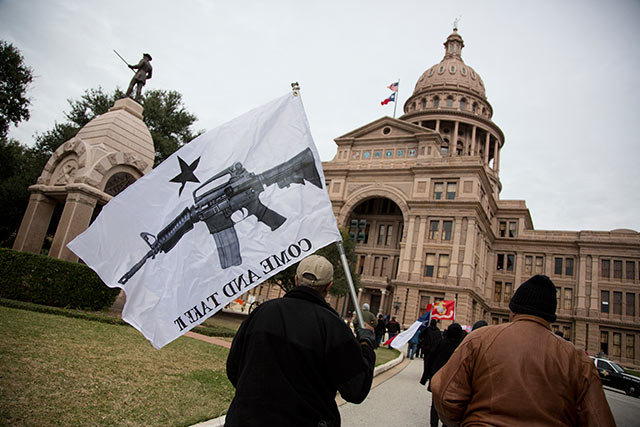
 

Demonstrators gather outside the State Capitol for a rally about expanded gun rights in downtown Austin, Texas, Jan. 1, 2016. (Photo: Ilana Panich-Linsman / The New York Times)

HENRY GIROUX


Gun violence in the United States has produced a culture soaked in blood - a culture that threatens everyone and extends from accidental deaths, suicides and domestic violence to mass shootings. In late December, a woman in St. Cloud, Florida, fatally shot her own daughter after mistaking her for an intruder. Less than a month earlier, on December 2, in San Bernardino, California, was the mass shooting that left 14 people dead and more than 20 wounded. And just two months before that, on October 1, nine people were killed and seven wounded in a mass shooting at a community college in Roseburg, Oregon.

Mass shootings have become routine in the United States and speak to a society that relies on violence to feed the coffers of the merchants of death. Given the profits made by arms manufacturers, the defense industry, gun dealers and the lobbyists who represent them in Congress, it comes as no surprise that the culture of violence cannot be abstracted from either the culture of business or the corruption of politics. Violence runs through US society like an electric current offering instant pleasure from all cultural sources, whether it be the nightly news or a television series that glorifies serial killers.

At a policy level, violence drives the arms industry and a militaristic foreign policy, and is increasingly the punishing state's major tool to enforce its hyped-up brand of domestic terrorism, especially against Black youth. The United States is utterly wedded to a neoliberal culture in which cruelty is viewed as virtue, while mass incarceration is treated as the chief mechanism to "institutionalize obedience." At the same time, a shark-like mode of competition replaces any viable notion of solidarity, and a sabotaging notion of self-interest pushes society into the false lure of mass consumerism. The increasing number of mass shootings is symptomatic of a society engulfed in racism, fear, militarism, bigotry and massive inequities in wealth and power.

Guns and the hypermasculine culture of violence are given more support than young people and life itself.

Over 270 mass shootings have taken place in the United States in 2015 alone, proving once again that the economic, political and social conditions that underlie such violence are not being addressed. Sadly, these shootings are not isolated incidents. For example, one child under 12 years old has been killed every other day by a firearm, which amounts to 555 children killed by guns in three years. An even more frightening statistic and example of a shocking moral and political perversity was noted in data provided by the Centers for Disease Control and Prevention (CDC), which states that "2,525 children and teens died by gunfire in [the United States] in 2014; one child or teen death every 3 hours and 28 minutes, nearly 7 a day, 48 a week." Such figures indicate that too many youth in the United States occupy what might be called war zones in which guns and violence proliferate. In this scenario, guns and the hypermasculine culture of violence are given more support than young people and life itself.

The predominance of a relatively unchecked gun culture and a morally perverse and politically obscene culture of violence is particularly evident in the power of the gun lobby and its political advocates to pass laws in eight states to allow students and faculty to carry concealed weapons "into classrooms, dormitories and other buildings" on campuses. In spite of the rash of recent shootings on college campuses, Texas lawmakers, for instance, passed one such "campus carry bill," which will take effect in August 2016. To add insult to injury, they also passed an "open carry bill" that allows registered gun owners to carry their guns openly in public. Such laws not only reflect "the seemingly limitless legislative clout of gun interests," but also a rather irrational return to the violence-laden culture of the "Wild West."


As in the past, individuals will be allowed to walk the streets, while openly carrying guns and packing heat as a measure of their love of guns and their reliance upon violence as the best way to address any perceived threat to their security. This return to the deadly practices of the " Wild West" is neither a matter of individual choice nor some far-fetched yet allegedly legitimate appeal to the Second Amendment. On the contrary, mass violence in the United States has to be placed within a broader historical, economic and political context in order to address the totality of the forces that produce it. Focusing merely on mass shootings or the passing of potentially dangerous gun legislation does not get to the root of the systemic forces that produce the United States' love affair with violence and the ideologies and criminogenic institutions that produce it.

Imperial policies that promote aggression all across the globe are now matched by increasing levels of lawlessness and state repression, which mutually feed each other. On the home front, civil society is degenerating into a military organization, a space of lawlessness and warlike practices, organized primarily for the production of violence. For instance, as Steve Martinot observes at CounterPunch, the police now use their discourse of command and power to criminalize behavior; in addition, they use military weapons and surveillance tools as if they are preparing for war, and create a culture of fear in which militaristic principles replace legal principles. He writes:

This suggests that there is an institutional insecurity that seeks to cover itself through social control ... the cops act out this insecurity by criminalizing individuals in advance. No legal principle need be involved. There is only the militarist principle.... When police shoot a fleeing subject and claim they are acting in self-defense (i.e. threatened), it is not their person but the command and control principle that is threatened. To defend that control through assault or murderous action against a disobedient person implies that the cop's own identity is wholly immersed in its paradigm. There is nothing psychological about this. Self-worth or insecurity is not the issue. There is only the military ethic of power, imposed on civil society through an assumption of impunity. It is the ethos of democracy, of human self-respect, that is the threat.

The rise of violence and the gun culture in the United States cannot be separated from a transformation in governance in the United States. Political sovereignty has been replaced by economic sovereignty as corporate power takes over the reins of governance. The more money influences politics, the more corrupt the political culture becomes. Under such circumstances, holding office is largely dependent on having huge amounts of capital at one's disposal, while laws and policies at all levels of government are mostly fashioned by lobbyists representing big business corporations and financial institutions. Moreover, such lobbying, as corrupt and unethical as it may be, is now carried out in the open by the National Rifle Association (NRA) and other individuals, groups and institutions invested in the militarization of US society. This lobbying is then displayed as a badge of honor - a kind of open testimonial to the lobbyists' disrespect for democratic governance.

But money in politics is not the only major institutional factor in which everyday and state violence are nourished by a growing militarism. As David Theo Goldberg has argued in his essay "Mission Accomplished: Militarizing Social Logic," the military has also assumed a central role in shaping all aspects of society. Militarization is about more than the use of repressive power; it also represents a powerful social logic that is constitutive of values, modes of rationality and ways of thinking. According to Goldberg,

The military is not just a fighting machine.... It serves and socializes. It hands down to the society, as big brother might, its more or less perfected goods, from gunpowder to guns, computing to information management ... In short, while militarily produced instruments might be retooled to other, broader social purpose - the military shapes pretty much the entire range of social production from commodities to culture, social goods to social theory.

The militarization and corporatization of social logic permeates US society. The general public in the United States is largely depoliticized through the influence of corporations over schools, higher education and other cultural apparatuses. The deadening of public values, civic consciousness and critical citizenship are also the result of the work of anti-public intellectuals representing right-wing ideological and financial interests, a powerful set of corporate-controlled media agencies that are largely center-right and a market-driven public pedagogy that reduces the obligations of citizenship to the endless consumption and discarding of commodities. Military ideals permeate every aspect of popular culture, policy and social relations. In addition, a pedagogy of historical, social and racial amnesia is constructed and circulated through celebrity and consumer culture.

A war culture now shapes every aspect of society as warlike values, a hypermasculinity and an aggressive militarism seep into every major institution in the United States, including schools, the corporate media and local police forces. The criminal legal system has become the default structure for dealing with social problems. More and more people are considered disposable because they offend the sensibilities of the financial elite, who are rapidly consolidating class power. Under such circumstances, violence occupies an honored place.

Militarism provides ideological support for policies that protect gun owners and sellers rather than children.

It is impossible to understand the rise of gun culture and violence in the United States without thinking about the maturation of the military state. Since the end of the Cold War the United States has built "the most expensive and lethal military force in the world." The defense budget for 2015 totaled $598.5 billion and accounted for 54 percent of all federal discretionary spending. The US defense budget is both larger than the combined G-20 and "more than the combined military spending of China, Russia, the United Kingdom, Japan, France, Saudi Arabia, India, Germany, Italy and Brazil," according to an NBC report. Since 9/11, the United States has intensified both the range of its military power abroad while increasing the ongoing militarization of US society. The United States circles the globe with around 800 military bases, producing a massive worldwide landscape of military force, at an "annual cost of $156 billion," according to a report by David Vine in The Nation.

Moreover, Vine adds, "there are US troops or other military personnel in about 160 foreign countries and territories, including small numbers of Marines guarding embassies and larger deployments of trainers and advisers like the roughly 3,500 now working with the Iraqi army." Not only is the Pentagon in an unprecedented position of power, but also it thrives on a morally bankrupt vision of domestic and foreign policy dependent upon a world defined by terrorism, enemies and perpetual fear. Military arms are now transferred to local police departments, drone bases proliferate, and secret bases around the world support special operations, Navy SEALs, CIA personnel, Army Rangers and other clandestine groups, as Nick Turse has shown in Tomorrow's Battlefield. Under such circumstances, it is not surprising, as Andrew Bacevich points out, that "war has become a normal condition [and the] use of violence has become the preferred "instrument of statecraft."

Violence feeds on corporate-controlled disimagination machines that celebrate it as a sport while upping the pleasure quotient for the public. Americans do not merely engage in violence; they are also entertained by it. This kind of toxic irrationality and lure of violence is mimicked in the United States' aggressive foreign policy, in the sanctioning of state torture and in the gruesome killings of civilians by drones. As my colleague David L. Clark pointed out to me in an email, voters' support for " bombing make-believe countries [with Arab-sounding names] is not a symptom of muddled confusion but, quite to the contrary, a sign of unerring precision. It describes the desire to militarize nothing less than the imagination and to target the minutiae of our dreams." State repression, unbridled self-interest, an empty consumerist ethos and an expansive militarism have furthered the conditions for society to flirt with forms of irrationality that are at the heart of everyday aggression, violence and the withering of public life.

Pushback Against Gun Control Efforts

Warlike values no longer suggest a pathological entanglement with a kind of mad irrationality or danger. On the contrary, they have become a matter of common sense. For instance, the US government is willing to lock down a major city such as Boston in order to catch a terrorist or prevent a terrorist attack, but refuses to pass gun control bills that would significantly lower the number of Americans who die each year as a result of gun violence. As Michael Cohen observes, it is truly a symptom of irrationality when politicians can lose their heads over the threat of terrorism, even sacrificing civil liberties, but ignore the fact that "30,000 Americans die in gun violence every year (compared to the 17 who died [in 2012] in terrorist attacks)." It gets worse.

As the threat of terrorism is used by the US government to construct a surveillance state, suspend civil liberties and accelerate the forces of authoritarianism, the fear of personal and collective violence has no rational bearing on addressing the morbid acceleration of gun violence. In fact, the fear of terrorism appears to feed a toxic culture of violence produced, in part, by the wide and unchecked availability of guns. The United States' fascination with guns and violence functions as a form of sport and entertainment, while gun culture offers a false promise of security. In this logic, one not only kills terrorists with drones, but also makes sure that patriotic Americans are individually armed so they can use force to protect themselves against the apparitions whipped up by right-wing politicians, pundits and the corporate-controlled media.

Rather than bring violence into a political debate that would limit its production, various states increase its possibilities by passing laws that allow guns at places from bars to houses of worship. Florida's "stand your ground" law, based on the notion that one should shoot first and ask questions later, is a morbid reflection of the United States' adulation of gun culture and the fears that fuel it. This fascination with guns and violence has infected the highest levels of government and serves to further anti-democratic and authoritarian forces. For example, the US government's warfare state is propelled by a military-industrial complex that cannot spend enough on weapons of death and destruction. Super modern planes such as the F-35 Joint Strike Fighter cost up to $228 million each and are plagued by mechanical problems and yet are supported by a military and defense establishment. As Gabriel Kolko observes, such warlike investments "reflect a pathology and culture that is expressed in spending more money," regardless of how it contributes to running up the debt, and that thrives on whatanthropologist João Biehl has described as "the energies of the dead."

Militarism provides ideological support for policies that protect gun owners and sellers rather than children. The Children's Defense Fund is right in stating, "Where is our anti-war movement here at home? Why does a nation with the largest military budget in the world refuse to protect its children from relentless gun violence and terrorism at home? No external enemy ever killed thousands of children in their neighborhoods, streets and schools year in and year out."

There is a not-so-hidden structure of politics at work in this type of sanctioned irrationality. Advocating for gun rights provides a convenient discourse for ignoring what Carl Boggs has described as a "harsh neoliberal corporate-state order that routinely generates pervasive material suffering, social dislocation, and psychological despair - worsening conditions that ensure violence in its many expressions."

As the United States moves from a welfare state to a warfare state, state violence becomes normalized. The United States' moral compass and its highest democratic ideals have begun to wither, and the institutions that were once designed to help people now serve to largely suppress them. Gun laws matter, social responsibility matters and a government responsive to its people matters, especially when it comes to limiting the effects of a mercenary gun culture. But more has to be done. The dominance of gun lobbyists must end; the reign of money-controlled politics must end; the proliferation of high levels of violence in popular culture, and the ongoing militarization of US society must end. At the same time, it is crucial, as participants in the Black Lives Matter movement have argued, for Americans to refuse to endorse the kind of gun control that criminalizes young people of color.

Moderate calls for reining in the gun culture and its political advocates do not go far enough because they fail to address the roots of the violence causing so much carnage in the United States, especially among children and teens. For example, Hillary Clinton's much publicized call for controlling the gun lobby and improving background checks, however well intentioned, did not include anything about a culture of lawlessness and violence reproduced by the government, the financial elites and the defense industries, or a casino capitalism that is built on corruption and produces massive amounts of human misery and suffering. Moreover, none of the calls to eliminate gun violence in the United States link such violence to the broader war on youth, especially poor youth of color.

A Culture of Violence

It would be wrong to suggest that the violence that saturates popular culture directly causes violence in the larger society. Nevertheless, it is arguable that depictions of violence serve to normalize violence as both a source of pleasure and as a practice for addressing social issues. When young people and others begin to believe that a world of extreme violence, vengeance, lawlessness and revenge is the only world they inhabit, the culture and practice of real-life violence is more difficult to scrutinize, resist and transform.

Many critics have argued that a popular culture that endlessly trades in violence runs the risk of blurring the lines between the world of fantasies and the world we live in. What they often miss is that when violence is celebrated in its myriad registers and platforms in a society, a formative culture is put in place that is amenable to the pathology of fascism. That is, a culture that thrives on violence runs the risk of losing its capacity to separate politics from violence. A.O. Scott recognizes such a connection between gun violence and popular culture, but he fails to register the deeper significance of the relationship. He writes:

... it is absurd to pretend that gun culture is unrelated to popular culture, or that make-believe violence has nothing to do with its real-world correlative. Guns have symbolic as well as actual power, and the practical business of hunting, law enforcement and self-defense has less purchase in our civic life than fantasies of righteous vengeance or brave resistance.... [Violent] fantasies have proliferated and intensified even as our daily existence has become more regulated and standardized - and also less dangerous. Perhaps they offer an escape from the boredom and regimentation of work and consumption.

Popular culture not only trades in violence as entertainment, but also it delivers violence to a society addicted to a pleasure principle steeped in graphic and extreme images of human suffering, mayhem and torture. While the Obama administration banned waterboarding as an interrogation method in January 2009, it appears to be thriving as a legitimate procedure in a number of prominent Hollywood films, including Safe House, Zero Dark Thirty, G.I. Jane and Taken 3. The use of and legitimation of torture by the government is not limited to Hollywood films. Republican presidential candidate Donald Trump announced recently on ABC's "This Week" that he would bring back waterboarding because it "is peanuts compared to what they do to us." It appears that moral depravity and the flight from social responsibility have no limits in an authoritarian political landscape.

Gun Violence Is Just the Tip of the Iceberg

The United States is suffering from an epidemic of violence, and much of it results in the shooting and killing of children. In announcing his package of executive actions to reduce gun violence, President Obama singled out both the gun lobby and Congress for refusing to implement even moderate gun control reforms. Obama was right on target in stating that "the gun lobby may be holding Congress hostage right now, but they cannot hold America hostage. We do not have to accept this carnage as the price of freedom." Congress's refusal to enact any type of gun control is symptomatic of the death of US democracy and the way in which money and power now govern the United States. Under a regime of casino capitalism, wealth and profits are more important than keeping the American people safe, more worthwhile than preventing a flood of violence across the land, and more valued than even the lives of young children caught in the hail of gunfire.

In spite of the empty bluster of Republican politicians claiming that Obama is violating the US Constitution with executive overreach, threatening to take guns away from the American people or undermining the Second Amendment, the not-so-hidden politics at work in these claims is one that points to the collapse of ethics, compassion and responsibility in the face of a militarized culture defined by the financial elite, gun lobbies and big corporations. Such forces represent a take-no-prisoners approach and refuse to even consider Obama's call for strengthening background checks, limiting the unchecked sale of firearms by gun sellers, developing "smart gun" technologies, and preventing those on the United States' terrorist watch list from purchasing guns. These initiatives hardly constitute a threat to gun ownership in the United States.

Guns are certainly a major problem in the United States, but they are symptomatic of a much larger crisis: Our country has tipped over into a new and deadly form of authoritarianism. We have become one of the most violent cultures on the planet and regulating guns does not get to the root of the problem. Zhiwa Woodbury touches on this issue at Tikkun Daily, writing:

We are a country of approximately 300 million people with approximately 300 million firearms - a third of which are concealable handguns. Each one of these guns is made for one purpose only - to kill as quickly and effectively as possible. The idea that some magical regulatory scheme, short of confiscation, will somehow prevent guns from being used to kill people is laughable, regardless of what you think of the NRA. Similarly, mentally ill individuals are responsible for less than 5% of the 30,000+ gunned down in the U.S. every year.

In the current historical conjuncture, gun violence makes a mockery of safe public spaces, gives rise to institutions and cultural apparatuses that embrace a deadly war psychology, and trades on fear and insecurity to undermine any sense of shared responsibility. It is no coincidence that the violence of prisons is related to the violence produced by police in the streets; it is no coincidence that the brutal masculine authority that now dominates US politics, with its unabashed hatred of women, poor people, Black people, Muslims and Mexican immigrants, shares an uncanny form of lawlessness with a long tradition of 20th century authoritarianism.

As violence moves to the center of American life, it becomes an organizing principle of society, and further contributes to the unraveling of the fabric of a democracy. Under such circumstances, the United States begins to consider everyone a potential criminal, wages war with itself and begins to sacrifice its children and its future. The political stooges, who have become lapdogs of corporate and financial interests, and refuse out of narrow self- and financial interests to confront the conditions that create such violence, must be held accountable for the deaths taking place in a toxic culture of gun violence. The condemnation of violence cannot be limited to police brutality. Violence does not just come from the police. In the United States, there are other dangers emanating from state power that punishes whistleblowers, intelligence agencies that encourage the arrests of those who protest against the abuse of corporate and state power, and a corporate-controlled media that trades in ignorance, lies and falsehoods, all the while demanding and generally "receiving unwavering support from their citizens," as Teju Cole has pointed out in The New Yorker.

Yet, the only reforms we hear about are for safer gun policies, mandatory body-worn cameras for the police and more background checks. These may be well-intentioned reforms, but they do not get to the root of the problem, which is a social and economic system that trades in death in order to accumulate profits. What we don't hear about are the people who trade their conscience for supporting the gun lobby, particularly the NRA. These are the politicians in Congress who create the conditions for mass shootings and gun violence because they have been bought and sold by the apostles of the death industry. These are the same politicians who support the militarization of everyday life, who trade in torture, who bow down slavishly to the arms industries and who wallow in the handouts provided by the military-industrial-academic complex.

These utterly corrupted politicians are killers in suits whose test of courage and toughness was captured in one of the recent Republican presidential debates, when candidate Ben Carson was asked by Hugh Hewitt, a reactionary right-wing talk show host, if he would be willing to kill thousands of children in the name of exercising tough leadership. As if killing innocent children is a legitimate test for leadership. This is what the warmongering politics of hysterical fear with its unbridled focus on terrorism has come to - a future that will be defined by moral and political zombies who represent the real face of terrorism, domestic and otherwise.

Clearly, the cause of violence in the United States will not stop by merely holding the politicians responsible. What is needed is a mass political movement willing to challenge and replace a broken system that gives corrupt and warmongering politicians excessive political and economic power. Democracy and justice are on life support and the challenge is to bring them back to life not by reforming the system but by replacing it. This will only take place with the development of a politics in which the obligation to justice is matched by an endless responsibility to collective struggle.

Note: Parts of this article were drawn from an earlier version published at CounterPunch.

Copyright, Truthout. May not be reprinted without permission of the author.

Henry A. Giroux:

Henry A. Giroux currently holds the McMaster University Chair for Scholarship in the Public Interest in the English and Cultural Studies Department and the Paulo Freire Chair in Critical Pedagogy at The McMaster Institute for Innovation & Excellence in Teaching and Learning. He also is a Distinguished Visiting Professor at Ryerson University. His most recent books include Youth in Revolt: Reclaiming a Democratic Future (Paradigm 2013), America's Educational Deficit and the War on Youth (Monthly Review Press, 2013), Neoliberalism's War on Higher Education (Haymarket Press, 2014), The Violence of Organized Forgetting: Thinking Beyond America's Disimagination Machine (City Lights, 2014), Zombie Politics in the Age of Casino Capitalism, 2nd edition (Peter Lang 2014), Disposable Futures: The Seduction of Violence in the Age of the Spectacle, co-authored with Brad Evans, (City Lights Books 2015), Dangerous Thinking in the Age of the New Authoritarianism (Paradigm Publisher 2015). The Toronto Star named Henry Giroux one of the 12 Canadians changing the way we think! Giroux is also a member of Truthout's Board of Directors. His website is www.henryagiroux.com.

Related Stories:

Henry A. Giroux | Neoliberalism, Violence and Resistance: A Discussion on Forthright Radio
By Henry A. Giroux, Truthout | Interview

Henry A. Giroux | Murder, Incorporated: Guns and the Growing Culture of Violence in the US
By Henry A. Giroux, Truthout | News Analysis

Henry A. Giroux | Terrorizing Students: The Criminalization of Children in the US Police State
By Henry A. Giroux, Truthout | Op-Ed

Wednesday, April 9, 2014

Henry Giroux On Neoliberalism, Corporate Dominance, the Rise of Authoritarianism, and the Modern Surveillance State in the U.S.


Neoliberalism and the Machinery of Disposability
08 April 2014
By Henry A Giroux, Truthout | Op-Ed

 (Image: Jared Rodriguez / Truthout)

Under the regime of neoliberalism, especially in the United States, war has become an extension of politics as almost all aspects of society have been transformed into a combat zone. Americans now live in a society in which almost everyone is spied on, considered a potential terrorist, and subject to a mode of state and corporate lawlessness in which the arrogance of power knows no limits. The state of exception has become normalized. Moreover, as society becomes increasingly militarized and political concessions become relics of a long-abandoned welfare state hollowed out to serve the interest of global markets, the collective sense of ethical imagination and social responsibility toward those who are vulnerable or in need of care is now viewed as a scourge or pathology.

What has emerged in this new historical conjuncture is an intensification of the practice of disposability in which more and more individuals and groups are now considered excess, consigned to zones of abandonment, surveillance and incarceration. Moreover, this politics of disappearance has been strengthened by a fundamental intensification of increasing depoliticization, conducted largely through new modes of spying and the smothering, if not all-embracing, market-driven power of commodification and consumption.
Citizens are now reduced to data, consumers, and commodities and as such inhabit identities in which they increasingly "become unknowables, with no human rights and with no one accountable for their condition."[1] Within this machinery of social death, not only does moral blindness prevail on the part of the financial elite, but the inner worlds of the oppressed are constantly being remade under the force of economic pressures and a culture of fear. According to João Biehl, as the realpolitik of disposability "comes into sharp visibility . . . tradition, collective memory, and public spheres are organized as phantasmagoric scenes, [that] thrive on the "energies of the dead," who remain unaccounted for in numbers and law."[2]

Economists such as Paul Krugman and Robert Reich have argued that we are in a new Gilded Age, one that mimics a time when robber barons and strikebreakers ruled, and the government and economy were controlled by a cabal that was rich, powerful and ruthless.[3] And, of course, blacks, women and the working class were told to mind their place in a society controlled by the rich. What is often missing in these analyses is that what is new in the second Gilded Age is not just about the moral sanctioning of greed, the corruption of politics by big money, and the ruthlessness of class power.

What is unique is the rise of a brutal punishing-incarceration state that imposes its power on the dispossessed, the emergence of a surveillance state that spies on and suppresses dissenters, the emergence of vast cultural apparatuses that colonize subjectivity in the interests of the market, and a political class that is uninterested in political concessions and appears immune from control by nation states. The second Gilded Age is really a more brutal form of authoritarianism driven by what psychologist Robert Jay Lifton rightly calls a "death-saturated age," in which matters of violence, survival and trauma now infuse everyday life. [4]

... life has become completely unbearable for over half of the American public living in or near poverty.

Discarded by the corporate state, dispossessed of social provisions and deprived of the economic, political and social conditions that enable viable and critical modes of agency, expanding populations of Americans now find themselves inhabiting zones of abandonment marked by deep inequalities in power, wealth and income. Such zones are sites of rapid disinvestment, places marked by endless spectacles of violence, and supportive of the neoliberal logics of containment, commodification, surveillance, militarization, cruelty and punishment.

These zones of hardship and terminal exclusion constitute a hallmark signature and intensification of a neoliberal politics of disposability that is relentless in the material and symbolic violence it wages against the 99% for the benefit of the new financial elite. Borrowing from Hannah Arendt, one could say that capitalist expropriation, dispossession and disinvestment has reached a point where life has become completely unbearable for over half of the American public living in or near poverty.[5]

Evidence of such zones can be seen in the war against immigrants, poor minorities, the homeless, young people living in debt, the long-term unemployed, workers, the declining middle class, all of whom have been pushed into invisible communities of control, harassment, security and the governing-through-punishment complex.

The promises of modernity regarding progress, freedom and hope have not been eliminated; they have been reconfigured, stripped of their emancipatory potential and subordinated to the logic of a savage market instrumentality and individualization of the social. Dispossession and disinvestment have invalidated the promises of modernity and have turned progress into a curse for the marginalized and a blessing for the super-financial elite. Modernity has reneged on its undertaking to fulfill the social contract, however disingenuous or limited, especially with regards to young people. Long-term planning and the institutional structures that support them are now weakened, if not eliminated, by the urgencies of privatization, deregulation, flexibility and short-term investments. Social bonds have given way under the collapse of social protections and the welfare state and are further weakened by the neoliberal insistence that there are only "individual solutions to socially produced problems." [6]

"There’s simply the reluctance ever to imagine what the other person is experiencing."

Neoliberalism’s disposability machine is relentlessly engaged in the production of an unchecked notion of individualism that both dissolves social bonds and removes any viable notion of agency from the landscape of social responsibility and ethical considerations. Absorbed in privatized orbits of consumption, commodification and display, Americans vicariously participate in the toxic pleasures of a mode of authoritarianism characterized by the reactionary presence of the corporate state, the concentration of power and money in the upper 1% of the population, the ongoing militarization of all aspects of society, and the ongoing, aggressive depoliticization of the citizenry.

In its current historical conjuncture, the authoritarian state is controlled by a handful of billionaires (eg., the Koch Brothers), their families (eg., the Waltons) and a select class of zombie-like financial and corporate elite who now control the commanding economic, political and cultural institutions of American society.

Mechanisms of governance have been transformed into instruments of war. Violence has become the organizing force of a society driven by a toxic notion of privatization in which it becomes difficult for ideas to be lifted into the public realm. Under such circumstances, politics is eviscerated because it now supports a market-driven view of society that has turned its back on the idea that "Humanity is never acquired in solitude." [7] That is, society has come undone in terms of the social contract and in doing so has turned its back on most Americans whose lives and futures are no longer determined by social spaces that give them a voice and provide the conditions for autonomy, freedom and equality. This violence against the social mimics is not just the death of the radical imagination, but also a notion of banality made famous by Hannah Arendt, who argued that at the root of totalitarianism was a kind of thoughtlessness, an inability to think, and a type of outrageous stupidity in which, "There’s simply the reluctance ever to imagine what the other person is experiencing."[8]

The plight of disposable populations can be seen in the fact that millions of Americans are unemployed and are receiving no long-term benefits. Shockingly, the only source of assistance for one in 50 Americans "is nothing but a food stamp card." [9] Close to half of all Americans live on or beneath the poverty line while "more than a million public school students are homeless in the United States; 57 percent of all children are in homes considered to be either low-income or impoverished; and half of all American children will be on food stamps at least once before they turn 18 years old." [10] At the same time, the 400 richest Americans "have as much wealth as 154 million Americans combined, that’s 50 percent of the entire country [while] the top economic 1% of the US population now has a record 40 percent of all wealth and more wealth than 90 percent of the population combined." [11]

Within this system of power and disposability, the ethical grammars that draw our attention to the violence of such suffering disappear while dispossessed populations lose their dignity, bodies, and material goods and homes. The fear of losing everything, the horror of the engulfing precarity, the quest to merely survive, and the impending reality of social and civil death have become a way of life for the 99% in the United States. Under the politics of disposability, the grammars of suffering, cruelty, and punishment have replaced the value of compassion, social responsibility and civic courage.

Young people are not seen as troubled but viewed as a source of trouble; rather than viewed as being "at risk," they are the risk and subject to a range of punitive policies.
The severity of the consequences of this shift in modernity under neoliberalism among youth is evident in the fact that this is the first generation, as Zygmunt Bauman argues, in which the "plight of the outcast may stretch to embrace a whole generation." [12] He rightly argues that today’s youth have been "cast in a condition of liminal drift, with no way of knowing whether it is transitory or permanent." [13] Youth no longer occupy the hope of a privileged place that was offered to previous generations. They now inhabit a neoliberal notion of temporality marked by a loss of faith in progress along with the emergence of apocalyptic narratives in which the future appears indeterminate, bleak and insecure. Heightened prospects and progressive visions pale and are smashed next to the normalization of market-driven government policies that wipe out pensions, eliminate quality health care, raise college tuition, and produce a harsh world of joblessness, while giving millions to banks and the military. Students, in particular, now find themselves in a world in which heightened expectations have been replaced by dashed hopes and a world of onerous debt. [14]

What has changed about an entire generation of young people includes not only neoliberal society’s disinvestment in youth and the permanent fate of downward mobility but also the fact that youth live in a commercially carpet-bombed and commodified environment that is unlike anything experienced by those of previous generations. Nothing has prepared this generation for the inhospitable and savage new world of commodification, privatization, joblessness, frustrated hopes, surveillance and stillborn projects. [15] The present generation has been born into a throwaway society of consumers in which both goods and young people are viewed increasingly as redundant and disposable or they are merely valued as consumers and commodities. In this discourse, young people are not seen as troubled but viewed as a source of trouble; rather than viewed as being "at risk," they are the risk and subject to a range of punitive policies.

The structures of neoliberal modernity do more than disinvest in young people and commodify them, they also transform the protected space of childhood into a zone of disciplinary exclusion and cruelty, especially for those young people further marginalized by race and class who now inhabit a social landscape in which they are increasingly disparaged as flawed consumers. With no adequate role to play as consumers, many youth are forced to inhabit "zones of social abandonment," extending from bad schools to bulging detention centers to prisons. [16] Youth have become a marker for a mode of disposability in which their fate is defined largely through the registers of a society that throws away resources, people and goods. These are zones where the needs of young people are not only ignored, but where many young people, especially poor minority youth, are subjected to conditions of impoverishment and punishment that underserve them and often criminalize their behavior. For example, with the hollowing out of the social state and the rise of the punishing state, the circuits of state repression, surveillance and disposability increasingly "link the fate of blacks, Latinos, Native Americans, poor whites, and Asian Americans" to a crime youth complex, which now serves as the default solution to major social problems. [17] Within these "zones of abandonment" and social death, poor minority and low-income youth are viewed as out of step, place, and time and defined largely as "pathologies feeding on the body politic," exiled to spheres of "terminal exclusion." [18]

As the welfare state is hollowed out, a culture of compassion is replaced by a culture of violence, cruelty and atomization. Within the existing neoliberal historical conjuncture, there is a merging of violence and governance and the systemic disinvestment in, and breakdown of, institutions and public spheres that have provided the minimal conditions for democracy. A generalized fear now shapes American society - one that thrives on insecurity, precarity, dread of punishment, and a perception of constant lurking threats. Americans occupy a historical conjuncture in which everything that matters politically, ethically and culturally is being erased - either ignored, turned into a commodity or simply falsified.

In the United States and many other countries, the state monopoly on the use of violence has not only intensified since the 1980s, but is unashamedly sanctioned by the new extremists in power. Under the regime of neoliberalism, this new-found embrace of social Darwinism and the culture of violence has been directed against young people, poor minorities, immigrants and, increasingly, women.

Abandoned by the existing political system, young people are placing their bodies on the line, protesting peacefully across the globe while trying to produce a new language, politics, long-term institutions, and "community that manifests the values of equality and mutual respect that they see missing in a world that is structured by neoliberal principles." [19] Such movements are not simply about reclaiming space but also about producing new ideas, generating new conversations, and introducing a new political language. While there has been considerable coverage in the progressive media since 2001 given to the violence being waged against the movement protesters in Brazil, the United States, Greece and elsewhere, it is important to situate such violence within a broader set of categories that enables a critical understanding of not only the underlying social, economic and political forces at work in such assaults, but also makes it possible to reflect critically on the distinctiveness of the current historical period in which they are taking place. For example, it is difficult to address such state-sponsored violence against young people without analyzing the devolution of the social state, emergence of a politics of disposability, and the corresponding rise of the warfare and punishing state.
The merging of the military-industrial-academic-cultural complex and unbridled corporate power points to the need for strategies that address what is specific about the current warfare state and the neoliberal project and how different interests, modes of power, social relations, public pedagogies, and economic configurations come together to shape its politics of domestic terrorism, cruelty, and zones of disposability. Such a conjuncture is invaluable politically in that it provides a theoretical opening for making the practices of the neoliberal revolution visible to organize resistance to its ideologies, policies and modes of governance. It also points to the conceptual power of making clear that history remains an open horizon that cannot be dismissed through appeals to the end of history or end of ideology.[20] It is precisely through the indeterminate nature of history that resistance becomes possible and politics refuses any guarantees and remains open.

As a mode of public pedagogy, a state of permanent war needs willing subjects to abide by its values, ideology and narratives of fear and violence.

A number of neoliberal societies, including the United States, have become addicted to violence. War provides jobs, profits, political payoffs, research funds, and forms of political and economic power that reach into every aspect of society. As war becomes a mode of sovereignty and rule, it erodes the distinction between war and peace. Increasingly fed by a moral and political frenzy, warlike values produce and endorse shared fears as the primary register of social relations. Shared fears and the media-induced panics that feed them produce more than a culture of fear. Such hysteria also feeds the growing militarization of the police, who increasingly use their high-tech scanners, surveillance cameras and toxic chemicals on anyone who engages in peaceful protests against the warfare and corporate state. Images abound in the mainstream media of such abuses.
 
As a mode of public pedagogy, a state of permanent war needs willing subjects to abide by its values, ideology and narratives of fear and violence. Such legitimation is largely provided through a market-driven culture addicted to production of consumerism, militarism, and organized violence, largely circulated through various registers of popular culture that extend from high fashion and Hollywood movies to the creation of violent video games and music concerts sponsored by the Pentagon. The market-driven spectacle of war demands a culture of conformity, quiet intellectuals and a largely passive republic of consumers. But it also needs subjects who find intense pleasure in the spectacle of violence.

As the pleasure principle is unconstrained by a moral compass based on a respect for others, it is increasingly shaped by the need for intense excitement and a never-ending flood of heightened sensations. In this instance, unfamiliar violence such as extreme images of torture and death become banally familiar, while familiar violence that occurs daily is barely recognized and relegated to the realm of the unnoticed and unnoticeable. As an increasing volume of violence is pumped into the culture, yesterday’s spine-chilling and nerve-wrenching violence loses its shock value. As the need for more intense images of violence accumulates, the moral indifference and desensitization to violence grows, while matters of cruelty and suffering are offered up as fodder for sports, entertainment, news media, and other outlets for seeking pleasure.

Marked by a virulent notion of hardness and aggressive masculinity, a culture of violence has become commonplace in a society in which pain, humiliation and abuse are condensed into digestible spectacles endlessly circulated through extreme sports, reality TV, video games, YouTube postings, and proliferating forms of the new and old media. But the ideology of hardness and the economy of pleasure it justifies are also present in the material relations of power that have intensified across the globe since the 1970s. Conservative and liberal politicians alike now spend millions waging wars around the globe, funding the largest military state in the world, providing huge tax benefits to the ultra-rich and major corporations, and all the while draining public coffers, increasing the scale of human poverty and misery, and eliminating all viable public spheres—whether they be the social state, public schools, public transportation, or any other aspect of a formative culture that addresses the needs of the common good. State violence, particularly the use of torture, abductions, and targeted assassinations are now justified as part of a state of exception that has become normalized. A "political culture of hyper punitiveness" has become normalized and accelerates throughout the social order like a highly charged electric current. [21]

A symptomatic example of the way in which violence has saturated everyday life can be seen in the growing acceptance of criminalizing the behavior of young people in public schools. Behaviors that were normally handled by teachers, guidance counselors, and school administrators are now dealt with by the police and the criminal justice system. The consequences have been disastrous for young people. Not only do schools resemble the culture of prisons, but young children are being arrested and subjected to court appearances for behaviours that can only be termed as trivial. This is not merely barbarism parading as reform - it is also a blatant indicator of the degree to which sadism and the infatuation with violence have become normalized in a society that seems to take delight in dehumanizing itself.
 
As the social is devalued along with rationality, ethics, and any vestige of democracy, spectacles of war, violence, and brutality now merge into forms of collective pleasure that constitute an important and new symbiosis between visual pleasure, violence, and suffering. The control/punishing society is now the ultimate form of entertainment as the pain of others, especially those considered disposable and powerless, has become the subject not of compassion but of ridicule and amusement. My emphasis here is on the sadistic impulse and how it merges spectacles of violence and brutality with forms of collective pleasure that often lend support and sway public opinion in favor of social policies and "lawful" practices that create zones of abandonment for youth. No society can make a claim to being a democracy as long as it defines itself through shared fears rather than shared responsibilities, especially in regards to young people. Widespread violence now functions as part of an anti-immune system that turns the economy of genuine pleasure into a mode of sadism that creates the foundation for sapping democracy of any political substance and moral vitality that might counter a politics of disposability more generally.

The prevalence of violence throughout American society suggests the need for a politics that not only negates the established order and the proliferating zones of disappearance and dispossession of subjects rendered useless or burdensome, but also imagines new radical visions in which the future diverges from the dark conditions of the present. [22] In this discourse, critique merges with a sense of realistic hope, and individual struggles merge into larger social movements.
At the heart of the oppression experienced by young people and others are ideologies, modes of governance, and policies that embrace a pathological individualism, a distorted notion of freedom, and a willingness both to employ state violence to suppress dissent and abandon those suffering from a collection of social problems ranging from dire poverty and joblessness to homelessness. In the end, these are stories about disposability in which growing numbers of young people are considered dispensable and a drain on the body politic, the economy, and the sensibilities of the rich and powerful. Rather than work for a more dignified life, most young people now work simply to survive - that is, if they can find work - in a survival-of-the-fittest society in which getting ahead and accumulating capital, especially for the ruling elite, is the only game in town. In the past, public values have been challenged and certain groups have been targeted as superfluous or redundant. But what is new about the politics of disposability that has become a central feature of contemporary American politics is the way in which such antidemocratic practices have become normalized in the existing neoliberal order. A politics of inequality and ruthless power disparities is now matched by a culture of cruelty soaked in blood, humiliation and misery. Private injuries are not only separated from public considerations by such narratives, but accounts of poverty and exclusion have become objects of scorn. Similarly, all noncommercial public spheres where such stories might get heard are viewed with contempt, a perfect supplement to the chilling indifference to the plight of the disadvantaged and disenfranchised.
HENRY GIROUX

As politics is disconnected from its ethical and material moorings, it becomes easier to punish and imprison young people than to educate them. From the inflated rhetoric of the political right to market-driven media peddling spectacles of violence, the influence of these criminogenic and death-saturated forces in everyday life is undermining our collective security by justifying cutbacks to social supports and restricting opportunities for democratic resistance. Saturating mainstream discourses with anti-public narratives, the neoliberal machinery of social death effectively weakens public supports and prevents the emergence of much-needed new ways of thinking and speaking about politics in the 21st century.

As Noam Chomsky has pointed out, the biggest threat to the Gilded Age autocrats is solidarity . . .

Before this dangerously authoritarian mindset has a chance to take hold of our collective imagination and animate our social institutions, it is crucial that all Americans think critically and ethically about the coercive forces shaping US culture - and focus our energy on what can be done to change them. It will not be enough only to expose the falseness of the propaganda pumped out by the commanding neoliberal cultural apparatuses. We also need to create alternative narratives about what the promise of democracy might be for our children and ourselves. This demands a break from established political parties, the creation of alternative public spheres in which to produce democratic narratives and visions, and a notion of politics that is educative, one that takes seriously how people interpret and mediate the world, how they see themselves in relation to others, and what it might mean to imagine otherwise in order to act otherwise.

At stake here is more than a call for reform. The American public needs to organize around a revolutionary ideal that enables people to hold power, participate in the process of governing, and create public institutions and discourses capable of explaining and reversing chronic injustices and power relations evident everywhere in society. This is a revolution that not only calls for structural change, but for a transformation in the ways in which subjectivities are created, desires are produced, and agency itself is safeguarded as crucial to any viable notions of community and freedom. Democracy requires, at the very least, a type of education that fosters a working knowledge of citizenship and the development of individuals with the capacity to be self-reflective, passionate about the collective good, and able to defend the means by which ideas are translated into the worldly space of the public realm. It is not enough to wait for the Occupy Movement to revitalize itself. [23] That is important, but is too limited a call for change. Such a struggle is impossible without an alliance among unions, working people, students, youth, educators, feminists, environmentalists and intellectuals. In particular, organized labor, students, educators, and youth have to provide the base of a broader organization and social movement designed to dismantle casino capitalism.

Such an alliance has to be built around defending the common good, public values, economic and racial justice and environmental sustainability. As Noam Chomsky has pointed out, the biggest threat to the Gilded Age autocrats is solidarity and rightly so. The time has come for a surge of opposition in the name of democracy, one designed to save the planet from destruction and for a social order in which economic justice is matched with a reverence for care for the other. Politics becomes meaningless without a vision, a willingness to develop a radical collective imagination rooted in a formative culture that nourishes a vibrant sense of critique, civic courage, and sustained collective struggle. Any struggle that matters will have to reimagine and fight for a society in which it becomes possible once again to dream the project of a substantive democracy. This means, as Ulrich Beck has pointed out, looking for politics in new spaces and arenas outside of traditional elections, political parties, and "duly authorized agents." [24] It suggests developing public spaces outside of the regime of predatory corporatism and engaging in a type of counter politics that shapes society from the bottom up.


1. João Biehl, Vita: Life in A Zone of Social Abandonment, (Los Angeles, CA: University of California Press, 2005), p. 4
2. Ibid., Biehl, Vita: Life in A Zone of Social Abandonment, p. 10.
3. See: Robert B. Reich, “McCutcheon took us back in time, but it might just birth the next Occupy,” The Guardian (April 6, 2014). Doug Henwood, “Our Gilded Age” The Nation, (June 30, 2008), pp. 14, 17.
4. Robert Jay Lifton, Death in Life: Survivors of Hiroshima (Chapel Hill: University of North Carolina Press, 1987), p. 479.
5. As indicated by a report from "the Corporation for Enterprise Development, nearly half of Americans are living in a state of "persistent economic insecurity," that makes it "difficult to look beyond immediate needs and plan for a more secure future." The CFED . . . report finds that 44 percent of Americans are living with less than $5,887 in savings for a family of four. Christopher Matthews, "Nearly Half of America Lives Paycheck-to-Paycheck," Time Magazine (June 30, 2014).
6. Zygmung Bauman, Liquid Times: Living in an Age of Uncertainty (Cambridge: Polity Press, 2007), p. 14.
7. The quote by Karl Jaspers is cited in Hannah Arendt, The Last Interview and Other Conversations, (Brooklyn, N.Y.: Melville House Publishing, 2013), p. 37.
8. Ibid., p. 48.
9. Jason Deparle and Robert M. Gebeloff, "Living on Nothing but Food Stamps," The New York Times (January 3, 2010), p. A1.
10. Editor, "75 Economic Numbers From 2012 That Are Almost Too Crazy To Believe," The Economic Collapse Blog (December 20, 2012). Online:
11. David DeGraw, "Meet the Global Financial Elites Controlling $46 Trillion in Wealth," Alternet (August 11, 2011).
12. Zygmunt Bauman, "Downward mobility is now a reality," The Guardian (May 31, 2012). Bauman develops this theme in detail in both Zygmunt Bauman, On Education, (Cambridge, UK: Polity Press, 2012) and Zygmunt Bauman, This Is Not A Diary, (Cambridge, UK: Polity Press, 2012).
13. Zygmunt Bauman, Wasted Lives (London: Polity, 2004), p. 76.
14. See Steve Fraser, "The Politics of Debt in America: From Debtor’s Prison to Debtor Nation," TomDispatch.com (January 29, 2013). On the history of debt, see David Graeber, Debt: The First 5,000 Years (New York: Melville House, 2012).
15. Ibid., Bauman, On Education, p. 47.
16. I have borrowed the term "zones of social abandonment" from Joäo Biehl, Vita: Life in a Zone of Social Abandonment (Berkeley: University of California Press, 2005); see also Henry A. Giroux, Disposable Youth (New York: Routledge, 2012) and Michelle Alexander, The New Jim Crow (New York: The Free Press, 2012).
17. Angela Y. Davis, "State of Emergency," in Manning Marable, Keesha Middlemass and Ian Steinberg, Eds. Racializing Justice, Disenfranchising Lives (New York: Palgrave, 2007), p. 324.
18. Joao Biehl, Vita: Life in a Zone of Social Abandonment (Berkeley: University of California Press, 2005), p.14
19. Kyle Bella, "Bodies in Alliance: Gender Theorist Judith Butler on the Occupy and SlutWalk Movements," TruthOut (December 15, 2011).
20. Daniel Bell, The End of Ideology: On the Exhaustion of Political Ideas in the Fifties (New York: Free Press, 1966) and the more recent Francis Fukuyama, The End of History and the Last Man (New York: Free Press, 2006) .
21. Steve Herbert and Elizabeth Brown, "Conceptions of Space and Crime in the Punitive Neoliberal City," Antipode (2006), p. 757.
22. John Van Houdt, "The Crisis of Negation: An Interview with Alain Badiou," Continent, 1.4 (2011): 234-238.
23. This position has been taken up recently by former labor secretary, Robert Reich, see: Robert B. Reich, "McCutcheon took us back in time, but it might just birth the next Occupy," The Guardian (April 6, 2014).
24. Ulrich Beck, Democracy without Enemies (London: Polity Press, 1998), p. 38.

 
Copyright, Truthout. May not be reprinted without permission.

HENRY A GIROUX:

Henry A. Giroux currently holds the Global TV Network Chair Professorship at McMaster University in the English and Cultural Studies Department and a Distinguished Visiting Professorship at Ryerson University. His most recent books include: On Critical Pedagogy (Continuum, 2011), Twilight of the Social: Resurgent Publics in the Age of Disposability (Paradigm 2012), Disposable Youth: Racialized Memories and the Culture of Cruelty (Routledge 2012), Youth in Revolt: Reclaiming a Democratic Future (Paradigm 2013), and The Educational Deficit and the War on Youth (Monthly Review Press, 2013), America's Disimagination Machine (City Lights) and Higher Education After Neoliberalism (Haymarket) will be published in 2014). Giroux is also a member of Truthout's Board of Directors. His web site is www.henryagiroux.com.

RELATED STORIES

Neoliberalism and the Politics of Higher Education: An Interview With Henry A. Giroux
By CJ Polychroniou, Truthout | Interview
Neoliberalism, "Just Desserts" and the Post-Climate Crisis Economy
By Gaius Publius, America Blog | News Analysis
Neoliberalism as Social Necrophilia: The Case of Greece
By Panayota Gounari, Truthout | News Analysis