Showing posts with label Barack Obama. Show all posts

Sunday, January 18, 2015

What is Chris Rock Talking About and Why Is He Saying It?: The Dangerous Absence of Critical Thought and the Infantile and Pervasive Reality of Self Delusion and Magical Thinking in the U.S. Today


“...I never limited myself. And that's the beauty of Obama. It might be a generational thing, because the difference between Barack Obama and Jesse Jackson was that Jesse Jackson never actually ran for president. He ran to disrupt the presidency. If he actually ran for president, he probably could have been president. Jesse Jackson won a bunch of primaries in Southern states, but not for five seconds did he think he could be president, whereas Obama was like, "Yeah, I could be president," and nobody stopped him. Literally, nobody stopped him.”
                               —Chris Rock, from the last paragraph of his December 12, 2014 Hollywood Reporter article “It’s a White Industry” on racism in Hollywood

"If my mind can conceive it and my heart can believe it I know I can achieve it”
                           —Jesse Jackson campaign slogan in 1988 candidacy for the Democratic Party nomination for President

All,

I just read an alarmingly mindless, outlandishly FALSE and bizarrely absurd statement by Chris Rock that if only Jesse Jackson had possessed enough "personal confidence" in 1984 and 1988 to “think” he could actually become President (because as Rock states incredulously Jackson “won a bunch of primaries in southern states”; for the record Jackson won a grand total of only six southern state primaries spread over both 1984 and 1988 and only 16 primaries total overall in both years accounting for 20% of the national Democratic primary vote overall), he could have actually become President, and that the difference between Jackson and Obama is that Obama actually “believed” and “thought” he could become the President and that because of his "self confidence" and "self belief" (bolstered by his simply “thinking” he could do it) “nobody stopped him, literally nobody stopped him" (from becoming President).  Huh? WTF!  Is Chris Rock REALLY THIS STUPID?  Is he completely incapable of understanding even simple second grade ARITHMETIC when it comes to determining not only why Jesse Jackson (or any other African American--let alone Latino, or Asian American human being-- could absolutely NEVER have become President of the United States from 1984-2008 no matter how much “self confidence”, “belief”, or “positive thinking” they possessed)?  In fact no white female could possibly have won the nomination either! (and haven’t since).  Has Rock never heard of national population/voting demographics?  Which is to say of course that if Barack Obama or any other “ black person" had run for the presidential nomination when Jackson did in the 1980s they too wouldn’t have had a chance in hell of winning the nomination of either major political party— thus let alone actually running for the Presidency even if Obama had the “self confidence, belief, and positive thinking” of a hundred individuals. Doesn’t Rock even know that 90% of the national electorate was white in 1984 and 1988 and the national white share of the voting electorate has now shrunk 18% in the past 25 years to 72% as of 2012, and that is the ONLY reason why Obama even had any chance at all to win the nomination of the Democratic Party to be able to run for the Presidency in the first place? Or does Rock even know that if either John McCain or Mitt Romney had received a mere 33% of the black vote in either 2008 or 2012 they would have beaten Obama in a landslide? (for the record McCain received a paltry 4% of the black vote and Romney got 6%).  This shouldn’t be necessary to say to any reasonably intelligent person but here goes anyway:  the difference between Jackson and Obama is decidedly NOT a “generational” thing.  It is a very simple ‘MATH (I mean arithmetic) THING”  And while we are still engaged in sheer fantasy here:  Imagine if Jackson had actually won the Democratic Party nomination in either 1984 or 1988?  Would “positive thinking” and Obama-like “self belief” had made it possible to get elected. considering that the actual white nominee candidate Walter Mondale was crushed in a massive landslide by Ronald Reagan in 1984 (Mondale won exactly ONE STATE—his native Minnesota) and that the white DP nominee Michael Dukakis lost in 1988 and won only ten states nationally against George H.W. Bush. Considering that Jackson’s political positions were also far to the left of both Mondale and Dukakis in what political UNIVERSE would Jackson have ever won his party’s nomination let alone become the president of this country?   

In addition what kind of idiotic “magical thinking” (which is to say grandiose self delusion) would allow Rock to make such a brazenly false, and completely ludicrous statement that "nothing could stop Obama" because Obama simply believed otherwise, and that if Jackson had in Rock's warped view simply “thought he could be President” he "probably could have been President" in spite of everything?   What accounts for this kind of infantile utterly nonsensical “ thinking” by Rock and so many other people today?  And why is Chris Rock (and incredibly ignorant and shallow dolts like Kevin Hart and Jay Z and so many other clueless black and white public figures in the arts and politics today) allowed to make these kind of outrageously DUMB statements on a regular basis by every major media outlet (print and electronic) in the country?  Well it’s a completely depressing RHETORICAL QUESTION at this point in American history isn’t it?  This is yet another textbook lesson in how the heinous doctrines and practices of white supremacy and ruling class capitalist domination and control wins by default both culturally and politically these days…It’s called COMPLICITY…and it’s killing us…(with our suicidal consent that is)…

P.S.  Rock’s piece in the Hollywood Reporter is far from “blistering.”  Weak, apologetic, fatalistic, confused, and meandering is more like it…

Kofi   


Chris Rock Pens Blistering Essay on Hollywood's Race Problem: "It's a White Industry”
by Chris Rock
12/3/2014

This story first appeared in the Dec. 12 issue of The Hollywood Reporter magazine.


I was probably 19 when I first came to Hollywood. Eddie Murphy brought me out to do Beverly Hills Cop II and he had a deal at Paramount, so I remember going through the gates of the Paramount lot. He's in a Rolls-Royce, and he's not just a star, he's the biggest star in the world. Don Simpson and Jerry Bruckheimer's office was in the same building as Eddie's office, and they would come to work every day with matching cars. Some days it would be the Porsches, and the next day it would be Ferraris. I was like the kid in A Bronx Tale. I got to just hang around when the biggest parts of show business were happening. I was only there a couple of weeks, but I remember every day Jeffrey Katzenberg would call Eddie Murphy — I don't even know if Eddie was calling him back — but it was like, "Jeffrey Katzenberg called again." "Janet Jackson just called." "Michael Jackson called." It was that crazy. I've still never seen anything like it. I had a small part in the movie, but my dream was bigger than that. I wanted to have a convertible Rolls-Royce with a fine girl driving down Melrose blasting Prince.

Now I'm not Murphy, but I've done fine. And I try to help young black guys coming up because those people took chances on me. Eddie didn't have to put me in Beverly Hills Cop II. Keenen Wayans didn't have to put me in I'm Gonna Git You Sucka. Arsenio didn't have to let me on his show. I'd do the same for a young white guy, but here's the difference: Someone's going to help the white guy. Multiple people will. The people whom I've tried to help, I'm not sure anybody was going to help them.

And I have a decent batting average. I still remember people thinking I was crazy for hiring Wanda Sykes on my old HBO show. I recommended J.B. Smoove for Saturday Night Live, and I just helped Leslie Jones get on that show. She's about as funny as a human being can be, but she didn't go to Second City, she doesn't do stand-up at The Cellar and she's not in with Judd Apatow, so how the hell was she ever going to get through unless somebody like me says to Lorne Michaels, "Hey, look at this person"? I saw her at a comedy club four or five years ago, and I wrote her name down in my phone. I probably called four managers — the biggest managers in comedy — to manage her, and all of them said no. They didn't get it. They didn't get it until Lorne said yes a few years later, and then it was too late.

Some of these younger black guys just want me to see their act. Some come to me for advice. Hannibal Buress called the other day. They want to know about agents and managers and the business; this kind of deal and that kind of deal; dealing with the media and dealing with family; money crap and where they should live. It's big brother shit, and they ask because there aren't that many black people to turn to. Who do you hire? Where's the big black PR agency? Where are the big black agents? Where's the big black film producer? That's why I've been all over Steve McQueen. I put a microchip in Steve's pocket and track him like an Uber driver. Steve thinks we keep bumping into each other by accident. "Hey, Steve, my man!" I don't care if I have to play a whip, I'm going to be in a Steve McQueen movie. But I digress.

It's a white industry. Just as the NBA is a black industry. I'm not even saying it's a bad thing. It just is. And the black people they do hire tend to be the same person. That person tends to be female and that person tends to be Ivy League. And there's nothing wrong with that. As a matter of fact, that's what I want for my daughters. But something tells me that the life my privileged daughters are leading right now might not make them the best candidates to run the black division of anything. And the person who runs the black division of a studio should probably have worked with black people at some point in their life. Clint Culpepper [a white studio chief who specializes in black movies] does a good job at  Screen Gems because he's the kind of guy who would actually go see Best Man Holiday. But how many black men have you met working in Hollywood? They don't really hire black men. A black man with bass in his voice and maybe a little hint of facial hair? Not going to happen. It is what it is. I'm a guy who's accepted it all.

We cut it out in Top Five, but there had been a scene where Kevin Hart, who plays my character's agent, is in his office talking to me, and he finds out that "Zoolander" (Ben Stiller) is down the hall and he's mad because none of the agents called him. He's the only black agent at the agency, and there was a line in the movie like, "I'm the only black agent here. They never invite me to anything, and these people are liberals. This isn't the Klan."

But forget whether Hollywood is black enough. A better question is: Is Hollywood Mexican enough? You're in L.A, you've got to try not to hire Mexicans. It's the most liberal town in the world, and there's a part of it that's kind of racist — not racist like "F— you, nigger" racist, but just an acceptance that there's a slave state in L.A. There's this acceptance that Mexicans are going to take care of white people in L.A. that doesn't exist anywhere else. I remember I was renting a house in Beverly Park while doing some movie, and you just see all of the Mexican people at 8 o'clock in the morning in a line driving into Beverly Park like it's General Motors. It's this weird town.

You're telling me no Mexicans are qualified to do anything at a studio? Really? Nothing but mop up? What are the odds that that's true? The odds are, because people are people, that there's probably a Mexican David Geffen mopping up for somebody's company right now. The odds are that there's probably a Mexican who's that smart who's never going to be given a shot. And it's not about being given a shot to greenlight a movie because nobody is going to give you that — you've got to take that. The shot is that a Mexican guy or a black guy is qualified to go and give his opinion about how loud the boings are in Dodgeball or whether it's the right shit sound you hear when Jeff Daniels is on the toilet in Dumb and Dumber. It's like, "We only let white people do that." This is a system where only white people can chime in on that. There would be a little naivete to sitting around and going, "Oh, no black person has ever greenlighted a movie," but those other jobs? You're kidding me, right? They don't even require education. When you're on the lower levels, they're just about taste, nothing else. And you don't have to go to Harvard to have taste.

Fifteen years ago, I tried to create an equivalent to The Harvard Lampoon at Howard University, to give young black comedy writers the same  opportunity that white comedy writers have. I wish we could've made it work. The reason it worked at Harvard and not at Howard is that the kids at Howard need money. It's that simple. Kids at Harvard come from money — even the broke ones come from money. They can afford to work at a newspaper and make no money. The kids at Howard are like, "Dude, I love comedy, but I've got a f—ing tuition that I've got to pay for here." But that was 15 years ago; it might be easier to do it now because of the Internet. I don't know.

I really don't think there's any difference between what black audiences find funny and what white audiences find funny, but everyone likes to see themselves onscreen, so there are some instances where there's a black audience laughing at something that a white audience wouldn't laugh at because a black audience is really just happy to see itself. Things that would be problems in a world where there were a lot of black movies get overlooked. The same thing happened with those Sex and the City movies. You don't really see that level of female movie that much, so women were like, "We're only going to get this every whatever, so f— you, f— the reviews, we're going, we like it."

And you should at least be able to count on your people, and then it grows from there. If someone's people don't love them, that's a problem. No one crosses over without a base. But if we're going to just be honest and count dollars and seats and not look at skin color, Kevin Hart is the biggest comedian in the world. If Kevin Hart is playing 40,000 seats in a night and Jon Stewart is playing 3,000, the fact that Jon Stewart's 3,000 are white means Kevin has to cross over? That makes no sense. If anybody needs to cross over, it's the guy who's selling 3,000 seats.

But here's one thing I've noticed in the last five to seven years, and I didn't think I'd live to see this day. There used to be black film and Eddie Murphy, and the two had nothing to do with each other. Literally nothing. And in the world of black film, everything was judged on a relative basis — almost the same curve that indie films get judged on. It was, "Hey, House Party made a lot of money relative to its budget," or "Oh, we only paid $7 million for New Jack City and it made $50 million." Now, not only are black movies making money, they're expected to make money — and they're expected to make money on the same scale as everything else.

Read more Writer Roundtable: Chris Rock, Gillian Flynn on Their "Perfect Movies," 'Gone Girl' Backlash and Unhappy Endings

I think they've been better in the last few years, too — a little more daring, a little funnier. But look, most movies suck. Absolutely suck. They just do. Most TV shows suck. Most books suck. If most things were good, I'd make $15 an hour. I don't live the way I live because most things are even remotely good. But when you have a system where you probably only see three movies with African-American leads in them a year, they're going to be judged more harshly, and you're really rooting for them to be good a little more so than the 140 movies starring white people every year.

The best ones are made outside of the studio system because they're not made with that many white people — maybe one or two, but not a whole system of white people. I couldn't have made Top Five at a studio. First of all, no one's going to make a movie with a premise so little and artsy: a star putting out a movie and getting interviewed by a woman from The New York Times. I would have had to have three two-hour meetings explaining that black people also read The New York Times. A studio would've made it like Malibu's Most Wanted. And never in a million years would they have allowed a scene where the rich guy comes back to the projects and actually gets along with everybody. No way. In most black movies — and in most black TV shows and even in most black plays — anyone with money or an education is evil, even movies made by black directors. They have to be saved by the poor people. This goes back to Good Times and What's Happening!!

Now, when it comes to casting, Hollywood pretty much decides to cast a black guy or they don't. We're never on the "short list." We're never "in the mix." When there's a hot part in town and the guys are reading for it, that's just what happens. It was never like, "Is it going to be Ryan Gosling or Chiwetel Ejiofor for Fifty Shades of Grey?" And you know, black people f—, too. White women actually want to f— black guys, sometimes more than white guys. More women want to f— Tyrese than Jamie Dornan, and it's not even close. It's not a contest. Even Jamie would go, "OK, you got it."

Or how about True Detective? I never heard anyone go, "Is it going to be Amy Adams or Gabrielle Union?" for that show. I didn't hear one black girl's name on those lists. Not one. Literally everyone in town was up for that part, unless you were black. And I haven't read the script, but something tells me if Gabrielle Union were Colin Farrell's wife, it wouldn't change a thing. And there are almost no black women in film. You can go to whole movies and not see one black woman. They'll throw a black guy a bone. OK, here's a black guy. But is there a single black woman in Interstellar? Or Gone Girl? Birdman? The Purge? Neighbors? I'm not sure there are. I don't remember them. I go to the movies almost every week, and I can go a month and not see a black woman having an actual speaking part in a movie. That's the truth.

But there's been progress. When I was on Saturday Night Live a few weeks ago, we did a sketch where I was Sasheer Zamata's dad and she had an Internet show. Twenty years ago when I was on Saturday Night Live, anything with black people on the show had to deal with race, and that sketch we did didn't have anything to do with race. That was the beauty: The sketch is funny because it's funny, and that's the progress. And there are black guys who are making it: Whatever Kevin Hart wants to do right now, he can do; I think Chiwetel is a really respected actor who is getting a lot of great shots just because he's really good; if Steve McQueen wants to direct a Marvel movie, they would salivate to get him. Change just takes time. The Triborough Bridge has been the Robert F. Kennedy Bridge for almost 20 years now, but we still call it the Triborough Bridge. That's how long it takes shit to change. We're not going to be calling it the Robert F. Kennedy Bridge for another 10, 15 years. People will have to die for it actually to be the Robert F. Kennedy Bridge.

I don't think the world expected things to change overnight because Obama got elected president. Of course it's changed, though, it's just changed with kids. And when you're a kid, you're not thinking of any of this shit. Black kids watch The Lord of the Rings and they want to be the Lord of the Rings. I remember when they were doing Starsky & Hutch, and my manager was like, "We might be able to get you the part of Huggy Bear," which eventually went to Snoop Dogg. I was like: "Do you understand that when my brother and I watched Starsky and Hutch growing up, I would play Starsky and he would play Hutch? I don't want to play f—ing Huggy Bear. This is not a historical drama. This is not Thomas Jefferson. It's a movie based on a shitty TV show, it can be anybody. Who cares. If they want me to play Starsky or Hutch, or even the bad guy, I'm down. But Huggy Bear?"

I wouldn't be here if I thought I couldn't play those parts. I never limited myself. And that's the beauty of Obama. It might be a generational thing, because the difference between Barack Obama and Jesse Jackson was that Jesse Jackson never actually ran for president. He ran to disrupt the presidency. If he actually ran for president, he probably could have been president. Jesse Jackson won a bunch of primaries in Southern states, but not for five seconds did he think he could be president, whereas Obama was like, "Yeah, I could be president," and nobody stopped him. Literally, nobody stopped him.


Monday, December 27, 2010

THE PANOPTICON REVIEW PRESENTS TWENTY OUTSTANDING BOOKS OF 2010

Please Note: The following list of books is not organized according to any personal hierarchy of the relative value of each individual book. Rather it is a list that considers ALL of the books listed to be of equal intellectual value and interest, albeit for different reasons. In a couple of instances I even include texts that were originally published in 2009 but were subsequently republished in paperbook editions in 2010. A brief summation of the content of some of the books is included below the titles. The bottomline on this list is that each one of these books is extraordinary and invaluable in their own right and represents some of the very best writing published in the United States in 2010
--Kofi Natambu, Editor


The Warmth of Other Suns: The Epic Story of America's Great Migration. by Isabel Wilkerson. Random House. New York 2010.

A powerful, groundbreaking, and exquisitely written history of the massive migration of African Americans from the south to other regions of the country north, east, and west that took place over a nearly six decade period after 1915 and its ongoing revolutionary impact on American social history, culture, politics, and art that reverberates to this day by the Pulitzer Prize winning African American journalist, historian, scholar, and teacher Isabel Wilkerson

The Cross of Redemption: Uncollected Writings. by James Baldwin; edited by Randall Kenan. Pantheon Books. New York 2010

This new collection of previously unpublished essays, reviews, criticism, and social commentary is a scintillating, dynamic, and profound reminder of why the extraordinary late novelist and essayist and social/cultural critic James Baldwin is justly considered to be one of the greatest and most influential American writers of the past century.

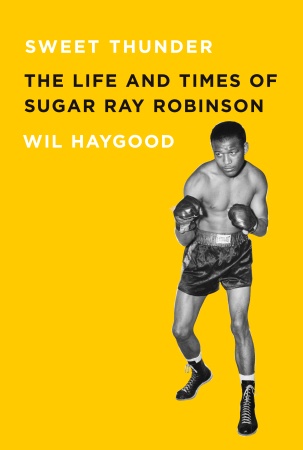
Sweet Thunder : The Life and Times of Sugar Ray Robinson. by Wil Haygood. Alfred A. Knopf. New York 2009

The third book in a historical trilogy of grand biographical narratives of legendary African American male cultural figures of the 20th century (the previous two in this series were about Sammy Davis, Jr, and Adam Clayton Powell) by a man whom many consider to be one of the finest U.S. biographers writing today, the African American journalist and historian Wil Haygood. Like all of Haygood's work this book is an extremely well written and absolutely riveting examination of the life and times of the elegant champion boxer, urbane sophisticate, consummate artist, and bon vivant Walker Smith Jr. (aka Sugar Ray Robinson) who was and is considered to this day to be the best boxer pound-for-pound in the history of boxing. Robinson was also an iconic African American figure whom both Miles Davis and Muhammad Ali among many others revered and considered a major role model and mentor.

Black Is The New White: A Memoir. by Paul Mooney. Simon & Schuster. New York 2010 (paperback edition)

Paul Mooney is a legendary figure in American comedy circles over the past four decades and was also the best friend, creative colleague, comrade in arms, and fellow artist of the late, great Richard Pryor (1940-2005) for over 40 years. Writer of some of Pryor's most famous and enduring monologues, routines, and skits as well as an iconic staff writer for a number of television series featuring African American performers (e.g. everything from "Sanford and Son" to "In Living Color", "The Chapelle Show" and Saturday Night Live, etc.) A scathing and extremely perceptive satirist, Mooney is widely considered to be one of the funniest and most socially conscious comedians in U.S. history. This powerful memoir details the fascinating story of the major struggles and triumphs of Mooney's life and career and provides an important contextual study of the evolution of American culture and public entertainment since the early 1960s.


At The Dark End of the Street: Black Women, Rape, and Resistance--A New History of the Civil Rights Movement from Rosa Parks To the Rise of Black Power. by Danielle McGuire. Alfred A. Knopf. New York 2010


This very important new book by the brilliant Detroit historian, professor, and scholar Danielle McGuire is destined to have a profound and lasting impact on our perceptions, knowledge, and understanding of the intellectual, cultural, and political history of the Civil Rights Movement of the 1940s, '50s. and '60s, and an even more transformative effect on our ongoing appreciation and study of the pervasive, extraordinary and thoroughly revolutionary role of African American women in modern U.S. history.

Colorblind: The Rise of Post-Racial Politics and the Retreat From Racial Equity. by Tim Wise. City Lights Books (Open Media Series). San Francisco 2010
Wrestling With The Left: The Making of Ralph Ellison's Invisible Man.
by Barbara Foley. Duke University Press. Durham 2010


Edward Said: A Legacy of Emancipation and Representation. Edited by Adel Iskander and Hakem Rustom. University of California Press. Berkeley 2010
Nelson Mandela: Conversations With Myself. by Nelson Mandela. Farrar, Straus Giroux. New York 2010


A Presidency In Peril: The Inside Story of Obama's Promise, Wall Street's Power, and The Struggle To Control Our Economic Future. by Robert Kuttner Chelsea Green Publishing. Vermont 2010


The Mendacity Of Hope: Barack Obama and the Betryal of American Liberalism. by Roger D. Hodge. Harper. New York 2010
Coltrane On Coltrane: The John Coltrane Interviews. edited by Chris DeVito. Chicago Review Press. Chicago 2010
The New Jim Crow: Mass Incarceration in the Age of Colorblindness. by Michelle Alexander. The New Press. New York 2010
 

The Obama Syndrome: Surrender At Home, War Abroad. by Tariq Ali. Verso. New York 2010

 
The Empire's New Clothes: Barack Obama in the Real World of Power. by Paul Street. Paradigm Publishers. Boulder 2010

The Bridge: The Life and Rise of Barack Obama. by David Remnick. Alfred A. Knopf. New York 2010


Griftopia: Bubble Machines, Vampire Squids, and the Long Con That Is Breaking America. by Matt Taibbi. Spiegel & Grau 2010

Bob Dylan in America. by Sean Wilentz. Doubleday. New York 2010
Digging: The Afro-American Soul of American Classical Music. by Amiri Baraka. University of California Press. Berkeley 2010 (Paperback edition)


Thelonious Monk: The Life and Times of an American Original. by Robin D.G. Kelley. Free Press 2010 (Paperback edition)


Tuesday, January 26, 2010

To Speak Truth To Power One Must Be Honest and Prepared To Deal With the Consequences Of Such Action

http://www.nytimes.com/2010/01/26/opinion/26herbert.html?th&emc=th

All,

"If the truth hurts then you'll be in pain and if the truth drives you crazy then you'll just be insane."

This is an excellent and timely piece by Bob Herbert. The president seriously needs to read it...He might learn something important about himself...

Kofi


OP-ED COLUMNIST

Obama’s Credibility Gap
By BOB HERBERT
Published: January 25, 2010
New York Times

Who is Barack Obama?

Americans are still looking for the answer, and if they don’t get it soon — or if they don’t like the answer — the president’s current political problems will look like a walk in the park.

Mr. Obama may be personally very appealing, but he has positioned himself all over the political map: the anti-Iraq war candidate who escalated the war in Afghanistan; the opponent of health insurance mandates who made a mandate to buy insurance the centerpiece of his plan; the president who stocked his administration with Wall Street insiders and went to the mat for the banks and big corporations, but who is now trying to present himself as a born-again populist.

Mr. Obama is in danger of being perceived as someone whose rhetoric, however skillful, cannot always be trusted. He is creating a credibility gap for himself, and if it widens much more he won’t be able to close it.

Mr. Obama’s campaign mantra was “change” and most of his supporters took that to mean that he would change the way business was done in Washington and that he would reverse the disastrous economic policies that favored mega-corporations and the very wealthy at the expense of the middle class and the poor.

“Tonight, more Americans are out of work, and more are working harder for less,” said Mr. Obama in his acceptance speech at the Democratic National Convention in August 2008. “More of you have lost your homes and even more are watching your home values plummet. More of you have cars you can’t afford to drive, credit card bills you can’t afford to pay, and tuition that’s beyond your reach.”

Voters watching the straight-arrow candidate delivering that speech, in the midst of the worst economic crisis since the Depression, would not logically have thought that an obsessive focus on health insurance would trump job creation as the top domestic priority of an Obama administration.

But that’s what happened. Moreover, questions were raised about Mr. Obama’s candor when he spoke about health care. In his acceptance speech, for example, candidate Obama took a verbal shot at John McCain, sharply criticizing him for offering “a health care plan that would actually tax people’s benefits.”

Now Mr. Obama favors a plan that would tax at least some people’s benefits. Mr. Obama also repeatedly said that policyholders who were pleased with their plans and happy with their doctors would be able to keep both under his reform proposals.

Well, that wasn’t necessarily so, as the president eventually acknowledged. There would undoubtedly be changes in some people’s coverage as a result of “reform,” and some of those changes would be substantial. At a forum sponsored by ABC News last summer, Mr. Obama backed off of his frequent promise that no changes would occur, saying only that “if you are happy with your plan, and if you are happy with your doctor, we don’t want you to have to change.”

These less-than-candid instances are emblematic of much bigger problems. Mr. Obama promised during the campaign that he would be a different kind of president, one who would preside over a more open, more high-minded administration that would be far more in touch with the economic needs of ordinary working Americans. But no sooner was he elected than he put together an economic team that would protect, above all, the interests of Wall Street, the pharmaceutical industry, the health insurance companies, and so on.

How can you look out for the interests of working people with Tim Geithner whispering in one ear and Larry Summers in the other?

Now with his poll numbers down and the Democrats’ filibuster-proof margin in the Senate about to vanish, Mr. Obama is trying again to position himself as a champion of the middle class. Suddenly, with the public appalled at the scandalous way the health care legislation was put together, and with Democrats facing a possible debacle in the fall, Mr. Obama is back in campaign mode. Every other utterance is about “fighting” for the middle class, “fighting” for jobs, “fighting” against the big bad banks.

The president who has been aloof and remote and a pushover for the health insurance and pharmaceutical industries, who has been locked in the troubling embrace of the Geithners and Summers and Ben Bernankes of the world, all of a sudden is a man of the people. But even as he is promising to fight for jobs, a very expensive proposition, he’s proposing a spending freeze that can only hurt job-creating efforts.

Mr. Obama will deliver his State of the Union address Wednesday night. The word is that he will offer some small bore assistance to the middle class. But more important than the content of this speech will be whether the president really means what he says. Americans want to know what he stands for, where his line in the sand is, what he’ll really fight for, and where he wants to lead this nation.

They want to know who their president really is.

Sunday, March 1, 2009

Obama, Race, and the Future of U.S. Politics

A Political essay by Bob Wing

Bob Wing is a writer and organizer in South Los Angeles, and former editor of ColorLines magazine and War Times newspaper


Barack Obama’s victory is indeed an historic breakthrough for U.S. politics. In a country that enforced a system of legalized racism until just 40 years ago, and that was founded on white supremacy, black slavery and Native genocide, the election of the first black president is cause for jubilation.

The significance of Obama’s victory is accentuated by the fact that not only is he an outstanding individual with liberal politics and a community organizer’s instincts, but he is also leading a potentially historic realignment of U.S. politics.

Such realignment could not come at a better time. Beset by a deep economic crisis, now is the time for progressive structural changes to the international and national socio-economic landscape. But such changes will be impossible without enormous political strength.

Whether President Obama can help orchestrate a turnaround of the economic crisis now facing the country, indeed the world, will be revealed in the coming years. But he has already made a major contribution to changing the pattern of U.S. politics, a pattern that was set by slavery and enabled conservative Republicans to dominate the presidency for the last forty years.

However, the development of a mass progressive movement with its own agenda will be critical to consolidating that realignment, and to winning systemic change in the year s to come.

The Color of Election 2008

The enormity of Obama’s victory has led to much hyperbole about the end of racism and the advent of a colorblind society. This notion deserves closer examination lest Obama’s victory become an obstacle, rather than an opening, to future racial progress.

Much of the press has focused on celebrating the willingness of many whites to elect a black president. But just how colorblind is the U.S. electorate?

Despite the fact that the Republicans had failed miserably, even on their own terms, and run the country virtually into the ground, whites still voted for McCain by 55 to 43. In stark contrast, blacks voted for Obama by 95 to 4, Latinos went for Obama by 66 to 32 and Asians backed Obama by 61 to 35. (1)

In 2008, the white vote was virtually identical to election 2000 and continued to exert a strong conservative pull on the electorate while the votes of peoples of color and young people of all races headed powerfully in a more progressive direction.

The color lines, in life and politics, are alive and well.

Indeed, peoples of color made the biggest shifts in their voting between 2004 and 2008. It was they who proved decisive in Obama’s victory. Left to white voters, John McCain would have won a landslide twelve-point victory.

African Americans voted for Obama by an astonishing 95 to 4, a fourteen-point swing for the Democrats compared to 2004. (2) Many a pundit has d ismissed this result as a knee-jerk racial solid arity vote for Obama. How soon they forget that the majority of black voters favored Hillary Clinton for the many months leading up to the Iowa primary.

Much of the mainstream media declared that Latinos were too racist to vote for Obama. They pointed to the large Latino primary vote for Clinton as “proof.”

Latinos resoundingly put the lie to these cynics by voting for Obama by 66 to 32, a huge sixteen-point swing to the Democrats compared to 2004. Even a 58 percent majority of Cubans in Florida, traditionally solidly Republican, went for Obama.

Latinas led the way toward Obama, casting 68 percent of their votes for him and only 30 percent for McCain. Latino voters under 30 went for Obama by 76 to 24, perhaps indicating the direction of future Latino voting patterns.

Asians swung Democratic by fourteen points over 2004, voting for Obama 61 to 35. The political trajectory of Asian voters has been striking. In 1992, Bill Clinton received only 31 percent of the Asian vote. Since then Asians have steadily moved Democratic, reaching a highpoint this year.

So much for the pundits who believed that Latinos and Asians would never unite behind black leadership. These results amount to a massive progressive motion by peoples of color.

Meanwhile the white vote swung toward Obama and the Democrats by five points compared to 2004. White voters under 30 were the only age group among whites to favor Oba ma. They voted for him by 54 to 44. All=2 0other whites voted for McCain by about 57 to 41.

The most anemic swing was made by white women, who voted for McCain by 53 to 46, moving a mere four points toward the Democrats, This was particularly disappointing in light of their ten point swing to Bush from 2000 to 2004, a change that accounted for Bush’s victory in that year.

White men favored McCain by a bigger margin, 57 to 41, but this represented a sizable nine-point swing to the Democrats compared to 2004 when they voted for Bush overwhelmingly, 62 to 37.

Overall, Obama carried the white vote in only 18 states, mostly in the Northeast and the West Coast.

The Changing Color of the Electorate

From a long-range point of view, the change in the racial composition of the electorate as a whole is perhaps even more important than the recent shifts towards the Democrats. In 1976 whites constituted 90 percent of the vote; in 2000 they still accounted for 81 percent. This year the white share of the vote fell to 74 percent, quite a dramatic change in a short time.

Just as surprising, the main group increasing its share of the electorate is not Latinos, but African Americans. Blacks constituted thirty percent of all new voters in 2004, and an even greater mobilization this year brought them to 13 percent of the overall vote, a thirty percent increase over 2000.

The sheer numbers of Latino and Asian voters have risen significan tly over the same period, but their percen tage share of the overall vote is virtually unchanged since 2000: nine percent for Latinos and two percent for Asians. (3)

Surprisingly, the percentage of the electorate that is under thirty years of age, regardless of color, also remained stable, at 17-18 percent. However, these voters increased their Democratic vote by 12 points compared to 2004, voting for Obama by 66 to 32. Young voters were also the main corps of Obama field organizers and their energy gave the campaign much of its movement-like quality.

Historic Realignment?

The true maverick in the 2008 campaign was not McCain who pursued the same old reactionary Republican Southern Strategy, but Obama whose bold strategy of fighting for the South and the Southwest, indeed all fifty states, ran counter to all previous electoral “common sense.”

His success was both astonishing and history making. He won the southwestern states of Nevada, Colorado and New Mexico, and the former Confederate slave states of Virginia, North Carolina and Florida, as well as former slave states Maryland and Delaware. The Latino vote was decisive for Obama in Nevada, New Mexico, Florida and Colorado.

In all, nine states switched from red to blue from 2004 to 2008: Virginia, North Carolina, New Mexico, Colorado, Florida, Indiana, Ohio, New Hampshire and Iowa. Obama lost Missouri by the narrowest of margins.

The historic nature of these victories is brought into sharp relief by the ac companying maps.

The first is=2 0the map of slave versus free states and territories just prior to the Civil War. The other is the electoral map of the 2004 election. Depressingly, they are almost identical: the former slave areas are almost universally Republican and the former free areas, with a couple of exceptions, are Democratic.

Almost 150 years after the abolition of slavery, the political patterns wrought by the “peculiar institution” still shape U.S. politics. Barack Obama’s campaign may mark the beginning of the end of this historic pattern, with tremendous implications for the future of U.S. politics. The main window into this change is the Electoral College.

Electoral College: a Pillar of Racism

It is not so surprising that slavery set the pattern of U.S. politics if one knows that the Electoral College itself was a product of slavery.

The Founding Fathers, led by slaveholders such as George Washington, Thomas Jefferson, James Madison and James Monroe, invented the Electoral College out of thin air to serve their interests.

They codified the notorious idea that slaves were non-humans, and thus deserving of no constitutional or human rights. The one exception to this rule was the stipulation that slaves were to be counted as three-fifths of a person, solely for the purpose of determining how many congressional representatives each state would be allotted. The three-fifths rule vastly increased the slave power in the House of Representatives20and therefore the Congress.

Th e Electoral College, in which each state receives a number of Electors equal to their congressional delegation, was invented as the institutional means to transfer that same pro-slavery congressional allocation to determining the presidency. Slaveholders held the presidency for 50 of the 72 years before Abraham Lincoln, who was elected in 1860, became the first U.S. president to oppose the expansion of slavery. The South, used to wielding political power through the selective enumeration of slaves, promptly seceded.

Since the end of slavery the Electoral College has remained a racist and conservative instrument. It has given the Republicans a running head start to win the presidency ever since reactionary Southerners switched en masse from the Democratic Party to the Republican Party in protest of the 1960s civil rights legislation.

As then-Republican strategist Kevin Phillips put it in 1970, “The more Negroes who register as Democrats in the South, the sooner the Negrophobe whites will quit the Democrats and become Republicans. That's where the votes are.”

Based on that switch, the Republicans adopted the notorious Southern Strategy that has enabled them to dominate the presidency for the last forty years. The Republicans learned to skillfully fashion a winning combination of the solidly Republican white southern voters with conservative and moderate whites in the Midwest and Southwest, through barely coded racist appeals.

The Southern Strategy has been (20) the glue with which the Republican Party20has united powerful corporate capitalists to conservative white workers, farmers, gun aficionados, small business owners and suburban homeowners.

Negating the Southern Black Vote

The racial bias embedded in the Electoral College system is the structural basis of the Republican’s Southern Strategy. The winner-take-all Electoral College system ensures, even requires, that about half of all voters of color be marginalized or totally ignored. (4)

About 53 percent of all blacks live in the southern states, and in 2000 and 2004 they voted about 90 percent Democratic. However, in those elections white Republicans out-voted them in every Southern state and every border state except Maryland.

As a result, every single southern Electoral College vote was awarded to Bush. While whites voted 54-42 for Bush nationally in 2000, southern whites gave him over 70 percent of their votes in both 2000 and 2004. They thus completely erased the massive Southern black vote for the Democrats in that region.

The Electoral College result was the same as if blacks, and other Democrats, in the South had not voted at all.

Similarly negated were the votes of millions of Native American and Latino voters who live in overwhelmingly white Republican states like Arizona, Nevada, Oklahoma, Utah, the Dakotas, Montana and Texas. Further, the peoples of Puerto Rico, the U.S. Virgin Islands, American Samoa and Guam, territories ruled by the U.S., get no Elector al College votes at all. The tyranny o f the white, conservative majority prevailed.

Compounding the reactionary and pro-Republican bias of the Electoral College, the system gives as much as three times as much weight to the mainly conservative and white Republicans in the rural states compared to states with large, racially diverse and majority Democratic populations.

For example, Wyoming has a little more than 240,000 voters and has three Electoral College votes: one for every 80,000 or so voters. By comparison large population states like California have about one Electoral College vote for every 220,000 voters.

Thus, the Electoral College system violates the principle of one person, one vote, drastically undermines the impact of the black vote and gives the Republicans a major advantage in presidential contests. Its abolition should be a key part of the progressive agenda.

Final Thoughts

Although the political dynamics of each of the nine states that turned from red to blue in 2008 need to be examined closely in their own right, it is likely that a minimum of three or four will move decisively into the Democratic column. A number of others that swung Democratic in 2008 have moved from being solidly red states to battleground states.

The solid Republican South and Southwest may be a thing of the past. In the wake of Obama’s hard-won victories, the Democrats have no excuse for essentially conceding these regions, as they have done for decades.

This will qualitatively shift the Electoral College math. Since 1968 the Electoral College has clearly favored the Republicans and the Democrats had to pull off an upset to win. Indeed, Bill Clinton won only because of the third party candidacy of Ross Perot. In the future, it may be that the Electoral College math will favor the Democrats, and that the Republicans can only win by staging an upset.

Just as important, for the first time in U.S. history the two political parties clearly represent the two broad wings of U.S. politics. At the national level, the southern reactionaries no longer hold the Democratic Party hostage.

This augurs well for the possibility that an Obama presidency may be able to gather the political strength to undertake a major restructuring of the economy in favor of working people and peoples of color in general, and to reorganize our foreign policy in a positive direction.

However, there is still a major political element missing from the political equation: a powerful independent peoples’ movement. In the 1930s the union movement, and especially the newly formed, radical CIO, was key to the New Deal. In the 1960s the civil rights movement was the driving force of the War on Poverty.

Herein lies the principal task of progressives in the coming period: to forge powerful independent, mass movements and organizations that can help shape the Obama coalition in a positive way. Our relative success or failure at this task may determine the future o f the U.S. and the world every bit20as much as President Obama himself.

-----------------------------------------------------
Footnotes

1. Unless otherwise noted all voting figures are drawn from the National Exit Polls for 2000, 2004 and 2008, as reported by CNN.

2. I calculate the “swing” or “change” in the vote in the traditional but rather confusing manner as the change in the vote differential. For example, in 2004 blacks voted Democratic by 88 to 11, a 77 point differential. In 2008, they voted Democratic by 95 to 4, a 91 point differential. The vote differential thus changed from 77 points to 91 points, so I report a 14-point “swing” or “change.”

3. No national exit poll numbers are available about Arab or Native American voters for any year.

4. Only Nebraska and Maine allocate their electoral votes more or less proportionate to the vote rather than on a statewide winner-take-all basis.

Monday, December 1, 2008

Change We Can Believe In?

http://www.samarmagazine.org/archive/article.php?id=273

All,

Anjali Kamat, a producer of "Democracy Now!" writes below on the grave necessity of "demanding something more" of our new President-elect.
Remember: Holding Obama accountable is identical to holding ourselves accountable. In fact political responsibility rests with all of us even more than it does with Barack. It is absolutely paramount that we not forget that fundamental fact and act accordingly...

Kofi


Editorial
Change We Can Believe In?

Obama's landslide victory marks the beginning of a new era, a moment of enormous possibility and for those of us fed up from the past eight years, long overdue prospect of change. But the change needs our continued efforts and work, unless we are willing to settle for another version of the Clinton years.

By Anjali Kamat
This piece originally appeared in Samar 30, published online November 10th, 2008.

It has been less than a week since Barack Hussein Obama's remarkable victory at the polls. Despite a vicious Republican campaign built on hate, ignorance, McCarthyite fear-mongering, and voter disenfranchisement efforts, the junior senator from Illinois won the election by more than 7.5 million votes. He overturned months of speculation about the "Bradley effect" and the projected disapproval of white working-class voters by winning swing states and turning even reliably red states like Indiana, Virginia, Colorado, and North Carolina blue for the first time in decades.

People across the country took to the streets in droves to celebrate President-elect Obama's victory on November 4th. The thousands of volunteers who devoted time and energy to promote his campaign and the millions who donated, many less than $200, are ecstatic. To all those for whom America has represented generations of racial injustice—slavery, lynching, the Ku Klux Klan, Jim Crow, Emmett Till, Amadou Diallo, Sean Bell, and the Jena Six—the election of America's first Black president marks the beginning of a new era. It's a moment of enormous possibility and the realization of a long-awaited dream that seemed unimaginable just a few years ago. And everyone fed up with the past eight years of the Bush-Cheney nightmare (and two elections stolen from under the noses of Gore and Kerry) is overjoyed at the long-overdue prospect of change.

But is this really "change we can believe in?" That depends on whether we're willing to settle for another version of the Clinton years or demand something more. Obama won the election primarily on economic issues but unless his millions-strong grassroots constituency holds his feet to the fire, the banks and the corporations will be the only remaining believers in this brand of change. Obama's support of the Treasury's bailout plan, his failure to call for a complete moratorium on foreclosures until just last month, and the fact that Clinton-era champions of deregulation (like Lawrence Summers and Robert Rubin) are among those getting the President-elect's ear on economic issues are not encouraging signs. Nor are Vice-President elect Joe Biden's close ties to the credit card industry.

Obama secured the support many progressives because he was the only Democratic Presidential candidate (besides Dennis Kucinich) who did not vote for the war in Iraq. But his ideas on how to end this trillion-dollar war remain ambiguous at best and his stated commitment to pursuing the "war on terror" in Afghanistan and extending it into Pakistan should be alarming to many. He has repeatedly called for increasing US troops inside Afghanistan and said he supports unilateral attacks on "Al Qaeda targets" inside Pakistan—with or without Pakistan's permission. On Iran, to his credit, he has said he would talk to the leadership but has also argued for increased pressure and tightened sanctions to halt Iran's nuclear program, "before Israel feels like its back is to the wall."

Israel may well be the Achilles heel of Obama's progressive pretensions. It's particularly disheartening given the respect he once held for reputed Palestinian intellectuals like Edward Said and Rashid Khalidi. A day after winning the Democratic nomination, Obama told AIPAC that Jerusalem should be Israel's undivided capital. Now, just two days after being elected President, he named the hawkish pro-Israeli Rahm Emmanuel as his chief of staff, crushing any hopes that the coming administration might have a fairer policy on the Palestinian question. In another questionable appointment, Obama just named Sonal Shah to his transition team. A co-founder of Indicorps, Shah was also, until 2001, the National Coordinator of the deeply sectarian Vishwa Hindu Parishad of America, tied to the Sangh Parivar in India.

On domestic issues of criminal justice and civil liberties, the Obama-Biden record is not very inspiring either. They both support the death penalty and Joe Biden is infamous for sponsoring some of the most punitive legislation in the war on drugs. Biden voted for the PATRIOT Act and Obama voted to reauthorize it. Equally shameful is the fact that Obama voted this July to cover up the Bush administration's illegal surveillance program. He supported Bush's expansion of warrantless wiretapping as well as retroactive immunity for telecom companies involved in the eavesdropping.

For eight years, people in the U.S. have endured an administration that has blatantly undermined the Constitution, rejected multilateralism and international law, launched illegal and inhumane wars, refused to believe in global warming, and engaged in unmatched lying, scheming, and corporate thieving. An Obama presidency will indeed be an improvement in many respects. But unless the inspired millions who brought him to power continue to believe their demands matter and insist on holding him accountable each step of the way, it will be Obama's corporate and hawkish friends who determine the domestic and foreign policies of the coming administration and our collective future.

"We will not be silent" became a popular slogan during the Bush years, signaling opposition to everything the Bush administration stood for. It is perhaps tempting to remain silent now, during this immediate after-glow of Obama's victory, to allow ourselves a moment of relief. While on the campaign trail Obama often quoted Dr. Martin Luther King to explain why he was running for President: because, he said, of the "fierce urgency of now," because "there is such a thing as being too late." Those words are from MLK's 1967 "Beyond Vietnam" speech, where Dr. King, unlike Obama, called for an unequivocal end to all American war-making and solidarity with people's struggles against injustice around the world. If we're serious about realizing the kind of change we actually do believe in, then it's worthwhile to remember the letter and spirit of MLK's words and speak up before its too late.

Anjali Kamat is a producer at Democracy Now!

Democracy Now!: Naomi Klein, Robert Kuttner and Michael Hudson Dissect Obama's New Economic Team & Stimulus Plan

http://i2.democracynow.org/2008/11/25/naomi_klein_robert_kuttner_and_michael


All,

This riveting discussion by Naomi Klein, Michael Hudson, and Robert Kuttner on Amy Goodman's excellent program "Democracy Now!" is by far the most honest and erudite yet of the actual severe contradictions, inadequacies, misrepresentations, and weaknesses within Obama's new highly problematic, deeply compromised, and politically elitist economic team, and what their historically complicit role in the current massive capitalist crisis of the thoroughly corrupt U.S. multinational banking system and heavily subsidized financial institutions (via criminally huge public bailouts) augurs for the general future of the American/global economy vis-a-vis Obama's professed and now empirically suspect vision of genuine social and economic "change". All three participants in this discussion are highly prescient and insightful in their respective invaluable analyses and Klein and Hudson are particularly sharp and hard hitting as well as highly skeptical about Obama's new selections of people like the largely conservative economic and financial staff policy advisors Larry Summers (formerly Clinton's Treasury Secretary and now head of Obama's National Economic Council) and Timothy Geithner, Obama's new Secretary of the Treasury (and Summers's former protege). Very disturbing to say the least. Clearly we all have a lot of political organizing work to do to help fully counter and critically oppose the so-called 'safe' and 'conventional wisdom' of Obama's new economic team and their policies...

Kofi

Sean Penn With Raul Castro & Hugo Chavez

All,

Amiri Baraka sent this to me yesterday. Fascinating interviews by Sean Penn (!) with Fidel's brother and Cuba's president Raul Castro and Venezuelan President Hugo Chavez...

Kofi


Sean Penn Sits Down With Raul Castro for First Foreign Interview


http://www.thenation.com/doc/20081215/penn

FOR IMMEDIATE RELEASE -- November 25, 2008 Cuban President Raul
Castro Sits Down with Sean Penn & The Nation for First Foreign
Interview Castro Speaks About President-Elect Obama, Guantanamo and
Relations With the Pentagon; Hugo Chavez Interviewed As Well.

In the cover story of this week's Nation Magazine, actor/filmmaker Sean
Penn questions Cuban President Raul Castro in his first-ever
interview with the foreign press. In the wide-ranging, seven-hour
conversation, Castro discusses his views of President-elect Barack
Obama, reflects on his role during the Bay of Pigs invasion and the
Cuban missile crisis, and shares details of the secret but ongoing
military relationship between the Pentagon and Cuba over Guantanamo.

Penn, making his second trip to Cuba, spoke to Castro at the
Presidential Palace in Havana with the knowledge of Castro's
brother Fidel. In the interview, Castro:

* Expands on the secret military relationship between the Pentagon
and Cuba, detailing a remarkably structured series of monthly
meetings, formal response plans to crises on=2 0the base, and even a
hotline and collaborative emergency response exercises held jointly
between the two militaries. This cooperation belies the popular image
of two antagonistic nations on the brink of conflict.

* Offered his prediction about the (then) upcoming U.S. Presidential
election. "If he is not murdered before November 4," he says of
Obama, "he will be your next President."

* Describes the drama and unheard details about the Cuban missile
crisis and the Bay of Pigs invasion.

* Responds forcefully to allegations of human rights violations and
suppression of free speech, and defends criticism of Cuba as a haven
for the drug trade.

* Extends a surprising olive branch to the United States, proposing a
summit with President-elect Barack Obama.

Castro, sipping tea and discussing films as well as politics with
Penn, is at times defiant towards the United States. "Iraq is a
child's game," he tells Penn, "compared with what would happen if the
U.S. invaded Cuba." Largely, though, Castro is respectful towards the
United States and it's people, challenging policy ("a blockade is an
act of war, so Americans prefer the term embargo") but expressing
generosity towards Americans. "The American people are among our
closest neighbors," he says. "We should respect each other. We have
never held anything against the American people. Good relations would
be mutually advantageous.20Perhaps we cannot solve all of our
problems, but we can solve a good many of them."

In the article, Conversations with Chavez and Castro, Penn also
travels to Venezuela as well as to Cuba with journalist Christopher
Hitchens and historian Douglas Brinkley. In Venezuela, the group
interviewed President Hugo Chavez at length, discussing his view of a
potential relationship with President Obama, the Monroe Doctrine and
human rights and freedom of expression under his presidency.

The article is online now at:
[http://www.thenation.com/doc/20081215/penn], along with a
VideoNation interview with Sean Penn.

Conversations With Chavez and Castro
By Sean Penn

This article appeared in the December 15, 2008 edition of The Nation.
November 25, 2008

*
This article is an adapted excerpt of the essay/interview "A Mountain of
Snakes," which will appear in full December 1 at HuffingtonPost.
com.

Sean Penn: Conversations with Raul Castro about Obama, Guantánamo and the
Pentagon; and with Venezuelan President Hugo Chávez on human rights in his
country and the next US administration.

Soon to be Vice President-elect Joe Biden was rallying the troops: "We can
no longer be energy dependent on Saudi Arabia or a Venezuelan dictator."
Well, I know what Saudi Arabia is. But having been to Venezue la in 2006,
touring slums, mixing with the wealthy opposition and spending days and
hours at its president's side, I wondered, without wondering, to whom
Senator Biden was referring. Hugo Chávez Frías is the democratically elected
president of Venezuela (and by democratically elected I mean that he has
repeatedly stood before the voters in internationally sanctioned elections
and won large majorities, in a system that, despite flaws and
irregularities, has allowed his opponents to defeat him and win office, both
in a countrywide referendum last year and in regional elections in
November). And Biden's words were the kind of rhetoric that had recently led
us into a life-losing and monetarily costly war, which, while toppling a
shmuck in Iraq, had also toppled the most dynamic principles upon which the
United States was founded, enhanced recruitment for Al Qaeda and
deconstructed the US military.

By now, October 2008, I had digested my earlier visits to Venezuela and Cuba
and time spent with Chávez and Fidel Castro. I had grown increasingly
intolerant of the propaganda. Though Chávez himself has a penchant for
rhetoric, never has it been a cause for war. In hopes of demythologizing
this "dictator," I decided to pay him another visit. By this time I had come
to say to friends in private, "It's true, Chávez may not be a good man. But
he may well be a great one."

Among those to whom I said this were historian Douglas Brinkley and Vanity
Fair columnist Christopher Hitchens. These two were perfect complements.
Brinkley is a notably steady thinker whose historian's code of ethics
assures adherence to supremely reasoned evidence. Hitchens, a wily
wordsmith, ever too unpredictable for predisposition, is a wild card by any
measure who in a talk-show throwaway once referred to Chávez as an "oil-rich
clown." Though I believe Hitchens to be as principled as he is brilliant, he
can be combative to the point of bullying, as he once was in severe comments
made about saintly antiwar activist Cindy Sheehan. Brinkley and Hitchens
would balance any perceived bias in my writing. Also, these are a couple of
guys I have a lot of fun with and affection for.

So I called Fernando Sulichin, an old friend and well-connected independent
film producer from Argentina, and asked that he get them vetted and approved
to interview Chávez. In addition, we wanted to fly from Venezuela to Havana,
and I asked that Fernando request on our behalf interviews with the Castro
brothers, most urgently Raúl, who had taken over the reins of power from an
ailing Fidel in February--and who had never given a foreign interview. I had
traveled to Cuba in 2005, when I had the good fortune of meeting Fidel, and
was eager for an interview with the new president. The phone rang at 2
o'clock the following after noon. "Mi hermano," Fernando said. "It is done."

Our flight from Houston to Caracas was delayed due to mechanical problems.
It was 1 o'clock in the morning, and as we waited, Hitchens paced. "Very
rarely does only one thing go wrong," he said. He must have liked the way it
sounded, because he said it again. He was God's pessimist. I said, "Hitch,
it's gonna be fine. They'll get us another plane, and we'll be there on
time." But God's pessimist is actually God's atheistic pessimist. And I
would later be reminded of the clarity in his atheism. Something else would
indeed go wrong. Well, right and wrong, as you'll find out. Within two
hours, we were taking off.

When we landed at Caracas airport, Fernando was there to greet us. He guided
us to a private terminal, where we waited for the arrival of President
Chávez, who would take us on a stumping tour for gubernatorial candidates on
the beautiful Isla Margarita.

We spent the next two days in Chávez's constant company, with many hours of
private meetings among the four of us. In the private quarters of the
president's plane, I find that on the subject of baseball Chávez's command
of English soars. When Douglas asks if the Monroe Doctrine should be
abolished, Chávez, wanting to choose his words carefully, reverts to Spanish
to detail the nuances of his position against this doctrine, which has
justified US interv ention in Latin America for almost two centuries. "The
Monroe Doctrine has to be broken," he says. "We've been stuck with it for
over 200 years. It always gets back to the old confrontation of Monroe
versus Bolívar. Jefferson used to say that America should swallow, one by
one, the republics of the south. The country where you were born was based
on an imperialistic attitude."

Venezuelan intelligence tells him that the Pentagon has plans for invading
his country. "I know they are thinking about invading Venezuela," Chávez
says. It seems he sees killing the Monroe Doctrine as a yardstick for his
destiny. "Nobody again can come here and export our natural resources." Is
he concerned about the US reaction to his bold statements about the Monroe
Doctrine? He quotes Uruguayan freedom fighter José Gervasio Artigas: "With
the truth, I don't offend or fear."

Hitchens sits quietly, taking notes throughout the conversation. Chávez
recognizes a flicker of skepticism in his eye. "CREES-to-fer, ask me a
question. Ask me the hardest question." They share a smile. Hitchens asks,
"What's the difference between you and Fidel?" Chávez says, "Fidel is a
communist. I am not. I am a social democrat. Fidel is a Marxist-Leninist. I
am not. Fidel is an atheist. I am not. One day we discussed God and Christ.
I told Castro, I am a Christian. I believe in the Social Gospels of Christ.
He doesn't. Just doesn't. More than once, Castro told me that Venezuela is
not Cuba, and we are not in the 1960s.

"You see," Chávez says, "Venezuela must have democratic socialism. Castro
has been a teacher for me. A master. Not on ideology but on strategy."
Perhaps ironically, John F. Kennedy is Chávez's favorite US president. "I
was a boy," he says. "Kennedy was the driving force of reform in America."
Surprised by Chávez's affinity for Kennedy, Hitch chimes in, referring to
Kennedy's counter-Cuba economic plan for Latin America: "The Alliance for
Progress was a good thing?" "Yes," says Chávez. "The Alliance for Progress
was a political proposal to improve conditions. It was aimed at lowering the
social difference between cultures."

Conversation among the four of us continues on buses, at rallies and at
dedications throughout Isla Margarita. Chávez is tireless. He addresses
every new group for hours on end under a blistering sun. At most he'll sleep
four hours at night, spending the first hour of his morning reading news of
the world. And once he's on his feet, he's unstoppable despite heat,
humidity and the two layers of revolutionary red shirts he wears.

I had three primary motivations for this trip: to include the voices of
Brinkley and Hitchens, to deepen my understanding of Chávez and Venezuela
and excite my writing hand, and to enlist Chávez's support in encouraging
=0 A the Castro brothers to meet with the three of us in Havana. While my
understanding through Fernando was that this third piece of the puzzle had
been approved and confirmed, somewhere in the cultural, language and
telephonic exchanges there had been a misunderstanding. Meanwhile, CBS News
was expecting a report from Brinkley, Vanity Fair was expecting one from
Hitchens and I was writing on behalf of The Nation.

On our third day in Venezuela, we thanked President Chávez for his time, the
four of us standing among security personnel and press at the Santiago
Marino Airport on Isla Margarita. Brinkley had a final question, and so did
I. "Mr. President," he said, "if Barack Obama is elected president of the
United States, would you accept an invitation to fly to Washington and meet
with him?" Chávez immediately answered, "Yes."

When it was my turn, I said, "Mr. President, it is very important for us to
meet with the Castros. It is impossible to tell the story of Venezuela
without including Cuba--and impossible to tell the story of Cuba without the
Castros." Chávez promised us that he would call President Castro the moment
he got on his plane and ask on our behalf but warned us that it was unlikely
big brother Fidel would be able to respond so quickly, as he was doing a lot
of writing and reflecting these days, not seeing a lot of people. He could
make no promises about Ra úl either. Chávez boarded his plane, and we watched
him fly away.

The next morning we took off for Havana. Full disclosure: we were loaned an
airplane through the Venezuelan Ministry of Energy and Petroleum. If someone
wants to refer to that as a payoff, be my guest. But when you read the next
report from a journalist flying on Air Force One, or hopping on board a US
military transport plane, be so kind as to dismiss that article as well. We
appreciated the ride in all its luxury, but our reporting remains
uninfluenced.

'Very Rarely Does Only One Thing Go Wrong'

For me the personal stakes were pretty high. Getting on the plane to Havana
shy of that guarantee of access to Raúl Castro was making me anxious.
Christopher had pulled out of a few important speaking engagements at the
last minute to make the trip. It was not his practice to leave others
holding the bag. So for him, it was buy or bust, and he was becoming
agitated. Douglas, a professor of history at Rice University, would have to
return imminently for lecture obligations. Fernando was feeling the weight
of our expectation that he'd be our battering ram. And me, well, I was
depending on the call to Castro from Chávez, both to get the interview and
to save my ass with my companions.

We landed in Havana around noon and were met on the tarmac by Omar Gonzalez
Jimenez, preside nt of the Cuban Film Institute, and Luis Alberto Notario,
head of the institute's international co-production wing. I'd spent time
with both of them on my earlier trip to Cuba. We started catching up on
personal matters on the walk to the customs office, until Hitch stepped
forward and unabashedly demanded of Omar, "Sir, we must see the president!"
"Yes," Omar said. "We are aware of the request, and word has been passed to
the president. We are still awaiting his response."

For the rest of that day and into the following afternoon, we tortured our
hosts with the incessant drumbeat: Raúl, Raúl, Raúl. I assumed if Fidel was
up to it and could make the time, he would call. And if not, I remained
appreciative of our prior meeting and said as much in a note I passed to him
through Omar. Raúl I only knew about through what I'd read, and I hadn't a
clue as to whether or not he'd see us.

Cubans are a particularly warm and hospitable people. As our hosts took us
around the city, I noticed that the number of American 1950s cars had
diminished even in the few years since my last trip, giving way to smaller
Russian designs. On a sweep by the invasive-looking US Interests Section on
the Malecón, where waves breaking against the sea wall shower passing cars,
I noticed something almost indescribable about the atmosphere in Cuba. It is
the palpable presence of architectura l and living human history on a small
plot of land surrounded by water. Even the visitor feels the spirit of a
culture that proclaims, in various ways, "This is our special place."

We snaked through Old Havana, and in a glass-encased display outside the
Museum of the Revolution we saw the Granma, the boat used to transport Cuban
revolutionaries from Mexico in 1956. We moved on to the Palace of Fine Arts,
with its collection of passionate and political pieces from a cross section
of Cuba's deep talent pool. We then toured the Higher Institute of Arts and
later went to dinner with National Assembly President Ricardo Alarcón and
Roberto Fabelo, a painter they had invited after I'd expressed appreciation
of his work at the art museum that afternoon. By midnight there had still
been no word from Raúl Castro. After that we were taken to the protocol
house, where we would lay our heads till dawn.

By noon of the following day, the clock was ticking loudly in our ears. We
had sixteen hours left in Havana before we would have to head to the airport
to catch our flights back home. We were sitting around a table at La
Castellana, an upscale Old Havana eatery, with a large group of artists and
musicians who, led by the famed Cuban painter Kcho, had established Brigada
Martha Machado, an organization of volunteers aiding victims of Hurricanes
Ike and Gustav on the Isle of Youth. The brigade has the full support of
government dollars, airplanes and staff that would be the envy of our Gulf
Coast volunteers after Hurricane Katrina. Also joining us for lunch was
Antonio Castro Soto del Valle, a handsome young man of humble character who
is the 39-year-old son of Fidel Castro. Antonio is a doctor and chief medic
for the Cuban national baseball team. I had a brief but pleasant chat with
him and re-emphasized our Raúl agenda.

The clock was no longer ticking. It was pounding. Omar told me we would be
hearing the decision of the president quite soon. Fingers crossed, Douglas,
Hitch, Fernando and I went back to the protocol house to get our bags packed
in advance. By 6 pm, we were on a ten-hour countdown. I was sitting
downstairs in the living room, reading in the hazy late-afternoon light.
Hitch and Douglas were in their upstairs quarters, I assumed napping to
offset anxiety. And on the couch beside me was Fernando, snoring away.

Then Luis appeared at our open front door. I glanced over the top of my
glasses as he gave me a very direct nod. Without words, I pointed
questioningly up the stairs to where my companions lay. But Luis shook his
head apologetically. "Only you," he said. The president had made his
decision.

I could hear Hitch's words of doubt echo in my head, "Very rarely does only
one thing go wrong." Was he talking about me? Et mi, Br ute? Nonetheless, I
grabbed at my back pocket to make sure I had my pad of Venezuela notes,
checked for my pen, pocketed my specs and headed out with Luis. Just before
I shut the door of the waiting car, I heard Fernando's voice calling after
me. "Sean!" We drove away.

I'm Off to See the Wizard

Stateside, Cuban President Raúl Castro, the island's former minister of the
Armed Forces, has been branded a "cold militarist" and a "puppet" of Fidel.
But the once ponytailed young revolutionary of the Sierra Maestra is proving
the snakes wrong. Indeed, "Raulism" is on the rise alongside a recent
industrial and agricultural economic boom. Fidel's legacy, like that of
Chávez, will depend upon the sustainability of a flexible revolution, one
that could survive its leader's departure by death or resignation. Fidel has
once again been underestimated by the North. In the selection of his brother
Raúl, he has put the day-to-day policy-making of his country into formidable
hands. In a report by the Council on Hemispheric Affairs, US State
Department spokesman John Casey acknowledges that Raulism could lead to
"greater openness and freedom for the Cuban people."

Soon enough I'm sitting at a small polished table in a government office
with President Castro and a translator. "Fidel called me moments ago," he
tells me. "He wants me to call him after we have spoken." There is a humor
i n Raúl's voice that recalls a lifetime of affectionate tolerance for his
big brother's watchful eye. "He wants to know everything we speak about," he
says with the chuckle of the wise. "I never liked the idea of giving
interviews," he says. "One says many things, but when they are published,
they become shortened, condensed. The ideas lose their meaning. I was told
you make long movies. Maybe you will make long journalism as well." I
promise him I'll write as fast as I can, and print as much as I write. He
tells me he's informally promised his first interview as president
elsewhere, and not wanting to multiply what could be construed as an insult,
he singled me out from my companions.

Castro and I share a cup of tea. "Forty-six years ago today, at exactly this
time of day, we mobilized troops, Alameda in the West, Fidel in Havana, me
in Areda. It had been announced at noon in Washington that President Kennedy
would give a speech. This was during the missile crisis. We anticipated that
the speech would be a declaration of war. After his humiliation at the Bay
of Pigs, the pressure of the missiles [which Castro claims were strictly
defensive] would represent a great defeat to Kennedy. Kennedy would not
stand with that defeat. Today we study US candidates very carefully,
focusing on McCain and Obama. We look at all the old speeches. Particularly
those made in Florida, where opposing Cuba=2 0has become a for-profit business
for many. In Cuba we have one party, but in the US there is very little
difference. Both parties are an expression of the ruling class." He says
today's Miami Cuban lobby members are descendants of Batista-era wealth, or
international landowners "who'd only paid pennies for their land" while Cuba
had been under absolute US rule for sixty years.

"The 1959 land reform was the Rubicon of our revolution. A death sentence
for our US relations." Castro seems to be sizing me up as he takes another
sip of his tea. "At that moment, there was no discussion about socialism, or
Cuba dealing with Russia. But the die was cast."

After the Eisenhower administration bombed two vessel-loads of guns headed
for Cuba, Fidel reached out to old allies. Raúl says, "We asked Italy. No!
We asked Czechoslovakia. No! Nobody would give us weapons to defend
ourselves because Eisenhower had put pressure on them. So by the time we got
weapons from Russia, we had no time to learn how to use them before the US
attacked at the Bay of Pigs!" He laughs and excuses himself to an adjacent
restroom, briefly disappearing behind a wall, only to immediately pop back
into the room, joking, "At 77, this is the fault of the tea."

Joking aside, Castro moves with the agility of a young man. He exercises
every day, his eyes are bright and his voice is strong. He picks up where he
left off. "You know, Sean, there was a famous picture of Fidel from the Bay
of Pigs invasion. He is standing in front of a Russian tank. We did not yet
know even how to put those tanks in reverse. So," he jokes, "retreat was no
option!" So much for the "cold militarist." Raúl Castro was warm, open,
energetic and sharp of wit.

I return to the subject of US elections by repeating the question Brinkley
had asked Chávez: Would Castro accept an invitation to Washington to meet
with a President Obama, assuming he won in the polling, only a few weeks
away? Castro becomes reflective. "This is an interesting question," he says,
followed by a rather long, awkward silence. Until: "The US has the most
complicated election process in the world. There are practiced election
stealers in the Cuban-American lobby in Florida..." I chime in, "I think
that lobby is fracturing." And then, with the certainty of a die-hard
optimist, I say, "Obama will be our next president." Castro smiles,
seemingly at my naïveté, but the smile disappears as he says, "If he is not
murdered before November 4, he'll be your next president." I note that he
had still not answered my question about meeting in Washington. "You know,"
he says, "I have read the statements Obama has made, that he would preserve
the blockade." I interject, "His term was embargo." "Yes," Castro says,
"blockade is an act of war, so A mericans prefer the term embargo, a word
that is used in legal proceedings...but in either case, we know that this is
pre-election talk, and that he has also said he is open to discussion with
anyone."

Raúl interrupts himself: "You are probably thinking, Oh, the brother talks
as much as Fidel!" We laugh. "It is not usually so, but you know,
Fidel--once he had a delegation here, in this room, from China. Several
diplomats and a young translator. I think it was the translator's first time
with a head of state. They'd all had a very long flight and were jet-lagged.
Fidel, of course, knew this, but still he talked for hours. Soon, one near
the end of the table, just there [pointing to a nearby chair], his eyes
begin to get heavy. Then another, then another. But Fidel, he continued to
talk. Soon all, including the highest-ranking of them, to whom Fidel had
been directly addressing his words, fell sound asleep in their chairs. So
Fidel, he turns his eyes to the only one awake, the young translator, and
kept him in conversation till dawn." By this time in the story, both Raúl
and I were in stitches. I'd only had the one meeting with Fidel, whose
astonishing mind and passion bleed words. But it was enough to get the
picture. Only our translator was not laughing, as Castro returned to the
point.

"In my first statement after Fidel fell ill, I said we are willing to<> discuss our relationship with the US on equal footing. Later, in 2006, I
said it again in an address at the Revolutionary Square. I was laughed at by
the US media--that I was applying cosmetics over dictatorship." I offer him
another opportunity to speak to the American people. He answers, "The
American people are among our closest neighbors. We should respect each
other. We have never held anything against the American people. Good
relations would be mutually advantageous. Perhaps we cannot solve all of our
problems, but we can solve a good many of them."

He paused now, slowly considering a thought. "I'll tell you something, and
I've never said it publicly before. It had been leaked, at some point, by
someone in the US State Department, but was quickly hushed up because of
concern about the Florida electorate, though now, as I tell you this, the
Pentagon will think me indiscreet."

I wait with bated breath. "We've had permanent contact with the US military,
by secret agreement, since 1994," Castro tells me. "It is based on the
premise that we would discuss issues only related to Guantánamo. On February
17, 1993, following a request by the United States to discuss issues related
to buoy locators for ship navigations into the bay, was the first contact in
the history of the revolution. Between March 4 and July 1, the Rafters
Crisis took place. A military-to-military hot line was established, and on
May 9, 1995, we agreed to monthly meetings with primaries from both
governments. To this day, there have been 157 meetings, and there is a taped
record of every meeting. The meetings are conducted on the third Friday of
every month. We alternate locations between the American base at Guantánamo
and in Cuban-held territory. We conduct joint emergency-response exercises.
For example, we set a fire, and American helicopters bring water from the
bay, in concert with Cuban helicopters. [Before this] the American base at
Guantánamo had created chaos. We had lost border guards, and have graphic
evidence of it. The US had encouraged illegal and dangerous emigration, with
US Coast Guard ships intercepting Cubans who tried to leave the island. They
would bring them to Guantánamo, and a minimal cooperation began. But we
would no longer play guard to our coast. If someone wanted to leave, we
said, Go ahead. And so, with the navigation issues came the beginning of
this collaboration. Now at the Friday meetings there is always a
representative of the US State Department." No name given. He continues,
"The State Department tends to be less reasonable than the Pentagon. But no
one raises their voice because...I don't take part. Because I talk loud. It
is the only place in the world where these two militaries meet in peace."

"What about Guantánamo?" I ask. "I'll tell you the truth,"=2 0Castro says. "The
base is our hostage. As a president, I say the US should go. As a military
man, I say let them stay." Inside, I'm wondering, Have I got a big story to
break here? Or is this of little relevance? It should be no surprise that
enemies speak behind the scenes. What is a surprise is that he's talking to
me about it. And with that, I circle back to the question of a meeting with
Obama. "Should a meeting take place between you and our next president, what
would be Cuba's first priority?" Without a beat, Castro answers, "Normalize
trade." The indecency of the US embargo on Cuba has never been more evident
than now, in the wake of three devastating hurricanes. The Cuban people's
needs have never been more desperate. The embargo is simply inhumane and
entirely unproductive. Raúl continues, "The only reason for the blockade is
to hurt us. Nothing can deter the revolution. Let Cubans come to visit with
their families. Let Americans come to Cuba." It seems he's saying, Let them
come see this terrible Communist dictatorship they keep hearing about in the
press, where even representatives of the State Department and prominent
dissidents acknowledge that in a free and open election in Cuba today, the
ruling Communist Party would win 80 percent of the electorate. I list
several US conservatives who have been critical of the embargo, from the
late economist Milton Friedman, to Colin Powell, to20even Texas Republican
Senator Kay Bailey Hutchison, who said, "I have believed for a while that we
should be looking for a new strategy for Cuba. And that is, opening more
trade, especially food trade, especially if we can give the people more
contact with the outside world. If we can build up the economy, that might
make the people more able to fight the dictatorship." Castro, ignoring the
slight, responds boldly, "We welcome the challenge."

By now, we have moved on from the tea to red wine and dinner. "Let me tell
you something," he says. "We have newly advanced research that strongly
suggests deepwater offshore oil reserves, which US companies can come and
drill. We can negotiate. The US is protected by the same Cuban trade laws as
anyone else. Perhaps there can be some reciprocity. There are 110,000 square
kilometers of sea in the divided area. God would be unfair not to give some
oil to us. I don't believe he would deprive us this way." Indeed, the US
Geological Survey speculates something in the area of 9 billion barrels of
oil and 21 trillion cubic feet of natural gas reserves in the North Cuba
Basin. Now that he's improved recently rocky relations with Mexico, Castro
is looking at also improving prospects with the European Union. "EU
relations should improve with Bush's exit," he states confidently. "And the
US?" I ask. "Listen," he says, "we are as patient as the Chinese. Seven ty
percent of our population was born under the blockade. I am the
longest-standing minister of Armed Forces in history. Forty-eight and a half
years until last October. That's why I'm in this uniform and continue to
work from my old office. In Fidel's office, nothing has been touched. At the
Warsaw Pact military exercises, I was the youngest, and the one who had been
there the longest. Then, I was the oldest, and still the one who had been
there the longest. Iraq is a child's game compared with what would happen if
the US invaded Cuba." After another sip of wine, Castro says, "Preventing a
war is tantamount to winning a war. This is in our doctrine."

With our dinner finished, I walk with the president through the sliding
glass doors onto a greenhouse-like terrace with tropical plants and birds.
As we sip more wine, he says, "There is an American movie--the elite are
sitting around a table, trying to decide who will be their next president.
They look outside the window, where they see the gardener. Do you know the
movie I'm talking about?" "Being There," I say. "Yes!" Castro responds
excitedly, "Being There. I like this movie very much. With the United
States, every objective possibility exists. The Chinese say: 'On the longest
path, you start with the first step.' The US president should take this step
on his own, but with no threat to our sovereignty. That is not negotiable.
We ca n make demands without telling each other what to do within our
borders."

"Mr. President," I say, "watching the last presidential debate in the United
States, we heard John McCain encouraging the free-trade agreement with
Colombia, a country where death squads are notorious and assassinations of
labor leaders have been occurring, and yet relations with the United States
continue to get closer, as the Bush administration is currently attempting
to push that agreement through Congress. As you know, I've just come from
Venezuela, which, like Cuba, the Bush administration considers an enemy
nation, though of course we buy a lot of oil from them. It occurred to me
that Colombia may reasonably become our geographically strategic partner in
South America, as Israel is in the Middle East. Would you comment on that?"

He considers the question with caution, speaking in a slow and metered tone.
"Right now," he says, "we have good relations with Colombia. But I will say
that if there is a country in South America where an environment exists that
is vulnerable to that...it is Colombia." Thinking of Chávez's suspicion of
US intentions to intervene in Venezuela, I take a deep breath.

The hour was getting late, but I didn't want to leave without asking Castro
about allegations of human rights violations and alleged narco-trafficking
facilitated by the Cuban government. A 2007 report by Human Rights Watch
states that Cuba "remains the one country in Latin America that represses
nearly all forms of political dissent." Furthermore, there are about 200
political prisoners in Cuba today, approximately 4 percent of whom are
convicted of crimes of nonviolent dissent. As I await Castro's comments, I
can't help but think of the nearby US prison at Guantánamo and the
horrendous US offenses against human rights there.

"No country is 100 percent free of human rights abuses," Castro tells me.
But, he insists, "reports in the US media are highly exaggerated and
hypocritical." Indeed, even high-profile Cuban dissidents, such as Eloy
Gutiérrez Menoyo, acknowledge the manipulations, accusing the US Interests
Section of gaining dissident testimony through cash payoffs. Ironically, in
1992 and '94, Human Rights Watch also described lawlessness and intimidation
by anti-Castro groups in Miami as what author/journalist Reese Erlich termed
"violations normally associated with Latin American dictatorships."

Having said that, I'm a proud American and infinitely aware that if I were a
Cuban citizen and were to write an article such as this about the Cuban
leadership, I could be jailed. Furthermore, I'm proud that the system set up
by our founding fathers, while not exactly intact today, was never dependent
on just one great leader per epoch. These things remain in question for the
romantic heroes of Cuba and Venezuela. I consider20mentioning this, and
perhaps should have, but I've got something else on my mind.

"Can we talk about drugs?" I ask Castro. He responds, "The United States is
the largest consumer of narcotics in the world. Cuba sits directly between
the United States and its suppliers. It is a big problem for us.... With the
expansion of tourism, a new market has developed, and we struggle with it.
It is also said that we allow narco-traffickers to travel through Cuban
airspace. We allow no such thing. I'm sure some of these planes get by us.
It is simply due to economic restrictions that we no longer have functioning
low-altitude radar."

While this may sound like tall-tale telling, not so, according to Col.
Lawrence Wilkerson, a former adviser to Colin Powell. Wilkerson told Reese
Erlich in a January interview, "The Cubans are our best partners in the
counter-drug and counter-terror war in the Caribbean. Even better than
Mexico. The military looked at Cuba as a very cooperative partner."

I want to ask Castro my unanswered question a final time, as our mutual body
language suggests we've hit the witching hour. It is after 1 am, but he
initiates. "Now," he says, "you asked if I would accept to meet with [Obama]
in Washington. I would have to think about it. I would discuss it with all
my comrades in the leadership. Personally, I think it would not be fair that
I be the first to visi t, because it is always the Latin American presidents
who go to the United States first. But it would also be unfair to expect the
president of the United States to come to Cuba. We should meet in a neutral
place."

He pauses, putting down his empty wine glass. "Perhaps we could meet at
Guantánamo. We must meet and begin to solve our problems, and at the end of
the meeting, we could give the president a gift...we could send him home
with the American flag that waves over Guantánamo Bay."

As we exit his office, we are followed by staff as President Castro takes me
down the elevator to the lobby and walks me to my waiting car. I thank him
for the generosity of his time. As my driver puts the car in gear, the
president taps on the window beside me. I roll it down as the president
checks his watch, realizing that seven hours have passed since we began the
interview. Smiling, he says, "I will call Fidel now. I can promise you this.
When Fidel finds I have spoken to you for seven hours, he will be sure to
give you seven and a half when you return to Cuba." We share a laugh and a
last handshake.

It had rained earlier in the night. In this early-hour darkness, our tires
streaming over the wet pavement on a quiet Havana morning, it strikes me
that the most basic questions of sovereignty offer substantial insight into
the complexities of US antagon ism toward Cuba and Venezuela, as well as
those countries' policies. They've only ever had two choices: to be
imperfectly ours, or imperfectly their own.

Viva Cuba. Viva Venezuela. Viva USA.

When I got back to the protocol house, it was nearly 2 am. My old friend
Fernando, looking much the worse for wear, had waited up. My companions had
had quite a night. Poor Fernando had taken the brunt of their frustration.
They hadn't known where I'd gone, nor why I had left them behind. And the
remaining Cuban officials they'd been able to contact had insisted they stay
put, should either of the Castro brothers spontaneously offer an audience.
So they had also missed out on a last Cuban night on the town. After filling
me in, Fernando went to get a couple hours' sleep. I stayed up reviewing my
notes and was first at the breakfast table, at 4:45 am. When Douglas and
Hitch ambled down the stairs, I put the edge of the tablecloth over my head
in mock shame. I guess, under the circumstances, it was a bit early (in more
than just the hour) to be testing their humor. The joke didn't play. While
Fernando took a separate flight to Buenos Aires, we had a quiet breakfast
and a quiet flight back to home sweet home.

When we arrived in Houston, I realized I'd underestimated the thick skin of
these two road-worn professionals. Whatever ice I'd perceived earlier had
melted. We said ou r goodbyes, celebrating what had been a thrilling several
days. Neither had been so catty as to inquire into the content of my
interview, but Christopher headed to his eastbound connection with a parting
word, "Well...I guess we'll read about it."

¡Sí, Se Puede!

I sat on the edge of my bed with my wife, son and daughter, tears streaming
down my face, as Barack Obama spoke for the first time as the
president-elect of the United States of America. I closed my eyes and
started to see a film in my head. I could hear the music too, appropriately
the Dixie Chicks covering a Fleetwood Mac song over slow-motion images in
montage. There they were: Bush, Hannity, Cheney, McCain, Limbaugh and
Robertson. I saw them all. And the song was rising as the image of Sarah
Palin took over the screen. Natalie Maines sweetly sang,

And I saw my reflection in the snow-covered hills
till the landslide brought me down.
Landslide brought me down...


About Sean Penn:

Actor/filmmaker Sean Penn's pieces have appeared in the San Francisco

Chronicle, Time, Rolling Stone and at HuffingtonPost.com, among others.