Showing posts with label Frank Rich. Show all posts

Sunday, May 27, 2012

Frank Rich On America's Ongoing 'Post-Racial' Farce and Its Profound and Disturbing Consequences For U.S. Culture and Social Reality

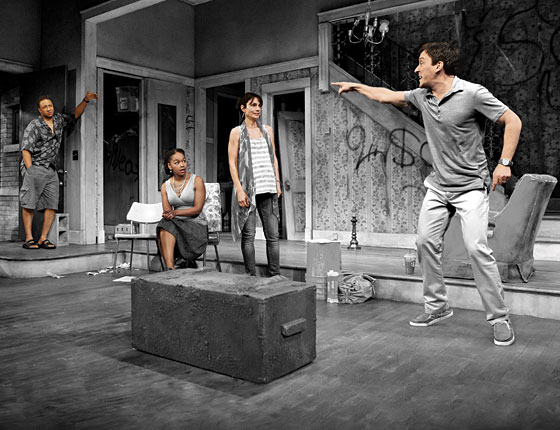
2009: Clybourne Park
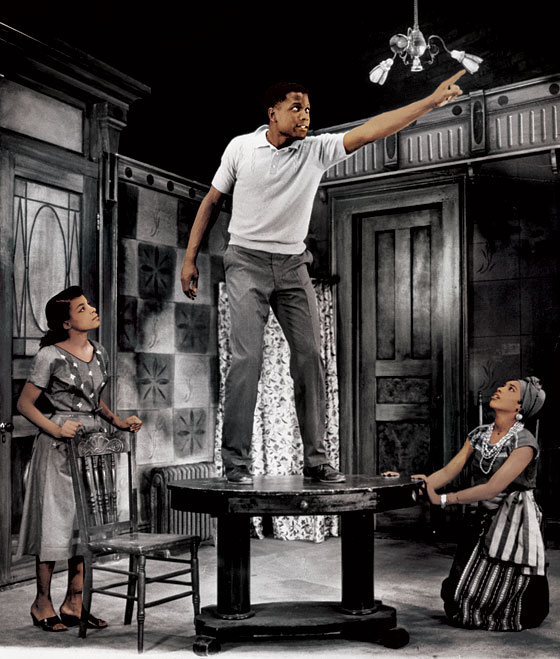
1959: A Raisin in the Sun
(Photo: Bettmann/Corbis)


"History repeats itself. The first time as tragedy, the second time as farce"
--Karl Marx


http://nymag.com/frank-rich/

http://nymag.com/print/?/news/frank-rich/racism-2012-5/index1.html

"That Norris takes a bleak—albeit frequently hilarious—view of our racial state of affairs is not hard to fathom. For all the national chatter about a “post-racial America” following the 2008 election, America seems more obsessed with race than ever, if less honest about it, since Obama strode onto the national stage. If the official milestones of his administration thus far include the passage of the stimulus and the Affordable Care Act, the killing of Osama bin Laden, and the endorsement of gay marriage, they have often been upstaged by the red-letter incidents of racial conflict that have steadily rolled out on a parallel track. Just a short list would include: the arrest of Henry Louis Gates Jr. in Cambridge; the hysterical tea-party rally against health-care reform that showered obscenities on black congressmen entering the Capitol; the ousting of the African- American Department of Agriculture worker Shirley Sherrod after she was libeled as a racist; the execution of Troy Davis in Georgia; the killing of Trayvon Martin in Florida; and, this month, the protest of more than 40 percent of West Virginia Democratic-primary voters, who pulled the lever for an obscure white federal- prison inmate rather than endorse a second run for the incumbent president of their own party. Last week brought the pièce de résistance: the Times revelation of a proposed super-PAC TV commercial that would slime Obama as pretending to be a “metrosexual black Abe Lincoln.” With material this good, it’s hard for a playwright to keep up. But Norris comes close."
--Frank Rich
All,

As I've said many times before our ongoing identification with, and ongoing submission to, the reigning oppressive ideologies and practices of our present historical epoch is yet another massive indictment of the typically unrestrained hatred, hubris, and hypocrisy of our current society and culture and that its historically vile and always pervasive racism, sexism, classism, and homophobia has become even MORE blatantly transparent since Obama was elected President in 2008. The great Frank Rich who has the extraordinary distinction of being not only the major political journalist of our time but also the best American drama critic of the past 30 years reveals in the following essay/review on the Pulitzer Prize winning playwright Bruce Norris's play Clybourne Park, a scathing satire and theatrical attack on the lies, contradictions, hypocrisies, bad faith, phony posturing, mindless cruelty, delusional platititudes, venal demagoguery, and false consciousness permeating so-called "race relations" in the United Hates today, that what we are utterly failing to honestly confront both in our art and our politics today is the stark REALITY of how and why White Supremacy as doctrine and practice (and its always equally tenacious partners-in-crime Capitalism and Patriarchy) continues to RULE AND DOMINATE American society and culture in all of its social, institutional, and spiritual aspects and dimensions. Please read the following masterful essay and pass the word--especially to ALL AMERICAN ARTISTS AND THE GENERAL CITIZENRY...

Kofi


Post-Racial Farce

Since America elected its first black president, the conversation on race has turned just as loopy as the hilarious and audacious Clybourne Park.

By Frank Rich
May 20, 2012
NEW YORK


Eight times a week, audiences at the play Clybourne Park are laughing at jokes as racist as any ever heard in a modern Broadway theater. While the audiences are mostly (though not exclusively) white, the racism onstage does meet a basic diversity quota. No sooner does a white man ask and answer the question “What’s long and hard on a black man?” than he is countered by a black female antagonist posing the riddle “Why is a white woman like a tampon?” Unlike the intentionally tasteless gags minted by the South Park guys at The Book of Mormon around the corner, these jokes were not written to sow escapist mirth. They are more mean-spirited than funny. The audience’s laughter is triggered not by the characters’ wit, which is minimal, but by the sheer audacity of their racial volleys. It is the audacity of rage, not hope.

The play’s 52-year-old author, Bruce Norris, is white. He has already won the Pulitzer Prize for this work and next month could win the Tony, too. Though Clybourne Park didn’t arrive on Broadway until this spring, it has been a cultural fixture during much of the Obama presidency. Following its Off Broadway premiere at Playwrights Horizons in early 2010, it has been produced in Washington, D.C.; San Francisco; Los Angeles; London (where it won the Tony equivalent, the Olivier); and Obama’s own town of Chicago. Chicago is also where the play is set, in two very different American eras 50 years apart—1959 (Act I) and 2009 (Act II). Or nominally different, anyway. Clybourne Park says that when it comes to race in America, not that much has changed over the past half-century, the historic arrival of an African-American family in the White House notwithstanding.

A Scene From A Raisin in the Sun
A Scene From Clybourne Park

Both halves of his play are about a fight over a plain little house in the (fictional) neighborhood of Clybourne Park. In 1959, a three-generation black family from a ghetto on the South Side has just purchased it and is preparing to move in—over the objections of a neighborhood association that wants to keep its enclave lily-white. By 2009, that battle over integration is half-forgotten ancient history. Clybourne Park, like so many other urban neighborhoods nationwide, had long ago turned black in the wake of wholesale white flight to the suburbs. The house has since devolved into a graffiti-defaced teardown, battered by decades of poverty, crime, drugs, and neglect. But lo and behold, the neighborhood is “changing” again. A young white suburban couple is moving back into the rapidly gentrifying Clybourne Park. It’s convenient for work, and there’s a new Whole Foods besides. The only hitch is that middle-class African-Americans in the present-day neighborhood association are as hostile to white intruders as their racist white antecedents were to black home buyers 50 years earlier.

Norris started writing Clybourne in 2006, before Obama ran for president. He tweaked the script slightly after his ascension. “Even though I was a supporter,” the playwright said when I spoke to him recently, “I listened to his speech of hope and change, and I thought to myself, ‘Good luck.’ ” That pessimism led him to add a line for the character of Bev, a white fifties housewife even more sheltered than Betty Draper from the America outside her immediate domain. “I really believe things are about to change for the better,” she says. Bev’s naïve declaration of hope, delivered in the play’s coda, seems laughably delusional after the audience has bathed in two hours of mayhem among the white and black characters, none of it happily resolved. However well meaning, she’s a fool destined to be mowed down by historical forces she doesn’t remotely understand or anticipate.

That Norris takes a bleak—albeit frequently hilarious—view of our racial state of affairs is not hard to fathom. For all the national chatter about a “post-racial America” following the 2008 election, America seems more obsessed with race than ever, if less honest about it, since Obama strode onto the national stage. If the official milestones of his administration thus far include the passage of the stimulus and the Affordable Care Act, the killing of Osama bin Laden, and the endorsement of gay marriage, they have often been upstaged by the red-letter incidents of racial conflict that have steadily rolled out on a parallel track. Just a short list would include: the arrest of Henry Louis Gates Jr. in Cambridge; the hysterical tea-party rally against health-care reform that showered obscenities on black congressmen entering the Capitol; the ousting of the African- American Department of Agriculture worker Shirley Sherrod after she was libeled as a racist; the execution of Troy Davis in Georgia; the killing of Trayvon Martin in Florida; and, this month, the protest of more than 40 percent of West Virginia Democratic-primary voters, who pulled the lever for an obscure white federal- prison inmate rather than endorse a second run for the incumbent president of their own party. Last week brought the pièce de résistance: the Times revelation of a proposed super-PAC TV commercial that would slime Obama as pretending to be a “metrosexual black Abe Lincoln.” With material this good, it’s hard for a playwright to keep up. But ­Norris comes close.

In the standard telling of American racial history, the heroes, villains, and victims of such stories tend to be unambiguous. In keeping with our present reality, Clybourne Park departs from that pattern by going after white liberals and black characters, too. Indeed, Norris has been taken for a conservative by some because he sometimes portrays well-intentioned whites as sanctimonious and patronizing hypocrites. In truth, he’s just an equal-opportunity misanthrope. There is hardly anyone in either act of the play—fifteen characters in all—who is sympathetic, not even the ghostly Korean War veteran who had the good sense to commit suicide before the curtain goes up on Act I. Norris’s collection of Americans would be right at home on any cable channel whenever a racial story, even an anecdote as relatively small bore as a testy conflict between a black Harvard professor and a white cop, rises to the level of 24/7 infotainment.

Norris violates another fundamental maxim of mainstream narratives of American racial history written by whites as well—that they should be uplifting parables with a clear-cut message and, at the end, a glimmer of racial justice yet to come, God be willing. Clybourne Park could not be further removed in sensibility from, say, To Kill a Mockingbird (whose 50th anniversary was celebrated in 2010 just as Shirley Sherrod was being pilloried). His play doesn’t culminate in a stirring courtroom scene but with the protracted telling of a joke about a “big black man” raping a “little white guy” in a jail cell. Norris’s mission is to prod those of us who have tended to be starry-eyed about Obama’s breakthrough into conducting a reality check. He reminds us that America has a long way to go before it gets anywhere near its promised nirvana of racial reconciliation, if it ever does. He tells us that unreconstructed white racists, of whom there are still a significant number in America, are not the whole problem. His lunatic humor may not be built for the ages, but it surely encapsulates the lunatic racial atmosphere of the Obama years to date.

There has been change on the American playing field of race since Inauguration Day 2009—not so much for the better or the worse, but a shift into a kind of twilight zone where the nation’s racial conversation has moved from its usual gears of intractability, obfuscation, angry debate, and platitudinous sentimentality to the truly unhinged. It’s as if everyone can now say, well, that’s that, we’ve elected our first African-American president, we can pat ourselves on the back for doing so, and, with that noble and historic accomplishment in the bank, we will sign on to sideshows ranging from a Herman Cain stunt presidential run to a malicious jihad mounted by a right-wing hit man in Los Angeles, Andrew Breitbart, to destroy Sherrod, an obscure federal worker in Georgia. You’d think Obama’s victory gave the entire country permission to act out like the racial brawlers of Clybourne Park.

It has certainly encouraged the GOP to unleash its id and wax with unapologetic nostalgia about the good ole days of the Jim Crow South. Governor Bob McDonnell of Virginia issued a proclamation declaring Confederate History Month with no mention of slavery. Rand Paul, when running successfully for senator of Kentucky, disparaged the Civil Rights Act of 1964. Haley Barbour, the former GOP chairman and Mississippi governor and almost presidential candidate, reminisced about how things were not “that bad” back when the segregationist White Citizens’ Councils were in charge of Yazoo City during his halcyon youth. Toss in such other uninhibited party leaders as Newt Gingrich, branding Obama “the best food-stamp president in American history,” and Karl Rove, who labeled the public-spirited rapper Common “a thug” when Obama invited him to a poetry evening at the White House, and you see why some white voters in Steubenville, Ohio, were happy to confide to a Times reporter this month that they wouldn’t be casting ballots for a black man.

But this renaissance of neo-Confederatism on the right is retro. We’ve been there, done that many times in the decades since Richard Nixon’s “southern strategy” turned the party of Lincoln into a haven for the old Dixiecrats. What’s new in the Obama era are the less binary racial free-for-alls dramatized so vividly in Clybourne Park. Though some of these episodes have comic elements that seem like holdovers from The Bonfire of the Vanities, Tom Wolfe’s eighties satirical assault on liberal political correctness, they have become wackier in plot and boast a wider cast of characters: white conservatives and liberals, black conservatives and liberals, and a political-media Establishment that is more easily manipulated by racial provocateurs than at any time in recent memory.

The Sherrod case is an apt example. As you may recall, this sad tale began when the late Breitbart hyped a maliciously edited video of a speech she made at an NAACP gathering in Georgia. Sherrod seemed to be telling how she had discriminated against a white farmer. In the full version, we’d learn, she was instead offering a heartwarming account of how she overcame her historical racial grievances to help a white farmer out. That the rabid Breitbart would tar Sherrod was no surprise. That some in the mainstream press would recycle his libel without vetting it is, sadly, par for the course. But that the NAACP would also pile on, condemning Sherrod as “shameful” without even checking the record of an event it had sponsored, was nuts. So was the cowardly behavior of Tom Vilsack, the white secretary of Agriculture, who in a panic immediately forced Sherrod’s resignation, with the knowledge and tacit approval of the Obama White House.

What Breitbart understood was that the election of an African-American president has thrown white and black liberals on the defensive. The NAACP and Vilsack were so eager to appear color-blind in the new “post- racial” America that they would rather sell Sherrod out than wait for any facts that might alter the story. Once it became clear to Obama that his own camp had been snookered, he apologized to her and called for a discussion of race that “needs to take place not on cable TV, not just through a bunch of academic symposia or fancy commissions or panels, not through political posturing, but around kitchen tables, and water coolers, and church basements, and in our schools.” Whatever. There was no discussion of how the NAACP, the White House, and a Cabinet department were so easily enlisted in Breitbart’s assault on Sherrod in the first place. There were no repercussions for Vilsack, who remains in his sinecure today.

Breitbart, of course, isn’t the only one to wield a maliciously edited recording to serve a racial animus; his legacy is that he helped solidify an Obama-era trend. NBC News would do the same in the Trayvon Martin case, airing an audio recording on the Today show in which George Zimmerman seemed to profile his victim as black to a police dispatcher when in fact he was only responding to the dispatcher’s direct question (edited out by NBC). On the right, a website founded by the conservative pundit Michelle Malkin tried to stack the deck against Trayvon by posting a defamatory, racially stereotyped photo portrait that turned out to be of a different young black man. In a category of his own was Spike Lee, who tweeted an address he thought was Zimmerman’s to some 250,000 followers. How he wanted others to act on this information was unspecified, but in any event, the address actually belonged to an innocent white couple in their seventies who were forced to flee their home to escape a torrent of death threats and other harrassments. (Lee ultimately did the right thing, apologizing and agreeing to compensate them.)

Like the Sherrod incident, the Martin killing made almost everyone who touched it look bad, not just the derelict Floridian officials in proximity. The so-called liberal national media didn’t report on the case until three weeks after it happened. Once they started playing catchup, reporters and commentators alike flew into a tizzy trying to figure out how to shoehorn Zimmerman’s Hispanic ethnicity into the rigid black-vs.-white racial grid the narrative demanded. Conservative pundits tried to drown out the Martin tragedy altogether (and the role played by weak gun control and “stand your ground” laws in abetting it) by complaining vociferously that the mainstream press and black leaders habitually ignore America’s epidemic of black-on-black violence. For good measure, the original story was further muddied by debates over whether it was out of line for Obama to say he could have had a son who looked like Trayvon, whether hoodies should be banned (not for Mark Zuckerberg, apparently), and whether the Times was right to identify Zimmerman as a “white Hispanic” instead of simply a Hispanic. If there ever is justice in this case, which there may well not be, it will hardly be looked back on as a clarifying episode in the story of America’s struggle with race.

The Trayvon Martin mêlée, at least, was about something grave at its core: An unarmed 17-year-old boy had been killed, and law enforcement had failed to act. What was the Herman Cain presidential campaign about? As an indicator of present-day racial disingenuousness in America, this brief but delicious saga is hard to top. It’s the one recent national farce that delivers comedy as well as substance to match that of Clybourne Park. It offers something to embarrass everyone.

Let us not sugarcoat the central fact: Cain is a clown, if an entertaining one, who may well be a perfectly capable pizza marketer and motivational speaker but who had no more qualifications for the presidency than a Friars Club roastmaster. Yet no matter how unabashedly and frequently he advertised his own shortcomings, few had the temerity to say this short-lived emperor had no clothes—whether he was “joking” about building an electrified fence to stop illegal immigration, or reveling in his complete ignorance of foreign policy (from Libya to “Ubeki-beki-beki-beki-stan-stan”), or proposing economic panaceas that were a euphonic delight but otherwise as nonsensical as a pronouncement by Chauncey Gardiner in Being There.

The silence was notably conspicuous among those Republican and conservative leaders who saw in Cain a tool to portray the GOP as a more inclusive brand than the nearly all-white bastion it actually is. (Just 8 percent of blacks identify themselves as Republican, according to Pew.) The only time conservatives criticized Cain— accusing him of playing the “race card,” needless to say—was when he had the temerity to suggest that the “Niggerhead” sign at a hunting ranch leased by Rick Perry was “insensitive.” That daring bit of truth-telling on Cain’s part was soon forgiven and forgotten (including by Cain), and he was back to being hailed on the right as “a magnificent man” and “a great man,” in the words of Ann Coulter. His only real sin was “getting too uppity” for liberals, Rush Limbaugh explained helpfully. Once Cain started to reel from multiple accusations of sexual harassment, Coulter and her cohort eulogized him as Clarence Thomas redux—the blameless victim of a “high-tech lynching.” When Cain finally dropped out of the race, The Wall Street Journal editorial page faulted him not for his dubious personal behavior but for his inept public-relations management.

After the Herminator’s candidacy finally did implode under the weight of the aggrieved women coming forward (five proved to be the tipping point), his farcical journey through the entire racial spectrum of the presidential race came full circle. He went from being a figurative clown to a professional one, reemerging as a popular comic partner for white liberal comedians like Stephen Colbert, Bill Maher, and John Oliver of The Daily Show, playing Richard Pryor to their Gene Wilder in delightful segments of neo-minstrelsy. Only in America! The GOP, meanwhile, liberated from its expedient shotgun marriage to a black front-runner, could return to its racial business-as-usual—its campaign to depress minority turnout on Election Day by pushing onerous new voting requirements in any state legislature they can.

Herman Cain could not have defeated Obama. Whether Republican efforts to curtail voter turnout can help do so is unknown. In retrospect, it’s not even clear whether Obama’s election in 2008 was a historic triumph of America over its racial legacy or a freak confluence of unlikely forces. Voters went to the polls just as the economy was crashing, and the only alternative to the black man was a crabby old white guy who didn’t seem to have a clue about what was going on.

The 2012 contest may be a more revealing indicator of the racial state of the union. Obama is running against the whitest man America could produce—a product of white states, white neighborhoods, and white institutions that include a church that didn’t give African-Americans full equal rights until 1978, well after the Old Confederacy had been forced to surrender to the new order of federal civil-rights laws. The new Census Bureau report that minority births have finally surpassed white births can only increase the demographic panic in a GOP that looks less and less like the electorate. No one should have been surprised to learn last week that one of the right’s billionaire sugar daddies was considering writing a $10 million check to support an ad campaign that would have exhumed the Reverend Jeremiah Wright in its plot to persuade America to “hate the president.”

Romney has declined invitations to see The Book of Mormon. It’s hard to imagine that he’d even recognize the historical context of Clybourne Park. Norris’s raucous comedy was inspired by a mostly somber (and seminal) Broadway drama of 1959, A Raisin in the Sun, by a young black woman, Lorraine Hansberry, then 28. (She would die at 34.) Her play has a single white character: Karl Lindner, the milquetoast emissary from the Clybourne Park neighborhood association who wants to bribe the black family, the Youngers, to prevent them from moving into their newly purchased house. The white man proves unable to buy what he wants. Raisin ends with the indelible image of the family matriarch, a domestic worker, walking out of her old home into a future that no one could foresee but that surely held more promise than the dead-end existence she is leaving behind.

Hansberry took her title from a poem by Langston Hughes that opens with the lines “What happens to a dream deferred? / Does it dry up / Like a raisin in the sun?” Hughes ended the verse with a more volatile possibility: “Or does it explode?” (Italics his.) Explode it did, in the years after Hans berry’s final curtain, and Norris’s play is most of all an effort to sort through the ensuing wreckage. By the second act of Clybourne Park, everything is on the table, including slavery, the American stain that neither time nor civil-rights advances can ever erase. “We get it, okay?” says the exasperated white homebuyer when that past rears up. “And we apologize. But what good does it do, if we perpetually fall into the same, predictable little euphemistic tap dance around the topic?” To which a black man of the neighborhood association sneers, “You know how to tap dance?”

And so the tap dancing continues—verbally, that is—as both the white and black characters work hard not just to offend each other but to take offense even when none is intended. Both Norris’s and Hansberry’s white men put great store in resolving conflicts by talking things out—to “say what it is we’re really saying …,” as one Clybourne line has it. It’s the same pitch that Obama has made nearly every time the country has driven into a racial ditch during his term. “We should all make more of an effort to discuss with one another, in a truthful and mature and responsible way, the divides that still exist,” he said during the Sherrod fracas. But for the most part we never get there, any more than do the characters of Clybourne Park.

You have to feel sympathy for Obama. A born conciliator with a well-documented history of avoiding and defusing racial confrontation, he did not want to wake up every day as The Black President. If he were white, he could duck a lot of these episodes instead of having to calibrate a political response each time. One can almost imagine the calculus: If I hold a “beer summit” for Gates, do I invite Sherrod in for tea? If I remain silent about the execution of Troy Davis, can I speak up about the killing of Trayvon Martin?

But while Clybourne Park captures the volatile blend of racial hostilities, gamesmanship, dishonesty, and sheer posturing that Obama, and, for that matter, the entire country, is up against, might it be too bleak? I still remember seeing A Raisin in the Sun as a white middle-class kid in 1961, a few months after the Kennedy inaugural, when it played the National Theatre in Washington, D.C., on tour. It was just as Martin Luther King was bringing his gospel to the nation. For an 11-year-old attending a (de facto) segregated public-school system in the nation’s capital, it was an awakening to the unreconstructed apartheid America all around me. Anyone of any race who remembers that America knows just how epic a difference the civil-rights movement made in sweeping so much of it away. The actual lives of many, if hardly all, black Americans have improved immeasurably in those 50 years.

I asked Norris if he really is as pessimistic about America’s capacity for change as his play would indicate. Yes and no. “Joe Biden says Will & Grace changed the world,” he said. “Did The Jeffersons or Cosby change the world? I don’t think so.” What Norris does see is “incredible progress on the legislative front in terms of greater justice for minorities.” But he doesn’t think that legislation can alter human nature and “prevent a change to something much worse” if, for instance, America were to fall into another economic crisis. “It’s harder to be liberal and tolerant when your existence is threatened,” he says. “You circle the wagons.”

Norris’s vision is dark—darker than my own—but he’s an artist and has no obligation to soothe or flatter his constituency. His play is truly a thing without hope, and he aims to provoke. I was particularly struck by the exasperated reactions of a group of New York City public-high-school seniors—at Talent Unlimited, a performing-arts school—who recently saw Clybourne Park and then responded to it in essays that their teacher shared with me. One of them ended her paper with this abrupt summation: “Both couples got very offended about what the other couple was saying about their race and the issue of racism was never solved.” She and her classmates—who, as it happens, attend one of the nation’s most segregated school systems—might as well learn now that, even in the age of Obama, a solution is not in sight.


Frank Rich joined New York magazine in June 2011 as Writer-at-Large, writing monthly on politics and culture, and editing a special monthly section anchored by his essay. He is also a commentator on nymag.com, engaging in regular dialogues on the news of the week.

Rich joined the magazine following a distinguished career at the New York Times, where he had been an op-ed columnist since 1994. He was previously the paper's chief drama critic, from 1980 to 1993. His weekly 1,500-word essay helped inaugurate the expanded opinion pages that the Times introduced in the Sunday "Week in Review" section in 2005. From 2003 to 2005, Rich had been the front-page columnist for the Sunday "Arts & Leisure" section as part of that section's redesign and expansion. He also served as senior adviser to the Times'The New York Times Magazine. The dual title was a first for the Times.

He has written about culture and politics for many national publications. His books include Ghost Light: A Memoir and, most recently, The Greatest Story Ever Sold: The Decline and Fall of Truth From 9/11 to Katrina. Rich is also a creative consultant to HBO, where he is an executive producer of two projects, Veep, a comedy series written and directed by Armando Iannucci and starring Julia Louis-Dreyfus, and a documentary on Stephen Sondheim.

A native of Washington, D.C., and graduate of Harvard, he lives in New York City with his wife, the novelist and journalist Alex Witchel.

Tuesday, November 1, 2011

The Future Is Now: Matt Taibbi Reminds Us of the Recent Past and What Crucial and Troubling Roles President Obama and Wall Street Have Played In It

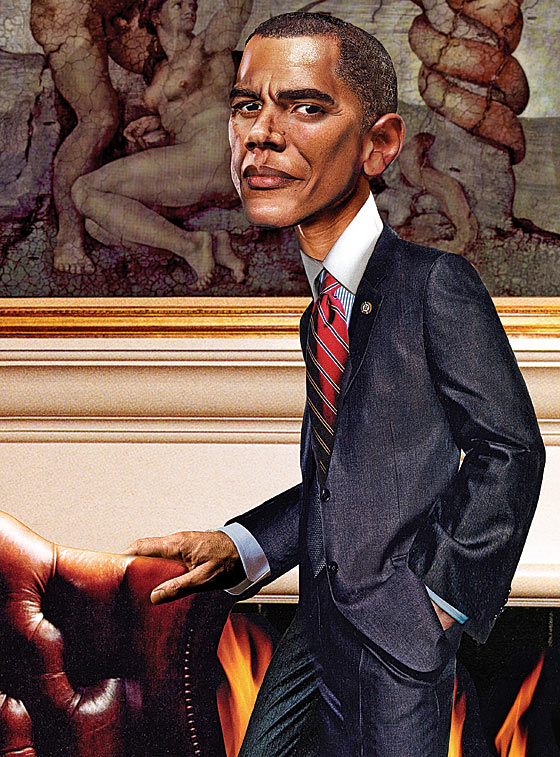
Illustration by Eddie Guy

Official White House Photo by Pete Souza

http://www.rollingstone.com/politics/blogs/taibblog/frank-rich-blasts-obama-20110706

http://panopticonreview.blogspot.com/2011/07/frank-rich-on-obama-administration-and.html


All,

A very recent, prescient, and prophetic "blast from the past" (yeah folks it's only a mere 4 months ago!) from Matt Taibbi who along with Frank Rich, Paul Krugman, Glenn Greenwald, Naomi Klein, Chris Hedges, Bob Herbert, Robert Kuttner and one or two others is providing by far the best and most dynamic/critical/insightful/informative political analysis and commentary in this country since the incendiary 1960s and early '70s period when the brilliant and eloquent likes of Jimmy Baldwin, Leroi Jones/Amiri Baraka, Gore Vidal, Norman Mailer, Robert Allen, Seymour Hersh, and David Halberstam, etc. held court and kicked so much necessary public ass. And like always real truthtelling plays no favorites nor does it supinely asks/begs others (i.e. the targets of their public criticism) to simply agree with or endorse its conclusions so as to avoid any "hurt feelings." That's the immense, inexorable VALUE of the truth under any and all circumstances, and a truly critical, sober, and truthful assessment of this era--and this President-- (and ourselves as well when we too don't do the right thing for whatever reasons)---is no exception...

Kofi


Frank Rich Blasts Obama For Letting Wall Street Off the Hook
July 6, 2011
by Matt Taibbi
Rolling Stone


A lot of people are talking about Frank Rich’s explosive new article (July 3, 2011) in New York magazine. I think it is a remarkable thing, the latest and maybe the most comprehensive in an increasingly lengthy series of articles and investigations into the Obama administration’s failure to properly investigate the causes of the financial crisis.

By now this is not quite a mainstream media drumbeat, but it’s coming close: between the reporting of Louise Story and Gretchen Morgenson at the New York Times to the recent not-terribly-laudatory piece on New York Southern District U.S. Attorney Preet Bharara by the New Yorker’s George Packer, to Eliot Spitzer’s bitter commentary on the subject on CNN, to my own bleatings, and now this Rich broadside, it seems quite clear that the Obama administration’s failure to clean up Wall Street is becoming a matter of some fascination with the few investigative journalists who are not covering the Casey Anthony case.

Rich’s thesis is that this issue is becoming important not just to reporters, but to voters, and that Obama may soon pay for his failures at the polls:

"Obama can win reelection without carrying 10021 or Greenwich in any case. The bigger political problem is that a far larger share of the American electorate views him as a tool of the very fat-cat elite that despises him."

In making this point, Rich uses language that seems unusually savage for him:

"For all the lurid fantasies of the birthers, the dirty secret of Obama’s background is that the values of Harvard, not of Kenya or Indonesia or Bill Ayers, have most colored his governing style. He falls hard for the best and the brightest white guys."

Yikes! That last line is truly brutal and I imagine will not be forgotten inside the White House, which once must have viewed Rich as one of Obama’s great supporters in the punditry world. A lot of journalists, myself included, were once enthralled by Obama, and saw his election as a rare uplifting moment in our electoral history, with the candidate himself performing with tremendous grace and class as he helped slay the country’s racial demons. Some of us even thought that Obama might be that rare, once-in-a-generation-type political talent who could help the country rise above itself, an MLK or a Roosevelt.

I say might. Because throughout 2008, it was hard to shake the feeling that this was a politician whose legacy could still go either way. There were an awful lot of troubling signs on the horizon in Obama’s campaign, not the least of which being the enthusiastic support he was receiving from Wall Street.

Obama in part ran a very slightly economically populist campaign, but the tens of millions pouring into his campaign coffers from the very rich (and specifically from hedge funds) told all of us that we probably shouldn’t expect those promises to come off. For a piece I wrote that summer, I asked people in Washington why Wall Street would be throwing money at a guy who was out there on the stump pledging to reach into their pockets:

"Sadly, the answer to that question increasingly appears to be that Obama is, well, full of shit. He has made no bones about his plans to raise income by soaking the rich, promising to roll back the Bush tax cuts for people making over $250,000, increase the top tax rate on capital gains to 25 percent and raise the top rate on qualified dividends. He has also pledged to deliver a real stomach punch to hedge-fund managers, raising the tax rate on most of their income from 15 percent to 35 percent."

"These populist pledges sound good, but many business moguls appear to be betting that the tax policies, like Obama himself, are only that: something that sounds good. "I think we don't want to make too much of his promises on taxes," says Robert Pollin, professor of economics at the University of Massachusetts. "Not all of these things will happen." Noting the overwhelming amount of Wall Street money pouring into Obama's campaign, even elitist fuckwad David Brooks was recently moved to write, "Once the Republicans are vanquished, I wouldn't hold your breath waiting for that capital-gains tax hike."
Disgustingly, Brooks turned out to be right, and the narrative of the Obama presidency did end up turning sour, on that front anyway. All of these articles are now chronicling how and why that happened.

The gist of this blistering Rich piece is that Obama came to office at a time of unprecedented hardship and public discontent, and made a mistake in deciding not to ride that anger and take an axe to those guilty of destroying the economy. Rich isn’t saying that Obama needed to put a guillotine on Maiden Lane; he’s saying that Obama’s big problem was that his failure to clean up Wall Street coincided with a similarly inexplicable failure to address the unemployment problem:

"Howard Dean rage has never been Obama’s style—hope-and-change was an elegant oratorical substitute—and had he given full voice to the public mood, he would have been pilloried as an “angry black man.” But Obama didn’t have to play Huey Long. He could have pursued a sober but determined execution of justice and an explicit, major jobs initiative—of which there have been exactly none, the too-small stimulus included, to the present day."
Rich goes on to argue, very convincingly, that Obama decided to pass on the unemployment issue because he accepted the advice of Bob Rubin acolytes like Tim Geithner, who urged the president to move instead toward the Tea Party and take up the “austerity” mantle:

"A once-hoped-for WPA-style public-works program, unloved by Geithner, had been downsized in the original stimulus, and now a tardy, halfhearted stab at a $50 billion transportation-infrastructure jobs bill produced a dandy Obama speech but nothing else.

"Obama soon retreated into the tea-party mantra of fiscal austerity… It’s his fault, no one else’s, that he seems diffident about the unemployed. Each time there’s a jolt in the jobless numbers, he and his surrogates compound that profile by farcically reshuffling the same clichés, from “stuck in a ditch” to “headwinds” (first used by Geithner in March 2009—retire it already!) to “bumps in the road.” It’s true the administration has caught few breaks and the headwinds have been strong, but voters have long since tuned out this monotonous apologia. The White House’s repeated argument that the stimulus saved as many as 3 million jobs, accurate though it may be, is another nonstarter when 14 million Americans are looking for work."
Rich in this way describes the central failure of the Obama presidency. Obama entered the White House in the middle of a great economic crisis, and his Geithner/Rubin solution was to spend mind-boggling amounts bailing out Wall Street, while extracting no conditions or reforms in exchange, and punishing no one. Then, by abandoning jobs programs and taking up the Tea Party’s “austerity” model, he essentially asked ordinary Americans to foot the bill for this no-strings-attached rescue program.

Rich thinks that this is going to hurt him with voters next fall, and he may be right. It could also be that Americans don’t particularly care about Obama’s failure to deal with Wall Street (or, more specifically, to clean up his completely broken and corrupted regulatory apparatus), and the administration’s political calculus is that that apathy and unfamiliarity with the root causes of the crisis will be such that there’s no real downside to continuing to take mountains of financial-sector cash while slow-rolling the cleanup.

If that’s what the Obama administration is thinking, I can certainly see the logic there. They may well be right that to solve the problem of getting re-elected in 2012, the president’s best bet is to take care of the Citigroups and JP Morgans on his Pioneer list, blow Romney or Bachmann away on the spending front, and then non-act and non-police his way straight into a second term.

But the problem is that doing that leaves the whole running-the-country matter unresolved. He might win re-election, but by taking this course of non-action, he’s risking another 2008-style crash, which Rich correctly points out would render the results of next year’s election irrelevant:

"The alternative is a failure of historic proportions. Those who gamed the economy to near devastation—so much so that the nation turned to an untried young leader in desperation and in hope—would once again inherit the Earth. Unless and until there’s a purging of the crimes that brought our president to his unlikely Inauguration Day, much more in America than the second term of his administration will be at stake."
More and more, I hear that Obama’s hands-off-Wall-Street policy is a matter of concern within what used to be his own circle – Beltway professionals, intellectuals, lobbyists, academics, etc. Pretty clearly, that concern is bleeding into the mainstream press now. It’ll be interesting to see if Rich is right about it bleeding into the voter pool next.


Read more: http://www.rollingstone.com/politics/blogs/taibblog/frank-rich-blasts-obama-20110706#ixzz1cRJuyRGD

Monday, October 31, 2011

Frank Rich On The Timely Return of the Centrality of Class Warfare in American Politics

The Bonus Army veterans stage a mass vigil on the lawn of the U.S. Capitol in 1932.
(Photo: MPI/Getty Images)


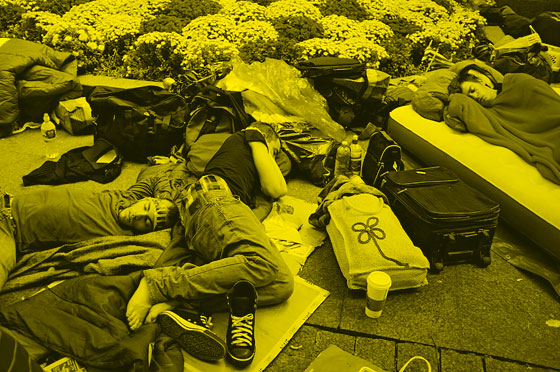
Occupy Wall Street demonstrators asleep in Zuccotti Park.
(Photo: Spencer Platt/Getty Images)


http://nymag.com/news/frank-rich/class-war-2011-10/

"First they ignore you, then they laugh at you, then they fight you, then you win."

--Mohandas Gandhi


All,

The consistently brilliant exegesis, analytical clarity, and visceral power of Frank Rich's political journalism is rooted in his relentlessly critical refusal to pretend that what is actually happening in this society is the result of any "mysterious" forces far beyond our "understanding and comprehension." Au contraire brothers and sisters. Rich simply and clearly sees and understands what we all know and understand all too well: We are as always at the ruthless mercy of extremely wealthy and powerful elites in both the economic and political spheres (which by definition are also the dominating cultural forces as well) who really don't care if we live or die so long as they continue to make huge profits at our collective expense-- no matter what happens to the rest of us in the meantime. One doesn't have to be any kind of "Marxist" or "Socialist" to fully perceive exactly what CLASS is and means in this societal context or that it is inextricably and eternally connected to and deeply informed by the pervasive historical contradictions and realities produced, maintained, and reinforced by the ideological ferocity and social murder of racism, sexism, homophobia, and imperialism/empire politics. Typically, Rich focuses precisely on exactly how and why this perverse nexus of power, money, hatred, ignorance, and indifference actually controls and "guides" this society as it goes spiralling toward the abyss--and what inevitably we must all do about it, or suffer the enormous consequences...

Kofi


"Politicians in either party, of course, never use the term “class warfare” to describe what’s going on in America, unless it’s Republican leaders accusing Obama of waging it every time he even mildly asserts timeless liberal bromides about taxing the rich. Nor do most politicians want to talk about the depth of the crisis in present-day capitalism, since to acknowledge its scale would only dramatize how little they intend to do about it. The whole system is screwed up, and it’s not all Wall Street’s fault—or remotely in the financial sector’s power alone to solve. As middle-class Americans have lost their jobs or watched their wages stagnate or decline while corporations pile up record profits, they’ve also seen CEOs far removed from Wall Street (at Hewlett-Packard and Yahoo most recently) walk away with rich settlements even after they’ve laid off workers en masse, mismanaged their companies, or wrecked them. But at least politicians pay lip service to the woes of the middle class. That America’s poverty rate has risen to its highest level since 1993 goes all but unmentioned by leaders in both parties. The poor, after all, don’t make campaign contributions and are unlikely to vote. And they have even less clout than usual now that Republican legislators and governors, fanning bogus fears of “voter fraud,” have mandated new, Jim Crow–style restrictions to scare away poor, elderly, and minority voters in fourteen states. In the Beltway bubble, even the local poor are out of sight and out of mind; with a 6.1 percent unemployment rate and a median income of $84,523 (versus $50,046 nationally), Washington is now the wealthiest metro area in the country and, according to Gallup, departs from all 50 states in believing by a majority that the economy is getting better. Back in 1931, even Hoover worried that “timid people, black with despair” had “lost faith in the American system” and might be susceptible to the kind of revolutions that had become a spreading peril abroad. When Roosevelt took office, he had the confidence that his leadership could overcome that level of despair and head off radicals on the left or right. In 2011, the despair is again black, and faith in the system is shaky, but it would be hard to describe the atmosphere at Zuccotti Park or a tea-party rally as prerevolutionary. The anger of the class war across the spectrum seems fatalistic more than incendiary. No wonder. Everyone just assumes the fix is in for the highest bidder, no matter what. Take—please!—the latest bipartisan Beltway panacea: the congressional supercommittee charged by the president and GOP leaders to hammer out the deficit-reduction compromise they couldn’t do on their own. The Washington Post recently discovered that nearly 100 of the registered lobbyists no doubt charged with besieging the committee to protect the interests of the financial, defense, and health-care industries are former employees of its dozen members. Indeed, six of those members (three from each party) currently have former lobbyists on their staffs. Elections are supposed to resolve conflicts in a great democracy, but our next one will not. Just in time for election season, Obama has recovered his populist rhetoric (if not populism itself) and will say the right things about Wall Street, about that “frustration” out there, about the modest reforms of Dodd-Frank, and about millionaires who don’t pay their fair share of taxes. It’s not clear if anyone believes it, including him. Having been a bystander to history when the tea party harvested populist rage during the summer of 2009, he may have a tough time co-opting Occupy Wall Street now to plug the so-called enthusiasm gap in his base. There’s a serious danger that the anger could co-opt him instead. To pander to the swing state of North Carolina, the Democrats in their wisdom chose to hold their convention in a city best known as the headquarters of Bank of America, whose recent financial innovations include illegal robo-foreclosures and the $5 monthly fee on debit cards. Occupy Charlotte could be a far more telegenic show than the one happening inside the hall. Despite all the chatter to the contrary, Obama is so far outdrawing all the GOP candidates combined in Wall Street contributions. His best hope is that that fact is blurred by either Romney, the plutocrat from central casting, or Rick Perry, a creature of lobbyists and pay-for-play government in Texas. Herman Cain’s as yet little-known corporate history would also prove problematic to Republicans: He’s not only an unabashed Alan Greenspan fan who was chairman of the Kansas City Fed but also served on the board of Aquila, an energy company that ended up paying a $10.5 million settlement for Enron-esque shenanigans. (Cain’s campaign manager hails from Americans for Prosperity, the Koch brothers’ political front.) Whatever else is to be said about Michele Bachmann, Rick Santorum, Tim Pawlenty, and Ron Paul, they actually spent most of their pre-political careers in the aggrieved middle class. But they are all history in the presidential race, and perhaps were destined to be, given how big money plays its hand. You don’t have to like their views to find their earnest but misplaced faith in the free-market efficiency of the political system a bit poignant. Elections are supposed to resolve conflicts in a great democracy, but our next one will not. The elites will face off against the elites to a standoff, and the issues animating the class war in both parties won’t even be on the table. The structural crises in our economy, our government, and our culture defy any of the glib solutions proposed by current Democrats or Republicans; the quixotic third-party movements being hatched by well-heeled do-gooders are vanity productions. The two powerful forces that extricated America from the Great Depression—the courageous leadership and reformist zeal of Roosevelt, the mobilization for World War II—are not on offer this time. Our class war will rage on without winners indefinitely, with all sides stewing in their own juices, until—when? No one knows. The reckoning with capitalism’s failures over the past three decades, both in America and the globe beyond, may well be on hold until the top one percent becomes persuaded that its own economic fate is tied to the other 99 percent’s. Which is to say things may have to get worse before they get better."
--Frank Rich, "The Class War Has Begun"


The Class War Has Begun

And the very classlessness of our society makes the conflict more volatile, not less.

By Frank Rich
October 23, 2011

New York


During the death throes of Herbert Hoover’s presidency in June 1932, desperate bands of men traveled to Washington and set up camp within view of the Capitol. The first contingent journeyed all the way from Portland, Oregon, but others soon converged from all over—alone, in groups, with families—until their main Hooverville on the Anacostia River’s fetid mudflats swelled to a population as high as 20,000. The men, World War I veterans who could not find jobs, became known as the Bonus Army—for the modest government bonus they were owed for their service. Under a law passed in 1924, they had been awarded roughly $1,000 each, to be collected in 1945 or at death, whichever came first. But they didn’t want to wait any longer for their pre–New Deal entitlement—especially given that Congress had bailed out big business with the creation of a Reconstruction Finance Corporation earlier in its session. Father Charles Coughlin, the populist “Radio Priest” who became a phenomenon for railing against “greedy bankers and financiers,” framed Washington’s double standard this way: “If the government can pay $2 billion to the bankers and the railroads, why cannot it pay the $2 billion to the soldiers?”

The echoes of our own Great Recession do not end there. Both parties were alarmed by this motley assemblage and its political rallies; the Secret Service infiltrated its ranks to root out radicals. But a good Communist was hard to find. The men were mostly middle-class, patriotic Americans. They kept their improvised hovels clean and maintained small gardens. Even so, good behavior by the Bonus Army did not prevent the U.S. Army’s hotheaded chief of staff, General Douglas MacArthur, from summoning an overwhelming force to evict it from Pennsylvania Avenue late that July. After assaulting the veterans and thousands of onlookers with tear gas, MacArthur’s troops crossed the bridge and burned down the encampment. The general had acted against Hoover’s wishes, but the president expressed satisfaction afterward that the government had dispatched “a mob”—albeit at the cost of killing two of the demonstrators. The public had another take. When graphic newsreels of the riotous mêlée fanned out to the nation’s movie theaters, audiences booed MacArthur and his troops, not the men down on their luck. Even the mining heiress Evalyn Walsh McLean, the owner of the Hope diamond and wife of the proprietor of the Washington Post, professed solidarity with the “mob” that had occupied the nation’s capital.


The Great Depression was then nearly three years old, with FDR still in the wings and some of the worst deprivation and unrest yet to come. Three years after our own crash, we do not have the benefit of historical omniscience to know where 2011 is on the time line of America’s deepest bout of economic distress since that era. (The White House, you may recall, rolled out “recovery summer” sixteen months ago.) We don’t know if our current president will end up being viewed more like Hoover or FDR. We don’t know whether Occupy Wall Street and its proliferating satellites will spiral into larger and more violent confrontations, disperse in cold weather, prove a footnote to our narrative, or be the seeds of something big.

What’s as intriguing as Occupy Wall Street itself is that once again our Establishment, left, right, and center, did not see the wave coming or understand what it meant as it broke. Maybe it’s just human nature and the power of denial, or maybe it’s a stubborn strain of all- American optimism, but at each aftershock since the fall of Lehman Brothers, those at the top have preferred not to see what they didn’t want to see. And so for the first three weeks, the protests were alternately ignored, patronized, dismissed, and insulted by politicians and the mainstream news media as a neo-Woodstock for wannabe collegiate rebels without a cause—and not just in Fox-land. CNN’s new prime-time hopeful, Erin Burnett, ridiculed the protesters as bongo-playing know-nothings; a dispatch in The New Republic called them “an unfocused rabble of ragtag discontents.” Those who did express sympathy for Occupy Wall Street tended to pat it on the head before going on to fault it for being leaderless, disorganized, and inchoate in its agenda.

Despite such dismissals, the movement, abetted by made-for-YouTube confrontations with police, started to connect with the mass public much as the Bonus Army did with a newsreel audience. The week after a Wall Street Journal editorial claimed that “no one seems to care very much” about the “collection of ne’er-do-wells” congregating in Zuccotti Park, the paper released its own poll, in collaboration with NBC News, finding that 37 percent of Americans supported the protesters, 25 percent had no opinion, and just 18 percent opposed them. The approval numbers for Occupy Wall Street published in Time and Reuters were even higher—hitting 54 percent in Time. Apparently some of those dopey kids, staggering under student loans and bereft of job prospects, have lots of parents and friends of all ages who understand exactly what they’re talking about.

Coverage increased and politicians ran for cover. Mayor Bloomberg, who had initially (and preposterously) portrayed the occupiers as a threat to the financial industry’s lower-income service workers, gingerly observed that some unspecified “people” are “very frustrated.” Though the Treasury secretary, Timothy Geithner, waffled when asked if he had any sympathy for Occupy Wall Street, Barack Obama publicly acknowledged the demonstrators’ “broad-based frustration about how our financial system works.”* (If Bloomberg and Obama are both using “frustration,” you can be certain it is a focus-group-tested trope chosen not to frighten the presumed sensibilities of independents.) Mitt Romney, who had first called the protests “dangerous,” executed another of his patented flip-flops to assert that he, too, identifies with America’s 99 percent, not the top one percent where he’s always dwelled. “Boy, I understand how these people feel,” he said. (Boy, do “these people” not believe him.) Even Eric Cantor, who’d described the protesters as “mobs,” started talking about—what else?—“frustration.”

These efforts to domesticate and contain the protests are unlikely to succeed. It is not frustration that’s roiling America but anger, the anger of a full-fledged class war. Try as polite company keeps trying to ignore it, that war has been building in this country and abroad for much of this decade and has been waged in earnest in America since the fall of 2008. But the crisp agenda demanded of Occupy Wall Street will not be forthcoming. The inchoateness of our particular class war is central to its meaning. America is not Tahrir Square or the riot-scarred precincts of North London, where everyone knows at birth who is in which class and why. We pride ourselves on being a “classless” democracy. We abhor ideology. When Americans left and right, young and old, express anger at an overclass, they don’t necessarily agree about who’s on which side of that class divide. The often confusing fluidity of class definitions, especially in an America as polarized as ours is now, may make our home grown class war more volatile, not less.

The tea-party right finds the hippie-scented movement in lower Manhattan repellent, but it and Occupy Wall Street are two sides of the same coin. “Take Back America,” the initial tea-party battle cry, would work for those in Zuccotti Park as well. The disagreement is about which America needs to be taken back, and from whom.

Provoked by Obama’s ascent, the right was ahead of the class-war curve, with Sarah Palin sounding the charge when she stuck up for “the real America” against the elites during the 2008 campaign. The real America, as she defined it, was in small towns—“those who are running our factories and teaching our kids and growing our food.” In other words: It is the middle class (or at least its white precincts) that fell behind while the rich got richer. The Über-class she and her angry followers would take to the guillotine, however, is not defined by its super-wealth. It is first and foremost exemplified by potentates in the federal government, especially the Ivy League cohort of Obama—closely followed by the usual right-wing populist bogeymen, the pointy-headed experts in fancy universities and the mainstream- media royalty with their “gotcha” questions.

Palin may now have abdicated her position on the barricades, not least because she succumbed to the financial blandishments of the unreal America, but the zeal of her constituency has not faded a bit. The right’s angry class warriors constitute the vast majority of the GOP—that roughly three- quarters of the party that seems determined to resist Romney no matter what. A Harvard-educated former Massachusetts governor, especially one who embraced the social engineering of health-care reform, inspires class anger from his own party to the same degree that his private-sector record as a leveraged-buyout tycoon provokes class anger from Democrats.

But while Romney is a class enemy liberals and conservatives can unite against, perhaps nothing has revealed how much the class warriors of the right and left of our time have in common than the national outpouring after Steve Jobs’s death. Indeed, the near-universal over-the-top emotional response—more commensurate with a saintly religious or civic leader, not a sometimes bullying captain of industry—brought Americans of all stripes together as few events have in recent memory.

Some on the right were baffled that the ostensible Marxists demonstrating in lower Manhattan would observe a moment of silence and assemble makeshift shrines for a top one-percenter like Jobs, whose expensive products were engineered for near- instant obsolescence and produced by Chinese laborers in factories with substandard health-and-safety records. For heaven’s sake, the guy didn’t even join Warren Buffett and Bill Gates in their Giving Pledge. “There is perhaps no greater image of irony,” wrote the conservative blogger Michelle Malkin, “than that of anti-capitalist, anti-corporate, anti-materialist extremists of the Occupy Wall Street movement paying tribute to Steve Jobs.”

*This article has been corrected to clarify Timothy Geithner's reaction to being asked about Occupy Wall Street.

Yet those demonstrators who celebrated Jobs were not necessarily hypocrites at all—and no more anti-capitalist than the Bonus Army of 1932. If you love your Mac and iPod, you can still despise CDOs and credit-default swaps. Jobs’s genius—in the words of Regis McKenna, a Silicon Valley marketing executive who worked with him early on—was his ability “to strip away the excess layers of business, design, and innovation until only the simple, elegant reality remained.” The supposed genius of modern Wall Street is the exact reverse, piling on excess layers of business and innovation on ever thinner and more exotic creations until simple reality is distorted and obscured. Those in Palin’s “real America” may not be agitated about the economic 99-vs.-one percent inequality brought about by the rise of the financial sector in the past three decades, but, like class warriors of the left, they know that “financial instruments” wreaked havoc on their 401(k)s, homes, and jobs. The bottom line remains that Wall Street’s opaque inventions led directly to TARP, the taxpayers’ bank bailout that achieved the seemingly impossible feat of unifying the left and right in rage against government—much as Jobs’s death achieved the equally surprising coup of unifying left and right in mourning a corporate god.

That bipartisan grief was arguably as much for the passing of a capitalist culture as for the man himself. Finance long ago supplanted visionary entrepreneurial careers like Jobs’s as the most desired calling among America’s top-tier university students, just as hedge-fund tycoons like John Paulson and Steve Cohen passed Jobs on the Forbes 400 list. Americans sense that something incalculable has been lost in this transformation that cannot be measured in dollars and cents.

There’s no handier way to track just how much American capitalism has changed since Apple’s divine, mid- seventies birth in a garage than by following the corporate afterlife of the American icon most frequently invoked as Jobs’s antecedent in his obituaries, Thomas Alva Edison. Like Jobs, Edison wasn’t just a brilliant fount of technological breakthroughs but a businessman as well (albeit a less savvy one). He was the official founder of General Electric—known as Edison General Electric at its inception in 1890, before Edison was strong-armed into an early merger. G.E. was created to maximize the profits of his many inventions and businesses, Apple style. And like Apple, the company flourished as an exemplar of American capitalism at its most creative and productive, even in a downtime. During the Great Depression, it produced an astonishing array of Jobs-worthy innovations—the first commercial fluorescent lamp, the first waste “Disposall,” the first night baseball game, and the first television network. This was the job-­creating, profit-making, America- empowering corporate behemoth, spewing out refrigerators and jet engines, that would ultimately recruit Ronald Reagan as its television pitchman in the fifties.

But the G.E. born out of Edison’s genius and synergistic with Reagan’s brand of postwar jingoism is far from the G.E. of our time. Its once minor financial-services subsidiary, G.E. Capital, metastasized over the past 30 years in sync with the growth of the new Wall Street. In 1990, G.E. Capital accounted for just a quarter of G.E.’s overall profits, but by 2007, on the eve of the crash, it had gobbled up 55 percent of the bottom line. Its sophisticated gambling strategies, like those of the big banks it emulated, amounted to an ingenious get-rich-quick scheme for high-rollers until the bottom fell out, taking shareholders and employees, not to mention the country, down with it. G.E. Capital’s dependence on short-term credit was so grave that it forced G.E. to cut back its dividend for the first time since the thirties and to turn to Buffett for a $3 billion emergency cash infusion in the dark days of October 2008.

The cheerleader for ratcheting up that risk at G.E. was the CEO, Jeffrey Immelt. These days he heads the president’s ineffectual Council on Jobs and Competitiveness, despite his own corporation’s record of job-shedding in America and the revelation that G.E. paid no American taxes in 2010 (on more than $14 billion in profits, including $5.1 billion in the U.S.). Immelt is a Republican, but that didn’t prevent Palin this fall from calling G.E. “the poster child of corporate welfare and crony capitalism.” (Bill O’Reilly and Newt Gingrich joined this class-warfare chorus.) On this point, once again, there is no air between the right and Occupy Wall Street. And as both camps condemn Immelt, so they are also united in the conviction that the godfather of Obama’s economic team, Robert Rubin, is likewise a poster child for corporate welfare and crony capitalism. Rubin, whose useful cronies included his former protégés Geithner and Lawrence Summers, encouraged reckless greed and risk at Citigroup during the bubble much as Immelt did at G.E. Capital, ultimately requiring the taxpayers’ rescue of TARP.

Politicians in either party, of course, never use the term “class warfare” to describe what’s going on in America, unless it’s Republican leaders accusing Obama of waging it every time he even mildly asserts timeless liberal bromides about taxing the rich. Nor do most politicians want to talk about the depth of the crisis in present-day capitalism, since to acknowledge its scale would only dramatize how little they intend to do about it.

The whole system is screwed up, and it’s not all Wall Street’s fault—or remotely in the financial sector’s power alone to solve. As middle-class Americans have lost their jobs or watched their wages stagnate or decline while corporations pile up record profits, they’ve also seen CEOs far removed from Wall Street (at Hewlett-Packard and Yahoo most recently) walk away with rich settlements even after they’ve laid off workers en masse, mismanaged their companies, or wrecked them. But at least politicians pay lip service to the woes of the middle class. That America’s poverty rate has risen to its highest level since 1993 goes all but unmentioned by leaders in both parties. The poor, after all, don’t make campaign contributions and are unlikely to vote. And they have even less clout than usual now that Republican legislators and governors, fanning bogus fears of “voter fraud,” have mandated new, Jim Crow–style restrictions to scare away poor, elderly, and minority voters in fourteen states. In the Beltway bubble, even the local poor are out of sight and out of mind; with a 6.1 percent unemployment rate and a median income of $84,523 (versus $50,046 nationally), Washington is now the wealthiest metro area in the country and, according to Gallup, departs from all 50 states in believing by a majority that the economy is getting better.

Back in 1931, even Hoover worried that “timid people, black with despair” had “lost faith in the American system” and might be susceptible to the kind of revolutions that had become a spreading peril abroad. When Roosevelt took office, he had the confidence that his leadership could overcome that level of despair and head off radicals on the left or right. In 2011, the despair is again black, and faith in the system is shaky, but it would be hard to describe the atmosphere at Zuccotti Park or a tea-party rally as prerevolutionary. The anger of the class war across the spectrum seems fatalistic more than incendiary. No wonder. Everyone just assumes the fix is in for the highest bidder, no matter what. Take—please!—the latest bipartisan Beltway panacea: the congressional supercommittee charged by the president and GOP leaders to hammer out the deficit-reduction compromise they couldn’t do on their own. The Washington Post recently discovered that nearly 100 of the registered lobbyists no doubt charged with besieging the committee to protect the interests of the financial, defense, and health-care industries are former employees of its dozen members. Indeed, six of those members (three from each party) currently have former lobbyists on their staffs.

Elections are supposed to resolve conflicts in a great democracy, but our next one will not.

Just in time for election season, Obama has recovered his populist rhetoric (if not populism itself) and will say the right things about Wall Street, about that “frustration” out there, about the modest reforms of Dodd-Frank, and about millionaires who don’t pay their fair share of taxes. It’s not clear if anyone believes it, including him. Having been a bystander to history when the tea party harvested populist rage during the summer of 2009, he may have a tough time co-opting Occupy Wall Street now to plug the so-called enthusiasm gap in his base. There’s a serious danger that the anger could co-opt him instead. To pander to the swing state of North Carolina, the Democrats in their wisdom chose to hold their convention in a city best known as the headquarters of Bank of America, whose recent financial innovations include illegal robo-foreclosures and the $5 monthly fee on debit cards. Occupy Charlotte could be a far more telegenic show than the one happening inside the hall.

Despite all the chatter to the contrary, Obama is so far outdrawing all the GOP candidates combined in Wall Street contributions. His best hope is that that fact is blurred by either Romney, the plutocrat from central casting, or Rick Perry, a creature of lobbyists and pay-for-play government in Texas. Herman Cain’s as yet little-known corporate history would also prove problematic to Republicans: He’s not only an unabashed Alan Greenspan fan who was chairman of the Kansas City Fed but also served on the board of Aquila, an energy company that ended up paying a $10.5 million settlement for Enron-esque shenanigans. (Cain’s campaign manager hails from Americans for Prosperity, the Koch brothers’ political front.) Whatever else is to be said about Michele Bachmann, Rick Santorum, Tim Pawlenty, and Ron Paul, they actually spent most of their pre-political careers in the aggrieved middle class. But they are all history in the presidential race, and perhaps were destined to be, given how big money plays its hand. You don’t have to like their views to find their earnest but misplaced faith in the free-market efficiency of the political system a bit poignant.

Elections are supposed to resolve conflicts in a great democracy, but our next one will not. The elites will face off against the elites to a standoff, and the issues animating the class war in both parties won’t even be on the table. The structural crises in our economy, our government, and our culture defy any of the glib solutions proposed by current Democrats or Republicans; the quixotic third-party movements being hatched by well-heeled do-gooders are vanity productions. The two powerful forces that extricated America from the Great Depression—the courageous leadership and reformist zeal of Roosevelt, the mobilization for World War II—are not on offer this time. Our class war will rage on without winners indefinitely, with all sides stewing in their own juices, until—when? No one knows. The reckoning with capitalism’s failures over the past three decades, both in America and the globe beyond, may well be on hold until the top one percent becomes persuaded that its own economic fate is tied to the other 99 percent’s. Which is to say things may have to get worse before they get better.

Over the short term, meanwhile, the Democratic Establishment is no doubt wishing that Occupy Wall Street will melt away with the winter snows, much as its Republican counterpart hopes that the leaderless tea party will wither if Romney nails down the nomination. But even in the unlikely event that these wishes come true, it is not likely to be the end of the story. Though the Bonus Army was driven out of Washington in the similarly fraught election year of 1932, the newsreels they left behind turned out to be previews of coming attractions for the long decade still to come.