https://www.bostonreview.net/articles/uclas-unholy-alliance/
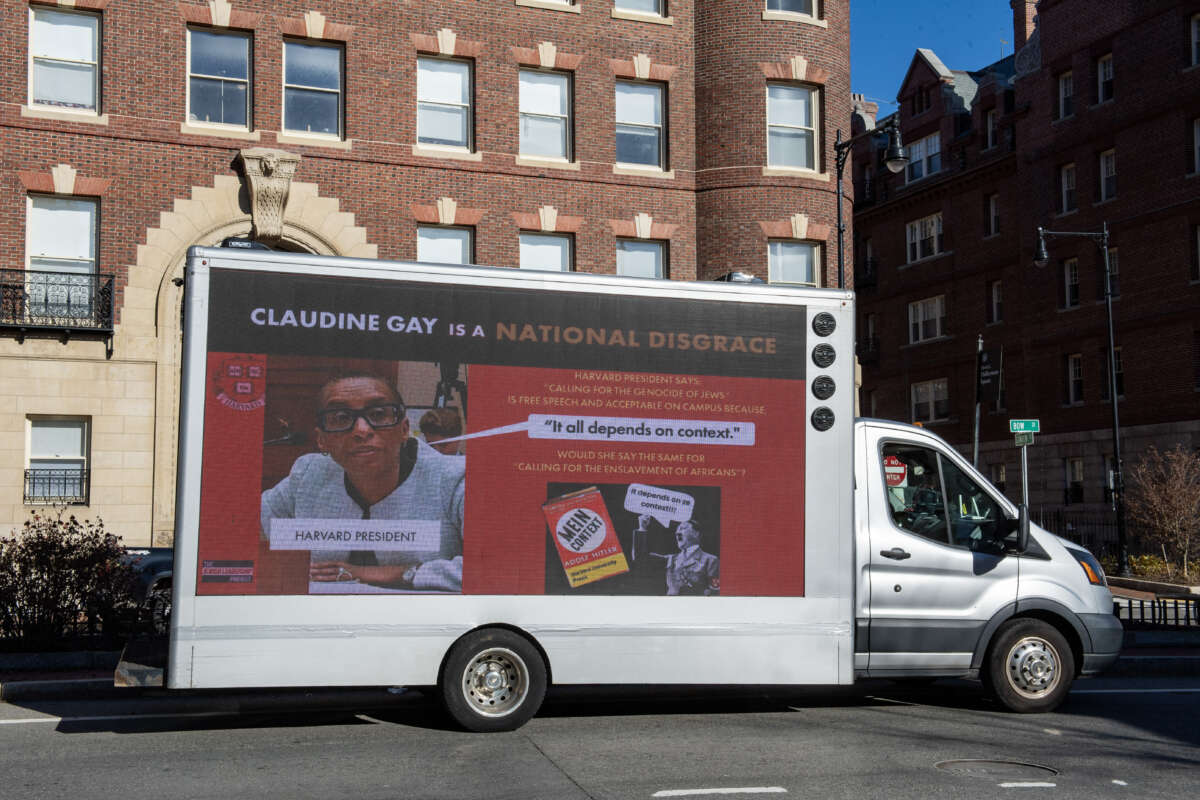
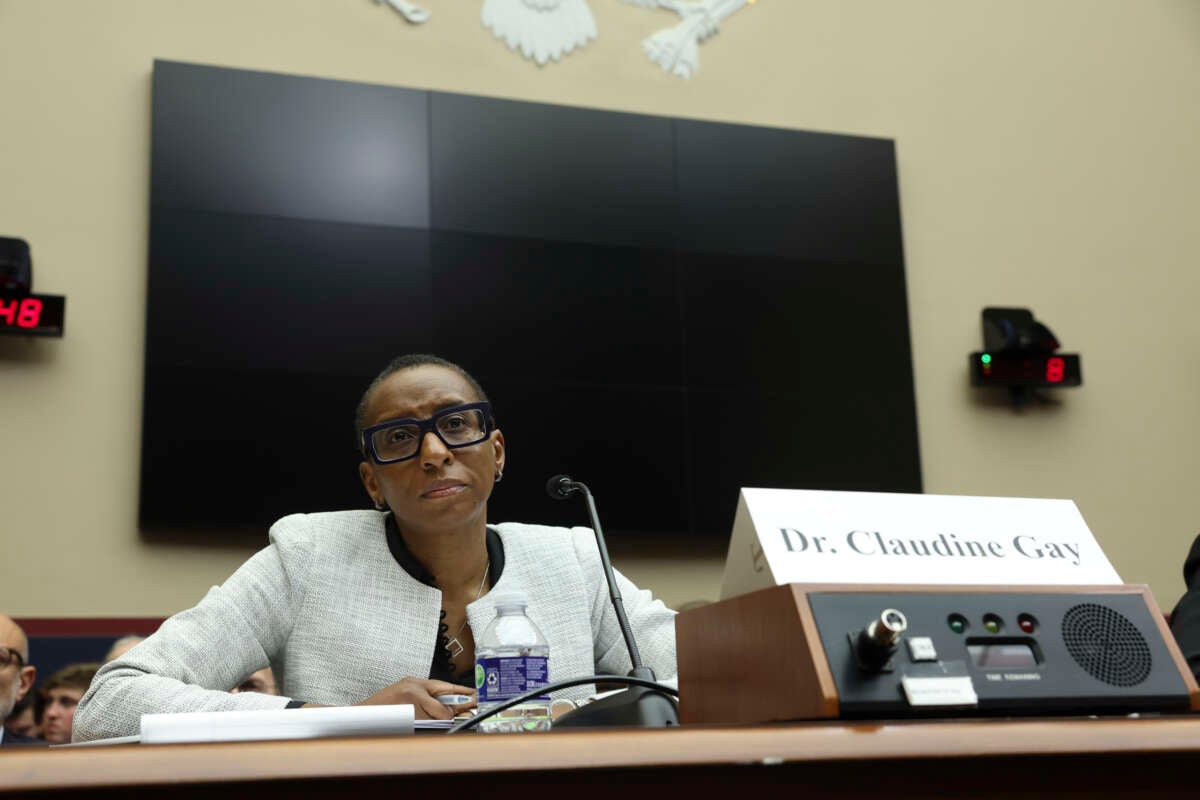
In December the House Committee on Education and the Workforce held a hearing on anti-Semitism on college campuses that forced University of Pennsylvania president Liz McGill and Harvard University president Claudine Gay to resign in its wake. In April the committee held another hearing, reducing Columbia University President Minouche Shafik, keen to avoid the fate of her counterparts, to a groveling mess. On May 23 it will hold yet another, under the title “Calling for Accountability: Stopping Antisemitic College Chaos.”
This time the committee has summoned Michael Schill, president of Northwestern University; Jonathan Holloway, president of Rutgers University; and Gene Block, Chancellor of the University of California, Los Angeles. We expect another show trial, where committee chair Virginia Foxx (Republican of North Carolina), Elise Stefanik (Republican of New York), and their friends pressure “liberal” university leaders into confessing that anti-Semitism has run amok on college campuses, that Jewish students are the real victims of a Hamas-backed genocide being plotted in Gaza solidarity encampments and the classrooms of tenured radicals, and that the source of Jew hatred is critical race theory. The committee has promised that it will not sit idly by. In a press release, Foxx warned “mealy-mouthed, spineless college leaders” that “College is not a park for playacting juveniles or a battleground for radical activists. Everyone affiliated with these universities will receive a healthy dose of reality: actions have consequences.”
The House Committee hearings chose only to summon college presidents for a public tongue-lashing and dressing-down. This is because House Republicans are less interested in anti-Semitism than racking up “gotcha” soundbites for their fundraising campaigns, advancing the right-wing assault on DEI and what they define as “critical race theory,” and attacking the university as a whole. According to Inside Higher Ed, Foxx confirmed that “the inquiries could broaden to include the universities’ diversity, equity and inclusion politics.” If Foxx, Stefanik, and fellow House Republicans were genuinely concerned about anti-Semitism, they would investigate the white nationalists, neo-Nazis, and QAnon conspiracy theorists who make up part of their base and participated in the January 6 insurrection. Parroting Donald Trump, Stefanik referred to the men and women convicted on charges ranging from obstruction to assaulting a law enforcement officer as “hostages.” Foxx not only voted against certifying the 2020 election but, like Stefanik and fellow House Republicans, vehemently opposed the commission to investigate the capitol riot.
Unlike the January 6 hearings, Foxx’s committee has produced very little evidence of anti-Semitism outside of words and slogans either taken out of context or misinterpreted. Stefanik, for example, managed to turn “intifada,” which literally means “shaking off” or “uprising,” into “genocide of Jews.” But Chancellor Block’s testimony will be different. It will give the committee an opportunity to investigate not only a verifiable and egregious incident of anti-Semitism, but one involving white nationalists and neo-Nazis.
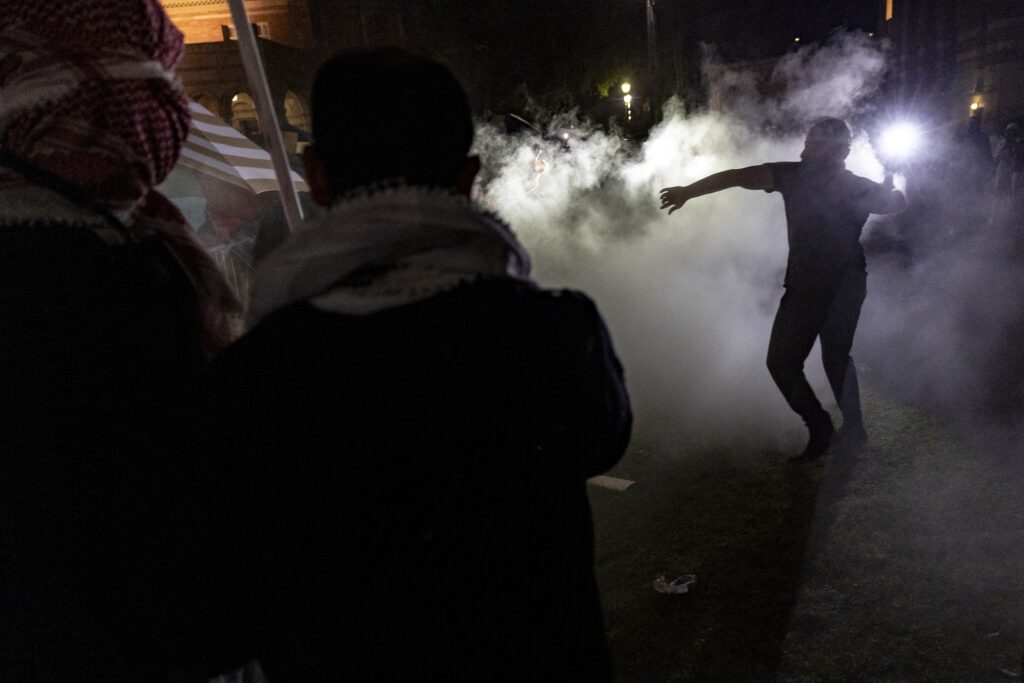
Between April 25 and May 2, UCLA experienced the worst episode of both anti-Semitic and anti-Palestinian/Islamophobic/racist violence in the university’s century-long history. White nationalists and neo-Nazis joined forces with Zionists (including some saying they were Israelis) to attack UCLA’s Palestine Solidarity Encampment, whose residents included a large number of Jewish students. The assailants were not affiliated with the university. One neo-Nazi was heard shouting, “we’re here to finish what Hitler started,” without any apparent protest from the self-identified Zionists. At least one person present has been identified as an associate of the Proud Boys. Using metal pipes, wooden planks, fists, knives, bricks, noise, chemical weapons, and incendiary fireworks, the mob sent at least twenty-five students to the hospital for broken bones, head trauma, and severe lacerations, while police stood by and watched for hours, electing to neither detain nor interrogate the perpetrators. No arrests took place that night. The following day, only students and faculty defending the encampment were arrested.
Although Block has promised to launch a full investigation, reporting from various media outlets (including outstanding coverage by our student paper, The Daily Bruin), along with hundreds of hours of video captured by students, faculty and observers, prove beyond a shadow of a doubt that the Palestine Solidarity Encampment—a nonviolent occupation erected to protest U.S. support for the genocide in Gaza and to demand that UCLA divest from companies that fuel Israel’s war and occupation, exercise financial transparency, break ties with Israeli universities, and acknowledge the loss of Palestinian life—came under brutal attack from its very inception and the administration did nothing to protect our students.
Given Block’s fervent opposition to anti-Semitism and his unwavering defense of Israel and Zionism, why are House Republicans going after him? Are they really concerned about the assault on the encampment and the health and safety of our students? To the contrary, Foxx has crafted an indictment designed to shield white nationalists from accountability and prosecution for their rabid anti-Semitism by magically recasting neo-Nazis as encampment defenders rather than assailants, and by twisting information, repeating misinformation, and conveying outright falsehoods fed to the committee by Israel advocacy organizations such as the AMCHA Initiative, the Anti-Defamation League (ADL), American Israel Public Affairs Committee (AIPAC), and Stand With Us; right-wing media outlets such as Campus Reform, Legal Insurrection, and Fox News; and isolated tweets and Instagram posts. Foxx’s letter notifying Block of the charges against him makes the wildly specious claim that “a van displaying the Star of David inside a Nazi swastika, as well as antisemitic writing referring to Jews as ‘puppet masters,’ was parked on UCLA’s campus in support of the encampment.” It repeats false claims that journalists who tried to enter the encampment were “assaulted,” but never mentions the documented fact that in the wee hours of May 1, four student journalists with the Daily Bruin were tracked down, maced, and severely beaten by members of the mob —sending one, Catherine Hamilton, to the hospital. The letter also repeats the thoroughly debunked rumor that “anti-Israel activists shoved a Jewish student counter-protestor . . . kicked her in the head, and stepped on her. The assault left her bleeding and caused her to lose consciousness and to be rushed to the hospital.” Immediately after the story began circulating on social media, the Los Angeles Times interviewed the woman in question who explained that she had been accidentally shoved by a fellow counterprotester “while attempting to retrieve her fallen [Israeli] flag.”
The letter never mentions that self-proclaimed Zionists took part in the attacks, nor does it acknowledge that the encampment had actually been attacked. Instead, Foxx labels the victims of mob and police violence “antisemitic rioters.” She finds evidence of rampant anti-Semitism in the Undergraduate Student Association Council’s (USAC) resolution calling for amnesty for those arrested, the elimination of police on campus, and, in her words, “a “permanent ceasefire” and an end to what they allege is a “genocide in Palestine.” Finally, she makes the absurd claim that the resolution asks professors to hold Muslim and Palestinian students “to lower academic standards.” In actuality, it asks for temporary academic leniency “and to take into account the needs of all students during this time, but especially those of Palestinian and Muslim identities who are the most unsafe and targeted individuals on campus right now.”
There are many more examples of misinformation that I will address below. My point is that the list of charges Chancellor Block will face on May 23 performs double duty in that it defends Israel’s genocidal war and exonerates white supremacists and Zionists responsible for the worst incident of anti-Semitic violence in UCLA’s history. Foxx and Stefanik will undoubtedly demand Block’s resignation. A large proportion of the faculty and students at UCLA is also calling for Block’s resignation, but for very different reasons.
UCLA’s Task Force on Anti-Palestinian, Anti-Muslim, and Anti-Arab Racism, of which I am a member, conducted its own investigation, and released a report with its findings earlier this week. The report holds Block and his administration, along with various branches of law enforcement, responsible for failing to protect our students. UCLA’s administration, it finds, not only failed to direct law enforcement to arrest and remove the armed mob but indirectly incited the violence by inviting “counter protesters” to come on to our campus, hold inflammatory rallies a few feet from the encampment, and allow them to remain in the name of protecting “free speech” and upholding their responsibility as a “public university” to grant the “community” access to campus. It seems clear in hindsight that permitting hostile groups to harass and attack the encampment is one strategy to avoid the optics of sending in the police to attack students. If that was the strategy, it didn’t work. The administration probably did not anticipate an unholy alliance of neo-Nazis and Zionists working together, but those of us who spent more than a decade criticizing Chancellor Block’s unremitting hostility toward critics of Israel and his fervent defense of Zionism could have predicted this outcome—especially after October 7.
The following account draws on findings from our report and provides a broader context but does not purport to speak for the entire task force.
Intolerance and its Discontents
As I write, UAW Local 4811, representing some forty-eight thousand postdocs, teaching assistants, academic and student researchers, tutors, and readers across the University of California system, is preparing to strike over the administration’s conduct with respect to the encampment. The union is demanding, among other things, amnesty for all academic employees, students, faculty, and staff facing criminal or disciplinary charges for protesting; the right to free speech; divestment from UC’s known investments in weapons manufacturers, military contractors, and companies profiting from Israel’s war on Palestine; and disclosure of all funding sources and investments. UCLA faculty are pushing for a vote of no confidence, or at minimum, “censure” of Chancellor Block for failing to keep our students safe. Some argue that the vote is merely symbolic, both because the faculty do not have the power to remove the Chancellor and because Block is just two months from retirement.
By most standards, his seventeen-year tenure has been a success. Under his leadership, UCLA rose in the U.S. News and World Report rankings from the twenty-sixth best public university in the country to the first, and its endowment swelled from $2.2 billion to $7.7 billion. The grandson of working-class Eastern European Jews, Block proudly identifies as a liberal who believes in diversity and racial equity. He often speaks of his experiences as an undergraduate at Stanford (1966–70) when he opposed the war in Vietnam. He is way too liberal for House Republicans, who are poised to make him their latest punching bag. But his liberalism ends when it comes to Palestine.
Since I joined the UCLA faculty in 2011, I’ve seen colleagues targeted for teaching critical perspectives on Israel, and Muslim and Arab students profiled by campus police and subject to racist epithets and graffiti. In 2012 a UC “President’s Advisory Council” issued a report on the campus climate asserting that Students for Justice in Palestine (SJP) and “anti-Zionism and Boycott, Divestment and Sanctions (BDS) movements and other manifestations of anti-Israel sentiment” created a hostile environment for Jewish students. It warned faculty that criticizing Israel or Israeli policies in the classroom was tantamount to using “the academic platforms to denounce the Jewish state and Jewish nationalist aspirations.” The report recommended, among other things, suspending support for Palestine Awareness Week from any university sponsorship and adopting a hate speech policy that would not only mute criticisms of Israel but prohibit outside speakers deemed advocates of hate. The report was so extreme and biased that over two thousand faculty signed a petition asking the UC Regents to reject its findings. Ultimately, UC President Mark Yudof rejected the report, since its recommendations violated the First Amendment. But while we succeeded in pressing the UC Regents, students and faculty at UCLA could not persuade Chancellor Block to openly denounce it.
In 2014 students seeking to divest student council funds from companies doing business in the Palestinian occupied territories learned that some members of student government had accepted paid-for trips to Israel sponsored by the ADL, AIPAC, Hasbara Fellowships, and other organizations that not only lobbied on behalf of Israel but promoted “discriminatory and Islamophobic positions.” SJP argued before the student judicial council that the members who accepted these trips had a conflict of interest in any government resolutions regarding divestment, since the organizations furnishing them were firmly opposed to campus divestment movements. They also asked candidates running for student government to take an ethics pledge committing to decline free trips to Israel paid for by those organizations—provoking a vicious backlash from the AMCHA Initiative, who accused the students raising these issues of “intimidation,” “harassment,” and making Jewish students feel unsafe.
In reality, pro-Zionist retaliation made pro-divestment students actually unsafe. Zionist organizations not affiliated with the university came on campus, filmed students without their consent, engaged in online harassment, and arranged visits by Israeli soldiers in full military uniform. Rather than condemn these intimidation tactics, Block chastised the students for proposing divestment in the first place. He stated flatly that the UC Regents “does not support divestment in companies that engage in business with Israel” and that “divestment decisions should not hold any one organization or country to a different standard than any other.” He refused to meet with SJP, but he did meet with representatives of the AMCHA Initiative to hear their demands to investigate SJP. The divestment campaign also triggered a resolution from the Los Angeles City Council condemning SJP’s actions as “bullying” and “harassment” and requesting that UC administrators “refer cases of ‘intimidation or harassment’ to ‘the proper law enforcement agencies.’” And while Block’s administration was busy painting campus divestment advocates as closed-minded and intolerant, it was the other side who was moving to shut down opposing speech. That same year, UCLA Hillel worked with a public relations firm to “‘isolate’ SJP on campus and to paint the group as ‘unrepresentative,’” in the words of a leaked email.
Despite these tactics, in November 2014 a coalition of more than thirty student groups passed a resolution calling on student government “to divest from companies engaged in violence against Palestinians.” In response, the David Horowitz Freedom Center (DHFC)—which has been designated a hate group by the Southern Poverty Law Center—plastered posters all over campus and in the surrounding neighborhood accusing SJP and individual faculty members of terrorism and anti-Semitism. The names of individual students and faculty were printed on posters under the slogan “Combat Jew Hatred on College Campuses.” At the time, only the Vice Chancellor of Diversity, Equity, and Inclusion, Jerry Kang, issued a strong campuswide statement condemning the posters as racist fear-mongering. Chancellor Block was silent.
Student council remained a contested terrain over Israel and divestment. In 2015 three students unaffiliated with SJP questioned Rachel Beyda, a nominee for USAC’s Judicial Board, about her ability to remain objective on the “Israeli-Palestinian conflict” because of her Jewish identity. Foxx resurrects this incident as evidence of USAC’s “deeply concerning history of retribution against students who speak against anti-Jewish bigotry on campus.” What she omits from the story is that the students who opened the line of questioning were swiftly censured and offered apologies, and that Beyda was unanimously appointed to the committee. SJP also condemned “the questioning of Beyda or anyone else based on their identity,” adding that its members “believe in the inherent equality and right to freedom for all people, a stance that inspires us to both support the Palestinian call for BDS as well as to oppose incidents like that which befell Beyda.”
We can point to many more examples, such as Block’s November 2018 Los Angeles Times op-ed explaining why he “allowed” SJP to hold its National Conference at UCLA. After claiming that “some” feared the conference “will be infused with anti-Semitic rhetoric” expressed by people who embrace “a double standard that demonizes the world’s only Jewish state while other countries receive less condemnation for dreadful behavior,” Block invoked the principle of free speech to justify his decision to let it proceed. But the damage had been done.
This decade-long trail of evidence indicates that Block has maintained a consistent anti-Palestinian bias, giving Zionist and pro-Israeli groups such as AMCHA Initiative outsized influence over university policy and carte blanche to come onto campus and intimidate students and faculty without consequence. The mere fact that DHFC could access our campus under the cynical guise of protecting Jewish students presaged the crisis we now face.
The Winds of October
Our students were deeply affected by the events of October 7. The nearly 350 students enrolled in my lecture course on the history of neoliberalism were genuinely shell-shocked, saddened by the immediate loss of life. When a couple of Jewish students told me they felt unsafe on campus, I encouraged them to stay home and listen to the recorded lectures. We mourned the loss of life—not just the 695 Israeli civilians, but the 26 Arab-Israeli citizens (mostly Bedouin), the 71 Thai and Nepalese migrant workers, and even the 373 police and soldiers who were official combatants.
But before the official death toll and hostage count were complete, Israel had begun its breathtaking war of extermination. As the death toll in Gaza rose exponentially, students and colleagues told of losing dozens of family members, including cousins they had never gotten the chance to meet. They felt betrayed when Block and UC President Michael Drake spoke on behalf of the university, affirming that “we” stand with Israel but saying nothing about the slaughter of Palestinians, the leveling of universities, schools, hospitals, and homes, and the displacement of more than 75 percent of Gaza’s population. When students and faculty began to criticize the war and deploy the word “genocide,” many were threatened, doxxed, and subjected to investigation by colleagues who weaponized Title VI complaints and the university grievance process to attack anyone critical of Israel or Zionism. Statements decrying the loss of Palestinian life, Israeli war crimes, and U.S. complicity were deemed anti-Semitic and “pro-Hamas.”
Unfazed by these patently false accusations, SJP and the UC Divest Coalition organized a mass march and rally on campus on October 25, calling for an immediate ceasefire and divestment. Unsurprisingly, Block found the speakers’ rhetoric “hateful” and “antisemitic,” cherry-picking a few ill-informed and unsanctioned actions unrepresentative of the spirit or intent of the march. More significant is the fact that the administration ignored the Undergraduate Students Association Council’s Cultural Affairs Commission (CAC) warning that
Zionists who do not attend this school are being allowed entry into UCLA to freely harass students. It speaks volumes of the level of unsafety that our students are facing. . . . Various attacks like these have been happening on campus for weeks and UCLA has not done a sufficient job to intervene or even condemn harm against students who support Palestine.
They made a direct appeal to UC leaders to
protect students from the violence that is waged by both students and non-students on your own campuses. We call on campus resources to be more accessible to students facing imminent and indirect danger from islamophobic, zionist, and anti-Palestinian violence. It is unacceptable that agitators, especially non-students, are able to access student-led spaces like Kerckhoff [Hall] to harass and threaten students.
The attacks on faculty and students ramped up when a group calling itself “UCLA Faculty Against Terror,” led by Professor Judea Pearl, branded the student antiwar movement as anti-Semitic and “incitement.” Pearl himself labeled these students “pro-Hamas,” endangering antiwar students, faculty, and staff and putting a chilling effect on speech as well as on the urgent effort to secure a ceasefire. In response, well over 250 of our colleagues signed a letter expressing our concerns over the attack on academic freedom, the safety of our students, and the administration’s indifference to Palestinian suffering. A meeting with Chancellor Block and Executive Vice Chancellor and Provost Darnell Hunt in November ultimately led to the creation of our group, the Task Force on Anti-Palestinian, Anti-Muslim, and Anti-Arab Racism, along with a Task Force on Antisemitism and Anti-Israeli Hostility. Our taskforce’s goals were to inform campus leadership of the hostile climate faced by Arab and Muslim students as well as student groups protesting Israel’s assault on Gaza; to urge Block to affirm the value of Palestinian life publicly and unequivocally, to make a clear statement rejecting the conflation of anti-Zionism with anti-Semitism; and to back up any statement with action. To date, none of our objectives have been met.
A Beautiful Experiment Under Siege
Five months later, the UCLA Palestine Solidarity Encampment was up. Erected on Royce Quad on Thursday morning, April 25, it was one of the greatest examples of principled protest, nonviolent civil disobedience, collective education, and political resistance I have ever seen. The encampment was a multiracial, multinational, and gender-diverse assembly, composed of undergraduate and graduate students from across campus. Residents were required to sign a community agreement outlining shared principles and behavior, and those who were willing to risk arrest or assume security duties underwent training in de-escalation tactics. All faiths were welcome, and so were families with children. The encampment fed everyone, thanks to donations, volunteers, and the labor of Strike Kitchen—an autonomous student-run outfit formed during last year’s historic UC-wide graduate student workers’ strike.
Protesters took special care to ensure everyone’s safety. One member of the community had a banana allergy, so signs were posted prohibiting bananas in the encampment. They made art, created a People’s Library, watched and discussed films, organized reading groups and teach-ins on a range of topics: Kashmir, Frantz Fanon’s The Wretched of the Earth, local tenants’ rights struggles, and of course, Palestine. They never lost sight of why they were: to stop the genocide in Gaza, divest, and fight for a free Palestine. The encampment offered a more enriching and interdisciplinary learning space than what many students found in their classrooms. As one fourth-year student explained to me, “My time in the encampment was actually a very positive experience. Yes, the shit was scary. I’m not going to lie. . . . I loved the community, and I felt safer in the encampment than I felt on any other part of the campus.” Another young woman, a first-year student of mine, was awestruck by people’s eagerness to share with and care for one another, and the fact that she could eat without having to pull out her meal card or wallet. “Is this communism?” she asked.
As with any experiment, the encampment was hardly perfect. Managing security, food, hygiene, health, space, negotiations, personalities, and political disagreements while establishing a certain level of discipline among hundreds of young people is hard enough. I don’t doubt that there have been tensions, divisions, and missteps within the ranks, but encampment leaders created a system of accountability to address and redirect these disruptions critically and empathetically.
They soon had to operate under a state of siege. Counterprotesters who identified as Zionists began trickling into the camp around noon on the first day. They heckled people with racial and homophobic slurs and comments: “You’re cool with rape?”, “You’re a jihadist,” “You’re a terrorist,” “Hamas would kill you fags.” Some entered the encampment without authorization and physically attacked the students. On April 25 a man walked through the encampment carrying a sign that read “Israel is not apartheid. Come talk,” and proceeded to steal a student’s keffiyeh, pour water over chalk art, and assault a Black woman who tried to take his sign. Even as the harassment intensified, lead security organizers urged students to stand down. “By engaging with them we’re only opening the risk for the community to get hurt,” one organizer texted me. “I understand they make really heinous comments, but we need to keep in mind that these people should not be the focus, we should be the focus, our community should be the focus, and sustaining this encampment until we reach FULL DIVESTMENT is our focus.”
The agitators showed up around 4:00 a.m. the next morning, shouting “Death to Hamas,” “Wake up commies, it’s time to work,” and “Fuck Allah” and spraying students with bear spray and other chemical agents. As their numbers grew over the next couple of days, the mob became more aggressive. They sexually harassed women in the encampment, blasted loud music, screamed throughout Muslim prayer times, and brought bunches of bananas to throw into the encampment—which terrified and drove out the student with the allergy. Instead of barring the agitators from campus and providing more security, the UCLA administration granted counterprotesters a permit to assemble a Jumbotron adjacent to the encampment for a pro-Israel rally on Sunday, April 28. The massive concert-grade flat-screen TV equipped with powerful speakers was paid for by a GoFundMe account that had raised over $70,000, and was protected by private security guards employed by the Apex Security Group. Supporters of the encampment regarded the university’s decision to permit outside groups to rally against a peaceful student-run assembly, which the administration refused to recognize or authorize, as a hostile act of incitement.
The rally, sponsored by the Israeli American Council, attracted between eight hundred and one thousand people. Speakers included State Assembly member Rick Chavez Zbur, Hillel at UCLA executive director Dan Gold, student council candidate Eli Tsives (who had been photographed shaking hands with a UCLA Police Department (UCPD) officer), regional Consul General of Israel Israel Bachar, and ADL CEO Jonathan Greenblatt. In between speeches denouncing the encampment as anti-Semitic and defending Israel’s aggression, the Jumbotron blasted the U.S. national anthem and clips about the October 7 attacks, and counterprotesters carrying Israeli flags verbally and physically attacked our students. They were pushed, punched, spat upon, called “dogs,” “whores” (sharmuta in Hebrew), “bitch-ass n—,” and told to “listen to your master” and that “Hamas would rape and murder you for what you’re wearing, sweetheart.” One agitator shouted, “We’re not American Jews! We’re Israelis! You stand up against us, we’ll fucking slit your throat.” The attacks continued well into the night. At around 1:30 a.m. someone emptied a backpack full of mice injected with an unknown substance into the encampment.
The permit for the Jumbotron expired Sunday afternoon, but the university allowed it to remain, where it continued to be weaponized against the encampment. All students passing by the quad, whether or not they had anything to do with the encampment, endured near-continuous video loops of the October 7 attacks, audio clips with graphic descriptions of rape and sexual violence, sounds of gunshots and screaming babies, clips of President Biden pledging unconditional support for Israel, and loud music, including the children’s song “Mamtera Im Matara,” which Israeli soldiers and West Bank settlers have been documented playing on hours-long loops for captive Palestinians. The taunts and harassment continued throughout the day. One inebriated agitator harassed several Black women and femmes working security, calling them “slaves” and threatening rape. Later that night, several agitators broke through the encampment barriers and attacked students and pepper sprayed one of the security guards hired by UCLA.
Students complained about the attacks to UCPD, administrators, and trusted faculty. Several filed reports to our office of Equity, Diversity, and Inclusion. Campus security’s failure to protect our students prompted a faculty walkout on Monday, April 29. The next day Block issued a statement calling the encampment “unauthorized” and condemning tactics he found “shocking and shameful.” He did not mention the violence committed by the Zionists, the slurs and epithets, the Jumbotron, or the mice attack. Instead, he only identifies reports that “students on their way to class have been physically blocked from accessing parts of the campus. . . . These incidents have put many on our campus, especially our Jewish students, in a state of anxiety and fear.”
The problem is, it wasn’t true. All buildings and classrooms remained accessible. Campus security closed off particular entrances to buildings facing the quad, but that decision was authorized by the administration. Student-appointed security leads asked passers-by to go around the encampment in order to limit congestion and the risk of Covid infection (masks were required). Nevertheless, a video taken by a Jewish student demanding to pass through the encampment rather than walk around went viral. The student’s mother circulated the video as evidence that Jews were being denied access to classrooms. This was Block’s smoking gun. Soon it would become Virginia Foxx’s as well, evidence that Jewish students were subject to “pervasive civil rights violations and harassment.”
If Block’s statement was intended to quell potential violence, it had the opposite effect. The video and the message paved the way for the April 30 assault. That night Zionist agitators, alongside neo-Nazis, came armed with bear mace and other chemical irritants, hammers, knives, stink bombs, high-grade fireworks, metal and wooden rods, and, according to some reports, a gun. The attack began with loud recordings of screaming babies, followed by a fusillade of fireworks shot directly into the encampment. Men in full-faced white masks broke down the barriers and began attacking students with metal rods, chunks of wood, stink bombs, bear mace and tear gas. One student recalled seeing “planks of wood come sailing into the camp and strike some girl in the back of the head and she just fell to the ground.” Another student was struck in the back of the head by fireworks and had to be hospitalized. The medics were simply overwhelmed, forcing students with little experience to attend to wounds. “People were crying and being like, ‘Can you call my mom, I need to call my mom, please help me’. . . . We were trying to do the best that we could but we ran out of saline needed to flush the chemicals out of people’s eyes,” one told me.
As objects rained down on them, the leads shouted “Don’t throw back! Don’t engage!” and implored campus security to intervene. They refused, choosing instead to retreat inside of Royce Hall. UCLA alumnus Ismael Sindha, who was later treated for chemical burns, heard attackers shout, “I’ll kill you,” “I’ll rape your sister,” and “What Israel does to Gaza, we’ll do to you.” Students under siege and their family and friends inundated UCPD with calls for help, only to be told that the situation was “under control” and for the operators to hang up on them. The California Highway Patrol and LAPD showed up just before midnight but sat idle for three hours watching the violence unfold. People inside the encampment were left on their own to care for the wounded and protect the barricades.
One student was rushed to the hospital by his classmates after being struck twice in the head. His injuries were serious enough to require stitches and staples. “I thought I was going to die. I thought I’d never see my family again,” the student recalled. “The only thing that kept me moving forward was my . . . classmates who were brave enough to protect the encampment from these terrorists.” What also kept him going was remembering why they were there in the first place: “I had the luxury of getting sedated as they stapled my head back together. Currently, in Gaza, there are zero fully functioning hospitals.”
It was nearly 3:00 a.m. when CHP officers began moving in to quell the violence. They permitted the mob to leave without questioning or arresting a single assailant. The next day, Block issued a statement bemoaning the violent attack on the encampment by “a group of instigators.” While acknowledging that the students and faculty protecting the encampment were the victims of violence, he refused to link the pro-Israel rally that the university authorized to the attack or to recognize that the attacks had been ongoing since April 25. “Physical violence ensued,” he declared, “and our campus requested support from external law enforcement agencies to help end this appalling assault, quell the fighting and protect our community.” The administration issued all sorts of excuses for the failure of campus security and the UCPD to act. But we were especially outraged by the inaction of our Chancellor, who, along with the Executive Vice Chancellor and Provost Darnell Hunt, watched the violence unfold in real time via a security camera. Members of our Task Force texted back and forth with Hunt into the early morning hours. He was responsive and seemed genuinely concerned, but explained that once the police are called in there is nothing they can do. The claim strained credulity; if it is indeed true, then it exposes a dangerous imbalance in university-police relations.
In yet another statement, issued on May 1, Block condemned the attacks, acknowledged the trauma our students experienced, and expressed “sympathy” for those injured. He called for an investigation, urging “those who have experienced violence to report what they encountered to UCPD, and those who have faced discrimination to contact the Civil Rights Office.” Students and faculty not only found Block’s concern to be disingenuous but suspected that by declaring the encampment “unauthorized” he actually emboldened the mob. Our suspicions were confirmed when, shortly after issuing his statement, he announced plans to clear the encampment by 6:00 p.m. that day. The timing is important: UC Divest and SJP were scheduled to begin negotiations with Hunt at 4:00 p.m. The meeting was doomed to fail, in part because the administration did not try to negotiate in good faith and gave students no time to recover from the horrific violence they had suffered just hours before. Angry and disenchanted, organizers refused to give up.
With the encampment slated for destruction, the mob grew, as did the number of police officers. The encampment population also grew, as faculty showed up in significant numbers in an effort to protect students. One colleague was shocked to see assailants viciously attacking students in front of the police. “Not one of the attackers was detained or arrested. Some of the attackers were older—definitely not students. Some of them looked like they had militia training.” When police finally intervened, LAPD snipers on the roof of Royce Hall trained their guns on the people defending the encampment, and California Highway Patrol officers in riot gear moved within close range and allowed the mob, once again, to pass by unmolested. Once in formation, they fired stun grenades and rubber bullets at students and faculty, hitting them in the face, head, legs, and chest. The police command blocked EMS from entering the encampment to aid the injured. The medics were already overwhelmed, leaving the remaining students and faculty to administer first aid.
Police arrested over two hundred people, the vast majority of them students. As of this writing, not a single assailant has been arrested or questioned.
Aftermath
If Chancellor Block believed clearing the camp would restore order and balance, allowing him to enjoy a hero’s retirement, he was mistaken. UC Divest, SJP, and Faculty for Justice in Palestine continue to push for divestment and focus on ending the genocide in Gaza.
On May 6 students attempted what has long been an effective strategy of university-based civil disobedience by occupying Moore Hall, a large building at the center of campus that houses the School of Education and Information Studies—but with an expanded police presence on campus, the administration has ramped up repression. The LA County Sheriff and the LAPD arrested some forty-three students as well as legal observers, confiscated their cell phones, and plan to charge them with conspiracy to commit burglary. Block also announced plans to expand and reorganize UCPD under a newly created Office of Campus Safety. The proposal is wildly unpopular, as is the expanded police presence on UCLA’s campus right now. As we state in our report:
With such a heavy police presence, students and faculty reported feeling unsafe and on high alert. As visibly armed police patrol near classrooms and student centers, immigrant, undocumented, and formerly incarcerated students have reported feeling afraid to be on campus. Staff have also expressed reluctance to report to work. UCLA has become a militarized space, where peaceful protest and the right to free speech have become pervasively criminalized. They have alienated and isolated students from their right to learn and from each other.
Chancellor Block represents the status quo in U.S. higher education, which not only has a record of stifling criticism of Israel and initiatives in support of Palestinian freedom but is also heavily invested in firms with ties to Israel and weapons manufacturers fueling the ongoing war in Gaza. The rise of the Palestine solidarity encampments, a UC-wide graduate workers strike, and the proliferation of acts of civil disobedience led by organizations such as Jewish Voice for Peace and If Not Now are proof that the status quo is no longer tenable. But rather than reinvent higher education—modeled for us by the encampments as a free space of deep learning, dissent, and experimentation, divested of all ties to militarism and state violence and genocide—our universities are becoming police states. Policing is not just armed uniformed officers. Policing entails monitoring our communications and classrooms, doxxing, intimidation, curtailing academic freedom, maintaining the Palestine exception, and refusing to grant amnesty for those arrested for trying to stop a genocide. Chancellor Block’s right-wing inquisitors encourage the repressive turn; they want to lock up our students, crush dissent, and replace the university with fortresses of “patriotic” Christian education.
But our students did not pitch tents and risk arrest to save the university; they’re trying to save lives. Their eyes are trained of the people of Palestine, on the rubble where universities and schools and libraries and homes once stood, on the young people who continue to believe liberation is possible. Our students refuse to be complicit with their own universities in the unimaginable death and destruction occurring in Gaza right now. They have challenged all of us in the academy to ask the question Noam Chomsky posed in 1967 in the face of America’s war on Vietnam: “As for those of us who stood by in silence and apathy as this catastrophe slowly took shape over the past dozen years—on what page of history do we find our proper place?”
Correction: An earlier version of this article stated that a member of the Proud Boys was present at the UCLA encampment. While Proud Boys founder Gavin McInnes was spotted trying to enter the encampment at Columbia, it has not been confirmed that a Proud Boys member was present at UCLA. According to the Guardian, at least one person present at UCLA has associated with Proud Boys in southern California.
ABOUT THE AUTHOR:
Robin D. G. Kelley is Gary B. Nash Professor of American History at UCLA and a contributing editor at Boston Review. His many books include Freedom Dreams: The Black Radical Imagination.