Showing posts with label singing and songcraft. Show all posts

Saturday, April 4, 2015

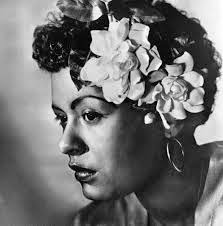
IN TRIBUTE TO AND CELEBRATION OF ONE OF THE MOST PROFOUND AND IMPORTANT ARTISTS OF THE 20th CENTURY, THE GREAT BILLIE HOLIDAY DURING HER CENTENNIAL YEAR, 1915-2015

All,

I hope you enjoyed the ninth week issue from March 28-April 3, 2015 of Volume 1, Number 2 of SOUND PROJECTIONS, the online quarterly music magazine which featured the outstanding trumpet player, jazz and film composer, arranger, orchestrator, ensemble leader, teacher TERENCE BLANCHARD (b. March 13, 1962). The tenth week issue of this volume of the quarterly begins TODAY on Saturday, April 4, 2015 @10AM PST which is @1PM EST.

The featured artist for this week (April 4-April 10, 2015) is the legendary, iconic and innovative singer, songwriter, ensemble leader BILLIE HOLIDAY (1915-1959). In recognition and deep appreciation of Ms. Holiday's extraordinary life and career we celebrate the powerful ongoing legacy of one of the preeminent artists of the 20th century. So please enjoy this week’s featured musical artist in SOUND PROJECTIONS, the online quarterly music magazine and please pass the word to your friends, colleagues, comrades, and associates that the magazine is now up and running at the following site. Please click on the link below:


Thanks. For further important details please read below…

Kofi

Sound Projections
A sonic exploration and tonal analysis of contemporary creative music in a myriad of improvisational/composed settings, textures, and expressions.

Welcome to Sound Projections

I'm your host Kofi Natambu. This online magazine features the very best in contemporary creative music in this creative timezone NOW (the one we're living in) as well as that of the historical past. The purpose is to openly explore, examine, investigate, reflect on, studiously critique, and take opulent pleasure in the sonic and aural dimensions of human experience known and identified to us as MUSIC. I'm also interested in critically examining the wide range of ideas and opinions that govern our commodified notions of the production, consumption, marketing, and commercial exchange of organized sound(s) which largely define and thereby (over)determine our present relationships to music in the general political economy and culture.

Thus this magazine will strive to critically question and go beyond the conventional imposed notions and categories of what constitutes the generic and stylistic definitions of 'Jazz', 'classical music', 'Blues', 'Rhythm and Blues', 'Rock 'n Roll', 'Pop', 'Funk', 'Hip Hop' etc. in order to search for what individual artists and ensembles do creatively to challenge and transform our ingrained ideas and attitudes of what music is and could be.

So please join me in this ongoing visceral, investigative, and cerebral quest to explore, enjoy, and pay homage to the endlessly creative and uniquely magisterial dimensions of MUSIC in all of its guises and expressive identities.

April 4, 2015--April 11, 2015
Billie Holiday (1915-1959): Legendary, iconic and innovative singer, songwriter, and ensemble leader

SOUND PROJECTIONS
AN ONLINE QUARTERLY MUSIC MAGAZINE
EDITOR: KOFI NATAMBU
WINTER, 2015
VOLUME ONE NUMBER TWO

[In glorious tribute and gratitude to this great legendary artist we celebrate her centennial year]

FOR BILLIE HOLIDAY
by Kofi Natambu
Deep within her voice
there is a bird
and inside that bird is a song
and inside that song is a light
and inside that light is a Joy
and inside that Joy is a Monster
and inside that Monster is a memory
and inside that memory is a celebration
and inside that celebration is a hunger
and inside that hunger is a dance
and inside that dance is a moan
and inside that moan is a majesty
and inside that majesty is a longing
and inside that longing is a history
and inside that history is a mystery
and inside that mystery is a fear
and inside that fear is a truth
and inside that truth is a passion
and inside that passion is a whisper
and inside that whisper is a wolf
and inside that wolf is a howl
and inside that howl is a lover
and inside that lover is an escape
and inside that escape is a regret
and inside that regret is a fantasy
and inside that fantasy is a death
and inside that death is a life
and inside that life is a woman
and inside that woman is a scream
and inside that scream is a release
and inside that release is a power
and inside that power is a voice
and inside that voice is a song
and inside that song is a singer
and inside that singer is a Holiday
and inside that Holiday is Billie

Poem from the book THE MELODY NEVER STOPS by Kofi Natambu.  Past Tents Press, 1991

THE DAY LADY DIED
by Frank O'Hara

It is 12:20 in New York a Friday
three days after Bastille day, yes
it is 1959 and I go get a shoeshine
because I will get off the 4:19 in Easthampton
at 7:15 and then go straight to dinner
and I don't know the people who will feed me
I walk up the muggy street beginning to sun
and have a hamburger and a malted and buy
an ugly NEW WORLD WRITING to see what the poets
in Ghana are doing these days
I go on to the bank
and Miss Stillwagon (first name Linda I once heard)
doesn't even look up my balance for once in her life
and in the GOLDEN GRIFFIN I get a little Verlaine
for Patsy with drawings by Bonnard although I do
think of Hesiod, trans. Richmond Lattimore or
Brendan Behan's new play or Le Balcon or Les Nègres
of Genet, but I don't, I stick with Verlaine
after practically going to sleep with quandariness
and for Mike I just stroll into the PARK LANE
Liquor Store and ask for a bottle of Strega and
then I go back where I came from to 6th Avenue
and the tobacconist in the Ziegfield Theatre and
casually ask for a carton of Gauloises and a carton
of Picayunes, and a NEW YORK POST with her face
on it
and I am sweating a lot by now and thinking of
leaning on the john door in the 5 SPOT
while she whispered a song along the keyboard
to Mal Waldron and everyone and I stopped breathing

This immortal poem about Billie written upon her death in 1959 is from LUNCH POEMS by Frank O'Hara (City Lights, 1961)-- Pocket Poets Series 

WKCR presents: The Billie Holiday Centennial Festival:

Tuesday, April 7th marks the 100th birthday anniversary of the one and only Billie Holiday. We'll be celebrating the hauntingly honest, lyrical virtuosity of Lady Day with a weeklong centennial broadcast, featuring her entire 1933-1959 discography, as well as on-air interviews with musicians and scholars. WKCR has a precedent of commemorating Holiday and her incredibly important contributions to vocal jazz, jazz as a whole, and Black music in our annual birthday broadcast schedule and in a special 360-hour Billie Holiday Festival that aired in 2005. 

Tune in to WCKR 89.9FM-NY or online at www.wkcr.org from Sunday, April 5th at 2pm through Friday, April 9th at 9pm as we spend a week listening to and examining the life, career, and distinctive sound of Lady Day. We'll be posting a full broadcasting schedule soon, but so far, look forward to a combination of continuous and show-specific programming throughout the week.


April 3, 2015 

The Art of Billie Holiday’s Life
By Richard Brody
The New Yorker

Billie Holiday, like all great artists, is as distinctive, as idiosyncratic, as original off-stage and off-mike as on. Credit Photograph by Charles Hewitt / LIFE / Getty

Some biographies of artists take in the whole life—preferably with equal attention to the work, and integrating the two elements to the extent that the work invites it. Others offer a bio-slice or synecdoche, centered on one particular period, relationship, or field of activity to provide an exemplary angle on the life and work. John Szwed’s brief but revelatory new book, “Billie Holiday: The Musician and the Myth” (Viking), which comes out this week—just under the wire for her centenary (Holiday was born April 7, 1915)—is in another category. It’s a meta-biography, about the creation of Holiday’s public image in media of all sorts: print, television, movies, and, of course, her recordings, but with special attention to the composition of her autobiography, “Lady Sings the Blues,” which was published in 1956.

Szwed, whose other books include a superb biography of Sun Ra, “Space is the Place,” reconstructs, through ardent archival research as well as his own interviews, the circumstances of the making of Holiday’s book. In the process, he both evaluates the first-hand significance of “Lady Sings the Blues” as Holiday’s factual and emotional account of her own life—as a record of Holiday’s experiences and ideas—and also, secondarily, treats the writing and the publication of the book as important events in Holiday’s life. She died on July 17, 1959, at the age of forty-four, and had been suffering from liver disease and heart disease. She was, as she writes, addicted to heroin “on and off” since the early nineteen-forties. Szwed says that, when she went to the hospital in 1959, “No one at the hospital knew who she was, and with needle marks on her body, she was left in the hall for hours, since the institution was not allowed to treat drug addicts.”

Holiday’s recording career was precocious: she made her first records in 1933, with a small group headed by Benny Goodman (who wasn’t yet a big-band leader). On the very first page of the first chapter, Szwed writes wisely about the timing of Holiday’s own book, nothing that at the time it was published, “jazz had moved from being the popular music of 1940s America to a more rarefied place in the public view.” This fact, for Szwed, mitigated the response that Holiday’s book received. The critics now defending jazz were mainly “closet high modernists who wanted no mention of drugs, whorehouses, or lynching brought into discussions of the music.” And those are among the subjects addressed, in unsparing detail, in Holiday’s book. (Among the critics who attacked the book was Whitney Balliett, this magazine’s longtime jazz critic, who wrote about it in the Saturday Review.)

The first section of Szwed’s book is one of the most briskly revealing pieces of jazz biography that I’ve read. First, he establishes the bona fides of William Dufty, Holiday’s collaborator on the book, rescuing him from charges of being a hack. Dufty was an award-winning journalist at the New York Post at a time when it was a leading liberal paper; he and his wife, Maely Daniele, a longtime friend of Holiday’s, welcomed her to their apartment as “a place of refuge from the police, her husband Louis McKay, reporters, and the various unsavory figures who haunted her life.” Dufty did the actual writing, based on long and detailed conversations with Holiday augmented by archival research that sparked her recollections.

Szwed sketches a handful of the book’s divergences from the independently established biographical record, starting with the legendary first sentences: “Mom and Pop were just a couple of kids when they got married. He was eighteen, she was seventeen, and I was three.” Szwed explains, “When Billie was born, her mother was nineteen, her father seventeen. They never married . . . She was born not in Baltimore but in Philadelphia. Some questioned her claim of having been raped at age ten.”

Holiday’s book is unstinting in its depiction of the hardships she faced. As a child, she heard from her great-grandmother about life as a slave; she grew up away from her mother, in the home of a cousin who beat her; she scrubbed floors in a “whorehouse” in order to hear music on the record player; and the man who raped her when she was ten was a neighbor. She quit school at twelve and travelled to New York alone, where she worked first as a maid and then as a prostitute. Jailed and released, she moved in with her mother, who lived in Harlem. They were on the verge of eviction when Holiday, who was about fifteen, got a job singing—more or less by accident—at a local nightspot. Holiday details the roughness of the world of music, exacerbated by relentless racism—travelling through the South in the age of Jim Crow, being forced to darken her skin with makeup in order to perform in Detroit. She describes in detail her addiction to heroin, her resulting troubles with the law, and its impact on her career.

For all its confessional frankness and accusatory clarity, there is, as Szwed reveals, much more to her story—and the circumstances of the composition of “Lady Sings the Blues” are an exemplary part of it.

Delving into earlier drafts of “Lady Sings the Blues” and other archival materials, Szwed finds echoes of the book in other published sources to which Holiday had referred Dufty as particularly reliable. Holiday told Dufty some stories that were ultimately kept out of the book, including the agonizing home abortion that her mother forced her to undergo as a teen. But Szwed finds that the book’s most important omissions were demanded by lawyers (including one representing Holiday and McKay) and by many of the public figures who played major roles in Holiday’s life and autobiography.

In particular, Szwed traces the stories of two important relationships that are missing from the book—with Charles Laughton, in the nineteen-thirties, and with Tallulah Bankhead, in the late nineteen-forties—and of one relationship that’s sharply diminished in the book, her affair with Orson Welles around the time of “Citizen Kane.”

In 1941, Welles wanted to make a film called “The Story of Jazz,” in collaboration with Duke Ellington. It would be set in the nineteen-teens and twenties, centered on the rise of Louis Armstrong, playing himself. He wanted Holiday to play Bessie Smith. Welles’s movie, Szwed writes, was “intended to be radically innovative, mixing together different styles of jazz, using the surrealist drawings of Oskar Fischinger.” It was put off, Szwed reports, due to the start of the Second World War. When Welles went to Rio to make “It’s All True,” he thought that the jazz story could be woven into it—but his filming of “the everyday interaction of races in Brazil” soured Welles’s studio, RKO, on the entire production.

The basic idea is the crucial one: of all jazz singers, Holiday is the one who is a jazz musician, the equal in musical invention of the epoch-making instrumentalists who played alongside her. Szwed picks up on the negative effect on her career that her style risked when she was starting out. He quotes one club manager who told her, “You sing too slow . . . sounds like you’re asleep!” Music publishers—who still made lots of money from the sale of sheet music—didn’t like her singing, which didn’t present the melodies clearly enough. His analysis shines all the more brightly when he goes behind the scenes of the recordings to unfold the life of performance—her initial experience as a cabaret singer, going table to table for tips in the Prohibition-era cabarets on 133rd Street, where she got her start; the peculiarities of the Fifty-Second Street clubs where she performed in the late thirties, which fostered a casual musical intimacy (“They were small, maybe fifteen feet by sixty feet, and were located in the basements of brownstone residences. They featured miniature tables for a few dozen people.”). He also explains the painful conditions of some of her later recordings, when her health and her voice were in bad shape (“The on-the-spot rehearsals, the false starts, retakes, and overdubs began to pile up on the tape reels”).

Szwed looks closely at her choice of songs and the origins of ones with which she’s closely associated, including “Strange Fruit” and “God Bless the Child.” He details the life-threatening conflicts that she faced on the road in the South, where she performed as a member of the (white) Artie Shaw band. And he carefully considers the specifics of performance later in her career, when she sang at Carnegie Hall and recorded with far more elaborate arrangements than she had used in her youth—and focusses on the musical implications of these circumstances.

Above all, in analyzing her art, Szwed argues for the difference between the performer and the life—between the on-stage persona and the person: “Her ability to communicate strong and painful emotions through singing led many to believe that she was suffering and in real pain. But real suffering is not necessary for great singing, only the ability to communicate it in song . . . Like actors, singers create their identities as artists through words and music. . . . All we can know for certain is the performance itself.”

In general, the desire of even the most discerning critics, such as Szwed, to separate art and life, to analyze the formal traits of works as if they were dissociable from the experience and the emotions that inspire them and that they convey, is both noble and doomed—noble, because artists deserve to be honored for their achievements, and doomed, because the formal and systematic nature of those achievements isn’t what makes them endure. The individuality, the immense complexity of inner life that art conveys—including Holiday’s seemingly straightforward and instantly appreciable art—doesn’t occur in a laboratory-like isolation.

Holiday herself, in “Lady Sings the Blues,” took care to depict the unity of her personal life and her musicianship, starting with the haphazard circumstances under which she began her career, as a teen-age ex-prostitute in need of a fast way of making rent for herself and her mother. She specifically connects the way she sings with her experiences—and with her readiness to face them. (“Maybe I’m proud enough to want to remember Baltimore and Welfare Island.”)

Holiday, like all great artists, is as distinctive, as idiosyncratic, as original off-stage and off-mike as on. The life doesn’t explain the art; rather, life is an art in itself—whether a creation of sublime moments and fascinating gestures, or of terrifying confrontations and mighty endurances—that is illuminated by the same inner light, inspired by the same genius, inflected by the same touch that makes the works of art endure on their own. The biographer of an artist is a critic in advance, in acknowledging and appreciating the actions of an artist’s life and recognizing what’s personal and distinctive in their being—in discerning the artistic aspect of the life. Szwed, in his brief book, accomplishes this goal, perhaps even better than he intended.

Richard Brody began writing for The New Yorker in 1999, and has contributed articles about the directors François Truffaut, Jean-Luc Godard, and Samuel Fuller. He writes about movies in his blog for newyorker.com.


Billie Holiday: The Musician and the Myth review – reclaiming Lady Day's artistry

Everyone knows about the sex and drugs – but John Szwed’s biography makes the case for Holiday as a complex artist who inspired in many different directions

Billie Holiday: one of the most famously indescribable – and inimitable – voices in all of jazz and pop-music history. Photograph: Michael Ochs Archives 

by Seth Colter Walls
Thursday 2 April 2015
The Guardian (UK)

To the public, Billie Holiday might simply be an icon. But to specialists, she’s the subject of a long and unsettled argument. In the view of some critics, her art has often gotten short shrift compared with discussions over the tabloid particulars of her too-short life. In 1956, she published a co-written autobiography called Lady Sings the Blues, which tried to balance confessional storytelling with assertions of her artistic control. It was accused of doing a disservice to jazz by some self-appointed guardians of the genre.

In later decades, Lady Day – as she was called by fans and fellow musicians – was even accused of having been illiterate. A fast-and-loose 1972 biopic starring Diana Ross, a pop singer ill-suited to capturing Holiday’s swinging sophistication and melodic genius, hardly improved anyone’s understanding. The feminist critic Angela Davis took sharp exception to the film, writing that it “tends to imply that her music is no more than an unconscious and passive product of the contingencies of her life”.

With the approach of Holiday’s centenary, more and more people are coming over to Davis’s side. John Szwed’s swift, conversational and yet detail-rich new biography, Billie Holiday: The Musician and the Myth, communicates its artist-first priorities in the subtitle, and then makes good on them throughout. That’s not to say that he ignores the singer’s romantic flings (with Orson Welles, among others), the domestic abuse suffered at the hands of multiple partners or the long-term heroin use that are part of the familiar Holiday lore. Crucially, though, he spends more than half his page-count closely considering Holiday’s music. And his book comes just as three new recordings – one from José James, a singer who skillfully bridges the worlds of contemporary R&B and jazz, one by Cassandra Wilson and another by the classical pianist Lara Downes – likewise investigate the musician’s catalogue with respectfully daring air.

As tough as it is for those musicians to interpret songs Holiday made iconic, it’s possible that Szwed’s challenge was more daunting. He is writing in the wake of Holiday biographies that have, by necessity, relied on speculation and hearsay, given the fact that Holiday gave few interviews (and saw her autobiography redacted by a lawsuit-averse publisher). There are also political ambiguities involved in narrating the choices of an African American artist who, as Davis noted, “worked primarily with the idiom of white popular song”. And then there are the difficulties of needing to describe one of the most famously indescribable – and inimitable – voices in all of jazz and pop-music history.

On the latter point, Szwed clears his throat a bit – quoting divergent critical opinions and eminent musicologists – displaying some of the agonies that prose suffers when summing up the Holiday sound. But he does have moments where he succeeds beautifully: “In the upper register she had a bright but nasal sound; she sounded clearer, perhaps even younger, in the middle; and at the bottom, there was a rougher voice, sometimes a rasp or a growl. But even these voices were varied or might change depending on the song she was singing.” Elsewhere, Szwed is on point when he describes Holiday “falling behind the beat, floating, breathing where it’s not expected, scooping up notes and then letting them fall”.

As the author of compelling books on complex figures such as Miles Davis and Sun Ra, it’s little surprise that Szwed is also wise and authoritative on the sad, complex interaction of Jim Crow racism and early pop-music practices, in the 20-page chapter The Prehistory of a Singer. And he proves as good at reading Holiday’s political choices – such as revising the “in dialect” lyrics of Gershwin’s I Loves You, Porgy – as he is at spelling out Holiday’s evolving approach to improvisation, over the course of her career.

Like Davis, Szwed hears a hint of feminist consciousness-raising in Holiday’s 1948 rendition of My Man. And on the tortured history of credit-taking for the composition of Strange Fruit – the anti-lynching protest song that stunned one nightclub audience after another, once Holiday added it to her repertoire – Szwed cuts through the brush to show the ways in which Holiday’s melodic approach (as well as her choice to perform it in front of white people) destined the song for a place in history as much as anything else.

If it sounds like the accumulated weight of history makes for solemn reading, a lot of fun can actually be had using Szwed as a listening partner. Go ahead and launch your streaming-music engine of choice and build a playlist with the tracks as Szwed considers them. You probably won’t need much help enjoying three rare Holiday recordings with Count Basie’s 1937 band – available on disc eight of Lady Day: The Complete Billie Holiday on Columbia, 1933-1944 – since the musicians’ collective brand of ecstasy requires little in the way of selling. But Szwed’s description of Holiday “gliding over rhythm suspensions and finding her way over the glassine 4/4 of a great swing rhythm section” is a treat – as is his song-by-song investigation of Holiday’s musical partnerships with the pianist Teddy Wilson and the saxophonist Lester Young.

In the case of pre-existing songs that Holiday made her own, Szwed cites earlier recordings by other singers before inviting you to compare them with what he deems to be Holiday’s best version (the better to put her skills in relief). And when it comes to the core of Lady Day’s catalogue – the songs she recorded, with great variance, during multiple phases of her career – Szwed’s listening notes shed useful light on the differences, especially for fans who think they can safely dismiss the portion of Holiday’s discography that is less favoured by jazz aficionados.

That very hybridity – Holiday’s ability to help define jazz singing, and then buck the genre’s conventions – is what makes the new spate of tributes to her feel so appropriate. A listener might disagree with an arrangement choice made by Cassandra Wilson, on Coming Forth By Day, or else miss elements of swing in Lara Downes’s classical recital A Billie Holiday Songbook – but their risk-taking is clearly in the service of honoring Holiday’s often-surprising moves. (José James’s Yesterday I Had the Blues: The Music of Billie Holiday is just about perfect, including as it does the playing of MacArthur-winning pianist Jason Moran.)

Plenty of stars from yesteryear had crazy-juicy personal lives; very few left behind conceptual approaches that inspire in so many directions. Each of these new albums is in league with Szwed’s book – a joint persuasion campaign meant to encourage us to consider musicianship as the defining characteristic of Lady Day’s legacy. That’s about as fine a centenary-year gift as anyone had a right to expect.

Billie Holiday: The Musician and the Myth is published by Viking Press in the USA, and William Heinemann in the UK

When Billie played her yearly concerts at the Apollo and at Carnegie Hall everyone came out in full force either to hear her sing or to see whether she was still together. Each time a new record was issued it was compared with her early ones, and she was often judged to be imitating herself, to be working with the wrong musicians, the wrong arrangers, etc. Most everyone liked to believe that Billie made her best records when she sang with Count Basie and the other geniuses of swing. It's hard to disagree, for she was, like all of them, an incredible horn in those days. Billie's later records, usually in a much slower tempo, are a different music. They are the songs of a woman alone and lonely and without much sympathy. No one blows pretty solos behind her like Lester did. Sometimes there are unintelligent voices in the background going oo-oo-oo with none of the wit Billie had on "Ooo-oo-oo what a lil moonlight can doo-oo-oo." Nevertheless, these are the songs of Lady Day too, and if the sorrow sounds a little heavier it was because she'd been carrying it a while. "I remember when she was happy-" Carmen McRae said in 1955, "that was a long time ago."

Billie and Louis both were arrested in 1956. Billie knew by this time that if the Narcotics Bureau wanted to get her it only had to be arranged, the evidence "found" and she could be convicted on her past record. In her book she pleaded that the addict be treated rather than punished. She knew how little good punishment had ever done to help her. And her stated purpose in revealing all that she considered shameful in her life was to warn young people away from heroin. "If you think dope is for kicks and for thrills, you're out of your mind.... The only thing that can happen to you is sooner or later you'll get busted, and once that happens, you'll never live it down. Just look at me."

Billie never was able to stop using heroin completely, though she tried very hard. Some people thought she could have tried harder: "That girl's life... was just snapped away from foolishness." But there were others who knew and loved her. Lena Horne and Billie had been friends since Cafe Society days, and she understood how life had been spoiled for Billie.

Billie didn't lecture me - she didn't have to. Her whole life, the way she sang, made everything very plain. It was as if she were a living picture there for me to see something I had not seen clearly before.

Her life was so tragic and so corrupted by other people-by white people and by her own people. There was no place for her to go, except finally, into that little private world of dope. She was just too sensitive to survive.

Billie survived long enough to sing a few days at the Five Spot, a club that opened in downtown New York in the fifties. Her last appearance was at the Phoenix Theater in New York in May, 1959. On May 31 she was brought to a hospital unconscious, suffering from liver and heart ailments, the papers said. Twelve days later someone allegedly found heroin in her room. She was arrested while in her hospital bed and police came to guard her, to make sure this now thin, suffering woman could not get away from the law one more time. But she escaped the judgment of the United States of America versus Billie Holiday for a higher judgment, on July 17, 1959.


Billie Holiday at 100: Artists reflect on jazz singer’s legacy
By Aidin Vaziri
Friday, April 3, 2015
Photo: Associated Press

Image 1 of 13

FILE - This Sept. 1958 file photo shows Billie Holiday. The Apollo Theater is planning events to commemorate the 100th birthday of Holiday. The legendary American jazz vocalist was born on April 17, 1915 and died in 1959 at the age of 44. Holiday performed at least two dozen times at the Apollo. She will be inducted into its Walk of Fame on April 16, 2015. (AP Photo/FILE)

Billie Holiday would have turned 100 this week, but who’s counting? The famed jazz singer and songwriter’s voice is ageless, still luring fans with its effortless swagger and unblinking candor. It carried with it all the difficulty she endured throughout her tumultuous life — born Eleanora Fagan, an illegitimate child, on April 7, 1915, in Baltimore; died strung out and broken 44 years later in New York — along with all the hope, fear and desperation that came with it. “What comes out is what I feel,” she once said.

No one else can sound like Billie Holiday because no one else lived like Billie Holiday.
Yet in generation after generation, her influence is unmistakable. To mark the centennial of her birth, which will be celebrated with concerts, books, albums, tributes and reissue packages around the world, we spoke with some people closer to home whose lives were deeply touched by Holiday.

Paula West

Longtime Bay Area jazz singer, torchbearer of the American Songbook popularized by Holiday

I’m not quite sure when I first heard Billie Holiday. I believe it was before the Diana Ross biopic (“Lady Sings the Blues”) was released. Of course their voices were dissimilar. I was young at the time, and had only been exposed to those “greatest hits,” such as “Fine and Mellow,” “Them There Eyes” and “Good Morning Heartache.”

I feel the best singers have always been able to get across the raw emotions of the lyrics. She had no great vocal range, but that was never needed. It was about telling the truth, the story, and not too many singers could ever match her natural interpretations. No vocal histrionics, melisma necessary. She was respected by musicians, as well, and her singing was influenced by musicians such as Louis Armstrong.

There are dozens of her interpretations I love, but “Lady in Satin” is my favorite, particularly her version of “I’m a Fool to Want You.” The arrangement is beautiful yet heartbreaking, of course, and no one could deliver that better than Billie Holiday.

Lavay Smith

Blues and jazz singer with Lavay Smith & Her Red Hot Skillet Lickers, renowned for her tributes to the first ladies of jazz

I remember seeing Billie Holiday singing on TV on an oldies station that would show the Little Rascals, Shirley Temple and old black-and-white movies. Like everyone who hears her, I loved her right away.

Billie remains an icon because she was true to herself. As a singer, she made you believe that she meant every word she sang. Lyrics were very important to her, which isn’t true of all jazz singers. And the feeling that she creates through her use of rhythm was always swingin’ and happy. A lot of people think of her music as being sad, but she had a great sense of humor that comes through, and I’ve always found her music to be uplifting.

The first album I bought was “Lady Sings the Blues,” and I played the heck out of. It included “Strange Fruit” and many of her hits, like “Traveling Light” and “Good Morning Heartache.” I love all of the Columbia recordings that she did with Lester Young and Teddy Wilson, including all of the obscure songs. I just love the feeling and the soul of these records. The interplay between Billie and Lester Young is the textbook definition of how an instrumentalist should interact with a singer.

Joey Arias
New York cabaret singer and drag artist, who recently performed a tribute to Billie Holiday at Lincoln Center

I remember hearing her voice and thinking how lovely she sounded. I wanted to have that same sound that she was emoting. It was a magic spell that was sent to me. I feel as though we were connected at the hip from stories I’ve heard from friends and family.

Billie was an outspoken person. She was class all the way and never wanted to be treated any other way. She was being followed and became public enemy for standing up for her rights and acting strong and never letting her guard down. She dressed beautifully and had such presence.
 
“Lady in Satin” is my favorite album. It all depends on what period you want to hear her style, but I love her in the late ’50s. She summed it all up — her life, her singing and her thoughts, and her love of life and love.

Randall Kline
SFJazz executive director

I heard her on the home stereo as a teenager. My parents were jazz fans. One hearing of her voice — soft, persuasive, mournful, honest, beautiful — told you to listen more closely. “Don’t Explain” for its raw pathos. “Strange Fruit” for its power, poignancy and, sadly, its contemporary relevance.

Getting to know Billie Holiday

Here are some albums to help you get better acquainted with the jazz singer’s magic.

“Lady Day: The Best of Billie Holiday,” Legacy. A two-CD set containing many of the classic sides Holiday cut for Columbia and its Brunswick, Vocalion and Okeh labels in the 1930s and early ’40s, including “What a Little Moonlight Can Do,” “A Fine Romance,” “You Go to My Head” and “The Man I Love.”

“Billie Holiday: The Complete Decca Recordings,” GRP. An excellent two-CD box featuring the torch songs, raucous renditions of signature Bessie Smith numbers, and other material Holiday recorded for Decca from 1944 to 1950.

“Lady in Autumn: The Best of the Verve Years,” Verve. A good two-disc survey of Holiday’s small-band recordings of the 1950s, featuring stellar soloists like Ben Webster and Benny Carter.

“Lady in Satin,” Legacy. A heartbreaking beauty. Writer Michael Brooks wrote that this 1958 album feels “as if a group of family and friends are gathered around a loved one and saying their last goodbyes.”

“Ken Burns Jazz — Definitive Billie Holiday,” Verve. Compiled by the documentary filmmaker, this single-disc collection culls material from the three major phases of the singer’s career. — Jesse Hamlin

Kitty Margolis

San Francisco jazz singer, trustee at the Recording Academy, founder of Mad-Kat Records

I remember staring at a girlish, chubby Billie on the cover of this brown Columbia three-LP box set released in 1962, “Billie Holiday: The Golden Years.” It had an extensive photo book with detailed track listings inside and liner notes by John Hammond and Ralph Gleason. I still have it. Opening it and smelling the paper takes me right back. I realize now that a lot of the tunes in this box became very important to my early core repertoire.

I don’t think there is one genuine female jazz singer in the world who doesn’t have Billie inside. She defined the idiom.

One major thing that set Billie apart as a jazz singer is that she was a musician’s singer, a master improviser without ever uttering one scat syllable. She was not a classically “pretty”-sounding singer like Ella or Sarah. Billie’s sound was a bittersweet brew: raw, tart, personal, intimate, relaxed, understated, urgent.

Billie’s storytelling was always 100 percent emotionally intelligent and believable, an ironic cocktail of longing, pride, pain, strength with a sharp glint of humor. No one could sound happier (“Them There Eyes”) and no one could sound darker (“I’m a Fool to Want You”). Billie sang the truth. There was no “acting” involved. She could take even the most banal pop lyric of the time and imbue it with subtext that gave it a much deeper message, almost like a code.


Sunday, March 29, 2015

THE DIVINE ONE: In Tribute To and Celebration of the Legendary and Iconic Singer and Musician Sarah Vaughan (1924-1990) On Her 91st Birthday

https://www.facebook.com/pages/The-Panopticon-Review/342702882479366


SARAH VAUGHAN
(b. March 27, 1924--d. April 3, 1990)

Sarah Vaughan, Live at Mr. Kelly's, Chicago, 1957-- (full album):

https://www.youtube.com/watch?v=q71a25C0yCM


http://www.pbs.org/…/episodes/sara…/about-sarah-vaughan/723/

AMERICAN MASTERS
October 8th, 2005
Sarah Vaughan
About Sarah Vaughan
PBS


Jazz critic Leonard Feather called her “the most important singer to emerge from the bop era.” Ella Fitzgerald called her the world’s “greatest singing talent.” During the course of a career that spanned nearly fifty years, she was the singer’s singer, influencing everyone from Mel Torme to Anita Baker. She was among the musical elite identified by their first names. She was Sarah, Sassy — the incomparable Sarah Vaughan.

Born in Newark, New Jersey, in 1924, Vaughan was immediately surrounded by music: her carpenter father was an amateur guitarist and her laundress mother was a church vocalist. Young Sarah studied piano from the age of seven, and before entering her teens had become an organist and choir soloist at the Mount Zion Baptist Church. When she was eighteen, friends dared her to enter the famed Wednesday Night Amateur Contest at Harlem’s Apollo Theater. She gave a sizzling rendition of “Body and Soul,” and won first prize. In the audience that night was the singer Billy Eckstine. Six months later, she had joined Eckstine in Earl Hines’s big band along with jazz legends Dizzy Gillespie and Charlie Parker.

When Eckstine formed his own band soon after, Vaughan went with him. Others including Miles Davis and Art Blakey, were eventually to join the band as well. Within a year, however, Vaughan wanted to give a solo career a try. By late 1947, she had topped the charts with “Tenderly,” and as the 1940s gave way to the 1950s, Vaughan expanded her jazz repertoire to include pop music. As a result, she enlarged her audience, gained increased attention for her formidable talent, and compiled additional hits, including the Broadway show tunes “Whatever Lola Wants” and “Mr. Wonderful.” While jazz purists balked at these efforts, no one could deny that in any genre, Vaughan had one of the greatest voices in the business.

In the late 1960s, Vaughan returned to jazz music, performing and making regular recordings. Throughout the 1970s and ’80s she recorded with such jazz notables as Oscar Peterson, Louie Bellson, Zoot Sims, Herbie Hancock, Ron Carter, Don Cherry, and J.J. Johnson. Her recordings of the “Duke Ellington Song Book (1 and 2)” are considered some of the finest recordings of the time. While for many years her signature song had been “Misty,” by the mid-70’s, she was closing every show with Sondheim’s “Send In The Clowns.” In 1982, while in her late fifties, Vaughan won the Grammy for Best Jazz Vocalist for her album, “Gershwin Live”!

While she continued to work without the massive commercial success enjoyed by colleagues such as Peggy Lee, Rosemary Clooney, and Ella Fitzgerald, Sarah Vaughan consistently retained a special place in the hearts of fellow musicians and audiences alike. She continually performed at top venues, playing to adoring sell-out crowds well into her sixties. Remarkably, unlike many singers, she lost none of her extraordinary talent as time went on. Her multi-octave range, with its swooping highs and sensual lows, and the youthful suppleness of her voice shaded by a luscious timbre and executed with fierce control, all remained intact. In 1990, at the age sixty-six, Sarah Vaughan passed away. Shortly after her death, Mel Torme summed up the feelings of all who had seen her, saying “She had the single best vocal instrument of any singer working in the popular field.”

Sassy: The Life Of Sarah Vaughan
by Leslie Gourse
Paperback, 320 pages
Published August 22nd 1994 
by Da Capo Press 

(First published by C. Scribner's Sons in hardcover in 1993)


Sarah Vaughan possessed the most spectacular voice in jazz history. In Sassy, Leslie Gourse, the acclaimed biographer of Nat King Cole and Joe Williams, defines and celebrates Vaughan’s vital musical legacy and offers a detailed portrait of the woman as well as the singer. Revealed here is ”The Divine One” as only her closest friends and musical associates knew her. By her early twenties Sarah Vaughan was singining with Dizzy Gillespie, Charlie Parker, and Billy Eckstine, helping them invent bebop. For forty-five years thereafter, she reigned supreme in both pop and jazz, with several million-selling hits (among them ”Broken Hearted Melody,” ”Make Yourself Comfortable,” and ”Misty”).But life offstage was never smooth for Sarah Vaughan. Her voluptuous voice was matched by her exuberant appetite for excess: three failed marriages, financial difficulties through many changes in management, late-night jam sessions, liquor, and cocaine. In Sassy, though, we also see the feisty and unpretentious woman who worked hard all her life to support her parents and adopted daughter, and who came to savor the hard-won independence and worldwide acclaim she achieved as the greatest jazz singer of her generation.


http://www.npr.org/artists/15202481/sarah-vaughan
 

Sarah Vaughan "Misty" Live 1964:


Sarah Vaughan "Tenderly" Live 1958:


Count Basie & Sarah Vaughan LIVE in Carnegie Hall 1981:


Sarah Vaughan - Live in '58 & '64:


Performers:

Sarah Vaughan (Vocal)
Richard Davis (Bass)
Ronnell Bright (Piano)
Art Morgan (Drums)


SONGS:


Live in Sweden 1958
Sometimes I’m Happy
Lover Man
September In The Rain
Mean To Me
Tenderly
If This Isn’t Love

Live in Holland 1958
Over The Rainbow
They All Laughed
Lover Man
Cherokee
Sometimes I’m Happy

Live in Sweden 1964
I Feel Pretty
The More I See You
Baubles, Bangles And Beads
I Got Rhythm
Misty
Honeysuckle Rose
Maria
Bill Bailey, Won’t You Please Come Home


Entertainment › Noah K. Murray/ The Star-Ledger
Poet Amiri Baraka reads a poem about Sarah Vaughan

Author Amiri Baraka, who turns 75 next week (10-7-2009), reads his poetry at Skippers Pub in Newark. The poem entitled, "The Lullabye of Avon Avenue" is about American jazz singer and Newarker, Sarah Vaughan. Starting tomorrow, several commemorative events are planned in the city to examine his career as an artist and activist. (Video by Noah K. Murray / The Star-Ledger)
PUBLISHED: August 22, 2010

http://en.wikipedia.org/wiki/Sarah_Vaughan

Sarah Vaughan
From Wikipedia, the free encyclopedia


 Sarah Vaughan, c. 1946

Background information
Birth name Sarah Lois Vaughan
Also known as "Sassy"
"The Divine One"
"Sailor"
Born March 27, 1924
Newark, New Jersey, United States
Died April 3, 1990 (aged 66)
Hidden Hills, California. United States
Genres Vocal jazz, bebop, cool jazz, blues, traditional pop, bossa nova
Occupation(s) Singer
Years active 1942–1989
Labels Columbia, Mercury, Verve, Roulette, Pablo

 
Sarah Lois Vaughan (March 27, 1924 – April 3, 1990) was an American jazz singer, described by music critic Scott Yanow as having "one of the most wondrous voices of the 20th century."[1]

Nicknamed "Sassy", "The Divine One" and "Sailor" (for her salty speech),[2] Sarah Vaughan was a Grammy Award winner.[3] The National Endowment for the Arts bestowed upon her its "highest honor in jazz", the NEA Jazz Masters Award, in 1989.[4]

Contents

1 Early life
2 Early career: 1942–1943
3 With Earl Hines and Billy Eckstine: 1943–1944
4 Early solo career: 1945–1948
5 Stardom and the Columbia years: 1948–1953
6 Mercury years: 1954–1958
7 1960s
8 Rebirth in the 1970s
9 Late career
10 Death
11 Grammy Hall of Fame
12 Voice
13 Personal life
14 Discography
15 Tributes
16 References
17 External links


Early life

Sarah Vaughan's father, Asbury "Jake" Vaughan, was a carpenter by trade and played guitar and piano. Her mother, Ada Vaughan, was a laundress and sang in the church choir.[5] Jake and Ada Vaughan had migrated to Newark from Virginia during the First World War. Sarah was their only biological child, although in the 1960s they adopted Donna, the child of a woman who traveled on the road with Sarah Vaughan.[6]

The Vaughans lived in a house on Brunswick Street, in Newark, New Jersey, for Sarah's entire childhood.[6] Jake Vaughan was deeply religious and the family was very active in the New Mount Zion Baptist Church on 186 Thomas Street. Sarah began piano lessons at the age of seven, sang in the church choir and occasionally played piano for rehearsals and services.

Vaughan developed an early love for popular music on records and the radio. In the 1930s, Newark had a very active live music scene and Vaughan frequently saw local and touring bands that played in the city at venues like the Montgomery Street Skating Rink.[6] By her mid-teens, Vaughan began venturing (illegally) into Newark's night clubs and performing as a pianist and, occasionally, singer, most notably at the Piccadilly Club and the Newark Airport USO.

Vaughan initially attended Newark's East Side High School, later transferring to Newark Arts High School,[6] which had opened in 1931 as the United States' first arts "magnet" high school. However, her nocturnal adventures as a performer began to overwhelm her academic pursuits and Vaughan dropped out of high school during her junior year to concentrate more fully on music. Around this time, Vaughan and her friends also began venturing across the Hudson River into New York City to hear big bands at the Apollo Theater in Harlem.

Early career: 1942–1943


Biographies of Vaughan frequently stated that she was immediately thrust into stardom after a winning amateur night performance at Harlem's Zeus Theater. In fact, the story that biographer Renee relates seems to be a bit more complex. Vaughan was frequently accompanied by a friend, Doris Robinson, on her trips into New York City. Some time in the fall of 1942 (when Sarah was 18 years old), Vaughan suggested that Robinson enter the Apollo Theater Amateur Night contest. Vaughan played piano accompaniment for Robinson, who won second prize. Vaughan later decided to go back and compete herself as a singer. Vaughan sang "Body and Soul" and won, although the exact date of her victorious Apollo performance is uncertain. The prize, as Vaughan recalled later to Marian McPartland, was $10 and the promise of a week's engagement at the Apollo. After a considerable delay, Vaughan was contacted by the Apollo in the spring of 1943 to open for Ella Fitzgerald.

Some time during her week of performances at the Apollo, Vaughan was introduced to bandleader and pianist Earl "Fatha" Hines, although the exact details of that introduction are disputed. Billy Eckstine, Hines' singer at the time, has been credited by Vaughan and others with hearing her at the Apollo and recommending her to Hines. Hines also claimed later to have discovered her himself and offered her a job on the spot. Regardless, after a brief tryout at the Apollo, Hines officially replaced his current male singer with Vaughan on April 4, 1943.

With Earl Hines and Billy Eckstine: 1943–1944


Vaughan spent the remainder of 1943 and part of 1944 touring the country with the Earl Hines big band that also featured baritone Billy Eckstine. Vaughan was hired as a pianist, reputedly so Hines could hire her under the jurisdiction of the musicians' union (American Federation of Musicians) rather than the singers union (American Guild of Variety Artists), but after Cliff Smalls joined the band as a trombonist and pianist, Sarah's duties became limited exclusively to singing. This Earl Hines band is best remembered today as an incubator of bebop, as it included trumpeter Dizzy Gillespie, saxophonist Charlie Parker (playing tenor saxophone rather than the alto saxophone that he would become famous with later) and trombonist Bennie Green. Gillespie also arranged for the band, although a recording ban by the musicians union prevented the band from recording and preserving its sound and style for posterity.

Eckstine left the Hines band in late 1943 and formed his own big band with Gillespie, leaving Hines to become the new band's musical director. Parker came along too, and the Eckstine band over the next few years would host a startling cast of jazz talent: Miles Davis, Kenny Dorham, Art Blakey, Lucky Thompson, Gene Ammons, and Dexter Gordon, among others.

Vaughan accepted Eckstine's invitation to join his new band in 1944, giving her an opportunity to develop her musicianship with the seminal figures in this era of jazz. Eckstine's band also afforded her first recording opportunity, a December 5, 1944 date that yielded the song "I'll Wait and Pray" for the Deluxe label. That date led to critic and producer Leonard Feather to ask her to cut four sides under her own name later that month for the Continental label, backed by a septet that included Dizzy Gillespie and Georgie Auld.

Band pianist John Malachi is credited with giving Vaughan the moniker "Sassy", a nickname that matched her personality. Vaughan liked it and the name (and its shortened variant "Sass") stuck with colleagues and, eventually, the press. In written communications, Vaughan often spelled it "Sassie".

Vaughan officially left the Eckstine band in late 1944 to pursue a solo career, although she remained very close to Eckstine personally and recorded with him frequently throughout her life.

Early solo career: 1945–1948


At Café Society, September 1946

Vaughan began her solo career in 1945 by freelancing in clubs on New York's 52nd Street such as the Three Deuces, the Famous Door, the Downbeat and the Onyx Club. Vaughan also hung around the Braddock Grill, next door to the Apollo Theater in Harlem. On May 11, 1945, Vaughan recorded "Lover Man" for the Guild label with a quintet featuring Gillespie and Parker with Al Haig on piano, Curly Russell on double bass and Sid Catlett on drums. Later that month she went into the studio with a slightly different and larger Gillespie/Parker aggregation and recorded three more sides.

After being invited by violinist Stuff Smith to record the song "Time and Again" in October, Vaughan was offered a contract to record for the Musicraft label by owner Albert Marx, although she would not begin recording as a leader for Musicraft until May 7, 1946. In the intervening time, Vaughan made a handful of recordings for the Crown and Gotham labels and began performing regularly at Café Society Downtown, an integrated club in New York's Sheridan Square.

While at Café Society, Vaughan became friends with trumpeter George Treadwell. Treadwell became Vaughan's manager and she ultimately delegated to him most of the musical director responsibilities for her recording sessions, leaving her free to focus almost entirely on singing. Over the next few years, Treadwell also made significant positive changes in Vaughan's stage appearance. Aside from an improved wardrobe and hair style, Vaughan had her teeth capped, eliminating an unsightly gap between her two front teeth.

Many of Vaughan's 1946 Musicraft recordings became quite well known among jazz aficionados and critics, including "If You Could See Me Now" (written and arranged by Tadd Dameron), "Don't Blame Me", "I've Got a Crush on You", "Everything I Have Is Yours" and "Body and Soul". With Vaughan and Treadwell's professional relationship on solid footing, the couple married on September 16, 1946.

Vaughan's recording success for Musicraft continued through 1947 and 1948. Her recording of "Tenderly" became an unexpected pop hit in late 1947. Her December 27, 1947, recording of "It's Magic" (from the Doris Day film Romance on the High Seas) found chart success in early 1948. Her recording of "Nature Boy" from April 8, 1948, became a hit around the same time as the release of the famous Nat King Cole recording of the same song. Because of yet another recording ban by the musicians union, "Nature Boy" was recorded with an a cappella choir as the only accompaniment, adding an ethereal air to a song with a vaguely mystical lyric and melody.

Stardom and the Columbia years: 1948–1953


The musicians union ban pushed Musicraft to the brink of bankruptcy and Vaughan used the missed royalty payments as an opportunity to sign with the larger Columbia record label. Following the settling of the legal issues, her chart successes continued with the charting of "Black Coffee" in the summer of 1949. During her tenure at Columbia through 1953, Vaughan was steered almost exclusively to commercial pop ballads, a number of which had chart success: "That Lucky Old Sun", "Make Believe (You Are Glad When You're Sorry)", "I'm Crazy to Love You", "Our Very Own", "I Love the Guy", "Thinking of You" (with pianist Bud Powell), "I Cried for You", "These Things I Offer You", "Vanity", "I Ran All the Way Home", "Saint or Sinner", "My Tormented Heart", and "Time", among others.

Vaughan also achieved substantial critical acclaim. She won Esquire magazine's New Star Award for 1947 as well as awards from Down Beat magazine continuously from 1947 through 1952, and from Metronome magazine from 1948 through 1953. A handful of critics disliked her singing as being "over-stylized", reflecting the heated controversies of the time over the new musical trends of the late 40s. However, the critical reception to the young singer was generally positive.

Recording and critical success led to numerous performing opportunities, packing clubs around the country almost continuously throughout the years of the late 1940s and early 1950s. In the summer of 1949, Vaughan made her first appearance with a symphony orchestra in a benefit for the Philadelphia Orchestra entitled "100 Men and a Girl." Around this time, Chicago disk jockey Dave Garroway coined a second nickname for her, "The Divine One", that would follow her throughout her career. One of her early television appearances was on DuMont's variety show Stars on Parade (1953–54), in which she sang "My Funny Valentine" and "Linger Awhile".

With improving finances, in 1949 Vaughan and Treadwell purchased a three-story house on 21 Avon Avenue in Newark, occupying the top floor during their increasingly rare off-hours at home and relocating Vaughan's parents to the lower two floors. However, the business pressures and personality conflicts led to a cooling in the personal relationship between Treadwell and Vaughan. Treadwell hired a road manager to handle Vaughan's touring needs and opened a management office in Manhattan so he could work with clients in addition to Vaughan.

Vaughan's relationship with Columbia Records also soured as she became dissatisfied with the commercial material she was required to record and lackluster financial success of her records. A set of small group sides recorded in 1950 with Miles Davis and Bennie Green are among the best of her career, but they were atypical of her Columbia output.
Mercury years: 1954–1958


In 1953, Treadwell negotiated a unique contract for Vaughan with Mercury Records. She would record commercial material for the Mercury label and more jazz-oriented material for its subsidiary EmArcy. Vaughan was paired with producer Bob Shad and their excellent working relationship yielded strong commercial and artistic success. Her debut Mercury recording session took place in February 1954 and she stayed with the label through 1959. After a stint at Roulette Records (1960 to 1963), Vaughan returned to Mercury from 1964 to 1967.

Vaughan's commercial success at Mercury began with the 1954 hit, "Make Yourself Comfortable", recorded in the fall of 1954, and continued with a succession of hits, including: "How Important Can It Be" (with Count Basie), "Whatever Lola Wants", "The Banana Boat Song", "You Ought to Have A Wife" and "Misty". Her commercial success peaked in 1959 with "Broken Hearted Melody", a song she considered to be "corny", but, nonetheless, became her first gold record and a regular part of her concert repertoire for years to come. Vaughan was reunited with Billy Eckstine for a series of duet recordings in 1957 that yielded the hit "Passing Strangers". Vaughan's commercial recordings were handled by a number of different arrangers and conductors, primarily Hugo Peretti and Hal Mooney.

The jazz "track" of her recording career also proceeded apace, backed either by her working trio or various combinations of stellar jazz players. One of her own favorite albums was a 1954 sextet date that included Clifford Brown.

In the latter half of the 1950s she followed a schedule of almost non-stop touring, with many famous jazz musicians. She was featured at the first Newport Jazz Festival in the summer of 1954 and starred in subsequent editions of that festival at Newport and in New York City for the remainder of her life. In the fall of 1954, she performed at Carnegie Hall with the Count Basie Orchestra on a bill that also included Billie Holiday, Charlie Parker, Lester Young and the Modern Jazz Quartet. That fall, she again toured Europe successfully before embarking on a "Big Show" U.S. tour, a grueling succession of start-studded one-nighters that included Count Basie, George Shearing, Erroll Garner and Jimmy Rushing. At the 1955 New York Jazz Festival on Randalls Island, Vaughan shared the bill with the Dave Brubeck quartet, Horace Silver, Jimmy Smith, and the Johnny Richards Orchestra

Although the professional relationship between Vaughan and Treadwell was quite successful through the 1950s, their personal relationship finally reached a breaking point and she filed for a divorce in 1958. Vaughan had entirely delegated financial matters to Treadwell, and despite significant income figures reported through the 1950s, at the settlement Treadwell said that only $16,000 remained. The couple evenly divided the amount and their personal assets, terminating their business relationship.

1960s


The exit of Treadwell from Vaughan's life was also precipitated by the entry of Clyde "C.B." Atkins, a man of uncertain background whom she had met in Chicago and married on September 4, 1959. Although Atkins had no experience in artist management or music, Vaughan wished to have a mixed professional and personal relationship like the one she had with Treadwell. She made Atkins her personal manager, although she was still feeling the sting of the problems she had with Treadwell and initially kept a slightly closer eye on Atkins. Vaughan and Atkins moved into a house in Englewood, New Jersey.[7]

When Vaughan's contract with Mercury Records ended in late 1959, she immediately signed on with Roulette Records, a small label owned by Morris Levy, who was one of the backers of New York's Birdland, where she frequently appeared. Roulette's roster also included Count Basie, Joe Williams, Dinah Washington, Lambert, Hendricks and Ross and Maynard Ferguson.

Vaughan began recording for Roulette in April 1960, making a string of strong large ensemble albums arranged and/or conducted by Billy May, Jimmy Jones, Joe Reisman, Quincy Jones, Benny Carter, Lalo Schifrin, and Gerald Wilson. Surprisingly, she also had some pop chart success in 1960 with "Serenata" on Roulette and a couple of residual tracks from her Mercury contract, "Eternally" and "You're My Baby". She also made a pair of intimate vocal/guitar/double bass albums of jazz standards: After Hours (1961) with guitarist Mundell Lowe and double bassist George Duvivier and Sarah + 2 (1962) with guitarist Barney Kessell and double bassist Joe Comfort.

Vaughan was incapable of having children so, in 1961, she and Atkins adopted a daughter, Debra Lois. However, the relationship with Atkins proved difficult and violent so, following a series of strange[clarification needed] incidents, she filed for divorce in November 1963. She turned to two friends to help sort out the financial affairs of the marriage: club owner John "Preacher" Wells, a childhood acquaintance, and Clyde "Pumpkin" Golden, Jr. Wells and Golden found that Atkins' gambling and profligate spending had put Vaughan around $150,000 in debt. The Englewood house was ultimately seized by the IRS for nonpayment of taxes. Vaughan retained custody of their child and Golden essentially took Atkins place as Vaughan's manager and lover for the remainder of the decade.

Around the time of her second divorce, she also became disenchanted with Roulette Records. Roulette' finances were even more deceptive and opaque than usual in the record business and its recording artists often had little to show for their efforts other than some excellent records. When her contract with Roulette ended in 1963, Vaughan returned to the more familiar confines of Mercury Records. In the summer of 1963, Vaughan went to Denmark with producer Quincy Jones to record four days of live performances with her trio, Sassy Swings the Tivoli, an excellent example of her live show from this period. The following year, she made her first appearance at the White House, for President Johnson.

The Tivoli recording would be the brightest moment of her second stint with Mercury. Changing demographics and tastes in the 1960s left jazz artists with shrinking audiences and inappropriate material. While Vaughan retained a following large and loyal enough to maintain her performing career, the quality and quantity of her recorded output dwindled even as her voice darkened and her skill remained undiminished. At the conclusion of her Mercury deal in 1967, she was left without a recording contract for the remainder of the decade.

In 1969, Vaughan terminated her professional relationship with Golden and relocated to the West Coast, settling first into a house near Benedict Canyon in Los Angeles and then into what would end up being her final home in Hidden Hills.

Rebirth in the 1970s


Vaughan met Marshall Fisher after a 1970 performance at a casino in Las Vegas and Fisher soon fell into the familiar dual role as Vaughan's lover and manager. Fisher was another man of uncertain background with no musical or entertainment business experience but, unlike some of her earlier associates, he was a genuine fan devoted to furthering her career.

The seventies also heralded a rebirth in Vaughan's recording activity. In 1971, Bob Shad, who had worked with her as producer at Mercury Records, asked her to record for his new record label, Mainstream Records. Basie veteran Ernie Wilkins arranged and conducted her first Mainstream album, A Time in My Life in November 1971. In April 1972, Vaughan recorded a collection of ballads written, arranged and conducted by Michel Legrand. Arrangers Legrand, Peter Matz, Jack Elliott and Allyn Ferguson teamed up for Vaughan's third Mainstream album, Feelin' Good. Vaughan also recorded Live in Japan, a live album in Tokyo with her trio in September 1973.

During her sessions with Legrand, Bob Shad presented "Send in the Clowns", a Stephen Sondheim song from the Broadway musical A Little Night Music, to Vaughan for consideration. The song would become her signature, replacing the chestnut "Tenderly" that had been with her from the beginning of her solo career.

Unfortunately, Vaughan's relationship with Mainstream soured in 1974, allegedly in a conflict precipitated by Fisher over an album cover photograph and/or unpaid royalties[citation needed]. This left Vaughan again without a recording contract for three years.

In December 1974, Vaughan played a private concert for the United States president, Gerald Ford, and French president, Giscard d'Estaing, during their summit on Martinique.

Also in 1974, conductor Michael Tilson Thomas asked Vaughan to participate in an all-Gershwin show he was planning for a guest appearance with the Los Angeles Philharmonic at the Hollywood Bowl. The arrangements were by Marty Paich and the orchestra would be augmented by established jazz artists Dave Grusin on piano, Ray Brown on double bass, drummer Shelly Manne and saxophonists Bill Perkins and Pete Christlieb. The concert was a success and Thomas and Vaughan repeated the performance with Thomas' home orchestra in Buffalo, New York, followed by appearances in 1975 and 1976 with symphony orchestras around the country. These performances fulfilled a long-held interest by Vaughan in working with symphonies and she made orchestra performances without Thomas for the remainder of the decade.

In 1977, Vaughan terminated her personal and professional relationship with Marshall Fisher. Although Fisher is occasionally referenced as Vaughan's third husband, they were never legally married. Vaughan began a relationship with Waymond Reed, a trumpet player 16 years her junior who was playing with the Count Basie band. Reed joined her working trio as a musical director and trumpet player and became her third husband in 1978.

In 1977, Tom Guy, a young filmmaker and public TV producer, followed Vaughan around on tour, interviewing numerous artists speaking about her and capturing both concert and behind-the-scenes footage. The resulting sixteen hours of footage was pared down into an hour-and-a-half documentary, Listen to the Sun, that aired on September 21, 1978, on New Jersey Public Television, but was never commercially released.

In 1977, Norman Granz, who was also Ella Fitzgerald's manager, signed Vaughan to his Pablo Records label. Vaughan had not had a recording contract for three years, although she had recorded a 1977 album of Beatles songs with contemporary pop arrangements for Atlantic Records that was eventually released in 1981. Vaughan's first Pablo release was I Love Brazil!, recorded with an all-star cast of Brazilian musicians in Rio de Janeiro in the fall of 1977. It garnered a Grammy nomination.

1977 also saw the release of the Godley & Creme album "Consequences", on which Vaughan sang one of the few tracks to achieve popularity outside of the album: "Lost Weekend".

The Pablo contract resulted in a total of seven albums: a second and equally wondrous Brazilian record, "Copacabana", again recorded in Rio (1979), How Long Has This Been Going On? (1978) with a quartet that included pianist Oscar Peterson, guitarist Joe Pass, bassist Ray Brown, and drummer Louis Bellson; two Duke Ellington Songbook albums (1979); Send in the Clowns (1981) with the Count Basie orchestra playing arrangements primarily by Sammy Nestico; and Crazy and Mixed Up (1982), another quartet album featuring Sir Roland Hanna, piano, Joe Pass, guitar, Andy Simpkins, bass, and Harold Jones, drums.
Vaughan and Waymond Reed divorced in 1981.

Late career


Vaughan remained quite active as a performer during the 1980s and began receiving awards recognizing her contribution to American music and status as an important elder stateswoman of jazz. In the summer of 1980, Vaughan received a plaque on 52nd Street outside the CBS Building (Black Rock) commemorating the jazz clubs she had once frequented on "Swing Street" and which had long since been demolished and replaced with office buildings.

A performance of her symphonic Gershwin program with the New Jersey Symphony in 1980 was broadcast on PBS and won her an Emmy Award in 1981 for "Individual Achievement – Special Class". She was reunited with Michael Tilson Thomas for slightly modified version of the Gershwin program with the Los Angeles Philharmonic and the CBS Records recording, Gershwin Live! won Vaughan the Grammy award for Best Jazz Vocal Performance, Female. In 1985, Vaughan received a star on the Hollywood Walk of Fame. In 1988, Vaughan was inducted into the American Jazz Hall of Fame.

After the conclusion of her Pablo contract in 1982, Vaughan did only a limited amount of studio recording. She made a guest appearance in 1984 on Barry Manilow's 2:00 AM Paradise Cafe, an album of original pastiche compositions that featured a number of established jazz artists. In 1984, Vaughan participated in one of the more unusual projects of her career, The Planet is Alive, Let It Live a symphonic piece composed by Tito Fontana and Sante Palumbo on Italian translations of Polish poems by Karol Wojtyla, the future Pope John Paul II. The recording was made in Germany with an English translation by writer Gene Lees and was released by Lees on his own private label after the recording was turned down by the major labels. In 1986, Vaughan sang two songs, "Happy Talk" and "Bali Ha'i", in the role of Bloody Mary on an otherwise stiff studio recording by opera stars Kiri Te Kanawa and José Carreras of the score of the Broadway musical South Pacific, while sitting on the studio floor.

Vaughan's final complete album was Brazilian Romance, produced and composed by Sérgio Mendes and recorded primarily in the early part of 1987 in New York and Detroit. In 1988, Vaughan contributed vocals to an album of Christmas carols recorded by the Mormon Tabernacle Choir with the Utah Symphony Orchestra and sold in Hallmark Cards stores. In 1989, Quincy Jones' album Back on the Block featured Vaughan in a brief scatting duet with Ella Fitzgerald. This was Vaughan's final studio recording and, fittingly, it was Vaughan's only formal studio recording with Fitzgerald in a career that had begun 46 years earlier opening for Fitzgerald at the Apollo.

Vaughan is featured in a number of video recordings from the 1980s. Sarah Vaughan Live from Monterey was taped in 1983 or 1984 and featured her working trio with guest soloists. Sass and Brass was taped in 1986 in New Orleans and also features her working trio with guest soloists, including Dizzy Gillespie and Maynard Ferguson. Sarah Vaughan: The Divine One was featured in the American Masters series on PBS. Also in 1986, on Independence Day in a program nationally-televised on PBS she performed with the National Symphony Orchestra, conducted by Mstislav Rostropovich, in a medley of songs composed by George Gershwin[8]

She was given the George and Ira Gershwin Award for Lifetime Musical Achievement, UCLA Spring Sing.[9]

Death


In 1989, Vaughan's health began to decline, although she rarely revealed any hints in her performances. She canceled a series of engagements in Europe in 1989 citing the need to seek treatment for arthritis in the hand, although she was able to complete a later series of performances in Japan. During a run at New York's Blue Note Jazz Club in 1989, Vaughan received a diagnosis of lung cancer and was too ill to finish the final day of what would turn out to be her final series of public performances.

Vaughan returned to her home in California to begin chemotherapy and spent her final months alternating stays in the hospital and at home. Vaughan grew weary of the struggle and demanded to be taken home, where she died on the evening of April 3, 1990, while watching a television movie featuring her daughter, a week after her 66th birthday.

Vaughan's funeral was held at Mount Zion Baptist Church at 208 Broadway in Newark, New Jersey, which was the same congregation she grew up in. Following the ceremony, a horse-drawn carriage transported her body to its final resting place in Glendale Cemetery, Bloomfield in New Jersey.[10][11]

Grammy Hall of Fame


Recordings of Sarah Vaughan were inducted into the Grammy Hall of Fame, which is a special Grammy award established in 1973 to honor recordings that are at least twenty-five years old, and that have "qualitative or historical significance."

Grammy Hall of Fame[12]


Year Recorded Title Genre Label Year Inducted
1954 Sarah Vaughan with Clifford Brown Jazz (Album) Mercury 1999


1946 "If You Could See Me Now" Jazz (Single) Musicraft 1998
Voice


Parallels have been drawn between Vaughan's voice and that of opera singers. Jazz singer Betty Carter said that with training Vaughan could have "...gone as far as Leontyne Price."[13] Bob James, Vaughan's musical director in the 1960s said that "...the instrument was there. But the knowledge, the legitimacy of that whole world were not for her...But if the aria were in Sarah's range she could bring something to it that a classically trained singer could not."[14]

In a chapter devoted to Vaughan in his book Visions of Jazz (2000), critic Gary Giddins described Vaughan as the "...ageless voice of modern jazz – of giddy postwar virtuosity, biting wit and fearless caprice".[15] He concluded by saying that "No matter how closely we dissect the particulars of her talent...we must inevitably end up contemplating in silent awe the most phenomenal of her attributes, the one she was handed at birth, the voice that happens once in a lifetime, perhaps once in several lifetimes."[15]

Her voice had wings: luscious and tensile, disciplined and nuanced, it was as thick as cognac, yet soared off the beaten path like an instrumental solo...that her voice was a four-octave muscle of infinite flexibility made her disarming shtick all the more ironic" – Gary Giddins

Vaughan's New York Times obituary described her as a "singer who brought an operatic splendour to her performances of popular standards and jazz."[16] Fellow jazz singer Mel Tormé said that Vaughan had "...the single best vocal instrument of any singer working in the popular field." Her ability was envied by Frank Sinatra who said that "Sassy is so good now that when I listen to her I want to cut my wrists with a dull razor."[17] The New York Times critic John S. Wilson said in 1957 that Vaughan possessed "what may well be the finest voice ever applied to jazz."[16] Age hardly affected Vaughan's voice.[16] Her voice was still close to its peak before her death at the age of 66. Late in life Vaughan retained a "youthful suppleness and remarkably luscious timbre", she was also still capable of the projection of coloratura passages described as "delicate and ringingly high".[16]

Vaughan had a large vocal range of soprano through a female baritone, exceptional body, volume, a variety of vocal textures, and superb and highly personal vocal control. Her ear and sense of pitch were just about perfect, and there were no difficult intervals.[18]

In her later years her voice was described as a "burnished contralto" and as her voice deepened with age her lower register was described as having "shades from a gruff baritone into a rich, juicy contralto".[19] Her use of her contralto register was likened to "dipping into a deep, mysterious well to scoop up a trove of buried riches."[20] Musicologist Henry Pleasants noted that "Vaughan who sings easily down to a contralto low D, ascends to a pure and accurate [soprano] high C."[21]

Vaughan's vibrato was described as "an ornament of uniquely flexible size, shape and duration,"[18] a vibrato also described as "voluptuous" and "heavy"[16] Vaughan was also accomplished in her ability to "fray" or "bend" notes at the extremities of her vocal range.[18] It was noted in a 1972 performance of Leslie Bricusse and Lionel Bart's "Where Is Love?" that "In mid-tune she began twisting the song, swinging from the incredible cello tones of her bottom register, skyrocketing to the wispy pianissimos of her top."[17]

Vaughan would use a handheld microphone in live performance, using its placement as part of her performance.[18] Her various placings of the microphone would allow her to complement her volume and vocal texture, often holding the microphone at arms length and moving it to alter her volume.[18]

Vaughan would frequently use the song "Send in the Clowns" to demonstrate her vocal abilities in live performance, it was described as a "three-octave tour de force of semi-improvisational pyrotechnics in which the jazz, pop and operatic sides of her musical personality came together and found complete expression" by the New York Times.[16]
Singers directly influenced by Vaughan have included Phoebe Snow, Anita Baker, Sade and Rickie Lee Jones.[16] Singers Carmen McRae and Dianne Reeves both recorded tribute albums to Vaughan following her death; Sarah: Dedicated to You (1991) and The Calling: Celebrating Sarah Vaughan (2001) respectively.

Though usually considered a "jazz singer", Vaughan avoided classifying herself as one. Vaughan discussed the term in an 1982 interview for Down Beat:

"I don't know why people call me a jazz singer, though I guess people associate me with jazz because I was raised in it, from way back. I'm not putting jazz down, but I'm not a jazz singer...I've recorded all kinds of music, but (to them) I'm either a jazz singer or a blues singer. I can't sing a blues – just a right-out blues – but I can put the blues in whatever I sing. I might sing 'Send In the Clowns' and I might stick a little bluesy part in it, or any song. What I want to do, music-wise, is all kinds of music that I like, and I like all kinds of music."

Personal life

Vaughan was married three times: to George Treadwell (1946–1958), Clyde Atkins (1958–1961) and Waymon Reed (1978–1981). Unable to bear children, Vaughan adopted a baby girl (Debra Lois) in 1961. Debra worked in the 1980s and 1990s as an actress under the name Paris Vaughan.[22]
Sarah Vaughan's personal life was a jumble of paradoxes. She had a mercurial personality and could be extremely difficult to work with (especially in areas outside music), but numerous fellow musicians recounted their experiences with her to be some of the best of their careers. None of her marriages were successful, yet she maintained close long-running friendships with a number of male colleagues in the business and was devoted to her parents and daughter. Despite effusive public acclaim, Vaughan was insecure and suffered from stage fright that was, at times, almost incapacitating[citation needed]. While shy and often aloof with strangers, she was quite gregarious and generous with friends.

Sarah Vaughan was a member of the Zeta Phi Beta sorority.[23]

Discography


Main article: Sarah Vaughan discography
Tributes


In 2004–2006, New Jersey Transit paid tribute to Miss Vaughan in the design of its new Newark Light Rail stations. Passengers stopping at any station on this line can read the lyric to one of her signature songs, "Send in the Clowns", along the edge of the station platform.

On March 27, 2003, initiated by Susie M. Butler, the cities of San Francisco and Berkeley, California, signed a proclamation making March 27 "Sarah Lois Vaughan Day" in their respective cities.

In 2012, Vaughan was elected into the New Jersey Hall of Fame.[24]

References

Allmusic.com
Jazz: A Film By Ken Burns, Episode 9, 2001.
"Entertainment Awards Database". theenvelope.latimes.com. November 11, 2008. Retrieved November 3, 2011.

Gates, Cornell The African-American Century: How Black Americans Have Shaped Our Country ISBN 0684864150, page 229


Gourse, Leslie Sassy: the life of Sarah Vaughan ISBN 0306805782


Gourse, Leslie. "Sassy: the life of Sarah Vaughan", p. 106, Da Capo Press, 1994. ISBN 0-306-80578-2. Retrieved October 24, 2009.


"Turner Classic Movies Database".
"Student Alumni Association | UCLA Alumni". Uclalumni.net. Retrieved November 3, 2011.
Scaduto, Anthony. "A Final Farewell To Sarah Vaughan", Newsday, April 10, 1990. Retrieved July 18, 2011. "Two white horses, bedecked with black plumes over their ears, pulled the hearse a little over three miles to Glendale Cemetery in nearby Bloomfield."


"Sarah Vaughan (1924–1990) – Find A Grave Memorial". Findagrave.com. Retrieved November 3, 2011.
"GRAMMY Hall Of Fame". GRAMMY.org. Retrieved November 3, 2011.
Ian Carr; Digby Fairweather; Brian Priestley (2004). The Rough Guide to Jazz. Rough Guides. pp. 147–. ISBN 978-1-84353-256-9. Retrieved August 6, 2013.
Gourse 2001, p. 246.
Gary Giddins (May 18, 2000). Visions of Jazz: The First Century. Oxford University Press. pp. 307–. ISBN 978-0-19-513241-0. Retrieved August 6, 2013.
Holden, Stephen (April 5, 1990). "Sarah Vaughan, 'Divine One' Of Jazz Singing, Is Dead at 66". The New York Times. p. 1.
Time Inc (June 16, 1972). LIFE. Time Inc. pp. 27–. ISSN 0024-3019.
Martin Williams (November 11, 1992). The Jazz Tradition. Oxford University Press. pp. 211–. ISBN 978-0-19-536017-2. Retrieved August 6, 2013.
Holden, Stephen (June 21, 1987). "Sarah Vaughan At Carnegie". The New York Times. p. 52.
Holden, Stephen (July 3, 1988). "Jazz Festival; Sarah Vaughan, at Carnegie, Shows Grace in Adversity". The New York Times. p. 33.
Pleasants, H. (1985). The Great American Popular Singers. Simon and Schuster
"Paris Vaughan". IMDb. Retrieved August 9, 2013.
"ZΦΒ Heritage :: Notable Zetas". Zphib1920.org. Retrieved November 1, 2011.

"The Newark Star Ledger".
Gourse, Leslie (1993). Sassy – The Life of Sarah Vaughan. London: Mainstream Publishing. ISBN 978-1-851584-130.
Sarah Vaughan - William P. Gottlieb
Sarah Vaughan, c. 1946