Discourse that allows us to express a wide range of ideas, opinions, and analysis that can be used as an opportunity to critically examine and observe what our experience means to us beyond the given social/cultural contexts and norms that are provided us.
PHOTO: Students protest as they walk out from the George Washington University (GWU) commencement ceremony as GWU President Ellen Granberg speaks on the National Mall on May 19, 2024, in Washington, D.C. Kent Nishimura / Getty Images
At 4:45 am on May 8, the University of Chicago Police Department
arrived at the UChicago Popular University of Gaza, a Gaza solidarity
encampment organized by a coalition of student organizations called
UChicago United for Palestine, and destroyed it.
Within 15 minutes, the most beautiful, abundant, diverse iteration of
university life many of us had ever experienced was gone. All the
participants in the encampment — including me, an assistant professor —
were left to wonder, did we win?
By now, many of the almost 200 encampments that sprung up across the
country have been raided and destroyed by police. How do we make sense
of the legacy of the encampments? This question is fundamentally about
how we process the rise and fall of revolutionary moments within
reactionary times.
First, we must celebrate the triumph of revolutionary thinking and
practice — even when its material manifestations are brief. The
encampments already won something simply by existing.
Liberal and centrist forces within U.S. politics are always working
to co-opt and defang social movements in the United States by pushing
them into silos of reformist single-issue campaigns. Too much of the
energy of the movement for gay liberation got poured into the campaign
for gay marriage for this reason. And too much of the energy associated
with the movement for women’s liberation got poured into distilled
milquetoast logics of white, middle-class feminism. Everywhere,
movements of power and liberation have too often fizzled into bids for
representation in compromised institutions or within more narrow spaces,
and little more.
The liberal forces that seek to co-opt radical grassroots energy into
the logic of single-issue campaigns usually try to persuade us that
fundamentally the world is moving in the right direction. They argue
that the institutions that rule our world — the government, the
university, the market etc. — are replete with justice at their core and
only need small tweaks to reach their equitable potential. They try to
persuade us that to win those changes, we need to work only within our
identity groups and stay within the system. Eventually, those who
embrace this strategy may eke out some limited progress, usually in the
form of increased representation. And this is held up as a promise that
all will be well because the people in power will look like us, and the
wealthy and privileged of our group will have all the benefits to which
the wealthy and privileged are generally entitled.
The recent wave of student-led Palestine solidarity encampments at
universities across the U.S. rejected these liberal logics. Students,
faculty and organizers recognized the devastation of Gaza as a direct
result of the capitalist world order under which we all live, a world
order whose core logic is profit over people, that protects us so long
as we are profitable and discards us when we are not.
Many encampments paired demands for divestment from Israeli apartheid
with demands for repair of their university’s harms to local
communities. For example, the UChicago United for Palestine coalition
demanded reparations for members of the South Side community and a halt
to the ravenous expansionism to which the university has long subjected
the neighborhood. Demanding these reparations acknowledges the simple
fact that the same logic that displaces Palestinians also works to
displace the University of Chicago’s Black neighbors.
The encampment was not only a triumph of revolutionary thinking, it
was also a triumph of revolutionary practice. In a reactionary present
whose days are clearly numbered, each encampment was a practice run for a
revolutionary future. Every time we seize a space in this world and
decide to run it for ourselves, decide to feed ourselves, to shelter
ourselves, to keep each other safe — we beckon to a revolutionary
horizon. We open a window and look out onto a liberated future. We
practice the hope that fuels our movements, wave after wave.
The encampments have been revolutionary, but they have not been the
revolution itself. At the UChicago Popular University for Gaza, campers
had to face the difficult work of debate and consensus building over
strategy and tactics. Some questioned whether students should negotiate
with the administration at all, while others debated what material gains
would feel acceptable. After long discussions with the camp, students
negotiated with the administration. These negotiations would come to
naught when the administration suspended them on Sunday. In the
processes of decision-making, many were eager to live out the
abolitionist ideal for which the Popular University stood — an ideal
where every voice in the camp had equal weight. But of course, we were
not in the revolution. We were still on the campus of the University of
Chicago, a private institution with a large and violent police force. We
could act horizontally within the camp, but different people had
different stakes in the outcomes of the encampment. Some could lose
hundreds of thousands in tuition dollars or their livelihoods, others
could walk away unscathed.
We must not mistake revolutionary moments for the revolution. If we
do, then defeats — an unmet demand or a dispersed encampment — begin to
feel like the end of the road. We have to treat every revolutionary
moment as that — a moment. Moments are, by definition, ephemeral. It is
in their nature to pass. But they matter because they leave us
transformed in their wake. They give us a taste of freedom. Once we
taste freedom, we hunger for it for the rest of our lives.
I learned civil rights activist and revolutionary Assata Shakur’s
chant at a police abolitionist encampment in New York a decade ago named
Liberation Square. I recited it again with my students at the UChicago
Popular University for Gaza, then again with students at the University
of Arizona’s Gaza solidarity encampment while in Tucson on a visit.
It is our duty to fight for our freedom.
It is our duty to win.
We must love each other and support each other.
We have nothing to lose but our chains.
Liberation Square in New York did not win its direct aims, nor did
many of the encampments demanding dignity for Black lives that
proliferated across the country. Along the way to liberation, we always
suffer many defeats. For my generation, some defeats have included
watching the Arab Spring turn into a winter, or watching the fall of
Occupy Wall Street or watching the police continue to kill Black people
despite the uprising in Ferguson, Missouri. But this generation of
uprisings has the imprints of everything we learned during these earlier
waves of movement, just as our uprisings had lessons from our elders
imprinted within them. We never lose in struggle. Every action we take
toward liberation plants a seed, but sometimes harvests take a long
time.
Irish poet Seamus Heaney said:
History says, don’t hope On this side of the grave. But then, once in a lifetime The longed-for tidal wave Of justice can rise up, And hope and history rhyme.
We must practice hope until hope and history rhyme. As we move
through seasons of struggle, we practice hope by creating revolutionary
space, by continuing to sample freedom and continuing to feed our hunger
for it. In doing so, we beckon to our liberated future, the future we
deserve. We have a world to win, and truly, we have nothing to lose but
our chains.
The Israeli military has officially begun to move into the southern Gazan city of Rafah, sending in tanks and taking control of the border crossing with Egypt. The looming full-scale invasion has already been called a “humanitarian nightmare” by the UN secretary-general.
In response to these escalations, Mehdi hosted a town hall for Zeteo paid subscribers with Israeli Holocaust scholar Raz Segal and Palestinian lawyer Diana Buttu.
Segal, who has previously called Israel’s war on Gaza a “textbook case of genocide,” explained to Mehdi why Israel’s assault on Gaza, and America’s support for it, is about so much more than those in power will ever admit.
Zeteo contributor Diana Buttu reminded viewers that Israel’s latest escalations in Rafah are, unfortunately, no surprise, stating that the invasion is what “Netanyahu always wanted.”
Founded by Mehdi Hasan, Zeteo has a strong bias for the truth and an unwavering belief in the media’s responsibility to the public. Unfiltered news, bold opinions.
For more content from Zeteo, subscribe now www.zeteo.com.
Hundreds
of protesters were arrested in Brooklyn on Tuesday when Jewish New
Yorkers and allies gathered for what they called a "Seder in the Streets
to Stop Arming Israel" on the second night of Passover. The
demonstration, held one block away from the home of Senate Majority
Leader Chuck Schumer, came just hours before the Senate overwhelmingly
approved a $95 billion foreign aid package that includes about $17
billion in arms and security funding to Israel. "Too many of our people
are worshiping a false idol," said award-winning author and activist
Naomi Klein, one of several speakers at Tuesday's rally. "They are
enraptured by it. They are drunk on it. They are profaned by it. And
that false idol is called Zionism."
Democracy Now! is an independent global news hour that airs on over
1,500 TV and radio stations Monday through Friday.
Watch our livestream at democracynow.org Mondays to Fridays 8-9 a.m. ET.
Subscribe to our Daily Email Digest: https://democracynow.org/subscribe
Universities Struggle as Pro-Palestinian Demonstrations Grow Dozens were arrested Monday at N.Y.U. and Yale, but officials there and at campuses across the country are running out of options to corral protests that are expected to last the rest of the school year.
Police arrest protesters outside of New York University on Monday night. Credit: Adam Gray for The New York Times
At New York University, the police swept in to arrest protesting students on Monday night, ending a standoff with the school’s administration.
At Yale, the police placed protesters’ wrists into zip ties on Monday morning and escorted them onto campus shuttles to receive summonses for trespassing.
Columbia kept its classroom doors closed on Monday, moving lectures online and urging students to stay home.
Harvard Yard was shut to the public. Nearby, at campuses like Tufts and Emerson, administrators weighed how to handle encampments that looked much like the one that the police dismantled at Columbia last week — which protesters quickly resurrected. And on the West Coast, a new encampment bubbled at the University of California, Berkeley.
Less than a week after the arrests of more than 100 protesters at Columbia, administrators at some of the country’s most influential universities were struggling, and largely failing, to calm campuses torn by the conflict in Gaza and Israel.
Image Despite arrests at Columbia last week, protests continued on campus on Monday. Credit: C.S. Muncy for The New York Times
During the turmoil on Monday, which coincided with the start of Passover, protesters called on their universities to become less financially tied to Israel and its arms suppliers. Many Jewish students agonized anew over some protests and chants that veered into antisemitism, and feared again for their safety. Some faculty members denounced clampdowns on peaceful protests and warned that academia’s mission to promote open debate felt imperiled. Alumni and donors raged.
And from Congress, there were calls for the resignation of Columbia’s president, Nemat Shafik, from some of the same lawmakers Dr. Shafik tried to pacify last week with words and tactics that inflamed her own campus.
The menu of options for administrators handling protests seems to be quickly dwindling. It is all but certain that the demonstrations, in some form or another, will last on some campuses until the end of the academic year, and even then, graduation ceremonies may be bitterly contested gatherings.
For now, with the most significant protests confined to a handful of campuses, the administrators’ approaches sometimes seem to shift from hour to hour.
“I know that there is much debate about whether or not we should use the police on campus, and I am happy to engage in those discussions,” Dr. Shafik said in a message to students and employees early Monday, four days after officers dressed in riot gear helped clear part of Columbia’s campus.
“But I do know that better adherence to our rules and effective enforcement mechanisms would obviate the need for relying on anyone else to keep our community safe,” she added. “We should be able to do this ourselves.”
Protesters have demonstrated with varying intensity since the Oct. 7 Hamas attack on Israel. But this particular round of unrest began to gather greater force last Wednesday, after Columbia students erected an encampment, just as Dr. Shafik was preparing to testify before Congress.
At that hearing in Washington, before a Republican-led House committee, she vowed to punish unauthorized protests on the private university’s campus more aggressively, and the next day, she asked the New York Police Department to clear the encampment. In addition to the more than 100 people arrested, Columbia suspended many students. Many Columbia professors, students and alumni voiced fears that the university was stamping out free debate, a cornerstone of the American college experience.
The harsher approach helped lead to more protests outside Columbia’s gates, where Jewish students reported being targeted with antisemitic jeers and described feeling unsafe as they traveled to and from their campus.
The spiraling uproar in Upper Manhattan helped fuel protests on some other campuses.
“We’re all a united front,” said Malak Afaneh, a law student protesting at University of California, Berkeley. “This was inspired by the students at Columbia who, in my opinion, are the heart of the student movement whose bravery and solidarity with Palestine really inspired us all.”
The events at Columbia also rippled to Yale, where students gathered at Beinecke Plaza in New Haven, Conn., for days to demand that the university divest from arms manufacturers.
Yale’s president, Peter Salovey, said Monday that university leaders had spent “many hours” in talks with the protesters, with an offer that included an audience with the trustee who oversees Yale’s Corporation Committee on Investor Responsibility. But university officials had decided late Sunday that the talks were proving unsuccessful, and Dr. Salovey said, they were troubled by reports “that the campus environment had become increasingly difficult.”
The authorities arrested 60 people on Monday morning, including 47 students, Dr. Salovey said. The university said the decision to make arrests was made with “the safety and security of the entire Yale community in mind and to allow access to university facilities by all members of our community.”
In the hours after the arrests, though, hundreds of protesters blocked a crucial intersection in New Haven.
Students protesters occupied an intersection near the campus of Yale University on Monday. Credit: Adrian Martinez Chavez for The New York Times
“We demand that Yale divests!” went one chant.
“Free Palestine!” went another.
Far from being cowed by the police, protesters suggested that the response at Beinecke Plaza had emboldened them.
“It’s pretty appalling that the reaction to students exercising their freedom of speech and engaging in peaceful protest on campus grounds — which is supposed to be our community, our campus — the way that Yale responds is by sending in the cops and having 50 students arrested,” said Chisato Kimura, a law student at Yale.
The scene was less contentious in Massachusetts, where Harvard officials had moved to limit the possibility of protests by closing Harvard Yard, the 25-acre core of the campus in Cambridge, through Friday. Students were warned that they could face university discipline if they, for instance, erected unauthorized tents or blocked building entrances.
On Monday, Harvard’s Palestine Solidarity Committee said on social media that the university had suspended it. National Students for Justice in Palestine, a loose confederation of campus groups, said it believed the decision was “clearly intended to prevent students from replicating the solidarity encampments” emerging across the United States. Harvard said in a statement that it was “committed to applying all policies in a content-neutral manner.”
Elsewhere in the Boston area, protesters had set up encampments at Emerson College, the Massachusetts Institute of Technology and Tufts University. But those protests, for now, appeared more modest than the ones at Yale and in New York, where demonstrators constructed an encampment outside N.Y.U.’s Stern School of Business.
Protesters outside of New York University, before police arrived. Credit: Adam Gray for The New York Times
“Students, students, hold your ground!” protesters roared. “N.Y.U., back down!” Credit: Adam Gray for The New York Times
N.Y.U. officials tolerated the demonstration for hours but signaled Monday night that their patience was wearing thin. Police officers gathered near the protest site as demonstrators ignored a 4 p.m. deadline to vacate it. As nightfall approached, sirens blared and officers, donning helmets and bearing zip ties, mustered. Prisoner transport vans waited nearby.
“Students, students, hold your ground!” protesters roared. “N.Y.U., back down!”
Soon enough, police officers marched on the demonstration.
“Today’s events did not need to lead to this outcome,” said John Beckman, a university spokesman in a statement. But, he said, some protesters, who may not have been from N.Y.U., breached barriers and refused to leave. Because of safety concerns, the university said it asked for assistance from the police.
At Columbia, Dr. Shafik ordered Monday’s classes moved online “to de-escalate the rancor.”
She did not immediately detail how the university would proceed in the coming days, beyond saying that Columbia officials would be “continuing discussions with the student protesters and identifying actions we can take as a community to enable us to peacefully complete the term.”
Some students and faculty members said support for Dr. Shafik was eroding, with the university senate preparing for the possibility of a vote this week to censure the president. Supporters of the censure complained that Dr. Shafik was sacrificing academic freedom to appease critics.
But Dr. Shafik was castigated on Monday by the very people she was accused of appeasing when at least 10 members of the U.S. House of Representatives demanded her resignation.
“Over the past few days, anarchy has engulfed Columbia University,” Representative Elise Stefanik, Republican of New York and one of Dr. Shafik’s chief interrogators last week, wrote with other lawmakers. “As the leader of this institution, one of your chief objectives, morally and under law, is to ensure students have a safe learning environment. By every measure, you have failed this obligation.”
A university spokesperson said that Dr. Shafik was focused on easing the strife and that she was “working across campus with members of the faculty, administration, and board of trustees, and with state, city, and community leaders, and appreciates their support.”
Amid the acrimony, and with scores of green, blue and yellow tents filling the Columbia encampment, parts of the campus sometimes took on an eerie, surreal quiet on a splendid spring day.
Some faculty members said support for Dr. Shafik was eroding. Credit: CS Muncy for The New York Times
At Columbia, many Jewish students stayed away from campus for Passover. Credit: Bing Guan for The New York Times
The unease was never all that far away, though, even with many Jewish students away from campus for Passover.
“When Jewish students are forced to watch others burning Israeli flags, calling for bombing of Tel Aviv, calling for Oct. 7 to happen over and over again, it creates an unacceptable degree of fear that cannot be tolerated,” Representative Daniel Goldman, Democrat of New York, said outside Columbia’s Robert K. Kraft Center for Jewish Student Life.
By then, in another symbol of the crisis enveloping Columbia, Mr. Kraft, an alumnus and owner of the New England Patriots, had launched his own broadside and suggested he would pause his giving.
“I am no longer confident that Columbia can protect its students and staff,” he wrote in a statement, “and I am not comfortable supporting the university until corrective action is taken.”
Reporting was contributed by Kaja Andric, Olivia Bensimon, Troy Closson, Maria Cramer, Liset Cruz, Jacey Fortin, Amanda Holpuch, Eliza Fawcett, Sarah Maslin Nir, Sarah Mervosh, Coral Murphy Marcos, Sharon Otterman, Wesley Parnell, Jeremy W. Peters, Karla Marie Sanford, Stephanie Saul and Derrick Bryson Taylor.
ABOUT THE AUTHOR:
Alan Blinder is a national correspondent for The Times, covering education.
A version of this article appears in print on April 23, 2024, Section A, Page 1 of the New York edition with the headline: Universities Try to Quell Pro-Palestinian Protests. Order Reprints | Today’s Paper
Angela Davis: Standing With Palestinians Reflecting on the past 60 years.
by Angela Davis Hammer and Hope No. 3 Spring 2024
PHOTO: Angela Davis in Paris, France, March 2013. Photograph by Richard Dumas/Agence VU/Redux. Solidarity with Palestinians and their decades-long struggle in defense of their land, culture, and freedom has long been a central theme of my political life. I am gratified to see so many young people — especially young Black people — supporting the struggle in Palestine today. The emotional turbulence so many of us have experienced for the past five months as we’ve witnessed the unprecedented damage the Israeli military has inflicted reminds me just how central the Palestinian quest for justice is to liberation struggles here in the U.S. and in other parts of the world, as well as to my own sense of self in our extremely complicated political world. The state of Israel is the purveyor not only of a settler-colonial project but also of one that actively continues its violent expansion in the 21st century. Over the past months we have witnessed widespread, unnecessary death and extraordinary devastation that has led to the uprooting of practically the entire population of Gaza. Massive demonstrations all over the planet and deep collective grief about the conditions in Gaza have turned my attention back to the emotion-laden political mobilizations during the summer of 2020. People everywhere, including in Palestine, felt both rage and profound sadness at the racist police lynching of George Floyd. Some might say that the issues driving the George Floyd mobilizations and the current protests against the war on Gaza are different. But are they? The collective mourning elicited by the racist violence that claimed the lives of George Floyd, Breonna Taylor, and so many others galvanized demonstrations aimed at the systems, structures, and histories that enabled such racist state violence. And those demonstrations were implicitly directed at the global imperialism that furthers the proliferation of racial capitalist strategies. Some of the protests also highlighted the lessons the U.S. has learned as a direct result of its close alliance with Israel, which has included trainings offered by the Israel Defense Forces to U.S. police departments all over the country. Whether or not the Minnesota police ever directly learned combat moves from the IDF, the increased militarization of policing here is directly related to global capitalism, including the economic and military ties between Israel and the U.S. Israel’s genocidal war against the Palestinian people in Gaza — who, along with those in the West Bank, East Jerusalem, and inside Israel itself, have been conscripted to serve as involuntary embodiments of the foundational enemy of Israel — has produced unimaginable grief and sorrow. Gazan families will never fully recover from the deaths of their loved ones, from the destruction of their homes (as many as 70 percent of homes and more than half of all buildings have been damaged or destroyed), from their monthslong attempts to survive without food and water, or from sleeping in the open as human counterparts of the scarred landscape, which may not recover in the foreseeable future. The vicious and dehumanizing verbal assaults by representatives of the government and armed forces have compounded this trauma. In announcing a “complete siege” of Gaza, the Israeli defense minister, Yoav Gallant, announced: “There will be no electricity, no food, no fuel. Everything is closed.” He justified this action by adding, “We are fighting human animals and we are acting accordingly.” The international press widely quoted these remarks in the aftermath of the Oct. 7 assault by Hamas. These atrocities, according to the charges South Africa brought before the International Court of Justice, have acquired genocidal proportions. But amid all of this, we have witnessed the rise of an unprecedented degree of global resistance and solidarity with Gazans and Palestinians. Like many others during these heartbreaking times, I have been encouraged by the leadership proffered by Jewish Voice for Peace, IfNotNow, and other progressive Jewish organizations. Their dramatic presence in the movement is a reminder that binary constructions obscure more accurate and nuanced understandings of what it means to engage in freedom quests. I was fortunate to witness Jewish solidarity with Palestine, however minoritized, during the early history of the state of Israel, which coincided with my undergraduate years at Brandeis University. My own lifelong sense of solidarity with Palestine is rooted in those experiences of my young political life. I learned the moral value of political solidarity and what it means to express that solidarity not only as a minority position within a larger progressive community but also through a deep identification with those who have been designated as enemies. Solidarity is never entirely straightforward, but in this situation, it requires us to reach beyond simplistic explanations that attribute positions of moral rectitude to one side and utter depravity to the other. Solidarity commands us to recognize the fallacious either/or construction that effectively forbids the proximity of positions of solidarity for Palestine and of deep and heartfelt condemnations of antisemitism. In the process of reflecting on the meaning of solidarity, I have also learned over the years how dangerous it is to objectify one’s perceived enemies such that nothing they do or say can ever change or even challenge the qualities they are assumed to embody. It is always easy to defer to prevailing discourses that rely on these objectifications, and I think that most of us (myself included) have given in to such pressures at times. Colonialism, racism, and patriarchy all thrive on such capitulations. But some of us have had the good fortune to have been presented with alternative ways of understanding, critical engagements that question the ideological underpinnings of what we are confronting. I am thankful to many people in the various collective movements and organizations to which I have belonged — the Communist Party USA, L.A. SNCC, Black Panther Political Party, Black Panther Party, Socialist German Students’ Union, Black Women’s Health Project, and others too numerous to name — for having pointed me and others in more productive directions, regardless of the consequences for their own lives. I have always gravitated toward those who are prepared to challenge the status quo. And I am grateful to those who have offered support when I have come under attack personally. In 2018, the Birmingham Civil Rights Institute offered me a human rights award named after Fred Shuttlesworth, a co-founder of the Southern Christian Leadership Conference, and then rescinded the honor because of my activism in support of Palestine. Before I even had the opportunity to decide what my response would be, Jewish Voice for Peace and other progressive Jewish organizations began to organize. Their support was especially important, because it was clear that I was not being targeted as an individual. Several months after the rescission of the award, Representative Ilhan Omar was singled out by Donald Trump, who misrepresented her as he argued that she was insufficiently critical of the perpetrators of 9/11 and accused her of antisemitism because of her principled support of Palestine. Scholar and activist Barbara Ransby and others organized an outdoor convergence and protest in Washington, D.C., to support Omar, alongside her fellow representatives Rashida Tlaib, Ayanna Pressley, and Alexandria Ocasio-Cortez. In November 2018, CNN fired academic and activist Marc Lamont Hill because he had used the phrase “from the river to the sea” at a UN meeting on the International Day of Solidarity with the Palestinian People. His firing prefigured Zionists’ widespread contemporary effort to ban a rallying call that for many, in the words of Tlaib, is “an aspirational call for freedom, human rights, and peaceful coexistence, not death, destruction, or hate.”
PHOTO: Palestinian solidarity protesters in the Bay Ridge neighborhood of Brooklyn, N.Y., Oct. 21, 2023. Photograph by Christopher Lee for Hammer & Hope.
It was clear then that the Zionist lobby was stepping up its offensive because it had been losing ground. During and after the 2014 Ferguson protests, young Black activists and their supporters had begun to fiercely challenge the ideological representation of Israel as the central outpost of democracy in the Middle East, which had to be defended at all costs. The longstanding work of Palestinian activists Linda Sarsour, Ahmad Abuzaid and others to develop productive alliances that could amplify Black solidarity with Palestine and further cultivate internationalism within the Black Lives Matter movement began to resonate broadly. The Dream Defenders, founded in Florida by Phillip Agnew, Ahmad Abuznaid, and Gabriel Pendas in the aftermath of Trayvon Martin’s murder, not only brought Palestinian Americans and African Americans together in an organization that identifies as abolitionist, feminist, and socialist but also has organized a number of delegations to Palestine. I see a direct line connecting this recent history — and, of course, all the history linking Black and Palestinian movements since the Nakba in 1948 — with the rising numbers of Black people who now refuse to toe the Democratic Party line on support for Israel. As radical advocates and activists, we don’t often have the opportunity to experience the changes for which we struggle; instead we expect that our work will affirm new starting points for generations to come. But sometimes, if we manage to live long enough, we may also have the good fortune of experiencing the transformative impact of struggles in which we have participated. When I first heard the news that the Fred Shuttlesworth Human Rights Award was being rescinded as a response to my Palestine activism, I felt unable to breathe — as if this blow had literally knocked the wind out of my body — which was why my statement at the time indicated that I was “stunned.” That feeling soon dissipated, however, as many expressions of solidarity from all over the world, including from organizations of rabbis and other Jewish formations, began to circulate. Overwhelmingly supportive responses from Black and other politically progressive organizations reminded me that freedom work, even when it may not appear to be making an appreciable difference, can lead to profound and transformative results. Though the Birmingham Civil Rights Institute’s gala had been canceled, community activists, together with the mayor and other city officials, came together to organize a public event at the Boutwell Auditorium that probably attracted 10 times more people than the fund-raiser would have. For me personally and politically, this event occasioned a rare and deep-seated sense of collective triumph. In this historical bastion of racist segregation where I had been born and grew up — the Johannesburg of the South — a vast collection of people of different racial, religious, and cultural backgrounds attested to the weakening influence of Zionist ideology. When I looked out into the audience from the stage, I saw so many of my childhood friends, a number of whom had helped organize this gathering, protesting the BCRI decision, and all of whom were putting their bodies on the line by showing up en masse. Before visiting Birmingham, I had traveled to Waltham, Mass., to participate in the 50th anniversary celebration of the Department of African and African American Studies at Brandeis. Students at Brandeis during the early 1960s were constantly reminded that Israel was founded in 1948, the same year Brandeis was established. While none of us could avoid the pervasive Zionism, I was grateful to have a Jewish roommate during my first year who constantly steered me to think critically about the representation of Israel as the only possible defense for the global Jewish community. She turned my attention to the condition of Palestinians, who were being systematically divested of their land, their rights, and their future. She also helped me to understand that standing with the Palestinian resistance was the best way to fight for a world where we could all be safe. I invoke my own experience at Brandeis because despite its perpetuation of the claim that Palestinians embody a continuing existential threat to Israel (it was the first private university to ban a Students for Justice in Palestine campus chapter), I do not remember any major conflicts around this issue during my time there. But I do recall many subterranean conversations about the impact of this militaristic nation-building process on the Palestinian people. What I now deeply appreciate is that I retained crucial insights regarding the kinship between racism and antisemitism (violent white supremacists dynamited Black churches and homes in my natal city of Birmingham and targeted a synagogue), and these insights continued to lead me to the people I organized with and the people with whom I socialized. They were not displaced by my evolving consciousness of the dangers of Zionism. After I graduated from Brandeis in 1965, I traveled to Frankfurt, Germany, to study with Max Horkheimer, Theodor Adorno, and others associated with the Institute for Social Research at the University of Frankfurt. Shortly after arriving, I became involved with the Socialist German Students’ Union (SDS). This was precisely when SDS began to turn away from Israel and toward solidarity with the Arab states challenging Israel. A few days before the outbreak of the 1967 war, the police killed a student named Benno Ohnesorg while he attended an SDS protest against the shah of Iran’s visit to Berlin. Fascist police violence happened at the same time as the Israeli army’s aggression. This led the SDS to create an interesting connection between supporting Third World Liberation efforts (including solidarity with Palestine) and challenging police violence and other forms of state repression within what was then West Germany. That a student could be killed for participating in peaceful protests provided clear evidence that West Germany had not overcome the dangers of fascism.
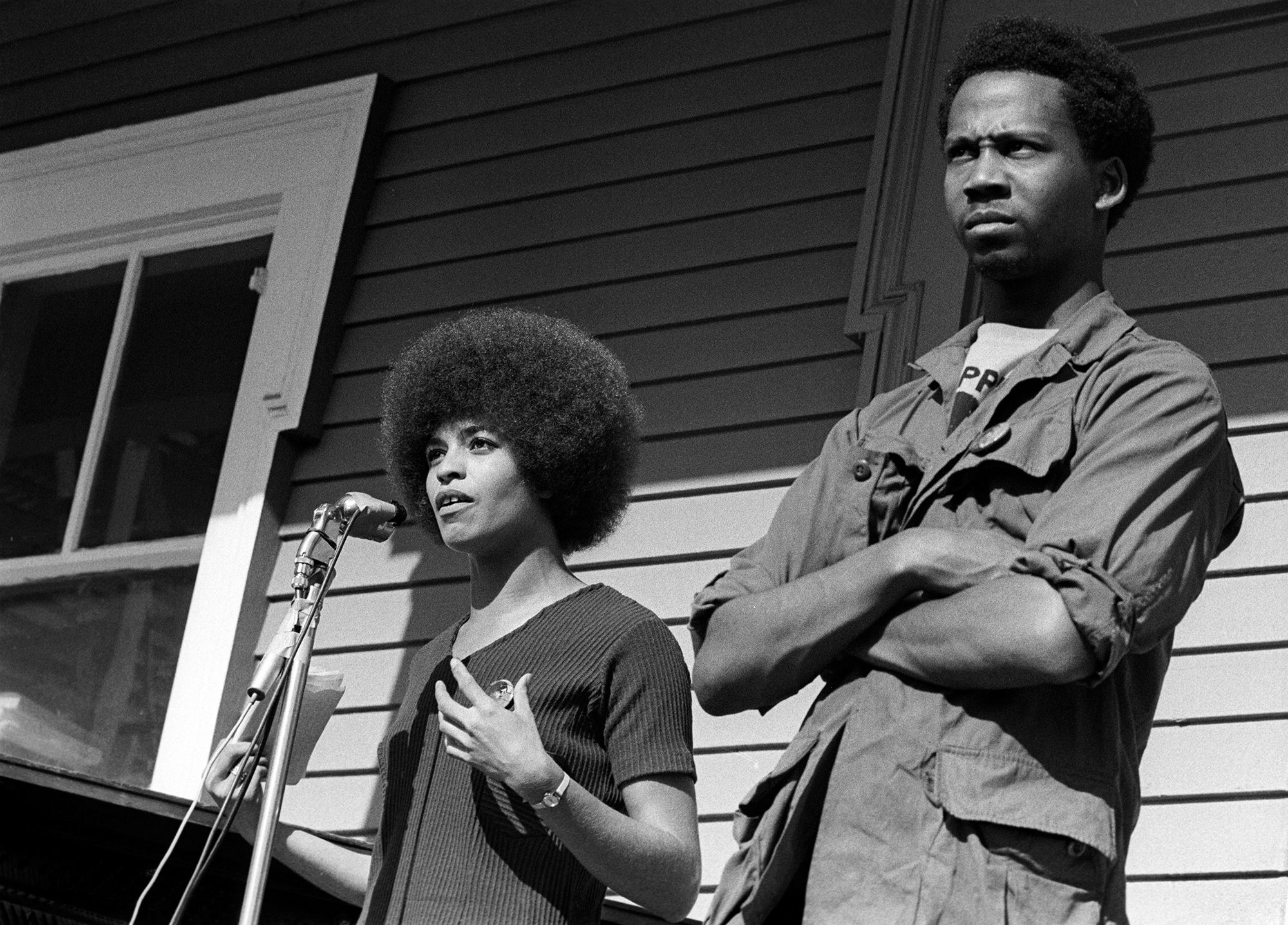
PHOTO: Angela Davis speaks at a Free Huey rally in DeFremery Park in Oakland, Calif., Nov. 12, 1969. Standing next to Davis is James Burford. Photograph by Stephen Shames. After I returned to the U.S. in the fall of 1967, I was determined to find my way into the revolutionary Black Liberation Movement, and I reconnected with Herbert Marcuse, my Brandeis mentor, who was now teaching at UC San Diego. My experiences in Germany — especially among students from Africa and other parts of what was then known as the Third World — had consolidated my embrace of revolutionary internationalism, and I gravitated toward organizations and individuals who shared that identification. At a time of growing global solidarity with Third World struggles, all of the groups I worked with — the Communist Party, the Black Panther Party, and the Los Angeles chapter of the Student Nonviolent Coordinating Committee (SNCC) — were absolutely clear about their solidarity with Palestine. During that period, I participated in a series of exciting and enlightening political conversations with James Forman, who was then the international affairs director of SNCC. At that time, SNCC encouraged its members to study the situation in the Middle East; the organization insisted that making significant progress in our domestic struggles required us to embrace internationalism. In a letter Forman wrote to the executive secretary of SNCC during the 1967 war, he explained:
"The class struggle in the black community will become sharper if the war continues. Obviously the “gut” reaction in many people is against Israel and for the Arabs, reflecting the black-white tension, the hardening of racism, and the particular circumstances in which we find ourselves in this country. However, it becomes very necessary for those of us in the organization, especially those of us in leadership positions, to study the historical development and the contemporary economic policies of Israel. Actually Israel represents an extension of United State foreign policy as well as an attempt by the Zionists to create a homeland for the Jews. The latter merges with the former in many countries, especially the United States, Great Britain, and France in some respects." When the FBI arrested me in October 1970, I could not have predicted that my own political proximity to Palestine would increase exponentially. Of the many expressions of solidarity forwarded to me during my imprisonment, I was most deeply moved by the messages emanating from prisons. I can still remember how humbled I felt upon receiving a beautiful letter of solidarity signed by Palestinian political prisoners. The letter had been smuggled out of an Israeli jail and transmitted to my lawyers, who brought it into the California jail where I was being held. Some 40 years later, when I joined a solidarity delegation to Palestine of women of color and indigenous scholar-activists, I met a Palestinian activist who told me that he was one of the imprisoned people who had signed that solidarity message so many years ago. When we embraced, I experienced a profound sense of satisfaction with the trajectory of my life and how it has intersected with so many others around the world who again and again collectively generate the hope that radical transformation is being inscribed on the agendas of our futures. Today the unceasing military assaults on Gaza are reason for deep despair, especially as we learn every day about a loss of life and community destruction that is unprecedented in comparison to all recent wars. Despite the obvious need for a cease-fire — a permanent cease-fire — the U.S. government continues to lend aid and support to Israel. Young activists today are trying to unravel this conundrum, even as the government and both major political parties remain in thrall to Zionism. Despite efforts to persuade the public that any critique or even questioning of the state of Israel is equivalent to antisemitism, astute young people, including radical Jewish activists, are pointing out that the most effective struggles against antisemitism are necessarily linked to opposition to racism, Islamophobia, and other modes of repression and discrimination. This is the first time in my own political memory that the Palestine solidarity movement is experiencing such broad support both throughout the U.S. and all over the world. Here in the United States, despite the McCarthyist strategies employed against those who call for freedom and justice for Palestine on campuses, in the entertainment industry, and elsewhere, we are in a new political moment, and we cannot — we must not — capitulate to those who represent the interests of racial capitalism and the legacies of colonialism. As June Jordan wrote in “Poem for South African Women”: And who will join this standing up and the ones who stood without sweet company will sing and sing back into the mountains and if necessary even under the sea
we are the ones we have been waiting for
ABOUT THE AUTHOR:
Angela Y. Davis is Professor Emerita of History of Consciousness and Feminist Studies at UC Santa Cruz. An activist, writer, and lecturer, her work focuses on prisons, police, abolition, and the related intersections of race, gender, and class. She is the author of many books, from Angela Davis: An Autobiography to Freedom Is a Constant Struggle. Hammer & Hope is free to read. Sign up for our newsletter, donate to our magazine, and follow us on Instagram, Threads, TikTok, Facebook, and Twitter.
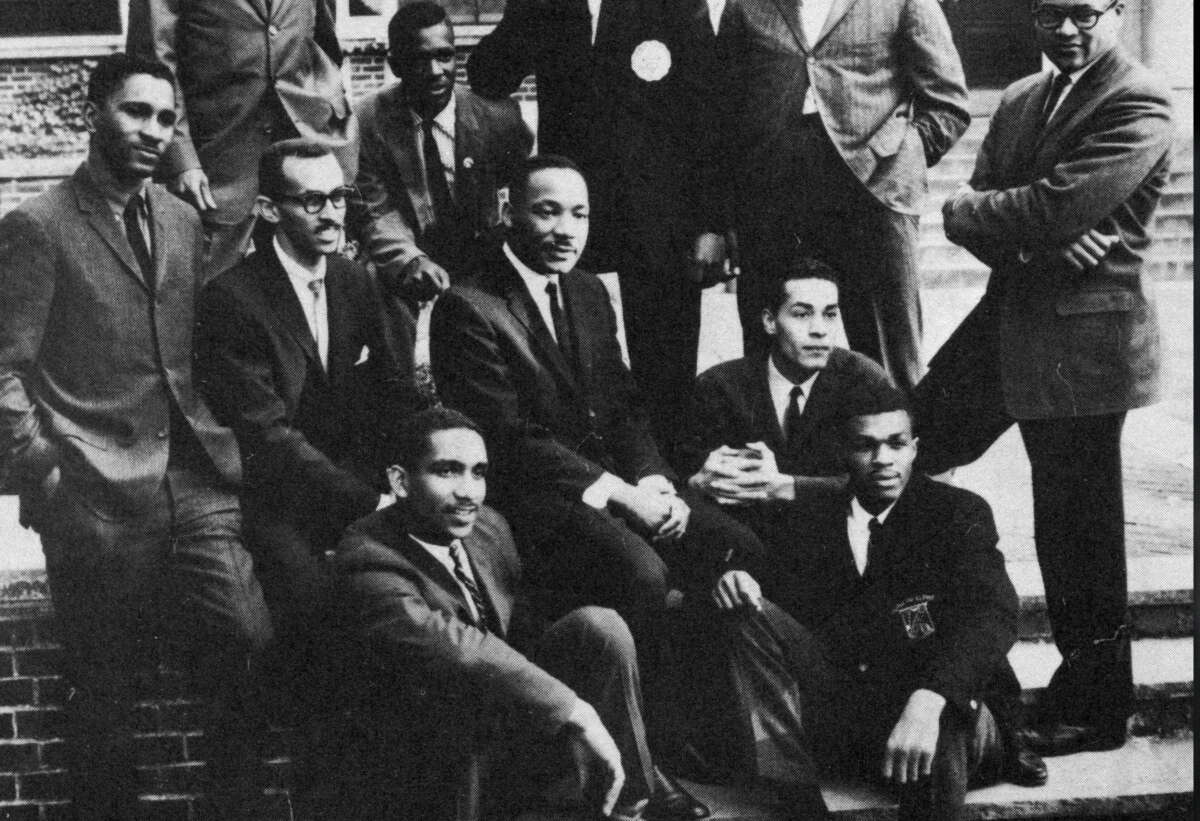
PHOTO: Martin Luther King Jr. (center) poses with members of the Student Nonviolent Coordinating Committee. Afro American Newspapers / Gado / Getty Images
Our time is shaped by Israel’s genocidal assault in Gaza. But it is
also shaped by the largest mobilization of opposition to U.S. support
for Israel in this country’s history, and within this wave of protest,
we see — among other things — the inescapable connections between Black
America and people who are oppressed and marginalized around the world.
Indeed, today’s outpouring of protest for Gaza is the largest and
most sustained since the 2020 Black-led uprisings in response to the
police-perpetrated murders of George Floyd and Breonna Taylor, and this
is not a coincidence. On one hand, decades of steadfast organizing to
bring awareness to Israeli apartheid and U.S. complicity — led by
Palestinians and their supporters — laid the foundation for the mass
action for Gaza that we are seeing now. Campaigns to boycott Israeli
products and divest from Israeli institutions and educational events —
particularly on campuses across North America — have led to a situation
where Americans are far more informed about Palestine than during
Israel’s previous bombardments of Gaza and other violence throughout its
history.
But it is also the case that more than 10 years of protest, political
education and national conversation under the banner “Black lives
matter” has primed the U.S. population for a clear look at Israel’s
actions and a deep interrogation of the histories and structures that
inform them. After all, the movement for Black lives not only has
produced sharp scrutiny of U.S. policing, but has also forced a
reckoning with institutional racism — particularly rooted in the
enslavement of Black Americans — and the ways in which it informs every
aspect of U.S. society.
When, in May 2021, Israeli police cracked down on Palestinians in
Jerusalem who were worshiping at the Al Aqsa Mosque, forced Palestinians
from their homes in that city and elsewhere, and escorted far right
Israeli marches, people in the U.S. observed with eyes that had been
shaped by the Black-led uprisings of the previous year. Israeli
apartheid on the other side of the world suddenly looked very familiar.
It is unsurprising that Israeli police in Jerusalem behaved similarly to
cops who repressed the 2020 protests in Brooklyn, Philadelphia, Los
Angeles and Portland, because the police in those cities train with Israeli forces. That moment stands as a precursor to the mass opposition to Israeli violence that we are seeing now.
In fact, the time stretching from the early days of the movement for
Black lives through now has included a contemporary wave of
Black-Palestinian solidarity. The year 2014 in particular was seminal:
The Ferguson Uprising in response to the police murder of Michael Brown
in the St. Louis suburb coincided with Israel’s 2014 bombardment of
Gaza. As these events unfolded, Palestinians voiced solidarity with
Ferguson and famously took to social media to offer advice on dealing with tear gas.
In the wake of summer 2014, Black American activists deepened solidarity with Palestinians — from Florida’s Dream Defenders’s delegation to Palestine, to more than 1,100 Black activists, artists and writers signing a statement that said, among other things, that “we continue to see connections between the situation of Palestinians and Black people.”
This is not the first time that connections between the struggle
against anti-Black racism in the U.S. and freedom struggles around the
world informed a Black internationalist consciousness here in the United
States. We are at the end of Black History Month, which offers an
annual set of conversations about Black history, the unfinished Black
freedom struggle, and the ways in which these things have shaped this
place and its broader history. While typically official celebrations in
February minimize the radical content of Black history and narrow the
conversation to within the borders of the United States, an honest look
at the full breadth of Black politics over time points to thought and
movements that push against the very foundations of the United States —
and to a consciousness that extends well beyond its borders.
While Martin Luther King Jr. Day tends to offer a sanitized,
innocuous version of the civil rights leader, for example, King’s
transnational, anti-colonial vision is usually omitted entirely. In his
1963 “Letter from Birmingham Jail,” for example, King laments the
conservatism of the United States by contrasting the time taken to
dismantle Jim Crow segregation with the pace at which victorious
anti-colonial struggles were sweeping the colonized world. King wrote,
“the nations of Asia and Africa are moving with jetlike speed toward the
goal of political independence, and we still creep at horse and buggy
pace toward the gaining a cup of coffee at a lunch counter.”
“Black
lives matter” has primed the U.S. population for a clear look at
Israel’s actions and a deep interrogation of the histories and
structures that inform them.
King saw the civil rights movement not as a struggle isolated to the
American South, but in the context of a broader world struggle against
racism and colonization. He studied and spoke extensively about the
Indian fight against British colonialism, and was present in Accra at
the inauguration of Ghana as an independent nation in 1957.
King was not alone. For the most forward leadership of the Black
Power era — and many of its participants — linking the struggle in the
U.S. to the global struggle for a freer world was not the exception, but
the rule. The Student Nonviolent Coordinating Committee (SNCC), the key
organization of the civil rights movement, spoke out
against Israeli colonization of Palestine in 1967 — the year in which
Israel seized several territories that it would settle, including Gaza.
That same year, SNCC’s James Forman spoke in Zambia at the International
Seminar on Apartheid, Racial Discrimination, and Colonialism in South
Africa, saying, “SNCC has never visualized the struggle for human rights
in America in isolation from the worldwide struggle for human rights.”
SNCC’s words and actions against Israeli apartheid and colonization
throughout Africa were among the many aspects of the organization’s rich engagement with struggles against war and for liberation throughout the world.
Other Black Power organizations of this era had similar commitments.
The Black Panther Party for Self Defense had an international section of
its newspaper from the first issue. The party opened an office in
Algiers in 1970 to coordinate relationships between the organization and
newly independent countries and revolutionary leaders (including the
Palestinian Liberation Organization) around the world in what it called
“people’s diplomacy.” The League of Revolutionary Black Workers, which
was centered in the Detroit area, worked extensively with Arab coworkers
in the auto plants to campaign against U.S. support for Israel, and
used the South End newspaper to educate and agitate for Palestine — even facing an arson attack for doing so.
Israel’s — and Washington’s — catastrophe in Gaza is ushering in a
new era of awareness of Palestine in particular, and the U.S.’s violent
activities abroad in general, from which there is no going back. Today,
Black clergy are speaking out
against the genocide in Gaza and students at historically Black
colleges and universities are interrogating their campuses’ connections
with Israel and promoting solidarity with Palestinians.
As we work to construct a new time of anti-militarism and
internationalism, we should know that we have a rich inheritance of
Black internationalist history. We should unearth this knowledge and the
lessons it holds as we do our urgent work today.
ABOUT THE AUTHOR:
Khury Petersen-Smith is the Michael Ratner Middle East Fellow at the Institute for Policy Studies.
Scholar and activist Angela Davis joins Frank Barat to discuss the importance of solidarity with Palestinians as they face a genocide in Gaza by Israel.
Prof. Angela Davis is the Distinguished Professor Emerita in the History of Consciousness and Feminist Studies Departments at the University of California, Santa Cruz.
The project "Viva Palestina Libre-Subtitles against the Occupation" collaborates by preparing the Spanish subtitles of several of the interviews. These are usually added 2 to 3 days after the original interview is uploaded. Every time the subtitles of an interview are available, they are announced on their Instagram account (@viva_palestina_libre). On their blog, you can find all the subtitled interviews: https://memoriapresente.net/subtitulo...
"Fascism is a system of political authority and social order intended to reinforce the unity, energy, and purity of communities in which liberal democracy stands accused of producing division and decline...a form of political behavior marked by obsessive preoccupation with community decline, humiliation or victimhood and by compensatory cults of unity, energy and purity, in which a mass-based party of committed nationalist militants, working in uneasy but effective collaboration with traditional elites, abandons democratic liberties and pursues with redemptive violence and without ethical or legal restraints goals of internal cleansing and external expansion.”
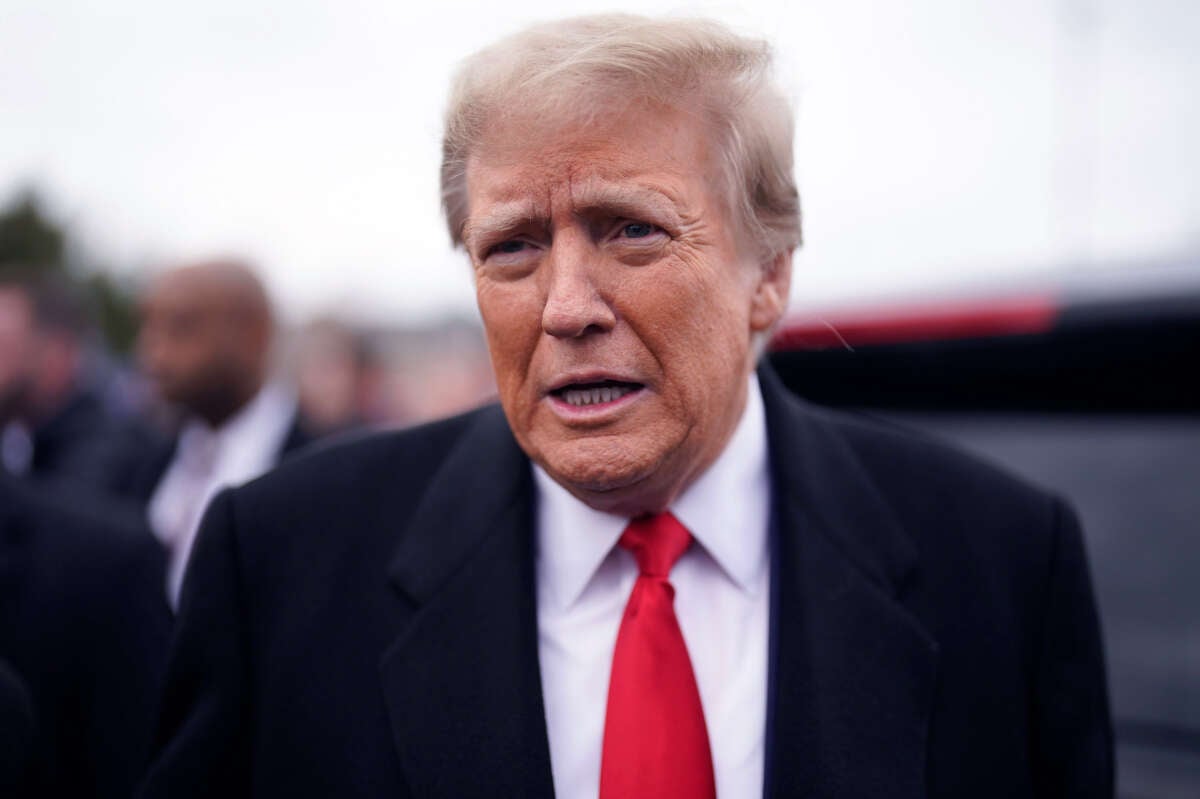
PHOTO: Former president Donald Trump speaks to the media outside a polling location at Londonderry High School in Londonderry, New Hampshire, on January 23, 2024. Jabin Botsford / The Washington Post via Getty Images
This week’s revelation that Donald Trump is already plotting new ways to try to put himself permanently above the law
is just the latest reminder of the looming threat of lawless and
emboldened right-wing forces in the United States. Trump’s new scheme to
expand a Nixon-era policy memo to prohibit the Justice Department from
prosecuting presidents, even after they leave office, is just a tiny hint of the greater threat. In recent months, several scholars have sounded the alarm
that the United States is “sleepwalking towards authoritarianism.” The
concern is not unfounded given that in his run for the presidency in
2024, Trump has boldly telegraphed his aspirations to impose an
authoritarian future on the United States. He has repeatedly injected
authoritarian language, extremist ideas and threats of violence into the
mainstream. Moreover, he has done so to “create a climate of
trepidation and powerlessness that discourages mobilization by the
opposition,” in the words
of scholar Ruth Ben-Ghiat. Forecasting his authoritarian intentions,
Trump has openly stated that he intends to terminate portions of the
U.S. Constitution, calls his political enemies “vermin” and boldly proclaims he will make himself a dictator “on day one.” On Truth Social, he claimed without irony that a president should have blanket authority and total immunity “even for events that ‘cross the line.’” He has repeatedly stated that if he regains the White House, “it will be a time for retribution” and revenge.
Taking pages from Hitler’s speeches, Trump has also said that the biggest threat to the United States “is from within.” In this instance, he reproduces a version of McCarthyite slander with his claim
that the country is being overrun by “communists, Marxists, fascists
and the radical left thugs that live like vermin within the confines of
our country, that lie and steal and cheat on elections, and need to be
rooted out.” His constant attacks on what he labels as the “enemy
within” are meant to incite his MAGA followers to wage violence against
people of color, critics, progressives, LGBTQ+ Americans, news networks,
immigrants, feminists, and any other group that does not buy into
Christian nationalist, white supremacist views.
Trump’s discourse overflows with the genocidal language used in the Third Reich. The historian Heather Cox Richardson rightly notes
that Trump’s “use of language referring to enemies as bugs or rodents
has a long history in genocide because it dehumanizes opponents, making
it easier to kill them. In the U.S., this concept is most associated
with Hitler and the Nazis, who often spoke of Jews as ‘vermin’ and vowed
to exterminate them.”
Trump has claimed that immigrants “are poisoning the blood of our
country” and polluting his notion of white Christian culture, and he’s
indicated that, if reelected, he plans to make them undergo “ideological
screening” in order to enter the country legally (assuming here that he
wants to make sure they would not vote for the Democratic Party). If
his vision were carried out, millions of undocumented immigrants would
be barred from the country while others would be rounded up, put into
what amount to Gulag camps, and subjected to unimaginably harsh
policies. Given Trump’s calls to shoot shoplifters, impose death
penalties on drug dealers, and his suggestion that his former chair of
the Joint Chiefs of Staff, Mark Milley, “deserves to be executed,” there
is no reason to doubt Trump’s authoritarian designs.
On the campaign trail, Trump repeatedly echoes the language of
autocrats such as Hungarian Prime Minister Viktor Orbán, who embraces
the concept of “illiberal democracy,” and claims, as The Guardian
points out, that the biggest threat to Hungary and other nations is
“the ‘mixing’ of European and non-European races.” Trump and the GOP,
like many of the authoritarian politicians they admire, believe that
equality is a weakness endemic to democracy and destroys society.
Trump’s contempt for the law and desire for absolute power is not only
evident in his remarks about wanting to be a dictator; it was also on
full display when his legal team argued
before a D.C. Circuit Court that unless Trump is impeached, he could
not be held responsible for “selling pardons, military secrets, or
simply having people assassinated.” As Thom Hartmann put it,
“Trump’s lawyer argued before the DC Appeals Court that if Trump became
president again, he could order SEAL Team Six to assassinate Joe Biden
or Liz Cheney and nobody could do anything about it.” While
Trump’s lawlessness is central to his grab for unchecked power, there
are also displays of the delusions and aspirations of a Nazi-infested
politics.
What is especially disturbing about the emerging fascism in the
United States is the lack of general public outrage that accompanies it.
Such silence extends from almost the entirety of the Republican Party,
the mainstream media, 84 percent of white Evangelicals,
and a number of the wealthiest American billionaires and corporate
tycoons. While the Democratic Party, including President Joe Biden, have
called out Trump as a fascist, they have been silent about their
support for decades of neoliberal economic policies, the ravages of
deindustrialization, a staggering rise in economic inequality
and cuts to social programs. Such policies have produced the conditions
that have accelerated the rise of authoritarianism in the United
States. Wedded to the interests of the banks, corporate ideology and the
financial elite, their silence should come as no surprise. At
the same time, such policies have produced enormous economic hardships
and a diminished sense of agency that creates an enforced silence among
the most impoverished populations and often results in their inevitable
retreat from politics, especially in relation to voting in national elections.
In the current historical moment, language has increasingly forfeited
its obligation to a politics of truth, justice, equality and freedom,
and in doing so has turned cannibalistic and cruel. As political
horizons and public life wither under the assault of an emerging fascism
and a mainstream media that refuse to confront it, language appears to
fail in the presence of what Zygmunt Bauman called “the
emergence of modern barbarity.” A continuing series of crises —
political, cultural, economic and ecological — are translated into
emotional plagues of fear, lies and violence produced by right-wing
spectacles that have undermined the ability of the U.S. public to
address critically the endless attacks by tyrannical forces on
democratic ideas, values and institutions. Matters of historical
context, interconnections, informed judgment and critical analysis that
refuse to divorce themselves, in the words of Winifred Woodhull, “from social institutions and material relations of power and domination”
are either ignored or disappear from public view. Language in the age
of gangster capitalism and fascist politics is under siege, functioning
less as a vehicle of audacious truth and moral witnessing than as a tool
to purge democracy of its ideals. In the face of a politics of enforced
silence, the United States is experiencing an era marked by what Brad Evans calls “a closing of the political,” grounded in the assumption that “nothing can be done.”
The poisonous shadow of authoritarianism has entered the public
imagination in spectacular fashion as a normalized political discourse. A
boisterous creed of “annihilating nihilism” marked by a politics of
vacuousness, resentment, historical amnesia, self-interest and freedom
from responsibility has become a dominating force in U.S. politics. A
right-wing vocabulary of hatred, bigotry, lies and conspiracy theories
has produced a brutalizing politics whose rhetoric and polices echo a
dark and horrifying period of history unlike anything we have seen since
the 1930s in Europe. The mobilizing passions of fascism are now being
produced, circulated and legitimated though all aspects of the mass
media, which are increasingly under the control of a billionaire class. How
else to explain not only Trump’s public courting of white supremacists
and antisemites, such as Nick Fuentes and Kanye West, but also Nikki
Haley’s claim
that slavery was not the cause of the Civil War? Such comments reveal
the GOP’s fascist tendency not only to whitewash and seek to erase the
relevance of the history of racism, but also to endorse the poisonous
ideologies of white nationalism and white supremacy. As Czech dissident
Václav Havel once remarked, “the disorder of real history is replaced by
the orderliness of pseudo-history.… Instead of events, we are offered
non-events.”
Diverse social movements … produced a language that allows us to recognize ourselves as agents, not victims.
Extremist language that was once considered unimaginable and
relegated to fringe groups has been elevated to the center of power,
politics and everyday life. For instance, billionaire Elon Musk’s recent racist comments
echo the racial eugenicist movements in the U.S. in the 19th and 20th
centuries, from which Hitler took inspiration. Yet, little is said in
the mainstream press connecting Musk’s comments to a shameful past that
gave us the Tuskegee experiments and provided a rationale for Jim Crow
and racial segregation laws. Enforced silence is a tool for the
repression of history and the wiping out of historical consciousness and
memory, especially those moments in history we associate with
segregation, exploitation, disposability and genocide. Fascist discourse
is currently abetted and affirmed by ongoing public displays of the
detritus of fascist politics, which makes visible that which the United
States has forgotten and of which it should be ashamed — that is, a
society in which collective morality and the ethical imagination appear
to no longer matter.
Beyond bold and unapologetic public displays of fascist rhetoric,
beliefs and policies, there are relentless right-wing assaults against
democracy that are barely recognized in the media and in public
discourse for the danger they pose to democracy. A short list includes
book censorship, turning libraries into student detention centers,
voter suppression laws, threatening election workers, assaulting
reproductive rights, enacting cruel policies against queer and trans
people and harassing critical educators. In addition, schools are turned
into indoctrination centers, torrents of propaganda replace facts,
history is whitewashed, dissent is suppressed and those who provide
medical care to trans people and people in need of abortions are
criminalized.
These authoritarian aggressions have become embedded in United States
culture to the degree that they fail to garner any alarm or concern
from the wider public. As fascist beliefs, values and language multiply,
so do attacks by far right politicians, reactionary pundits and white
supremacists against diversity, equality and inclusion, all the while
promoting a white nationalist notion of who counts as a citizen. As Toni
Morrison once noted, this is a language constrained by the “weary and wearying vocabulary of racial domination.” It is “a dead language” trapped in sordid silence regarding the racist ideology that drives its claims to “exclusivity and dominance.”
A dangerous silence now often accompanies a language at war with
democratic ideals and the public imagination. This is an enforced
silence among the larger public that purposely mutes matters of critical
agency, moral responsibility, reason, justice and the demands of
keeping alive a substantive democracy. It is a language where moral
outrage disappears, is silenced or both, while concealing the danger
that this fascist language portends. This is a depoliticizing silence
that clouds lies and untruths in mindless theater, spectacles and a
flood of evasions. Under such circumstances, community is emptied of any
substance, reduced to notions of the social organized around the
merging of lies and violence. The loneliness and social atomization
produced under neoliberalism provide fodder for the dictatorial energies
that offer forms of the false promise of community rooted in hate,
bigotry and lies, often resulting in habitual ignorance to justice.
Mainstream institutions such as schools, the media and online platforms
that should trade in imaginative ideas and provide a critical culture
are under siege. One consequence is the breakdown of civic culture,
egalitarian values and politics itself. What many Americans fail to
realize is that this reactionary mode of silence is a form of complicity
that creates a political climate marked by cruelty, violence and
lawlessness. How else to explain the lack of public outrage against an
extremist Republican Party that rejects free summer lunch programs for
food-insecure youth, weakens child labor laws and restricts voting
rights?
Liberal and conservative Americans are immersed in a crisis of
silence that ignores the fact that politicians such as Trump embrace
totalitarian values — the language of dictators — and advocate for
violence as a tool of political opportunism. This is not to suggest that
all forms of silence function to erase the scourge of racism, white
supremacy and the misery imposed by neoliberal capitalism.
Silence can be contemplative, offer consolation, and provide the
space for close analysis, thinking critically and mobilizing modes of
critical agency. However, in an era marked by a massive flight from
ethical and political responsibility, a particular kind of administered
silence emerges, one that subverts any sense of critical agency and
abandons a more noble message regarding a warning of the dangers to come
and the lessons to be addressed. Under such conditions, silence
operates increasingly within oppressive relations of power. Tyrannical
relations of power are now at the center of U.S. politics and radiate a
contempt for dissent, integrity, compassion and liberty which, as Bauman
notes in his book Babel, ejects “any sense of critical agency and [refuses] to recognize the bonds we have with others.”
In the face of injustice, silence has become ethically mute, and exhibits a
dehumanizing indifference to human suffering in the midst of dangerous
politics. Enforced silence, both as a subjective stance and as a
political space of organized moral irresponsibility and self-deception,
increasingly legitimates and helps to produce a society that has lost
its moral bearings and wallows in a repudiation of civic courage and
human rights. This current politics of enforced silence is happening at a
time when many Americans seem oblivious to the threat posed to
democracy by Trump, the GOP, far right foundations, reactionary cultural
apparatuses and neoliberal educational institutions.
Silence today has become part
of a politics of disappearance where critical ideas are buried along
with dangerous memories, and the bodies of journalists, poets and those
who lead the fight against oppression in its diverse modes. As Spanish
painter Francisco Goya once warned
of the degree to which truth and informed judgments are overcome by
ignorance, superstition and falsehoods, “the sleep of reason produces
monsters.” Martin Luther King Jr. gave a contemporary valence to Goya’s
warning in his famous 1967 speech, “Beyond Vietnam: A Time to Break the
Silence.” His words alerted Americans to the dangers of refusing to
speak out in the face of militarism, racism and massive poverty. Stating
that “a time comes when silence is betrayal,” King was clear regarding
how the refusal to speak out eviscerates both the idea of democracy and
the promise of resisting the mobilizing passions of fascism, especially
militarism, poverty and racism. The challenge posed by King’s call to
resist a complicitous silence in the face of injustice is exceptionally
relevant today. At the heart of this challenge is the need to not only
make detectable the current threats to democracy but also to understand
how silence in the face of tyranny legitimates authoritarianism along
with the risks it poses to any viable notion of justice, equality and
freedom.
It is important to note that fascism not only arrives through the
language of hate, bigotry, dehumanization and military dictatorships as
it did in Chile and Argentina in the 1970s; it also arrives through the
everyday acceptance of an ethically debilitating silence. In the current
moment, such silence accompanies authoritarian threats to democracy. A
politics of silence facilitates a tsunami of manufactured ignorance
advanced by the repression of dissent, the cowardice of the mainstream
media, the unaccountability of social media platforms steeped in the
astonishing toxicity of hatred, and a disdain for equality, freedom and
truth in a society, notes Jonathan Crary, governed by the corrupting force of the billionaire elite.
Given the current threat posed
to U.S. democracy, enforced silence should be analyzed within the
uniquely current threats to liberty, basic human rights and equality
that sabotage any viable notion of democracy. Such a challenge is
especially crucial at a time when the habits of democracy are being
replaced by what David Graeber called
the “habits of oligarchy, as though no other politics are possible.”
The politics of silence increasingly works through multiple sites and
seemingly contrasting impulses, often aligning itself with a reactionary
disdain for the public good. In part, it does so by refusing to address
the growing (yet to some, seemingly unrelated) issues of Trump’s full
embrace of fascist politics, the growing attacks on freedom of
expression and the struggle for social justice.
This is all the more reason to reclaim the language of the common
good; to protect public and higher education from a fascist takeover; to
reject the privatization of public goods; expand the power of unions
and the rights of workers, people of color, women, immigrants, queer and
trans people, and all those others considered excess and disposable.
The plague of silence has to be broken so as to inject the struggle for
human rights back into the language of politics, and to fight for a
socialist democracy built on the anti-capitalist values of equality,
social justice, liberty and human dignity. The words of Frederick
Douglass are prescient here and worth remembering. He writes:
If there is no struggle, there is no progress. Those who profess to
favor freedom and yet deprecate agitation are men who want crops without
plowing the ground. They want rain without thunder and lightning. They
want the ocean without the roar of its mighty waters.
If the plague of silence is to be overcome, Americans need to tap
into a language that makes clear that they will not look away or refuse
to stand up in the face of fascist aggression. The brilliant writer
Maaza Mengiste argues
for such a language with his call for a vocabulary that “will take us
from shock and stunned silence toward a coherent, visceral speech, one
as strong as the force that is charging at us.”
Fortunately, especially since the Occupy movement in 2011, a number
of social movements have emerged to provide a language that both exposes
and makes the ruthless power of the financial elite and other
anti-democratic forces accountable through a discourse of critique and
hope. The Occupy movement made the discourse of inequality and class
differences a more central part of a national political narrative. In
the last decade, workers have used the language of economic justice,
solidarity and fair play to reenergize the labor movement. The
resurgence of the labor movement provided a discourse that exposes how
neoliberalism benefits the wealthy and privileged.
Silence has
become the language through which people are either depoliticized or are
willingly complicit with the economic and racial forces of
totalitarianism.
Meanwhile movements such as the movement for Black lives have
highlighted the language of structural racism along with making visible a
history of slavery, racial abuse and police violence, and crafting a
nuanced and multidimensional discourse of liberation.
The #MeToo movement created new discourses to make visible the
pervasive extent of sexual assault, violence and harassment across a
wide variety of sites and greatly advanced gender justice.
The abolitionist movement has provided a contextual and relational
language highlighting the punitive nature of highly racialized criminal
legal system and the carceral state while instituting a national
movement to defund the police.
Trans and queer people have invigorated a movement and language that
critiques the right-wing weaponization of marginalized and ostracized
identities.
Climate activists have exposed the danger fossil fuels pose to the
planet, and how the most vulnerable populations, especially Black and
Brown communities, pay a heavy price for the abuses of the oil and gas
industries. In doing so, they have inserted the language of climate
justice into the public sphere and made clear how capitalism is creating
a murderous future for human beings by destroying the environment.
Black and Brown theorists working with the idea of intersectionality have provided a new language highlighting
how every social movement is “shaped by multiple intersecting
inequalities and power dynamics,” which draw “attention to unmarked
categories” of both oppression and resistance. All of these movements
have imaginatively offered a new language of politics and continue to
further expand and sharpen such discourses.
Equally promising is the increased political activism of young
people, who are voicing a language and pedagogy of disruption, critique
and possibility. As I stated more than a decade ago in Truthout,
theirs is a language “that recognizes that there is no viable politics
without will and awareness and that critical education motivates and
provides a crucial foundation for understanding and intervening in the
world.” Young people recognize that they have been written out of the
script of democracy for too long and are now creating spaces and
enacting a language in which to expand individual and social agency
through collective forms of resistance as starting points to build a new
democratic social order.
Fortified with the energy and language of these dynamic movements, it
is incumbent upon the broader left and its various social movements to
continue to develop a language that not only highlights social
injustices but also includes a vocabulary that moves people, allows them
to feel compassion for “the other” and gives them the courage to talk
back. Beyond highlighting the wide range of social injustices, all of us
on the left must continue to develop a vocabulary that speaks to
people’s needs in a way that is moving, affirming, recognizable and
enables them to confront the burden of conscience in the face of the
unspeakable, and to do so with a sense of dignity, self-reflection and
the courage to act individually and collectively in the service of a
radical democracy.
One important contribution of these diverse social movements is that
they all produced a language that allows us to recognize ourselves as
agents, not victims. In doing so, they have expanded the discourse of
radical democratic politics. Of course, there is more at stake here than
a struggle over meaning; there is also the struggle over power, over
the need to create a formative culture that will produce new modes of
critical agency and contribute to a broad social movement that will
translate meaning into a fierce struggle for economic, political and
racial equality. While there is a new energy among youth and a number of
powerful social movements, there is the ongoing challenge of
confronting with renewed vigor a culture of silence and indifference
that has become the most powerful educational force of the emerging
fascism.
Writing about the civil rights struggles of the ‘60s, Martin Luther
King Jr. was prescient in acknowledging that the tyranny and violence of
authoritarianism feeds on silence, moral apathy and the collapse of
conscience. Given the fierce urgency of the times, the struggle against
an enforced silence is especially crucial when people refuse to speak up
in the face of injustice. Silence
has become the language through which people are either depoliticized
or are willingly complicit with the economic and racial forces of
totalitarianism. As King notes, it is the language of those “who accept evil without protesting against it.”
The new social movements in the face of an emerging fascism have done
us a great theoretical and political favor in making clear that any
viable mode of resistance must embrace a language that translates into
power — a critical language that expands the power of education, agency
and resistance. This is a language that imaginatively rethinks the
forces of militarism, capitalism, racism and sexism in light of the
dramatic changes taking place technologically, culturally and
politically. There will be no justice or democracy in the United States
unless a mass multiclass social movement emerges that combines political
and individual rights with economic rights — that joins a movement for
gender and racial equality with a movement for economic justice.
At the same time, many new social movements need to further a
language that is not only theoretical and critical but also passionate.
In many ways, they do this, but a politics of passion needs a greater
place in their politics. Central to such a language is a politics of
emotion that addresses what Ruth Ben-Ghiat refers to as communities of
belonging. This is a language that invites joy while mobilizing emotions
that embrace compassion, justice and hope. What might be called a
politics of identification and emotion is particularly important at a
time when many people living in a neoliberal society are atomized,
feeling alienated, lonely, invisible, and subject to far right emotional
appeals to forms of allegiance rooted in hatred, bigotry and a
poisonous nationalism.
Anand Giridharads claims
that today’s left is often too cerebral and too suspicious of what he
calls empowering emotional appeals. He writes that much of the left
today is “suspicious of the politics of passion” and “doesn’t do
emotional appeals,” adding:
Can those who defend the rule of law and pluralism and economic
justice and human rights not only articulate those ideas but also appeal
to the more basic human needs to belong, to have anxieties soothed, to
have fears answered, to feel hope, or just to feel something at
the end of bleak and tedious days?… In an era [of anxiety and future
dread] such as this, leaving the politics of emotion, of passion, to
aspiring autocrats is a dangerous abdication.
It is worth emphasizing that the struggle against fascism and for a
socialist democracy will not take place if education is not made central
to politics. Any attempt to further the language of social, economic
and racial justice will not be effective if it does not construct a
language of critique, possibility and desire. We need a language that
pedagogically moves people, makes power visible and creates communities
of belonging, justice and compassion. We need to continue to fight
aggressively the plague of silence with what Gayatri Chakravorty Spivak argues
is “the power to think the absent.” It is only then that a critical
public consciousness can be awakened, and a multiracial working-class
movement can begin to bring into fruition a democratically socialist
society.
ABOUT THE AUTHOR:
Henry A. Giroux currently
holds the McMaster University Chair for Scholarship in the Public
Interest in the English and Cultural Studies Department and is the Paulo
Freire Distinguished Scholar in Critical Pedagogy. His most recent
books include: American Nightmare: Facing the Challenge of Fascism (City Lights, 2018); The Terror of the Unforeseen (Los Angeles Review of books, 2019), On Critical Pedagogy, 2nd edition (Bloomsbury, 2020); Race, Politics, and Pandemic Pedagogy: Education in a Time of Crisis (Bloomsbury 2021); and Pedagogy of Resistance: Against Manufactured Ignorance (Bloomsbury 2022). Giroux is also a member of Truthout’s Board of Directors.
"I'm for truth, no matter who tells it. I'm for justice, no matter who it's for or against."
W.E.B. DuBois (1868-1963)
"There is but one coward on earth, and that is the coward that dare not know."
Dr. Martin Luther King, Jr. (1929-1968)
"Change does not roll in on the wheels of inevitability, but comes through continuous struggle. And so we must straighten our backs and work for our freedom. A man can't ride you unless your back is bent. "
James Baldwin (1924-1987)
"Precisely at the point when you begin to develop a conscience you must find yourself at war with your society."
Aimé Césaire (1913-2008)
"A civilization that proves incapable of solving the problems it creates is a decadent civilization. A civilization that chooses to close its eyes to its most crucial problems is a stricken civilization. A civilization that uses its principles for trickery and deceit is a dying civilization."
Nina Simone (1933-2003)
"There's no other purpose, so far as I'm concerned, for us except to reflect the times, the situations around us and the things we're able to say through our art, the things that millions of people can't say. I think that's the function of an artist and, of course, those of us who are lucky leave a legacy so that when we're dead, we also live on. That's people like Billie Holiday and I hope that I will be that lucky, but meanwhile, the function, so far as I'm concerned, is to reflect the times, whatever that might be."
Amilcar Cabral (1924-1973)
"Always bear in mind that the people are not fighting for ideas, for the things in anyone's head. They are fighting to live better and in peace, to see their lives go forward, to guarantee the future of their children ....Hide nothing from the masses of our people. Tell no lies. Expose lies whenever they are told. Mask no difficulties, mistakes, failures. Claim no easy victories..." .
Angela Davis (b. 1944)
"The idea of freedom is inspiring. But what does it mean? If you are free in a political sense but have no food, what's that? The freedom to starve?”
Duke Ellington (1899-1974)
“Jazz is the freest musical expression we have yet seen. To me, then, jazz means simply freedom of musical speech! And it is precisely because of this freedom that so many varied forms of jazz exist. The important thing to remember, however, is that not one of these forms represents jazz by itself. Jazz simply means the freedom to have many forms.”
Amiri Baraka (1934-2014)
"Thought is more important than art. To revere art and have no understanding of the process that forces it into existence, is finally not even to understand what art is."
Frederick Douglass (1817-1895)
"Power concedes nothing without a demand. It never did and it never will. Find out just what any people will quietly submit to and you have found out the exact measure of injustice and wrong which will be imposed upon them, and these will continue till they are resisted with either words or blows, or both. The limits of tyrants are prescribed by the endurance of those whom they oppress.” --August 3, 1857
Cecil Taylor (1929-2018)
“Musical categories don’t mean anything unless we talk about the actual specific acts that people go through to make music, how one speaks, dances, dresses, moves, thinks, makes love...all these things. We begin with a sound and then say, what is the function of that sound, what is determining the procedures of that sound? Then we can talk about how it motivates or regenerates itself, and that’s where we have tradition.”
Ella Baker (1903-1986)
"Strong people don't need strong leaders"
Paul Robeson (1898-1976)
"The artist must take sides. He must elect to fight for freedom or for slavery. I have made my choice. I had no alternative."
John Coltrane (1926-1967)
"I want to be a force for real good. In other words, I know there are bad forces. I know that there are forces out here that bring suffering to others and misery to the world, but I want to be the opposite force. I want to be the force which is truly for good."
Miles Davis (1926-1991)
"Jazz is the big brother of Revolution. Revolution follows it around."
C.L.R. James (1901-1989)
"All development takes place by means of self-movement, not organization by external forces. It is within the organism itself (i.e. within the society) that there must be realized new motives, new possibilities."
Frantz Fanon (1925-1961)
"Now, political education means opening minds, awakening them, and allowing the birth of their intelligence as [Aime] Cesaire said, it is 'to invent souls.' To educate the masses politically does not mean, cannot mean, making a political speech. What it means is to try, relentlessly and passionately, to teach the masses that everything depends on them."
Edward Said (1935-2003)
“I take criticism so seriously as to believe that, even in the midst of a battle in which one is unmistakably on one side against another, there should be criticism, because there must be critical consciousness if there are to be issues, problems, values, even lives to be fought for."
Antonio Gramsci (1891-1937)
“The challenge of modernity is to live without illusions and without becoming disillusioned. There must be pessimism of the intellect and optimism of the will.”
Susan Sontag (1933-2004)
"Do stuff. Be clenched, curious. Not waiting for inspiration’s shove or society’s kiss on your forehead. Pay attention. It’s all about paying attention. Attention is vitality. It connects you with others. It makes you eager. Stay eager."
Kofi Natambu, editor of The Panopticon Review, is a writer, poet, cultural critic, and political journalist whose poetry, essays, criticism, reviews, and journalism have appeared in many literary magazines, journals, newspapers, and anthologies. He is the author of a biography MALCOLM X: His Life & Work (Alpha Books) and two books of poetry: THE MELODY NEVER STOPS (Past Tents Press) and INTERVALS (Post Aesthetic Press). He was the founder and editor of SOLID GROUND: A NEW WORLD JOURNAL, a national quarterly magazine of the arts, culture, and politics and the editor of a literary anthology NOSTALGIA FOR THE PRESENT (Post Aesthetic Press). Natambu has read his work throughout the country and given many lectures and workshops at academic and arts institutions. He has taught American literature, literary theory and criticism, cultural history and criticism, film studies, political science, creative writing, philosophy, critical theory, and music history and criticism (Jazz, Blues, R&B, Hip Hop) at many universities and colleges. He was also a curator in the Education Department of Detroit’s Museum of African American History. Born in Detroit, Michigan, Natambu currently lives in Berkeley, California with his wife Chuleenan.
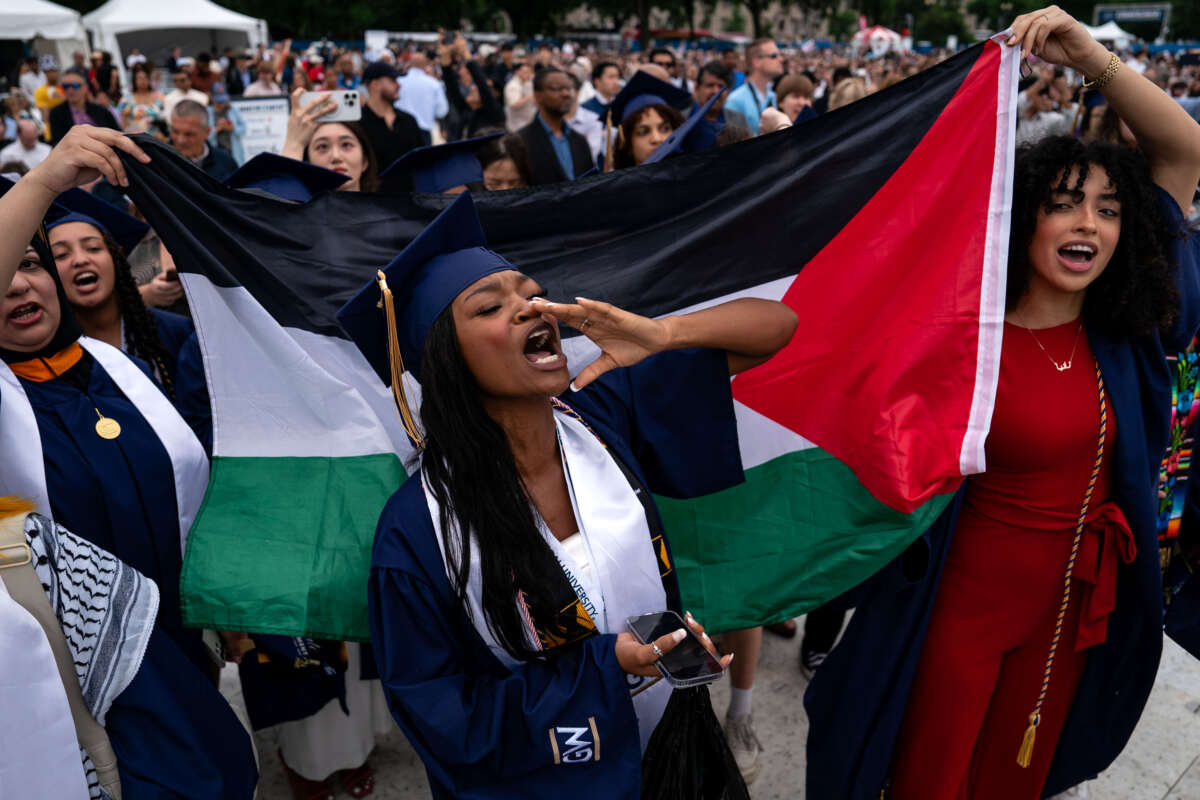



 Despite arrests at Columbia last week, protests continued on campus on Monday. Credit: C.S. Muncy for The New York Times
 Students protesters occupied an intersection near the campus of Yale University on Monday. Credit: Adrian Martinez Chavez for The New York Times
 Protesters outside of New York University, before police arrived. Credit: Adam Gray for The New York Times
 “Students, students, hold your ground!” protesters roared. “N.Y.U., back down!” Credit: Adam Gray for The New York Times
 Some faculty members said support for Dr. Shafik was eroding. Credit: CS Muncy for The New York Times
 At Columbia, many Jewish students stayed away from campus for Passover. Credit: Bing Guan for The New York Times