Discourse that allows us to express a wide range of ideas, opinions, and analysis that can be used as an opportunity to critically examine and observe what our experience means to us beyond the given social/cultural contexts and norms that are provided us.
Showing posts with label international solidarity. Show all posts
Israeli Strikes Kill 7 Aid Workers in Gaza The attack on clearly marked vehicles run by the World Central Kitchen shows how dangerous relief work has been during the war, and adds fuel to accusations that Israel has bombed indiscriminately.
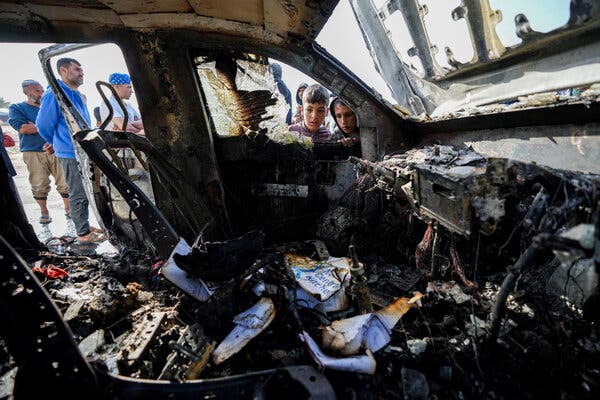
PHOTO: One of the vehicles that World Central Kitchen vehicles workers were traveling in when they were killed in an Israeli strike late on Monday in Deir al Balah, Gaza. Credit: Abdel Kareem Hana/Associated Press
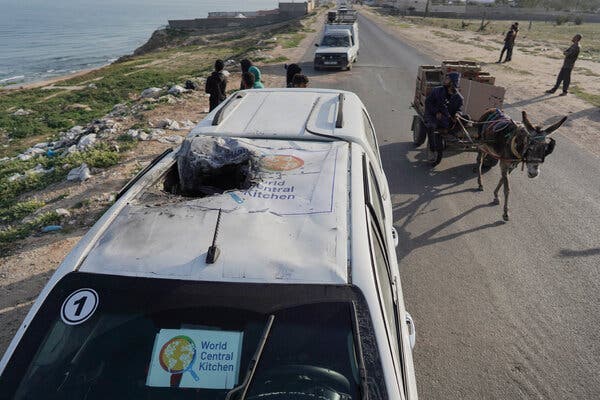
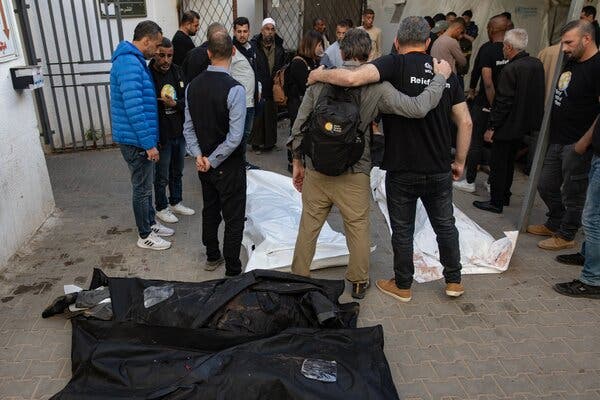
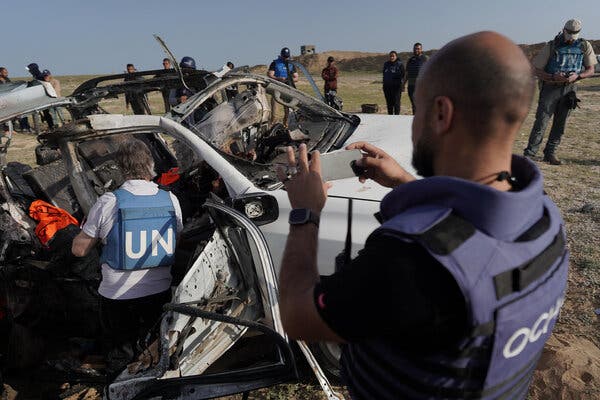
by Aaron Boxerman, Adam Rasgon, Matthew Mpoke Bigg and Michael Levenson April 2, 2024 New York Times Israeli strikes on an aid convoy run by the charity group World Central Kitchen killed seven of its workers in the Gaza Strip, setting off international outrage and underscoring the risks to humanitarian workers trying to alleviate a looming famine. The aid workers — a Palestinian, an Australian, a Pole, three Britons and a dual U.S.-Canadian citizen — were traveling in two armored vehicles clearly marked with the World Central Kitchen logo and a third vehicle when they came under fire late Monday night, according to the charity. The convoy was hit despite having coordinated its movements with the Israeli military, the group said. The workers were leaving a warehouse in Deir al Balah, in central Gaza, where the team had unloaded more than 100 tons of humanitarian food aid that had arrived by boat on Monday, World Central Kitchen said. Prime Minister Benjamin Netanyahu, who rarely comments on deadly strikes in Gaza, released a videotaped statement on Tuesday in which he appeared to acknowledge that the Israeli military was responsible. Israel launched an investigation into the circumstances surrounding the strikes. “Unfortunately, in the last day there was a tragic case of our forces unintentionally hitting innocent people in the Gaza Strip,” Mr. Netanyahu said. “It happens in war, we are fully examining this, we are in contact with the governments and we will do everything so that this thing does not happen again.” Israel’s military said that the strikes had resulted from a “misidentification.” “It was a mistake that followed a misidentification, at night during the war in a very complex condition,” the Israeli military chief of staff, Lt. Gen. Herzi Halevi, said in a video. “It shouldn’t have happened.” World Central Kitchen, which was founded by the renowned chef José Andrés, said on Tuesday that it was suspending operations in the territory. “This is not only an attack against WCK, this is an attack on humanitarian organizations showing up in the most dire of situations where food is being used as a weapon of war,” Erin Gore, the group’s chief executive, said in a statement. “This is unforgivable.” Several nations, including the home countries of the people killed, voiced indignation and demanded explanations. President Biden said in a statement: “I am outraged and heartbroken by the deaths of seven humanitarian workers from World Central Kitchen.” He added: “Israel has not done enough to protect aid workers trying to deliver desperately needed help to civilians. Incidents like yesterday’s simply should not happen. Israel has also not done enough to protect civilians.” David Cameron, the British foreign secretary, called the workers’ deaths “completely unacceptable” in a social media post, adding, “Israel must urgently explain how this happened and make major changes to ensure the safety of aid workers.” Videos and photos verified by The New York Times suggest the convoy was hit multiple times. The imagery shows three destroyed white vehicles, with the northernmost and southernmost vehicles nearly a mile and a half apart. PHOTO: The attack left a gaping hole in the roof of the middle vehicle in the convoy. Credit: Agence France-Presse — Getty Images The World Central Kitchen logo could be seen on items inside the charred interior of the northernmost and southernmost cars. The car in the middle was left with a gaping hole in its roof, emblazoned with the group’s logo. All three vehicles, though far apart from each other, were on or near the same coastal road. It remained unclear on Tuesday morning what sort of munitions struck the cars and whether those explosives were launched from the ground, from a warplane or from a drone. Israel-Hamas War: Live Updates Updated April 2, 2024, 11:03 p.m. ETApril 2, 2024 Biden denounces killing of aid workers, saying Israel has ‘not done enough to protect civilians.’ Israeli military issues rare mea culpa, taking responsibility for an airstrike that killed 7 aid workers. In a U.N. meeting, U.S., Britain and France do not join the condemnation of an Israeli strike in Syria. The war in Gaza has proved exceptionally dangerous for aid workers. As of March 20, at least 196 have been killed there since the fighting began on Oct. 7, most of them Palestinian employees of the main U.N. relief organization there, according to the United Nations. Israeli strikes have hit aid distribution centers, schools and shelters run by aid groups. Throughout the war, Palestinians and relief organizations have accused Israel of bombing indiscriminately, heedless of civilian casualties — a claim Israel denies. The killing of aid workers from countries that have backed Israel could add fuel to rising anger over the way it has conducted the war. In the aftermath of the attack on World Central Kitchen workers, other aid groups said they were also reassessing their plans. American Near East Refugee Aid, or Anera, said it was suspending operations in Gaza, given the rising threats to aid workers. “Everybody feels endangered now,” said Michael Capponi, the founder of Global Empowerment Mission, a nonprofit aid group distributing tents, sleeping bags, medical equipment and food to Palestinians in Gaza. Mr. Capponi said he was reconsidering his plans to travel to Gaza next week. Some staff members “basically want to pack up and go home now,” he said. PHOTO: World Central Kitchen workers gathering around the bodies of their colleagues after they were transferred to Al-Najjar Hospital in Rafah on Tuesday.Credit: Haitham Imad/EPA, via Shutterstock Prime Minister Anthony Albanese of Australia identified one of the victims as Zomi Frankcom, an Australian citizen who was a manager at World Central Kitchen. “We want full accountability for this, because this is a tragedy that should never have occurred,” he told reporters. “The truth is that this is beyond any reasonable circumstances,” he said. Secretary of State Antony J. Blinken said the United States government had spoken to Israeli officials about the strike and had urged a swift and impartial investigation. “These people are heroes,” Mr. Blinken said, referring to the aid workers. “They run into the fire, not away from it. They show the best of what humanity really has to offer when the going gets tough. They have to be protected.” A spokesman for Israel’s military, Rear Adm. Daniel Hagari, said the investigation would be carried out by a military body that examines battlefield incidents. “This will help us reduce the risk of such an event from occurring again,” he said. Admiral Hagari said that Israeli forces had been “working closely with the World Central Kitchen to assist them in fulfilling their noble mission of helping bring food and humanitarian aid to the people of Gaza.” Noting that the group had delivered food to Israel after the Hamas-led attack on Oct. 7, he said the charity was on the “front lines of humanity.” General Halevi also said in the video: “We are sorry for the unintentional harm to the members of the W.C.K. We share in the grief of the families, as well as the entire World Central Kitchen organization, from the bottom of our hearts.” World Central Kitchen had recently become an important player in the delivery of aid into Gaza, organizing two shipments of food that arrived in the territory by boat from Cyprus, a maritime route intended to supplement the limited aid that has been delivered by trucks and dropped from airplanes. PHOTO: United Nations members inspecting one of the destroyed vehicles from the World Central Kitchen on Tuesday. Credit: Agence France-Presse — Getty Images The group was trying to help ease widespread hunger in Gaza, where Palestinians, particularly in the north, have been fighting starvation and regularly converge on the relatively few aid trucks that enter the territory. On Monday, workers unloaded food from the World Central Kitchen vessel, the Jennifer, at a hastily built jetty on the Mediterranean coast. They planned to unload 240 tons more on Tuesday, according to Theodoros Gotsis, a spokesman for the Cypriot foreign ministry. Mr. Gotsis said that the Jennifer had instead left Gaza to sail back to Cyprus on Tuesday, with most of its cargo still on board. He added that several more tons of aid were waiting at warehouses in a Cypriot port, but that it was not clear if the aid would now be delivered to Gaza. Aid groups have said that only a cease-fire and the opening of more border crossings from Israel would allow workers to deliver enough food and other essentials to Gazans without putting more lives at risk. Among those killed in the strikes was Saif Abu Taha, a 26-year-old Gazan working as a driver and translator for World Central Kitchen. He and others workers were proud to have been delivering food to hungry people, his brother Shadi said. “They were so excited, like they were going to a wedding,” the brother said. Damian Sobol, an aid worker from the southeastern Polish city of Przemysl, was also killed, the city’s mayor, Wojciech Bakun, said. Reporting was contributed by John Yoon, Patrick Kingsley, Gabby Sobelman, Lauren Leatherby, Nader Ibrahim, Cassandra Vinograd, Erica L. Green, Damien Cave, Aric Toler, Anushka Patil, Daniel Victor, Victoria Kim and Natasha Frost.
ABOUT THE AUTHORS:
Aaron Boxerman is a Times reporting fellow with a focus on international news. More about Aaron Boxerman Adam Rasgon reports from Israel for The Times's Jerusalem bureau. More about Adam Rasgon Matthew Mpoke Bigg is a correspondent covering international news. He previously worked as a reporter, editor and bureau chief for Reuters and did postings in Nairobi, Abidjan, Atlanta, Jakarta and Accra. More about Matthew Mpoke Bigg Michael Levenson joined The Times in December 2019. He was previously a reporter at The Boston Globe, where he covered local, state and national politics and news. More about Michael Levenson A version of this article appears in print on April 3, 2024, Section A, Page 1 of the New York edition with the headline: Strikes by Israel Kill Aid Workers And Draw Outcry. Order Reprints | Today’s Paper
After October
7, this question has become a matter of grave importance, amid
crackdowns on free speech and protest. Five writers reflect on the state
of Palestinian life today.
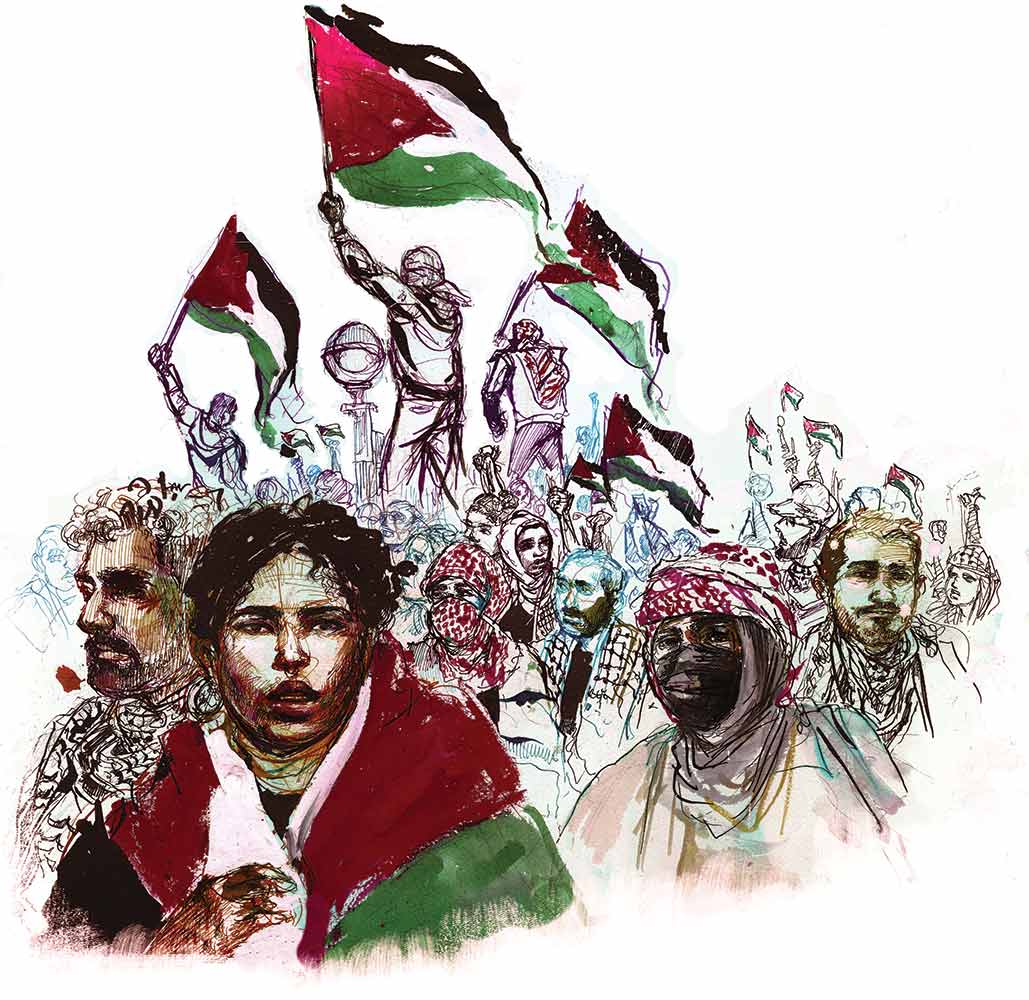
For generations, the voices of Palestinians
have been routinely overlooked. When we do turn to them, it is usually
to ask them to justify their despair or prove their worthiness as
humans—and to teach us the very basics of a generations-long crisis of
forced exile and violent displacement.
Instead of making Palestinians play out that endless cycle one
more time, we wanted to get to the heart of a question that feels more
vital, more essential, in our moment.
The contributors to this section are Palestinians living in the
US, where the war reverberates with terrifying intimacy even though the
bloodshed is thousands of miles away. It is also where the need to hear
from Palestinians—and to listen to what they have to say—has never been
as critical, or as fraught.
So what does it mean to be Palestinian now? It’s a question whose
answer we know will keep changing in the months and years ahead. But we
have to keep asking it. —The Editors
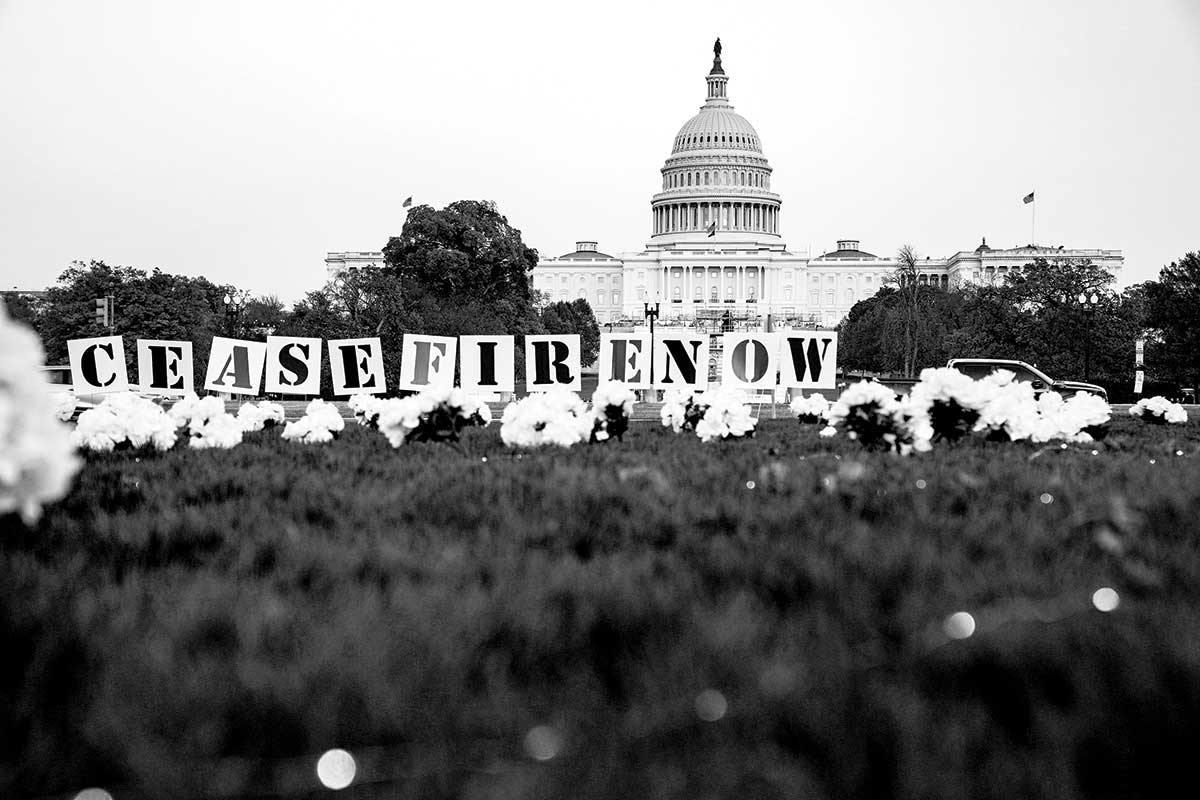
Cease-fire now: An installation at the National Mall in Washington, D.C. (Leigh Vogel / Getty Images )
A Day in the Life
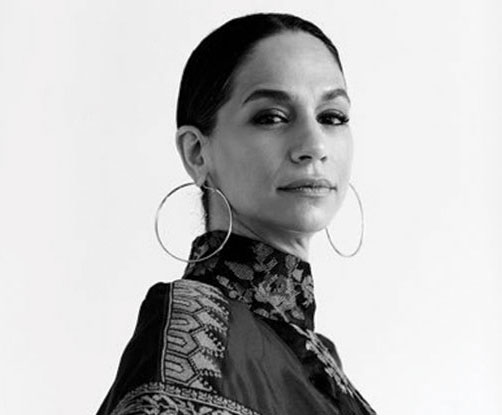
Noura Erakat
(Leigh Vogel/Getty Images)
It’s the sound that guts me. The mama
grasping her baby boy wrapped in a white shroud, moaning in shock. A
little girl curled up next to the wheels of a stretcher holding her
father. Between her cries, we hear her implore, “Baba!” There is also
the father with skinny arms, still in his slippers, covered in ash,
screaming his children’s names one by one. He turns over a piece of
shattered concrete searching for his babies, but there is nothing but
wreckage.
Palestinians are certainly not the first people to endure genocide,
but they are most certainly the first to have it broadcast in real time.
How pathetic that we can’t stop this. Every night I make a single wish:
Please let us wake to news of a cease-fire. But in the morning, when I
pick up my phone, I already know what I see will keep me up another
night.
I’m barely up, and my phone is already ablaze with requests. I won’t be
able to respond to all of them. My title—human rights attorney—gives the
impression that I have a law practice. A Palestinian family from Gaza
has arrived in Cairo; 46 members have been killed. They want to sue
Israel and need help. A journalist friend writes from Gaza. His employer
is demoting him for being “anti-Israel,” as he and his family scramble
to find food and shelter. What can he do? I frantically try to respond.
It never feels like enough.
Besides work and protests, I only leave home for my daughter’s sake.
She always asks me to put away my phone. She explains her poor test
score is a result of her baba and me “talking about the war too much.”
I broke my self-imposed isolation to take her to a school Halloween
party. I joked with one of the parents that my costume was a Palestinian
pretending to be OK. She didn’t laugh. Ever since 6-year-old Wadea
Al-Fayoume was stabbed 26 times by his family’s landlord, I have been
acutely afraid for my daughter’s safety and anxious that my
public-facing work could cause her harm. I stay in costume and pretend
everything is OK.
I marvel at the sky: How lucky we are it does not fall and crush us without announcement.
The requests for comment from journalists and TV producers start to
pile up. I wade through them on my commute to campus. I’m usually calm
with the media, but these days I’ve been livid about their coverage and
exhausted by the cable networks that have blacklisted me or refused to
post my interviews. A TV producer who invites me to appear on his show
several times but then never has me on writes to share that he is
“trying to connect with Hamas leaders Ghazi Hamad and Osama Hamdan.” He
asks, “Do you have their contact info?” I am boiling.
In my pre-interview prep with the BBC, a producer asks me how
Palestinians feel about Hamas, and I snap: “You know that’s a racist
question, right?”
“I’m just trying to help,” she says, “because not all Palestinians are Hamas.”
“What does it matter what Palestinians feel? Their ideas don’t alter
their civilian status; nothing justifies a genocide. You’ve never asked
a single Israeli what they feel about their government. You didn’t even
ask if Americans supported Bush when his administration invaded Iraq…”
“OK, thank you. I’ll talk to the team and get back to you.”
I know she won’t call back. So I send a text suggesting other
Palestinians she should call. I’m so mad at myself that I may have lost
this opportunity for Palestinians to be heard.
In class, I walk a tightrope. I want my students to ask me about
what’s happening. I want to tell them how lucky we are to have
classrooms, how hundreds of schools in Gaza have been destroyed or
turned into makeshift shelters and 100 percent of the students don’t
have access to education, how “too much reading”—their standard
complaint—is a wonderful problem to have. But no one asks. They are
reluctant to speak in a charged environment. So I open space for them to
share. At the very least, discussing Palestine will not be a taboo.
In our critical race theory class, we’re covering the last chapter of Ruth Wilson Gilmore’s Golden Gulag.
My voice cracks as I read to them: “If the twentieth century was the
age of genocide on a planetary scale, then in order not to repeat
history, we ought to prioritize coming to grips with dehumanization.”
Though my university likes to boast about its faculty in the news, it
has avoided mentioning me for the past three months. I’m grateful it’s
not worse. Despite 12,000 complaints and congressional interventions,
our teach-in on “Race, Liberation, and Palestine”
in early December was not canceled. Meanwhile, at UPenn, donors are
calling for the resignation of my colleagues for chanting for freedom
“from the river to the sea.” At Harvard, protesting students have been doxxed by roaming trucks plastered
with their faces and names. Our Students for Justice in Palestine
chapter became the first to be suspended at a public university.
Suspensions, punishments, and threats mount at nearly every campus in
the country.
After the last student leaves, I put down my mask. I pretend to be OK here, too.
On my commute home, I take calls: about a campaign to address the
United Nations’ inefficacy from within; about a nascent effort to
organize artists; about legal strategies to supplement and amplify our
International Criminal Court petition… I’ll never be able to respond to
everyone.
Once home, I rush to set up a makeshift studio for a live TV interview. Even before I am done, the angry e-mails are pouring in.
“Poor Hamas, right? You are a morally depraved black hole.”
“You are like poison…. Thank goodness my children are not exposed to you.”
“Go to Palestine so we can kill you too.”
I also receive remarkable messages. People around the world,
enthusiastically supporting freedom, who ask over and over again: “What
can I do?”
I’m late again. I rush to pick up my daughter, who is embarrassed by
my tear-stained face. She likes to joke that I sound the same when I
laugh and cry. That always makes me laugh. At the park, we find the
sidewalk colorfully chalked with the words “Kids say no to genocide.” My
heart pops with the promise of the generations to come.
The evening is filled with Al Jazeera Arabic, a refreshing reprieve
from US media coverage. I tape a podcast, jump on an emergency Zoom.
More e-mails come in, more speaking invitations, some that I know will
be canceled. History didn’t begin on October 7, so why are we asked to
teach everything from scratch again?
It’s past midnight. I get into bed and back on my phone. I witness
and listen intently. I cry with my eyes shut, and I wish to wake to the
news of a cease-fire.
We Were Children Once
Ahmed Moor
Anyone who has been to Gaza knows it’s a
place of children. They are everywhere. Little girls and boys underfoot,
in the streets, arrayed on sandy curbs. They reach into your pockets
and make fun of you. Boys on carts pulled by donkeys, peddling goods in
tattered clothing and barefoot, baked brown by an unrelenting summer
sun. That’s the Gaza I remember.
I was born in Rafah in 1984, in the refugee camp there. My family
moved when I was young. My father, an orphan who started kindergarten at
an UNRWA school at the age of 9 and worked as a child porter for
Egyptian soldiers before picking oranges in Israel after 1967, got us
out. He finished school and university in Beirut—the only passport
available to the Palestinians, then and now—and secured a job with an
American NGO. But we went back to Gaza every summer until I was 15, when
the Second Intifada started. I haven’t been back since.
My earliest memories of Gaza: I remember summer evenings fragrant
with jasmine, bright with the Milky Way and the sodium lights of Rafiah
Yam, the nearby Jewish settlement, a different kind of bright, searing
against the darkness of the Strip. I remember rushing off into the night
with other boys, to build plastic bonfires in the dunes and smoke dried
molokhia stems, pretending we had cigarettes. And by day, sledding down
those same dunes on discarded corn oil containers.
I remember the summer a boy was buried alive when a dune collapsed in his wake. An apocryphal story, or a portentous one…
I remember trudging through the sandy lanes with my mother to the
local telephone operator to call my father, who could rarely join us on
those trips home. And I recall, years later, the thrill of watching as
the first crew of laborers built a network of telephone exchanges in our
corner of Gaza. I remember riding my bike past those high dunes, past
Rafiah Yam, and through the checkpoint where Israeli men, armed then, as
now, to the teeth, plied small cruelties for fun. I remember “Shlomo’s
bar” on the beach, which served Palestinian laborers Heineken beer in
glass bottles. The prickly pear groves with their fruit—so much like
Gaza—sweet, but too often painful.
The dunes are gone now. The sand was used for cinder blocks, the
ubiquitous building material in Gaza, where the number of small children
has only grown with time. My memories come back to me, relentlessly,
with the force of guilt and loss, as I watch the videos of what’s being
done to those children, more than 10,000 of them now. In one, a
cameraman sweeps past a collection of small feet, the only visible parts
of small bodies, crushed to death under a collapsed roof in Gaza as
they slept. The dunes of my youth turned to cinder blocks, children
buried alive under their weight. A timeless story for the children of
Gaza, not apocryphal at all.
Lately, I catch myself thinking strange thoughts. I imagine a dying
sun, eight billion years from now, swallowing the earth and turning
everything to ash. I know I am not alone, and I recognize the dark
fantasies of a broken spirit.
And then my children, alive, beautiful, and vivacious—three little
girls—wake me from my grim reveries. They pull me back from the
precipice. Unknowingly, they hold the genocide at bay. They are too
young to know what’s being done to their family, so far away from
everything in their lives. I write this love letter to Gaza’s children,
whose lives are brief and whose deaths are meaningless. I write this
letter for all the people in Gaza, who were children once, if only
briefly, before the awareness of their own worthlessness crept into
their lives. I write this letter for myself, and I wonder, when all the
children in Gaza are dead, who will pull us back from the precipice?
A scene from Dearborn, Mich.: In one of Michigan’s Arab American strongholds, a pro-Palestine protest greeted a visit from Joe Biden. (Seth Herald / AFP via Getty Images)
Occupied by Hope
Noor Hindi
(Jeffrey Smith)
Recently, I asked my father a simple question: “Is there hope?”
I was standing in my kitchen in Dearborn, Mich., slicing mangoes.
Peering through the doorway, I saw him as I’ve always seen him:
squinting at his phone, his body collapsed on a couch, a tired look on
his face.
He had already turned on the news.
I have never been to Palestine. But the chaos of headlines about our
homeland is something I am all too familiar with. So is the history that
haunts us.
As a child, I was lulled to sleep by the sound of Al Jazeera as I lay
on my father’s lap. At family gatherings, I listened to our stories: my
grandmother surviving the Nakba at 5 years old; my father’s upbringing
in the Qalandia refugee camp; the trees my great-grandfather planted
around his house in Al-Qubab (now Ramleh), one of 418 Palestinian
villages destroyed between 1948 and 1949.
One night last year, I dreamed of Palestine. In the dream, I was
kneeling alongside my father, a handful of Palestine’s soil in my mouth.
I awoke gasping for water, an emptiness in my throat, a hollowness in
my body.
I am familiar with emptiness, the cavities of its grief, its hands around my neck. I called my dad later that day.
“We are going to Palestine,” I said. “October 2024.”
He made one simple demand: He wished to go in August. “For fig season,” he said, and I could hear his smile through the phone.
I want to taste Palestine’s bitter earth. For years, I have grieved
its soil without ever having touched it. I want to find the exact
location of my hurt, the coordinates of my emptiness. I want and I want.
Lately, I have been demanding.
At a recent protest in Dearborn, I detached myself from the crowd and
stood under a tree. I was trying to catch my breath. I played
hide-and-seek with my body, begging my feet to find the ground they were
standing on, to find comfort in a country I am not built for.
I watched a father chase after his son. The boy was barefoot.
Hysterical with laughter. He picked up a single red leaf. He flung it in
the air. He was a mess of joy, of life.
I don’t know what future we are leaving him.
For months, Gazans have made the violence they are facing at the
hands of Israel indisputable. Before mourning, before reckoning with all
they have lost, before even allowing Allah himself to bear witness to
such tragedy, they point their cameras.
I refuse to re-create most of these images here. To describe what is indescribable. But here is what I can say.
In October, doctors in Gaza held a press conference at Al-Ahli
Baptist Hospital. A sea of dead Gazan children, their tiny bodies
wrapped in white cloth, surrounded them. And yet, Israel continues to
kill thousands more. The world watches.
In November, Gazan children held their own press conference in front
of Al-Shifa Hospital. They spoke in English. They begged us to protect
them. And yet, Israel continues to kill thousands more. The world
watches.
On Instagram, Gazans like Motaz Azaiza and Bisan Owda, armed only with their phones and their voices, are broadcasting their own genocide—the
constant bombardment, the mass displacement, the poisoning of the
water, the starvation of the people, the endless grief. And yet, Israel
continues to kill thousands more. The world watches.
What more needs to be seen?
Palestinians do not get to mourn our dead. We must argue our
humanity, must make our trauma irrefutable, must prove over and over
again that we do not deserve our fate. It has been 75 years and
counting.
This is the genesis of my frustration, the private anguish lurking in
the background of my everyday movements: We have nothing but the
stories we use as shields. And this is not enough.
There is little that is more dislocating than witnessing the genocide
of your own people: on Twitter, on Instagram, in waiting rooms at
doctors’ offices, on the radio, and during all the mundane tasks of
survival. There is little that is more demoralizing than watching the
world deny a violence that is so simply seen, heard, and broadcast by
the people experiencing it themselves.
I have become impatient with the headlines. With “solutions.” With
the empire’s demand that we treat this crisis as “complex”—a demand that
only seems to arise when the people dying are Palestinian. With the
insistence that every conversation start with October 7, when we know
that was far from the beginning of this crisis.
I refuse. I want my country back. This is not complicated.
I am writing for a future I no longer know is possible. I am making
art for a future I no longer know is possible. I am dreaming of a
Palestine I may never encounter.
Yet still, I am dreaming.
When I ask my father, “Is there hope?,” his response is swift.
“Of course there is hope.”
“From where?” I ask.
“I haven’t let go of my hope.”
Here is the truth about being Palestinian: In this lifetime, and the
one after, and the one thereafter, we will always choose Palestine.
There is little that endures more than our hope.
In the face of the unimaginable, this is what I hold on to.
Sending a message: Protesters occupying the Manhattan Bridge in New York City. (Kena Betancur / AFP via Getty Images)
The Question
Mohammed El-Kurd
(Ryan Brand)
At a recent closed-door meeting in London to
discuss BDS with various publishers and writers, a well-intentioned,
well-known author asked me if Zionism could hold a double meaning: To
some, it is a settler-colonial movement motivated by expansion and
racial elimination, and to others it is a movement for Jewish
self-determination. “No,” I said. “Zionism is best defined by its
material manifestations—the most recent being genocide. It is irrelevant
whether it could contain multitudes.” At the time, the death toll in
the besieged Gaza Strip was approaching 20,000, and our martyred friend and poet Refaat Al-Areer
was among the thousands yet to be retrieved from the rubble. The
suggestion that I would have the patience for theoretical discussions
felt profane.
Yet conversations about Palestine in the West are steered by
abstractions and hypotheticals—about the meaning of Zionism, about the
threat level of words, about a logistically impossible yet impossibly
imminent genocide of the Jewish people. (Apparently, I am supposed to
clarify that I do believe the Holocaust happened.) You almost feel as
though you are the victim of an elaborate, callous joke.
The morning I sat down to write this, a nurse and journalist named
Yousef Mema published photos of the decomposing corpses of Palestinians
murdered in the north of Gaza—a skull, a rib cage, and foot bones
protruding through jeans. They had been exposed to the harsh elements
for the past 80 days, he explained, because heavy Israeli bombardment
and ground incursions had “prevented paramedics from reaching the
martyrs.”
Meanwhile, in another world, Zionist college students were busy
decrying the threat posed by pro-Palestinian demonstrations on campus,
then testifying about this threat in front of Congress, while young
Palestinians were being gunned down or stabbed by white supremacists. At
first, I had Norman Finkelstein in my ear,
accusing these students of crocodile tears. Of feigning fear. But it
cannot only be performance: despite the nukes and the promised homeland,
their fear is so visceral it can conjure the Gestapo in the halls of
the Ivy Leagues.
To be Palestinian today is to feel like you are caught in a fever
dream—trapped in someone else’s hallucination, where the question “What
happens to the settlers?” is offered with more urgency than questions
about the welfare of six million stateless Palestinian refugees who are
scattered around the world. It is to be interrogated about the hidden
insidiousness of our chants, while Israeli politicians boast about
ethnically cleansing Gaza in newspapers and interviews. It is to be
shouted over, silenced, by people who claim to fear for their lives from
the safety of apartments that have never been blistered by white
phosphorus—that have endured nothing fiercer than a US winter—while
people in another corner of the planet dig for loved ones buried beneath
the rubble of demolished buildings.
Such details are not minor. In situating the Holocaust outside of
history, in placing it not just in the past but in an eternal future,
Zionism today has created a status quo in which the possibility of a
second holocaust is given primacy over a holocaust happening in the
present. I am certain some readers will find those previous lines
uncomfortable or even incendiary, but that is precisely the point:
Language comparing Zionists to Nazis is scrutinized—even penalized—more
than the government policies and military actions that beg for the
analogy to be made.
Distracting questions—“Can Zionism mean different things?”; “Is
anti-Zionism antisemitism?”—feed the discursive loop that prioritizes a
conjectural “day after” over the material present. But here, in the
present, there are more pressing questions: What are the mental and
muscular consequences of being forced to transform a taxi into a hearse?
What becomes of the nurse whose shift is interrupted by the arrival of
her husband’s corpse on a stretcher? What about the father carrying what
remains of his son in two separate plastic bags? What happens to him
after all of this death, once he is alone and away from the cameras?
What kind of man will the boy carrying his brother’s limbs in a bag grow
up to be?
We on the outside simply do not understand what life inside Gaza does
to a person. We know the facts: The 2.3 million Palestinians in Gaza—which has been declared “uninhabitable” by the UN—have
been under siege for 16 years. Two-thirds of them are refugees or the
descendants of dispossessed refugees; half of them are children; and
many of them have lived their entire lives under blockade, their
calendars marked by routine bombardments. Sometimes these facts are
produced to contextualize and historicize the violence coming out of
Gaza; more often they are obfuscated to depoliticize and mystify that
violence.
But in either case, neither the well-intentioned nor the
ill-intentioned truly contend with the magnitude of these facts or the
truth they lay bare: Gaza is a place like no other. Here is a world
governed solely by its severed geography. People here live encircled by
an abundance that they are owed, and yet within this world, the water is
most likely undrinkable, passage is impossible, and food—like the
people themselves—needs a passport. Massacres are both televised and
denied. And all the while, the world’s superpowers aid and abet our
annihilation—explicitly, institutionally, and materially—then berate us
about the meaning of human rights and the myth of Israeli self-defense.
We are, to them, an unfortunate complication of an otherwise acceptable
status quo.
As long as this status quo persists, as long as Palestinians are
subjected to colonial violence and erasure, as long as the people of
Gaza continue to defy the genocide being waged against them, we who are
living outside the concentration camp certainly can, and should, refuse
indignity as a state of being, refuse to shrink ourselves and our
aspirations, refuse to assuage the hallucinations of our colonizers or
be silenced or shouted over. In the last three months, the world changed
forever. We all should act accordingly.
Do You See What I See?
Laila Al-Arian
(Courtesy of Laila Al-Arian)
I put down my phone just before closing my
eyes to sleep, a final break from the endless stream of horrific news
from Gaza. The last posts I see are chilling: Palestinians in Gaza
describing the ferocity of Israel’s bombing campaign, many of the posts
declaring “This is the worst night” yet. Then there are the videos. The
screams of terror as 2,000-pound bombs hit homes, the flares of bright
orange illuminating Gaza’s night skies, and the billowing smoke that
follows.
The cycle repeats as night turns into day. I reach for my phone as
soon as I wake up and see posts of Gazans taking stock of the events of
the previous night: who was killed, who was rescued from the rubble, who
was shot by snipers while fleeing for their safety and waving a white
flag.
In the videos, children shake uncontrollably, covered in dust after
an air strike, silent and bewildered. The number of children killed and
wounded, their limbs amputated, without anesthesia in far too many
cases, is so massive that the UN has called Gaza “a graveyard for children.”
Gaza is where Palestinian children go to sleep hungry, where they hold a
press conference to beg the world to stop their killing, and where
parents write their children’s names on their arms and legs in case they
need to find them beneath the rubble.
Every time I see a video, photo, or post, I wonder if others are
seeing it too—especially Americans, whose tax dollars provide much of
the arms for Israel’s bombardment. Are they seeing what I’m seeing? I ask over and over again, as each day brings a new brutality that I didn’t think was possible.
Israel cut off food, water, fuel, and electricity to Gaza.
I know that if this were happening somewhere else, it would merit
wall-to-wall coverage in the United States. Instead, much of what I
learn comes from social media and independent or international news
outlets.
Israel has barred foreign journalists from entering Gaza unless they
are embedded with their military, but even that fact, which would
provoke outrage if another country were doing it, has barely made a
ripple. Instead, it has fallen on Palestinians to tell their own
story—the reporters targeted and killed in record numbers, and the
citizen journalists using their phones to capture displacement,
starvation, injuries, and death, all evidence of war crimes for which
Israel will almost certainly never be held accountable.
It’s difficult enough to see the terror unleashed on Gaza’s 2.3
million people, nearly half of whom are children. But the complicity and
justification from Western countries that have lectured others about
human rights for decades makes it unbearable. And then there is the
gaslighting, those who deny that any of this is happening at all and
claim, for instance, that a dead Palestinian baby is actually a doll.
I am consumed by my feelings—of sadness, grief, and rage—but feel
guilty for dwelling on them and even for living life, eating while
people are starving, drinking while they are thirsty, sleeping in a warm
bed while they are bombed in theirs or sleeping outside in the cold. We
Palestinians in the diaspora know that it is fate alone—decisions made
by or for our grandparents—that separates us from those in Gaza who are
once again enduring Israel’s brutality.
In October, I watched a video of two young brothers in the aftermath
of an Israeli air strike. The older one, whose face was stained with
blood, stood over his younger brother, who was lying down, his head
bandaged and face and chest covered in blood. The older boy, no more
than 10, was whispering to him to say the declaration of faith that
Muslims say when they’re dying. This was one of countless videos of
Palestinians confronted with the violent deaths of their loved ones,
saying goodbye, crying over them in disbelief, and kissing their dead
bodies over and over again.
These moments of horrific intimacy are filmed because those who suffer and witness them want to show the world that this really happened.
But as the death toll reaches 25,000 (the number is likely much higher
given the bodies under the rubble), I wonder if there is a cost to all
the images we’re seeing, if they inure people to Palestinian death, if
there’s no point in intruding on their most vulnerable moments, since
those in power have not been moved to stop the carnage.
The day after I saw the video of the two brothers, their images still
running through my mind, I asked a member of Congress if he would
support the call for a cease-fire. “They’ve been fighting each other for
thousands of years,” he responded. It was galling. “That’s not true,” I
responded. “It’s been 75 years. My grandparents became refugees after
Israel was created.” “Thousands of years,” he responded, walking away.
This level of ignorance can only come from decades of demonizing
Palestinians as “human animals” and “children of darkness” to justify
killing them en masse even in the face of the indisputable fact that 70
percent of those killed are children, women, and the elderly. Are they seeing what I’m seeing?
Most of the videos from Gaza show graphic horror and heartbreaking loss: a child, whose face is covered in blood, writhing and screaming in pain; a father shouting the names of his children as he searches for them under the rubble; a mother screaming in disbelief that her children were killed while they were hungry.
But I have found that mundane and familiar footage of everyday life
before this onslaught is haunting in its own way. In one video, a young
dental school graduate named Abdallah Baghdadi sits in the back of a
jeep, wearing a black baseball cap, while on vacation in Turkey,
a brief respite from the weight of living under Gaza’s blockade. He is
smiling, carefree, full of life. Abdallah’s grieving friend posted it
after he was killed on October 30, to remember him as she knew him.
In the first three weeks of Israel’s bombardment of Gaza, I found out
that my mother lost 17 members of her extended family in two separate
strikes. We had never met them because of Israel’s 17-year siege of
Gaza, which has cut off the tiny strip from the world and made it nearly
impossible for anyone to visit. I’ve learned that it’s possible to
mourn people I’ve never met, like the poet and professor Refaat Alareer,
who was killed along with members of his family. Refaat was one of the
founders of “We Are Not Numbers,” a nonprofit that cultivated young
writers from Gaza to tell their stories to make sure they don’t become
statistics. But in the face of so much relentless death, it feels
daunting to make sure that each person Israel has killed does not become
just a number. How long does it take to recite 25,000 names?
We even worry about the dead in Gaza, as Israel attacks cemeteries
throughout the strip. I think about what will become of my late
grandfather, who returned to Gaza in 2004 after living abroad as a
refugee for much of his life because he wanted to die in his homeland.
My grandfather survived Israeli bombardments in 2008, 2012, and 2014.
But he can’t rest even in death.
What will be left for the people of Gaza when Israel finally ends its
campaign of terror? It has destroyed everything that makes a place
livable in its determination to end life itself in Gaza, to separate the
people from the land. How does life go on when you’re surrounded by
rubble and mass graves, by children who lost their limbs before they
learned to walk, who lost their parents before they learned how to say
their names?
Outside of Gaza, to be a Palestinian in this moment is to go through
the motions of life while feeling dead inside. It feels like it should
be a state of emergency, but all around us life goes on. People do their
grocery shopping, gather for the holidays, and blow out their birthday
candles, while we are overcome by powerlessness and grief. To be
Palestinian right now is to feel betrayed by those who remain silent,
whatever their reasons, and to feel gratitude and hope from those who
have spoken up.
It’s not just Palestinians, though. So many people have told me that
this is a life-defining moment for them that has shaped their views in
profound ways. Those people have seen what I’ve seen.
Something has broken in all of us, and we will never be the same.
Noura Erakat (@4noura on
Twitter), a human rights attorney and activist, is an associate
professor at Rutgers University—New Brunswick, and a contributing editor
of Jadaliyya. She is the author of Justice for Some: Law and the Question of Palestine (Stanford University Press).
Noor Hindi is a Palestinian-American poet and reporter. Her debut collection of poems, Dear God. Dear Bones. Dear Yellow, was an honorable mention for the Arab American Book Award.
Mohammed El-Kurd is a writer and poet from Jerusalem, occupied Palestine, currently serving as The Nation's first-ever Palestine Correspondent. He is the author of RIFQA (Haymarket) and the forthcoming nonfiction project tentatively-titled A Million States In One (Haymarket). His 2023 Edward Said Memorial Lecture at Princeton will be adapted into a book.
"I'm for truth, no matter who tells it. I'm for justice, no matter who it's for or against."
W.E.B. DuBois (1868-1963)
"There is but one coward on earth, and that is the coward that dare not know."
Dr. Martin Luther King, Jr. (1929-1968)
"Change does not roll in on the wheels of inevitability, but comes through continuous struggle. And so we must straighten our backs and work for our freedom. A man can't ride you unless your back is bent. "
James Baldwin (1924-1987)
"Precisely at the point when you begin to develop a conscience you must find yourself at war with your society."
Aimé Césaire (1913-2008)
"A civilization that proves incapable of solving the problems it creates is a decadent civilization. A civilization that chooses to close its eyes to its most crucial problems is a stricken civilization. A civilization that uses its principles for trickery and deceit is a dying civilization."
Nina Simone (1933-2003)
"There's no other purpose, so far as I'm concerned, for us except to reflect the times, the situations around us and the things we're able to say through our art, the things that millions of people can't say. I think that's the function of an artist and, of course, those of us who are lucky leave a legacy so that when we're dead, we also live on. That's people like Billie Holiday and I hope that I will be that lucky, but meanwhile, the function, so far as I'm concerned, is to reflect the times, whatever that might be."
Amilcar Cabral (1924-1973)
"Always bear in mind that the people are not fighting for ideas, for the things in anyone's head. They are fighting to live better and in peace, to see their lives go forward, to guarantee the future of their children ....Hide nothing from the masses of our people. Tell no lies. Expose lies whenever they are told. Mask no difficulties, mistakes, failures. Claim no easy victories..." .
Angela Davis (b. 1944)
"The idea of freedom is inspiring. But what does it mean? If you are free in a political sense but have no food, what's that? The freedom to starve?”
Duke Ellington (1899-1974)
“Jazz is the freest musical expression we have yet seen. To me, then, jazz means simply freedom of musical speech! And it is precisely because of this freedom that so many varied forms of jazz exist. The important thing to remember, however, is that not one of these forms represents jazz by itself. Jazz simply means the freedom to have many forms.”
Amiri Baraka (1934-2014)
"Thought is more important than art. To revere art and have no understanding of the process that forces it into existence, is finally not even to understand what art is."
Frederick Douglass (1817-1895)
"Power concedes nothing without a demand. It never did and it never will. Find out just what any people will quietly submit to and you have found out the exact measure of injustice and wrong which will be imposed upon them, and these will continue till they are resisted with either words or blows, or both. The limits of tyrants are prescribed by the endurance of those whom they oppress.” --August 3, 1857
Cecil Taylor (1929-2018)
“Musical categories don’t mean anything unless we talk about the actual specific acts that people go through to make music, how one speaks, dances, dresses, moves, thinks, makes love...all these things. We begin with a sound and then say, what is the function of that sound, what is determining the procedures of that sound? Then we can talk about how it motivates or regenerates itself, and that’s where we have tradition.”
Ella Baker (1903-1986)
"Strong people don't need strong leaders"
Paul Robeson (1898-1976)
"The artist must take sides. He must elect to fight for freedom or for slavery. I have made my choice. I had no alternative."
John Coltrane (1926-1967)
"I want to be a force for real good. In other words, I know there are bad forces. I know that there are forces out here that bring suffering to others and misery to the world, but I want to be the opposite force. I want to be the force which is truly for good."
Miles Davis (1926-1991)
"Jazz is the big brother of Revolution. Revolution follows it around."
C.L.R. James (1901-1989)
"All development takes place by means of self-movement, not organization by external forces. It is within the organism itself (i.e. within the society) that there must be realized new motives, new possibilities."
Frantz Fanon (1925-1961)
"Now, political education means opening minds, awakening them, and allowing the birth of their intelligence as [Aime] Cesaire said, it is 'to invent souls.' To educate the masses politically does not mean, cannot mean, making a political speech. What it means is to try, relentlessly and passionately, to teach the masses that everything depends on them."
Edward Said (1935-2003)
“I take criticism so seriously as to believe that, even in the midst of a battle in which one is unmistakably on one side against another, there should be criticism, because there must be critical consciousness if there are to be issues, problems, values, even lives to be fought for."
Antonio Gramsci (1891-1937)
“The challenge of modernity is to live without illusions and without becoming disillusioned. There must be pessimism of the intellect and optimism of the will.”
Susan Sontag (1933-2004)
"Do stuff. Be clenched, curious. Not waiting for inspiration’s shove or society’s kiss on your forehead. Pay attention. It’s all about paying attention. Attention is vitality. It connects you with others. It makes you eager. Stay eager."
Kofi Natambu, editor of The Panopticon Review, is a writer, poet, cultural critic, and political journalist whose poetry, essays, criticism, reviews, and journalism have appeared in many literary magazines, journals, newspapers, and anthologies. He is the author of a biography MALCOLM X: His Life & Work (Alpha Books) and two books of poetry: THE MELODY NEVER STOPS (Past Tents Press) and INTERVALS (Post Aesthetic Press). He was the founder and editor of SOLID GROUND: A NEW WORLD JOURNAL, a national quarterly magazine of the arts, culture, and politics and the editor of a literary anthology NOSTALGIA FOR THE PRESENT (Post Aesthetic Press). Natambu has read his work throughout the country and given many lectures and workshops at academic and arts institutions. He has taught American literature, literary theory and criticism, cultural history and criticism, film studies, political science, creative writing, philosophy, critical theory, and music history and criticism (Jazz, Blues, R&B, Hip Hop) at many universities and colleges. He was also a curator in the Education Department of Detroit’s Museum of African American History. Born in Detroit, Michigan, Natambu currently lives in Berkeley, California with his wife Chuleenan.