Showing posts with label National Heathcare Reform. Show all posts

Thursday, February 25, 2010

Obama's Absurd National Healthcare Reform Summit: A Spectacle of Both Tragedy and Farce

http://www.nytimes.com/2010/02/26/health/policy/26health.html?nl=us&emc=politicsemailema1

All,

This is a complete and utter farce and an insult to the intelligence of anyone who knows and cares anything about real national healthcare reform. The President's publically televised dog and pony show featuring some of the most irresponsible, self serving, and corrupt politicians in America--from both the Republican and Democratic parties--is nothing but an open denial and evasion of the huge incompetent MESS both parties and President Obama have made of this major political and economic issue. The fact that it is now over one year since the White House and Democrats in Congress made their national legislative appeal for finally reforming and overhauling the biggest, most exploitive, and corrupt system of corporate criminality this side of the banks and Wall Street is a sad testimony to this government being both unable and unwilling to do what is necessary and right to actually reform the system. The massive insurance and pharmaceutical industries and their thousands of lobbyists are some of the most heinous corporate criminals in the country and have shown-- and continued to show-- a withering contempt for the average health needs and desires of the masses of working and poor people in this country. Meanwhile the President, the Democratic Party and the notoriously nihilistic reactionaries known as the Republican Party have continued to play empty, meaningless rhetorical games at our collective expense all the while falsely claiming that they are sincerely meeting or trying to meet our real needs for quality and affordable healthcare. NOTHING COULD BE FURTHER FROM THE TRUTH. As the Rolling Stone magazine's political journalist Matt Taibbi stated in his brilliant and groundbreaking analysis of the sordid politics and horrific economic realities of this entire issue in his article 'Sick and Wrong: How Washington is screwing up health care reform--and why it may take a revolt to fix it' originally published August 19, 2009 in Rolling Stone, reprinted on September 3, 2009 online:http://www.rollingstone.com/politics/story/29988909/sick_and_wrong and reprinted in The Panopticon Review magazine on September 12, 2009 http://panopticonreview.blogspot.com/search/label/Matt%20Taibbi:


"Let's start with the obvious: America has not only the worst but the dumbest health care system in the developed world. It's become a black leprosy eating away at the American experiment — a bureaucracy so insipid and mean and illogical that even our darkest criminal minds wouldn't be equal to dreaming it up on purpose.

The system doesn't work for anyone. It cheats patients and leaves them to die, denies insurance to 47 million Americans, forces hospitals to spend billions haggling over claims, and systematically bleeds and harasses doctors with the specter of catastrophic litigation. Even as a mechanism for delivering bonuses to insurance-company fat cats, it's a miserable failure: Greedy insurance bosses who spent a generation denying preventive care to patients now see their profits sapped by millions of customers who enter the system only when they're sick with incurably expensive illnesses.

The cost of all of this to society, in illness and death and lost productivity and a soaring federal deficit and plain old anxiety and anger, is incalculable — and that's the good news. The bad news is our failed health care system won't get fixed, because it exists entirely within the confines of yet another failed system: the political entity known as the United States of America.

Just as we have a medical system that is not really designed to care for the sick, we have a government that is not equipped to fix actual crises. What our government is good at is something else entirely: effecting the appearance of action, while leaving the actual reform behind in a diabolical labyrinth of ingenious legislative maneuvers...

...It's a joke, the whole thing, a parody of Solomonic governance. By the time all the various bills are combined, health care will be a baby not split in half but in fourths and eighths and fractions of eighths. It's what happens when a government accustomed to dealing on the level of perception tries to take on a profound emergency that exists in reality. No matter how hard Congress may try, though, it simply is not possible to paper over a crisis this vast.

Then again, some of the blame has to go to all of us. It's more than a little conspicuous that the same electorate that poured its heart out last year for the Hallmark-card story line of the Obama campaign has not been seen much in this health care debate. The handful of legislators — the Weiners, Kuciniches, Wydens and Sanderses — who are fighting for something real should be doing so with armies at their back. Instead, all the noise is being made on the other side. Not so stupid after all — they, at least, understand that politics is a fight that does not end with the wearing of a T-shirt in November."

Kofi


February 26, 2010

President Urges Focus on Common Ground
By SHERYL GAY STOLBERG and ROBERT PEAR
New York Times

WASHINGTON — If there was any question about how deeply divided Republicans and Democrats are about how to reshape the American health care system, consider that they spent the first few hours of President Obama’s much-anticipated health care forum on Thursday arguing over whether they were in fact deeply divided.

The forum played out with Mr. Obama serving as moderator, M.C. and chief defender of Democratic policy prescriptions. He and his fellow Democrats tried to make the case that the two parties were closer than they thought, with the implication that their bill was centrist and would be acceptable to mainstream voters.

Republicans countered that the gap was vast, the bill out of touch with what the country wanted, and that Mr. Obama should throw it out and start over. “A dangerous experiment,” warned Representative John A. Boehner of Ohio, the House Republican leader.

By day’s end, it seemed clear that the all-day televised session might have driven the parties even farther apart. Republicans said there was no way they would vote for Mr. Obama’s bill, and Democrats were talking openly about pushing it through Congress on a simple majority vote using a controversial parliamentary maneuver known as reconciliation.

As he wrapped up the session, Mr. Obama chided Republicans for advocating “baby steps” and rejected their call to start over, declaring Americans “don’t want us to wait.” He said that if he did not see any significant movement toward bipartisan cooperation, Democrats would push ahead on their own and leave it to voters to render their judgment.

“That’s what elections are for,” the president said.

The forum, at Blair House across the street from the White House, was in many respects an extraordinary sight — the president, with Vice President Joseph R. Biden Jr. at his side, engaging in a spirited and detailed policy debate with Republicans about one of the most compelling and ideologically polarizing issues facing the nation. Mr. Obama’s mastery of the intricacies of health policy was impressive even to some Republicans.

“It was sort of his classroom,” Senator Lamar Alexander, the Tennessee Republican who delivered his party’s opening statement, said in an interview. “I was glad we did it, because the president’s megaphone is the biggest one and when he shares it with Republicans like he did, that gives us several hours to make our case, and I thought we made it well.”

The session did produce hints of potential agreement on some issues, but in each case Democrats and Republicans differed over important details.

They agreed on the need for more regulation of insurers, for example, but clashed over the question of whether the federal government should replace states as the primary regulator. They agreed that the federal government should help individuals and small businesses pool their purchasing power to buy insurance, but disagreed over whether the government should specify minimum benefits, as Democrats proposed.

Beyond the question of government intervention in the private insurance market, their most profound disagreement was over expanding coverage to the uninsured. The Democrats want to cover more than 30 million people over 10 years; Republicans said the nation could not even afford the entitlement programs, like Medicare, that already exist, much less start new ones.

Amid the debate over insurance industry regulation, cost containment, medical malpractice lawsuits and other minutiae of health policy, there were also plenty of theatrics. At one point, Senator Mitch McConnell of Kentucky, the Republican leader, chastised Mr. Obama for allowing Democrats to run on, saying Republicans had spoken for 24 minutes while Democrats had had 52. (Republicans kept track of the dialogue; at the end of the day, they said Mr. Obama had spoken for 119 minutes, Democrats 114 and Republicans 110.)

At another point, Mr. Obama looked wryly at Representative Eric Cantor of Virginia, the Republican whip, who addressed the president with a stack of papers in front of him. “Let me just guess,” Mr. Obama said, barely containing his smirk, “that’s the 2,400-page bill.”

But the biggest clash of the day involved Mr. Obama’s 2008 Republican rival, Senator John McCain of Arizona. Reminding Mr. Obama that both of them had run for office “promising change in Washington,” Mr. McCain delivered a lengthy talk deriding the Democrats’ bill as being produced “behind closed doors” and stuffed with “unsavory deal-making.”

Mr. Obama finally tried to cut the senator off. “We’re not campaigning anymore,” the president said. “The election is over.”

Mr. McCain laughed and shot back, “I’m reminded of that every day.”

Later, though, Mr. Obama credited Mr. McCain with making a valid argument in a discussion over federal payments to private Medicare Advantage plans.

Mr. McCain criticized a provision of the Senate bill that would carve out special protections for people enrolled in the plans in Florida and a few other states, while people in his own state of Arizona would not benefit. The president called it a “legitimate point.”

Throughout the day, Mr. Obama skirmished with Republicans over the effects of the Democrats’ proposal on health insurance premiums. Republicans, citing a Congressional Budget Office analysis of the Senate bill, said the average premium for individual policies would be about 10 percent to 13 percent higher in 2016 than the average premium that year under current law.

Mr. Obama countered that under the Senate bill, the federal government would establish standards for “decent insurance,” and that the better benefits might be more costly. And in any event, most people buying individual policies would qualify for federal subsidies, which would substantially lower what they pay.

One of the sharpest areas of philosophical disagreement between Mr. Obama and the Republicans emerged when Senator John Barrasso, the Wyoming Republican who is also an orthopedic surgeon, contended that Americans would make better, less costly health care choices if they had catastrophic insurance coverage that required them to pay for most services out of pocket.

Mr. Obama asked if he would prefer that members of Congress have only catastrophic coverage; the senator said he would. “That’s right, because members of Congress make $176,000 a year,” Mr. Obama replied, adding that he wondered whether Mr. Barrasso would feel the same way if he earned only $40,000.

For the president, Thursday’s session was a kind of Hail Mary pass, a last-ditch effort to keep his top legislative priority from slipping out of his grasp.

He opened the session by calling on the two parties to search for common ground and implored them to “make sure that this discussion is actually a discussion and not just us trading talking points.”

Mr. Obama said he found considerable overlap in the two parties’ ideas, and Democrats like Senator Max Baucus of Montana, a chief author of the bill, spent much of their morning trying to back up that assertion.

Sounding optimistic, Mr. Baucus said, “We are on the verge and the cusp, with not too much effort, to try to bridge a lot of gaps here.”

David M. Herszenhorn contributed reporting.

Sunday, January 24, 2010

Finding the Courage and Conviction To Lead

http://www.nytimes.com/2010/01/24/opinion/24Rich.html?em

All,

I agree emphatically with every single word of Frank Rich's typically incisive and clear-eyed analysis EXCEPT the very first sentence. Other than that what Rich says here is 100% correct...

Kofi


January 24, 2010

OP-ED COLUMNIST

After the Massachusetts Massacre
By FRANK RICH
New York Times

It was not a referendum on Barack Obama, who in every poll remains one of the most popular politicians in America. It was not a rejection of universal health care, which Massachusetts mandated (with Scott Brown’s State Senate vote) in 2006. It was not a harbinger of a resurgent G.O.P., whose numbers remain in the toilet. Brown had the good sense not to identify himself as a Republican in either his campaign advertising or his victory speech.

And yet Tuesday’s special election was a dire omen for this White House. If the administration sticks to this trajectory, all bets are off for the political future of a president who rode into office blessed with more high hopes, good will and serious promise than any in modern memory. It’s time for him to stop deluding himself. Yes, last week’s political obituaries were ludicrously premature. Obama’s 50-ish percent first-anniversary approval rating matches not just Carter’s but Reagan’s. (Bushes 41 and 43 both skyrocketed in Year One.) Still, minor adjustments can’t right what’s wrong.

Obama’s plight has been unchanged for months. Neither in action nor in message is he in front of the anger roiling a country where high unemployment remains unchecked and spiraling foreclosures are demolishing the bedrock American dream of home ownership. The president is no longer seen as a savior but as a captive of the interests who ginned up the mess and still profit, hugely, from it.

That’s no place for any politician of any party or ideology to be. There’s a reason why the otherwise antithetical Leno and Conan camps are united in their derision of NBC’s titans. A TV network has become a handy proxy for every mismanaged, greedy, disloyal and unaccountable corporation in our dysfunctional economy. It’s a business culture where the rich and well-connected get richer while the employees, shareholders and customers get the shaft. And the conviction that the game is fixed is nonpartisan. If the tea party right and populist left agree on anything, it’s that big bailed-out banks have and will get away with murder while we pay the bill on credit cards — with ever-rising fees.

Politically, no other issue counts. In last weekend’s Washington Post/ABC News poll, 42 percent of Americans chose the economy as the country’s most pressing concern. Only 5 percent picked terrorism, and 2 percent Afghanistan. Obama’s highest approval ratings are now on foreign policy and national security issues — despite the relentless hammering from the Cheney right — but voters don’t care.

Does health care matter? Not as much as you’d think after this yearlong crusade. In the Post/ABC poll, the issue was second-tier — at 24 percent. Obama has blundered, not by positioning himself too far to the left but by landing nowhere — frittering away his political capital by being too vague, too slow and too deferential to Congress. The smartest thing said as the Massachusetts returns came in Tuesday night was by Howard Fineman on MSNBC: “Obama took all his winnings and turned them over to Max Baucus.”

Worse, the master communicator in the White House has still not delivered a coherent message on his signature policy. He not only refused to signal his health care imperatives early on but even now he, like Congressional Democrats, has failed to explain clearly why and how reform relates to economic recovery — or, for that matter, what he wants the final bill to contain. Sure, a president needs political wiggle room as legislative sausage is made, but Scott Brown could and did drive his truck through the wide, wobbly parameters set by Obama.

Ask yourself this: All these months later, do you yet know what the health care plan means for your family’s bottom line, your taxes, your insurance? It’s this nebulousness, magnified by endless Senate versus House squabbling, that has allowed reform to be caricatured by its foes as an impenetrable Rube Goldberg monstrosity, a parody of deficit-ridden big government. Since most voters are understandably confused about what the bills contain, the opponents have been able to attribute any evil they want to Obamacare, from death panels to the death of Medicare, without fear of contradiction.

It’s too late to rewrite that history, but it may not be too late for White House decisiveness. Whatever happens now — good, bad or ugly — must happen fast. Each day Washington spends dickering over health care is another day lost while the election-year economy, stupid, remains intractable for Americans who are suffering.

On the economic front, Obama needs both stylistic and substantive makeovers. He has stepped up the populist rhetoric lately — and markedly after political disaster struck last week — but few find this serene Harvard-trained lawyer credible when slinging populist rhetoric at “fat-cat” bankers. His two principal economic policy makers are useless, if not counterproductive, surrogates. Timothy Geithner, the Treasury secretary, was probably fatally compromised from the moment his tax lapses surfaced; now he is stalked by the pileup of unanswered questions about the still-not-transparent machinations at the New York Fed when he was knee-deep in the A.I.G. bailout. Lawrence Summers, the top administration economic guru, is a symbol of the Clinton-era deregulatory orgy that helped fuel the bubble.

The White House clearly knows this duo is a political albatross. After the news broke that 85,000 more jobs had been lost in December despite some economists’ more optimistic predictions, Christina Romer, a more user-friendly (though still academic) economic hand, was dispatched to the Sunday shows. This is at best a makeshift solution.

Obama needs more independent economists like Paul Volcker, who was hastily retrieved from exile last week after the Massachusetts massacre prompted the White House to tardily embrace his strictures on big banks. Obama also needs economic spokesmen who are not economists and who can authentically speak to life on the ground. Obama must also reconnect. The former community organizer whose credit card was denied at the Hertz counter during the 2000 Democratic convention now spends too much time at the White House presiding over boardroom-table meetings and stiff initiative rollouts instead of engaging with Americans not dressed in business suits.

When it comes to economic substance, small symbolic gestures (the proposed new bank “fee”) won’t cut it. Nor will ineffectual presidential sound bites railing against Wall Street bonuses beyond the federal government’s purview. There’s no chance of a second stimulus. The White House will have to jawbone banks on foreclosures, credit card racketeering and the loosening of credit to small businesses. This means taking on bankers who were among the Obama campaign’s biggest backers and whose lobbyists have castrated regulatory reform by buying off congressmen of both parties. It means pressing for all constitutional remedies that might counter last week’s 5-to-4 Supreme Court decision allowing corporate campaign contributions to buy off even more.

It’s become so easy to pin financial elitism on Democrats that the morning after Brown’s victory the Republican Senatorial Campaign Committee had the gall to accuse them of being the “one party who bailed out the automakers and insurance companies.” Never mind that the Bush White House gave us the bank (and A.I.G.) bailouts, or that the G.O.P. is even more in hock than Democrats to corporate patrons. The Obama administration is so overstocked with Goldman Sachs-Robert Rubin alumni and so tainted by its back-room health care deals with pharmaceutical and insurance companies that conservative politicians, Brown included, can masquerade shamelessly as the populist alternative.

Last year the president pointedly studied J.F.K.’s decision-making process on Vietnam while seeking the way forward in Afghanistan. In the end, he didn’t emulate his predecessor and escalated the war. We’ll see how that turns out. Meanwhile, Obama might look at another pivotal moment in the Kennedy presidency — and this time heed the example.

The incident unfolded in April 1962 — some 15 months into the new president’s term — when J.F.K. was infuriated by the U.S. Steel chairman’s decision to break a White House-brokered labor-management contract agreement and raise the price of steel (but not wages). Kennedy was no radical. He hailed from the American elite — like Obama, a product of Harvard, but, unlike Obama, the patrician scion of a wealthy family. And yet he, like that other Harvard patrician, F.D.R., had no hang-ups about battling his own class.

Kennedy didn’t settle for the generic populist rhetoric of Obama’s latest threats to “fight” unspecified bankers some indeterminate day. He instead took the strong action of dressing down U.S. Steel by name. As Richard Reeves writes in his book “President Kennedy,” reporters were left “literally gasping.” The young president called out big steel for threatening “economic recovery and stability” while Americans risked their lives in Southeast Asia. J.F.K. threatened to sic his brother’s Justice Department on corporate records and then held firm as his opponents likened his flex of muscle to the power grabs of Hitler and Mussolini. (Sound familiar?) U.S. Steel capitulated in two days. The Times soon reported on its front page that Kennedy was at “a high point in popular support.”

Can anyone picture Obama exerting such take-no-prisoners leadership to challenge those who threaten our own economic recovery and stability at a time of deep recession and war? That we can’t is a powerful indicator of why what happened in Massachusetts will not stay in Massachusetts if this White House fails to reboot.


Copyright 2010 The New York Times Company

Monday, December 14, 2009

The Big Betrayal: The Democratic Party and the Obama Administration Sell Us Down The River on National Healthcare Reform--With our Complicit Support

http://www.nytimes.com/2009/12/15/health/policy/15health.html?_r=1&emc=na

http://www.nytimes.com/2009/12/14/health/policy/14health.html?em

All,

There's no other way to say it and still tell the truth so I ain't gonna pretend that there is: The national healthcare 'reform' legislation presently stumbling along toward severely compromised passage in the Senate is nothing but a huge sellout to the criminally avaricious insurance and pharmaceutical companies. A shortlist of what is fatally wrong with this egregiously backward proposal can be described as follows: This massive bullshit bill does not provide universal coverage for American citizens, does not provide public-based economic competition against the current de facto corporate monopoly/oligopoly of national healthcare services and protection, does not keep down or regulate soaring and largely arbitrary healthcare costs, does not provide cheaper and more comprehensive coverage and protection for the poor and working classes, does not extend or expand medicare coverage to younger citizens under 64, and does not advocate or provide any kind of institutional alternative to the prevailing legal, economic, and political domination and control of the conservatives and rightwing opposition in both the Democratic and Republican parties. In a word: WE'RE SCREWED.

As Rolling Stone political journalist Matt Taibbi pointed out so clearly and prophetically in his long, stunningly brilliant, and groundbreaking article/essay 'Sick and Wrong: How Washington is screwing up health care reform--and why it may take a revolt to fix it' originally published August 19, 2009 in Rolling Stone, reprinted on September 3, 2009 online: http://www.rollingstone.com/politics/story/29988909/sick_and_wrong and reprinted in this magazine on September 12, 2009, this current debacle is as much our own fault as duped, ignorant, and cynical citizens as it is of the typically corrupt, cowardly, opportunist, and on-the-make hustler politicians on both sides of the aisle. As Taibbi made crystal clear in August of this year the stark political and economic reality we are all faced with as corporate capitalism runs rampant in our lives is epitomized and represented most dramatically in the now largely lost fight for genuine national healthcare reform:

"To recap, here's what ended up happening with health care. First, they gave away single-payer before a single gavel had fallen, apparently as a bargaining chip to the very insurers mostly responsible for creating the crisis in the first place. Then they watered down the public option so as to make it almost meaningless, while simultaneously beefing up the individual mandate, which would force millions of people now uninsured to buy a product that is no longer certain to be either cheaper or more likely to prevent them from going bankrupt. The bill won't make drugs cheaper, and it might make paperwork for doctors even more unwieldy and complex than it is now. In fact, the various reform measures suck so badly that PhRMA, the notorious mouthpiece for the pharmaceutical industry which last year spent more than $20 million lobbying against health care reform, is now gratefully spending more than seven times that much on a marketing campaign to help the president get what he wants.

So what's left? Well, the bills do keep alive the so-called employer mandate, requiring companies to provide insurance to their employees. A good idea — except that the Blue Dogs managed to exempt employers with annual payrolls below $500,000, meaning that 87 percent of all businesses will be allowed to opt out of the best and toughest reform measure left. Thanks to Harry Reid, Nancy Pelosi and Barack Obama, we can now be assured that the 19 or 20 employers in America with payrolls above $500,000 who do not already provide insurance will be required to offer good solid health coverage. Hurray!

Or will they? At the end of July, word leaked out that the Senate Finance Committee, in addition to likely spiking the public option, had also decided to ditch the employer mandate. It was hard to be certain, because even Democrats on the committee don't know what's going on in the Group of Six selected by Baucus to craft the bill. Things got so bad that some Democrats on the committee — including John Kerry, Chuck Schumer and Robert Menendez — were reduced to holding what amounts to shadow hearings on health care several times a week, while Baucus and his crew conducted their meetings in relative secrecy. The chairman did not even bother to keep his fellow Democrats informed of the bill's developments, let alone what he has promised Republicans in return for their support of the bill. "The Group of Six has hijacked the process," says an aide to one of the left-out senators.

This leaves Democrats on the committee in the strange position of seriously considering pulling their support for a bill that will emerge from a panel on which they hold a clear majority. Other Democrats are also weighing an end run around their own leadership, hoping to sneak meaningful reforms back into the process. In the House, Rep. Anthony Weiner of New York refused to support the bill passed by the commerce committee unless he was allowed to attach an amendment that will enable Congress to vote on replacing the entire reform bill with a single-payer plan (Bernie Sanders is working on a similar measure in the Senate). On the labor committee, Rep. Dennis Kucinich of Ohio took a more nuanced tack, offering an amendment that would free up states to switch to a single-payer system of their own.

It's highly unlikely, though, that the party's leaders will agree to include such measures when the five competing reform bills are eventually combined. On the House side, "Pelosi has unfettered discretion to combine the bills as she pleases," observes one Democratic aide. Which leaves us where we are today, as Congress enjoys its vacation, and the various sides have taken to the airwaves in an advertising blitz to make sure the population is saturated with idiotic misconceptions before the bill is actually voted on in the fall.

The much-ballyhooed right-wing scare campaign, with its teabagger holdovers ridiculously disrupting town-hall meetings with their belligerent protests and their stoneheaded memes (the sign raised at a town hall held by Rep. Rick Larson of Washington — keep the guvmint out of my medicare — is destined to become a classic of conservative propaganda), has proved to be almost totally irrelevant to the entire enterprise. Aside from lowering even further the general level of civility (teabaggers urged Sen. Chris Dodd to off himself with painkillers; Rep. Brad Miller had his life threatened), the Limbaugh minions have accomplished nothing at all, except to look like morons for protesting as creeping socialism a reform effort designed specifically to change as little as possible and to preserve at all costs our malfunctioning system of private health care.

All that's left of health care reform is a collection of piece-of-shit, weakling proposals that are preposterously expensive and contain almost nothing meaningful — and that set of proposals, meanwhile, is being negotiated down even further by the endlessly negating Group of Six. It is a fight to the finish now between Really Bad and Even Worse. And it's virtually guaranteed to sour the public on reform efforts for years to come.

"They'll pass some weak, mediocre plan that breaks the bank and even in the best analysis leaves 37 million people uninsured," says Mokhiber, one of the single-payer activists arrested by Baucus. "It's going to give universal health care a bad name."

It's a joke, the whole thing, a parody of Solomonic governance. By the time all the various bills are combined, health care will be a baby not split in half but in fourths and eighths and fractions of eighths. It's what happens when a government accustomed to dealing on the level of perception tries to take on a profound emergency that exists in reality. No matter how hard Congress may try, though, it simply is not possible to paper over a crisis this vast.

Then again, some of the blame has to go to all of us. It's more than a little conspicuous that the same electorate that poured its heart out last year for the Hallmark-card story line of the Obama campaign has not been seen much in this health care debate. The handful of legislators — the Weiners, Kuciniches, Wydens and Sanderses — who are fighting for something real should be doing so with armies at their back. Instead, all the noise is being made on the other side. Not so stupid after all — they, at least, understand that politics is a fight that does not end with the wearing of a T-shirt in November."

Kofi

[From Issue 1086 — September 3, 2009]: Rolling Stone

Check out Matt Taibbi's blog for updates on this story and more.


December 15, 2009

Senate Democrats Likely to Drop Medicare Expansion
By CARL HULSE and ROBERT PEAR
New York Times

WASHINGTON — Senate Democratic leaders said Monday that they were prepared to drop a proposed expansion of Medicare and make other changes in sweeping health legislation as they tried to rally their caucus in hopes of passing the bill before Christmas.

After a tense 90-minute meeting on Monday evening, Senator Max Baucus, Democrat of Montana and chairman of the Finance Committee, was asked if Democrats were likely to jettison the Medicare proposal.

“It’s looking like that’s the case,” Mr. Baucus said, indicating that the provision might be scrapped as a way of “getting support from 60 senators.”

Under the proposal, uninsured people ages 55 to 64 could purchase Medicare coverage. The Senate Democratic leader, Harry Reid of Nevada, floated the idea about 10 days ago as a way to break an intraparty impasse over his earlier proposal to create a government-run health insurance plan.

The signal from the party leadership came after the closed-door session to gauge sentiment for moving ahead with a pared-back measure that would not contain elements that liberal lawmakers had sought, particularly a public health insurance option.

Lawmakers and top aides said that the overriding view at the session held just off the Senate floor was that they had come too far in the health care debate to give up and that they should forge ahead with some legislation even if it was not all that they wanted.

After the meeting, lawmakers said they believed that chances were increased for completing a health care bill and that a final product would be a substantial improvement over the current system.

“If you compared it to the alternative, it looks good,” said Senator Sheldon Whitehouse, Democrat of Rhode Island, about the prospect of moving ahead with a measure that does not have a public health insurance option. “If you compare it to the possibilities, it looks pretty sad.”

Democrats were scheduled to meet Tuesday at the White House with President Obama to discuss health care. The party meeting in the Capitol came at a crucial time since the leadership must begin taking procedural steps if Democrats hope to reach a final vote on a health care plan sometime next week.

At a brief news conference after the caucus meeting, Mr. Reid refused to answer questions. He said: “This is like a steeplechase race. The last big puddle is in front of us.”

Senator Tom Harkin, Democrat of Iowa and chairman of the health committee, appeared to be laying the groundwork for a decision to abandon the Medicare buy-in.

“There is enough good in this bill that we ought to move it” even without the Medicare buy- in, Mr. Harkin said. Among the most important provisions of the bill, he said, are stringent new federal regulation of health insurance and coverage for a wide range of preventive health services.

Senator Evan Bayh, Democrat of Indiana, said, “If dropping the Medicare expansion is necessary, that’s what should be done.” He reported that “there was some disappointment by some members that some of the provisions could not be retained.”

The idea of expanding Medicare to cover younger members of the public ran into trouble this weekend when Senator Joseph I. Lieberman, the Connecticut independent, indicated he would not vote for that proposal. Given the need for Democrats to keep Mr. Lieberman in the fold, Democrats sought to find ways to ease his objections. Mr. Lieberman and Senator Ben Nelson, Democrat of Nebraska and another potential Democratic defector, were both in the private meeting but did not speak, lawmakers said.

Senator Arlen Specter of Pennsylvania, who switched parties earlier this year to become a Democrat, urged his colleagues not to let obstructionists stand in the way. “I came to this caucus to be your 60th vote,” he said to a round of applause, according to observers. Democrats need 60 votes to pass the health care bill over Republican objections.


Copyright 2009 The New York Times Company


December 14, 2009
Lieberman Rules Out Voting for Health Bill
By ROBERT PEAR and DAVID M. HERSZENHORN
New York Times

WASHINGTON — In a surprise setback for Democratic leaders, Senator Joseph I. Lieberman, independent of Connecticut, said on Sunday that he would vote against the health care legislation in its current form.

The bill’s supporters had said earlier that they thought they had secured Mr. Lieberman’s agreement to go along with a compromise they worked out to overcome an impasse within the Democratic Party.

But on Sunday, Mr. Lieberman told the Senate majority leader, Harry Reid, to scrap the idea of expanding Medicare and abandon any new government insurance plan or lose his vote.

On a separate issue, Mr. Reid tried over the weekend to concoct a compromise on abortion that would induce Senator Ben Nelson, Democrat of Nebraska, to vote for the bill. Mr. Nelson opposes abortion. Any provision that satisfies him risks alienating supporters of abortion rights.

In interviews on the CBS News program “Face the Nation,” Mr. Lieberman and Mr. Nelson said the bill did not have the 60 votes it would need in the Senate.

Senate Democratic leaders, including Mr. Reid and Senator Charles E. Schumer of New York, said they had been mindful of Mr. Lieberman’s concerns in the last 10 days and were surprised when he assailed major provisions of the bill on television Sunday. He reiterated his objections in a private meeting with Mr. Reid.

A Senate Democratic aide, perplexed by Mr. Lieberman’s stance, said, “It was a total flip-flop, and leaves us in a predicament as to what to do.”

Democrats are desperately trying to round up 60 votes and conclude Senate debate on the health care bill before Christmas.

Mr. Reid could not immediately figure out how to achieve that goal at a meeting he held Sunday with senior Democratic senators and White House officials, including Mr. Obama’s chief of staff, Rahm Emanuel, according to Senate Democratic aides.

Marshall H. Wittmann, a spokesman for Mr. Lieberman, said the Connecticut senator “notified Senator Reid on Friday that he had severe misgivings about the Medicare buy-in proposal, so his comments on ‘Face the Nation’ should not have come as a surprise to the leadership.”

The Senate Republican leader, Mitch McConnell of Kentucky, said that passage of the bill was looking less and less inevitable. The Democrats “are in serious trouble on this,” he said, “and the core problem is the American people do not want us to pass it.”

On television Sunday, Mr. Lieberman said: “We’ve got to stop adding to the bill. We’ve got to start subtracting some controversial things. I think the only way to get this done before Christmas is to bring in some Republicans who are open-minded on this, like Olympia Snowe.”

Senator Snowe, of Maine, has tried to find common ground with Democrats, but has rejected Mr. Reid’s proposal to let uninsured people 55 to 64 years old purchase coverage under Medicare.

“You’ve got to take out the Medicare buy-in,” Mr. Lieberman said. “You’ve got to forget about the public option. You probably have to take out the Class Act, which was a whole new entitlement program that will, in future years, put us further into deficit.”

Class Act refers to a federal insurance program for long-term care, known as the Community Living Assistance Services and Supports Act.

Mr. Lieberman said he would have “a hard time” voting for a bill with the Medicare buy-in.

“It has some of the same infirmities that the public option did,” he said. “It will add taxpayer costs. It will add to the deficit. It’s unnecessary. The basic bill, which has a lot of good things in it, provides a generous new system of subsidies for people between ages 55 and 65, and choice and competition.”

Mr. Nelson said he wanted to know the cost of the Medicare buy-in. “I am concerned that it’s the forerunner of single payer, the ultimate single-payer plan, maybe even more directly than the public option,” he said.

Mr. Lieberman said: “The bill itself does a lot to bring 30 million people into the system. We don’t need to keep adding onto the back of this horse, or we’re going to break the horse’s back and get nothing done.”

Even if Senate Democratic leaders were prepared to meet Mr. Lieberman’s demands, they would still need to resolve intraparty disputes over insurance coverage for abortion.

Aides to Mr. Reid met Saturday with advocates of abortion rights to explore ideas for a compromise.

Details were sketchy. Under one idea, some health plans receiving federal subsidies could offer optional coverage for abortion, but they could not use federal money to pay for the procedure. They would have to use money taken from premiums paid by subscribers and would have to keep it separate from federal money.

Critics of abortion say such requirements for the segregation of funds are an accounting gimmick.

In hopes of placating opponents of abortion, Mr. Reid is also considering an increase in the federal tax credit for adoption of children and a new program to provide services to pregnant high school and college students.

Both ideas were proposed by Senator Bob Casey, Democrat of Pennsylvania, who opposes abortion but generally supports the overall bill.

“Many teens and women who face an unplanned pregnancy do so with little or no support,” Mr. Casey said.


Copyright 2009 The New York Times Company

Tuesday, December 8, 2009

Rep. John Conyers Holds President Obama Accountable--And We Should Too

http://thehill.com/homenews/administration/71075-conyers-obama-told-me-to-stop-demeaning-him

All,

I've always liked and respected Congressman John Conyers, Jr. (whose father John, Sr. was a legendary black labor leader during the 1930s, 1940s, and '50s). Conyers is that rare bourgeois politician who has a modicum of personal integrity and a genuine sense of independence. In other words: HE ACTUALLY STANDS FOR SOMETHING.
He's not a saint or infallible by any stretch of the imagination but at least he makes a genuine effort to be a progressive legislator. Since 1964 he has been the major congressional representative from my hometown and is now in his mindboggling 23rd term. Check out this very interesting article. It tells you a great deal about the current tensions within the Democratic Party over very serious domestic and foreign policy issues. Obama should remember that it's not people like Conyers who are "demeaning" him but the virulently racist rightwing Republican Party and various rogue conservative Democrats (i.e. "bluedogs") who are actually his real enemies. Conyers characterizes his sober criticism of the President and some of his errant policy choices as constructive and ultimately supportive in that he insists on a genuine progressive agenda. I agree with his fundamental assessment and sincerely hope that the President will put his ego and hurt feelings aside to seriously consider precisely why Conyers and others in his own party and beyond are making the analyses that they are. It can only help him and his Presidency in the long run--not to mention the rest of us...

Kofi


President Obama told me to stop ‘demeaning’ him, says Rep. Conyers
By Molly K. Hooper - 12/08/09
The Hill

President Barack Obama recently called Rep. John Conyers Jr. to express his frustrations with the Judiciary Committee chairman’s criticism.

In an interview with The Hill, Conyers said his opinions of Obama’s policies on healthcare reform and the war in Afghanistan have not sat well with the president.

According to the lawmaker, the president picked up the phone several weeks ago to find out why Conyers was “demeaning” him.

Obama’s decision to challenge Conyers highlights a sensitivity to criticism the president has taken on the left. Conyers’s critical remarks, many of which have been reported on the liberal-leaning Huffington Post, appear to have irritated the president, known for his calm demeanor.

Conyers, the second-longest-serving member of the House, said, “[Obama] called me and told me that he heard that I was demeaning him and I had to explain to him that it wasn’t anything personal, it was an honest difference on the issues. And he said, ‘Well, let’s talk about it.’”

Sitting in the Judiciary Committee’s conference room two days after Obama delivered his speech on Afghanistan, the 23-term lawmaker said he wasn’t in the mood to “chat.”

Obama’s move to send in 30,000 troops to Afghanistan by the summer of 2010 has clearly disappointed Conyers.

He said he intends to press his case in writing soon.

“I want something so serious that he has to respond in writing, like I am responding in writing to him,” he said.

“Calling in generals and admirals to discuss troop strength is like me taking my youngest to McDonald’s to ask if he likes french fries,” Conyers said.

Many on the left have argued that military leaders routinely respond to crises by calling for more troops.

“I’ve been saying I don’t agree with him on Afghanistan, I think he screwed up on healthcare reform, on Guantánamo and kicking Greg off,” Conyers said, referring to the departure of former White House counsel Greg Craig.

Craig was a leading proponent in the White House of closing the terrorist detention center at Guantánamo Bay and releasing photos of detainees undergoing torture. Closing the military prison has proven to be politically difficult, and Obama reversed field on the photos, opting not to make them publicly available.

The White House did not respond to requests for comment for this article.

The liberal Conyers has been an outspoken proponent of a single-payer healthcare system and a critic of U.S. involvement in the wars in Afghanistan and Iraq.

He has also been at odds with White House policy on extending expiring provisions of the Patriot Act, crafting legislation that is to the left of the Senate’s version.

Obama and Conyers have a complicated and nuanced relationship.

Conyers was the first member of the Congressional Black Caucus to endorse Obama over then-Sen. Hillary Clinton (D-N.Y.) for the 2008 Democratic nomination for president.

Conyers earlier this year noted that he spent most weekends in 2007 and 2008 on the campaign trail trying to get Obama elected.

“I did whatever was necessary to be done to win. I met with ministers, I met with unions, I met with lawyers, I met with community activists, I met with healthcare people,” Conyers explained in early April.

The 80-year-old lawmaker, who participated in the civil rights movement alongside Martin Luther King Jr., does not shy away from saying what is on his mind.

In mid-November, Conyers said on the Bill Press radio show that Obama and White House Chief of Staff Rahm Emanuel have been “bowing down” to “nutty right-wing” healthcare proposals in a desperate effort to get legislation passed.

The Michigan Democrat, a friend of liberal filmmaker Michael Moore, said he was “getting tired of saving Obama’s can in the White House,” after progressive Democrats were forced to vote for a healthcare bill that did not call for a “robust public option” and includes language opposed by abortion-rights supporters.

Since the House narrowly passed its healthcare bill, Conyers has grown increasingly frustrated with what he sees as the White House’s willingness to weaken the role of the government in administering the proposed new benefits.

Conyers also said last month that Obama was “getting bad advice from … clowns” on Afghanistan, according to a report in the Detroit Free Press.

At times, Conyers has shown his pragmatic side. For example, he has abandoned hope of moving his legislation calling for a commission to review whether the U.S. government should pay reparations to descendants of slaves. He has called his measure too controversial.

On the morning following Obama’s landmark speech on the war in Afghanistan, Conyers sent around a “Dear Colleague” letter to Democratic and GOP lawmakers interested in joining his newly formed “Peace and Progress in Afghanistan Caucus.”

In the letter, Conyers explained that the caucus “will serve as an informal bipartisan group of members dedicated to reorienting the United States’ commitment to the Afghan government and people by emphasizing indigenous reconciliation and reconstruction strategies, rigorous regional diplomacy, and swift redeployment of the U.S. military.”

Monday, November 16, 2009

Michelle Obama Speaks Out On Necessity of National Heathcare reform for Women and Senior Citizens


http://www.politico.com/news/stories/1109/29505.html

Michelle talks health care for women
By: Nia-Malika Henderson
November 13, 2009
Politico

First Lady Michelle Obama targeted another key constituency in the health care debate Friday, highlighting the concerns of senior women at the White House.

At a gathering of administration officials and health care advocates, Obama talked about the special responsibilities and burdens of women and seniors and how reform fits in.

"Women are among those who will benefit most from health insurance reform...We are the health care system in so many ways," Obama said in a 12-minute address. "We are asked to bear much of the responsibility but we often face challenges when it comes to our own health care."

The first lady has had similar events on health care, delivering speeches to gatherings of women, health care workers and advocates.

East Wing aides said she may hold similar events in the coming weeks, depending on how reform efforts develop in Congress.

At the Friday event three seniors took the podium in the East Room and told of health care crises and insurance problems, with Medicare in particular.

Medicare has been a major focus of the health care debate and the plans being considered call for as much as $500 billion in cuts to the government program.

Nancy-Ann DeParle, Director of White House Office of Health Reform, said that Obama's plan would "strengthen Medicare and put some fairness back in the system."

"It's the right plan for women and the right plan for America," she said.

Obama, who said she was battling a cold, did not go into specifics about what the plans being considered offered and said she didn't know what would land on her husband's desk, but said the plan would not endanger Medicare.

Using similar phrases from President Obama's talks on health care, the first lady said that health insurance reform would end "wasteful subsidies and crack down on fraud."

She said the president believes that Medicare is a "sacred part of America's safety net."

"America has a responsibility to give all seniors the golden years they deserve," she said. "That's exactly what health insurance reform is going to help us do in this country....Let's get to work."

© 2009 Capitol News Company, LLC

Tuesday, October 20, 2009

Citizen Activism, the fight for a 'Public Option', and the Movement for National Healthcare Reform

All,

The Feinstein 1200 Newsletter is a publication that was put together by an engaged citizen from the San Francisco Bay Area who is trying to organize public opinion in support of a public option for healthcare reform. When Chuleenan attended an August session at Senator Diane Feinstein's San Francisco office to push her to support a public option, she met a woman who was very interested in citizen action on healthcare. That woman collected people's emails and began sending messages to folks interested in staying informed about healthcare. She eventually established a restricted Google group, The Feinstein 1200, which aims to link this community, and to provide a sounding board to exchange ideas and news on the issue of health care reform throughout the August recess.

The following excerpts from the Newsletter raise some very important facts about the current national fight for real healthcare reform. Check it out,,,

Kofi


The Feinstein 1200 Newsletter: October 19, 2009


This Feinstein 1200 Newsletter is devoted entirely to today’s appearance by former U.S. Labor Secretary, Berkeley professor, and tireless public option supporter Robert Reich on WNYC, which you can hear through the blogspot.

I've excerpted three quotes, for those who don't have 15 minutes for the entire program.


1) Reich’s “bombshell” on the agreement between the White House and health insurers,

2) A quick quote from Reich on insurance anti-trust exemptions, and

3) Most importantly, Reich's clarification of what is now possible through the Senate.


1. Reich’s bombshell: On today's WNYC interview, Reich stated: “Originally there was a kind of agreement between the insurance companies and the White House, started last January, and that agreement was the WH saying to the insurance companies:


‘Look, we can get you 30-35 million more customers, but you have to agree to just, uh, to be quiet. Don’t do what you did during Bill Clinton’s health care fight. Don’t run ads against us, don’t be an obstreperous, negative lobbying force. At the very least be quiet, you’ll make much more money if we can get this thing through. And when it comes to a public option, we, that is the White House, we will not push it. If it gets enacted, that’s okay, but we’re not going to push it, that’s up to Congress.’

“Now that deal began to unravel probably about 3 or 4 weeks ago, and certainly the last piece of that unraveling was a major study produced by the insurance lobby in Washington saying that the health care reforms emerging from the Hill were going to cost consumers much more than the White House or the Congressional Budget Office had let on. Why did the insurance company do an about-face? I think because instead of getting the 25-35 million new customers that they were promised by the White House, it looked as if they were only going to get 20 million new customers. And the Senate Finance Committee and other committees were even toying with the idea of reducing the penalties on people who would not necessarily sign up, which means there could be even fewer benefits for them.”


2. In response to the question of whether there is an anti-trust exemption for insurance companies: “They do have an anti-trust exemption, and that means that there is really not very much that the government - unless that exemption is taken away - can do about insurance companies getting together and monopolizing a local market or a national market. Which is exactly why I and so many others have been calling for a public insurance option, something that would give the insurance companies some real competition. And (in Saturday’s media address) the President did come down rhetorically on the insurance companies, but I did not hear anything about him going to demand a public option.”


(Editor’s note: this mirrors President Obama’s omission of any statement about a public insurance option, or “public option”, during his fundraising appearance in San Francisco on Thursday evening. So is he still trying to “play nice” with an insurance lobby that is trying to destroy his health care reform package? Mr. President, the insurance lobby is not your real friend. Those of us holding you to your promises are, believe it or not, your real friends - we want, and need, for you to have a genuine legacy, and we believe that's possible if you don't continue to bend to corporate interests.)


3. Most importantly, Reich clarified: “Most people don’t understand but it’s critically important in terms of understanding the process of the Senate: All Harry Reid has to get is 60 senators (and there are 60 democrats) to vote for a procedural motion to get the health care bill to the Senate floor. They don’t have to vote in favor of the health care bill. If they don’t like the health care bill, if they’re Mary Landrieu from Louisiana who’s in serious trouble because her state is so conservative, they can say to constituents: ‘I’m just voting for procedural motion because I think it’s fair to get the bill voted on.’ Now once Harry Reid gets those 60 votes for procedural motion to overcome a filibuster and gets the vote to the floor, then all he needs is 51 votes, and by many peoples’ head counts, he does have 51 votes, including a good chance of 51 votes for a public insurance option. And again that option is critically important because if we don’t have it, we won’t be able to afford health care in years ahead because there won’t be competition for the private insurance companies.”


Please contact me with any questions or comments. You might also want to check out Reich's blog.


Many thanks,

Eva Chrysanthe

The Feinstein 1200

http://feinstein1200.blogspot.com/

Friday, September 18, 2009

Michelle Obama Helps Lead Healthcare Reform Fight


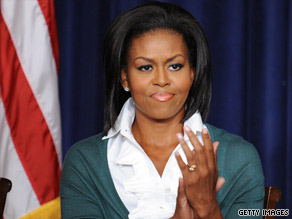
First lady Michelle Obama listens to remarks during a forum at the White House on Friday


Hyungwon Kang/Reuters
Michelle Obama discussing women and health care at the White House on Friday


.
http://prescriptions.blogs.nytimes.com/2009/09/18/michelle-obama-health-care-overhaul-important-to-women/?nl=us&emc=politicsemailema3


Michelle Obama: Health Care Overhaul ‘Next Step’ for Women

By JEFF ZELENY
September 18, 2009
New York Times


First Lady Michelle Obama said Friday that overhauling the nation’s health care system was of critical importance to women and part of “the next step” in the long quest to assure full opportunities and equality for women.

“Women aren’t just disproportionately affected by this issue because of the roles that we play in families,” Mrs. Obama said. “Women are affected because of the jobs that we do in this economy.”

In a morning speech at the Eisenhower Executive Office Building on the grounds of the White House, the first lady took one of her biggest steps yet into the health care discussions under way in Congress. She urged women to pay attention and get involved in the debate, saying it should be of particular concern to them and their families.

“We all know that women are more likely to work part-time or to work in small companies or businesses that don’t provide any insurance at all,” Mrs. Obama said. “Women are affected because, as we heard, in many states, insurance companies can still discriminate because of gender. And this is still shocking to me.”

In some states across the country, she said, insurance companies can still discriminate because of gender. She recalled instances where women had been denied coverage because of a pre-existing condition – “like having a C-section, or having had a baby.”

“These are the kind of facts that still wake me up at night,” she said.

In her speech, Mrs. Obama also told the story of one of their daughters, Sasha, who would not stop crying when she was 4 months old. A doctor’s visit revealed that she might have meningitis, which she ultimately did not, but the illness produced a scare.

“It is that moment in our lives that flashes through my head every time we engage in this health-insurance conversation. It’s that moment in my life because I think about, what on earth would we had done if we had not had insurance?” Mrs. Obama said. “What would have happened to that beautiful little girl, if we hadn’t been able to get to a pediatrician, who was able to get us to an emergency room?”

In the first eight months of the Obama presidency, the first lady has only occasionally weighed in on policy discussions, a strategy intended to keep her away from controversial topics. But the speech on Friday, delivered to leaders of several women’s groups, signaled the beginnings of an increasing role for her in the health care debate.

“She’s obviously a very popular figure in America,” said Robert Gibbs, the White House press secretary. “If she can help out, we’re happy to have her.”


http://edition.cnn.com/2009/POLITICS/09/18/michelle.obama.health.reform/

All,

Very important support and advocacy for healthcare reform by Michelle Obama...

Kofi

Michelle Obama could be secret weapon in health care reform

STORY HIGHLIGHTS

First lady Michelle Obama delivers remarks on health care reform Friday
Obama recalls personal health stories about her daughter and father
Analysts say her personal touch on the thorny issue could help her husband


WASHINGTON (CNN) -- She stood by her husband throughout the contentious 2008 presidential campaign and during heated health care reform debates during his presidency.


First lady Michelle Obama listens to remarks during a health care forum at the White House on Friday.

Now, as the debate is reaching a fever pitch, first lady Michelle Obama is weighing in on the issue by focusing on how health care can affect families.

"What she's doing is putting a personal and human face on the issue ... there's nothing more crucial," said Washington Post columnist Sally Quinn. "Everybody gets sick, and everybody has someone in the family that gets sick."

"I think if you can humanize it and personalize it, it suddenly brings it home to people -- especially those who are screaming and yelling about the government taking over," Quinn said.

On Friday, the first lady, a former hospital administrator, spoke about the issue to a crowd at the White House, highlighting her own family's experience with health care.

In one touching moment, Obama recalled when daughter Sasha exhibited signs of potentially deadly meningitis when she was 4 months old.

"We didn't know what, but he [the doctor] told us she could have meningitis, so we were terrified. He said get to the emergency room right away," she said. "Fortunately, things worked out."

"But it is that moment in our lives that flashes through my head every time we engage in this health insurance conversation. It's that moment in my life, because I think about what on earth would we have done if we had not had insurance."

Mrs. Obama not only faced the issue as a mother, but also as a daughter.

"My father had multiple sclerosis. He contracted it in his 20s. ... He was able to get up and go to work every day, even though it got harder for him as he got sicker and more debilitated. And I find myself thinking what would we had done as a family on the south side of Chicago if my father hadn't had insurance."

Quinn says that personal story is critical in the health care debate -- something that has been lacking in the president's message so far, which has often been deemed by pundits as too policy-oriented and too surgical in nature.

"What she's doing is she's humanizing the issue. And I think that has been missing in their [White House] campaign," she says. "He's been so focused on the details and the strategy and the money that the individual problems and issues have seemed to have gotten lost in the fray."

Gloria Borger, a CNN senior political analyst, agreed.

"I think she's always been a great asset to him," she said. "She can help in this health care debate by not getting involved in the minutiae of the bills, but essentially emphasizing the reason we need health care reform. And that's what she will stick to."

Michelle Obama was a lightning rod -- both good and bad -- throughout her husband's presidential campaign. Now, in her role as first lady, she has garnered greater support among American voters from both parties.

A national survey by the Pew Research Center for People and the Press in April found that the first lady's positive ratings have increased since her husband took office. The poll found that 76 percent of Americans had a favorable opinion of her, which is up from 68 percent in January.

"Much of the change has come among Republicans, especially Republican women," the organization noted. "About two-thirds of Republican women [67 percent] have a favorable impression of Michelle Obama, a gain of 21 points since January."

But a first lady's involvement in health care reform is nothing new.

In the early '90s, first lady Hillary Clinton spearheaded the Clinton administration's push for reform, holding meetings, testifying before congressional committees and, in general, taking charge of the issue.

"Hillary Clinton was the architect of health care reform," Borger said.

As for whether Michelle Obama is mirroring Clinton's role, the answer from both Borger and Quinn is absolutely not.

"I don't see any parallels at all. ... The Clintons came in, and they had run on the platform of buy one, get one free, a co-presidency and all of that. And she took over this huge thing herself. Bill wasn't doing it," Quinn said.

She said the president, not Michelle Obama, was the was the one who pushed health care reform in his early domestic agenda.

"He promised in his campaign, and then he's the one that did it. This is not Michelle's plan. She hasn't been doing the town meetings and the national press conferences," she added.


Borger said that the first lady is playing a completely different role.

"It's a much more supportive role, and it's a role out of the policy arena, but more in the arena of just why we ought to think we need reform."

All About Michelle Obama • Health Care Policy


Saturday, September 12, 2009

Matt Taibbi On the Ideological and Economic Dynamics of the Battle for National Health Care Reform


http://www.rollingstone.com/politics/story/29988909/sick_and_wrong


Sick and Wrong


How Washington is screwing up health care reform – and why it may take a revolt to fix it

MATT TAIBBI
Posted Sep 03, 2009
Rolling Stone


Watch Matt Taibbi break down his report on the sad state of health care reform in his blog, Taibblog.


Let's start with the obvious: America has not only the worst but the dumbest health care system in the developed world. It's become a black leprosy eating away at the American experiment — a bureaucracy so insipid and mean and illogical that even our darkest criminal minds wouldn't be equal to dreaming it up on purpose.

The system doesn't work for anyone. It cheats patients and leaves them to die, denies insurance to 47 million Americans, forces hospitals to spend billions haggling over claims, and systematically bleeds and harasses doctors with the specter of catastrophic litigation. Even as a mechanism for delivering bonuses to insurance-company fat cats, it's a miserable failure: Greedy insurance bosses who spent a generation denying preventive care to patients now see their profits sapped by millions of customers who enter the system only when they're sick with incurably expensive illnesses.

The cost of all of this to society, in illness and death and lost productivity and a soaring federal deficit and plain old anxiety and anger, is incalculable — and that's the good news. The bad news is our failed health care system won't get fixed, because it exists entirely within the confines of yet another failed system: the political entity known as the United States of America.

Just as we have a medical system that is not really designed to care for the sick, we have a government that is not equipped to fix actual crises. What our government is good at is something else entirely: effecting the appearance of action, while leaving the actual reform behind in a diabolical labyrinth of ingenious legislative maneuvers.

Over the course of this summer, those two failed systems have collided in a spectacular crossroads moment in American history. We have an urgent national emergency on the one hand, and on the other, a comfortable majority of ostensibly simpatico Democrats who were elected by an angry population, in large part, specifically to reform health care. When they all sat down in Washington to tackle the problem, it amounted to a referendum on whether or not we actually have a functioning government.

It's a situation that one would have thought would be sobering enough to snap Congress into real action for once. Instead, they did the exact opposite, doubling down on the same-old, same-old and laboring day and night in the halls of the Capitol to deliver us a tour de force of old thinking and legislative trickery, as if that's what we really wanted. Almost every single one of the main players — from House Speaker Nancy Pelosi to Blue Dog turncoat Max Baucus — found some unforeseeable, unique-to-them way to fuck this thing up. Even Ted Kennedy, for whom successful health care reform was to be the great vindicating achievement of his career, and Barack Obama, whose entire presidency will likely be judged by this bill, managed to come up small when the lights came on.

We might look back on this summer someday and think of it as the moment when our government lost us for good. It was that bad.

Here's where we are right now: Before Congress recessed in August, four of the five committees working to reform health care had produced draft bills. On the House side, bills were developed by the commerce, ways and means, and labor committees. On the Senate side, a bill was completed by the HELP committee (Health, Education, Labor and Pensions, chaired by Ted Kennedy). The only committee that didn't finish a bill is the one that's likely to matter most: the Senate Finance Committee, chaired by the infamous obfuscating dick Max Baucus, a right-leaning Democrat from Montana who has received $2,880,631 in campaign contributions from the health care industry.

The game in health care reform has mostly come down to whether or not the final bill that is hammered out from the work of these five committees will contain a public option — i.e., an option for citizens to buy in to a government-run health care plan. Because the plan wouldn't have any profit motive — and wouldn't have to waste money on executive bonuses and corporate marketing — it would automatically cost less than private insurance. Once such a public plan is on the market, it would also drive down prices offered by for-profit insurers — a move essential to offset the added cost of covering millions of uninsured Americans. Without a public option, any effort at health care reform will be as meaningful as a manicure for a gunshot victim. "The public option is the main thing on the table," says Michael Behan, an aide to Sen. Bernie Sanders of Vermont. "It's really coming down to that."

The House versions all contain a public option, as does the HELP committee's version in the Senate. So whether or not there will be a public option in the end will likely come down to Baucus, one of the biggest whores for insurance-company money in the history of the United States. The early indications are that there is no public option in the Baucus version; the chairman hinted he favors the creation of nonprofit insurance cooperatives, a lame-ass alternative that even a total hack like Sen. Chuck Schumer has called a "fig leaf."

Even worse, Baucus has set things up so that the final Senate bill will be drawn up by six senators from his committee: a gang of three Republicans (Chuck Grassley of Iowa, Olympia Snowe of Maine, Mike Enzi of Wyoming) and three Democrats (Baucus, Kent Conrad of North Dakota, Jeff Bingaman of New Mexico) known by the weirdly Maoist sobriquet "Group of Six." The setup senselessly submarines the committee's Democratic majority, effectively preventing members who advocate a public option, like Jay Rockefeller of West Virginia and Robert Menendez of New Jersey, from seriously influencing the bill. Getting movement on a public option — or any other meaningful reform — will now require the support of one of the three Republicans in the group: Grassley (who has received $2,034,000 from the health sector), Snowe ($756,000) or Enzi ($627,000).

This is what the prospects for real health care reform come down to — whether one of three Republicans from tiny states with no major urban populations decides, out of the goodness of his or her cash-fattened heart, to forsake forever any contributions from the health-insurance industry (and, probably, aid for their re-election efforts from the Republican National Committee).

This, of course, is the hugest of long shots. But just to hedge its bets even further and ensure that no real reforms pass, Congress has made sure to cover itself, sabotaging the bill long before it even got to Baucus' committee. To do this, they used a five-step system of subtle feints and legislative tricks to gut the measure until there was nothing left.


STEP ONE: AIM LOW

Heading into the health care debate, there was only ever one genuinely dangerous idea out there, and that was a single-payer system. Used by every single developed country outside the United States (with the partial exceptions of Holland and Switzerland, which offer limited and highly regulated private-insurance options), single-payer allows doctors and hospitals to bill and be reimbursed by a single government entity. In America, the system would eliminate private insurance, while allowing doctors to continue operating privately.

In the real world, nothing except a single-payer system makes any sense. There are currently more than 1,300 private insurers in this country, forcing doctors to fill out different forms and follow different reimbursement procedures for each and every one. This drowns medical facilities in idiotic paperwork and jacks up prices: Nearly a third of all health care costs in America are associated with wasteful administration. Fully $350 billion a year could be saved on paperwork alone if the U.S. went to a single-payer system — more than enough to pay for the whole goddamned thing, if anyone had the balls to stand up and say so.

Everyone knows this, including the president. Last spring, when he met with Rep. Lynn Woolsey, the co-chair of the Congressional Progressive Caucus, Obama openly said so. "He said if he were starting from scratch, he would have a single-payer system," says Woolsey. "But he thought it wasn't possible, because it would disrupt the health care industry."

Huh? This isn't a small point: The president and the Democrats decided not to press for the only plan that makes sense for everyone, in order to preserve an industry that is not only cruel and stupid and dysfunctional, but through its rank inefficiency has necessitated the very reforms now being debated. Even though the Democrats enjoy a political monopoly and could have started from a very strong bargaining position, they chose instead to concede at least half the battle before it even began.

Obama wasn't the only big Democrat to mysteriously abandon his position on single-payer. House Speaker Nancy Pelosi and Rep. Henry Waxman, the influential chair of the House commerce committee, have both backed away from their longtime support of single-payer. Hell, even Max-freaking-Baucus once conceded the logic of single-payer, saying only that it isn't feasible politically. "There may come a time when we can push for single-payer," he said in February. "At this time, it's not going to get to first base in Congress."

And helping it not get to first base was … Max Baucus. It was Baucus' own committee that held the first round-table discussions on reform. In three days of hearings last May, he invited no fewer than 41 people to speak. The list featured all the usual industry hacks, including big insurers like America's Health Insurance Plans (AHIP), Blue Cross and Aetna. It's worth noting that several of the organizations invited — including AHIP and Amgen — employ several former Baucus staffers as lobbyists, including two of his ex-chiefs of staff.

Not one of the 41 witnesses, however, was in favor of single-payer — even though eliminating the insurance companies enjoys broad public support. Leading advocates of single-payer, including doctors from the Physicians for a National Health Program, implored Baucus to allow them to testify. When he refused, a group of eight single-payer activists, including three doctors, stood up during the hearings and asked to be included in the discussion. One of the all-time classic moments in the health care reform movement came when the second protester to stand up, Katie Robbins of Health Care Now, declared, "We need single-payer health care!"

To which Baucus, who looked genuinely frightened, replied, "We need more police!"

The eight protesters were led away in handcuffs and spent about seven hours in jail. "It's funny, the policemen were all telling us their horror stories about health care," recalls Dr. Margaret Flowers, one of the physicians who was jailed. "One was telling us about his mother who was 62 and lost her job and was uninsured, waiting to get Medicare when she was 65." The protesters were sentenced to six months' probation. Baucus later met with them and conceded that not including single-payer advocates in the discussion had been a mistake, although it was "too late" to change that.

Single-payer advocates have had an equally tough time getting a hearing with the president. In March, the White House refused to allow Rep. John Conyers to invite two physicians who support single-payer to the health care summit that Obama was holding to kick off the reform effort. Three months later, a single-payer advocate named David Scheiner, who served as Obama's physician for 22 years, was mysteriously bumped from a prime-time forum on health care, where he had been invited to ask the president a question.

Many of the health care advisers in Obama's inner circle, meanwhile, are industry hacks — people like Nancy-Ann DeParle, the president's health care czar, who has served on the boards of for-profit companies like Medco Health Solutions and Triad Hospitals. DeParle is so unthreatening to the status quo that Karen Ignagni, the insurance industry's leading lobbyist-gorgon, praised her "extensive experience" and "strong track record."

Behind closed doors, Obama also moved to cut a deal with the drug industry. "It's a dirty deal," says Russell Mokhiber, one of the protesters whom Baucus had arrested. "The administration told them, 'Single-payer is off the table. In exchange, we want you on board.'" In August, the Pharmaceutical Research and Manufacturers of America announced that the industry would contribute an estimated $150 million to campaign for Obamacare.

Even the Congressional Progressive Caucus, whose 80-plus members have overwhelmingly supported single-payer legislation in the past, decided not to draw a line in the sand. They agreed to back down on single-payer, seemingly with the understanding that Pelosi would push for a strong public option — a sort of miniversion of single-payer, a modest, government-run insurance plan that would serve as a test model for the real thing. But one of the immutable laws of politics in the U.S. Congress is that progressives will always be screwed by their own leaders, as soon as the opportunity presents itself. And with a bill the size and scope of health care, there was plenty of opportunity.


STEP TWO: GUT THE PUBLIC OPTION

Once single-payer was off the table, the Democrats lost their best bargaining chip. Rather than being in a position to use the fear of radical legislation to extract concessions from the right — a position Obama seemingly gave away at the outset, by punting on single-payer — Republicans and conservative Blue Dog Democrats suddenly realized that they had the upper hand. Pelosi and Senate Majority Leader Harry Reid would now give away just about anything to avoid having to walk away without a real health care bill.

The situation was made worse as the flagging economy ate away at Obama's political capital. Polls showed the percentage of "highly engaged" Democrats plummeting, while the percentage of "highly engaged" Republicans — inspired by idiotic scare stories from Rush Limbaugh and Sarah Palin about socialized medicine and euthanasia — rose rapidly. By late summer, "the depth of Republican support was starting to rival the breadth of Democratic support," said noted statistician Nate Silver. The more the Republicans and Blue Dogs fidgeted and fucked around, the easier it would be for them to kill the public option. Democrats, who on the morning after Election Day could have passed a single-payer system without opposition, were now in a desperate hurry to make a deal.

The public option is hardly a cure-all: Among other things, it does nothing to reduce the $350 billion a year in unnecessary paperwork and administrative overhead that makes the current system so expensive and maddening. "That's one of the big issues," says an aide to a member of the progressive caucus. "None of this addresses the paperwork issue. It might even make it worse." But the basic idea of the public option is sound enough: create a government health plan that citizens could buy through regulated marketplaces called insurance "exchanges" run at the state level. Simply by removing the profit motive, the government plan would be cheaper than private insurance. "The goal here was to offer the rock-bottom price, the Walmart price, so that people could buy insurance practically at cost," says one Senate aide.

The logic behind the idea was so unassailable that its opponents often inadvertently found themselves arguing for it. "Assurances that the government plan would play by the rules that private insurers play by are implausible," groused right-wing douchebag George Will. "Competition from the public option must be unfair, because government does not need to make a profit and has enormous pricing and negotiating powers." In other words, if you offer a public plan that doesn't systematically fuck every single person in the country by selling health care at inflated prices and raking in monster profits, private insurers just won't be able to compete.

Will wasn't the only prominent opponent of reform openly arguing in favor of the insurance industry's right to continue doing business inefficiently. Sen. Ben Nelson, who together with Baucus are the Laverne and Shirley of turncoat Democrats, complained that the public option "would win the game." Senate Minority Leader Mitch McConnell admitted that "private insurance will not be able to compete with a government option." This is a little like complaining that Keanu Reeves was robbed of an Oscar just because he can't act.

For a while, the public option looked like it might have a real chance at passing. In the House, both the ways and means committee and the labor committee passed draft bills that contained a genuine public option. But then conservative opponents of the plan, the so-called Blue Dog Democrats, mounted their counterattack. A powerful bloc composed primarily of drawling Southerners in ill-fitting suits, the Blue Dogs — a gang of puffed-up political mulattos hired by the DNC to pass as almost-Republicans in red-state battlegrounds — present themselves as a quasi-religious order, worshipping at the sacred altar of "fiscal responsibility" and "deficit reduction." On July 9th, in a harmless-sounding letter to Pelosi, 40 Blue Dogs expressed concern that doctors in the public option "must be fairly reimbursed at negotiated rates, and their participation must be voluntary." Paying doctors "using Medicare's below-market rates," they added, "would seriously weaken the financial stability of our local hospitals."

The letter was an amazing end run around the political problem posed by the public option — i.e., its unassailable status as a more efficient and cheaper health care alternative. The Blue Dogs were demanding that the very thing that makes the public option work — curbing costs to taxpayers by reimbursing doctors at Medicare rates plus five percent — be scrapped. Instead, the Blue Dogs wanted compensation rates for doctors to be jacked up, on the government's tab. The very Democrats who make a point of boasting about their unwavering commitment to fiscal conservatism were lobbying, in essence, for a big fat piece of government pork for doctors. "Cost should be the number-one concern to the Blue Dogs," grouses Rep. Woolsey. "That's why they're Blue Dogs."

In the end, the Blue Dogs won. When the House commerce committee passed its bill, the public option no longer paid Medicare-plus-five-percent. Instead, it required the government to negotiate rates with providers, ensuring that costs would be dramatically higher. According to one Democratic aide, the concession would bump the price of the public option by $1,800 a year for the average family of four.

In one fell swoop, the public plan went from being significantly cheaper than private insurance to costing, well, "about the same as what we have now," as one Senate aide puts it. This was the worst of both worlds, the kind of take-the-fork-in-the-road nonsolution that has been the peculiar specialty of Democrats ever since Bill Clinton invented a new way to smoke weed. The party could now sell voters on the idea that it was offering a "public option" without technically lying, while at the same time reassuring health care providers that the public option it was passing would not imperil the industry's market share.

Even more revolting, when Pelosi was asked on July 31st if she worried that progressives in the House would yank their support of the bill because of the sellout to conservatives, she literally laughed out loud. "Are the progressives going to take down universal, quality, affordable health care for all Americans?" she said, chuckling heartily to reporters. "I don't think so."

The laugh said everything about what the mainstream Democratic Party is all about. It finds the notion that it has to pay anything more than lip service to its professed values funny. "It's a joke," complains one Democratic aide. "This is all a game to these people — and they're good at it."

The concession to the Blue Dogs comes at a potentially disastrous price: Without a public option that drives down prices, the cost of other health care reforms being considered by Congress will almost certainly skyrocket. The trade-off with conservatives might be understandable, if those other reforms were actually useful. But this is Congress we're talking about.

STEP THREE: PACK IT WITH LOOPHOLES

Even seasoned congressional aides, who are accustomed to sitting through long and boring committee meetings, have found the debate over health care reform uniquely torturous. Unlike other congressional matters, where there is at least a feeling that the process might at some point be completed, the endless sessions over health care have led many staffers to fear that they will be locked in hearing rooms for the rest of their lives, listening to words like "target" and "mandate" and "doughnut hole" being repeated ad nauseam by weary, gray-faced, saggy-necked legislators — who begin, after weeks of self-inflated posturing, to look like the ugliest people in the universe. "You come out of these hearings," says Behan, the aide to Sen. Sanders, "and the number of interconnected, moving pieces going in and out of these bills is insane — the case for single-payer health insurance makes itself."

For those looking to fuck up health care reform — or to load it up with goodies for their rich pals — the tedium actually serves a broader purpose. Given that five different committees are weighing five different and often competing paths to reform, it's not surprising that all sorts of bizarre crap winds up buried in their bills, stuff no one could possibly have expected to be in there. The most glaring example, passed by Ted Kennedy's HELP committee, would allow the makers of complex drugs known as "biologics" to keep their formulas from being copied by rivals for 12 years — twice as long as the protection for ordinary pharmaceuticals. The notion that an effort ostensibly aimed at curbing health care costs would grant the pharmaceutical industry lucrative new protections against generic drugs is even weirder when you consider that earlier proposals, including one supported by Obama, would have protected brand-name drugs for only seven years.

Another favor to industry buried in the bills involves the issue of choice. From the outset, Democrats have been careful to make sure that a revamped system would not in any way force citizens to give up their existing health care plans. As Obama told the American Medical Association in June, "If you like your doctor, you will be able to keep your doctor, period. If you like your health care plan, you'll be able to keep your health care plan, period. No one will take it away, no matter what."

That sounds great, particularly in conjunction with the new set of standards for employer-provided insurance outlined in the House version of reform. Under the bill — known as HR 3200 — employers must provide "essential benefits" to workers or face a stiff penalty. "Essential benefits" includes elements often missing in the fly-by-night plans offered by big employers: drug benefits, outpatient care, hospitalization, mental health, the works. If your employer does not offer acceptable coverage, you then have the right to go into one of the state-run insurance "exchanges," where you can select from a number of insurance plans, including the public option.

There's a flip side, though: If your employer offers you acceptable care and you reject it, you are barred from buying insurance in the insurance "exchange." In other words, you must take the insurance offered to you at work. And that might have made sense if, as decreed in the House version, employers actually had to offer good care. But in the Senate version passed by the HELP committee, there is no real requirement for employers to provide any kind of minimal level of care. On the contrary, employers who currently offer sub-par coverage will have their shitty plans protected by a grandfather clause. Which means …

"If you have coverage you like, you can keep it," says Sen. Sanders. "But if you have coverage you don't like, you gotta keep it."

This grandfather clause has potentially wide-ranging consequences. One of the biggest health care problems we have in this country is the technique used by large employers — Walmart is the most notorious example — of offering dogshit, bare-bones health insurance that forces employees to take on steep co-pays and other massive charges. Low-wage workers currently offered these plans often reject them and join Medicaid, effectively shifting the health care burden for Walmart employees on to the taxpayer. If the HELP committee's grandfather clause survives to the final bill, those workers who did the sensible thing in rejecting Walmart's crap employer plan and taking the comparatively awesome insurance offered via Medicaid will now be rebuffed by the state and forced to take the dogshit Walmart offering.

This works out well for the states, who will get to purge all those Walmart workers from their Medicaid rolls. It also works great for Walmart, since any new competitors who appear on the horizon will be forced to offer genuine and more expensive health insurance — giving Walmart a clear competitive advantage. This little "glitch" is the essence of the health care reform effort: It changes things in a way that works for everyone except actual sick people.

Veteran legislators speak of this horrific loophole as if it were an accident — something that just sort of happened, while no one was looking. Sen. Ron Wyden of Oregon was looking at an early version of the bill several months ago, when he suddenly realized that it was going to leave people stuck with their employer insurance. "I woke up one morning and was like, 'Whoa, people aren't going to have choices,'" he recalls.

As a means of correcting the problem, Wyden wrote up a thing called the Free Choice Act, which like many of the prematurely sidelined ideas in this health care mess is actually quite sensible. The bill would open up the insurance "exchanges" to all consumers, regardless of who is offered employer-based insurance and who isn't. But Wyden has little hope of having his proposal included in later versions of the bill. Like Sanders, who hopes to correct the committee's giveaway to drugmakers, Wyden won't get a real shot at having an impact until the House and Senate meet to hammer out differences between their final bills. In a legislative sense, the bad ideas are already in the barn, and the solutions are fenced off in the fields, hoping to get in.

STEP FOUR: PROVIDE NO LEADERSHIP

One of the reasons for this chaos was the bizarre decision by the administration to provide absolutely no real oversight of the reform effort. From the start, Obama acted like a man still running for president, not someone already sitting in the White House, armed with 60 seats in the Senate. He spoke in generalities, offering as "guiding principles" the kind of I'm-for-puppies-and-sunshine platitudes we got used to on the campaign trail — investment in prevention and wellness, affordable health care for all, guaranteed choice of doctor. At no time has he come out and said what he wants Congress to do, in concrete terms. Even in June, when congressional leaders desperate for guidance met with chief of staff (and former legislative change-squelcher) Rahm Emanuel, they got no signal at all about what the White House wanted. On the question of a public option, Emanuel was agonizingly noncommittal, reportedly telling Senate Democrats that the president was still "open to alternatives."

On the same day Emanuel was passing the buck to senators, Obama was telling reporters that it's "still too early" to have a "strong opinion" on a public option. This was startling news indeed: Eight months after being elected president of the United States is too early to have an opinion on an issue that Obama himself made a central plank of his campaign? The president conceded only that a "public option makes sense."


This White House makes a serial vacillator like Bill Clinton look like Patton crossing the Rhine. Veterans from the Clinton White House, in fact, jumped on Obama. "The president may have overlearned the lesson of the Clinton health care plan fiasco, which was: Don't deliver a package to the Hill, let the Hill take ownership," said Robert Reich, who served as labor secretary under Clinton. There were now so many competing ideas about how to pay for the plan and what kind of mandates to include that even after the five bills are completed, Congress will not be much closer to reform than it was at the beginning. "The president has got to go in there and give it coherence," Reich concluded.

But Reich's comment assumes that Obama wants to give the bill coherence. In many ways, the lily-livered method that Obama chose to push health care into being is a crystal-clear example of how the Democratic Party likes to act — showering a real problem with a blizzard of ineffectual decisions and verbose nonsense, then stepping aside at the last minute to reveal the true plan that all along was being forged off-camera in the furnace of moneyed interests and insider inertia. While the White House publicly eschewed any concrete "guiding principles," the People Who Mattered, it appeared, had already long ago settled on theirs. Those principles seem to have been: no single-payer system, no meaningful public option, no meaningful employer mandates and a very meaningful mandate for individual consumers. In other words, the only major reform with teeth would be the one forcing everyone to buy some form of private insurance, no matter how crappy, or suffer a tax penalty. If the public option is the sine qua non for progressives, then the "individual mandate" is the counterpart must-have requirement for the insurance industry.

"That was their major policy 'ask,' and it looks like they're going to get it," says Dr. Steffie Woolhandler, a Boston physician who is a prominent single-payer advocate.

The so-called "individual mandate" is currently included in four of the five bills before Congress. The most likely version to survive into the final measure resembles the system in Massachusetts designed by Mormon glambot Mitt Romney, who imposed tax penalties on citizens who did not buy insurance. Several of Romney's former advisers are involved in the writing of Obamacare, including a key aide to Ted Kennedy who was instrumental in designing the HELP committee legislation. The federal version of the Massachusetts plan would slap the uninsured with a hefty tax penalty — making the HELP committee clause barring people from opting out of their employer-provided plan that much more outrageous.

If things go the way it looks like they will, health care reform will simply force great numbers of new people to buy or keep insurance of a type that has already been proved not to work. "The IRS and the government will force people to buy a defective product," says Woolhandler. "We know it's defective because three-quarters of all people who file for bankruptcy because of medical reasons have insurance when they get sick — and they're bankrupted anyway."

STEP FIVE: BLOW THE MATH

Health care is a beast — a monster. The House 3200 bill alone is 1,017 pages long and contains countless inscrutable references to other pieces of legislation, meaning that in order to fully comprehend even those thousand pages one really has to read upward of 9,000 or 10,000 pages. There are five different versions of this creature, each with its own nuances and shades, and solving a highly complex mathematical challenge like reconciling the costs of each of the five plans would be beyond even minds who were (a) expert at such things and (b) motivated to get it right. Imagine the same problem in the hands of a bunch of second-rate country lawyers and mall owners, and you about get the idea of what the congressional picture looks like.

For instance: All five of the bills envision a significant expansion of Medicaid. As it stands, the LBJ-era program, which celebrated its 44th birthday on the day before Nancy Pelosi laughed at the progressives, awards benefits according to a jumbled series of state-by-state criteria. Some states, like Vermont, offer Medicaid to citizens whose income is as high as 300 percent of the federal poverty level, while others, like Georgia, only offer Medicaid to those closer to or below the poverty level.

The House plan would expand Medicaid eligibility to automatically include every American whose income is 133 percent of the poverty level or less. For those earning somewhat more — up to 400 percent of the poverty level — federal subsidies would help pay for the cost of a public or private plan purchased via the insurance "exchanges." That worries state governments, which currently pay for almost half of Medicaid — and which are already seeing their Medicaid rolls swelled by the economic meltdown. A massive surge in new Medicaid members — as many as 11 million Americans under the current proposals, according to the Congressional Budget Office — might literally render many big states insolvent overnight.

Democrats pointed out that under the House plan, the federal government would pay the costs of any "newly eligible" members of Medicaid. But that phrasing, it turns out, was a semantic trick designed to undersell the cost to the states. When Massachusetts imposed a similar mandate under Romney, thousands of people who were already eligible for Medicaid, but had not enrolled, immediately joined the program in order to avoid the tax penalty for being uninsured. So while the House plan would pay for "newly eligible" patients, it won't cover the "oldly eligible."

Congress in this instance is behaving like corporations in the Enron age, orphaning hidden costs and complications through clever wording and accounting. Another neat trick involves the federal subsidies for low-income people who make up to 400 percent of the poverty level. The Congressional Budget Office projects that under the House bill, the subsidies will cost upward of $773 billion by 2019. But some aides think that number could end up being much higher. "Without a real public option to drive down costs, the federal support to make sure everyone gets coverage is going to get very expensive very fast," says Behan, the aide to Sen. Sanders.

Here's the other thing. By blowing off single-payer and cutting the heart out of the public option, the Obama administration robbed itself of its biggest argument — that health care reform is going to save a lot of money. That has left the Democrats vulnerable to charges that the plan is going to blow a mile-wide hole in the budget, one we'll be paying debt service on through the year 3000. It also left them scrambling to find other ways to pay for the plan, making it almost inevitable that they would step in political shit with seniors everywhere by trying surreptitiously to whittle down Medicare. As a result, the Democrats have become so oversensitive to charges of fiscal irresponsibility that they're taking their frustrations out on people who don't deserve it. Witness Nancy Pelosi's bizarre freakout over the Congressional Budget Office. When the CBO questioned Obama's projected cost savings, Pelosi blasted them for "always giving you the worst-case scenario" — which, of course, is exactly what the budget office is supposed to do. When you start asking your accountant to look on the bright side, you know you're not dealing from a position of strength.


To recap, here's what ended up happening with health care. First, they gave away single-payer before a single gavel had fallen, apparently as a bargaining chip to the very insurers mostly responsible for creating the crisis in the first place. Then they watered down the public option so as to make it almost meaningless, while simultaneously beefing up the individual mandate, which would force millions of people now uninsured to buy a product that is no longer certain to be either cheaper or more likely to prevent them from going bankrupt. The bill won't make drugs cheaper, and it might make paperwork for doctors even more unwieldy and complex than it is now. In fact, the various reform measures suck so badly that PhRMA, the notorious mouthpiece for the pharmaceutical industry which last year spent more than $20 million lobbying against health care reform, is now gratefully spending more than seven times that much on a marketing campaign to help the president get what he wants.

So what's left? Well, the bills do keep alive the so-called employer mandate, requiring companies to provide insurance to their employees. A good idea — except that the Blue Dogs managed to exempt employers with annual payrolls below $500,000, meaning that 87 percent of all businesses will be allowed to opt out of the best and toughest reform measure left. Thanks to Harry Reid, Nancy Pelosi and Barack Obama, we can now be assured that the 19 or 20 employers in America with payrolls above $500,000 who do not already provide insurance will be required to offer good solid health coverage. Hurray!

Or will they? At the end of July, word leaked out that the Senate Finance Committee, in addition to likely spiking the public option, had also decided to ditch the employer mandate. It was hard to be certain, because even Democrats on the committee don't know what's going on in the Group of Six selected by Baucus to craft the bill. Things got so bad that some Democrats on the committee — including John Kerry, Chuck Schumer and Robert Menendez — were reduced to holding what amounts to shadow hearings on health care several times a week, while Baucus and his crew conducted their meetings in relative secrecy. The chairman did not even bother to keep his fellow Democrats informed of the bill's developments, let alone what he has promised Republicans in return for their support of the bill. "The Group of Six has hijacked the process," says an aide to one of the left-out senators.

This leaves Democrats on the committee in the strange position of seriously considering pulling their support for a bill that will emerge from a panel on which they hold a clear majority. Other Democrats are also weighing an end run around their own leadership, hoping to sneak meaningful reforms back into the process. In the House, Rep. Anthony Weiner of New York refused to support the bill passed by the commerce committee unless he was allowed to attach an amendment that will enable Congress to vote on replacing the entire reform bill with a single-payer plan (Bernie Sanders is working on a similar measure in the Senate). On the labor committee, Rep. Dennis Kucinich of Ohio took a more nuanced tack, offering an amendment that would free up states to switch to a single-payer system of their own.

It's highly unlikely, though, that the party's leaders will agree to include such measures when the five competing reform bills are eventually combined. On the House side, "Pelosi has unfettered discretion to combine the bills as she pleases," observes one Democratic aide. Which leaves us where we are today, as Congress enjoys its vacation, and the various sides have taken to the airwaves in an advertising blitz to make sure the population is saturated with idiotic misconceptions before the bill is actually voted on in the fall.

The much-ballyhooed right-wing scare campaign, with its teabagger holdovers ridiculously disrupting town-hall meetings with their belligerent protests and their stoneheaded memes (the sign raised at a town hall held by Rep. Rick Larson of Washington — keep the guvmint out of my medicare — is destined to become a classic of conservative propaganda), has proved to be almost totally irrelevant to the entire enterprise. Aside from lowering even further the general level of civility (teabaggers urged Sen. Chris Dodd to off himself with painkillers; Rep. Brad Miller had his life threatened), the Limbaugh minions have accomplished nothing at all, except to look like morons for protesting as creeping socialism a reform effort designed specifically to change as little as possible and to preserve at all costs our malfunctioning system of private health care.

All that's left of health care reform is a collection of piece-of-shit, weakling proposals that are preposterously expensive and contain almost nothing meaningful — and that set of proposals, meanwhile, is being negotiated down even further by the endlessly negating Group of Six. It is a fight to the finish now between Really Bad and Even Worse. And it's virtually guaranteed to sour the public on reform efforts for years to come.

"They'll pass some weak, mediocre plan that breaks the bank and even in the best analysis leaves 37 million people uninsured," says Mokhiber, one of the single-payer activists arrested by Baucus. "It's going to give universal health care a bad name."

It's a joke, the whole thing, a parody of Solomonic governance. By the time all the various bills are combined, health care will be a baby not split in half but in fourths and eighths and fractions of eighths. It's what happens when a government accustomed to dealing on the level of perception tries to take on a profound emergency that exists in reality. No matter how hard Congress may try, though, it simply is not possible to paper over a crisis this vast.

Then again, some of the blame has to go to all of us. It's more than a little conspicuous that the same electorate that poured its heart out last year for the Hallmark-card story line of the Obama campaign has not been seen much in this health care debate. The handful of legislators — the Weiners, Kuciniches, Wydens and Sanderses — who are fighting for something real should be doing so with armies at their back. Instead, all the noise is being made on the other side. Not so stupid after all — they, at least, understand that politics is a fight that does not end with the wearing of a T-shirt in November.

[From Issue 1086 — September 3, 2009]

Check out Matt Taibbi's blog for updates on this story and more.