Showing posts with label Patriarchy. Show all posts

Wednesday, December 13, 2023

The Fundamental Crisis and Foundational Contradiction Facing the United States During the Upcoming Presidential Election Year of 2024: Fascism guided, informed, and enabled by the Doctrines and Practices of White Supremacy and Global Capitalism--PART 3

DEFEAT FASCISM BEFORE FASCISM DEFEATS YOU 

"What's Past is Prologue..."

http://www.truth-out.org/…/38319-white-supremacy-elected-do…

White Supremacy Elected Donald Trump
Wednesday, 9 November 2016 
by Kelly Hayes 
Truthout | News Analysis

I had no interest in watching the returns come in. Early Tuesday night, I was watching "Supernatural" reruns on my couch and only occasionally glancing at election updates on Twitter. Everything looked as predicted. The New York Times said Hillary Clinton was very likely to become the next president, as its irksome electoral meter bounced about. Like many, I had adopted the steadfast belief that Trump simply couldn't win. The polls were thoroughly damning. Wall Street didn't want him. The Republicans barely wanted him. But after a while, I felt compelled to turn off Netflix and switch to live election coverage.

I watched, drop-jawed, as it became clear the unthinkable was happening.  Donald Trump was surging toward victory.

As the electoral tide turned, wounded Clinton supporters began casting blame on social media, accusing voters who supported third-party candidates of derailing a Clinton victory. The mud-slinging directed at anyone on the left who hadn't supported Clinton was predictably swift and devoid of insight. After all, Donald Trump was the opponent Hillary Clinton wanted. He was supposed to be an easy takedown. But Clinton's team had obviously underestimated Trump's cultural momentum. The media all but celebrated his despicable antics for shock and entertainment value, as large swaths of bigoted white people endorsed his racism and xenophobia.

The Democratic establishment was sure it would have Bernie Sanders' crestfallen supporters on lock, even as it insulted them. Clinton didn't even attempt to speak the issues that might have moved such people. The Democratic establishment assumed it would get what it wanted out of fear, without making any concessions to those who didn't trust it. The struggle at Standing Rock -- which Clinton weakly acknowledged in a noncommittal statement -- is just one example of how this campaign took people for granted, and took votes for granted.

Some issues never warranted engagement for Clinton and those issues often involved marginalized people -- because the Democratic Party was betting it all on one of its most basic electoral assumptions: There's no need to be loved when your opponent is feared.

But in spite of my distaste for Clinton, I likely would have voted for her if I lived in a battleground state. I didn't because I didn't have to. And given her track record and all the harm she's done -- supporting and enacting policies that expanded mass incarceration and our violent interventions abroad -- feeling like I didn't have to vote for her was a relief. I am willing to bet that some voters in states where Clinton was projected to win had that same feeling: a sense of relief that they didn't have to cosign a neoliberal nightmare's ascension. Wall Street wanted her. The establishment wanted her. Plenty of people who hated her seemed ready to suck it up, and the polls looked good. And then....

Enter President Trump.

What came as a shock to many of us probably shouldn't have. While Clinton seemed to have made a Thatcher-like assent, overcoming misogyny by embracing her own kind of casual brutality, white supremacy would not allow her to win so easily as Obama stepped out. The flames of white violence had been stoked at a time when white people had felt the displacement of a Black presidency, and the unapologetic momentum of a movement for Black lives.

Not even Wall Street could overrule the white rage and vanity that fueled Trump. The electoral dictates of Wall Street are institutional, but white supremacy is structural. White supremacy redistributed its power Tuesday night, and in such a spectacular fashion that even those of us who expect the worst of our country were left astonished. The United States, which seemed poised to usher in another Clinton presidency, instead rallied behind a dangerous, racist buffoon.

So what does the future hold? Ugliness, to be sure. The terrifying promises of Trump's campaign are ringing in the ears of all affected by them, myself included. I am afraid for everyone who will be harmed by this man's administration. I am afraid of just how much destruction one oafish reality TV star might bring, when life as we know it nears the edge of extinction.

Yet I am, as ever, certain in my own work. I will organize and take action. I imagine a few more people will be in the streets in the coming year than otherwise would. I'll be glad to see you all out there, though sorry about the circumstances.

This is going to be rough, but it's what we've got. So let's pull it together and figure out how to tear into our common enemies in the days ahead. I know loss is bitter, but it's time to get over it and learn what you can. In this case, that might mean learning that people may not bother to show up for a candidate they don't believe cares about them, no matter how scary the alternative. And it definitely means getting ready to throw down hard, because it's going to be a long four years.


ABOUT THE AUTHOR:


Kelly Hayes is a direct action trainer and a cofounder of The Chicago Light Brigade and the direct action collective Lifted Voices. She is community relations associate and a contributing writer at Truthout and her photography is featured in the "Freedom and Resistance" exhibit of the DuSable Museum of African American History. Kelly's contribution to the anthology Who Do You Serve, Who Do You Protect? stems from her work as an organizer against state violence and her ongoing analysis of movements in the United States, as featured in Truthout and the blog Transformative Spaces.


Related Stories:

White Supremacy Is Alive and All Too Well
by Mitchell Zimmerman, OtherWords | Op-Ed

Democrats March Toward Cliff
by Robert Parry, Consortium News | Op-Ed

Standing Firm at Standing Rock: Why the Struggle Is Bigger Than One Pipeline
by Sarah Jaffe, Moyers & Company | Report


"What's Past is Prologue..."

https://newrepublic.com/…/joe-biden-destructive-politics-wh…

The Destructive Politics of White Amnesia

Joe Biden set the stage for Donald Trump's racial scapegoating. Why can't he admit that he was wrong?

by Kimberlé Williams Crenshaw
August 6, 2019
The New Republic
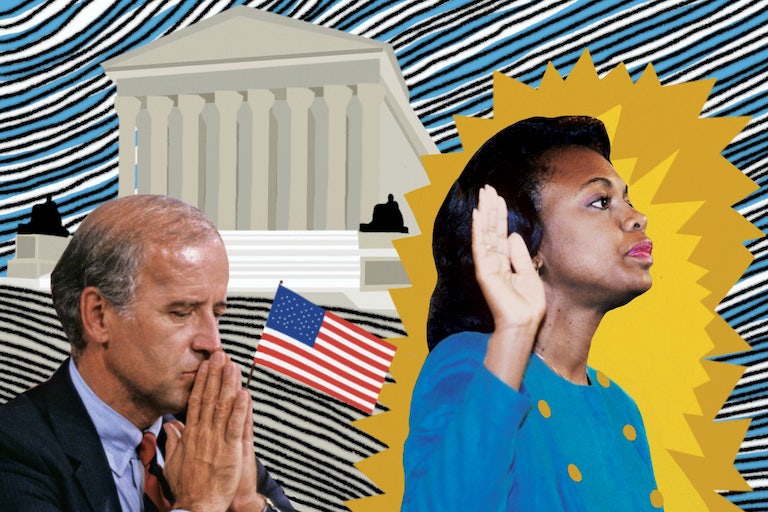

IMAGE: Arnie Sachs/Picture-Alliance/DPA/AP Photo (Biden) Jennifer Law/AFP/Getty (Hill)


For all of his bumbling verbosity and avuncular artlessness, Democratic front-runner Joe Biden serves as a remarkably elegant illustration of all that ails the Democratic Party’s bid to retake the White House in 2020.

Trump’s breathtaking weaponization of the Republican Party into the party of white nationalism should, at minimum, make the parameters of the Democratic primary campaign clear. Where conservatives in the past have employed dog whistle rhetoric to mask the manipulation of racial tensions, Trump’s itchy Twitter fingers dole out something more like smart missile rhetoric. The precision-guided invectives hurled at Representative Elijah Cummings, “the Squad,” and civil rights leader the Reverend Al Sharpton represent an escalation that Trump’s eventual general election challenger cannot meet with appeasement.

To counter such terrifying demagoguery, the party must be as unified in its repudiation of racism, xenophobia, and misogyny as the Party of Trump has been in enabling them. One would think, therefore, that candidates angling to become the standard-bearer of the loyal opposition should be capable of articulating not only the danger of this political moment, but also how their own party helped create this tragedy. Democratic candidates will never be able to steer a fresh course so long as they continue decades of denial and dissemblance. Joe Biden’s status as the 2020 field’s front-runner, in spite of his cringeworthy efforts to account for his part in that history, speaks volumes about how far today’s Democrats still have to go before they can meet the challenges of Trumpism head-on. A good deal of Biden’s inflated standing comes from an all-too characteristic Democratic posture of risk aversion, compounded by a talismanic faith in Biden’s mystic “electability.” Many party leaders and voters clearly view a Biden candidacy as the safest post-Trump course correction—and Biden as a pragmatic man of the people with the unique ability to build coalitional bridges between coastal elites and the so-called forgotten men and women of America’s heartland.

As if to underscore the inherent limitations of this posturing, Biden has trafficked enthusiastically in images of good ol’ boy politicking as evidence that he is the right man for the job. As his reminiscences of Senate business in the sepia-toned (but decidedly white) past tripped up his early campaign efforts, Biden has tried, gingerly to grudgingly, to walk his comments back. But those overtures point up a disquieting fear about his bid to defeat Trump: He may well perpetuate the fallacies of elite comity that marked his early career—and that continue to animate Democratic strategies to win back voters who are not as yet scandalized by the racist and misogynist rabble-rousing that is Trumpism. Falling back on that strategy alone may be fool’s gold. Not only is it questionable whether Trump’s heartland faithful will ever return to the Democratic column; the clouds that hang over Biden’s candidacy also suggest that when the going gets tough, the tough might find themselves going it alone. Biden’s missteps present a troubling pattern of sacrificing the interests of the very constituencies that stand to lose the most if the 2020 battle is undercut by the politics of appeasement. Voters who are activated to battle tooth-and-nail against the resurrection of our white supremacist past have every reason to press candidates for evidence that their failing marks on some of the most consequential issues affecting race and gender justice won’t be repeated. So far, the current front-runner has offered little substance in his defense, beyond Obama stardust and affability. That’s not enough in the best of times, and it is certainly not sufficient now.

For starters, Biden has yet to accept any genuine responsibility for how he helped preside over a process that depicted women—African American women—as conniving bottom-feeders. As chairman of the Senate Judiciary Committee in 1991, Biden actively enabled the humiliation and stigmatization of Anita Hill in that terrible spectacle of patriarchal impunity. He failed to call the multiple existing witnesses who could corroborate Hill’s testimony, while granting future Justice Clarence Thomas the ability to testify both before and after his accuser. From his chairman’s perch, meanwhile, Biden took a sharply inquisitorial line of questioning toward Hill, and reassured the country that Thomas’s character was beyond reproach.

Biden’s long-overdue apology for his central role in the Hill-Thomas fiasco was typical Biden—that is to say, the rough equivalent of a reckless driver’s acknowledgment that a hapless bystander may have been harmed while he was behind the wheel. But well into the #MeToo era, Biden’s entire driving record warrants explaining, in close detail. Almost three decades after the Thomas hearings, he seems unaware of how his penchant for Senate friendliness made him a prime choreographer of a cultural debacle steeped in the toxic brand of white-male privilege that Moya Bailey and Trudy have come to call misogynoir.

The harm done to Anita Hill, to Black women, and to sexual harassment victims overall is not the half of it. The mishandled hearings put Thomas on the Supreme Court, and Thomas has gone on to be the most influential justice currently sitting. Any basic review of the long train of recent high court decisions dismantling the modest protections erected to safeguard our democracy against the unlicensed rule by the wealthy and racially privileged can’t help but highlight their common thread: The majority are 5–4 opinions in which Thomas’s vote has turned the country inside out.

In the same discursive vein, Biden’s wistful recollection of working alongside segregationists James Eastland and Herman Talmadge sent up clear alarms. To be sure, from a certain realpolitik vantage, one can defend Biden’s collaboration with white power as a necessary evil. At the same time, however, Biden’s nostalgia for his pragmatic former alliances with segregationist lawmakers bespeaks a foreshortened moral compass, one prone to equate bigotry with collegial rascalry.

Rather than citing abhorrent figures like Eastland and Talmadge as exemplars of a bygone civility, Biden might just as easily have lamented the many ways in which the postwar Senate majority amplified the power and influence of segregationists—a pivotal fact that Biden only glancingly acknowledged after the public uproar greeting his comments. This glib moral embrace of unyielding racists for the sake of “getting things done” buttressed a vicious anti-Black social and political order for generations on end. When those who think of Black people as subhumans are the arbiters of policy, it’s no great surprise to see them endorse policies that are at best indifferent and at worst inimical to the interests of Black people. When it came to defining issues like busing and, subsequently, mass incarceration, Biden was an accommodating enabler in the regressive politics of race.

Biden’s selective—and at times flatly deceptive—invocation of his history of course mirrors the countless ways in which American political culture at large relies on robustly denying the truth about our own collective past. His very candidacy, pitched on a vice presidential tenure under the glorious “post-racial” interregnum of the Obama years, elides much of his public career. American leaders can indulge in such self-exculpating flights of fancy via a stolid ideological refusal to deny the true implications of a state built on racial power. However much we love to pretend otherwise, the legitimacy of segregation and chattel slavery is inscribed in many of our most hallowed rhetorical and constitutional traditions—and extend right up into the present, as the Trump White House and the rise of the alt-right remind us nearly every day.

Biden’s difficulties are not personal; rather, like many of our white leaders, he’s inherited them from institutional, societal, and cultural patterns of denial. In our near-schizophrenic consensus view of racial progress, this legacy of denial operates to celebrate the nation’s preferred self-image as a clearinghouse of equal individual opportunity, open to all, while obsessively rationalizing away slavery, colonialism, and extermination as the singular, hermetically contained responsibility of the individual bad actors long ago who perpetrated these harms. This very denial is what has set the stage for the riotous resurrection of white entitlement and scapegoat politics.

Before there is reconciliation, there must be truthful engagement with the conditions of Trumpian reaction. If Biden’s campaign fails to channel and instead diminishes the energies of constituencies mobilized to resist 45, Trumpism still wins.

The playwright Eve Ensler recently referred to the American inability to confront the country’s past injustices as a form of “diabolical amnesia.” This forgetfulness so dulls the tip of progress that we repeat the same unjust narratives over and over again. At a minimum, defeating the existential menace of the Trump movement means waking up, once and for all, from the many fatally compromised half-measures—and worse—that make up Joe Biden’s fond imaginings of bipartisan comity. The good old days of the good ol’ boys were never good. No one equipped to stem the MAGA tide would pretend otherwise.


ABOUT THE AUTHOR:
 

Kimberlé Crenshaw J.D. Harvard; L.L.M. University of Wisconsin; B.A. Cornell University) is founder and executive director of the African American Policy Forum. She is also Professor of Law at UCLA and Columbia Law School, and a leading authority in the area of Civil Rights, Black feminist legal theory, and race, racism and the law. Her articles have appeared in the Harvard Law Review, National Black Law Journal, Stanford Law Review and Southern California Law Review. She is the founding coordinator of the Critical Race Theory Workshop, and the co-editor of the volume, Critical Race Theory: Key Documents That Shaped the Movement. Crenshaw has lectured widely on race matters, addressing audiences across the country as well as in Europe, India, Africa and South America.

A specialist on race and gender equality, she has facilitated workshops for human rights activists in Brazil and in India, and for constitutional court judges in South Africa. Her groundbreaking work on “Intersectionality” has traveled globally and was influential in the drafting of the equality clause in the South African Constitution. Crenshaw authored the background paper on Race and Gender Discrimination for the United Nation’s World Conference on Racism, served as the Rapporteur for the conference’s Expert Group on Gender and Race Discrimination, and coordinated NGO efforts to ensure the inclusion of gender in the WCAR Conference Declaration.

Crenshaw has worked extensively on a variety of issues pertaining to gender and race in the domestic arena including violence against women, structural racial inequality, and affirmative action. She has served as a member of the National Science Foundation’s committee to research violence against women and has consulted with leading foundations, social justice organizations and corporations to advance their race and gender equity initiatives.

In 1996, she co-founded the African American Policy Forum to house a variety of projects designed to deliver research-based strategies to better advance social inclusion. Among the Forum’s projects are the Affirmative Action Research and Policy Consortium and the Multiracial Literacy and Leadership Initiative. In partnership with the Aspen Roundtable for Community Change, Crenshaw facilitated workshops on racial equity for hundreds of community leaders and organizations throughout the country. With the support of the Rockefeller Foundation, Crenshaw facilitates the Bellagio Project, an international network of scholars working in the field of social inclusion from five continents. Currently, she serves as Committee Chair for the U.S.-Brazil Joint Action Plan to Promote Racial and Ethnic Equality, an initiative of the U.S. State Department. A founding member of the Women’s Media Initiative, Crenshaw writes for Ms. Magazine, the Nation and other print media, and has appeared as a regular commentator on “The Tavis Smiley Show,” NPR, and MSNBC.

Twice awarded Professor of the Year at UCLA Law School, Crenshaw received the Lucy Terry Prince Unsung Heroine Award presented by the Lawyers’ Committee on Civil Rights Under Law, and the ACLU Ira Glasser Racial Justice Fellowship from 2005-07. Crenshaw has received the Fulbright Distinguished Chair for Latin America, the Alphonse Fletcher Fellowship, and was a Fellow at the Center for Advanced Study in the Behavioral Sciences at Stanford University in 2009 and a Visiting Fellow at the European University Institute in Florence, Italy in 2010. Currently, Crenshaw is the Faculty Director of the Critical Race Studies program at UCLA Law School.


IMAGE: Arnie Sachs/Picture-Alliance/DPA/AP Photo (Biden) Jennifer Law/AFP/Getty (Hill)


#CNN #News

Ilhan Omar responds to Trump's racist attack: "He spreads the disease of hate"

September 23, 2020

Rep. Ilhan Omar (D-MN) responds to President Donald Trump making a racially divisive attack against her at a campaign rally in Moon Township, Pennsylvania. 

He also denigrated the Minnesota congresswoman in her home state last month as "a horrible woman who hates our country" and insinuated that she may not have won her recent primary election.

"Let's check the mail-in vote," Trump told the crowd, adding. "Where are the people that would vote for her?"
Last summer, in a series of racist tweets, Trump told Omar and the other members of the "Squad" who have been outspoken against his policies -- Reps. Alexandria Ocasio-Cortez, Ayanna Pressley and Rashida Tlaib -- to "go back" to their supposed home countries, though they were born in the United States and Omar is a naturalized citizen.

Following his tweets, Trump's supporters at a campaign rally in North Carolina chanted "send her back," which was directed at Omar, as the President stood silently. He later claimed to disavow the chants.

Trump has also promoted false smears against Omar and questioned her patriotism, highlighting some of her controversial comments on issues including Israel, law enforcement and the September 11th terrorist attacks.


VIDEO: 


 https://www.youtube.com/watch?v=s_WQcqnQSpg

Tuesday, February 13, 2018

The Real Crisis in American Politics in the Ominous Age of Trump

The Major Ongoing Crisis in American Politics (and Society) and Why Virtually No One Really Wants To Honestly Acknowledge And/Or Seriously Deal With It

by Kofi Natambu
February 13, 2018
The Panopticon Review

The conventional historical narratives governing the "nature and meaning” of modern American politics (i.e. since 1945) are often brazenly distorted and stubbornly ill-informed analyses that far too often over emphasizes how the two major national political parties (and the various intensely ambitious and obsessively media focused individual “candidates and leaders” of these institutions) shape and influence our system of government and thereby impact the pervasive social, economic, and cultural fallout stemming from their involvement and participation in the normative rituals of this system.  What is blatantly missing from the larger discourse however is a much broader and far more detailed and critical assessment and interpretation of how fundamentally existential factors and dynamics of U.S. history and social reality go far beyond those of self serving media personalities and careerist politicians within the structural and institutionally based bureaucratic parameters of mainstream political activity.  What needs to be critically identified and examined instead is how the larger society and culture itself—its values, motives, ideas, desires, fears, anxieties, perceptions, behavior, and perspectives not only ‘influence' but in many cases actually determine how and why major decisions are made regarding what happens to the general polity via the legislative, judicial, and executive branches of government.

Nowhere is this major influence and determined intervention of large demographic groups of American citizens in the affairs of government and the political economy generally felt more intensely or pervasively than in the ideological and political minefields (boobytraps?) of “race and gender” (or more accurately the   omnipresent roles that the varying doctrines and practices of white and male supremacy—as well as state sanctioned xenophobia— plays in American society and culture generally at the levels of both material reality and ideological/social activity). The empirical evidence of these factors and their actual role can be found most tellingly and dramatically in the historical voting patterns of  white American citizens of every demographic class group in U.S. national and statewide elections over the past seven decades. What is revealed time and again is just how consistently and incessantly  these voting patterns have determined not merely the perennial outcomes of these elections but how they have in turn shaped the very form and content of the national discourse on what American politics "is and should be” with respect to the social and economic policy investment issues of labor, education, housing, energy, environmental protections, criminal justice, reproductive rights, and fiscal/budgetary management.  Furthermore the ways in which these voting patterns reveal how American citizens generally perceive and thus participate in its rituals on the basis of seeking and demanding social, political, and economic status that openly advantages their relative position(s) in the structural and institutional  hierarchies that systemically rules and dominates via specific demographic segments of our national population over that of “others" they deem are “not worthy” of social, political, and economic parity and equality in the society as a whole (e.g. oppressed national minorities as defined by the coercive and ideologically imposed white supremacist category of “inferior races”, and the sexist, misogynist and patriarchal domination and control of women generally).

For example it is painfully clear given the overwhelmingly well documented empirical evidence that generally speaking white American voters in particular are not by any stretch of the imagination either progressive or liberal and are certainly not even remotely leftwing in their fundamental political positions, values, beliefs, and attitudes.  In fact since 1945 the United States has been quite distinctive and even unique among so-called advanced and highly developed Western nations in that such a large major swath of their national population of voters are so consistently conservative to openly rightwing politically and their voting records at both the federal and state levels as well as locally reflect this blatant fact (by contrast European nations like England, France, Germany, and Italy not to mention politically progressive and social democratic scandinavian  countries like Denmark, Sweden, and the Netherlands have a far wider range of ideological and political positions and representatives than are customary in the United States. Thus it is no mystery why in the past half century since 1968 the Republican Party has dominated national politics  (most ominously revealing stat: As of this very moment in 2018 Republicans have now been the occupants of the White House a commanding 60% of the time (30 out of the past 50 years or 8 out of 13 elections) and if not for the national black vote of over 90% on behalf of the Democratic Party in the specific elections of 1976, 1992, 1996, 2008 and 2012  the Republicans would have won every single national presidential election in the past 50 years! 

In that light no one needs to ask how we all got here in the deadly Orwellian dystopian dungeon known as the 'Age of Trump.'


"What's Past is Prologue..."

https://www.poynter.org/news/ta-nehisi-coates-trump-and-duty-we-have-connect-dots

Ta-Nehisi Coates, Trump and the duty we have to connect the dots


In the 2016 election, which age ranges of white supporters did Trump win? Which economic brackets? And which gender? If you answered all, all and both, you are correct. If you did not, what does your mistake say about the ability of journalism to paint an accurate picture of reality?

One of the most sweeping and thoughtful critiques of the media comes in Ta-Nehisi Coates’ just-released book, "We Were Eight Years in Power." Coates argues that journalists missed an essential truth when we diminish Trump’s support among whites.

“Trump won white women (+9) and white men (+31),” writes Coates. “He won white people with college degrees (+3) and white people without them (+37). He won young whites, ages 18–29 (+4), adult whites, age 30 to 44 (+17), middle-age whites, age 45 to 64 (+28), and senior whites, age 65 and older (+19).” Trump also won among every economic bracket of whites, writes Coates, drawing on findings from Edison Research.

Coates argues that after the recent election, journalists lessened the consequences of whiteness and by extension, white supremacy. The reason why journalists discount the enormity of Trump’s support among whites is because to do otherwise would call into question the American self-image of goodness. This is a similar argument to the one Coates made in his writings about the shootings of unarmed black men: Many white Americans need black victims to be guilty because it protects an image of a fair America.

This misperception grips even thoughtful, enlightened writers like Nicholas Kristof and George Packer, Coates writes, and he suggests that the mainstream news media suffers from widespread delusion about whiteness. Can a democratic nation’s free press operate under a mass delusion about race?
Wells
Ida B. Wells
To answer this question, let’s travel back in time to the pinnacle of post-Civil War white supremacy: 1892. That's the year that lynching of African-Americans peaked in the United States. On March 10, 1892, the New York Times reported that three African-American men were “literally shot to pieces” by a white mob. One of the lynched men, Thomas Moss, was a friend of Ida B. Wells, a woman who was born the daughter of slaves and who became a journalist and anti-lynching crusader.

Moss and his associates, said the New York Times, were lynched because they had shot three white “Deputy Sheriffs.” In fact, as Wells quickly learned, a white mob surrounded a black-owned business and fired into it. The three African Americans defended themselves against the mob, firing back and injuring three men, none of whom were “Deputy Sheriffs.”

“This is what opened my eyes to what lynching really was,” wrote Wells in her autobiography. “An excuse to get rid of Negroes who were acquiring wealth and property and thus keep the race terrorized and ‘keep the nigger down.’” This led Wells to embark on one of the most courageous journalistic crusades in American history. Journeying across the South, Wells investigated lynching cases and discovered a disconnect between the perception of blacks as lawless and thus deserving of mob action, and the reality that many black victims were clearly innocent.

Wells was not only uncovering facts; she was operating against the deep-seated racism embedded in the reporting of the day. In an article in 1894, the New York Times referred to white lynch mobs as “savages,” but in the same paragraph stated that “The crime for which negroes have frequently been lynched, and occasionally been put to death with frightful tortures, is a crime to which negroes are particularly prone.” The crime the Times was alluding to was rape. The mainstream press believed that black men were lynched because they were raping white women.

In fact, through her investigations, Wells uncovered four truths about the “black rapist” trope. First, rape was not the stated cause in most lynching cases. Second, when rape was charged, it was generally done so after the lynching took place as an ex post facto justification. Third, in most cases where a sexual relationship was in fact real, it was generally between consenting adults. And fourth, the root cause of lynching could often be traced to economic competition.

For her efforts, Wells was met with incredulity and anger. In 1894, the Times said that Wells was a “slanderous and nasty minded mulattress, who does not scruple to represent the victims of black brutes in the South as willing victims.” Despite all her courageous reporting, Wells could not break through a national narrative that protected a vision of white benevolence.

Even the great and otherwise enlightened Frederick Douglass told Wells that until he read her evidence to the contrary, he too was troubled by “lasciviousness on the part of Negroes,” Wells recalled in her autobiography. While Douglass and other African-Americans learned from Wells’ exhaustive reporting, white America clung to the myths. Twenty years after Wells finished her investigations, the blockbuster "Birth of a Nation" told a story a heroic Ku Klux Klan defending the innocence of white maidens against lascivious black brutes.

We live in different eras, and 2017 is not 1892. But parallels exist.

If Coates is right, Trump’s advocacy of white privilege and his erasure of Obama are the central features of his presidency. Imagine for a second that Trump’s perceived advocacy of white rights is not considered by his supporters to be a bug, but a feature.

That would explain why his outrageousness never seems to hurt his base. If many among his wide, white base voted for a racial realignment, then the wackier Trump is, the more muscular a white supremacist he could be.

A recent article in BuzzFeed reveals the extent that the so-called Alt-White radicals, in coordination with members of Trump’s team, promoted a white supremacist agenda. Coates believes that we have failed to grasp the brutal consequences of broad white support of President Trump.

“Every white Trump voter is most certainly not a white supremacist, just as every white person in the Jim Crow South was not a white supremacist,” Coates writes. “But every Trump voter felt it acceptable to hand the fate of the country over to one.”

When a writer as careful and probing as Coates tells us that we might be suffering from a widespread delusion, we should pay attention to the charge and understand that historical precedent suggests it is possible, that journalism as a whole can suffer from a widespread insensitivity to racial issues.

What should journalists do today? First, unlike the mainstream journalists of the 1890s — who rejected charges of bias — we should use the charges of Coates and others to goad ourselves to examine our perspectives.

When the media of a majority culture sees the world, it often perceives it as race-neutral, the “color of water,” to borrow a phrase, used in a different context, in James McBride’s best-selling memoir. But today’s journalists, with less overt racism and far more access to different perspectives, need to face the issue of race forthrightly.

The second thing today’s journalists should do is to connect the dots. The 1890s saw a relentless string of lynchings, and the era’s press was better at listing the horrors than finding the golden threads.

Journalism has often been a better strobe light than a searchlight. But when we list Trump’s endless tweets, proclamations and imbroglios, we could do a better job of seeing them as pieces of a whole.

When Trump maligns an American judge of Mexican heritage; defends neo-Nazis; attacks two Gold Star families, one Muslim and one black; or views Puerto Rico’s population as being too lazy to help themselves after a hurricane, we must avoid seeing these as distinct incidents.

Connecting the dots of white supremacy would challenge journalistic objectivity and require a level of self-awareness that is difficult to achieve, but reporters, above all else, are charged with creating a true picture of the world. And we must not avoid grappling with all the racial issues that hide in plain sight.

ABOUT THE AUTHOR:

David Mindich is the chair of the journalism department at the Klein College of Media and Communication at Temple University; before that, he was a journalism professor at Saint Michael's College in Vermont, where he served nearly a decade as chair. The author of two books and numerous articles.

Friday, October 26, 2012

The War On Women 2012: How the Vicious Sexism, Misogyny, and Patriarchial Demogoguery of the Right in the United States is Destroying the Country


All,

Question:  What is the actual structural, institutional, cultural, and ideological role of sexism, misogyny, and patriarchy (male supremacy) in politics, economics, and culture in the United Hates?

Answer:  It is exactly what it is with respect to all forms of racism, sexism, and homophobia--a very powerful systemic instrument for the comprehensive domination, control, oppression, and exploitation of women, people of color, and the LGBT community. 

Which is precisely WHY Romney and Ryan as well as many other vicious rightwing sexist and misogynist demagogues running for Congress in the Senate MUST be defeated in the 2012 national elections...

Kofi 


The War on Women and Its Consequences
by Hatty Lee
October 11 2012
Colorlines

After two years of relentless attacks on the infrastructure of family planning, poor and uninsured women are starting to see the impact in some states. In an article accompanying this infographic, Akiba Solomon reports from Texas, where women of color in both rural and urban areas have suddenly found themselves with starkly limited choices for reproductive health.


WAR ON WOMEN
OCTOBER 25, 2012

Voter ID Laws Are Actually a Sneaky Way to Silence Women of Color

by Erin Gloria Ryan

Any connoisseur of 80's and 90's era kids' sports comedies knows that when the bad guys can't win, they cheat. Cobra Kai tried it, the Urbania Cowboys tried it, and everyone The Mighty Ducks ever played tried it. Now that an increasingly nonwhite population trend has threatened the electoral clout of white people, terrified conservatives have responded to the realization that democracy is not on their side by trying to pass voter ID laws to address the imaginary problem of in-person voter fraud. But, when you cut through all the high minded talk about the CONSTITUTION and the SANCTITY OF WHAT THE PEOPLE WANT, it's painfully obvious that what voter-ID enthusiasts really want is for women of color to shut up and let the white folk run things.

The Center for American Progress released a fascinating but depressing report yesterday that found that voter ID laws screw women of color over in two ways — by making it more difficult for them to vote, their voice in the electoral process is minimized, which means the elected officials who would actually represent their interests are losing to guys who think rape is just a penis-kiss from God. They're getting denied at the voting booth and the people who do get elected are a bunch of jagoffs who think women are literally made out of man-ribs and legislate accordingly. It's a double whammy of suck.

First, the report shows that women of color comprise the largest block of voters of color, and their civic engagement is increasing. Latina turnout increased 21% between 2004 and 2008, and during the last Presidential election, a larger percentage of black women than white women voted. Furthermore, behind most voter ID laws are really obvious, painfully oblivious racists who don't think anyone else notices that the laws they're trying to enact are specifically designed to discourage black people from voting. From the report,

An Ohio elections board member, for example, in discussing his vote against weekend voting hours, stated: "I guess I really actually feel we shouldn't contort the voting process to accommodate the urban - read African-American - voter-turnout machine."

Ohio has attempted to drastically limit both the periods for registering to vote and voting itself. Meanwhile, in South Carolina, the legislature passed a photo identification requirement, but because South Carolina has a history of racial discrimination and voter suppression based on race, a panel of judges in the District Court in Washington, D.C. was required to approve the law before it can go into effect. There was available evidence of racial animus, including an email discussion involving a South Carolina lawmaker. In the email exchange, the lawmaker affirmed a constituent's racially charged statement that if the legislature offered potential voters money to obtain identification cards, "it would be like a swarm of bees going after a watermelon," by replying with an "Amen." Despite that evidence, the court approved the law for 2013.

But it's not just Ohio and South Carolina that are attempting to keep women of color quiet; 34 states have introduced voter ID legislation, and 8 have passed them. Four will be in effect on election day. CAP estimates that between 596,000 and 959,000 women of color will lose their ability to vote on election day 2012.

But here's the thing: in-person voting fraud — which these laws are ostensibly designed to prevent — is much, much rarer than fatal shark attacks. In-person voter fraud only happens at a frequency 2.5 times greater than the frequency of Rush Limbaugh getting married and divorced. Since 2000, only 10 incidents of in-person voter impersonation have been reported. But legislating around this imaginary problem makes things much worse for women of color; according to the report, 25% of black voters and 16% of Latino voters lack photo ID, compared with a single-digit percentage of white voters. In states like Florida and Indiana, these restrictions that prevent US citizens from voting could swing elections.

And the elections will swing — SURPRISE! — to the right. And the right sure does like to attack women when they're out of ideas on how to fix the economy. The report details how the 61 new reproductive rights-restricting state laws passed this legislative session disproportionately affect women of color — from attempts to target South Asian women with so-called "prenatal nondiscrimination" bills to defunding Planned Parenthood in states where many women of color rely on the organization for reproductive and sexual health care. And all this loudly bellowed bluster from the Romney camp about how Obamacare will be repealed on "Day One" is a dramatically delivered middle finger flipped at uninsured women (53.2% of whom are nonwhite).

CAP's proposed solution to this bang-your-head-against-the-desk problem of old white men trying to cheat their way back into relevance is: KNOCK IT OFF (Seriously, the report reads, in its conclusion: "Stop disenfranchising voters and stop attacking women's reproductive rights."). But we know that the Dick Mourdocks and Todd Akins and Darrell Issas and Trent Franks and Paul Ryans and Mitt Romneys of the world won't stop doing what they're doing just because a liberal think tank told them to. Women, and men who give a shit about women, need to stay angry, stay awake, and remember that all those patriotic platitudes on cheap America tchotchkes are on your side. They's nothing less American than wanting fewer people to vote.

[Center for American Progress]


A woman stands at the registration window at Nuestra Clinica Del Valle in San Juan, Texas. About 85 percent of those served at the clinic are uninsured. Photo: AP Photo/Eric Gay

by Akiba Solomon
October 11 2012


On a patch of browning grass just 100 steps from the McAllen, Texas, headquarters of Planned Parenthood Association of Hidalgo County stands an eye-level banner featuring an adorable white infant on either side.

Wide-eyed and pensive, baby number one grasps an adult’s fingers while gazing toward the familiar pro-life tagline, “Take my hand not my life…” Baby number two is sleeping, thumb in mouth and naked except for a jumbo red ribbon tied around its torso. “Life. The Greatest Gift of All!” the caption announces.

The placement of this PVC guilt trip is ironic. While the Planned Parenthood network is the largest provider of publicly funded family planning services along the Texas/Mexico border, none of its locations perform abortions.

To “get your period back,” as some locals describe it, you’ll have to cross the border for relatively cheap, maybe-safe, over-the-counter drugs that might trigger a miscarriage if you take it early enough in your pregnancy, at the right dosage and at the correct intervals. Or, if you have the cash, credit, or private insurance coverage, you can book an appointment across town or two cities away, at one of two private abortion providers in the entire Rio Grande Valley.


Race & Women’s Health


INFOGRAPHIC: War on Women and Its Consequences


Another bit of irony: Thanks to the anti-choice public health policies advanced by the state’s Republican leadership, Hidalgo County’s poor and uninsured women have fewer sources of the birth control and exams they need to prevent unwanted pregnancies.

“I would say that 85 to 90 percent of our clients live below the federal poverty line. They’re uninsured and many of them have two or three children and don’t want any more,” says Patricio Gonzalez, the network’s CEO. “Basic healthcare access is just very bad here so the women don’t get [regular] screenings for STIs or cancers, and when they do get them they often need more diagnostic services because they’ve delayed care. You’ll hear them say, ‘I don’t have $60 or $100 for this lab test, or this ultrasound or this mammogram.’ “

Up until last September, when massive state budget cuts took effect, Planned Parenthood had eight clinics throughout the county and served about 21,000 mostly poor and Latino clients a year. Now the network is down to four centers. Stripped of public funding, the rural sites were the first to go.

Two years into what NARAL Pro-Choice America has famously dubbed the War on Women, the wear is beginning to show in cities and towns around the country where poor, uninsured women live. In the right’s new abortion war strategy, taking apart the infrastructure for family planning services—providers like Planned Parenthood, Title X funding and, now, the Affordable Care Act—is as important as triggering a Supreme Court challenge that will overturn Roe v. Wade. In just one year, dozens of clinics throughout Texas have shut down or slashed their hours—limiting options for poor and working women in even big cities like Austin and Dallas, and closing the doors of clinics that have nothing to do with Planned Parenthood. The state offers a striking example of the collateral damage that’s inevitable when anti-choice Republicans use the legislative equivalent of drone strikes to attack abortion rights.

To show me what rural poverty looks like in Hidalgo County, Planned Parenthood promotora (outreach worker) Dora Alicia Proa takes me to a colonia nearly 15 miles away from McAllen, in San Carlos. Colonias are unincorporated subdivisions founded in the 1950s by predatory developers who sold lots of barren and flood-prone land to poor Latin American migrant workers without installing basic infrastructure. They are synonymous with poverty. Literally. The Texas Secretary of State defines these communities as “residential areas along the Texas-Mexico border that may lack some of the most basic living necessities, such as potable water and sewer systems, electricity, paved roads, and safe and sanitary housing.”

Last year, Hidalgo County’s Planned Parenthood offered free birth control, STI testing, Well Woman exams and men’s health screenings at the San Carlos Community Resource Center. Now, to get the same services, patients have to drive up to 20 miles to the Edinburg clinic, where a physical, HIV test and Pap smear costs at least $60 and a monthly supply of birth control pills costs $20 at minimum.

The Hidalgo County Health and Human Services Department runs eight clinics where people of all ages can get a range of services, from tuberculosis treatment to newborn screenings. However, wait times are reportedly brutal, and the health department’s STI testing site is located in McAllen. Ostensibly to fill the void created by Planned Parenthood closures, the University of Texas Medical Branch opened a maternal health clinic in Hidalgo. But that site is also in McAllen; it specializes in pregnancy and prenatal care, and it doesn’t have weekend hours.

In one San Carlos household Proa and I visit—a cramped trailer on concrete blocks where the kitchen sink collides with bunk beds—Proa informs two young women that the Edinburg clinic is running a special on annual exams. They shake their heads at the mention of cash, then tsk tsk at six young boys and girls who are smiling shyly, pointing and calling me chocolate.

Next, Proa introduces me to a young woman standing in front of a three-room track house with dirt floors, a chunk of the roof missing and the toilet located in a crumbling shed next door. My Spanish is pitiful and neither Proa nor the homeowner speaks much English. But I can see that four small children and two adults share this space.

Within this context, it’s unclear how defunding conveniently located sources of free birth control, STI testing, Pap smears, clinical breast exams and other women’s health care is a pro-life activity. But this is what counts as logic in today’s abortion wars.

Two Years of Destruction

It’s hard to imagine a time when the Christian evangelical anti-abortion movement held such sway over the Republican party’s publicly stated agenda. Title X, a federal program that’s the leading source of family planning funds for low-income women, was established in 1970 under Richard Nixon and enjoyed wide bipartisan support despite chronic underfunding.

Since 2010, however, attacks on Title X have been relentless and overt. Between the tea party takeover of the House of Representatives and the steady stream of state-level anti-choice laws and ballot initiatives, radical anti-abortion Republicans have concentrated their power and they’ve been more than willing to wield it.

In Congress, an anti-choice dream team that includes Mike Pence of Indiana, vice presidential hopeful Paul Ryan of Wisconsin and Trent Franks of Arizona have turned their religiously based opposition to a legal medical procedure into a legislative priority. Among scores of anti-choice proposals, eight came to a full House vote in 2011, including Pence’s failed amendment that would have excluded Planned Parenthood from Title X funding.

During the marathon primary season, presidential hopefuls including a formerly pro-choice Mitt Romney, Rick Santorum, and Rick Perry tripped over themselves to condemn Planned Parenthood, Obamacare, contraception, abortion and unmarried vaginas. Romney even upped the ante and pledged to eliminate a major chunk of Title X funding altogether. This week his campaign reiterated his promise to be the “pro-life president,” after the notoriously hard-to-pin-down candidate told the Des Moines Register that he was unfamiliar with any “legislation with regards to abortion” that would become a part of his agenda. (In their endorsement statements, anti-choice juggernauts including Susan B. Anthony List and National Right to Life provide detailed lists of Romney’s agenda.)

The 2012 Republican Party Platform expands on the anti-abortion stance outlined in the 2008 version of the document. Now, it’s official GOP policy to defund health providers who “promote or perform abortion.” The platform also treats the scientifically unproven concept of first-trimester fetal pain as fact and praises congressional Republicans for banning Medicaid-funded abortions in Washington, D.C., a predominantly black city represented by a delegate without voting power.

In their attempt to stigmatize and outlaw abortion, some tea party-backed lawmakers have gone as far as to distort definitions of rape. In his amendment to the failed “No Taxpayer Support of Abortion” act, New Jersey Rep. Chris Smith changed the language of the so-called rape exception outlined in the Hyde Amendment to “forcible rape,” an outdated law enforcement term that excludes statutory rape and sexual violence against women who are intoxicated. This August, Missouri Republican senatorial candidate and sitting Congressman Todd Akin claimed that female bodies have the biological capacity to “shut down” conception during “legitimate rapes.”

Anti-choice activists and the lawmakers who represent them have also attempted to manipulate the legitimate concerns some people of color have about the history and modern limitations of publicly funded family planning. They have equated voluntary abortions with black genocide and compared the rights of fertilized eggs to those of enslaved Africans and freedmen denied citizenship via the 1857 Dred Scott decision. Arizona’s Franks coupled these race-baiting ideas with unsubstantiated claims of a growing trend in sex-selective abortion by Chinese immigrants. He floated two versions of an anti-choice bill called the Frederick Douglass and Susan B. Anthony Prenatal Nondiscrimination Act.

On the state level, Republican lawmakers enacted a record 69 anti-choice measures in 2011. For example, South Dakota’s GOP-dominated legislature mandated that women who have already decided to have an abortion must first visit an openly anti-choice crisis pregnancy center (CPC) for “counseling” beforehand. Arizona voided charitable status for any entity that performs or refers patients for abortions. Seven states—Indiana, Kansas, New Hampshire, North Carolina, Tennessee and Wisconsin—legally restricted the flow of family planning dollars to Planned Parenthood affiliates that already, by law, were not using the money to fund abortions.

All of this has made reproductive health a flash point in the 2012 elections. But a hardening reality is buried in the culture war surrounding Rush Limbaugh’s slurs and Todd Akin’s shocking claims: reproductive healthcare options are increasingly limited for people who are poor, uninsured, without a medical home and reliant on an ever-fraying healthcare safety net. These women—disproportionately Latinas and African American—are bearing the true brunt of the renewed attack on publicly funded family planning services. Nearly a third of all women who used those services in 2010 were Latina, and nearly 20 percent were black.

Lone Star Falling

Texas provides a striking example of the changes taking place at the local level.

The cash-strapped state has the highest percentage of uninsured people in the nation. This year it was ranked dead last in health care delivery by the nonpartisan federal Agency for Healthcare Research and Quality. In the most recent Texas Medical Association survey of private physicians in the state, only 30 percent said they would accept new Medicaid patients. (In 2000, 67 percent said they would.) Yet the Lone Star State has made a series of decisions that jeopardizes an entire network of family planning providers who do accept patients who need publicly funded care.

First, lawmakers slashed the state’s two-year family planning budget by 66 percent—from $111.5 million to $37.9 million. Then they created a three-tiered funding scheme for evaluating potential recipients of the federal family planning funds that the Texas Department of State Health Services administers.

Under this system, government agencies, universities, public hospitals and federally certified safety net clinics get the first crack at family planning service contracts. Comprehensive primary care providers are second in line. Last in line are nonprofits and community action organizations solely dedicated to family planning, including—you guessed it—Planned Parenthood.

Finally, lawmakers sabotaged the Texas’ Women’s Health Program (WHP), a widely heralded project that extended health care to a wider range of poor women.

Launched in 2005, WHP has allowed about 130,000 uninsured, low-income women ages 18 to 44 who weren’t able to meet Texas’s very narrow Medicaid eligibility requirements to receive no- or low-cost birth control and other preventative care each year. The program has been credited with saving the state about $183 million in Medicaid spending by averting nearly 17,000 unintended pregnancies. Planned Parenthood affiliates treated about 40 percent of women enrolled in WHP.

But last year—with the war on women in full tilt and Gov. Rick Perry in a presidential run—the GOP-dominated Texas legislature decided to enforce an existing rule that blocks providers that share a name, trademark or any other relationship with “an entity that performs or promotes elective abortions.” It was a blatant attempt to exclude Planned Parenthood from WHP.

The federal government, which supports the program via Medicaid, rejected the rule and threatened to withhold $35 million—90 percent of the WHP budget. Unlike Indiana anti-choicers who made a similar move last year, Texas stood its ground and lost the funding. Citing states rights, Perry vowed to “find the money” to maintain the program. The new Texas Women’s Health Program is set to debut on Nov. 1 and a lawsuit Planned Parenthood filed against the Texas health department is pending.

The WHP fiasco confirmed how far some anti-choice Republicans are willing to go to attack Planned Parenthood in 2012. Perry, a self-proclaimed fiscal conservative, turned away $35 million of federal funds in a presidential election year. Deficit reduction, fiscal responsibility and limited government intrusion in personal matters are supposed to be the bedrock principles of the post-tea party GOP. And yet Perry willingly entered a power struggle with the Obama administration at the expense of more than 100,000 poor women in his state.

Ironically, Texas clinics that are in no way affiliated with Planned Parenthood are at greatest risk of closure, says Fran Hagerty, CEO of the Austin-based Women’s Health and Family Planning Association of Texas.

“In the legislature’s effort to target Planned Parenthood and drive them out of Texas, everybody else has been caught in the net,” she says. “I have been telling [conservative legislators] for years that if they keep doing what they’re doing, we’re going to end up with no family planning providers except Planned Parenthood because they do such a bang-up job of getting national and local support. It’s the little guys in rural one-stoplight towns that no one has ever heard of—the community action organizations formed back in the 1950s under the Johnson administration—that are going under. The state is throwing the baby out with the bathwater.”

New data from UT Austin’s Texas Policy Evaluation Project confirm Hagerty’s thrown-baby theory.

The nonpartisan research team surveyed the 76 agencies that received public funding for family planning and reproductive health care in fiscal year 2010—before the most dramatic budget cuts kicked in. Of the 240 clinics run by survey respondents, a staggering 22 percent have closed their doors and 16 percent have cut their hours. Dedicated family planning groups fared the worst: more than one third closed their doors and nearly 40 percent reduced their hours.

Urban Upheaval

Armed with an ebullient voice, easy smile and bright almond-shaped eyes, Chenoa Elizabeth, 32, is an ideal volunteer for the North Texas Planned Parenthood clinic where she is also a patient. As she rattles off familiar talking points—how the Dallas-area center provides “amazing, compassionate, quality care” for low-income women like herself—I can’t help but think that she’s handling me the way she would a customer at the boutiques and cocktail lounges where she’s worked for most of her adult life.

Until she starts with the sobbing. In the stutter-step dialect of panic and humiliation, the Hurricane Katrina survivor of Trinidadian and Scottish descent tries to explain why she’s so attached to this particular clinic. She tells me that she was raped in her early 20s, that she terminated the resulting pregnancy and that she uses a Planned Parenthood-installed 12-year Paraguard IUD because she never, ever wants children. She also notes that she’s a severe asthmatic who didn’t see a non-emergency doctor from 2008 to 2011 because she didn’t have insurance. Elizabeth, who’s pursing her associates degree in peace and justice studies, did have private health benefits once. But then a global corporation acquired the music venue where she was working, transferred her to Dallas and cut her hours, rendering her ineligible for coverage. Today she has limited coverage under WHP, because administrators at this Planned Parenthood branch introduced her to the program and walked her through the enrollment process. But now that the clinic can’t take her WHP benefits, Elizabeth worries that she’ll lose access to an organization that gives her a sense of stability and safety. “I’ve always been able to take care of myself, and I’m trying so hard,” she tells me.

Rural towns like those in Hidalgo County aren’t the only losers in the defunding game. The cuts have wide ranging effects on providers that women like Elizabeth turn to in big cities as well.

Take Austin-based People’s Community Clinic, which has a patient population that is 78 percent Latino and 75 percent at or below the federal poverty line.

According to Celia Neavel, director of the clinic’s Center for Adolescent Health, the 42-year-old nonprofit received a half million dollars in federal funding prior to the budget cuts. As a Title X provider, the clinic could treat a wide range of teen patients without parental consent and they were able to buy contraceptives at a greatly reduced rate. In the funding carnage of 2011, the clinic lost all of these funds and the legal and purchasing protections of Title X.

“We’ve been scrambling to raise money so that we don’t turn patients away or bill them,” says Neaval, who admits to feeling frustrated and drained. In addition to reducing hours and forcing shutdowns, family planning budget cuts also drove up the cost of subsidized birth control and, in some cases, made confidential care for minors illegal. “There is some sadness as well, that now we can’t get a teen who has already had one pregnancy a long lasting, reversible form of birth control or the confidential care she needs.”

Patients are feeling the same anxieties. “When I think about losing my health insurance or what will happen if my IUD slips, or if I get sick,” says Elizabeth, “I just don’t know. I don’t know…what I’m going to do.”

Legislators who gutted the state’s family planning networks have an idea of what she should do: Seek select medical care from an overtly religious crisis pregnancy center (CPC) that specializes in talking pregnant women out of abortions.

Marketing itself as Houston’s first “life affirming pregnancy medical clinic,” The Source for Women Spring Branch held its big opening bash in mid-September. Like countless other CPCs around the country, The Source locations were founded for the express purpose of persuading “abortion-vulnerable” girls and women to continue unintended pregnancies using Bible study, “therapeutic counseling,” “reproductive health counseling,” and classes in marriage, parenting, adoption, cooking.

But now that Texas is rolling out Gov. Perry’s fully state-funded, anti-choice version of WHP, The Source has repositioned itself as a healthcare provider that offers traditional family planning services. Think of it as Planned Parenthood, plus Jesus.

In a late September email, The Source spokesperson Tiffany Pardue told me that the spanking new Spring branch, which aims to be a WHP provider by the program’s Nov. 1 relaunch, will offer its clients STI testing and treatment; breast, pelvic and anal exams; Pap smears; referrals for mammograms, and something the organization calls “a verbal review of your gynecologic system.”

Conspicuously absent from The Source’s current menu of expanded services? Birth control. It’s a confusing omission given the original intent of WHP—to reduce the number of Medicaid-funded births in Texas by preventing unintended pregnancies.

According to Pardue, the “life-affirming” nonprofit’s board hasn’t yet decided which contraceptives it will offer. “Our medical team is considering each medical service and prescription that we will provide to serve the women of Houston,” she wrote. “A full list will be made available upon determination.”

The Source’s lack of specificity about contraception didn’t deter Gov. Perry from participating in the Spring Branch ribbon cutting. In his official remarks he hailed it as a model WHP provider.

“The Source gives women with unexpected pregnancies the information and the support they need to make the right choice, the choice of life,” Perry said. “We’ve banned the use of your tax dollars for abortion procedures in Texas, and expanded that ban to include those affiliated with abortion providers in the case of our Women’s Health Program. … The Source for Women clinics, in fact, will be part of Texas’ own Women’s Health Program, and Planned Parenthood will not be.”

As Goes Texas…?

About three months after our first interview, Chenoa Elizabeth sends me a shocking email. In it, she details how she was sexually assaulted for a second time this past March. “This attack has been much more difficult for me to process,” she wrote. “There was a man who approached me in a coffee shop posing as a business owner and offered me a job. … I thought this was the financial breakthrough that I had been waiting for, but instead I waltzed right into a trap.”

To avoid the trauma—and the expense—of an ER exam, Elizabeth didn’t report the assault to police or seek emergency care. When we last spoke, she hadn’t been tested for STIs, either. “Yes, I could use WHP with a different provider,” she acknowledged. “But I don’t want to have to sacrifice receiving compassionate and specialized care because I’m low-income.”

Elizabeth’s experience speaks to one of the least acknowledged consequences of the war on women’s reproductive health care. All women—hell, all people—should be able to get the medical attention they need in an environment that makes them feel as safe as possible. By turning something as personal as gynecological care into a political battleground, Texas provides us with a blueprint for what doesn’t work.

In the run-up to the presidential election and the full implementation of Obamacare, anti-choice Republicans have taken umbrage at the “war on women” metaphor, but they have not changed course. Red state governments, along with religiously affiliated hospital networks and universities have filed court challenges to repeal health reform or gut its birth control coverage requirements. In these cases, state officials have used the rhetoric of religious freedom to deny women birth control and abortion coverage in the private insurance policies for which they pay premiums. Similarly about 15 states have signaled that they will reject Medicaid expansion, a core component of the plan. Fourteen have outlawed abortion coverage in their insurance exchanges. It’s likely that the next wave of anti-choice sabotage will be centered on insurance coverage.

Only time will tell if the new Texas Women’s Health Program will provide a seamless transition for the hundreds of thousands of women enrolled in it. The overall impact of family planning clinic closures on the health of poor Texas women is also a big question mark.

What’s clear is that politicizing health care is a dangerous, crazy-making game. Hopefully Texas will serve as an example of what not to do, instead of an inspiration for anti-choice crusaders who seem all too willing to sacrifice the reproductive health of poor women to say they have won.
