"What's Past is Prologue…”
Op-Ed
Politics & Elections
Downplaying Trumpism Is Dangerous
by Henry A. Giroux
January 15, 2021
Truthout
[Part of the Series: The Public Intellectual]
PHOTO: Trump supporters storm the U.S. Capitol following a rally with President Trump on January 6, 2021, in Washington, D.C.Samuel Corum / Getty Images
Op-Ed
Politics & Elections
Downplaying Trumpism Is Dangerous
by Henry A. Giroux
January 15, 2021
Truthout
[Part of the Series: The Public Intellectual]
PHOTO: Trump supporters storm the U.S. Capitol following a rally with President Trump on January 6, 2021, in Washington, D.C.Samuel Corum / Getty Images

But the vast majority of Republicans in the House either remained silent or produced further falsifications diverting attention away from Trump and their own role in inciting the violent insurrection. For instance, Rep. Andy Biggs (R-Arizona) claimed that impeaching Trump will turn him into “a martyr.”
One of Trump’s most egregious lackeys, Rep. Jim Jordan (R-Ohio), defended Trump with the ludicrous claim that impeaching him was simply an expression of “cancel culture” and a further attempt to silence conservatives
Meanwhile, Republican Senate Majority Leader Mitch McConnell has stated that he will not hold a Senate trial to complete the impeachment-and-conviction process before the end of Trump’s term, though he had no trouble convening the Senate to rush through Trump’s conservative Supreme Court nominee, Amy Coney Barrett.
The Republicans’ continued defense of Trump points to a moral vacuum in the Republican Party that has paved the way for not just Trump’s crimes but also for the emergence of an updated version of fascist politics.
The continued GOP alignment with Trump is even more striking in a moment when many corporations and institutions are belatedly acknowledging how Trump and his enablers in Congress represent a dangerous threat to democracy and are unworthy of their support politically or financially.
Some universities have stripped Trump of honorary degrees and at the same time, a number of banks and large companies have “said they would halt donations from their political action committees, or PACs, to the 147 Republican members of Congress who objected to certifying the election results on Jan. 6,” according to The New York Times.
In addition, the Times reports that the Professional Golfers’ Association (PGA) of America will no longer hold its May 2022 championship at Trump’s golf club in Bedminster, New Jersey.
The impeachment does not offer any guarantees that Trump’s control over the Republican Party will disappear.
History may have been made with the second impeachment of Trump, but the impeachment — while notable — does not offer any guarantees that Trump’s control over the Republican Party or his massive influence on his social base will disappear. Nor is there any implication that Trump’s big lie about losing the election, inseparable from his long-standing racism and white supremacist views, will suddenly dissipate. More specifically, Trumpism enacts, without apology, a form of historical erasure and willful forgetting that is particularly dangerous in a world wrought with anxiety and enveloped in a deadly surge of pandemics and plagues. This form of erasure has become even more apparent in the wake of the fascist mob attack on the Capitol.
As the long history of right-wing domestic terrorism disappears in the mainstream press’s emphasis on the immediacy of the events and images regarding the violent spectacle, little is said about how it is connected to what fascism historian Timothy Snyder describes as Trump’s belief that the “American government should be in the hands of white people who are willing to be violent about Black people.”
Memory is short-lived in the United States. In addition, the language used to describe the attack focuses repeatedly on the word “mob.” In doing so, what gets lost is the fact that this was a right-wing collection of extremists that included a sizeable number of white supremacists, right-wing militia groups, diehard racist segregationists and neo-Nazis, all of whom constitute Trump’s social base. Finally, historical erasure is particularly evident in the refusal in the mainstream and conservative media to address how neoliberalism and the long legacy of racism helped to create Trump, his followers and the Capitol breach.
The neoliberal-induced financial crisis produced the economic conditions of deindustrialization, homelessness and massive unemployment among the white working class. This laid the groundwork for mass anger among certain sections of the white working class, who as Walden Bello observes, were “ready to be mobilized someplace, and it was Trump and the right in the United States that took advantage of that, mobilized them, but in a right-wing direction, in a racist direction.” After all, the appeal to racism, voter suppression and state violence became central elements of the Republican Party with Nixon’s Southern Strategy and evolved with ever more intensity and dire consequences with the election of Donald Trump.
Impeaching Trump is a step forward in holding him accountable, but he did not act alone. The broader forces aligned with his ongoing acts of violence, cruelty and lawlessness must also be held accountable, and this must include the crimes of Wall Street, the right-wing extremist media conglomerates who lied about the election, and the financial elite who provided the funds for Trump’s political and cultural workstations of denial, diversion and falsehoods. It is impossible to separate the violent attack on the Capitol from both Trump’s language of violence and the systemic violence characteristic of neoliberal governance in the U.S.
The violence Trump used to stay in power did not happen in a vacuum. The governing principles of genocide, militarism and violence have a long history and should also be on trial as a moment of self-reckoning in a time of political and ethical crisis.
Impeaching Trump is a step forward in holding him accountable, but he did not act alone.
Historical vision, moral witnessing and democratic ideals are now buried in a glut of misinformation and the spectacle of political corruption, plague of consumerism and a culture of immediacy. Trump’s disimagination and depoliticizing propaganda machines produced a relentless tsunami of emotionally charged events that obliterated the space and time for contemplating the past while freezing the present in a fragmented display of shocks and spectacles.
Trumpism, with its mix of noxious white supremacist politics and poisonous use of conservative mainstream press and right-wing social media, represents a new form of fascism in which older elements of a fascist past are recycled, modified and updated. One example pertaining to Trumpism can be seen in the systemic lying that was not only at the heart of Hitler’s regime, but central to Trump’s rise to power and the development of his social base, though the latter expressed itself in a different context and through a unique set of cultural apparatuses. Timothy Snyder is instructive on this issue:
Post-truth is pre-fascism, and Trump has been our post-truth president. When we give up on truth, we concede power to those with the wealth and charisma to create spectacle in its place. Without agreement about some basic facts, citizens cannot form the civil society that would allow them to defend themselves. If we lose the institutions that produce facts that are pertinent to us, then we tend to wallow in attractive abstractions and fictions. Truth defends itself particularly poorly when there is not very much of it around, and the era of Trump … is one of the decline of local news. Social media is no substitute: It supercharges the mental habits by which we seek emotional stimulation and comfort, which means losing the distinction between what feels true and what actually is true.
Under such circumstances, the lessons of history disappear along with similarities between an authoritarian past and an authoritarian present. One consequence is that public consciousness of the space needed for critical reflection withers along with a rendering of the past as a source of critical insight. History, with its dangerous memories, becomes something that cannot happen in the present; that is, it cannot happen in a country that makes a claim to exceptionalism and in doing so argues, until recently, that Trump’s behavior is more performative than dangerous.
In this discourse, the shadows of an updated fascist politics disappears in the long-standing claims that Trump was merely incompetent and that his politics were inept and bore no resemblance to an incipient dictator. Of course, with Trump’s obvious role in inciting and legitimating the rebellious attack on the Capitol, liberal discourse has moved from calling him incompetent to dangerous.
Conservatives who believe that the market is the only template for politics and governance refuse to see Trump’s reign as an outgrowth of their own disdain for the welfare state and redistribution of wealth and power, while liberals live in fear of recognizing that neoliberal capitalism poses the greatest threat to democracy, and creates the conditions for the ongoing threat of fascism. This view provides a breeding ground for liberals who argue that Trumpism is a passing and failed anti-democratic exception to the rule, regardless of the violence that has been a hallmark of the Trump regime.
Trumpism is a worldview that defines culture as a battleground of losers and winners, a world in which everything is rigged against whites.
In the aftermath of the attempted coup, liberals have focused on not only the danger Trump poses to the country, but also the radical and extremist elements that make up his social base. Moreover, they have finally moved with the impeachment proceedings to both hold him accountable for his actions and to prevent him from ever holding public office again. At the same time, little is being said about the need to revise earlier analysis of Trump’s coming to power, and the financial and corporate interests he has served and how this indicts not just right-wing extremism, but points to the fragility of democracy and the major threat posed to it by neoliberal capitalism.
For instance, the historical record needs to be revisited regarding the liberal view of Trumpism, especially evident in the work of Samuel Moyn, who argued that traditional institutional checks proved successful against Trumpism. Moyn also claimed falsely that Trump provided a “portal for all comers to search for alternatives beyond [neoliberalism], and never provided a systemic threat to American democracy.”
Moyn’s notion that Trump was anti-militarist and a champion of the working class, at least initially, rings especially false, in light of current events. Not only did Trump give the financial elite a $1.5 trillion tax break at the expense of funding crucial social programs, he also passed endless policies that promoted what Saharra Griffin and Malkie Wall, research assistants for Economic Policy at the Center for American Progress Action Fund, call corporate wage theft. Trump’s policies included derailing “an Obama-era plan to extend overtime protections to more Americans and instead lowered the salary threshold…. Workers [were] denied an estimated $1.2 billion in earnings annually due to Trump’s overtime protection rollback.”
Trumpism made it difficult for workers to unionize while making it easier for employers to eliminate unions. This anti-worker campaign also included reducing workplace safety regulations, discriminating against people with disabilities and the weakening of civil rights protections for workers.
What is lost in the view of most liberals is that Trumpism is the endpoint of the historical failure of capitalism which has morphed into a nihilistic death drive — a quickened call to ugliness, violence and dehumanization — reinforced by market values that destroy any sense of moral and social responsibility.
Trumpism is not simply about Trump the bungling leader, a decrepit Republican Party, or a weak president, as Moyn, Jeet Heer, Cass Sunstein, Ross Douthat, and others have wrongly argued. What is lost in their politics of denialism is an honest look at the emergence of Trump’s undisguised authoritarian impulses. Also overlooked here are the mobilizing elements of a fascist politics that is an extension of capitalism and whose recent endpoint emerged with the violent assault on both the Capitol and democracy itself.
Trumpism may not constitute a fully formed fascist regime, but as Sarah Churchill, Timothy Snyder, Paul Street and Jason Stanley have argued, the Trump regime has consistently embraced the long standing and malignant traditions of American fascism.
Snyder dismisses the liberal claim that the fascist label does not apply to Trump because his ideology and policies do not invite a direct comparison. He writes:
These last four years, scholars have discussed the legitimacy and value of invoking fascism in reference to Trumpian propaganda. One comfortable position has been to label any such effort as a direct comparison and then to treat such comparisons as taboo. More productively, the philosopher Jason Stanley has treated fascism as a phenomenon, as a series of patterns that can be observed not only in interwar Europe but beyond it. My own view is that greater knowledge of the past, fascist or otherwise, allows us to notice and conceptualize elements of the present that we might otherwise disregard and to think more broadly about future possibilities.
Moyn, Sunstein and others, such as Corey Robin, contributed to a politics of denial by refusing to look honestly at key elements of fascism that Trumpism mobilized prior to the violent January 6 attack.
Trumpism will continue to undermine the ability of individuals and institutions to think critically and produce informed citizens and aligned social movements that can fight collectively for and sustain a radical democracy.
In the aftermath of the assault, these issues need to be revisited, not simply cited. They need to be rigorously analyzed in terms of the wider economic, educational and political conditions that produced them. These include: a corporate-controlled media complex capable of flooding the country with lies and launching a full-fledged attack on the truth and science; the underlying ideologies and institutions that have played a major role in enacting racist fear-mongering and a politics of disposability; the political and cultural conditions that enabled the successful promotion by Trump of extreme nationalism and his normalizing alignment with dictators; and a neoliberal ethos that was elevated to the center of U.S. power that endorsed a discourse of winners, along with a list of losers and enemies who became the object of contempt, if not violence. Trump labeled the American press as the “enemy of the people”; legitimated a culture of cruelty and dehumanization that normalized, among other morally depraved acts, putting children in camps; reinforced the language of misogyny and xenophobia; and used a powerful right-wing propaganda machine to legitimate a culture of lawlessness and political corruption.
What is missed in these alleged liberal arguments is that Trumpism is the unapologetic plague of neoliberal capitalism that induces massive inequalities, manufactured ignorance, and horrific degrees of hardship and suffering among diverse groups of people, who are considered excess. It concentrates wealth and power in the hands of a financial elite.
Moreover, it is the logical outcome of a brutal neoliberal capitalism that colonizes subjectivity in order to turn people into isolated consumers and atomized individuals, willing to suspend their sense of agency and deem all democratic social bonds untrustworthy. Under this capitalist discourse, fate is deemed solely a matter of individual responsibility, irrespective of wider structural forces. Lost here is what the late Tony Judt called “the thick mesh of mutual obligations and social responsibilities” to be found in any substantive democracy. The logical outcome of this upending of social connections that expand the common good is an individual and collective need for the comfort of strongmen — a default community that offers the swindle of fulfillment.
Trumpism is a worldview in which critical thought collapses into what Robert Jay Lifton calls “ideological totalism.” Under the influence of “ideological totalism,” narratives of certainty are produced through a language frozen in the assumption that there is “nothing less than absolute truth and equally absolute virtue,” all of which provides the conditions for “sealed off communities.”
Frank Bruni, an opinion writer for The New York Times, raised the question of just how rotten Trump must be for his followers to wake up and realize what a threat he is to both democracy and their very lives. In raising this issue, Bruni puts into high relief the cult-like and mind-boggling submission and irrationality that shapes the consciousness of many of Trump’s followers. He writes:
Trump was impeached. A plague struck. Tens of millions of Americans lost their jobs and huge chunks of their savings. Trump responded with tantrums, lies and intensified attacks on democratic traditions. Trump’s supporters reinvented or decided to ignore his coronavirus denialism, which made America a world leader in reported infections and recorded deaths and has had catastrophic economic consequences. They disbelieved or forgave all of his cheating: on his taxes, in his philanthropy, when he tried to extort the president of Ukraine, when he grabbed another Supreme Court seat in defiance of the Merrick Garland precedent. They accepted or outright embraced his racism and nativism. They shrugged off his lying, which is obvious even through the pore-minimizing filters of Fox News and Rush Limbaugh. They endorsed his cruelty and made peace with his tantrums and erratic behavior.
Coco Das goes further and argues that America has a Nazi problem that will not go away on its own and has to be addressed. Das observes:
"We have a Nazi problem in this country. Some 73 million people voted for it.… They don’t, for the most part, wave swastikas and salute Hitler, but we have a Nazi problem in this country as deeply as the German people had a Nazi problem in the 1930s. Their minds waterlogged with conspiracy theories, they take lies as truth, spread hate and bigotry, wrap themselves in several flags – American, Confederate, Blue Lives Matter – and use the Bible as a weapon of violence and repression. They are a grotesque expression of the worst of this country, of its ugly narcissism, its thuggish militarism, its ignorance.… They carry the torch of slavery, genocide, and Jim Crow terror. Gunned up and mask-less, they exalt above all the right to kill."
In light of the refusal to view seriously the emergence of an updated fascism under Trump, a more comprehensive critical analysis of Trumpism is necessary. Such an approach should offer insights into the unthinking allegiance of Trump’s followers and the legacy of an authoritarian malignancy, such as white supremacy (among others) that has resurfaced in American political culture. One necessary insight is the recognition that any rendering of Trumpism as a version of authoritarianism carries with it elements of a fascist past that can easily disappear into a discourse in which historical similarities are dismissed. For example, Corey Robin has gone so far as to make the claim that Trump was a weak leader marked by political incompetence and failed in his attempt to change the political culture. This wild misreading of Trumpism goes hand in hand with the charge that those who claim Trump has resurrected the mobilizing passions of fascism represent what David Klion called “unhinged reactions to the Trump era.”
Neoliberal capitalism has morphed into a form of Trumpism which produces zones of abandonment where individuals become unknowable, faceless and lack human rights.
It is difficult to take such a charge seriously in light of a range of policies enacted under the Trump regime that are as cruel as they are oppressive. These range from voter suppression and the unleashing of the military on peaceful protesters to cruel anti-immigration policies and a politics of disposability that mimics what Richard A. Etlin calls the Nazi policy of “‘Vernichtung lebensunwerten Lebens,’ that is, the ‘destruction’ or ‘extermination’ of ‘lives not worth living.’” There is no acknowledgment by Moyn, Robin, and others of this ilk of the centrality and the power of cultural politics and neoliberal and authoritarian pedagogies at work under Trumpism.
The lessons of history wither in the discourse of denial, especially since, as Hannah Arendt argues, “the all too protean origins of totalitarianism are still with us: loneliness as the normal register of social life, the frenzied lawfulness of ideological certitude, mass poverty and mass homelessness, the routine use of terror as a political instrument, and the ever-growing speeds and scales of media, economics, and warfare.” Moreover, the argument ignores the groundwork of forces laid long before Trump came to power and it says little about the enormous ways in which he used Twitter, the internet, conservative foundations and the right-wing media to turn the Republican Party into a group of morally and politically vacuous sycophants. More specifically, it both ignores and underestimates the power of Trumpism in creating slightly more than 74 million followers who inhabit right-wing populist spaces where “reality can be dispensed and controlled,” according to Robert Jay Lifton’s Losing Reality. It also overlooks the power of Trumpism to create cult-like followers who disregard reason and reality for the image of the strongman who demands unmitigated loyalty and ideological purity.
The power of Trumpism in the cultural realm affirms the success of a new cultural/social formation. It testifies less to the personalized issue of incompetence than to the success of Trumpism to create regressive modes of identification among large segments of the American public that further strengthen and integrate once-marginal elements of a fascist politics into centers of governmental power. Thoughtlessness and the collapse of civic culture and moral agency echo a period in history in which criminality and corruption entered into politics, and as Stephen Spender once argued, as cited in Elisabeth Young-Bruehl’s Why Arendt Matters, “the future is like a time bomb buried but ticking away at the present.” In the age of Trump, language reinforces the central fascist notion of friend/enemy distinction as an organizing principle of politics. In this instance, language is used to vilify those considered “other” while the language of environmental justice and anti-racism disappears. More shockingly, Trump used language to imply a moral equivalence between white supremacists and neo-Nazis marching in Charlottesville and peaceful protesters. At the same time, he employs the language of white supremacists to protest against removing Confederate flags and symbols from the American landscape. There is more at stake here than simply labeling Trump incompetent or ascribing his toxic beliefs and dangerous actions to his personality.
Trumpism is a worldview that defines culture as a battleground of losers and winners, a world in which everything is rigged against whites. This is a world in which unity disappears into Trump’s right-wing assault on the public good and truth, as reality itself dissolves into a right-wing propaganda machine in which politics becomes “a plot to steal from [whites] their natural due as Americans.” Trumpism defines power as immunity from the law, and that the most admirable representatives of power are those who are “triumphant and innocent in the face of every accusation of incapacity, criminality and unethical conduct.” How else to explain Trump’s pardoning of grifters, political cronies and war criminals?
Far from being the “almost opposite of fascism,” Trump’s politics pave the way for deeply entrenched legacies of hate to be passed on to his followers and future generations. Under Trumpism, there is an ongoing attempt to destroy any vestige of democracy as we know it, however flawed, and replace it with a form of neoliberal capital unmoored from any sense of social, political and ethical ethos. Trumpism will long outlive the language, actions, values and views that have defined Trump’s presidency.
What is crucial to recognize is that any starting point for challenging Trumpism and its fascist politics must begin, as Kali Holloway and Martin Mycielski observe, by “recognizing the reality of what is happening … how much damage is being done, how much earth was already scorched.… It’s good to remember the very big, very frightening picture before us, how far we’ve already come, and to consider what recourse we have with complicit and corrupt forces standing in the way.” Trumpism will not disappear once Trump leaves office. On the contrary, its afterlife seems assured as long as its politics is endlessly reproduced through the reactionary cultural workstations that produce and distribute its lies, regressive notions of agency, hatred and disdain for the truth. Trumpism represents both a crisis of the civic imagination and an educational and political crisis.
Trump’s impeachment is only the beginning of confronting the fascist ghosts of the past which Trump proved are no longer in the shadows or on the margins of U.S. politics.
Until it is understood as a cultural crisis rather than defined exclusively as an economic and narrowly political crisis, Trumpism will continue to undermine the ability of individuals and institutions to think critically, question themselves, and produce informed citizens and aligned social movements that can fight collectively for and sustain a radical democracy. There is no democracy without an educated citizenry and no democracy can survive under the banner of Trumpism with its glut of ignorance, commercialization, concentration of power, corporate-owned media and illusion of freedom.
Drawing upon history, Masha Gessen argues that Trump’s defeat offers a choice “between two paths: the path of reckoning and the path of forgetting.” They further argue that the price for forgetting is too high and would leave in place a rationale for giving immunity to terror, lawlessness and corruption. More is necessary than simply impeaching Trump. In order to avoid becoming complicit with the crimes of Trumpism, it is necessary for the Biden administration to put in place a national project — which would include investigations, hearings, court trials, public assemblies, journalistic inquiries, and other invented formats — in order to hold accountable those who committed crimes under the Trump regime, including those individuals and politicians who advocated sedition by baselessly claiming voter fraud and attempting to overturn results of the Biden election.
Furthermore, there are two important points regarding Trump’s impeachment that should be embraced. First, as Georgetown University professor Neal Katyal stated in an interview with Brian Williams, Trump should be impeached in the hope that he would then be barred from holding any political office in the future. Second, a signal needs to be sent to the 12 Republican senators and more than half of congressional Republicans who are dousing the Constitution with fire through their attempts to create what amounts to a coup by invalidating Biden’s election and creating the groundwork for undermining free and fair elections in the future, if not democracy itself.
It is astonishing that in the face of Trump’s attempt to overthrow the election, which closely resembles the actions of authoritarian regimes around the world, that 38 percent oppose his impeachment and 15 percent have no opinion. The data suggest little resistance on the part of such a large percentage of Americans who either willingly support the death of democracy or are misinformed about the U.S. being at the tipping point of becoming a full-fledged authoritarian regime. New York Times journalist Peter Baker did not miss the threat of authoritarianism posed by Trump’s actions regarding his attempt to overturn an election he decisively lost, while entertaining the use of martial law to do so. Quoting Ruth Ben-Ghiat, Baker writes:
Mr. Trump’s efforts ring familiar to many who have studied authoritarian regimes in countries around the world, like those run by President Vladimir V. Putin in Russia and Prime Minister Viktor Orbán in Hungary. “Trump’s attempt to overturn the election, and his pressure tactics to that end with Brad Raffensperger, the Georgia secretary of state, are an example of how authoritarianism works in the 21st century,” said Ruth Ben-Ghiat, the author of “Strongmen: From Mussolini to the Present.” “Today’s leaders come in through elections and then manipulate elections to stay in office — until they get enough power to force the hand of legislative bodies to keep them there indefinitely.’
With the possibility of instituting various layers of democratic accountability which now included impeaching Trump for a second time, the conditions can be laid for not only a project of truth-telling and answerability but also a narrative of remembrance in which crimes can be revealed and the stories of the victims heard. Under such circumstances, the historical record can become an object of critical inquiry, culpability and the rectifying of moral injury. Such reckoning can also serve as an educational and learning project in which the lessons of the past can create the conditions for connecting education to democratic values, relations, goals, and a redemptive notion of equity and inclusion. Desmond Tutu, in his opening remarks before the convening of South Africa’s Truth and Reconciliation Commission in 1996, rightly invoked the power of historical memory and the need to bear witness in the fight against tyranny. He stated: “We are charged to unearth the truth about our dark past; to lay the ghosts of the past so that they will not return to haunt us.” The power of education, reason, and the search for truth and justice are one mechanism for learning from the past and resisting the ghosts ready to emerge in the present.
The eradication of the public good, the continued growth of neoliberalism’s disimagination machines, the individualizing of social problems, a collective indifference to the rise of the punishing state, the repression of historical consciousness, the failure to engage honestly with the full scope of the U.S.’s racist history, and the crushing role of racial and economic inequality are at their core educational issues. These issues speak powerfully to the task of changing consciousness by dismantling those depoliticizing forces that create apocalyptic visions that render the current social order a world without alternatives. In part, this means intellectuals, artists and other cultural workers must make the work they produce meaningful in order to make it critical and transformative. This demands a revolutionary vision matched by a collective effort to create alternative public spaces that unpack how common sense works to prevent people from recognizing the oppressive nature of the societies in which they find themselves. The ideological tyranny and cultural politics of Trumpism demands a wholesale revision of how education and democracy mutually inform each other and how they are understood as part of a broader politics in which the oppressed can be heard and a world can be created in which the voices of the suffering find a public space for articulation.
Any movement for resistance needs to become more accessible to working-class people, and there is a crucial need to connect personal and political rights with economic rights. Democracy can only survive as a social state that guarantees rights for everyone. The question of who holds power, and how power is separated from politics, with politics being local and power being global, has to be addressed as a condition for international resistance. Neoliberal capitalism has morphed into a form of Trumpism which produces zones of abandonment where individuals become unknowable, faceless and lack human rights.
Under Trumpism, society increasingly reproduces pedagogical “death zones of humanity” that triumph not only in violence but also ignorance and irrationality, writes Étienne Balibar in “Outline of a Topography of Cruelty.” These are zones that undermine the capacity for people to speak, write, and act from a position of empowerment and be responsible to themselves and others. Against this form of depoliticization, there is the need for modes of civic education and critical literacy that provide the bridging work between thinking critically and the possibility of interpretation as intervention. Critical pedagogy is a moral and political practice committed to the realization that there is no resistance without hope, and no hope without a vision of an alternative society rooted in the ideals of justice, equality and freedom.
Trumpism evokes the shadow of authoritarianism in the form of a resurgent fascist politics that dehumanizes all of us in the face of a refusal to confront its specter of racism, lawlessness and brutality. Trump’s impeachment is only the beginning of confronting the fascist ghosts of the past which Trump proved are no longer in the shadows or on the margins of U.S. politics.
The influence and legacy of Trumpism will long outlast the aftermath of Trump’s presidency making it all the more urgent to reclaim the redemptive elements of government responsibility, democratic ideals and the public spheres that make a radical democracy possible. In the current historical moment, the time has come to reclaim the great utopian ideals unleashed by a long history of civil rights struggles, the insights and radical struggles produced by the Black Lives Matter movement, and a cultural politics and pedagogy written in the language of justice, compassion, and the fundamental narratives of freedom and equality.
ABOUT THE AUTHOR:
Henry A. Giroux currently holds the McMaster University Chair for Scholarship in the Public Interest in the English and Cultural Studies Department in Toronto, Canada and is the Paulo Freire Distinguished Scholar in Critical Pedagogy. His most recent books include: Neoliberalism’s War on Higher Education (Haymarket 2014), The Violence of Organized Forgetting (City Lights 2014), Dangerous Thinking in the Age of the New Authoritarianism (Routledge, 2015), America’s Addiction to Terrorism (Monthly Review Press, 2016), America at War with Itself (City Lights, 2017), The Public in Peril (Routledge, 2018) and American Nightmare: Facing the Challenge of Fascism (City Lights, 2018) and The Terror of the Unforeseen (LARB Books, 2019). Giroux is also a member of Truthout’s Board of Directors.
"What's Past is Prologue..."
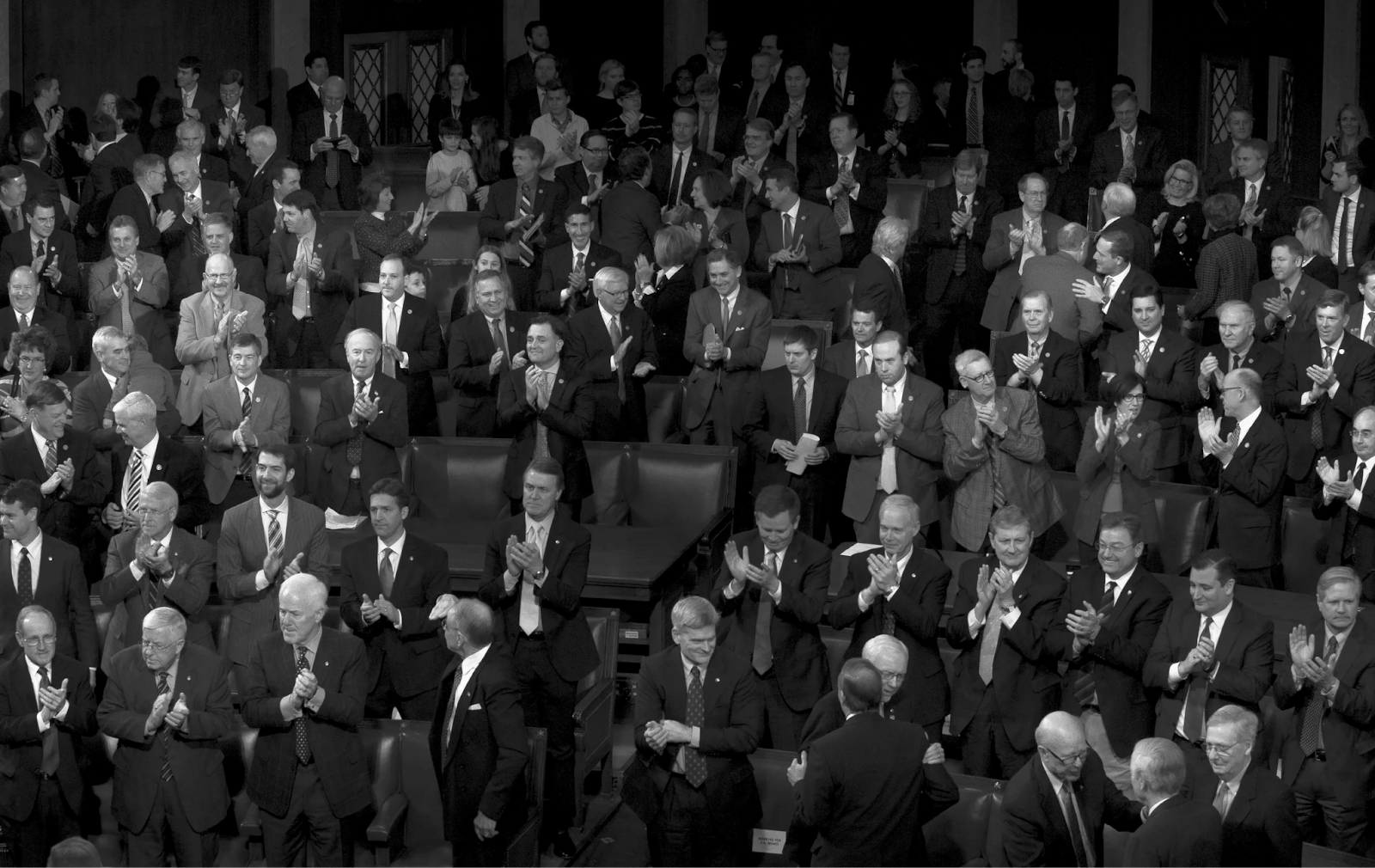
THIS PHOTOGRAPH WAS TAKEN SEVEN YEARS AGO ON JANUARY 6, 2017
DOES THIS SAME DATE SEVEN YEARS LATER IN 2024 AND THE FOLLOWING PHOTOGRAPH HAVE ANYTHING IN COMMON WITH EACH OTHER?
YOU BET THEY DO...
PHOTO: January 6, 2017. Republicans applaud after Congress certifies Donald Trump’s victory in the Electoral College. The American tragedy now being wrought will not end with him. (Gabriella Demczuk)
"What's Past is Prologue..."
November 23, 2016
FROM THE PANOPTICON REVIEW ARCHIVES
(Originally posted on March 2, 2016):
All,
Keep in mind that the following article ("The Real Danger of Donald Trump") was written a mere six months ago(!)
NOW (after winning seven of the ten Republican primaries tonight in resounding fashion) look at how much closer we are to the very real possibility that a genuine fascist could become the next President of the United Hates in November. Don't laugh, or even think about blithely dismissing this once extremely remote possibility. A looming catastrophe of monumental proportions is now only 8 months away from actually happening. If Trump is able to win a mere 2-3 more midwestern states (given that like Romney in 2012 it is absolutely assured that he will win at least 95% of the entire South--a grand total of 13 states-- plus 5 more in the Plains states region of Wyoming, Montana, Utah, North and South Dakota in addition to 3 more in Nebraska, Alaska, and Idaho). Add the certainty that like Romney in 2012 Trump would also easily win three of the 10 midwestern states (Indiana, Kansas, and Missouri), and all of a sudden we are looking at a grand total of 24 states (which is exactly the same number of states Romney won in 2012). It is also likely under this horrific scenario that if Trump is also able to win back the state of Florida that Obama was barely able to win against Romney by a little less than 1% of the vote he would suddenly be much closer to actually winning the Presidency. Then all Trump would need to win the election is two more states TOTAL in the rest of the country, If you don't think this is possible given how thoroughly reactionary and rabidly rightwing most of the national white vote in this country actually is (in 2012 60% of that national voting demographic went to Romney as Obama only won a feeble 39% nationally of this vote and actually lost the white vote in both New York and California!) you are deluding yourself.
So don't think for a nanosecond that the worst possible scenario could not possibly occur at this point and that an extremely wealthy and openly bigoted white male supremacist and certifiable meglomaniac could win the White House and turn a horrific fantasy into a nightmarish reality very soon ...Stay tuned...
NOW (after winning seven of the ten Republican primaries tonight in resounding fashion) look at how much closer we are to the very real possibility that a genuine fascist could become the next President of the United Hates in November. Don't laugh, or even think about blithely dismissing this once extremely remote possibility. A looming catastrophe of monumental proportions is now only 8 months away from actually happening. If Trump is able to win a mere 2-3 more midwestern states (given that like Romney in 2012 it is absolutely assured that he will win at least 95% of the entire South--a grand total of 13 states-- plus 5 more in the Plains states region of Wyoming, Montana, Utah, North and South Dakota in addition to 3 more in Nebraska, Alaska, and Idaho). Add the certainty that like Romney in 2012 Trump would also easily win three of the 10 midwestern states (Indiana, Kansas, and Missouri), and all of a sudden we are looking at a grand total of 24 states (which is exactly the same number of states Romney won in 2012). It is also likely under this horrific scenario that if Trump is also able to win back the state of Florida that Obama was barely able to win against Romney by a little less than 1% of the vote he would suddenly be much closer to actually winning the Presidency. Then all Trump would need to win the election is two more states TOTAL in the rest of the country, If you don't think this is possible given how thoroughly reactionary and rabidly rightwing most of the national white vote in this country actually is (in 2012 60% of that national voting demographic went to Romney as Obama only won a feeble 39% nationally of this vote and actually lost the white vote in both New York and California!) you are deluding yourself.
So don't think for a nanosecond that the worst possible scenario could not possibly occur at this point and that an extremely wealthy and openly bigoted white male supremacist and certifiable meglomaniac could win the White House and turn a horrific fantasy into a nightmarish reality very soon ...Stay tuned...
Kofi
https://archive.nytimes.com/takingnote.blogs.nytimes.com/2015/09/16/the-real-danger-of-donald-trump/
Taking Note - The Editorial Page
Editor's Blog
The Real Danger of Donald Trump
by Lawrence Downes
September 16, 2015
New York Times
Taking Note - The Editorial Page
Editor's Blog
The Real Danger of Donald Trump
by Lawrence Downes
September 16, 2015
New York Times
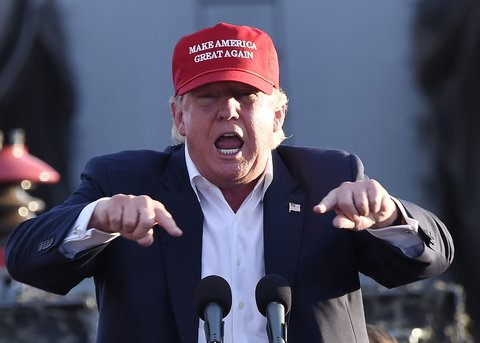
PHOTO: Donald Trump.Credit Robyn Beck/Agence France-Presse — Getty Images
The Real Danger of Donald Trump
Some may find him amusing, but he is stirring up hatred that will take a long time to die down.
The caller to Brian Lehrer’s WNYC radio show on Wednesday morning was pining for a strongman, a president who would do what was necessary to get rid of immigrants, whom she blamed for taking jobs and money away from real Americans.
“We’re very angry about what’s going on in the world today. We’re very angry about all the immigration,” she said. “He does speak for the people. I don’t understand why everyone doesn’t realize that there are a lot of angry people out here that are tired of listening to the politicians step all over us.”
She was speaking, of course, of Donald Trump, whose vehement anti-immigrant message is working brilliantly for him. Heading into tonight’s second Republican debate, he is the 2016 campaign’s main object of fascination and intimidation — the gas planet around which the discussion will likely revolve, while his rivals spin, tumble and flail.
Because Mr. Trump is caustic and bombastic, many people find him delightful and refreshing. Late-night comedians have been praying for him to stick around, because the jokes write themselves.
But the problem with this particular clown is that his words are not clownish. The language he uses about immigrants is dehumanizing and vile. The audiences that adore him are animated not just by infatuation, but by the age-old catalysts of fear, resentment and hate.
This is what moves the Trump effect into the realm of the frightening, rather than amusing or fascinating.
When did that move happen? For me, it was his rally on Monday in Dallas, where he told an adoring crowd he was disgusted with what was happening to America. He called it “a dumping ground for the rest of the world.”
The garbage he was referring to is people, the same kind of people we describe more poetically on a plaque at the foot of the Statue of Liberty.
Mr. Trump’s rivals are talking, in all seriousness, of undoing the Constitution and building a border wall. A Fox News host compares immigration to “a tumor or a disease.” Two young thugs in Boston attack and urinate on a homeless Latino man, saying Mr. Trump inspired them. A Trump supporter outside the Dallas rally grabs a microphone and yells at anti-Trump protesters: “Clean my hotel room, bitch!” Another, referring to Mr. Trump’s mass-deportation plan, says: “This isn’t going to be painless. They’ve been inflicting pain on us for 20 years.”
It’s not clear that Mr. Trump will end up with any power to pursue his racist agenda — his ambitions seem a lot narrower, more TV-based. But the toxic support he is stirring up, the polluted ideas he is spreading, the hate he is emboldening his supporters to voice with his blaring, surround-sound campaign — that evil will live after him. We will be cleaning up after Mr. Trump for a long time.
Vice President Joe Biden spoke reassuringly to a Latino group on Tuesday, saying that Mr. Trump and his fellow Republicans were taking pages from an old playbook that always fails.
“This will pass,” he said. This “sick message” has been tried on America before, and we always — “always, always, always, always” — overcome it.
Yes, we do, but it keeps coming back, and keeps doing damage.
I think of some recent examples, close to home.
Long Island, where I live, has been transformed in recent years, like many other American suburbs, by an influx of Latino immigrants. The demographics of Long Island’s two counties, Nassau and Suffolk, are similar. But where Nassau had a cool, pragmatic county executive, who talked of unity and sensible solutions, Suffolk had a county executive who liked to blame immigrants for overburdened housing, schools and hospitals, and for supposedly lawless acts like gathering on sidewalks to look for work. His words inflamed and incited community passions; his claims that immigrants were a blight on the county found a receptive audience.
And Suffolk, not Nassau, became nationally notorious for repeated attacks on Latino immigrants, including one horrific murder. Even the county police department was accused of patterns of racial abuse. Other politicians have risen to power in communities where people feel uneasy and resentful and are looking for a target for their anger. Sheriff Joe Arpaio of Maricopa County, Ariz., has perennially been elected despite — or rather because of — his history of oppressing Latinos in his jurisdiction.
Mr. Trump has made the nativists restless, on a national scale. Those in media and entertainment who are distracted by his comedic potential are missing the point. Jimmy Fallon, doing a skit with Mr. Trump, normalizes his toxic message, with giggles. (I’m hoping that Stephen Colbert, who has Mr. Trump on his show next week, will do better at avoiding this moral trap, but I’m not holding my breath.)
The Trump effect leads to a question I’ve been pondering. Is politics like physics, where adding gas to a container creates pressure and heat? If you keep pumping inflammatory speech into the public discourse, do you eventually get ignition?
The Real Danger of Donald Trump
Some may find him amusing, but he is stirring up hatred that will take a long time to die down.
The caller to Brian Lehrer’s WNYC radio show on Wednesday morning was pining for a strongman, a president who would do what was necessary to get rid of immigrants, whom she blamed for taking jobs and money away from real Americans.
“We’re very angry about what’s going on in the world today. We’re very angry about all the immigration,” she said. “He does speak for the people. I don’t understand why everyone doesn’t realize that there are a lot of angry people out here that are tired of listening to the politicians step all over us.”
She was speaking, of course, of Donald Trump, whose vehement anti-immigrant message is working brilliantly for him. Heading into tonight’s second Republican debate, he is the 2016 campaign’s main object of fascination and intimidation — the gas planet around which the discussion will likely revolve, while his rivals spin, tumble and flail.
Because Mr. Trump is caustic and bombastic, many people find him delightful and refreshing. Late-night comedians have been praying for him to stick around, because the jokes write themselves.
But the problem with this particular clown is that his words are not clownish. The language he uses about immigrants is dehumanizing and vile. The audiences that adore him are animated not just by infatuation, but by the age-old catalysts of fear, resentment and hate.
This is what moves the Trump effect into the realm of the frightening, rather than amusing or fascinating.
When did that move happen? For me, it was his rally on Monday in Dallas, where he told an adoring crowd he was disgusted with what was happening to America. He called it “a dumping ground for the rest of the world.”
The garbage he was referring to is people, the same kind of people we describe more poetically on a plaque at the foot of the Statue of Liberty.
Mr. Trump’s rivals are talking, in all seriousness, of undoing the Constitution and building a border wall. A Fox News host compares immigration to “a tumor or a disease.” Two young thugs in Boston attack and urinate on a homeless Latino man, saying Mr. Trump inspired them. A Trump supporter outside the Dallas rally grabs a microphone and yells at anti-Trump protesters: “Clean my hotel room, bitch!” Another, referring to Mr. Trump’s mass-deportation plan, says: “This isn’t going to be painless. They’ve been inflicting pain on us for 20 years.”
It’s not clear that Mr. Trump will end up with any power to pursue his racist agenda — his ambitions seem a lot narrower, more TV-based. But the toxic support he is stirring up, the polluted ideas he is spreading, the hate he is emboldening his supporters to voice with his blaring, surround-sound campaign — that evil will live after him. We will be cleaning up after Mr. Trump for a long time.
Vice President Joe Biden spoke reassuringly to a Latino group on Tuesday, saying that Mr. Trump and his fellow Republicans were taking pages from an old playbook that always fails.
“This will pass,” he said. This “sick message” has been tried on America before, and we always — “always, always, always, always” — overcome it.
Yes, we do, but it keeps coming back, and keeps doing damage.
I think of some recent examples, close to home.
Long Island, where I live, has been transformed in recent years, like many other American suburbs, by an influx of Latino immigrants. The demographics of Long Island’s two counties, Nassau and Suffolk, are similar. But where Nassau had a cool, pragmatic county executive, who talked of unity and sensible solutions, Suffolk had a county executive who liked to blame immigrants for overburdened housing, schools and hospitals, and for supposedly lawless acts like gathering on sidewalks to look for work. His words inflamed and incited community passions; his claims that immigrants were a blight on the county found a receptive audience.
And Suffolk, not Nassau, became nationally notorious for repeated attacks on Latino immigrants, including one horrific murder. Even the county police department was accused of patterns of racial abuse. Other politicians have risen to power in communities where people feel uneasy and resentful and are looking for a target for their anger. Sheriff Joe Arpaio of Maricopa County, Ariz., has perennially been elected despite — or rather because of — his history of oppressing Latinos in his jurisdiction.
Mr. Trump has made the nativists restless, on a national scale. Those in media and entertainment who are distracted by his comedic potential are missing the point. Jimmy Fallon, doing a skit with Mr. Trump, normalizes his toxic message, with giggles. (I’m hoping that Stephen Colbert, who has Mr. Trump on his show next week, will do better at avoiding this moral trap, but I’m not holding my breath.)
The Trump effect leads to a question I’ve been pondering. Is politics like physics, where adding gas to a container creates pressure and heat? If you keep pumping inflammatory speech into the public discourse, do you eventually get ignition?