Showing posts with label Taxes. Show all posts

Thursday, August 18, 2011

The 2012 Presidential Election and the Rabid Demagoguery of Republican Candidates for the Presidency

Curtis Mayfield (1942-1999)
Legendary Singer/Songwriter

http://www.nytimes.com/2011/08/13/opinion/magical-unrealism.html?src=recg

http://youtu.be/x1xmXOP3lhM


Composition: "If There's Hell Below, We're All Gonna Go" (1970)

Sisters, niggers, whities, Jews, crackers
Don't worry: if there's hell below we're all gonna go!
Blacks and the crackers
Police and their backers
They're all political lepers

Sisters, brothers and the whities
Blacks and the crackers
Police and their backers
They're all political actors

Hurry
People running from their worries
While the judge and his juries
Dictate the law that's partly flaw
Cat calling, love balling, fussing and cussing
Top billing now is killing
For peace no one is willing
Kind of make you get that feeling...

Educated fools
From uneducated schools
Pimping people is the rule
Polluted water in the pool
And Nixon talking about don't worry, worry, worry, worry
He says don't worry, worry, worry, worry

But they don't know
There can be no show
And if there's hell below
We're all gonna go, go, go, go, go

Everybody's praying
And everybody's saying
But when come time to do
Everybody's laying

Just talking about don't worry, worry, worry, worry
They say don't worry, worry, worry, worry
They say don't worry, worry, worry, worry...

All,

A gaggle of madmen (and women), liars, fools, assholes, jerks, demagogues, thieves, hypocrites, and criminals--That's the GOP for ya. Boys and Girls can you spell E-V-I-L?

Kofi


EDITORIAL

Magical Unrealism
August 12, 2011
New York Times


There was nothing particularly surprising about the shrill skirmishing at the ideological edges of Thursday night’s Republican presidential debate in Iowa. What was shocking were the antics in the center.

In full public view, the party’s mainstream jumped the tracks of reality on issues of spending and taxes, brightly illustrating the ruinous magical thinking that has led to a downgrade of the nation’s credit and invited a double-dip recession. When asked if they would reject a deal to cut the deficit that had 10 times the amount of spending cuts as it had tax increases, the hands of all eight candidates went up. Even a tincture of new revenue, though mixed with huge cuts in government spending, would be too much for the modern Republican Party.

The raised hands included those of Jon Huntsman and Mitt Romney, two former governors who have proved that they know better. Mr. Huntsman was the only one on the stage who said he would have accepted last week’s budget deal and the only one to point out that Washington should never even consider defaulting.

Saying as much is already Tea Party heresy, so why not take the next logical step and admit that the nation’s finances are unsustainable in the long term without some tax increases? Even Mr. Huntsman was unwilling to take the slightest risk of offending the rigid and unforgiving Republican Party primary electorate.

Mr. Romney derided the budget deal as “Mr. Obama’s dog food” and said he would not eat it, perhaps hoping the public has already forgotten that it was really the deal demanded by the Congressional leaders of his party. (Speaker John Boehner said last week the deal was “98 percent of what I wanted.” We’d love to know what the remaining 2 percent is.)

Rejecting compromise was not the way Mr. Romney governed. He balanced the Massachusetts budget with new income from $269 million in closed tax loopholes, and $271 million in increased fees. He has claimed unconvincingly that those were not taxes, but it turns out that his administration boasted about them to the bond rating agencies in 2004 and 2005, and his state won an upgrade by demonstrating fiscal prudence. Now he is repudiating that approach at the federal level.

That has been the nature of every Republican debate this cycle: deny the truth or tell an outrageous lie with such bellicosity that no one dares to challenge it.

Representative Michele Bachmann, for example, said the credit downgrade was because the government could not pay its debt. Standard and Poor’s actually said it was because lawmakers like her did not take a default seriously. Representative Ron Paul ridiculously claimed that the United States is bankrupt. Tim Pawlenty said President Obama had no plan to reduce social insurance spending, conveniently forgetting that Mr. Boehner walked away from the president’s overly generous offer to reduce that spending in exchange for revenue increases.

The Republican Party has been led into its current cul-de-sac by manipulative officials who would not tell voters the truth about the government’s finances. It will remain there if even its “moderate” leaders refuse to break the pattern.

Wednesday, August 3, 2011

Economist Richard Wolff On the Actual Reality of the U.S. Political Economy and the Ideological Conflict Over National Priorities

Prior to House Speaker John Boehner (R-Ohio) speaking at a news conference about his bill to extend the debt ceiling, field recorders are laid out on top of a podium, on Capitol Hill in Washington, July 28, 2011. The political posturing around the debt ceiling "crisis" has distracted from the hard issues underlying US economic decline. (Photo: Stephen Crowley / The New York Times)

http://www.truth-out.org/tale-two-lootings/1312292014

All,

Actual Truth and Consequences in the realm of the contemporary U.S. political economy or social Reality vs. Fantasy...

Kofi


A Tale of Two Lootings
3 August 2011

by Richard D. Wolff

Truthout | News Analysis


The political posturing around the debt ceiling "crisis" was mostly a distraction from the hard issues. The hardest of those - underlying US economic decline - keeps resurfacing to display costs, pains and injustices that threaten to dissolve society. Its causes - two long-term trends over the last 30 years - help also to explain the political failures that now compound the social costs of economic decline.

The first trend is the attack on jobs, wages and benefits, and the second is the attack on the federal government's budget. The first trend enables the second. A capitalist economy suffering high unemployment with all its costly consequences shapes a bizarre, disconnected politics. The two major parties ignore unemployment and the system that keeps reproducing it. They argue instead over how much to cut social programs for the people while they agree that such cutting is the major way to fix the government's broken budget.

The first trend amounts to looting the US working class (the media softens that to "disappearing middle class"). Since the 1970s, real wages have been flat to declining, while productivity per worker has risen steadily. What employers give workers (wages) has remained the same while what workers produce for their employers (profits) rose. Workers and their families responded by working ever more hours and borrowing ever more money to get or keep the "American dream." By 2007, they were physically exhausted, families emotionally stressed and deeply anxious about the debts that their flat real wages could no longer sustain. When the system crashed, zooming unemployment, further wage and benefit reductions and home foreclosures made everything still worse for most Americans.

The second trend was looting the government. This happened because exhausted and stressed workers turned away from participation or even political interests after the 1970s. In contrast, employers used the profits made possible by flat wages and rising productivity to buy politicians, parties and policies. More than ever before, businesses and top executives grabbed the levers of political power. They made government serve their interests. Starting in the 1980s, Washington lowered business taxes, deregulated businesses, cut taxes on executives' and other high incomes, increased spending on the military-industrial and medical-insurance complexes, provided more opportunities and freedom for financial speculation, and so on. To distract people from recognizing, debating, or opposing this political shift, more was also spent on social programs and supports.

Washington was thus deprived of tax revenues (chiefly on corporations and the richest individuals) while spending more on defense, business supports and social programs. As this gap between revenues and expenditures rose, Washington kept borrowing ever more. Rising annual budget deficits added to the national debt. When the private capitalist system crashed in 2007, business and the rich made sure the government spent vast sums to bail out banks, insurance companies and large corporations and to revive the stock market. Accordingly, government deficits and debts zoomed upward.

Business and the rich made trillions from both trends. By keeping workers' wages flat, profits soared as employers alone kept the full fruits of rising worker productivity. Employers and the rich profited further by getting Washington to lower their taxes. They then lent at interest to the government what they no longer needed to pay in taxes. After all, the government needed to borrow precisely because it had stopped taxing corporations and the rich at the rates of the 1940s, 1950s and 1960s. Business and the rich happily financed a political system that converted their tax obligations into secure, well-rewarded loans to the government instead.

Looting the working class and the state widened the gap between rich and poor in the US to what it was a century ago. Now the corporations and the rich want the state, whose budget they looted, to cut back social supports and services for the working class whose wages and productivity they also looted.

Republicans yell "class warfare" against advocates of a return to the 1940s tax rates on business profits, and the 1950s and 1960s rates on high-income individuals. Both were far higher than they are today. "Class warfare" better describes government policies since the 1970s. Business and the rich made sure those policies shifted the burden of federal taxation from business to individuals and from rich individuals to everyone else.

Despite this double looting of working people and the state, many victims direct their anger at the government instead of those who control the government. Unemployed millions fired by private capitalist employers (or suffering wage and benefits cuts imposed by them) blame the government, not their employers. Millions foreclosed out of their homes by private capitalist banks blame the government. They want the government punished, made smaller and weaker, and they are desperate to avoid further taxes. Republicans promise to do all that. Those who fear that a smaller, tax-starved government will do even less for them hear Democrats promising to cut less than Republicans. This is politics disconnected from economic realities (for example, high unemployment) and twisted into a contest between more and less government spending cuts imposed on a working class already reeling from economic crisis.

Neither party dares to return taxes on corporations and the rich to what they were. Neither party dares to advocate that government hire the unemployed to rebuild the US, to spend their government-job wages on maintaining their mortgages (reviving the housing industry) and thereby stimulate the whole economy from the bottom up. Above all, neither party dares admit that so long as production remains in the hands of tiny groups of rich shareholders and boards of directors, they will keep looting the system.

Can the US do better than this capitalist system's performance? We need to debate honestly and decide whether and how we can do better. We should have had the courage to debate that over the last 50 years. The cold war - and the priorities of corporations and the rich - prevented that. Now it's long overdue. We need new political organizations mobilizing people to demand and engage that debate, theoretically and also in practical, political struggles.


RICHARD D. WOLFF

Richard D. Wolff is Professor of Economics Emeritus, University of Massachusetts, Amherst where he taught economics from 1973 to 2008. He is currently a Visiting Professor in the Graduate Program in International Affairs of the New School University, New York City. He also teaches classes regularly at the Brecht Forum in Manhattan. Earlier he taught economics at Yale University (1967-1969) and at the City College of the City University of New York (1969-1973). In 1994, he was a Visiting Professor of Economics at the University of Paris (France), I (Sorbonne).

Sunday, March 6, 2011

How The Rich Exploit and Manipulate the Rest Of Us...Really

Dr. Richard Wolff


http://www.truth-out.org/how-rich-soaked-rest-us68155

All,

This article very succinctly and ominously explains precisely how the wealthiest class of Americans are systematically exploiting and engaging in massive "legalized" THEFT from the rest of us with the direct and indirect, implicit and complicit, covert AND overt support of the federal government, various state governments, banks, corporations, Wall Street, the tax system, and the Federal Reserve. The result has been the largest and most sustained redistribution of wealth and income over the past 30 years FROM THE POOR, WORKING, AND MIDDLE CLASS TO THE RICH in the history of the United States. In other words the wealthiest 1% of the population not so ironically has socialist-like protections/safeguards and massive public welfare (dishonestly called "subsidies") while the rest of us have virtually NOTHING in the way of actual wealth while our incomes keep falling and jobs keep disappearing in the millions per year as the multinational American based corporations keep shipping those jobs overseas for far cheaper and even more exploited labor which of course are completely absent of unions or any other economic protections and safeguards whatsoever.

The only great mystery in all of this is why the masses of American people are not yet openly calling for social revolution in this country--for real. In any other self respecting Third World nation (which the rest of us are fast turning into thanks to and aside from the coercive and consensual rule of the wealthy!) the people would have the common sense to at least call for massive, organized rebellion in the streets and sytematically call out and denounce the corporate and political class of criminals who are totally responsible for this debacle. One thing is absolutely certain over the next decade however: There will have to be something akin to radical leftist activity on the part of millions of American citizens or we will be thorouhly crushed by the ruling class and their wimpering political servants in the Republican, Tea, and Democratic parties. The final wakeup call is coming--and soon, and we won't be able to escape or sidestep the very dire consequences. In that case we will either fight back and demand fundamental changes in our political and economic system in a serious organized fashion on a national scale or we and future generations will be economically and politically destroyed and turned into mere impoverished wards of the State...Stay tuned...

Kofi


How the Rich Soaked the Rest of Us
by Richard D. Wolff
Wednesday 02 March 2011
Truthout

This article was also published in The Guardian (UK)

How the rich soaked the rest of us: The astonishing story of the last few decades is a massive redistribution of wealth, as the rich have shifted the tax burden.

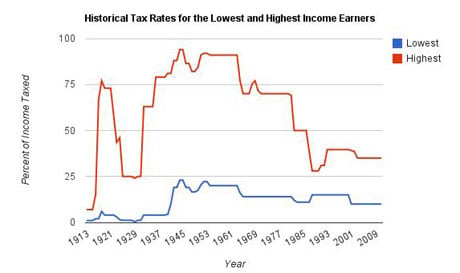
Over the last half-century, the richest Americans have shifted the burden of the federal individual income tax off themselves and onto everybody else. The three convenient and accurate Wikipedia graphs below show the details. The first graph compares the official tax rates paid by the top and bottom income earners. Note especially that from the end of the Second World War into the early 1960s, the highest income earners paid a tax rate over 90 percent for many years. Today, the top earners pay a rate of only 35 percent. Note, also, how the gap between the rates paid by the richest and the poorest has narrowed. If we take into account the many loopholes the rich can and do use far more than the poor, the gap narrows even more. One conclusion is clear and obvious: the richest Americans have dramatically lowered their income tax burden since 1945, both absolutely and relative to the tax burdens of the middle income groups and the poor.


Historical tax rates for the highest and lowest income earners.

Consider two further points based on this graph: first, if the highest income earners today were required to pay the same rate that they paid for many years after 1945, the federal government would need far lower deficits to support the private economy through its current crisis; and second, those tax-the-rich years after 1945 experienced far lower unemployment and far faster economic growth than we have had for years.

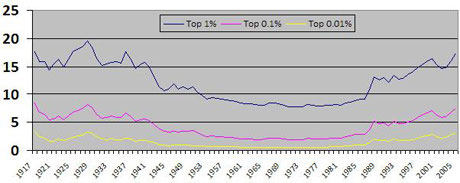
The lower taxes the rich got for themselves are one reason why they have become so much richer over the last half-century. Just as their tax rates started to come down from their 1960s heights, so their shares of the total national income began their rise. As the two other Wikipedia graphs below show, we have now returned to the extreme inequality of income that characterized the US a century ago.


Share of national income taken by top tranches of earners.

The graph above shows the portion/percentage of total national income taken by the top 1 percent, the top tenth of a percent, and the top 100th of a percent of individuals and families: the richest of the rich. The third graph compares what happened to the after-tax household incomes of Americans from 1979 to 2005 (adjusted for inflation). The bottom fifth of poorest citizens saw their income barely rise at all. The middle fifth of income earners saw their after-tax household income rise by less than 25 percent. Meanwhile, the top 1 percent of households saw their after-tax household incomes rise by 175 percent.


Relative increases in net household incomes of Americans from 1979 to 2005.

In simplest terms, the richest Americans have done by far the best over the last 30 years; they are more able to pay taxes today than they have been in many decades, and they are more able to pay than other Americans by a far wider margin. At a time of national economic crisis, especially, they can and should contribute far more in taxes. Instead, a rather vicious cycle has been at work for years. Reduced taxes on the rich leave them with more money to influence politicians and politics. Their influence wins them further tax reductions, which gives them still more money to put to political use. When the loss of tax revenue from the rich worsens already strained government budgets, the rich press politicians to cut public services and government jobs and not even debate a return to the higher taxes the rich used to pay. So it goes - from Washington, to Wisconsin to New York City. How do the rich justify and excuse this record? They claim that they can invest the money they save from taxes and thereby create jobs etc. But do they? In fact, cutting rich people's taxes is often very bad for the rest of us (beyond the worsening inequality and hobbled government it produces). Several examples show this. First, a good part of the money the rich save from taxes is then lent by them to the government (in the form of buying US Treasury securities for their personal investment portfolios). It would obviously be better for the government to tax the rich to maintain its expenditures, and thereby avoid deficits and debts. Then, the government would not need to tax the rest of us to pay interest on those debts to the rich. Second, the richest Americans take the money they save from taxes and invest big parts of it in China, India, and elsewhere. That often produces more jobs over there, fewer jobs here, and more imports of goods produced abroad. US dollars flow out to pay for those imports and so accumulate in the hands of foreign banks and foreign governments. They, in turn, lend from that wealth to the US government because it does not tax our rich, and so we get taxed to pay for the interest Washington has to give those foreign banks and governments. The largest single recipient of such interest payments today is the People's Republic of China. Third, the richest Americans take the money they don't pay in taxes and invest it in hedge funds and with stockbrokers to make profitable investments. These days, that often means speculating in oil and food, which drives up their prices, undermines economic recovery for the mass of Americans and produces acute suffering around the globe. Those hedge funds and brokers likewise use part of the money rich people save from taxes to speculate in the US stock markets. That has recently driven stock prices higher: hence, the stock market recovery. And that mostly helps - you guessed it - the richest Americans who own most of the stocks. The one kind of significant wealth average Americans own, if they own any, is their individual home. And home values remain deeply depressed: no recovery there. Cutting the taxes on the rich in no way guarantees social benefits from what they may choose to do with their money. Indeed, their choices can worsen economic conditions for the mass of people. These days, that is exactly what they are doing.


Richard D Wolff is professor of economics emeritus at the University of Massachusetts, Amherst, where he taught economics from 1973 to 2008. He is currently a visiting professor in the graduate programme in international affairs of the New School University, New York City. Richard also teaches classes regularly at the Brecht Forum in Manhattan. His most recent book is Capitalism Hits the Fan: The Global Economic Meltdown and What to Do About It (2009). A full archive of Richard's work, including videos and podcasts, can be found on his site: http://www.rdwolff.com/


Tuesday, October 28, 2008

Obama vs. McCain on Tax Cuts

http://www.dailykos.com/story/2008/10/18/12630/064/131/634471


Barack Obama hits back, HARD, on Taxes in front of OVER 100,000 People in St. Louis--
by Muzikal203
Sat Oct 18, 2008


Some excerpts have been released of the speech Senator Obama will give today in Missouri in which he hits back at McCain's latest charge that Obama's tax cuts for the middle class amount to "welfare."

My opponent's been talking a lot about taxes in his campaign. But here's the truth Missouri – we are both offering tax cuts. The difference is who we're cutting taxes for.

It comes down to values – in America, do we simply value wealth, or do we value the work that creates it? For eight years, we've seen what happens when we put the extremely wealthy and well-connected ahead of working people. Now, John McCain thinks that the way to rebuild this economy is to double down on George Bush's policy of giving more and more tax breaks to those at the very top in the false hope that it will all trickle down. I think it's time to rebuild the middle class in this country, and that is the choice in this election.

Senator McCain wants to give the average Fortune 500 CEO a $700,000 tax cut but absolutely nothing at all to over 100 million Americans. I want to cut taxes – cut taxes – for 95 percent of all workers. And under my plan, if you make less than $250,000 a year – which includes 98 percent of small business owners – you won't see your taxes increase one single dime. Not your payroll taxes, not your income taxes, not your capital gains taxes – nothing. It' time to give the middle class a break, and that's what I'll do as President of the United States.

Lately, Senator McCain has been attacking my middle class tax cut. He actually said it goes to, "those who don't pay taxes," even though it only goes to working people who are already getting taxed on their paycheck. That's right, Missouri – John McCain is so out of touch with the struggles you are facing that he must be the first politician in history to call a tax cut for working people "welfare."

The only "welfare" in this campaign is John McCain's plan to give another $200 billion in tax cuts to the wealthiest corporations in America – including $4 billion in tax breaks to big oil companies that ran up record profits under George Bush. That's who John McCain is fighting for. But we can't afford four more years like the last eight. George Bush and John McCain are out of ideas, they are out of touch, and if you stand with me in 17 days they will be out of time.

We need new priorities in Washington. I think it's time to give a tax cut to the teachers and janitors who work in our schools; to the cops and firefighters who keep us safe; to the waitresses working double shifts, the nurses in the ER, and the plumbers fighting for their American Dream. These workers are the backbone of our country. They are the ones that Washington has forgotten. They're the ones I'll fight for. And while Senator McCain ignores the payroll taxes you pay to score a few political points, I'll put a tax cut into the pockets of working people so you can pay the bills, put away some savings, and pass on a brighter future to your children.

Exactly, John McCain isn't fighting for US, he's fighting for his friends on K-Street. If Joe the Plumber was an Obama supporter, McCain wouldn't be able to care less about him or his "struggles." I think a lot of people have been surprised by the strength of Senator Obama, and it's good to catch people off guard when the surprise is good.

While we wait for the rally to start, I think you all should check out this Frontline special on the election. I skipped the McCain parts, but I actually ended up learning a lot more about Obama through watching it (and I thought I knew everything), they even have some video of the rallies he held while he was running for State office and while he was on Harvard's campus. It's really a great piece. While I was watching I just kept thinking "wow, he has not changed AT ALL." His message, delivery, mannerisms, all of it has stayed pretty constant. McCain can't even stay constant for one day.