Showing posts with label Joe Biden. Show all posts

Monday, June 10, 2024

The Real Risks, Costs, Demands, and Consequences of the Genocidal War in Gaza and Its Actual Ongoing and Deadly Impact on American Politics and Civil Society Writ Large in the Upcoming Presidential Election

https://truthout.org/articles/biden-wants-to-enable-genocide-we-must-make-it-impossible-for-him-to-continue/


Op-Ed
War & Peace

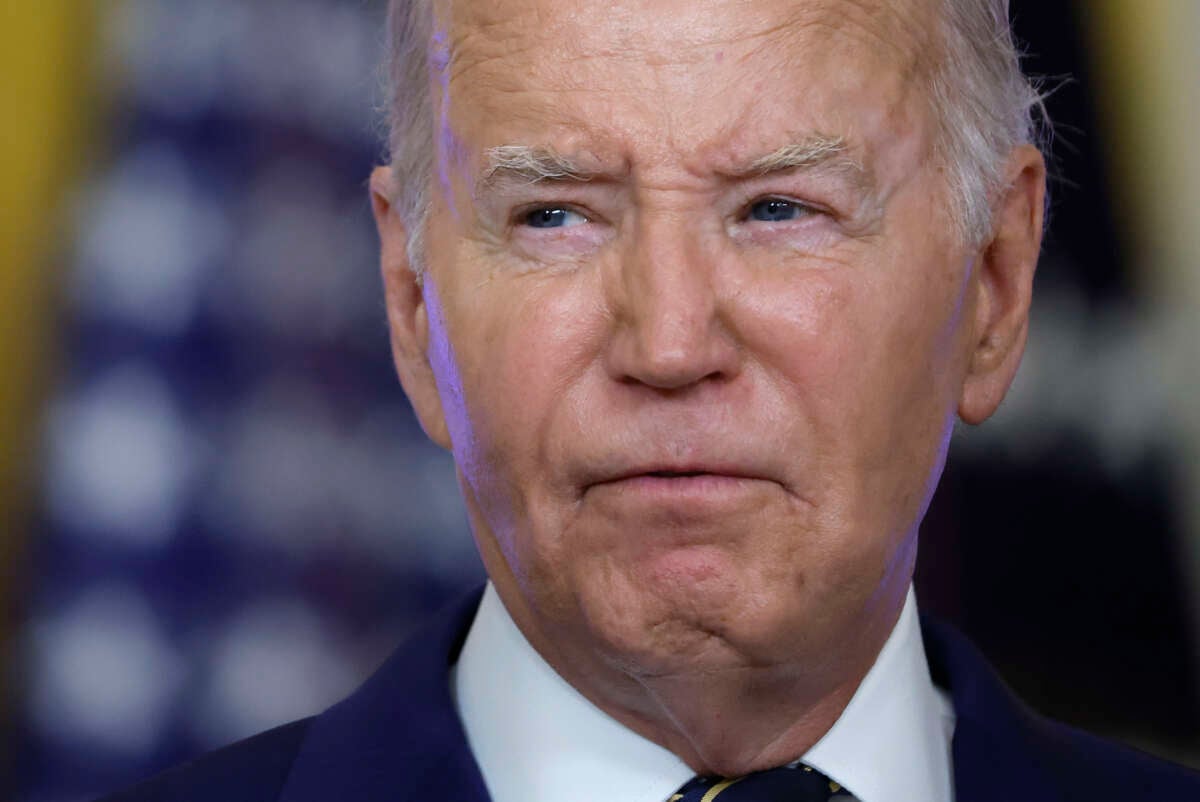
Biden Wants to Enable Genocide. We Must Make It Impossible for Him to Continue.

Palestinian genocide comes at a devastating human cost. What will supporting it cost Biden politically?

by Khury Petersen-Smith
June 8, 2024
Truthout

Today, activists from around the country are mobilizing in Washington, D.C. to surround the White House to demand an end to Israel’s onslaught on Gaza and President Joe Biden’s support for it. Palestinians are paying an incalculable price for U.S. policy. But there is a set of costs of a different nature that the U.S. is incurring by supporting the genocide — and a strategy aimed at raising those costs can make it so great that Biden has to stop.

One cost is global. From upsetting relations between Israel and its neighbors to repeated condemnations of genocide at the UN Security Council, General Assembly, International Court of Justice and International Criminal Court, Israel and the U.S. are more isolated on the world stage than ever.

But a more immediate cost for Biden is in U.S. politics.

U.S. support for Israel has long been treated in the United States as a “domestic issue” — with AIPAC, the Anti-Defamation League, and other pro-Israel groups intervening heavily to shape federal policy, local politics and all levels in between. The conventional thinking is that insufficient support for Israel can result in a lost election — whereas the fate of Palestinians and their rights are marginalized to the realm of “foreign policy,” when discussed at all.

Since Israel invaded Gaza last October, that understanding has radically shifted: The rights of Palestinians have emerged as a “domestic issue” in their own right — with city councils across the country passing resolutions calling for a ceasefire, workers at corporations like Google demanding an end to their employers’ complicity in genocide and a student revolt against U.S. academia’s role in buttressing it.

RELATED STORY:
 
The movements for labor and Palestinian rights have common cause against the billionaires who aim to destroy them both.
Truthout


The move of Palestinian rights from the margins of U.S. politics to its center is even raising the prospect of the incumbent president losing the November election because of his insistence on supplying the weapons to fuel Israel’s siege. Activists and voters in Michigan, Wisconsin, and elsewhere have made this likelihood dramatically visible with their “Uncommitted” and “Uninstructed” campaigns.

If Biden loses in November to an open fascist, it will likely be because he repulsed young people, progressives and people of color with his support for Israel. These are the people who he needs not only to vote for him, but to mobilize the vote for him. As the remarkable campus rebellions of this spring showed, they’re also the voters most likely to be demanding a ceasefire in Gaza.

By maintaining his support for Israel, Biden risks not just losing an election but a generation — one that does not seem willing to quietly accept the unacceptable. The question is: Is that enough to force Biden to change course? And if not, what will?
 
Why We Have Not Yet Won a Ceasefire

The difficult reality is that the movement demanding ceasefire is up against the hard core of U.S. imperial power, which sees support for Israel as central to its strategy in the Middle East — at apparently any cost, particularly that of Palestinian life. This is especially true for President Biden, whose personal investment in Israel appears to go beyond the requisite required for any steward of U.S. power.

In addition, there is a pillar buttressing that commitment that is unique to the U.S.-Israel relationship: a powerful pro-Israel lobby.

This includes a formal lobbying operation — led by AIPAC and other Washington-based firms — and a large, well-organized, well-funded and very dedicated constituency in communities across the country. Organizations like StandWithUs and the associated Israel on Campus Coalition target Palestinian rights activists on college campuses, accusing them of antisemitism and calling on universities to restrict free speech on campus.

While pro-Israel Jewish organizations play a key role, Christian Zionism is an increasingly dominant force in mobilizing fanatical support for Israel. Coordinated by organizations like Christians United for Israel, Christian Zionism combines right-wing Christian nationalism with an apocalyptic vision for the Middle East. Activists against U.S. support for Apartheid South Africa did not have to contend with a mass organizing force on the other side like this.

The fate of Palestinians and their rights are marginalized to the realm of “foreign policy,” when discussed at all.

Activists are also facing a White House that has greater power to pursue militarism than at other points in U.S. history. After more than two decades of the “war on terror,” the executive branch wields tremendous power to act unchecked. Even with growing opposition in Congress for Biden’s unflinching supply of weapons to Israel, the White House is able to press ahead. This is because Biden has used tricks — like invoking “emergency authority,” and making more than 100 sales that fall under the threshold amount that requires congressional approval — to feed the Israeli arsenal.

Meanwhile, the White House is going to great lengths to insulate the president and Vice President Kamala Harris from the ubiquitous protests, arranging campaign events that are closed to the public, smaller and whose attendees are highly vetted.

What should activists do then, in the face of a president who refuses to stop supplying the weapons for a genocide — even when it could cost him his reelection?
 
What to Do in the U.S.?

Over these eight months, activists have sought to identify any levers of power to pull that would stop Biden’s policy. This has included winning over dozens of members of Congress to demand a ceasefire. It has involved passing ceasefire resolutions in dozens of city and town councils. The movement successfully demonstrated its power to withhold votes in states that Biden needs to win in November. Recent polls show that, in these states, one in five voters say that they are less likely to vote for Biden because of his support of Israel’s assault.

The Palestine solidarity movement mobilized the largest march for Palestinian rights in U.S. history on November 4 in Washington, D.C. It has helped elevate Palestinian voices in the mainstream media conversation, and has featured vocal Jewish organizing for a ceasefire as one counter to the false notion that supporting Palestinian rights is antisemitic.

It has turned campuses — from the most public to the most elite — into sites of mobilization for Palestinian rights. It has compelled staffers in Congress and the White House itself to protest, and the resignation of State Department officials and others. Key institutions and individuals in Biden’s inner circle have urged him to push for a ceasefire, from the influential think tank the Center for American Progress to the president’s own wife.

The fact that no one of these breakthroughs has in itself forced a ceasefire does not mean that they are all useless. In many cases, the work that produced them should continue. But we also need more, because it is evident that no one of these things is the key to unlocking a halt to U.S. weapons and other support to Israel.

The challenge then is not to find the one thing that will force Biden to shift course, but to carry out a combination of things that undermine his ability to pursue his policy and make it as politically costly and as difficult as possible, until it is impossible.
 
Raising the Political Costs

It is clear that we need to expand actions that disrupt the ability of the U.S. to support the Israeli genocide, both politically and physically. But there is an important catch: One of the great strengths of the outpouring of protest in defense of Palestinian life has been how accessible it has been to the U.S. public. The starkness of Israel’s violence — and genocidal rhetoric of its leaders — along with the self-evident virtue of the ceasefire demand have allowed hundreds of thousands to join the movement.

Because the risk of arrest and police violence that comes with more confrontational actions tends to limit the range of participants, a challenge for organizers will be escalating disruption while continuing to invite broad numbers of people with a range of abilities and vulnerabilities to continue to participate. We therefore need to be as strategic as possible.

One area of focus should be disrupting the flow of U.S. weapons to Israel. With weapons manufacturing taking place across the country, the machinery of producing and supplying arms requires a combination of ignorance and consent to those processes by the U.S. population. But what if our communities learn about their entanglement with the flow of weapons, and replace that “consent” with resistance?

If the cost of Palestinian life is not sufficient to compel Biden to stop supporting a genocide, then it is the responsibility of the movement … to exact a greater cost by raising the political price.

How many cities and towns that have passed ceasefire resolutions host factories that make bombs — and even provide tax breaks to those companies? How many such cities and towns have roads passing through that transport weapons, or ports that ship them to Israel? What if, through a combination of nonviolent direct action, and cities being compelled by public pressure to pass ordinances against their complicity in genocide, the federal government could no longer count on our communities allowing weapons to flow from and through them?

And what if workers involved in the making or transport of these weapons supported the protests — as union longshore workers have at the Port of Oakland, refusing to unload cargo from an Israeli ship?

Activists can also undermine economic support for Israeli violence. Carrying out this genocide in Gaza comes at a great cost to the Israeli economy. Hundreds of thousands of Israeli reservists have been mobilized, taking them away from their jobs. Palestinian workers have been expelled from the agricultural sector and others. With the Israeli economy dependent on 120,000 Palestinian workers before October 7 and many of their work permits canceled since, farmers and volunteers scrambled to harvest produce and plant crops in the fall and construction projects are down 50 percent. And Moody’s has downgraded Israel’s credit rating.

The Israeli economy, in short, is vulnerable.

Unlike other countries, Israel crowdsources the financing of its economy, relying on institutions and individuals in North America to invest in Israeli companies and in the state of Israel through selling Israel bonds. Israel makes the case that such investment will offer a good financial return, and appeals to investors that such support is a political contribution to the Israeli project.

This explains why 35 U.S. state and municipal governments — most of them headed by Trump-aligned Republicans — have collectively bought more than $1.7 billion in Israel bonds since October. Additionally, American capitalists have rallied to support the Israeli economy. Bain Capital organized a trip to Israel in December for a delegation of 70 tech executives and investors, who met with Israeli leaders as well as local investors and startups.

Venture capitalists and far right state governments aren’t likely to change their positions, but there may be more vulnerable targets. We can demand that states run by liberal Democrats with investments in Israel cease, and brand-conscious banks should be made to see investing in Israel as a liability, just as they were pressured to stop propping up Apartheid South Africa years ago.

While divestment campaigns can take years, enough disruption and negative attention can lead to more immediate, further downgrades of Israel’s credit rating by institutions like Moody’s. The world of stocks and bonds markets is volatile, and Israel’s utter dependence on outside finance makes it vulnerable to big shocks, even if they come well short of full divestments.
 
Making Genocide Too Costly for a Government That Doesn’t Value Life

Twenty-eight years ago, the United States carried out another policy in the Middle East that brought catastrophic suffering: its economic sanctions against Iraq. In an interview with “60 Minutes” in May 1996, journalist Leslie Stahl said to then-Secretary of State Madeleine Albright: “We have heard that half a million children have died. I mean, that’s more children than died in Hiroshima. And, you know, is the price worth it?”

Albright responded, “We think the price is worth it.”

The horrific history is a reminder that Biden’s support of Israel today comes in a context: Washington makes foreign policy decisions in which officials are quite aware of the suffering of those on the receiving end of their actions. The problem is that, in the dehumanizing and racist world of Washington’s geopolitics, the lives of Iraqis or Palestinians — or the Japanese victims of the atomic bombings that Stahl mentions, for that matter — do not carry much weight in their calculations.

If the cost of Palestinian life is not sufficient to compel Biden to stop supporting a genocide, then it is the responsibility of the movement against it — and for U.S. civil society — to exact a greater cost by raising the political price. We must make carrying out this genocide so difficult, and its price so politically expensive, that Washington cannot afford it


ABOUT THE AUTHOR:


Khury Petersen-Smith is the Michael Ratner Middle East Fellow at the Institute for Policy Studies.

Wednesday, May 22, 2024

DEFEAT FASCISM BEFORE FASCISM DEFEATS YOU

All,

The major and most important issue facing the United States in 2024 and beyond is whether FASCISM will flourish and ultimately prevail in every single political, economic, social, cultural and judicial Institution in the country no matter who is (cough) "elected" in November.  It is crystal clear to me and millions of others not only here but throughout the world that we are all at this point seriously "on the brink and about to sink." For more deadly evidence of this fundamental fact please read and share the very stark information from both May 16 and May 22 provided below...Stay tuned and especially STAY WOKE because it is destined to get far worse very soon...

Kofi 

https://panopticonreview.blogspot.com/2024/05/supreme-court-justice-samuel-alito.html

Thursday, May 16, 2024

Supreme Court Justice Samuel Alito, An Upside Down American Flag and January 6, 2021: How the US Supreme Court Became an Arm of the Republican Party

FALL OF THE AMERICAN EMPIRE
by Kofi Natambu

AMERICA wants another
Pep talk
It’s never satisfied
Banality rules
its days & nights

Another mass rally

Never satisfied
Mass media not enuff
Mass boredom not enuff
Mass murder not enuff
now
nothing can quench its
rampaging thirst
for lies

AMERICA wants a panacea
wants a placebo
wants a panderer
wants a papier-mache god
it can pray to
wants a Victim it can identify with
scream at
cry over
stomp on
BE!

AMERICA WANTS ANOTHER ENEMY
(besides itself)
You see: it’s never satiated
Infantilism rules
Its afternoons & evenings

Another mass tally

Never satiated
Stupidity not enuff
Cynicism not enuff
Suicide not enuff
now
nothing can impede
its spiralling flight
toward emptiness

AMERICA wants another alibi
wants another excuse
wants still another thrill
wants another ‘reason’
to eat up the world
wants a Fear it can live with
fawn over
suck on
talk about
BE!!


[Poem from the book THE MELODY NEVER STOPS by Kofi Natambu. Post Aesthetic Press, 1991]

https://www.nytimes.com/2024/05/16/us/justice-alito-upside-down-flag.html

At Justice Alito’s House, a ‘Stop the Steal’ Symbol on Display

An upside-down flag, adopted by Trump supporters contesting the Biden victory, flew over the justice’s front lawn as the Supreme Court was considering an election case.

 
A photo obtained by The Times shows an inverted flag at the Alito residence on Jan. 17, 2021, three days before the Biden inauguration.

Wednesday, May 22, 2024

https://www.nytimes.com/2024/05/22/us/justice-alito-flag-appeal-to-heaven.html

Another Provocative Flag Was Flown at Another Alito Home

The justice’s beach house displayed an “Appeal to Heaven” flag, a symbol carried on Jan. 6 and associated with a push for a more Christian-minded government.

 
The “Appeal to Heaven” flag flew outside the Alitos’ New Jersey vacation home last summer, along with a “2022” Phillies flag and a Long Beach Island flag.

by Jodi Kantor, Aric Toler and Julie Tate
May 22, 2024
New York Times

Last summer, two years after an upside-down American flag was flown outside the Virginia home of Justice Samuel A. Alito Jr., another provocative symbol was displayed at his vacation house in New Jersey, according to interviews and photographs.

This time, it was the “Appeal to Heaven” flag, which, like the inverted U.S. flag, was carried by rioters at the Capitol on Jan. 6, 2021. Also known as the Pine Tree flag, it dates back to the Revolutionary War, but largely fell into obscurity until recent years and is now a symbol of support for former President Donald J. Trump, for a religious strand of the “Stop the Steal” campaign and for a push to remake American government in Christian terms.

Three photographs obtained by The New York Times, along with accounts from a half-dozen neighbors and passers-by, show that the Appeal to Heaven flag was aloft at the Alito home on Long Beach Island in July and September of 2023. A Google street view image from late August also shows the flag.

The photographs, each taken independently, are from four different dates. It is not clear whether the flag was displayed continuously during those months or how long it was flown overall.

An “Appeal to Heaven” flag and other flags flying outside a beach house owned by Justice Samuel A. Alito Jr.
A Google street view photo taken in August 2023 shows the flag flying at the Alitos’ house.

Justice Alito declined to respond to questions about the beach house flag, including what it was intended to convey and how it comported with his obligations as a justice. The court also declined to respond.

In commenting for the Times report last week about the upside-down American flag at his Virginia home in 2021, Justice Alito said that it had been raised by his wife, Martha-Ann Alito, during a clash with a neighbor.

The revelation about that flag prompted concerns from legal scholars and ethicists, and calls from dozens of Democratic lawmakers that the justice recuse himself from cases related to Jan. 6. The news also drew criticism from some conservative politicians, including Senator Lindsey Graham, who said that displaying the inverted flag was “not good judgment.”

During the period the Appeal to Heaven flag was seen flying at the justice’s New Jersey house, a key Jan. 6 case arrived at the Supreme Court, challenging whether those who stormed the Capitol could be prosecuted for obstruction.In coming weeks, the justices will rule on that case, which could scuttle some of the charges against Mr. Trump, as well as on whether he is immune from prosecution for actions he took while president. Their decisions will shape how accountable he can be held for trying to overturn the last presidential election and his chances at regaining the White House in the next one.

Rioters outside the Capitol on Jan. 6, 2021, waving several flags including American flags, MAGA and Trump flags, and the “Appeal to Heaven” flag.
The flag was a presence at the Jan. 6 attack on the capitol.Credit: JT/STAR MAX/IPx, via Associated Press

The disclosure about the new flag is troubling, several ethics experts said in interviews, because it ties Justice Alito more closely to symbols associated with the attempted election subversion on Jan. 6, and because it was displayed as the obstruction case was first coming for consideration by the court.

Judges are not supposed to give any impression of bias, yet the flag could be seen as telegraphing the Alitos’ views — and at a time when the justices were on the cusp of adopting a new ethics code. “We all have our biases, but the good judge fights against them,” said Charles Geyh, a law professor at Indiana University Bloomington. “When a judge celebrates his predispositions by hoisting them on a flag,” he added, “that’s deeply disturbing.”

Records show that the Alitos have owned the beach house since 2014, and he is a well-known presence in the waterfront community. Residents said they recalled seeing the justice last summer, though it is unclear how much time he spent there. Neighbors said that once they realized what the flag signified, they were surprised to see it displayed, particularly in a prominent spot where many boaters glide by. The six people who shared their accounts and photographs asked not to be identified because they didn’t want to antagonize a longtime neighbor. When The Times visited the house on Wednesday, the flagpole was bare.

Until about a decade ago, the Appeal to Heaven flag was mostly a historical relic. But since then it has been revived to represent “a theological vision of what the United States should be and how it should be governed,” said Matthew Taylor, a religion scholar at the Institute of Islamic, Christian and Jewish Studies. He is also the author of a forthcoming book tracing how a right-wing Christian author and speaker who repopularized the flag helped propel Mr. Trump’s attempt to overturn the election.

That figure, Dutch Sheets, has led a yearslong campaign to present the flag to political figures, including Sarah Palin, the former Alaska governor and vice-presidential pick, and an Indiana gubernatorial candidate whom Mr. Sheets wrapped in the flag at a recent rally. Republican members of Congress and state officials have displayed the flag as well, among them Doug Mastriano, a Pennsylvania state senator and a leader of the “Stop the Steal” campaign. The highest-ranking elected official known to show the flag is Representative Mike Johnson, who hung it at his office last fall shortly after becoming speaker of the House.

A spokesman for Mr. Johnson said that the speaker “has long appreciated the rich history of the flag, as it was first used by General George Washington during the Revolutionary War.” It was a gift, the spokesman said, from Pastor Dan Cummins, a guest chaplain for the House of Representatives.

The doorway to the office of Mike Johnson, the speaker of the House, with three flags displayed outside: the American flag, the Louisiana flag and an “Appeal to Heaven” flag.
“An Appeal to Heaven” is one of three flags outside the office of the House speaker, Mike Johnson. Credit:  Kenny Holston/The New York Times

Since its creation during the American Revolution, the flag has carried a message of defiance: The phrase “appeal to heaven” comes from the 17th-century philosopher John Locke, who wrote of a responsibility to rebel, even use violence, to overthrow unjust rule. “It’s a paraphrase for trial by arms,” Anthony Grafton, a historian at Princeton University, said in an interview. “The main point is that there’s no appeal, there’s no one else you can ask for help or a judgment.”

 See more on: Samuel A. Alito Jr., U.S. Supreme Court


Friday, May 10, 2024

Journalists, Media Activists, and Public Intellectuals Mehdi Hasan and Owen Jones On The Nefarious Role of Joe Biden in Funding and Directly Enabling the Genocide in Gaza by Israel and Its Historical Implications As Represented by the Progressive Politics of Dr. Martin Luther King, Jr. in 1963 To 2024 and Beyond

Is Biden the ‘White Moderate’ that MLK Warned Us About? | Mehdi Hasan and Owen Jones
 

Zeteo


May 4, 2024

VIDEO: https://www.youtube.com/watch?v=oiEDcbvyAWk


00:00 - Intro
00:33 -MLK on the 'white moderate’
1:54 -Joe Biden denounces campus protests
12:20 -Latest on Gaza and potential Rafah invasion
23:20 -UK elections


Owen and Mehdi discuss the ongoing misrepresentation of college protests in the mainstream media, the debate over genocide in Gaza, and the London mayoral elections. They discuss how college and antiwar protests have long been demonized to undermine public support for them, and how the term "genocide" is deliberately and conveniently mis-defined by supporters of Israel. Plus, Mehdi takes us back in time to read Dr. Martin Luther King Jr. 's letter from a Birmingham jail about the “white moderate,” and reflects on its relevance to modern-day politicians, particularly in light of recent comments made by President Joe Biden. Owen criticizes Biden's approach on all this, accusing him of fetishizing past struggles while vilifying current protests. They also touch on the London mayoral elections and the challenges faced by Sadiq Khan, particularly in the context of his stance on issues like Gaza and Islamophobia. ‘Two Outspoken’ is a twice-monthly conversation between broadcaster, author, and Zeteo Editor-in-Chief Mehdi Hasan and political commentator, author, and activist Owen Jones.

Mehdi and Owen will be discussing the news of the week, offering their analysis on the state of American and British politics, and even, from time to time, taking questions from Zeteo subscribers.

Founded by Mehdi Hasan, Zeteo has a strong bias for the truth and an unwavering belief in the media’s responsibility to the public. Unfiltered news, bold opinions. For more content from Zeteo, subscribe now www.zeteo.com.


Friday, March 29, 2024

Why Ireland Does Not Love Joe Biden--and yes-- it is very much related to his deadly policy regarding Israel, Palestine, and Genocide in Gaza

Opinion

Guest Essay


Biden Loves Ireland. It Doesn’t Love Him Back.
March 27, 2024
New York Times

Credit: Jim Watson/Agence France-Presse — Getty Images


by Una Mullally

Ms. Mullally, a columnist for The Irish Times, wrote from Dublin.
 
[Want to stay updated on what’s happening in Ireland, Israel, and West Bank and Gaza Strip? Sign up for Your Places: Global Update, and we’ll send our latest coverage to your inbox.]

If there’s one thing Irish people know about President Biden, it’s that he’s one of us. He says so all the time. “Remember,” he recalls his grandfather saying, “the best drop of blood in you is Irish.” He has a habit of quoting the poet Seamus Heaney and never lets an opportunity to recall his origins go to waste. His Secret Service code name, tellingly, is Celtic.

So when he visited Ireland last year, it felt like a homecoming. “Today you are amongst friends because you are one of us,” the speaker of Parliament announced before Mr. Biden addressed Irish lawmakers. If the trip took on the sheen of a wealthy Irish American searching for his roots, a constant of Irish tourism, it also cemented the bond between him and the country. When Mr. Biden referred to the Irish rugby team beating “the Black and Tans” — the notoriously brutal 1920s police force — as opposed to the All Blacks, as New Zealand’s rugby team is known, the gaffe became an instant, affectionate meme.

By the end of the trip, it was official: Mr. Biden loves Ireland, and Ireland loves Mr. Biden. But last October changed everything. After Hamas’s attacks, the Israeli bombardment of Gaza appalled the Irish. Mr. Biden, as the leader of Israel’s closest ally and chief military supplier, was seen to be enabling the devastation. That complicity has damaged both his reputation and his relationship with the Irish people, perhaps irreparably. His ancestral homeland no longer loves him back.

Ireland has long and emotional links to Palestinians, something the world has become steadily more aware of in recent months. The Irish government, for its part, unequivocally condemns the Oct. 7 Hamas attacks and repeatedly calls for the release of Israeli hostages. But it also urges restraint in Israel’s response, making multiple interventions at the European Union level and consistently calling for a cease-fire and a political solution to the carnage. Ireland knows all about cease-fires and peace building, after all.


On this matter, Ireland is something of an outlier in Europe. In a January poll, 71 percent of respondents in Ireland said they believed Palestinians lived under an Israeli apartheid system; in another poll in February, 79 percent said they believed Israel was committing genocide. By contrast, no more than 27 percent of people in seven Western European countries said they sympathized more with Palestinians than with Israelis. Here in Britain’s first colony — a status cast off through a war of independence — empathy for Palestinians is deeply rooted, born of shared historical experience.

This feeling has given rise to an extraordinary wave of pro-Palestinian actions in Ireland since the war began. The array of protests — countless concerts, fund-raisers and demonstrations calling for a cease-fire and an end to the bombardment of Gaza — goes far beyond any fringe concern. Protests in Ireland are large and spread across the country, with attendees diverse in age, class, ethnicity and political affiliation. They bring together trade unionists, Gaelic football players, journalists, ordinary citizens young and old, politicians, health care workers, L.G.B.T.Q. people and many more. It is a truly national phenomenon.

Around the world, chants at pro-Palestinian demonstrations are pretty similar. But over the winter, a specific chant took hold on Irish streets. Though St. Patrick’s Day was months away, protesters looked to the annual meeting in Washington between the Irish prime minister, or taoiseach, and the American president. At the Oval Office every March 17, the Irish leader presents to the American president a bowl of shamrock. The chant, taking notice of this tradition, was bracingly simple: “No shamrocks for Genocide Joe.”

It caught on, becoming the aural centerpiece of protests across the country, especially at the largest demonstrations on Saturdays in Dublin’s city center. It was transformed with a slight modification into a mural in Belfast, a city where Palestinian flags have long flown in nationalist communities; was spray-painted along tram tracks in Dublin; and took hold on social media, where people drew black shamrocks on the palms of their hands. Such agitation coalesced around the demand that the prime minister, Leo Varadkar, boycott this year’s White House visit.

Along with that demand, Mr. Biden became the focus of Irish ire. At protests he was rebuked by public figures, not least Bernadette Devlin McAliskey, a hero of the 1960s civil rights movement in the north of Ireland. In the press, commentators lined up to pass judgment on the American president, including the acclaimed novelist Sally Rooney, who characterized the assault on Gaza as “Biden’s war.” The criticism, at times, has been intimate. In County Louth, where Mr. Biden’s great-grandfather James Finnegan was born, a group of people gathered at a graveyard to castigate the president for betraying his roots.

The disapproval has cut through. While half of Irish voters would still rather Mr. Biden win re-election over Donald Trump, nearly a third would like to see neither man win the presidency. An open letter revoking “symbolic support” for his 2024 election campaign has been signed by 20,000 people. Given 80 percent of Irish people backed Mr. Biden in 2020 and his victory was widely welcomed, it is a startling decline in esteem for our emigrant son.

As calls to boycott the White House meeting and shamrock presentation grew, Mr. Varadkar’s own criticism of the war in Gaza became more robust. He spoke about the “hope” a cease-fire could bring and “believing in our shared humanity.” But he was never going to skip the trip. Strong relations with the United States are central to Ireland’s economic and foreign policy, after all. Even so, Irish people’s expectations for the visit, which offered an opportunity to impress on Mr. Biden their views, were high.

Mr. Varadkar did his best to relay the message. “Mr. President, as you know, the Irish people are deeply troubled about the catastrophe that’s unfolding before our eyes in Gaza,” he said at the shamrock presentation. “Leaders often ask me why the Irish have so much empathy for the Palestinian people. The answer is simple: We see our history in their eyes.”

This stirring speech turned out to be one of his final acts in office. Mr. Varadkar, worn out by the job, announced his resignation last week. Coming within a year of the next elections, the decision was certainly a surprise. But it did little to dampen the defiant mood in Ireland.

Mr. Biden often cites Mr. Heaney’s “The Cure at Troy.” “History says don’t hope/On this side of the grave,” the poem runs. “But then, once in a lifetime/The longed-for tidal wave/Of justice can rise up,/And hope and history rhyme.” As Irish people look across the Atlantic to Ireland’s great-grandson, many are waiting for that rhyme to land.

More on Biden and Ireland

‘I’m Comin’ Home’: Biden Takes a Tour of His Irish Heritage

April 12, 2023

Opinion | Maeve Higgins

Joe Biden, the Irishman

Jan. 28, 2021

Opinion | Séamas O’Reilly

Watching the U.S. Election While Irish

Nov. 13, 2020

Opinion | Shawn McCreesh

Donald Trump, Joe Biden and the Vote of the Irish

May 25, 2020

Una Mullally (@UnaMullally) is a columnist for The Irish Times.

The Times is committed to publishing a diversity of letters to the editor. We’d like to hear what you think about this or any of our articles. Here are some tips. And here’s our email: letters@nytimes.com.

Follow the New York Times Opinion section on Facebook, Instagram, TikTok, WhatsApp, X and Threads

Wednesday, March 20, 2024

The Central Role That Systemic Racism Has Played in the Western World's Dehumanization of Arabs Generally and The Subsequent Normalization of War Crimes In Its Specific Support Of and Indifference To Settler Colonial Oppression, Exploitation, and Marginalization of Palestinians in Gaza and the West Bank


Anti-Arab Racism and the U.S. and Israeli War Machines
 
The West’s dehumanization of Arabs has helped to normalize war crimes.

Hammer & Hope
No. 3
Spring 2024


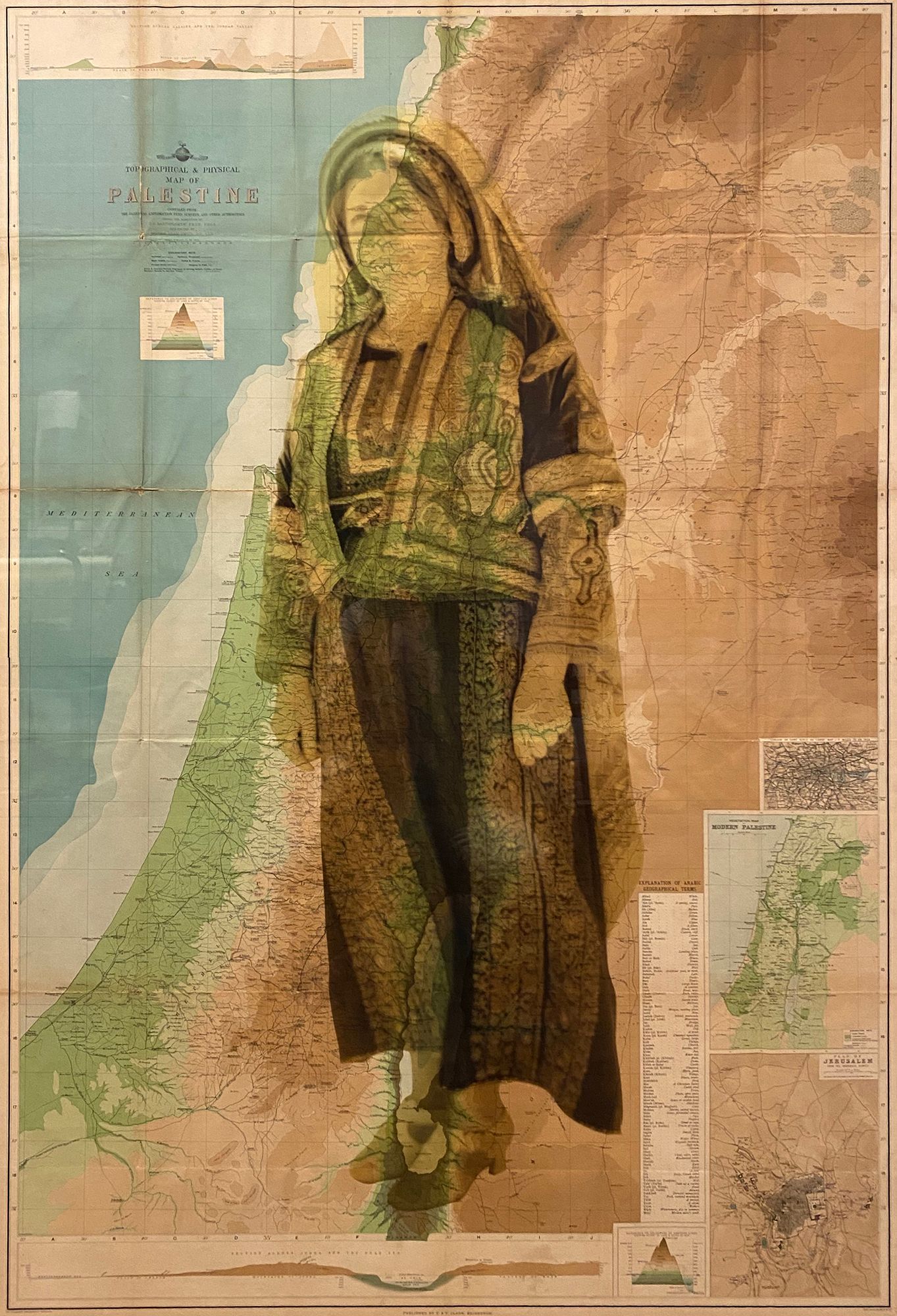
Hazem Harb, The Mother Land, 2023.

The state of Israel has unleashed the most brutal military bombardment since World War II on the Palestinians of the Gaza Strip. This siege came in response to Hamas’s breach of the wall that delineates the Israeli occupation and the group’s subsequent attacks on Israeli soldiers and civilians.

Israel’s more than 45,000 air strikes since October have far exceeded the nearly 15,000 air strikes the U.S. carried out on Iraq in its campaign against the Islamic State from 2014 to 2017. In December, U.S. intelligence sources divulged to CNN that 40 to 45 percent of the 29,000 missile strikes against Gaza were “dumb bombs,” or unguided missiles, which can be more dangerous to civilians in densely populated areas.

“When a 3-year-old girl is killed in a home in Gaza, it’s because someone in the army decided it wasn’t a big deal for her to be killed — that it was a price worth paying in order to hit [another] target,” an Israeli military source told reporters as part of a bombshell report attributing the virulence of Israel’s assault in part to an increased reliance on artificial intelligence to generate targets. “Everything is intentional. We know exactly how much collateral damage there is in every home.”

Intense anti-Arab racism, Islamophobia, and what the Palestinian American intellectual Edward Said described as “Orientalism” has underwritten the West’s perpetual wars, sieges, and onslaughts against the Middle East, wars that America’s client state, Israel, has helped manage for multiple generations. This racism has normalized America’s and Israel’s war crimes in the Middle East.

But this is far more than a simple ideological project. As the largest recipient of U.S. aid in the region, to the tune of more than $3 billion each year, Israel has long been of use to the West as the Zionist project of building a state on the dispossession of the indigenous Palestinian population. The U.S. disguises its geopolitical designs to control access to the region’s oil supply under the guise of rooting out terrorism. Though America’s “war on terror” failed, its afterlife of security theater, surveillance, and abject racist demonization of a perpetual Arab or Muslim “other” lives on.

Soon after Israel began its siege, Joe Biden made a mockery of Palestinian grief and death. “I have no notion that the Palestinians are telling the truth about how many people are killed,” he said, echoing the Israeli government. His statement recognizing 100 days of the war on Gaza made no mention of the thousands of Palestinians whom Israel had killed. More recently, Biden enjoyed an ice cream cone with a late-night talk show host while blithely suggesting the possibility of a cease-fire. A week later, The Washington Post revealed that the United States has quietly delivered 100 weapons packages to Israel over the course of its assault, including thousands of precision-guided munitions, small-diameter bombs, and bunker busters.

Of course, the U.S. has long licensed Arab death. Consider the Clinton era. In 1996, when Lesley Stahl on “60 Minutes” asked UN Ambassador Madeleine Albright about the deaths of half a million Iraqi children caused by U.S.-backed sanctions on Iraq, Albright infamously said, “The price is worth it.” Activists confronted her the next year, and she responded, “I am as concerned about the children in Iraq as any person in this room.” But, she added, “Saddam Hussein is the one who has the fate of his country in his hands. … He is the one responsible for starving children, not the United States of America.”

George W. Bush claimed after the attacks on Sept. 11 that “the face of terror is not the true faith of Islam,” and “Islam is peace.” But the indiscriminate targeting of Arabs and Muslims abroad through various war efforts and domestically by federal and local police during the Bush presidency contradicted such overtures. The federal government’s gearing up for war reverberated across the country and fomented an atmosphere of fear, anxiety, and extraordinary racism. Polls taken soon after Sept. 11 found 58 percent of Americans supported “intensive security checks” for Arabs, 49 percent favored special identification cards for them, and 32 percent approved of “special surveillance” of Arabs.

The media played a significant role in providing bigoted justifications for racial profiling. Richard Cohen, then a columnist for The Washington Post, argued: “We have become driveling idiots on matters of race and ethnicity. One hundred percent of the terrorists involved in the Sept. 11 mass murder were Arabs. Their accomplices, if any, were probably Arabs, too — at least Muslims. Ethnicity and religion are the very basis of their movement. It hardly makes sense, therefore, to ignore that fact and, say, give Swedish au pair girls heading to the United States the same scrutiny as Arab men coming from the Middle East.”

Indeed, less than a month after the attacks, Bush sang a different tune from his earlier overture:
 
"They hate us because we love the idea that people can worship an Almighty God any way he or she sees fit. They hate us because we love political discourse and a free society. They hate us because of our free press. They hate everything about us, because of our freedom. And there’s another — there are a lot of distinguishing features, but one of the most clear ones to me is this: We value life in America. We say everybody is precious, everybody counts, every life has worth, every life has dignity. They don’t value life."

An emboldened American security state was activated. In the weeks after Sept. 11, the FBI and other law enforcement agencies rounded up and detained more than 1,200 people, mostly Arabs and Muslims. The Department of Justice initiated a program of “voluntary interviews” with 5,000 “non-immigrant” men who claimed citizenship from countries the U.S. insisted harbored Al Qaeda. Two years later, in preparation for war with Iraq, a new Iraqi Task Force, created by the FBI, interviewed 11,000 people of Iraqi origin living in the United States, many of them citizens.

The swell of anti-Arab suspicion and racism shaped the lead-up to America’s baseless war of aggression against Afghanistan and Iraq. Politicians’ xenophobia obscured the brutality of a war that killed between 150,000 and perhaps as many as 600,000 Iraqis. The widespread destruction of civilian infrastructure, already weakened by a decade of brutal U.S.-backed sanctions, resulted in even more deaths of Iraqis. It also helped to foment the conditions that allowed for the creation of the U.S. gulag in Guantánamo Bay — a military space controlled by the U.S. absent any rights or freedom. The climate of war allowed for torture and abuse of detainees at Abu Ghraib, too. Tens of thousands more were killed in Afghanistan — the longest war in U.S. history, ending only in 2021.

According to a 2023 report from Brown University, researchers estimated that more than four million people were either killed or eventually died in the War on Terror. From Afghanistan to Iraq, Syria, Libya, Somalia, and Yemen, millions have died from what The Washington Post described as “waves of violence, hunger, the devastation of public services, and the spread of disease.” In fact, it was anti-Palestinian bigotry that drove the creation of and shaped the development of anti-terrorism laws, according to a new report by Palestine Legal and the Center for Constitutional Rights. In 1969, the first-ever mention of terrorism in a federal law “dealt specifically with restricting humanitarian aid to Palestinians and inaugurated a pattern of rendering Palestinians synonymous with terrorism.”

The characterization of Arabs and Muslims as forever enemies was built into politics and disseminated through popular culture, which endlessly portrayed brown-skinned men as terrorists.

Republicans have long worn their derision of Arabs and Muslims openly. The far right concocted a mass hysteria over the conspiracy theory that Muslims sought to implement Shariah law in the U.S. Since 2010, state legislatures have introduced at least 201 anti-Shariah bills. Breaking with longstanding international consensus, Trump moved the U.S. embassy from Tel Aviv to the contested land of Jerusalem. And he implemented a ban on entry into the United States from a handful of majority Muslim countries after he was inaugurated as president, a ban the Supreme Court upheld. More recently, in the weeks after Hamas’s attacks, Montana Representative Ryan Zinke introduced legislation (with 10 cosponsors) that would ban Palestinians from entering the United States. “I don’t even want to call it the Palestinian flag because they’re not a state,” Republican Representative Max Miller of Ohio complained after Michigan Representative Rashida Tlaib pinned a Palestinian flag to her office door. “They’re a territory that’s about to probably get eviscerated and go away here shortly, as we’re going to turn that into a parking lot.”

We have come to expect such racist dreck from the Republican Party. But this is the Democratic Party’s war. Democrats have mastered the art of performing grief even while Biden’s intersectional and multiracial cohort of UN ambassadors and functionaries oppose cease-fire resolutions that could immediately end the war. When Tlaib spoke out early in favor of a cease-fire and for an end to Israeli atrocities in Gaza, Biden press secretary Karine Jean-Pierre, a queer Haitian American, described as “repugnant” and “disgraceful” statements from Tlaib and others in the Squad calling for a cease-fire or criticizing Israel.

Meanwhile, Nancy Pelosi told Palestine solidarity protesters to “go back to China” and declared that calls for a cease-fire are “Mr. Putin’s message.” As if time-traveling back to the Cold War, she pressed on without evidence. “This is directly connected to what he would like to see,” she said. “Some of these protesters are spontaneous and organic and sincere,” but others “are connected to Russia.” Kathy Hochul, the Democratic governor of New York, joked that if Canada attacked Buffalo, N.Y., in the way that Hamas attacked Israel on Oct. 7, “there would be no Canada” — an apparent endorsement of collective punishment and the right of Israel to annihilate Gaza.

Beyond such crass rhetoric, in early February, 46 Democrats voted for a $17.6 billion aid package put forth by Republicans to finance Israel’s siege of Gaza; it failed to pass. Instead of pressuring Israel to allow more aid trucks into Gaza, which is on the brink of famine, the Biden administration has dropped parachutes of food aid, some of which failed to open midair, killing people upon landing, and rushed to create a temporary port off Gaza’s coast for humanitarian aid shipments, a theatrical, cumbersome workaround.


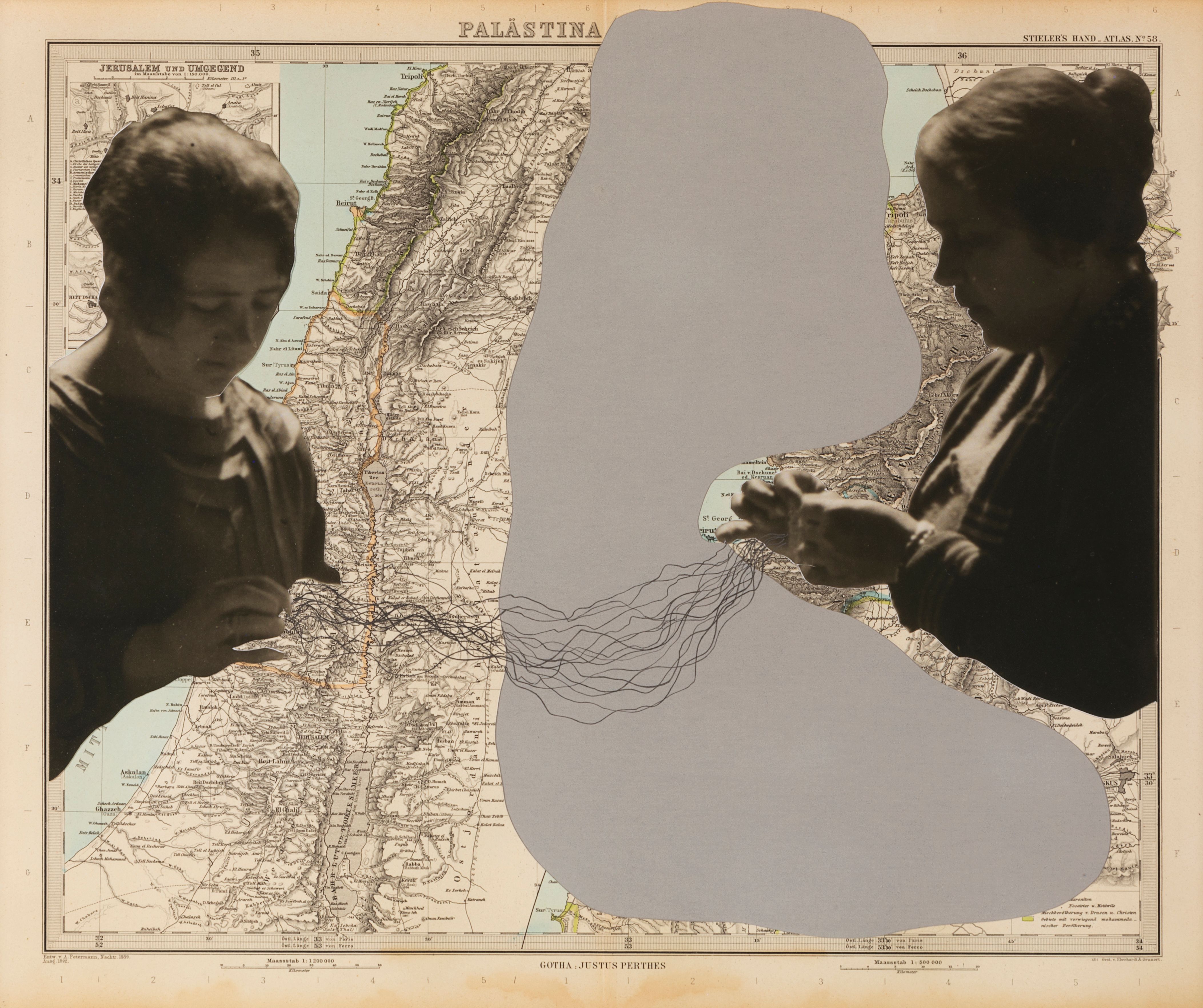
Hazem Harb, Map of Land Series, #4, 2019.

But we are in a new moment. For the short life of this war, millions across the globe have roared in opposition, demanding a cease-fire, along with medical aid and food for Palestinians. The protests spurred a campaign spearheaded by South Africa at the International Court of Justice to make a surprising intervention, holding that Israel’s actions may constitute genocide. Opposition to Israel’s siege has activated a Palestine solidarity movement in the U.S. led largely by Palestinian Americans and young Jews. U.S. financing and arming of this war has made Biden politically vulnerable even as he continues to stand by it.

Biden’s polling among Arab Americans voters has plummeted from 59 percent to 17 percent, while progressives have threatened to withhold their votes in the fall’s presidential contest. His political future is further imperiled by widespread opposition to Israel’s actions in Gaza among Democratic voters, especially the young. Most recently, tens of thousands of Democratic Party primary voters in Michigan, Minnesota, and elsewhere voted “uncommitted” as a protest vote against Biden’s Gaza policy. The Democratic establishment downplayed the Michigan vote in public, but when Vice President Kamala Harris was dispatched to commemorate the 59th anniversary of the Selma civil rights march, she called for an “immediate cease-fire,” then paused for applause, “for at least the next six weeks.” Of course, the movement demands an immediate and permanent cease-fire and an end to the occupation. Harris’s use of “cease-fire” instead of Biden’s “pause” is the administration’s effort to co-opt an antiwar movement that has spiraled beyond their control or their imaginations. But that rhetorical shift is also evidence that the “uncommitted” movement is unsettling the party’s consensus, as was Senator Chuck Schumer’s surprising excoriation of Benjamin Netanyahu in a speech.

Palestinians have challenged the U.S.-Israeli war machine. The U.S. war in Vietnam was the first to be broadcast widely in the homes of Americans, and the Israeli onslaught in Gaza is the first genocide to be watched live on people’s smartphones across the globe. The sheer determination of the Palestinian people to document their own suffering has transformed our understanding of this lopsided war, slicing through state-generated propaganda that has, since Vietnam, sought to shield the public from the death and destruction that is the reality of all war.

As the West has moved toward remote war conducted by drones, the human costs have become more abstract. Mainstream media outlets reinforce that remove, refusing to show the extent of the carnage, obliquely sanctioning the dubious claims of “smart bombs” and other euphemisms meant to assuage the public’s concern about the deaths of innocents. Because Israel has locked Gaza’s doors, courageous Palestinian journalists have risked their lives to broadcast Israel’s atrocities, and dozens have died doing so. It is because of Palestinians that we know of the hunger they are experiencing, visible in the gaunt bodies of their children. We know of the sniper attacks outside hospitals, the bombings of residential housing, mosques, and universities. Palestinians have learned how to circumvent the mainstream media’s equivocation about the value of their lives. They have seized the technology to show the world the consequences of Israel’s actions. Activists around the world emulated those techniques to document global movements like Occupy, the Arab Spring, Fees Must Fall, and the Black Lives Matter movement during the Ferguson uprising in 2014.

But today it is not only Palestinians who document their genocide in real time. For months, Israeli soldiers have filmed their atrocities. There are the group selfies of soldiers huddling, smiling in the foreground of the smoldering remains of apartment buildings and neighborhoods. Male Israeli soldiers fondling the underwear and nightwear of Palestinian women. A soldier in a tank bragging about running over a Palestinian man. Israeli soldiers beating, degrading, belittling Palestinians on camera, as if to showcase their hatred as well as their imperviousness to human rights, international law, or the rules of warfare. Israel has made a mockery of all of it, as settlers build illegal housing units across the West Bank at record pace, murdering Palestinians in the process and arresting thousands to be held in indefinite detention. In doing so, it has betrayed the fake piety of U.S. officials who defend Israel’s every action while deflecting queries about a cease-fire or humanitarian aid for Palestinians. That these bureaucrats feel obliged to explain this particular foreign policy is because of the mass movement and Palestinians who, from a tiny strip, occupy the center of its moral universe.

The longevity of the Palestinian movement in Gaza and beyond allowed a core of activists to immediately jolt into action after Israel began to strike Gaza. Student activism organized around the boycott, divestment, and sanctions (BDS) campaign has been a staple of the Palestinian solidarity movement for years. Now there are almost 100 new Faculty for Justice in Palestine chapters. The political atmosphere is still charged by a decade of Black Lives Matter activism and just three years removed from the paroxysmal marches in the summer of 2020. Solidarity activism replaced the political ennui brought about by an adrift Biden administration.

Even as young Jews and many of their parents have rejected Israel’s war, Israel’s propaganda machine has denounced the movement as antisemitic. Those accusations have created an academic year like no other, with student activists taking courageous action week to week, while being doxxed by right-wing activists and surveilled by paranoid college administrators. The punishment of Palestinian solidarity and activism can’t be attributed only to “Islamophobia.” In the U.S., Zionists and conservatives attack the language of decolonization along with Palestinian demands for self-determination, as captured in the old slogan “From the river to the sea,” as antisemitism. (The far-right Likud party used a version of that slogan in its original platform.) They seek to marginalize and ban Palestinian solidarity on college campuses. Here, the work of the right, liberal college administrators, and the donor class converge. There is little doubt that antisemitism is on the rise. But its ascendance must be understood alongside the simultaneous growth of anti-Arab racism and Islamophobia that Israel’s ruthless assault on Gaza has encouraged, and fear of the loss of a significant portion of young Jews for the Zionist project.

Today, the reputation of the United Nations is in tatters because of both Israel’s relentless criticism of the organization and America’s ability to unilaterally undo the sentiment of a body that claims to represent the international community. Of course, the U.S. has always used or ignored the UN for its own purposes, but never under a spotlight this searing. Consider how the U.S. relied upon the UN to launch its illegal war in Iraq after the specious claim that the country harbored weapons of mass destruction. As the world longs for a cease-fire, we all watch in astonishment as U.S. Ambassador Linda Thomas-Greenfield erases the will of the world with a mere wave of her hand.

What will become of international law as Israel continues to flout every postwar convention intended to constitute a new global order based on human rights in the aftermath of the Holocaust? All were intended to prevent exactly the kinds of atrocities that Israel is carrying out in Gaza. Of course, we have never enjoyed such a global peace. The global north instrumentalized these legal frameworks to police and control the global south. But now the emperor has no clothes — the hypocrisy of Israel’s barbarism, bankrolled by the United States, has been exposed before a global audience not just on the internet but in the Hague itself, the embodiment of the supposed sacrosanctity of international law.

Israel is a state forged in the aftermath of the traumatic experience of the Holocaust. But it has long weaponized this trauma and displaced it from Europe onto Arabs. In this siege, Israel is not satisfied with only territorial conquest and the defeat of its enemies; its military and state leaders also seek to torture, humiliate, and revel in the murder of Palestinians and the ruin of Palestinian society. Despite the gruesome suffering of Gazans, in a December poll of Israeli Jews that asked “to what extent should Israel take into consideration the suffering of the civilian population of Gaza when planning the continuation of the fighting there,” over 80 percent said a very small or fairly small extent. Nearly 75 percent of Israeli Jews supported the invasion of Rafah in a March poll. Israel projects its own violence and hatred onto Palestinians in an orgy of racism, mass murder, and wanton destruction, while Western states, led by the United States, claim to be powerless to stop this madness.

But even amid a powerful backlash that conflates demands for a cease-fire and support of Hamas’s attacks, the power of Palestinians has propelled a global antiwar movement and in turn made the Western world finally see them and their righteous demands for freedom as legitimate — even urgent. No one in any country that has been colonized or invaded or occupied by Western imperialism needs to be told about either the atrocities or the hypocrisies of the world’s greatest democracies. Vietnam, India, Congo, Namibia, Mexico, Brazil, Chile, Iraq, Yemen, Egypt, Belfast, and beyond do not need to be reminded of the compromised freedom of imperial democracy. Their own colonial and imperial histories, and their legacies of resistance, are being remembered by and for a new generation.

In the United States, disapproval of Biden’s handling of the Israeli-Palestinian conflict continues to rise — now among 79 percent of Republicans and 30 percent of Democrats. According to one poll, a stunning 67 percent of Americans support “calling for a permanent cease-fire and a de-escalation of violence in Gaza,” including 56 percent of Republicans. This may not translate into immediate support for Palestinian freedom, but Palestinian liberation is being seen in the new light of day.

This is the challenge for the left now, the one we are all focused on and the one we must think most sharply about. We are living through a revival of internationalism and another extended moment of mass protest. Even as we tire in the face of exhausting odds, a hulking imperial ship that refuses to acknowledge our power as it trembles, we must persist. A victory against the systems that oppress Palestinians is a victory against the systems that oppress us all. We hope this special edition of Hammer & Hope on Palestine provides some measure of the history, politics, and solidarity needed to support any liberation movement in its quest for freedom.


Hammer & Hope is free to read. Sign up for our newsletter, donate to our magazine, and follow us on Instagram, Threads, TikTok,