Showing posts with label Elena Kagan. Show all posts

Wednesday, June 16, 2010

We Don't Need Another Gliberal: The Political Dilemma of Elena Kagan

http://www.nytimes.com/2010/06/15/us/politics/15kagan.html?nl=us&emc=politicsemailemb1

All,

As I deeply suspected all along it's now clear that Ms. Kagan is just another half-assed and absurdly "cautious" 'gliberal'/neoliberal whose fundamental politics are those of the decidely mediocre and self serving "moderate Democrats" in the opportunist wing of the Democratic Party who are far too often nothing more than 'Republicans-lite' (like her former political mentor and boss Bill Clinton). In many ways Kagan--who is now Obama's nominee choice for the Supreme Court-- mirrors and embodies many of the biggest weaknesses, blindspots, and openly careerist attitudes and values of the current President...

Kofi


As Aide, Kagan Battled Colleague Over Policy

By PETER BAKER
Published: June 14, 2010
New York Times

WASHINGTON — Elena Kagan was not responding to messages, so Christopher Edley Jr. fired off an exasperated e-mail message to higher-ranking White House officials. He had just learned that Ms. Kagan’s office was preparing a policy for President Bill Clinton to discourage “social promotion” in schools.

To Mr. Edley, a consultant to the Clinton administration, that was code for flunking more poor children. But he could not get Ms. Kagan’s attention.

“I have had no success contacting Elena to learn details or give feedback on this policy,” he wrote. “I have tried email, voice mail, hallway greeting, and conversation with her secretary.” If he could not reconcile himself to the policy, Mr. Edley added, he would have to decide “whether I need to resign.”

The tension between Ms. Kagan and Mr. Edley that day in 1998 went deeper than unanswered messages and an ultimately forgettable policy clash. At the heart of the dispute was a broader cleavage inside Mr. Clinton’s White House between two visions for Democratic politics, one that adhered to traditional liberal conceptions of social justice and aid to the disadvantaged and another that sought to nudge the party to the center after a generation of electoral losses.

Along that fault line, Ms. Kagan, now President Obama’s nominee to the Supreme Court, was situated squarely in the camp of the centrist New Democrats as deputy to her college friend Bruce Reed, the White House domestic policy director and veteran of the Democratic Leadership Council that advocated a “third way.” Mr. Reed coined the phrase “end welfare as we know it” and promoted the measure that Mr. Clinton signed into law requiring work and setting time limits. He advocated charter schools, free-trade pacts and more police officers on the beat.

And for two years, from 1997 to 1999, Ms. Kagan served as Mr. Reed’s lieutenant in those battles. Whether her work reflected her personal beliefs or those of her boss is still debated in Clinton circles, but either way her formative years in politics were spent in the trenches with Mr. Reed.

“She was a full partner with him in trying to move the debate,” said John D. Podesta, Mr. Clinton’s last White House chief of staff and now an outside adviser to Mr. Obama. “I don’t know that you can ascribe all of Bruce’s views to her. On the other hand, I think they were fairly simpatico.”

Chris Jennings, the president’s health care adviser, said Ms. Kagan and Mr. Reed “share similar philosophies” that government should empower people but not create dependency. He added, however, “a clone she is not.”

Perhaps no other issues during her time with Mr. Reed put her in the cross hairs of an ideological firefight as much as Mr. Clinton’s project to improve race relations. Born out of his second inaugural address promise to become a “repairer of the breach,” the initiative exposed the breach inside Mr. Clinton’s own team, according to interviews with participants and a review of 4,700 pages of documents in Ms. Kagan’s files released this month.

Leading one side was Mr. Edley, a Harvard Law School professor who was recruited to consult on the project and resisted anything that seemed to abandon core progressive values. On the other were Mr. Reed and Ms. Kagan, who wanted less talk of grievance and more focus on initiatives that promoted both opportunity and responsibility.

From the start, Mr. Reed and Ms. Kagan resisted the idea of a race commission, sending a March 1997 memorandum criticizing “serious flaws” with the idea and arguing instead for a multiday White House conference followed by town-hall-style meetings. Ultimately, Mr. Clinton appointed a seven-member commission to study race.

“We made our case, and we lost for the most part,” Mr. Reed recalled in an interview.

In handwritten notes, Ms. Kagan recorded skepticism. “Mission too focused on PR, not enough on research/report,” she wrote. “Focus should be on future, not Kerner,” she added, referring to a landmark 1968 study of American race relations.

After a May 1997 meeting where they were told that the project would be 80 percent dialogue and 20 percent policy, they received a strategy plan. “Looks like 20% substance was an extremely optimistic estimate,” Mr. Reed wrote Ms. Kagan.

A month later, Mr. Clinton announced his project, but tensions persisted. In July, Mr. Reed and Ms. Kagan sent Mr. Clinton thoughts emphasizing the “equal opportunity and shared responsibility” formula that had been his hallmark. Mr. Edley responded the same day, arguing against “so much emphasis on the Clinton record, past Clinton initiatives, Clinton themes.”

By fall, the project was developing policy initiatives and Ms. Kagan forwarded one list to Mr. Reed. “Pretty exciting stuff,” she wrote, evidently in sarcasm. Next to a proposal to draft a presidential letter calling young people to action, she scribbled, “By November 15, a letter!” In November, Mr. Reed and Ms. Kagan sent the president their own “race-neutral opportunity agenda,” including expanding access to banks for poor Americans; deploying more police officers to local communities; and enacting “education opportunity zones” to promote public school choice, end social promotion and remove bad teachers.

In January 1998 came the eruption over the social-promotion initiative that prompted Mr. Edley to threaten briefly to resign. Just weeks later, he sent a memorandum outlining various themes. Ms. Kagan wrote on it: “I’m all in favor of pushing hard on (3) — his ‘obsession’ — so we can get our way on (4).” (No. 3 was “Public Leadership” emphasizing inclusion while No. 4 was “Policy Action” to overhaul but preserve affirmative action.)

“We thought the administration had a responsibility to propose big ideas that would expand opportunity, not just have a conversation about these issues without concrete action to address them,” Mr. Reed said in the interview.

Mr. Edley, now dean at the law school of the University of California, Berkeley, declined an interview request. But Judith A. Winston, the project’s executive director, recalled a “constant push and pull” with the White House staff. “For any policy to be really effective in eliminating the disparities, they had to be targeted by race, not just race neutral,” Ms. Winston said.

By summer 1998, Mr. Edley was drafting a “race book” to sum up the project. But he believed he was “setting up for failure because I have no authority from the president to do anything except spin wheels,” Mr. Edley confided in August to Maria Echaveste, a deputy White House chief of staff who would later become his wife.

The next day, a White House aide wrote Mr. Reed and Ms. Kagan that Mr. Edley’s ideas on education “are not likely to be ours.” In frustration, Mr. Edley sent Ms. Kagan ideas a week later and asked, “So, tell me honestly: Are you on board, or are you ‘actively skeptical’?”

Still actively skeptical, by all indications. In September, several aides sent her critiques of Mr. Edley’s draft race book, taking issue, for example, with his ideas on education and law enforcement. The divide was so deep that another aide wrote Mr. Reed and Ms. Kagan in January 1999 about “solving the Edley problem” and complaining about his “flagrant process foul.” Two months later, there was another flare-up when Mr. Edley pressed for an executive order on racial profiling.

“The caution of the White House staff was unsurprising,” Mr. Edley wrote, resignedly. He speculated that the final report would have a dissent by White House staff members: “I hope the memorandum is shorter than the book.” Mr. Reed and Ms. Kagan forwarded Mr. Edley’s memo to Mr. Podesta along with an angry handwritten note, saying: “John — This simply cannot be allowed to happen. We have policy processes for a reason.”

The issue reached a climax in March when Mr. Reed drafted a brutal appraisal of Mr. Edley’s book in his and Ms. Kagan’s names, saying it was “not a bold vision of race and America for the 21st century,” calling its conclusion “hopelessly trite and naïve,” and adding “we doubt that this is the caliber of book the president was hoping for or expecting.”

For Ms. Kagan, though, Mr. Reed’s assessment went too far. She deleted the most inflammatory language. Next to one harsh sentence, she wrote, “Maybe too much.” By the next sentence, she wrote, “Definitely too much.” Finally, she crossed out her name, making the memorandum solely from Mr. Reed.

In the interview, Mr. Reed said Ms. Kagan had taken her name off because she was leaving the White House. But he agreed that she thought he was going too far. “She was toning down my less-than-judicious tone,” he said. “Looking back, there’s no question that she was right.”

In the end, the schism was too profound and the race book was shelved.


Sunday, May 16, 2010

Elena Kagan, President Obama, and the Dire Necessity of Integrity and Vision on the Supreme Court


Washington -- President Barack Obama has nominated Solicitor General Elena Kagan to the Supreme Court, saying she will demonstrate independence, integrity and passion for the law.

If confirmed by the Senate, Kagan will become the third woman on the high court. Obama introduced her today in the White House's East Room. He called her "my friend" and one of the nation's foremost legal minds.

The selection of Kagan came after nearly a monthlong process of consideration. Obama always had Kagan on his short list but still considered a broader group of candidates, interviewing four.

The president informed Kagan that she would a Supreme Court nominee on Sunday night. He then called the three federal judges he did not choose for the position, Diane Wood, Merrick Garland and Sidney Thomas.

Never a judge, Kagan is known as sharp and politically savvy and has enjoyed a blazing legal career. She was the first female dean of Harvard Law School, first woman to serve as the top Supreme Court lawyer for any administration, and now first in Obama's mind to succeed legendary liberal Justice John Paul Stevens.

At 50 years old, Kagan would be the youngest justice on the court, which would give her the opportunity to extend Obama's legacy for a generation.

Kagan must first win Senate confirmation. A source close to the selection process said a central element in Obama's choice was Kagan's reputation for bringing together people of competing views and earning their respect.

Republicans have shown no signs in advance that they would try to prevent a vote on Kagan, but they are certain to grill her in confirmation hearings over her experience, her thin record of legal writings and her objections to the military's policy about gays.
When she was confirmed as solicitor general in 2009, seven Republicans backed her: Sens. Tom Coburn of Oklahoma, Susan Collins of Maine, Judd Gregg of New Hampshire, Orrin Hatch of Utah, Jon Kyl of Arizona, Richard Lugar of Indiana and Olympia Snowe of Maine.

Kagan came to the fore as a candidate who had worked closely with all three branches of government, a legal mind with both a sense of modesty and sense of humor. The source spoke on condition of anonymity to discuss factors that led to Kagan's impending nomination.

Kagan has clerked for Thurgood Marshall, worked for Bill Clinton and earned a stellar reputation as a student, teacher and manager of the elite academic world. Her standing has risen in Obama's eyes as his government's lawyer before the high court over the last year.

Yet Kagan would be the first justice without judicial experience in almost 40 years. The last two were William H. Rehnquist and Lewis F. Powell Jr., both of whom joined the court in 1972.

All of the three other finalists she beat out for the job are federal appeals court judges, and all nine of the current justices served on the federal bench before being elevated.
Kagan's fate will be up to a Senate dominated by Democrats, who with 59 votes have more than enough to confirm her, even though they are one shy of being able to halt any Republican stalling effort.

For the second straight summer, the nation can expected an intense Supreme Court confirmation debate even though, barring a surprise, Kagan is likely to emerge as a justice.

Supreme Court justices wield enormous power over the daily life of Americans. Any one of them can cast the deciding vote on matters of life and death, individual freedoms and government power. Presidents serve four-year terms; justices have tenure for life.

Democrats went 15 years without a Supreme Court appointment until Obama chose federal appellate judge Sonia Sotomayor last year to succeed retiring Justice David Souter. Just 16 months in office, Obama has a second opportunity with Kagan, under different circumstances.

Obama's decision last year centered much on the compelling narrative of Sotomayor, the first Hispanic Supreme Court justice, who grew up in a housing project and overcame hardship.

This year, Obama particularly wanted someone who could provide leadership and help sway fellow justices toward a majority opinion. The president has grown vocal in his concern that the conservative-tilting court is giving too little voice to average people.

Kagan is known for having won over liberal and conservative faculty at the difficult-to-unite Harvard Law School, where she served as dean for nearly six years.

Her background, including time as a lawyer and a key domestic policy aide in President Clinton's White House, would give the court a different perspective.

The White House is expected to frame Kagan's lack of service as a judge in upbeat terms, underscoring that there are many qualified routes to the top of the judiciary.

Kagan, who is unmarried, was born in New York City. She holds a bachelor's degree from Princeton, a master's degree from Oxford and a law degree from Harvard.

She served as a Supreme Court clerk for one of her legal heroes, Justice Thurgood Marshall. And before that, she clerked for federal appeals court judge Abner Mikva, who later became an important political mentor to Obama in Chicago.

Kagan and Obama both taught at the University of Chicago Law School in the early 1990s.

In her current job, Kagan represents the U.S. government and defends acts of Congress before the Supreme Court and decides when to appeal lower court rulings.
Kagan has the high task of following Stevens, who leaves a legacy that includes the preservation of abortion rights, protection of consumer rights and limits on the death penalty and executive power. He used his seniority and his smarts to form majority votes.

Rick Garnett, a professor of law and associate dean of University of Notre Dame Law School, voiced the concern of many conservatives.

"Future elections might undo some of the president's policies, but his more liberal views about the Constitution, the powers of the national government, and the role of unelected federal judges, are now being locked in securely," Garnett said in a statement.

Kagan would be the fourth woman to serve on the Supreme Court, following current Justices Ruth Bader Ginsburg and Sonia Sotomayor and retired Justice Sandra Day O'Connor.

She would be the third Jewish justice along with six Catholics. With Stevens' retirement, the court will have no Protestants, the most prevalent denomination in the United States.

http://www.nytimes.com/2010/05/14/us/politics/14diversity.html?nl=us&emc=politicsemailema1

All,

Whoa folks...WAIT a damn minute here...let me get this straight: Does Obama and the African American supporters of Ms. Kagan who "just happen to be" some of the President's oldest black friends and colleagues at Harvard Law School (like Professor Charles Ogletree who taught Obama at the Law School during his time there as a student in the late 1980s) really, seriously think that they can get away with their strong and emphatic endorsements of Kagan's clearly abysmal record of hiring African American law professors for tenured positions at Harvard Law just because the President likes her and she too is a longtime friend and colleague of his? This position is absolutely bogus and quite absurd on its face. Kagan is on record of hiring ZERO African Americans (as well as Latinos) while Dean of Harvard Law School during her tenure there out of 32(!) positions. Nor did she hire any blacks of Latinos in her position of Solicitor General which she was selected for by Obama last year. NONE, NADA, ZILCH..C'mon! Let's get real--these numbers are atrocious and frankly indefensible. The President, his black cronies and associates at the Law School, and others who support her in her nomination for the Supreme court must be JOKING if they actually think this record is in any way acceptable. What kind of ludicrous standard for "diversity" is this? If a Republican or southern democratic nominee had this kind of insulting record of (not) hiring African Americans and Latinos at Harvard Law would we give that person a pass the way that the President and her personal friends are asking/demanding that we do on Kagan's behalf? Would this record be considered OK and worthy of support by Professors Ogletree and Kennedy? OF COURSE NOT! In fact they and Obama would be the first to publicly and quite justifiably raise very serious questions and objections if this were the case. So let's not play stupid little games here and give Ms. Kagan, the President, and their supporters at Harvard Law School a pass for pretending that this is fine just because the President is her personal friend...Nah... No way! That would not only be intellectually and morally dishonest but very irresponsible to say the least. Ms. Kagan and the President must be held publicly accountable for this serious problem and critical questions should and must be raised about this with regard to her general nomination, Merely refusing an endowed chair tainted with the blood money of slavery and taking one instead with the great Charles Hamilton Houston's name on it (the legendary Houston was Thurgood Marshall's mentor at Howard University and in his general legal career during the the 1930s and '40s) is simply not enough by a long shot.. Like both Houston and Marshall did during their extraordinary careers as courageous and stalwart legal protectors of social and economic justice Ms. Kagan AND President Obama must PUT UP OR SHUT UP on these crucial matters of genuine public diversity and equal employment opportunities for African Americans and Latinos in our higher education institutions and professions. In other words: NO ONE GETS A PASS ON THAT-- not even the President and a Supreme Court nominee. The ball (and the fate of the Supreme Court) is now in their hands...I sincerely hope they don't blow it...

Kofi


Nominee Scrutinized for Hiring on Race

By KATHARINE Q. SEELYE
May 13, 2010
New York Times

BOSTON — When Elena Kagan became dean of Harvard Law School in 2003, she could have taken the endowed chair named for Isaac Royall Jr. The Royall family had donated more than 2,100 acres to Harvard in the 1700s, but the family had earned its fortune on the backs of the slave trade.

Ms. Kagan declined to take the Royall professorship. Instead, she chose a new chair in the name of Charles Hamilton Houston, the first African-American on the Harvard Law Review and a crusader against Jim Crow laws.

Ms. Kagan’s history on race issues at Harvard has come under scrutiny since President Obama nominated her to the Supreme Court on Monday. Critics say that she did not create enough racial diversity at Harvard, and that in the absence of any writings or opinions, her hiring practices serve as a clue to her thinking. Her supporters counter that she demonstrated a commitment to equality; her claiming the chair in the name of Mr. Houston, they said, is but one example.

In the nearly six years that Ms. Kagan was dean, from 2003 to 2009, she hired a total of 43 permanent, full-time faculty members, 32 of whom were tenured and tenured-track. Of those, 25 were white men, 6 were white women and one was an Asian-American woman. Of the other 11, 6 were white men, 2 were women and 3 were minority men (2 black and one Indian), according to a law school official.

Law school officials said the numbers did not reflect the whole story because offers were made to other minority and women scholars; some were declined and some still open. But others said the record spoke for itself.

“Kagan’s performance as dean at Harvard raises doubts about her commitment to equality for traditionally disadvantaged groups,” Guy-Uriel Charles, a black law professor at Duke, wrote last month in an oft-cited post.

During roughly the same period that Ms. Kagan was at Harvard, Mr. Charles wrote, Yale Law School hired just 10 faculty members; 5 were women, and only one was a minority.

Ms. Kagan’s track record on diversity improved during the last year when she became solicitor general. In that office, she has hired six people — three women and three men (one white, one Asian and one Indian).

Lester K. Spence, a political scientist at Johns Hopkins University, wrote on theroot.com, a Web site devoted to black issues, that Ms. Kagan appeared to be more concerned with ideological diversity than with diversity of race or gender.

“President Obama wants us to support his choice not because she’s got a strong record, not even because she has a particularly visible record, but because he knows her,” Mr. Spence wrote. “I’m not buying it,” he added. “And even if Kagan ends up being the best justice this side of Thurgood Marshall, you shouldn’t either.”

After it was clear that Mr. Obama, the first black president, would nominate Ms. Kagan, several black women wrote to him saying they were disappointed that he had not nominated a black woman.

The women, who included Melanie Campbell of the National Coalition on Black Civic Participation, also said they wanted to learn more about Ms. Kagan’s record on civil rights.

The administration has been pushing back against any suggestion that Ms. Kagan has been insensitive on racial matters, as have some of her black supporters.

Ronald S. Sullivan, a black law professor whom Ms. Kagan recruited to Harvard, wrote on thegrio.com, another site devoted to black issues, that “no elite law school has done enough” with respect to minority hiring. But, he noted, her spurning of the Royall chair “was a significant statement made by the dean of one of the nation’s top law schools.“

And, he said, Ms. Kagan had expanded the clinical teaching program at Harvard so that “thousands of indigent and under-represented citizens received quality legal services that they otherwise would not have been able to afford.”

Randall L. Kennedy, another black professor at Harvard Law, also strongly defended Ms. Kagan’s hiring practices. He said in an article in The Huffington Post that no dean was solely responsible for hiring faculty, with each one requiring a majority if not a supermajority of votes. This, he said, gets to be a complicated proposition.

Still, he said, Ms. Kagan supported programs that have helped advance minorities, and she helped form a committee to identify promising racial minority candidates.

While she was dean, an average of about 30 percent of the entering classes were minorities, up from about 25 percent in the previous six years, according to a Harvard official.

One of Ms. Kagan’s strongest backers has been Charles J. Ogletree Jr., perhaps the most prominent black law professor at Harvard. He has noted in interviews and articles that she has been supportive of men and women of color among both students and faculty.

“If you look at her whole record, ” Mr. Ogletree said in an interview on Thursday with Essence.com, “I think it tells you that she worked diligently to make opportunities available for others. The questions about who she recommended and who was tenured are fair, and I think she’ll be able to respond to them.”


http://www.nytimes.com/2010/05/13/us/politics/13marshall.html?nl=us&emc=politicsemailema1


Kagan’s Link to Marshall Cuts 2 Ways
By CHARLIE SAVAGE
May 12, 2010
New York Times

WASHINGTON — In the spring of 1988, Justice Thurgood Marshall assigned a clerk, Elena Kagan, to write a first draft of his opinion in a case considering whether a school district could charge a poor family for busing a child to the nearest school, which was 16 miles away.


Associated Press


Thurgood Marshall at his Supreme Court confirmation hearings in 1967. Elena Kagan clerked for him 20 years later

A majority on the Supreme Court ruled that the busing fee was constitutional. Justice Marshall, who was 80, was incensed and wanted a fiery dissent. But the 28-year-old Ms. Kagan, now a Supreme Court nominee, thought her boss’s legal analysis was wrong.

Ms. Kagan, recalling the incident in a 1993 tribute after his death, wrote that after she told him that “it would be difficult to find in favor of the child” under legal doctrine, he called her a “knucklehead.” He “returned to me successive drafts of the dissenting opinion for failing to express — or for failing to express in a properly pungent tone — his understanding of the case,” she wrote.

Because Ms. Kagan has never been a judge and has produced only a handful of scholarly writings, clues to her philosophy are rare. In that vacuum, liberals and conservatives alike are attributing special significance to her clerkship year with Justice Marshall, who led the civil rights movement’s legal efforts to dismantle segregation before becoming a particularly liberal Supreme Court justice.

But while Ms. Kagan, a former board member for the Thurgood Marshall Scholarship Fund, clearly relished the experience and admired the justice as a historic figure, she appears to have had a far more ambivalent attitude toward his jurisprudence, according to a review of his papers at the Library of Congress, her comments over the years about him and interviews with her fellow clerks and colleagues.

In analyzing why Justice Marshall was adamant about siding with the poor family in the busing fee case, for example, Ms. Kagan explained in her tribute that he “allowed his personal experiences, and the knowledge of suffering and deprivation gained from those experiences, to guide him.”

But Ms. Kagan did not share those experiences, notes Charles J. Ogletree, a Harvard law professor who heads an institute named after Justice Marshall’s mentor, Charles Hamilton Houston, and who has talked over the years with Ms. Kagan, a former Harvard Law School dean, about her clerkship.

“It’s absurd to compare Elena Kagan’s judicial philosophy to Thurgood Marshall’s philosophy,” Professor Ogletree said. “Their times and life experiences are different. They lived in different worlds. The reality is that Elena Kagan learned a lot from Justice Marshall, but she will not be overly influenced by Marshall or anyone else. She is her own person.”

Some differences in the views of Justice Marshall — who once described his legal philosophy as, “You do what you think is right and let the law catch up” — and of his former clerk are striking. For example, he believed that the death penalty was always unconstitutional. But during the confirmation process when she was named solicitor general last year, Ms. Kagan said she had no quarrel with the death penalty.

“I am not morally opposed to capital punishment,” Ms. Kagan wrote to a senator, adding that she “accepted” the Supreme Court’s precedents upholding “the death penalty as constitutional in a wide variety of cases and circumstances.”

Nevertheless, the political dynamics of Ms. Kagan’s nomination have led figures on the left and the right to gloss over such differences.

After some liberal commentators questioned whether Ms. Kagan could be trusted, President Obama declared that Justice Marshall’s “understanding of law, not as an intellectual exercise or words on a page, but as it affects the lives of ordinary people, has animated every step of Elena’s career.”

Conservative critics, too, have sought to link Ms. Kagan closely to Justice Marshall. Among them, Curt Levey of the Committee for Justice has decried a supposed “Kagan/Marshall judicial philosophy,” noting that in her tribute she described as a “thing of glory” her former boss’s view that courts should show special solicitude for disadvantaged parties.

By 1987, as the Rehnquist court was moving to the right, Justice Marshall was “in his decline and alienated, marginalized” and, in hiring clerks like Ms. Kagan, “looking for really bright people to kind of put a new charge in him” and to help him write dissents, said Juan Williams, a Marshall biographer.

“She didn’t come to him because she was necessarily of like mind, although she was coming out of the same political milieu,” Mr. Williams said.

Justice Marshall nicknamed Ms. Kagan “Shorty” and sometimes referred to her as “Little Bits,” though they all got called “knucklehead” from time to time, recalled Harry Litman, another clerk that year. The musty chambers were crammed with books, African artifacts, red Naugahyde chairs and ungainly desks.

Justice Marshall did a lot of work in an anteroom to his main office. There, he sat in a comfortable chair across a large table from his clerks to discuss cases, sessions that inevitably digressed into stories the justice would tell about his life.

“You’re at the same time laughing because he’s such a great raconteur and also thinking it’s unbelievable that these things happened in the lifetime of this person in whose presence I’m sitting, and their life made such a difference in re-creating a South where he had to be out of town by sunset or his life was in danger,” recalled Carol Steiker, another clerk that year.

One task of the clerks was to write brief memorandums evaluating the thousands of cases appealed to the Supreme Court. Most written by Ms. Kagan are straightforward, but some caution against taking a case because of how the conservative justices might rule or elevate outcomes over the law.

For example, on Oct. 7, 1987, she analyzed a case in which a judge dismissed an immigrant’s guilty plea over a minor infraction because it could jeopardize his application for permanent residency. The Justice Department appealed, saying the district court had exceeded its authority.

Ms. Kagan wrote that the Justice Department’s view was “almost certainly correct.” Still, she recommended against taking the appeal because the judge had “ensured an equitable result” at “no great cost to the Republic.” Justice Marshall scrawled “D” for “deny” at the top of her memorandum.

In her hearing last year, Ms. Kagan distanced herself from those writings, saying her job was to “channel” Justice Marshall’s mind-set.

A clerk to a justice is “trying to facilitate his work, and to enable him to advance his goals and purposes as a justice,” she said, adding: “He knew what he thought about most issues. And for better or for worse, he was not really interested in engaging with his clerks on first principles.”

Indeed, while her 1993 tribute is couched in fond terms, the bulk of her remarks about cases that arose in her clerkship year concerned their disagreements.

In one case, he voted not to let a man pursue a discrimination claim because his lawyer, who was blind, accidentally left his name off an appeal, and a deadline expired. Ms. Kagan and fellow clerks sought to persuade Justice Marshall to change his vote until he grew annoyed and, pointing to his framed judicial commission on the wall, asked them whose name was on it.

But the case Justice Marshall cared about the most that year, she wrote, was the school bus dispute in which she had trouble justifying his dissent. The final draft seems to implicitly acknowledge that his vote rested less on legal doctrine than on his notion of social justice.

The case, it says, asked “whether a state may discriminate against the poor in providing access to education,” adding: “I regard this question as one of great urgency. As I have stated on prior occasions, proper analysis of equal protection claims depends less on choosing the formal label under which the claim should be reviewed than upon identifying and carefully analyzing the real interests at stake.”


Saturday, April 10, 2010

Supreme Court Justice Stevens Retires and a Search for a Replacement Begins

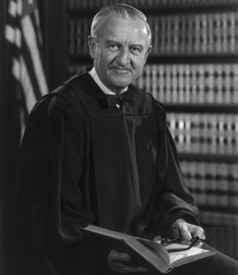
Official portrait of Justice John Paul Stevens, taken on January 27, 1976. (Photo: Library of Congress)

http://www.truthout.org/supreme-court-justice-stevens-will-retire-june58430


Supreme Court Justice Stevens Will Retire in June
09 April 2010 by Michael Doyle and David Lightman
McClatchy Newspapers
t r u t h o u t


Washington - Supreme Court Justice John Paul Stevens announced his retirement Friday, setting up a long-anticipated confirmation battle during the most sensitive of political seasons.

Stevens, who'll turn 90 on April 20, said that after 34 years on the high court it was time to step down.

"It would be in the best interests of the court to have my successor appointed and confirmed well in advance of the commencement of the court's next term," Stevens said in a letter to President Barack Obama.

A Supreme Court representative conveyed Stevens' letter to the White House at about 10:30 a.m. Friday. White House Counsel Bob Bauer called Obama with the news, reaching the president aboard Air Force One as Obama was returning from the nuclear treaty signing in Prague.

Stevens' departure in June at the end of the 2009-10 term will remove from the court its most senior justice as well as the linchpin of what's now the liberal wing. Stevens' retirement also will ensure that the Supreme Court is front and center during the upcoming midterm congressional elections.

For conservatives and liberals alike, the pending court vacancy will become a way to mobilize the troops as well as to wage proxy fights over hot-button issues, including abortion and wartime security.

For Obama, the vacancy provides a challenge and an opportunity.

Republicans are eager to unite around an issue that will engage their conservative base. The president's Democratic Party controls 59 seats, one short of the number that's needed to stop a filibuster. In a break with tradition, some senators have signaled that they wouldn't be reluctant to filibuster a Supreme Court nominee.

Stevens' departure also provides Obama a second chance to shape the court with a relatively young justice who'll be interpreting the Constitution for the next several decades. Because of Stevens' relatively left-of-center position, the new justice may not tip the court's overall ideological balance.

"I hope that senators on both sides of the aisle will make this process a thoughtful and civil discourse," said Democratic Sen. Patrick Leahy of Vermont, the chairman of the Senate Judiciary Committee.

"Americans can expect Senate Republicans to make a sustained and vigorous case for judicial restraint and the fundamental importance of an evenhanded reading of the law," cautioned Senate Minority Leader Mitch McConnell, R-Ky.

The experience of the president's first court choice, Justice Sonia Sotomayor, may foreshadow the political conflict to come. Thirty-one Republicans opposed her, including some who'd traditionally crossed party lines to approve Democratic choices in the past.

Nine Republicans voted for Sotomayor.

Gary Jacobson, a political scientist at the University of California, San Diego, put it this way: "Given the track record of the Senate Republicans, anybody Obama supports is going to be attacked. They're geared up for battle. The question is can Republicans oppose the nominee without embarrassing themselves too much."

Having named Sotomayor as the first Hispanic justice on the Supreme Court, Obama now could make more history.

The nine-member court has never had more than two women serving at a time. Obama can change that if he reinforces Sotomayor and the 77-year-old Justice Ruth Bader Ginsburg with a female nominee. Several possibilities exist.

A very serious contender is Solicitor General Elena Kagan, the first woman to hold that prestigious post as well as the first female dean of Harvard Law School. An appellate judge who was considered seriously last year, Diane Wood of the Chicago-based 7th U.S. Circuit Court of Appeals, knows Obama from their teaching at the University of Chicago Law School.

The president might name a second Hispanic justice, Judge Kim Wardlaw of the 9th U.S. Circuit Court of Appeals.

Michigan Gov. Jennifer Granholm comes from the non-appellate world, which Obama has said he'd like to make use of.

Alternatively, the president might try to name the first Asian-American to the court. Although only seven Asian-Americans are serving on the federal bench, the president could search elsewhere; for instance, by tapping his top State Department lawyer, former Yale Law School Dean Harold Koh.

Regardless of whom the president nominates, a fight is all but guaranteed. Currently, only six of Obama's 15 appellate court nominees have been confirmed.

The last unanimously approved Supreme Court justice was Anthony Kennedy, 22 years ago. The deeply conservative top Republican on the Senate Judiciary Committee, Sen. Jeff Sessions of Alabama, was himself rejected by Democrats when he was nominated to the federal bench, and midterm election years generally only harden positions.

Stevens' retirement announcement wasn't unexpected. He'd hired only one law clerk for next year, instead of the customary four. He would've had to serve roughly another year to become either the oldest or the longest-serving Supreme Court justice.

The longest-serving justice will remain William O. Douglas, whose seat Stevens took after President Gerald Ford nominated him in 1975.

At the time, Stevens was serving on the 7th U.S. Circuit Court of Appeals. A Northwestern University Law School graduate and Navy veteran of World War II, he was deemed a conventionally moderate Midwestern Republican at the time.

Stevens "has earned the gratitude and admiration of the American people for his nearly 40 years of distinguished service to the judiciary, including more than 34 years on the Supreme Court," Chief Justice John Roberts Jr. said Friday. "He has enriched the lives of everyone at the court through his intellect, independence and warm grace."

McClatchy White House Correspondent Margaret Talev also contributed to this report.