Showing posts with label Mario Savio. Show all posts

Monday, November 28, 2011

OccupyCal Protest Rally at University of California Berkeley Campus, Nov. 15, 2011


General Assembly in front of Sproul Hall at UC Berkeley


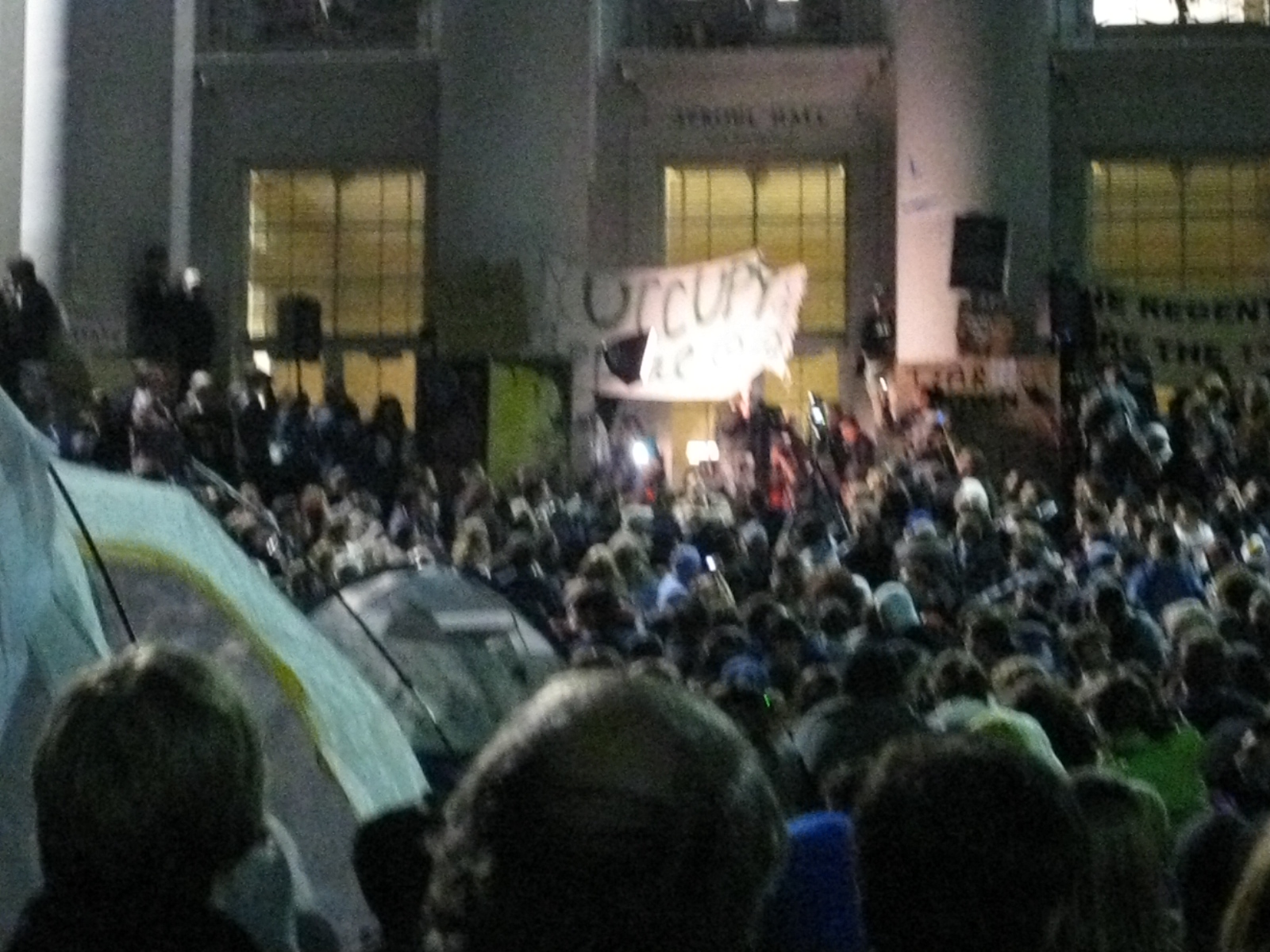


PHOTOS BY CHULEENAN

All,

On Monday evening, November 15, 2011, Chuleenan and I participated in a massive rally and protest sponsored by OccupyCal at Sproul Plaza on the University of California, Berkeley campus in which over 4,000 students and community citizens and activists declared our collective intellectual, spiritual, political and ideological solidarity with the national Occupy Wall Street movement and demanded that the state of California honestly address the crucial issues of the need for real democracy in public education, the exploitive and corrupting influences of the banks and Wall Street on the U.S. economy generally, and the critical political, cultural, and economic relationships between higher education, health care reform, financial regulation, systemic structural investment, and science and technology in a global context. Former Secretary of Labor and currently Professor of Public Policy at UC Berkeley Robert Reich was the keynote speaker who had been chosen by student groups to give the annual Mario Savio memorial lecture in honor of the great and profound legacy left by the late UC, Berkeley philosophy school graduate and leader of the famed Free Speech Movement in 1964 Mario Savio (1942-1996). Reich gave his inspiring speech on the exact same steps on the Plaza directly in front of Sproul Hall that Savio gave his famous speech in December of 1964 at the height of the extraordinary campus wide Free Speech Movement (see Video of that incredible speech below). BTW: The rally and Reich's speech were terrific. Mario would have been very proud of us...

Kofi


MARIO SAVIO AT SPROUL HALL
DECEMBER 2, 1964


"There is a time when the operation of the machine becomes so odious, makes you so sick at heart, that you can't take part; you can't even passively take part, and you've got to put your bodies upon the gears and upon the wheels, upon the levers, upon all the apparatus, and you've got to make it stop. And you've got to indicate to the people who run it, to the people who own it, that unless you're free, the machine will be prevented from working at all!"
--Mario Savio, University of California, Berkeley Sproul Hall--December 2, 1964

"Savio's moral clarity, his eloquence, and his democratic style of leadership inspired thousands of fellow Berkeley students to protest university regulations which severely limited political speech and activity on campus. The non-violent campaign culminated in the largest mass arrest in American history, drew widespread faculty support, and resulted in a revision of university rules to permit political speech and organising. This significant advance for student freedom rapidly spread to countless other colleges and universities across the country."

[Via stonecast, see here: http://www.savio.org/who_was_mario.html

The Rise of Occupy Cal--Thousands Rally and Protest at University of California, Berkeley in Solidarity with the National Occupy Wall Street Movement

Francisco Alvarado yells during an anti-Wall Street rally near Sproul Hall at the University of California, Berkeley during an Occupy Cal rally, Nov. 15, 2011, in Berkeley, Calif. (AP)

Former Secretary of Labor Robert Reich speaks to Anti-Wall Street activists near Sproul Hall at the University of California, Berkeley during an Occupy Cal rally, Nov. 15, 2011, in Berkeley, Calif. (Credit: AP)


http://www.cbsnews.com/8301-201_162-57325649/occupy-protesters-rebuild-uc-berkeley-camp/

November 16, 2011

"Occupy" protesters rebuild UC Berkeley camp


BERKELEY, Calif. - Anti-Wall Street activists began rebuilding their tent encampment on the steps of the University of California, Berkeley student plaza and cheered wildly when former U.S. Labor Secretary Robert Reich implored them to take a moral stand against the very rich owning so much of America's wealth.

A daylong strike and peaceful demonstrations against big banks and education cuts culminated in some 4,000 people rallying at the Reich speech on the steps of the same student plaza that first launched the Berkeley Free Speech Movement in the 1960s.

"The days of apathy are over, folks," Reich, a professor of public policy at UC Berkeley, said to a roaring crowd at Sproul Hall on Tuesday. "We are losing the moral foundation stone on which this country and our democracy were built. There are some people out there who say we cannot afford education any longer, we cannot provide social services for the poor ... but how can that be true if we are now richer than we have ever been before?"

The protests were disrupted earlier in the day by a campus shooting in inside the Haas School of Business. Officials did not know if the suspect was part of the Occupy Cal movement, said Ute Frey, a spokeswoman for the university.

"I just hope it wasn't from the protest or the movement, because that's not what the movement is about," said Sadia Saif, a 19-year-old UC Berkeley sophomore.

The shooting didn't prevent thousands of students and demonstrators from gathering at the university to vote on a list of demands and await Reich's Mario Savio Lecture, named for the political activist and leader of the Berkeley Free Speech Movement of the 1960s. Savio's impassioned speeches on the same steps of Sproul Hall against the Vietnam War and racial inequality prompted thousands of students to join the movement.

"Every social movement in the last half century or more — it started with moral outrage," Reich said, likening Wall Street to the bullies who battered him when he was an especially short kid. "You understand how important it is to fight the bullies, to protect the powerless."

Protesters also cheered as at least 10 tents were constructed on the steps, less than a week after baton-wielding police clashed with people who tried to defy a campus ban on camping.

Elizabeth de Martelly, a 29-year-old UC Berkeley graduate student, said she was inspired by Reich's comments about social movements born from moral outrage and planned to spend the night in the new encampment.

"That said, I want to see the movement to expand beyond encampments," she said amid the music, light shows and dancing. "But this is a powerful thing for the time being."

The Occupy Cal students were joined by hundreds of Occupy Oakland demonstrators who marched the five miles from Oakland to Berkeley along Telegraph Avenue, chanting, "Here comes Oakland!" Police cleared their tent city outside Oakland City Hall on Monday amid complaints about safety and sanitation, and arrested more than 50 people.

Occupy Cal's general assembly voted in favor of inviting the university's chancellor and board of regents to a debate in early December and sending the educational officials a list of demands, including a tuition rollback to 2009 levels.

They also voted in favor of rebuilding their encampment despite earlier violence.
On Nov. 9, police jabbed students with batons and arrested 40 people as the university sought to uphold a campus ban on camping.

UC Berkeley Chancellor Robert Birgeneau launched an investigation into allegations that campus police used excessive force. He said videos of the protests were disturbing, and he plans to grant amnesty to all students who were arrested and cited for attempting to block police from removing the tents.

Birgeneau issued a statement to the students and Occupy demonstrators, saying the university leadership shares in their anger and frustration over relentless tuition hikes and the growing burden on their families.

"We all share the distress and anger at the State of California's disinvestment in public higher education," Birgeneau said.

He called on the "political leadership" from Sacramento to come to campus to engage with him and student representatives in a public forum to debate the future of public education. "The issues require bold action and time is short," he said.

Over the past three years, the cash-strapped state has sharply reduced funding to California's public colleges and universities, which has led to steep tuition hikes, course cutbacks, staff layoffs and reduced student enrollment.

Oscar Varela, 21, a fifth-year economics major who helped organize Tuesday's demonstrations, was among the students who tried to block campus police from tearing down the campus encampment last week.

"We want to stay here to prove to the regents and state that we are part of this movement and that we want our tuition to go back to what it used to be, which essentially should be free," Varela said.

Earlier in the day, university officials said a female staff member reported seeing a man with a gun, who was shot by a university police officer within minutes. The condition of the 33-year-old suspect was not immediately known. His name was not released.

Dong Hwan Kim, 27, a senior, said he was terrified when he learned of the shooting.

"The shooting, in addition to what's happening here with the protests, makes the campus feel really tense," Kim said. "This is a historical moment, but it is also really scary at the same time."

Protesters descended on the university after ReFund California, a coalition of student groups and university employee unions, called for a campus strike and teach-ins.

"If the only people who can come here in the future are those who have money, it's going to hurt everyone's educational experience," said Daniel Rodriguez, 28, a graduate student who was conducting an introductory Spanish language class outside.

Wednesday, November 16, 2011

Occupy Cal Protest Rally at University of California Berkeley Campus, Nov. 15, 2011


General Assembly in front of Sproul Hall at UC Berkeley


PHOTOS BY CHULEENAN

All,

On Monday evening, November 15, 2011, Chuleenan and I participated in a massive rally and protest of Occupy Cal at Sproul Plaza on the University of California, Berkeley campus in which over 4,000 students and community citizens and activists declared our collective intellectual, spiritual, political and ideological solidarity with the national Occupy Wall Street movement and demanded that the state of California honestly address the crucial issues of the need for real democracy in public education, the exploitive and corrupting influences of the banks and Wall Street on the U.S. economy generally, and the critical political, cultural, and economic relationships between higher education, health care reform, financial regulation, systemic structural investment, and science and technology in a global context. Former Secretary of Labor Robert Reich and currently Professor of Public Policy at UC Berkeley Robert Reich was the keynote speaker who had been chosen by student groups to give the annual Mario Savio memorial lecture in honor of the great and profound legacy left by the late UC, Berkeley philosophy graduate and leader of the famed Free Speech Movement in 1964 Mario Savio (1942-1996). Reich gave his inspiring speech on the exact same steps on the Plaza directly in front of Sproul Hall that Savio gave his famous speech on top of a police car in December of 1964 at the height of the extraordinary campus wide Free Speech Movement (see Video of that incredible speech below). BTW: The huge rally and Reich's speech were terrific. Mario would have been very proud of us...

Kofi


MARIO SAVIO AT SPROUL HALL
DECEMBER 2, 1964


"There is a time when the operation of the machine becomes so odious, makes you so sick at heart, that you can't take part; you can't even passively take part, and you've got to put your bodies upon the gears and upon the wheels, upon the levers, upon all the apparatus, and you've got to make it stop. And you've got to indicate to the people who run it, to the people who own it, that unless you're free, the machine will be prevented from working at all!"
--Mario Savio, University of California, Berkeley Sproul Hall Plaza--December 2, 1964

"Savio's moral clarity, his eloquence, and his democratic style of leadership inspired thousands of fellow Berkeley students to protest university regulations which severely limited political speech and activity on campus. The non-violent campaign culminated in the largest mass arrest in American history, drew widespread faculty support, and resulted in a revision of university rules to permit political speech and organising. This significant advance for student freedom rapidly spread to countless other colleges and universities across the country."

[Via stonecast, see here: http://www.savio.org/who_was_mario.html