Showing posts with label Democracy. Show all posts

Thursday, February 22, 2024

Historian, Scholar, Critic, and Activist Nancy MacLean On What the Despicable GOP and Their Fascist MAGA Cult Leader Donald J. Trump is Planning For America if the Nation is Insane Enough To Vote Them Into Power Again in November, 2024

 
DEFEAT FASCISM BEFORE FASCISM DEFEATS YOU
 

Sound the Alarm

Warn Voters About the Radicalism Beyond Trump

The Republicans are plotting to literally rewrite the Constitution to eliminate core rights and protections.
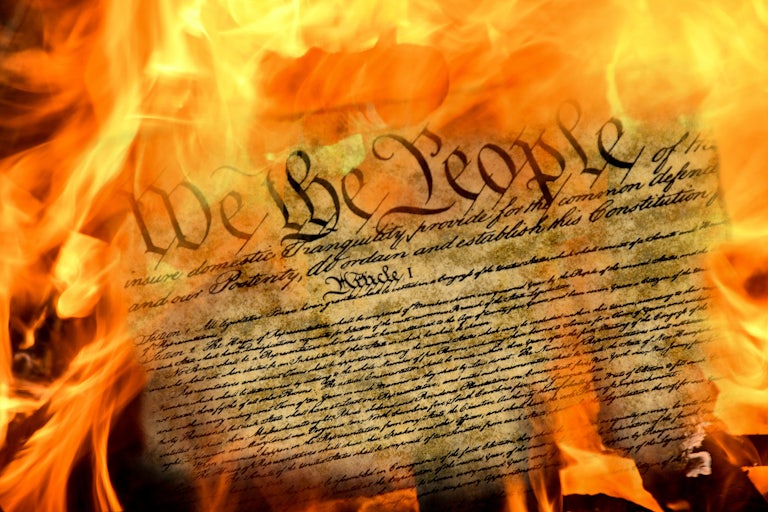
Getty

by Nancy MacLean
February 8, 2024
The New Republic


"...Lurking behind the full-frontal assault by Donald Trump and his enablers lies a more far-reaching threat. If the Republicans gain control of both Houses of Congress, expect a state-authorized Constitutional Convention to eviscerate core rights and protections most Americans hold dear.

Imagine living in a country without Social Security, Medicare, the Affordable Care Act, the right to organize a union, civil rights enforcement, and clean air and water protections, let alone action to stop climate collapse. The Constitutional Convention, in the plain language of the leading organizer for it, aims “to reverse 115 years of progressivism.”

That’s big talk, 115 years. Think it can’t be done? Although the convention push has been all but ignored by the commentariat and national Democratic leaders, it has powerhouse backing. The Koch network and other dark-money donors are generously funding it. The corporation-underwritten American Legislative Exchange Council (ALEC) has supplied “model legislation” and training to Republican state legislators. Endorsers include Mark Meadows, Ron DeSantis, Greg Abbott, Sean Hannity, and many more. Convention of States Action (COS), the 501c(4) organization leading the campaign, whose head was a co-founder of Tea Party Patriots, has recruited and deployed volunteers to lobby their legislatures. (It also offers training in “biblical citizenship.”) COS has held three practice conventions with legislators from nearly every state. The Heritage Foundation—the 800-pound gorilla on the right—recently signed on in “a game-changing report” that such a convention would be “a potent check on federal power” and is “a worthy cause.” That endorsement is likely to drive even more cash to add to the over $70 million in IRS-traceable contributions that groups solely focused on convening such a gathering have garnered from 2012 to 2022, in findings of the Center for Media and Democracy. That figure does not include contributions to ALEC, which has promoted the convention since 2013; its revenue hovers around $10 million annually.

Promoters have been methodically lining up authorizations from the states since the 2012 election showed them that most Americans reject the kind of society they seek, even Mitt Romney’s mild version. So strategists concluded that the only way to permanently entrench minority rule by plutocrats and theocrats is to encase it in a dramatically altered Constitution.

They count on most of us remaining in the dark until it is too late to stop their scheme.

So far, that’s proved a good gamble. How many of us know that there are two routes to amending the Constitution—the usual one, and the nuclear option never yet tried?

Under Article V of the Constitution, Congress “shall call a convention for proposing amendments” when it receives applications from two-thirds of the states. In reality, this is hard, because one party would need to control both houses of 34 state legislatures (or 33 plus unicameral Nebraska). But ALEC has fabricated a claim built around the idea that enough states have made past calls for a convention, some going back decades, for the idea to proceed. It plans to use these outdated state resolutions to argue to the courts that they should force Congress to convene one.

But it gets worse. If Republicans control Congress, they won’t have to bother with litigation, because it would be up to the majority in control to determine the validity of the applications—and Article V lacks the guardrails to prevent this manipulation.

Seriously? Yes, alas. House Speaker Mike Johnson, who would be in a position to call it, is a longtime ally of COS.

So how exactly would a convention nullify the Democratic agenda, past and current? The six amendments adopted by the Simulated Convention held in Williamsburg, Virginia, on August 4, 2023, would dismantle reforms We the People have won over generations. The centerpiece amendment, entitled “Fiscal Restraints,” is a one-two punch to knock out popular programs such as Social Security, unemployment insurance, Medicare, and Medicaid. By mandating that two-thirds of both houses of Congress would have to agree to any tax increase, it would force annually balanced budgets, while making it all but impossible to raise revenue from the wealth-hoarding ultrarich who back this radical agenda.

Another amendment takes dead aim at all federal regulation since 1937 and civil rights and environmental policies since then. It would obliterate the “administrative state,” the bugbear of the hard-right coalition. The measure would in short order end fair labor standards, antitrust enforcement, environmental protections, safeguards for workers who choose to unionize, civil rights on the job and in public accommodations, and the Affordable Care Act, among other hard-won reforms that ease hardship and protect us from corporate domination.

Still another amendment would allow a simple majority of state legislatures “to abrogate any action of Congress, President, or administrative agencies.” That could stop federal intervention to ensure the equal citizenship rights established in the Thirteenth, Fourteenth, and Fifteenth Amendments.

The simulated convention’s last adopted amendment would be a gargantuan gift to fossil fuel corporations. It would require Congress to turn over to state control virtually all federal lands and mineral rights, including any national park, monument, or wilderness area designated since 1975.


But this is madness, you will say. These reactionaries could never get away with rewriting the Constitution!

Except they could. First, because the instigators have already adopted a representation scheme for the convention based on one-vote-per-state, chosen by the legislatures; it gives near-empty states like Alaska and Wyoming the same power as California and New York. Second, because by crooked counting (“aggregating”) of ancient authorizations with those recently obtained, planners claim that the threshold needed to call a convention under Article V has already been met: two-thirds of the states. Third, because most of us aren’t even aware that this is happening.

For the American people to realize how much is at stake will require vast and to-the-point popular education. While the right has been tutoring its base in its version of the Constitution for years, the left has dropped this ball badly, particularly on such vital but wonky matters as how interpretation of the Commerce Clause after 1937 enabled all the federal regulations demanded by voters that had been overturned until then by reactionary justices.

But here’s the silver lining as we approach November. Democrats could jiujitsu this. Why not use the right’s menace to the Constitution to energize turnout to reclaim for Democrats state legislatures lost since 2010? The consummation of the right-wing plan depends on convention backers being able to control most statehouses. If Democratic get-out-the-vote workers train voters to fill out the entire ballot, including state legislative and judicial races, progressives could reclaim vast power to enact the popular agenda that Republican elected officials have blocked.

This urgent emphasis on winning at the state level could pay off handsomely. It might even help top-of-the-ticket candidates. Few know it, but the 2016 election was likely the first time a president was swept into office on the “reverse coattails” of Senate candidates (thanks to a flood of last-minute money from corporate donors afraid of losing the upper chamber in the predicted Hillary Clinton sweep). Wouldn’t it be a delicious inversion if President Biden won reelection and Republicans suffered a shellacking in House and Senate races because informed voters turned out in epic numbers to keep the right from rigging the Constitution?

ABOUT THE AUTHOR:


Nancy MacLean


Nancy MacLean is the William H. Chafe Distinguished Professor of History and Public Policy and author most recently of Democracy in Chains: The Deep History of the Radical Right’s Stealth Plan for America.


"What's Past is Prologue..."

http://panopticonreview.blogspot.com/…/the-panopticon-revie…

IMPORTANT NEW BOOK:

 
NOTE: This book is one of the Panopticon Review's 20 Outstanding books of 2017

Democracy in Chains: The Deep History of the Radical Right’s Stealth Plan for America
by Nancy MacLean
Viking, 2017

[Publication date: June 13, 2017]


https://kbimages1-a.akamaihd.net/…/…/democracy-in-chains.jpg

Finalist for the 2017 National Book Award

“[A] vibrant intellectual history of the radical right . . .” – The Atlantic

“This sixty-year campaign to make libertarianism mainstream and eventually take the government itself is at the heart of Democracy in Chains. . . . If you're worried about what all this means for America's future, you should be” – NPR

An explosive exposé of the right’s relentless campaign to eliminate unions, suppress voting, privatize public education, and change the Constitution.

Behind today’s headlines of billionaires taking over our government is a secretive political establishment with long, deep, and troubling roots. The capitalist radical right has been working not simply to change who rules, but to fundamentally alter the rules of democratic governance. But billionaires did not launch this movement; a white intellectual in the embattled Jim Crow South did. Democracy in Chains names its true architect—the Nobel Prize-winning political economist James McGill Buchanan—and dissects the operation he and his colleagues designed over six decades to alter every branch of government to disempower the majority.

In a brilliant and engrossing narrative, Nancy MacLean shows how Buchanan forged his ideas about government in a last gasp attempt to preserve the white elite’s power in the wake of Brown v. Board of Education. In response to the widening of American democracy, he developed a brilliant, if diabolical, plan to undermine the ability of the majority to use its numbers to level the playing field between the rich and powerful and the rest of us.

Corporate donors and their right-wing foundations were only too eager to support Buchanan’s work in teaching others how to divide America into “makers” and “takers.” And when a multibillionaire on a messianic mission to rewrite the social contract of the modern world, Charles Koch, discovered Buchanan, he created a vast, relentless, and multi-armed machine to carry out Buchanan’s strategy.

Without Buchanan's ideas and Koch's money, the libertarian right would not have succeeded in its stealth takeover of the Republican Party as a delivery mechanism. Now, with Mike Pence as Vice President, the cause has a longtime loyalist in the White House, not to mention a phalanx of Republicans in the House, the Senate, a majority of state governments, and the courts, all carrying out the plan. That plan includes harsher laws to undermine unions, privatizing everything from schools to health care and Social Security, and keeping as many of us as possible from voting. Based on ten years of unique research, Democracy in Chainstells a chilling story of right-wing academics and big money run amok. This revelatory work of scholarship is also a call to arms to protect the achievements of twentieth-century American self-government.

For decades, the capitalist radical right has been hard at work to crush unions, suppress voting, privatize public education, change the Constitution and rig the rules of American democracy. Nancy MacLean names the architects of this movement, showing how corporations, right-wing foundations and billionaires have supported a strategy designed to disempower the majority.


“[A] vibrant intellectual history of the radical right . . .” – The Atlantic

“This sixty-year campaign to make libertarianism mainstream and eventually take the government itself is at the heart of Democracy in Chains. . . . If you're worried about what all this means for America's future, you should be” – NPR

“Riveting” – O, The Oprah Magazine (Top 20 Books to Read This Summer)

An explosive exposé of the right’s relentless campaign to eliminate unions, suppress voting, privatize public education, and change the Constitution.

Behind today’s headlines of billionaires taking over our government is a secretive political establishment with long, deep, and troubling roots. The capitalist radical right has been working not simply to change who rules, but to fundamentally alter the rules of democratic governance. But billionaires did not launch this movement; a white intellectual in the embattled Jim Crow South did. Democracy in Chains names its true architect—the Nobel Prize-winning political economist James McGill Buchanan—and dissects the operation he and his colleagues designed over six decades to alter every branch of government to disempower the majority.

In a brilliant and engrossing narrative, Nancy MacLean shows how Buchanan forged his ideas about government in a last gasp attempt to preserve the white elite’s power in the wake of Brown v. Board of Education. In response to the widening of American democracy, he developed a brilliant, if diabolical, plan to undermine the ability of the majority to use its numbers to level the playing field between the rich and powerful and the rest of us.

Corporate donors and their right-wing foundations were only too eager to support Buchanan’s work in teaching others how to divide America into “makers” and “takers.” And when a multibillionaire on a messianic mission to rewrite the social contract of the modern world, Charles Koch, discovered Buchanan, he created a vast, relentless, and multi-armed machine to carry out Buchanan’s strategy.

Without Buchanan's ideas and Koch's money, the libertarian right would not have succeeded in its stealth takeover of the Republican Party as a delivery mechanism. Now, with Mike Pence as Vice President, the cause has a longtime loyalist in the White House, not to mention a phalanx of Republicans in the House, the Senate, a majority of state governments, and the courts, all carrying out the plan. That plan includes harsher laws to undermine unions, privatizing everything from schools to health care and Social Security, and keeping as many of us as possible from voting. Based on ten years of unique research, Democracy in Chains tells a chilling story of right-wing academics and big money run amok. This revelatory work of scholarship is also a call to arms to protect the achievements of twentieth-century American self-government.

Reviews:

“A remarkable new book which argues that the radical right revolution engineered by Charles and his brother David is not just about accruing political and economic power, but about restricting democracy itself.”
—The New Republic

“[A] vibrant intellectual history of the radical right . . . [MacLean] has dug deep into her material—not just Buchanan’s voluminous, unsorted papers, but other archives, too—and she has made powerful and disturbing use of it all. . . . The behind-the-scenes days and works of Buchanan show how much deliberation and persistence—in the face of formidable opposition—underlie the antigoverning politics ascendant today. What we think of as dysfunction is the result of years of strategic effort.”
—The Atlantic

“This sixty-year campaign to make libertarianism mainstream and eventually take the government itself is at the heart of Democracy in Chains. . . . [MacLean] takes the time to meticulously trace how we got here. . . . If you're worried about what all this means for America's future, you should be. . . . And if someone you know isn't convinced, you have just the book to hand them.”
—NPR

“[A] riveting, unsettling account of 'Tennessee country boy' James McGill Buchanan, key architect of today's radical right.”
—O, The Oprah Magazine

"Perhaps the best explanation to date of the roots of the political divide that threatens to irrevocably alter American government.”
—Booklist (starred review)

“It’s happening: the subversion of our democratic system from within. How did the political Right do it? Nancy MacLean tells the long-overlooked story of the political economist who developed the playbook for the Koch brothers. James McGill Buchanan merged states rights’ thinking with free market principles and helped to fashion the inherently elitist ideology of today’s Republican Party. Professor MacLean’s meticulous research and shrewd insights make this a must-read for all who believe in government ‘by the people.’”
—Nancy Isenberg, author of White Trash: The 400-Year Untold History of Class in America

“This book is mesmerizing. Rarely have I encountered a work that speaks to such significant issues, with evidence rooted in conclusive new sources. In clear prose, MacLean reveals how a public once committed to social responsibility and egalitarian values became persuaded that only an unregulated free market could protect ‘liberty’ and ‘choice.’ Because of this, our once cherished democracy is now subject to attack. Everyone who wants to understand today’s confrontational politics should read this important book, now.”
—Alice Kessler-Harris, author of In Pursuit of Equity: Women, Men and the Quest for Economic Citizenship in Twentieth Century America

“How did we get to where we are today? How did corporations come to possess ‘rights?’ How did democracy come to be defined as selfish individualism? Or money as free speech? Nancy MacLean’s Democracy in Chains provides the answers. It is essential reading in order to understand the ideas that billionaires use to justify their control of our political institutions. I can’t imagine a more timely or urgent book.”
—Greg Grandin, author of Fordlandia (finalist for the Pulitzer Prize) and The Empire of Necessity (winner of the Bancroft Prize)

"[MacLean] creates a chilling portrait of an arrogant, uncompromising, and unforgiving man . . . [she] offers a cogent yet disturbing analysis of libertarians' current efforts to rewrite the social contract and manipulate citizens' beliefs. . . . An unsettling exposé of the depth and breadth of the libertarian agenda."
—Kirkus Reviews

"MacLean constructs an erudite searing portrait of how the late political economist James McGill Buchanan (1919 - 2013) and his deep-pocketed conservative allies have reshaped --and undermined--American democracy. . . . A thoroughly researched and gripping narrative, she exposes how Buchanan’s strategies shaped trends in government in favor of “corporate dominance” and against the welfare state. . . . She has delivered another deeply important book. . . . Her work here is a feat of American intellectual and political history."
—Publisher's Weekly (starred review)

“For those who think the Tea Party, Freedom Caucus, and the alt-right are recent constructs, MacLean provides an extensive history lesson that traces the genesis of the right wing back to post-WWII doctrines. . . . A worthy companion to Jane Mayer’s Dark Money, MacLean’s intense and extensive examination of the right-wing’s rise to power is perhaps the best explanation to date of the roots of the political divide that threatens to irrevocably alter American government.”
—Booklist (starred review)


ABOUT THE AUTHOR:

Nancy MacLean is the award-winning author of Behind the Mask of Chivalry (a New York Times "noteworthy" book of the year) and Freedom is Not Enough, which was called by the Chicago Tribune “contemporary history at its best.” The William Chafe Professor of History and Public Policy at Duke University, she lives in Durham, North Carolina.

http://www.npr.org/…/democracy-in-chains-traces-the-rise-of…

Book Reviews

'Democracy In Chains' Traces The Rise Of American Libertarianism
June 18, 2017


Book Reviewed by Genevieve Valentine
National Public Radio (NPR)


Democracy in Chains: The Deep History of the Radical Right's Stealth Plan for America
by Nancy MacLean
Viking, 2017
334 pages

Obscuring census data to give "conservative districts more than their fair share of representation." Preventing access to the vote. Decrying "socialized medicine." Trying to end Social Security using dishonest vocabulary like "strengthened." Lionizing Lenin. Attempting to institute voucher programs to "get out of the business of public education." Increasing corporatization of higher education. Harboring a desire, at heart, to change the Constitution itself.

This unsettling list could be 2017 Bingo. In fact, it's from half a century earlier, when economist James Buchanan — an early herald of libertarianism — began to cultivate a group of like-minded thinkers with the goal of changing government. This ideology eventually reached the billionaire Charles Koch; the rest is, well, 2017 Bingo.

This sixty-year campaign to make libertarianism mainstream and eventually take the government itself is at the heart of Democracy in Chains. It's grim going; this isn't the first time Nancy MacLean has investigated the dark side of the American conservative movement (she also wrote Behind the Mask of Chivalry: The Making of the Second Ku Klux Klan), but it's the one that feels like it was written with a clock ticking down.

Still, it takes the time to meticulously trace how we got here from there. Charles and his brother David Koch have been pushing the libertarian agenda for more than 20 years. A generation before them, Buchanan founded a series of enclaves to study ways to make government bend. Before that, critic and historian Donald Davidson coined the term "Leviathan" in the 1930s for the federal government, and blamed northeasterners for "pushing workers' rights and federal regulations. Such ideas could never arise from American soil, Davidson insisted. They were 'alien' European imports brought by baleful characters." And going back another century, the book locates the movement's center in the fundamentalism of Vice President John C. Calhoun, for whom the ideas of capital and self-worth were inextricably intertwined. (Spoilers: It was about slavery.)

It's grim going; this isn't the first time Nancy MacLean has investigated the dark side of the American conservative movement ... but it's the one that feels like it was written with a clock ticking down.

Buchanan headed a group of radical thinkers (he told his allies "conspiratorial secrecy is at all times essential"), who worked to centralize power in states like Virginia. They eschewed empirical research. They termed taxes "slavery." They tried repeatedly to strike down progressive action — school integration, Social Security — claiming it wasn't economically sound. And they had the patience and the money to weather failures in their quest to win.

As MacLean lays out in their own words, these men developed a strategy of misinformation and lying about outcomes until they had enough power that the public couldn't retaliate against policies libertarians knew were destructive. (Look no further than Flint, MacLean says, where the Koch-funded Mackinac Center was behind policies that led to the water crisis.) And it's painstakingly laid out. This is a book written for the skeptic; MacLean's dedicated to connecting the dots.

She gives full due to the men's intellectual rigor; Buchanan won the Nobel for economics, and it's hard to deny that he and the Koch brothers have had some success. (Alongside players like Dick Armey and Tyler Cowen, there are cameos from Newt Gingrich, John Kasich, Mitt Romney, and Antonin Scalia.) But this isn't a biography. Besides occasional asides, MacLean's much more concerned with ideology and policy. By the time we reach Buchanan's role in the rise of Chilean strongman Augusto Pinochet (which backfired so badly on the people of Chile that Buchanan remained silent about it for the rest of his life), that's all you need to know about who Buchanan was.

We are, 'Democracy in Chains' is clear, at a precipice.

If you're worried about what all this means for America's future, you should be. The clear and present danger is hard to ignore. When nearly every radical belief the Buchanan school ever floated is held by a member of the current administration, it's bad news.

But it's worth noting that the primary practice outlined in this book is the leveraging of money to protect money — and the counter-practice is the vocal and sustained will of the people. We are, Democracy in Chains is clear, at a precipice. At the moment, the first practice is winning. If you don't like it, now's the time to try the second. And if someone you know isn't convinced, you have just the book to hand them.

ABOUT THE AUTHOR:

Genevieve Valentine's latest novel is Icon.

Thursday, February 1, 2024

Scholar, Activist, Critic, and Historian Henry A. Giroux On the Grave Necessity of Speaking Out Against, Standing Up To, and Defeating Fascism in the 21st Century--At Home and Abroad

 WHAT IS FASCISM?
"Fascism is a system of political authority and social order intended to reinforce the unity, energy, and purity of communities in which liberal democracy stands accused of producing division and decline...a form of political behavior marked by obsessive preoccupation with community decline, humiliation or victimhood and by compensatory cults of unity, energy and purity, in which a mass-based party of committed nationalist militants, working in uneasy but effective collaboration with traditional elites, abandons democratic liberties and pursues with redemptive violence and without ethical or legal restraints goals of internal cleansing and external expansion.”
—Robert Paxton, “The Anatomy of Fascism"


Silence Is Dangerous in the Current Age of Rising Fascism in the US

Social movements are creating powerful new languages for confronting tyranny. We must resist the plague of silence.

PHOTO: Former president Donald Trump speaks to the media outside a polling location at Londonderry High School in Londonderry, New Hampshire, on January 23, 2024. Jabin Botsford / The Washington Post via Getty Images

This week’s revelation that Donald Trump is already plotting new ways to try to put himself permanently above the law is just the latest reminder of the looming threat of lawless and emboldened right-wing forces in the United States. Trump’s new scheme to expand a Nixon-era policy memo to prohibit the Justice Department from prosecuting presidents, even after they leave office, is just a tiny hint of the greater threat. In recent months, several scholars have sounded the alarm that the United States is “sleepwalking towards authoritarianism.” The concern is not unfounded given that in his run for the presidency in 2024, Trump has boldly telegraphed his aspirations to impose an authoritarian future on the United States. He has repeatedly injected authoritarian language, extremist ideas and threats of violence into the mainstream. Moreover, he has done so to “create a climate of trepidation and powerlessness that discourages mobilization by the opposition,” in the words of scholar Ruth Ben-Ghiat. Forecasting his authoritarian intentions, Trump has openly stated that he intends to terminate portions of the U.S. Constitution, calls his political enemies “vermin” and boldly proclaims he will make himself a dictator “on day one.” On Truth Social, he claimed without irony that a president should have blanket authority and total immunity “even for events that ‘cross the line.’” He has repeatedly stated that if he regains the White House, “it will be a time for retribution” and revenge.

Taking pages from Hitler’s speeches, Trump has also said that the biggest threat to the United States “is from within.” In this instance, he reproduces a version of McCarthyite slander with his claim that the country is being overrun by “communists, Marxists, fascists and the radical left thugs that live like vermin within the confines of our country, that lie and steal and cheat on elections, and need to be rooted out.” His constant attacks on what he labels as the “enemy within” are meant to incite his MAGA followers to wage violence against people of color, critics, progressives, LGBTQ+ Americans, news networks, immigrants, feminists, and any other group that does not buy into Christian nationalist, white supremacist views.

Trump’s discourse overflows with the genocidal language used in the Third Reich. The historian Heather Cox Richardson rightly notes that Trump’s “use of language referring to enemies as bugs or rodents has a long history in genocide because it dehumanizes opponents, making it easier to kill them. In the U.S., this concept is most associated with Hitler and the Nazis, who often spoke of Jews as ‘vermin’ and vowed to exterminate them.”

Trump has claimed that immigrants “are poisoning the blood of our country” and polluting his notion of white Christian culture, and he’s indicated that, if reelected, he plans to make them undergo “ideological screening” in order to enter the country legally (assuming here that he wants to make sure they would not vote for the Democratic Party). If his vision were carried out, millions of undocumented immigrants would be barred from the country while others would be rounded up, put into what amount to Gulag camps, and subjected to unimaginably harsh policies. Given Trump’s calls to shoot shoplifters, impose death penalties on drug dealers, and his suggestion that his former chair of the Joint Chiefs of Staff, Mark Milley, “deserves to be executed,” there is no reason to doubt Trump’s authoritarian designs.

On the campaign trail, Trump repeatedly echoes the language of autocrats such as Hungarian Prime Minister Viktor Orbán, who embraces the concept of “illiberal democracy,” and claims, as The Guardian points out, that the biggest threat to Hungary and other nations is “the ‘mixing’ of European and non-European races.” Trump and the GOP, like many of the authoritarian politicians they admire, believe that equality is a weakness endemic to democracy and destroys society. Trump’s contempt for the law and desire for absolute power is not only evident in his remarks about wanting to be a dictator; it was also on full display when his legal team argued before a D.C. Circuit Court that unless Trump is impeached, he could not be held responsible for “selling pardons, military secrets, or simply having people assassinated.” As Thom Hartmann put it, “Trump’s lawyer argued before the DC Appeals Court that if Trump became president again, he could order SEAL Team Six to assassinate Joe Biden or Liz Cheney and nobody could do anything about it.” While Trump’s lawlessness is central to his grab for unchecked power, there are also displays of the delusions and aspirations of a Nazi-infested politics.

What is especially disturbing about the emerging fascism in the United States is the lack of general public outrage that accompanies it. Such silence extends from almost the entirety of the Republican Party, the mainstream media, 84 percent of white Evangelicals, and a number of the wealthiest American billionaires and corporate tycoons. While the Democratic Party, including President Joe Biden, have called out Trump as a fascist, they have been silent about their support for decades of neoliberal economic policies, the ravages of deindustrialization, a staggering rise in economic inequality and cuts to social programs. Such policies have produced the conditions that have accelerated the rise of authoritarianism in the United States. Wedded to the interests of the banks, corporate ideology and the financial elite, their silence should come as no surprise. At the same time, such policies have produced enormous economic hardships and a diminished sense of agency that creates an enforced silence among the most impoverished populations and often results in their inevitable retreat from politics, especially in relation to voting in national elections.

In the current historical moment, language has increasingly forfeited its obligation to a politics of truth, justice, equality and freedom, and in doing so has turned cannibalistic and cruel. As political horizons and public life wither under the assault of an emerging fascism and a mainstream media that refuse to confront it, language appears to fail in the presence of what Zygmunt Bauman called “the emergence of modern barbarity.” A continuing series of crises — political, cultural, economic and ecological — are translated into emotional plagues of fear, lies and violence produced by right-wing spectacles that have undermined the ability of the U.S. public to address critically the endless attacks by tyrannical forces on democratic ideas, values and institutions. Matters of historical context, interconnections, informed judgment and critical analysis that refuse to divorce themselves, in the words of Winifred Woodhull, “from social institutions and material relations of power and domination” are either ignored or disappear from public view. Language in the age of gangster capitalism and fascist politics is under siege, functioning less as a vehicle of audacious truth and moral witnessing than as a tool to purge democracy of its ideals. In the face of a politics of enforced silence, the United States is experiencing an era marked by what Brad Evans calls “a closing of the political,” grounded in the assumption that “nothing can be done.”

The poisonous shadow of authoritarianism has entered the public imagination in spectacular fashion as a normalized political discourse. A boisterous creed of “annihilating nihilism” marked by a politics of vacuousness, resentment, historical amnesia, self-interest and freedom from responsibility has become a dominating force in U.S. politics. A right-wing vocabulary of hatred, bigotry, lies and conspiracy theories has produced a brutalizing politics whose rhetoric and polices echo a dark and horrifying period of history unlike anything we have seen since the 1930s in Europe. The mobilizing passions of fascism are now being produced, circulated and legitimated though all aspects of the mass media, which are increasingly under the control of a billionaire class. How else to explain not only Trump’s public courting of white supremacists and antisemites, such as Nick Fuentes and Kanye West, but also Nikki Haley’s claim that slavery was not the cause of the Civil War? Such comments reveal the GOP’s fascist tendency not only to whitewash and seek to erase the relevance of the history of racism, but also to endorse the poisonous ideologies of white nationalism and white supremacy. As Czech dissident Václav Havel once remarked, “the disorder of real history is replaced by the orderliness of pseudo-history.… Instead of events, we are offered non-events.”

Diverse social movements … produced a language that allows us to recognize ourselves as agents, not victims.

Extremist language that was once considered unimaginable and relegated to fringe groups has been elevated to the center of power, politics and everyday life. For instance, billionaire Elon Musk’s recent racist comments echo the racial eugenicist movements in the U.S. in the 19th and 20th centuries, from which Hitler took inspiration. Yet, little is said in the mainstream press connecting Musk’s comments to a shameful past that gave us the Tuskegee experiments and provided a rationale for Jim Crow and racial segregation laws. Enforced silence is a tool for the repression of history and the wiping out of historical consciousness and memory, especially those moments in history we associate with segregation, exploitation, disposability and genocide. Fascist discourse is currently abetted and affirmed by ongoing public displays of the detritus of fascist politics, which makes visible that which the United States has forgotten and of which it should be ashamed — that is, a society in which collective morality and the ethical imagination appear to no longer matter.

Beyond bold and unapologetic public displays of fascist rhetoric, beliefs and policies, there are relentless right-wing assaults against democracy that are barely recognized in the media and in public discourse for the danger they pose to democracy. A short list includes book censorship, turning libraries into student detention centers, voter suppression laws, threatening election workers, assaulting reproductive rights, enacting cruel policies against queer and trans people and harassing critical educators. In addition, schools are turned into indoctrination centers, torrents of propaganda replace facts, history is whitewashed, dissent is suppressed and those who provide medical care to trans people and people in need of abortions are criminalized.

These authoritarian aggressions have become embedded in United States culture to the degree that they fail to garner any alarm or concern from the wider public. As fascist beliefs, values and language multiply, so do attacks by far right politicians, reactionary pundits and white supremacists against diversity, equality and inclusion, all the while promoting a white nationalist notion of who counts as a citizen. As Toni Morrison once noted, this is a language constrained by the “weary and wearying vocabulary of racial domination.” It is “a dead language” trapped in sordid silence regarding the racist ideology that drives its claims to “exclusivity and dominance.”

A dangerous silence now often accompanies a language at war with democratic ideals and the public imagination. This is an enforced silence among the larger public that purposely mutes matters of critical agency, moral responsibility, reason, justice and the demands of keeping alive a substantive democracy. It is a language where moral outrage disappears, is silenced or both, while concealing the danger that this fascist language portends. This is a depoliticizing silence that clouds lies and untruths in mindless theater, spectacles and a flood of evasions. Under such circumstances, community is emptied of any substance, reduced to notions of the social organized around the merging of lies and violence. The loneliness and social atomization produced under neoliberalism provide fodder for the dictatorial energies that offer forms of the false promise of community rooted in hate, bigotry and lies, often resulting in habitual ignorance to justice. Mainstream institutions such as schools, the media and online platforms that should trade in imaginative ideas and provide a critical culture are under siege. One consequence is the breakdown of civic culture, egalitarian values and politics itself. What many Americans fail to realize is that this reactionary mode of silence is a form of complicity that creates a political climate marked by cruelty, violence and lawlessness. How else to explain the lack of public outrage against an extremist Republican Party that rejects free summer lunch programs for food-insecure youth, weakens child labor laws and restricts voting rights?

Liberal and conservative Americans are immersed in a crisis of silence that ignores the fact that politicians such as Trump embrace totalitarian values — the language of dictators — and advocate for violence as a tool of political opportunism. This is not to suggest that all forms of silence function to erase the scourge of racism, white supremacy and the misery imposed by neoliberal capitalism.

Silence can be contemplative, offer consolation, and provide the space for close analysis, thinking critically and mobilizing modes of critical agency. However, in an era marked by a massive flight from ethical and political responsibility, a particular kind of administered silence emerges, one that subverts any sense of critical agency and abandons a more noble message regarding a warning of the dangers to come and the lessons to be addressed. Under such conditions, silence operates increasingly within oppressive relations of power. Tyrannical relations of power are now at the center of U.S. politics and radiate a contempt for dissent, integrity, compassion and liberty which, as Bauman notes in his book Babel, ejects “any sense of critical agency and [refuses] to recognize the bonds we have with others.”

In the face of injustice, silence has become ethically mute, and exhibits a dehumanizing indifference to human suffering in the midst of dangerous politics. Enforced silence, both as a subjective stance and as a political space of organized moral irresponsibility and self-deception, increasingly legitimates and helps to produce a society that has lost its moral bearings and wallows in a repudiation of civic courage and human rights. This current politics of enforced silence is happening at a time when many Americans seem oblivious to the threat posed to democracy by Trump, the GOP, far right foundations, reactionary cultural apparatuses and neoliberal educational institutions.

Silence today has become part of a politics of disappearance where critical ideas are buried along with dangerous memories, and the bodies of journalists, poets and those who lead the fight against oppression in its diverse modes. As Spanish painter Francisco Goya once warned of the degree to which truth and informed judgments are overcome by ignorance, superstition and falsehoods, “the sleep of reason produces monsters.” Martin Luther King Jr. gave a contemporary valence to Goya’s warning in his famous 1967 speech, “Beyond Vietnam: A Time to Break the Silence.” His words alerted Americans to the dangers of refusing to speak out in the face of militarism, racism and massive poverty. Stating that “a time comes when silence is betrayal,” King was clear regarding how the refusal to speak out eviscerates both the idea of democracy and the promise of resisting the mobilizing passions of fascism, especially militarism, poverty and racism. The challenge posed by King’s call to resist a complicitous silence in the face of injustice is exceptionally relevant today. At the heart of this challenge is the need to not only make detectable the current threats to democracy but also to understand how silence in the face of tyranny legitimates authoritarianism along with the risks it poses to any viable notion of justice, equality and freedom.

It is important to note that fascism not only arrives through the language of hate, bigotry, dehumanization and military dictatorships as it did in Chile and Argentina in the 1970s; it also arrives through the everyday acceptance of an ethically debilitating silence. In the current moment, such silence accompanies authoritarian threats to democracy. A politics of silence facilitates a tsunami of manufactured ignorance advanced by the repression of dissent, the cowardice of the mainstream media, the unaccountability of social media platforms steeped in the astonishing toxicity of hatred, and a disdain for equality, freedom and truth in a society, notes Jonathan Crary, governed by the corrupting force of the billionaire elite.

Given the current threat posed to U.S. democracy, enforced silence should be analyzed within the uniquely current threats to liberty, basic human rights and equality that sabotage any viable notion of democracy. Such a challenge is especially crucial at a time when the habits of democracy are being replaced by what David Graeber called the “habits of oligarchy, as though no other politics are possible.” The politics of silence increasingly works through multiple sites and seemingly contrasting impulses, often aligning itself with a reactionary disdain for the public good. In part, it does so by refusing to address the growing (yet to some, seemingly unrelated) issues of Trump’s full embrace of fascist politics, the growing attacks on freedom of expression and the struggle for social justice.

This is all the more reason to reclaim the language of the common good; to protect public and higher education from a fascist takeover; to reject the privatization of public goods; expand the power of unions and the rights of workers, people of color, women, immigrants, queer and trans people, and all those others considered excess and disposable. The plague of silence has to be broken so as to inject the struggle for human rights back into the language of politics, and to fight for a socialist democracy built on the anti-capitalist values of equality, social justice, liberty and human dignity. The words of Frederick Douglass are prescient here and worth remembering. He writes:

If there is no struggle, there is no progress. Those who profess to favor freedom and yet deprecate agitation are men who want crops without plowing the ground. They want rain without thunder and lightning. They want the ocean without the roar of its mighty waters.

If the plague of silence is to be overcome, Americans need to tap into a language that makes clear that they will not look away or refuse to stand up in the face of fascist aggression. The brilliant writer Maaza Mengiste argues for such a language with his call for a vocabulary that “will take us from shock and stunned silence toward a coherent, visceral speech, one as strong as the force that is charging at us.”

Fortunately, especially since the Occupy movement in 2011, a number of social movements have emerged to provide a language that both exposes and makes the ruthless power of the financial elite and other anti-democratic forces accountable through a discourse of critique and hope. The Occupy movement made the discourse of inequality and class differences a more central part of a national political narrative. In the last decade, workers have used the language of economic justice, solidarity and fair play to reenergize the labor movement. The resurgence of the labor movement provided a discourse that exposes how neoliberalism benefits the wealthy and privileged.

Silence has become the language through which people are either depoliticized or are willingly complicit with the economic and racial forces of totalitarianism.

Meanwhile movements such as the movement for Black lives have highlighted the language of structural racism along with making visible a history of slavery, racial abuse and police violence, and crafting a nuanced and multidimensional discourse of liberation.

The #MeToo movement created new discourses to make visible the pervasive extent of sexual assault, violence and harassment across a wide variety of sites and greatly advanced gender justice.

The abolitionist movement has provided a contextual and relational language highlighting the punitive nature of highly racialized criminal legal system and the carceral state while instituting a national movement to defund the police.

Trans and queer people have invigorated a movement and language that critiques the right-wing weaponization of marginalized and ostracized identities.

Climate activists have exposed the danger fossil fuels pose to the planet, and how the most vulnerable populations, especially Black and Brown communities, pay a heavy price for the abuses of the oil and gas industries. In doing so, they have inserted the language of climate justice into the public sphere and made clear how capitalism is creating a murderous future for human beings by destroying the environment.

Black and Brown theorists working with the idea of intersectionality have provided a new language highlighting how every social movement is “shaped by multiple intersecting inequalities and power dynamics,” which draw “attention to unmarked categories” of both oppression and resistance. All of these movements have imaginatively offered a new language of politics and continue to further expand and sharpen such discourses.

Equally promising is the increased political activism of young people, who are voicing a language and pedagogy of disruption, critique and possibility. As I stated more than a decade ago in Truthout, theirs is a language “that recognizes that there is no viable politics without will and awareness and that critical education motivates and provides a crucial foundation for understanding and intervening in the world.” Young people recognize that they have been written out of the script of democracy for too long and are now creating spaces and enacting a language in which to expand individual and social agency through collective forms of resistance as starting points to build a new democratic social order.

Fortified with the energy and language of these dynamic movements, it is incumbent upon the broader left and its various social movements to continue to develop a language that not only highlights social injustices but also includes a vocabulary that moves people, allows them to feel compassion for “the other” and gives them the courage to talk back. Beyond highlighting the wide range of social injustices, all of us on the left must continue to develop a vocabulary that speaks to people’s needs in a way that is moving, affirming, recognizable and enables them to confront the burden of conscience in the face of the unspeakable, and to do so with a sense of dignity, self-reflection and the courage to act individually and collectively in the service of a radical democracy.

One important contribution of these diverse social movements is that they all produced a language that allows us to recognize ourselves as agents, not victims. In doing so, they have expanded the discourse of radical democratic politics. Of course, there is more at stake here than a struggle over meaning; there is also the struggle over power, over the need to create a formative culture that will produce new modes of critical agency and contribute to a broad social movement that will translate meaning into a fierce struggle for economic, political and racial equality. While there is a new energy among youth and a number of powerful social movements, there is the ongoing challenge of confronting with renewed vigor a culture of silence and indifference that has become the most powerful educational force of the emerging fascism.

Writing about the civil rights struggles of the ‘60s, Martin Luther King Jr. was prescient in acknowledging that the tyranny and violence of authoritarianism feeds on silence, moral apathy and the collapse of conscience. Given the fierce urgency of the times, the struggle against an enforced silence is especially crucial when people refuse to speak up in the face of injustice. Silence has become the language through which people are either depoliticized or are willingly complicit with the economic and racial forces of totalitarianism. As King notes, it is the language of those “who accept evil without protesting against it.”

The new social movements in the face of an emerging fascism have done us a great theoretical and political favor in making clear that any viable mode of resistance must embrace a language that translates into power — a critical language that expands the power of education, agency and resistance. This is a language that imaginatively rethinks the forces of militarism, capitalism, racism and sexism in light of the dramatic changes taking place technologically, culturally and politically. There will be no justice or democracy in the United States unless a mass multiclass social movement emerges that combines political and individual rights with economic rights — that joins a movement for gender and racial equality with a movement for economic justice.

At the same time, many new social movements need to further a language that is not only theoretical and critical but also passionate. In many ways, they do this, but a politics of passion needs a greater place in their politics. Central to such a language is a politics of emotion that addresses what Ruth Ben-Ghiat refers to as communities of belonging. This is a language that invites joy while mobilizing emotions that embrace compassion, justice and hope. What might be called a politics of identification and emotion is particularly important at a time when many people living in a neoliberal society are atomized, feeling alienated, lonely, invisible, and subject to far right emotional appeals to forms of allegiance rooted in hatred, bigotry and a poisonous nationalism.

Anand Giridharads claims that today’s left is often too cerebral and too suspicious of what he calls empowering emotional appeals. He writes that much of the left today is “suspicious of the politics of passion” and “doesn’t do emotional appeals,” adding:

Can those who defend the rule of law and pluralism and economic justice and human rights not only articulate those ideas but also appeal to the more basic human needs to belong, to have anxieties soothed, to have fears answered, to feel hope, or just to feel something at the end of bleak and tedious days?… In an era [of anxiety and future dread] such as this, leaving the politics of emotion, of passion, to aspiring autocrats is a dangerous abdication.

It is worth emphasizing that the struggle against fascism and for a socialist democracy will not take place if education is not made central to politics. Any attempt to further the language of social, economic and racial justice will not be effective if it does not construct a language of critique, possibility and desire. We need a language that pedagogically moves people, makes power visible and creates communities of belonging, justice and compassion. We need to continue to fight aggressively the plague of silence with what Gayatri Chakravorty Spivak argues is “the power to think the absent.” It is only then that a critical public consciousness can be awakened, and a multiracial working-class movement can begin to bring into fruition a democratically socialist society.


ABOUT THE AUTHOR:


Henry A. Giroux currently holds the McMaster University Chair for Scholarship in the Public Interest in the English and Cultural Studies Department and is the Paulo Freire Distinguished Scholar in Critical Pedagogy. His most recent books include: American Nightmare: Facing the Challenge of Fascism (City Lights, 2018); The Terror of the Unforeseen (Los Angeles Review of books, 2019), On Critical Pedagogy, 2nd edition (Bloomsbury, 2020); Race, Politics, and Pandemic Pedagogy: Education in a Time of Crisis (Bloomsbury 2021); and Pedagogy of Resistance: Against Manufactured Ignorance (Bloomsbury 2022). Giroux is also a member of Truthout’s Board of Directors. 


Saturday, October 14, 2023

IMPORTANT NEW BOOKS:

Democracy Awakening: Notes On The State of America
by Heather Cox Richardson
Viking,  2023

[Publication date:  September 26, 2023]


“Engaging and highly accessible.”—Boston Globe

“A vibrant, and essential history of America's unending, enraging and utterly compelling struggle since its founding to live up to its own best ideals… It's both a cause for hope, and a call to arms.”--Jane Mayer, author
Dark Money

From historian and author of the popular daily newsletter LETTERS FROM AN AMERICAN, a vital narrative that explains how America, once a beacon of democracy, now teeters on the brink of autocracy -- and how we can turn back.


In the midst of the impeachment crisis of 2019, Heather Cox Richardson launched a daily Facebook essay providing the historical background of the daily torrent of news. It soon turned into a newsletter and its readership ballooned to more than 2 million dedicated readers who rely on her plainspoken and informed take on the present and past in America.

In
Democracy Awakening, Richardson crafts a compelling and original narrative, explaining how, over the decades, a small group of wealthy people have made war on American ideals. By weaponizing language and promoting false history they have led us into authoritarianism -- creating a disaffected population and then promising to recreate an imagined past where those people could feel important again. She argues that taking our country back starts by remembering the elements of the nation’s true history that marginalized Americans have always upheld. Their dedication to the principles on which this nation was founded has enabled us to renew and expand our commitment to democracy in the past. Richardson sees this history as a roadmap for the nation’s future.

Richardson’s talent is to wrangle our giant, meandering, and confusing news feed into a coherent story that singles out what we should pay attention to, what the precedents are, and what possible paths lie ahead. In her trademark calm prose, she is realistic and optimistic about the future of democracy. Her command of history allows her to pivot effortlessly from the Founders to the abolitionists to Reconstruction to Goldwater to Mitch McConnell, highlighting the political legacies of the New Deal, the lingering fears of socialism, the death of the liberal consensus and birth of “movement conservatism.”

Many books tell us what has happened over the last five years.
Democracy Awakening explains how we got to this perilous point, what our history really tells us about ourselves, and what the future of democracy can be.
REVIEWS:
“[Democracy Awakening] is the most lucid just-so story for Trump’s rise I’ve ever heard. It’s magisterial.” –Virginia Heffernan, Washington Post

“Heather Cox Richardson’s
Democracy Awakening is an important addition to the burgeoning literature and scholarship on what I have characterized as America’s Third Reconstruction…she is at her best simply telling us the story of how we came to be living on the brink of ending our nearly 250-year democratic experiment.”
–Peniel Joseph, Democracy

"A fresh historical interpretation of American democracy and its many challenges...It’s an unusual but effective structure, allowing Richardson to do what she does best: show her readers how history and the present are in constant conversation. Reminding us that 'how it comes out rests…in our own hands,' Richardson empowers us for the chapters yet to come."
—Kirkus *Starred Review*

“Engaging and highly accessible.”
—Boston Globe

“This is a vibrant, and essential history of America's unending, enraging and utterly compelling struggle since its founding to live up to its own best ideals. From yesterday's enslavers to today's authoritarians, it shows how bad actors have always tried to twist history to serve their own purposes, but again and again, less powerful challengers have risen and often won. It's both a cause for hope, and a call to arms.”
—Jane Mayer, author Dark Money: The Hidden History of the Billionaires Behind the Rise of the Radical Right
 
“With her characteristic powerful prose, Heather Richardson explores the raging (in every sense of the word) political, cultural, and social forces that an elite minority has fostered to divide Americans, erode democracy, and rise to power. By reclaiming this history, she reminds us that democracy is a process, not an endpoint -- and that it demands our efforts now, more than ever.”

—Joanne Freeman, Professor of History at Yale University and author of Field of Blood
 
"No one understands the warp and woof of the complicated tapestry that is the United States, no one apprehends the undertow and disparate forces that have directed the tides of American politics, no one forges the connections between then and now better than Heather Cox Richardson does. The result is a cogent, challenging, thoughtful, riveting and beautiful narrative.  Brava!"
—Ken Burns, Filmmaker
 
“For the last several turbulent years, millions have looked to Heather Cox Richardson’s daily letters for vital historical perspective, wisdom, and moral clarity. In
Democracy Awakening, Richardson goes beyond the news cycle to explain how we got here, placing our current political crisis against the age-old struggle to expand civil rights and economic opportunity. What emerges is a brilliant and honest account of our nation’s past and present. If you care about American democracy—and are engaged in the fight to preserve it—this book is a must-read.”
—Preet Bharara, former U.S. Attorney for the Southern District of New York

ABOUT THE AUTHOR:


Heather Cox Richardson is a professor of history at Boston College and an expert on American political and economic history. She is the author of seven books, including the award-winning How the South Won the Civil War. Her work has appeared in The Washington Post, The New York Times, and The Guardian, among other outlets. Her widely read newsletter, Letters from an American, synthesizes history and modern political issues.

Until Our Lungs Give Out: Conversations on Race, Justice, and the Future
by George Yancy
‎Rowman & Littlefield Publisher, 2023

[Publication date:  September 15, 2023]


From Library Journal's Starred Review: "All readers stand to learn something from this compelling book."

Award-winning author, scholar, and social visionary George Yancy brings together the greatest minds of our time to speak truth to power and welcome everyone into a conversation about the pursuit of justice, equality, and peace.

This interwoven collection of searingly honest interviews with leading intellectuals includes conversations with Noam Chomsky, Judith Butler, Cornel West, Robin D. G. Kelley, and Peter McLaren. Each conversation bears witness to the weighty moment in which it was first conducted and presented by Truthout and Tikkun magazines while pointing to ramifications, future hurdles, and practical optimism for moving forward.

Learning how to speak about such topics as white supremacy and global whiteness, xenophobia, anti-BIPOC racism, fear of critical race theory, and the importance of Black feminist and trans perspectives, readers will be better able to join future conversations with their peers, those in power, and those who need to be empowered to change the status quo. 

REVIEWS:

Award-winning Yancy presents this collection of interviews that are replete with ideas and insights about all that the pursuit of justice, equality, and peace entails. The author brings together leading intellectuals and philosophers—Noam Chomsky, Judith Butler, Cornel West, and Eric Foner, for example—to discuss the topic in raw, searing honesty. Author/scholar/activist Frank B. Wilderson III describes the impact of unrelenting oppression against Black people, and there are powerful chapters such as the one called, "To Be Black in the U.S. Is To Have a Knee Against Your Neck Every Day." The book also includes observations by somewhat lesser-known people: author Chelsea Watego; British-based political sociologist Akwugo Emejulu, and Brian Burkhart, and more. Explicitly addressed is the preposterous suggestion that everyone just "move on" from thinking about racism. This book’s contributors say that the only way society can do that is if white people go through some type of kenosis about their prejudices and notions that people do not deserve the same rights. All readers stand to learn something from this compelling book.― Library Journal, Starred Review

These stimulating and wide-ranging engagements—from Noam Chomsky and Judith Butler, to Robin Kelley, Mari Matsuda, and Cornel West—remind us of the range and depth of philosophical knowledge that underscores George Yancy’s work as a public intellectual as well as a scholar. This collection of conversations is a must-read for those of us seeking deeper understandings of the complex interactions of race, class, gender, and justice.

-- Henry Louis Gates Jr, the Alphonse Fletcher University Professor, Harvard University

Until Our Lungs Give Out is a painfully relevant and indispensable book that brings together world-renowned scholars to collectively demonstrate what it looks like to face the horrors and deep conflicts of the world head on and to speak against them despite the dangers of doing so. As one of our nation's most searingly insightful philosophers, Yancy has prophetically modeled speaking truth in love and has steadfastly refused to sugarcoat the truth no matter the personal cost to him. This collection of critical conversations underscores the hard truth that we have neither been good stewards of the earth nor have we been good neighbors toward each other. We have failed to give the abundance of care that each one of us deserves. Until Our Lungs Give Out bears witness to a cadre of renowned peacemakers (not peacekeepers) who will fight for national and global justice, humanity and peace until their lungs give out.

-- Kirsten Powers, CNN senior political analyst, New York Times bestselling author

Many thanks to philosopher and public intellectual George Yancy for this bounty of engaged thought from our foremost thinkers. We need this gift now more than ever—as a source of both perception and hope.

 -- Nell Irvin Painter, author of The History of White People

Robin D. G. Kelley poignantly captures the protests for racial justice during the surge in white nationalist retaliations. He states, 'If there is such a thing as the arc of the moral universe, it does not bend on its own. We bend it one way, our enemies bend it back.' George Yancy’s interviews with Kelley and many of the most important thinkers and doers of our times inspire many ways we can go forward from here. These interviews are thought-provoking, forward-thinking, and inspiring about next steps.

-- Tera W. Hunter, author of Bound in Wedlock: Slave and Free Black Marriage in the Nineteenth Century

Until Our Lungs Give Out is a timely and tremendously important book. It presents thoughtful and thought-provoking conversations between distinguished philosopher George Yancy and a dazzling array of the world’s most profound, original, and generative thinkers about anti-Black racism in the U.S. and around the world.

-- George Lipsitz, author of The Possessive Investment in Whiteness

The title of George Yancy’s new collection of interviews tells it all: he gives voice to the top critical thinkers in today’s struggle against racism and sexism, thinkers who persist in their struggle to the end, until their lungs give out. I’ve never seen a volume which combines multiple perspectives with a united strong commitment to emancipation. Until Our Lungs Give Out gives hope, and hope is what we need in our dark times.

-- Slavoj Žižek, author of Surplus-Enjoyment: A Guide for the Non-Perplexed and Heaven in Disorder

In this set of interviews, George Yancy invites leading intellectuals to tarry with global white supremacy, planetary anti-blackness, nocent settler-colonialism, structural misogyny, and insatiable capitalist extraction. The message and messengers are deeply political, philosophical, and pedagogical. At once an act of defiance and radical love, Until Our Lungs Give Out asks us to peer into a futurity its authors likely will not inhabit.

-- Zeus Leonardo, author of Edward Said and Education

Refusing to adjust to injustice, George Yancy’s interlocutors speak with passion and urgency attesting to Yancy’s skill as an interviewer. Listen to what they have to say, for the insights they express speak to some of the gravest issues of our times.

-- Robert Gooding-Williams, professor of philosophy and African American studies, Columbia University

ABOUT THE AUTHOR:

George Yancy is the author, editor, and co-editor of over 20 books, including Backlash: What Happens When we Talk Honestly About Racism in America. He is known for his influential essays and interviews in the New York Times' philosophy column, The Stone. Yancy lives in Atlanta, Georgia and he works primarily in the areas of critical philosophy of race, critical whiteness studies, and philosophy of the Black experience. He is particularly interested in the formation of African-American philosophical thought as articulated within the social and historical space of anti-Black racism, African-American agency, and questions of identity formation. His current work focuses on the theme of whiteness and how it constitutes a site of embedded social reality and a site of deep and enduring opacity, which is related to what he has theorized as white ambush. He is interested in the ways in which whiteness as an embodied phenomenon is a reality underwritten by historical forces and practices. Hence, he takes history seriously as an ever present force through which bodies are positioned. He is interested in themes such as white subject formation, white epistemic ways of knowing/not knowing, privilege and hegemony, and forms of white spatial bonding as sites of white solidarity and interpellation (or hailing). He is also interested in how such forms of white epistemic and bodily bonding are underwritten by white intelligibility. Yancy explores the theme of racial embodiment, particularly in terms of how white bodies live their whiteness unreflectively in relationship to the deformation of the black body and other bodies of color. He sees the two as relational. Within this context, his work explores Black Erlebnis or the lived experience of black people, which raises important questions regarding Black subjectivity, modes of Black spatial mobility, ontological truncation, and embodied resistance.

Yancy is also interested in the intersection between philosophy and biography. More specifically, he is interested in questions regarding philosophical self-formation, that is, how philosophers come to believe what they believe and how such belief formations/configurations are linked to historical, cultural, racial, and gendered processes. Yancy is also interested in ways to engage philosophy dynamically, to practice frank speech or courageous speech, within and outside the classroom. Yancy's publications are varied and extensive. He has authored, edited, and co-edited numerous books, articles, and chapters. His work has been quoted worldwide, including in Turkey, Australia, South Africa, and Sweden. He is known for his powerful and influential conversations with philosophers on race at The Stone, New York Times. Yancy is also "Philosophy of Race" Book Series Editor at Lexington Books. Learn more at www.georgeyancy.com

 
Black AF History: The Un-Whitewashed Story of America
by Michael Harriot
Dey Street Books, 2023
 
[Publication date: September 19, 2023]

From acclaimed columnist and political commentator Michael Harriot, a searingly smart and bitingly hilarious retelling of American history that corrects the record and showcases the perspectives and experiences of Black Americans.

America’s backstory is a whitewashed mythology implanted in our collective memory. It is the story of the pilgrims on the Mayflower building a new nation. It is George Washington’s cherry tree and Abraham Lincoln’s log cabin. It is the fantastic tale of slaves that spontaneously teleported themselves here with nothing but strong backs and negro spirituals. It is a sugarcoated legend based on an almost true story.

It should come as no surprise that the dominant narrative of American history is blighted with errors and oversights—after all, history books were written by white men with their perspectives at the forefront. It could even be said that the devaluation and erasure of the Black experience is as American as apple pie.
 
In Black AF History, Michael Harriot presents a more accurate version of American history. Combining unapologetically provocative storytelling with meticulous research based on primary sources as well as the work of pioneering Black historians, scholars, and journalists, Harriot removes the white sugarcoating from the American story, placing Black people squarely at the center. With incisive wit, Harriot speaks hilarious truth to oppressive power, subverting conventional historical narratives with little-known stories about the experiences of Black Americans. From the African Americans who arrived before 1619 to the unenslavable bandit who inspired America’s first police force, this long overdue corrective provides a revealing look into our past that is as urgent as it is necessary. For too long, we have refused to acknowledge that American history is white history. Not this one. This history is Black AF.

REVIEWS:

“A razor-sharp reassessment of American history. . . . Entertainingly colloquial and impressively erudite, this meticulous survey of the American past is an invaluable resource.” — Publishers Weekly (starred review)

"Fresh eyes and bold, entertaining language combine in this authoritative, essential work of U.S. history." — Kirkus Reviews

“A stirring correction of U.S. history. . . . Emphasizing Black survival and resistance, Harriot simplifies complex issues into easily understandable, digestible bites. . . . With blunt, entertaining, irreverent, sarcastic, and sometimes laugh-out-loud statements, Harriot provocatively explains how the United States came to be and how money-focused, self-serving intentions made it what it is today.”
 — Library Journal

“Michael Harriot has done it. Written a book that evokes the full range of human emotions. Laughter. Rage. Sadness. Love (of Black resistance). Hate (of anti-Blackness). More laughter. Constant thinking and connecting and discovering. What an experience. But how can this book be anything less when it is Black AF History.” — Ibram X. Kendi, Award-winning author

“This is history as it should be told: straight, no chaser; unvarnished and unembossed. Michael Harriot, the Samuel L. Jackson of the written word, strikes again, weaving fascinating facts, scathing humor and pieces of his own life story to detail the stony road we trod.” — Joy Reid, Host of The ReidOut on MSNBC

“The story we've been told about America has always been redacted. With Black AF History, Michael Harriot removes the redacted parts and replaces them with griot-level storytelling. This is what everyone wishes their high school courses were actually like. Halfway through, you realize that this is not even a book about Black history, it's about how American history is Black AF.” — Pharrell Williams, Grammy Award-winning producer and musician

“Michael Harriot tells the most shocking (not shocking) stories of Black History I've ever heard. Every story is unbelievable yet, unfortunately, completely believable. Black AF History should be taught in every school across America.” — Amber Ruffin, comedian and host of The Amber Ruffin Show

“If I ever won an election for political office, I would have them swear me in on a copy of Black AF History. Michael Harriot is too funny to be this smart. Now, I have to go google how to ship a case of these to Ron DeSantis.” — W. Kamau Bell, Award-winning television host and stand-up comedian

“A masterwork… Harriot is completely unafraid to call bullshit where it is warranted, and the humorous sidebars, digressions, and reader activities add further value to a history that every American would do well to read… He presents the material in a way that promises to keep readers engaged and, when required, agitated and spurred to action, and documentation offers ample opportunity for anyone to dig further into a particular topic.” — Kirkus Reviews

ABOUT THE AUTHOR:

Michael Harriot is a columnist at theGrio.com where he covers the intersection of race, politics, and culture. His work has appeared in the Washington Post, The Atlantic, NBC, BET, and on his mother’s refrigerator. He is a political commentator on MSNBC and CNN and has been honored by the National Association of Black Journalists for commentary, digital commentary, and TV news writing. Michael is the creator and cohost of the podcast Drapetomaniax: Unshackled History, produced in partnership with Pharrel's OTHERtone. His college course “Race: An Economic Construct” was adapted by university economics departments across the country as a model for teaching the combination of history, economics, politics, and class structures.
 

Watch Your Language: Visual and Literary Reflections on a Century of American Poetry
by Terrance Hayes
Penquin Books, 2023
[Publication date:  July 18, 2023]
 
“Dazzling . . . a verbal and visual feast that defies genres.” —The Washington Post

From the National Book Award–winning author of
Lighthead, Terrance Hayes, a fascinating collection of graphic reviews and illustrated prose addressing the last century of American poetry—to be published simultaneously with his latest poetry collection, So to Speak

Canonized, overlooked, and forgotten African American poets star in Terrance Hayes's brilliant contemplations of personal, canonical, and allegorical literary development. Proceeding from Toni Morrison's aim to expand the landscape of literary imagination in
Playing in the Dark ("I want to draw a map, so to speak, of a critical geography"), Watch Your Language charts a lyrical geography of reading and influence in poetry. Illustrated micro-essays, graphic book reviews, biographical prose poems, and nonfiction sketches make reading an imaginative and critical act of watching your language. Hayes has made a kind of poetic guidebook with more questions than answers. "If you don't see suffering's potential as art, will it remain suffering?" he asks in one of the lively mock poetry exam questions of this musing, mercurial collection. Hayes's astonishing drawings and essays literally and figuratively map the acclaimed poet's routes, roots, and wanderings through the landscape of contemporary poetry.
REVIEWS:

Praise for Watch Your Language:

“A dazzling homage . . . [
Watch Your Language is] a verbal and visual feast that defies genres . . . exhilerating . . . Time and time again, [Hayes] introduces a phrase or form that appears familiar, then radically reinvents it. The results are strange, sometimes surreal and always sublimely surprising . . . [He] continues to devise language well worth watching.” —The Washington Post

“A wildly entertaining and honest view into a poet and artist’s rangy mind.” —
The Millions

“When one of America’s great poets assembles his poetic origin story in a collage-like collection of mini essays, illustrations, prose fragments, and assorted feuilletons of a life in poetry, it behooves us all to pay attention. In examining his own path to poetry, Terrance Hayes also manages to excavate a century of nearly forgotten African American poets, reminding us all of the very narrow poetic canon that predominates to this day in the academy. Essential reading.” —
LitHub

“A freewheeling work of creative originality . . . Equal parts zine, poetic bibliography, and interior atlas to Hayes' literary inheritance, this imaginative undertaking will intrigue aficionados of the author's expanding oeuvre and anyone looking for artistic inspiration.” 
 
—Booklist

ABOUT THE AUTHOR:


Terrance Hayes is the author of Lighthead, winner of the 2010 National Book Award and finalist for the National Book Critics Circle Award. His other poetry collections are American Sonnets for My Past and Future Assassin, How to Be Drawn, Wind in a Box, Hip Logic, and Muscular Music, and he is also the author of To Float in the Space Between: A Life and Work in Conversation with the Life and Work of Etheridge Knight, which was a finalist for the National Book Critics Circle Award for criticism. His honors include a National Endowment for the Arts Fellowship, a Guggenheim Fellowship, and a 2014 MacArthur Fellowship. Hayes lives in New York City, where he is a professor of creative writing at New York University.