
Damon Winter/The New York Times
Americans voted to give President Obama a second chance to change Washington.
 Damon Winter/The New York Times
President Obama, with his family, took the stage at McCormick Place in Chicago early Wednesday to speak at his victory party.
Americans voted to give President Obama a second chance to change Washington.

President Obama, with his family, took the stage at McCormick Place in Chicago early Wednesday to speak at his victory party.
All,
Once again just as they did in 2008 in soundly defeating the McCain/Palin ticket the breathtaking strategic, tactical, and highly disciplined organizational brilliance of Team Obama (especially the incredible campaign leadership of the 'Two Davids'--Axelrod and Plouffe--as well as that of their major organizing cohorts Jim Messina, and the always dynamic Stephanie Cutter) prevailed over the fiercely reactionary and billion dollar 'Super-Pac' fueled Romney and Ryan rightwing machine. The winning combination of extraordinary political mobilization skills and creative mastery of social media linked to the historically unprecedented voter participation of Obama's vaunted national coalition of African Americans, Latinos, Women, Asian Americans and young people under 40 was a very convincing textbook example of how to effectively organize and motivate an emerging new national demographic coalition that in both stylistic and substantive terms opposes, repudiates, and categorically rejects the socially lethal doctrines of white supremacy and sexist patriarchy and misogyny that thoroughly defines the Republican and Tea Party.
That said it is now essential that this same progressive coalition make absolutely certain and insist that the President fight and stand up to the rightwing bullies in Congress and not give in to their demagogic bluster and blackmail on every major issue facing us in the very near future. Obama ran a GREAT campaign and seriously deserves all the kudos and hyperbolic praise he has received. Hopefully this will remind him that to be a great leader he must have and be prepared to assert courage, integrity, determination, and conviction. Only time will tell if he--and the rest of us--has what it takes to truly change the direction of this country...Stay tuned...
Kofi
That said it is now essential that this same progressive coalition make absolutely certain and insist that the President fight and stand up to the rightwing bullies in Congress and not give in to their demagogic bluster and blackmail on every major issue facing us in the very near future. Obama ran a GREAT campaign and seriously deserves all the kudos and hyperbolic praise he has received. Hopefully this will remind him that to be a great leader he must have and be prepared to assert courage, integrity, determination, and conviction. Only time will tell if he--and the rest of us--has what it takes to truly change the direction of this country...Stay tuned...
Kofi
Obama Wins New Term as Electoral Advantage Holds
By JEFF ZELENY and JIM RUTENBERG
November 6, 2012
By JEFF ZELENY and JIM RUTENBERG
November 6, 2012
New York Times
Barack Hussein Obama was re-elected president of the United States on Tuesday, overcoming powerful economic headwinds, a lock-step resistance to his agenda by Republicans in Congress and an unprecedented torrent of advertising as a divided nation voted to give him more time.
In defeating Mitt Romney, the president carried Colorado, Iowa, Ohio, New Hampshire, Virginia and Wisconsin, a near sweep of the battleground states, and was holding a narrow advantage in Florida. The path to victory for Mr. Romney narrowed as the night wore along, with Mr. Obama winning at least 303 electoral votes.
A cheer of jubilation sounded at the Obama campaign headquarters in Chicago when the television networks began projecting him as the winner at 11:20 p.m., even as the ballots were still being counted in many states where voters had waited in line well into the night. The victory was far narrower than his historic election four years ago, but it was no less dramatic.
“Tonight in this election, you, the American people, reminded us that while our road has been hard, while our journey has been long, we have picked ourselves up, we have fought our way back,” Mr. Obama told his supporters early Wednesday. “We know in our hearts that for the United States of America, the best is yet to come.”
Mr. Obama’s re-election extended his place in history, carrying the tenure of the nation’s first black president into a second term. His path followed a pattern that has been an arc to his political career: faltering when he seemed to be at his strongest — the period before his first debate with Mr. Romney — before he redoubled his efforts to lift himself and his supporters to victory.
The evening was not without the drama that has come to mark so many recent elections: For more than 90 minutes after the networks projected Mr. Obama as the winner, Mr. Romney held off calling him to concede. And as the president waited to declare victory in Chicago, Mr. Romney’s aides were prepared to head to the airport, suitcases packed, potentially to contest several close results.
But as it became increasingly clear that no amount of contesting would bring him victory, he called Mr. Obama to concede shortly before 1 a.m.
“I wish all of them well, but particularly the president, the first lady and their daughters,” Mr. Romney told his supporters in Boston. “This is a time of great challenges for America, and I pray that the president will be successful in guiding our nation.”
Hispanics made up an important part of Mr. Obama’s winning coalition, preliminary exit poll data showed. And before the night was through, there were already recriminations from Republican moderates who said Mr. Romney had gone too far during the primaries in his statements against those here illegally, including his promise that his get-tough policies would cause some to “self-deport.”
Mr. Obama, 51, faces governing in a deeply divided country and a partisan-rich capital, where Republicans retained their majority in the House and Democrats kept their control of the Senate. His re-election offers him a second chance that will quickly be tested, given the rapidly escalating fiscal showdown.
For Mr. Obama, the result brings a ratification of his sweeping health care act, which Mr. Romney had vowed to repeal. The law will now continue on course toward nearly full implementation in 2014, promising to change significantly the way medical services are administrated nationwide.
Confident that the economy is finally on a true path toward stability, Mr. Obama and his aides have hinted that he would seek to tackle some of the grand but unrealized promises of his first campaign, including the sort of immigration overhaul that has eluded presidents of both parties for decades.
But he will be venturing back into a Congressional environment similar to that of his first term, with the Senate under the control of Democrats and the House under the control of Republicans, whose leaders have hinted that they will be no less likely to challenge him than they were during the last four years.
The state-by-state pursuit of 270 electoral votes was being closely tracked by both campaigns, with Mr. Romney winning North Carolina and Indiana, which Mr. Obama carried four years ago. But Mr. Obama won Michigan, the state where Mr. Romney was born, and Minnesota, a pair of states that Republican groups had spent millions trying to make competitive.
Americans delivered a final judgment on a long and bitter campaign that drew so many people to the polls that several key states extended voting for hours. In Virginia and Florida, long lines stretched from polling places, with the Obama campaign sending text messages to supporters in those areas, saying: “You can still vote.”
Neither party could predict how the outcome would affect the direction of the Republican Party. Moderates were hopeful it would lead the rank and file to realize that the party’s grass-roots conservatism that Mr. Romney pledged himself to during the primaries doomed him in the general election. Tea Party adherents have indicated that they will argue that he was damaged because of his move to middle ground during the general election.
As he delivered his brief concession speech early Wednesday, Mr. Romney did not directly address the challenges facing Republicans. His advisers said that his second failed quest for the White House would be his last, with his running mate, Representative Paul D. Ryan of Wisconsin, standing as one of the leaders of the party.
“We have given our all to this campaign,” said Mr. Romney, stoic and gracious in his remarks. “I so wish that I had been able to fulfill your hopes to lead this country in a different direction.”
The results were more a matter of voters giving Mr. Obama more time than a second chance. Through most of the year slight majorities of voters had told pollsters that they believed his policies would improve the economy if they could stay in place into the future.
Mr. Obama’s campaign team built its coalition the hard way, through intensive efforts to find and motivate supporters who had lost the ardor of four years ago and, Mr. Obama’s strategists feared, might not find their way to polls if left to their own devices.
Up against real enthusiasm for Mr. Romney — or, just as important, against Mr. Obama — among Republicans and many independents, their strategy of spending vast sums of money on their get-out-the-vote operation seemed vindicated on Tuesday.
As opinion surveys that followed the first debate between Mr. Romney and Mr. Obama showed a tightening race, Mr. Obama’s team had insisted that its coalition was coming together as it hoped it would. In the end, it was not a bluff.
Even with Mr. Obama pulling off a new sweep of the highly contested battlegrounds from Nevada to New Hampshire, the result in each of the states was very narrow. The Romney campaign was taking its time early Wednesday to review the outcome and searching for any irregularities.
The top issue on the minds of voters was the economy, according to interviews, with three-quarters saying that economic conditions were not good or poor. But only 3 in 10 said things were getting worse, and 4 in 10 said the economy was improving.
Mr. Romney, who campaigned aggressively on his ability to turn around the deepest economic downturn since the Great Depression, was given a narrow edge when voters were asked which candidate was better equipped to handle the economy, the interviews found.
The electorate was split along partisan lines over a question that drove much of the campaign debate: whether it was Mr. Obama or his predecessor, George W. Bush, who bore the most responsibility for the nation’s continued economic challenges. About 4 in 10 independent voters said that Mr. Bush should be held responsible.
The president built a muscular campaign organization and used a strong financial advantage to hold off an array of forces that opposed his candidacy. The margin of his victory was smaller than in 2008 — he held an advantage of about 700,000 in the popular vote early Wednesday — but a strategic firewall in several battleground states protected his Electoral College majority.
As Mr. Romney gained steam and stature in the final weeks of the campaign, the Obama campaign put its hopes in perhaps one thing above all others: that the rebound in the auto industry after the president’s bailout package of 2009 would give him the winning edge in Ohio, a linchpin of his road to re-election.
Early interviews with voters showed that just over half of Ohio voters approved of the bailout, a result that was balanced by a less encouraging sign for the president: Some 4 in 10 said they or someone in their household had lost a job over the last four years.
He defeated Mr. Romney 52 percent to 47 percent in Hamilton County, home to Cincinnati, but only because of the number of votes he banked in the month leading up to Election Day.
Mr. Obama won despite losing some of his 2008 margins among his key constituencies, including among younger voters, blacks and Jewish voters, yet he appeared to increase his share among Hispanics and Asians. Early exit poll results showed Latinos representing about 1 in 10 voters nationwide, and voting for Mr. Obama in greater numbers than four years ago, making a difference in several states, including Colorado and Florida.
He held on to female voters, according to preliminary exit polls conducted by Edison Research, but he struggled even more among white men than he did four years ago.
Mr. Romney’s coalition included disproportionate support from whites, men, older people, high-income voters, evangelicals, those from suburban and rural counties, and those who call themselves adherents of the Tea Party — a group that had resisted him through the primaries but had fully embraced him by Election Day.
The Republican Party seemed destined for a new round of self-reflection over how it approaches Hispanics going forward, a fast-growing portion of the voting population that senior party strategists had sought to woo before a strain of intense activism against illegal immigration took hold within the Republican grass roots.
It was the first presidential election since the 2010 Supreme Court decision loosening restrictions on political spending, and the first in which both major-party candidates opted out of the campaign matching system that imposes spending limits in return for federal financing. And the overall cost of the campaign rose accordingly, with all candidates for federal office, their parties and their supportive “super PACs” spending more than $6 billion combined.
The results Tuesday were certain to be parsed for days to determine just what effect the spending had, and who would be more irate at the answer — the donors who spent millions of dollars of their own money for a certain outcome, or those who found a barrage of negative advertising to be major factors in their defeats.
While the campaign often seemed small and petty, with Mr. Romney and Mr. Obama intensely quarreling and bickering, the contest was actually rooted in big and consequential decisions, with the role of the federal government squarely at the center of the debate.
Though Mr. Obama’s health care law galvanized his most ardent opposition, and continually drew low ratings in polls as a whole, interviews with voters found that nearly half wanted to see it kept intact or expanded, a quarter wanted to see it repealed entirely and another quarter said they wanted portions of it repealed.
In Chicago, as crowds waited for Mr. Obama to deliver his speech, his supporters erupted into a roar of relief and elation. Car horns honked from the street as people chanted the president’s name.
“I feel like it’s a repudiation of everything the Republicans said in the campaign,” said Jasmyne Walker, 31, who jumped up and down on the edge of a stone planter in a downtown plaza. “Everybody said that if he lost it would be buyer’s remorse — that we were high on hope in 2008. This says we’re on the right track. I feel like this confirms that.”
Michael Cooper contributed reporting.
Barack Hussein Obama was re-elected president of the United States on Tuesday, overcoming powerful economic headwinds, a lock-step resistance to his agenda by Republicans in Congress and an unprecedented torrent of advertising as a divided nation voted to give him more time.
In defeating Mitt Romney, the president carried Colorado, Iowa, Ohio, New Hampshire, Virginia and Wisconsin, a near sweep of the battleground states, and was holding a narrow advantage in Florida. The path to victory for Mr. Romney narrowed as the night wore along, with Mr. Obama winning at least 303 electoral votes.
A cheer of jubilation sounded at the Obama campaign headquarters in Chicago when the television networks began projecting him as the winner at 11:20 p.m., even as the ballots were still being counted in many states where voters had waited in line well into the night. The victory was far narrower than his historic election four years ago, but it was no less dramatic.
“Tonight in this election, you, the American people, reminded us that while our road has been hard, while our journey has been long, we have picked ourselves up, we have fought our way back,” Mr. Obama told his supporters early Wednesday. “We know in our hearts that for the United States of America, the best is yet to come.”
Mr. Obama’s re-election extended his place in history, carrying the tenure of the nation’s first black president into a second term. His path followed a pattern that has been an arc to his political career: faltering when he seemed to be at his strongest — the period before his first debate with Mr. Romney — before he redoubled his efforts to lift himself and his supporters to victory.
The evening was not without the drama that has come to mark so many recent elections: For more than 90 minutes after the networks projected Mr. Obama as the winner, Mr. Romney held off calling him to concede. And as the president waited to declare victory in Chicago, Mr. Romney’s aides were prepared to head to the airport, suitcases packed, potentially to contest several close results.
But as it became increasingly clear that no amount of contesting would bring him victory, he called Mr. Obama to concede shortly before 1 a.m.
“I wish all of them well, but particularly the president, the first lady and their daughters,” Mr. Romney told his supporters in Boston. “This is a time of great challenges for America, and I pray that the president will be successful in guiding our nation.”
Hispanics made up an important part of Mr. Obama’s winning coalition, preliminary exit poll data showed. And before the night was through, there were already recriminations from Republican moderates who said Mr. Romney had gone too far during the primaries in his statements against those here illegally, including his promise that his get-tough policies would cause some to “self-deport.”
Mr. Obama, 51, faces governing in a deeply divided country and a partisan-rich capital, where Republicans retained their majority in the House and Democrats kept their control of the Senate. His re-election offers him a second chance that will quickly be tested, given the rapidly escalating fiscal showdown.
For Mr. Obama, the result brings a ratification of his sweeping health care act, which Mr. Romney had vowed to repeal. The law will now continue on course toward nearly full implementation in 2014, promising to change significantly the way medical services are administrated nationwide.
Confident that the economy is finally on a true path toward stability, Mr. Obama and his aides have hinted that he would seek to tackle some of the grand but unrealized promises of his first campaign, including the sort of immigration overhaul that has eluded presidents of both parties for decades.
But he will be venturing back into a Congressional environment similar to that of his first term, with the Senate under the control of Democrats and the House under the control of Republicans, whose leaders have hinted that they will be no less likely to challenge him than they were during the last four years.
The state-by-state pursuit of 270 electoral votes was being closely tracked by both campaigns, with Mr. Romney winning North Carolina and Indiana, which Mr. Obama carried four years ago. But Mr. Obama won Michigan, the state where Mr. Romney was born, and Minnesota, a pair of states that Republican groups had spent millions trying to make competitive.
Americans delivered a final judgment on a long and bitter campaign that drew so many people to the polls that several key states extended voting for hours. In Virginia and Florida, long lines stretched from polling places, with the Obama campaign sending text messages to supporters in those areas, saying: “You can still vote.”
Neither party could predict how the outcome would affect the direction of the Republican Party. Moderates were hopeful it would lead the rank and file to realize that the party’s grass-roots conservatism that Mr. Romney pledged himself to during the primaries doomed him in the general election. Tea Party adherents have indicated that they will argue that he was damaged because of his move to middle ground during the general election.
As he delivered his brief concession speech early Wednesday, Mr. Romney did not directly address the challenges facing Republicans. His advisers said that his second failed quest for the White House would be his last, with his running mate, Representative Paul D. Ryan of Wisconsin, standing as one of the leaders of the party.
“We have given our all to this campaign,” said Mr. Romney, stoic and gracious in his remarks. “I so wish that I had been able to fulfill your hopes to lead this country in a different direction.”
The results were more a matter of voters giving Mr. Obama more time than a second chance. Through most of the year slight majorities of voters had told pollsters that they believed his policies would improve the economy if they could stay in place into the future.
Mr. Obama’s campaign team built its coalition the hard way, through intensive efforts to find and motivate supporters who had lost the ardor of four years ago and, Mr. Obama’s strategists feared, might not find their way to polls if left to their own devices.
Up against real enthusiasm for Mr. Romney — or, just as important, against Mr. Obama — among Republicans and many independents, their strategy of spending vast sums of money on their get-out-the-vote operation seemed vindicated on Tuesday.
As opinion surveys that followed the first debate between Mr. Romney and Mr. Obama showed a tightening race, Mr. Obama’s team had insisted that its coalition was coming together as it hoped it would. In the end, it was not a bluff.
Even with Mr. Obama pulling off a new sweep of the highly contested battlegrounds from Nevada to New Hampshire, the result in each of the states was very narrow. The Romney campaign was taking its time early Wednesday to review the outcome and searching for any irregularities.
The top issue on the minds of voters was the economy, according to interviews, with three-quarters saying that economic conditions were not good or poor. But only 3 in 10 said things were getting worse, and 4 in 10 said the economy was improving.
Mr. Romney, who campaigned aggressively on his ability to turn around the deepest economic downturn since the Great Depression, was given a narrow edge when voters were asked which candidate was better equipped to handle the economy, the interviews found.
The electorate was split along partisan lines over a question that drove much of the campaign debate: whether it was Mr. Obama or his predecessor, George W. Bush, who bore the most responsibility for the nation’s continued economic challenges. About 4 in 10 independent voters said that Mr. Bush should be held responsible.
The president built a muscular campaign organization and used a strong financial advantage to hold off an array of forces that opposed his candidacy. The margin of his victory was smaller than in 2008 — he held an advantage of about 700,000 in the popular vote early Wednesday — but a strategic firewall in several battleground states protected his Electoral College majority.
As Mr. Romney gained steam and stature in the final weeks of the campaign, the Obama campaign put its hopes in perhaps one thing above all others: that the rebound in the auto industry after the president’s bailout package of 2009 would give him the winning edge in Ohio, a linchpin of his road to re-election.
Early interviews with voters showed that just over half of Ohio voters approved of the bailout, a result that was balanced by a less encouraging sign for the president: Some 4 in 10 said they or someone in their household had lost a job over the last four years.
He defeated Mr. Romney 52 percent to 47 percent in Hamilton County, home to Cincinnati, but only because of the number of votes he banked in the month leading up to Election Day.
Mr. Obama won despite losing some of his 2008 margins among his key constituencies, including among younger voters, blacks and Jewish voters, yet he appeared to increase his share among Hispanics and Asians. Early exit poll results showed Latinos representing about 1 in 10 voters nationwide, and voting for Mr. Obama in greater numbers than four years ago, making a difference in several states, including Colorado and Florida.
He held on to female voters, according to preliminary exit polls conducted by Edison Research, but he struggled even more among white men than he did four years ago.
Mr. Romney’s coalition included disproportionate support from whites, men, older people, high-income voters, evangelicals, those from suburban and rural counties, and those who call themselves adherents of the Tea Party — a group that had resisted him through the primaries but had fully embraced him by Election Day.
The Republican Party seemed destined for a new round of self-reflection over how it approaches Hispanics going forward, a fast-growing portion of the voting population that senior party strategists had sought to woo before a strain of intense activism against illegal immigration took hold within the Republican grass roots.
It was the first presidential election since the 2010 Supreme Court decision loosening restrictions on political spending, and the first in which both major-party candidates opted out of the campaign matching system that imposes spending limits in return for federal financing. And the overall cost of the campaign rose accordingly, with all candidates for federal office, their parties and their supportive “super PACs” spending more than $6 billion combined.
The results Tuesday were certain to be parsed for days to determine just what effect the spending had, and who would be more irate at the answer — the donors who spent millions of dollars of their own money for a certain outcome, or those who found a barrage of negative advertising to be major factors in their defeats.
While the campaign often seemed small and petty, with Mr. Romney and Mr. Obama intensely quarreling and bickering, the contest was actually rooted in big and consequential decisions, with the role of the federal government squarely at the center of the debate.
Though Mr. Obama’s health care law galvanized his most ardent opposition, and continually drew low ratings in polls as a whole, interviews with voters found that nearly half wanted to see it kept intact or expanded, a quarter wanted to see it repealed entirely and another quarter said they wanted portions of it repealed.
In Chicago, as crowds waited for Mr. Obama to deliver his speech, his supporters erupted into a roar of relief and elation. Car horns honked from the street as people chanted the president’s name.
“I feel like it’s a repudiation of everything the Republicans said in the campaign,” said Jasmyne Walker, 31, who jumped up and down on the edge of a stone planter in a downtown plaza. “Everybody said that if he lost it would be buyer’s remorse — that we were high on hope in 2008. This says we’re on the right track. I feel like this confirms that.”
Michael Cooper contributed reporting.
http://www.huffingtonpost.com/2012/11/06/barack-obama-reelection_n_2085819.html
Barack Obama Reelection Signals Rise Of New America
Barack Obama Reelection Signals Rise Of New America
by Howard Fineman
11/07/2012
Huffington Post
NEW YORK -- President Barack Obama did not just win reelection tonight. His victory signaled the irreversible triumph of a new, 21st-century America: multiracial, multi-ethnic, global in outlook and moving beyond centuries of racial, sexual, marital and religious tradition.
Obama, the mixed-race son of Hawaii by way of Kansas, Indonesia, Los Angeles, New York and Chicago, won reelection in good part because he not only embodied but spoke to that New America, as did the Democratic Party he leads. His victorious coalition spoke for and about him: a good share of the white vote (about 45 percent in Ohio, for example); 70 percent or so of the Latino vote across the country, according to experts; 96 percent of the African-American vote; and large proportions of Asian Americans and Pacific Islanders.
The Republican Party, by contrast, has been reduced to a rump parliament of Caucasian traditionalism: white, married, church-going -- to oversimplify only slightly. "It's a catastrophe," said GOP strategist Steve Schmidt. "This is, this will have to be, the last time that the Republican Party tries to win this way."
The GOP chose as its standard-bearer Mitt Romney, whose own Mormon Church until recent decades discriminated officially against blacks. His campaign made little serious effort to reach out to Hispanics voters, and Romney hurt himself by taking far-right positions on immigration during the GOP primaries. He made no effort whatsoever in the black community.
Obama reached out not only racially and ethnically, but in terms of lifestyle. Analysts made fun of, and Republicans derided, his campaign's focus on discrete demographic and social slices of the electorate, including gays and lesbians. But the message was one about the future, not the American past.
U.S. Census numbers tell the story. In the first decade of the new millennium, the Asian-American population rose 43.3 percent, the African-American population 12.3 percent, the Latino community 43 percent -- and the white population just 5.7 percent.
To be sure, the president won because of his stand on the issues -- health care reform, Wall Street regulation, the auto industry bailout, among others. But his victory is something more: a sense that we are all in this together as a society, no matter who we are or how we live our lives.
I saw this new America at the heart of the Obama reelection effort, in their campaign offices. In one office in Virgina, for example, the local campaign manager was Pakistani-American, the volunteers were of every race and background, the people heading out to handle the signup drive were Hispanic, and the event they were working on was a concert by Bruce Springsteen.
Huffington Post
NEW YORK -- President Barack Obama did not just win reelection tonight. His victory signaled the irreversible triumph of a new, 21st-century America: multiracial, multi-ethnic, global in outlook and moving beyond centuries of racial, sexual, marital and religious tradition.
Obama, the mixed-race son of Hawaii by way of Kansas, Indonesia, Los Angeles, New York and Chicago, won reelection in good part because he not only embodied but spoke to that New America, as did the Democratic Party he leads. His victorious coalition spoke for and about him: a good share of the white vote (about 45 percent in Ohio, for example); 70 percent or so of the Latino vote across the country, according to experts; 96 percent of the African-American vote; and large proportions of Asian Americans and Pacific Islanders.
The Republican Party, by contrast, has been reduced to a rump parliament of Caucasian traditionalism: white, married, church-going -- to oversimplify only slightly. "It's a catastrophe," said GOP strategist Steve Schmidt. "This is, this will have to be, the last time that the Republican Party tries to win this way."
The GOP chose as its standard-bearer Mitt Romney, whose own Mormon Church until recent decades discriminated officially against blacks. His campaign made little serious effort to reach out to Hispanics voters, and Romney hurt himself by taking far-right positions on immigration during the GOP primaries. He made no effort whatsoever in the black community.
Obama reached out not only racially and ethnically, but in terms of lifestyle. Analysts made fun of, and Republicans derided, his campaign's focus on discrete demographic and social slices of the electorate, including gays and lesbians. But the message was one about the future, not the American past.
U.S. Census numbers tell the story. In the first decade of the new millennium, the Asian-American population rose 43.3 percent, the African-American population 12.3 percent, the Latino community 43 percent -- and the white population just 5.7 percent.
To be sure, the president won because of his stand on the issues -- health care reform, Wall Street regulation, the auto industry bailout, among others. But his victory is something more: a sense that we are all in this together as a society, no matter who we are or how we live our lives.
I saw this new America at the heart of the Obama reelection effort, in their campaign offices. In one office in Virgina, for example, the local campaign manager was Pakistani-American, the volunteers were of every race and background, the people heading out to handle the signup drive were Hispanic, and the event they were working on was a concert by Bruce Springsteen.
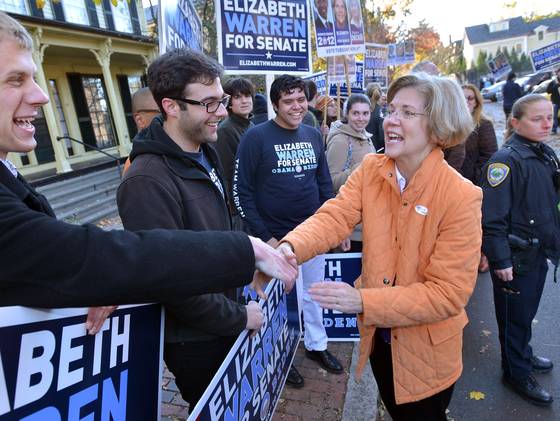
Senator-Elect Elizabeth Warren
(Photo: Josh Reynolds, AP)
Democrats keep control of U.S. Senate
by Susan Davis
USA TODAY
Democrats are going to maintain their hold on the U.S. Senate.
3:05AM EST November 7, 2012 - Democrats will maintain control of the U.S. Senate after their candidates picked up Republican-held seats in Indiana, Maine and Massachusetts, leaving the GOP no path to a takeover with the remaining competitive races that remain undecided.
Senate Majority Leader Harry Reid, D-Nev., offered a concillatory tone and called for compromise as Congress faces a daunting series of fiscal challenges in the months ahead.
"Democrats and Republicans must come together, and show that we are up to the challenge," Reid said. "This is no time for excuses. This is no time for putting things off until later. We can achieve big things when we work together."
It is the second election cycle in a row in which Republicans were favored to make gains because they were defending fewer seats, only to see their chances diminish because of missteps by their own candidates.
Sen. John Cornyn, R-Texas, chairman of the National Republican Senatorial Committee, said the party needs to take some time to process the impact of Tuesday's results.
"It's clear that with our losses in the Presidential race, and a number of key Senate races, we have a period of reflection and recalibration ahead for the Republican Party," Cornyn said. "While some will want to blame one wing of the party over the other, the reality is candidates from all corners of our GOP lost tonight. Clearly we have work to do in the weeks and months ahead."
In Indiana, Republican Richard Mourdock failed to recover from a late controversy over his remarks at a debate that pregnancy resulting from rape is "God's will" in explaining his opposition to abortion rights. Democratic Rep. Joe Donnelly was declared the winner by a narrow margin in a victory that delivered a fatal blow to lingering GOP hopes for a takeover.
Indiana Republican Senate candidate Richard Mourdock failed to recover from a late controversy over his remarks on abortion rights.(Photo: Michael Conroy, AP)
Harvard University professor and former Obama administration official Elizabeth Warren handily defeated GOP Sen. Scott Brown in one of the highest-profile races of the 2012 cycle, and the most costly in the state's history. Her victory was critical to Democrats' efforts to maintain control and hailed by liberal activists who supported her campaign.
In Maine, former Gov. Angus King sailed to victory despite the GOP's best efforts to make it a competitive race. King ran as an independent and has not said which party he intends to caucus with, but he is widely expected to sit with Democrats in the chamber. To that end, King criticized GOP strategist Karl Rove in his victory speech for directing super PAC money into Maine in an effort to defeat King. "I hope that man never comes to Maine," King said.
An early duo of Democratic re-election victories came in Ohio for Sen. Sherrod Brown and in Florida for Sen. BIll Nelson, thwarting long-shot GOP efforts for pick-ups in those states. Recent Democratic concerns about Connecticut quickly evaporated after Democratic Rep. Chris Murphy handily defeated former World Wrestling Entertainment CEO Linda McMahon, who spent nearly $100 million of her own fortune for a Senate seat in 2010 and 2012.
by Susan Davis
USA TODAY
Democrats are going to maintain their hold on the U.S. Senate.
3:05AM EST November 7, 2012 - Democrats will maintain control of the U.S. Senate after their candidates picked up Republican-held seats in Indiana, Maine and Massachusetts, leaving the GOP no path to a takeover with the remaining competitive races that remain undecided.
Senate Majority Leader Harry Reid, D-Nev., offered a concillatory tone and called for compromise as Congress faces a daunting series of fiscal challenges in the months ahead.
"Democrats and Republicans must come together, and show that we are up to the challenge," Reid said. "This is no time for excuses. This is no time for putting things off until later. We can achieve big things when we work together."
It is the second election cycle in a row in which Republicans were favored to make gains because they were defending fewer seats, only to see their chances diminish because of missteps by their own candidates.
Sen. John Cornyn, R-Texas, chairman of the National Republican Senatorial Committee, said the party needs to take some time to process the impact of Tuesday's results.
"It's clear that with our losses in the Presidential race, and a number of key Senate races, we have a period of reflection and recalibration ahead for the Republican Party," Cornyn said. "While some will want to blame one wing of the party over the other, the reality is candidates from all corners of our GOP lost tonight. Clearly we have work to do in the weeks and months ahead."
In Indiana, Republican Richard Mourdock failed to recover from a late controversy over his remarks at a debate that pregnancy resulting from rape is "God's will" in explaining his opposition to abortion rights. Democratic Rep. Joe Donnelly was declared the winner by a narrow margin in a victory that delivered a fatal blow to lingering GOP hopes for a takeover.
Indiana Republican Senate candidate Richard Mourdock failed to recover from a late controversy over his remarks on abortion rights.(Photo: Michael Conroy, AP)
Harvard University professor and former Obama administration official Elizabeth Warren handily defeated GOP Sen. Scott Brown in one of the highest-profile races of the 2012 cycle, and the most costly in the state's history. Her victory was critical to Democrats' efforts to maintain control and hailed by liberal activists who supported her campaign.
In Maine, former Gov. Angus King sailed to victory despite the GOP's best efforts to make it a competitive race. King ran as an independent and has not said which party he intends to caucus with, but he is widely expected to sit with Democrats in the chamber. To that end, King criticized GOP strategist Karl Rove in his victory speech for directing super PAC money into Maine in an effort to defeat King. "I hope that man never comes to Maine," King said.
An early duo of Democratic re-election victories came in Ohio for Sen. Sherrod Brown and in Florida for Sen. BIll Nelson, thwarting long-shot GOP efforts for pick-ups in those states. Recent Democratic concerns about Connecticut quickly evaporated after Democratic Rep. Chris Murphy handily defeated former World Wrestling Entertainment CEO Linda McMahon, who spent nearly $100 million of her own fortune for a Senate seat in 2010 and 2012.

Sen. Sherrod Brown thwarted a long-shot GOP effort to pick up Ohio.(Photo: Tony Dejak, AP)
In Missouri, Democratic Sen. Claire McCaskill, who was targeted heavily by Republicans, pulled out a convincing win against Republican Rep. Todd Akin, whose campaign foundered after he claimed that women who were victims of rape had a biological defense against becoming pregnant.
Former Democratic Gov. Tim Kaine defeated Republican former governor and senator George Allen in the hotly contested Virginia race, maintaining the party's hold on the seat. Democratic Rep. Tammy Baldwin defeated former GOP Gov. Tommy Thompson in Wisconsin and made history: She is the first openly gay person elected to the U.S. Senate.
Republicans scored a rare victory in Nebraska, where Republican Deb Fischer defeated former Democratic Sen. Bob Kerrey, who was seeking a comeback. Fischer's victory was a GOP pick-up because the seat is currently held by retiring Democratic Sen. Ben Nelson. GOP Rep. Jeff Flake also handily won in Arizona against Democrat Richard Carmona. Texas also elected Republican Ted Cruz, a popular candidate among Tea Party activists.
In Nevada, Democratic Rep. Shelley Berkley held a narrow lead over GOP Sen. Dean Heller, another potential Democratic pick-up, but the race remained tight. Republicans were also eyeing a potential pick-up in North Dakota, where Democrat Heidi Heitkamp held a narrow lead over GOP Rep. Rick Berg in a state Republican Mitt Romney won easily.
If either Berkley or Heitkamp secures a victory, 2012 would make history for sending a new record of non-incumbent freshman women senators to the Senate. The record was set in 1996 when four new women were sent to the Senate. Four women have already won including Baldwin, Fischer, Warren and Democrat Mazie Hirono in Hawaii.
Montana was too close to call in a race pitting incumbent Democratic Sen. Jon Tester against GOP Rep. Denny Rehberg in a state Romney carried comfortably.
There were 33 Senate seats up for re-election, 23 Democrats and 10 Republicans, and most incumbents were favored to win handily. Five Republican senators and 17 Democratic senators faced no real re-election threat. With Republicans maintaining control of the U.S. House, Congress will be divided by near-identical margins next year.
In Missouri, Democratic Sen. Claire McCaskill, who was targeted heavily by Republicans, pulled out a convincing win against Republican Rep. Todd Akin, whose campaign foundered after he claimed that women who were victims of rape had a biological defense against becoming pregnant.
Former Democratic Gov. Tim Kaine defeated Republican former governor and senator George Allen in the hotly contested Virginia race, maintaining the party's hold on the seat. Democratic Rep. Tammy Baldwin defeated former GOP Gov. Tommy Thompson in Wisconsin and made history: She is the first openly gay person elected to the U.S. Senate.
Republicans scored a rare victory in Nebraska, where Republican Deb Fischer defeated former Democratic Sen. Bob Kerrey, who was seeking a comeback. Fischer's victory was a GOP pick-up because the seat is currently held by retiring Democratic Sen. Ben Nelson. GOP Rep. Jeff Flake also handily won in Arizona against Democrat Richard Carmona. Texas also elected Republican Ted Cruz, a popular candidate among Tea Party activists.
In Nevada, Democratic Rep. Shelley Berkley held a narrow lead over GOP Sen. Dean Heller, another potential Democratic pick-up, but the race remained tight. Republicans were also eyeing a potential pick-up in North Dakota, where Democrat Heidi Heitkamp held a narrow lead over GOP Rep. Rick Berg in a state Republican Mitt Romney won easily.
If either Berkley or Heitkamp secures a victory, 2012 would make history for sending a new record of non-incumbent freshman women senators to the Senate. The record was set in 1996 when four new women were sent to the Senate. Four women have already won including Baldwin, Fischer, Warren and Democrat Mazie Hirono in Hawaii.
Montana was too close to call in a race pitting incumbent Democratic Sen. Jon Tester against GOP Rep. Denny Rehberg in a state Romney carried comfortably.
There were 33 Senate seats up for re-election, 23 Democrats and 10 Republicans, and most incumbents were favored to win handily. Five Republican senators and 17 Democratic senators faced no real re-election threat. With Republicans maintaining control of the U.S. House, Congress will be divided by near-identical margins next year.
All,
Elizabeth is a REAL progressive and a very strong, independent, and effective leader. She is now also the best and most accomplished grassroots activist and public intellectual in the U.S. Senate...
Kofi
Elizabeth Warren Election Results:
Consumer Advocate Unseats Scott Brown
11/07/2012
Elizabeth Warren defeated Sen. Scott Brown (R-Mass.) Tuesday in the race for U.S. Senate, NBC News and CBS News projected.
The Harvard Law professor and consumer advocate had narrowly been favored in recent days, as polls showed her with a slight lead over the incumbent senator.
Warren was the intellectual godmother of the Consumer Financial Protection Bureau and was its first head. She was denied a permanent appointment due to objections from congressional Republicans and from within the Treasury Department.
From the beginning, the Massachusetts Senate race attracted national attention. Brown, who opposed Obamacare, won election to the Senate in a 2010 special election at the height of the health care reform debate following the death of Sen. Ted Kennedy (D-Mass.) Warren's impassioned advocacy for economic fairness caused liberals to rally around their candidacy. Democrats were eager to reclaim the seat that Kennedy held for over four decades.
As a result, Warren became one of the top Senate fund-raisers of all time, surpassing Hillary Clinton's 2000 Senate run. Brown was also successful in fundraising, having a significant war chest from his 2010 run.
The race was neck-and-neck for most of the race, but Warren pulled away narrowly after her speech at the Democratic National Convention in Charlotte, N.C. In September.
Warren stressed that the race was about control of the Senate, and tied Brown to the national GOP. Brown distanced himself from other Senate candidates like Todd Akin of Missouri and Richard Mourdock of Indiana. In the end, Warren had an easier lift as a Democrat in a deep blue state, and Brown's moderate image only carried him so far.
11/07/2012
Elizabeth Warren defeated Sen. Scott Brown (R-Mass.) Tuesday in the race for U.S. Senate, NBC News and CBS News projected.
The Harvard Law professor and consumer advocate had narrowly been favored in recent days, as polls showed her with a slight lead over the incumbent senator.
Warren was the intellectual godmother of the Consumer Financial Protection Bureau and was its first head. She was denied a permanent appointment due to objections from congressional Republicans and from within the Treasury Department.
From the beginning, the Massachusetts Senate race attracted national attention. Brown, who opposed Obamacare, won election to the Senate in a 2010 special election at the height of the health care reform debate following the death of Sen. Ted Kennedy (D-Mass.) Warren's impassioned advocacy for economic fairness caused liberals to rally around their candidacy. Democrats were eager to reclaim the seat that Kennedy held for over four decades.
As a result, Warren became one of the top Senate fund-raisers of all time, surpassing Hillary Clinton's 2000 Senate run. Brown was also successful in fundraising, having a significant war chest from his 2010 run.
The race was neck-and-neck for most of the race, but Warren pulled away narrowly after her speech at the Democratic National Convention in Charlotte, N.C. In September.
Warren stressed that the race was about control of the Senate, and tied Brown to the national GOP. Brown distanced himself from other Senate candidates like Todd Akin of Missouri and Richard Mourdock of Indiana. In the end, Warren had an easier lift as a Democrat in a deep blue state, and Brown's moderate image only carried him so far.





