Showing posts with label The Postracial myth. Show all posts

Thursday, February 4, 2016

‘The Black Presidency: Barack Obama and the Politics of Race in America,’--by Michael Eric Dyson--Houghton Mifflin Harcourt, 2016: A Review

http://www.nytimes.com/…/the-black-presidency-barack-obama-…

All, 

Welcome to yet another casebook study of brazen hagiography, hubris, denial, EGOMANIA, sophistry, careerism, pompous self entitlement, and rank solipsism in the insistently self deluding and self serving 'Age of Obama' led by that strutting peacock rhetorician and shameless gliberal opportunist Michael Eric Dyson. Yeah. Welcome once again to the land of the spree and home of the knave...

Kofi

Sunday Book Review

‘The Black Presidency: Barack Obama and the Politics of Race in America,’ by Michael Eric Dyson. Houghton Mifflin Harcourt, 2016

by N. D. B. CONNOLLY
February. 2, 2016
New York Times 


PHOTO: President Obama with Michael Eric Dyson in the Oval Office, July 7, 2010. Credit Pete Souza/The White House 

What happens when the nation’s foremost voice on the race question is also its most confined and restrained? Michael Eric Dyson raises this question about President Obama in his latest book, “The Black Presidency: Barack Obama and the Politics of Race in America.” The book inspires one to raise similar questions about Dyson himself. For, while hardly restrained, Dyson appears noticeably boxed in by the limitations placed on celebrity race commentators in the Age of Obama.

Readers will recognize Dyson’s practiced flair for language and metaphor as he makes an important and layered argument about American political culture and the narrowness of presidential speech. The book argues that Americans live under a black presidency — not so much because the president is black, but because Obama’s presidency remains bound by the rules and rituals of black respectability and white supremacy. Even the leader of the free world, we learn in Dyson’s book, conforms principally to white expectations. (Dyson maintained in the November issue of The New Republic that Hillary Clinton may well do more for black people than Obama did.) But Obama’s presidency is “black” in a more hopeful way, too, providing Americans with an opportunity to better realize the nation’s democratic ideals and promises. “Obama’s achievement gestures toward what the state had not allowed at the highest level before his emergence,” Dyson writes. “Equality of opportunity, fairness in democracy and justice in society.”

The president has not been able to pursue an agenda of racial justice.

A certain optimism ebbs and flows in “The Black Presidency,” but only occasionally does it refer to white Americans’ beliefs about race. Far more often, Dyson hangs hope on Obama’s impromptu shows of racial solidarity. One such moment was the president’s remarks after the 2009 arrest of the Harvard professor Henry Louis Gates Jr. (who was arrested trying to get into his own home). Another was Obama’s public identification with Trayvon Martin. Both acts may have been politically risky, but they also greatly heartened African- Americans. Hope builds, and by book’s end, readers find a chapter-long celebration of the president’s soaring invocations of “Amazing Grace” during last year’s memorial service for the slain parishioners of Emanuel A.M.E. Church. For Dyson, the eulogy at Emanuel seems to serve as a sign of grace that black America may still yet enjoy from the Obama White House.

Its cresting invocations of hope aside, the book ably maintains a sharp critical edge. Dyson uncovers a troubling consistency to the president’s race speech and shows that in spite of Obama’s reliance on black political networks and black votes during his meteoric rise, the president chose to follow a governing and rhetorical template largely hewed by his white predecessors. As both candidate and president, Obama’s speeches have tended to allay white guilt. They have scolded ­African-American masses for cultural pathology and implied that blacks were to blame for lingering white antipathy. Obama’s speeches have also often consigned the worst forms of racism and anti-black violence to the past or to the fringes of American political culture. One finds passive-voice constructions everywhere in Obama’s race talk, as black folk are found suffering under pressures and at the hands of parties that go largely unnamed. “Obama is forced to exaggerate black responsibility,” Dyson advances, “because he must always underplay white responsibility.”

Critically, Dyson contends that the president’s tepid anti-racism comes from political pragmatism rather than a set of deeper ideological concerns. “Obama is anti-ideological,” Dyson maintains, and that is “the very reason he was electable.”

That characterization, however, overlooks how liberal pragmatism functions as ideology. What’s more, it ignores the marginalization and violence that black and brown people often suffer — at home and abroad — whenever moderates resolve to “get things done.” If the Obama era proved anything about liberalism, it’s that there remains little room for an explicit policy approach to racial justice — even, or perhaps especially, under a black president. As Obama himself explains to Dyson: “I have to appropriate dollars for any program which has to go through ways and means committees, or appropriations committees, that are not dominated by folks who read Cornel West or listen to Michael Eric Dyson.”

Upon a careful reading of Dyson’s book, loss seems always to arrive on the heels of hope. As we might expect, the author explores Obama’s estrangement from the Rev. Jeremiah Wright in 2008. He also attends to his own very public and more recent split from Cornel West. But even beyond these signal episodes, “The Black Presidency” is suffused with a bittersweet tone about relationships strained. President Obama seems to leave a host of people and political commitments at the White House door as he conforms to the racial demands of a historically white office. Even Dyson seems unaware of all the ways in which “The Black Presidency,” as a book, both explicates and illustrates how the Obama administration leaves black folk behind.

All but the last two of the book’s eight chapters begin with the author placing himself in close and often luxurious proximity to Obama. The repetition has the literary effect of a Facebook feed. Here is Michael at Oprah’s sumptuous California mansion during a 2007 fund-raiser, sharing a joke with Barack and Chris Rock. Here is Michael on the private plane and in the S.U.V., giving the candidate tips on how to use a “ ‘blacker’ rhetorical style” during his debate performances against a surging Hillary Clinton. Here he is in the V.I.P. section of the 50th-anniversary ceremony for the March on Washington and, yet again, at the White House Correspondents’ Association dinner. Through these and similar moments, Dyson projects his status and, in ways less clear, his authority. Dyson knows Obama, the reader is assured, because he has kept his company. He has swapped playful taunts and bro-hugs with the president; he has been intimate, one might say, with history.

Moments like these have a secondary effect. They illuminate a tension cutting through and profoundly limiting “The Black Presidency” as a work of political commentary. Regardless of who Michael Eric Dyson may have been to Obama the candidate, Dyson now has barely any access to Obama the president. Time and circumstance have rendered Dyson, the man and the thinker, increasingly irrelevant to Obama’s presidency. He can be at the party, but not at the table.

Perhaps worse in relation to the book’s stated aim to be the first full measure of Obama and America’s race problem, Dy­son, the author, has none but only the smallest role to play in assessing and narrating Obama’s legacy. When Bill Clinton decided to chronicle his own historic turn in the White House, he called on Taylor Branch and recorded with the historian some 150 hours of interviews over 79 separate sessions. Dyson, in 2015, gets far shabbier treatment. Chapter 5, “The Scold of Black Folk,” opens: “I was waiting outside the Oval Office to speak to President Obama. I had a tough time getting on his schedule.” In response to Dyson’s request for a presidential audience, the White House offered the author 10 whole minutes. By his own telling, Dyson “politely declined” and pressed Obama’s confidante, Valerie Jarrett, to remember his long history with and support of the president. “I eventually negotiated a 20-minute interview that turned into half an hour.” It appears to be the only interview Dyson conducted for the book.

In the end, “The Black Presidency” possesses a loaves-and-fishes quality. Drawing mostly on the news cycle, close readings of carefully crafted speeches and a handful of glittering encounters, Dyson has managed to do a lot with a little. The book might well be considered an interpretive miracle, one performed in fealty and hope for a future show of presidential grace, either from this president or, should she get elected, the next one.

THE BLACK PRESIDENCY
Barack Obama and the Politics of Race in America
by Michael Eric Dyson
346 pp. Houghton Mifflin Harcourt, 2016
$27.


N. D. B. Connolly is the author of “A World More Concrete: Real Estate and the Remaking of Jim Crow South Florida.”

A version of this review appears in print on February 7, 2016, on page BR20 of the Sunday Book Review with the headline: What Obama Can’t Say. 

Thursday, September 8, 2011

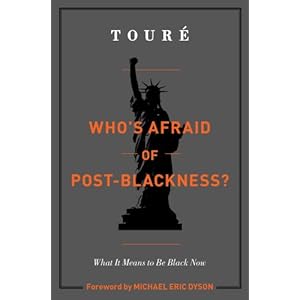
Randall Kennedy's Penetrating Critique Of Toure's New Book on Racial Identity and the Post Racial Myth in the United States

Randall Kennedy


Touré Neblett


All,

It was a real pleasure to read Randall Kennedy's eloquent takedown and incisive critical dismantling of Touré's hopelessly jejune, shallow, and infantile new book on "racial identity and (in) authenticity" in the "new"(?) so-called "postracial era." That Kennedy of all people performs such a surgical dissection of Touré's highly fallacious "theory" of a crassly 'libertarian' uber-transcendence of racial politics in the United States is poetic justice given Kennedy's own past personal and intellectual struggles with these shamelessly bourgeois and excessively defensive notions of what it "means to be black" in the U.S. today. What is especially refreshing about Kennedy's penetrating analysis is that he systematically attacks not the public personality/persona of the man who wrote the book but keeps his laserlike attention fixed on the reductive, self aggrandizing and intellectually lazy flights from logical thought and historical/social/factual verisimilitude of Touré's highly dubious arguments about ALL forms and expressions of "blackness" being equally valid and "authentic."

What's particularly egregious about the appearance of Touré's new book (and its obvious, even clumsy timing in the wake of the emergence of Barack Obama on the national and global political and cultural stage) is that so many clueless young black intellectuals and artists from his generation (Touré was born in 1971) are presently engaged in the same sort of egocentric and arrogantly defensive displays of attacking what they erroneously identify as "black political correctness" using an aggressively transparent inversion of the exact same methodology and ideological reductionism that they deplore in others. For one very recent disturbing example of this "postmodern" black bourgeois tendency, I was appalled to read last month that the celebrated Pulitzer Prize winning "avant" black playwright and novelist Suzan Lori-Parks (b. 1963) is writing-- for a new all-black Broadway cast-- an "updated" (post) modern revised script of the execrable and notoriously racist 1935 "folk opera" Porgy and Bess by DuBose Heyward with music (largely stolen and "revised" from black vernacular folk sources) by George and Ira Gershwin. The "new" version while fastidiously "cleaning up" much of the rancidly racist pseudo-dialect of the original script by Heyward retains intact the ludicrous and brazenly offensive narrative of black bucks, coons, tragic mulattoes, hustlers, conmen, thieves, pimps, whores, and mammies that White American critics and standing room only audiences of the 1930s and '40s all the way up to the present day (!) have critically and commercially proclaimed 'a work of genius'. Condemned, assailed, and strongly dismissed by every major black intellectual and artist of the past 75 years (a long list that includes such iconic and legendary black cultural and political figures of the past century as Duke Ellington, Langston Hughes, Paul Robeson, W.E.B. DuBois, Lena Horne, James Baldwin, Nina Simone, Harold Cruse, Josephine Baker, and Amiri Baraka, among many others), one's position on 'Porgy and Bess' stands as a major litmus test of the actual intellectual and political committment to genuine African American art, and an active critical and aesthetic repudiation of the imposed fake racial "standards" and "identities" provided by racist white artists, critics, and intellectuals, among others.

So in light of that heinous historical context it was particularly disturbing to see Ms. Lori-Parks defend herself, the all black award winning cast (including Audra McDonald (b. 1970) who plays Bess in this new production and who has won three Tony awards in her career for her singing and acting on Broadway), and their white female director by saying of this production (which by the way has been retitled "The Gershwin's Porgy and Bess" by the Gershwin estate which commissioned it): "The artist's job is not to be politically correct; the artist's job is to fully realize the characters. They needed to be fleshed out".

With that kind of pure adolescent sophistry and solipsism masquerading as transcendent Olympian detachment, contemporary black artists and intellectuals like Lori-Parks and Touré and far too many others have utterly failed to acknowledge the real dialectical relationship(s) between art, philosophy, and life in society, and have settled for a papier-mache thin notion of cultural identity and work that not only lacks any serious content but is bereft of vision as well. False consciousness on steroids. But take heart everybody: I understand that in the 'new and improved' "post(modern)" version of 'Porgy and Bess', Porgy no longer crawls around on his hands and knees. Oh no brothers and sisters. He now stumbles around upright with a cane! My goodness. How's THAT for "progress"?...

Kofi


The Fallacy of Touré's Post-Blackness Theory
by Randall Kennedy
August 11, 2011
The Root


In his latest book, the cultural critic argues that African Americans should never have their racial loyalty or authenticity questioned. This reviewer disagrees.

African Americans fight a multifront struggle in pursuing their ambitions. Along with the difficulties that others face -- bad luck, personal deficiencies, talented competitors -- blacks face additional obstacles. On one front they encounter prejudiced Caucasians. On another they encounter Negroes who, attached to stunted conceptions of racial solidarity, habitually castigate as disloyal blacks perceived as "acting white," being "oreos," "selling out."

Blacks characteristically confront white racism with uninhibited fury. With black critics, however, they often display ambivalence. Even when chafing miserably from constraints imposed by racial solidarity, many blacks nonetheless bite their tongues. They refrain from speaking openly and frankly because the rhetoric and performance of racial solidarity occupies an honored position in black American circles. It has claims on blacks' psyches even as they wrestle with the restraints that solidarity entails.

In Who's Afraid of Post-Blackness: What It Means to Be Black Now (Free Press 2011), Touré assails "self-appointed identity cops" who write "Authenticity Violations as if they were working for Internal Affairs making sure everyone does Blackness in the right way." His aim is to "destroy the idea that there is a correct or legitimate way of doing Blackness," maintaining that "if there's a right way then there must be a wrong way, and that [that] kind of thinking cuts us off from exploring the full potential of Black humanity." Touré claims that he wants African Americans to have the freedom to be black in whatever ways they choose and that he aspires "to banish from the collective mind the bankrupt, fraudulent concept of 'authentic' Blackness."

"Post-Blackness" is the label Touré deploys to describe the sensibility he champions, a "modern individualist Blackness" that enthusiastically endorses novelty and diversity, fluidity and experimentation. "Post-Blackness," he insists, "is not a box, it's an unbox. It opens the door to everything. It's open-ended and open-sourced and endlessly customizable. It's whatever you want it to be." "Post-Blackness" means, he says, that "we are [like President Barack Obama] rooted in, but not restricted by, Blackness."

Touré, a 40-year-old author of three previous books, a contributing editor to Rolling Stone and a correspondent for MSNBC, is a keen student and practitioner of publicity who rounds up a posse of artists, scholars and journalists to assist with the promotion of his brand of "post-Blackness."

In Who's Afraid of Post-Blackness, he prominently features, for example, professor Michael Eric Dyson. "We've got to do away with the notion," Dyson writes, "that there's something that all Black folk have to believe in order to be Black. We've got to give ourselves permission to divide into subgroups, or out-groups, organized around what we like and dislike, and none of us is less or more Black for doing so."

"The undeniable need to fight oppression," Dyson declares, "can't overshadow the freedom to live and think Blackness just as we please." "Post-Blackness," he insists, "has little patience for racial patriotism, racial fundamentalism, and racial policing."

Selling Out or Not?

Touré and his allies are right to be concerned about charges of racial disloyalty. As I showed in Sellout: The Politics of Racial Betrayal, the specter of defection occupies a salient place in the African-American mind and soul. It figures in novels (such as Ralph Ellison's Invisible Man), in films (Spike Lee's Bamboozled), in hip-hop (the Geto Boys' "No Sell Out") and in writings questioning whether blacks have an obligation to reside in "the hood," marry within the race or decline certain careers, such as prosecutor.

Anxieties over racial loyalty are echoed in incantations such as "Don't forget where you come from" and "Stay black." They are glimpsed in the obsessive scrutiny of prominent blacks for evidence of inadequate commitment to black solidarity.

These fears prompt blacks, especially those in elite, predominantly white settings, to signal conspicuously their allegiance to blackness. This angst contributes to the rise of what journalist John Blake termed "soul patrols," cliques of black folk "who impose their definition of blackness on other black people." Writing in the Atlanta Journal-Constitution in 1992, in an article that Touré could have usefully cited, Blake complained that soul patrols are not content with choosing your friends. "They want to tell you how to think, where to live, how to do your job."

Touré's principal complaint with those he sneeringly dismisses as racial-identity police is that their disapproval trenches on personal freedom. He wants black people to be able to do what they please, free of inhibitory racial expectations. He wants blacks to be able to occupy offices as corporate or governmental chief executives without being immediately hectored as sellouts.

He wants African Americans to be able to have nonblack romantic partners without facing charges of racial abandonment. He wants Negroes out in public to be able to eat fried chicken or watermelon without feeling that they are disgracing the race. He wants black artists to be able to play with depictions of slavery, segregation or anything else without being indicted for defaming Afro-America.

Call the Blackness Police

Touré rightly assails principles or tactics that impose wrongful constraints on blacks (or anyone else). He errs, however, when he adopts a stance of libertarian absolutism, according to which it is always wrong for one black person to question another black person's fidelity to black America. This is the stance taken by Stephen L. Carter in Confessions of an Affirmative Action Baby, in which he wrote, "Loving our people and loving our culture does not require any restriction on what black people can think or say or do or be ... "

No restriction? But what about an African American who expresses racial hatred for blacks? Or what about an African American who joins a legitimate black-uplift organization for the purpose of crippling it? Blacks (or anyone else) who do or say such things ought to be shunned as forcefully as possible in order to punish them, render them ineffective and dissuade others from following a similar course.

Some ideas ought to be stifled. Determining what ideas should meet that fate under what circumstances and by what means are large, complex, daunting questions that warrant the most careful attention. The world is awash in destructive censorship. And the broad swath of cultural freedom that has been painstakingly won in the United States is a treasure for which Americans should be willing to fight. At the same time, it bears repeating that under some circumstances, people behaving in certain ways -- which includes the expression of certain ideas -- ought to be ostracized.

Touré is rightly appalled by the pettiness, narrowness, bigotry and dictatorial character of those who have intermittently afflicted Negroes with destructive bouts of internecine warfare. Hence the purgings committed by proponents of Marcus Garvey's Universal Negro Improvement Association, Elijah Muhammad's Nation of Islam and H. Rap Brown's Student Nonviolent Coordinating Committee. "We've all heard and felt," Touré observes, "the Blackness police among us -- or within us -- judging and convicting and sentencing and verbally or mentally casting people out of the race for large and small offenses."

What Does It Mean to Be Black?

Touré's response is to so broaden the boundaries of blackness that no black person can properly be "convicted" of straying outside. In this post-black era, Touré writes, "the definitions and boundaries of Blackness are expanding ... into infinity ... [O]ur identity options are limitless." According to Touré, "Blackness is not a club you can be expelled from ... We've been arguing for decades and decades about identity and authenticity and who's Black and who's not and I want to yell above the din -- Truce! We're all Black! We all win!"

There are several problems here. First, Touré himself does not fully believe in the unbounded conceptions of blackness or post-blackness that he sometimes seems to propound. "Our commonality," he writes, "is too diverse, complex, imaginative, dynamic, fluid, creative, and beautiful to impose restraints on Blackness."

To what, however, does he refer to when he says "our"? For "our" to have meaning, it must have some boundary that separates "us" from "them." If post-black opens the door to everything, does that mean that anyone can rightly be deemed "Black"? Just suppose that Glenn Beck and Bill O'Reilly, as a joke, declared themselves to be black. If there really are no restraints on blackness, no boundaries distinguishing "Blacks" from "non-Blacks," then it follows that there would be no basis on which to deny their claim. That, in my view, would be unsatisfactory.

What Touré and his allies seek to escape are fundamental aspects of any community: boundaries and discipline. Every community -- be it a family, firm or nation-state -- necessarily has boundaries that distinguish members from nonmembers. That boundary is a constituent element of the community's existence.

Touré could opt to reject affiliations that are organized around racial identity. He could abandon blackness or post-blackness or any and all racial labelings and groupings. But Touré eschews that option. It is, among other things, all too unpopular for his taste.

Despite his avant-garde pretensions, Touré is at bottom rather conventional: a politically liberal black guy who wants to make it in the white-dominated world of print journalism and television broadcasting without catching flak from "brothas" and "sistahs" because of the way he talks (preppy), because of his significant other (a woman who is not African American) and because of his attachment to ideas that he knows some blacks will disdain.

Touré voices, for instance, an instrumental patriotism: "We may need to more fully embrace our American-ness in order to maximize the power we have as individuals and as a collective." He praises "Black people who can make the leap to loving and trusting white people" because these African Americans "have far more ability [than others] to climb the ladders of power." He frankly propounds a preference for insiderism:

We need more and more Blacks sitting at tables of real power. Let's be like Barack and get what we want from America in spite of racism ... Let's buy into the promise of America and get what we deserve: a place in the American life lottery. Let's come home. You can fight the power, but I want us to be the power.

Aware that some African Americans will see in these beliefs an ugly ethic of racial brownnosing aimed merely at attaining robust tokenism, Touré seeks a general truce whereby blacks forgo judging the racial politics of one another. But that aim is futile; judgment is inevitable.

Touré claims to accept as equally "Black" all beliefs advanced by African Americans. But he doesn't really believe this. He insists repeatedly, for instance, that he is no "oreo" -- an inauthentic Negro -- black on the outside but white on the inside. In saying that he is not an oreo, however, Touré concedes that someone is.

Touré supports the continuation of blacks as a distinct community in America. He situates himself in a racialized "we": "We Blacks." He views his book as a contribution to a more effective and enlightened black collective action. Collective action, however, requires coordination; coordination requires discipline; and discipline requires coercion.

Consider the magnificent Montgomery Bus Boycott triggered by the arrest of Rosa Parks. The boycott is typically portrayed as an entirely voluntary enterprise in which the heroes of the story wage their struggle against racist villains without morally soiling their hands. The reality, however, was considerably more complicated. The boycott was mainly animated by the commitment of blacks to resisting Jim Crow oppression. It was also reinforced, however, by fear. While few African Americans rode the buses, more would have, had they not feared reprisal.

Improper policing can indeed impinge unduly on individual freedoms, prompt excessive self-censorship, truncate needed debate and nurture demagoguery. But policing is part of the unavoidable cost of group maintenance. That is why all nations have criminal laws, including prohibitions against treason.

Boycotting Clarence Thomas

To the extent that Touré wants to perpetuate black communities but eschew policing, he seeks a sociological impossibility. The erection of boundaries and the enforcement of stigmatization, including the threat of expulsion, are inescapable, albeit dangerous, aspects of any collective enterprise.

Some folks ought to have their racial credentials lifted. Consider Supreme Court Justice Clarence Thomas -- the most vilified black official in American history, a man whose very name has become synonymous with selling out. Many organizations, including scores of law schools, refuse to bestow any semblance of prestige or support through association with him. He is being massively boycotted. And like all boycotts, this one is coercive. It applies pressure to the target.

It also applies pressure to third parties, threatening with disapproval those who might cross the boycotters' picket line. The boycott of Thomas is largely monitored by blacks who detest his reactionary politics and rue his paradoxical success in exploiting black racial loyalism. Remember that but for his appeal for protection against a "high-tech lynching," he would probably have failed to win senatorial confirmation to the seat once occupied by Thurgood Marshall.

Is it right for blacks to cast Thomas from their communion? Is it appropriate to indict him for betrayal? These questions have arisen on numerous occasions. In confronting them now, I conclude that I have erred in the past. Previously I have criticized Thomas' performance as a jurist -- his complacent acceptance of policies that unjustly harm those tragically vulnerable to ingrained prejudices; his naked Republican Party parochialism; and his proud, Palinesque ignorance. But I have also chastised those who labeled him a sellout.

I was a sap. Blacks should ostracize Thomas as persona non grata. Despite his parentage, physiognomy and racial self-identification, he ought to be put outside of respectful affiliation with black folk because of his indifference or hostility to their collective condition. His conduct has been so hurtful to and antagonistic toward the black American community that he ought to be expelled from membership in it.

Touré rejects the idea that an African American can ever properly be dismissed from the race -- "de-blacked," to use the memorable term coined by Washington University professor Kimberly Jade Norwood. How one stands on this matter depends on how one conceptualizes racial membership. Some view racial membership as an immutable status -- you are born black and that is it. I do not. I view choice as an integral element of membership. In my view, a person (or at least an adult person) should be black by choice, with a recognized right of resignation.

Carrying through with that contractualist conception, I also believe that a black person should have no immunity from being de-blacked. Any Negro should be subject to having his or her membership in blackness revoked if he or she pursues a course of conduct that convincingly demonstrates the absence of even a minimal communal allegiance.

Religions impose excommunication. Nations revoke citizenship. Parents disown children. Children disown parents. Why, as a matter of principle, should blacks be disallowed from casting from their community those adjudged to be enemies of it? The power of expulsion is so weighty that prudence should demand extraordinary care in exercising it. Still, the power to exclude and expel is, and should be, part of what constitutes black America.

Unlike the United States, individual states or Indian tribes, black America lacks mechanisms of sovereignty -- courts, for example -- that can provide centralized, authoritative and enforceable judgments regarding membership. In black America, only an amorphous public opinion adjudicates such matters, generating inconclusive results. Nonetheless, black public opinion should and does exercise some control over its communal boundary, determining in the process a person's standing as member, guest, enemy and so on.

Keeping It Real

Opposed to the idea of racial boundaries, Touré is also against the idea of racial authenticity. His opening chapter is titled "Thirty-Five Million Ways to Be Black," an homage to a statement he attributes to Henry Louis Gates Jr.:

If there are thirty-five million Black Americans then there are thirty-five million ways to be Black. There are ten billion cultural artifacts of Blackness and if you add them up and put them in a pot and stew it, that's what Black culture is. Not one of those things is more authentic than the other.

Recall that one of Touré's aims is "to banish from the collective mind the bankrupt, fraudulent concept of 'authentic' Blackness." That aim is misleading. To be sure, there are numerous instances in which blacks' racial authenticity has been challenged on spurious grounds by people claiming that "real" blacks don't (fill in the blank) fence, ski, enjoy Mozart, climb mountains, study hard, etc. These ignorant suppositions have generated destructive consequences -- shriveling expectations, discouraging curiosity, reinforcing stereotypes.

One should differentiate, however, between specious and defensible notions of racial authenticity. Out of frustration with the former, Touré throws out the latter. Authentic blackness can be discerned by comparing it with performances in which people self-consciously dilute their artistry or message to give it "crossover" appeal. Whether such dilution is warranted or not in a given circumstance is not the immediate point. The point is simply that in some circumstances, African Americans do vary the racial character of their performances, and the language of authenticity is one way of noting that variation.

When African-American artists, politicians or activists assert that they are going to "keep it real" despite complaints that they are "too black," they are adopting a stance that is important to appreciate even if one disagrees with it. That stance, like the strategy of dilution, is no figment of the imagination. It is a choice that gives rise to different grades of blackness. That is why it is proper, Henry Louis Gates notwithstanding, to recognize that the music of James Brown at the Apollo is more authentically black than the music of the Supremes at the Copacabana.

Racial solidarity will always depend to some extent on self-appointed monitors of racial virtue. Touré himself, of course, is just such a monitor. His chiding of black political correctness is itself a variant of black political correctness.

Those who want to maintain black community while containing the peer pressure that makes collective action possible must recognize that solidarity always poses a problem of balance between unity and freedom. That is why libertarian romanticism is untenable when conjoined with a desire for collective advancement.


ABOUT THE AUTHOR:

Randall Kennedy is the Michael R. Klein Professor of Law at Harvard University and the author of The Persistence of the Color Line: Racial Politics and the Obama Presidency (Pantheon, 2011)


https://www.broadwayworld.com/article/Paulus-Parks-Murray-Reimagine-American-Repertory-Theaters-PORGY-AND-BESS-20101105

Creative Team to Re-imagine Porgy and Bess
Production to Open American Repertory Theater’s 2011-2012 Season
For Immediate Release
 
Contact: Anna Fitzloff
anna_fitzloff@harvard.edu
617-496-2000 ext. 8906
 
Cambridge, Mass — The American Repertory Theater (A.R.T.) announced today that Artistic Director Diane Paulus, Pulitzer prize-winning writer Suzan-Lori Parks, and two-time Obie winner Diedre Murray have been chosen by the Gershwin Trusts and the Heyward Trust to re-imagine the Gershwins’ seminal American opera Porgy and Bess. The creative team also includes choreographer Ronald K. Brown, set designer and regular A.R.T. collaborator Riccardo Hernandez, costume designer and Project Runway finalist Emilio Sosa, Tony Award-winning lighting designer Christopher Akerlind, sound by Acme Sound Partners, and casting by Telsey + Company who cast The Color Purple and La Bohème on Broadway. This production of Porgy and Bess will be presented in association with Jeffrey Richards and Jerry Frankel and is currently scheduled to open the A.R.T.’s 2011-2012 season in early September 2011.

Spokespersons from the Gershwin family remarked, “The fusion of musical styles in Porgy and Bess is distinctly American. It has had, and continues to have, a successful life in opera houses around the world yet it contains some of America’s most beloved jazz and popular standards. The Gershwin family and the Heyward trustees are thrilled that the American Repertory Theater will be premiering a re-imagination of Porgy and Bess for a whole new generation of theatergoers. We cannot wait to see the results of Diane Paulus’, Suzan-Lori Parks’, and Diedre Murray’s collaboration as they venture forth from the original. We believe audiences will fall in love with their vision of this masterwork for the 21st century.”

In a meeting with the creative team, Diane Paulus commented, “The Gershwin and Heyward estates have given us the charge to create a version of Porgy and Bess that will have a unique identity as a musical. I am delighted to be working with Suzan-Lori Parks on making the characters in the story more fully realized. With one of the most incredible scores ever written, we want to bring Porgy and Bess to life on the musical stage in a way that feels essential, immediate, and passionate."

Suzan-Lori Parks added, “I am thrilled to be part of the wonderful team working on Porgy and Bess. Our approach is fresh and respectful; we're working to retain all the best-loved elements of the original while crafting a piece that speaks to contemporary audiences.”

Diedre Murray said, “We want to move the story of Porgy and Bess forward on its continuum, re-envisioning it for a modern perspective. We will acknowledge the timelessness of this masterpiece, and stay true to its original spirit while illuminating this work and exploring it in a new way.”

Porgy and Bess first premiered at the Colonial Theatre in Boston on September 30, 1935, with a libretto by DuBose and Dorothy Heyward based on DuBose’s novel Porgy, and their play of the same name. Broadway performances followed featuring a cast of classically trained African-American singers — a daring and visionary artistic choice at the time. 
 
ABOUT THE ARTISTS: 
 
Diedre Murray is a Pulitzer Prize finalist, two-time Obie Winner and master musician. An innovative composer, cellist, producer and curator, her credits include Unending Pain, co-presented by the Performance Garage and the Whitney Museum of American Art; Lets Go Down to the River, for the Willasau Jazz Festival in Switzerland; The Eves of Nhor, for National Dutch Radio and De Effenaar Festival in Eindhoven Holland; Five Minute Tango, for the inaugural concert at the Danny Kaye/Sylvia Fine Playhouse, performed by the Manhattan Brass Quintet; You Don't Miss the Water, a music-theatre piece, in collaboration with noted poet Cornelius Eady, produced by the Music-Theatre Group (MTG); Women In The Dunes, a dance piece created by Blondel Cummings for the Japan Society; the jazz-opera Running Man, for which she wrote the original story, score, and book with Cornelius Eady, won two Obie Awards, and was named a finalist for the 1999 Pulitzer Prize for Drama; music arrangements for Eli's Coming for which she won an Obie Award; The Blackamour Angel, a cabaret opera written by Carl Hancock Rux; an adaptation by Diane Paulus of James Baldwin's Another Country; The Voice Within co-written with Marcus Gardley, and produced by Harlem Stage and the Apollo Theatre; and Best of Both Worlds with writer Randy Weiner, directed by Diane Paulus, featured in the Shakespeare Exploded! festival at the A.R.T. in 2009.

Suzan-Lori Parks is one of the most exciting and acclaimed playwrights in American drama today. She was named one of TIME magazine's "100 Innovators for the Next New Wave," and is the first African-American woman to receive the Pulitzer Prize in Drama for the Broadway hit Topdog/Underdog. Other plays include In the Blood (2000 Pulitzer Prize finalist), Venus (1996 Obie Award), The Death of the Last Black Man in the Whole Entire World, f-ing A, Imperceptible Mutabilities in the Third Kingdom (1990 Obie Award for Best New American Play), and The America Play (produced at the A.R.T. in 1994). Her Ray Charles musical, Unchain My Heart is scheduled to premiere on Broadway in the spring of 2011. Her screenplays include Girl 6 for Spike Lee and her adaptation of Zora Neale Hurston's classic novel Their Eyes Were Watching God for ABC's "Oprah Winfrey Presents". In 2007 her project 365 Plays/365 Days was produced in over 700 theaters worldwide, creating one of the largest grassroots collaborations in theater history. Her first novel, Getting Mother's Body , was published by Random House in 2003. She is a MacArthur "Genius" Award recipient, and has been awarded grants from numerous organizations including the National Endowment for the Arts, the Rockefeller Foundation, the Ford Foundation, the New York State Council on the Arts and the New York Foundation for the Arts, and a Guggenheim Foundation Grant. She has received a Lila-Wallace Reader's Digest Award and a CalArts/Alpert Award in the Arts (Drama). Suzan-Lori Parks is an alumnae of New Dramatists and her work is the subject of the PBS Film The Topdog Diaries.
 
Diane Paulus is the Artistic Director of the American Repertory Theater, where she helmed The Donkey Show, Best of Both Worlds, and Johnny Baseball in her inaugural season. Her recent theater credits include The Public Theater's revival of Hair on Broadway (2009 Tony Award winner for Best Revival of a Musical, nominated for 8 Tony Awards including Best Director, as well as winner of a Drama Desk Award, Outer Critics Circle Award and Drama League Award for Best Revival of a Musical), London's West End and national tour. Her other recent work includes Kiss Me, Kate (Glimmerglass Opera) and Lost Highway (ENO co-production with the Young Vic.) Opera credits include Il Mondo Della Luna (Gotham Chamber Opera at the Hayden Planetarium), Don Giovanni, Le nozze di Figaro, Turn Of The Screw, Cosi fan tutte; and Il ritorno d'Ulisse in patria, L'incoronazione di Poppea, and Orfeo at the Chicago Opera Theater. Diane is a Part-Time Professor of the Practice in the Harvard University faculty of Arts and Sciences' Department of English. Her upcoming work at the A.R.T. includes Prometheus Bound and Death and The Powers: The Robots' Opera.


Monday, April 4, 2011

American Racism, The Entrenched Reality of Racial Segregation, and the Insidious Post-Racial Myth

http://truthout.org/americas-most-segregated-cities-likely-stay-way/1301468400

All,

"Post-racial" my black ass!...Racism is not merely alive but THRIVING in these United Hates 392 years after our "most recent arrival" here...As the late great Bob Marley said: "Many more will have to suffer/many more will have to die/don't ask me why/such a natural mystic blowing in the wind..."

Kofi


America's Most Segregated Cities Likely to Stay That Way
Sunday 3 April 2011
by Earl Ofari Hutchinson
New America Media


The recent report that America’s most segregated cities are just as -- if not more -- segregated than they were a couple of decades ago is hardly a revelation. The report focused on the top 10 most segregated cities. But this could easily be expanded to find vast and unbroken pockets of racial segregation in many of the nation’s smaller and mid-size cities as well. A casual drive through any of the major urban neighborhoods in America, a walk through the neighborhood schools, hospitals, and clinics reveal the stark pattern of the two Americas. In fact, even three or four urban Americas: an America that is poor, black and Latino; an America that is black and middle class; an America that is white, working class and middle class; and one that’s white and wealthy.

But whichever urban America one travels through, the line dividing the neighborhoods is as deep as the Grand Canyon. There are the usual suspects to blame for the rigid segregation. Poverty, crime, lender redlining, a decaying industrial and manufacturing inner city, white and middle-class black and Hispanic flight, crumbling inner-city schools, the refusal of major business and financial institutions to locate in minority neighborhoods, and cash-strapped city governments that have thrown in the towel on providing street repairs and basic services.

This tells a big part of the story of the chronic segregation, but it's only part of the story. The painful truth three years after the election of America’s first black president is that there are far too many policy makers, political leaders, and many whites that still think that segregation is too much a longstanding, even immutable, way of life in America to ever change. The entire history of Northern urban segregation is damning proof of that.

In the decades before the passage of the 1964 Civil Rights Act, the great migration of blacks from the South before and after both World Wars, and the flight of whites from urban neighborhoods to the suburbs locked in place the economic, social, and political mindset that racial segregation was a fact of life in the North and would stay that way. Redlining, zoning laws, and the federal government’s deliberate policy of bolstering residential segregation insured that. Even as the Jim Crow barriers tumbled in the South and blacks and whites mingled in schools, public facilities, and more and more neighborhoods, residential segregation in the North remained America’s idée fixe.

Every census report in the post-Civil Rights era and the countless Urban League’s State of Black America reports showed that the inner cities continued to get blacker and browner and poorer, while the suburbs got whiter and more well to do. That trend isn’t likely to change.

With President Obama and Congressional leaders trying to figure out where to cut every penny they can from education, health care and employment programs, there is absolutely no chance of any new spending or initiatives to be put on the legislative table to deal with the continuing decay of urban neighborhoods. Some experts have pointed to the increasing gentrification by young whites and non-blacks of some urban neighborhoods as a hopeful sign that residential segregation could in time pass away. That’s not likely. In fact, studies have shown that gentrification has not altered the neighborhood racial segregation patterns as much as is popularly presented. Many of the old homes that have been renovated as chic, pricey, apartments and townhouses, have been gobbled up, not by whites and non-blacks, but by upwardly-mobile black professionals. They are upscale, but they are still black, and so are the freshly gentrified neighborhoods they live in.

Urban racial segregation, then, may not be the permanent lot of American society, but if past decades and current policies are any sign, America’s most segregated cities will stay that way for more census counts to come.

Tuesday, December 1, 2009

The Thriving Persistence of Racism in Employment against African Americans in "Obama's America"

http://www.nytimes.com/2009/12/01/us/01race.html?th&emc=th

All,

Who says racism is not alive and still absolutely thriving here in the United Hates of Hysteria--with or without Obama?...So much for the ridiculous "postracial" myth...

Kofi


Damon Winter/The New York Times

Johnny Williams has scrubbed his résumé of any details that might tip off his skin color.


In Job Hunt, College Degree Can’t Close Racial Gap
By MICHAEL LUO
Published: November 30, 2009
New York Times

Johnny R. Williams, 30, would appear to be an unlikely person to have to fret about the impact of race on his job search, with companies like JPMorgan Chase and an M.B.A. from the University of Chicago on his résumé.


Multimedia


Graphic
Racial Differences in Joblessness


Karena Cawthon for The New York Times
Barry Jabbar Sykes goes by Barry J. Sykes in his job hunt.


But after graduating from business school last year and not having much success garnering interviews, he decided to retool his résumé, scrubbing it of any details that might tip off his skin color. His membership, for instance, in the African-American business students association? Deleted.

“If they’re going to X me,” Mr. Williams said, “I’d like to at least get in the door first.”

Similarly, Barry Jabbar Sykes, 37, who has a degree in mathematics from Morehouse College, a historically black college in Atlanta, now uses Barry J. Sykes in his continuing search for an information technology position, even though he has gone by Jabbar his whole life.

“Barry sounds like I could be from Ireland,” he said.

That race remains a serious obstacle in the job market for African-Americans, even those with degrees from respected colleges, may seem to some people a jarring contrast to decades of progress by blacks, culminating in President Obama’s election.

But there is ample evidence that racial inequities remain when it comes to employment. Black joblessness has long far outstripped that of whites. And strikingly, the disparity for the first 10 months of this year, as the recession has dragged on, has been even more pronounced for those with college degrees, compared with those without. Education, it seems, does not level the playing field — in fact, it appears to have made it more uneven.

College-educated black men, especially, have struggled relative to their white counterparts in this downturn, according to figures from the Bureau of Labor Statistics. The unemployment rate for black male college graduates 25 and older in 2009 has been nearly twice that of white male college graduates — 8.4 percent compared with 4.4 percent. Various academic studies have confirmed that black job seekers have a harder time than whites. A study published several years ago in The American Economic Review titled “Are Emily and Greg More Employable than Lakisha and Jamal?” found that applicants with black-sounding names received 50 percent fewer callbacks than those with white-sounding names. A more recent study, published this year in The Journal of Labor Economics found white, Asian and Hispanic managers tended to hire more whites and fewer blacks than black managers did.

The discrimination is rarely overt, according to interviews with more than two dozen college-educated black job seekers around the country, many of them out of work for months. Instead, those interviewed told subtler stories, referring to surprised looks and offhand comments, interviews that fell apart almost as soon as they began, and the sudden loss of interest from companies after meetings.

Whether or not each case actually involved bias, the possibility has furnished an additional agonizing layer of second-guessing for many as their job searches have dragged on.

“It does weigh on you in the search because you’re wondering, how much is race playing a factor in whether I’m even getting a first call, or whether I’m even getting an in-person interview once they hear my voice and they know I’m probably African-American?” said Terelle Hairston, 25, a graduate of Yale University who has been looking for work since the summer while also trying to get a marketing consulting start-up off the ground. “You even worry that the hiring manager may not be as interested in diversity as the H.R. manager or upper management.”

Mr. Williams recently applied to a Dallas money management firm that had posted a position with top business schools. The hiring manager had seemed ecstatic to hear from him, telling him they had trouble getting people from prestigious business schools to move to the area. Mr. Williams had left New York and moved back in with his parents in Dallas to save money.

But when Mr. Williams later met two men from the firm for lunch, he said they appeared stunned when he strolled up to introduce himself.

“Their eyes kind of hit the ceiling a bit,” he said. “It was kind of quiet for about 45 seconds.”

The company’s interest in him quickly cooled, setting off the inevitable questions in his mind.

Discrimination in many cases may not even be intentional, some job seekers pointed out, but simply a matter of people gravitating toward similar people, casting about for the right “cultural fit,” a buzzword often heard in corporate circles.

There is also the matter of how many jobs, especially higher-level ones, are never even posted and depend on word-of-mouth and informal networks, in many cases leaving blacks at a disadvantage. A recent study published in the academic journal Social Problems found that white males receive substantially more job leads for high-level supervisory positions than women and members of minorities.

Many interviewed, however, wrestled with “pulling the race card,” groping between their cynicism and desire to avoid the stigma that blacks are too quick to claim victimhood. After all, many had gone to good schools and had accomplished résumés. Some had grown up in well-to-do settings, with parents who had raised them never to doubt how high they could climb. Moreover, there is President Obama, perhaps the ultimate embodiment of that belief.

Certainly, they conceded, there are times when their race can be beneficial, particularly with companies that have diversity programs. But many said they sensed that such opportunities had been cut back over the years and even more during the downturn. Others speculated there was now more of a tendency to deem diversity unnecessary after Mr. Obama’s triumph.

In fact, whether Mr. Obama’s election has been good or bad for their job prospects is hotly debated. Several interviewed went so far as to say that they believed there was only so much progress that many in the country could take, and that there was now a backlash against blacks. “There is resentment toward his presidency among some because of his race,” said Edward Verner, a Morehouse alumnus from New Jersey who was laid off as a regional sales manager and has been able to find only part-time work. “This has affected well-educated, African-American job seekers.” It is difficult to overstate the degree that they say race permeates nearly every aspect of their job searches, from how early they show up to interviews to the kinds of anecdotes they try to come up with.

“You want to be a nonthreatening, professional black guy,” said Winston Bell, 40, of Cleveland, who has been looking for a job in business development. He drew an analogy to several prominent black sports broadcasters. “You don’t want to be Stephen A. Smith. You want to be Bryant Gumbel. You don’t even want to be Stuart Scott. You don’t want to be, ‘Booyah.’ ” Nearly all said they agonized over job applications that asked them whether they would like to identify their race. Most said they usually did not.

Tuesday, August 11, 2009

Two Takes on Henry Louis Gates by Ishmael Reed & Associated Press Journalist

http://www.counterpunch.org/reed07272009.html

July 27, 2009

How Henry Louis Gates Got Ordained as the Nation's "Leading Black Intellectual"

Post-Race Scholar Yells Racism
By ISHMAEL REED
Counterpunch

Now that Henry Louis Gates’ Jr. has gotten a tiny taste of what “the underclass” undergo each day, do you think that he will go easier on them? Lighten up on the tough love lectures? Even during his encounter with the police, he was given some slack. If a black man in an inner city neighborhood had hesitated to identify himself, or given the police some lip, the police would have called SWAT. When Oscar Grant, an apprentice butcher, talked back to a BART policemen in Oakland, he was shot!

Given the position that Gates has pronounced since the late eighties, if I had been the arresting officer and post-race spokesperson Gates accused me of racism, I would have given him a sample of his own medicine. I would have replied that “race is a social construct”--the line that he and his friends have been pushing over the last couple of decades.

After this experience, will Gates stop attributing the problems of those inner city dwellers to the behavior of “thirty five-year-old grandmothers living in the projects?” (Gates says that when he became a tough lover he was following the example of his mentor Nobel Laureate Wole Soyinka as though his and Soyinka’s situations were the same. As a result of Soyinka’s criticisms of a Nigerian dictator, he was jailed and his life constantly threatened.)

Prior to the late eighties, Gates’ tough love exhortations were aimed at racism in the halls of academe, but then he signed on to downtown feminist reasoning that racism was a black male problem. Karen Durbin, who hired him to write for The Village Voice, takes credit for inventing him as a “public intellectual.” He was then assigned by Rebecca Penny Sinkler, former editor of The New York Times Book Review, to do a snuff job on black male writers. In an extraordinary review, he seemed to conclude that black women writers were good, not because of their merit, but because black male writers were bad. This was a response to an article by Mel Watkins, a former book review editor, who on his way out warned of a growing trend that was exciting the publisher’s cash registers. Books that I would describe as high Harlequin romances, melodramas in which saintly women were besieged by cruel black male oppressors, the kind of image of the brothers promoted by confederate novelists Thomas Nelson Page and Thomas Dixon.

Gates dismissed a number of black writers as misogynists, including me, whom he smeared throughout the United States and Europe, but when Bill Clinton was caught exploiting a young woman, sexually, he told the Times that he would “go to the wall for this president.” Feminists like Gloria Steinem defended the president as well, even though for years they’d been writing about women as victims of male chauvinists with power, the kind of guys who used to bankroll Ms. magazine.

Not to say that portraits of black men should be uniformly positive--I’vecertainly introduced some creeps in my own work--but most of the white screenwriters, directors and producers who film this material--and the professors and critics who promote it-- are silent about the abuses against women belonging to their own ethnic groups. Moreover, Alice Walker, Tina Turner and bell hooks have complained that in the hands of white script writers, directors and producers, the black males become more sinister straw men than they appear in the original texts.

There are big bucks to be made in promoting this culture. Two studios are currently fighting over the rights to a movie called “Push” about a black father who impregnates his illiterate Harlem daughter. A representative of one, according to the Times, said that the movie would provide both with “a gold mine of opportunity.”

As an example of the double standard by which blacks and whites are treated in American society, at about the same time that the Gate’s article on black misogyny was printed, there appeared a piece about Jewish American writers. Very few women were mentioned.

Gates was also under pressure for making himself the head black feminist in the words of feminist Michele Wallace as a result of his profiting from black feminist studies sales because, as she put it in the Voice, he had unresolved issues with his late mother, who was, according to Gates, a black nationalist. The black feminists wanted in. As a result, Gates invited them to join his Norton anthology project. The result was the Norton Anthology of African American Literature. One of the editors was the late feminist scholar Dr. Barbara Christian. She complained to me almost to the day that she died that she and the late Nellie Y. McKay, another editor, did all of the work while Gates took the credit. This seems to be Gates’ pattern. Getting others to do his work. Mother Jones magazine accused him of exploiting those writers who helped to assemble his Encarta Africana, of running an academic sweat shop and even avoiding affirmative action goals by not hiring blacks. Julian Brookes of Mother Jones wrote:

“Henry Louis Gates Jr. has never been shy about speaking up for affirmative action. Indeed, the prominent Harvard professor insists that he wouldn't be where he is today without it. Odd, then, that when it came to assembling a staff to compile an encyclopedia of black history, Gates hired a group that was almost exclusively white. Of the up to 40 full-time writers and editors who worked to produce Encarta Africana only three were black. What's more, Gates and co-editor K. Anthony Appiah rejected several requests from white staffers to hire more black writers. Mother Jones turned to Gates for an explanation of this apparent inconsistency.

“Did the staff members who expressed concern that the Africana team was too white have a point?”

Gates responded:

“It's a disgusting notion that white people can't write on black history--some of the best scholars of Africa are white. People should feel free to criticize the quality of the encyclopedia, but I will not yield one millimeter[to people who criticize the makeup of the staff]. It's wrongheaded. Would I have liked there to be more African Americans in the pool? Sure. But we did the best we could given the time limits and budget.”

While his alliance with feminists gave Gates’ career a powerful boost, it was his Op ed for the Times blaming continued anti-Semitism on African Americans that brought the public intellectual uptown. It was then that Gates was ordained as the pre-eminent African American scholar when, if one polled African-American scholars throughout the nation, Gates would not have ranked among the top twenty five. It would have to be done by secret ballot given the power that Gates’ sponsors have given him to make or break academic careers. As Quincy Troupe, editor of Black Renaissance Noire would say, Gates is among those leaders who were “given to us,” not only by the white mainstream but also by white progressives. Amy Goodman carries on about Gates and Cornel West like the old Bobby Soxers used to swoon over Sinatra. Last week Rachel Maddow called Gates “the nation’s leading black intellectual.” Who pray tell is the nation’s leading white intellectual, Rachel? How come we can only have one? Some would argue that Gates hasn’t written a first rate scholarly work since 1989.

CNN gave Gates’ accusation against blacks as anti-Semites a worldwide audience and so when I traveled to Israel for the first time in the year, 2000, Israeli intellectuals asked me why American blacks hated Jews so. In print, I challenged Gate’s libeling of blacks as a group in my book, Another Day at the Front, because at the time of his Op-ed, the Anti-Defamation League issued a report that showed the decline of anti-Semitism among black Americans. I cited this report to Gates. He said that the Times promised that there would be a follow up Op-ed about racism among American Jews. It never appeared. Barry Glassner was correct when he wrote in his “The Culture of Fear” that the whole Gates-generated black Jewish feud was hyped.

Under Tina Brown’s editorship at The New Yorker, Gates was hired to do hatchet jobs on Minister Louis Farrakhan and the late playwright August Wilson.

The piece on Wilson appeared after a debate between Robert Brunstein and Wilson about Wilson’s proposal for a black nationalist theater. Gates took Brunstein’s side of the argument. Shortly afterward, Brustein and Gates were awarded a million dollar grant from the Ford Foundation for the purpose of holding theatrical Talented Tenth dinner parties at Harvard at a time when regional black theater was heading toward extinction. Tina Brown, a one-time Gates sponsor, is a post-racer like Gates. Like Andrew Sullivan, a Charles Murray supporter, she gets away with the most fatuous comments as a result of Americans being enthralled by a London accent. On the Bill Maher show, she said that issues of race were passé because the country has elected a black president. This woman lives in a city from which blacks and Latinos have been ethnically cleansed as a result the policies of Mayor Giuliani, a man who gets his talking points from The Manhattan Institute. Thousands of black and Hispanic New Yorkers have been stopped and frisked without a peep from Gates and his Harvard circle of post-racers such as Orlando Patterson.

Even the Bush administration admitted to the existence of racial profiling, yet Gates says that only after his arrest did he understand the extent of racial profiling, a problem for over two hundred years. Why wasn’t “the nation’s leading black intellectual” aware of the problem? His exact words following his arrest were “What it made me realize was how vulnerable all black men are, how vulnerable are all poor people to capricious forces like a rogue policemen.” Amazing! Shouldn’t “the nation’s leading black intellectual” be aware of writer Charles Chesnutt who wrote about racial profiling in 1905!

The Village Voice recently exposed the brutality meted out to black and Hispanic prisoners at New York’s Riker’s Island and medical experiments that have damaged black children living in the city. Yet Maureen Dowd agrees with Tina Brown, her fellow New Yorker, that because the president and his attorney general are black--in terms of racism--it’s mission accomplished. Makes you understand how the German citizens of Munich could go about their business while people were being gassed a few miles away. You can almost forgive Marie Antoinette. She was a young woman in her thirties with not a single face lift operation.

What is it with this post-race Harvard elite? I got to see Dick Gregory and Mort Sahl perform in San Francisco the other night, the last of the great sixties comedians. During his routine, Gregory said that he’s sending his grand kids to black historical colleges because even though he lives near Harvard and can afford to send them there, he wouldn’t “send his dog to Harvard.” Maybe he is on to something.

When Queer Power became the vogue, Gates latched on to that movement, too. In an introduction to an anthology of Gay writings, Gates argued that Gays face more discrimination than blacks, which is disputed even by Charles Blow, Times statistician, who like Harvard’s Patterson and Gates, makes tough love to blacks exclusively. Recently, he reported that the typical target of a hate crime is black, but failed to identify the typical perpetrator of a hate crime as a young white male.

Moreover, what’s the percentage of Gays on death row? The percentage of blacks? Which group is more likely to be redlined by banks, a practice that has cost blacks billions of dollars in equity? Would Cambridge police have given two white Gays the problems that they gave Gates? Why no discussion of charges of Gay racism made by Marlon Riggs, Barbara Smith and Audre Lorde? How many unarmed white Gays have been murdered by the police? How many blacks? Undoubtedly, there are pockets of homophobia among blacks but not as much as that among other ethnic communities that I could cite. The best thing for blacks would be for Gays to get married and blacks should help in this effort, otherwise all of the oxygen on the left will continue to be soaked up by this issue.

For white Gays and Lesbians to compare their struggle to that of the Civil Rights movement is like Gates comparing his situation with that of Wole Soyinka’s. Moreover, Barbara Smith says that when she tried to join the Gay Millennial March on Washington, the leaders told her to get lost. They said they were intent upon convincing white Heterosexual America that “We’re just like you.”

Will the pre-late-80s Gates be resurrected as a result of what MSNBC and CNN commentator Toure calls Gates’ wake up call? (This is the same Toure, a brilliant fiction writer, who just about wrote a post-race manifesto for The New York Times Book Review, during which he dismissed an older generation of black activists as a bunch of “Jesses”.)

Will Gates let up on what Kofi Natambu the young editor of the Panopticon Review calls his “opportunism.” Will he re-think remarks like the one he made after the election of his friend, the tough love president Barack Obama? Gates said that he doubted that the election would end black substance abuse and unmarried motherhood?

Is it possible that things are more complicated than tough love sound bites which are designed to solicit more patronage? Will he reconsider the post-race neocon line of his blog, TheRoot.com, bankrolled by The Washington Post? Will he invite writers Carl Dix and Asia Toure, who represent other African American constituencies, as much as he prints the views of far right Manhattan Institute spokesperson and racial profiling denier, John McWhorter.

Will he continue to advertise shoddy blame-the-victim and black pathology sideshows like CNN’s “Black In America,” and “The Wire?” (Predictably CNN’s Anderson Cooper turned Gates’ controversy into a carnival act. The story was followed by one about Michael Jackson’s doctors. CNN is making so much money and raising its ratings so rapidly from black pathology stories that it’s beginning to give Black Entertainment Network a run for its money, so to speak.)

Predictably, the segregated media--the spare all white jury dominating the conversation about race as usual--gave the Cambridge cop the benefit of the doubt and the police unions backed him up. The police unions always back up their fellow officers even when they shoot unarmed black suspects in the back or, in the case of Papa Charlie James, an elderly San Francisco black man, while he was laying in bed. They back each other up and “testilie” all of the time.

Will Gates listen to his critics from whom he has been protected by powerful moneyed forces, which have given him the ability to make or break academic careers, preside over the decision-making of patronage and grant-awarding intuitions. Houston A. Baker Jr.’s Betrayal: How Black Intellectuals Have Abandoned The Ideals Of The Civil Rights Era offers mild criticisms of Gates, West and other black public intellectuals, who, according to him, are “embraced by virtue of their race transcendent ideology.” His book went from the warehouse to the remainder shelves. The Village Voice promised two installments of courageous muckraking pieces about Gates written by novelist, playwright and poet Thulani Davis; part two never appeared. Letters challenging Gates by one of Gates’ main critics at Harvard, Dr. Martin Kilson, have been censored. Kilson refers to Gates as “the master of the intellectual dodge.” And even when Professor Melissa Harris-Lacewell at The Nation’s blog defied the 24-hour news cycle that has depicted Gates, a black nationalist critic, as an overnight black nationalist-- she calls him “apolitical”--she had to pull her punches. As an intellectual, she has more depth than all of the white mainstream and white progressive media’s selected “leaders of black intellection,” among whom are post-modernist preachers who can spew rhetoric faster than the speed of light.

It remains to be seen whether Gates, who calls himself an intellectual entrepreneur, will now use his “wake up call” to lead a movement that will challenge racial disparities in the criminal justice system. A system that is rotten to the core, where whites commit the overwhelming majority of the crimes, while blacks and Hispanics do the time. A prison system where torture and rape are regular occurrences and where in some states the conditions are worse than at Gitmo. California prisons hospitals are so bad that they have been declared unconstitutional and a form of torture, over the objections of Attorney General Jerry Brown and Arnold Schwarzenegger, who leased his face to the rich and was on television the other day talking about how rough they have it. A man who is channeling his hero the late Kurt Waldheim’s attitudes toward the poor and disabled.

Gates can help lead the fight so that there will be mutual respect between law enforcement and minorities instead of their calling us niggers all the time and being Marvin Gaye’s “trigger happy” policemen. Not all of them but quite a few. Or Gates can coast along. Continue to maintain that black personal behavior, like not turning off the TV at night, is at the root of the barriers facing millions of black Americans. Will return to the intellectual rigor espoused by his hero W.E.B Dubois or will he continue to act as a sort of black intellectual Charles Van Doren? An entertainer. (An insider at PBS told me that the network is demanding that Gates back up his claims about the ancestry of celebrities with more solid proofs.)

Gates has discussed doing a documentary about racial profiling. I invite him to cover a meeting residents of my Oakland ghetto neighborhood have with the police each month. (Most of our problems incidentally are caused by the off-springs of two family households. Suburban gun dealers who arm gang leaders. The gang leader on our block isn’t black! An absentee landlord who owns a house where crack operations take place.) He can bring Bill Cosby with him. He’ll find that the problems of inner citizens are more complex than “thirty five year-old grandmothers living in the projects” and rappers not pulling up their pants and that racism remains in the words of the great novelist John A. Williams, “an inexorable force.”

Finally, in his 2002 Jefferson lecture, delivered at the Library of Congress, Henry Louis Gates, Jr., during remarks about the 18th-Century poet Phillis Wheatley in which he excoriated the attitudes of her critics in the Black Arts movement, one more time, Gates ended his lecture with: “We can finally say: Welcome home, Phillis; welcome home.”

If Gate’s ceases his role as just another tough lover and an “intellectual entrepreneur,” and takes a role in ending racial traffic and retail profiling, and police home invasions, issues that have lingered since even more Chesnutt’s time, we can say, “Welcome home, Skip; welcome home.”


Ishmael Reed is the publisher of Konch. A renowned novelist, critic, essayist, journalist, poet and teacher Reed is the critically acclaimed author of over 20 books. His new book, "Mixing It Up, Taking On The Media Bullies" was published in 2008 by Da Capo Press


http://www.philly.com/inquirer/world_us/20090726_A_scholar_in_the_fray__Henry_Louis_Gates_Jr_.html


A scholar in the fray: Henry Louis Gates Jr.

By Hillel Italie
Associated Press

July 27, 2009

Decades ago - long before Harvard, long before his books and documentaries - Henry Louis Gates Jr. and some friends nearly set off a brawl trying to integrate a West Virginia club.

Gates and the others were circled by a white mob. The owner screamed at the black students to leave, slamming one of them against a wall. The club was shut down, but Gates had been marked: West Virginia police, he would write in his memoir, placed him on a list of those who might be detained should race riots break out during election time.

"Someone in authority had decided I was dangerous?" he wrote. "I mean, I liked to think so."

Gates rarely has been considered a dangerous man. Gregarious, outgoing, media savvy - yes. But in the years after the confrontation in Keyser, W.Va., his unrelenting focus on black life in America was intellectual. He has written essays, compiled reference works, searched for slave narratives, produced documentaries, assembled a mighty team of colleagues at Harvard.

"He's unquestionably one of the great public intellectuals," said David Remnick, editor of the New Yorker, for which Gates has been a contributor. "He puts people together; he makes a million speeches. . . . I think he has 50 honorary degrees by now."

Now a dispute with police has brought Gates down into the arena once again. He was suspected of breaking into a house - his own - and then charged with disorderly conduct after arguing with a police officer.

The charge was quickly dropped, but the news did not end, for Gates is the most well-connected of men, a friend of at least two presidents (Bill Clinton and Barack Obama) and a scholar whose arrest was worthy of mention at a White House news conference.

Responding to a reporter's question Wednesday night, President Obama said that he didn't know all the facts but that the Cambridge, Mass., police "acted stupidly" by citing Gates for disorderly conduct. He later said he regretted his comments, though he believed that both Gates and the police officer overreacted.

Gates, for his part, says he is ready to move on. In a statement yesterday, he promised to do all he could so that others could learn from his arrest. "This could and should be a profound teaching moment in the history of race relations in America," Gates said.

And after a call from Obama, Gates said Friday that he would accept the president's invitation to the White House for a beer with him and the arresting officer, Sgt. James Crowley.

Gates' life has been an almost perfect arc of energy and ascent. A mill worker's son, he graduated with honors from Yale and has devoted himself to discovering and explaining the very marrow of the black past.

As head of the W.E.B. Du Bois Institute for African and African American Research at Harvard, Gates has consciously tried to build upon Du Bois' scholarship and to live out, and up to, his place in what Du Bois called "The Talented Tenth" of black elites.

He has told his own story in a memoir, Colored People. Gates was born in 1950 in Piedmont, W.Va., then a segregated mill community. His first knowledge of whites was through television, in sitcoms such as The Life of Riley, which featured a factory worker, like Gates' own father. His family initially had little interest in protest, wondering why black people would want to eat at white-owned restaurants given that it was well established that whites couldn't cook.

"Civil rights took us all by surprise," wrote Gates, whose life was changed, as millions were, by the 1954 Supreme Court decision outlawing the "separate but equal" doctrine in public schools.

Just two years later, Gates began at the Davis Free Elementary School, integrated in 1955 and virtually the only place in Piedmont where blacks and whites gathered together. Gates arrived more determined than afraid. He was "marked out to excel," an early reader and writer "blessed with the belief that I could learn anything."

"I was all set to become the little prince of that almost all-white school," he wrote.

He was an A student who loved history and geography and would practice the way African leaders' names were pronounced by following the newscasts of Edward R. Murrow and Walter Cronkite. He gave his high school valedictory address and graduated summa cum laude from Yale, where he majored in history.

To his eventual embarrassment, he wrote in his Yale application:

"As always, whitey now sits in judgment of me, preparing to cast my fate. It is your decision either to let me blow with the wind as a nonentity or to encourage the development of self. Allow me to prove myself."

He was substantial enough to get into Yale anyway, politicized enough to protest racism and the Vietnam War, but never so disheartened by his country that he didn't consider himself a part of it.

As a scholar, he has advocated African American history as part of American history, unwilling to enter the "sweepstakes of oppression."

Gates' pull is also political. He is close to the Clintons and initially supported Hillary Rodham Clinton's presidential run. He has met Obama often enough to host a fund-raiser for his successful U.S. Senate race in 2004, and Gates has said he contributed the maximum allowable amount to Obama's presidential campaign.