Showing posts with label Professor Robert Reich. Show all posts

Friday, December 9, 2011

Robert Reich On What We All Need To Know and Understand About The U.S. Political Economy Right Now

All,

The truly progressive and brilliant former Secretary of Labor and presently Professor of Public Policy at UC Berkeley (and 2011 Mario Savio Memorial Lecturer) Robert Reich on What Everybody Really Needs To Know About The U.S. Economy RIGHT NOW...

Kofi


Monday, November 28, 2011

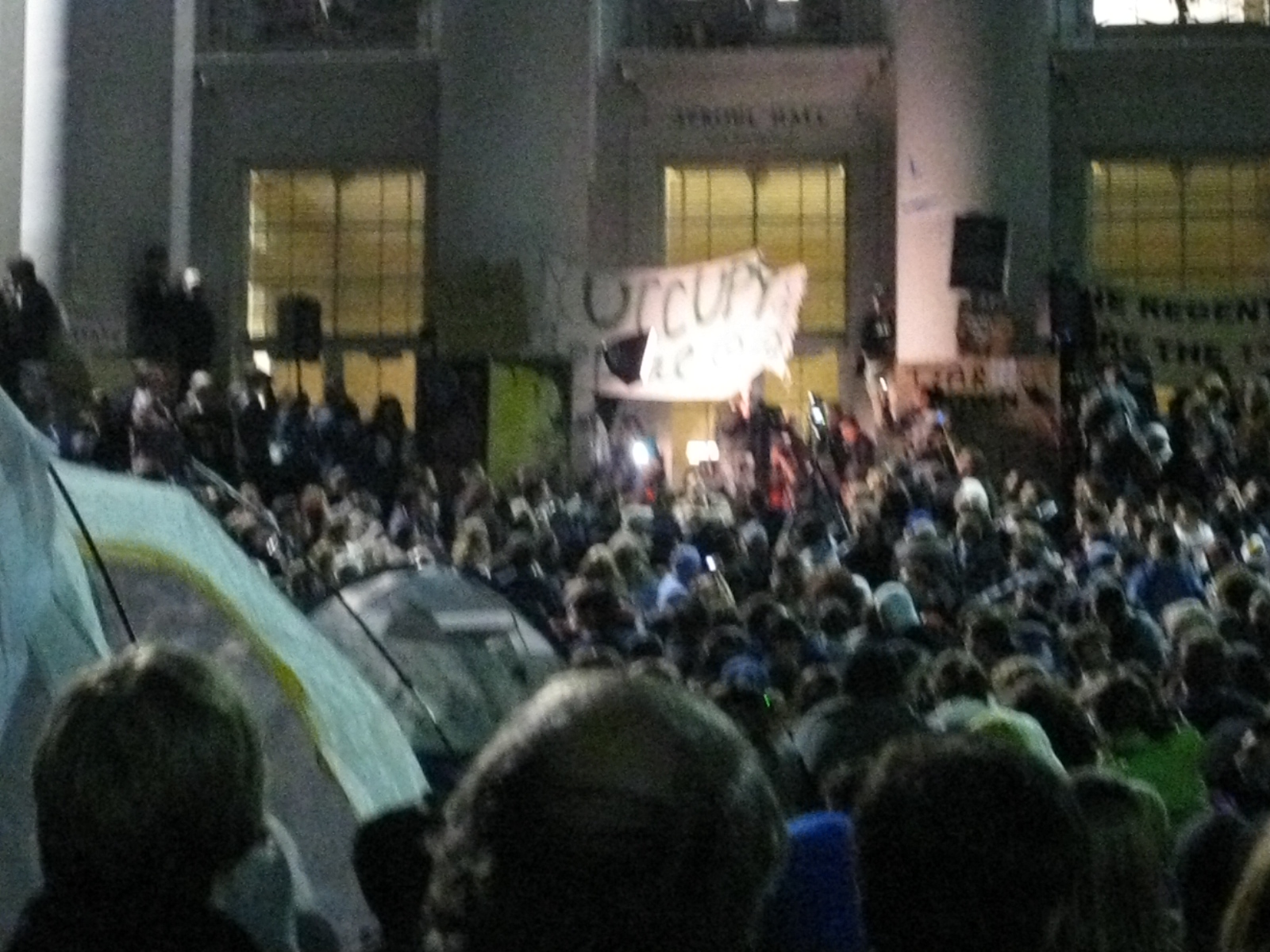
OccupyCal Protest Rally at University of California Berkeley Campus, Nov. 15, 2011


General Assembly in front of Sproul Hall at UC Berkeley


PHOTOS BY CHULEENAN

All,

On Monday evening, November 15, 2011, Chuleenan and I participated in a massive rally and protest sponsored by OccupyCal at Sproul Plaza on the University of California, Berkeley campus in which over 4,000 students and community citizens and activists declared our collective intellectual, spiritual, political and ideological solidarity with the national Occupy Wall Street movement and demanded that the state of California honestly address the crucial issues of the need for real democracy in public education, the exploitive and corrupting influences of the banks and Wall Street on the U.S. economy generally, and the critical political, cultural, and economic relationships between higher education, health care reform, financial regulation, systemic structural investment, and science and technology in a global context. Former Secretary of Labor and currently Professor of Public Policy at UC Berkeley Robert Reich was the keynote speaker who had been chosen by student groups to give the annual Mario Savio memorial lecture in honor of the great and profound legacy left by the late UC, Berkeley philosophy school graduate and leader of the famed Free Speech Movement in 1964 Mario Savio (1942-1996). Reich gave his inspiring speech on the exact same steps on the Plaza directly in front of Sproul Hall that Savio gave his famous speech in December of 1964 at the height of the extraordinary campus wide Free Speech Movement (see Video of that incredible speech below). BTW: The rally and Reich's speech were terrific. Mario would have been very proud of us...

Kofi


MARIO SAVIO AT SPROUL HALL
DECEMBER 2, 1964


"There is a time when the operation of the machine becomes so odious, makes you so sick at heart, that you can't take part; you can't even passively take part, and you've got to put your bodies upon the gears and upon the wheels, upon the levers, upon all the apparatus, and you've got to make it stop. And you've got to indicate to the people who run it, to the people who own it, that unless you're free, the machine will be prevented from working at all!"
--Mario Savio, University of California, Berkeley Sproul Hall--December 2, 1964

"Savio's moral clarity, his eloquence, and his democratic style of leadership inspired thousands of fellow Berkeley students to protest university regulations which severely limited political speech and activity on campus. The non-violent campaign culminated in the largest mass arrest in American history, drew widespread faculty support, and resulted in a revision of university rules to permit political speech and organising. This significant advance for student freedom rapidly spread to countless other colleges and universities across the country."

[Via stonecast, see here: http://www.savio.org/who_was_mario.html

The Rise of Occupy Cal--Thousands Rally and Protest at University of California, Berkeley in Solidarity with the National Occupy Wall Street Movement

Francisco Alvarado yells during an anti-Wall Street rally near Sproul Hall at the University of California, Berkeley during an Occupy Cal rally, Nov. 15, 2011, in Berkeley, Calif. (AP)

Former Secretary of Labor Robert Reich speaks to Anti-Wall Street activists near Sproul Hall at the University of California, Berkeley during an Occupy Cal rally, Nov. 15, 2011, in Berkeley, Calif. (Credit: AP)


http://www.cbsnews.com/8301-201_162-57325649/occupy-protesters-rebuild-uc-berkeley-camp/

November 16, 2011

"Occupy" protesters rebuild UC Berkeley camp


BERKELEY, Calif. - Anti-Wall Street activists began rebuilding their tent encampment on the steps of the University of California, Berkeley student plaza and cheered wildly when former U.S. Labor Secretary Robert Reich implored them to take a moral stand against the very rich owning so much of America's wealth.

A daylong strike and peaceful demonstrations against big banks and education cuts culminated in some 4,000 people rallying at the Reich speech on the steps of the same student plaza that first launched the Berkeley Free Speech Movement in the 1960s.

"The days of apathy are over, folks," Reich, a professor of public policy at UC Berkeley, said to a roaring crowd at Sproul Hall on Tuesday. "We are losing the moral foundation stone on which this country and our democracy were built. There are some people out there who say we cannot afford education any longer, we cannot provide social services for the poor ... but how can that be true if we are now richer than we have ever been before?"

The protests were disrupted earlier in the day by a campus shooting in inside the Haas School of Business. Officials did not know if the suspect was part of the Occupy Cal movement, said Ute Frey, a spokeswoman for the university.

"I just hope it wasn't from the protest or the movement, because that's not what the movement is about," said Sadia Saif, a 19-year-old UC Berkeley sophomore.

The shooting didn't prevent thousands of students and demonstrators from gathering at the university to vote on a list of demands and await Reich's Mario Savio Lecture, named for the political activist and leader of the Berkeley Free Speech Movement of the 1960s. Savio's impassioned speeches on the same steps of Sproul Hall against the Vietnam War and racial inequality prompted thousands of students to join the movement.

"Every social movement in the last half century or more — it started with moral outrage," Reich said, likening Wall Street to the bullies who battered him when he was an especially short kid. "You understand how important it is to fight the bullies, to protect the powerless."

Protesters also cheered as at least 10 tents were constructed on the steps, less than a week after baton-wielding police clashed with people who tried to defy a campus ban on camping.

Elizabeth de Martelly, a 29-year-old UC Berkeley graduate student, said she was inspired by Reich's comments about social movements born from moral outrage and planned to spend the night in the new encampment.

"That said, I want to see the movement to expand beyond encampments," she said amid the music, light shows and dancing. "But this is a powerful thing for the time being."

The Occupy Cal students were joined by hundreds of Occupy Oakland demonstrators who marched the five miles from Oakland to Berkeley along Telegraph Avenue, chanting, "Here comes Oakland!" Police cleared their tent city outside Oakland City Hall on Monday amid complaints about safety and sanitation, and arrested more than 50 people.

Occupy Cal's general assembly voted in favor of inviting the university's chancellor and board of regents to a debate in early December and sending the educational officials a list of demands, including a tuition rollback to 2009 levels.

They also voted in favor of rebuilding their encampment despite earlier violence.
On Nov. 9, police jabbed students with batons and arrested 40 people as the university sought to uphold a campus ban on camping.

UC Berkeley Chancellor Robert Birgeneau launched an investigation into allegations that campus police used excessive force. He said videos of the protests were disturbing, and he plans to grant amnesty to all students who were arrested and cited for attempting to block police from removing the tents.

Birgeneau issued a statement to the students and Occupy demonstrators, saying the university leadership shares in their anger and frustration over relentless tuition hikes and the growing burden on their families.

"We all share the distress and anger at the State of California's disinvestment in public higher education," Birgeneau said.

He called on the "political leadership" from Sacramento to come to campus to engage with him and student representatives in a public forum to debate the future of public education. "The issues require bold action and time is short," he said.

Over the past three years, the cash-strapped state has sharply reduced funding to California's public colleges and universities, which has led to steep tuition hikes, course cutbacks, staff layoffs and reduced student enrollment.

Oscar Varela, 21, a fifth-year economics major who helped organize Tuesday's demonstrations, was among the students who tried to block campus police from tearing down the campus encampment last week.

"We want to stay here to prove to the regents and state that we are part of this movement and that we want our tuition to go back to what it used to be, which essentially should be free," Varela said.

Earlier in the day, university officials said a female staff member reported seeing a man with a gun, who was shot by a university police officer within minutes. The condition of the 33-year-old suspect was not immediately known. His name was not released.

Dong Hwan Kim, 27, a senior, said he was terrified when he learned of the shooting.

"The shooting, in addition to what's happening here with the protests, makes the campus feel really tense," Kim said. "This is a historical moment, but it is also really scary at the same time."

Protesters descended on the university after ReFund California, a coalition of student groups and university employee unions, called for a campus strike and teach-ins.

"If the only people who can come here in the future are those who have money, it's going to hurt everyone's educational experience," said Daniel Rodriguez, 28, a graduate student who was conducting an introductory Spanish language class outside.

Wednesday, November 9, 2011

Robert Reich On The Real Stakes of the 2012 National Elections, The Wall Street Debacle, And the Collapse of the U.S. Economy

(Photo: Andrew Bossi / Flickr)

http://www.truth-out.org/washington-pre-occupied/1320501362

"The disconnect between Washington and the rest of the nation hasn’t been this wide since the late 1960s.

The two worlds are on a collision course: Americans who are losing their jobs or their pay and can’t pay their bills are growing increasingly desperate. Washington insiders, deficit hawks, regressive Republicans, diffident Democrats, well-coiffed lobbyists, and the lobbyists’ wealthy patrons on Wall Street and in corporate suites haven’t a clue or couldn’t care less.

I can’t tell you when the collision will occur but I’d guess 2012.

Look elsewhere around the world and you see a similar collision unfolding. The details differ but the larger forces are similar. You see it in Spain, Greece, and Italy, whose citizens are being squeezed by bankers insisting on austerity. You see it in Chile and Israel, whose young people are in revolt. In the Middle East, whose “Arab spring” is becoming a complex Arab fall and winter. Even in China, whose young and hourly workers are demanding more – and whose surge toward inequality in recent years has been as breathtaking as is its surge toward modern capitalism.

Will 2012 go down in history like other years that shook the foundations of the world’s political economy – 1968 and 1989?

I spent part of yesterday in Oakland, California. The Occupier movement is still in its infancy in the United States, but it cannot be stopped. Here, as elsewhere, people are outraged at what feels like a rigged game – an economy that won’t respond, a democracy that won’t listen, and a financial sector that holds all the cards.

Here, as elsewhere, the people are rising."

--Robert Reich

All,

Robert Reich says it all here and then some. This is just the beginning of a massive social movement that will-- if intelligently sustained and expanded --serve as the very foundation in the short and longterm for any real concrete social, economic, and political change in this society. So while it's just a (brilliant) beginning the important thing to remember is that it is a very POWERFUL beginning and for the first time in a very long time we, the People are in the forefront of actually making or at least demanding these changes. That is an inspiring reality in itself that will continue to serve as a major incentive for mass participation and elevating the very principle of grassroots struggle and mobilization that animates all genuine radical change in society and culture. This is our major opportunity to ACT on our own collective behalf for once without crippling ourselves with the eternal copouts and lazy equivocations of cynicism, solipsism, fatalism, nihilism, and despair. We dare not blow, take for granted, or smugly dismiss this great opportunity for creating real change. If we do so it will only be at our own peril as citizens and human beings...

Kofi


3 November 2011
by Robert Reich
Robert Reich's Blog | Op-Ed

The biggest question in America these days is how to revive the economy.

The biggest question among activists now occupying Wall Street and dozens of other cities is how to strike back against the nation’s almost unprecedented concentration of income, wealth, and political power in the top 1 percent.

The two questions are related. With so much income and wealth concentrated at the top, the vast middle class no longer has the purchasing power to buy what the economy is capable of producing. (People could pretend otherwise as long as they could treat their homes as ATMs, but those days are now gone.) The result is prolonged stagnation and high unemployment as far as the eye can see.

Until we reverse the trend toward inequality, the economy can’t be revived.

But the biggest question in our nation’s capital right now has nothing to do with any of this. It’s whether Congress’s so-called “Supercommittee” – six Democrats and six Republicans charged with coming up with $1.2 trillion in budget savings — will reach agreement in time for the Congressional Budget Office to score its proposal, which must then be approved by Congress before Christmas recess in order to avoid an automatic $1.5 trillion in budget savings requiring major across-the-board cuts starting in 2013.

Have your eyes already glazed over?

Diffident Democrats on the Supercommittee have already signaled a willingness to cut Medicare, Social Security, and much else that Americans depend on. The deal is being held up by Regressive Republicans who won’t raise taxes on the rich – not even a tiny bit.

President Obama, meanwhile, is out on the stump trying to sell his “jobs bill” – which would, by the White House’s own estimate, create fewer than 2 million jobs. Yet 14 million people are out of work, and another 10 million are working part-time who’d rather have full-time jobs.

Republicans have already voted down his jobs bill anyway.

The disconnect between Washington and the rest of the nation hasn’t been this wide since the late 1960s.

The two worlds are on a collision course: Americans who are losing their jobs or their pay and can’t pay their bills are growing increasingly desperate. Washington insiders, deficit hawks, regressive Republicans, diffident Democrats, well-coiffed lobbyists, and the lobbyists’ wealthy patrons on Wall Street and in corporate suites haven’t a clue or couldn’t care less.

I can’t tell you when the collision will occur but I’d guess 2012.

Look elsewhere around the world and you see a similar collision unfolding. The details differ but the larger forces are similar. You see it in Spain, Greece, and Italy, whose citizens are being squeezed by bankers insisting on austerity. You see it in Chile and Israel, whose young people are in revolt. In the Middle East, whose “Arab spring” is becoming a complex Arab fall and winter. Even in China, whose young and hourly workers are demanding more – and whose surge toward inequality in recent years has been as breathtaking as is its surge toward modern capitalism.

Will 2012 go down in history like other years that shook the foundations of the world’s political economy – 1968 and 1989?

I spent part of yesterday in Oakland, California. The Occupier movement is still in its infancy in the United States, but it cannot be stopped. Here, as elsewhere, people are outraged at what feels like a rigged game – an economy that won’t respond, a democracy that won’t listen, and a financial sector that holds all the cards.

Here, as elsewhere, the people are rising.


Links:

[1] http://www.truth-out.org/print/8617
[2] http://www.truth-out.org/printmail/8617
[3] http://robertreich.org/post/12303771388
[4] http://www.flickr.com/photos/thisisbossi/4393355562/in/photostream/
[5] http://www.truth-out.org/printmail
[6] http://www.truth-out.org/content/robert-reich
[7] http://org2.democracyinaction.org/o/6694/p/salsa/web/common/public/signup?signup_page_KEY=2160
[8] https://members.truth-out.org/donate
[9] http://www.truth-out.org/?q=occupied-what-now/1318825916
[10] http://www.truth-out.org/?q=food-system-pays-dearly-wall-street-occupies-washington/1319462814

Thursday, September 8, 2011

Robert Reich Strongly Reminds Us And the President What the U.S. Economy Really Needs

(Image: JR / t r u t h o u t)

http://www.truth-out.org/zero-economy/1315143274

All,

I and many others said all this and more a couple days ago. But it certainly bears repeating over and over again until SOMEBODY actually listens and ACTS on what it means...Acclaimed economist, Professor at UC, Berkeley, and former Secretary of Labor in the Clinton administration Robert Reich reminds us in crystal clear language what we all need to know and do about the national economy at this point in history...

Kofi


The Zero Economy
4 September 2011
by Robert Reich
Robert Reich's Blog | Op-Ed


The Bureau of Labor Statistics reported Friday no jobs were created in August. Zero. Nada.

Well, not quite. The strike at Verizon reduced the labor force by 45,000. Minnesota government employees returned to work, adding 22,000. So in reality, America added 23,000 jobs. Almost zero.

In reality, worse than zero. We need 125,000 a month merely to keep up with population growth. So the hole continues to deepen.

Since this Depression began at the end of 2007, America’s potential labor force – working-age people who want jobs – has grown by over 7 million. But since then the number of Americans with jobs has shrunk by more than 300,000.

If this doesn’t prompt President Obama to unveil a bold jobs plan next Thursday, I don’t know what will.

The problem is on the demand side. Consumers (whose spending is 70 percent of the economy) can’t boost the economy on their own. They’re still too burdened by debt, especially on homes that are worth less than their mortgages. Their jobs are disappearinig, their pay is dropping, their medical bills are soaring.

And businesses won’t hire without more sales.

So we’re in a vicous cycle.

Republicans continue to claim businesses aren’t hiring because they’re uncertain about regulatory costs. Or they can’t find the skilled workers they need.

Baloney. If these were the reasons businesses weren’t hiring – and demand were growing – you’d expect companies to make more use of their current employees. The length of the average workweek would be increasing.

But the length of the average workweek has been dropping. In August it declined for the third month in a row, to 34.2 hours. That’s back to where it was at the start of the year – barely longer than what it was at its shortest point two years ago (33.7 hours in June 2009).

It’s demand, stupid.

So what does a sane nation do when the consumers and businesses can’t boost the economy on their own?

Government becomes the purchaser of last resort. It hires directly (a new WPA and Civilian Conservation Corps, for example). It helps states and locales, so they don’t have to continue to slash payrolls and public services. (The help could be structured as a loan, to be repaid when unemployment drops to, say, 6 percent.)

And it hires indirectly — contracting with companies to rebuild our crumbling infrastructure, including school buildings, to take another example.

Not only does this create jobs but also puts money in the hands of all the people who get the jobs, so they can turn around and buy the goods and services they need – generating more jobs.

Get it? Not exactly rocket science.

So why don’t Republicans get it? Either they’re knaves – they want the economy to stay awful through next Election Day so Obama gets the boot. Or they’re fools – they’ve bought the lie that reducing the deficit now creates more jobs.

Every time you hear anyone say we’re “broke” or “can’t afford to spend more,” tell them we’ll be in worse shape if we don’t. If the economy remains dead in the water, the ratio of public debt to GDP balloons.

And remind them that the federal government can now borrow at fire-sale rates. Interest on the ten-year Treasury bill is 2 percent.

Do you hear me, Mr. President? Please — be bold next week. And if, as expected, Republicans refuse to go along, take it to the people. Mobilize the public. Use the bully pulpit. That’s what you have it for.

One more thing, Mr. President. You also have to tackle inequality. When so much income and wealth continues to flow to the very top, America’s vast middle class still won’t have enough purchasing power to boost the economy. Priming the pump is necessary but won’t be sufficient without enough water in the well.

Wednesday, August 3, 2011

The Ideological and Social Consequences of the Debt Ceiling Fight and Its Devastating Impact on the Real Crisis of National Unemployment

http://www.truth-out.org/hostage-crisis-continues-why-obama-cant-pivot-jobs-and-growth/1312377777


All,

Actual Truth and Consequences in the realm of the contemporary U.S. political economy or social Reality vs. Fantasy...(again)...

Kofi


The Hostage Crisis Continues: Why Obama Can't Pivot to Jobs and Growth
3 August 2011
by Robert Reich

Robert Reich's Blog | Op-Ed


With the hostage crisis behind him, the President is now ready to talk about the nation’s real problem.

Nine paragraphs into his remarks today announcing the nation has paid most of the ransom the radical right demanded as a condition for maintaining the full faith and credit of the United States (he didn’t use these exact words), the President pivoted to the agenda he should have been talking about all along:

“And in the coming months I’ll continue also to fight for what the American people care most about: new jobs, higher wages, and faster economic growth.”

But what precisely will he fight for now that the debt deal has tied his hands?

He says he wants to extend tax cuts for middle class families and make sure the jobless get unemployment benefits.

Fine, but the new deal won’t let him. He’ll have to go back to Congress after the recess (five weeks from now) and round up enough votes to override the budget caps that now restrict spending. What are the odds? Maybe a little higher than zero.

He says he wants an “infrastructure bank” that would borrow money from private capital markets to pay private contractors to rebuild our nations roads, bridges, airports, and everything else that’s falling apart.

Fine, but the new deal he just signed may not let him do this either – if the infrastructure bank relies on federal funds or even federal loan guarantees to attract private money. The only way he could create an infrastructure bank without sweetening the pot would be by privatizing all the new infrastructure. That means toll roads and toll bridges, user-fee airports, and entry fees everywhere else.

Apart from its potential unfairness to lower-income people, such a privatized infrastructure would have the same effect as a tax increase. After paying more for roads and bridges and all other infrastructure, Americans would have less cash for to spend on goods and services. That means no boost to the economy.

The President also wants to complete trade deals and reform the patent process. These may make the economy slightly more efficient, but they’re not going to have any perceptible positive impact on the lives of the 26 million Americans who are now either looking for work, working in part-time jobs but needing full-time ones, or have given up looking.

More importantly, the deal he just signed makes it impossible for the President and Democrats to launch any major jobs program – no WPA or Civilian Conservation Corps, no major lending program to cash-starved states and locales, no new help for distressed homeowners, and so on. Nada.

“We’ve got to do everything in our power to grow this economy and put America back to work,” the President says, now that the hostage crisis is over.

But the sad truth is he and the nation remain hostage to the ideology of right-wing Republicans who won’t let the government spend more money. Yet if the government can’t spend more – at least this year and next, until the pump is primed and the economy is growing again – we won’t see job growth. And without job growth, the economy will remain anemic.

That’s why even the stock market is reacting badly to the end of the hostage crisis.

If you hadn’t noticed, the number of people unemployed or underemployed keeps growing. (We’ll know Friday how many it added in July, but remember it needs to add 125,000 a month just to keep up with the growth of the labor force. Anything below 125,000 means we continue to slide backward.)

The reason: Consumers, who are 70 percent of the economy, haven’t been able to pick up the slack. That’s because they’re still deep in debt. Their homes have plummeted in value. They can’t borrow. Their jobs are on the line and their wages are dropping.

So where will the demand come from if not government? The radical right points to the alleged “failure” of the stimulus program as evidence that government spending doesn’t work. The fact is it did work – it saved at least 3 million jobs, and would have saved far more if the stimulus was on the scale needed and directed to job creation.

To be sure, pump-priming is more difficult when the well is almost dry, as it is now. And widening inequality – the rich taking home an increasing share of the nation’s total income and wealth – has left the vast middle class with even less purchasing power.

But the pump still needs to be primed.

And the well has to be filled: The nation must also push for real tax reform that reverses the surge toward inequality – raising taxes on the wealthy, cutting them for the middle, and expanding the Earned Income Tax Credit for the poor.

To do this, though, requires that Americans understand the truth. But where will they learn it?

The radical right has not only captured the federal budget. In convincing so many Americans the problem is the size of government rather than their shrinking paychecks and growing economic insecurity, the radical right has also captured the American mind.


ROBERT REICH

Robert Reich is Chancellor's Professor of Public Policy at the University of California at Berkeley. He has served in three national administrations, most recently as secretary of labor under President Bill Clinton. He has written thirteen books, including The Work of Nations, Locked in the Cabinet, Supercapitalism, and his most recent book, Aftershock.

Robert Reich Tells the Whole Truth About the Abject Capitulation of President Obama and the Democratic Party to the Right in the Debt Crisis Fight

President Barack Obama speaks about a debt deal at the White House on Sunday night in Washington, July 31, 2011. Obama announced that leaders of both parties in the House and Senate have reached an agreement with him to raise the government's debt ceiling. (Photo: Philip Scott Andrews / The New York Times)

http://www.truth-out.org/ransom-paid/1312207122

Ransom Paid Monday
1 August 2011

by Robert Reich
Robert Reich's Blog | Op-Ed


Anyone who characterizes the deal between the President, Democratic, and Republican leaders as a victory for the American people over partisanship understands neither economics nor politics.

The deal does not raise taxes on America’s wealthy and most fortunate — who are now taking home a larger share of total income and wealth, and whose tax rates are already lower than they have been, in eighty years. Yet it puts the nation’s most important safety nets and public investments on the chopping block.

It also hobbles the capacity of the government to respond to the jobs and growth crisis. Added to the cuts already underway by state and local governments, the deal’s spending cuts increase the odds of a double-dip recession. And the deal strengthens the political hand of the radical right.

Yes, the deal is preferable to the unfolding economic catastrophe of a default on the debt of the U.S. government. The outrage and the shame is it has come to this choice.

More than a year ago, the President could have conditioned his agreement to extend the Bush tax cuts beyond 2010 on Republicans’ agreement not to link a vote on the debt ceiling to the budget deficit. But he did not.

Many months ago, when Republicans first demanded spending cuts and no tax increases as a condition for raising the debt ceiling, the President could have blown their cover. He could have shown the American people why this demand had nothing to do with deficit reduction but everything to do with the GOP’s ideological fixation on shrinking the size of the government — thereby imperiling Medicare, Social Security, education, infrastructure, and everything else Americans depend on. But he did not.

And through it all the President could have explained to Americans that the biggest economic challenge we face is restoring jobs and wages and economic growth, that spending cuts in the next few years will slow the economy even further, and therefore that the Republicans’ demands threaten us all. Again, he did not.

The radical right has now won a huge tactical and strategic victory. Democrats and the White House have proven they have little by way of tactics or strategy.

By putting Medicare and Social Security on the block, they have made it more difficult for Democrats in the upcoming 2012 election cycle to blame Republicans for doing so.

By embracing deficit reduction as their apparent goal – claiming only that they’d seek to do it differently than the GOP – Democrats and the White House now seemingly agree with the GOP that the budget deficit is the biggest obstacle to the nation’s future prosperity.

The budget deficit is not the biggest obstacle to our prosperity. Lack of jobs and growth is. And the largest threat to our democracy is the emergence of a radical right capable of getting most of the ransom it demands.


ROBERT REICH

Robert Reich is Chancellor's Professor of Public Policy at the University of California at Berkeley. He has served in three national administrations, most recently as secretary of labor under President Bill Clinton. He has written thirteen books, including The Work of Nations, Locked in the Cabinet, Supercapitalism, and his most recent book, Aftershock.

Tuesday, October 20, 2009

Citizen Activism, the fight for a 'Public Option', and the Movement for National Healthcare Reform

All,

The Feinstein 1200 Newsletter is a publication that was put together by an engaged citizen from the San Francisco Bay Area who is trying to organize public opinion in support of a public option for healthcare reform. When Chuleenan attended an August session at Senator Diane Feinstein's San Francisco office to push her to support a public option, she met a woman who was very interested in citizen action on healthcare. That woman collected people's emails and began sending messages to folks interested in staying informed about healthcare. She eventually established a restricted Google group, The Feinstein 1200, which aims to link this community, and to provide a sounding board to exchange ideas and news on the issue of health care reform throughout the August recess.

The following excerpts from the Newsletter raise some very important facts about the current national fight for real healthcare reform. Check it out,,,

Kofi


The Feinstein 1200 Newsletter: October 19, 2009


This Feinstein 1200 Newsletter is devoted entirely to today’s appearance by former U.S. Labor Secretary, Berkeley professor, and tireless public option supporter Robert Reich on WNYC, which you can hear through the blogspot.

I've excerpted three quotes, for those who don't have 15 minutes for the entire program.


1) Reich’s “bombshell” on the agreement between the White House and health insurers,

2) A quick quote from Reich on insurance anti-trust exemptions, and

3) Most importantly, Reich's clarification of what is now possible through the Senate.


1. Reich’s bombshell: On today's WNYC interview, Reich stated: “Originally there was a kind of agreement between the insurance companies and the White House, started last January, and that agreement was the WH saying to the insurance companies:


‘Look, we can get you 30-35 million more customers, but you have to agree to just, uh, to be quiet. Don’t do what you did during Bill Clinton’s health care fight. Don’t run ads against us, don’t be an obstreperous, negative lobbying force. At the very least be quiet, you’ll make much more money if we can get this thing through. And when it comes to a public option, we, that is the White House, we will not push it. If it gets enacted, that’s okay, but we’re not going to push it, that’s up to Congress.’

“Now that deal began to unravel probably about 3 or 4 weeks ago, and certainly the last piece of that unraveling was a major study produced by the insurance lobby in Washington saying that the health care reforms emerging from the Hill were going to cost consumers much more than the White House or the Congressional Budget Office had let on. Why did the insurance company do an about-face? I think because instead of getting the 25-35 million new customers that they were promised by the White House, it looked as if they were only going to get 20 million new customers. And the Senate Finance Committee and other committees were even toying with the idea of reducing the penalties on people who would not necessarily sign up, which means there could be even fewer benefits for them.”


2. In response to the question of whether there is an anti-trust exemption for insurance companies: “They do have an anti-trust exemption, and that means that there is really not very much that the government - unless that exemption is taken away - can do about insurance companies getting together and monopolizing a local market or a national market. Which is exactly why I and so many others have been calling for a public insurance option, something that would give the insurance companies some real competition. And (in Saturday’s media address) the President did come down rhetorically on the insurance companies, but I did not hear anything about him going to demand a public option.”


(Editor’s note: this mirrors President Obama’s omission of any statement about a public insurance option, or “public option”, during his fundraising appearance in San Francisco on Thursday evening. So is he still trying to “play nice” with an insurance lobby that is trying to destroy his health care reform package? Mr. President, the insurance lobby is not your real friend. Those of us holding you to your promises are, believe it or not, your real friends - we want, and need, for you to have a genuine legacy, and we believe that's possible if you don't continue to bend to corporate interests.)


3. Most importantly, Reich clarified: “Most people don’t understand but it’s critically important in terms of understanding the process of the Senate: All Harry Reid has to get is 60 senators (and there are 60 democrats) to vote for a procedural motion to get the health care bill to the Senate floor. They don’t have to vote in favor of the health care bill. If they don’t like the health care bill, if they’re Mary Landrieu from Louisiana who’s in serious trouble because her state is so conservative, they can say to constituents: ‘I’m just voting for procedural motion because I think it’s fair to get the bill voted on.’ Now once Harry Reid gets those 60 votes for procedural motion to overcome a filibuster and gets the vote to the floor, then all he needs is 51 votes, and by many peoples’ head counts, he does have 51 votes, including a good chance of 51 votes for a public insurance option. And again that option is critically important because if we don’t have it, we won’t be able to afford health care in years ahead because there won’t be competition for the private insurance companies.”


Please contact me with any questions or comments. You might also want to check out Reich's blog.


Many thanks,

Eva Chrysanthe

The Feinstein 1200

http://feinstein1200.blogspot.com/