Showing posts with label Civil Rights Movement. Show all posts

Wednesday, February 7, 2024

IMPORTANT NEW BOOK:

Medgar and Myrlie: Medgar Evers and the Love Story That Awakened America
by Joy-Ann Reid
Mariner Books, 2024

[Publication date:  February 6, 2024]

“Medgar Evers deserves a place alongside Malcolm X and Dr. King in our historical memory. Evers, with Myrlie as his partner in activism and in life, was doing civil rights work in the single most hostile and dangerous environment in America.”—from Medgar and Myrlie

By MSNBC's Joy-Ann Reid, a triumphant work of biography that repositions slain Civil Rights pioneer Medgar Evers at the heart of America's struggle for freedom, and celebrates Myrlie Evers's extraordinary activism after her husband's assassination in the driveway of their Mississippi home.

"I love this book. The empathic, brilliant, and wise Joy Reid has brought us the poignant, fascinating inside story of Medgar and Myrlie Evers, transformational leaders who confronted pure evil and risked their lives to ensure that all American children might grow up in a United States that was more just. As Reid shows us, that painful task is now more urgent than ever.” — Michael Beschloss

Myrlie Louise Beasley met Medgar Evers on her first day of college. They fell in love at first sight, married just one year later, and Myrlie left school to focus on their growing family.

Medgar became the field secretary for the Mississippi branch of the NAACP, charged with beating back the most intractable and violent resistance to black voting rights in the country. Myrlie served as Medgar’s secretary and confidant, working hand in hand with him as they struggled against public accommodations and school segregation, lynching, violence, and sheer despair within their state’s “black belt.” They fought to desegregate the intractable University of Mississippi, organized picket lines and boycotts, despite repeated terroristic threats, including the 1962 firebombing of their home, where they lived with their three young children.

On June 12, 1963, Medgar Evers became the highest profile victim of Klan-related assassination of a black civil rights leader at that time; gunned down in the couple’s driveway in Jackson. In the wake of his tragic death, Myrlie carried on their civil rights legacy; writing a book about Medgar’s fight, trying to win a congressional seat, and becoming a leader of the NAACP in her own right.

In this groundbreaking and thrilling account of two heroes of the civil rights movement, Joy-Ann Reid uses Medgar and Myrlie’s relationship as a lens through which to explore the on-the-ground work that went into winning basic rights for Black Americans, and the repercussions that still resonate today.

Dr. Peniel E. Joseph On the Ongoing Historical and Political Significance of 1963 in the United States

"What's Past is Prologue...
Opinion
Three days in 1963 that are still changing America
by Peniel E. Joseph
November 22, 2023
CNN


16 comments

[Editor’s note: Peniel E. Joseph is the Barbara Jordan chair in ethics and political values and founding director of the Center for the Study of Race and Democracy at the LBJ School of Public Affairs at the University of Texas at Austin, where he is a professor of history. He is the author of “The Third Reconstruction: America’s Struggle for Racial Justice in the Twenty-First Century.” The views expressed here are his own.]

John F. Kennedy’s abbreviated presidency, while often overshadowed by his successor’s on this front, was a crucial component of America’s second Reconstruction.


PHOTO:  Dr. Peniel E. Joseph - Kelvin Ma/Tufts University/Kelvin Ma/Tufts University

As the world acknowledges the somber occasion, 60 years ago this week, of Kennedy’s assassination in Dallas on November 22, 1963, it’s important to reflect on Kennedy’s pivotal role in the civil rights revolution. Kennedy’s death stunned the world and shook our nation’s foundation — but his life, punctuated by three days in June 1963, was instrumental to a transformation of American democracy.

Kennedy’s death was the end of one era and the beginning of another. Although we popularly remember his presidency and its end as closing the door on a purported age of American innocence, this is untrue.

Kennedy entered office as a young president with the firm belief that his most consequential role would be as a commander in chief, waging a global war for freedom and democracy on the world stage against the Soviet Union. Instead, Kennedy presided over the early years of the nation’s most crucial period of Reconstruction since the end of the Civil War. This new reality jarred Kennedy’s moral sensibilities, tested his political nerve and emboldened his personal will. He became a more passionate speaker, interested reader and public champion of freedom at home and abroad based on the changing domestic and global landscape. Kennedy never stood still or remained static in his conception of America.

Kennedy’s tragic death came near the end of the most tumultuous year of his presidency. The youngest man ever elected president in 1960 at the age of 43, Kennedy had a vision of a “New Frontier” that would see the nation conquer space, defeat the tyranny of Soviet Union communism and export America’s dreams of freedom to Africa and the developing world, but it was complicated by the most significant domestic crisis in our history: the Civil Rights Movement.

During Kennedy’s first two years in office, civil rights leaders such as the Rev. Martin Luther King Jr. criticized the young president and his younger brother and closest political adviser, Attorney General Robert Kennedy, for shortcomings in the pursuit of racial justice. The Kennedy administration’s allyship in the struggle had been cautious: at its best, exemplified by efforts in ending the mob violence against interracial Freedom Riders in 1961 and deploying federal marshals to help integrate the University of Mississippi in 1962.

The year that changed everything

When the racial crisis in Birmingham, Alabama, in the spring of 1963 galvanized America’s second Reconstruction, it prompted a decisive personal and political moment for Kennedy. The movement’s efforts to racially integrate the declining industrial steel city in Alabama met racist opposition from its commissioner of public safety, Eugene “Bull” Connor, a former sports radio announcer turned full-time segregationist terror. The state of Alabama was so hostile to civil rights that it had outlawed the NAACP.

King and local leader the Rev. Fred Shuttlesworth organized a series of demonstrations in April and May that landed them and fellow activist Ralph Abernathy in jail. There, King wrote his famous “Letter From Birmingham Jail,” which would not be published until after the crisis ended.

Meanwhile, the “Children’s Crusade,” launched by civil rights worker Jim Bevel, drew thousands of children as young as 7 to serve as shock troops of a peaceful movement to eradicate White supremacy in Birmingham. Connor’s police incarcerated thousands, unleashed dogs on nonviolent protesters and used water hoses from the fire department that were powerful enough to strip the bark from trees.

On Mother’s Day 1963, racial terrorists in Birmingham exploded bombs at the hotel of the city’s most successful Black business leader and movement supporter, AG Gaston, in an attempt to assassinate King. The blasts ignited a full-blown Black uprising that took hundreds of Alabama state troopers to quell and forced Kennedy to place the National Guard on alert. The violence also threatened to destroy a public truce between civil rights leaders and city officials that resulted in the formation of a biracial commission, the planned integration of public accommodations and the hiring of Black workers in department stores.

Kennedy faced another crisis when Alabama Gov. George Wallace, in defiance of a federal court order, vowed to prevent two Black students from entering the University of Alabama. Wallace’s infamous stand at the schoolhouse door made him a national hero to racial segregationists, far-right conservatives and believers in the Lost Cause. It propelled him to run for president in Democratic primaries the following year. It fueled an astonishingly successful campaign in 1968 that helped pave the way for more contemporary demagogues in the manipulation of White anger and resentment.

Kennedy’s pivotal words


Having tracked these violent developments from the White House, Kennedy responded to the spring crisis with a momentous set of statements and actions. Over three days in June, Kennedy embraced a vision of Black citizenship and dignity as the beating heart of American democracy.

He first did so in Hawaii on June 9 at a conference of mayors. Kennedy outlined that, for all the attention paid to the South, Northern race relations stood at a critical inflection point. Black Americans suffered double the unemployment rates as Whites, and the millions who migrated North and west to escape racial oppression found themselves living in racially segregated and economically depressed neighborhoods with poor schools, practically no social services and unaffordable, substandard housing. Kennedy challenged America’s mayors in Honolulu to offer summer jobs for Black youth and rid their local cities of racial injustice and ordinances that prevented access to equal opportunity.

The next day, Kennedy delivered the commencement address at American University. In a speech whose primary topic was world peace and finding common ground with Soviet adversaries, it’s impossible not to read into Kennedy’s words a deeper understanding of his growing consciousness about matters of race, especially lines such as his call: “Let us not be blind to our differences — but let us also direct attention to our common interests and to the means by which those differences can be resolved.”

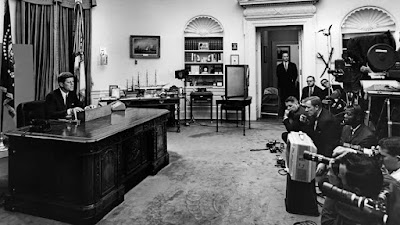
June 11 was Kennedy’s finest hour. That evening, after Vivian Malone and James Hood successfully enrolled at the University of Alabama, Kennedy delivered an 8 p.m. televised address to the American people.


PHOTO:  On June 11, 1963, in his finest hour as president, Kennedy gives a televised address to the nation, vowing to send civil rights legislation to Congress. - Abbie Rowe/The White House/John F. Kennedy Presidential Library and Museum

For nearly 17 minutes, Kennedy discussed the Civil Rights Movement the way King had urged him to do over the past two years. “We are confronted primarily with a moral issue,” Kennedy told the nation. He juxtaposed, throughout his address, the divergent life chances between Blacks and Whites from birth to death, pointing out that both groups served in the military, irrespective of race. Kennedy characterized the hundreds of demonstrations around the country supporting civil rights as “a revolution,” which could be violent or peaceful, depending on the country’s leadership. Kennedy vowed to bring comprehensive civil rights legislation to Congress within the week.

It was a bravura speech, the best of his presidency, certainly the most politically and morally significant. It left a legacy of a president who, despite being pushed in various directions by activists, his brother Bobby and the crisis of Birmingham, seized the time and stood on the right side of history.

An unfinished legacy

Early the following day, Medgar Wiley Evers, a charismatic 37-year-old military veteran and married father of three who served as the NAACP field secretary in Mississippi, was assassinated by a White supremacist. Evers’ murder triggered national waves of protests, mourning and outrage. Kennedy greeted Medgar’s wife, Myrlie, brother Charles, son Darrell Kenyatta and daughter Reena Denise at the White House after the funeral service at Arlington Cemetery.

Over the next five months, Kennedy would, at times reluctantly, fully embrace the struggle for civil rights as part of his legacy. Kennedy met with civil rights leaders after the August 28 March on Washington, hosting them with tea, coffee and sandwiches. “I have a dream,” he said to King as he shook his hand, offering congratulations for a timeless speech against the backdrop of the Lincoln Memorial.

Progress for Kennedy would always mean something other than perfection. After the September 15, 1963, bombing of the 16th Street Baptist Church in Birmingham, Kennedy, to the disappointment of King and many others, refused to attend the funeral services for any of the six children killed that day. Carole Robertson, Addie Mae Collins, Cynthia Wesley, and Denise McNair all perished in the dynamite blast that ripped through the basement of the church. Three of the girls were 14, and one 11. Two other young people died in Birmingham that day. Two White Eagle Scouts murdered “Peanut” Ware as he rode on the handlebars of his brother’s bike, and police fired a shotgun in the back of Johnny Robinson in Birmingham during the unrest that came after the bombing.


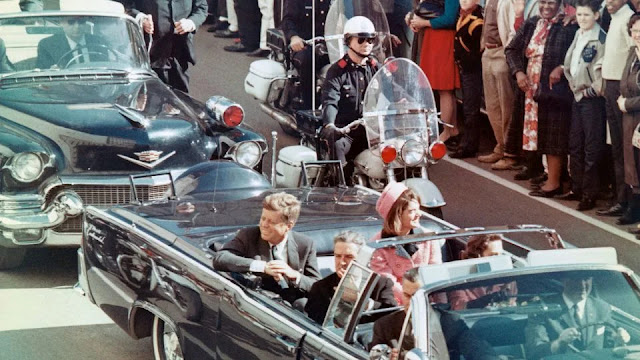
PHOTO: The president rides with first lady Jacqueline Kennedy in Dallas on November 22, 1963. Bullets put an end to his evolution on matters of racial justice. - Bettmann Archive/Getty Images

Bullets put a brutal end to Kennedy’s evolution on matters of racial justice. He was shot to death in Dallas while riding in a convertible next to first lady Jacqueline Kennedy in an act of violence that also wounded then-Texas Gov. John Connally. The shock of Kennedy’s murder brought the world up short, sparking endless conspiracy theories — especially after the accused killer, Lee Harvey Oswald, was then shot and killed by Jack Ruby, himself a figure with underworld connections. While a presidential commission later identified Oswald as a lone shooter, questions remain, even six decades later.

His killing also placed him in a pantheon with the year’s other less celebrated victims— Medgar Evers and the Birmingham Six. Malcolm X, the revolutionary leader who embodied the Black resistance and parried with King over the meaning of democracy, infamously characterized Kennedy’s death as “chickens coming home to roost,” which resulted in his suspension and eventual departure from the Nation of Islam.

Though less well-known, writer James Baldwin’s response to the assassination is particularly instructive. Baldwin found himself too angry to mourn only Kennedy. He lashed out against the country that, in his estimation, did not sufficiently express grief for Medgar Evers or the lost children of Birmingham. “Evers was put to death by the southern oligarchy to preserve the southern power structure,” Baldwin said. “That’s why he died and that’s why nobody cares.” He continued. “That’s why six children died in Birmingham and nobody cares.”

The best compliment that can be paid to Kennedy’s unfinished legacy is that he evolved. That political evolution helped lay the groundwork for his successor, Lyndon Baines Johnson, and the magnificent achievements of the Great Society, including landmark civil rights legislation Kennedy proposed that was passed under Johnson. The ultimate lesson we can learn from Kennedy, 60 years after his death, is that this nation remains a work in progress. Kennedy’s vision, at its best, continues today in the pursuit of progress, the restless and relentless effort to achieve freedom and citizenship for all Americans so that the power of our example can reverberate hopefully throughout the world.


Monday, October 16, 2023

JEANNE THEOHARIS AND LERONE MARTIN ON J. EDGAR HOOVER, THE FBI, AND THE RISE OF MODERN WHITE CHRISTIAN NATIONALISM IN THE UNITED STATES


One Bureau under God

Jeanne Theoharis speaks with Lerone A. Martin on the white Christian legacy of J. Edgar Hoover’s FBI.

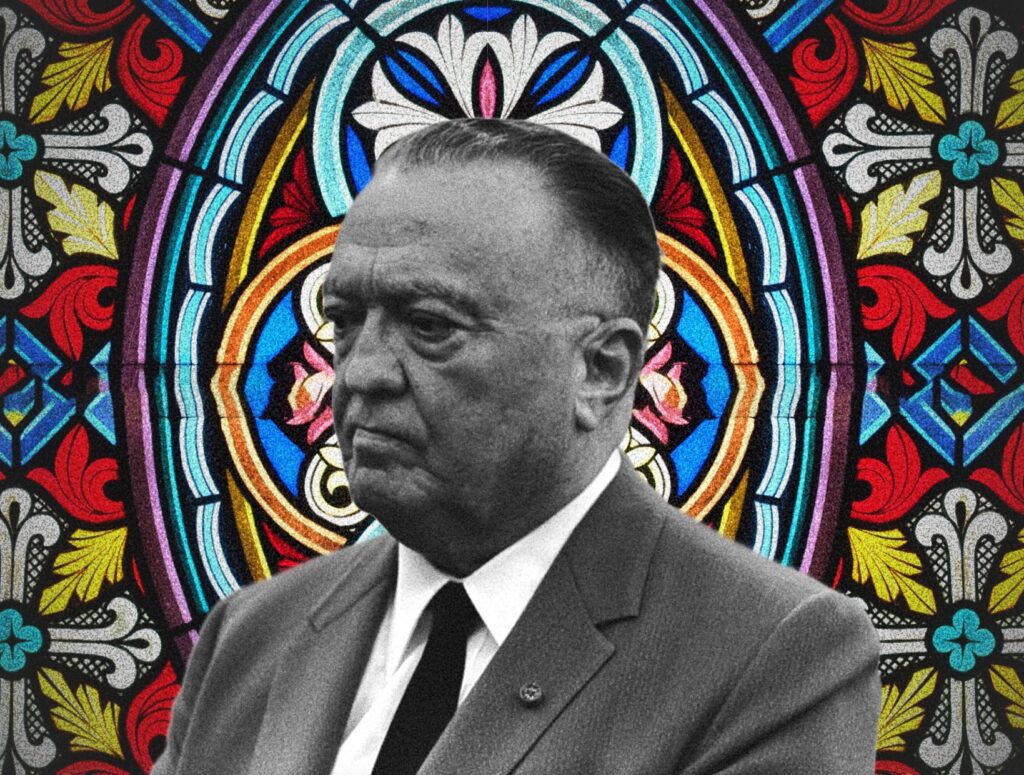
J. EDGAR HOOVER (1895-1972).  Image: Wikimedia Commons

On this day sixty years ago, October 10, 1963, the Department of Justice signed a memo granting the FBI permission to conduct technical, wall-to-wall surveillance on Martin Luther King, Jr. The eloquence and reach of King following the March on Washington had so alarmed the Kennedy administration and the bureau that six weeks later they felt drastic steps had to be taken. The bureau had already been surveilling King for some time, but this memo gave them something new: the ability to wiretap him at his home, at his office, or at “any future address to which he may move.” The FBI interpreted that language very liberally. It could be read as allowing continued surveillance if Martin Luther King, Jr. changed residences—if he picked up and moved his permanent address. But they chose instead to interpret it as saying that surveillance was permitted anywhere King moved, and used this to begin to wiretap him during his travels, installing microphones and bugs in his hotel rooms.

The FBI’s campaign against King, of course, is far from unknown. In the past few decades, even the federal government has publicly acknowledged it—if only as a way of distancing itself from its past. Indeed, Former Director of the FBI James Comey kept a record of the Kennedy memo on his desk as a supposed reminder of that “shameful” history.

Martin’s book reveals the crucial role of white Christian nationalism in Hoover’s FBI and modern practices of domestic intelligence.

But it’s one that we haven’t actually learned from, as Lerone A. Martin shows. Doing so would require the government to do some soul-searching: to commit to understanding the ideas and the influence of J. Edgar Hoover, the man who steered the bureau for thirty-seven years. Martin’s new book, The Gospel of J. Edgar Hoover: How the FBI Aided and Abetted the Rise of White Christian Nationalism (2023), is a worthy addition to this project, painstakingly documenting the religious ideology at the core of Hoover’s politics. Using thousands of newly declassified files—including records he had to sue the FBI to gain access to—the book reveals the crucial role of white Christian nationalism in Hoover’s FBI and modern practices of domestic intelligence.

Jeanne Theoharis, author of A More Beautiful and Terrible History: The Uses and Misuses of Civil Rights History (2018), interviewed Martin to discuss his book, the religious beliefs at the heart of Hoover’s FBI, and what it shows us for understanding the bureau and our country today.


 Jeanne Theoharis: Why is this date marking the Kennedy administration’s authorization of the FBI’s wiretapping of King so important? What does it reveal about the FBI’s relationship to King—and what have we not adequately understood about this history?

Lerone A. Martin: It reveals how the FBI’s perceptions of race and religion, not evidence, led them to surveil King. The memo was a long-awaited gift for Hoover. At first, some of the FBI agents were not convinced of the need to surveil King in the first place. They told Hoover, “No, there’s no communist infiltration here.” In some ways, they were patting themselves on the back, congratulating themselves on what they thought was the success of the COINTELPRO campaign in decimating the communist movement. But then, Hoover pushed back following King’s “I Have a Dream” speech, fearful of King’s influence in the “racial revolution.” Hoover’s FBI perceived Reverend King’s gospel as a direct threat to what it still saw as a Christian nation.

And the FBI allowed this fear to supersede the lack of evidence of communist infiltration. “Facts by themselves are not too meaningful, for they are somewhat like stones tossed in a heap as contrasted to the same stones put in the form of a sound edifice,” the FBI concluded in a different memo. “It is obvious to us now that we did not put the proper interpretation upon the facts.” They marked King as “the most dangerous and effective Negro leader in the country” and moved forward with their counterintelligence campaign.

Hoover exerted a powerful influence upon the politics of evangelical conservatism.

Unfortunately, the bureau is repeating this history today. Government data tells us that white supremacist violence is the top threat to the homeland. But national security policy continues to focus on communities of color, especially Muslim communities. In 2017 the Trump administration put forth a Muslim ban to secure the homeland, despite the facts. The FBI’s Countering Violent Extremism program focuses on communities of color, especially Muslim communities, despite the facts. And the now-shuttered DOJ China Initiative stoked anti-Asian hate and false charges, such as in the prosecution of Dr. Feng “Franklin” Tao, under the guise of national security. There is no doubt a direct line from Kennedy’s memo to our current moment.

JT: You’re not the first person to take on the FBI under Hoover. How does your research help us see the FBI’s mission in a new light?

LM: All of the books about Hoover—like Richard Gid Powers’s Secrecy and Power (1987) and Beverly Gage’s recent G-Man (2022)—mention Hoover’s religious upbringing, but I try to go a little further, showing how this is not something that he forgets when he becomes an adult. I argue instead that this religious upbringing shapes his entire worldview: that if we want to take him seriously as a political subject, we need to take him seriously as a man of faith. His life proves this. He had a lifelong relationship with his pastor, appointed an honorary “Chaplain of the FBI,” rented a pew at his church, served as a trustee for that church, and produced voluminous religious writings.

And I’m not just studying his faith in isolation. I wanted to know how it shaped his FBI. Bureau men, for one, were shaped accordingly. They went to worship services that were held especially for FBI agents and their families, and attended spiritual retreats, communion breakfasts, and masses at various field offices.

Hoover also engaged in a whole host of partnerships with faith communities. Undergirded by taxpayer funds, Hoover became one of the most voluminous and productive producers of religious literature, both Protestant and Catholic. The bureau—or to be more accurate, its ghostwriters—was one of the most noteworthy religious authors of the Cold War era. One of the most significant partnerships was with Christianity Today, one of the most popular conservative periodicals of the day. With homilies and essays such as “Communist Domination or Christian Rededication” and “The Communist Menace: Red Goals and Christian Ideals,” Hoover exerted a powerful influence upon the politics of evangelical conservatism.

The Cold War provided fertile ground for Hoover’s racist religious commitments

Hoover constantly told his agents the FBI had a “Christian purpose…to defend and perpetuate the dignity of the Nation’s Christian endowment.” Or as he told agents after one spiritual retreat, the fight for the soul and security of the nation was “a fight which we cannot lose, since God is on our side.” All of this becomes a part of what it means to fall in line in the bureau. Under Hoover, all of the bureau’s labor—from illegal surveillance and break-ins to lying under oath—was God’s labor.

JT: Much of the focus and recent work about Hoover focuses on his overwhelming power, his blackmailing, his personal psychology. How does your work get us to move in a different direction?

LM: It’s important to point out that Hoover’s FBI was not rogue. Nobody in this country can be considered rogue and outside of the mainstream and crazy and remain in office for almost forty-eight years. Hoover’s FBI had help and tremendous support. Robert F. Kennedy signed the memo approving the surveillance of King. President Kennedy and President Johnson both received constant briefings on the bureau’s counterintelligence. Journalists, too, illegally received bureau briefings on King’s surveillance. Ministers like Elder Lightfoot Solomon Michaux laundered FBI intel. Publications such as Christianity Today enthusiastically supported Hoover and his FBI. Public opinion polls from the Washington Post and Gallup pointed out that the overwhelming majority of Americans sided with Hoover over King. This campaign was one that was endemic to the nation. Hoover was America and America was—and in some ways still is—J. Edgar Hoover.

JT: Your book shows how this public support was bolstered especially during the Cold War. What energies and political currents was Hoover seizing upon?

LM: Hoover’s commitment to white Christian nationalism preceded the Cold War. But the Cold War provided fertile ground for his racist religious commitments. At the time, America was concerned about its ideological battle with communism and Russia coming out of World War II. And the FBI was considered America’s front guard to protect the nation in this fight—the first line of defense against an existential threat. The bureau was perfectly set up to allow Hoover to dispense all types of opinions and commentary as actual policy: this is what America needs to do to remain safe and this is what America needs to do to win the war against communism. It gave him a unique seat of authority with a direct line to the ear of the American public.

And under Hoover’s watch, anyone who disagreed with him is not seen as disagreeing based on legitimate policy differences. They are labeled enemies of the state and deemed to be going against anything that will keep America safe. So what normally would be robust debate and conversation in a functioning democracy became an us versus them: you are an existential threat to the nation if you disagree with me. And in that context, Hoover was a master of operating.

JT: You also argue that Hoover’s Christianity allows him to make a lot of partners, some of whom are Black clergy. In the book, we see the wide array of support he gets from various Black evangelicals and other Black informants. How does Hoover capture this support?

LM: Evangelicalism has often been thought of as solely as a white phenomenon. But there are African American evangelicals: there’s a National Black Evangelical Association, for example, that’s still in existence.

Hoover was able to tap into the idea that everything that ails the nation can be solved by individual conversions—that if we just get people committed to Jesus Christ, for example, all this stuff about racism, all this stuff about poverty, will cease. Because of that, Hoover earned a number of African American evangelical supporters, one of whom is Elder Lightfoot Solomon Michaux, a very popular Black religious broadcaster of the day in D.C. He broadcast over CBS Radio all around the country, and at times, the globe. He had his own television show beginning in the 1940s. He was one of the first preachers, Black or white, to have their own TV show named after them. Michaux believed in the gospel that Hoover preached. The two had a large amount of correspondence, which I was able to comb through, which showed how they coordinated to discredit Martin Luther King, Jr.

The FBI would first give Michaux “intelligence” and “counterintelligence” on King. Michaux would then launder that for them by putting it in his sermons. Over the airways, he was able to provide cover for the FBI: now, it’s not the FBI who says King is a communist, or King is faking, or King’s clerical bona fides are not real. The bureau was able to point to an African American minister who’s saying the same thing. And this became proof that King is a problem: Michaux even sent some of these sermons to the Kennedy White House. The FBI was able to work with him in a very explicit ways to use his popularity and his Blackness to authenticate their claims against King, Jr. For example, in 1965 Elder Michaux teamed up with the FBI to organize a protest against Martin Luther King, Jr. in Baltimore following the Selma to Montgomery march. He claimed that he had evidence that MLK was a communist “termite” determined to destroy America from the inside.

JT: Part of what your book also gets us to see is how Hoover sees and treats King as a distinctly Christian threat.

LM: To Hoover, King’s Christianity called into question America’s commitment to being “the land of the free.” In the ‘60s, King began to expose the country’s hypocrisy abroad to the globe for all to see. And instead of the FBI seeing the hypocrisy as a problem, King and others like him get seen as the problem for exposing it. To this end, MLK is seen as a heretic.

Hoover believed American democracy rested upon a foundation of Christian faith. American societal structures were God-ordained. Those who claimed marginalization had simply failed to live up to God’s standards. King, on the other hand, exposed America’s structural sins. Hoover perceived King’s calls for structural change as a fight against God. Therefore, the FBI concluded, King was at best a clergyman who was unwittingly being used by communists and revolutionaries, or worse, a communist in clerical garb. Either way, MLK was preaching a false gospel.

JT: To me it’s not only white Christian nationalism. It’s sort of a white Christian capitalism that the bureau is adopting: and maybe you can’t really separate the Christianity from the capitalism in terms of the threat the bureau saw in King.

LM: King did indeed challenge U.S. capitalism. And as your own work points out, Jeanne, when King was talking about gaining access to places of consumption—for Black people to have the right to spend money in more places—the United States was okay with that. It benefited them. It created a larger Black middle class. The thinking was: if they want to spend money, they should be able to spend money wherever they want. But King then starts to raise concerns about how capitalism is continually making people poor and impoverished in a very rich nation. He called for things that were seen as radical and are still seen as radical today: namely, a universal basic income and a broader social safety net.

This was a huge challenge to the idea of the bootstrapped, individualistic, capitalist way of doing things. As Sarah Hammond’s God’s Businessmen (2017) points out, corporations and evangelical conservatives pushed the idea that free market capitalism was an economic expression of Christian free will and the heart of what it meant to be an American. As MLK challenged this, many people, especially the FBI, saw it as a threat to America’s foundation because in the midst of the Cold War any challenges to unfettered capitalism were labeled communist-inspired.


JT: When James Comey was the FBI director, he proudly kept the King memo in his office allegedly to acknowledge the agency’s overreach and past mistakes. Both of us question the value of that gesture. Why is this not the way to learn from this history?

LM: I remember watching the 60 Minutes episode with Comey when he talked about having that copy of that memo placed underneath his desk to remind him of the FBI’s past sins. He talks about a training module in which new agents visit the Martin Luther King, Jr. Memorial in D.C., take down some of the quotes, and then go back and study them and discuss them. And an MLK quote— “The time is always right to do what is right”— is etched in stone at the FBI’s main training facility in Quantico, VA. These moments provide an example of—to borrow a phrase of yours—history as a way of providing comfort, but not caution. It comforted the FBI, and the American public. It said, “Hey, look, we’ve learned from our history, and we acknowledge it.” But I don’t think it was used as caution: as a warning about what could happen if the FBI does not truly reckon with its past.

And to do that you’d have to understand that King was considered radical. He was not the saint that he has been made into today. You would need to understand that at the time, King was being surveilled because he posed a threat to the political order of things. He was an enemy of the FBI. To use this history to provide caution would require the FBI to reflect on its practices of surveilling people it considers as posing a grave threat to national security. Acknowledging its true aims—to mount a coordinated campaign against an enemy—is a far more difficult task than simply apologizing for its treatment of someone we now consider a hero. Because back then, he wasn’t.

You won’t learn that from studying King’s quote at the monument that “the arc of the moral universe is long, but it bends towards justice.” These are beautiful quotes, but if you’re really going to learn from history, agents need to understand King in context. If agents were to read King’s Why We Can’t Wait (1964) and Where Do We Go from Here (1967), books where King is fundamentally challenging the American status quo, particularly on racism, poverty, and war, they would understand why the FBI chose to launch a counterintelligence campaign against him.

The lessons of history would call for a true examination of how the FBI engages current progressive movements that call for change. Without that, it’s simply a field trip to a beautiful monument in D.C.

JT: Part of your work is getting us to ask the question: who do we see as dangerous today and how are we treating them? Because at the same time that Comey has the nice framed document in his office, fifteen thousand paid FBI informants are surveilling Muslim communities; acting much like they did during COINTELPRO in the ‘60s but on an even broader scale.

LM: If we put the question this way, we can see that the bureau has not really learned from that moment. Much of the rhetoric resembles Hoover’s communism rhetoric. The bureau’s 2017 intelligence assessment of “Black Identity Extremists” is an example. The FBI, with no evidence, created the term. Black Identity Extremists were described as African Americans, motivated by “perceived” police brutality and anti-Black racism, who developed a Black religious ideology to commit terroristic acts. The reasoning is shockingly similar to the FBI’s reasoning to surveil MLK.

JT: At moments, particularly during the Trump presidency, we saw people who should have known better embracing the FBI as the good guys. We’ve seen the support of most Democrats for increasing the funding and power of the FBI.

LM: I think my book came out, for some, at an inopportune time, because all of a sudden, many folks who would consider themselves political liberals were rooting for the FBI as the good guys during the Trump moment. And my book was inconvenient because it pointed out that the FBI has been and remains complicit in the scourge that is white Christian nationalism.

Much of the rhetoric today resembles Hoover’s communism rhetoric.

To be clear, after Hoover passed away in 1972, there are some changes. Two women—one a former nun, the other a marine—joined in 1972. African Americans joined in larger numbers. And standards loosened. Certain haircuts were no longer required, facial hair was allowed, and agents were no longer restricted to white shirts. But the FBI is still operating out of the J. Edgar Hoover Building, which was finished after his death. And I think it provides a great metaphor: Hoover’s ghost is still very much so in the bureau. And one of the things about ghosts is that they’re nowhere and everywhere at the same time. We see that in the FBI.

For one, the worship services continued. After Hoover’s death, Pat Robertson became a favorite at the FBI, preaching twice for the FBI worship service. In the 2000s, the FBI invited the Westboro Baptist Church to new agent training. And in 2017 Terry Albury, an African American FBI agent, was arrested for linking intel to the press detailing the FBI’s internal racism and targeting of Muslims. Part of what he testified to was not just what was happening to Muslim Americans and how they were being treated by the bureau, but also how he was being treated within the FBI because he was an African American. And this is a long-held pattern. Since the 1980s there have been at least three racial discrimination law suits filed by Black and Latino agents of color. In 2019 women special agents and recruits sued the bureau for gender discrimination.

And the bureau still has not caught up to the white terrorist threat. In 2022 the U.S. Senate Committee on Homeland Security and Governmental Affairs issued a report on the rise of domestic terrorism. “White supremacist extremists,” it wrote, “pose the primary threat among all domestic violent extremists.” But the FBI and the Department of Homeland Security, it concluded, had not adequately aligned their resources to meet this threat. And I think that speaks perfectly to what we’re talking about. The bureau still struggles with seeing white supremacist violence as domestic terrorism or as the top domestic threat, despite the facts to the contrary. Even though the data says so, the resources within the bureau have not adjusted accordingly. It’s still focused on people of color, antiracist movements, and Muslim religious communities. Hoover’s ghost, America’s ghost, remains.

ABOUT THE INTERVIEW PARTICIPANTS:

Lerone A. Martin is Director of the Martin Luther King, Jr. Research and Education Institute at Stanford University and author of The Gospel of J. Edgar Hoover: How the FBI Aided and Abetted the Rise of White Christian Nationalism.

Jeanne Theoharis is Distinguished Professor of Political Science at Brooklyn College of CUNY and author of A More Beautiful and Terrible History: The Uses and Misuses of Civil Rights History.


IMPORTANT NEW BOOK:

The Gospel of J. Edgar Hoover: How the FBI Aided and Abetted the Rise of White Christian Nationalism
by Lerone A. Martin
‎Princeton University Press, 2023

[Publication date: February 7, 2023]

The shocking untold story of how the FBI partnered with white evangelicals to champion a vision of America as a white Christian nation

On a Sunday morning in 1966, a group of white evangelicals dedicated a stained glass window to J. Edgar Hoover. The FBI director was not an evangelical, but his Christian admirers anointed him as their political champion, believing he would lead America back to God.
The Gospel of J. Edgar Hoover reveals how Hoover and his FBI teamed up with leading white evangelicals and Catholics to bring about a white Christian America by any means necessary.

Lerone Martin draws on thousands of newly declassified FBI documents and memos to describe how, under Hoover’s leadership, FBI agents attended spiritual retreats and worship services, creating an FBI religious culture that fashioned G-men into soldiers and ministers of Christian America. Martin shows how prominent figures such as Billy Graham, Fulton Sheen, and countless other ministers from across the country partnered with the FBI and laundered bureau intel in their sermons while the faithful crowned Hoover the adjudicator of true evangelical faith and allegiance. These partnerships not only solidified the political norms of modern white evangelicalism, they also contributed to the political rise of white Christian nationalism, establishing religion and race as the bedrock of the modern national security state, and setting the terms for today’s domestic terrorism debates.

Taking readers from the pulpits and pews of small-town America to the Oval Office, and from the grassroots to denominational boardrooms,
The Gospel of J. Edgar Hoover completely transforms how we understand the FBI, white evangelicalism, and our nation’s entangled history of religion and politics.

REVIEWS:

"An elegantly written book."---David Smith, Guardian

"Marked by Martin’s impressive research and sharp character sketches, this is a fresh and invigorating look at the interplay between faith, politics, and American law enforcement." ―
Publishers Weekly

"Adds an important new aspect to Hoover’s story, based largely on newly released material, showing how he played a large role in the rise of conservative, white, male, Christian nationalism."
---Jessica Mathews, Foreign Affairs

"[Martin] focuses not just on Hoover’s notorious racism but also on his promotion of a distinct brand of conservative evangelicalism."
---Adam Hochschild, The Nation

"A fine work of scholarship that displays a diligent use of archives and a relentless pursuit of the truth."
---Daniel Rey, History Today.
 
“The Gospel of J. Edgar Hoover is a work of rigorous archival research that also manages to be a page-turner. In this riveting narrative, Lerone Martin shows how Christian nationalism, ethnocentrism, and authoritarianism are deeply embedded not only in American evangelicalism, but also in the very fabric of our nation. A commanding and compelling reassessment of twentieth-century American religion.”―Kristin Kobes Du Mez, New York Times–bestselling author of Jesus and John Wayne: How White Evangelicals Corrupted a Faith and Fractured a Nation

“An immensely original account of a crucial aspect of FBI history during the Hoover era. Martin’s analysis of the remarkable depth and extent of Christian clergy support for Hoover’s unbridled reign will surprise and perhaps shock even readers well-familiar with prior scholarship.”
―David J. Garrow, Pulitzer Prize–winning author of Bearing the Cross: Martin Luther King, Jr., and the Southern Christian Leadership Conference

“A disturbingly appropriate book for our times, a book about a white Christian force forever determined to bring America back to their God. One only need read the chapter headers to start and never stop turning pages.”
―Kenneth O’Reilly, author of “Racial Matters”: The FBI’s Secret File on Black America, 1960–1972

“In this impressive work, Martin reveals how J. Edgar Hoover’s commitment to America as a white Christian nation shaped American politics and religion for much of the twentieth century. This is essential reading for anyone interested in the history of religion in the modern United States.”
―Judith Weisenfeld, author of New World A-Coming: Black Religion and Racial Identity during the Great Migration
 

ABOUT THE AUTHOR:


Lerone A. Martin is the Martin Luther King, Jr., Centennial Professor and Director of the Martin Luther King, Jr., Research and Education Institute at Stanford University. He is the award-winning author of Preaching on Wax: The Phonograph and the Shaping of Modern African American Religion.


Tuesday, December 1, 2020

In Tribute To The Life And Work Of Medgar Evers (1925-1963)

"What's Past is Prologue..."

https://panopticonreview.blogspot.com/…/a-tribute-to-legend…

FROM THE PANOPTICON REVIEW ARCHIVES

(Originally posted on June 12, 2013):

Wednesday, June 12, 2013

A TRIBUTE TO LEGENDARY CIVIL RIGHTS LEADER AND MISSISSIPPI ACTIVIST MEDGAR EVERS (1925-1963) ON THE 50th ANNIVERSARY OF HIS TRAGIC ASSASSINATION

All,

Medgar Evers (1925-1963) is one of the central and thus most important figures to emerge in the modern Civil Rights movement that began directly after WWII in the United States. A brilliant visionary, shrewd political strategist, and deeply courageous man who had served his country with great honor, distinction, and bravery throughout Europe fighting fascism in the second world war, a 21 year old Medgar returned to the United States as did hundreds of thousands of his fellow African American veteran soldiers in 1945-46 absolutely determined to confront, challenge, and defeat the ruthlessly racist system of Jim Crow segregation that absolutely ruled his home state of Mississippi as well as the entire southern region of the country with an iron fist and the morally bankrupt sanction of the law--and tellingly in most of the rest of the country as well. Arriving back in his hometown of Jackson, it didn't take long for the ambitious and dynamic Evers to take full advantage of the higher educational opportunities provided by the GI bill that financially enabled an entire generation to attend college. Medgar immediately enrolled in and successfully completed a B.A. program in business administration at Alcorn State College, a well regarded historically black college where he met and soon married Myrlie Beasley in 1951. They had three children and raised a strong family together first in Mound Bayou, Missisippi, and later in Jackson, Miss. while Evers worked as a life insurance salesman for an independently successful black insurance company. Evers's boss T.R.M. Howard was a prominent civil rights activist in his own right and was local President of the Regional Council of Negro Leadership (RCNL). Through its auspices Evers played a major role in organizing the RCNL's boycott of filling stations that denied black people use of the stations' restrooms. Over the next couple years from 1952-1954 Evers and his brother Charles were very active representatives and organizers of the RCNL's annual conferences which attracted thousands of local black residents.

In 1954 Evers became an even more high profile figure in the burgeoning--and very dangerous--Mississippi civil rights struggle when a highly qualified Evers in a NAACP sponsored legal test case applied to the then completely segregated University of Mississippi. Predictably his application was rejected but Evers's effort galvanized many other black activists throughout the country who were inspired by Evers's courageous example and emulated his activity in many similar anti-segregation cases in the United States. In late 1954 the NAACP officially named Evers its first field secretary in Mississippi. In this leadership capacity Medgar organized many boycotts and established many local chapters of the NAACP. Medgar was also at the epicenter of the heroic desegregation efforts of James Meredith to successfully enroll at the University of Mississippi in 1962 after major violence by enraged white Mississippi students and many local racist thugs who rioted both on and off campus in protest of Meredith's admission were confronted and disarmed by federal troops that President John Kennedy sent to quell the racist violence.

Evers continued as he always had as a dedicated local civil rights leader and organizer in Mississippi who also worked as an investigator in various civil rights cases and incidents around the issues of voter registration (which like in most of the south was still denied to African American citizens), education, and labor rights. For these and other activities Evers was targeted by the Ku Klux Klan (KKK) and many other racist organizations throughout the region. For his important public investigations into the vile racist murders of 14 year old Emmitt Till in 1955 and his outspoken support for Clyde Kennard an innocent and brilliant black man (and also WWII veteran) who after trying vainly to transfer from the University of Chicago following his junior year after returned to his native Mississippi to aid a sick and infirm family relative and tried to enroll in a prominent and racially segregated all white Mississippi college. After leading an unsuccessful legal and political effort during the late '1950s to enroll in the school Kennard was framed and falsely imprisoned for burglary because he was seen as a local "troublemaker" for trying to enroll in the school. His case was later thrown out of court years later because of false arrest.

From this point in 1960 onward Medgar was a marked man by the Klan and others for his leadership and on May 28, 1963a Molotov cocktail bomb was thrown into the carport of his home and a week later on June 7, 1963 Evers was nearly run down by a car after he emerged from his Jackson, Mississippi NAACP office. Then just five days later only a few minutes past midnight on June 12, 1963 Medgar was assassinated by a well known KKK and white citizens council member and murderer by the name of Byron De La Beckworth. After being acquited in two all white male deadlocked jury trials in 1964 it would be another 30 years before De La Beckworth was finally convicted and sent to prison where he died at the age of 80 in 2001. It was the fiercely dedicated persistence and deep commitment by Medgar Evers's extraordinary wife and widow who was and is also a civil rights leader and organizer in her own right (and later chairperson during the late 1990s of the NAACP) who diligently fought for the successful reopening of his husband's case over a three decade period that led to finally bring Medgar's racist murderer to justice. At age 80 Mrs. Evers-Williams continues her now 50 year old fight to carry on and implement the tremendous legacy of Medgar's astonishing human and civil right activism on behalf of genuine justice, freedom, and equality today.

The following collection of original texts, videos, recordings, photographs and other pertinent archival information about Medgar Evers's inspiring life and work follows. We offer it all in humble recognition and deep appreciation for what Medgar fought for and achieved during his exceptional life and what now remains for all the rest of us to do both in his personal honor and on behalf of our own collective humanity. Long Live Medgar Evers!...

Kofi 

http://mshistorynow.mdah.state.ms.us/articles/53/medgar-evers-and-the-origin-of-the-civil-rights-movement-in-mississippi

Medgar Evers and the Origin of the Civil Rights Movement in Mississippi
by Dernoral Davis
Mississippi Historical Society

PHOTO: MEDGAR EVERS
(b. July 2, 1925--d. June 12, 1963)

Image may contain: 1 person, closeup


Mississippi became a major theatre of struggle during the Civil Rights Movement of the mid-20th century because of its resistance to equal rights for its black citizens. Between 1952 and 1963, Medgar Wiley Evers was one of the state’s most impassioned activist, orator, and visionary for change. He fought for equality and fought against brutality.

Born July 2, 1925, in Decatur, Mississippi, Medgar was one of four children born to James and Jesse Evers. His father worked in a sawmill and his mother was a laundress. Evers’s childhood was typical in many ways of black youths who grew up in the Jim Crow South during the Great Depression of the 1930s and in the years preceding World War II. As a youth, Evers’s parents showered him with love and affection, taught him family values, and routinely disciplined him when needed. The Evers home emphasized education, religion, and hard work.

Among his siblings, Evers spent the most time with Charles, whom he idolized. As Evers’s older brother, Charles protected him, taught him to fish, swim, hunt, box, wrestle, and generally served as a sounding board for many of Medgar’s early experiences. He attended all-black schools in the dual and segregated public educational system of Newton County. Segregated public education meant long walks to school for the Evers children. The schools had few resources and operated with outdated textbooks, few teachers, large classes, and small classrooms without laboratories and supplies for the study of biology, chemistry, and physics.

Besides his under-funded public education, Evers on occasion saw and witnessed acts of raw violence against blacks. On these occasions, Evers’s parents and older brother could not shield him from the realities of a society built on racial discrimination. At about age 14, Evers observed to his horror the dragging of a black man, Willie Tingle, behind a wagon through the streets of Decatur. Tingle was later shot and hanged. A friend of Evers’s father, Tingle was accused of insulting a white woman.

Evers later recalled that Tingle’s bloody clothes remained in the field for months near the tree where he was hanged. Each day on his way to school Evers had to pass this tableau of violence. He never forgot the image.

A World War II soldier

At the end of his sophomore year of high school and several months before his eighteenth birthday, Evers volunteered and was inducted into the United States Army in 1942. The decision to volunteer was prompted by a desire to see the world and to follow Charles, who had enlisted a year earlier. During his tour of duty in World War II, Evers was assigned to and served with a segregated port battalion, first in Great Britain and later in France. Though typical at the time, racial segregation in the military only served to anger Evers. By the end of the war, Evers was among a generation of black veterans committed to answering W.E.B. Dubois’s clarion call of nearly three decades earlier: “to return [home] fighting” for change.

Upon returning home, the initial “fight” for Evers was to register to vote. For Evers voting was an affirmation of citizenship. Accordingly, in the summer of 1946, along with his brother, Charles, and several other black veterans, Evers registered to vote at the Decatur city hall. But on election day, the veterans were prevented by angry whites from casting their ballots. The experience only deepened Evers’s conviction that the status quo in Mississippi had to change.

A college student

Evers spent the next decade preparing to become part of the vanguard for change in Mississippi. He returned to school to complete his education under the military’s GI Bill, which was passed by Congress in 1944 to provide education to people who had served in the armed forces during World War II.

In 1946, he enrolled at Alcorn A&M College in Lorman, Mississippi, where he roomed with his brother Charles. At Alcorn, which had both high school and college courses of study, Evers first completed high school and remained to pursue a college degree with a major in business administration.

While in college, Evers met and courted Myrlie Beasley, an education major from Vicksburg. They were married Christmas Eve 1951. Myrlie remembers her initial impressions of Evers as a well-built, self-assured veteran and athlete. Soon afterward she realized he was a “rebel” at heart. “He was ready,” Myrlie recalls, “to put his beliefs to any test. He [even] saw a much larger world than the one that, for the moment, confined him; but he aspired to be a part of that world.”

During his years at Alcorn, Evers enjoyed reading and worked hard to pass all classes. Participation in extracurricular activities remained Evers’s real passion from his freshman year through his senior year. As a freshman he joined the debate team, the business club, played football, and ran track. As a junior he was elected president of his class and vice president of the student forum. By his senior year he had become editor of the Alcorn Yearbook, the student newspaper, the Alcorn Herald, and was named to Who’s Who Among American College Students.

The decision to attend college afforded Evers critical exposure and experiences that contributed to his development as an emerging activist and eventual leader of the Civil Rights Movement in Mississippi. A crucial experience occurred during his senior year when each month he drove to Jackson to participate in an interracial seminar jointly sponsored by then all-white Millsaps and all-black Tougaloo colleges. It was at one of the interracial seminars that Evers became aware of the National Association for the Advancement of Colored People (NAACP), which he subsequently joined.

An insurance agent

After Evers’s graduation, he and Myrlie moved to the all-black town of Mound Bayou, Mississippi, where he began work as an insurance agent for the Magnolia Mutual Insurance Company, selling life and hospitalization policies to blacks in the Mississippi Delta. The insurance company was owned by Dr. T. R. M. Howard, a black physician in Mound Bayou and a political activist. It was largely because of Howard’s influence that Evers, from 1952 to 1954, not only traveled his Delta route selling insurance, but organized new chapters of the NAACP. The NAACP organizing travels convinced Evers that Jim Crow rendered the state a virtual closed society and that mobilizing at the grassroots level was essential for building a movement for social change. Increasingly, too, Evers saw himself in the vanguard to put an end to Mississippi’s infrastructure of segregation. Other people in the still-young Mississippi Civil Rights Movement also began thinking of Evers as a leader.

The leadership prospects for Evers only increased when he volunteered to become the first black applicant to seek admission to the University of Mississippi. University and state officials reacted to Evers’s January 1954 application for admission to the law school in Oxford with alarm and sought to handle the matter with dispatch. His application was rejected on the “technicality” that it failed to include letters of recommendation from two individuals in the county (Bolivar) where he lived at the time.

NAACP state field secretary

The law school application soon catapulted Evers from relative obscurity to broader name recognition and to serious leadership consideration within the emerging state Civil Rights Movement. E.J. Stringer, president of the NAACP Mississippi State Conference, was so impressed with Evers’s leadership potential that he recommended him for the newly created position of state field secretary of the civil rights organization. The National Office of the NAACP voted in favor of Stringer’s recommendation.

In December 1954, Evers’s appointment as state field secretary was officially announced. The new position required that Evers move from Mound Bayou to Jackson and establish an NAACP field office. Evers negotiated with the NAACP National Office for Myrlie to be appointed as the office’s paid secretary. The Medgar Evers family, which now included two children, Darryl Kenyatta and Reena Denise, came to Jackson in January 1955 – the couple in 1960 had another son, James. Once in Jackson a residence for the family was quickly secured followed by the selection of the new NAACP office in the business hub of the local black community on North Farish Street. Evers relocated the field office ten months later to the Masonic Temple on Lynch Street.

When Evers assumed his position as state field secretary, he began an eight-year career in public life that was both demanding and frustrating. The 1950s proved frustrating and anxiety-laden as some white Mississippians responded with massive resistance to the civil rights activities of the NAACP and to the 1954 Brown v. Board of Education of Topeka decision which declared segregated schools unconstitutional. There was widespread racial violence against blacks and from 1955 to 1960, Evers faced a range of daunting challenges. He investigated nine racial murders and countless numbers of alleged maltreatment cases involving black victims during the period.

And, Evers’s organizing efforts on behalf of the NAACP proved just as demanding. He worked to promote the growth of adult-lead chapters and to encourage involvement of younger activists in local youth councils across the state. The inclusion of youth, Evers believed, was critical to a winning strategy in the crusade against Jim Crow. In several areas of the state – Jackson, Meridian, McComb, and Vicksburg most notably – youth councils emerged and were quite active. Statewide membership in NAACP chapters nearly doubled between 1956 and 1959 from about 8,000 to 15,000 dues-paying activists.

In the 1960s the agitation for civil rights grew more radical and diverse in its protest strategies. The dominant protest strategies became direct action with civil disobedience, such as boycotts against white merchants. Evers had only limited knowledge of these protest strategies but willingly embraced them to advance the struggle.

On the morning of June 12, 1963, around 12:20 a.m., Medgar Evers arrived home from a long meeting at the New Jerusalem Baptist Church located at 2464 Kelley Street. He got out of his car, arms filled with “Jim Crow Must Go” T-shirts, and walked toward the kitchen door when a shot was fired from a high-powered rifle, striking Evers in the back. Myrlie heard the shot, ran outside with the children behind her, and saw Medgar lying face down in the carport. Next-door-neighbor Houston Wells heard the shot and called the police. The police arrived only minutes later and provided an escort as Wells drove Evers to the emergency room of the University of Mississippi Medical Center on North State Street. Evers died shortly after 1:00 a.m. of loss of blood and internal injuries.

In the initial police investigation, a rifle, which was thought to have fired the fatal shot, was discovered in a thicket of honeysuckle approximately 150 feet from Evers’s carport. White leaders publicly expressed shock and regret. Governor Ross Barnett called the shooting a “dastardly act.” On behalf of the city, Mayor Allen Thompson offered a $5,000 reward for the arrest of the shooter and added that he was “dreadfully shocked, humiliated and sick at heart.”

The day after Evers’s death, several demonstrations broke out in the local black community in reaction to the murder. Black ministers and businessmen joined other angry blacks as they surged out into the streets. Jackson police used force to stop the demonstrations.

On June 15, 1963, Evers’s funeral was held at the Masonic Temple, with Charles Jones, Campbell College chaplain, officiating the service. A special permit was obtained from the city in anticipation of a large funeral cortege and march from the site of the services to Collins Funeral Home. The permit prohibited slogans, shouting, and singing during the funeral procession. After the service about 5,000 mourners joined the procession from the Masonic Temple on Lynch Street, east to Pascagoula, then north onto Farish to the funeral home. When the cortege reached the funeral home, approximately 300 young mourners began singing and moving south in mass toward Capitol Street, the main street of the capital city. The police, who had been shadowing the cortege, responded to mourners by using billy clubs and dogs to disperse them. The crowd then began hurling bricks, bottles, and rocks. A potentially deadly incident was averted when several civil rights workers, and John Doar, a U.S. Justice Department lawyer, beseeched the mourners to stop, which they soon did.

The loss of Medgar Evers was a serious blow to the civil rights struggle across the state. Gone were his imposing presence, compelling oratory, and committed leadership. In a mere eight years, Evers had advanced the civil rights struggle in Mississippi from a fledgling organization to a formidable agent for change.

Medgar Evers is buried in Arlington National Cemetery. Despite the loss of Evers’s leadership, the Mississippi Civil Rights Movement forged ahead. The remaining years of the 1960s saw the emergence of the Mississippi Freedom Democratic Party (1964), Freedom Summer (1964), James Meredith’s March Against Fear (1966), and other protests for racial equality.

On June 22, 1963, Byron De La Beckwith, a member of the White Citizens’ Council, was arrested and charged with the slaying of Medgar Evers. Beckwith was tried twice for Evers’s murder, first in February and later in April 1964. Both trials (before all-white male jurors) ended in hung juries. Beckwith was not retried for the Evers murder until 30 years later. In a two-week trial, held in February 1994 before a jury of eight blacks and four whites, Beckwith was found guilty of the murder of Evers, for which he received a life sentence. Beckwith served only seven years of his life sentence at the Central Mississippi Correctional Facility in Rankin County before dying of a heart attack January 21, 2001.

Dernoral Davis, Ph.D., is chairman of the history and philosophy departments, Jackson State University.

Posted October 2003

Bibliography:

Books:

Chafe, William. Civilities and Civil Rights: Greensboro, North Carolina and the Black Struggle for Freedom. New York: Oxford University Press, 1980.

Delaughter, Bobby. Never Too Late: A Prosecutor’s Story of Justice in the Medgar Evers Case. New York: Scribner, 2001.

Dittmer, John. Local People: The Struggle for Civil Rights in Mississippi. Urbana: University of Illinois Press, 1995.

Evers, Charles. Evers. New York: The World Publishing Company, 1971.

Evers, Myrlie (with William Peters). For Us the Living. New York: Doubleday, 1967. Reprint. Jackson: University Press of Mississippi, 1996.

Johnston, Erle. Mississippi’s Defiant Years, 1953-1973. Forest, Mississippi: Lake Haber Publishers, 1990.

Lawson, Steven, and Payne, Charles. Debating the Civil Rights Movement, 1945-1968. New York: Rowman, Littlefield Publishers, Inc., 1998.

McMillen, Neil, ed. Remaking Dixie: The Impact of World War II on the American South. Jackson: University Press of Mississippi, 1997.

Mendelsohn, Jack. The Martyrs: Sixteen Who Gave Their Lives for Racial Justice. New York: Harper and Row, 1966.

Mottley, Constance Baker. Equal Justice Under Law. New York: Farrar, Straus and Giroux, 1998.

Numan, Bartley. The Rise of Massive Resistance: Race and Politics in the South During the 1950s. Baton Rouge: Louisiana State University Press, 1969.

Payne, Charles. I’ve Got the Light of Freedom: The Organizing Tradition and the Mississippi Freedom Struggle. Berkeley: University of California Press, 1995.

Salter, John. Jackson, Mississippi: An American Chronicle of Struggle and Schism. Malabar, Florida: Robert Krueger Publishing Company, 1987.

Articles:


Crittendon, Denise. “Medgar Evers Killer Finally Convicted.” Crisis, April 8, 1994.

Evers, Medgar. “Why I Live In Mississippi.” Ebony, September, 1963, 44.

Evers, Myrlie. “He said he wouldn’t mind dying if.” Life, June 28, 1963, 35.

Mitchell, Dennis. “Trial for Honor.” Mindscape (Publication of the Mississippi Committee for the Humanities), 1986, 3-5.

Wynn, Linda. “The Dawning of a New Day: The Nashville Sit-Ins, February 13-May 10, 1960.” Tennessee Historical Quarterly, Vol 50 (1991), 42-54.

Pamphlet

National Association for the Advancement of Colored People (NAACP). M is for Mississippi and Murder. New York: NAACP, 1955. This NAACP publication was based on the investigations of Medgar Evers, the newly appointed field secretary for the civil rights organization in Mississippi. The pamphlet provided details on three racial murders in 1955. The three victims were George W. Lee of Belzoni, Lamar Smith of Brookhaven, and Emmett Till, a 14-year-old teenager from Chicago who was visiting his grandfather in Money, Mississippi. At least ten other Black men were racial murder victims during the 1950s in Mississippi.

Mississippi Historical Society © 2000–2013. All rights reserved.

Remembering Medgar Evers: Writing the Long Civil Rights Movement (Mercer University Lamar Memorial Lectures)
by Minrose Gwin
University of Georgia Press, 2013

https://www.democracynow.org/2013/6/12/medgar_evers_murder_50_years_later

Medgar Evers’ Murder, 50 Years Later: Widow Myrlie Evers-Williams Remembers "A Man for All Time"

WEDNESDAY, June 12, 2013

Medgar Evers’ Murder, 50 Years Later: Widow Myrlie Evers-Williams Remembers "A Man for All Time"

Fifty years ago today — June 12th, 1963 — 37-year-old civil rights organizer Medgar Evers was assassinated in the driveway outside his home in Jackson, Mississippi. In the early 1960s, Evers served as the first NAACP field secretary for Mississippi, where he worked to end segregation, fought for voter rights, struggled to increase black voter registration, led business boycotts, and brought attention to murders and lynchings. We hear from Edgers’ widow, Myrlie Evers-Williams, on how she wants her husband to be remembered "a man for all time, one who was totally dedicated to freedom for everyone — and was willing to pay a price."

TRANSCRIPT:

NERMEEN SHAIKH: We end today’s show remembering the life of African-American civil rights activist Medgar Evers. In the early 1960s, Evers served as the first NAACP field secretary for Mississippi, where he worked to end segregation and fought for voter rights. It was 50 years ago today, June 12th, 1963, when the 37-year-old organizer was assassinated in his driveway.

AMY GOODMAN: I recently caught up with his widow, Myrlie Evers, at an NAACP dinner here in New York and asked her how people should remember her husband, for whom she sought justice for so many years.

MYRLIE EVERS-WILLIAMS: Well, what I would encourage young people to do is to go online and find out as much as they can about him, his contributions, to go, believe it or not, to their libraries and do research, and to say to them that he was a man of all time, one who was totally dedicated to freedom for everyone, and was willing to pay a price. And he knew what that price was going to be, but he was willing to pay it. As he said at one of his last speeches, "I love my wife, and I love my children, and I want to create a better life for them and all women and all children, regardless of race, creed or color." I think that kind of sizes him up. He knew what was going to happen. He didn’t want to die, but he was willing to take the risk.

AMY GOODMAN: Talk about where he was coming from that night that he was killed in your driveway.

MYRLIE EVERS-WILLIAMS: Medgar was coming from a mass rally that we had two or three times a week, actually. And there had been a meeting after that session, and he was on his way home. I know how weary he was, because he got out of his car on the driver’s side, which was next to the road where the assassin was waiting, and we had determined quite some time ago that we should always get out on the other side of the car. And that night, he got out on the driver’s side with an armful of T-shirts that said "Jim Crow must go." And that bullet struck him in his back, ricocheted throughout his chest, and he lasted 30 minutes after that. And the doctors said they didn’t know how he did. But he was determined to live. The good thing, his body is not here, but he still lives. And I’m very happy, proud and pleased to have played a part in making that come true.

AMY GOODMAN: Myrlie Evers, 50 years ago today, June 12th, 1963, her husband, the civil rights leader Medgar Evers, 37 years old, was assassinated in his driveway in Jackson, Mississippi.

Medgar Evers, Mississippi Martyr
by Michael Vinson Williams
University of Arkansas Press, 2011

Myrlie Evers-Williams On Medgar's Assassination:

The widow of Medgar Evers, Mississippi civil rights activist and former chairperson of the NAACP, Myrlie Evers-Williams talks about both the events leading up to her husband's assassination and the tragic incident itself in interview:

http://www.youtube.com/watch?v=ibJFzOBtmag

Myrlie Evers-Williams On Medgar's Accomplishments:

http://www.youtube.com/watch?v=QlunCuiojAs

The Autobiography of Medgar Evers: A Hero's Life and Legacy Revealed Through His Writings, Letters, and Speeches

Edited by Myrlie Evers-Williams and Manning Marable
Basic Civitas Books 2006

PHOTO: MEDGAR EVERS
(b. July 2, 1925--d. June 12, 1963)

Image may contain: 1 person, closeup


  NOTE:  This post can also now be found here at the Panopticon Review On Facebook page.