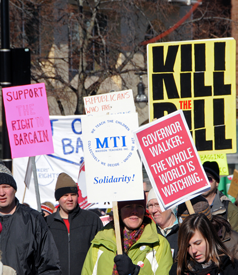
Protesters in Wisconsin on February 19, 2011. (Photo: mrbula)
http://www.truth-out.org/the-betrayal-public-workers67939
All,
Still more truth and consequences...
Kofi
The Betrayal of Public Workers
by Robert Pollin and Jeffrey Thompson
16 February 2011
Truthout
The Great Recession and its aftermath are entering a new phase in the United States, which could bring even more severe assaults on the living standards and basic rights of ordinary people than we have experienced thus far. This is because a wide swath of the country’s policy- and opinion-making elite have singled out public sector workers—including schoolteachers, healthcare workers, police officers and firefighters—as well as their unions and even their pensions as deadweight burdens sapping the economy’s vitality.
The Great Recession did blow a massive hole in state and municipal government finances, with tax receipts—including income, sales and property taxes—dropping sharply along with household incomes, spending and real estate values. Meanwhile, demand for public services, such as Medicaid and heating oil assistance, has risen as people’s circumstances have worsened. But let’s remember that the recession was caused by Wall Street hyper-speculation, not the pay scales of elementary school teachers or public hospital nurses.
Nonetheless, a rising chorus of commentators charge that public sector workers are overpaid relative to employees in comparable positions in the private sector. The fact that this claim is demonstrably false appears not to matter. Instead, the attacks are escalating. The most recent proposal gaining traction is to write new laws that would allow states to declare bankruptcy. This would let them rip up contracts with current public sector employees and walk away from their pension fund obligations. Only by declaring bankruptcy, Republican luminaries Jeb Bush and Newt Gingrich argued in the Los Angeles Times, will states be able to “reform their bloated, broken and underfunded pension systems for current and future workers.”
But this charge is emanating not only from the Republican right; in a front-page story on January 20, the New York Times reported on a more general trend spreading across the country in which “policymakers are working behind the scenes to come up with a way to let states declare bankruptcy and get out from under crushing debts, including the pensions they have promised to retired public workers.”
Considered together, state and local governments are the single largest employer in the US economy. They are also the country’s most important providers of education, healthcare, public safety and other vital forms of social support. Meanwhile, the official unemployment rate is stuck at 9 percent—a more accurate figure is 16.1 percent—a full eighteen months after the recession was declared over. How have we reached the point where the dominant mantra is to dismantle rather than shore up state and local governments in their moment of crisis?
Why States Need Support During Recessions
The Wall Street–induced recession clobbered state and local government budgets. By 2009, state tax revenues had fallen by fully 13 percent relative to where they were in 2007, and they remained at that low level through most of last year. By comparison, revenues never fell by more than 6 percent in the 2001 recession. Even during the 1981–82 recession, the last time unemployment reached 9 percent, the decline in state tax revenues never exceeded 2 percent. These revenue losses, starting in 2008, when taken together with the increased demand for state services, produced an average annual budget gap in 2009–11 of $140 billion, or 21 percent of all state spending commitments.
Unlike the federal government, almost all state and local governments are legally prohibited from borrowing money to finance shortfalls in their day-to-day operating budgets. The state and local governments do borrow to finance their long-term investments in school buildings, roads, bridges, sewers, mass transit and other infrastructure projects. They have established a long record of reliability in repaying these debt obligations, even during the recession. Nevertheless, these governments invariably experience a squeeze in their operating budgets during recessions, no matter how well they have managed their finances during more favorable economic times.
If, in a recession, states and municipalities are forced to reduce their spending in line with their loss in tax revenues, this produces layoffs for government employees and loss of sales for government vendors. These cutbacks, in turn, will worsen conditions in the private market, discouraging private businesses from making new investments and hiring new employees. The net impact is to create a vicious cycle that deepens the recession.
As such, strictly as a means of countering the recession—on behalf of business interests as well as everyone else in the community—the logic of having the federal government providing stimulus funds to support state and local government spending levels is impeccable. The February 2009 Obama stimulus—the American Recovery and Reinvestment Act (ARRA)—along with supplemental funds for Medicaid, has provided significant support, covering about one-third of the total budget gap generated by the recession. But that leaves two-thirds to be filled by other means. ARRA funds have now run out, and the Republican-controlled House of Representatives will almost certainly block further funding.
In 2010 roughly another 15 percent of the budget gap was covered by twenty-nine states that raised taxes and fees-for-services. In general, raising taxes during a recession is not good policy. But if it must be done to help fill deepening budgetary holes, the sensible way to proceed is to focus these increases on wealthier households. Their ability to absorb such increases is obviously strongest, which means that, unlike other households, they are not likely to cut back on spending in response to the tax hikes. In fact, ten states—New York, Illinois, Connecticut, North Carolina, Wisconsin, Oregon, Hawaii, Vermont, Rhode Island and Delaware—have raised taxes progressively in some fashion.
Of course, the wealthy do not want to pay higher taxes. But during the economic expansion and Wall Street bubble years of 2002–07, the average incomes of the richest 1 percent of households rose by about 10 percent per year, more than three times that for all households. The richest 1 percent received fully 65 percent of all household income growth between 2002–07.
One charge against raising state taxes in a progressive way is that it will encourage the wealthy to pick up and leave the state. But research on this question shows that this has not happened. We can see why by considering, as a hypothetical example, the consequences of a 2 percent income tax increase on the wealthiest 5 percent of households in Massachusetts. This would mean that these households would now have $359,000 at their disposal after taxes rather than $370,000—hardly enough to affect spending patterns significantly for these households, much less induce them to relocate out of the state. At the same time, a tax increase such as this by itself will generate about $1.6 billion for the state to spend on education, healthcare and public safety.
The forces against independent journalism are growing. Help Truthout keep up the fight against ignorance and regression! Support us here.
But even with the ARRA stimulus funds and tax increases, states and municipalities have had to make sharp cuts in spending. More severe cuts will be coming this year, with the ARRA funds now gone. These include cuts that will reduce low-income children’s or families’ eligibility for health insurance; further cuts in medical, homecare and other services for low-income households, as well as in K–12 education and higher education; and layoffs and furloughs for employees. The proposed 2012 budgets include still deeper cuts in core areas of healthcare and education. In Arizona, the governor’s budget would cut healthcare for 280,000 poor people and reduce state support for public universities by nearly 20 percent. In California, Governor Brown is proposing to bring spending on the University of California down to 1999 levels, when the system had 31 percent fewer students than it does today.
State and Local Government Workers Are Not Overpaid
Even if state and local government employees are not responsible for the budgetary problems that emerged out of the recession, are they nevertheless receiving bloated wage and benefits packages that are holding back the recovery? Since the recession began, there has been a steady stream of media stories making such claims. One widely cited 2009 Forbes cover article reported, “State and local government workers get paid an average of $25.30 an hour, which is 33 percent higher than the private sector’s $19…. Throw in pensions and other benefits and the gap widens to 42 percent.”
What figures such as these fail to reflect is that state and local government workers are older and substantially better educated than private-sector workers. Forbes is therefore comparing apples and oranges. As John Schmitt of the Center for Economic Policy Research recently showed, when state and local government employees are matched against private sector workers of the same age and educational levels, the public workers earn, on average, about 4 percent less than their private counterparts. Moreover, the results of Schmitt’s apples-to-apples comparison are fully consistent with numerous studies examining this same question over the past twenty years. One has to suspect that the pundits who have overlooked these basic findings have chosen not to look.
State Pension Funds Are Not Collapsing
Not surprisingly, state and local government pension funds absorbed heavy losses in the 2008–09 Wall Street crisis, because roughly 60 percent of these pension fund assets were invested in corporate stocks. Between mid-2007 and mid-2009, the total value of these pension funds fell by nearly $900 billion.
This collapse in the pension funds’ asset values has increased their unfunded liabilities—that is, the total amount of benefit payments owed over the next thirty years relative to the ability of the pension funds’ portfolio to cover them. By how much? In reality, estimating the total level of unfunded liabilities entails considerable guesswork. One simply cannot know with certainty how many people will be receiving benefits over the next thirty years, nor—more to the point—how much money the pension funds’ investments will be earning over this long time span. The severe instability of financial markets in the recent past further clouds the picture.
Thus, these estimates vary by huge amounts, depending on the presumed rate of return for the funds. The irony is that right-wing doomsayers in this debate, such as Grover Norquist, operate with an assumption that the fund managers will be able to earn returns only equal to the interest rates on riskless US Treasury securities. Under this assumption, the level of unfunded liabilities balloons to the widely reported figure of $3 trillion. To reach this conclusion, the doomsayers are effectively arguing that the collective performance of all the Wall Street fund managers—those paragons of free-market wizardry—will be so anemic over the next thirty years that the pension funds may as well just fire them and permanently park all their money in risk-free government bonds. It follows that the profits of private corporations over the next thirty years will also be either anemic or extremely unstable.
But it isn’t necessary to delve seriously into this debate in order to assess the long-term viability of the public pension funds. A more basic consideration is that before the recession, states and municipalities consistently maintained outstanding records of managing their funds. In the 1990s the funds steadily accumulated reserves, such that by 2000, on average, they were carrying no unfunded liabilities at all. Even after the losses to the funds following the previous Wall Street crash of 2001, the unfunded share of total pension obligations was no more than around 10 percent. By comparison, the Government Accountability Office holds that to be fiscally sound, the unfunded share can be as high as 20 percent of the pension funds’ total long-term obligations.
A few states are facing more serious problems, including New Jersey, Illinois and California. New Jersey is in the worst shape. But this is not because the state has been handing out profligate pensions to its retired employees. The average state pension in New Jersey pays out $39,500 per year. The problem is that over the past decade, the state has regularly paid into the system less than the amount agreed upon by the legislature and governor and stipulated in the annual budgets. For 2010 the state skipped its scheduled $3.1 billion payment altogether. However, even taking New Jersey’s worst-case scenario, the state could still eliminate its unfunded pension fund liabilities—that is, begin running a 100 percent fully funded pension fund—if it increased the current allocation by about 4 percent of the total budget, leaving 96 percent of the state budget allocation unchanged.
In dollar terms, this worst-case scenario for New Jersey would require the state to come up with roughly $4 billion per year to cover its pension commitments in an overall budget in the range of $92 billion. Extracting this amount of money from other programs in the budget would certainly cause pain, especially when New Jersey, like all other states, faces tight finances. But compare this worst-case scenario with the bankruptcy agenda being discussed throughout the country.
To begin with, seriously discussing a bankruptcy agenda will undermine the confidence of private investors in all state and municipal bonds—confidence that has been earned by state and municipal governments. When the markets begin to fear that states and municipalities are contemplating bankruptcy, this will drive up the interest rates that governments will have to pay to finance school buildings, infrastructure improvements and investments in the green economy.
Then, of course, there is the impact on the pensioners and their families. For the states and municipalities to walk away from their pension fund commitments would leave millions of public sector retirees facing major cuts in their living standards and their sense of security. Something few Americans understand is that roughly one-third of the 19 million state and local employees—i.e., those in fifteen states, including California, Texas and Massachusetts—are not eligible for Social Security and will depend exclusively on their pensions and personal savings in retirement. In addition, public sector pensions are not safeguarded by the federal Pension Benefit Guaranty Corporation. Unlike Wall Street banks, state pensioners will receive no bailout checks if the states choose to abrogate their pension fund agreements.
Getting Serious About Reforming State Finances
Of course, there are significant ways the public pension systems, as well as state and local finances more generally, can be improved. The simplest solution, frequently cited, involves “pension spiking”—that is, practices such as allowing workers to add hundreds of hours of overtime at the end of their careers to balloon their final year’s pay and their pensions. This has produced serious additional costs to pension obligations in some states and municipalities, but it is still by no means a major factor in explaining states’ current fiscal problems.
But states and municipalities also have to follow through on the steps they have taken to raise taxes on the wealthy households that are most able to pay. They should also broaden their sources of tax revenue by taxing services such as payments to lawyers, as well as by taxing items purchased over the Internet. And they have to stop giving out large tax breaks to corporations as inducements to locate in their state or municipality instead of neighboring locations. This kind of race to the bottom generates no net benefit to states and municipalities.
Finally, state and local governments are in the same boat as the federal government and private businesses in facing persistently rising healthcare costs. As was frequently noted during the healthcare debates over the past two years, the United States spends about twice as much per person on healthcare as other highly developed countries do, even though these other countries have universal coverage, longer life expectancies and generally healthier populations. These costs weigh heavily on the budgets of state and local governments, which finance a large share of Medicaid and health benefits for state employees. The problem is that we spend far more than other countries on medications, expensive procedures and especially insurance and administration. We also devote less attention to prevention. It remains to be seen how much the Obama healthcare reform law—the 2010 Patient Protection and Affordable Care Act—will remedy this situation. It is certainly the case that more must be done, especially in establishing effective controls on the drug and insurance industries.
These are some of the long-run measures that must be taken to bolster the financing of education, healthcare, public safety and other vital social services, as well as to support investments in infrastructure and the green economy. If states declare bankruptcy they will break their obligations to employees, vendors, pensioners and even bondholders, which will undermine the basic foundations of our economy. As we emerge, if only tentatively, from the wreckage of the Great Recession, this is precisely the moment we need to strengthen, not weaken, the standards of fairness governing our society.
Robert Pollin is a professor of economics and co-director of the Political Economy Research Institute (PERI) at the University of Massachusetts. One of his most recent books (co-written) is A Measure of Fairness: The Economics of Living Wages and Minimum Wages in the United States.
Jeffrey Thompson is an assistant research professor at the Political Economy Research Institute (PERI) at the University of Massachusetts.
All,
Still more truth and consequences...
Kofi
The Betrayal of Public Workers
by Robert Pollin and Jeffrey Thompson
16 February 2011
Truthout
The Great Recession and its aftermath are entering a new phase in the United States, which could bring even more severe assaults on the living standards and basic rights of ordinary people than we have experienced thus far. This is because a wide swath of the country’s policy- and opinion-making elite have singled out public sector workers—including schoolteachers, healthcare workers, police officers and firefighters—as well as their unions and even their pensions as deadweight burdens sapping the economy’s vitality.
The Great Recession did blow a massive hole in state and municipal government finances, with tax receipts—including income, sales and property taxes—dropping sharply along with household incomes, spending and real estate values. Meanwhile, demand for public services, such as Medicaid and heating oil assistance, has risen as people’s circumstances have worsened. But let’s remember that the recession was caused by Wall Street hyper-speculation, not the pay scales of elementary school teachers or public hospital nurses.
Nonetheless, a rising chorus of commentators charge that public sector workers are overpaid relative to employees in comparable positions in the private sector. The fact that this claim is demonstrably false appears not to matter. Instead, the attacks are escalating. The most recent proposal gaining traction is to write new laws that would allow states to declare bankruptcy. This would let them rip up contracts with current public sector employees and walk away from their pension fund obligations. Only by declaring bankruptcy, Republican luminaries Jeb Bush and Newt Gingrich argued in the Los Angeles Times, will states be able to “reform their bloated, broken and underfunded pension systems for current and future workers.”
But this charge is emanating not only from the Republican right; in a front-page story on January 20, the New York Times reported on a more general trend spreading across the country in which “policymakers are working behind the scenes to come up with a way to let states declare bankruptcy and get out from under crushing debts, including the pensions they have promised to retired public workers.”
Considered together, state and local governments are the single largest employer in the US economy. They are also the country’s most important providers of education, healthcare, public safety and other vital forms of social support. Meanwhile, the official unemployment rate is stuck at 9 percent—a more accurate figure is 16.1 percent—a full eighteen months after the recession was declared over. How have we reached the point where the dominant mantra is to dismantle rather than shore up state and local governments in their moment of crisis?
Why States Need Support During Recessions
The Wall Street–induced recession clobbered state and local government budgets. By 2009, state tax revenues had fallen by fully 13 percent relative to where they were in 2007, and they remained at that low level through most of last year. By comparison, revenues never fell by more than 6 percent in the 2001 recession. Even during the 1981–82 recession, the last time unemployment reached 9 percent, the decline in state tax revenues never exceeded 2 percent. These revenue losses, starting in 2008, when taken together with the increased demand for state services, produced an average annual budget gap in 2009–11 of $140 billion, or 21 percent of all state spending commitments.
Unlike the federal government, almost all state and local governments are legally prohibited from borrowing money to finance shortfalls in their day-to-day operating budgets. The state and local governments do borrow to finance their long-term investments in school buildings, roads, bridges, sewers, mass transit and other infrastructure projects. They have established a long record of reliability in repaying these debt obligations, even during the recession. Nevertheless, these governments invariably experience a squeeze in their operating budgets during recessions, no matter how well they have managed their finances during more favorable economic times.
If, in a recession, states and municipalities are forced to reduce their spending in line with their loss in tax revenues, this produces layoffs for government employees and loss of sales for government vendors. These cutbacks, in turn, will worsen conditions in the private market, discouraging private businesses from making new investments and hiring new employees. The net impact is to create a vicious cycle that deepens the recession.
As such, strictly as a means of countering the recession—on behalf of business interests as well as everyone else in the community—the logic of having the federal government providing stimulus funds to support state and local government spending levels is impeccable. The February 2009 Obama stimulus—the American Recovery and Reinvestment Act (ARRA)—along with supplemental funds for Medicaid, has provided significant support, covering about one-third of the total budget gap generated by the recession. But that leaves two-thirds to be filled by other means. ARRA funds have now run out, and the Republican-controlled House of Representatives will almost certainly block further funding.
In 2010 roughly another 15 percent of the budget gap was covered by twenty-nine states that raised taxes and fees-for-services. In general, raising taxes during a recession is not good policy. But if it must be done to help fill deepening budgetary holes, the sensible way to proceed is to focus these increases on wealthier households. Their ability to absorb such increases is obviously strongest, which means that, unlike other households, they are not likely to cut back on spending in response to the tax hikes. In fact, ten states—New York, Illinois, Connecticut, North Carolina, Wisconsin, Oregon, Hawaii, Vermont, Rhode Island and Delaware—have raised taxes progressively in some fashion.
Of course, the wealthy do not want to pay higher taxes. But during the economic expansion and Wall Street bubble years of 2002–07, the average incomes of the richest 1 percent of households rose by about 10 percent per year, more than three times that for all households. The richest 1 percent received fully 65 percent of all household income growth between 2002–07.
One charge against raising state taxes in a progressive way is that it will encourage the wealthy to pick up and leave the state. But research on this question shows that this has not happened. We can see why by considering, as a hypothetical example, the consequences of a 2 percent income tax increase on the wealthiest 5 percent of households in Massachusetts. This would mean that these households would now have $359,000 at their disposal after taxes rather than $370,000—hardly enough to affect spending patterns significantly for these households, much less induce them to relocate out of the state. At the same time, a tax increase such as this by itself will generate about $1.6 billion for the state to spend on education, healthcare and public safety.
The forces against independent journalism are growing. Help Truthout keep up the fight against ignorance and regression! Support us here.
But even with the ARRA stimulus funds and tax increases, states and municipalities have had to make sharp cuts in spending. More severe cuts will be coming this year, with the ARRA funds now gone. These include cuts that will reduce low-income children’s or families’ eligibility for health insurance; further cuts in medical, homecare and other services for low-income households, as well as in K–12 education and higher education; and layoffs and furloughs for employees. The proposed 2012 budgets include still deeper cuts in core areas of healthcare and education. In Arizona, the governor’s budget would cut healthcare for 280,000 poor people and reduce state support for public universities by nearly 20 percent. In California, Governor Brown is proposing to bring spending on the University of California down to 1999 levels, when the system had 31 percent fewer students than it does today.
State and Local Government Workers Are Not Overpaid
Even if state and local government employees are not responsible for the budgetary problems that emerged out of the recession, are they nevertheless receiving bloated wage and benefits packages that are holding back the recovery? Since the recession began, there has been a steady stream of media stories making such claims. One widely cited 2009 Forbes cover article reported, “State and local government workers get paid an average of $25.30 an hour, which is 33 percent higher than the private sector’s $19…. Throw in pensions and other benefits and the gap widens to 42 percent.”
What figures such as these fail to reflect is that state and local government workers are older and substantially better educated than private-sector workers. Forbes is therefore comparing apples and oranges. As John Schmitt of the Center for Economic Policy Research recently showed, when state and local government employees are matched against private sector workers of the same age and educational levels, the public workers earn, on average, about 4 percent less than their private counterparts. Moreover, the results of Schmitt’s apples-to-apples comparison are fully consistent with numerous studies examining this same question over the past twenty years. One has to suspect that the pundits who have overlooked these basic findings have chosen not to look.
State Pension Funds Are Not Collapsing
Not surprisingly, state and local government pension funds absorbed heavy losses in the 2008–09 Wall Street crisis, because roughly 60 percent of these pension fund assets were invested in corporate stocks. Between mid-2007 and mid-2009, the total value of these pension funds fell by nearly $900 billion.
This collapse in the pension funds’ asset values has increased their unfunded liabilities—that is, the total amount of benefit payments owed over the next thirty years relative to the ability of the pension funds’ portfolio to cover them. By how much? In reality, estimating the total level of unfunded liabilities entails considerable guesswork. One simply cannot know with certainty how many people will be receiving benefits over the next thirty years, nor—more to the point—how much money the pension funds’ investments will be earning over this long time span. The severe instability of financial markets in the recent past further clouds the picture.
Thus, these estimates vary by huge amounts, depending on the presumed rate of return for the funds. The irony is that right-wing doomsayers in this debate, such as Grover Norquist, operate with an assumption that the fund managers will be able to earn returns only equal to the interest rates on riskless US Treasury securities. Under this assumption, the level of unfunded liabilities balloons to the widely reported figure of $3 trillion. To reach this conclusion, the doomsayers are effectively arguing that the collective performance of all the Wall Street fund managers—those paragons of free-market wizardry—will be so anemic over the next thirty years that the pension funds may as well just fire them and permanently park all their money in risk-free government bonds. It follows that the profits of private corporations over the next thirty years will also be either anemic or extremely unstable.
But it isn’t necessary to delve seriously into this debate in order to assess the long-term viability of the public pension funds. A more basic consideration is that before the recession, states and municipalities consistently maintained outstanding records of managing their funds. In the 1990s the funds steadily accumulated reserves, such that by 2000, on average, they were carrying no unfunded liabilities at all. Even after the losses to the funds following the previous Wall Street crash of 2001, the unfunded share of total pension obligations was no more than around 10 percent. By comparison, the Government Accountability Office holds that to be fiscally sound, the unfunded share can be as high as 20 percent of the pension funds’ total long-term obligations.
A few states are facing more serious problems, including New Jersey, Illinois and California. New Jersey is in the worst shape. But this is not because the state has been handing out profligate pensions to its retired employees. The average state pension in New Jersey pays out $39,500 per year. The problem is that over the past decade, the state has regularly paid into the system less than the amount agreed upon by the legislature and governor and stipulated in the annual budgets. For 2010 the state skipped its scheduled $3.1 billion payment altogether. However, even taking New Jersey’s worst-case scenario, the state could still eliminate its unfunded pension fund liabilities—that is, begin running a 100 percent fully funded pension fund—if it increased the current allocation by about 4 percent of the total budget, leaving 96 percent of the state budget allocation unchanged.
In dollar terms, this worst-case scenario for New Jersey would require the state to come up with roughly $4 billion per year to cover its pension commitments in an overall budget in the range of $92 billion. Extracting this amount of money from other programs in the budget would certainly cause pain, especially when New Jersey, like all other states, faces tight finances. But compare this worst-case scenario with the bankruptcy agenda being discussed throughout the country.
To begin with, seriously discussing a bankruptcy agenda will undermine the confidence of private investors in all state and municipal bonds—confidence that has been earned by state and municipal governments. When the markets begin to fear that states and municipalities are contemplating bankruptcy, this will drive up the interest rates that governments will have to pay to finance school buildings, infrastructure improvements and investments in the green economy.
Then, of course, there is the impact on the pensioners and their families. For the states and municipalities to walk away from their pension fund commitments would leave millions of public sector retirees facing major cuts in their living standards and their sense of security. Something few Americans understand is that roughly one-third of the 19 million state and local employees—i.e., those in fifteen states, including California, Texas and Massachusetts—are not eligible for Social Security and will depend exclusively on their pensions and personal savings in retirement. In addition, public sector pensions are not safeguarded by the federal Pension Benefit Guaranty Corporation. Unlike Wall Street banks, state pensioners will receive no bailout checks if the states choose to abrogate their pension fund agreements.
Getting Serious About Reforming State Finances
Of course, there are significant ways the public pension systems, as well as state and local finances more generally, can be improved. The simplest solution, frequently cited, involves “pension spiking”—that is, practices such as allowing workers to add hundreds of hours of overtime at the end of their careers to balloon their final year’s pay and their pensions. This has produced serious additional costs to pension obligations in some states and municipalities, but it is still by no means a major factor in explaining states’ current fiscal problems.
But states and municipalities also have to follow through on the steps they have taken to raise taxes on the wealthy households that are most able to pay. They should also broaden their sources of tax revenue by taxing services such as payments to lawyers, as well as by taxing items purchased over the Internet. And they have to stop giving out large tax breaks to corporations as inducements to locate in their state or municipality instead of neighboring locations. This kind of race to the bottom generates no net benefit to states and municipalities.
Finally, state and local governments are in the same boat as the federal government and private businesses in facing persistently rising healthcare costs. As was frequently noted during the healthcare debates over the past two years, the United States spends about twice as much per person on healthcare as other highly developed countries do, even though these other countries have universal coverage, longer life expectancies and generally healthier populations. These costs weigh heavily on the budgets of state and local governments, which finance a large share of Medicaid and health benefits for state employees. The problem is that we spend far more than other countries on medications, expensive procedures and especially insurance and administration. We also devote less attention to prevention. It remains to be seen how much the Obama healthcare reform law—the 2010 Patient Protection and Affordable Care Act—will remedy this situation. It is certainly the case that more must be done, especially in establishing effective controls on the drug and insurance industries.
These are some of the long-run measures that must be taken to bolster the financing of education, healthcare, public safety and other vital social services, as well as to support investments in infrastructure and the green economy. If states declare bankruptcy they will break their obligations to employees, vendors, pensioners and even bondholders, which will undermine the basic foundations of our economy. As we emerge, if only tentatively, from the wreckage of the Great Recession, this is precisely the moment we need to strengthen, not weaken, the standards of fairness governing our society.
Robert Pollin is a professor of economics and co-director of the Political Economy Research Institute (PERI) at the University of Massachusetts. One of his most recent books (co-written) is A Measure of Fairness: The Economics of Living Wages and Minimum Wages in the United States.
Jeffrey Thompson is an assistant research professor at the Political Economy Research Institute (PERI) at the University of Massachusetts.





