Op-Ed
War & Peace
Biden Wants to Enable Genocide. We Must Make It Impossible for Him to Continue.
Palestinian genocide comes at a devastating human cost. What will supporting it cost Biden politically?
June 8, 2024
Truthout
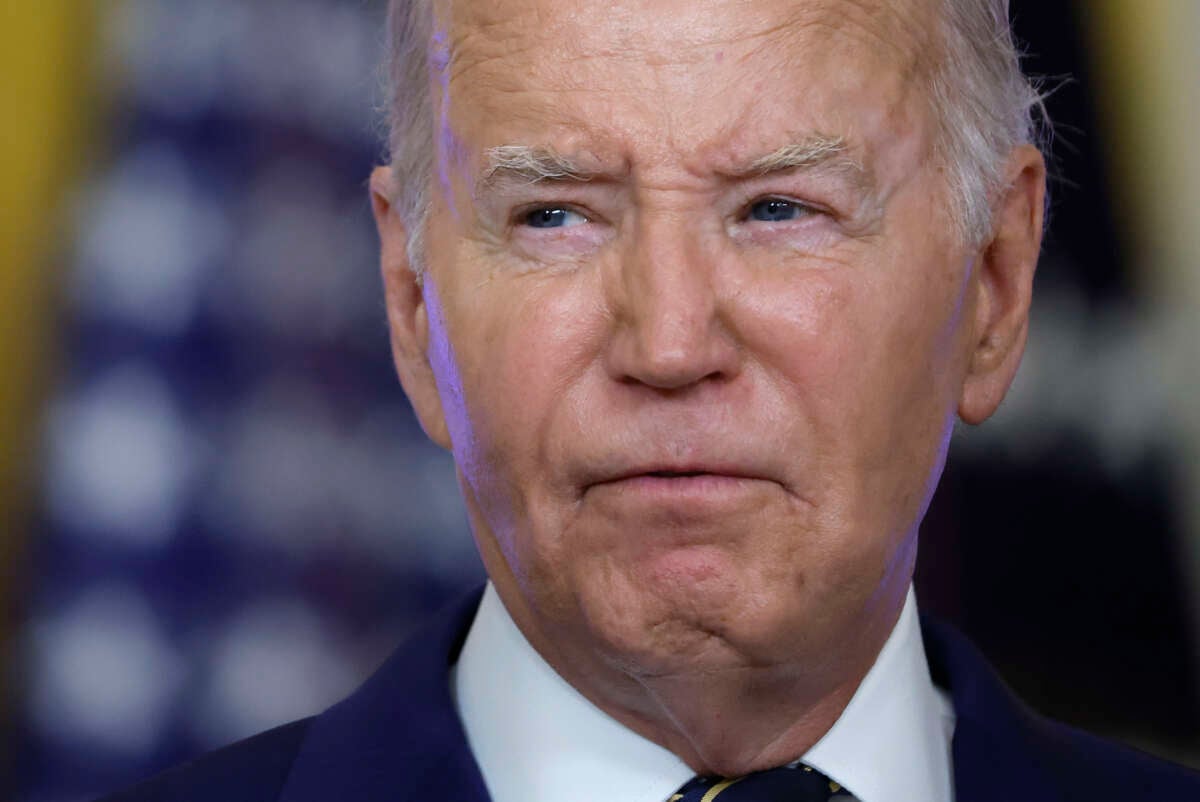
Today, activists from around the country are mobilizing in Washington, D.C. to surround the White House to demand an end to Israel’s onslaught on Gaza and President Joe Biden’s support for it. Palestinians are paying an incalculable price for U.S. policy. But there is a set of costs of a different nature that the U.S. is incurring by supporting the genocide — and a strategy aimed at raising those costs can make it so great that Biden has to stop.
One cost is global. From upsetting relations between Israel and its neighbors to repeated condemnations of genocide at the UN Security Council, General Assembly, International Court of Justice and International Criminal Court, Israel and the U.S. are more isolated on the world stage than ever.
But a more immediate cost for Biden is in U.S. politics.
U.S. support for Israel has long been treated in the United States as a “domestic issue” — with AIPAC, the Anti-Defamation League, and other pro-Israel groups intervening heavily to shape federal policy, local politics and all levels in between. The conventional thinking is that insufficient support for Israel can result in a lost election — whereas the fate of Palestinians and their rights are marginalized to the realm of “foreign policy,” when discussed at all.
Since Israel invaded Gaza last October, that understanding has radically shifted: The rights of Palestinians have emerged as a “domestic issue” in their own right — with city councils across the country passing resolutions calling for a ceasefire, workers at corporations like Google demanding an end to their employers’ complicity in genocide and a student revolt against U.S. academia’s role in buttressing it.
RELATED STORY:
The movements for labor and Palestinian rights have common cause against the billionaires who aim to destroy them both.
Truthout
The move of Palestinian rights from the margins of U.S. politics to its center is even raising the prospect of the incumbent president losing the November election because of his insistence on supplying the weapons to fuel Israel’s siege. Activists and voters in Michigan, Wisconsin, and elsewhere have made this likelihood dramatically visible with their “Uncommitted” and “Uninstructed” campaigns.
If Biden loses in November to an open fascist, it will likely be because he repulsed young people, progressives and people of color with his support for Israel. These are the people who he needs not only to vote for him, but to mobilize the vote for him. As the remarkable campus rebellions of this spring showed, they’re also the voters most likely to be demanding a ceasefire in Gaza.
By maintaining his support for Israel, Biden risks not just losing an election but a generation — one that does not seem willing to quietly accept the unacceptable. The question is: Is that enough to force Biden to change course? And if not, what will?
The move of Palestinian rights from the margins of U.S. politics to its center is even raising the prospect of the incumbent president losing the November election because of his insistence on supplying the weapons to fuel Israel’s siege. Activists and voters in Michigan, Wisconsin, and elsewhere have made this likelihood dramatically visible with their “Uncommitted” and “Uninstructed” campaigns.
If Biden loses in November to an open fascist, it will likely be because he repulsed young people, progressives and people of color with his support for Israel. These are the people who he needs not only to vote for him, but to mobilize the vote for him. As the remarkable campus rebellions of this spring showed, they’re also the voters most likely to be demanding a ceasefire in Gaza.
By maintaining his support for Israel, Biden risks not just losing an election but a generation — one that does not seem willing to quietly accept the unacceptable. The question is: Is that enough to force Biden to change course? And if not, what will?
Why We Have Not Yet Won a Ceasefire
The difficult reality is that the movement demanding ceasefire is up against the hard core of U.S. imperial power, which sees support for Israel as central to its strategy in the Middle East — at apparently any cost, particularly that of Palestinian life. This is especially true for President Biden, whose personal investment in Israel appears to go beyond the requisite required for any steward of U.S. power.
In addition, there is a pillar buttressing that commitment that is unique to the U.S.-Israel relationship: a powerful pro-Israel lobby.
This includes a formal lobbying operation — led by AIPAC and other Washington-based firms — and a large, well-organized, well-funded and very dedicated constituency in communities across the country. Organizations like StandWithUs and the associated Israel on Campus Coalition target Palestinian rights activists on college campuses, accusing them of antisemitism and calling on universities to restrict free speech on campus.
While pro-Israel Jewish organizations play a key role, Christian Zionism is an increasingly dominant force in mobilizing fanatical support for Israel. Coordinated by organizations like Christians United for Israel, Christian Zionism combines right-wing Christian nationalism with an apocalyptic vision for the Middle East. Activists against U.S. support for Apartheid South Africa did not have to contend with a mass organizing force on the other side like this.
The fate of Palestinians and their rights are marginalized to the realm of “foreign policy,” when discussed at all.
Activists are also facing a White House that has greater power to pursue militarism than at other points in U.S. history. After more than two decades of the “war on terror,” the executive branch wields tremendous power to act unchecked. Even with growing opposition in Congress for Biden’s unflinching supply of weapons to Israel, the White House is able to press ahead. This is because Biden has used tricks — like invoking “emergency authority,” and making more than 100 sales that fall under the threshold amount that requires congressional approval — to feed the Israeli arsenal.
Meanwhile, the White House is going to great lengths to insulate the president and Vice President Kamala Harris from the ubiquitous protests, arranging campaign events that are closed to the public, smaller and whose attendees are highly vetted.
What should activists do then, in the face of a president who refuses to stop supplying the weapons for a genocide — even when it could cost him his reelection?
What to Do in the U.S.?
Over these eight months, activists have sought to identify any levers of power to pull that would stop Biden’s policy. This has included winning over dozens of members of Congress to demand a ceasefire. It has involved passing ceasefire resolutions in dozens of city and town councils. The movement successfully demonstrated its power to withhold votes in states that Biden needs to win in November. Recent polls show that, in these states, one in five voters say that they are less likely to vote for Biden because of his support of Israel’s assault.
The Palestine solidarity movement mobilized the largest march for Palestinian rights in U.S. history on November 4 in Washington, D.C. It has helped elevate Palestinian voices in the mainstream media conversation, and has featured vocal Jewish organizing for a ceasefire as one counter to the false notion that supporting Palestinian rights is antisemitic.
It has turned campuses — from the most public to the most elite — into sites of mobilization for Palestinian rights. It has compelled staffers in Congress and the White House itself to protest, and the resignation of State Department officials and others. Key institutions and individuals in Biden’s inner circle have urged him to push for a ceasefire, from the influential think tank the Center for American Progress to the president’s own wife.
The fact that no one of these breakthroughs has in itself forced a ceasefire does not mean that they are all useless. In many cases, the work that produced them should continue. But we also need more, because it is evident that no one of these things is the key to unlocking a halt to U.S. weapons and other support to Israel.
The challenge then is not to find the one thing that will force Biden to shift course, but to carry out a combination of things that undermine his ability to pursue his policy and make it as politically costly and as difficult as possible, until it is impossible.
Raising the Political Costs
It is clear that we need to expand actions that disrupt the ability of the U.S. to support the Israeli genocide, both politically and physically. But there is an important catch: One of the great strengths of the outpouring of protest in defense of Palestinian life has been how accessible it has been to the U.S. public. The starkness of Israel’s violence — and genocidal rhetoric of its leaders — along with the self-evident virtue of the ceasefire demand have allowed hundreds of thousands to join the movement.
Because the risk of arrest and police violence that comes with more confrontational actions tends to limit the range of participants, a challenge for organizers will be escalating disruption while continuing to invite broad numbers of people with a range of abilities and vulnerabilities to continue to participate. We therefore need to be as strategic as possible.
One area of focus should be disrupting the flow of U.S. weapons to Israel. With weapons manufacturing taking place across the country, the machinery of producing and supplying arms requires a combination of ignorance and consent to those processes by the U.S. population. But what if our communities learn about their entanglement with the flow of weapons, and replace that “consent” with resistance?
If the cost of Palestinian life is not sufficient to compel Biden to stop supporting a genocide, then it is the responsibility of the movement … to exact a greater cost by raising the political price.
How many cities and towns that have passed ceasefire resolutions host factories that make bombs — and even provide tax breaks to those companies? How many such cities and towns have roads passing through that transport weapons, or ports that ship them to Israel? What if, through a combination of nonviolent direct action, and cities being compelled by public pressure to pass ordinances against their complicity in genocide, the federal government could no longer count on our communities allowing weapons to flow from and through them?
And what if workers involved in the making or transport of these weapons supported the protests — as union longshore workers have at the Port of Oakland, refusing to unload cargo from an Israeli ship?
Activists can also undermine economic support for Israeli violence. Carrying out this genocide in Gaza comes at a great cost to the Israeli economy. Hundreds of thousands of Israeli reservists have been mobilized, taking them away from their jobs. Palestinian workers have been expelled from the agricultural sector and others. With the Israeli economy dependent on 120,000 Palestinian workers before October 7 and many of their work permits canceled since, farmers and volunteers scrambled to harvest produce and plant crops in the fall and construction projects are down 50 percent. And Moody’s has downgraded Israel’s credit rating.
The Israeli economy, in short, is vulnerable.
Unlike other countries, Israel crowdsources the financing of its economy, relying on institutions and individuals in North America to invest in Israeli companies and in the state of Israel through selling Israel bonds. Israel makes the case that such investment will offer a good financial return, and appeals to investors that such support is a political contribution to the Israeli project.
This explains why 35 U.S. state and municipal governments — most of them headed by Trump-aligned Republicans — have collectively bought more than $1.7 billion in Israel bonds since October. Additionally, American capitalists have rallied to support the Israeli economy. Bain Capital organized a trip to Israel in December for a delegation of 70 tech executives and investors, who met with Israeli leaders as well as local investors and startups.
Venture capitalists and far right state governments aren’t likely to change their positions, but there may be more vulnerable targets. We can demand that states run by liberal Democrats with investments in Israel cease, and brand-conscious banks should be made to see investing in Israel as a liability, just as they were pressured to stop propping up Apartheid South Africa years ago.
While divestment campaigns can take years, enough disruption and negative attention can lead to more immediate, further downgrades of Israel’s credit rating by institutions like Moody’s. The world of stocks and bonds markets is volatile, and Israel’s utter dependence on outside finance makes it vulnerable to big shocks, even if they come well short of full divestments.
It is clear that we need to expand actions that disrupt the ability of the U.S. to support the Israeli genocide, both politically and physically. But there is an important catch: One of the great strengths of the outpouring of protest in defense of Palestinian life has been how accessible it has been to the U.S. public. The starkness of Israel’s violence — and genocidal rhetoric of its leaders — along with the self-evident virtue of the ceasefire demand have allowed hundreds of thousands to join the movement.
Because the risk of arrest and police violence that comes with more confrontational actions tends to limit the range of participants, a challenge for organizers will be escalating disruption while continuing to invite broad numbers of people with a range of abilities and vulnerabilities to continue to participate. We therefore need to be as strategic as possible.
One area of focus should be disrupting the flow of U.S. weapons to Israel. With weapons manufacturing taking place across the country, the machinery of producing and supplying arms requires a combination of ignorance and consent to those processes by the U.S. population. But what if our communities learn about their entanglement with the flow of weapons, and replace that “consent” with resistance?
If the cost of Palestinian life is not sufficient to compel Biden to stop supporting a genocide, then it is the responsibility of the movement … to exact a greater cost by raising the political price.
How many cities and towns that have passed ceasefire resolutions host factories that make bombs — and even provide tax breaks to those companies? How many such cities and towns have roads passing through that transport weapons, or ports that ship them to Israel? What if, through a combination of nonviolent direct action, and cities being compelled by public pressure to pass ordinances against their complicity in genocide, the federal government could no longer count on our communities allowing weapons to flow from and through them?
And what if workers involved in the making or transport of these weapons supported the protests — as union longshore workers have at the Port of Oakland, refusing to unload cargo from an Israeli ship?
Activists can also undermine economic support for Israeli violence. Carrying out this genocide in Gaza comes at a great cost to the Israeli economy. Hundreds of thousands of Israeli reservists have been mobilized, taking them away from their jobs. Palestinian workers have been expelled from the agricultural sector and others. With the Israeli economy dependent on 120,000 Palestinian workers before October 7 and many of their work permits canceled since, farmers and volunteers scrambled to harvest produce and plant crops in the fall and construction projects are down 50 percent. And Moody’s has downgraded Israel’s credit rating.
The Israeli economy, in short, is vulnerable.
Unlike other countries, Israel crowdsources the financing of its economy, relying on institutions and individuals in North America to invest in Israeli companies and in the state of Israel through selling Israel bonds. Israel makes the case that such investment will offer a good financial return, and appeals to investors that such support is a political contribution to the Israeli project.
This explains why 35 U.S. state and municipal governments — most of them headed by Trump-aligned Republicans — have collectively bought more than $1.7 billion in Israel bonds since October. Additionally, American capitalists have rallied to support the Israeli economy. Bain Capital organized a trip to Israel in December for a delegation of 70 tech executives and investors, who met with Israeli leaders as well as local investors and startups.
Venture capitalists and far right state governments aren’t likely to change their positions, but there may be more vulnerable targets. We can demand that states run by liberal Democrats with investments in Israel cease, and brand-conscious banks should be made to see investing in Israel as a liability, just as they were pressured to stop propping up Apartheid South Africa years ago.
While divestment campaigns can take years, enough disruption and negative attention can lead to more immediate, further downgrades of Israel’s credit rating by institutions like Moody’s. The world of stocks and bonds markets is volatile, and Israel’s utter dependence on outside finance makes it vulnerable to big shocks, even if they come well short of full divestments.
Making Genocide Too Costly for a Government That Doesn’t Value Life
Twenty-eight years ago, the United States carried out another policy in the Middle East that brought catastrophic suffering: its economic sanctions against Iraq. In an interview with “60 Minutes” in May 1996, journalist Leslie Stahl said to then-Secretary of State Madeleine Albright: “We have heard that half a million children have died. I mean, that’s more children than died in Hiroshima. And, you know, is the price worth it?”
Albright responded, “We think the price is worth it.”
The horrific history is a reminder that Biden’s support of Israel today comes in a context: Washington makes foreign policy decisions in which officials are quite aware of the suffering of those on the receiving end of their actions. The problem is that, in the dehumanizing and racist world of Washington’s geopolitics, the lives of Iraqis or Palestinians — or the Japanese victims of the atomic bombings that Stahl mentions, for that matter — do not carry much weight in their calculations.
If the cost of Palestinian life is not sufficient to compel Biden to stop supporting a genocide, then it is the responsibility of the movement against it — and for U.S. civil society — to exact a greater cost by raising the political price. We must make carrying out this genocide so difficult, and its price so politically expensive, that Washington cannot afford it
ABOUT THE AUTHOR:
Khury Petersen-Smith is the Michael Ratner Middle East Fellow at the Institute for Policy Studies.
Twenty-eight years ago, the United States carried out another policy in the Middle East that brought catastrophic suffering: its economic sanctions against Iraq. In an interview with “60 Minutes” in May 1996, journalist Leslie Stahl said to then-Secretary of State Madeleine Albright: “We have heard that half a million children have died. I mean, that’s more children than died in Hiroshima. And, you know, is the price worth it?”
Albright responded, “We think the price is worth it.”
The horrific history is a reminder that Biden’s support of Israel today comes in a context: Washington makes foreign policy decisions in which officials are quite aware of the suffering of those on the receiving end of their actions. The problem is that, in the dehumanizing and racist world of Washington’s geopolitics, the lives of Iraqis or Palestinians — or the Japanese victims of the atomic bombings that Stahl mentions, for that matter — do not carry much weight in their calculations.
If the cost of Palestinian life is not sufficient to compel Biden to stop supporting a genocide, then it is the responsibility of the movement against it — and for U.S. civil society — to exact a greater cost by raising the political price. We must make carrying out this genocide so difficult, and its price so politically expensive, that Washington cannot afford it
ABOUT THE AUTHOR:
Khury Petersen-Smith is the Michael Ratner Middle East Fellow at the Institute for Policy Studies.