Discourse that allows us to express a wide range of ideas, opinions, and analysis that can be used as an opportunity to critically examine and observe what our experience means to us beyond the given social/cultural contexts and norms that are provided us.
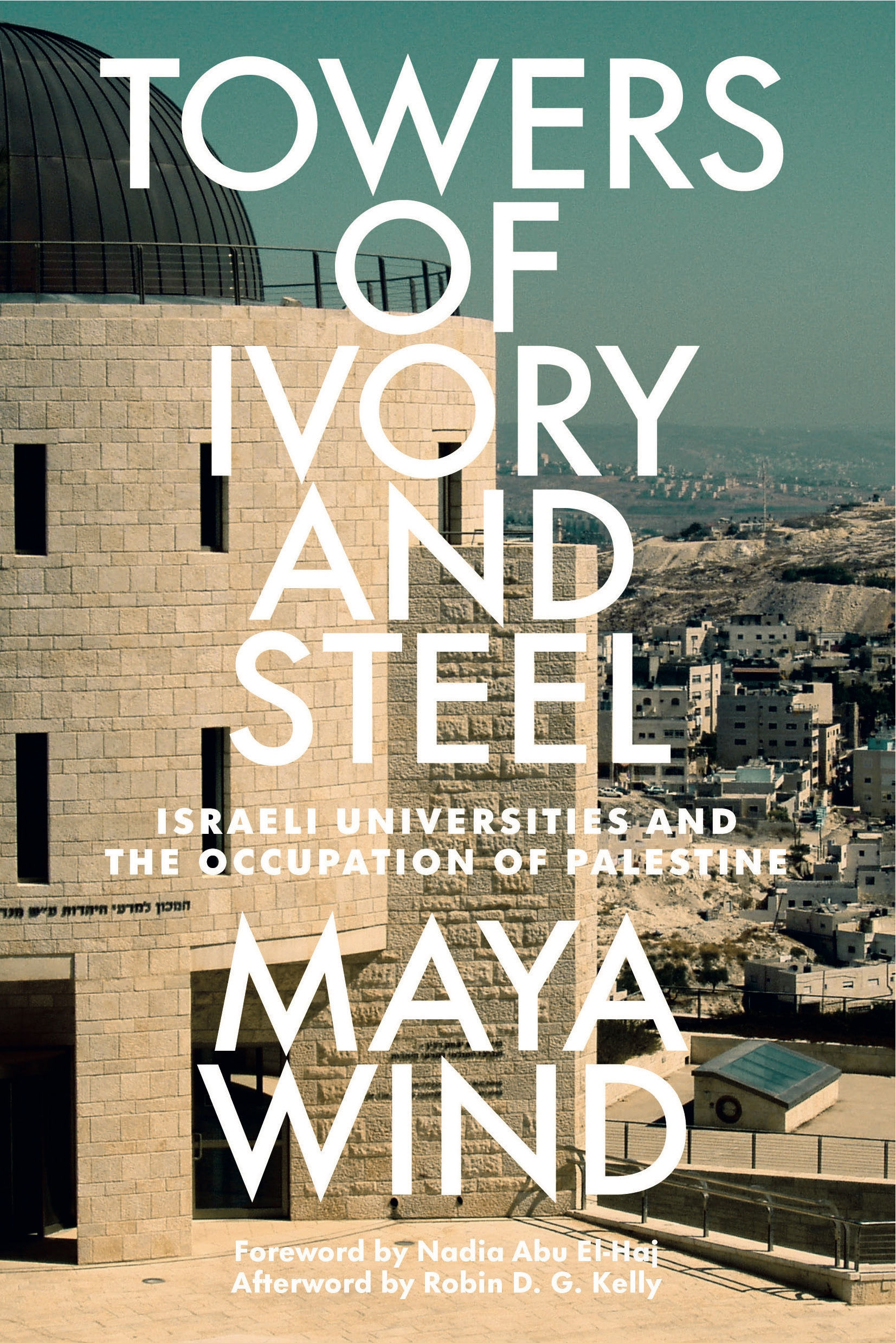
How Israeli universities collaborate in Israeli state violence against Palestinians
Israeli
universities have long enjoyed a reputation as liberal bastions of
freedom and democracy. Drawing on extensive research and making Hebrew
sources accessible to the international community, Maya Wind shatters
this myth and documents how Israeli universities are directly complicit
in the violation of Palestinian rights.
As this book shows, Israeli universities serve as pillars of Israel's system of oppression against Palestinians.
Academic disciplines, degree programs, campus infrastructure, and
research laboratories all service Israeli occupation and apartheid,
while universities violate the rights of Palestinians to
education, stifle critical scholarship, and violently repress student
dissent. Towers of Ivory and Steel is a powerful expose of Israeli academia’s ongoing and active complicity in Israel’s settler-colonial project.
REVIEWS:
"This book lands like a
grenade, detonating comfortable and long held myths about the liberalism
and independence of Israel’s university system. In their place, Wind’s
rigorous and jaw-dropping research reveals countless ways that the
nation’s most celebrated and storied education institutions are utterly
entangled in the violent machinery of Palestinian dispossession,
occupation, incarceration, surveillance, siege and military bombardment.
From the development of deadly weapons to the crafting of state
propaganda to the training of officers, there is no escaping the
conclusion that these universities are part and parcel of the official
infrastructure that has enabled Israel to systematically avoid the
political solutions that are the only hope of enduring peace in the
region. An explosive contribution from a brilliant young scholar."
—Naomi Klein, author of The Shock Doctrine and Doppelganger
"There
are no ivory towers! Maya Wind brings this truth to the light with a
forensic accounting of Israeli universities and their complete
implication in Israel’s occupation and apartheid regime. Towers of Ivory and Steel
lays bare Israeli campuses as Jewish settlements of replacement in
occupied lands, the knowledge arm for security forces and the local
military industry, and as sites of Palestinian intellectual suppression,
all co-signed by the “liberal silence” of Israeli academics. Fearless,
emphatic, and unflinching. No other work better demonstrates why higher
education remains a vital site of struggle over the future of democracy,
in Israel, in Palestine, and across the world."
—Davarian L. Baldwin, author of In the Shadow of the Ivory Tower: How Universities are Plundering Our Cities
"This
book is a must read — meticulously researched, lucidly written, and
convincingly argued. Wind deftly illuminates the myriad ways in which
the university is a site of meaningful struggle, debunking the
deep-seated myths that heretofore have served to normalize Israel’s
academic complex as it is part and parcel of the state’s settler
colonial projects of both occupation and apartheid that violently
dominate and dispossess the Palestinian people. Towers of Ivory and Steel
provides a roadmap for Israeli academics to end the institutional
complicity and join the movement to remake higher education for
liberation." —J. Kehaulani Kauanui, author of Paradoxes of Hawaiian Sovereignty: Land, Sex, and the Colonial Politics of State Nationalism
"A
devastating analysis of the extensive, insidious ways that the Israeli
academy is central to the architecture of occupation, settler colonial
violence, and repression of Palestinians. Through meticulous
ethnographic and archival research, Wind not only gives lie to the claim
that the Israeli academy is a bastion of academic freedom and vigorous
debate. She provides a model for the decolonial work we must all do
until there is freedom and liberation for all." —Jessica Winegar, co-author with Lara Deeb of Anthropology's Politics: Disciplining the Middle East
"Drawing
on Hebrew sources, Maya Wind shatters the myth of liberal expression in
Israeli universities, revealing instead how they prop up apartheid."
—Rebecca Ruth Gould, New Arab
"Towers of Ivory and Steel
is a paradigm-shifting book, with incredible insider reporting that
provides riveting detail of how Israeli universities serve primarily as
centers of military research, propaganda, and command. A must read."
—Sarah Schulman, Bookforum
ABOUT THE AUTHOR:
Maya Wind
is a scholar of Israeli expertise and militarism. She is a Killam
Postdoctoral Fellow in the Department of Anthropology at the University
of British Columbia.
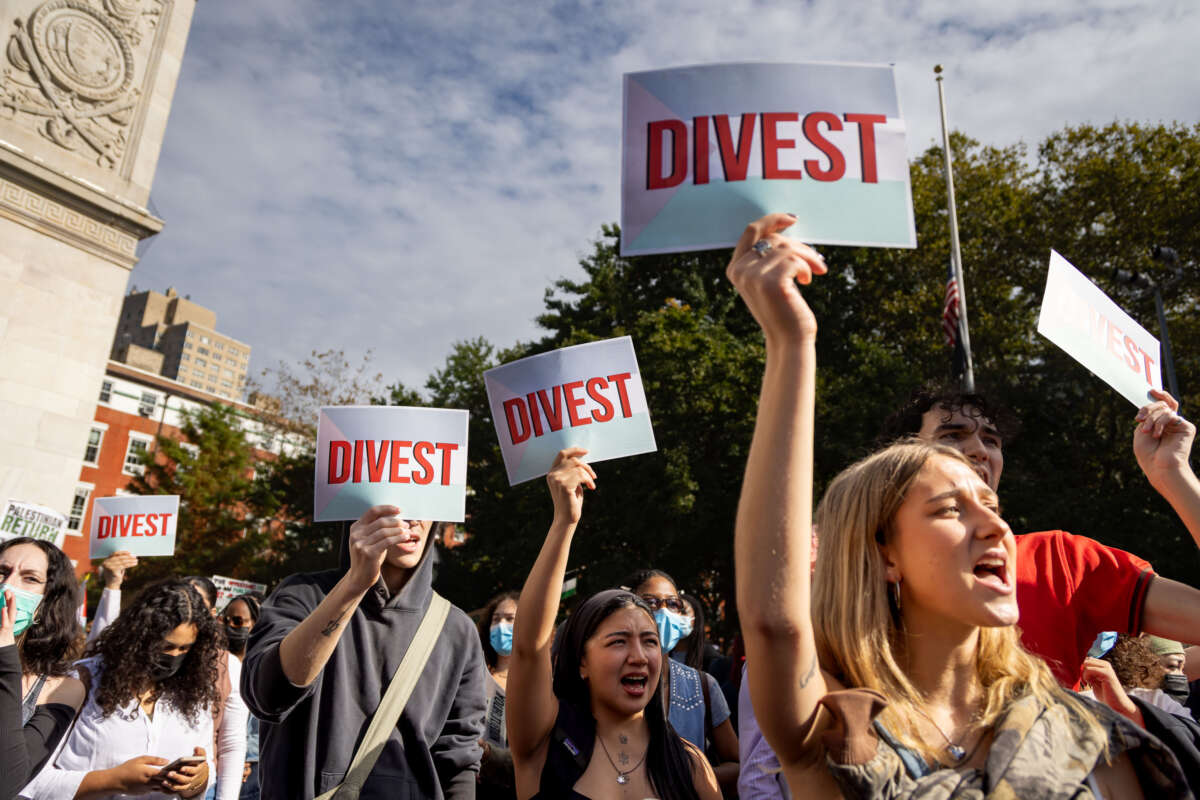
Students
from New York University hold signs that read "Divest" and chant during
a rally as students call for a ceasefire in Gaza, in New York, on
October 25, 2023. Michael Nigro / Pacific Press / Light Rocket via Getty Images
Across U.S. universities and workplaces, a growing number of
dissenting voices have faced swift reputational, career and personal
backlash after speaking out against the Israeli government’s retributive
mass killing of Palestinians. The October 7 Hamas attacks
indiscriminately killed over a thousand Israelis, many of them
civilians. Yet the IDF, clearly bent on revenge, has responded by
killing at a disproportionate extreme: More than 9,000 Palestinians in Gaza, including more than 3,700 children, have now been murdered by their airstrikes. In the U.S., many individuals who have openly opposed this genocidal collective punishment have been swiftly punished by social consequences including harassment, slander, blacklisting and firings.
Students and academics, among many others, have protested this
treatment with calls for solidarity and speech freedoms, including in a
number of collective letters signed by major figures. These discursive
struggles have reached the highest levels of government, with
condemnations and censorship issuing from state leaders and the Senate.
For decades, there has been a long, slow massacre perpetrated as so
many in the U.S. remained oblivious, pacified by propaganda. But each
new horror further pulls the blinders from Western eyes. It comes as
little surprise that U.S. universities, where radical student bodies are
overseen by more conservative administrators, have been the sites of
some of the most fevered rhetorical upsets — and the harshest
punishments. The college campus, it seems, will be a key site of the
increasingly desperate scramble to control the narrative. Nevertheless, far more consequential worldwide protests seem to indicate that, perhaps, the long denial is entering its last throes.
A State of Exception
“History didn’t start on October 7,” Palestinian literary critic Saree Makdisi wrote recently.
It is that self-evident fact that has too often fallen to the wayside.
The longtime imprisonment of Gazans and the steady colonization of the
West Bank has meant a drumbeat of death and violence for Palestinians:
death from IDF weapons and death from the slow violence of social
murder, by the active denial of lifesaving necessities.
For decades, the grim truths of Palestinian suffering have been
whitewashed for the U.S. population. The state of Israel has been
effectively exempt from criticism in major news organs; in many ways, it
is the sole subject that has remained totally anathema. So thoroughly
has the U.S. public understanding of the Israeli occupation been
manipulated that the effort represents perhaps the single greatest
domestic triumph of manufactured consent.
Yet, despite Israeli propagandists’ success in implanting that
correlation in the public mind, there have been undeniable signs that
the lockstep ideological narrative is increasingly in disarray. The
selective moral outrage cultivated by Israeli hasbara, or propaganda operations,
has been diluted by new Western attentiveness to the truth of the
occupation, which generates daily injustices that have become impossible
to hide. There’s a sense of a qualitative shift; even just a handful of
years ago, open criticism of Israel was off the table. Now, it’s arguably a liability for the incumbent in the next presidential election. The fact that referring to the Israeli occupation as a state of “apartheid” has more or less entered the mainstream bespeaks a remarkable reversal.
Still, IDF apologists will not cede any terrain without a fight. As Dylan Saba wrote in the publication n+1 (his article was first for The Guardian,
but was tellingly pulled by editors at the last minute), support for
Palestine has invited a distributed, stochastic reprisal, severe to the
point that it can, without exaggeration, be compared to a “McCarthyite
backlash.” Historian and n+1 editor Charles Petersen concurred, in a post that stated:
“We are witnessing the largest number of politically motivated firings
in at least fifty years. You have to go back to the Vietnam War or
McCarthyism to see something on a greater scale.”
A wealth of examples bears out this charge. Saba, who works at law
services nonprofit Palestine Legal, wrote, “Since 2014, we’ve handled
thousands of such incidents — suppression of speech supporting
Palestinian rights is nothing new — but it’s never been this bad.”
Indeed, Palestine Legal has already fielded over 200 reports of
repression in the U.S. since October 7.
“Students
on our campus are being harassed — physically assaulted, in some cases —
and a lot of the times, the university has just watched.”
In a letter also signed by “over 600 legal organizations and professionals,”
the organization included a litany of infringements on the rights of
Palestine supporters: censorship on social media and news, doxxing,
harassment online and on campus, firings and demotions, discrimination
and bullying, organizing activities banned or disrupted, racist
legislative initiatives on visas and immigration, calls for action to
instate surveillance, law enforcement investigations and outright
violence. In this most recent crisis, examples of these kinds of
suppressions first reared their heads at universities.
On-Campus Reaction
After the Hamas attack on October 7, school administrations and various academic leaders
released a volley of statements (as did other entities, from corporate
brands to sports teams). Generic at best, other declarations were
misleadingly pat, condemning Hamas violence without contextualizing it
in the brutalities of the occupation. The oversight is revealing; it
obscures the essential aspect of the problem and delegitimizes
Palestinian suffering. But implicit support for Israel is
uncontroversial — that’s why it’s perceived as the safe bet for
organizations looking for something milquetoast to churn out, to
inoffensive effect. (Why every corporation now sees fit to declare a stance on sociopolitical issues at all is another matter.)
Student groups and various left-leaning campus voices, of course, put
out oppositional statements of their own — which invited immediate
backlash. One of the more reported-on examples was that of Ryna Workman,
a New York University (NYU) law student and former president of the (now-disbanded) student bar association. Workman was harassed online, attacked on right-wing media and condemned by her dean. She also lost a job offer
at the law firm Winston & Strawn for posting a statement that
ascribed responsibility to Israel for the violence. (A stance, it’s
worth noting, that was not meaningfully distinct from an op-ed on the front page of Israel’s leading newspaper, Haaretz — in other words, not an absurd or extreme fringe view, except in a public discourse so warped as ours.)
Winston & Strawn, on top of rebuking Workman, was joined by the firm Davis Polk & Wardwell in declaring that any student signatories of similar statements will be persona non grata at their offices.
Similarly, in what seems like a low point in teacher-student trust, a
corporate law professor at UC Berkeley expressed his wish to sabotage
his own students’ futures in a Wall Street Journal op-ed: “Don’t Hire My Anti-Semitic Law Students.”
A statement written and signed by Harvard student groups, like
Workman’s, attributed the violence’s origin to Israel. They were, almost
immediately, met with a startling reprisal: not only doxxing and harassment of themselves and their family members, but also more inventive punishments. Executives at Wall Street firms “demanded a list of student names to ban their hiring,” reported The New York Times.
Most absurd was “a truck with a digital billboard — paid for by a
conservative group — [that] circled Harvard Square, flashing student
photos and names, under the headline, ‘Harvard’s Leading Antisemites.’”
On October 25, the Columbia University student newspaper reported that the tactic had resurfaced on their campus: Another “doxxing truck” singled out pro-Palestine Columbia students, adorned with their pictures and personal information. (As the students themselves would later comment,
most of the doxxed students were people of color, at least in Harvard’s
case; there were intimations of a racist aspect to the threat.)
Black Studies professor Russell Rickford faced outrage and death
threats after he made some initial remarks as the Hamas attack was
unfolding that some perceived as lauding the later violence. (Rickford clarified in Cornell’s student paper
that what he was “referring to is in those first few hours, when they
broke through the apartheid wall, that it seemed to be a symbol of
resistance”; rather than cheering the “horrifying realities” of Hamas’s
cruelties toward civilians, which later came to light.) Columbia
professor Joseph Massad is also facing death threats and calls for his
firing after he published an article in the Electronic Intifada that some interpreted as vaguely celebratory of the attack. (Hundreds of students and scholars
have since come to the defense of Massad’s academic freedom, noting
that his statements have been misrepresented in mainstream media.)
A source at Boston University, who requested anonymity out of concern for reprisals, told Truthout that, after students walked out in protest,
silence was implicitly demanded of the faculty: “The administration
[made it] clear that we were expected to follow a particular political
line, neither condemning it nor punishing students for participating,
but rather talking about it as ‘a complex issue’.… All of the faculty
recognized [this as] a contravention of academic freedom.”
Even a small sign of dissent, the source continued, incurred
consequences. “I stuck my neck out in a staff meeting over the statement
and supported the students who walked out.” As a result, he was brought
in by administrators more than once for questioning about his loyalties
and activities. “Since we don’t yet have a union contract,” he added,
“all of us generally have felt extraordinarily precarious.”
There are clear incentives motivating private universities to condemn
their own students and faculty: First and foremost, they have little
choice but to try and placate powerful donors. Some examples that The New York Times listed:
At Harvard, a billionaire couple quit an executive board. Another donor pulled money for fellowships. And Lawrence Summers, a former Harvard president and Treasury secretary, criticized the leadership for a “delayed” response to the Hamas attack and the student letter.
Dylan Kupsh is a Ph.D. candidate in computer science at UCLA and a member of Students for Justice in Palestine. He described ongoing Students for Justice in Palestine activities:
walkouts, teach-ins, vigils and marches across greater Los Angeles,
which have drawn thousands. The events’ success has, naturally,
attracted opponents’ attention as well: “We’ve been facing a lot of
repression,” Kupsh said to Truthout. “Students on our campus
are being harassed — physically assaulted, in some cases — and a lot of
the times, the university has just watched.”
It’s certainly not the first time Students for Justice in Palestine has been targeted at UCLA (or at other schools, in other circumstances).
But Kupsh has been disquieted by the escalation. “We were getting
threats around a teach-in, so it went online. But people still showed up
in person — and they were assaulted. A Zionist came in and threw
people’s computers in the trash.” Kupsh says the university was made
aware of this — but “nothing ever came [of it].”
Zionist speech has been manifestly well-protected, while advocacy for Palestinians has been outright criminalized.
“I think the university has been tacitly condoning a lot of this by
lack of action,” said Kupsh, who also said that counterprotesters have
regularly become violent at Palestinian solidarity rallies: “We’re
concerned about the safety when people are getting really physically
aggressive and escalating the situation.” In addition, he alleges that
the university explicitly refused to publish an announcement of a
solidarity gathering for Muslim students, despite sharing a similar one
for a Zionist group.
Students for Justice in Palestine has been a focal point of reprisal: The City University of New York chancellor indirectly condemned the organization, and on October 24, rather disturbingly, the Florida State University system banned Students for Justice in Palestine on its campuses outright
after “consulting with Governor DeSantis.” The statement claimed the
group’s activism was tantamount to “material support” of a “foreign
terrorist organization.”
Things escalated further still: As reported by The Intercept,
the U.S. Senate, a day after mass student walkouts, passed “a unanimous
resolution condemning what it called ‘anti-Israel, pro-Hamas student
groups’ across the country” — namely, the organizing groups, Students
for Justice in Palestine and Jewish Voice for Peace. Such are the true
heights attainable in this overzealous stifling of all dissent — the
impulse to ideological chastising runs all the way to the top.
Faculty Dissent and Public Universities
Blanca Missé
is an associate professor of French at San Francisco State University
(SFSU), a union member at the California Faculty Association (CFA) and
an organizer in the union’s Palestinian, Arab and Muslim (PAM) Caucus.
“For several years we’ve been organizing for justice in Palestine and
against Islamophobia and anti-Arab racism,” Missé told Truthout.
“Now that we’re getting a true stigma, we’re getting all the
constituents of the union to support it. That’s been very
reinvigorating.”
Joint action by faculty, especially unionized faculty, represents one
means of pushing back against the dominant narrative and the
restriction of academic freedoms. Truthout reviewed a response
letter addressed to the UC Board of Regents, in which the UC Ethnic
Studies Faculty Council, comprising over 300 teachers, “call[ed] on the
UC administrative leadership to retract its charges of terrorism … and
to stand against Israel’s war crimes.”
At public universities like SFSU, Missé noted, different incentives
predominate: “I think for private universities of course, there’s the
pressure of the donors. [But] public universities are terrified of
having to get into legal battles [with] Zionist organizations that file
frivolous lawsuits.… They call it lawfare, because it treats law as a
form of warfare. And they say that themselves.”
Missé meant it literally — last year, SFSU settled a lawsuit filed by two students and attorneys with the Zionist “Lawfare Project”
over charges “that school administrators acted with specific intent to
suppress pro-Israel speech or exclude Jewish student groups from
on-campus events.” Initially deemed baseless and thrown out of court,
the suit was settled on appeal. The university agreed “to publish a
statement that Zionism is an important part of Jewish identity” as well
as “a sweeping set of changes, including the creation of an on-campus mural that will feature Zionist views and a major investment in ‘viewpoint diversity.’”
Insistence on “viewpoint diversity” is one means of introjecting pro-Israel counterclaims into dissent, analogous to “both sides”
rhetoric. Of course, academic and speech freedoms must cut both ways.
The issue is that Zionist speech has been manifestly well-protected,
while advocacy for Palestinians has been outright criminalized.
“Repression and ‘cancel culture,’ what they call the ‘progressive
except Palestine’ exception — that has been going on for the last 20
years,” Missé pointed out. The ideological character and strategy behind
these counternarratives have shifted over time. But there is a
detectable correspondence with the success of the Boycott, Divestment,
Sanctions (BDS) movement, which has in part attained popularity by
fostering cross-group solidarity, bringing together “immigrant
organizations, Black organizations, Indigenous organizations. That
became very threatening,” Missé said. That BDS is successful in
challenging the dominant narrative seems to be corroborated by the
intensity of repression: Bills that criminalize or otherwise punish BDS
support can be found in 35 states. These rather extreme infringements upon free expression are largely the result of the inordinately powerful Israel lobby.
Political consequences do not end there, though they do come in more
petty varieties: At present, New York Councilman Robert Holden
(D-Queens) is attempting to defund an entire women’s services nonprofit to the tune of millions of dollars because its communication manager attended a protest against the killing of Gazan civilians.
Consensus Fails
The reach of the Israel lobby and its legal, media and advocacy
infrastructure mean that the recriminations extend far beyond academia.
Blacklists are not a thing of the past, to be sure. On social media, commentators have been tracking first-person accounts of people that have suffered career consequences and firings
in the last few weeks — a range that includes professions from subway
drivers to sportswriters to talent agents to tech executives. Major
conferences have been cancelled, publications and media interviews pulled, and bomb threats called into a Council on American-Islamic Relations (CAIR) banquet, as The Guardian would eventually document. (That particular publication was, as noted above, a bit late to the subject.)
There are certainly extremist voices that can be found reveling in
the deaths of Israeli innocents. But to a large extent, what makes the
backlash so remarkable is that it has not only spanned a wide front of
industries and income levels, but also that its punishments have been
brought down for statements that are so mild — like approvingly sharing an article from The Onion.
It’s an outrage that people are facing dramatic reprisals for having
advocated for the basic human rights of Palestinians, called for an end
to an apartheid system and demanded a halt to the revenge killings of
thousands. Yet these kinds of reactions are a testament to how warped
the discursive space around Palestine still remains. Decades of
effective propaganda produced by the Israeli government’s hasbara
organs and amplified by the evangelical chorus in the United States
have drowned out dissent for so long that the struggle toward a
corrective shift will necessarily be long and, as is clearly apparent,
rather grueling.
Despite progress, a reversal may still be a long time coming. After
all, the reason the domestic echoes resound so loudly is because the
U.S. military and foreign policy blob
have an enormous strategic-economic interest in propping up,
vindicating and rearming their Israeli client. And the mainstream U.S.
media, those noble watchdogs of the fourth estate, still react much more
like the kind of dog that prefers the lap.
We can at least be certain that center and far right mainstream media
channels (that is to say, all of them) will continue to play eager host
to fawning praise of Israel, and to tut-tut about the real threat to campus free speech. Their claims of “woke” repression and Orwellian pronoun enforcement are, of course, totally fraudulent. The actual repression, which goes unreported, is the glaring “Palestine exception.” Though free-speech warriors will never deign to mention it, there is a cancel culture, as activist and cartoonist Eli Valley reminded us in a social media post. It’s just not the type that the anti-woke charlatans have concocted.
The real infringement of rights consists in these punishments that
are meted out for free expression — all part of an ideological apparatus
that has, in the U.S., held Israel above reproach. The consensus is at
long last shifting. Until it does, Palestinians and their supporters,
from U.S. campuses to Gaza and the West Bank, are left demanding a kind
of change that is far more sweeping than any rhetoric, far more
consequential than any campus dust-up. Before all else, the genocidal
IDF bombardment of the Gaza Strip must be halted before countless more
are killed.
"I'm for truth, no matter who tells it. I'm for justice, no matter who it's for or against."
W.E.B. DuBois (1868-1963)
"There is but one coward on earth, and that is the coward that dare not know."
Dr. Martin Luther King, Jr. (1929-1968)
"Change does not roll in on the wheels of inevitability, but comes through continuous struggle. And so we must straighten our backs and work for our freedom. A man can't ride you unless your back is bent. "
James Baldwin (1924-1987)
"Precisely at the point when you begin to develop a conscience you must find yourself at war with your society."
Aimé Césaire (1913-2008)
"A civilization that proves incapable of solving the problems it creates is a decadent civilization. A civilization that chooses to close its eyes to its most crucial problems is a stricken civilization. A civilization that uses its principles for trickery and deceit is a dying civilization."
Nina Simone (1933-2003)
"There's no other purpose, so far as I'm concerned, for us except to reflect the times, the situations around us and the things we're able to say through our art, the things that millions of people can't say. I think that's the function of an artist and, of course, those of us who are lucky leave a legacy so that when we're dead, we also live on. That's people like Billie Holiday and I hope that I will be that lucky, but meanwhile, the function, so far as I'm concerned, is to reflect the times, whatever that might be."
Amilcar Cabral (1924-1973)
"Always bear in mind that the people are not fighting for ideas, for the things in anyone's head. They are fighting to live better and in peace, to see their lives go forward, to guarantee the future of their children ....Hide nothing from the masses of our people. Tell no lies. Expose lies whenever they are told. Mask no difficulties, mistakes, failures. Claim no easy victories..." .
Angela Davis (b. 1944)
"The idea of freedom is inspiring. But what does it mean? If you are free in a political sense but have no food, what's that? The freedom to starve?”
Duke Ellington (1899-1974)
“Jazz is the freest musical expression we have yet seen. To me, then, jazz means simply freedom of musical speech! And it is precisely because of this freedom that so many varied forms of jazz exist. The important thing to remember, however, is that not one of these forms represents jazz by itself. Jazz simply means the freedom to have many forms.”
Amiri Baraka (1934-2014)
"Thought is more important than art. To revere art and have no understanding of the process that forces it into existence, is finally not even to understand what art is."
Frederick Douglass (1817-1895)
"Power concedes nothing without a demand. It never did and it never will. Find out just what any people will quietly submit to and you have found out the exact measure of injustice and wrong which will be imposed upon them, and these will continue till they are resisted with either words or blows, or both. The limits of tyrants are prescribed by the endurance of those whom they oppress.” --August 3, 1857
Cecil Taylor (1929-2018)
“Musical categories don’t mean anything unless we talk about the actual specific acts that people go through to make music, how one speaks, dances, dresses, moves, thinks, makes love...all these things. We begin with a sound and then say, what is the function of that sound, what is determining the procedures of that sound? Then we can talk about how it motivates or regenerates itself, and that’s where we have tradition.”
Ella Baker (1903-1986)
"Strong people don't need strong leaders"
Paul Robeson (1898-1976)
"The artist must take sides. He must elect to fight for freedom or for slavery. I have made my choice. I had no alternative."
John Coltrane (1926-1967)
"I want to be a force for real good. In other words, I know there are bad forces. I know that there are forces out here that bring suffering to others and misery to the world, but I want to be the opposite force. I want to be the force which is truly for good."
Miles Davis (1926-1991)
"Jazz is the big brother of Revolution. Revolution follows it around."
C.L.R. James (1901-1989)
"All development takes place by means of self-movement, not organization by external forces. It is within the organism itself (i.e. within the society) that there must be realized new motives, new possibilities."
Frantz Fanon (1925-1961)
"Now, political education means opening minds, awakening them, and allowing the birth of their intelligence as [Aime] Cesaire said, it is 'to invent souls.' To educate the masses politically does not mean, cannot mean, making a political speech. What it means is to try, relentlessly and passionately, to teach the masses that everything depends on them."
Edward Said (1935-2003)
“I take criticism so seriously as to believe that, even in the midst of a battle in which one is unmistakably on one side against another, there should be criticism, because there must be critical consciousness if there are to be issues, problems, values, even lives to be fought for."
Antonio Gramsci (1891-1937)
“The challenge of modernity is to live without illusions and without becoming disillusioned. There must be pessimism of the intellect and optimism of the will.”
Susan Sontag (1933-2004)
"Do stuff. Be clenched, curious. Not waiting for inspiration’s shove or society’s kiss on your forehead. Pay attention. It’s all about paying attention. Attention is vitality. It connects you with others. It makes you eager. Stay eager."
Kofi Natambu, editor of The Panopticon Review, is a writer, poet, cultural critic, and political journalist whose poetry, essays, criticism, reviews, and journalism have appeared in many literary magazines, journals, newspapers, and anthologies. He is the author of a biography MALCOLM X: His Life & Work (Alpha Books) and two books of poetry: THE MELODY NEVER STOPS (Past Tents Press) and INTERVALS (Post Aesthetic Press). He was the founder and editor of SOLID GROUND: A NEW WORLD JOURNAL, a national quarterly magazine of the arts, culture, and politics and the editor of a literary anthology NOSTALGIA FOR THE PRESENT (Post Aesthetic Press). Natambu has read his work throughout the country and given many lectures and workshops at academic and arts institutions. He has taught American literature, literary theory and criticism, cultural history and criticism, film studies, political science, creative writing, philosophy, critical theory, and music history and criticism (Jazz, Blues, R&B, Hip Hop) at many universities and colleges. He was also a curator in the Education Department of Detroit’s Museum of African American History. Born in Detroit, Michigan, Natambu currently lives in Berkeley, California with his wife Chuleenan.