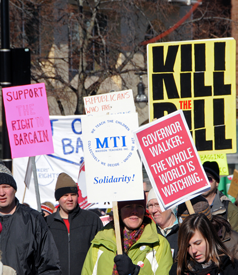
Sotheby's locked out its professional art handlers despite record breaking profits and the most successful quarter in the company's 267 year history. Now, valuable pieces of art are at risk as Sotheby's uses inexperienced, temporary workers to handle art once taken care of by veteran art handlers of 40 plus years.
Tell the Whitney Museum: Cut Your Ties With Sotheby's!All,
This is a very important and necessary struggle that deserves our collective support. Please respond to the urgent request below by signing the petition and passing it on to others. Thank you...
Kofi
Begin forwarded message:
From: Chris Tysh
Date: April 25, 2012
Dear friends,
The art handlers at Sotheby's have been locked out since August 1, 2011. They have lost their medical coverage, their source of income and are a fighting a corporation bent on crushing the union. please support the workers by signing the petition and circulating it as widely as possible. Sotheby's must end the lock out now!
regards,
Chris
Dear Friend,
Imagine you have proudly served your employer for years. Imagine that in 2010 your employer had its second-best year in its 268-year history. Imagine that your company made so much money (over $680 million in profit) that your CEO rewarded himself with a nearly $3 million dollar bonus--bringing his total compensation to almost $6 million.
And now imagine that despite all of that, your company has kicked you and your coworkers out onto the street, cut off your family medical coverage, replaced you with new workers, and even after 8 months, refuses to bring you back to work until you agree to sign a contract that will completely destroy your job security and your right to collectively bargain a contract.
This is what is happening right now to 42 art handlers at Sotheby’s auction house. These workers, the majority of whom are people of color, desperately need their jobs back. All they are asking for is a fair contract that ensures a decent living for future generations of art handlers.
Please sign this petition to lend your voice in support of these workers, and to ask the Whitney Museum to stand up for socially responsible practices in the art world.
The Whitney Museum has accepted sponsorship money from Sotheby’s and has ignored pleas to cut ties to the anti-worker auction house.
A public pledge from The Whitney would not only help these workers and their families, but it would send a message to the art world that racial and economic fairness are just as valuable as the masterpieces regularly handled by these workers.
Please sign our petition* asking The Whitney Museum to take a stand for justice by vowing to not do any business with Sotheby’s until the auction house ends the lockout and signs a fair contract with the workers.
Thank you for your support!
In solidarity,
Workers for Justice in the Arts
SothebysBadForArt.com
*when signing the petition please list your title and organization if applicable!
Julian Tysh
Organizer
Teamsters Local 814
http://www.sothebysbadforart.com/content/
In 2010, Sotheby’s sales increased by 74 percent to $4.8 billion. And recently, Sotheby’s reported its most profitable quarter in the company’s 267-year history.
Despite record profits and growth, Sotheby’s refuses to negotiate a fair contract with its art handlers. Instead of recognizing and rewarding the contribution these workers have made to the company’s success, Sotheby’s has locked out its professional art handlers, kicking them into the street with no paycheck, while outsourcing their jobs to temporary workers. Meanwhile, Sotheby’s rewarded its CEO by nearly doubling his annual salary to almost $6 million.
Is Sotheby’s putting irreplaceable and fragile pieces of art at risk? Auctioneers may sell the art, but art handlers are responsible for the transportation, preparation and display of each piece. Some of the locked out art handlers have more than 40 years of experience protecting art that sells for as much as $100 million. Replacing these individuals with temporary workers is enough to make anyone scream.
http://www.teamster.org/content/teamsters-sothebys-bad-art

TEAMSTERS: SOTHEBY'S IS BAD FOR ART
August 26, 2011
Teamsters, Community Members Protest Sotheby's Worker Abuses
PRESS CONTACT:
Leigh Strope
lstrope@teamster.org
202-497-7766
(New York, N.Y.) – Hundreds of Teamster members and supporters protested outside Sotheby's Manhattan showroom to educate the company’s clients about the lockout of its art handlers today. Protesters held banners and signs that read, “Sotheby’s: Bad for Art” and “Sotheby’s: Stop the War on Art Workers,” while distributing leaflets.
After the most profitable year in the history of the company, auction house Sotheby’s locked out its longtime, dedicated employees on Aug. 1 while in the middle of contract negotiations. Those employees handle artwork and antiques valued at hundreds of millions of dollars. The company replaced its longtime, dedicated union employees with unskilled replacement workers.
“Sotheby's hired Jackson Lewis, one of America's most notoriously union-hostile law firm, to sabotage our contract talks. Jackson Lewis specializes in helping New York employers destroy permanent, professional jobs by bringing in a temporary workforce with high turnover,” said Jason Ide, President of Teamsters Local 814, which represents the 43 locked-out workers. “New York can’t afford to lose more good jobs, and art patrons need to know that outsourced art handlers at Sotheby’s aren’t destroying their treasures.”
“Sotheby’s has joined the growing ranks of companies that abuse their workers despite making hundreds of millions in profit. The Teamsters will always stand up for working people, and we are here to tell Sotheby’s that when they act like a corporate bully, we will fight back,” said Teamsters General President James P. Hoffa.
“New Yorkers need to know that these Sotheby’s workers—these experienced and dedicated art handlers who are responsible for protecting priceless works of art—are being treated unfairly,” said George Miranda, Teamsters International Vice President and President of Teamsters Joint Council 16 in New York. “Replacing experienced art handlers with outsourced workers is a bad way to handle New York’s fine art.”
When Sotheby's experienced the most profitable quarter in its 267-year history, it rewarded its top management royally. Sotheby's CEO Bill Ruprecht’s salary almost doubled in 2010 to $6 million. In several bargaining sessions since the Aug. 1 lockout, there has been little movement from the company to settle the contract.
“We are responsible for shipping, receiving, unpacking, assembling, and installing exhibitions of artwork and antiques valued in the millions of dollars,” said Julian Tysch, a locked-out Sotheby's art handler. “With profits over $100 million in the last quarter alone, I don’t understand why Sotheby’s would make such a bad decision to outsource this sensitive work and kick us to the curb for no reason.”
Founded in 1903, the Teamsters Union represents more than 1.4 million hardworking men and women in the United States and Canada. Visit www.teamster.org for more information.
The Origins of May Day: A Story of Chicago, the First Labor Movement and the Bombing That Divided Gilded Age America
Transcript
May 1, 2006
AMY GOODMAN: We are joined in the studio by James Green, Professor of History and Labor Studies at the University of Massachusetts, Boston, author of a new book called Death in the Haymarket: A Story of Chicago, the First Labor Movement and the Bombing that Divided Gilded Age America (2006). We welcome you to Democracy Now!
JAMES GREEN: Good morning. Happy May Day!
AMY GOODMAN: It’s good to be with you. Let’s stay in Chicago, where our last guest was, Jorge Mujica. They have major plans for today. But it all began here 120 years ago.
JAMES GREEN: Yes, it did. 120 years ago, thousands of workers and their families were marching through the streets of Chicago. It was a Saturday. Everyone left work, because in those days people had to work on Saturday. They were working a ten- and twelve-hour day. Most of these people were immigrants, and as your last interviewee just said, they were protesting as immigrant workers, as well as as people who were U.S. citizens and wanted to be U.S. citizens.
AMY GOODMAN: Where were these immigrants from?
JAMES GREEN: These were immigrants mostly from Germany, from Bohemia, what is now Czechoslovakia [Czech Republic and Slovakia], from France, all different parts of Europe, and this was a city where they worked in enormously large factories and found that they had been in years of depression and wanted to shorten the workday.
AMY GOODMAN: Talk about this period, 120 years ago. Put it in the historical context of the Civil War, of Abraham Lincoln.
JAMES GREEN: Right. Well, this was a period when the United States was still living with the memory of the Civil War. Many people had fought in the Civil War. And the question was whether African Americans, who were free people, would have their rights and whether now other people, who were so-called free labor, would also have their freedom. And they defined that as the eight-hour day, as getting some freedom from the long arm of the job.
It was also the period when American industrial capitalism was booming. The largest corporations in America were being created then, and yet people in the United States were thinking these were bad organizations, that they could be stopped, that somehow they could create an economy that was run by local people, run by workers themselves. The things that we think were inevitable in the 20th century didn’t seem so in 1886.
AMY GOODMAN: When Abraham Lincoln was assassinated, his body was brought to Chicago.
JAMES GREEN: Yes, yes. My book begins on May Day, but it’s May Day, May 1st, 1865, when Lincoln’s body comes back to Chicago, who is a great hero of all the people and all the classes, and Chicagoans stand unified in grief that May Day. And my project in the book is to explain how in 19 years all that came apart, and people became so divided from one another.
AMY GOODMAN: Well, talk about that, because it’s also the history of labor in this country.
JAMES GREEN: Yes. There was really no labor movement in 1865 to speak of. But what happened was, workers — many of them immigrants — felt the need to create one, partly because employers felt that there was a — they were going to freeze wages, keep wages the way they were, that any increase in wages would be a loss in profits, and they were not going to allow the workday to decrease. So people organized the labor movement, and when they did that in 1877, they faced terrible, terrible violence. About 30 people were killed in Chicago by the Chicago police. And that sets the city down a road of tension, of struggle, that leads directly to Haymarket.
AMY GOODMAN: It’s interesting, today there is a debate over whether to boycott, to rally, to protest, what the protest should look like. And people are doing all different things throughout the country. The same thing was happening more than a hundred years ago.
JAMES GREEN: Yes, the resonance in this is amazing. You know, I’m a history professor, and I tell my students, history doesn’t repeat itself, but you have to wonder when you look at what’s happening today, because the labor movement was divided then, too. The main organization, the Knights of Labor, said, "Don’t go on strike, let’s talk to employers. Don’t boycott, let’s appeal to the American people, let’s appeal to the legislature." But the immigrant and the community-based groups and the radical groups, the anarchists in Chicago, were all for taking direct action and had very little faith that the legislature would do the right thing, unless the people in the streets forced them to.
AMY GOODMAN: And so, explain in this 19-year period how we come to May Day, 1886, who the key players are, both on the corporate side, the Chicago powers that be, and the activists who were organizing workers.
JAMES GREEN: Well, first of all, the employers and legislature had really decided that they were against an eight-hour law. Illinois had been the first state to pass one, and the employers simply refused to obey it. So that was the background of the labor movement saying — a wing of the labor movement saying we have to really compel employers to concede. And, in fact, all during the spring of 1886, employers were conceding, just as you see people today closing down, like your guest, and accepting the reality that they needed these workers, and if they would come back for eight hours a day, they would have them. So, as the May Day appeared that first time in 1886, it looked as though everything was going to proceed peacefully. Employers were conceding, but behind the scenes people were getting their backs up.
AMY GOODMAN: I also would like you to lay out the media landscape, media absolutely critical today, the most powerful institutions on earth. Back then, also extremely critical in shaping people’s perception of labor that was organizing.
JAMES GREEN: Yes, it’s fair to say the daily press — and there were eight dailies in Chicago at the time — were universally hostile to the strike, to any form of direct action, very, I think anti-immigrant as well. And so, the workers had to create their own press. There was a daily newspaper in German published, Die Arbeiterzeitung [The Workers’s Newspaper], that reached 20,000 people. So the workers had to create an alternative media. Then, of course, when the violence began, the media was really responsible for shaping public opinion in all the events that occurred afterward.
AMY GOODMAN: Who was in charge of, for example, the Chicago Daily Tribune?
JAMES GREEN: The Chicago Daily Tribune was edited and published by a man named Joseph Medill, who was arguably the most powerful and influential journalist in the United States, and he had the ability to really shape what business opinion and what legal opinion in Chicago was. And he played a tremendous role in this. It’s really hard to underestimate it.
AMY GOODMAN: And would you say it was a paper of the business community?
JAMES GREEN: Yes, it announced itself as the paper of the businessman. And so they were very much opposed to the eight-hour day and very determined to identify radicals in the movement and in effect to kind of bait the movement by saying it’s led by revolutionaries, when in fact it was a broad mass-based effort.
AMY GOODMAN: Karl Marx also played a role here.
JAMES GREEN: Well, Karl Marx died in 1883, but his followers — there were many German followers of his in Chicago among the cigar makers and others, and they believed in what he and Engels wrote, that the only way for workers to get power was to create a mass-based labor movement that included all the workers of the world and that eventually this kind of movement could take over and create a cooperative economy that they called communism.
AMY GOODMAN: But hadn’t Marx and Engels brought their organization to New York, to the United States?
JAMES GREEN: They did. There was at the time something called the International Working Peoples Association, which was way ahead of its time, in terms of seeing the unity of workers as extending across boundaries and national lines. And the people in Chicago were devoted followers of the International Working Peoples Association.
AMY GOODMAN: And he was also a close follower of the Civil War and of the Emancipation Proclamation, of what happened to slaves as they were freed.
JAMES GREEN: Interestingly enough, Karl Marx wrote in English for the New York Tribune during the Civil War. Interesting. And he saw the Civil War as the most important event in world history, that not only did it end slavery and liberate black people, but it created an eight-hour movement, and Marx and Engels really looked to the United States, to the U.S. workers, as leading the world struggle for justice and freedom.
AMY GOODMAN: We’re going to break. When we come back, I want to ask you about Albert and Lucy Parsons. I want to talk about what happened after May Day, May 1, 1886, what really shaped the modern day labor movement in this country. I want to talk about the killings of May 5th. I want to talk about the riot. This is Democracy Now! We’re talking to James Green, Professor of History and Labor Studies at University of Massachusetts. His book is Death in the Haymarket: A Story of Chicago, the First Labor Movement and the Bombing that Divided Gilded Age America.
[break]
AMY GOODMAN: I’m Amy Goodman, as we talk about the history of May Day, 120 years ago today, May 1, 1886. Our guest is James Green. Death in the Haymarket is his book, A Story of Chicago, the First Labor Movement and the Bombing that Divided Gilded Age America. Again, welcome, and as we continue with the story. May Day, 1886, there is a mass uprising in Chicago.
JAMES GREEN: Right, and a tremendous euphoria and people in the streets and celebrating, because they called it their "Emancipation Day," actually, because it appeared that all of this would take place peacefully, and it was a great empowerment moment for the immigrants who had come here and hadn’t yet started to vote. This was their vehicle almost for asserting their definition of Americanism, and unfortunately something happened on May 3rd that led to tragic consequences.
There were pickets at the McCormick Harvester plant, they called it the Reaper Works. They produced farm implements. There were strike breakers. There was a lockout going on there. Their workers protested the lockout. There was a fight. Chicago police intervened massively, and several workers were killed, several unarmed workers, so the anarchists in Chicago — and I have to tell you a little bit about them — they were very active, very well-organized in Chicago, led by Albert and Lucy Parsons. They were people from Texas, not from Germany. Albert Parsons was from East Texas. He met Lucy there, who was a woman who had grown up in slavery and had become a free person, and they were married in Texas and had to flee there, because they were fighting for black rights after Reconstruction, and then they were dodging the Ku Klux Klan.
AMY GOODMAN: And they were an interracial couple.
JAMES GREEN: And they were an interracial couple and radicals, who believed — in those days being radical meant you supported the 13th, 14th and 15th Amendments in Texas. That was radical, and it could cost you your life.
AMY GOODMAN: And Albert Parsons ran a press.
JAMES GREEN: He ran a press that supported the Black Freedom Movement of the time, and he lost all of his former friends and was, you know, couldn’t sleep in the homes of white people. So he had already stepped outside of the mainstream before he left Texas. They came to Chicago in 1873 in the midst of a great depression, and as a result of their experiences there, particularly in the Great Uprising of 1877, when the Chicago police shot people in the streets, they became revolutionaries and called themselves anarchists by 1886. Parsons was a very, very good organizer. He was probably one of the key people in the whole eight-hour movement in Chicago, and so was his comrade August Spies, who was the man who edited this daily German newspaper, this anarchist newspaper.
AMY GOODMAN: And where had August Spies come from?
JAMES GREEN: He was from the forests of Germany. He grew up in a relatively privileged family background, and he, too, came to America, and what he saw here radicalized him actually, and also hearing speeches of people talking about the evils of capitalism, as they experienced. They were both rather independent men, tradesmen. Parsons was a printer. Spies was an upholsterer, and yet they identified themselves with the cause of the masses of immigrants in the city of Chicago. So when they heard about this killing by the police, they called a rally the next night on May 4th in the Haymarket Square, which is where workers had always gathered for political events, and they wanted it to be a peaceful rally. Everything so far had been peaceful in the eight-hour strikes, and, indeed, the rally was peaceful. The mayor of Chicago came and said, "I don’t hear any talk of throwing bombs. I don’t hear any threats."
AMY GOODMAN: In fact, Albert Parsons wasn’t even going to be there, right? He had been somewhere else.
JAMES GREEN: Right, he was planning to go somewhere else, and, in fact, he wasn’t even expecting trouble, so he brought Lucy and his two children, Albert, Jr. and Lulu, and later on, in the defense, they said, "Well, how could a man be advocating violence with innocent people around?" And so, the rally was winding down. It was about 10:30 in the evening. It started to rain. In fact, Albert and Lucy left the rally for the warmth of a nearby saloon, and just as the rally was winding down, a large force of police marched on the square where the rally was taking place.
AMY GOODMAN: Haymarket Square.
JAMES GREEN: Haymarket Square, about 176 police. The police captain had actually disobeyed the orders of the mayor, who said, "The rally is peaceful. There’s no need to disperse it." The police captain acted on his own, marched right up to them and said, "You must disperse," and the speaker said, "But we are peaceful." And he said, "You must disperse anyway." And as the speaker was coming down from the wagon, someone — and to this day, we don’t know who it was — threw a bomb that landed into the ranks of the police. One officer was killed immediately. Six others later died. The police were panicked, of course, almost hysterical. They’d never expected anything like this, began firing, probably shot, you know, each other, shot people in the crowd, and in the end, seven police died and at least three of the demonstrators. Many, many people were wounded, and this was the tragic, violent Haymarket Riot and had enormous consequences for what happened in labor history afterwards.
AMY GOODMAN: Explain.
JAMES GREEN: Well, it set off hysteria. Nothing like this had ever happened before in peacetime America. There had been horrible losses of life in battlefields, but in the middle of a city — there had been many riots, many demonstrations, many citizens had died, but never any police, so this was a shocking event, and it also sort of triggered off all the fears that many Americans had, people born here, of this massive number of immigrants who lived around them. A majority of the people in Chicago were foreign-born, so there was great deal of anxiety about that, and this attack on the police by what was assumed to be an anarchist, or today would be called a terrorist, really set off a kind of anxiety that the United States had not experienced before and nation’s first red scare. So people were rounded up; newspapers were suppressed; people’s homes were searched without warrant, and the anarchists, ten anarchists, were arrested and tried for the bombing.
AMY GOODMAN: The role of the paper in the anti-immigrant hysteria, and again, to this day, you don’t know who did this.
JAMES GREEN: Right, right. Well, the newspapers —- I quote them at length, and it will make your hair stand on end to see what they said about immigrants then, because there were no holds barred, and so these were -—
AMY GOODMAN: Do you see similarities with today?
JAMES GREEN: I do, although I think people today are being a little more careful about the overtly racist — I mean, there were all kinds of racist things in the papers about Germans and Czechs. You know, I mean it wasn’t just the color of people’s skin. It was that they were foreign, and they were threatening, and they were un-American, and so as soon as the bombing occurred, it didn’t matter whether they found the actual perpetrator. Someone was going to pay for this. And the Chicago papers — and the New York Times was even more extreme, actually —- said, "Somebody has to hang for this," and ultimately four anarchists did, even though the evidence doesn’t place them at the crime scene, doesn’t really put the bomb in any of their hands. They were the victims of the -—
AMY GOODMAN: Talk about the people who went on trial and the four men who hanged.
JAMES GREEN: Right, eight people were indicted, anarchists, all workers, all organizers, seven of them immigrants, were indicted not for — no one was accused of throwing the bomb, but having knowledge of a conspiracy that led to the bombing. Later this was regarded as an unprecedented kind of trial where people could be not only accused of being accessories, but sentenced to death, as seven of them were, for having knowledge, and later on it was said that they were sentenced as much for what they had said as what they did, and ultimately four of these men were hanged. One of them, Louis Lingg, committed suicide, "cheated the hangman," as the anarchists said, committed suicide on death row in Chicago.
AMY GOODMAN: Who was Louis Lingg?
JAMES GREEN: Louis Lingg was a young German anarchist, was the most overtly radical and militant of the anarchists. He actually was making bombs. He wasn’t at Haymarket, so it wasn’t him who threw the bomb. People were preparing for street warfare, and so that was enough for the press and the jury, the fact that people were preparing for this and saying this might be necessary. It didn’t really matter that they had actually done it, and ultimately Albert Parsons, August Spies, George Engel, and Adolph Fischer are all hanged, and they become known around the world, even to this day, as the Haymarket Martyrs, because after the execution takes place, it’s celebrated in America by all the press, but around the world, people believe a great injustice has been done, and people died — really these are the first "martyrs for the cause of industrial freedom," as Eugene Debs put it.
AMY GOODMAN: How did Parsons get connected? You said he had gone off to a saloon with his wife and kids.
JAMES GREEN: Right, he was really tried, I think, because he was the most important leader of the anarchist movement and the labor movement in Chicago. He wasn’t even present during the bombing. There was hardly anything to link him to it. In fact, he fled the city, and his defense lawyer persuaded him to come back and said, "There’s no way you can be convicted of this crime, because you had nothing to do with it," but in fact, he was, and he was sentenced to death. He was offered clemency by the governor, saying, "If you sign a recantation, you can save your life and spend the rest of your life in prison," and he refused.
AMY GOODMAN: And Spies?
JAMES GREEN: Yes, Spies was there at the time and was accused of being connected directly with the bombing, but there was a trial, sort of the trial of the century, and there was a tremendous amount of contradictory testimony indicating that he really didn’t have anything to do with actually throwing the bomb.
AMY GOODMAN: Can you talk about how their language, how their speeches, their writings were used against them?
JAMES GREEN: Yes, well, they believed that it was simply a matter of time before the police and militia — the businessmen had their own militia, by the way —- would intervene in one of these demonstrations and strikes -—
AMY GOODMAN: Wait, on that "by the way," what do you mean the businessmen had their own militia?
JAMES GREEN: The militia in Chicago and other cities were privately raised armed forces. You could fund your own militia company, and the interesting thing in Chicago is the workers, in reaction to this, formed their own militia, which were outlawed by the State of Illinois.
AMY GOODMAN: Pinkerton came from Chicago?
JAMES GREEN: Pinkerton was based there, so Chicago was really an armed camp. That’s the only way to put it, and it looked like something very seriously violent was going to happen. So Spies and Parsons said, ’You’d better be ready. You’d better have arms. By the way, the Constitution says you have the right to bear arms, and you’d better make bombs, and guess what? There’s no law against that either.’ So they were prepared to really go to war. They had been fighting the Pinkertons in the streets, and so this was a very volatile situation.
AMY GOODMAN: What do you mean they had been fighting the Pinkertons? Who were the Pinkertons?
JAMES GREEN: Well, the Pinkertons were private police that were hired by the employers who wanted to beef up their security, and the Pinkertons had actually killed people in Chicago. They were also remembered as the ones who hung the Molly Maguires, the Irish miners who were regarded as being innocent of the crime that they committed, so it was almost an armed conflict situation that they were preparing for.
AMY GOODMAN: Allan Pinkerton had established the company and hired veteran soldiers?
JAMES GREEN: Veteran soldiers and people who were out of work to go in and be informers and to be really hired gunmen and really to protect strike-breakers. That was their main job, because the employers weren’t sure they could always count on the police. Police were immigrant workers themselves, and sometimes they said, "Well, you know, we are not intervening here." That was part of the problem in Chicago at first.
AMY GOODMAN: So, you had these militias. You also had the police. How did they stand in relation to the militias?
JAMES GREEN: Well, at first the police were under the control of the mayor, who was pro-worker, pro-union, and you had situations where strike-breakers would be brought into plants, and the Chicago police would say, "Well, it’s not our job to protect them. If you want to bring them in, that’s your business." But something happened about a year before Haymarket, and the mayor lost control of the police, and a new captain came in who really wanted to do what the businessmen wanted, which was to prevent strikes, to back up lockouts, to prevent rallies, and so, you know, there’s clearly a situation where trouble is going to take place in Chicago and has to do with this shift in the use of police and the fact that you have Pinkertons and militia in the streets.
AMY GOODMAN: Can you talk, Professor Green, about the day that the men were hung?
JAMES GREEN: Yes. This was November 11, 1887, and people around the world knew that for a long time that these men would be sentenced to death. But something happened in the Cook County Jail which was quite extraordinary, was that the anarchists on the gallows seemed to be choreographing their own death scene, and they gave these speeches, which in some ways sound like they could come from a Shakespeare play or something like that. And August Spies said, "You may silence us now, but our memory will survive us." And Albert Parsons’s last words were, "Fighting for free speech even at the last breath." And when they died, when they were executed, the people in the room, who were all witnesses who wanted them to die, were kind of stunned and saddened, according to the newspapers, about this. So almost immediately, people in Chicago said, "Well, maybe something was done here that was wrong," and that was certainly true around the world.
AMY GOODMAN: And Lucy Parsons?
JAMES GREEN: Lucy Parsons lived on, carried on the struggle until 1942. The struggle for her really was to preserve her husband’s memory and the memory of the cause that he died for, and in the end she — her last May Day is in 1941. She is an 88-year-old woman. She’s blind, and she’s going through the streets of Chicago on a C.I.O. union parade on a float, and she became a kind of a living saint at the end of already life for the new labor movement coming to Chicago, unionizing the stockyards and the steel mills, and there was a real connection between that and what had happened before.
AMY GOODMAN: And how did the Haymarket killings and the hangings of the four men shape the modern-day labor movement?
JAMES GREEN: Well, I think that initially it had a very negative impact on the American Federation of Labor, the mainstream. The labor movement wanted nothing to do with the memory of these men. In fact, that’s one of the reasons why May Day wasn’t celebrated here, and instead Labor Day became the national holiday, rather than the international holiday. But somehow — I try to explain this in the book — the memory of these men wouldn’t die. It kept being recreated by people in the labor movement who wanted a broader movement, wanted a labor movement that would go into the streets, wanted a labor movement that would strike, even if it was against the law, wanted a labor movement that would use boycotts, and so that’s why their memory keeps getting revived.
AMY GOODMAN: Is there a monument to them in Chicago?
JAMES GREEN: Well, there is. There’s a cemetery, Waldheim Cemetery, a non-denominational cemetery, outside of the city — the mayor wouldn’t let them be buried in the city of Chicago — which has become a kind of international shrine, and not only are the Haymarket anarchists buried there, but 69 other people of the left, including Emma Goldman and Elizabeth Gurley Flynn, are buried there, but nothing exists in the city of Chicago, except a new monument, which is not to the police and not to the anarchists, but to the fragility of free speech, and you have to go there to see it, because it’s an abstract group of figures that are supposed to represent what happened in Haymarket as a kind of national tragedy.
AMY GOODMAN: Last comments on this May Day, where millions are observing this day by honoring immigrants, standing up for immigrant rights around the country.
JAMES GREEN: Well, it does appear as though what goes around comes around, in a way, that people are feeling the need to go into the streets to do — to take extraordinary action and to do it as part of an international community of workers. That’s what was important about May Day of 1886 is that people were demonstrating not only as U.S. citizens, but as citizens of the world, the larger world community of workers. And that’s what I see happening today, because, of course, in Indonesia and the Philippines, people are demonstrating, and they are here, too, and using some of the same tactics, the boycott, the staying away from work, that were really began in 1886.
AMY GOODMAN: And for people to remember that going back then is where we got the eight-hour day.
JAMES GREEN: Yes, that’s where it started, and people had to sacrifice their lives for what took many, many years. Not until 1938 did the struggle finally succeed.
AMY GOODMAN: I want to thank you for being with us, James Green, and for writing this book, Death in the Haymarket: A Story of Chicago, the First Labor Movement and the Bombing that Divided Gilded Age America.
Despite record profits and growth, Sotheby’s refuses to negotiate a fair contract with its art handlers. Instead of recognizing and rewarding the contribution these workers have made to the company’s success, Sotheby’s has locked out its professional art handlers, kicking them into the street with no paycheck, while outsourcing their jobs to temporary workers. Meanwhile, Sotheby’s rewarded its CEO by nearly doubling his annual salary to almost $6 million.
Is Sotheby’s putting irreplaceable and fragile pieces of art at risk? Auctioneers may sell the art, but art handlers are responsible for the transportation, preparation and display of each piece. Some of the locked out art handlers have more than 40 years of experience protecting art that sells for as much as $100 million. Replacing these individuals with temporary workers is enough to make anyone scream.
http://www.teamster.org/content/teamsters-sothebys-bad-art

TEAMSTERS: SOTHEBY'S IS BAD FOR ART
August 26, 2011
Teamsters, Community Members Protest Sotheby's Worker Abuses
PRESS CONTACT:
Leigh Strope
lstrope@teamster.org
202-497-7766
(New York, N.Y.) – Hundreds of Teamster members and supporters protested outside Sotheby's Manhattan showroom to educate the company’s clients about the lockout of its art handlers today. Protesters held banners and signs that read, “Sotheby’s: Bad for Art” and “Sotheby’s: Stop the War on Art Workers,” while distributing leaflets.
After the most profitable year in the history of the company, auction house Sotheby’s locked out its longtime, dedicated employees on Aug. 1 while in the middle of contract negotiations. Those employees handle artwork and antiques valued at hundreds of millions of dollars. The company replaced its longtime, dedicated union employees with unskilled replacement workers.
“Sotheby's hired Jackson Lewis, one of America's most notoriously union-hostile law firm, to sabotage our contract talks. Jackson Lewis specializes in helping New York employers destroy permanent, professional jobs by bringing in a temporary workforce with high turnover,” said Jason Ide, President of Teamsters Local 814, which represents the 43 locked-out workers. “New York can’t afford to lose more good jobs, and art patrons need to know that outsourced art handlers at Sotheby’s aren’t destroying their treasures.”
“Sotheby’s has joined the growing ranks of companies that abuse their workers despite making hundreds of millions in profit. The Teamsters will always stand up for working people, and we are here to tell Sotheby’s that when they act like a corporate bully, we will fight back,” said Teamsters General President James P. Hoffa.
“New Yorkers need to know that these Sotheby’s workers—these experienced and dedicated art handlers who are responsible for protecting priceless works of art—are being treated unfairly,” said George Miranda, Teamsters International Vice President and President of Teamsters Joint Council 16 in New York. “Replacing experienced art handlers with outsourced workers is a bad way to handle New York’s fine art.”
When Sotheby's experienced the most profitable quarter in its 267-year history, it rewarded its top management royally. Sotheby's CEO Bill Ruprecht’s salary almost doubled in 2010 to $6 million. In several bargaining sessions since the Aug. 1 lockout, there has been little movement from the company to settle the contract.
“We are responsible for shipping, receiving, unpacking, assembling, and installing exhibitions of artwork and antiques valued in the millions of dollars,” said Julian Tysch, a locked-out Sotheby's art handler. “With profits over $100 million in the last quarter alone, I don’t understand why Sotheby’s would make such a bad decision to outsource this sensitive work and kick us to the curb for no reason.”
Founded in 1903, the Teamsters Union represents more than 1.4 million hardworking men and women in the United States and Canada. Visit www.teamster.org for more information.
The Origins of May Day: A Story of Chicago, the First Labor Movement and the Bombing That Divided Gilded Age America
Transcript
May 1, 2006
AMY GOODMAN: We are joined in the studio by James Green, Professor of History and Labor Studies at the University of Massachusetts, Boston, author of a new book called Death in the Haymarket: A Story of Chicago, the First Labor Movement and the Bombing that Divided Gilded Age America (2006). We welcome you to Democracy Now!
JAMES GREEN: Good morning. Happy May Day!
AMY GOODMAN: It’s good to be with you. Let’s stay in Chicago, where our last guest was, Jorge Mujica. They have major plans for today. But it all began here 120 years ago.
JAMES GREEN: Yes, it did. 120 years ago, thousands of workers and their families were marching through the streets of Chicago. It was a Saturday. Everyone left work, because in those days people had to work on Saturday. They were working a ten- and twelve-hour day. Most of these people were immigrants, and as your last interviewee just said, they were protesting as immigrant workers, as well as as people who were U.S. citizens and wanted to be U.S. citizens.
AMY GOODMAN: Where were these immigrants from?
JAMES GREEN: These were immigrants mostly from Germany, from Bohemia, what is now Czechoslovakia [Czech Republic and Slovakia], from France, all different parts of Europe, and this was a city where they worked in enormously large factories and found that they had been in years of depression and wanted to shorten the workday.
AMY GOODMAN: Talk about this period, 120 years ago. Put it in the historical context of the Civil War, of Abraham Lincoln.
JAMES GREEN: Right. Well, this was a period when the United States was still living with the memory of the Civil War. Many people had fought in the Civil War. And the question was whether African Americans, who were free people, would have their rights and whether now other people, who were so-called free labor, would also have their freedom. And they defined that as the eight-hour day, as getting some freedom from the long arm of the job.
It was also the period when American industrial capitalism was booming. The largest corporations in America were being created then, and yet people in the United States were thinking these were bad organizations, that they could be stopped, that somehow they could create an economy that was run by local people, run by workers themselves. The things that we think were inevitable in the 20th century didn’t seem so in 1886.
AMY GOODMAN: When Abraham Lincoln was assassinated, his body was brought to Chicago.
JAMES GREEN: Yes, yes. My book begins on May Day, but it’s May Day, May 1st, 1865, when Lincoln’s body comes back to Chicago, who is a great hero of all the people and all the classes, and Chicagoans stand unified in grief that May Day. And my project in the book is to explain how in 19 years all that came apart, and people became so divided from one another.
AMY GOODMAN: Well, talk about that, because it’s also the history of labor in this country.
JAMES GREEN: Yes. There was really no labor movement in 1865 to speak of. But what happened was, workers — many of them immigrants — felt the need to create one, partly because employers felt that there was a — they were going to freeze wages, keep wages the way they were, that any increase in wages would be a loss in profits, and they were not going to allow the workday to decrease. So people organized the labor movement, and when they did that in 1877, they faced terrible, terrible violence. About 30 people were killed in Chicago by the Chicago police. And that sets the city down a road of tension, of struggle, that leads directly to Haymarket.
AMY GOODMAN: It’s interesting, today there is a debate over whether to boycott, to rally, to protest, what the protest should look like. And people are doing all different things throughout the country. The same thing was happening more than a hundred years ago.
JAMES GREEN: Yes, the resonance in this is amazing. You know, I’m a history professor, and I tell my students, history doesn’t repeat itself, but you have to wonder when you look at what’s happening today, because the labor movement was divided then, too. The main organization, the Knights of Labor, said, "Don’t go on strike, let’s talk to employers. Don’t boycott, let’s appeal to the American people, let’s appeal to the legislature." But the immigrant and the community-based groups and the radical groups, the anarchists in Chicago, were all for taking direct action and had very little faith that the legislature would do the right thing, unless the people in the streets forced them to.
AMY GOODMAN: And so, explain in this 19-year period how we come to May Day, 1886, who the key players are, both on the corporate side, the Chicago powers that be, and the activists who were organizing workers.
JAMES GREEN: Well, first of all, the employers and legislature had really decided that they were against an eight-hour law. Illinois had been the first state to pass one, and the employers simply refused to obey it. So that was the background of the labor movement saying — a wing of the labor movement saying we have to really compel employers to concede. And, in fact, all during the spring of 1886, employers were conceding, just as you see people today closing down, like your guest, and accepting the reality that they needed these workers, and if they would come back for eight hours a day, they would have them. So, as the May Day appeared that first time in 1886, it looked as though everything was going to proceed peacefully. Employers were conceding, but behind the scenes people were getting their backs up.
AMY GOODMAN: I also would like you to lay out the media landscape, media absolutely critical today, the most powerful institutions on earth. Back then, also extremely critical in shaping people’s perception of labor that was organizing.
JAMES GREEN: Yes, it’s fair to say the daily press — and there were eight dailies in Chicago at the time — were universally hostile to the strike, to any form of direct action, very, I think anti-immigrant as well. And so, the workers had to create their own press. There was a daily newspaper in German published, Die Arbeiterzeitung [The Workers’s Newspaper], that reached 20,000 people. So the workers had to create an alternative media. Then, of course, when the violence began, the media was really responsible for shaping public opinion in all the events that occurred afterward.
AMY GOODMAN: Who was in charge of, for example, the Chicago Daily Tribune?
JAMES GREEN: The Chicago Daily Tribune was edited and published by a man named Joseph Medill, who was arguably the most powerful and influential journalist in the United States, and he had the ability to really shape what business opinion and what legal opinion in Chicago was. And he played a tremendous role in this. It’s really hard to underestimate it.
AMY GOODMAN: And would you say it was a paper of the business community?
JAMES GREEN: Yes, it announced itself as the paper of the businessman. And so they were very much opposed to the eight-hour day and very determined to identify radicals in the movement and in effect to kind of bait the movement by saying it’s led by revolutionaries, when in fact it was a broad mass-based effort.
AMY GOODMAN: Karl Marx also played a role here.
JAMES GREEN: Well, Karl Marx died in 1883, but his followers — there were many German followers of his in Chicago among the cigar makers and others, and they believed in what he and Engels wrote, that the only way for workers to get power was to create a mass-based labor movement that included all the workers of the world and that eventually this kind of movement could take over and create a cooperative economy that they called communism.
AMY GOODMAN: But hadn’t Marx and Engels brought their organization to New York, to the United States?
JAMES GREEN: They did. There was at the time something called the International Working Peoples Association, which was way ahead of its time, in terms of seeing the unity of workers as extending across boundaries and national lines. And the people in Chicago were devoted followers of the International Working Peoples Association.
AMY GOODMAN: And he was also a close follower of the Civil War and of the Emancipation Proclamation, of what happened to slaves as they were freed.
JAMES GREEN: Interestingly enough, Karl Marx wrote in English for the New York Tribune during the Civil War. Interesting. And he saw the Civil War as the most important event in world history, that not only did it end slavery and liberate black people, but it created an eight-hour movement, and Marx and Engels really looked to the United States, to the U.S. workers, as leading the world struggle for justice and freedom.
AMY GOODMAN: We’re going to break. When we come back, I want to ask you about Albert and Lucy Parsons. I want to talk about what happened after May Day, May 1, 1886, what really shaped the modern day labor movement in this country. I want to talk about the killings of May 5th. I want to talk about the riot. This is Democracy Now! We’re talking to James Green, Professor of History and Labor Studies at University of Massachusetts. His book is Death in the Haymarket: A Story of Chicago, the First Labor Movement and the Bombing that Divided Gilded Age America.
[break]
AMY GOODMAN: I’m Amy Goodman, as we talk about the history of May Day, 120 years ago today, May 1, 1886. Our guest is James Green. Death in the Haymarket is his book, A Story of Chicago, the First Labor Movement and the Bombing that Divided Gilded Age America. Again, welcome, and as we continue with the story. May Day, 1886, there is a mass uprising in Chicago.
JAMES GREEN: Right, and a tremendous euphoria and people in the streets and celebrating, because they called it their "Emancipation Day," actually, because it appeared that all of this would take place peacefully, and it was a great empowerment moment for the immigrants who had come here and hadn’t yet started to vote. This was their vehicle almost for asserting their definition of Americanism, and unfortunately something happened on May 3rd that led to tragic consequences.
There were pickets at the McCormick Harvester plant, they called it the Reaper Works. They produced farm implements. There were strike breakers. There was a lockout going on there. Their workers protested the lockout. There was a fight. Chicago police intervened massively, and several workers were killed, several unarmed workers, so the anarchists in Chicago — and I have to tell you a little bit about them — they were very active, very well-organized in Chicago, led by Albert and Lucy Parsons. They were people from Texas, not from Germany. Albert Parsons was from East Texas. He met Lucy there, who was a woman who had grown up in slavery and had become a free person, and they were married in Texas and had to flee there, because they were fighting for black rights after Reconstruction, and then they were dodging the Ku Klux Klan.
AMY GOODMAN: And they were an interracial couple.
JAMES GREEN: And they were an interracial couple and radicals, who believed — in those days being radical meant you supported the 13th, 14th and 15th Amendments in Texas. That was radical, and it could cost you your life.
AMY GOODMAN: And Albert Parsons ran a press.
JAMES GREEN: He ran a press that supported the Black Freedom Movement of the time, and he lost all of his former friends and was, you know, couldn’t sleep in the homes of white people. So he had already stepped outside of the mainstream before he left Texas. They came to Chicago in 1873 in the midst of a great depression, and as a result of their experiences there, particularly in the Great Uprising of 1877, when the Chicago police shot people in the streets, they became revolutionaries and called themselves anarchists by 1886. Parsons was a very, very good organizer. He was probably one of the key people in the whole eight-hour movement in Chicago, and so was his comrade August Spies, who was the man who edited this daily German newspaper, this anarchist newspaper.
AMY GOODMAN: And where had August Spies come from?
JAMES GREEN: He was from the forests of Germany. He grew up in a relatively privileged family background, and he, too, came to America, and what he saw here radicalized him actually, and also hearing speeches of people talking about the evils of capitalism, as they experienced. They were both rather independent men, tradesmen. Parsons was a printer. Spies was an upholsterer, and yet they identified themselves with the cause of the masses of immigrants in the city of Chicago. So when they heard about this killing by the police, they called a rally the next night on May 4th in the Haymarket Square, which is where workers had always gathered for political events, and they wanted it to be a peaceful rally. Everything so far had been peaceful in the eight-hour strikes, and, indeed, the rally was peaceful. The mayor of Chicago came and said, "I don’t hear any talk of throwing bombs. I don’t hear any threats."
AMY GOODMAN: In fact, Albert Parsons wasn’t even going to be there, right? He had been somewhere else.
JAMES GREEN: Right, he was planning to go somewhere else, and, in fact, he wasn’t even expecting trouble, so he brought Lucy and his two children, Albert, Jr. and Lulu, and later on, in the defense, they said, "Well, how could a man be advocating violence with innocent people around?" And so, the rally was winding down. It was about 10:30 in the evening. It started to rain. In fact, Albert and Lucy left the rally for the warmth of a nearby saloon, and just as the rally was winding down, a large force of police marched on the square where the rally was taking place.
AMY GOODMAN: Haymarket Square.
JAMES GREEN: Haymarket Square, about 176 police. The police captain had actually disobeyed the orders of the mayor, who said, "The rally is peaceful. There’s no need to disperse it." The police captain acted on his own, marched right up to them and said, "You must disperse," and the speaker said, "But we are peaceful." And he said, "You must disperse anyway." And as the speaker was coming down from the wagon, someone — and to this day, we don’t know who it was — threw a bomb that landed into the ranks of the police. One officer was killed immediately. Six others later died. The police were panicked, of course, almost hysterical. They’d never expected anything like this, began firing, probably shot, you know, each other, shot people in the crowd, and in the end, seven police died and at least three of the demonstrators. Many, many people were wounded, and this was the tragic, violent Haymarket Riot and had enormous consequences for what happened in labor history afterwards.
AMY GOODMAN: Explain.
JAMES GREEN: Well, it set off hysteria. Nothing like this had ever happened before in peacetime America. There had been horrible losses of life in battlefields, but in the middle of a city — there had been many riots, many demonstrations, many citizens had died, but never any police, so this was a shocking event, and it also sort of triggered off all the fears that many Americans had, people born here, of this massive number of immigrants who lived around them. A majority of the people in Chicago were foreign-born, so there was great deal of anxiety about that, and this attack on the police by what was assumed to be an anarchist, or today would be called a terrorist, really set off a kind of anxiety that the United States had not experienced before and nation’s first red scare. So people were rounded up; newspapers were suppressed; people’s homes were searched without warrant, and the anarchists, ten anarchists, were arrested and tried for the bombing.
AMY GOODMAN: The role of the paper in the anti-immigrant hysteria, and again, to this day, you don’t know who did this.
JAMES GREEN: Right, right. Well, the newspapers —- I quote them at length, and it will make your hair stand on end to see what they said about immigrants then, because there were no holds barred, and so these were -—
AMY GOODMAN: Do you see similarities with today?
JAMES GREEN: I do, although I think people today are being a little more careful about the overtly racist — I mean, there were all kinds of racist things in the papers about Germans and Czechs. You know, I mean it wasn’t just the color of people’s skin. It was that they were foreign, and they were threatening, and they were un-American, and so as soon as the bombing occurred, it didn’t matter whether they found the actual perpetrator. Someone was going to pay for this. And the Chicago papers — and the New York Times was even more extreme, actually —- said, "Somebody has to hang for this," and ultimately four anarchists did, even though the evidence doesn’t place them at the crime scene, doesn’t really put the bomb in any of their hands. They were the victims of the -—
AMY GOODMAN: Talk about the people who went on trial and the four men who hanged.
JAMES GREEN: Right, eight people were indicted, anarchists, all workers, all organizers, seven of them immigrants, were indicted not for — no one was accused of throwing the bomb, but having knowledge of a conspiracy that led to the bombing. Later this was regarded as an unprecedented kind of trial where people could be not only accused of being accessories, but sentenced to death, as seven of them were, for having knowledge, and later on it was said that they were sentenced as much for what they had said as what they did, and ultimately four of these men were hanged. One of them, Louis Lingg, committed suicide, "cheated the hangman," as the anarchists said, committed suicide on death row in Chicago.
AMY GOODMAN: Who was Louis Lingg?
JAMES GREEN: Louis Lingg was a young German anarchist, was the most overtly radical and militant of the anarchists. He actually was making bombs. He wasn’t at Haymarket, so it wasn’t him who threw the bomb. People were preparing for street warfare, and so that was enough for the press and the jury, the fact that people were preparing for this and saying this might be necessary. It didn’t really matter that they had actually done it, and ultimately Albert Parsons, August Spies, George Engel, and Adolph Fischer are all hanged, and they become known around the world, even to this day, as the Haymarket Martyrs, because after the execution takes place, it’s celebrated in America by all the press, but around the world, people believe a great injustice has been done, and people died — really these are the first "martyrs for the cause of industrial freedom," as Eugene Debs put it.
AMY GOODMAN: How did Parsons get connected? You said he had gone off to a saloon with his wife and kids.
JAMES GREEN: Right, he was really tried, I think, because he was the most important leader of the anarchist movement and the labor movement in Chicago. He wasn’t even present during the bombing. There was hardly anything to link him to it. In fact, he fled the city, and his defense lawyer persuaded him to come back and said, "There’s no way you can be convicted of this crime, because you had nothing to do with it," but in fact, he was, and he was sentenced to death. He was offered clemency by the governor, saying, "If you sign a recantation, you can save your life and spend the rest of your life in prison," and he refused.
AMY GOODMAN: And Spies?
JAMES GREEN: Yes, Spies was there at the time and was accused of being connected directly with the bombing, but there was a trial, sort of the trial of the century, and there was a tremendous amount of contradictory testimony indicating that he really didn’t have anything to do with actually throwing the bomb.
AMY GOODMAN: Can you talk about how their language, how their speeches, their writings were used against them?
JAMES GREEN: Yes, well, they believed that it was simply a matter of time before the police and militia — the businessmen had their own militia, by the way —- would intervene in one of these demonstrations and strikes -—
AMY GOODMAN: Wait, on that "by the way," what do you mean the businessmen had their own militia?
JAMES GREEN: The militia in Chicago and other cities were privately raised armed forces. You could fund your own militia company, and the interesting thing in Chicago is the workers, in reaction to this, formed their own militia, which were outlawed by the State of Illinois.
AMY GOODMAN: Pinkerton came from Chicago?
JAMES GREEN: Pinkerton was based there, so Chicago was really an armed camp. That’s the only way to put it, and it looked like something very seriously violent was going to happen. So Spies and Parsons said, ’You’d better be ready. You’d better have arms. By the way, the Constitution says you have the right to bear arms, and you’d better make bombs, and guess what? There’s no law against that either.’ So they were prepared to really go to war. They had been fighting the Pinkertons in the streets, and so this was a very volatile situation.
AMY GOODMAN: What do you mean they had been fighting the Pinkertons? Who were the Pinkertons?
JAMES GREEN: Well, the Pinkertons were private police that were hired by the employers who wanted to beef up their security, and the Pinkertons had actually killed people in Chicago. They were also remembered as the ones who hung the Molly Maguires, the Irish miners who were regarded as being innocent of the crime that they committed, so it was almost an armed conflict situation that they were preparing for.
AMY GOODMAN: Allan Pinkerton had established the company and hired veteran soldiers?
JAMES GREEN: Veteran soldiers and people who were out of work to go in and be informers and to be really hired gunmen and really to protect strike-breakers. That was their main job, because the employers weren’t sure they could always count on the police. Police were immigrant workers themselves, and sometimes they said, "Well, you know, we are not intervening here." That was part of the problem in Chicago at first.
AMY GOODMAN: So, you had these militias. You also had the police. How did they stand in relation to the militias?
JAMES GREEN: Well, at first the police were under the control of the mayor, who was pro-worker, pro-union, and you had situations where strike-breakers would be brought into plants, and the Chicago police would say, "Well, it’s not our job to protect them. If you want to bring them in, that’s your business." But something happened about a year before Haymarket, and the mayor lost control of the police, and a new captain came in who really wanted to do what the businessmen wanted, which was to prevent strikes, to back up lockouts, to prevent rallies, and so, you know, there’s clearly a situation where trouble is going to take place in Chicago and has to do with this shift in the use of police and the fact that you have Pinkertons and militia in the streets.
AMY GOODMAN: Can you talk, Professor Green, about the day that the men were hung?
JAMES GREEN: Yes. This was November 11, 1887, and people around the world knew that for a long time that these men would be sentenced to death. But something happened in the Cook County Jail which was quite extraordinary, was that the anarchists on the gallows seemed to be choreographing their own death scene, and they gave these speeches, which in some ways sound like they could come from a Shakespeare play or something like that. And August Spies said, "You may silence us now, but our memory will survive us." And Albert Parsons’s last words were, "Fighting for free speech even at the last breath." And when they died, when they were executed, the people in the room, who were all witnesses who wanted them to die, were kind of stunned and saddened, according to the newspapers, about this. So almost immediately, people in Chicago said, "Well, maybe something was done here that was wrong," and that was certainly true around the world.
AMY GOODMAN: And Lucy Parsons?
JAMES GREEN: Lucy Parsons lived on, carried on the struggle until 1942. The struggle for her really was to preserve her husband’s memory and the memory of the cause that he died for, and in the end she — her last May Day is in 1941. She is an 88-year-old woman. She’s blind, and she’s going through the streets of Chicago on a C.I.O. union parade on a float, and she became a kind of a living saint at the end of already life for the new labor movement coming to Chicago, unionizing the stockyards and the steel mills, and there was a real connection between that and what had happened before.
AMY GOODMAN: And how did the Haymarket killings and the hangings of the four men shape the modern-day labor movement?
JAMES GREEN: Well, I think that initially it had a very negative impact on the American Federation of Labor, the mainstream. The labor movement wanted nothing to do with the memory of these men. In fact, that’s one of the reasons why May Day wasn’t celebrated here, and instead Labor Day became the national holiday, rather than the international holiday. But somehow — I try to explain this in the book — the memory of these men wouldn’t die. It kept being recreated by people in the labor movement who wanted a broader movement, wanted a labor movement that would go into the streets, wanted a labor movement that would strike, even if it was against the law, wanted a labor movement that would use boycotts, and so that’s why their memory keeps getting revived.
AMY GOODMAN: Is there a monument to them in Chicago?
JAMES GREEN: Well, there is. There’s a cemetery, Waldheim Cemetery, a non-denominational cemetery, outside of the city — the mayor wouldn’t let them be buried in the city of Chicago — which has become a kind of international shrine, and not only are the Haymarket anarchists buried there, but 69 other people of the left, including Emma Goldman and Elizabeth Gurley Flynn, are buried there, but nothing exists in the city of Chicago, except a new monument, which is not to the police and not to the anarchists, but to the fragility of free speech, and you have to go there to see it, because it’s an abstract group of figures that are supposed to represent what happened in Haymarket as a kind of national tragedy.
AMY GOODMAN: Last comments on this May Day, where millions are observing this day by honoring immigrants, standing up for immigrant rights around the country.
JAMES GREEN: Well, it does appear as though what goes around comes around, in a way, that people are feeling the need to go into the streets to do — to take extraordinary action and to do it as part of an international community of workers. That’s what was important about May Day of 1886 is that people were demonstrating not only as U.S. citizens, but as citizens of the world, the larger world community of workers. And that’s what I see happening today, because, of course, in Indonesia and the Philippines, people are demonstrating, and they are here, too, and using some of the same tactics, the boycott, the staying away from work, that were really began in 1886.
AMY GOODMAN: And for people to remember that going back then is where we got the eight-hour day.
JAMES GREEN: Yes, that’s where it started, and people had to sacrifice their lives for what took many, many years. Not until 1938 did the struggle finally succeed.
AMY GOODMAN: I want to thank you for being with us, James Green, and for writing this book, Death in the Haymarket: A Story of Chicago, the First Labor Movement and the Bombing that Divided Gilded Age America.