Showing posts with label American vernacular. Show all posts

Saturday, April 4, 2015

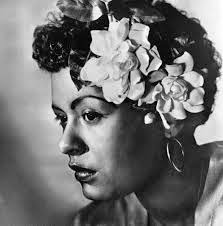
IN TRIBUTE TO AND CELEBRATION OF ONE OF THE MOST PROFOUND AND IMPORTANT ARTISTS OF THE 20th CENTURY, THE GREAT BILLIE HOLIDAY DURING HER CENTENNIAL YEAR, 1915-2015

All,

I hope you enjoyed the ninth week issue from March 28-April 3, 2015 of Volume 1, Number 2 of SOUND PROJECTIONS, the online quarterly music magazine which featured the outstanding trumpet player, jazz and film composer, arranger, orchestrator, ensemble leader, teacher TERENCE BLANCHARD (b. March 13, 1962). The tenth week issue of this volume of the quarterly begins TODAY on Saturday, April 4, 2015 @10AM PST which is @1PM EST.

The featured artist for this week (April 4-April 10, 2015) is the legendary, iconic and innovative singer, songwriter, ensemble leader BILLIE HOLIDAY (1915-1959). In recognition and deep appreciation of Ms. Holiday's extraordinary life and career we celebrate the powerful ongoing legacy of one of the preeminent artists of the 20th century. So please enjoy this week’s featured musical artist in SOUND PROJECTIONS, the online quarterly music magazine and please pass the word to your friends, colleagues, comrades, and associates that the magazine is now up and running at the following site. Please click on the link below:


Thanks. For further important details please read below…

Kofi

Sound Projections
A sonic exploration and tonal analysis of contemporary creative music in a myriad of improvisational/composed settings, textures, and expressions.

Welcome to Sound Projections

I'm your host Kofi Natambu. This online magazine features the very best in contemporary creative music in this creative timezone NOW (the one we're living in) as well as that of the historical past. The purpose is to openly explore, examine, investigate, reflect on, studiously critique, and take opulent pleasure in the sonic and aural dimensions of human experience known and identified to us as MUSIC. I'm also interested in critically examining the wide range of ideas and opinions that govern our commodified notions of the production, consumption, marketing, and commercial exchange of organized sound(s) which largely define and thereby (over)determine our present relationships to music in the general political economy and culture.

Thus this magazine will strive to critically question and go beyond the conventional imposed notions and categories of what constitutes the generic and stylistic definitions of 'Jazz', 'classical music', 'Blues', 'Rhythm and Blues', 'Rock 'n Roll', 'Pop', 'Funk', 'Hip Hop' etc. in order to search for what individual artists and ensembles do creatively to challenge and transform our ingrained ideas and attitudes of what music is and could be.

So please join me in this ongoing visceral, investigative, and cerebral quest to explore, enjoy, and pay homage to the endlessly creative and uniquely magisterial dimensions of MUSIC in all of its guises and expressive identities.

April 4, 2015--April 11, 2015
Billie Holiday (1915-1959): Legendary, iconic and innovative singer, songwriter, and ensemble leader

SOUND PROJECTIONS
AN ONLINE QUARTERLY MUSIC MAGAZINE
EDITOR: KOFI NATAMBU
WINTER, 2015
VOLUME ONE NUMBER TWO

[In glorious tribute and gratitude to this great legendary artist we celebrate her centennial year]

FOR BILLIE HOLIDAY
by Kofi Natambu
Deep within her voice
there is a bird
and inside that bird is a song
and inside that song is a light
and inside that light is a Joy
and inside that Joy is a Monster
and inside that Monster is a memory
and inside that memory is a celebration
and inside that celebration is a hunger
and inside that hunger is a dance
and inside that dance is a moan
and inside that moan is a majesty
and inside that majesty is a longing
and inside that longing is a history
and inside that history is a mystery
and inside that mystery is a fear
and inside that fear is a truth
and inside that truth is a passion
and inside that passion is a whisper
and inside that whisper is a wolf
and inside that wolf is a howl
and inside that howl is a lover
and inside that lover is an escape
and inside that escape is a regret
and inside that regret is a fantasy
and inside that fantasy is a death
and inside that death is a life
and inside that life is a woman
and inside that woman is a scream
and inside that scream is a release
and inside that release is a power
and inside that power is a voice
and inside that voice is a song
and inside that song is a singer
and inside that singer is a Holiday
and inside that Holiday is Billie

Poem from the book THE MELODY NEVER STOPS by Kofi Natambu.  Past Tents Press, 1991

THE DAY LADY DIED
by Frank O'Hara

It is 12:20 in New York a Friday
three days after Bastille day, yes
it is 1959 and I go get a shoeshine
because I will get off the 4:19 in Easthampton
at 7:15 and then go straight to dinner
and I don't know the people who will feed me
I walk up the muggy street beginning to sun
and have a hamburger and a malted and buy
an ugly NEW WORLD WRITING to see what the poets
in Ghana are doing these days
I go on to the bank
and Miss Stillwagon (first name Linda I once heard)
doesn't even look up my balance for once in her life
and in the GOLDEN GRIFFIN I get a little Verlaine
for Patsy with drawings by Bonnard although I do
think of Hesiod, trans. Richmond Lattimore or
Brendan Behan's new play or Le Balcon or Les Nègres
of Genet, but I don't, I stick with Verlaine
after practically going to sleep with quandariness
and for Mike I just stroll into the PARK LANE
Liquor Store and ask for a bottle of Strega and
then I go back where I came from to 6th Avenue
and the tobacconist in the Ziegfield Theatre and
casually ask for a carton of Gauloises and a carton
of Picayunes, and a NEW YORK POST with her face
on it
and I am sweating a lot by now and thinking of
leaning on the john door in the 5 SPOT
while she whispered a song along the keyboard
to Mal Waldron and everyone and I stopped breathing

This immortal poem about Billie written upon her death in 1959 is from LUNCH POEMS by Frank O'Hara (City Lights, 1961)-- Pocket Poets Series 

WKCR presents: The Billie Holiday Centennial Festival:

Tuesday, April 7th marks the 100th birthday anniversary of the one and only Billie Holiday. We'll be celebrating the hauntingly honest, lyrical virtuosity of Lady Day with a weeklong centennial broadcast, featuring her entire 1933-1959 discography, as well as on-air interviews with musicians and scholars. WKCR has a precedent of commemorating Holiday and her incredibly important contributions to vocal jazz, jazz as a whole, and Black music in our annual birthday broadcast schedule and in a special 360-hour Billie Holiday Festival that aired in 2005. 

Tune in to WCKR 89.9FM-NY or online at www.wkcr.org from Sunday, April 5th at 2pm through Friday, April 9th at 9pm as we spend a week listening to and examining the life, career, and distinctive sound of Lady Day. We'll be posting a full broadcasting schedule soon, but so far, look forward to a combination of continuous and show-specific programming throughout the week.


April 3, 2015 

The Art of Billie Holiday’s Life
By Richard Brody
The New Yorker

Billie Holiday, like all great artists, is as distinctive, as idiosyncratic, as original off-stage and off-mike as on. Credit Photograph by Charles Hewitt / LIFE / Getty

Some biographies of artists take in the whole life—preferably with equal attention to the work, and integrating the two elements to the extent that the work invites it. Others offer a bio-slice or synecdoche, centered on one particular period, relationship, or field of activity to provide an exemplary angle on the life and work. John Szwed’s brief but revelatory new book, “Billie Holiday: The Musician and the Myth” (Viking), which comes out this week—just under the wire for her centenary (Holiday was born April 7, 1915)—is in another category. It’s a meta-biography, about the creation of Holiday’s public image in media of all sorts: print, television, movies, and, of course, her recordings, but with special attention to the composition of her autobiography, “Lady Sings the Blues,” which was published in 1956.

Szwed, whose other books include a superb biography of Sun Ra, “Space is the Place,” reconstructs, through ardent archival research as well as his own interviews, the circumstances of the making of Holiday’s book. In the process, he both evaluates the first-hand significance of “Lady Sings the Blues” as Holiday’s factual and emotional account of her own life—as a record of Holiday’s experiences and ideas—and also, secondarily, treats the writing and the publication of the book as important events in Holiday’s life. She died on July 17, 1959, at the age of forty-four, and had been suffering from liver disease and heart disease. She was, as she writes, addicted to heroin “on and off” since the early nineteen-forties. Szwed says that, when she went to the hospital in 1959, “No one at the hospital knew who she was, and with needle marks on her body, she was left in the hall for hours, since the institution was not allowed to treat drug addicts.”

Holiday’s recording career was precocious: she made her first records in 1933, with a small group headed by Benny Goodman (who wasn’t yet a big-band leader). On the very first page of the first chapter, Szwed writes wisely about the timing of Holiday’s own book, nothing that at the time it was published, “jazz had moved from being the popular music of 1940s America to a more rarefied place in the public view.” This fact, for Szwed, mitigated the response that Holiday’s book received. The critics now defending jazz were mainly “closet high modernists who wanted no mention of drugs, whorehouses, or lynching brought into discussions of the music.” And those are among the subjects addressed, in unsparing detail, in Holiday’s book. (Among the critics who attacked the book was Whitney Balliett, this magazine’s longtime jazz critic, who wrote about it in the Saturday Review.)

The first section of Szwed’s book is one of the most briskly revealing pieces of jazz biography that I’ve read. First, he establishes the bona fides of William Dufty, Holiday’s collaborator on the book, rescuing him from charges of being a hack. Dufty was an award-winning journalist at the New York Post at a time when it was a leading liberal paper; he and his wife, Maely Daniele, a longtime friend of Holiday’s, welcomed her to their apartment as “a place of refuge from the police, her husband Louis McKay, reporters, and the various unsavory figures who haunted her life.” Dufty did the actual writing, based on long and detailed conversations with Holiday augmented by archival research that sparked her recollections.

Szwed sketches a handful of the book’s divergences from the independently established biographical record, starting with the legendary first sentences: “Mom and Pop were just a couple of kids when they got married. He was eighteen, she was seventeen, and I was three.” Szwed explains, “When Billie was born, her mother was nineteen, her father seventeen. They never married . . . She was born not in Baltimore but in Philadelphia. Some questioned her claim of having been raped at age ten.”

Holiday’s book is unstinting in its depiction of the hardships she faced. As a child, she heard from her great-grandmother about life as a slave; she grew up away from her mother, in the home of a cousin who beat her; she scrubbed floors in a “whorehouse” in order to hear music on the record player; and the man who raped her when she was ten was a neighbor. She quit school at twelve and travelled to New York alone, where she worked first as a maid and then as a prostitute. Jailed and released, she moved in with her mother, who lived in Harlem. They were on the verge of eviction when Holiday, who was about fifteen, got a job singing—more or less by accident—at a local nightspot. Holiday details the roughness of the world of music, exacerbated by relentless racism—travelling through the South in the age of Jim Crow, being forced to darken her skin with makeup in order to perform in Detroit. She describes in detail her addiction to heroin, her resulting troubles with the law, and its impact on her career.

For all its confessional frankness and accusatory clarity, there is, as Szwed reveals, much more to her story—and the circumstances of the composition of “Lady Sings the Blues” are an exemplary part of it.

Delving into earlier drafts of “Lady Sings the Blues” and other archival materials, Szwed finds echoes of the book in other published sources to which Holiday had referred Dufty as particularly reliable. Holiday told Dufty some stories that were ultimately kept out of the book, including the agonizing home abortion that her mother forced her to undergo as a teen. But Szwed finds that the book’s most important omissions were demanded by lawyers (including one representing Holiday and McKay) and by many of the public figures who played major roles in Holiday’s life and autobiography.

In particular, Szwed traces the stories of two important relationships that are missing from the book—with Charles Laughton, in the nineteen-thirties, and with Tallulah Bankhead, in the late nineteen-forties—and of one relationship that’s sharply diminished in the book, her affair with Orson Welles around the time of “Citizen Kane.”

In 1941, Welles wanted to make a film called “The Story of Jazz,” in collaboration with Duke Ellington. It would be set in the nineteen-teens and twenties, centered on the rise of Louis Armstrong, playing himself. He wanted Holiday to play Bessie Smith. Welles’s movie, Szwed writes, was “intended to be radically innovative, mixing together different styles of jazz, using the surrealist drawings of Oskar Fischinger.” It was put off, Szwed reports, due to the start of the Second World War. When Welles went to Rio to make “It’s All True,” he thought that the jazz story could be woven into it—but his filming of “the everyday interaction of races in Brazil” soured Welles’s studio, RKO, on the entire production.

The basic idea is the crucial one: of all jazz singers, Holiday is the one who is a jazz musician, the equal in musical invention of the epoch-making instrumentalists who played alongside her. Szwed picks up on the negative effect on her career that her style risked when she was starting out. He quotes one club manager who told her, “You sing too slow . . . sounds like you’re asleep!” Music publishers—who still made lots of money from the sale of sheet music—didn’t like her singing, which didn’t present the melodies clearly enough. His analysis shines all the more brightly when he goes behind the scenes of the recordings to unfold the life of performance—her initial experience as a cabaret singer, going table to table for tips in the Prohibition-era cabarets on 133rd Street, where she got her start; the peculiarities of the Fifty-Second Street clubs where she performed in the late thirties, which fostered a casual musical intimacy (“They were small, maybe fifteen feet by sixty feet, and were located in the basements of brownstone residences. They featured miniature tables for a few dozen people.”). He also explains the painful conditions of some of her later recordings, when her health and her voice were in bad shape (“The on-the-spot rehearsals, the false starts, retakes, and overdubs began to pile up on the tape reels”).

Szwed looks closely at her choice of songs and the origins of ones with which she’s closely associated, including “Strange Fruit” and “God Bless the Child.” He details the life-threatening conflicts that she faced on the road in the South, where she performed as a member of the (white) Artie Shaw band. And he carefully considers the specifics of performance later in her career, when she sang at Carnegie Hall and recorded with far more elaborate arrangements than she had used in her youth—and focusses on the musical implications of these circumstances.

Above all, in analyzing her art, Szwed argues for the difference between the performer and the life—between the on-stage persona and the person: “Her ability to communicate strong and painful emotions through singing led many to believe that she was suffering and in real pain. But real suffering is not necessary for great singing, only the ability to communicate it in song . . . Like actors, singers create their identities as artists through words and music. . . . All we can know for certain is the performance itself.”

In general, the desire of even the most discerning critics, such as Szwed, to separate art and life, to analyze the formal traits of works as if they were dissociable from the experience and the emotions that inspire them and that they convey, is both noble and doomed—noble, because artists deserve to be honored for their achievements, and doomed, because the formal and systematic nature of those achievements isn’t what makes them endure. The individuality, the immense complexity of inner life that art conveys—including Holiday’s seemingly straightforward and instantly appreciable art—doesn’t occur in a laboratory-like isolation.

Holiday herself, in “Lady Sings the Blues,” took care to depict the unity of her personal life and her musicianship, starting with the haphazard circumstances under which she began her career, as a teen-age ex-prostitute in need of a fast way of making rent for herself and her mother. She specifically connects the way she sings with her experiences—and with her readiness to face them. (“Maybe I’m proud enough to want to remember Baltimore and Welfare Island.”)

Holiday, like all great artists, is as distinctive, as idiosyncratic, as original off-stage and off-mike as on. The life doesn’t explain the art; rather, life is an art in itself—whether a creation of sublime moments and fascinating gestures, or of terrifying confrontations and mighty endurances—that is illuminated by the same inner light, inspired by the same genius, inflected by the same touch that makes the works of art endure on their own. The biographer of an artist is a critic in advance, in acknowledging and appreciating the actions of an artist’s life and recognizing what’s personal and distinctive in their being—in discerning the artistic aspect of the life. Szwed, in his brief book, accomplishes this goal, perhaps even better than he intended.

Richard Brody began writing for The New Yorker in 1999, and has contributed articles about the directors François Truffaut, Jean-Luc Godard, and Samuel Fuller. He writes about movies in his blog for newyorker.com.


Billie Holiday: The Musician and the Myth review – reclaiming Lady Day's artistry

Everyone knows about the sex and drugs – but John Szwed’s biography makes the case for Holiday as a complex artist who inspired in many different directions

Billie Holiday: one of the most famously indescribable – and inimitable – voices in all of jazz and pop-music history. Photograph: Michael Ochs Archives 

by Seth Colter Walls
Thursday 2 April 2015
The Guardian (UK)

To the public, Billie Holiday might simply be an icon. But to specialists, she’s the subject of a long and unsettled argument. In the view of some critics, her art has often gotten short shrift compared with discussions over the tabloid particulars of her too-short life. In 1956, she published a co-written autobiography called Lady Sings the Blues, which tried to balance confessional storytelling with assertions of her artistic control. It was accused of doing a disservice to jazz by some self-appointed guardians of the genre.

In later decades, Lady Day – as she was called by fans and fellow musicians – was even accused of having been illiterate. A fast-and-loose 1972 biopic starring Diana Ross, a pop singer ill-suited to capturing Holiday’s swinging sophistication and melodic genius, hardly improved anyone’s understanding. The feminist critic Angela Davis took sharp exception to the film, writing that it “tends to imply that her music is no more than an unconscious and passive product of the contingencies of her life”.

With the approach of Holiday’s centenary, more and more people are coming over to Davis’s side. John Szwed’s swift, conversational and yet detail-rich new biography, Billie Holiday: The Musician and the Myth, communicates its artist-first priorities in the subtitle, and then makes good on them throughout. That’s not to say that he ignores the singer’s romantic flings (with Orson Welles, among others), the domestic abuse suffered at the hands of multiple partners or the long-term heroin use that are part of the familiar Holiday lore. Crucially, though, he spends more than half his page-count closely considering Holiday’s music. And his book comes just as three new recordings – one from José James, a singer who skillfully bridges the worlds of contemporary R&B and jazz, one by Cassandra Wilson and another by the classical pianist Lara Downes – likewise investigate the musician’s catalogue with respectfully daring air.

As tough as it is for those musicians to interpret songs Holiday made iconic, it’s possible that Szwed’s challenge was more daunting. He is writing in the wake of Holiday biographies that have, by necessity, relied on speculation and hearsay, given the fact that Holiday gave few interviews (and saw her autobiography redacted by a lawsuit-averse publisher). There are also political ambiguities involved in narrating the choices of an African American artist who, as Davis noted, “worked primarily with the idiom of white popular song”. And then there are the difficulties of needing to describe one of the most famously indescribable – and inimitable – voices in all of jazz and pop-music history.

On the latter point, Szwed clears his throat a bit – quoting divergent critical opinions and eminent musicologists – displaying some of the agonies that prose suffers when summing up the Holiday sound. But he does have moments where he succeeds beautifully: “In the upper register she had a bright but nasal sound; she sounded clearer, perhaps even younger, in the middle; and at the bottom, there was a rougher voice, sometimes a rasp or a growl. But even these voices were varied or might change depending on the song she was singing.” Elsewhere, Szwed is on point when he describes Holiday “falling behind the beat, floating, breathing where it’s not expected, scooping up notes and then letting them fall”.

As the author of compelling books on complex figures such as Miles Davis and Sun Ra, it’s little surprise that Szwed is also wise and authoritative on the sad, complex interaction of Jim Crow racism and early pop-music practices, in the 20-page chapter The Prehistory of a Singer. And he proves as good at reading Holiday’s political choices – such as revising the “in dialect” lyrics of Gershwin’s I Loves You, Porgy – as he is at spelling out Holiday’s evolving approach to improvisation, over the course of her career.

Like Davis, Szwed hears a hint of feminist consciousness-raising in Holiday’s 1948 rendition of My Man. And on the tortured history of credit-taking for the composition of Strange Fruit – the anti-lynching protest song that stunned one nightclub audience after another, once Holiday added it to her repertoire – Szwed cuts through the brush to show the ways in which Holiday’s melodic approach (as well as her choice to perform it in front of white people) destined the song for a place in history as much as anything else.

If it sounds like the accumulated weight of history makes for solemn reading, a lot of fun can actually be had using Szwed as a listening partner. Go ahead and launch your streaming-music engine of choice and build a playlist with the tracks as Szwed considers them. You probably won’t need much help enjoying three rare Holiday recordings with Count Basie’s 1937 band – available on disc eight of Lady Day: The Complete Billie Holiday on Columbia, 1933-1944 – since the musicians’ collective brand of ecstasy requires little in the way of selling. But Szwed’s description of Holiday “gliding over rhythm suspensions and finding her way over the glassine 4/4 of a great swing rhythm section” is a treat – as is his song-by-song investigation of Holiday’s musical partnerships with the pianist Teddy Wilson and the saxophonist Lester Young.

In the case of pre-existing songs that Holiday made her own, Szwed cites earlier recordings by other singers before inviting you to compare them with what he deems to be Holiday’s best version (the better to put her skills in relief). And when it comes to the core of Lady Day’s catalogue – the songs she recorded, with great variance, during multiple phases of her career – Szwed’s listening notes shed useful light on the differences, especially for fans who think they can safely dismiss the portion of Holiday’s discography that is less favoured by jazz aficionados.

That very hybridity – Holiday’s ability to help define jazz singing, and then buck the genre’s conventions – is what makes the new spate of tributes to her feel so appropriate. A listener might disagree with an arrangement choice made by Cassandra Wilson, on Coming Forth By Day, or else miss elements of swing in Lara Downes’s classical recital A Billie Holiday Songbook – but their risk-taking is clearly in the service of honoring Holiday’s often-surprising moves. (José James’s Yesterday I Had the Blues: The Music of Billie Holiday is just about perfect, including as it does the playing of MacArthur-winning pianist Jason Moran.)

Plenty of stars from yesteryear had crazy-juicy personal lives; very few left behind conceptual approaches that inspire in so many directions. Each of these new albums is in league with Szwed’s book – a joint persuasion campaign meant to encourage us to consider musicianship as the defining characteristic of Lady Day’s legacy. That’s about as fine a centenary-year gift as anyone had a right to expect.

Billie Holiday: The Musician and the Myth is published by Viking Press in the USA, and William Heinemann in the UK

When Billie played her yearly concerts at the Apollo and at Carnegie Hall everyone came out in full force either to hear her sing or to see whether she was still together. Each time a new record was issued it was compared with her early ones, and she was often judged to be imitating herself, to be working with the wrong musicians, the wrong arrangers, etc. Most everyone liked to believe that Billie made her best records when she sang with Count Basie and the other geniuses of swing. It's hard to disagree, for she was, like all of them, an incredible horn in those days. Billie's later records, usually in a much slower tempo, are a different music. They are the songs of a woman alone and lonely and without much sympathy. No one blows pretty solos behind her like Lester did. Sometimes there are unintelligent voices in the background going oo-oo-oo with none of the wit Billie had on "Ooo-oo-oo what a lil moonlight can doo-oo-oo." Nevertheless, these are the songs of Lady Day too, and if the sorrow sounds a little heavier it was because she'd been carrying it a while. "I remember when she was happy-" Carmen McRae said in 1955, "that was a long time ago."

Billie and Louis both were arrested in 1956. Billie knew by this time that if the Narcotics Bureau wanted to get her it only had to be arranged, the evidence "found" and she could be convicted on her past record. In her book she pleaded that the addict be treated rather than punished. She knew how little good punishment had ever done to help her. And her stated purpose in revealing all that she considered shameful in her life was to warn young people away from heroin. "If you think dope is for kicks and for thrills, you're out of your mind.... The only thing that can happen to you is sooner or later you'll get busted, and once that happens, you'll never live it down. Just look at me."

Billie never was able to stop using heroin completely, though she tried very hard. Some people thought she could have tried harder: "That girl's life... was just snapped away from foolishness." But there were others who knew and loved her. Lena Horne and Billie had been friends since Cafe Society days, and she understood how life had been spoiled for Billie.

Billie didn't lecture me - she didn't have to. Her whole life, the way she sang, made everything very plain. It was as if she were a living picture there for me to see something I had not seen clearly before.

Her life was so tragic and so corrupted by other people-by white people and by her own people. There was no place for her to go, except finally, into that little private world of dope. She was just too sensitive to survive.

Billie survived long enough to sing a few days at the Five Spot, a club that opened in downtown New York in the fifties. Her last appearance was at the Phoenix Theater in New York in May, 1959. On May 31 she was brought to a hospital unconscious, suffering from liver and heart ailments, the papers said. Twelve days later someone allegedly found heroin in her room. She was arrested while in her hospital bed and police came to guard her, to make sure this now thin, suffering woman could not get away from the law one more time. But she escaped the judgment of the United States of America versus Billie Holiday for a higher judgment, on July 17, 1959.


Billie Holiday at 100: Artists reflect on jazz singer’s legacy
By Aidin Vaziri
Friday, April 3, 2015
Photo: Associated Press

Image 1 of 13

FILE - This Sept. 1958 file photo shows Billie Holiday. The Apollo Theater is planning events to commemorate the 100th birthday of Holiday. The legendary American jazz vocalist was born on April 17, 1915 and died in 1959 at the age of 44. Holiday performed at least two dozen times at the Apollo. She will be inducted into its Walk of Fame on April 16, 2015. (AP Photo/FILE)

Billie Holiday would have turned 100 this week, but who’s counting? The famed jazz singer and songwriter’s voice is ageless, still luring fans with its effortless swagger and unblinking candor. It carried with it all the difficulty she endured throughout her tumultuous life — born Eleanora Fagan, an illegitimate child, on April 7, 1915, in Baltimore; died strung out and broken 44 years later in New York — along with all the hope, fear and desperation that came with it. “What comes out is what I feel,” she once said.

No one else can sound like Billie Holiday because no one else lived like Billie Holiday.
Yet in generation after generation, her influence is unmistakable. To mark the centennial of her birth, which will be celebrated with concerts, books, albums, tributes and reissue packages around the world, we spoke with some people closer to home whose lives were deeply touched by Holiday.

Paula West

Longtime Bay Area jazz singer, torchbearer of the American Songbook popularized by Holiday

I’m not quite sure when I first heard Billie Holiday. I believe it was before the Diana Ross biopic (“Lady Sings the Blues”) was released. Of course their voices were dissimilar. I was young at the time, and had only been exposed to those “greatest hits,” such as “Fine and Mellow,” “Them There Eyes” and “Good Morning Heartache.”

I feel the best singers have always been able to get across the raw emotions of the lyrics. She had no great vocal range, but that was never needed. It was about telling the truth, the story, and not too many singers could ever match her natural interpretations. No vocal histrionics, melisma necessary. She was respected by musicians, as well, and her singing was influenced by musicians such as Louis Armstrong.

There are dozens of her interpretations I love, but “Lady in Satin” is my favorite, particularly her version of “I’m a Fool to Want You.” The arrangement is beautiful yet heartbreaking, of course, and no one could deliver that better than Billie Holiday.

Lavay Smith

Blues and jazz singer with Lavay Smith & Her Red Hot Skillet Lickers, renowned for her tributes to the first ladies of jazz

I remember seeing Billie Holiday singing on TV on an oldies station that would show the Little Rascals, Shirley Temple and old black-and-white movies. Like everyone who hears her, I loved her right away.

Billie remains an icon because she was true to herself. As a singer, she made you believe that she meant every word she sang. Lyrics were very important to her, which isn’t true of all jazz singers. And the feeling that she creates through her use of rhythm was always swingin’ and happy. A lot of people think of her music as being sad, but she had a great sense of humor that comes through, and I’ve always found her music to be uplifting.

The first album I bought was “Lady Sings the Blues,” and I played the heck out of. It included “Strange Fruit” and many of her hits, like “Traveling Light” and “Good Morning Heartache.” I love all of the Columbia recordings that she did with Lester Young and Teddy Wilson, including all of the obscure songs. I just love the feeling and the soul of these records. The interplay between Billie and Lester Young is the textbook definition of how an instrumentalist should interact with a singer.

Joey Arias
New York cabaret singer and drag artist, who recently performed a tribute to Billie Holiday at Lincoln Center

I remember hearing her voice and thinking how lovely she sounded. I wanted to have that same sound that she was emoting. It was a magic spell that was sent to me. I feel as though we were connected at the hip from stories I’ve heard from friends and family.

Billie was an outspoken person. She was class all the way and never wanted to be treated any other way. She was being followed and became public enemy for standing up for her rights and acting strong and never letting her guard down. She dressed beautifully and had such presence.
 
“Lady in Satin” is my favorite album. It all depends on what period you want to hear her style, but I love her in the late ’50s. She summed it all up — her life, her singing and her thoughts, and her love of life and love.

Randall Kline
SFJazz executive director

I heard her on the home stereo as a teenager. My parents were jazz fans. One hearing of her voice — soft, persuasive, mournful, honest, beautiful — told you to listen more closely. “Don’t Explain” for its raw pathos. “Strange Fruit” for its power, poignancy and, sadly, its contemporary relevance.

Getting to know Billie Holiday

Here are some albums to help you get better acquainted with the jazz singer’s magic.

“Lady Day: The Best of Billie Holiday,” Legacy. A two-CD set containing many of the classic sides Holiday cut for Columbia and its Brunswick, Vocalion and Okeh labels in the 1930s and early ’40s, including “What a Little Moonlight Can Do,” “A Fine Romance,” “You Go to My Head” and “The Man I Love.”

“Billie Holiday: The Complete Decca Recordings,” GRP. An excellent two-CD box featuring the torch songs, raucous renditions of signature Bessie Smith numbers, and other material Holiday recorded for Decca from 1944 to 1950.

“Lady in Autumn: The Best of the Verve Years,” Verve. A good two-disc survey of Holiday’s small-band recordings of the 1950s, featuring stellar soloists like Ben Webster and Benny Carter.

“Lady in Satin,” Legacy. A heartbreaking beauty. Writer Michael Brooks wrote that this 1958 album feels “as if a group of family and friends are gathered around a loved one and saying their last goodbyes.”

“Ken Burns Jazz — Definitive Billie Holiday,” Verve. Compiled by the documentary filmmaker, this single-disc collection culls material from the three major phases of the singer’s career. — Jesse Hamlin

Kitty Margolis

San Francisco jazz singer, trustee at the Recording Academy, founder of Mad-Kat Records

I remember staring at a girlish, chubby Billie on the cover of this brown Columbia three-LP box set released in 1962, “Billie Holiday: The Golden Years.” It had an extensive photo book with detailed track listings inside and liner notes by John Hammond and Ralph Gleason. I still have it. Opening it and smelling the paper takes me right back. I realize now that a lot of the tunes in this box became very important to my early core repertoire.

I don’t think there is one genuine female jazz singer in the world who doesn’t have Billie inside. She defined the idiom.

One major thing that set Billie apart as a jazz singer is that she was a musician’s singer, a master improviser without ever uttering one scat syllable. She was not a classically “pretty”-sounding singer like Ella or Sarah. Billie’s sound was a bittersweet brew: raw, tart, personal, intimate, relaxed, understated, urgent.

Billie’s storytelling was always 100 percent emotionally intelligent and believable, an ironic cocktail of longing, pride, pain, strength with a sharp glint of humor. No one could sound happier (“Them There Eyes”) and no one could sound darker (“I’m a Fool to Want You”). Billie sang the truth. There was no “acting” involved. She could take even the most banal pop lyric of the time and imbue it with subtext that gave it a much deeper message, almost like a code.


Wednesday, June 4, 2014

IN CELEBRATION OF ANTHONY BRAXTON'S LIFE AND WORK ON HIS 69TH BIRTHDAY, JUNE 4, 2014

FROM THE PANOPTICON REVIEW ARCHIVES

(Originally posted on June 5, 2013):

Wednesday, June 5, 2013
 
ANTHONY BRAXTON
(B. JUNE 4, 1945)

"Going Outside the Categories That Are Assigned To Me": The Profound & Visionary Life, Art, and Work of Anthony Braxton (b. 1945)-- Musician, Composer, Philosopher, Teacher, Artist, and Public Intellectual

"I am viewed as the Negro who has gone outside of the categories assigned to me."
--Anthony Braxton

"I am interested in the study of music and the discipline of music and the experience of music and music as an esoteric mechanism to continue my real intentions."
--Anthony Braxton

"I'm seeking to have an art that is engaged as a way for saying, 'Hurray for unity'."
--Anthony Braxton

“For me the most basic assumption that dictated my early attempts to respond to creative music commentary was the mistaken belief that western journalists had some fundamental understanding of black creativity—or even western creativity—but this assumption was seriously in error.”
― Anthony Braxton, The Tri-Axium Writings

"I know I’m an African-American, and I know I play the saxophone, but I’m not a jazz musician. I’m not a classical musician, either. My music is like my life: It’s in between these areas."
--Anthony Braxton

"All great artists are beyond category"
--Duke Ellington

All,

The aesthetic, social, and cultural history of music generally over the past century in the (so-called) 'Western world' not only represents an enormously complex, complicated, and contentious creativity and innovation but is rooted in and deeply dependent upon a vast array of generic and idiosyncratic styles, traditions, genres, idioms, methodologies, and expressive identities. These structural, spiritual, and analytical modes of music making encompass a very broad and expansive territory of human concerns, issues, and expectations within the larger society, as well as profound individual emotional and psychological needs and desires that are simultaneously embodied and represented by these (creative) musical acts in public concert and collaboration with others (both like-minded and opposed). These conscious and subconscious attempts to engage, enhance, critique, celebrate, and transform society and culture via the immense environmental forcefield and sustained focused power of sonic intervention and expression in all of its many permutations and elliptical methods (whether they be encrypted or encoded in the formal "traditional/conventional" vocabularies and systems of melody, harmony, and rhythm or via other paths of producing and reproducing sound constructs), constitute what is "meant" by the term "music" in our time (zone).

Thus the 'classical' and 'popular music' traditions, styles, conceptions and forms of composition and improvisation (be they described/defined by the imposed advertising and thus commercial labels of "Jazz", "blues", rhythm and blues", "pop", "gospel", "funk", "hiphop" etc. et al) have served as a largely deceptive yet accepted means of identifying and classifying what sound formations can and "should be" used to convey these powerful sonic messages within the institutional structures and strictures established by the self appointed arbiters of musical taste and consumption. However there has always been throughout this highly volatile, contradictory, and conflicted history a significant number of sonic pioneers, adventurers, and creative activists who have openly challenged this status quo and have educated us all to the power, beauty, and necessity of asserting alternative notions of what we can and choose to do with our collective (and individual) sonic legacies and inheritances. No matter what specific or general "fields" these 'planters of sound' happen to harvest we not only know their names (they are indeed legion!) but we absorb, inhabit, embrace, and greatly benefit from their creative and visceral gifts embodied in the art and science of their sound. In the U.S. and beyond they have come from every cultural, "ethnic", spiritual. and gender enclave on earth and have been instrumental (get it?) in openly confronting and transforming our very lives. Many sterling examples abound: Armstrong, Ellington, Coleman, Ives, Stockhausen, Henderson, Morton, Schoenberg, Monk, Glass, Stravinsky, Stitt, Gordon, Silver, Washington, Holiday, Basie, Sinatra, Hendrix, Parker, Sun Ra, Fitzgerald, Vaughan, Carter (Elliot, Benny, and Betty), Franklin, Mayfield, Marley, Fela, Jackson (Mahalia and Michael), Partch, Varese, Gershwin, Hindemith, Bartok, Dylan, Wilson, Cowell, Prince, Berry, Davis, Coltrane, Powell, Rollins, Blakey, Shorter, Tatum, Webern, Copland, Hancock, Williams, Stone, Webster, Young, Robeson, Gaye, Wonder, Taylor, Robinson, Warwick, Johnson, Bacharach, Wolf, Hooker, Hopkins, Waters, James (Elmore and Etta), Khan, Mitchell (Blue and Roscoe), Smith, Abrams, Ayler, Mingus, Dolphy, Gillespie, Xenakis, Cage, Kirk, Brown (James and Clifford), Shepp, Roach, Lincoln, etc. et al...

Thus it is no surprise that one of the major names in this grand pantheon (and has been now for nearly 50 years!) is Mr. Anthony Braxton who tirelessly works and creates within an immense omniverse of influences, inheritances, and legacies culled from a colossal living archive of sound in all its many dimensions and in all the worlds he and we inhabit and live in. We owe Anthony and his many legendary forebears, contemporaries, colleagues, and peers a very deep and lasting debt that can only truly be repaid by listening...Happy birthday Mr. Braxton and to the rest of us: ENJOY...

Kofi

http://tricentricfoundation.org/bio-history

ABOUT ANTHONY BRAXTON


Braxton is recognized as one of the most important musicians, educators, and creative thinkers of the past 50 years, highly esteemed in the creative music community for the revolutionary quality of his work and for the mentorship and inspiration he has provided to generations of younger musicians. Drawing upon a disparate mix of influences from John Coltrane to Karlheinz Stockhausen to Native American music, Braxton has created a unique musical system that celebrates the concept of global creativity and our shared humanity. His work examines core principles of improvisation, structural navigation and ritual engagement—innovation, spirituality and intellectual investigation. His many accolades include a 1981 Guggenhiem Fellowship, a 1994 MacArthur Fellowship, a 2013 Doris Duke Performing Artist Award and a 2014 NEA Jazz Master Award.

Tri-Centric Foundation

The Tri-Centric Foundation is a not-for-profit organization that supports the ongoing work and legacy of Anthony Braxton while also cultivating and inspiring the next generation of creative artists to pursue their own visions with the kind of idealism and integrity Braxton has demonstrated throughout his distinguished career.

The term “Tri-Centric” derives from Braxton’s three-volume collection of philosophical investigations, The Tri-Axium Writings. Braxton believes creative thinking cannot be reduced to dichotomies, but must embrace multiple perspectives. For instance, music is not only composed or improvised, but also includes intuition. We must not only consider the past and the present, but also the future. It is not always this or that, it is often the other.

Tri-Centric exists to vigorously advocate for the crucial role risk-taking art plays in maintaining the health and vibrancy of our culture. Through a commitment to innovation, self-sufficiency, and artistic ambition, the organization looks to create a new model of artist empowerment and offer a supportive community to those in pursuit of “trans-idiomatic” creativity.
Board & Staff

Artistic Director:  Anthony Braxton (Middletown, CT)
Executive Director:  Taylor Ho Bynum (New Haven, CT)

Board:
Chris Jonas (Santa Fe, NM), president
James Fei (Oakland, CA), vice president
Jon Piper (Chicago, IL), secretary
Jean Cook (Brooklyn, NY), treasurer

Hugo De Craen (Antwerp, Belgium)
Jason Guthartz (Chicago, IL)
Chris McIntyre (Brooklyn, NY)
Nicole Mitchell (Chicago, IL)
Jonathan Piper (Chicago, IL)
Carl Testa (New Haven, CT)

Staff:
Kyoko Kitamura (Brooklyn, NY), Director of Communications
Amy Crawford (Brooklyn, NY), Administration
Ben Heller (New Haven, CT), Web Design


IN CELEBRATION OF THE LIFE, WORK, AND CAREER OF MASTER MUSICIAN AND COMPOSER ANTHONY BRAXTON ON HIS 68th BIRTHDAY!
http://www.jbhe.co
m/2013/05/wesleyan-universitys-anthony-braxton-wins-225000-doris-duke-artist-award/

All,

While doing personal research on this extensive tribute and retrospective in honor of Anthony Braxton's 68th birthday on June 4 I ran across this very good news item (see below). So hearty congratulations are due Brother Braxton who is not only an outstanding multi-instrumentalist, musician and composer but a very fine person as well. For once the well worn accolade/cliche "it couldn't happen to a nicer or more deserving guy" actually applies in a number of different ways. To say I'm sincerely happy for him and all that he has thus far accomplished in an extraordinary career and life would be an understatement. Well done Anthony...

Kofi
THE TRI-CENTRIC FOUNDATION

The Tri-Centric Foundation is a not-for-profit organization that supports the ongoing work and legacy of Anthony Braxton, while also cultivating and inspiring the next generation of creative artists to pursue their own visions with the kind of idealism and integrity Braxton has demonstrated throughout his long and distinguished career.

BIO & HISTORY MUSICAL SYSTEMS PROJECTS RESOURCES MEMBERSHIP

Wesleyan University’s Anthony Braxton Wins $225,000 Doris Duke Artist Award


Filed in Honors and Awards on May 17, 2013

Anthony Braxton, the John Spencer Camp Professor of Music at Wesleyan University in Middletown, Connecticut, received a 2013 Doris Duke Artist Award. The award program, established in 2011, supports performing artists in contemporary dance, theatre, jazz, and related interdisciplinary work. The award comes with a $225,000 honorarium.

Professor Braxton is a composer, saxophonist, and educator. He won a MacArthur Foundation genius award in 1994. During his long career, he has released more than 100 albums.

http://www.pointofdeparture.org/PoD37/PoD37Braxton.html

https://www.facebook.com/pages/The-Panopticon-Review/342702882479366

All,

This is a great piece about "Jazz"/Jazz if only because it actually forces the reader to THINK for a change and to REFLECT about what the music is, has been, and could be--a process known historically as "listening to the music" ...Just like Anthony Braxton (and every other great and innovative musician IN the "Jazz"/Jazz tradition) ya really gotta love that truly creative impulse in ALL of its (multi)dimensions (in another parallel context the legendary Amiri Baraka identified it as "the Changing Same")... WORD!

Kofi

Braxton & Jazz: IN the Tradition
by Kevin Whitehead

[Lightly adapted from a talk given at Wesleyan University, 16 September 2005, as part of “Anthony Braxton at 60: A Celebration”]

Today I want to talk about Anthony Braxton’s relationship to the jazz tradition, a loaded topic which calls for a few disclaimers up front.

The “Braxton at 60” concert series, concentrating on his compositional output, makes it clear his interests stretch well beyond jazz, which barely figures in the programming. As Braxton once said to Steve Lake, “Jazz is only a very small part of what I do.” He prefers his music to be looked at in totality, and not separated into discrete genres.

By talking about him in a jazz context I don’t seek to discount or ignore his activities in other musical areas, or reduce him to a jazz musician only. I accept Ronald Radano’s view that Braxton has developed his music along twin paths as a jazz-oriented improviser and experimental composer, two areas that frequently overlap. Musical genres are convenient handles for talking about tendencies, but to think any music must conform to a single clear-cut category is to confuse the handle for the suitcase. As Braxton would say, don’t confuse the “isms” for the “is.”

As some jazz watchdogs have given him a frosty reception at times, let’s start by reviewing the cases of other musicians who’ve found themselves in similar predicaments, starting in 1943. Duke Ellington had premiered his suite Black, Brown and Beige on a program at Carnegie Hall, and critic John Hammond slammed the concert in the pages of Jazz magazine. A compressed version of his comments: “During the last 10 years [Duke] has... introduced complex harmonies solely for effect and has experimented with material farther and farther away from dance music. … But the more complicated his music becomes the less feeling his soloists are able to impart to their work. … It was unfortunate that Duke saw fit to tamper with the blues form in order to produce music of greater significance. By becoming more complex he has robbed jazz of most of its basic virtue and lost contact with his audience.”

Now, it’s a bit shocking that John Hammond couldn’t hear any blues content in Black, Brown and Beige, but he wasn’t the only one to have difficulty with Ellington’s suites. Few commentators perceived any cohesion in them, and the jazz literature had to wait 30 years for Brian Priestley and Alan Cohen’s analysis of BBB which highlighted its thematic unity on several levels. (You can find their article, and Hammond’s review, in the Duke Ellington Reader, edited by Mark Tucker, an excellent sourcebook on Ellington’s expansive art and its problematic reception. By the way that anthology also makes it clear that Duke had his critical supporters from the beginning. The myth of critics always missing the point needs deflating, but not here today.)

Ellington’s response to such criticism typically took one of two forms. The first was to sidestep the whole issue by taking jazz out of the equation: as in his famous retort, “There are only two kinds of music, good and the other kind.” Or, “I don’t write jazz, I write Negro folk music,” which is not much of an evasion.

His other response was to argue for a broader view of jazz than his critics applied. In a 1947 interview found in the Reader, Ellington calls jazz “The freest musical expression we have yet seen. To me, then, jazz means simply freedom of musical speech! And it is precisely because of this freedom that so many varied forms of jazz exist. The important thing to remember, however, is that not one of these forms represents jazz by itself. Jazz simply means the freedom to have many forms.”

This was a more constructive rejoinder, I’d argue, if only because Duke’s frequent appearances at jazz festivals and album titles like Jazz Party in Stereo make it clear he never really broke with jazz. Indeed a key part of his musical mission was to expand the resources available to jazz improvisers, and to composers seeking to harness their energy.

The jazz-watchdog files also contain cases where musicians who made a reputation in jazz are criticized just for playing other kinds of music. The way Herbie Hancock’s ‘70s funk was assailed by jazz fans as treasonous is a good example. As I’ve said before, for some folks jazz is like the mafia: once you’re in there’s no getting out, and don’t ever go against the family – as if jazz existed to restrict rather than expand a musician’s creative options.

In extreme cases, the minders of jazz purity may simply cancel the offending musician’s jazz credentials. (We’ll get back to this.) In this regard there are striking parallels between the Dixieland revival of the 1940s and the rise of neo-bop neo-conservative musicians in the 1980s. In both cases, recent developments in the music were discounted as outside the scope of the Real and True Jazz, and said musicians went back 15 or 20 years in search of appropriate stylistic models – even if ‘40s Dixieland doesn’t sound much like King Oliver’s Creole Jazz Band, and Wynton Marsalis’ fine early quintet with its pre-plotted rhythmic change-ups misses the daring of the spontaneously mutating arrangements of Miles Davis’s mid-‘60s quintet.

Faced with charges of stylistic illegitimacy, some musicians retreat from the battle, just to avoid a fight. Charlie Parker told Down Beat in 1949 that “‘bop is something totally separate and apart’ from the older tradition.” Which is a funny comment from a guy who liked to quote the classic “High Society” clarinet solo all the old New Orleans players knew.

II

Anyone who’s followed Braxton’s reception in jazz will recognize the thumping parallels laid out here: a broad-ranging and ambitious musician is accused of being unfaithful to jazz principles or his African-American roots.

But in Braxton’s case there’s a new wrinkle. Here we have the singular case of a musician widely perceived as a driving force behind jazz in the 1970s, recognized as a leader in every sense, who a decade or so later was branded a heretic, without having changed the basic thrust of his music in the meantime. It’s a case of moving the goal posts after the receiver has spiked the ball.

As Braxton told me in 1993, and has told many others in similar terms, “I’m not a jazz musician. I could not have done my work without the great continuum of trans-African music, the restructural music, all the way up to Ornette Coleman.” But: “By 1979, or even before, I started to move away from that term, when I began to understand that they were redefining the music in a way that would not include me. So I accepted it, because I was tired of the controversy. I only wanted the right to do my music.”

Fair enough. But today I want to reintegrate Braxton into the jazz continuum. I mean, I’m a jazz person, and I want him for us. Why not? He still plays jazz when he wants to, and jazz has been enriched and influenced by his contributions, so it’s a no-brainer.

Jazz is after all a good fit for his musical appetites, for instance a strong desire to improvise with others. It’s part of what he sees as music’s function, to bring people together in a socially positive context.

Braxton is a superb free improviser, thanks in part to his ability to remember what his collaborators play and to develop it as thematic material. (Listen to his duets with German pianist Georg Graewe – Duo Amsterdam ‘91 on Okkadisk – to hear him with another musician who can play that game.) Still, Braxton’s drawn less to unstructured play than to the idea of “navigating through form,” mostly cyclical forms of his own devising. And jazz is a perfect vehicle for mediating between the impulse to improvise and to compose, on cyclical frameworks. And given that Braxton is an African-American from the south side of Chicago, where jazz musicians were handy role models for creative youngsters, you can understand the attraction.

One obvious point of departure is the album of jazz standards In the Tradition, recorded for SteepleChase in 1974 when Braxton was hastily recruited to replace Dexter Gordon on a quartet date with Gordon’s swinging rhythm section with Tete Montoliu, NHØP and Tootie Heath. It was Braxton’s decision to play standards for ease of communication – a strange thing, back then, for a musician who already had a rep for being the outest of the outcats (although he’d recorded a couple of standards already). Braxton showed it was possible to honor bebop phraseology while approaching it from a direction you didn’t expect – for example wailing (and swinging) through the Charlie Parker vehicle “Ornithology” on contrabass clarinet.

One important aspect of Braxton’s personality and musical persona is, he’s a very funny guy. His pieces, and his use of extremely low and high-pitched instruments often carry a whiff of breezy jocularity that’s easy to overlook in serious discussions of his music. (And of course that jocularity is something he shares with such American masters as Armstrong, Fats Waller and Dizzy Gillespie.)

Anyway, the album In the Tradition was a pacesetter. Its title became a catchphrase for experimental improvisers honoring and testing themselves on classic jazz material; Arthur Blythe made one such record that even had the same name. And Braxton himself has returned to standards programs often since then, including programs targeting specific composers like Monk and Andrew Hill.

“Ornithology” is credited to Bird on the LP sleeve; it’s more often credited to trumpeter Benny Harris. So like Miles Davis’s “Donna Lee” it’s one of those typical Parker tunes attributed to someone else – that is to say, built around Parker’s language as an improviser. For Bird, as for Monk, or Steve Lacy, the composition and the improvisation should make a tightly integrated package – you don’t just play the tune and ignore it when you solo over the chords. Or to put it another way, new sorts of written lines will inspire improvised responses that address those written heads on their own terms.

And Braxton has always been interested in material that spurs improvisers into new ways to be creative, and integrate the composed and improvised. You can look in vain in his five books of Composition Notes published in the late 1980s for any mention of a tune’s chord changes – the usual means of organizing improvisation on a jazz theme. Generalizing about his composing is tricky, given the hundreds of pieces he’s written, but it’s safe to say Braxton’s pieces for improvisers focus more on the shape of the line than an underlying harmonic scheme.

III

When commentators reach for adjectives to describe Braxton’s music, the first word that comes up is “angular,” that is to say, sharp-angled, that is to say, often characterized by quick sequences of wide intervals. A classic example is “Composition 6F” (aka “73 degrees A Kelvin”) recorded a couple of times with the Braxton/Corea/Holland/Altschul quartet Circle in 1970. As Braxton’s detractors have helpfully pointed out, this approach parallels certain tendencies in 20th century composed music; one might hear kinship with, say, the short last movement of the Webern “Concerto for Nine Instruments (Opus 24)” from 1934.

But “Composition 6F” doesn’t really sound like that, and the ear tells you why immediately. Even when Webern adopts a peppy Stravinskyian beat, there’s none of the propulsive rhythmic energy and focus that are at the root of Braxton’s piece. Indeed, as Braxton says in the Composition Notes, the akilter rhythm pattern is what really matters, not the melodic contour; he even proposed a revised version of the score that would specify the rhythms but not the pitches. And the specific function of that written line is to put the players into a unique vibrational space for improvising – in the same rhythmic zone as the composed line.

“Composition 6F” was the first piece in his Kelvin series of repetitive music structures one might roughly characterize as minimalist – minimalism being a style of composed music whose influence in jazz has been far greater than is generally acknowledged. (There’s a good doctoral thesis in that for someone.) But the particular sort of momentum “6F” has – a saw tooth rhythm, with a few quick sextuplets or other ‘tuplets thrown in to push things off kilter for a second – is typical of many Braxton pieces, including far more recent ones in the Ghost Trance sequence, like “Composition 245” as heard on Delmark’s Four Compositions (GTM) 2000.

A certain kind of hectic momentum is a major part of Braxton’s esthetic, and one not necessarily incompatible with swing. Take for example 1975’s “Composition 52,” as played by a Braxton quartet with Anthony Davis, Mark Helias and Edward Blackwell on Six Compositions Quartet (1982) (Antilles). One thing I particularly like about that record is that there are pieces like “52” where Davis on piano is clearly playing on chord changes, at least sometimes. Until I started working on this talk I underestimated the attraction of playing on chords to Braxton, and indeed one of the notable things about his many standards programs is how gleefully he enters into that particular game.

In “Composition 52,” we may note in his improvising the serrated rhythms and angles, and some of regular syncopations of ragtime amid the ‘tuplety subdivisions of the ground beat. That’s typical Braxton, and there’s no mistaking its rhythmic sophistication or drive. That he values momentum may be inferred from a few of the master drummers he’s employed or recorded with, including Blackwell, Heath, Steve McCall, Philly Joe Jones, Max Roach, and Victor Lewis.

When even non-wind players enter the realm of pieces like “Composition 6F” and “52,” they are apt to favor breath-like phrasing. The robotic music comes alive, which of course is the point: improvisation breathes life into formal structures. And jazz from early on has sought increasingly challenging material to test and inspire the improviser – even if it means breaking with long-established practice. (Not for nothing does Braxton cite Ornette Coleman’s example.) Braxton’s lines all but preclude a solo made of old-school licks learned at Berklee.

And his innovations go way beyond the shape or rhythm of a line. Some of his pieces call for musicians to isolate certain registers, or specific attacks or strategies at different times. Even when he uses familiar devices, he flips them on their backs or sides. A piece may emulate bop phrasing or celebrate Count Basie or evoke the good feeling he got as a kid spying his father at a Chicago street parade in the middle of a work-school day. But the source material is always transformed – as with Ellington, come to think of it. Like Duke he paints a picture of the community in action: an ideal community with room and tolerance for collective and individual initiatives.

In the Composition Notes, Braxton lays out unconventional strategies for improvisation built into many pieces: a call for drummer and bassist to play opposing rhythms, or for a soloist to play in deliberate opposition to the ensemble – encouraging you to hear the music in several layers or dimensions at once: the Charles Ives principle, as I hope it’s known in Connecticut. Even in solo saxophone pieces he’ll create the illusion of spatial distance, juxtaposing very loud and very soft passages, as if coming from different points in space: a self-contained call-and-response sequence. Or he’ll ask a soloist to improvise up to a written theme rather than away from it – so the composition seems to flower from the improvising, rather like the way Charlie Parker’s tunes sound like they began as improvisations on familiar chords. (“Ornithology” takes off from a line Bird played with Jay McShann.)

In time Braxton’s regular collaborators internalized such procedures and could apply them to any material in the band’s book. One reason why many of us cherish his 1986-1994 quartet – the one with Marilyn Crispell, Mark Dresser and Gerry Hemingway – was that they really knew the rules of the game.

Incidentally around the same time, a similar process was going on independently in Holland, with Misha Mengelberg and ICP. The musicians would take procedures Misha instructed them to use on certain pieces, and then apply them on their own initiative in any appropriate spot. The whole band would then pick up on that, so the boss’s esthetic becomes a self-sustaining musical system – a perpetuum mobile. ICP really perfected this in the 1980s, but Braxton was already working toward and through such ideas in the ‘70s.

IV

Not long after making In the Tradition Braxton signed with Arista records, a major major label at the time, for whom he made a series of nine high-profile albums, which include memorable time studies for quartets; “Composition 58,” a big band march that sounds like John Phillip Sousa having a breakdown over a skipping record which remains one of Braxton’s best-loved compositions; an even better march for quartet with George Lewis on trombone (“6C,” recorded live in Berlin in 1976); a duet with Muhal Richard Abrams on Scott Joplin’s “Maple Leaf Rag”; a saxophone quartet for which Braxton kindly brought together three-quarters of what would soon be the World Saxophone Quartet, who never remembered to thank him for it. He also got to record “Composition 82” for four orchestras, and “95” for two pianos, so he didn’t only get to document only the jazzy stuff.

In the 1970s Braxton was also on the road a lot, playing festivals, and getting his live music documented. Beginning with his late-‘70s concert recordings you can hear his genius for assembling a set of music, using the various collage structures and multi-dimensional opposition strategies just mentioned. Say what you will about Braxton’s swing micro-timing, he’s a master of macro-timing. The way a good drummer makes a single bar swing with internal surges and hesitations, Braxton can make the overarching structure of a whole set swing like that one bar. And on the micro-level, the various layers of activity from moment to moment provide a vibrant listening experience that little in jazz can equal. With his Crispell/Dresser/Hemingway quartet in particular, he got into complex layering of independently written pieces that fit together as aspects of one giant mega-composition, analogous perhaps to the way the seemingly disparate parts of Ellington’s suites fit together.

The composer has stressed how the multiple levels on which these performances work can help us deal with modern life in which we’re bombarded by more and more sensory input. To be able to follow a quartet performance where, say, the pianist is playing a totally notated composition, the saxophonist is improvising a solo line, perhaps off another tune, and the bass player and drummer are playing two different “pulse tracks” – dynamic, syncopated rhythmic patterns – to be able to follow that is not so different from listening to your iPod while flipping through the cable channels as you check your email while waiting for your phone to ring.

In Braxton’s (or Mengelberg’s) collage structures and constellations of events and mutable forms, one may recognize certain ideas creeping in from the classical avant-garde of the ‘50s and ‘60s, the whole big Earle Brown to Stockhausen mix. But then it’s only natural that Braxton’s varied musical influences and tastes infiltrate each other. By the late 1960s, he was already melding separate musical disciplines in open soundscapes. As Braxton points out, we all have cosmopolitan backgrounds, and are under the sway of many influences from diverse cultures, which open up new ranges of possibilities – which is where he runs into 1943 John Hammond-type objections from certain listeners, for opening up the possibilities too much.

I speak mainly of Wynton Marsalis and his allies Stanley Crouch and Tom Piazza – not so many people, really, although they’ve certainly been diligent about trashing Braxton over the years.

You can understand the predicament Braxton’s music created for educated young musicians who’d polished the whole jazz school bop-to-Brecker skill set till it shone like the good silverware. Braxton was raising a whole other set of options that required a very different conceptual toolbox. That was bound to make people uncomfortable. I don’t think that’s grounds to vilify a musician who never sought to do anyone any harm, but if you were looking to hype a derivative composer like Wynton as modern jazz’s big thinker, you may find it necessary to brush back the competition.

So, as mentioned earlier, they raised what amounts to the old Dixieland argument against bebop: these strange new procedures are not what real jazz is about. But this position rests on an absurd premise: that jazz should be kept pure, when it had evolved and taken shape as a mutt form.

Starting around 1900 the music’s creators applied the improvisational impulse to any material within earshot: hymns, street cries, field hollers, march and social dance and blues forms, the classical themes that ragtime and jazz pianists would extemporize on, barnyard animal impressions, handclap patterns harking back to West African polyrhythms, Islamic isorhythms, modified Congolese beats arriving via Cuba – and myriad echoes of Sousa-type concert bands, with their a cappella breaks and virtuoso solos in contrasting hot and sweet styles, and said solos’ operatic high-note endings. Also the syncopated songs of Tin Pan Alley which often embedded quotes from other tunes, the exquisite vocal timing of black vaudeville comic Bert Williams, the rhythms of trains and the sounds of new technology.

Think of Jelly Roll Morton’s car horns on “Sidewalk Blues,” Armstrong faking the sound of a skipping record on “I’m Not Rough,” and the nasal speech-like brass solos on Ellington’s early classics, resembling a remote voice heard over a telephone. Braxtonian multi-dimensionalism was already part of the music by 1926 and ‘7.

That’s why I call jazz a mutt. The hound can really run, but no amount of wishful thinking or ethnic cleansing can transform a mutt into a pure breed. To suggest that jazz, to honor its heritage, limit itself to only certain specific episodes from its own past is absurd – like asking a jury to disregard a witness’s earlier remark. As Braxton put it in 2001: “Every music is still relevant – whatever the projection.”
V

No one has to tell Braxton about the richness of the jazz tradition – he teaches it at Wesleyan. His eight CDs of standard tunes for quartet, recorded in 2003 and released in two boxes on Leo, demonstrate his broad tastes in jazz material: tunes from the 1920s, bossa novas, and pieces by Cole Porter, Wayne Shorter, Monk, Coltrane, Joe Henderson, Eddie Harris – and the unfashionable Dave Brubeck, whom Braxton has long championed, a musician whose endearingly clunky timing turns some jazz fans off.

Every Braxtonian has heard the objection that he’s not the swingingest jazz musician, and I’ll concede as much. But if someone else swinging harder than you cancels your jazz credentials, there’d only be one jazz musician left: Billy Higgins? Jelly Roll Morton may not have been the swingingest cat of the 1920s, but we recognize him as a jazz master for his restructuralist tendencies. His Red Hot Peppers records of 1926 had the conceptual daring to reformulate much of what jazz was and had been constructed from, adding lowbrow humor and the sounds of the modern city.

Braxton’s compositional language began with his saxophone language, in which I’ve always heard the sharp-angled, against-the-grain improvising of Eric Dolphy, who recorded a few solo pieces in that time before Braxton made solo recitals fashionable. The leaps that bookend Dolphy’s 1963 solo take on Victor Young’s “Love Me” make the parallel explicit.

Anyone who, say, attended last night’s solo concert knows Braxton can play the heck out of the saxophone. To quote from something I wrote last year, “Like all great jazz musicians he understands that timing, timbre and note-choices are intimately connected: how slowing the rhythm ever so slightly, sputtering that note, and placing it just off center pitch, all work to give it triple impact. His tone may be aggressive or growling one moment, parched or disarmingly vulnerable the next.”

“He may stomp on the offbeat like a ragtime pianist. Sometimes his line will attack the rhythm head-on; sometimes it’ll slide backwards over the pulse, moon-walking on ice; sometimes he’ll divide a fast phrase into complex groupings ... or speed up in the middle of an already speedy phrase.” His accentual patterns are more complex than the alternating strong-weak strong-weak accents of your average sure-fire swinger.

The jittery nature of his improvising is one thing that bugs folks who like their swing nice and round all the time, but that’s no reason to ignore everything else going on, in terms of thinking on one’s feet, and improvising complex phrases while honoring the tune – all that good stuff his detractors claim to be for. The idea that jazz’s rhythmic development is already complete, and 4/4 swing is the only way to fly is ridiculous: how can the development of a living music ever be finished?

Braxton’s influence as a saxophonist since the 1970s has been much greater than the jazz folks give credit for. I was going to compile a list of saxophonists who bear his influence, but let me just mention one: in Greg Osby’s up and down beat-parsing and shifting accents, one can hear a lot of Braxton creeping through. (That’s true of Osby’s old ally Steve Coleman too.) The connection to the ‘80s M-BASE saxophonists is particularly interesting because Osby hears how those accentual patterns relate to hip-hop. (You can hear all this come together in his “Concepticus in C” from Zone.) But then jazz usually comes to grips with pop music of its time, one way or another.

You could even talk about a Dolphy-Braxton-Osby rhythmic continuum, if you like – Greg’s low opinion of Dolphy notwithstanding. Osby’s style is on one level a more limber version of the master’s angularity.

So anyway, I say, as long as Braxton has done so much to add new tools to the improviser’s and bandleader’s arsenal, since he’s such a keen student of the music and such a striking horn player, since he’s a fundamental influence on many of today’s players (not least his many successful former students from Mills and Wesleyan), let’s make it official and reaffirm his connection to the jazz fold he never really left – even as he remains free to operate outside of jazz.

There’s another reason for that reaffirmation, which we writers don’t talk about enough. The jazz wars of the early ‘90s, where the gatekeepers decided to purge Braxton from the ranks? Those guys lost that war. At Lincoln Center, they finally let in Misha Mengelberg and recently paid tribute to ‘60s Coltrane, if not Anthony Braxton. And many of the so-called young lions who were assumed to share Marsalis’ outlook have shown that their interests are considerably more broad – look, for example, to funk records by Roy Hargrove or Terence Blanchard or Branford Marsalis, or Christian McBride’s salute to Steely Dan. It sometimes appears the only jazz musicians who haven’t flirted with funk are Wynton Marsalis and Anthony Braxton.

Turning back the clock is always a loser’s game, except at the end of daylight savings. That’s how the jazz wars played out in the ‘40s, and in the ‘90s. The music will keep changing as long as it’s alive; and in the last 35 or 40 years no one has pumped more oxygen into jazz than Braxton. For that, jazz might be a little more grateful.

Nobody can really speak for jazz, but as long as some people make the attempt, and since I have the podium, Anthony Braxton, jazz welcomes you back. Like you never even left. Even if you reject it, you can’t change that. Mr. Braxton: Thank you for your music sir.

© Kevin Whitehead 2011


http://www.akamu.net/braxton/biography.htm

Biography:

Anthony Braxton was born in Chicago (Illinois) on 4 June 1945.

An American composer as well as well as a highly versatile musician who plays various saxophones, clarinet, flute and piano he has created a large body of highly complex work.

While not known by the general public, Braxton is one of the most prolific American musicians/composers to date, having released well over 100 albums of his works since the 1960s.
Among the vast array of instruments he utilizes are the flute; the sopranino, soprano, C-Melody, F alto, E-flat alto, baritone, bass, and contrabass saxophones; and the E-flat, B-flat, and contrabass clarinets.

Braxton studied at the Chicago School of Music and at Roosevelt University. At Wilson Junior College, he met Roscoe Mitchell and Jack DeJohnette.

After a stint in the army, Braxton joined the AACM.

After moving to Paris with the Anthony Braxton Trio (which evolved into the Creative Construction Company), he returned to the US, where he stayed at Ornette Coleman's house, gave up music, and worked as a chess hustler in the city's Washington Square Park.

In 1970, he and Chick Corea studied scores by Stockhausen, Boulez, Xenakis and Schoenberg together, and Braxton joined Corea's Circle.

In 1972, he made his bandleader debut (leading duos, trios, and quintets) and played solo at Carnegie Hall.
In the early 1970s, he worked with the "Musica Elettronica Viva", which performed contemporary classical and improvised music.

In 1974, he signed a recording contract with Arista Records.
One of the first black abstract musicians to acknowledge a debt to contemporary European art music, Braxton is known as much as a composer as an improviser. The output ranges from solo pieces to For Four Orchestras, a work work that has been described as "a colossal work, longer than any of Gustav Mahler's symphonies and larger in instrumentation than most of Richard Wagner's operas."

His 1968 solo alto saxophone double LP For Alto (finally released in 1971) remains a jazz landmark, for its encouragement of solo instrumental recordings. Other important recordings include Three Compositions of New Jazz (1968, Delmark), his 1970s releases on Arista, Composition No. 96 (1981; Leo), Quartet (London) 1985; Quartet (Birmingham) 1985; Quartet (Coventry) 1985 (all on Leo), Seven Compositions (Trio) 1989 (hat Art), Duo (London) 1993 & Trio (London), both on the Leo record label.

Critic Chris Kelsey writes that "Although Braxton exhibited a genuine if highly idiosyncratic ability to play older forms (influenced especially by saxophonists Warne Marsh, John Coltrane, Paul Desmond, and Eric Dolphy), he was never really accepted by the jazz establishment, due to his manifest infatuation with the practices of such non-jazz artists as John Cage and Karlheinz Stockhausen".

The timing of this crowning achievement couldn't be better for Braxton's most recent professional goals: he is the founding Artistic Director of the newly incorporated Tri-Centric Foundation, Inc., a New York-based not-for-profit corporation including an ensemble of some 38 musicians, four to eight vocalists, and computer-graphic video artists assembled to perform his compositions.

The ensemble's debut at New York's The Kitchen sold out the last and most of the first two of three nights, through the press excitement it generated; the reviews--in Down Beat and the Chicago Tribune (John Corbett), the Village Voice (Kevin Whitehead), and the New York Times (Jon Pareles)--ranged from positive to ecstatic.

Most importantly, the musical success of the event inspired Braxton to pursue the “three-day and -night” program concept for this ensemble, including lectures/informances, and splinter chamber performances, around the world.
The second New York event, indeed, expanded on the concept: The Knitting Factory presented six nights of Anthony Braxton and his music, in all the variety of its vision. The first night showcased the composer's solo alto saxophone playing; the second his treatments of jazz-traditional material, both as reeds player and pianist; the third, his music for solo piano, and for synthesizer and acoustic sextet; the fourth showcased his new “Ghost Trance” music for small-to-medium groups; and the fifth and sixth his large-ensemble music, including Composition 102, with giant puppets. As with The Kitchen, all six nights included a full house and enthusiastic response.

This successful first season paid off: the second season has been virtually paid for by grants from the Mary Flagler Carey Charitable Trust and the Rockefeller Foundation in New York City. It will feature the world premiere of the four-hour opera Trillium R at the John Jay Theater in New York, and the theatrical Composition 173 (for actors, improvisers, and ensemble) in collaboration with New York's Living Theater members, at The Kitchen.

Anthony Braxton is widely and critically acclaimed as a seminal figure in the music of the late 20th century. His work, both as a saxophonist and a composer, has broken new conceptual and technical ground in the trans-African and trans-European (a.k.a. “jazz” and “American Experimental”) musical traditions in North America as defined by master improvisers such as Warne Marsh, John Coltrane, Paul Desmond, Ornette Coleman, Albert Ayler, and he and his own peers in the historic Association for the Advancement of Creative Musicians (AACM, founded in Chicago in the late '60s); and by composers such as Charles Ives, Harry Partch, and John Cage.

He has further worked his own extensions of instrumental technique, timbre, meter and rhythm, voicing and ensemble make-up, harmony and melody, and improvisation and notation into a personal synthesis of those traditions with 20th-century European art music as defined by Schoenberg, Stockhausen, Xenakis, Varese and others.

Braxton's three decades worth of recorded output is kaleidescopic and prolific, and has won and continues to win prestigious awards and critical praise. Books, anthology chapters, scholarly studies, reviews and interviews and other media and academic attention to him and his work have also accumulated steadily and increasingly throughout those years, and continue to do so. His own self-published writings about the musical traditions from which he works and their historical and cultural contexts (Tri-Axium Writings 1-3) and his five-volume Composition Notes A-E are unparalleled by artists from the oral and unmatched by those in the literate tradition.

Braxton is also a tenured professor at Wesleyan University, one of the world's centers of world music. His teaching career, begun at Mills College in Oakland, California, has become as much a part of his creative life as his own work, and includes training and leading performance ensembles and private tutorials in his own music, computer and electronic music, and history courses in the music of his major musical influences, from the Western Medieval composer Hildegard of Bingen to contemporary masters with whom he himself has worked (e.g. Cage, Coleman).
Braxton's name continues to stand for the broadest integration of such oft-conflicting poles as “creative freedom” and “responsibility,” discipline and energy, and vision of the future and respect for tradition in the current cultural debates about the nature and place of the Western and African-American musical traditions in America. His newly formed New York-based ensemble company is bringing to that debate a voice that is fresh and strong, still as new as ever even as it takes on the authority of a seasoned master.

http://tricentricfoundation.org/anthony-braxton/bio/

Anthony Braxton (b. June 4, 1945) has boldly redefined the boundaries of American music for more than 40 years. Drawing on such lifelong influences as jazz saxophonists Warne Marsh and Albert Ayler, innovative American composers John Cage and Charles Ives and pioneering European Avant-Garde figures Karlheinz Stockhausen and Iannis Xenakis, he created a unique musical system, with its own classifications and graphics-based language that embraces a variety of traditions and genres while defying categorization of its own.

His multi-faceted career includes hundreds of recordings, performances all over the world with fellow legends and younger musicians alike, an influential legacy as an educator and author of scholarly writings, and an ardent international fan base that passionately supports and documents it all. From his early work as a pioneering solo performer in the late 1960’s through his eclectic experiments on Arista Records in the 1970’s, his landmark quartet of the 1980’s, and more recent endeavors, such as his cycle of Trillium operas, a piece for 100 tubas and the day-long, installation-based Sonic Genome Project, his vast body of work is unparalleled.

In 2010, he revived the Tri-Centric Foundation which had been dormant for 10 years. In 2011, he released his first studio-recorded opera Trillium E; that year also saw the 4-evening Tri-Centric Festival (held at Roulette in Brooklyn), which was the most comprehensive portrait of Braxton’s five-decade career yet presented in the United States. Braxton is a tenured professor at Wesleyan University, which has one of the nation’s leading programs for world and experimental music, and his many awards include a MacArthur Fellowship, a Guggenheim Fellowship, a 2009 honorary doctorate from the Université de Liège, Belgium, a 2013 Doris Duke Performing Artist Award and a 2013 New Music USA Letter of Distinction. His next four-act opera, Trillium J, will be premiered in April 2014 at Brooklyn’s Roulette, headlining a two-week festival of Tri-Centric music.

Bio | The Tri-Centric Foundation
tricentricfoundation.org
New Braxton House Records