Monday, January 18, 2016

In Tribute to Michael Marqusee (1953-2015): Outstanding historian, critic, scholar, journalist, and social activist


http://www.theguardian.com/books/2015/jan/15/mike-marqusee

Mike Marqusee obituary

Journalist, political activist and author with eclectic tastes in sport, art and music

by Colin Robinson
4 February 2015
The Guardian  (UK) 

Mike Marqusee in 2009. He was born in New York but made his home in Britain, where he developed a love of cricket. Photograph: Felix Clay

Michael John Marqusee, writer, born 27 January 1953; died 13 January 2015

The writer and political activist Mike Marqusee, who has died of cancer aged 61, enjoyed an intellect as dazzling as it was unique. A true polymath, he made the most of a boundless curiosity and a powerful memory to educate himself, and others, about a kaleidoscope of topics: Renaissance art, cricket and empire, British labour politics, Indian history and culture, Zionism, the music of AndalucĂ­a and Tamil Nadu, the poetry and art of William Blake, the American civil rights movement, the films of John Ford, the songs of Bob Dylan. The list could go on and on.

He sometimes speculated that such eclecticism resulted in his work being undervalued by specialists. If that was true, those in error failed to see how his range of interests often enabled one sphere of knowledge to provide an exhilaratingly original insight into another. Further, beneath the panoply lay a set of core values: a commitment to socialism, a belief in the transformative nature of art, a rigorous internationalism and a prioritising of intellectual and personal honesty heedless of cost. A joyful, hedonistic appreciation that life’s pleasures were there for the sampling was also a vital part of Mike.

He was born in New York, the son of John and Janet Marqusee, who were involved in property development, publishing and radical politics. Seeking to escape the pressures exerted on a precocious anti-war leader at his high school in Scarsdale, an conservative and affluent suburb of New York, Mike left the US for Britain in 1971. He read English literature at Sussex University before moving to north London, where he was to settle for the rest of his life.

Mike started out as a youth leader, based at Highbury Roundhouse, driving minibuses full of inner-city children on field trips around Britain. He later said that he learned more about politics from his work on the youth schemes there than in any of his subsequent activism.

Though a lifelong Marxist, Mike eschewed membership of the competing revolutionary tendencies that attracted many young radicals of the period. Indeed, in later years, he endured a bitter falling out with Socialist Workers party sectarians in the Stop the War Coalition, of which he was a founding member. He joined the Labour party around 1980, supporting the leadership of Haringey council in its fight against cuts and resisting Neil Kinnock’s attacks on the left that would pave the way for the emergence of New Labour, a development that saw Mike eventually leave the party. He chronicled Labour’s rightwing drift in a book co-authored with Richard Heffernan, Defeat from the Jaws of Victory (1992). He also became involved in the radical publication Labour Briefing, going on to become its editor. It was through his engagement with the Labour party that he met his partner, the housing rights barrister Liz Davies, who survives him. Together they formed an alliance that was as formidable in the political arena as it was supportive at home.

Mike had already written one book, his only published novel, Slow Turn (1988), which featured the game of cricket, a sport he had come to love while watching county matches in Sussex as a student. He turned his focus to the overlap between the game and nationalism, drawing openly on the legacy of CLR James to produce a rivetingly original analysis. Anyone But England (1994) went on to be shortlisted for the William Hill Sports  Book of the Year award and laid the foundation for Mike’s regular cricket commentary in publications such as Wisden and The Hindu.

Two years later, he published another book on the game, War Minus the Shooting, that dealt with events surrounding the 1996 World Cricket Cup in South Asia. He co-founded Hit Racism for Six and could often be found practising his own swing in the nets at Finsbury Park, providing ample evidence that, in his case, the pen was mightier than the bat.

Mike now transferred his attention to another sport. Redemption Song (1999) was a paean to Muhammad Ali, setting the world heavyweight’s sporting achievements in the context of the political battles in the US. Moving seamlessly from descriptions of Ali’s bouts in the ring to the music of Sam Cooke, from the machinations of the Nation of Islam to the burgeoning of the anti-war movement, it was a fine example of Mike’s ability to weave together strands from different disciplines into a rich new cloth.

The distinction, so often snobbish, between high and popular culture held little appeal for Mike. He had a deep familiarity with Quattrocento art and I was lucky enough to be among a small group of friends that he introduced to the sublimity of Giovanni Bellini’s paintings on a trip to Venice. His mother was both a painter and a successful art dealer and Mike’s ability to scrutinise the formal qualities of a painting was probably acquired from her. But he was equally at home analysing the wider meanings of the plots of John Ford westerns or the character development in TV series such as Rome or The Wire. A large TV, a comfortable sofa and a strong joint was always a combination that made Mike happy.

His taste in music was equally catholic. Mike was a big fan of the driving rock of Springsteen and Steve Earle while, at the same time, his engagement with Indian culture resulted in several trips with Liz to the Carnatic music festival in Chennai. A subsequent enthusiasm for Cante jondo music saw expeditions to the flamenco bars of southern Spain and an immersion in the poetry of Lorca.

Mike wrote poems himself and published two collections, and it was the ear of a poet that he employed in his next book, Wicked Messenger (2003), an analysis of the lyrics of Bob Dylan. At the end of his life he was working on a book that examined the relationship between Thomas Paine and yet another poet, William Blake.

Mike’s penultimate book was perhaps his most daring and controversial. A firm atheist, he delighted in describing himself as a “deracinated Jew”. In If I Am Not For Myself (2008), he melded together, in characteristic fashion, his own family history, political theory and close reading of canonical religious texts, separating out Jewishness from its co-option by the state of Israel.

In 2007 Mike was diagnosed with the bone marrow cancer multiple myeloma. Though it took him a couple of years, he predictably reverted to type, responding to his illness by writing about it. His last book, The Price of Experience, a collection of pieces about his disease (several of them for this paper), ranges over withering contempt for the mercenary activity of the big drug companies, an appreciation of the fastidious care provided to him by the NHS and its selfless staff and quiet sensitivity concerning how we talk to each other about illness.

In his introduction to the book, which, like a number of his titles, I had the privilege of publishing, he wrote: “Writing itself was a precious continuity with ‘life before cancer’. While so many of my other capacities had been taken away from me, I could still write.” Now he no longer can. However, through his books and journalism, we will still be able to remember his voice, with its glorious combination of profusion and singularity.


http://theallrounder.co/2015/01/22/tribute-to-a-scholar/
 

All,

I was frankly shocked and very saddened to discover today that the outstanding historian, critic, scholar, and social activist Michael Marqusee passed away a year ago on January 13, 2015 at the age of 61 from cancer. I find myself at a loss for words at this moment to describe just how important and truly groundbreaking Marqusee's work was. As I collect my thoughts and feelings about his untimely death I will take some time to reflect on his profound contributions to a wide range of interests and activities that encompassed social and cultural history, radical political thought and practice, music criticism, philosophy, and sports. I was always a huge fan and devoted follower of his work and I considered him one of the few major American public intellectuals of the past half century. I will deeply miss him and his extraordinary work.

Kofi

TRIBUTE TO A SCHOLAR
by Amy Bass
22 January 2015


Author and activist Mike Marqusee passed away on January 13. A common theme in the obituaries was that he was a writer of remarkably diverse  interests. Marqusee himself wondered if this wide-ranging nature of his work would lead specialists to discount it. But one specialist in a subject he covered, the history of sport and race in the 1960s, answers to the contrary: Marqusee was a journalist whose work is respected by scholars, and a scholar whose work is loved by students.

The news arrived by Facebook post that Mike Marqusee had died, losing his battle with cancer at the age of 61. Historian David Roediger shared the obituary written by Colin Robinson for The Guardian. Sitting no more than six inches away from my computer was a copy of Marqusee’s book  Redemption Song: Muhammad Ali and the Spirit of the Sixties (1999). The book had yet to make it back on the shelf after the fall semester. As in years past, it had been on the students’ reading list for my seminar, “Race, Sport, and Society.”

To anyone with eclectic tastes, Marqusee’s writing career was enviable – his work moved among subjects as varied as cricket, art, music, and Zionism. “He sometimes speculated that such eclecticism resulted in his work being undervalued by specialists,” Robinson writes in his tribute. “If that was true, those in error failed to see how his range of interests often enabled one sphere of knowledge to provide an exhilaratingly original insight into another.”

Robinson’s words describe exactly the riches of Redemption Song. While Marqusee wrote buckets of good stuff, it is his book on Ali that will remain at center stage for me. As I wrote last spring for the Journal of American History, in an essay on the state of the field of sport history, I can think of no other book that better demonstrates the power of scholarship about sport.

Without question, to write about the history of boxing is to enter a rich field of work. Relatively early on, Elliot Gorn’s work on boxing showed just  how beautifully sport history could transcend sport itself, particularly in revealing the cultures of racial politics. For the vigilant scholar, boxing offered a range of consequential racial dramas populated by a series of prominent athletes. Whether reading Randy Roberts’s carefully researched histories of Jack Johnson, Jack Dempsey, and Joe Louis, or Michael Ezra’s more recent take on Ali, work on boxing has enabled sport history to take seriously topics that range from masculinity to national identity to – of course – violence.

At the center of the scholarship on boxing, and on sport in general, stands Muhammad Ali. A complex and colorful character who came to personify an era of domestic and global revolution, Ali – arguably the most renowned athlete the world has ever seen – has been at the center of so many celebrated works, from Gorn’s edited collection Muhammad Ali: The People’s Champ to David Remnick’s smart biography, King of the World: Muhammad Ali and the Rise of an American Hero.

Marqusee the eclectic writer not only ventured into this rich field of boxing scholarship, he doubled down and wrote about Ali. His work stands alone. Marqusee posed Ali as a gateway to the radical politics and culture of black life in the 1960s, offering a spectacular panorama of the era, from a history of Elijah Muhammad and the Nation of Islam to the influence of Malcolm X and pan-African ideologies on militant black movements in the U.S. For Marqusee, the only Ali that mattered was the radical Ali, a figure who helped fuse the rising militancy of Black Power with the growing tide of anti-war sentiment. In contrast, the Ali who stood in Atlanta in 1996 to light the Olympic flame, the Ali who accepted a new gold medal to replace the one from the Rome Olympics, which he allegedly had thrown into the Ohio after being refused service at a restaurant, did not matter. For Marqusee, this newly imagined and patriotic Ali could not, and should not, overshadow the combative politics that were so entrenched in his coming of age as an athlete. In Redemption Song, Ali stands tallest as the young man who transformed himself from Cassius Clay into something America had never seen before. Marqusee’s book is near flawless in presenting the life of this athlete as the ideal window to view a decade of social turmoil.

To say that Redemption Song blows students away, each and every semester, would be a gross understatement. In addition to their love of the book’s central characters, their awe and admiration for Ali, Malcolm X, Sam Cooke, and so on, they are in wonderment of the book, a reaction that can be hard to get from undergraduates. They are amazed by what they take away from reading it. They are amazed by how much more they know because they have read it.

Without question, Redemption Song will remain on my syllabus for many semesters to come. And while Marqusee’s career has been sadly cut short, there is no doubt that his legacy is clear for anyone interested in thinking about sport in historical, political, social, and cultural terms. Rest in peace, Mike.


Amy Bass teaches history at The College of New Rochelle. She is author of Not the Triumph But the Struggle: The 1968 Olympics and the Making of the Black Athlete, and earned an Emmy Award in 2012 as supervisor of the Research Room for NBC’s Olympics coverage. Amy tweets at @bassab1.

Sunday, January 17, 2016

MUHAMMAD ALI IS 74 YEARS YOUNG TODAY--HAPPY BIRTHDAY CHAMP!

http://www.netflix.com/watch/80015777…

BORN ON JANUARY 17, 1942 MUHAMMAD ALI IS 74 YEARS OLD TODAY. TEMPUS FUGIT...AND HAPPY BIRTHDAY CHAMP!

http://www.mikemarqusee.com/?p=82

Redemption Song: 
Book Review by Kofi Natambu
Posted on 4/3/2000


by Kofi Natambu
Ishmael Reed’s Konch Magazine,
20 March 2000


MUHAMMAD ALI
(b. January 17, 1942) 

This is an extraordinary book. It is especially astonishing because just when I began to despair that any one text could possibly do justice to accurately documenting and analyzing the often badly misunderstood and largely misrepresented complexity of either Muhammad Ali, the African American civil rights and black power movements, or that endlessly fascinating and elusive historical moment known forever as “the sixties,” an heretofore obscure author restores my faith in the illuminating power of great writing to do much more than merely chronicle legendary events. That the author would be a white American expatriate who left the U.S. in 1971 at the age of eighteen to settle in England and become an award-winning sports historian is all the more amazing and, in this particular case, gratifying.

For what Mike Marqusee has accomplished with this elegantly written book is nothing short of providing the most lucid, succinct, intellectually honest and even-handed account I have ever read of what Ali, and the various black political and cultural movements for radical social change both in this country and abroad (especially in Africa) of that volatile period really meant to its massive legions of fans and supporters throughout the world.

But Marqusee doesn’t stop there. His highly insightful and sharply analytical prose, which always somehow manages to remain both graceful and completely devoid of dogma, also incorporates an analysis of the significant social and cultural impact of such archetypal figures of the ’60s era, as well as earlier 20th century American history, as Malcolm X, Bob Dylan, Elijah Muhammad, Paul Robeson, Jackie Robinson, Marcus Garvey, W.E.B. DuBois, Louis Armstrong, Jack Johnson, Joe Louis, Sam Cooke and Martin Luther King. In doing so we learn how and why these seemingly disparate figures had such a profound effect on the anti-war movement against the American intervention in Vietnam, as well as the on-going struggles for human rights and social revolution in the United States, the African continent, the Caribbean, Latin America and Europe.

Toward that end Marqusee ties in the revolutionary movements against colonialism and for political and economic democracy in what was formerly known as the Congo (now Zaire), Ghana, and South Africa. Thus the reader is also treated to an analysis of U.S. complicity (through the CIA and the State Department) in the the military overthrow and assassination of the first and only democratically elected President in the Congo, Patrice Lumumba, in 1960 by none other than the vicious military officer and subsequent dictator Joseph Mobutu (who bankrolled the famous ‘Rumble in the Jungle’ heavyweight championship fight between Ali and George Foreman with state funds in 1974).

In fact it is one of the many engaging aspects of this book that it seriously investigates the many links between individuals like Ali, Malcolm X, Dr. King and Elijah Muhammad within the broader context of such major institutional forces as the Nation of Islam, SCLC, SNCC, the Organization of African Unity (founded by Ghanaian president and Pan-Africanist Kwame Nkrumah), the FBI, the CIA, and the American government. What emerges from this meticulously detailed attention to the intricate nuances of history is a book that tells us precisely who Muhammad Ali was as both boxer and human individual without sacrificing an understanding of how massive political, economic and social forces of the 1960s and ’70s impacted Ali’s perceptions of himself and the world. At the same time Marqusee allows us to see the champion’s considerable strengths and weaknesses in a way that doesn’t dehumanize him through either too much misplaced adulation or petty criticism. In fact the truly heroic dimensions of Ali’s stand against the war in Vietnam and his sincere commitment to his chosen religious and philosophical beliefs at great personal and professional cost is even clearer and more profound after reading this text.

As a result the extended and brilliantly written passages on the champion’s personal and political relationships with such icons of the period as Malcolm X, the major mentor and confidant of Ali’s before the acrimonious split between Malcolm and the authoritarian patriarch of the Nation of Islam, Elijah Muhammad, in March 1964 (and which helped lead to the tragedy of Malcolm’s assassination just eleven months later) is filled with well-researched and captivating accounts of the complex personalities and stances of all three men. For example, we learn that Ali, who first began secretly attending meetings of the Nation of Islam as early as 1962 (some two years after he received a gold medal as the American representative in boxing at the Olympic Games, and two years before he fought and defeated Sonny Liston in February 1964 for the world heavyweight crown), was already fascinated with the militant black nationalist oratory of Malcolm X (the leading national minister of the NOI) at a time when the Nation was still almost completely unknown to the general American public.

It was Ali’s intense interest in the sect as well as his highly confident and independent attitude that supported Malcolm’s typically prescient insight that a then relatively unknown 20-year-old kid named Cassius Marcellus Clay would very soon become world heavyweight champion. Thus began Malcolm’s recruitment of a young man that he insisted from the beginning was more than capable of becoming a very important force in the organization. That this prophecy was not shared by the then sixty-five-year-old founder and leader of the NOI, Elijah Muhammad, is a major understatement since the old man not only considered boxing to be a morally inferior pastime but the idea of the young Clay as an important member of his organization struck him as pure folly. Of course none of this kept him from fully endorsing and embracing Clay as a leading (and now wealthy) member once he did become champion or bestowing on him the very rare privilege of a new Islamic name, Muhammad Ali, on the very night he became champion. This resulted in the older man being able to not only wean Ali away from Malcolm who, after being suspended by the Nation in December 1963, formed his own organization just two weeks after Ali won the title on February 25, 1964 but also enabled the elder Muhammad to take over the new champion’s financial affairs through his appointment of his own son Herbert as Ali’s business manager.

Ali admits years later that his painful split with Malcolm at Elijah’s bidding was a big mistake on his part and the major regret of his life. As Ali put it: “It was a pity and a disgrace he died like that [assassination] because what Malcolm saw was right, and after he left us, we went his way anyway. Color didn’t make a man a devil. It’s the heart, soul and mind that counts.”
Marqusee also provides us with a particularly astute and dynamic comparative analysis of Ali and another ’60s cultural hero and icon, singer and songwriter Bob Dylan. What is revealed in this luminous comparison is how Ali and Dylan, who were only eight months apart in age, both symbolized and represented in strikingly similar and different ways the alienation, restlessness, rebellion and deep thirst and desire for social and cultural change that was so characteristic of an entire generation throughout the world.
As Marqusee writes: “Ali and Dylan were first generation children of the burgeoning electronic audio-visual culture, which was still at that time largely unrecognized as anything other than an inferior and distant cousin to the mature forms of “high culture.” Their public achievements and the controversies that surrounded them helped compel the in telligentsia to take pop culture seriously. By their boldness, their ambitions and, paradoxically, their playfulness, they made their disciplines–sport and popular music–worthy of study…”

The deep appreciation for, and understanding of, popular culture that Marqusee consistently demonstrates in this book is never smug or condescending. In fact his clarity regarding how cultural values, politics, and ideology intersect and influence each other is echoed in his riveting accounts of the rise, rapid expansion and agonizing decline of the black power movement in the 1965-1975 period. This section of the book is framed by a dizzying number of major historical events, two of the most pivotal being the public assassinations of Malcolm X and Dr. Martin Luther King, Jr. who both died at the age of thirty nine only three years apart in 1965 and 1968. In recounting and critically examining these earth-shattering incidents Marqusee very deftly weaves the parallel narrative of not only Muhammad Ali but the history of the Vietnam war (and the intense national anti-war activity and draft resistance against it) and such well-known organizations as SNCC, the Black Panther Party, SDS, and SCLC. In highly dramatic yet measured prose we see in great and fastidious detail how Ali’s courageous stands play a key role in the tremendous explosion of black political and cultural consciousness among young African Americans, as well as the millions of whites who were just beginning to seriously question and oppose the government’s war in Vietnam.

We also witness Ali’s impact on global affairs as the U.S. moves swiftly to prosecute him for his public opposition to the war and the draft. In England, France, Germany, Africa, South America and throughout the Caribbean island nations Ali is universally hailed as a hero moving everyone from the philosophers Bertrand Russell and Jean-Paul Sartre to foreign government leaders, political revolutionaries, peasants and workingclass people alike to sing his praises and openly defend his position.

Meanwhile Marqusee takes us on a philosophical journey of his own, musing about the historical implications and consequences of Ali’s role in terms of the ultimate meaning of sports in the United States as well as a scintillating critique of what dramatic changes have occured in American political economy and culture (and in the national African American community) since Ali was banned from boxing and had his passport revoked in 1967, was finally legally reinstated (by a 5-4 vote in the Supreme Court in June 1971), and defeated Joe Frazier in 1973, George Foreman in Zaire in 1974, and Leon Spinks in 1978 to become world heavyweight champion for a record three times. During this critique Marqusee demonstrates how and why the conservative white and black American establishment began to embrace and coopt the former militancy of Ali after 1975. Thus begins the media’s concerted (and on-going) attempts to distort and manipulate the true meaning of his public legacy.

Finally Marqusee takes the reader full circle from his opening paragraph where he ponders the sobering yet curious fact that where once Ali had been fiercely opposed and reviled by the government, sports writers and media executives he was now in the 1990s being openly lionized and feted by the same powerful public figures and corporate institutions that had once denounced him, took his championship title away and tried to send him to prison. It is also revealed that because of backstage lobbying by NBC Sports Ali was chosen to light the famous torch at the 1996 Olympic Games in Atlanta, Georgia before a sold-out crowd of 83,000 people (paying $600 per ticket), and a global TV audience estimated at three billion. However in the final chapter to this seemingly dense, but never boring or ponderous, three-hundred-page masterpiece, Marqusee provides an eloquent, powerful and compelling counterstatement and critique of this cynical appropriation by American and other global capitalists who use the symbolic power and authority of Ali’s international image to sell the Olympic Games and its endless spinoff products.

In a parallel, and very interesting, assessment of the contemporary sports scene Marqusee openly criticizes the global corporate and media absorption of Michael Jordan who, unlike Ali, has always been willingly complicit in the highly profitable exploitation of his image:

“Nothing could be further from the ethos of Muhammad Ali than the no-risk business acumen of Jordan. When campaigners trying to draw attention to the plight of low-paid workers in Nike’s Southeast Asian sweatshops appealed to Jordan for help, they got the brushoff. So did black Democrats in Jordan’s homestate of North Carolina when they asked him to endorse their efforts to defeat the racist, homophobic tobacco champion, Jesse Helms…Ali’s embrace of an alternative nationality, in the form of the Nation of Islam, evolved under the pressure of events into a humanist internationalism, a sense of responsibility to the poor and powerless of all nations. Jordan’s subordination of himself to “America” made him an emblem of “globalization”, a form of rule from above by multinational corporations. His astonishing achievements on the basketball court, and the huge rewards he has reaped from them, are advanced as justifications for “the American way,” the capitalist way. Jordan has become the embodiment of the Social Darwinism of the new world order…”
By historical constrast then we learn the real reasons why Ali and his mythic yet all too real example continues to be of great value today despite the greed-based blandishments of advertisers, promotors, athletes, and consumers alike. It is a fitting coda to a great book that, like its main subject, continually inspires, educates, entertains and transforms our understanding of ourselves, our shared history and the incredibly complex world that we live in. Nothing could be a greater tribute to a true champion of the people.


You can watch I Am Ali instantly on Netflix. Sign up for access to a wide variety of Movies & TV Shows streaming instantly to your TV, computer, tablet or favorite device.
netflix.com
 

Thursday, January 14, 2016

Critical Assessments and Analyses of President Obama's Last 'State of the Union' speech

All,

The following seven (7) individual links/posts constitute various political positions on and critical opinions about President Obama's last State of the Union speech given before Congress on Tuesday evening. Generally speaking all of these posts were taken from a liberal, progressive, or leftist point of view. Of course I know where I stand but which aspects of these varying arguments, analyses, and social/ideological commentary do you agree/disagree with and why?

Kofi


The seven (7) links are as follows:


Tuesday, January 12, 2016

Henry Giroux On the Structural and Systemic Links Between Gun Violence, Cultural Ideology, Neoliberalism, Capitalism, and the State in America Today

http://www.truth-out.org/news/item/34349-gun-culture-and-the-american-nightmare-of-violence
 
Henry A. Giroux | Gun Culture and the American Nightmare of Violence

10 January 2016
by Henry A. Giroux
Truthout | News Analysis


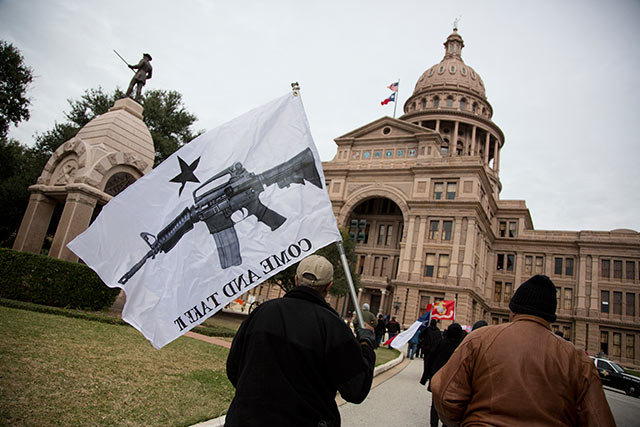
Demonstrators gather outside the State Capitol for a rally about expanded gun rights in downtown Austin, Texas, Jan. 1, 2016. (Photo: Ilana Panich-Linsman / The New York Times)

HENRY GIROUX


Gun violence in the United States has produced a culture soaked in blood - a culture that threatens everyone and extends from accidental deaths, suicides and domestic violence to mass shootings. In late December, a woman in St. Cloud, Florida, fatally shot her own daughter after mistaking her for an intruder. Less than a month earlier, on December 2, in San Bernardino, California, was the mass shooting that left 14 people dead and more than 20 wounded. And just two months before that, on October 1, nine people were killed and seven wounded in a mass shooting at a community college in Roseburg, Oregon.

Mass shootings have become routine in the United States and speak to a society that relies on violence to feed the coffers of the merchants of death. Given the profits made by arms manufacturers, the defense industry, gun dealers and the lobbyists who represent them in Congress, it comes as no surprise that the culture of violence cannot be abstracted from either the culture of business or the corruption of politics. Violence runs through US society like an electric current offering instant pleasure from all cultural sources, whether it be the nightly news or a television series that glorifies serial killers.

At a policy level, violence drives the arms industry and a militaristic foreign policy, and is increasingly the punishing state's major tool to enforce its hyped-up brand of domestic terrorism, especially against Black youth. The United States is utterly wedded to a neoliberal culture in which cruelty is viewed as virtue, while mass incarceration is treated as the chief mechanism to "institutionalize obedience." At the same time, a shark-like mode of competition replaces any viable notion of solidarity, and a sabotaging notion of self-interest pushes society into the false lure of mass consumerism. The increasing number of mass shootings is symptomatic of a society engulfed in racism, fear, militarism, bigotry and massive inequities in wealth and power.

Guns and the hypermasculine culture of violence are given more support than young people and life itself.

Over 270 mass shootings have taken place in the United States in 2015 alone, proving once again that the economic, political and social conditions that underlie such violence are not being addressed. Sadly, these shootings are not isolated incidents. For example, one child under 12 years old has been killed every other day by a firearm, which amounts to 555 children killed by guns in three years. An even more frightening statistic and example of a shocking moral and political perversity was noted in data provided by the Centers for Disease Control and Prevention (CDC), which states that "2,525 children and teens died by gunfire in [the United States] in 2014; one child or teen death every 3 hours and 28 minutes, nearly 7 a day, 48 a week." Such figures indicate that too many youth in the United States occupy what might be called war zones in which guns and violence proliferate. In this scenario, guns and the hypermasculine culture of violence are given more support than young people and life itself.

The predominance of a relatively unchecked gun culture and a morally perverse and politically obscene culture of violence is particularly evident in the power of the gun lobby and its political advocates to pass laws in eight states to allow students and faculty to carry concealed weapons "into classrooms, dormitories and other buildings" on campuses. In spite of the rash of recent shootings on college campuses, Texas lawmakers, for instance, passed one such "campus carry bill," which will take effect in August 2016. To add insult to injury, they also passed an "open carry bill" that allows registered gun owners to carry their guns openly in public. Such laws not only reflect "the seemingly limitless legislative clout of gun interests," but also a rather irrational return to the violence-laden culture of the "Wild West."


As in the past, individuals will be allowed to walk the streets, while openly carrying guns and packing heat as a measure of their love of guns and their reliance upon violence as the best way to address any perceived threat to their security. This return to the deadly practices of the " Wild West" is neither a matter of individual choice nor some far-fetched yet allegedly legitimate appeal to the Second Amendment. On the contrary, mass violence in the United States has to be placed within a broader historical, economic and political context in order to address the totality of the forces that produce it. Focusing merely on mass shootings or the passing of potentially dangerous gun legislation does not get to the root of the systemic forces that produce the United States' love affair with violence and the ideologies and criminogenic institutions that produce it.

Imperial policies that promote aggression all across the globe are now matched by increasing levels of lawlessness and state repression, which mutually feed each other. On the home front, civil society is degenerating into a military organization, a space of lawlessness and warlike practices, organized primarily for the production of violence. For instance, as Steve Martinot observes at CounterPunch, the police now use their discourse of command and power to criminalize behavior; in addition, they use military weapons and surveillance tools as if they are preparing for war, and create a culture of fear in which militaristic principles replace legal principles. He writes:

This suggests that there is an institutional insecurity that seeks to cover itself through social control ... the cops act out this insecurity by criminalizing individuals in advance. No legal principle need be involved. There is only the militarist principle.... When police shoot a fleeing subject and claim they are acting in self-defense (i.e. threatened), it is not their person but the command and control principle that is threatened. To defend that control through assault or murderous action against a disobedient person implies that the cop's own identity is wholly immersed in its paradigm. There is nothing psychological about this. Self-worth or insecurity is not the issue. There is only the military ethic of power, imposed on civil society through an assumption of impunity. It is the ethos of democracy, of human self-respect, that is the threat.

The rise of violence and the gun culture in the United States cannot be separated from a transformation in governance in the United States. Political sovereignty has been replaced by economic sovereignty as corporate power takes over the reins of governance. The more money influences politics, the more corrupt the political culture becomes. Under such circumstances, holding office is largely dependent on having huge amounts of capital at one's disposal, while laws and policies at all levels of government are mostly fashioned by lobbyists representing big business corporations and financial institutions. Moreover, such lobbying, as corrupt and unethical as it may be, is now carried out in the open by the National Rifle Association (NRA) and other individuals, groups and institutions invested in the militarization of US society. This lobbying is then displayed as a badge of honor - a kind of open testimonial to the lobbyists' disrespect for democratic governance.

But money in politics is not the only major institutional factor in which everyday and state violence are nourished by a growing militarism. As David Theo Goldberg has argued in his essay "Mission Accomplished: Militarizing Social Logic," the military has also assumed a central role in shaping all aspects of society. Militarization is about more than the use of repressive power; it also represents a powerful social logic that is constitutive of values, modes of rationality and ways of thinking. According to Goldberg,

The military is not just a fighting machine.... It serves and socializes. It hands down to the society, as big brother might, its more or less perfected goods, from gunpowder to guns, computing to information management ... In short, while militarily produced instruments might be retooled to other, broader social purpose - the military shapes pretty much the entire range of social production from commodities to culture, social goods to social theory.

The militarization and corporatization of social logic permeates US society. The general public in the United States is largely depoliticized through the influence of corporations over schools, higher education and other cultural apparatuses. The deadening of public values, civic consciousness and critical citizenship are also the result of the work of anti-public intellectuals representing right-wing ideological and financial interests, a powerful set of corporate-controlled media agencies that are largely center-right and a market-driven public pedagogy that reduces the obligations of citizenship to the endless consumption and discarding of commodities. Military ideals permeate every aspect of popular culture, policy and social relations. In addition, a pedagogy of historical, social and racial amnesia is constructed and circulated through celebrity and consumer culture.

A war culture now shapes every aspect of society as warlike values, a hypermasculinity and an aggressive militarism seep into every major institution in the United States, including schools, the corporate media and local police forces. The criminal legal system has become the default structure for dealing with social problems. More and more people are considered disposable because they offend the sensibilities of the financial elite, who are rapidly consolidating class power. Under such circumstances, violence occupies an honored place.

Militarism provides ideological support for policies that protect gun owners and sellers rather than children.

It is impossible to understand the rise of gun culture and violence in the United States without thinking about the maturation of the military state. Since the end of the Cold War the United States has built "the most expensive and lethal military force in the world." The defense budget for 2015 totaled $598.5 billion and accounted for 54 percent of all federal discretionary spending. The US defense budget is both larger than the combined G-20 and "more than the combined military spending of China, Russia, the United Kingdom, Japan, France, Saudi Arabia, India, Germany, Italy and Brazil," according to an NBC report. Since 9/11, the United States has intensified both the range of its military power abroad while increasing the ongoing militarization of US society. The United States circles the globe with around 800 military bases, producing a massive worldwide landscape of military force, at an "annual cost of $156 billion," according to a report by David Vine in The Nation.

Moreover, Vine adds, "there are US troops or other military personnel in about 160 foreign countries and territories, including small numbers of Marines guarding embassies and larger deployments of trainers and advisers like the roughly 3,500 now working with the Iraqi army." Not only is the Pentagon in an unprecedented position of power, but also it thrives on a morally bankrupt vision of domestic and foreign policy dependent upon a world defined by terrorism, enemies and perpetual fear. Military arms are now transferred to local police departments, drone bases proliferate, and secret bases around the world support special operations, Navy SEALs, CIA personnel, Army Rangers and other clandestine groups, as Nick Turse has shown in Tomorrow's Battlefield. Under such circumstances, it is not surprising, as Andrew Bacevich points out, that "war has become a normal condition [and the] use of violence has become the preferred "instrument of statecraft."

Violence feeds on corporate-controlled disimagination machines that celebrate it as a sport while upping the pleasure quotient for the public. Americans do not merely engage in violence; they are also entertained by it. This kind of toxic irrationality and lure of violence is mimicked in the United States' aggressive foreign policy, in the sanctioning of state torture and in the gruesome killings of civilians by drones. As my colleague David L. Clark pointed out to me in an email, voters' support for " bombing make-believe countries [with Arab-sounding names] is not a symptom of muddled confusion but, quite to the contrary, a sign of unerring precision. It describes the desire to militarize nothing less than the imagination and to target the minutiae of our dreams." State repression, unbridled self-interest, an empty consumerist ethos and an expansive militarism have furthered the conditions for society to flirt with forms of irrationality that are at the heart of everyday aggression, violence and the withering of public life.

Pushback Against Gun Control Efforts

Warlike values no longer suggest a pathological entanglement with a kind of mad irrationality or danger. On the contrary, they have become a matter of common sense. For instance, the US government is willing to lock down a major city such as Boston in order to catch a terrorist or prevent a terrorist attack, but refuses to pass gun control bills that would significantly lower the number of Americans who die each year as a result of gun violence. As Michael Cohen observes, it is truly a symptom of irrationality when politicians can lose their heads over the threat of terrorism, even sacrificing civil liberties, but ignore the fact that "30,000 Americans die in gun violence every year (compared to the 17 who died [in 2012] in terrorist attacks)." It gets worse.

As the threat of terrorism is used by the US government to construct a surveillance state, suspend civil liberties and accelerate the forces of authoritarianism, the fear of personal and collective violence has no rational bearing on addressing the morbid acceleration of gun violence. In fact, the fear of terrorism appears to feed a toxic culture of violence produced, in part, by the wide and unchecked availability of guns. The United States' fascination with guns and violence functions as a form of sport and entertainment, while gun culture offers a false promise of security. In this logic, one not only kills terrorists with drones, but also makes sure that patriotic Americans are individually armed so they can use force to protect themselves against the apparitions whipped up by right-wing politicians, pundits and the corporate-controlled media.

Rather than bring violence into a political debate that would limit its production, various states increase its possibilities by passing laws that allow guns at places from bars to houses of worship. Florida's "stand your ground" law, based on the notion that one should shoot first and ask questions later, is a morbid reflection of the United States' adulation of gun culture and the fears that fuel it. This fascination with guns and violence has infected the highest levels of government and serves to further anti-democratic and authoritarian forces. For example, the US government's warfare state is propelled by a military-industrial complex that cannot spend enough on weapons of death and destruction. Super modern planes such as the F-35 Joint Strike Fighter cost up to $228 million each and are plagued by mechanical problems and yet are supported by a military and defense establishment. As Gabriel Kolko observes, such warlike investments "reflect a pathology and culture that is expressed in spending more money," regardless of how it contributes to running up the debt, and that thrives on whatanthropologist JoĂŁo Biehl has described as "the energies of the dead."

Militarism provides ideological support for policies that protect gun owners and sellers rather than children. The Children's Defense Fund is right in stating, "Where is our anti-war movement here at home? Why does a nation with the largest military budget in the world refuse to protect its children from relentless gun violence and terrorism at home? No external enemy ever killed thousands of children in their neighborhoods, streets and schools year in and year out."

There is a not-so-hidden structure of politics at work in this type of sanctioned irrationality. Advocating for gun rights provides a convenient discourse for ignoring what Carl Boggs has described as a "harsh neoliberal corporate-state order that routinely generates pervasive material suffering, social dislocation, and psychological despair - worsening conditions that ensure violence in its many expressions."

As the United States moves from a welfare state to a warfare state, state violence becomes normalized. The United States' moral compass and its highest democratic ideals have begun to wither, and the institutions that were once designed to help people now serve to largely suppress them. Gun laws matter, social responsibility matters and a government responsive to its people matters, especially when it comes to limiting the effects of a mercenary gun culture. But more has to be done. The dominance of gun lobbyists must end; the reign of money-controlled politics must end; the proliferation of high levels of violence in popular culture, and the ongoing militarization of US society must end. At the same time, it is crucial, as participants in the Black Lives Matter movement have argued, for Americans to refuse to endorse the kind of gun control that criminalizes young people of color.

Moderate calls for reining in the gun culture and its political advocates do not go far enough because they fail to address the roots of the violence causing so much carnage in the United States, especially among children and teens. For example, Hillary Clinton's much publicized call for controlling the gun lobby and improving background checks, however well intentioned, did not include anything about a culture of lawlessness and violence reproduced by the government, the financial elites and the defense industries, or a casino capitalism that is built on corruption and produces massive amounts of human misery and suffering. Moreover, none of the calls to eliminate gun violence in the United States link such violence to the broader war on youth, especially poor youth of color.

A Culture of Violence

It would be wrong to suggest that the violence that saturates popular culture directly causes violence in the larger society. Nevertheless, it is arguable that depictions of violence serve to normalize violence as both a source of pleasure and as a practice for addressing social issues. When young people and others begin to believe that a world of extreme violence, vengeance, lawlessness and revenge is the only world they inhabit, the culture and practice of real-life violence is more difficult to scrutinize, resist and transform.

Many critics have argued that a popular culture that endlessly trades in violence runs the risk of blurring the lines between the world of fantasies and the world we live in. What they often miss is that when violence is celebrated in its myriad registers and platforms in a society, a formative culture is put in place that is amenable to the pathology of fascism. That is, a culture that thrives on violence runs the risk of losing its capacity to separate politics from violence. A.O. Scott recognizes such a connection between gun violence and popular culture, but he fails to register the deeper significance of the relationship. He writes:

... it is absurd to pretend that gun culture is unrelated to popular culture, or that make-believe violence has nothing to do with its real-world correlative. Guns have symbolic as well as actual power, and the practical business of hunting, law enforcement and self-defense has less purchase in our civic life than fantasies of righteous vengeance or brave resistance.... [Violent] fantasies have proliferated and intensified even as our daily existence has become more regulated and standardized - and also less dangerous. Perhaps they offer an escape from the boredom and regimentation of work and consumption.

Popular culture not only trades in violence as entertainment, but also it delivers violence to a society addicted to a pleasure principle steeped in graphic and extreme images of human suffering, mayhem and torture. While the Obama administration banned waterboarding as an interrogation method in January 2009, it appears to be thriving as a legitimate procedure in a number of prominent Hollywood films, including Safe House, Zero Dark Thirty, G.I. Jane and Taken 3. The use of and legitimation of torture by the government is not limited to Hollywood films. Republican presidential candidate Donald Trump announced recently on ABC's "This Week" that he would bring back waterboarding because it "is peanuts compared to what they do to us." It appears that moral depravity and the flight from social responsibility have no limits in an authoritarian political landscape.

Gun Violence Is Just the Tip of the Iceberg

The United States is suffering from an epidemic of violence, and much of it results in the shooting and killing of children. In announcing his package of executive actions to reduce gun violence, President Obama singled out both the gun lobby and Congress for refusing to implement even moderate gun control reforms. Obama was right on target in stating that "the gun lobby may be holding Congress hostage right now, but they cannot hold America hostage. We do not have to accept this carnage as the price of freedom." Congress's refusal to enact any type of gun control is symptomatic of the death of US democracy and the way in which money and power now govern the United States. Under a regime of casino capitalism, wealth and profits are more important than keeping the American people safe, more worthwhile than preventing a flood of violence across the land, and more valued than even the lives of young children caught in the hail of gunfire.

In spite of the empty bluster of Republican politicians claiming that Obama is violating the US Constitution with executive overreach, threatening to take guns away from the American people or undermining the Second Amendment, the not-so-hidden politics at work in these claims is one that points to the collapse of ethics, compassion and responsibility in the face of a militarized culture defined by the financial elite, gun lobbies and big corporations. Such forces represent a take-no-prisoners approach and refuse to even consider Obama's call for strengthening background checks, limiting the unchecked sale of firearms by gun sellers, developing "smart gun" technologies, and preventing those on the United States' terrorist watch list from purchasing guns. These initiatives hardly constitute a threat to gun ownership in the United States.

Guns are certainly a major problem in the United States, but they are symptomatic of a much larger crisis: Our country has tipped over into a new and deadly form of authoritarianism. We have become one of the most violent cultures on the planet and regulating guns does not get to the root of the problem. Zhiwa Woodbury touches on this issue at Tikkun Daily, writing:

We are a country of approximately 300 million people with approximately 300 million firearms - a third of which are concealable handguns. Each one of these guns is made for one purpose only - to kill as quickly and effectively as possible. The idea that some magical regulatory scheme, short of confiscation, will somehow prevent guns from being used to kill people is laughable, regardless of what you think of the NRA. Similarly, mentally ill individuals are responsible for less than 5% of the 30,000+ gunned down in the U.S. every year.

In the current historical conjuncture, gun violence makes a mockery of safe public spaces, gives rise to institutions and cultural apparatuses that embrace a deadly war psychology, and trades on fear and insecurity to undermine any sense of shared responsibility. It is no coincidence that the violence of prisons is related to the violence produced by police in the streets; it is no coincidence that the brutal masculine authority that now dominates US politics, with its unabashed hatred of women, poor people, Black people, Muslims and Mexican immigrants, shares an uncanny form of lawlessness with a long tradition of 20th century authoritarianism.

As violence moves to the center of American life, it becomes an organizing principle of society, and further contributes to the unraveling of the fabric of a democracy. Under such circumstances, the United States begins to consider everyone a potential criminal, wages war with itself and begins to sacrifice its children and its future. The political stooges, who have become lapdogs of corporate and financial interests, and refuse out of narrow self- and financial interests to confront the conditions that create such violence, must be held accountable for the deaths taking place in a toxic culture of gun violence. The condemnation of violence cannot be limited to police brutality. Violence does not just come from the police. In the United States, there are other dangers emanating from state power that punishes whistleblowers, intelligence agencies that encourage the arrests of those who protest against the abuse of corporate and state power, and a corporate-controlled media that trades in ignorance, lies and falsehoods, all the while demanding and generally "receiving unwavering support from their citizens," as Teju Cole has pointed out in The New Yorker.

Yet, the only reforms we hear about are for safer gun policies, mandatory body-worn cameras for the police and more background checks. These may be well-intentioned reforms, but they do not get to the root of the problem, which is a social and economic system that trades in death in order to accumulate profits. What we don't hear about are the people who trade their conscience for supporting the gun lobby, particularly the NRA. These are the politicians in Congress who create the conditions for mass shootings and gun violence because they have been bought and sold by the apostles of the death industry. These are the same politicians who support the militarization of everyday life, who trade in torture, who bow down slavishly to the arms industries and who wallow in the handouts provided by the military-industrial-academic complex.

These utterly corrupted politicians are killers in suits whose test of courage and toughness was captured in one of the recent Republican presidential debates, when candidate Ben Carson was asked by Hugh Hewitt, a reactionary right-wing talk show host, if he would be willing to kill thousands of children in the name of exercising tough leadership. As if killing innocent children is a legitimate test for leadership. This is what the warmongering politics of hysterical fear with its unbridled focus on terrorism has come to - a future that will be defined by moral and political zombies who represent the real face of terrorism, domestic and otherwise.

Clearly, the cause of violence in the United States will not stop by merely holding the politicians responsible. What is needed is a mass political movement willing to challenge and replace a broken system that gives corrupt and warmongering politicians excessive political and economic power. Democracy and justice are on life support and the challenge is to bring them back to life not by reforming the system but by replacing it. This will only take place with the development of a politics in which the obligation to justice is matched by an endless responsibility to collective struggle.

Note: Parts of this article were drawn from an earlier version published at CounterPunch.

Copyright, Truthout. May not be reprinted without permission of the author.

Henry A. Giroux:

Henry A. Giroux currently holds the McMaster University Chair for Scholarship in the Public Interest in the English and Cultural Studies Department and the Paulo Freire Chair in Critical Pedagogy at The McMaster Institute for Innovation & Excellence in Teaching and Learning. He also is a Distinguished Visiting Professor at Ryerson University. His most recent books include Youth in Revolt: Reclaiming a Democratic Future (Paradigm 2013), America's Educational Deficit and the War on Youth (Monthly Review Press, 2013), Neoliberalism's War on Higher Education (Haymarket Press, 2014), The Violence of Organized Forgetting: Thinking Beyond America's Disimagination Machine (City Lights, 2014), Zombie Politics in the Age of Casino Capitalism, 2nd edition (Peter Lang 2014), Disposable Futures: The Seduction of Violence in the Age of the Spectacle, co-authored with Brad Evans, (City Lights Books 2015), Dangerous Thinking in the Age of the New Authoritarianism (Paradigm Publisher 2015). The Toronto Star named Henry Giroux one of the 12 Canadians changing the way we think! Giroux is also a member of Truthout's Board of Directors. His website is www.henryagiroux.com.

Related Stories:

Henry A. Giroux | Neoliberalism, Violence and Resistance: A Discussion on Forthright Radio
By Henry A. Giroux, Truthout | Interview

Henry A. Giroux | Murder, Incorporated: Guns and the Growing Culture of Violence in the US
By Henry A. Giroux, Truthout | News Analysis

Henry A. Giroux | Terrorizing Students: The Criminalization of Children in the US Police State
By Henry A. Giroux, Truthout | Op-Ed

The Revealing Case of Two Prominent U.S. Mayors and the Deadly Ongoing Crisis in Law,Governance, and Political Economy in Urban America


January 25–February 1, 2016 Issue

Bill de Blasio Is New York’s Most Progressive Mayor in Decades—Is That Enough?

As opposition mounts, the solution to de Blasio’s problems might lie in even bigger, bolder interventions.

by Jarrett Murphy
Twitter
The Nation

 New York Mayor Bill de Blasio (Bebeto Matthews / AP)

 New York Mayor Bill de Blasio. (Reuters / Lucas Jackson) 

As the gears of federal government have ground to a halt, a new energy has been rocking the foundations of our urban centers. From Atlanta to Seattle and points in between, cities have begun seizing the initiative, transforming themselves into laboratories for progressive innovation. Income inequality, affordable housing, climate change, sustainable development, public health, participatory government—cities are tackling them all, bringing new urgency to some of the most vital questions of the day.

When Bill de Blasio emerged from the City Hall subway station a few minutes before his inauguration two Januarys ago, he wore a smile and a crisp suit. On his right were his wife, son, and daughter. On his back were two narratives destined to define his first 24 months in office.

One was “A Tale of Two Cities,” de Blasio’s campaign critique of an increasingly unequal New York, characterized by rising rents, swelling homeless shelters, and racially skewed policing. The other was the notion that as a liberal mayor with little executive experience, de Blasio was doomed to mismanage the city into a return of “the bad old days.” He’d won the 2013 race because of the former and despite the latter; the two narratives represented the lenses through which his performance as mayor would be viewed by friends and foes—and not just in the five boroughs. With anxiety over income inequality coloring the political mood well beyond the city’s borders, de Blasio was anointed by The Nation and others as the standard-bearer for a new progressive movement.

The hype meant high stakes. If de Blasio succeeded, he could help create a new national consensus around leftist policies. If he failed, John Lindsay would no longer be the person to whom hapless mayors were compared.

Midway through his first term, de Blasio has alternately fulfilled and frustrated his friends’ hopes and his enemies’ scorn. He has racked up substantive policy victories, like universal pre-kindergarten, Vision Zero traffic-safety improvements, a hugely popular municipal-ID program, and a rent freeze for many rent-regulated apartments, and he has taken aggressive stands on the minimum wage, climate change, and mental-health services. But few of his allies seem satisfied with the pace of reform or his ability to articulate a progressive vision, and the mayor has alienated some with his plan to rezone low-income neighborhoods.

As a manager, de Blasio has often defied the predictions of ineptitude: His budgets continue to run surpluses, Pre-K for All’s rollout was remarkably smooth, and he has steadily and responsibly worked through a massive set of overdue labor negotiations left by his predecessor, Michael Bloomberg. But these feats have been overshadowed by missteps: egregious lateness during his first year, pettiness with the press, unseemly ties to lobbyists, and premature efforts to take on a national role. These foibles delight his critics and terrify his allies, who see not just his reelection prospects, but the broader opportunities for progressive change, suffering with each snafu.

In many ways, the de Blasio team has tried to rejigger well-known policy options rather than imagine new ones.

Given de Blasio’s background as a campaign operative, the biggest surprise of his mayoralty so far has been the strategic blundering. The local backlash to his housing proposals suggests a political radar that needs recalibration—fast. And de Blasio has consistently been outmaneuvered by Governor Andrew Cuomo. It’s not the mayor’s fault that Cuomo—a political warrior of uncommon ruthlessness—seeks to belittle him at every turn, but de Blasio seems incapable of ducking any of Cuomo’s jabs. The biggest surprise of the past two years might be that Bill de Blasio has proven to be a better mayor than a politician.

That’s not necessarily good news, since de Blasio is in a predicament that only a skillful pol can escape. He bears massive expectations, faces strong enemies, wields only limited powers, and is supported by often-hesitant allies.
Through more than a dozen interviews with social-justice advocates, The Nation has found that there’s a lot for the mayor to be proud of—and much for him to figure out if he wants to transform the city from a symbol of extreme stratification into a model of equity.

HOUSING
Highlight: During his first full fiscal year in office, the city created more affordable apartments than in any prior year: 20,325 of them, enough for 50,000 people.

Lowlight: As of December, there were almost 58,000 people in the city’s homeless shelters.

Faced with one of the most extreme affordable-housing crises in the country, the de Blasio administration has rightly treated the issue as its biggest policy test. In May 2014, it announced a $41 billion plan, hailed by the mayor as the “most ambitious” in the country, to build or preserve 200,000 units of affordable housing over the next 10 years. The plan far outstrips Bloomberg’s efforts and is certainly “ambitious.” The problem is that earlier, smaller, but similar plans failed to stave off a huge loss of affordable units in the city. In many ways, the de Blasio team has tried to rejigger well-known policy tools rather than imagine new ones.

City Hall’s prescription for the housing crunch is, for the most part, “more”: more market-rate housing and more affordable housing, with the former sometimes subsidizing the latter, all toward the goal of a denser, more equal city. Through tax breaks and so-called inclusionary zoning, this approach can produce affordable housing. The question is whether it can generate enough to offset the impact of the market-rate development on which it depends.

Past experience makes many communities wary of this approach. Because of federal-subsidy rules, “affordable housing” rents tend to be set for households more affluent than those that actually exist in the targeted neighborhoods—a problem that the administration has tried to mitigate but can’t altogether solve. And the mayor’s plan—which would offer particular incentives to developers of affordable units in places like East Harlem and Flushing—strikes some as a dangerous trade-off, inviting in the very type of real-estate investment that has already made other neighborhoods unaffordable.

“I’m very dubious of the entire enterprise,” says Michael McKee, a longtime tenant-rights advocate and treasurer of TenantsPAC. “I just don’t think you can plop down that much market-rate housing in a neighborhood like East New York and not trigger more displacement.” Last fall, a vast majority of the city’s community boards rejected two big zoning-rule changes key to de Blasio’s housing vision, setting up a costly showdown early this year, when the measures reach the City Council. The mayor has tried to improve existing affordable-housing policy options like 421-a, a property-tax break, but he hasn’t attempted to fundamentally change the policy menu. One housing expert says that de Blasio “is not using all the tools at his disposal” to “try to change the paradigm between the real-estate community and the city.”

De Blasio has had clear success—and bucked the paradigm—in protecting the city’s 1 million–plus rent-stabilized tenants, getting the Rent Guidelines Board to order a record-low 1 percent hike for one-year leases in 2014 and an unprecedented freeze for those leases in 2015. This was “a very big deal,” in McKee’s view. But de Blasio’s call to lock in more protections via pro-tenant reforms in Albany was largely ignored by state legislators and Governor Cuomo last spring, repeating a dynamic that has defined much of his mayoralty. “We feel good about the work the administration did supporting the rent laws,” says Katie Goldstein, executive director of the New York State Tenants and Neighbors Coalition. “The real issue…is the governor.”
De Blasio’s efforts to respond to the homeless crisis he inherited have been similarly stymied. An uptick in the number of homeless people living in the streets sparked a political uproar last summer (and led to troubling police crackdowns), spurring a shake-up at the city’s homeless-services agency in December. But the administration has also launched eight rental-subsidy programs to move people out of shelters and into their own apartments. Jeff Foreman, policy director at Care for the Homeless, notes that the de Blasio administration has spent millions more on prevention and also agreed to create 15,000 supportive-housing units. But the funds necessary to bring these programs to the needed scale have not been forthcoming from Cuomo.

Meanwhile, thanks to the federal government’s long-standing disinvestment policy, the city’s public-housing developments remain mired in a fiscal crisis, leading the mayor’s team to propose controversial steps—such as allowing the private development of mixed-income housing on land owned by the New York City Housing Authority. Still, Vic Bach, a public-housing expert at the Community Service Society of New York, or CSS, credits de Blasio with ending the practice of charging the housing authority for police services, and for committing $300 million in capital funding to fix roofs. “Compared to the previous mayor or mayors, he’s paid a lot of attention to NYCHA’s financial needs and concerns,” Bach says.

ECONOMIC EQUALITY
Can the mayor trust enough in his vision to be truly bold? Can his allies trust him enough to give him the room he needs to be reelected?

Highlight: Within months of taking office, de Blasio signed a law mandating sick leave for up to 500,000 workers.

Lowlight: The rate of people living in poverty hasn’t budged, remaining at 20.9 percent.

De Blasio chose a formidable enemy when he railed against economic polarization on the campaign trail. Not only is inequality partly the result of global changes in trade, the use of technology, and the value of education—forces difficult for any city government to resist—but the de Blasio administration faces strict limits on how much redistribution it can affect, giving the mayor little power to reset relations between the 1 percent and the rest of us.

Yet de Blasio has used what power he has to significant effect. He signed a sick-leave bill into law and used executive action to expand living-wage provisions. “I would give him good grades on certain things,” says CSS policy expert Nancy Rankin. “On the paid-sick-days expansion, he did a robust outreach effort on enforcement,” while universal pre-K is “not only important for early-childhood education but immediately provides quality childcare for people trying to work, and it creates a lot of good public-sector jobs.” In mid-December, de Blasio announced that he was granting six weeks of paid parental leave for nonunion city workers—a bold step toward a more humane workplace.
The mayor stunned just about everyone when he appointed Steven Banks, a Legal Aid lawyer who’d spent his career suing the city over punitive welfare policies, to run its welfare agency. The city’s cash-assistance caseload, which bizarrely shrank during the Great Recession, has now risen modestly. Banks is also committed to ending the controversial Work Experience Program and to revising other harsh relics of welfare “reform.” “We didn’t even think that something like Steve Banks being named commissioner was possible,” says the leader of one economic-justice organization. “He has been fulfilling our hopes.”

The bad news for de Blasio has come from the governor’s mansion. The mayor’s pre-K program was supposed to be funded by a dedicated tax on the rich, but Cuomo blocked it. When de Blasio advocated allowing the city to set its own minimum wage, Cuomo shot that down, too. But after a scare from the left in the 2014 gubernatorial primary—a threat that de Blasio helped neutralize—Cuomo began pushing for economic policies very similar to the ones he’d mocked the mayor for, like a higher minimum wage. Although the governor will never give de Blasio credit for the shift, he likely deserves some.

POLICING
Highlight: Police encounters under the NYPD’s stop-and-frisk program have fallen from 21,187 in the third quarter of 2013 to 4,747 in the third quarter of 2015.

Lowlight: Of the roughly 148,000 misdemeanor arrests in the city during the first nine months of 2015, 87 percent involved people of color.

De Blasio’s come-from-behind victory wouldn’t have happened without the commercial featuring his teenage son Dante talking about the New York Police Department’s stop-and-frisk program, a policing strategy that enabled cops in the Bloomberg years to stop astronomical numbers of people—mostly black or Latino—who were rarely found to be doing anything wrong.

Police reform was always risky territory for de Blasio. Right-wing critics wagered that crime would explode under his watch; if it did, he would certainly fail to be reelected. The left, angry about NYPD policy since the Giuliani administration, had steep expectations for what a progressive mayor ought to deliver. In the end, de Blasio tried to please both: While vowing to end stop-and-frisk abuses, he chose to shore up City Hall’s law-and-order credibility by bringing back Bill Bratton, a champion of “broken windows” policing, to run the NYPD.

Two tempestuous years later, neither side is satisfied. Seizing on a small increase in violence, the right is threatening to support former police commissioner Ray Kelly as a mayoral candidate, while some on the left are unimpressed by the huge drop in stop-and-frisk numbers amid continued high levels of misdemeanor arrests, which disproportionately affect people of color. “The problem is that there’s been no significant change,” says Robert Gangi, executive director of the Police Reform Accountability Project.

Donna Lieberman, who heads the New York Civil Liberties Union, credits de Blasio for protecting civil liberties during the Black Lives Matter protests in 2013, and for making initial moves to scale back a racially skewed school-discipline system. “The mayor has certainly matched the rhetoric that was critical of stop-and-frisk abuse with a dramatic reduction in stops…. The city is, despite the tabloid effort to portray it otherwise, safer than ever,” she says. “But the racial disparities in arrests remain a problem.”

For community activist Mark Winston Griffith, the “broken windows” rhetoric linking misdemeanors to violent crime has created a framework that de Blasio cannot escape. “With Bratton there…[they] are still wedded to ‘broken windows,’” he says. “As long as [the policy] is in place, you’re going to have not just tensions but abuses.”

EDUCATION
Highlight: In its second year, Pre-K for All registered 65,504 children.

Lowlight: The racial gap in math proficiency remains wide. On the 2015 state tests for grades 3 to 8, 56.7 percent of white students performed at grade level, compared with 23.7 percent of Latinos and 19.1 percent of blacks.

When de Blasio announced his goal, at the peak of the mayoral campaign, to bring universal pre-K to New York City, most of his challengers greeted it as either a curiosity or a stunt. Yet Pre-K for All is now a fact of city life, enrolling “more students than in the entire school district of Boston,” according to City Hall. “That was a huge lift,” says Zakiyah Ansari, advocacy director at the Alliance for Quality Education. “His real commitment and willingness to put all his force behind it, that was a big feat…but it was something he was really committed to.”

De Blasio’s universal pre-K success and his appointment of a seasoned educator as schools chancellor—unlike Bloomberg, who twice picked education novices—have earned praise from veteran education-policy expert Diane Ravitch. “He actually is trying to improve the public schools, not demolish them,” she says. Among the better programs de Blasio has created are Renewal Schools, targeting low-performing schools for interventions, and Community Schools, which use school buildings to deliver a range of services to low-income neighborhoods.

Not everyone is content with the mayor’s performance. Education advocate Leonie Haimson says that de Blasio “made very specific promises around issues like reducing class sizes, expanding the school capital plan, more transparency in terms of the budget, more input for parents”—promises that, she argues, have yet to be fulfilled. Other allies contend that his response to criticism over racial disparities and extreme segregation has been flat-footed.

Some of the mayor’s loudest critics can be found in the charter-school industry. With Cuomo on their side, supporters not only beat back the de Blasio team’s early decision to reject a handful of charter applications for space in public schools; they also won a new state law essentially forcing the city to give them as much space as they want. De Blasio was further humbled in 2015 when his control of the school system was renewed for just one year— unlike the multiyear deal twice given to Bloomberg.

For many, de Blasio’s skirmishes with the charter-school industry are emblematic of a wider problem with his record on education. His allies feel that he has failed to link all of the programs he wants to advance—as well as his skepticism on charters—to a comprehensive philosophy. “He was in a position to create a model of progressive school reform,” says Pedro Noguera, a distinguished professor of education at UCLA. “Mayor Bloomberg gave us one model; [de Blasio] came in saying he was going to do it differently. But he never explained how.”

ENVIRONMENT
Highlight: The administration has committed to reducing New York City’s carbon footprint by 80 percent of 2005 levels by 2050.

Lowlight: Despite setting a “zero waste to landfills” goal, the city recently inked a 20-year, $3.3 billion deal to haul trash to landfills.

The night de Blasio was elected, I spoke with an environmental activist who confessed to anxiety. Compared with Bloomberg, the mayor-elect had said almost nothing about environmental policy during the campaign. Since then, however, de Blasio has been extremely vocal on such issues, adopting a far more aggressive greenhouse-gas reduction target and wedding his push for social equality to the goal of a greener city in a vision document called OneNYC, released last Earth Day. Mark Dunlea, an activist on the 350 NYC steering committee, says the mayor “does deserve some credit on climate change, though Hurricane Sandy…the People’s Climate March, and the pope’s visit created pressure for action.” However, Dunlea sees him stopping short of bold action—for example, by avoiding specific commitments to wind power in renewable-energy plans, or by calling for a study before divesting the city of all fossil-fuel stocks. But Dunlea adds that de Blasio “does deserve credit for… addressing environmental justice,” and proposes some overall letter grades: A-minus for vision, B-minus for execution. Those are more generous marks than others would give, but the consensus seems to be that Bill de Blasio still believes in the right things. The doubt is over his delivery.

At his midterm press roundtable, de blasio proudly pointed to his achievements: “At this level of play and at this volume, there’s going to be mistakes. My job is to make fewer and fewer mistakes.”

New York City has more than 4 million registered voters, but fewer than 800,000 cast their ballots for de Blasio. The low turnout indirectly validated his rationale for running, suggesting that vast numbers feel shut out not just from the economy but from politics—a different take on “A Tale of Two Cities.” New York City’s democracy is faltering, partly because trust in government has evaporated. This lack of trust touches us all and is de Blasio’s most dangerous enemy. Can the mayor trust enough in his vision to be truly bold? Can his allies trust him enough to give him the room he needs to be reelected and buy time to make real change?

Haimson is disappointed but not done. “I think he has time to recoup,” she says. “It’s not like anyone is giving up.”


Start Making Sense: Rahm Emanuel Must Go
Rick Perlstein on the Chicago mayor
by Start Making Sense and Jon Wiener
January 7, 2016
The Nation


Hundreds of people march on Christmas Eve demanding that Chicago Mayor Rahm Emanuel resign. (Rex Features via AP Images)

AUDIO LINK: 

The attempt to cover up the police killing of Laquan McDonald in Chicago ought to end Mayor Rahm Emanuel’s career, says Rick Perlstein, who reviews Rahm’s life in politics going back to the Clinton era and Obama’s first term.

Start Making Sense is hosted by Jon Wiener and co-produced by the Los Angeles Review of Books.

Start Making Sense Twitter Start Making Sense is The Nation’s podcast, featuring lively conversations with the writers, activists, and artists who shape the week in news, hosted by Jon Wiener. Subscribe on iTunes, Stitcher and SoundCloud for new episodes each Thursday.


Jon Wiener Twitter Jon Wiener is a contributing editor of The Nation.