Discourse that allows us to express a wide range of ideas, opinions, and analysis that can be used as an opportunity to critically examine and observe what our experience means to us beyond the given social/cultural contexts and norms that are provided us.
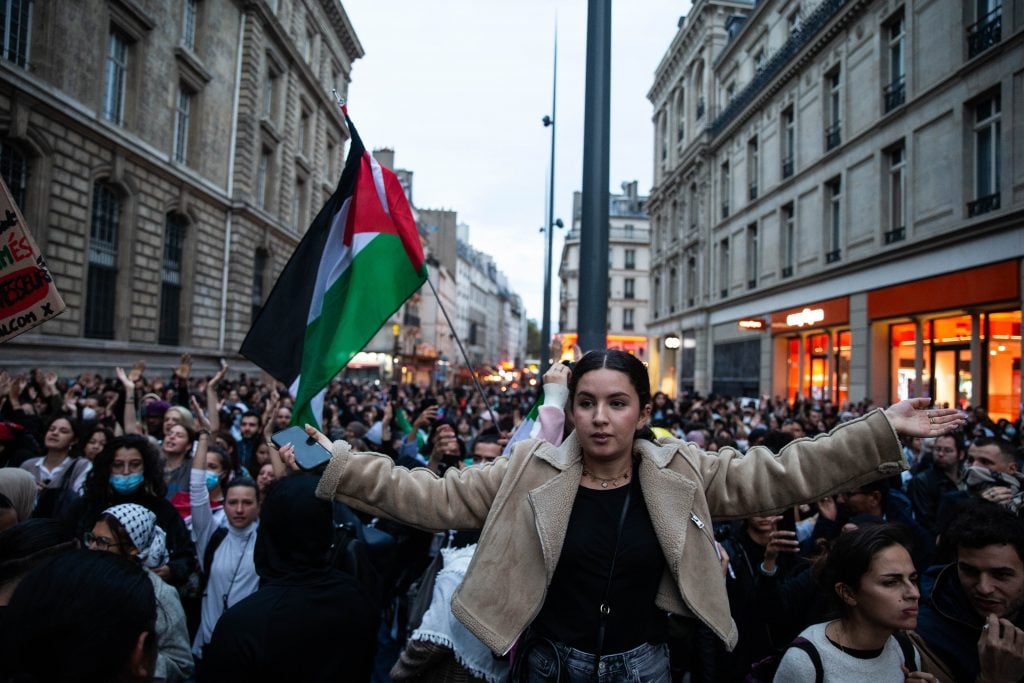
People
holding banners and Palestinian flags, take part in pro-Palestinian
rally to show their solidarity with Palestinian people at the Place de
la Republique in Paris, France, on October 19, 2023. Photo by Ibrahim
Ezzat/Anadolu via Getty Images.
Going on two weeks into the deadly crisis in the Middle
East, three open letters from high-profile artists and cultural figures
are calling for justice for Palestinians in Gaza.
One letter,
addressed “from the art community to cultural organizations,” was
signed by artists Peter Doig, Nan Goldin, Barbara Kruger, Tomás
Saraceno, Joan Jonas, and Kara Walker, as well as filmmaker Laura
Poitras and scholars Judith Butler and Fred Moten.
“We support Palestinian liberation and call for an end to the killing
and harming of all civilians,” the letter read. “We demand that the
institutional silence around the ongoing humanitarian crisis that 2.3
million Palestinians are facing in the occupied and besieged Gaza Strip
be broken immediately.”
Many institutions in the art world have stayed quiet
on the issue, perhaps reluctant to choose sides given the long,
divisive history of tensions and armed violence between Israelis and
Palestinians.
The conflict ignited anew on October 7 with Hamas’s surprise rocket
launch and massacre of Israeli civilians. But while the Israeli death
toll has been horrific, the letter, as well as two others from leading
writers and actors in the U.S. and U.K., focuses on the even larger
numbers mounting in Gaza.
A letter from the U.K. group Artists for Palestine,
which counts actors Tilda Swinton, Charles Dance, and Steve Coogan
among its signees, focused on the losses faced by the people of
Palestine, writing that “Israel has reduced much of Gaza to rubble, and
cut off the supply of water, power, food and medicine to 2.3 million
Palestinians.”
Meanwhile, a letter from the London Review of Books
signed by artists Molly Crabapple, Chitra Ganesh, and William Powhida,
among others, also condemned Israel’s deadly retaliation in Gaza.
“We can only express our grief and heartbreak for the victims of
these most recent tragedies, and for their families, both Palestinians
and Israelis,” the letter read, going on to note that “human rights
groups have long condemned Israel’s occupation of Palestine and the
inhumane treatment of—and system of racial domination over—Palestinians
at the hands of the Israeli state.” It notes that Israeli historian Raz
Segal has called “the situation in Gaza as a ‘textbook case of
genocide.’”
Israel responded to the offensive, which the U.S. has denounced as an
act of terrorism, with air strikes that have led to the mass
displacement of an estimated 1 million Gazans.
PHOTO: Mark Ruffalo, Jessica Chastain, Quinta Brunson and RizAhmed Getty/Chris Chapman/Michael Buckner for Deadline/Getty
A long list of big-name actors released a letter today directed to President Biden asking him to call for a cease fire in Gaza and Israel.
Among the signatories are Mark Ruffalo, Jessica Chastian, Cate
Blanchett, Quinta Brunson, Rosario Dawson, Oscar Isaac, Joaquin Phoenix,
Alyssa Milano, Jon Stewart and many more. The list includes prominent
Jewish, Muslim and Christian actors
The full text of the letter is below.
Dear President Biden,
We come together as artists and advocates, but most importantly as human
beings witnessing the devastating loss of lives and unfolding horrors
in Israel and Palestine.
We ask that, as President of the United States, you call for an
immediate de-escalation and ceasefire in Gaza and Israel before another
life is lost. More than 5,000 people have been killed in the last week
and a half – a number any person of conscience knows is catastrophic. We
believe all life is sacred, no matter faith or ethnicity and we condemn
the killing of Palestinian and Israeli civilians.
We urge your administration, and all world leaders, to honor all of the
lives in the Holy Land and call for and facilitate a ceasefire without
delay – an end to the bombing of Gaza, and the safe release of hostages.
Half of Gaza’s two million residents are children, and more than two
thirds are refugees and their descendants being forced to flee their
homes. Humanitarian aid must be allowed to reach them.
We believe that the United States can play a vital diplomatic role in
ending the suffering and we are adding our voices to those from the US
Congress, UNICEF, Doctors without Borders, The International Committee
of The Red Cross, and so many others. Saving lives is a moral
imperative. To echo UNICEF, “Compassion — and international law — must
prevail.”
As of this writing more than 6,000 bombs have been dropped on Gaza in
the last 12 days – resulting in one child being killed every 15 minutes.
Beyond our pain and mourning for all of the people there and their
loved ones around the world we are motivated by an unbending will to
stand for our common humanity. We stand for freedom, justice, dignity
and peace for all people – and a deep desire to stop more bloodshed.
We refuse to tell future generations the story of our silence, that we
stood by and did nothing. As Emergency Relief Chief Martin Griffiths
told UN News, “History is watching.”
Signed:
Riz Ahmed Mahershala Ali Mo Amer Cate Blanchett Quinta Brunson Farah Bsaiso Jessica Chastain Margaret Cho David Cross Cherien Dabis Rosario Dawson Ayo Edebiri Fatima Farheen Mirza America Ferrera Dominique Fishback Andrew Garfield Ilana Glazer Oscar Isaac Shaka King Elvira Lind Aria Mia Loberti Macklemore Michael Malarkey Rooney Mara Darius Marder Vic Mensa Alyssa Milano Hasan Minhaj Indya Moore Sandra Oh Joaquin Phoenix Mark Ruffalo Hend Sabry Susan Sarandon James Schamus Amanda Seales Anoushka Shankar Alia Shawkat Wallace Shawn Sebastian Silva Jon Stewart Kristen Stewart Jeremy Strong Wanda Sykes Michael Stipe Amber Tamblyn Bassam Tariq Channing Tatum Dominique Thorne Michelle Wolf Shailene Woodley Ramy Youssef
We call for the international community to commit to ending the
catastrophe unfolding in Gaza and to finally pursuing a comprehensive
and just political solution in Palestine.
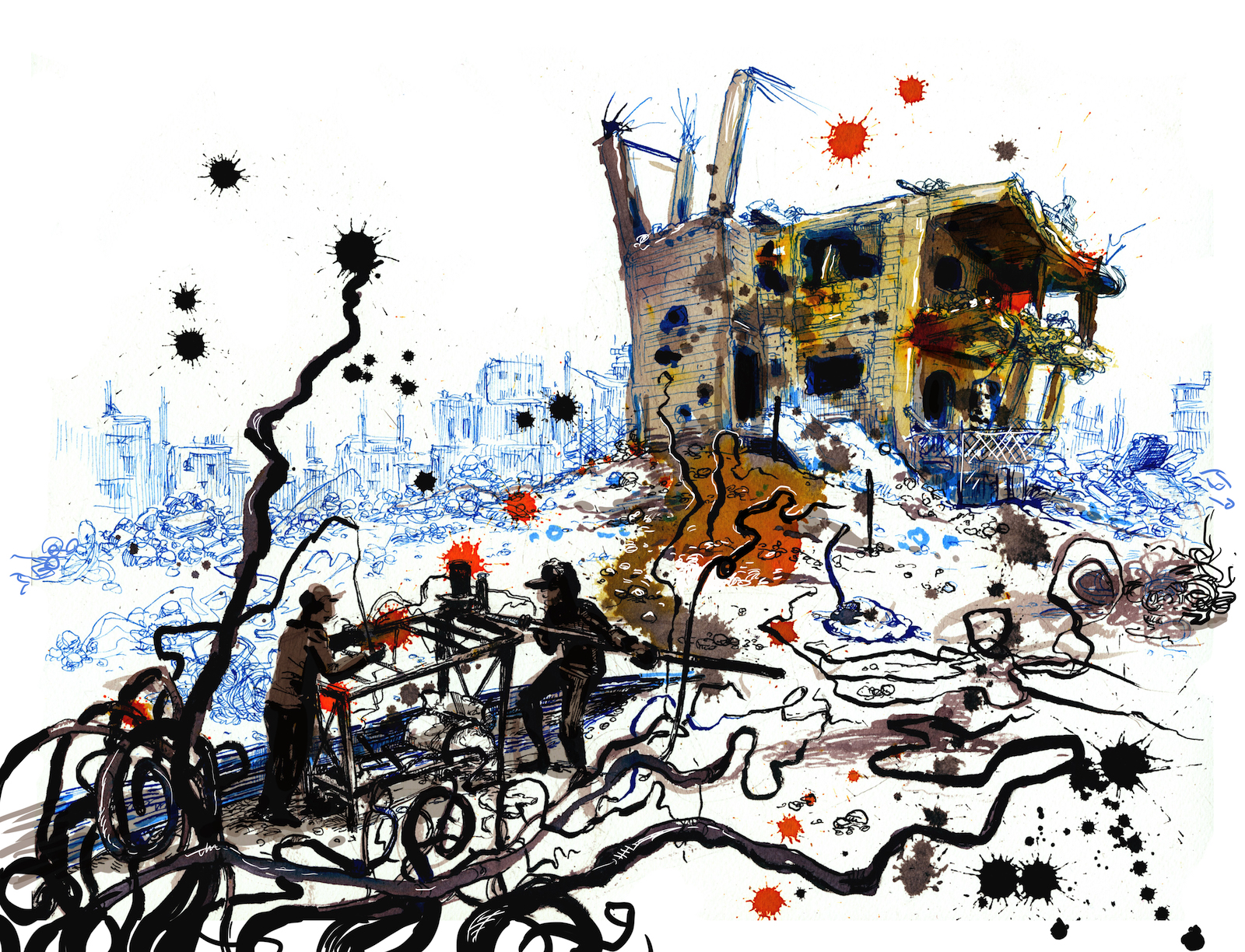
Molly Crabapple. Illustration by Molly Crabapple
We are writers and artists who have been to Palestine to participate
in the Palestine Festival of Literature. We now call for the
international community to commit to ending the catastrophe unfolding in
Gaza and to finally pursuing a comprehensive and just political
solution in Palestine. We have exercised our privilege as international
visitors to move around historic Palestine in ways that most
Palestinians are unable to. We have met and been hosted by Palestinian
artists, human rights workers, writers, historians, and activists. We
have stood on stage with them. Many of these people, including the
festival organizers based in Palestine, are in fear for their lives
right now. One festival organizer is locked down with their child in
Ramallah, sharing updates about the people killed by armed settlers last
night. One partner in Gaza, a magazine editor, is no longer answering
messages.
Israel has imposed what it calls a “complete siege” and told 1.1
million people in Gaza to evacuate within twenty-four hours. To where?
After six days of bombing that have already killed 2,215 people, 724 of
them children, in the fourth major aerial bombardment in the sixteenth
year of closure the question—to where?—rings unanswerable
around the world. When Israel’s top general refers to Palestinians as
“human animals” and the US State Department deletes a statement calling
for “a ceasefire,” then we fear we are watching an ethnic cleansing on a
scale unseen in decades.
The governments of the USA, UK, France and others are participating
in this crime by ramping up military support for Israel as it wages a
war that its officials have plainly stated aims to turn Gaza into a city
of tents, or even worse, empty of its people. A population of over two
million people, mostly from families that were made refugees in 1948,
half of whom are children, have been living under an Israeli and
Egyptian blockade since 2007, and to many of them, being told to leave
again is not an option. On Saturday, after sixteen years of siege, Hamas
militants broke out of Gaza. More than 1,300 Israelis were subsequently
killed with over one hundred more taken hostage—some of them friends
and family of signatories to this letter. We deplore the loss of all
innocent life and now, as we write this letter, Israel is executing the
largest expulsion of Palestinians since 1948 as it bombs Gazans without
discrimination.
Our words feel small in this terrifying escalation. After so many
years and so many deaths we must all, together, say this has to end, and
that it can only end with a free Palestine.
Ta-Nehisi Coates Molly Crabapple Natalie Diaz Maaza Mengiste Anjali Kamat Solmaz Sharif Leanne Betasamosake Simpson Preti Taneja Mirza Waheed Zukiswa Wanner Eve L. Ewing Benjamin Moser Jehan Bseiso Annie Baker Ashish George Jacques Testard Rickey Laurentiis Subhi Hadidi Mahdi Sabbagh Omar Robert Hamilton Yasmin El-Rifae Beesan Ramadan Sabrina Mahfouz China Miéville Kamila Shamsie Madiha Tahir Remi Kanazi Nancy Kricorian Selma Dabbagh Richard Ford Kristina Ford Eileen Myles Dirk Wanrooij Marcia Lynx Qualey Leopold Lambert Ritu Menon Tania Nasr Omar El Khairy Mabel O. Wilson Ismail Khalidi Rachel Holmes Kamila Shamsie Remi Kanazi Madiha Tahir Josh Begley Christina B. Handhart Susan Abulhawa Ru Freeman Nick Estes Samia Henni Jillian Eddelstein Mohamed Hanif Suad Amiry Youssef Rakha Robin Yassin-Kassab Felicity Scott Adam Foulds Sarah Carr Ed Pavlić Bhakti Shringarpure Jay Gao Victoria Brittain Tania Nasir Esther Freud Ghada Karmi Brigid Keenan Ben Ehrenreich Victoria Adukwei Bulley Isabella Hammad Ahdaf Soueif John McCarthy Nathan Hamilton Gillian Slovo Jack Shenker Alexandra Pringle Mohammed El-Kurd Sharif Abdel Kouddous Khalid Abdalla Natasha Soobramanien Luke Williams Bibi Bakare-Yusuf Maan Abu Taleb Suheir Hammad Malika Booker William Dalrymple Susannah Clapp Ibtisam Azem Suzanne Joinson
Ta-Nehisi Coates is an award-winning author and journalist. His books include The Beautiful Struggle, The Water Dancer, and Between the World and Me, which won the National Book Award in 2015. He was a recipient of a MacArthur Fellowship that same year. (October 2023)
Molly Crabapple is the author of Drawing Blood and, with Marwan Hisham, of Brothers of the Gun. Her artwork is in the permanent collection of the Museum of Modern Art. (July 2023)
Natalie Diaz is a
Pulitzer Prize–winning Mojave American poet, language activist, former
professional basketball player, and educator. She was born and raised in
the Fort Mojave Indian reservation and is an enrolled member of the
Gila River Akimel O’otham community. She is a Macarthur Foundation
Fellow, a Lannan Literary Fellow, a Native Arts Council Foundation
Artist Fellow, and a Professor at Arizona State University, where she is
the founding director of the Center for Imagination in the Borderlands.
(October 2023)
Maaza Mengiste is the author of The Shadow King, shortlisted for the 2020 Booker Prize, a LA Times Books Prize finalist, and a Best Book of 2019 by The New York Times, NPR, Time, Elle, and other publications. Beneath the Lion's Gaze, her debut novel, was selected by The Guardian as one of the ten best contemporary African books. (February 2021)
"I did not think it was possible to examine in 20 minutes what Gaza in Context does with such compelling clarity: Israeli policies toward Gaza and Palestine, which are inseparable; the core problems affecting Gaza and the deliberateness of the policies that have led to Gaza's disablement; Gaza's centrality in the Israeli-Palestinian conflict; and some common myths surrounding Gaza and the history of the conflict overall, which are straightforwardly debunked.An immensely valuable teaching tool, the film's power also lies in its fundamental humanity, a heartfelt entreaty to end the oppression and violence so that all people in this tortured part of the world may aspire to a future in which their children can flourish."--Dr. Sara Roy, Senior Research Scholar, Center for Middle Eastern Studies, Harvard University
"Gaza in Context is a superb film accompanied by an excellent teaching guide with seminal articles on the various aspects of the subject, discussion questions, reading list and bibliography. Not only does the 20- minute- film provide the essential facts necessary for an understanding of the problem it helps the viewer understand the context, history and nature of the Israeli policy that brought the Gaza Strip to where it is today. It does this without committing the common error of treating Gaza in isolation from the rest of Palestine but helps explain the consistency in the Israeli policy over the years and throughout Palestine while focusing on its implications and manifestations for Gaza. The film ends with a cri de Coeur to all of us to do what we can to bring an end to what the film convincingly argues is not a natural but a human- made disaster and save Gaza from continuing to be a zone of death."
--Raja Shehadeh, Palestinian lawyer, novelist, political activist, affiliate of the International Commission of Jurists, and a founder of the human rights organization Al-Haq.
"Israel's deliberate fragmentation of the Palestinian people and their land for the past 70 years has also fragmented the Palestinian narrative and struggle for rights. This is just one reason why it is vital that efforts to stop and reverse Israel's colonization project adopt a holistic framework of analysis. Gaza in Context does just that: It zeroes in on Israel's repeated assaults against the besieged strip but then broadens out to show how Israel's attacks on Gaza are part of a consistent plan against the entire Palestinian people, a plan that from day one has sought to minimize the number of Palestinians in historic Palestine and maximize the number of Israeli Jews. The 20-minute film and accompanying educational materials succinctly provide the missing context in so many accounts of the conflict. It is an excellent entry point for the many thousands who are beginning to support Palestinian rights and an important refresher for others that have been involved in the movement for longer. Spread the word!" --Nadia Hijab, Executive Director, Al-Shabaka: The Palestinian Policy Network
“Gaza in Contextshould be required viewing for everyone, including those familiar with the situation in Palestine. Powerful, informative, and persuasive, Noura Erakat delivers a fusillade of facts with concision and passion, obliterating in twenty minutes some three decades of media misinformation about Israel’s occupation of Palestine. An effective teaching tool, irrespective of one’s political position.”-- Robin D. G. Kelley, Professor of History and African American Studies, UCLA
"Gaza in Contextis a fantastic educational instrument, conveying in 20 minutes what it would take most people a lifetime to learn. It gives an accurate and visually brilliant portrayal of the tragedy that has befallen not only Gaza, but the entire Palestinian people."
--Dr. Richard Falk, Professor Emeritus of International law, Princeton University, former United Nations Special Rapporteur to the Occupied Palestinian Territories.
"Gaza in Context is an excellent educational resource that places Israel’s ongoing attacks on Palestinians in Gaza in their proper political context, that of settler colonialism, resistance to such colonialism and the Palestinian struggle to stay alive. In 20 minutes, this film debunks many of the Israeli-perpetuated myths — myths that have been conveniently adopted by others — by focusing on facts. The various articles and discussion questions accompanying the film serve as essential tools for those wishing to learn more."--Diana Buttu, Palestinian lawyer, analyst and former advisor to the PLO.
The film in four parts
Gaza in Context, Part I.
Watch Part 1 of the film, and check out the accompanying section of the teaching guide.
Gaza in Context, Part III.
Watch Part III of the film, and check out the accompanying section of the teaching guide.
Gaza in Context, Part II.
Watch Part II of the film, and check out the accompanying section of the teaching guide.
Gaza in Context, Part IV.
Watch Part IV of the film, and check out the accompanying section of the teaching guide.
In 2010 she was a co-founder of Jadaliyya, an online magazine published in English, Arabic, and French, and which is affiliated with the non-profit Arab Studies Institute, operating in Washington, D.C. and Beirut.
Dr. West rejoins Bad Faith to talk about his choice to leave the Green Party, and whether it’s really the best strategic option. He then weighs in on the violence on Israel/Palestine and the controversies around the left’s response. What does he make of the Harvard student groups joint letter in response to Hamas’s attack? How does one acknowledge grief and compassion at the murder of Israeli civilians, without validating media narratives that exclusively value Israeli lives without acknowledging the ongoing occupation of Palestinians? It’s the kind of tough, empathic, important conversation we’ve come to expect from Dr. West.
Subscribe to Bad Faith on YouTube to access our full video library.
Find Bad Faith with Briahna Joy Gray on Twitter (@badfaithpod) and Instagram (@badfaithpod).
Theme by Nick Thorburn (@nickfromislands)
ABOUT THE PARTICIPANTS:
Briahna Joy Gray (b. August 15, 1985) is an American political
commentator, lawyer, and political consultant who served as the National
Press Secretary for the Bernie Sanders 2020 presidential campaign. Gray is a contributing editor for Current Affairs, and was a senior politics editor for The Intercept. She hosts her own podcast, Bad Faith, and co-hosts The Hill's web series Rising. Ms. Gray is a graduate of both Harvard University and Harvard Law School
Dr. Cornel West (b. June 2, 1953) is currently the Dietrich Bonhoeffer Chair at Union Theological Seminary and is the former Professor of the Practice of Public Philosophy at
Harvard University and Professor Emeritus at Princeton University.
Cornel West graduated Magna Cum Laude from Harvard in three years and
obtained his M.A. and Ph.D. in Philosophy at Princeton.A democratic socialist, two of Dr. West's most influential books areRace Matters (1993) and Democracy Matters (2004).He has written 20 books and has edited 13 and is widely recognized as one of the major, most important, and highly influential public intellectuals, scholars, critics, and activists in the world today.
Marc Lamont Hill Speaks On Israel-Hamas War, International Law, History + More
Marc Lamont Hill (b. December 17, 1978) is an American academic, author, activist, and television personality. He is a professor of urban education at the CUNY Graduate Center in New York City. Hill is the host of UpFront on Al Jazeera English, VH1 Live! on VH1, and Basketball Wives reunion shows. He is also a BET News correspondent. He is the author or co-author of four books: the award-winning Beats, Rhymes, and Classroom Life: Hip-Hop Pedagogy and the Politics of Identity; The Classroom and the Cell: Conversations on Black life in America; the New York Times bestseller Nobody: Casualties of America’s War on The Vulnerable from Ferguson to Flint and Beyond; and Gentrifier. He has also published two edited books: Media, Learning, and Sites of Possibility; and Schooling Hip-Hop: New Directions in Hip-Hop Based Education.
Trained as an anthropologist of education, Dr. Hill holds a Ph.D. (with distinction) from the University of Pennsylvania. He finished his undergraduate studies at Temple University, where he received his B.S. in education and Spanish in 2000. He later earned both an M.A. and a Ph.D. from the University of Pennsylvania. His research focuses on the intersections between culture, politics, and education in the United States and the Middle East.
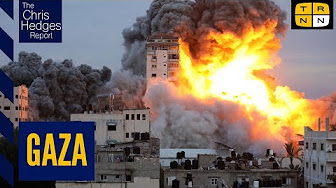
Norman Finkelstein explains Israel’s 17-year blockade of Gaza and the context of the war currently underway.
by Chris Hedges October 18, 2023 The Real News Network
PHOTO: Israeli airstrike in Gaza, Palestine on October 7, 2023. Photo by Majdi Fathi/NurPhoto via Getty Images
Israel has unleashed a horrific war of
collective punishment against the people of Gaza, the latest in a long
history of anti-Palestinian oppression. As corporate media shamelessly
provides cover for what is undoubtedly a genocide unfolding in real
time, the need to ground our understanding of the conflict in its proper
history is more important than ever. Norman Finkelstein joins The Chris Hedges Report to discuss Israel’s 17 year blockade of Gaza and its crucial significance to understanding the events of the past two weeks.
Studio Production: Adam Coley, Cameron Granadino Post-Production: David Hebden
Israel's long war on Gaza w/Norman Finkelstein | The Chris Hedges Report
Israel has unleashed a horrific war of collective punishment against the people of Gaza, the latest in a long history of anti-Palestinian oppression. As corporate media shamelessly provides cover for what is undoubtedly a genocide unfolding in real time, the need to ground our understanding of the conflict in its proper history is more important than ever. Norman Finkelstein joins The Chris Hedges Report to discuss Israel's 17 year blockade of Gaza and its crucial significance to understanding the events of the past two weeks.
Listen to episode podcasts and find bonus content at The Chris Hedges Report Substack: https://chrishedges.substack.com/
The Real News is an independent, viewer-supported, radical media network.
The following is a rushed transcript and may contain errors. A proofread version will be made available as soon as possible.
Chris Hedges:
On October 7, Hamas fighters broke through the security barrier
separating Gaza from Israel. They attacked army outposts, villages, and
outdoor concert venues, and kibbutz. Some 1300 Israelis, many of them
civilians, were killed. Almost 200 Israelis, including women, children,
and the elderly, were taken as hostages and transported back to Gaza.
Israel says 1,500 Hamas militants, most young men who most likely had
never been out of Gaza, were killed. Israel has now ordered some 1.1
million Palestinians in northern Gaza to evacuate. The north includes
Gaza City, the most densely populated part of the strip, with 750,000
residents. It also includes Gaza’s main hospital, the Jabalia, and
Al-Shati refugee camps. Gaza is one of the most heavily populated spots
on the planet. Its borders are sealed by Egypt and Israel.
There is no sanctuary; With a tiny landmass, 25 miles long, and only
about five miles wide. Israel has cut off food, fuel, water, and
electricity, provoking an appalling humanitarian crisis. Joining me to
discuss the crisis in Israel and the occupied Palestinian Territories is
the Middle East scholar Norman Finkelstein. Norman has written numerous
books on the Middle East, including Gaza: An Inquest Into Its
Martyrdom. Let’s set the stage before the October 7 attack. Israel has
carried out five murderous assaults against Gaza. But explain what life
was like. Or is like. But of course, now it’s changing with this on the
eve of what will be an incursion into Gaza by the IDF. But explain what
it was like to be in Gaza.
Norman Finkelstein:
There are several facts that need to be known. First of all, you
described Gaza as 25 miles long and about 5 miles wide. For those of you
listeners who need to envisage it, Gaza is about the length of a
marathon, and it’s, speaking on a personal basis, the distance I jog
every morning at Coney Island: 5 miles. It’s among the most densely
populated areas in the world. Beginning in 2006, there were elections
held in the West Bank in Gaza, elections that were urged upon the
Palestinians by the US administration. The results of the elections
unexpectedly brought Hamas, or its civilian party, into power. At that
moment, the Israelis, followed by the EU and the US, imposed a brutal
blockade on Gaza. I should note that Jimmy Carter was in the occupied
Palestinian Territories at the time, and he pronounced the elections
completely honest and fair.
Now let’s speak first to the blockade. With the rarest of exceptions,
nobody can go into Gaza. Nobody can leave Gaza. The population of Gaza
consists overwhelmingly of about 70% of refugees from the 1948 war and
the descendants of those refugees, about half the population, comprises
children. So when you think about Gaza, you should fix, in your mind,
we’re talking about a population that’s overwhelmingly refugees and at
least half children. Since the blockade was imposed on Gaza, nobody can
go in with the rarest exceptions and nobody can leave with the rarest
exceptions. Gaza has endured roughly, it fluctuates with time. So let’s
bring it up to the present. About 50% of the population of Gaza is
unemployed, 60% of the youth are unemployed. My memory is it has the
highest unemployment rate of any area in the world.
The other facts I would want to bring to bear on Gaza are the
humanitarian crisis. The international humanitarian organizations have
over time repeatedly described Gaza as suffering from “severe food
insecurity.” Now, if you take all of these discreet facts and you try to
come up with a comprehensive picture, it fluctuates or vacillates
between two images, or hovers between two images: One was the one
pronounced by the UK’s conservative Prime Minister David Cameron. He
described Gaza as an open-air prison. That would be one pole of the
spectrum. The other pole of the spectrum would be Baruch Kimmerling, the
eminent Hebrew University sociologist who described Gaza as the largest
concentration camp ever. So it’s fair to say that situation has been
endured for approximately 20 years, with variations. There was a period
when Gaza wouldn’t let in virtually any civilian products. Chocolate was
prohibited, potato chips were prohibited, baby chickens were
prohibited.
There was a period when Israel calibrated, literally calibrated, the
number of calories each Gazan needed above the starvation level, what
you might call starvation plus, and didn’t allow in any food beyond that
starvation plus calibration. As I said, with minor fluctuations over
time, that’s been the situation that the people of Gaza have had to
endure these past 20 years. But that’s only half the picture. That’s
what you might call the flora and fauna of Gaza, as it used to be called
in encyclopedia entries when they wanted to describe an area of the
world. But then you have to add in another element. And the other
element is the periodic massacres Israel launches on Gaza. Now, it’s
been a lot more than five, but I’ll tell you the truth, Chris, I can’t
even remember them because there are so many. There are tries I’ve made
to commit them to memory. I’m unable to.
So I’ll limit myself to two of the massacres. The ones which are best
known. First is Operation Cast Lead which ran from December 26, 2008,
to January 17, 2009. When Amnesty International, in the course of the
operation, called in a voluminous report it issued, “The 22 days of
death and destruction.” In the course of those 22 days, Israel killed
about 1,400 Palestinians, of whom 350 were children. It flattened about
6,000 homes and destroyed all of the vital infrastructure in Gaza: the
cement factories, the chicken factories. Targeted and flattened the
vital infrastructure. Then, fast-forwarding past several massacres, one
was the massacre in the Mavi Marmara, the humanitarian ship that was
heading towards Gaza. Then there was the massacre and Operation Pillar
of Defense in 2012, and then there was in July-August, 2014, there was
Operation Protective Edge. And in the course of Operation Protective
Edge, Israel killed about 2,200 Palestinians, 550 children, and
committed such dramatic destruction in the infrastructure of Gaza. It
destroyed about 18,000 homes.
But beyond the 18,000 homes, Peter Maurer — Who at the time was the
president of the International Committee of the Red Cross — Went to Gaza
after the Israeli assault, and he then said that in his entire
professional career… Now, bear in mind, this is the president of the
ICRC, so his job is to tour combat zones. He said in his entire
professional career, he had never seen such destruction as was visited
on Gaza during Operation Protective Edge. And then we’ll get to one more
massacre, not because it stands out in terms of numbers killed, but
because it speaks to one claim that’s constantly made against the people
of Gaza and the Hamas leadership. In 2018, March 31 it began, but it
could be wrong. I think it was March 31st. In 2018, the Palestinians in
Gaza, despairing but also responsive to the exhortations of the
international community, attempted a nonviolent Gandhi-like civil rights
movement, like resistance in Gaza, what came to be called the Great
March of Return.
And Palestinians overwhelmingly nonviolently… Now, I’m referring to
the first six weeks because a major massacre occurred. Israel committed a
major massacre on May 14, and that changed the character of that
nonviolent resistance. So what did the Palestinians who attempted to
follow the exhortations of the international community to try
nonviolence, what was the result of it? Well, there was several human
rights reports. The most exhaustive was carried out by a distinguished
committee commissioned by the United Nations. It was the Human Rights
Council. And it found that — And now I’m calling it pretty much
verbatim. I have not looked at it in quite a while — Remember, we’re
talking about nonviolent demonstrators. Israel targeted children, it
targeted medical personnel, it targeted journalists, and it targeted
disabled people; Palestinians who were in wheelchairs and suffering from
other physical disabilities. And not surprisingly, after the massacre
on May 14t 2018, the nonviolence quickly, though not entirely, petered
out.
So if we fast-forward till today or till October 7, the fair thing to
say — Not engaging in hyperbole or exaggeration, and I try not to
because the truth speaks for itself — The Palestinians in Gaza were left
there to languish and die. I had a lot of respect for Bernie Sanders
and I still retain that respect because you have to judge a person as a
whole. Otherwise, everybody fails the test of pristine morality. But his
last statement, he described this international community as
assiduously committed to bring justice to the Palestinians and Gaza, and
then along came Hamas and messed up everything. Well, with all due
regards to Bernie Sanders, that’s a complete fantasy and fabrication.
Nobody was doing anything the last few years for the people of Gaza. And
I’ve said it before and I’m going to say it again. Including myself, by
2020, I had given up. I wasn’t happy about that fact, and I was
privately criticized for that fact.
But I had reached a point where I was so minutely documenting each
and every crime that Israel has committed, that it seemed absolutely
pointless and purposeless. My last book that I published on the subject,
I Accuse!, it sold 374 copies of which half I purchased because I was
trying to convince the international criminal court to pursue a case
based on that book against Israel. So without elevating myself to
sainthood, I’m simply saying it’s a factual matter. And contrary to what
Bernie Sanders said, I began my involvement in June 1982 when Israel
invaded Lebanon. So that was 40 years as my entire adult life and I had
given up by 2020. I hadn’t written anything for the next three years up
until today on the subject, and I barely posted anything on my website.
So the Palestinians in Gaza, it was as if the people housed at Gaza
were confined to a game preserve and they were left there to die. They
were left there to languish and to die. So when the event of October 7
occurred, first of all, on the first days, it was very unclear what had
happened. We knew there was a breakthrough and the numbers originally
were about 50 on that morning of Israelis who were killed. Exactly how
they were killed in those circumstances, it was not known. And then the
dilemma became, as the events unfolded, it was not the question of the
factual side. The factual side, slowly but surely, it did become known.
The biggest dilemma was the moral dimension. How do you judge what
happened?
And now at the risk of self-indulgence for a second time, you’ll
forgive me if I point to my own moral dilemma. And that was the
following: For most of my adult life, I’ve been a pretty assiduous,
fastidious researcher and feel confident about my factual findings.
However, I’ve never been particularly confident of my moral judgment.
Moral judgment, it’s a discipline. It’s a faculty and it’s a faculty
that needs to be refined by serious immersion in a vast field called
moral philosophy. And I take the life of the mind seriously. And there
is a difference between what you might call snap judgments and having
that deep immersion, which is all a long way of saying I’ve relied or
deferred to Professor Chomsky, his moral judgment, in most
circumstances, and unlimited myself to, as I said, the factual side of
these issues that have arisen. Well, this time I was unable to defer to
Professor Chomsky’s judgment because he wasn’t available. So I was
thrust in a personal crisis. I felt there was a lot of weight on me now
to figure this out effectively on my own.
So what do you do? I thought about it. Of course, I thought a lot
about what my parents’ judgment would be because they had refined moral
faculties, not the deep immersion, but there was something there. They
were smart. But that only got me so far. And then I sat down and I
thought, okay, let me go back to what the abolitionists said when there
were the slavery votes in the US. The slavery votes here in other places
were quite ugly affairs if we’re talking about the targeting of
civilians and things like that. And I don’t hold it personally but I did
know that Frederick Douglass and W.E.B. Du Bois, they held the
abolitionists in very high regard. Charles Sumner, Wendell Phillips,
William Lloyd Garrison. When you read Douglass and when you read the Du
Bois, they will not brook any criticism of those abolitionists and the
heights they soared, S-O-A-R-E-D, in their defense of African Americans,
Blacks who were enslaved.
So I looked at the Nat Turner Rebellion, which was the largest slave
rebellion in the US and of course, when you look at it, there are some
eerie similarities. Nat Turner was a religious fanatic. Incidentally,
often forgotten, so was John Brown. Each of them, but we’ll stick now to
Nat Turner, each of them was convinced that they were acting on God’s
word, that they were agents of God and they were doing God’s will, and
their actions were sanctioned by God. You might call them premature
jihadis. That’s what they were. And it’s reported in Stephen Oates’
account — He’s a very respected historian, still among us — The Nat
Turner Rebellion, that Nat Turner gave the order to his federates, kill
all whites. Part of it was revenge, for sure, but part of it, he wanted
to create a moral crisis to force the country, the confront, and the
reality of slavery.
He was, by the way, a very smart guy like Frederick Douglass, very
literate and constantly acknowledged by whites for his intelligence. So
he was a zealot, but also very smart. And by the way, so was John Brown.
There was very few in academic that could write probes like those folks
could back then because they were schooled in the Bible and everything.
So they knew the English language. In any event, as I said, they said
to kill all whites. In the case of Nat Turner Rebellion, they killed
about three score whites, by the current term, innocent civilians, men,
women, and children.
So I was reading about Nat Turner — I will mention in passing but
I’ll get back to Nat Turner — When I read John Brown, I was very curious
because he killed civilians too. He hacked to death civilians. I was
very interested in what was both… Frederick Douglass gave this
absolutely breathtaking speech on John Brown. And he had come to grips
with the question of killing civilians. And the boys wrote a biography
of John Brown, not very good, but there weren’t many resources to draw
from. He too, in the last chapter, confronts the question of John Brown
and the killing of civilians. Neither of them condemned Brown. They
circled around it. They recognized they had to confront this question
but they wouldn’t condemn John Brown for killing civilians.
So when it came to Nat Turner, I was curious what the abolitionists
had to say about that. You can imagine it created complete hysteria in
Nat Turner Rebellion. The whites in the South went on a murderous… The
sameness was happening now in Gaza, but obviously on a smaller scale
because of relative population. So I was curious to read what William
Lloyd Garrison had to say. And I’ll tell you, it was so important for me
to read that because I refused — and I’m going to be perfectly honest
about it — I refused to condemn Hamas. It was too easy. It was too easy
to condemn them.
And I looked to Garrison. What did he do? And I’ll tell you now, my
regard for the abolitionists went through the roof when I read what
Garrison wrote. He acknowledged the horror had occurred. But he very
studiously carefully would not condemn the Nat Turner rebellion. He
condemned all the hypocrites who are condemning the rebellion. And he
said, “We told you so. We told you so. We warned you. We warned you. We
warned you that you were going to drive these people mad and they’re
going to do something horrible.” I read it and I reread it. And I reread
it.
And then in the past couple of days, I had to refresh my memory of my
own book, and I started to reread my book, the Gaza book, The Inquest
into Its Martyrdom. And I’m telling you, honest to God, I began to get
so filled with rage as it went through each detail of what was done to
those people. That two things: number one, I understood now why Garrison
did not condemn the rebellion, because he saw day in and day out.
Unlike Gaza, slavery was not out of sight. He saw, day in and day out,
the humiliation, the degradation, the physical assault on the people,
the African American slaves, and he realized he could not in good
conscience-
He could not in good conscience condemn them for what they did. And
then after I started to read my own book and the rage, the rage inside
of me… I was sitting in a restaurant yesterday because I didn’t want to
sit at home doing it because I lose it, so I started to read it. And
then as I read it, I said, Norman, I’m very unpopular because of what I
said in those first couple of days. And I lost a couple of close friends
over it, but I determined Garrison was right. I don’t know what
Professor Chomsky would have said. I know right after 9/11, he called it
an atrocity of a large magnitude. And then he went on to focus on what
caused the magnitude. As a journalist says the background story of why
they did what they did or might have done what they did. Would he have
condemned it? I’m not sure, but I’m 70 years old. I’m my own person now.
I have my own distinct family history and I find it very hard to
condemn people who were born into a concentration camp.
I know this is not going to sound like what people want to say, but
whatever they do, I can understand being driven mad. Driven mad by being
born into a concentration camp, never seeing anything except it was 25
miles by five miles. No hope at all. Everybody had abandoned them on
October 7th, be it remembered, the US administration and Israel were
cobbling together in agreement with Saudi Arabia to end the Arab-Israeli
conflict and leave the Palestinians in particular in Gaza to languish
and die. That’s where we stood. That’s what Bernie Sanders left out, and
in my opinion, misrepresented. And I find it very difficult, as I said,
because of my family history, I find it very difficult and I felt a lot
of consolation that Garrison effectively took the same position as me.
Although with a lot more eloquence, on the abolitionists they can write.
Chris Hedges:
I want to stop you there, Norman. You talked about your family
situation. Both of your parents were in concentration camps. Your mother
was in the Warsaw Ghetto and Auschwitz, right?
Norman Finkelstein:
Both of my parents were in the Warsaw Ghetto when the Warsaw Ghetto
uprising was repressed in April 1943, those who survived and estimates
are about 20 to 40,000 were deported to Majdanek concentration camp.
Both of my parents who didn’t know each other at the time were deported
to Majdanek concentration camp. My mother ended up in two slave labor
camps afterwards. And my father, I never discussed it with him, but my
mother told me he was in eight concentration camps. He ended up in
Auschwitz and he was in the Auschwitz death march. And every member of
the family on both sides, except for my mother and father were
exterminated during the war.
Chris Hedges:
I want to talk a little bit about uprisings. This is actually
characteristic, this kind of mass killing. You look back on the Haitian
slave revolt, they killed thousands of French planters. C. L. R. James
in his great book, The Black Jacobins acknowledges, writes in detail
about the same kinds of killings that Hamas carried out. He writes, “The
cruelties of property and privilege are always more ferocious than the
revenges of poverty and oppression for the one aims at perpetuating
resented injustice. The other is merely a momentary passion soon
appeased.” If you look also at Native Americans, I’m actually descended
from a man who has a boy hid in the chimney in remote part of Maine,
while the the entire family, the rest of the family were killed by
Native Americans. Red Cloud made a profession of wiping out white
settlements. Now we’ve romanticized Native American society and
forgotten this.
The French Revolution, if you were a clergy, if you were part of the
aristocratic class or even suspected of supporting the aristocratic
class, you were wiped out. This isn’t to condone it as I think none of
us would, but it is to begin to try and understand it and understand
where it has come from. And I think that’s why your voice is so
important. I want to talk about where we’re going. It certainly looks to
me that we are about to embark on a campaign of massive ethnic
cleansing. It looks to me, I’m guessing, I want to know what you think,
that Israel will occupy the northern part of Gaza, including Gaza City.
And this tiny area, as you said, one of the most densely populated spots
on the planet will be reduced, more densely populated and people living
who have been existing at a subsistence level will… I think the goal is
essentially to force them into flee south over the Rafah border into
Egypt, and then they will never come back.
And I will just add that I covered the massive ethnic cleansing
campaigns of ethnic Serbs in Croatia and saw a very similar reaction by
the international community, basically passive. And the Croats did it
fast enough without images to get it done, and those people never came
back. But I’ll let you comment on what you think Israel’s goal is. And
we should be clear that this is an extremely right wing government
filled with bigots and racists who when I was reporting from Israel,
were all gathered around Hamir Kalyani and were denounced within Israeli
society.
Norman Finkelstein:
Well, first of all, I wonder if I can ask you a question. I was going
to pick up C.L.R. James’s book because I’ve not read it. Did he render a
moral judgment or he just described?
Chris Hedges:
No, I think like you, he explained it and to a certain extent,
inevitable. I had read that the people in Gaza could actually hear the
music from the rave that was happening. Imagine, and I’ve spent a lot of
time in Gaza, so these young men, they can’t find work. They’re
sleeping 10 to a floor and if they can’t find work, they can’t get
married. And what I found in Gaza, and I knew Rantisi and Nisarah and
all sorts of leaders of Hamas. And what I found is that the only thing
that gave them any kind of continuity or structure in their life was
this form of Islam, number one. And number two, the only option left by
which they could affirm themselves was to become a shahid or a martyr.
That’s it. That was really the only route open to them. And we have to
remember, most of them were killed, certainly 1500 according to Israel.
And I suspect most of them knew they probably wouldn’t be coming back.
Norman Finkelstein:
About that I’m certain. Okay. You can never say it with certainty.
What I think happened was, and I know this might sound like a movie
script, but I think it’s true. I think the night before, October 7th,
they went over to their mother, their father, they hugged them, they
kissed them, and they knew it was goodbye. And inside of them, inside of
them, they thought about their sister who was killed, their grandfather
who was killed, their cousin who was killed, their nephew who was
killed in those murderous Israeli assaults. And then they reflect on all
the despair, despondency, depression of having been born into a
concentration camp. And they resolved to vindicate and avenge. And
exactly what you said about the music outside the camp, these folks
enjoying a joyous, carefree life. You may recall it was the movie about
the Nazi concentration, about the Nazi Holocaust called Shoah. And one
of the things the filmmaker did was he interviewed the people who were
right outside living normal lives, right outside the concentration
camps.
And it filled the viewer with such moral disgust. How could you carry
on a normal life knowing or suspecting or intuiting what’s going on
inside those camps? And I imagine those folks who broke out were
thinking the same thing. I remember, I once asked my late mother, I
asked her, “Well, what did you think about those terror bombings on the
German cities during World War II?” It’s often forgotten. I’m just
giving you statistics. I’m not passing moral judgment, but it’s often
forgotten. Roughly 27, 30 million Russians were killed. About 20, 25
million Chinese were killed. The third-largest figure is the Germans, it
was nine million. They were the third-largest population which
suffered. And I remember my mother’s reaction was quote, “Our feeling
was if we’re going to die, we’re going to take some of them with us.”
Now, my mother was a very moral person, very strict morality, but she
had no compunction about saying that. In fact, even 30 years later, I
was at the trial in Dusseldorf, Germany for the last major trial at the
time, 1979. I don’t know what transpired afterwards of the last major
trial of concentration camp guards. And this was the trial of the
concentration camps from Majdanek. And my mother was one of the
witnesses because one of the guards actually lived in Maspeth, Queens in
New York City. And my mother had her deported, or she was a witness in
the deportation trial. And I went with my mother to Germany and there
were the guards. You could imagine that scene. There were the guards.
And at one point we were exiting the courthouse in the evening. We
weren’t aware that the guards were released on their own recognizance
each night. And so we were walking in the street and right on my right
shoulder, there was one of the guards, Ragita was her name. And on my
left shoulder was my mother.
I looked at the guard and I looked at my mother. It was totally
surreal. And this guard was notorious for being the most brutal in the
camp. I held my breath. I waited until Ragita was about, let’s say a
block ahead of us, the distance of a block. And I turned to my mother
and I said, “Mom, do you know who that is?” And my mother squinted and
then her eyes lit up, “Ragita.” And I said, “Yeah.” I said to her, “What
do you want me to do?” She just went into a complete rage, “Get her.
Get her. They think we’re sheep. Get her.” .. think we’re sheep. Get
her. Well, as somebody pointed out for all the horrors, the Jews during
World War II, and I’m not going any way ever diminish what they endured,
it lasted roughly six years, the people in Gaza, for 70%. It started in
1948. It’s very long time. And for those young people who broke free,
they’ve never seen anything except a concentration count or a gain
preserve or an open hair prison. So are you shocked by the rage? No. You
want me to apply moral categories, condemn? I go with Garrison. I’ll
describe my reaction. I will acknowledge by a dictionary definition, it
constituted a very large atrocity. That’s a dictionary definition, and
it’s accurate. However, when you want me to apply a moral category to
what happened, you lose me. I mean, at that point, we take separate
paths. I won’t do it.
As to what’s happening now, a young colleague of mine, Jamie Stern
Minor, he posted a quite detailed account of the statements coming out
of Israel now. And it’s quite clear that however you want to configure
it all together, they’re talking about a very large ethnic cleansing. It
could be or one half of Gaza. But once the gate to Rafah opens up, I
don’t see how you can close it. And if Israel is depriving the people of
Gaza, as you said, food, fuel, electricity, and water, though now the
Biden administration has put pressure on Israel to provide some water.
It’s unclear whether Israel has accommodated that pressure from the
Biden administration. It’s hard to imagine that everybody won’t flee
once that gate is open, Rafah crossing, and then what happens next?
That’s very easy to predict. That’s very easy to predict. You know what
will happen next? Nothing. After each of Israel’s quote, unquote
operations in Gaza, there were promises made about lifting the blockade,
especially after 2009. Even people like Hillary Clinton were chiming
in. The blockade is untenable. The blockade has to end. Did it end? No.
What happened to Ukraine during this current? It vanishes and the
people in Gaza will be left to die in the Sinai desert because there’s
no possibility whatsoever, none, that the Egyptian head of state, Sisi,
will allow them to integrate with Egyptian life for political reasons.
For various political reasons, it will never happen. They will be just
left to die. Now, you might say that’s dramatic. What happened after all
the Israeli operations? Anybody remember? Anybody remember Protective
Edge, nothing. It was all just quickly forgotten. And so they’ll be left
to languish and die and nobody will do anything. So in many ways what
happened in Gaza, you could say it had an instrumental aspect to it. The
same instrumental aspect, or I should say what happened on October 7th.
It had an instrumental aspect to it, namely to, as Matt Turner said, to
force the world outside to reckon with this fact of slavery.
But there was also, it was the last goodbye. In the case of the
Warsaw Ghetto Uprising, nobody expected a handful of Jews to defeat the
German army. I mean, for Christ’s sake, the Red Army couldn’t defeat the
[inaudible 00:47:17], so a handful of Jews with a handful of weapons.
It was a last hurrah to die with dignity, to die as the expression has
it, the die fighting. Now, they took a lot of civilians with them, but
you’ll forgive me for quoting my mother. Our feeling was if we’re going
to die, we’re going to take some of them with us. And that comes from a
very humane human being. So I think that’s the plan. Will it succeed?
Politics is a very complicated business, and I think predictions are
generally worthless. It does not seem that the Hezbollah will accept it.
And first of all, because of a feeling of solidarity, but also
because it will completely discredit it as an organization. If Hezbollah
allows Israel to carry on what’s called a second [inaudible 00:48:35]
expulsion, they lose all credibility, then they’re just win backs. So
just from the point of view, as you can use the expression, just from
the organizational point of view, they have to do something and then all
bets are off. I don’t know if the reports are accurate, but it’s been
reported that they have 100,000 rockets. And they have said that they
can target certain factories in Tel Aviv. I think it’s either the
chlorine or ammonia factory, which if they targeted, you don’t want to
even have to imagine.
And then there is Israel, for the past week, there has been a lot of
talk of using the events of the past week to finally dispatch with Iran
if they attempt that. The fact of the matter is, and I’m not saying this
in a pejorative sense, I’m just saying it factually, Israel is no
longer able to fight a ground war. That’s what we learned in 2006 in
Lebanon, where they amassed huge numbers of troops on the border with
Lebanon, but didn’t want to tangle with the party of God. The Hezbollah,
they wade to the last three days before they quote, unquote launched
the ground invasion, which was just a photo up of Israeli troops going
to the border. So you could see that they launched the ground invasion
and same thing happened in 2014, the Operation Protective Edge, when
they finally did launched the ground invasion and they lost about 70 or
80 combatants, which is a very high number for Israel.
And now it seems pretty clear they’re doing the same thing. They’re
very wary of launching that ground invasion because of the revenge in
the hearts of those Hamas fighters. So it’s quite possible. And by the
time this is aired, we’ll probably know they won’t launch the ground
invasion. They will do to Gaza City what the Nazis did to the village of
[inaudible 00:51:08]. They will flatten the whole city, Gaza City, just
pulverize it into rumble and then celebrate it as their victory. But my
point was they’re not even capable of invading Gaza. So I do not
believe, but bear in mind, I know nothing about military matters. And I
say that very proudly. It’s possible they will use a tactical nuclear
weapon against Iran. I think that’s a realistic possibility. So that’s
my way of saying there’s a huge chasm that separates what Israel wants
to do versus what will actually unfold.
Chris Hedges:
Great. That was Middle East Scholar, Norman Finkelstein, author of
Gaza: An Inquest Into Its Martyrdom. I want to thank the Real News
Network and its production team, Cameron Granadino, Adam Coley, David
Hebden, and Kayla Rivara. You can find me at chrishedges.substack.com.
ABOUT THE AUTHOR AND INTERVIEWER:
Chris Hedges is a Pulitzer Prize–winning journalist who was a foreign correspondent for 15 years for The New York Times, where he served as the Middle East bureau chief and Balkan bureau chief for the paper. He previously worked overseas for The Dallas Morning News, The Christian Science Monitor, and NPR. He is the host of show The Chris Hedges Report.
"I'm for truth, no matter who tells it. I'm for justice, no matter who it's for or against."
W.E.B. DuBois (1868-1963)
"There is but one coward on earth, and that is the coward that dare not know."
Dr. Martin Luther King, Jr. (1929-1968)
"Change does not roll in on the wheels of inevitability, but comes through continuous struggle. And so we must straighten our backs and work for our freedom. A man can't ride you unless your back is bent. "
James Baldwin (1924-1987)
"Precisely at the point when you begin to develop a conscience you must find yourself at war with your society."
Aimé Césaire (1913-2008)
"A civilization that proves incapable of solving the problems it creates is a decadent civilization. A civilization that chooses to close its eyes to its most crucial problems is a stricken civilization. A civilization that uses its principles for trickery and deceit is a dying civilization."
Nina Simone (1933-2003)
"There's no other purpose, so far as I'm concerned, for us except to reflect the times, the situations around us and the things we're able to say through our art, the things that millions of people can't say. I think that's the function of an artist and, of course, those of us who are lucky leave a legacy so that when we're dead, we also live on. That's people like Billie Holiday and I hope that I will be that lucky, but meanwhile, the function, so far as I'm concerned, is to reflect the times, whatever that might be."
Amilcar Cabral (1924-1973)
"Always bear in mind that the people are not fighting for ideas, for the things in anyone's head. They are fighting to live better and in peace, to see their lives go forward, to guarantee the future of their children ....Hide nothing from the masses of our people. Tell no lies. Expose lies whenever they are told. Mask no difficulties, mistakes, failures. Claim no easy victories..." .
Angela Davis (b. 1944)
"The idea of freedom is inspiring. But what does it mean? If you are free in a political sense but have no food, what's that? The freedom to starve?”
Duke Ellington (1899-1974)
“Jazz is the freest musical expression we have yet seen. To me, then, jazz means simply freedom of musical speech! And it is precisely because of this freedom that so many varied forms of jazz exist. The important thing to remember, however, is that not one of these forms represents jazz by itself. Jazz simply means the freedom to have many forms.”
Amiri Baraka (1934-2014)
"Thought is more important than art. To revere art and have no understanding of the process that forces it into existence, is finally not even to understand what art is."
Frederick Douglass (1817-1895)
"Power concedes nothing without a demand. It never did and it never will. Find out just what any people will quietly submit to and you have found out the exact measure of injustice and wrong which will be imposed upon them, and these will continue till they are resisted with either words or blows, or both. The limits of tyrants are prescribed by the endurance of those whom they oppress.” --August 3, 1857
Cecil Taylor (1929-2018)
“Musical categories don’t mean anything unless we talk about the actual specific acts that people go through to make music, how one speaks, dances, dresses, moves, thinks, makes love...all these things. We begin with a sound and then say, what is the function of that sound, what is determining the procedures of that sound? Then we can talk about how it motivates or regenerates itself, and that’s where we have tradition.”
Ella Baker (1903-1986)
"Strong people don't need strong leaders"
Paul Robeson (1898-1976)
"The artist must take sides. He must elect to fight for freedom or for slavery. I have made my choice. I had no alternative."
John Coltrane (1926-1967)
"I want to be a force for real good. In other words, I know there are bad forces. I know that there are forces out here that bring suffering to others and misery to the world, but I want to be the opposite force. I want to be the force which is truly for good."
Miles Davis (1926-1991)
"Jazz is the big brother of Revolution. Revolution follows it around."
C.L.R. James (1901-1989)
"All development takes place by means of self-movement, not organization by external forces. It is within the organism itself (i.e. within the society) that there must be realized new motives, new possibilities."
Frantz Fanon (1925-1961)
"Now, political education means opening minds, awakening them, and allowing the birth of their intelligence as [Aime] Cesaire said, it is 'to invent souls.' To educate the masses politically does not mean, cannot mean, making a political speech. What it means is to try, relentlessly and passionately, to teach the masses that everything depends on them."
Edward Said (1935-2003)
“I take criticism so seriously as to believe that, even in the midst of a battle in which one is unmistakably on one side against another, there should be criticism, because there must be critical consciousness if there are to be issues, problems, values, even lives to be fought for."
Antonio Gramsci (1891-1937)
“The challenge of modernity is to live without illusions and without becoming disillusioned. There must be pessimism of the intellect and optimism of the will.”
Susan Sontag (1933-2004)
"Do stuff. Be clenched, curious. Not waiting for inspiration’s shove or society’s kiss on your forehead. Pay attention. It’s all about paying attention. Attention is vitality. It connects you with others. It makes you eager. Stay eager."
Kofi Natambu, editor of The Panopticon Review, is a writer, poet, cultural critic, and political journalist whose poetry, essays, criticism, reviews, and journalism have appeared in many literary magazines, journals, newspapers, and anthologies. He is the author of a biography MALCOLM X: His Life & Work (Alpha Books) and two books of poetry: THE MELODY NEVER STOPS (Past Tents Press) and INTERVALS (Post Aesthetic Press). He was the founder and editor of SOLID GROUND: A NEW WORLD JOURNAL, a national quarterly magazine of the arts, culture, and politics and the editor of a literary anthology NOSTALGIA FOR THE PRESENT (Post Aesthetic Press). Natambu has read his work throughout the country and given many lectures and workshops at academic and arts institutions. He has taught American literature, literary theory and criticism, cultural history and criticism, film studies, political science, creative writing, philosophy, critical theory, and music history and criticism (Jazz, Blues, R&B, Hip Hop) at many universities and colleges. He was also a curator in the Education Department of Detroit’s Museum of African American History. Born in Detroit, Michigan, Natambu currently lives in Berkeley, California with his wife Chuleenan.