Tuesday, December 19, 2023

Judith Butler On the Pernicious Role of Censorship and the Intellectual, Moral, and Political Fight Against It in the Struggle For Freedom, Justice, and Self Determination in Palestine in Opposition To Israeli Warfare in Gaza


Image: Faith Ninivaggi/Reuters
 

Politics

There Can Be No Critique

Not only does censorship allow the slaughter of Palestinians to continue; it also serves as the mirror and justification for state violence.

by Judith Butler
December 13, 2023
Boston Review


Education, Israel and Palestine

"The crisis of academic freedom we are currently facing is as acute as any since the McCarthy years in the United States. The charge of anti-Semitism has been instrumentalized to shut down speech in ways that should be acutely alarming for anyone who cares not only about free speech in the public domain, but academic freedom on college campuses. When even calls for ceasefire are considered anti-Semitic, only those who support Israel’s annihilationist war against the Palestinian people in Gaza are exonerated of the charge. The conflation of anti-Semitism with anti-Zionism can only serve the purposes of extreme censorship, for it constrains those who oppose ongoing Israeli violence, the killing of nearly 18,000 Gazans to date, from expressing moral and political outrage and defending fundamental principles of free expression and political justice. If we dare to name the killing as annihilationist, as bearing genocidal intent, or as genocide itself, as more than 800 jurists have recently insisted, then we are accused of anti-Semitism. But what does it mean to speak up against genocide only to be censored? It means that only speech that defends injustice is defensible…”

—Judith Butler, "There Can Be No Critique--Not only does censorship allow the slaughter of Palestinians to continue–it also serves as the mirror and justification for state violence” Boston Review, December 13, 2023


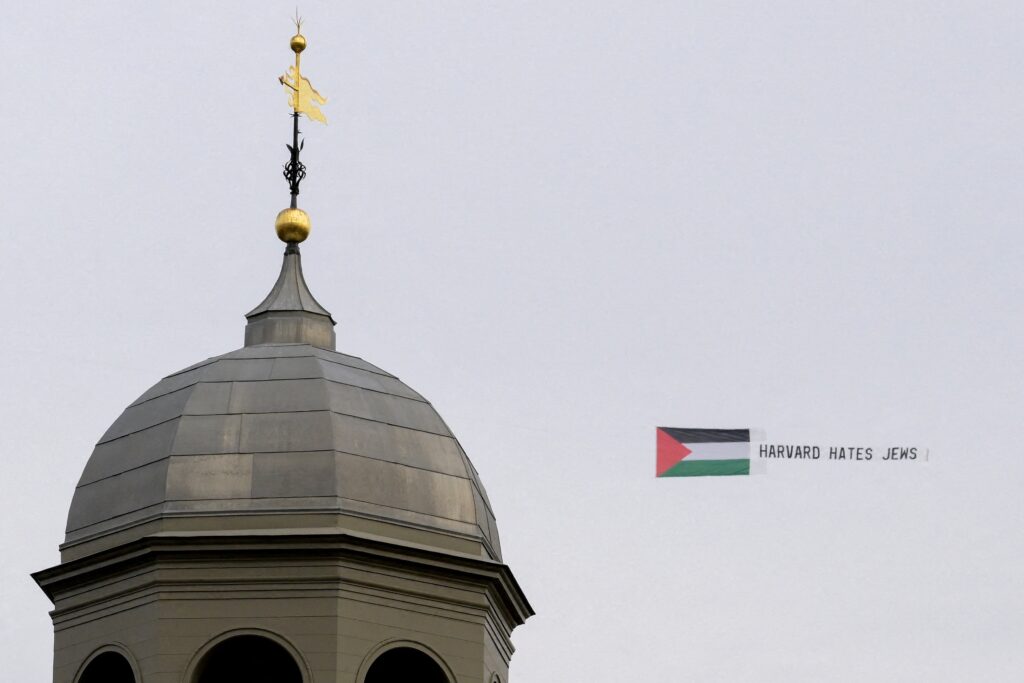
In the wake of genocidal violence in Gaza and the silencing of debate on college campuses, it now hardly matters that I, along with others, did not like every aspect of the arguments made by some student groups in the wake of October 7. When I offered my critique in the London Review of Books of the language used by the Harvard Palestine Solidarity Committee, I did so in the spirit of a conversation. I did not foresee how their viewpoint would be shut down, nor the extent of harassment and doxxing they would suffer. There is, however, still time to defend these students’—and all students’—rights to express their point of view without fear of retaliation or harm.

The crisis of academic freedom we are currently facing is as acute as any since the McCarthy years in the United States. The charge of anti-Semitism has been instrumentalized to shut down speech in ways that should be acutely alarming for anyone who cares not only about free speech in the public domain, but academic freedom on college campuses. When even calls for ceasefire are considered anti-Semitic, only those who support Israel’s annihilationist war against the Palestinian people in Gaza are exonerated of the charge. The conflation of anti-Semitism with anti-Zionism can only serve the purposes of extreme censorship, for it constrains those who oppose ongoing Israeli violence, the killing of nearly 18,000 Gazans to date, from expressing moral and political outrage and defending fundamental principles of free expression and political justice. If we dare to name the killing as annihilationist, as bearing genocidal intent, or as genocide itself, as more than 800 jurists have recently insisted, then we are accused of anti-Semitism. But what does it mean to speak up against genocide only to be censored? It means that only speech that defends injustice is defensible.
Students were right to bring attention to the longer history of violence that has culminated in this horrible moment.

When Israeli generals, backed by President Herzog, contend that there are no civilians in Gaza (evoking Golda Meir’s infamous phrase that “there is no such thing as a distinct Palestinian people”) they set the stage for being fully exonerated for obliterating civilians in Gaza. If there are no civilians, then there can be, by definition, no civilian deaths, no war crimes can be committed, and all killing is justified. The “no” of “no civilian deaths” bespeaks and ratifies the logic of annihilation itself. It does not happen and it cannot be opposed. Derealization of killing joins the censorship of any speech that would name it as genocide or even as a war crime or call for its end. It makes sense that student groups form and join small and massive rallies alike to protest this detestable logic and the relentless campaign of slaughter it supports. Those who oppose their protests as “anti-Semitism” cheapen, inflate, and instrumentalize a charge that should be reserved for the clear instances of anti-Semitism that emerge in anti-Zionist rhetoric. Those should be named and opposed since all racism must be opposed. So too should Christian nationalist anti-Semitism that supports Zionism, to which Netanyahu gives a pass. But precisely in this moment we are called upon to ask how censorship, doxxing, and bullying not only suppress—or outlaw—the public condemnation of crimes against humanity but serve to justify the killing In a mind-bending twist, those who oppose genocide are, paradoxically, sometimes accused of genocidal intention, as we saw in Republican representative Elise Stefanik’s December 7 public grilling of University of Pennsylvania president Liz Magill and Harvard president Claudine Gay. Her interrogation packed a number of dubious assumptions into the questions—that certain phrases express genocidal intent—rather than considering their place in an emancipation movement. Intifada, generally translated as “uprising” in Arabic, means “to be shaken” or “to shake oneself.” It is understood as a movement that refuses to remain docile in the face of colonial violence, an effort to throw off the shackles of colonial rule. It is also a call for Palestinian unity. Does it necessarily imply genocidal violence? No. Now, some may imagine that the colonized, once freed of their shackles, will turn against the colonizer with vengeful, genocidal intention. But imagining is not prediction. Indeed, that will not happen if a radical decolonization is successful. If the rage of intifada, however, is directed against colonial rule, then decolonization will more likely produce another emotion: emancipatory joy, a sense of freedom, the release from shackles that have only tightened over the seventy-five years of their imposition. One need only ask whether Palestinians would prefer to be killed by non-Jewish actors to see that it is state violence they oppose.

When asked whether Harvard University would condemn calls for Jewish genocide, Gay rightly hesitated, since the question assumed that anyone who called for “intifada” or chanted “from the river to the sea” was expressing genocidal intent or making a concrete threat to obliterate Israeli Jewish life, or Jewish life more broadly. The interrogation should have stopped right there to expose its fugitive assumptions. In the moment of questioning, however, they were consolidated: “intifada” and “from the river to the sea” were, without a pause of reflection, made identical with calling for genocide against the Jews, and calls for liberation were understood as threats of anti-Semitic violence. When the ability to reflect on questionable assumptions is ruled out, the trap is set. The terrible consequence is that there can be no critique of Israel’s killing machine, no oppositional speech, that is not immediately construed as a call for violence—if not the verbal threat of violence itself. Any president would be right to hesitate before answering such a question, since the interrogator has offered a set of false premises and specious conflations in the form that that question has taken. In the aftermath of Magill’s resignation, president Gay has an ethical decision to make: to stand up to forms of inquisition that conflate resistance to Israeli violence with genocidal intention, to stand up for the rights of protest and dissent, or to become an instrument of censorship and denial. Her stated apology does not bode well. Whatever she finally decides will set a consequential precedent for both academic freedom and freedom of expression.

At universities, we question the question for its premises. If we lose that critical capacity from our classrooms and from public life, we have lost our mission, and we have failed ourselves and our students. The censor is fierce and consequential, since we do get cancelled or lose our positions, or become smeared in the media. Without conviction, many simply obey the demand to signal their condemnation of Hamas in formulaic ways out of fear. Critical thought has vanished, and the demand to display moral condemnation becomes a form of moral terror.

Gay’s position has been compromised from the beginning by allowing the doxxing of students and failing to support their basic rights of assembly and expression. Of course, she has been, and will now be, criticized by Zionists for not having intervened to shut down the Harvard Palestine Solidarity Committee more quickly and brutally. The effort to suppress their message helped to initiate the the wave of campus censorship we now see, one that operates formally and informally. Such censorship not only allows this campaign of slaughter against Palestinians to continue but serves as its mirror and justification. The Israeli state shuts down Palestinian life, and censorship of statements of solidarity with the Palestinian struggle (conceived as larger and longer than Hamas) are shut down as well. The one requires the other, since a war against civilians can only be won if (a) the international community is convinced that civilians are either human shields or all terrorists and (b) open, public criticism of those assumptions, among other appalling conflations, can be suppressed. In other words, killing with impunity of this magnitude requires a censorship campaign that shuts down speech that would rightly name and oppose that killing, narrate the history of killing, and the structural violence of the state itself.
Censorship wields power, but it confesses that matters are already out of the control of those who use it.

It is not just the Harvard students who find their speech mangled in the public reception and their lives besieged by media attacks, doxxing, and harassment. All student speech that seeks to counter the conflation of anti-Semitism with anti-Zionism, or indeed, all efforts to name Israeli killing as genocidal, are targets. Students are harassed and job offers are rescinded, their professional aspirations are halted or destroyed, and their ability to withstand appalling accusations results in forms of psychic damage that only they can truly (one day) relay.

If this moment were less fraught with fear and hatred, we could pause and ask some important questions. Is Hamas a terrorist movement or a movement for armed resistance? When students defend Palestine, are they calling for decolonization, the end to Israeli state violence, or are they cheering for the death of Israelis? Shall we ask them? Shall we bother to find out? Or should we, as we now do, move quickly to the conclusion that the emancipation of Palestine leads to death for Israelis when, in fact, it may lead to a new possibility for cohabitation, whether in a one- or two-state solution or another form of governance? My own political alliances remain with the Boycott, Divestment and Sanctions movement whose nonviolent instruments and aims comport with my own values. But perhaps it is important to ask those who defend Hamas as a movement of armed resistance how they situate this armed resistance within a history of armed struggles, and what, if any, conditions would have to be met for the laying down of arms. One obvious answer is that Israeli state violence would have to end. If Israeli state violence is the condition of possibility for armed resistance, then the cessation of that violence would doubtless produce another political constellation.

I quarreled with the Harvard Palestine Solidarity Committee in my LRB essay for claiming that “the apartheid regime is the only one to blame” for the deadly attacks by Hamas on Israeli targets. I thought it was “wrong to apportion responsibility in that way, and nothing should exonerate Hamas from responsibility for the hideous killings they have perpetrated.” I do not think it makes sense to say that Israeli violence is the name for the violence that Hamas commits, since Hamas has its own plan, and the decision to launch an armed struggle is one for which it assumes responsibility. One could even say that claiming Hamas’s violence is only Israeli violence turned back on the Israelis undermines the agency of those Palestinians who have taken up the position in favor of armed struggle. They are not vessels for a reverse Israeli violence but are acting in their own name and for their own reasons, or so I would presume. That said, the students are surely right that there would be no need for armed struggle were there not an ongoing and insufferable infliction of state violence by a colonial power against the besieged and dispossessed.

But this thought can barely be communicated, let alone argued with, under present historical conditions. Palestinian lives are being destroyed in Gaza, and every Palestinian will object to that destruction. If they object, and we object with them, that does not make us supporters of Hamas. It only makes us vocal critics of genocide.

Let me then apologize and make clear: the students have every right to oppose the way that “the conflict” has been framed in the press, the way that October 7 and Hamas’s acts become the false starting point for any public debate, effacing the seventy-five years of occupation, detention, dispossession, and land theft that came before it. We do not have to back everything about their message to deplore unconditionally the way they have been damaged by the Zionist movement in the United States. They have a right to speak, to speak out against injustice, and to have their voices be heard—and fairly debated—in the public sphere. The censorship of their voices is in all respects unconscionable, for it demands silence in the face of an appalling attack on Palestinian lives and refuses to consider the campaign of slaughter that Israel now wages as part of a longer campaign to deny the basic rights of the Palestinian people to their homes, their land, and a future of political self-determination free of violence.

Censorship is always the instrument of the weak. Yes, it wields power, but it confesses that matters are already out of the control of those who use it. Censorship is deployed by those who seek to contain or eliminate a point of view they do not want to be heard. It attributes great power to that point of view because, perhaps, it knows that vocal opposition to injustice can attract supporters who still have the courage to see, name, and oppose the horror of what is happening. Censorship may instill fear of the censor in those who watch its operation as the cultural wing of the military campaign against Palestine. But there are always those who refuse to be contained or silenced by the censor, those whose sensibilities are awakened by the censor and oppose the stifling of speech and debate. Let us join those who believe that the Harvard students were right to speak freely, right to oppose injustice, and right to bring attention to the longer history of violence that has culminated in this horrible moment.

Universities should be places where we are free to learn about such viewpoints, where students are free to express dissenting ones, and where debates on the merits of their views should be encouraged. There are so many conversations to be had, including the question of how those of us committed to nonviolence can play an active role in preserving rights of speech and the critique of falsehoods. Censorship belongs to the scourge of authoritarianism. And as attacks on democracy are rampant and rising, it is the responsibility of university administrators to safeguard rights of free expression, especially when the atmosphere is tense, the language is fraught, and allegations and threats take the place of reflection and debate. To be prohibited from opposing injustice is to suffer a further injustice. Can we perhaps have a debate about justice? The university might then have the chance to renew its reputation for open inquiry. Can we listen to our students? The university might then have a chance to become a place of learning and provide, for faculty, a new lesson in humility.

Boston Review is nonprofit, paywall-free, and reader-funded.


Judith Butler


ABOUT THE AUTHOR:


Judith Butler is Distinguished Professor at the Graduate School at the University of California, Berkeley. Her forthcoming book, Who’s Afraid of Gender?, will be published in 2024.

Michel Moushabeck On The Truly Dire and Catastrophic Costs And Consequences Of All Out War On A Defenseless Population And What It Portends For The Future

"You know that the world is broken when a country is given the freedom to annihilate another people as the world watches in real time. This should shake each and every one of us to the core."

--Michel Moushabeck

https://truthout.org/articles/if-jesus-was-born-today-would-he-be-under-rubble/


If Jesus Was Born Today, Would He Be Under Rubble?

As U.S. leaders celebrate Christmas with their families, Palestinians will be mourning the loss of their loved ones.

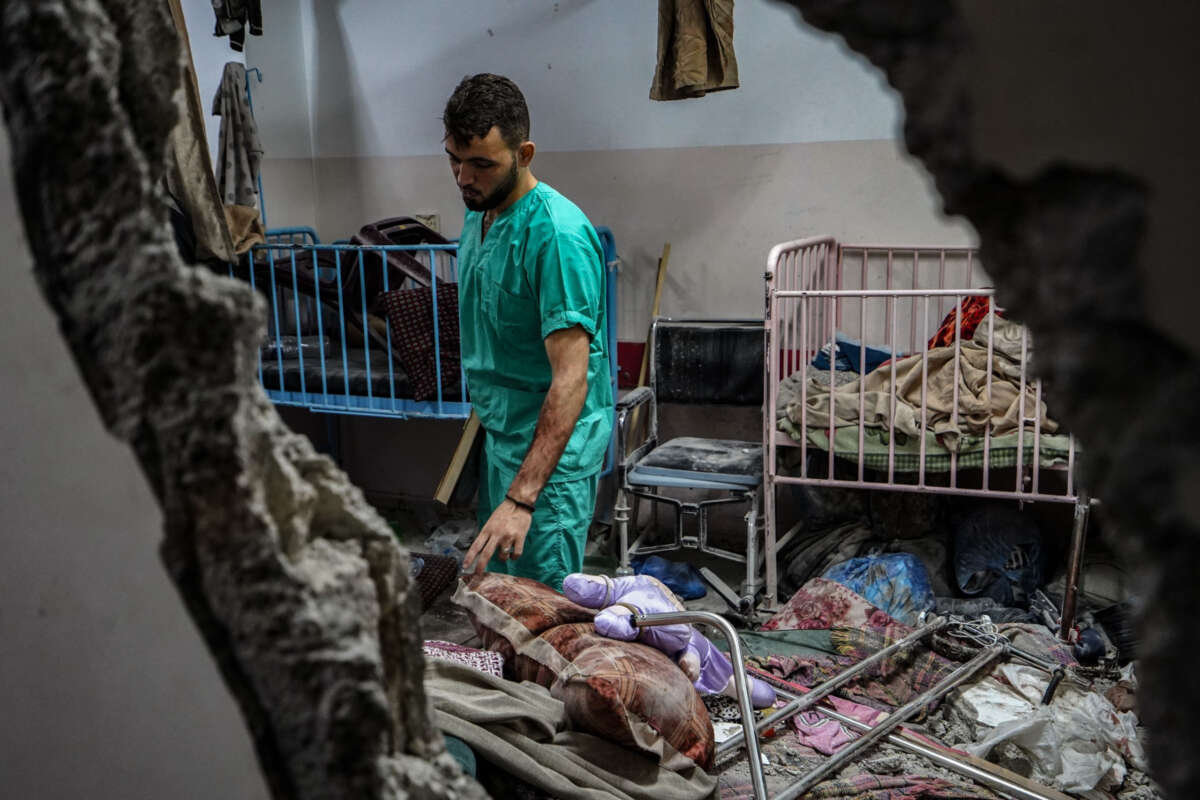
PHOTO:  A view of damage after the Israeli army hit the pediatric department of Nasser Hospital in Gaza's Khan Younis city on December 17, 2023. 

Monday, December 18, 2023

The Reactionary Lobbying Group AIPAC Is Attempting To Destroy the Careers of Progressive Socialist Politicians in Congress Focusing On 'The Squad'

https://jacobin.com/2023/12/pro-israel-billionaires-socialists-dsa-aipac-gaza-cease-fire-israel-war?mc_cid=917d570ade&mc_eid=543806b6cc 

Pro-Israel Billionaires Are Spending Big to Oust Socialists From Office

Across the country, pro-Israel groups and billionaires are trying to stop the antiwar movement pushing for a cease-fire in Gaza by bringing down its elected leaders, including Rashida Tlaib and Ilhan Omar. These are fights the Left can win with popular support.

PHOTO:  Benjamin Netanyahu speaking at the 2019 American Israel Public Affairs Committee Policy Conference in Washington, DC. (Cheriss May / NurPhoto via Getty Images)


Socialists in elected office are standing up for Palestinian rights and demanding a cease-fire in Gaza. A handful of billionaires, rejecting this progressive and popular agenda, are trying hard to take down these antiwar lawmakers. As well, many conservative and centrist Democratic candidates are launching primary challenges against them, hoping to be the recipients of big campaign cash from the American Israeli Public Affairs Committee (AIPAC) and similar pro-Israel groups. AIPAC and its allies — like-minded organizations and big donors — told the New York Times that they are going to spend big, probably far more than in previous election cycles, to defeat anyone standing up for Palestine. Many of their targets are members of Democratic Socialists of America (DSA) or close allies of the organization.

It’s essential that we defend those elected officials who are providing principled leadership to the Left in the midst of Israel’s brutal assault on the Gaza Strip, which has so far killed more than nineteen thousand Palestinians. Israeli president Benjamin Netanyahu’s allies have plenty of money, but politically, they’re flailing as international support for Israel’s war gradually declines in the face of its indiscriminate bombing of civilians. The call for a permanent cease-fire in Gaza is broadly popular, as are the economic justice issues these officeholders champion, so these should be winnable fights if the Left can stay organized. A 61 percent majority of likely US voters believes the United States should support a cease-fire, while only 28 percent oppose such a move — even though only sixty-two members of Congress have publicly called for one so far.

Michigan representative Rashida Tlaib may be number one on AIPAC’s enemies list. The DSA-endorsed congresswoman, who is the only Palestinian American to serve in the US House of Representatives, has faced censurefrom her colleagues for her Palestinian advocacy. Two Detroit Senate candidates say that AIPAC offered them $20 million to abandon their Senate races and run against her. Both refused, in pretty indignant terms, and despite the hefty political bounty on her head, Tlaib still doesn’t have a serious primary opponent. AIPAC has for now resorted to running attack ads against her through its dark money arm, equating her advocacy for a cease-fire in Gaza — and her participation in antiwar protests — with enabling terrorists.

AIPAC has a genuine challenger for Missouri representative Cori Bush, a democratic socialist activist from St Louis who introduced the House bill calling for a cease-fire, around which so much of the antiwar movement has mobilized. In an especially depraved move, Wesley Bell, the prosecutor who investigated the Ferguson Police Department after the infamous police murder of Michael Brown, switched his attentions from unseating far-right Senator Josh Hawley — a worthy goal — to launching a primary campaign against Bush, tapping into monied ire over her cease-fire bill.

Most of the “Squad” will be targeted in 2024. AIPAC remains, as the Nation put it in 2022, “desperate to defeat Summer Lee.” The group has tried backing both primary challengers and Republicans against the Pennsylvania representative and former DSA member, and it is expected to do so again in 2024. Minnesota representative Ilhan Omar, one of the most principled anti-imperialist and pro-Palestinian voices in office and a close ally of DSA members in Congress, faces multiple primary challengers competing for AIPAC funds.

Perhaps most worrisome is the animus against Representative Jamaal Bowman of New York. Bowman, ironically, left DSA when many members felt he was not sufficiently supportive of the group’s stance on Palestine, but he has turned out to be one of the strongest voices in Washington regarding the urgency of a cease-fire and the injustice of Israel’s occupation. Bowman’s seat may now be the most imperiled of any Squad member, as AIPAC has recruited Westchester County executive George Latimer to run against him, and Latimer may tap into considerable pro-war sentiment in the district.

Bowman isn’t the only New York elected official being targeted — a coalition of billionaires will also be taking aim at several state officeholders. A recent report in Hell Gate, a local New York City news site, confirmed rumors that had been flying around for months: a group of centrist and right-wing millionaires and billionaires, including Gil Cygler, a rental car mogul, as well as bigger names like Ronald Lauder (Republican diplomat and heir to the Estée Lauder Company) and Thomas J. Tisch (investor and Brown University chancellor), want New York’s socialists out of office. While these billionaires have disliked DSA’s success in expanding renters’ rights, the organization’s advocacy for Palestinians has galvanized even more ruling-class opposition.

DSA officials under fire include state senators Jabari Brisport of Brooklyn and Kristen Gonzalez of Queens, as well as Assemblymembers Marcela Mitaynes and Emily Gallagher from Brooklyn. (For full disclosure, I’m a DSA member and live in Brisport’s district; I’ve volunteered on his campaigns in the past and plan to do so again.) While the New York State Legislature does not set foreign policy, socialist elected officials have been visible at Palestinian solidarity protests.

A particular object of ire for the pro-Israel billionaires is Assemblymember Zohran Mamdani of Queens, who wrote the “Not on Our Dime” legislation, which would bar any charity in New York State from funding Israeli settlement activity (because the tax-exempt status of nonprofits makes them effectively government-supported). Mamdani also joined a group of legislators and activists on hunger strike in front of the White House recently, demanding a cease-fire in Gaza.

New York City Council doesn’t make foreign policy any more than the state government does. But these pro-Netanyahu billionaires understand that local leaders do help shape the discourse and play a role in building political movements. They’re also targeting Brooklyn councilmember Shahana Hanif, who was not endorsed by DSA but has said that she identifies as a socialist, and who has been outspoken in her support of a cease-fire in Gaza.

New York’s pro–Benjamin Netanyahu billionaires haven’t succeeded in their previous efforts to topple DSA-endorsed candidates. They have, however, backed successful challenges to longtime black socialist city councilmember Charles Barron and helped drive newcomer city councilmember Kristin Richardson Jordan, another democratic socialist not aligned with DSA, out of office.

The lawmakers presently targeted by AIPAC and the pro-Netanyahu billionaires are indispensable leaders on the Left, and it would be a travesty to lose any of them as political representatives. In the past, so much monied opposition might have been the kiss of death to an American left movement, especially given that most people aren’t well-informed about foreign policy. But that’s not the case right now.

The Left is up to the challenge of fighting well-funded opposition today. These fights require people and commitment, and all these districts have both — that’s how left-wing candidates get into office in the first place. DSA and allied groups like the Working Families Party, especially working with the wider movement for Palestinian rights and the hundreds of thousands of Americans who have taken to the streets to demand a cease-fire, have the grassroots power to fight back and win. Every decent American should join them.


ABOUT THE AUTHOR:


Liza Featherstone is a columnist for Jacobin, a freelance journalist, and the author of Selling Women Short: The Landmark Battle for Workers’ Rights at Wal-Mart.

Filed Under:

The Fundamental Crisis and Foundational Contradiction Facing the United States During the Upcoming Presidential Election Year of 2024: Fascism guided, informed, and enabled by the Doctrines and Practices of White Supremacy and Global Capitalism--PART 5

https://www.thenation.com/article/politics/rudy-giuliani-racism-media-tragedy/Politics

The Real Tragedy of Rudy Giuliani

The disgraced former mayor was a racist authoritarian—even back when he was being celebrated by the mainstream media.

by Jeet Heer
December 18, 2023
The Nation
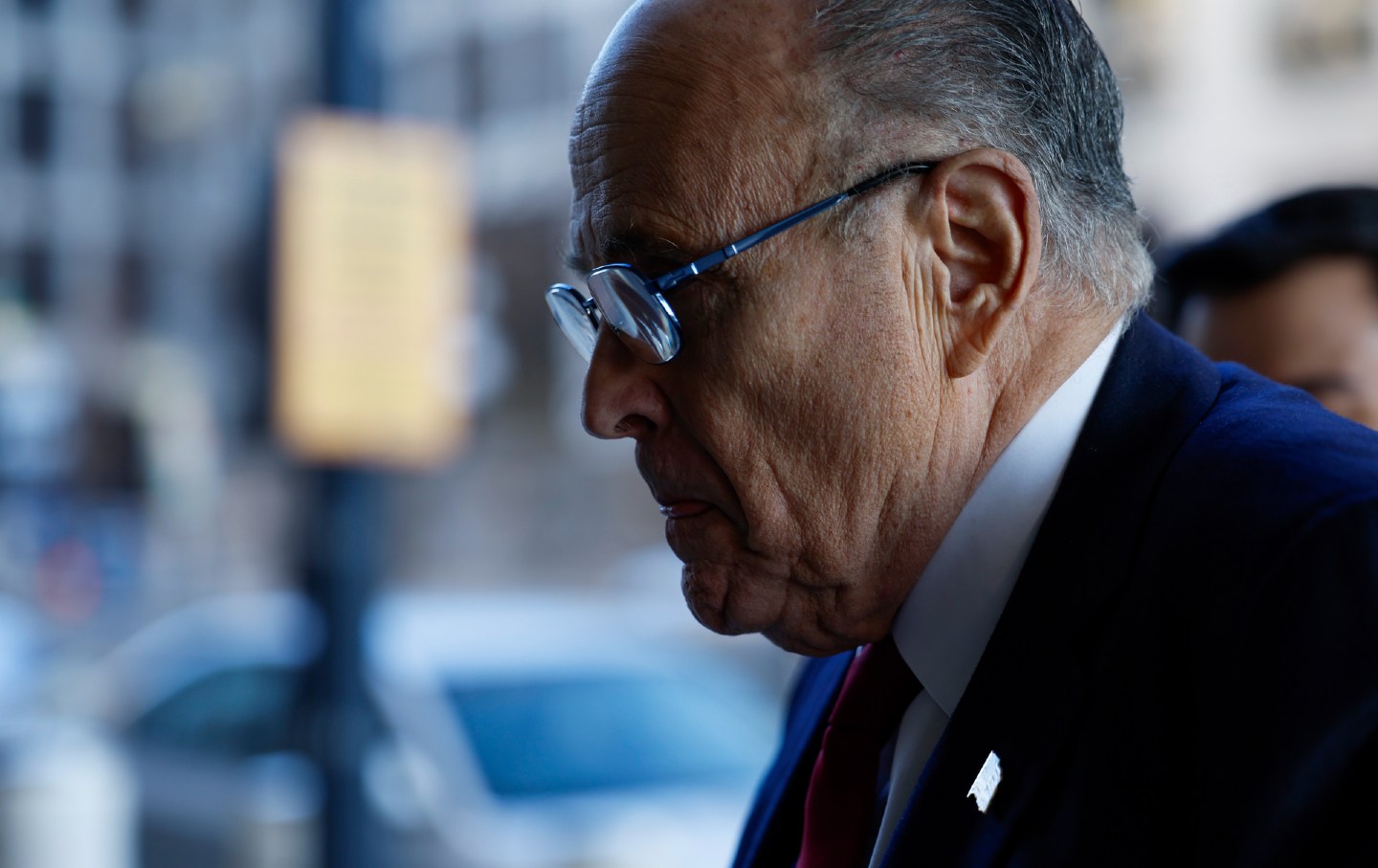
PHOTO:  Rudy Giuliani, the former personal lawyer for Donald Trump, arrives at the E. Barrett Prettyman US District Courthouse on December 15, 2023, in Washington, D.C. (Anna Moneymaker / Getty Images)

The disgrace of Rudy Giuliani is one of the most dramatic decline-and-fall stories in American history—all the more startlingly precipitous because he was in the recent past a figure whose popularity seemed to transcend normal partisan divides. On Friday, a federal jury in Washington, D.C., ordered that the former New York City mayor pay $148 million to two Georgia election workers whom, as determined by the judge in the case, Giuliani had defamed by claiming they had helped steal the election from Donald Trump. The case, along with Giuliani’s other ongoing legal troubles—such as the push to have him disbarred in Washington, D.C.—is an outgrowth of his role as one of Donald Trump’s key enablers in the failed coup attempt of January 6, 2021. The election workers won’t collect more than a minuscule fraction of the judgment because, although Giuliani refuses to disclose his finances to the court, there’s every evidence that he’s broke. A man whose net worth in 2007 was estimated to be $30 million is now effectively penniless, reduced to making money by recording voice messages for the service Cameo.

Giuliani’s name is now a byword for corruption, dishonesty, and buffoonery—especially after he had been pranked by the comedian Sacha Baron Cohen for a particularly humiliating scene in the satirical film Borat 2 (2020). Yet, not too long ago, Giuliani was one of the most admired public figures in America, celebrated not just for his seemingly dauntless leadership after the 9/11 terrorist attacks but also credited for the revival of New York during his two terms as mayor from 1994 to 2001. The city in those years enjoyed both a robust economic recovery and a sharp decline in crime, for which a broad swath of the mainstream press was happy to credit the mayor.

Giuliani was Time magazine’s Person of the Year in 2001, with a cover that proclaimed him a “tower of strength.” Not to be outdone, Newsweek enthused that Giuliani was “our Winston Churchill” and “setting a new global standard for crisis leadership.” The mayor, Newsweek cheered, “was strong, sensitive, straightforward and seriously well informed about every meaningful detail of the calamity. The mayor is unmistakably in command, and every New Yorker—even those who still dislike him—is gratefully in his debt.” In 2006, a poll showed Giuliani was the most popular politician in the country, outranking Barack Obama and John McCain. That pinnacle didn’t last. As The Washington Post reportedin September,  “Giuliani’s actions as New York’s mayor on Sept. 11, 2001, and in the days after earned positive marks from nearly 8 in 10 Americans, but his image rating has steadily deteriorated since, to the point where a new CNN poll shows just 16 percent of Americans now view him favorably. A majority—51 percent—view him unfavorably.”

It’s common to describe Giuliani’s evolution from hero to bozo as “tragic.” But tragedy implies that Giuliani was a noble figure brought low by some regrettable flaw in his character. As such it validates the earlier panegyrics to Giuliani as being essentially accurate when they were written.

But in truth, Giuliani was never quite the hero he was made out to be. The true tragedy of his career is that the mainstream media, eager to have a socially moderate Republican to lionize, consistently whitewashed his record for decades, both before 9/11 and after. As my Nation colleague Spence Ackerman noted in his 2021 book Reign of Terror, “Guiliani had always been a media creation, propelled by journalists who might have found him incorrigible but generally treated him as a necessity to control an out-of-control city—something that, in practice, meant repressing Black, brown, and poor New Yorkers.”

Giuliani’s career as a media darling started in the early 1980s, after he became US Attorney for the Southern District of New York in 1983. He quickly earned a reputation as a tough-as-steel prosecutor who wasn’t afraid to go after mobsters, Wall Street inside traders, and even political crooks in his own party. A 1986 profile in Vanity Fair by Gail Sheehy was typical of the unvarnished hero worship Giuliani received. According to Sheehy, 

Rudolph Giuliani is the biggest face in New York law enforcement. That bloodless white face with dark steady eyes and goofy haircomb turns up everywhere, like a death mask, announcing the demise of the Mafia, promising punishment for crooked politicians, springing swift and terrible justice on blue-chip Wall Street traders. Most people are still fuzzy on his title—U.S. attorney for the Southern District of New York—but they know his monk’s face and his altar-boy lisp. Rudy Giuliani has become a force.

In retrospect, it’s striking that even the excellent late investigative reporter Wayne Barrett, later to be Giuliani’s most scathing and devastating critic, helped build the Giuliani myth in the 1980s. Both in his Village Voice columns and in the 1988 book City for Sale (cowritten with Jack Newfield), Barrett would present Giuliani as a righteous force for justice and decency. In City For Sale, Barrett and Newfield write that for Giuliani the US Attorney job “was an opportunity to return to the city of his birth and affection, to run the biggest U.S. Attorney’s office in the country, with a staff of 130 lawyers, and to be his own boss, to feel free to use the office as a pulpit for his ideas about the law and about values.” They also describe Giuliani as a “priestly prosecutor.”

Both Barrett and Newfield would dramatically revise their judgment of Giuliani—especially after his first term as mayor revealed a deep-seated racism. Barrett would write two thoroughly researched books: Rudy! (written with the assistance of Adam Fifield in 2001) and Grand Illusion: The Untold Story of Rudy Giuliani and 9/11 (cowritten in 2006 with Dan Collins). In 2002, Newfield weighed in with his own debunking book, The Full Rudy.

In his Village Voice column and in Rudy!, Barrett expressed special outrage at Giuliani’s racism, which was both personal and political (seen in Giuliani’s welfare-state austerity that targeted people of color, as well as his unwavering defense of police violence and racial profiling). In a 1999 column (with reporting from Nicole White), Barrett linkedthe political and the personal, noting that “his world is as a white as Seinfeld’s, a slice of the city so comfortably one-dimensional that even the popular star of the ongoing Giuliani serial cannot see his own, peculiarly un-New York, isolation. Not since Vincent Impellitteri nearly half a century ago…have there been so few black faces in high places in a city administration.” Barrett went on to note the media’s complicity in this racism, pointing out that The New York Times’ endorsement of Giuliani in 1998 “did not make a single cautionary mention of race.”

Barrett’s account is complemented b Newfield’s analysis in The Full Rudy, which traced Giuliani’s racism to his bitterness at his 1989 loss in the mayoral race to David Dinkins, New York’s first Black mayor. Newfield reports that in a 1992 conversation, Giuliani said, “They stole that election from me. They stole votes in the black parts of Brooklyn, and in Washington Heights. Illegal Dominican immigrants were allowed to vote in Washington Heights.” This type of unfounded conspiracy theory about stolen elections, of course, is the very same thinking that led to Trump’s attempt to overturn the results of the 2020 presidential race.

In Grand Illusion, Barrett and Cohen challenge the myth of Giuliani’s heroic leadership on 9/11. They document his failure to fix systemic problems that were visible after the earlier 1993 attack on the World Trade Center, particularly the fact that the radios of the fire department and police department weren’t in sync. This reporting was iconoclastic at the time but is now part of the conventional wisdom, endorsed by subsequent Giuliani biographer Adam Kirtzman and publications such as The New Yorker.

Barrett made amends for his earlier celebrations of Giuliani by doing the shoe-leather reporting needed to make clear how truly terrible the former mayor was. But while Giuliani’s reputation has continued to sink to new lows, few of the other media enthusiasts for Giuliani have ever done any expiation. Giuliani is now facing a reckoning for his actions related to January 6. But still unsettled is the wider reckoning of the media accomplices who built up the baseless myth of Rudy Giuliani.


ABOUT THE AUTHOR:

Jeet Heer is a national affairs correspondent for The Nation and host of the weekly Nation podcast, The Time of Monsters. He also pens the monthly column “Morbid Symptoms.” The author of In Love with Art: Francoise Mouly’s Adventures in Comics with Art Spiegelman (2013) and Sweet Lechery: Reviews, Essays and Profiles (2014), Heer has written for numerous publications, including The New Yorker, The Paris Review, Virginia Quarterly Review, The American Prospect, The Guardian, The New Republic, and The Boston Globe.


https://www.essence.com/news/politics/55-percent-white-women-trump-election-2020/

“What’s Past is Prologue…”

November 5, 2020

All,

The absolutely abysmal and frankly abject inexcusable FAILURE of so-called "3rd wave [political] feminism" among white American female voters over the past 40 years since 1980 is a national disgrace. Are you listening GLORIA STEINEM?....55% support for Trump is just pathetic!! (not to mention DEADLY).  

MEANWHILE:  STOP MAKING BULLSHIT RHETORICAL EXCUSES FOR THIS OBVIOUSLY BRAINDEAD CAPITULATION TO THE VIRULENTLY RACIST AND DEEPLY SEXIST TRUMPIAN STRATEGY OF "PROTECTING WHITE SUBURBAN HOUSEWIVES" AGAINST THE INVASION OF THE "POOR AND RAPACIOUS BLACK HORDES FROM THE PREDATORY CITIES."

And as for the relatively small (18%) but still deeply disturbing and thoroughy creepy rise of cynical/nihilistic black male voter support for rightwing demagogues and the reactionary machismo that comes along with it: All you clueless young brothers who actually think some old blustering rich fascist whiteman like Trump and his super-corrupt corporate cronies is somehow gonna "save you” had better WAKE THE FUCK UP or your/our collective fate is absolutely sealed for many decades to come. Don't be a ignorant SUCKER for such loathsome phonies and emptyheaded poseurs and assholes as Kanye, 50 Cent, Jay-Z, Ice Cube, and Lil Wayne, etc. These cowardly morons are living proof that celebrity based wealth and fame have nothing to do with having a brain or a conscience or being able to use them...

Kofi 


WASHINGTON, DC – NOVEMBER 03: A person in a costume holds a sign that reads “230,893 Dead, TrumpTo Blame, Trust Fauci!! Vote Biden!!” at the Black Lives Matter plaza on Election Day on November 3, 2020 in Washington, DC. After a record-breaking early voting turnout, Americans head to the polls on the last day to cast their vote for incumbent U.S. President Donald Trump or Democratic nominee Joe Biden in the 2020 presidential election. (Photo by Eze Amos/Getty Images)
https://www.essence.com/news/politics/55-percent-white-women-trump-election-2020/

Home · Politics

55 Percent Of White Women, 18 Percent Of Black Men Voted For Donald Trump: Exit Poll

Black women's support for Trump continues to be minuscule—8% in 2020 compared to 4% in 2016. While his support among Latino voters significantly increased.

by Essence · 
November 4, 2020

More white women voted for President Donald Trump in 2020 (55%) compared to the 53% (or 52% some polls found) who voted for him in 2016, according to the New York Times exit poll. Additionally, 18 percent of Black men who voted cast their ballots for Trump, compared to 13% in 2016.

Black women’s support for Trump continues to be minuscule, but doubled—8% in 2020 compared to 4% in 2016.

Trump’s support among Latino voters also increased. In 2020, 36% of Latino men voted for Trump compared to 32% in 2016. As for Latinas, 28% broke for Trump in 2020, vs. 25% in 2016.


Exit Poll
New York Times

Interestingly enough, Trump’s support among white men dipped significantly—58% in 2020 compared to 62% in 2016.

According to ABC exit polls, “Biden led by a 33-point margin among first-time voters, and a 26-point margin among voters ages 18 to 29, while Trump had a slight edge on seniors (50%-48%) in the exit poll results.”

The 2020 presidential race still hangs in the balance, but former Vice President Joe Biden appears to be in the lead, with Wisconsin being called for him Wednesday afternoon and Philadelphia, Pennsylvania, more than likely breaking his way.

According to both campaigns, Georgia is still very much in play.

Speaking to supporters Tuesday night, Biden appeared hopeful.

“We believe we are on track to win this election… keep the faith,” the Democratic presidential nominee told a cheering crowd in his home town of Wilmington. “It ain’t over until every vote is counted.”