AMY GOODMAN: This is Democracy Now! I’m Amy Goodman.
We look now at the state of the Republican Party as Tuesday’s presidential primary in New Hampshire narrows down to a two-person race after Republican Florida Governor Ron DeSantis announced he’s dropping out, in a video posted Sunday on social media.
GOV. RON DESANTIS: I am today suspending my campaign. I’m proud to have delivered on 100% of my promises, and I will not stop now. It’s clear to me that a majority of Republican primary voters want to give Donald Trump another chance.
AMY GOODMAN: As DeSantis drops out of the race and endorses Trump, more questions are being raised about Trump’s mental capacity. At a campaign event Friday in New Hampshire, Trump confused his Republican rival Nikki Haley repeatedly with former House Speaker Nancy Pelosi.
DONALD TRUMP: By the way, they never report the crowd on January 6. You know, Nikki Haley — Nikki Haley — Nikki Haley — you know they — did you know they destroyed all of the information, all of the evidence, everything, deleted and destroyed all of it, all of it, because of lots of things, like Nikki Haley is in charge of security? We offered her 10,000 people, soldiers, National Guard, whatever they want. They turned it down.
AMY GOODMAN: Trump’s lapse prompted his Republican presidential opponent Nikki Haley to question his mental fitness in an interview Sunday on CBS’s Face the Nation.
NIKKI HALEY: I mean, he claimed that Joe Biden was going to get us into World War II. I’m assuming he meant World War III. He said that he ran against President Obama. He never ran against President Obama. He says that I’m the one that kept security from the Capitol on January 6th. I was nowhere near the Capitol on January 6th. But, Margaret, don’t be surprised: If you have someone that’s 80 in office, their mental stability is going to continue to decline. That’s just human nature. We know that.
AMY GOODMAN: For more, we’re joined by historian Rick Perlstein, author of a four-volume series on the rise of the modern conservative movement. His column for The American Prospect is “The Infernal Triangle.”
Rick, welcome back to Democracy Now! We don’t have much time, but a lot to cover. Talk about the significance of DeSantis pulling out, endorsing Trump, what this all means now, the two-person race, though he is winning in polls by a level — I mean, in Iowa — we haven’t seen before, trounced DeSantis by 30%. And one after another Republicans are endorsing him.
RICK PERLSTEIN: Yes. He is definitely going to be the nominee, presuming his continued ability to function as a human being, which is, you know, negligible. The important thing to understand is that, you know, the horse race stuff is fine, but the horse race doesn’t matter if the guys in the MAGA hats blow up the track. The important thing is not how many votes Donald Trump is able to get. He’s going to win the nomination. The important thing is not how many votes he gets in November, because he’s going to claim he won no matter what. The important people is — the important question is: How many people are going to be willing to take arms up for Donald Trump, you know, on the next January 6th, you know, in 2025? I don’t want to be melodramatic about it, but, you know, reality itself now seems to — for millions of Americans, a considerable part of the Republican Party, flows from the person of Donald Trump. And the word we have to begin using for this situation, as melodramatic as it seems, is “American fascism.”
AMY GOODMAN: And can you talk about people like New Hampshire Governor Sununu, who did endorse Nikki Haley, now saying if it’s Trump, he’s going to ultimately support him, to the questioning of Kristen Welker on Meet the Press? “You’re saying you would support him despite January 6, despite what you said about insurrection?” All of these Republican leaders who have questioned Trump falling into line in the end, as Trump now, today —
RICK PERLSTEIN: Right.
AMY GOODMAN: — once again, is dealing with the rape of E. Jean Carroll, the judge called it, essentially, in common parlance, “rape.”
RICK PERLSTEIN: Right. There’s nothing new about that — right? — if we look at what people like Lindsey Graham said in 2015 and 2016 about Donald Trump, and then what they said when they saw him as a vector to keep their own power. Again, it’s really unfortunate and kind of creepy that the only sort of words that we have within the context of political philosophy that describe what’s happening come from the German language. This is Führerprinzip. You know, the truth comes from the leader.
And when they need to kind of get behind a criminal in order to be, you know, kind of a legitimate figure within a political party, that political party is — you know, you’ve got to wonder what these guys are going to look like 50 years from now in the eyes of history, right? They’ll look like, you know, the guys like Fritz von Papen, who said, “We have Hitler backed into a corner so far that he’s going to squeal.” Right? Fritz von Papen was the vice chancellor of Germany, the guy who made a coalition with Hitler that made him chancellor of Germany, right? These things are processes, you know? And we’re very far along a process, one for which the questions that are asked by conventional political journalism no longer signify anymore.
AMY GOODMAN: Florida Governor Ron DeSantis has dropped out of the presidential race two days before the New Hampshire primary, less than a week after he lost to Donald Trump by a record 30 percentage points in the Iowa caucus. In a video released Sunday, DeSantis said he’s endorsing Trump.
GOV. RON DESANTIS: He has my endorsement because we can’t go back to the old Republican guard of yesteryear, a repackaged form of warmed-over corporatism that Nikki Haley represents.
AMY GOODMAN: With DeSantis out, the Republican race has essentially become a two-person contest between Trump and Nikki Haley, the former South Carolina governor, who served as Trump’s U.N. ambassador. Over the weekend, Haley campaigned in New Hampshire. She questioned Trump’s mental fitness after he confused her with former House Speaker Nancy Pelosi. Joe Biden is now running an online ad questioning Trump’s mental capacities, featuring Nikki Haley’s comments.
NIKKI HALEY: Last night Trump is in a rally.
DONALD TRUMP: You know, Nikki Haley — Nikki Haley — Nikki Haley —
NIKKI HALEY: And he’s going on and on, mentioning me multiple times as to why I didn’t handle January 6th better.
DONALD TRUMP: Nikki Haley is in charge of security. We offered her 10,000 people. They don’t want to talk about that.
NIKKI HALEY: I wasn’t in office then. They’re saying he got confused. He got confused and said he was running against Obama. He never ran against Obama.
DONALD TRUMP: And we did with Obama. We won an election that everyone said couldn’t be won. Obama wants to — he doesn’t want to talk about it.
BRIAN KILMEADE: Well, you mean President Biden. So —
NIKKI HALEY: Don’t put our country at risk like this.
PRESIDENT JOE BIDEN: I’m Joe Biden, and I approve this message.
AMY GOODMAN: So, there Trump says he ran against President Obama. He also said you wouldn’t want Joe Biden to preside over World War II, instead of III.
What Florida Governor Ron DeSantis represented, the amount of money that he spent in this failed presidential bid, where it came from?
RICK PERLSTEIN: Yeah. I think the most important thing to understand about what Ron DeSantis represented, since, you know, he made no dent on the cult of personality of Donald Trump, you know, no appreciable contest, really, what he represents is the failure of the mainstream media to do its job in informing people about what it requires to be self-governing citizens. You know, they took this guy who celebrated torture at Guantánamo — you know, he kind of supervised it as a lawyer, laughed at the people being tortured — you know, a guy who basically is turning his own state into a kind of little fascist fiefdom, and they raised him up not only as the person who could beat Donald Trump, but as somehow better than Donald Trump, right? So we’re kind of caught in this hall of mirrors, as I’ve been repeating, where the kind of traditional ways of doing mainstream journalism, where you have the front-runner and you have the challenger and they’re in a horse race and yada yada yada, don’t even really signify what’s going on in America anymore.
AMY GOODMAN: And the amount of money that he got? He spent something like $150 million?
RICK PERLSTEIN: Right. This speaks to, I think, the way a fascist cult of personality works. It’s impervious to facts. It’s impervious to challenge, right? I mean, the fact that Nikki Haley is pointing out that Donald Trump thinks he ran against Barack Obama and that she was the speaker of the House, I mean, this resembles what we read about in 1984 by George Orwell, where, you know, your loyalty to Big Brother is signified by your willingness to say two plus two equals five. I mean, really, if you look at Donald Trump’s quote, it’s not only that he confused Nikki Haley with Nancy Pelosi, he said that he requested 10,000 troops. That never happened, right? So there’s no fact-checking that’s possible when you’re within this kind of mythic space of this kind of almost religous figure who’s going to deliver us from transcendent evil. It’s not the way people learn about thinking about American politics in journalism school.
AMY GOODMAN: I wanted to play a few of the clips of, well, then-Republican presidential contender — now he’s dropped out of the race — Florida Governor Ron DeSantis, who doubled down on the Florida Board of Education’s new rules that require educators to teach students that enslaved Black people, quote, “developed skills which, in some instances, could be applied for their personal benefit.” DeSantis defended the curriculum.
GOV. RON DESANTIS: I think that they’re probably going to show some of the folks that eventually parlayed, you know, being a blacksmith into doing things later in life. But the reality is, all of that is rooted in whatever is factual. They listed everything out. And if you have any questions about it, just ask the Department of Education. You can talk about those folks. But, I mean, these were scholars who put that together. It was not anything that was done politically.
AMY GOODMAN: The NAACP called Florida’s new curriculum a, quote, “sanitized and dishonest telling of the history of slavery in America.” Rick Perlstein, I was wondering if you could weigh in on this and also —
RICK PERLSTEIN: Right.
AMY GOODMAN: — the controversies around Nikki Haley, right? It’s now a —
RICK PERLSTEIN: Right.
AMY GOODMAN: — two-person Republican race.
RICK PERLSTEIN: Right.
AMY GOODMAN: Everything from her forgetting to say, as she said forgetting to say, but when asked what caused the Civil War, not mentioning slavery, and then —
RICK PERLSTEIN: Right.
AMY GOODMAN: — when asked on Fox about whether the United States was a racist country, she said it is not a racist country, and it never has been. Your thoughts, from DeSantis to Haley?
RICK PERLSTEIN: Right, yeah. This one goes way back in the history of the right and the conservative movement and the Republican Party. I wrote about this in my 2014 book, The Invisible Bridge, with Reagan on the cover. You know, when Roots came out and, you know, introduced Americans, many of them for the first time, to the cruelties of slavery, he said he hated this show, that, you know, treated all the white people as the bad guys and all the Black people as the good guys, right?
This script of innocence in which America is God’s ordained nation and can’t do anything bad, you know, is one of these kind of structures that Trump inherits, but, like so much of kind of Trumpism — right? — as shown by Nikki Haley, it’s kind of conventional Republicanism kind of turned up to 11. Right? But this idea that you cannot be disturbed with anything other than the pristine perfection of your own country, you know, you can’t really kind of function in the world that way, in a modern world, in which kind of complexity and contradiction and reality — right? — have to be the ground of your actions. So, we’re kind of stuck in this situation where half the country has to live in this kind of mythic dream space. And that’s why some of us are beginning to use the word “fascism” to describe, you know, basically, the hegemony of the Republican Party.
AMY GOODMAN: Talk more about fascism.
RICK PERLSTEIN: Well, fascism, you know, is not just kind of ugly right-wing politics, right? We’ve had that for a long time. Fascism is a cult of personality around the individual, who is taken to embody the will of the people. And it’s the idea of a mythic return to, you know, this past that requires the destruction of these transcendent enemies of the people who are kind of constituted in this way of thinking as normal, you know, the true Americans. And they believe things like, you know, when you hear Mike Lindell say, if you had accurate polls, 70% of the American people are red, right? This idea that they are the people, that they are the state, and the idea that any opposition to this is illegitimate.
And when you pair that with, you know, an armed opposition, that say, quite explicitly — and this is, you know, the NRA ideology — that their guns are for fighting tyranny, you know, and preserving the Republican form of government against the bad guys, the tyrants — and they say the Democrats are the tyrants — this is a very bad formulation. This is a very ugly situation. And if people are tired of politics, if people are exhausted of politics, I don’t know what to say. You know, we might not have a — as Donald Trump likes to say, we might not have a country anymore that we can recognize five, 10, 20 years from now.
AMY GOODMAN: You know, the New Hampshire primary is upon us. And when Republican New Hampshire Governor Chris Sununu was asked about what’s going on with the Republican Party on NBC Meet the Press, the host, Kristen Welker, this was his response.
GOV. CHRIS SUNUNU: I don’t care what political party you’re from, whether you’re an extreme conservative or a socialist liberal, everybody should be concerned with that type of mentality going into the White House.
KRISTEN WELKER: Despite all of these comments, despite his comments on immunity, despite what you said, about the insurrection, you would still vote for Donald Trump in a general election against Joe Biden?
GOV. CHRIS SUNUNU: Well, according to the polls, most of America would. This is how — I mean, this is what you guys aren’t reporting. This is how bad Biden has been. This is how incompetent he’s been. The guy can barely get off the stage. Nobody wants what is currently, and everyone is scared of a President Kamala Harris.
AMY GOODMAN: So, when he talked about everyone’s scared of, he didn’t talk about why he was endorsing Trump after criticizing him, you know, especially around —
RICK PERLSTEIN: Right.
AMY GOODMAN: — the insurrection. But he’s talked about Kamala Harris.
RICK PERLSTEIN: Right. Yeah, I mean, that’s the mythic dream space — right? — the idea that, you know, Joseph Biden is a total failure, right? I mean, you know, there’s a lot, lot, lot to criticize about Joseph Biden, but we also have the lowest unemployment rate in 50 years, right? So, it’s just this kind of made-up world, you know, where everyone is against Kamala Harris, right? And, you know, this is one of the ways a fascist formation functions, right? You need these legitimate conservativesm, and the Sununu family have been retainers in the Bush family, just to take one example. His father, I think, was the chief of staff — right? — of the first President Bush. You need this kind of legitimation by the so-called establishment conservatives in order to seem like a viable holder of a position of power. So, you know, he’s just as responsible for what’s going on as, you know, some Proud Boy who’s willing to beat up an election worker.
AMY GOODMAN: I wanted to ask you about the Davos meeting that took place, the Davos summit of the corporate elite of the world, corporate and governmental lead of the world, and what was being said. Last week, at the World Economic Forum, JPMorgan CEO Jamie Dimon talked about how Trump has been right on many issues. He said, quote, “I don’t think they’re voting for Trump because of his family values. Just take a step back and be honest. He was kind of right about NATO. He was kind of right about immigration. He grew the economy quite well. Tax reform worked.” And the reported consensus out of Davos is that Donald Trump isn’t just going to win the Republican primary, he’s going to win the presidency back.
RICK PERLSTEIN: Well, that, again, reminds us of the German elite in the early 1930s, who thought that, you know, basically, they could control this, they could ride this tiger, right? And, you know, that’s not why they’re voting for Donald Trump. You know, what was it? Eighty-two percent of Republican primary voters said they agreed with Donald Trump that undocumented immigrants were poisoning the blood of America, right? So he’s living in this mythic dream space, too. And that’s — wow, if you’re not joining the resistance to, you know, the end of democracy as we know it — again, this is another establishment member who is revealing himself as part of the problem.
AMY GOODMAN: I wanted to play for you Donald Trump addressing the Republican Jewish Coalition Annual Leadership Summit in October.
DONALD TRUMP: Because they want to destroy our country. They want to destroy our country. Under Biden, we have not one, but two immigration disasters. We have one on the border, and we have one in the Biden State Department, which is admitting colossal amounts of jihadists into our communities and campuses and our refugee programs. That’s why you see all of these big demonstrations in New York, in Chicago. Nobody can believe what’s taking place. They’re letting them in at levels that nobody’s ever seen before. We cannot allow that to happen. And we don’t want to be like Europe, with jihads on every corner. That’s what happens. I mean, we’re going to have — we’re going to be like Europe. You take a look at London. You take a look at Paris. You take a look at what’s going on over there. We want to be the United States of America, and we want to make our country great again. Right now we don’t have a great country. We have a laughingstock.
As president, I will end, once and for all, the mass importation of antisemitism into the United States. And just as I did before, we will keep radical Islamic terrorists the hell out of our country. We’re going to keep them out of our country. We were keeping them out. We were keeping them out. You remember the travel ban. On day one, I will restore our travel ban. We had a travel ban, because we didn’t want people coming into our country who really love the idea of blowing — blowing our country up. Let’s blow up our streets and our shopping centers and our people. So I instituted what we call the Trump travel ban. And it was an amazing success. It was suspended immediately upon his coming into the country. And I never talked about this for four years. I never mentioned it. We didn’t have one incident in four years, because we kept bad people the hell out of our country. We kept them out. We didn’t have one, not one instance. I didn’t want to say it during the four years, because I didn’t want to walk out of the speech and have something happen, right?
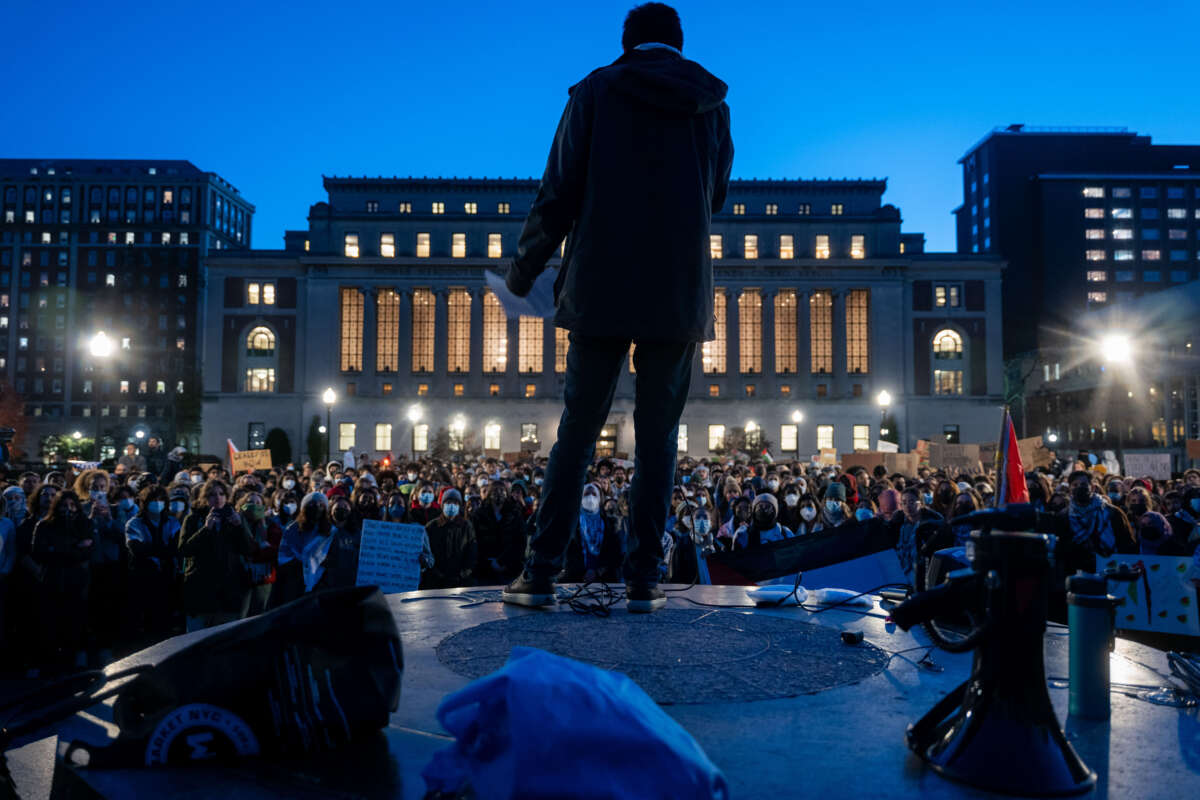
I’ll also be implementing strong ideological screenings for all immigrants coming in. If you hate America, if you want to abolish Israel, if you sympathize with jihadists, then we don’t want you in our country, and you’re not going to be getting into our country. I will cancel the student visas of Hamas and sympathizers on college campuses. The college campuses are being taken over. And all of the resident aliens who joined in the pro-jihadist protests this month, nobody’s ever seen anything like it. Come 2025, we will find you, and we will deport you. We will deport you.
AMY GOODMAN: So, that was President Trump after the October 7th attack, addressing the Republican Jewish Coalition, talking about the pro-Palestinian rights protests around the country on college campuses, among a number of other things, the Muslim ban, etc. Can you hold forth on this, Rick?
RICK PERLSTEIN: Yeah. First of all, I appreciate you running an extended clip, because people really need to know what Trump discourse sounds like, and not just kind of the soundbites that kind of get picked up in the media reports.
Second of all, there’s lots to say about that, but the thing that really leaped out at me was the beginning, when he said, “Oh, you know, the State Department has been infiltrated by jihadists.” And that’s, you know, an exact parallel to what Joseph McCarthy said in his famous speech in 1950, that the State Department had been infiltrated by communists. And it just shows how so much of what we’re dealing with now is kind of — these kind of scattered kind of roots of it, you know, exist throughout the history of the Republican right.
And what McCarthy was saying and what Trump is saying is that anything bad that happens in America was made to happen by elites, right? So, that is a very dangerous way of thinking. And then, everything bad that happened that elites have made happen is caused by aliens. You know, in Chicago, where I am now, an 8-year-old boy was stabbed to death by his landlord, because he thought this young Palestinian kid must be a jihadist, right? He’s scapegoating undocumented immigrants.
And the way this dreamscape works is, this promise of redemption, this promise that everything bad in the world is going to go away if these bad people go away, it can’t be satisfied. So that’s when you get to the next group. That’s why, you know, Pastor Niemöller’s, you know, “They came for the communists, and I didn’t say anything because I wasn’t a communist” is so prophetic. You know, when the redemption doesn’t come, when he, quote-unquote, “kicks out the Mexicans,” and when he, quote-unquote, “kicks out the jihadists,” people will be looking for the next scapegoat. And we need to appreciate that this is a ongoing process. It ratchets in a more and more authoritarian direction every week, every month, every year, so there’s kind of no fever that breaks here. We’re on a course that’s extremely dangerous.
AMY GOODMAN: So, I want to ask how Wall Street fits into this picture. As we were speaking, a piece came over on CNBC — right? — NBCs business channel, and it says, “As Donald Trump surges toward the Republican nomination, many Wall Street executives have made a calculated decision not to speak out against him, and in some cases they will consider supporting the Republican former president over … Joe Biden, according to [more than] a dozen people familiar with” this case. “This view reflects one shared by large portions of Wall Street, who are scrambling to come to grips with the idea that Trump is the likely [Republican] nominee for president and … could beat Biden in November. A Real Clear Politics polling average Sunday had Trump leading Biden nationwide by about 2 points in a general election.” What does this mean? And do you think that money determines who is president? Is that just a truism, or perhaps not?
RICK PERLSTEIN: Well, if money determined who was president, you know, Nikki Haley would be on a glide path, because she’s the Koch brothers’ candidate, right? There’s lots of things that determine who becomes president.
What leaps out at me at that is by the corporate elite saying, you know, “Yes, it doesn’t matter.” It doesn’t matter to them if Trump wins. You know, they can work with him — right? — is another one of those kind of Fritz von Papen situations, right? I mean, history will not absolve them. I mean, they will be looked at as part of the problem, when people look at the ruins, the smoldering ruins of America as a functioning republic, you know, if there are historians to tell us the story 50 years from now or a hundred years from now. I mean, these people, you know, have to join the fascist resistance, the anti-fascist resistance, or else, you know, it’s like Lenin said. I mean, they’re basically selling Trump the rope to kill them, because he’s going to be — you know, they’re going to be under his thumb, right? I mean, what Ron DeSantis tried to do with Disney is going to be a picnic to anyone who crosses Donald Trump, you know, even if they’re some kind of corporate master of the universe. I mean, you know, the guy is going to have the NSAsurveillance technology behind him. He has the army behind him. And the idea that they somehow believe that, you know, as Winston Churchill put it, they can kind of negotiate with the crocodile, it just means that they’re going to be eaten last.
AMY GOODMAN: So, talk about young people voting. You know, a while ago, you wrote this op-ed in The Washington Post about the Democrats forsaking young voters.
RICK PERLSTEIN: Right. Well, so, my column and a book I’m working on now about, basically, the last 25 years is called “The Infernal Triangle.” And the triangle is Republican authoritarianism, media incompetence — present company excepted — and, you know, kind of democratic fecklessness. And the fact that the Democratic Party has, you know, not seen it as an absolute priority to kind of hand the torch, to paraphrase John F. Kennedy, to a new generation of Americans is a real institutional failure and a real institutional tragedy, right? Because if people can’t feel like they can identify with the Democratic Party, well, you know, in our political system as it exists, it’s like Stephen Douglas said in the 1880s to African Americans. You know, the Republican Party might suck. You know, they might be becoming more and more plutocratic. They might not really be protecting us from, you know, lynching and terrorism in the South. But the Republican Party is the boat, and all else is the sea. And if the Democratic Party is not giving young voters, who, basically, you know, 10, 20, 30, 40, 50 years from now will be old voters, and if they become Democrats now will maintain that identity — if they’re not winning and maintaining their loyalty, they’re not doing their part to fight this fascism, either.
And, you know, I was very encouraged when Joseph Biden said that, you know, him and Kamala Harris were going to be — he said this in 2020 — kind of a bridge to the new generation of Democrats, but then kind of held on to their influence like grim death. You know, Nancy Pelosi, the fact that — you know, Ryan Grim has a wonderful — speaking of “grim” — a wonderful new book called The Squad. And the most shocking, jaw-dropping parts about it, frankly, is how instinctively she seemed to kind of patronize and condescend to the Squad and AOC, didn’t see them as an opportunity, but as a threat to her influence, you know, kind of calling the Green New Deal the “Green new dream” or whatever, right?
And, you know, to take your previous segment today on the issue of Israel-Palestine, nothing that the kind of superannuated class of 70-, 80-year-old Democrats believe about the world when it comes to what’s going on in the Middle East makes any sense to voters in their twenties, right? So, it’s just a terrible, sad situation. And we’re stuck with it. And, you know, I’ll go to the wall with the Democratic nominee, because the Democrats are the boat, and all else is the sea. But, you know, we have to think systematically about righting this tragic situation.
AMY GOODMAN: Can you say what you’re looking for, Rick, when it comes to the New Hampshire primary? And let me also say that this is not just a Republican primary. It’s also a Democratic one.
RICK PERLSTEIN: Right.
AMY GOODMAN: I mean, Biden had said that New Hampshire and Iowa shouldn’t be the first two states.
RICK PERLSTEIN: Right.
AMY GOODMAN: You know, some of the whitest states in the country —
RICK PERLSTEIN: Right.
AMY GOODMAN: — determining the agenda of the rest of the country or, you know, laying out so much of what happens next.
RICK PERLSTEIN: Yeah.
AMY GOODMAN: So, he is not on the Democratic Party —
RICK PERLSTEIN: Right.
AMY GOODMAN: — roster in New Hampshire. But, what, Congressman Dean Phillips is. And quietly, his aides are launching a write-in campaign for Biden. But explain what that’s about, and then what you’re looking for out of the Haley-Trump competition in terms of the breakdown of who’s voting for who.
RICK PERLSTEIN: Right, right. For the first part about the Democrats — and, you know, frankly, the behavior of the people running the Democratic Party in Iowa and New Hampshire, kind of holding on to their position of power, you know, as the first in the nation, like grim death, even though the DNC, quite reasonably and responsibly, tried to kind of reform that, it just shows, you know, one more tragedy of a group of incumbent power holders who don’t have the patriotism and civic fortitude to maybe do something for the common good of the country, right? This could have been fixed in 2024. It’s not being fixed.
And as far as the Republican side goes, you know, I will repeat this again and again and again and again, because Donald Trump is going to win the most votes in the primary. I mean, it’s really not worth all that much attention and coverage at all. The real question for voters who are supporting Donald Trump is, you know, not how many of them there are, but how many among them will be willing to take up arms on January 6, 2025, you know, if he loses the vote, you know, and, as we know he will do, claims that he won it. Right? So, we really need to think these days not just in terms of Republican voters, but as Republicans as also a paramilitary formation. And if reporters aren’t talking about that, if they’re not thinking about that, they’re still living in 1996.
AMY GOODMAN: And finally, Rick, with President Trump, for example, praising Viktor Orbán of Hungary and saying what he’s going to do on the first day, dictator for a day, he says —
RICK PERLSTEIN: Right.
AMY GOODMAN: — how seriously do you think people should take what he’s saying?
RICK PERLSTEIN: Very seriously. There’s no dictator for a day. Right? I mean, if you, you know, say that you’re going to reverse executive orders, that’s one thing. That’s constitutional. It’s within the law. But if you think of that as a dictatorship — right? — and we know from, you know, the 2025 project that Republicans have gotten together to put out as their plan, it’s a completely integrated, you know, thousand-page plan to undo the idea of expertise in civil service itself, right? It is a plan to undo the American form of government. So, this is absolutely something we should take seriously. He absolutely intends to be a dictator. And, unfortunately, people like Jamie Dimon want to help him do it.
AMY GOODMAN: And finally, why do you think Trump’s support hasn’t diminished at all, given the charges he faces for trials, 91 charges?
RICK PERLSTEIN: It’s the Führerprinzip. It’s that German word that all truth, all reality, all redemption flows from the person of Donald Trump. You know, it’s a cult of personality. There’s no breaking that spell, right? If the charge is coming from, you know, a state attorney general, well, that just means that it’s an African American, and they’re alien to real Americans, right? And the jury in a place like Washington is going to be Black, so they’re not real Americans. If it’s federal charges, it’s just somehow an extension of, you know, the deep state and Joseph Biden trying to delegitimize Donald Trump. It doesn’t matter what the facts are, right? This is a fascist dream space, a space of myth, in which there are bad guys and there are good guys, and Donald Trump is the good guy, and anyone associated with him is temporarily a good guy, and anyone against him is a bad guy and has to be terminated. That’s the situation we’re facing right now. We have to look it squarely in the eye, and we have to resist it with everything we have.
AMY GOODMAN: Rick Perlstein, author of a four-volume series on the rise of the modern conservative movement, author of Before the Storm: Barry Goldwater and the Unmaking of the American Consensus, Nixonland: The Rise of a President and the Fracturing of America, The Invisible Bridge: The Fall of Nixon and the Rise of Reagan, and Reaganland: America’s Right Turn 1976 to 1980. He also writes a column for The American Prospect titled “The Infernal Triangle.” We’ll link to it at democracynow.org