Monday, June 10, 2024

The Fundamental Crisis and Foundational Contradiction Facing the United States During the Upcoming Presidential Election of 2024: Fascism guided, informed, and enabled by the Doctrines and Practices of White Supremacy and Global Capitalism--PART 32

https://www.thenation.com/article/society/russell-vought-center-renewing-america-christian-nationalism/

Feature   

The Theocratic Blueprint for Trump’s Next Term

How the Christian nationalist vanguard would pursue unprecedented power over all branches of government.

by Chris Lehmann
June 6, 2024
The Nation

 
Illustration by Johanna Goodman.

This article is part of “Project 2025: The Plot Against America,” a Nation special issue devoted to unpacking the right’s vast and chilling program for a second Trump term.

This article appears in the June 2024 issue, with the headline “One Nation Under God.”


The first pages of Project 2025’s Mandate for Leadership invoke the Beltway axiom that “personnel is policy.” If that’s the case, readers should pay especially close attention to the handiwork of Russell Vought. Vought served as Donald Trump’s director of the Office of Management and Budget (OMB), the critical nexus of policy execution and agency performance in the executive branch. He has also served, by some accounts, as the lead administrator of the Project 2025 initiative, overseeing 1,000 employees in 30 separate task groups under its aegis. He also contributed a central chapter to Project 2025’s blueprint for a second Trump administration, bearing the deceptively anodyne title “Executive Office of the President of the United States.” In it, Vought lays out the case for unleashing untrammeled executive power from the maw of a “sprawling federal bureaucracy” that, contrary to the intent of the Constitution, “is carrying out its own policy plans and preferences—or, worse yet, the policy plans and preferences of a radical, supposedly ‘woke’ faction of the country.”

Vought proposes to curb the excesses of this dangerous administrative elite by expanding the prerogatives of presidential authority in every facet of the federal government’s operations. Right-wing power-mongers have long expounded the theory of a “unitary executive” as the most durable, efficient, and potent way to achieve a policy agenda that remains deeply unpopular with the American electorate, yet Vought seeks to transform that theory into a comic book plot arc, with a S.H.I.E.L.D.–style rescue mission to redeem a republic besieged by sinister bureaucratic scheming and administrative power grabs at every turn. “The overall situation is constitutionally dire, unsustainably expensive, and in urgent need of repair,” he writes. “Nothing less than the survival of self-governance in America is at stake.”


Project 2025

Why Trump’s Second Victory Would Be Worse
Robert L. Borosage

The Mandate for Leadership, Then and Now
Kim Phillips-Fein

Project 2025’s Guide to Subverting Democracy
John Nichols

In this dark vision of a looming administrative coup, the president becomes the Nick Fury savior figure: a master accruer of power devoted at the same time to its wide dispersion among the satellite communities of superheroes practicing an elevated MAGA-sanctioned lifestyle in conditions of stoic watchfulness. The president must be a figure of unparalleled ingenuity to carry out this ambitious agenda of national deliverance: “Success in meeting that challenge will require a rare combination of boldness and self-denial: boldness to bend or break the bureaucracy to the presidential will and self-denial to use the bureaucratic machine to send power away from Washington and back to America’s families, faith communities, local governments, and states.” (If you think, as Vought clearly does, that Donald Trump is the duly anointed avatar of this brand of benevolent spiritualized federalism, then I have a warehouse full of MAGA-branded Bibles to sell you.)

Since at least the heyday of Ronald Reagan, the American right has been steeped in the strongman vision of the presidency as a maximum lawgiver of patriotic virtue. That vision has guided the rampant consolidation of executive power, producing a model of presidential authority tailor-made for the abuses of a Caesarist figure such as Trump. Vought seeks to extend this legacy by championing his former bureaucratic haunt as the great cross-agency enabler of the Caesarist-Christian mashup that he wants a second Trump administration to be. He argues that the OMB must assume a far more aggressive role, for example, in securing the legal foundation of a MAGA imperial presidency—a great rolling brief for executive impunity that even past legal quislings such as John Yoo, the deputy assistant attorney general for the Office of Legal Counsel under George W. Bush, wouldn’t dare to dream of: “The Director must ensure the appointment of a General Counsel who is respected yet creative and fearless in his or her ability to challenge legal precedents that serve to protect the status quo.” This swashbuckling executive would rely on the OMB to face down renegade federal agencies “that attempt to protect their own institutional interests and foreclose certain avenues based on the mere assertion (and not proof) that the law disallows it or that, conversely, attempt to disregard the clear statutory commands of Congress.”

For adherents of actual democratic self-governance, Vought’s administrative theory of maximum executive power is plenty unnerving on its own. But an even fuller picture of the sort of substantive policy agendas that it would serve emerges in the theocratic mission of the think tank Vought launched after his tour at the OMB, the Center for Renewing America. This group is a partner in Project 2025, but it’s also a policy shop positioned firmly in the vanguard of the Christian nationalist movement, fiercely dedicated to shoring up a militant right-wing culture-war agenda and based on the lie that the United States was founded as an exclusionary, Christian nation. “Our mission is to renew a consensus of America as a nation under God with unique interests worthy of defending…where individuals’ enjoyment of freedom is predicated on just laws and healthy communities,” the CRA’s website announces.

If you’re curious to learn more about what the CRA’s vision of “healthy communities” might be, you can toggle over to a series of policy “primers” on the subject that advance a wide range of righteous crusades for a unitary executive to undertake. “Palestinian Culture is Prohibitive for Assimilation,” one such entry boldly asserts. “Yes, America’s Institutions Are Grooming Your Children,” another QAnon-adjacent offering proclaims. If that doesn’t have you sufficiently alarmed, check out “School Systems Are Corrupting Children with Pornography” or “Biden’s Woke War on Police.” There’s a rich mosaic of election-denial content under the deeply misleading heading of “Election Integrity,” while the designations “Medical Tyranny” and “Woke and Weaponized” speak—or rather shout—quite unmistakably for themselves. The overarching mood is less that of a colloquy of policy wonks than Steve Bannon podcasting on a meth binge.

Yet this is the labor of intellectual love undertaken by a man plainly positioning himself to be the cross-agency administrative czar in a second Trump administration. So if Trump wins another term and grants Russell Vought’s wishes, stand warned: He has already pledged his fealty to a vision of the MAGA imperial presidency that is equal parts Cotton Mather and Roy Cohn.


ABOUT THE AUTHOR:


Chris Lehmann is the D.C. Bureau chief for The Nation and a contributing editor at The Baffler. He was formerly editor of The Baffler and The New Republic, and is the author, most recently, of The Money Cult: Capitalism, Christianity, and the Unmaking of the American Dream (Melville House, 2016).


The Fundamental Crisis and Foundational Contradiction Facing the United States During the Upcoming Presidential Election of 2024: Fascism guided, informed, and enabled by the Doctrines and Practices of White Supremacy and Global Capitalism--PART 31


Under Trump, the DOJ Will Become the Legal Wing of the MAGA Movement

Should Trump win, conservatives have a plan to use the DOJ to make their darkest desires legal, while removing the legal means to stop them.

by Elie Mystal
June 7, 2024
The Nation
 
Illustration by Edel Rodriguez.

This article is part of “Project 2025: The Plot Against America,” a Nation special issue devoted to unpacking the right’s vast and chilling program for a second Trump term.
 
This article appears in the June 2024 issue, with the headline “A Legal Heist.”

There has probably never been a president who was more ignorant of the government, the Constitution, and the laws of this country than Donald Trump was in 2017. The man came to power with a child’s understanding of civics and a mob boss’s understanding of power. Instead of using the power of government to effectuate his agenda, he thought he could simply bend the law to his will.

Trump was wrong, and the Department of Justice showed him why. Trump fired FBI director James Comey (whose decision to reopen the investigation into Hillary Clinton’s emails happened to be one of the proximate causes of his election in the first place) for his lack of loyalty. That led the DOJ to investigate Trump’s abuse of power. Trump likely assumed that his attorney general, Jeff Sessions, a longtime senator and an early supporter of Trump’s vile candidacy, would put a stop to the inquiry. But to Trump’s surprise, Sessions followed department rules and norms and recused himself from the case, leaving Deputy Attorney General Rod Rosenstein to handle the investigation. Rosenstein eventually appointed former FBI director Bob Mueller as a special counsel, and while Trump was never held accountable for this crime, he learned that the Justice Department could be a threat to his lawless abuse of power.

It’s a lesson he will not have forgotten if he wins or steals a second term. Mandate for Leadership, the Project 2025blueprint for an eventual authoritarian takeover of the federal government, contains a lot of dangerous proposals for how Trump and his ruling conservatives can remake the executive branch. The authors’ ideas for the Department of Justice reflect not only their lust for unchallenged power, but also a deep fear of the DOJ’s independence—and, more particularly, the way that independence might be used against them if the DOJ is not brought to heel. Put simply: The conservatives hope to use the DOJ to make their darkest desires legal, while at the same time taking away the best legal means to stop them.

As a first step, the Project 2025 Mandate recommends hollowing out the FBI. Why the FBI? Think of it this way: If Project 2025 is basically a conservative heist plot, then the chapter on the DOJ is the part where the plotters explain how they plan to take out the security cameras and floodlights so they can proceed under the cover of darkness.

The chapter begins like the Seinfeld holiday of Festivus: with an airing of grievances that the conservatives have against the FBI, including its alleged attempts to “convince social media companies and the media generally that the story about the contents of Hunter Biden’s laptop was the result of a Russian misinformation campaign.” There are also entire paragraphs dedicated to railing against the FBI and the DOJ for trying to halt the spread of lies about the 2020 election—and, again, if you understand who these people are, you can see why stopping the government from policing their lies is a key goal.

In order to accomplish this, Project 2025 proposes pushing Congress to demote the FBI, and its director, to a lower rung on the DOJ’s organizational chart and make the director report to a political functionary. It also wants Congress to eliminate the 10-year term of the FBI director to make it easier for the president to replace the director at will, like most other political appointees. Again, Trump got burned for firing Comey, and this proposal would make sure any future FBI director is sufficiently loyal.
Current Issue

June 2024 Issue


If the conservatives simply wanted to destroy the FBI, I might agree with them. Even a cursory knowledge of the bureau’s history shows that the FBI is problematic: a dangerous tool of the surveillance state that, more often than not, has been deployed against civil liberties, civil rights, and social progress.

The problem with Project 2025 is that it doesn’t actually want to destroy the FBI; it wants to get rid of its independence—while keeping all of the FBI’s jackbooted thuggery so that it can hurt the “right” people. The Project 2025 Mandatecalls for renewing the bureau’s focus on “violent” crime—and that word choice is important, because it leaves out nonviolent crimes like bank fraud, tax evasion, bribery, and document theft—you know, all the things that Trump or his business or donor-class friends are accused of doing. The document further suggests stripping the FBI of its legal workforce—the 300 or so attorneys employed by the bureau—which would turn the FBI into an even blunter weapon than it already is, completely untethered from the Constitution or civil rights.

In line with the mission of hurting the “right” people, Mandate’s chapter on the DOJ details big plans for resuming Trump’s campaign against immigrants. Those plans include deploying the power of the Justice Department against Democrats who govern in “sanctuary cities.” Indeed, there’s a whole paragraph devoted to the wild idea of using the DOJ to sue district attorneys who use their discretion in ways that the conservatives don’t like—including, though hardly limited to, refusing to help deport immigrants:

Where warranted and proper under federal law, initiate legal action against local officials—including District Attorneys—who deny American citizens the “equal protection of the laws” by refusing to prosecute criminal offenses in their jurisdictions. This holds true particularly for jurisdictions that refuse to enforce the law against criminals based on the Left’s favored defining characteristics of the would-be offender (race, so-called gender identity, sexual orientation, etc.) or other political considerations (e.g., immigration status).

That paragraph is bonkers (and its recommendations would be unconstitutional if the people behind Project 2025 hadn’t already secured a conservative Supreme Court to rubber-stamp their authoritarian plans). But it reflects a general trend in Mandate’s chapter on the DOJ to put the department on the offense against the favored targets of the MAGA movement: people of color, women, immigrants, and the LGBTQ community.

Toward that end, this chapter proposes transforming the Civil Rights Division of the DOJ into a tool to fight for white supremacy instead of against it. It aims to do this by using the division to prosecute institutions and organizations that promote diversity as violating the civil rights and equal protection of whites, and it’s the logical conclusion of the conservative assault on affirmative action and DEI programs. Here’s the breathless language:

and other federal entities—has enshrined affirmative discrimination in all aspects of its operations under the guise of “equity.” Federal agencies and their components have established so-called diversity, equity, and inclusion (DEI) offices that have become the vehicles for this unlawful discrimination…. The Civil Rights Division should spend its first year under the next Administration using the full force of federal prosecutorial resources to investigate and prosecute all state and local governments, institutions of higher education, corporations, and any other private employers who are engaged in discrimination in violation of constitutional and legal requirements.

Using the DOJ to sue companies that hire people of color or women is meant to dissuade companies from hiring people of color or women, because according to conservative whites, anytime a person of color or a woman is hired for anything, it is because of affirmative action or DEI. This section is an attempt to whitewash America through force of law, since “the market” has rejected white supremacy (at least superficially) as a sound business practice.

When you break down what Project 2025 wants to do with the Justice Department, it’s chilling and terrifying, and yet I’m also struck by how petty and mean-spirited the tone of the document is. These people are consumed by their personal grievances (against Black people, against the media, against Hunter Biden and his laptop). There are multiple passages devoted to complaining that the DOJ has prosecuted people who threaten abortion clinics and parents who threaten school boards, as if being vile and hateful toward pregnant people and schoolteachers is their most precious “freedom.” Giving these people the DOJ is like giving a chimpanzee a gun: It’s inherently dangerous even when the chimp wields it like a crooked club.

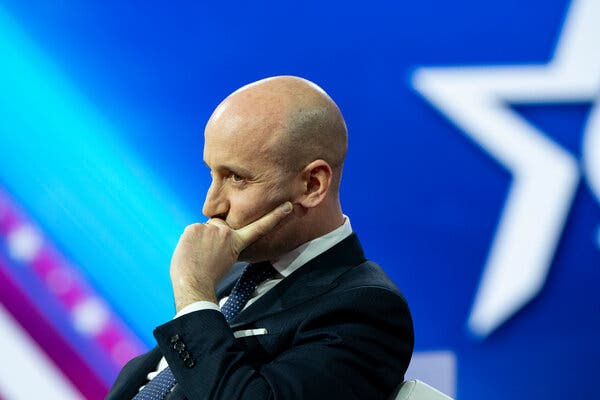
Next time, Trump will not be handing the DOJ to people like Jeff Sessions and Bill Barr—people who wanted to use the department to further the MAGA agenda but felt bound by the rule of law. Next time, Trump will let someone like Stephen Miller, a ghoul who wants the law to promote bigotry instead of eradicating it, run the Justice Department. He’ll hand it to a devout loyalist and unreconstructed racist who wants to weaken the DOJ so it can’t hurt Trump, while weaponizing it against Trump’s enemies and the vulnerable communities he has decided to harass and terrorize.


Project 2025 is telling us exactly how the conservatives plan to take away the rights of women, people of color, and the LGBTQ community. I beg the American people to believe them. This dystopian future isn’t a threat, it’s a certainty, should we give these people power again.
 

ABOUT THE AUTHOR:
 

Elie Mystal is The Nation’s justice correspondent and the host of its legal podcast, Contempt of Court. He is also an Alfred Knobler Fellow at the Type Media Center. His first book is the New York Times bestseller Allow Me to Retort: A Black Guy’s Guide to the Constitution, published by The New Press. Elie can be followed @ElieNYC.


The Fundamental Crisis and Foundational Contradiction Facing the United States During the Upcoming Presidential Election of 2024: Fascism guided, informed, and enabled by the Doctrines and Practices of White Supremacy and Global Capitalism--PART 30

https://www.nytimes.com/2024/06/05/us/politics/trump-conviction-gop-revenge.html

The G.O.P. Push for Post-Verdict Payback: ‘Fight Fire With Fire’

Republican leaders in and out of government are publicly pushing to prosecute Democrats as legal retribution for Donald Trump’s felony conviction.

Listen to this article
11:36 minutes


Learn more

Stephen K. Bannon was one of many Republican allies of former President Donald J. Trump who called for revenge prosecutions in response to his felony conviction last week. Credit: Rebecca Noble for The New York Times

by Jonathan Swan, Maggie Haberman and Charlie Savage
June 5, 2024
New York Times


Republican allies of Donald J. Trump are calling for revenge prosecutions and other retaliatory measures against Democrats in response to his felony conviction in New York.

Within hours of a jury finding Mr. Trump guilty last week, the anger congealed into demands for action. Since then, prominent G.O.P. leaders in and out of government have demanded that elected Republicans use every available instrument of power against Democrats, including targeted investigations and prosecutions.

The intensity of anger and open desire for using the criminal justice system against Democrats after the verdict surpasses anything seen before in Mr. Trump’s tumultuous years in national politics. What is different now is the range of Republicans who are saying retaliation is necessary and who are no longer cloaking their intent with euphemisms.

Stephen Miller, a former senior adviser to Mr. Trump who still helps guide his thinking on policy, blared out a directive on Fox News after a jury found Mr. Trump guilty of falsifying financial records to cover up a 2016 campaign hush-money payment to a porn actress. Mr. Miller posed a series of questions to Republicans at every level, including local district attorneys.

“Is every House committee controlled by Republicans using its subpoena power in every way it needs to right now?” he demanded. “Is every Republican D.A. starting every investigation they need to right now?”

“Every facet of Republican Party politics and power has to be used right now to go toe-to-toe with Marxism and beat these Communists,” Mr. Miller said, using the catchall slurs Trump allies routinely use against Democrats.

Stephen K. Bannon, the former chief strategist to Mr. Trump, said in a text message to The New York Times on Tuesday that now was the moment for obscure Republican prosecutors around the country to make a name for themselves by prosecuting Democrats.

Mr. Bannon was convicted in a federal prosecution for failing to comply with a congressional subpoena in the Jan. 6 investigation, and faces trial in September in a New York state court — before the same judge who oversaw Mr. Trump’s trial — in a charity fraud case.

“There are dozens of ambitious backbencher state attorneys general and district attorneys who need to ‘seize the day’ and own this moment in history,” Mr. Bannon wrote.

And Senator Marco Rubio of Florida, the top Republican on the Senate Intelligence Committee who is in contention to be Mr. Trump’s running mate, wrote on X that President Biden was “a demented man propped up by wicked & deranged people” and it was now time to “fight fire with fire” — using flame emojis to represent the fire.

Officials with the Trump campaign did not respond to requests for comment.

Stephen Miller, a former senior adviser to Mr. Trump, called on Republicans in the House and in district attorney offices to retaliate by investigating Democrats. Credit: Haiyun Jiang for The New York Times

Seeking retribution through the justice system is hardly a new concept for Mr. Trump. In 2016, he echoed and encouraged chants of “lock her up” against his opponent, Hillary Clinton, whom the authorities had declined to prosecute for using a private email server while she was secretary of state.

While president, Mr. Trump repeatedly told aides he wanted the Justice Department to indict his political enemies. The Justice Department opened various investigations of Mr. Trump’s adversaries but did not ultimately bring charges — infuriating Mr. Trump and contributing to a split in 2020 with his attorney general, William P. Barr. Last year, Mr. Trump promised that if elected again, he would appoint a “real special prosecutor” to “go after” Mr. Biden and his family.

Now, it remains unclear whether calls for legal retribution will amount to much in the way of actual prosecutions, at least in the short term. Without control of the White House, people close to Mr. Trump are urging district attorneys and attorneys general in red states to start aggressively targeting Democrats for unspecified crimes.

A central tenet of their argument is that the four criminal cases in four different jurisdictions against Mr. Trump are illegitimate and nothing more than political weaponization of the justice system. They continue to put forward the theory, without evidence, that all four cases are the result of a conspiracy by Mr. Biden — implicitly or explicitly rejecting the notion that Mr. Trump has been charged with crimes based on evidence.

But based on their premise that the charges — and now convictions in the fraudulent business records case — are baseless and were invented for political reasons, they are arguing that Republican prosecutors not only should but can do the same thing to Democrats. In short, having accused Democrats of “lawfare” — or using the law to wage war against political opponents — Republicans are saying they should respond in kind.

Some veteran Republican lawyers have sought to dress up the need for such retribution as a matter of constitutional principle. Among those calling for eye-for-an-eye prosecutions is John C. Yoo, a University of California, Berkeley, law professor best known as the author of once-secret Bush administration legal memos declaring that the president can lawfully violate legal limits on torturing detainees and wiretapping without warrants.

“In order to prevent the case against Trump from assuming a permanent place in the American political system, Republicans will have to bring charges against Democratic officers, even presidents,” Professor Yoo wrote in an essaypublished by The National Review.

He added: “Only retaliation in kind can produce the deterrence necessary to enforce a political version of mutual assured destruction; without the threat of prosecution of their own leaders, Democrats will continue to charge future Republican presidents without restraint.”

Mr. Trump’s closest allies on Capitol Hill are less bothered about finding a high-minded constitutional rationale.

“President Biden should just be ready because on Jan. 20 of next year when he’s former President Joe Biden, what’s good for the goose is good for the gander,” said Representative Ronny Jackson, a Texas Republican and close Trump ally, in an appearance on the pro-Trump network Newsmax.

Mr. Jackson said: “I am going to encourage all of my colleagues and everybody that I have any influence over as a member of Congress to aggressively go after the president and his entire family, his entire crime family, for all of the misdeeds that are out there right now related to this family.”

Some of the rhetoric has gone even further.

“Not just jail, they should get the death penalty,” said Laura Loomer, a far-right and anti-Muslim activist with a history of expressing bigoted views, in a podcast appearance after the verdict. Ms. Loomer, a onetime Republican nominee for a House seat in Florida, is not officially part of the Trump campaign. Mr. Trump, however, has praised her as “very special,” invited her to travel with him on his private plane and has met with her at his private clubs.

On social media, there has been an explosion of violent rhetoric and threats against the judge in the New York criminal case, Juan M. Merchan, and the Manhattan district attorney, Alvin L. Bragg, who brought the charges against Mr. Trump.

Representative Jim Jordan of Ohio, a close Trump ally who is chairman of the House Judiciary Committee, sent a letter this week demanding testimony by Mr. Bragg and one of his top trial lawyers in the case, Matthew Colangelo.

Mr. Bragg’s office has not yet responded to the letter, but the demand appears to set the stage for an eventual subpoena and court fight. After the indictment last year, Mr. Jordan subpoenaed a former prosecutor in Mr. Bragg’s office, Mark Pomerantz, who eventually sat for a deposition about the investigation.

Mr. Jordan this week also proposed barring federal law enforcement grants from going to Mr. Bragg’s office and to the office of the district attorney in Fulton County, Ga., where Mr. Trump is facing state charges over attempted subversion of the 2020 election.

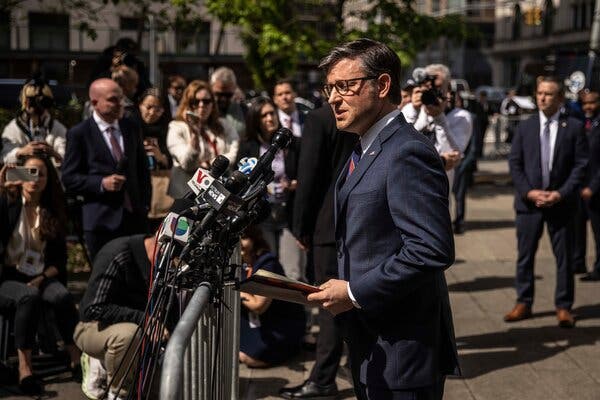
Speaker Mike Johnson went on Fox News and called on the Supreme Court to “step in” and overturn the Manhattan conviction, granting Mr. Trump immunity from prosecution. In the Senate, a group of Trump allies signed a letter declaring that they will oppose major legislation and Biden administration nominees, although they tend not to vote for Biden policies and nominees anyway.
 

Speaker Mike Johnson called on the Supreme Court to overturn Mr. Trump’s conviction and grant him immunity from prosecution. Credit: Dave Sanders for The New York Times

But the more extreme calls for not just oversight scrutiny and political obstructionism but revenge prosecutions are coming from former senior Trump administration officials and people close to the former president who are expected to play even larger roles in a potential second term. Their message is often apocalyptic.

There is no longer any room, they argue, for weaklings who fetishize decency and restraint.

Mike Davis, a former top Senate Judiciary Committee lawyer who is a close associate of Mr. Trump, is calling for an investigation of the investigators, similar to how the Justice Department under Mr. Trump used the special counsel investigation led by John Durham in a yearslong, unsuccessful attempt to find a basis to accuse high-level Obama administration officials of a crime because of the Russia investigation.

“The Republican attorneys general in Georgia and Florida and the county attorney in Maricopa County, Ariz., need to open investigations” into the prosecutors and investigators pursuing the indictments of Mr. Trump and his allies, Mr. Davis said. He added, “Then on Day 1, when he wins, President Trump needs to open a criminal civil rights investigation.”

Jeff Clark, a former Trump Justice Department official who has been indicted in the Georgia election case for his role in helping Mr. Trump’s attempt to overturn the 2020 vote in that state, has offered another suggestion. He has called for “brave” district attorneys in conservative areas to file lawsuits in federal court against people involved in criminal cases against Mr. Trump, under federal laws that allow people to seek monetary damages from government officials who violate their constitutional rights.

His theory is that the cases are a conspiracy to prevent Mr. Trump from effectively running for president. It remains unclear, however, why local criminal prosecutors would have legal standing to go into federal court and bring such lawsuits. A spokeswoman for Mr. Clark’s employer, the Center for Renewing America, a pro-Trump think tank, did not respond to a request for comment.

But there is no room on this issue for moderate or traditional Republicans, such as Larry Hogan, a former governor of Maryland and a star G.O.P. recruit to run for the Senate in the blue state. Mr. Hogan erred unforgivably in the eyes of the Trump team when he implored Americans “to respect the verdict and the legal process” regardless of the outcome.

Chris LaCivita, a top Trump adviser, addressed Mr. Hogan in a post on X: “You just ended your campaign.” And even though a victory by Mr. Hogan could make the difference between whether Republicans or Democrats control the Senate next year, Mr. Trump’s daughter-in-law Lara Trump, who is also the co-chair of the Republican National Committee, said on CNN that Mr. Hogan “doesn’t deserve the respect of anyone in the Republican Party.”

Luke Broadwater contributed reporting.
 

ABOUT THE AUTHORS:
 

Jonathan Swan is a political reporter covering the 2024 presidential election and Donald Trump’s campaign. More about Jonathan Swan

Maggie Haberman is a senior political correspondent reporting on the 2024 presidential campaign, down ballot races across the country and the investigations into former President Donald J. Trump. More about Maggie Haberman

Charlie Savage writes about national security and legal policy. More about Charlie Savage

See more on: Trump N.Y. Hush Money Case, U.S. Politics, Donald Trump, Republican Party, Democratic Party


The Fundamental Crisis and Foundational Contradiction Facing the United States During the Upcoming Presidential Election of 2024: Fascism guided, informed, and enabled by the Doctrines and Practices of White Supremacy and Global Capitalism--PART 29

DEFEAT FASCISM BEFORE FASCISM DEFEATS YOU

https://www.nytimes.com/interactive/2024/06/07/us/politics/trump-policy-list-2025.html 

PHOTO: Haiyun Jiang for The New York Times

If Trump Wins
by Charlie Savage, Jonathan Swan, and Maggie Haberman
June 7, 2024
New York Times

Donald Trump and his closest allies are preparing a radical reshaping of American government if he regains the White House. Here are some of his plans for cracking down on immigration, directing the Justice Department to prosecute his adversaries, increasing presidential power, upending America’s trade policies, retreating militarily from Europe and unilaterally deploying troops to Democratic-run cities.

Crack down on illegal immigration to an extreme degree

Mr. Trump is planning a massive expansion of his first-term crackdown on immigration if he returns to power in 2025. Among other things, he would:

1. Carry out mass deportations

Mr. Trump’s top immigration adviser, Stephen Miller, said that a second Trump administration would seek a tenfold increase in the volume of deportations — to more than a million per year.

2. Increase the number of agents for ICE raids

He plans to reassign federal agents and the National Guard to immigration control. He would also enable the use of federal troops to apprehend migrants.

3. Build camps to detain immigrants

The Trump team plans to use military funds to build “vast holding facilities” to detain immigrants while their deportation cases progress.

4. Push for other countries to take would-be asylum seekers from the United States

He plans to revive “safe third country” agreements with Central American countries and expand them to Africa and elsewhere. The aim is to send people seeking asylum to other countries.

5. Once again ban entry into the United States by people from certain Muslim-majority nations

He plans to suspend the nation’s refugee program and once again bar visitors from mostly Muslim countries, reinstating a version of the travel ban that President Biden revoked in 2021.

6. Try to end “birthright citizenship”

His administration would declare that children born to undocumented parents were not entitled to citizenship and would cease issuing documents like Social Security cards and passports to them.

Read more:
 

Use the Justice Department to prosecute his adversaries

Mr. Trump has declared that he would use the powers of the presidency to seek vengeance on his perceived foes. His allies have developed a legal rationale to erase the Justice Department’s independence from the president. Mr. Trump has suggested that he would:

1. Direct a criminal investigation into Mr. Biden and his family

As president, Mr. Trump pressed the Justice Department to investigate his foes. If re-elected, he has vowed to appoint a special prosecutor “to go after” Mr. Biden and his family.

2. Have foes indicted for challenging him politically

He has cited the precedent of his own indictments to declare that if he became president again and someone challenged him politically, he could say, “Go down and indict them.”

3. Target journalists for prosecution

Kash Patel, a Trump confidant, has threatened to target journalists for prosecution if Mr. Trump returns to power. The campaign later distanced Mr. Trump from the remarks.

Increase presidential power

Mr. Trump and his associates have a broad goal to alter the balance of power by increasing the president’s authority over every part of the federal government that currently operates independently of the White House. Mr. Trump has said that he will:

1. Bring independent agencies under presidential control

Congress has set up various regulatory agencies to operate independently from the White House. Mr. Trump has vowed to bring them under presidential control, setting up a potential court fight.

2. Revive the practice of “impounding” funds

He has vowed to return to a system under which the president has the power to refuse to spend money that Congress has appropriated for programs the president doesn’t like.

3. Strip employment protections from tens of thousands of longtime civil servants

During Mr. Trump’s presidency, he issued an executive order making it easier to fire career officials and replace them with loyalists. Mr. Biden rescinded it, but Mr. Trump has said that he would reissue it in a second term.

4. Purge officials from intelligence agencies, law enforcement, the State Department and the Pentagon

Mr. Trump has disparaged the career work force at agencies involved in national security and foreign policy as an evil “deep state” he intends to destroy.

5. Appoint lawyers who would bless his agenda as lawful

Politically appointed lawyers in the first Trump administration sometimes raised objections to White House proposals. Several of his closest advisers are now vetting lawyers seen as more likely to embrace aggressive legal theories about the scope of his power.

Read more:


Aggressively expand his first-term efforts to upend America’s trade policies

Mr. Trump plans to sharply expand his use of tariffs in an effort to steer the country away from integration with the global economy and to increase American manufacturing jobs and wages. He has said that he will:

1. Impose a “universal baseline tariff,” a new tax on most imported goods

Mr. Trump has said that he plans to impose a tariff on most goods manufactured abroad, floating a figure of 10 percent for the new import tax. On top of raising prices for consumers, such a policy would risk a global trade war.

2. Implement steep new trade restrictions on China to wrench apart the world’s two largest economies.

He has said that he will “phase out all Chinese imports” of electronics and other essential goods, and impose new rules to stop U.S. companies from making investments in China.

Retreat from military engagement with Europe

Mr. Trump has long made clear that he sees NATO, the country’s most important military alliance, not as a force multiplier with allies but as a drain on American resources by freeloaders. He has said he will:

1. Potentially undercut NATO or withdraw the United States from the alliance

While in office, he threatened to withdraw from NATO. On his campaign website, he says he plans to fundamentally re-evaluate NATO’s purpose, fueling anxiety that he could gut or end the alliance.

2. Settle the Russia-Ukraine war “in 24 hours”

He has claimed that he would end the war in Ukraine in a day. He has not said how, but he has suggested that he would have made a deal to prevent the war by letting Russia simply take Ukrainian lands.


Use military force in Mexico and on American soil

Mr. Trump has been more clear about his plans for using U.S. military force closer to home. He has said that he would:

1. Declare war on drug cartels in Mexico

He has released a plan to fight Mexican drug cartels with military force. It would violate international law if the United States used armed forces on Mexico’s soil without its consent.

2. Use federal troops at the border

While it’s generally illegal to use the military for domestic law enforcement, the Insurrection Act creates an exception. The Trump team would invoke it to use soldiers as immigration agents.

3. Use federal troops in Democratic-controlled cities

He came close to unleashing the active-duty military on racial justice protests that sometimes descended into riots in 2020 and remains attracted to the idea. Next time, he has said, he will unilaterally send federal forces to bring order to Democratic-run cities.

Produced by Eden Weingart and Rebecca Lieberman.


The Real Risks, Costs, Demands, and Consequences of the Genocidal War in Gaza and Its Actual Ongoing and Deadly Impact on American Politics and Civil Society Writ Large in the Upcoming Presidential Election

https://truthout.org/articles/biden-wants-to-enable-genocide-we-must-make-it-impossible-for-him-to-continue/


Op-Ed
War & Peace

Biden Wants to Enable Genocide. We Must Make It Impossible for Him to Continue.

Palestinian genocide comes at a devastating human cost. What will supporting it cost Biden politically?

by Khury Petersen-Smith
June 8, 2024
Truthout

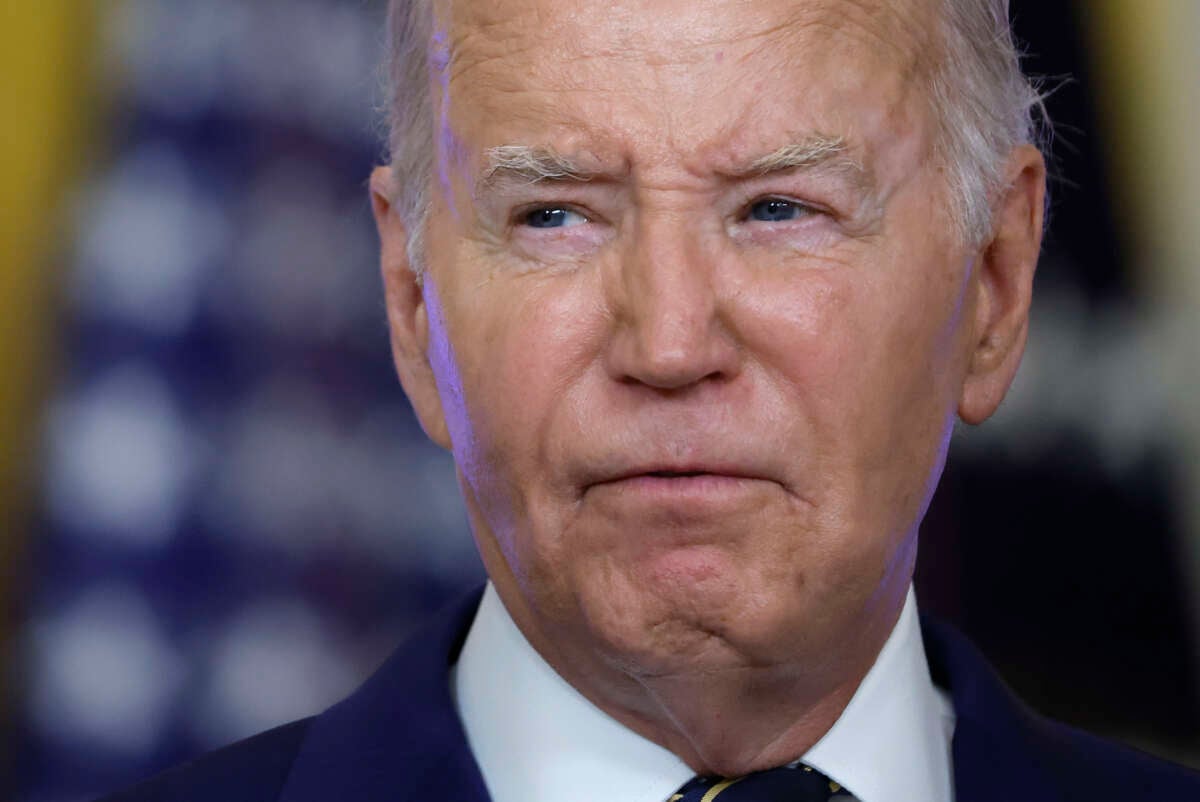
Today, activists from around the country are mobilizing in Washington, D.C. to surround the White House to demand an end to Israel’s onslaught on Gaza and President Joe Biden’s support for it. Palestinians are paying an incalculable price for U.S. policy. But there is a set of costs of a different nature that the U.S. is incurring by supporting the genocide — and a strategy aimed at raising those costs can make it so great that Biden has to stop.

One cost is global. From upsetting relations between Israel and its neighbors to repeated condemnations of genocide at the UN Security Council, General Assembly, International Court of Justice and International Criminal Court, Israel and the U.S. are more isolated on the world stage than ever.

But a more immediate cost for Biden is in U.S. politics.

U.S. support for Israel has long been treated in the United States as a “domestic issue” — with AIPAC, the Anti-Defamation League, and other pro-Israel groups intervening heavily to shape federal policy, local politics and all levels in between. The conventional thinking is that insufficient support for Israel can result in a lost election — whereas the fate of Palestinians and their rights are marginalized to the realm of “foreign policy,” when discussed at all.

Since Israel invaded Gaza last October, that understanding has radically shifted: The rights of Palestinians have emerged as a “domestic issue” in their own right — with city councils across the country passing resolutions calling for a ceasefire, workers at corporations like Google demanding an end to their employers’ complicity in genocide and a student revolt against U.S. academia’s role in buttressing it.

RELATED STORY:
 
The movements for labor and Palestinian rights have common cause against the billionaires who aim to destroy them both.
Truthout


The move of Palestinian rights from the margins of U.S. politics to its center is even raising the prospect of the incumbent president losing the November election because of his insistence on supplying the weapons to fuel Israel’s siege. Activists and voters in Michigan, Wisconsin, and elsewhere have made this likelihood dramatically visible with their “Uncommitted” and “Uninstructed” campaigns.

If Biden loses in November to an open fascist, it will likely be because he repulsed young people, progressives and people of color with his support for Israel. These are the people who he needs not only to vote for him, but to mobilize the vote for him. As the remarkable campus rebellions of this spring showed, they’re also the voters most likely to be demanding a ceasefire in Gaza.

By maintaining his support for Israel, Biden risks not just losing an election but a generation — one that does not seem willing to quietly accept the unacceptable. The question is: Is that enough to force Biden to change course? And if not, what will?
 
Why We Have Not Yet Won a Ceasefire

The difficult reality is that the movement demanding ceasefire is up against the hard core of U.S. imperial power, which sees support for Israel as central to its strategy in the Middle East — at apparently any cost, particularly that of Palestinian life. This is especially true for President Biden, whose personal investment in Israel appears to go beyond the requisite required for any steward of U.S. power.

In addition, there is a pillar buttressing that commitment that is unique to the U.S.-Israel relationship: a powerful pro-Israel lobby.

This includes a formal lobbying operation — led by AIPAC and other Washington-based firms — and a large, well-organized, well-funded and very dedicated constituency in communities across the country. Organizations like StandWithUs and the associated Israel on Campus Coalition target Palestinian rights activists on college campuses, accusing them of antisemitism and calling on universities to restrict free speech on campus.

While pro-Israel Jewish organizations play a key role, Christian Zionism is an increasingly dominant force in mobilizing fanatical support for Israel. Coordinated by organizations like Christians United for Israel, Christian Zionism combines right-wing Christian nationalism with an apocalyptic vision for the Middle East. Activists against U.S. support for Apartheid South Africa did not have to contend with a mass organizing force on the other side like this.

The fate of Palestinians and their rights are marginalized to the realm of “foreign policy,” when discussed at all.

Activists are also facing a White House that has greater power to pursue militarism than at other points in U.S. history. After more than two decades of the “war on terror,” the executive branch wields tremendous power to act unchecked. Even with growing opposition in Congress for Biden’s unflinching supply of weapons to Israel, the White House is able to press ahead. This is because Biden has used tricks — like invoking “emergency authority,” and making more than 100 sales that fall under the threshold amount that requires congressional approval — to feed the Israeli arsenal.

Meanwhile, the White House is going to great lengths to insulate the president and Vice President Kamala Harris from the ubiquitous protests, arranging campaign events that are closed to the public, smaller and whose attendees are highly vetted.

What should activists do then, in the face of a president who refuses to stop supplying the weapons for a genocide — even when it could cost him his reelection?
 
What to Do in the U.S.?

Over these eight months, activists have sought to identify any levers of power to pull that would stop Biden’s policy. This has included winning over dozens of members of Congress to demand a ceasefire. It has involved passing ceasefire resolutions in dozens of city and town councils. The movement successfully demonstrated its power to withhold votes in states that Biden needs to win in November. Recent polls show that, in these states, one in five voters say that they are less likely to vote for Biden because of his support of Israel’s assault.

The Palestine solidarity movement mobilized the largest march for Palestinian rights in U.S. history on November 4 in Washington, D.C. It has helped elevate Palestinian voices in the mainstream media conversation, and has featured vocal Jewish organizing for a ceasefire as one counter to the false notion that supporting Palestinian rights is antisemitic.

It has turned campuses — from the most public to the most elite — into sites of mobilization for Palestinian rights. It has compelled staffers in Congress and the White House itself to protest, and the resignation of State Department officials and others. Key institutions and individuals in Biden’s inner circle have urged him to push for a ceasefire, from the influential think tank the Center for American Progress to the president’s own wife.

The fact that no one of these breakthroughs has in itself forced a ceasefire does not mean that they are all useless. In many cases, the work that produced them should continue. But we also need more, because it is evident that no one of these things is the key to unlocking a halt to U.S. weapons and other support to Israel.

The challenge then is not to find the one thing that will force Biden to shift course, but to carry out a combination of things that undermine his ability to pursue his policy and make it as politically costly and as difficult as possible, until it is impossible.
 
Raising the Political Costs

It is clear that we need to expand actions that disrupt the ability of the U.S. to support the Israeli genocide, both politically and physically. But there is an important catch: One of the great strengths of the outpouring of protest in defense of Palestinian life has been how accessible it has been to the U.S. public. The starkness of Israel’s violence — and genocidal rhetoric of its leaders — along with the self-evident virtue of the ceasefire demand have allowed hundreds of thousands to join the movement.

Because the risk of arrest and police violence that comes with more confrontational actions tends to limit the range of participants, a challenge for organizers will be escalating disruption while continuing to invite broad numbers of people with a range of abilities and vulnerabilities to continue to participate. We therefore need to be as strategic as possible.

One area of focus should be disrupting the flow of U.S. weapons to Israel. With weapons manufacturing taking place across the country, the machinery of producing and supplying arms requires a combination of ignorance and consent to those processes by the U.S. population. But what if our communities learn about their entanglement with the flow of weapons, and replace that “consent” with resistance?

If the cost of Palestinian life is not sufficient to compel Biden to stop supporting a genocide, then it is the responsibility of the movement … to exact a greater cost by raising the political price.

How many cities and towns that have passed ceasefire resolutions host factories that make bombs — and even provide tax breaks to those companies? How many such cities and towns have roads passing through that transport weapons, or ports that ship them to Israel? What if, through a combination of nonviolent direct action, and cities being compelled by public pressure to pass ordinances against their complicity in genocide, the federal government could no longer count on our communities allowing weapons to flow from and through them?

And what if workers involved in the making or transport of these weapons supported the protests — as union longshore workers have at the Port of Oakland, refusing to unload cargo from an Israeli ship?

Activists can also undermine economic support for Israeli violence. Carrying out this genocide in Gaza comes at a great cost to the Israeli economy. Hundreds of thousands of Israeli reservists have been mobilized, taking them away from their jobs. Palestinian workers have been expelled from the agricultural sector and others. With the Israeli economy dependent on 120,000 Palestinian workers before October 7 and many of their work permits canceled since, farmers and volunteers scrambled to harvest produce and plant crops in the fall and construction projects are down 50 percent. And Moody’s has downgraded Israel’s credit rating.

The Israeli economy, in short, is vulnerable.

Unlike other countries, Israel crowdsources the financing of its economy, relying on institutions and individuals in North America to invest in Israeli companies and in the state of Israel through selling Israel bonds. Israel makes the case that such investment will offer a good financial return, and appeals to investors that such support is a political contribution to the Israeli project.

This explains why 35 U.S. state and municipal governments — most of them headed by Trump-aligned Republicans — have collectively bought more than $1.7 billion in Israel bonds since October. Additionally, American capitalists have rallied to support the Israeli economy. Bain Capital organized a trip to Israel in December for a delegation of 70 tech executives and investors, who met with Israeli leaders as well as local investors and startups.

Venture capitalists and far right state governments aren’t likely to change their positions, but there may be more vulnerable targets. We can demand that states run by liberal Democrats with investments in Israel cease, and brand-conscious banks should be made to see investing in Israel as a liability, just as they were pressured to stop propping up Apartheid South Africa years ago.

While divestment campaigns can take years, enough disruption and negative attention can lead to more immediate, further downgrades of Israel’s credit rating by institutions like Moody’s. The world of stocks and bonds markets is volatile, and Israel’s utter dependence on outside finance makes it vulnerable to big shocks, even if they come well short of full divestments.
 
Making Genocide Too Costly for a Government That Doesn’t Value Life

Twenty-eight years ago, the United States carried out another policy in the Middle East that brought catastrophic suffering: its economic sanctions against Iraq. In an interview with “60 Minutes” in May 1996, journalist Leslie Stahl said to then-Secretary of State Madeleine Albright: “We have heard that half a million children have died. I mean, that’s more children than died in Hiroshima. And, you know, is the price worth it?”

Albright responded, “We think the price is worth it.”

The horrific history is a reminder that Biden’s support of Israel today comes in a context: Washington makes foreign policy decisions in which officials are quite aware of the suffering of those on the receiving end of their actions. The problem is that, in the dehumanizing and racist world of Washington’s geopolitics, the lives of Iraqis or Palestinians — or the Japanese victims of the atomic bombings that Stahl mentions, for that matter — do not carry much weight in their calculations.

If the cost of Palestinian life is not sufficient to compel Biden to stop supporting a genocide, then it is the responsibility of the movement against it — and for U.S. civil society — to exact a greater cost by raising the political price. We must make carrying out this genocide so difficult, and its price so politically expensive, that Washington cannot afford it


ABOUT THE AUTHOR:


Khury Petersen-Smith is the Michael Ratner Middle East Fellow at the Institute for Policy Studies.

Saturday, June 8, 2024

The Fundamental Crisis and Foundational Contradiction Facing the United States During the Upcoming Presidential Election of 2024: Fascism guided, informed, and enabled by the Doctrines and Practices of White Supremacy and Global Capitalism--PART 28

DEFEAT FASCISM BEFORE FASCISM DEFEATS YOU
All,

This is a very important and deeply necessary discussion that demands not merely our collective engagement but ultimately a collective resolution. I hope everybody is really listening because whether we fully realize/like it or not FASCISM as a very real and dangerously viable ideological, economic, and political force is absolutely the major factor we must contend with in not only American politics (or this election specifically) but U.S. life generally at this point. Anyone who either genuinely or cynically believes otherwise is simply not paying adequate attention to what actually constitutes social, economic, and cultural reality itself in the 21st century.  Stay tuned because this fundamental challenge in our lives is only going to become much greater and severely
consequential over the next five months...


Kofi
 
Top Black pastor warns Biden to change course on Gaza
Don Calloway, a former Democratic member of the Missouri House of Representatives and now a Democratic Party strategist, and Pastor Michael McBride, a founder of Black Church PAC and the lead pastor of the Way church in Berkeley, California joined Mehdi for this debate over whether black voters will turn out for Joe Biden in this November's presidential election. “People do believe that the president and this administration, and by extension, the Democratic Party, has lost its way on this issue [Gaza],” McBride argues. “We believe there has to be a course correction.” Calloway pushed back. “Black voters do not have and have never had the luxury of being single-issue voters. So, do we care about Palestine? Absolutely… Do we vote against Joe Biden and the interests of Palestine against reproductive freedom? Probably not.” To hear McBride’s response and more of this exchange, watch the debate above.

Founded by Mehdi Hasan, Zeteo has a strong bias for the truth and an unwavering belief in the media’s responsibility to the public. Unfiltered news, bold opinions. For more content from Zeteo, subscribe now www.zeteo.com.


Friday, June 7, 2024

IMPORTANT NEW BOOKS:

Claudia Jones: Visions of a Socialist America
by Denise Lynn
Polity Press, 2024

Black Lives Series

[Publication date: January 31, 2024]