The Lost Giant of American Literature
A major black novelist made a remarkable début. How did he disappear?
by Kathryn Schulz
January 29, 2018 issue
The New Yorker
by Kathryn Schulz
January 29, 2018 issue
The New Yorker
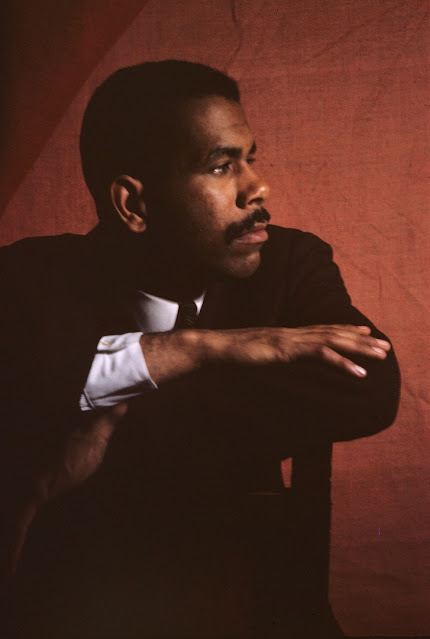
William Melvin Kelley wrote about white people thinking about black people. Photograph by Carl Van Vechten / Carl Van Vechten Trust / Beinecke Library, Yale
Audio: Listen to this story. To hear more feature stories, download the Audm app for your iPhone.
There were arrows, so we followed them. This was one afternoon last summer; my partner and I had spent the day at our local public library, working steadily through breakfast and lunch and what the British would call teatime, until suddenly hunger clobbered us both and we packed up and headed out to the car. Home was maybe four miles away. In my mind, I was already constructing enormous sandwiches. The arrows appeared two miles in, lining the side of the road where, that morning, there had been nothing but marsh grass. They were shin-high, wordless, red on a white background, pointing away from the sandwiches. My partner, who is usually more hungry than I am but always more curious, swung the car into the other lane and began to follow them.
The arrows led down a state highway, across an interchange, onto a smaller road, past a barn and some grain silos, then along one of the Chesapeake Bay’s countless tributaries. A sign warned us that we were in a flood zone. My partner, who grew up one county over, remembered the place from childhood—at seven or eight, she’d had a memorable encounter in the area with a trailer full of cockatiels—but she hadn’t been there since. The arrows ended at a large gray shed with a red roof. A spray-painted sign indicated that it was open twice a month, on Saturdays, in the summer only. We parked across the street, next to a boat, and headed for the door.
Inside: boxes of fishing tackle, cans of Rust-Oleum, a ceiling-high stack of interior/exterior paint. A half-dozen washboards, a cast-iron sewing machine, signs advertising fresh eggs and Guinness and speed limits in unknown locations. Doorframes, window frames, picture frames stripped of their pictures and stacked catawampus in a corner. A wall of old license plates, a box of old flashlights, Chock full o’Nuts cans chock-full of nails. Circular saws, gate weights, drill bits, jigging bait, oyster tongs, jumbles of other farming and fishing equipment that I, having grown up suburban and landlocked, could not identify. No cross-stitched pillows here; no clothes, unless you count waders; no discarded chinaware—not much, in short, of the usual junk-shop bric-a-brac. A few boxes of LPs. A few old sports pennants. And, near the cash register, a single bookshelf, with a handwritten sign taped to the top: “Paperbacks, 50¢. Hardbacks, $1.”
Books I can identify. I went to browse, and spotted, first thing, a slender volume that was shelved the wrong way round—binding in, pages out. I pulled it down, turned it over, and found myself holding a beautiful clothbound first edition of Langston Hughes’s “Ask Your Mama.” I flipped it open and there on the frontispiece it said:
Inscribed especially for William Kelley ~ on your first visit to my house ~ welcome!
Sincerely ~
Langston Hughes
New York
February 19, 1962
I gawped. Then I beckoned my partner over and we gawped together. After a short-lived and entirely silent moral crisis—resolved by remembering that half the point of visiting junk stores is the possibility of stumbling on unexpected treasures—I walked over to the cash register, handed the young man behind it a dollar, and bought the book. And then, because it, too, was an arrow, I followed it.
I didn’t know who William Kelley was when I found that book but, like millions of Americans, I knew a term he is credited with first committing to print. “If You’re Woke, You Dig It” read the headline of a 1962 Op-Ed that Kelley published in the New York Times, in which he pointed out that much of what passed for “beatnik” slang (“dig,” “chick,” “cool”) originated with African-Americans.
A fiction writer and occasional essayist, Kelley was, himself, notably woke. A half century before the poet Claudia Rankine used her MacArthur “genius” grant to establish an institute partly dedicated to the study of whiteness, Kelley turned his considerable intellect and imagination to the question of what it is like to be white in this country, and what it is like, for all Americans, to live under the conditions of white supremacy—not just the dramatic cross-burning, neo-Nazi manifestations of it common to his time and our own but also the everyday forms endemic to our national culture.
Kelley first addressed these issues at length in his début novel, “A Different Drummer.” Published three weeks after that Times Op-Ed, when he was twenty-four, it promptly earned him comparisons to an impressive range of literary greats, from William Faulkner to Isaac Bashevis Singer to James Baldwin. It also got him talked about, together with the likes of Alvin Ailey and James Earl Jones, as among the most talented African-American artists of his generation.
When I read “A Different Drummer,” I understood why. Geographically, the novel is set in a small town called Sutton, outside the city of New Marsails, in an imaginary Southern state wedged between Mississippi and Alabama. Temporally, it is set in June, 1957, when a young African-American farmer named Tucker Caliban salts his fields, slaughters his horse and cow, burns down his house, and departs the state—whereupon its entire African-American population follows.
It’s a brilliant setup. Our culture has produced countless fantasies about what would have happened if the Civil War had ended differently—chiefly, if the Confederacy had won and slavery had endured. (See, e.g., “The Guns of the South,” “If the South Had Won the Civil War,” and “Underground Airlines.”) But we have a paucity of art that chooses to imagine a different outcome for the civil-rights movement, or alternate universes where African-Americans, from any era, wield not less power but more.
Appropriately, that seizure of power—the sudden refusal of African-Americans to continue living under conditions of subordination—flummoxes the white citizens of Sutton. When “A Different Drummer” opens, one of them, seeking to make sense of the recent events, recounts a harrowing story. Half slave narrative, half tall tale, it concerns a behemoth of a man, known simply as the African, who arrives one day on a slave ship, cradling a baby boy in the crook of his arm. Bound by chains held by at least twenty men, the African is led into town and sold—whereupon he whips around and, with the chains, knocks over his captors and decapitates the auctioneer: “Some folks swear . . . that the head sailed like a cannon ball through the air a quarter mile, bounced another quarter mile, and still had enough steam to cripple a horse some fellow was riding into New Marsails.” Gathering up his chains “like a woman grabs up her skirts,” the African then flees to a nearby swamp and starts conducting raids to free other slaves. Eventually, his nominal owner, led to the hideout by a traitor, kills the African and claims as his own the baby boy: Tucker Caliban’s great-grandfather.
The man who tells this tale maintains that Caliban acted as he did because “the African’s blood” resurged within him. Not all his listeners agree, but they’re hard pressed to offer a better explanation for the recent exodus, or imagine its likely consequences. Some wonder whether wages will be better or worse with a third of the population gone. Others, professing not to care about Caliban and his followers, echo the governor’s statement: “We never needed them, never wanted them, and we’ll get along fine without them.” Still others feel betrayed, in ways they can’t articulate, by the violation of a social compact whose terms they’d never previously bothered to study too closely.
Although the plot of “A Different Drummer” depends on the autonomous actions of African-Americans, the story is told exclusively through the eyes of these white townspeople. This, too, is a smart idea—a kind of fictional affirmation of the historian Lerone Bennett, Jr.,’s claim that “there is no Negro problem in America. The problem of race in America . . . is a white problem.” Moreover, it is wonderfully executed. At twenty-four, Kelley was already a strikingly confident writer, with a sense of humor reminiscent of Flannery O’Connor in stories like “Revelation”: caustic, original, efficacious. He was also a keen observer, and although his story has the emotional proportions of a myth, his sentences reliably feel like real life. Tucker Caliban’s doomed cow is “the color of freshly cut lumber”; to the men watching from outside, the fire he set first appeared climbing a pair of curtains in the center of his home, then “moved on slowly to the other windows like someone inspecting the house to buy it.”
“A Different Drummer” ends in pessimism, less about the fate of black Americans than about the moral potential of white ones. Yet, thanks to it, Kelley’s career began in tremendous optimism. His was the rare first novel that makes future ones seem both inevitable and exciting—and, indeed, he went on to publish four more books in under a decade. But I wasn’t alone in being unfamiliar with them. After his early and fiery start, Kelley largely faded into obscurity—not just before our era but in his own prime. Obscurity, of course, is a common enough fate for authors. But what’s curious about Kelley is that he is seldom read today not just because of the weaknesses in his books but also because of their peculiar, discomfitting strengths.
William Melvin Kelley was born on November 1, 1937, at Seaview Hospital, a tuberculosis sanatorium on Staten Island, where his mother, Narcissa Agatha Garcia Kelley, was a patient. His father, also named William Kelley, worked for many years as an editor at the Amsterdam News, one of the oldest and most influential African-American newspapers in the nation. The paper was based in Harlem, but the family lived in a working-class Italian-American community in the Bronx, together with Kelley’s maternal grandmother, a seamstress, who was the daughter of a slave and the granddaughter of a Confederate colonel.
By his own account, Kelley grew up at a time when “striving Negroes wanted to transcend” race rather than politicize it. Typifying that impulse, his father “worked hard to eradicate all vestiges of Negroness from his voice,” and kept Countee Cullen and Paul Laurence Dunbar on the main shelves of his library while banishing Marcus Garvey to its highest reaches. Kelley, whose own voice never lost its Bronx accent, internalized this ethos young. At home, he won over the neighborhood kids with his excellent Sinatra imitation, and with his willingness, when playing Cowboys and Indians, to take on the role of Tonto. At the Fieldston School, the nearly all-white prep school he attended from first through twelfth grades, he practiced the time-honored strategy of overachieving: by his senior year, he was student-council president, captain of the track team, all-around “golden boy,” and bound for Harvard. Once there, Kelley discovered writing—which, he later recalled, “made me so happy I wasn’t going to do anything else.” He found mentors in the experimental novelist John Hawkes and the modernist poet Archibald MacLeish, and in 1960 he won the Dana Reed Prize, for the best writing by a Harvard undergraduate.
It was a high honor, but more or less the only one Kelley earned in an otherwise troubled college career. His mother died during his sophomore year, his father when he was a senior. Kelley switched majors four times, failed almost every class but his fiction courses, and dropped out of school one semester shy of graduation. He went home to his grandmother and, with considerable trepidation, confessed that he’d abandoned all his illustrious career plans and wanted to be a writer instead. She heard him out, then told him that she could not have spent seventy years making dresses if she hadn’t loved it. Two years later, Kelley published “A Different Drummer.”
Two more books followed in quick succession: a short-story collection, “Dancers on the Shore,” in 1964, and a novel, “A Drop of Patience,” in 1965. The stories are uneven, but the best of them—including “The Only Man on Liberty Street,” in which racism ruptures a complicated family, and “Not Exactly Lena Horne,” in which two retired widowers get into a small, upsetting fight—are exemplars of the form: taut and self-contained yet seemingly pulled midstream from life. The novel, meanwhile, concerns a blind jazz musician who rises to national prominence, has a doomed romance with a white woman, and subsequently suffers a nervous breakdown. It let Kelley explore not only the destructiveness of racial categories but one of his other long-standing interests as well: the primacy of sound. As a child, Kelley spent hours sitting with his grandmother while she worked, and the stories that she told him merged in his mind with the clatter of her sewing machine. In Europe, he befriended the avant-garde saxophonist Marion Brown and became part of an ongoing conversation about sound and meaning. “If things had gone another way,” he told Gordon Lish in a 1968 interview, “I would’ve been a musician.”
In retrospect, though, the most notable aspect of Kelley’s early work is its dramatis personae. Wallace Bedlow, whom we first encounter making his way toward Caliban’s farm in “A Different Drummer,” reappears in “Dancers on the Shore” as a blues singer destined for a short but brilliant career in New York, under the guidance of his brother, Carlyle. Carlyle himself then plays starring roles in Kelley’s last two novels, during the course of which he encounters Chig Dunford, a Harvard-educated aspiring writer who also débuts in the story collection. Dozens of other characters likewise reappear from tale to tale; in his old age, Kelley once said, he hoped to look up at his shelves “and see that all of my books are really one big book.” Like Balzac and Faulkner, he was in the business of world-building—in his literature, but also, by then, in his life.
Kelley was seventeen when he met his future wife, Karen Gibson; she was fourteen and, she told me, distinctly unimpressed. Almost a decade later, the two crossed paths again, at the Penn Relays, a weekend-long integrated track meet that drew thousands of African-American participants and spectators. By then, Kelley was finishing “A Different Drummer,” while Gibson, who had studied art at Sarah Lawrence, was planning to become a painter. She was drawn to creative types and, this time, she was dazzled by him. In 1962, they got married.
The Kelleys’ early life together was peripatetic. Gibson, who later changed her name to Aiki Kelley, was, like her husband, a product of the black bourgeoisie and eager to escape it; also like him, she wanted to see more of the world before starting a family, so the couple soon decamped to Rome. A year later, they returned to the United States for the birth of their first child, Jessica, but it was a short-lived homecoming. Three days after she was born, Malcolm X was assassinated. Kelley, asked by The Saturday Evening Post to cover the subsequent murder trial, grew disgusted with the bias in the judicial system, and vowed to leave the country again: “I wouldn’t assign myself the task of announcing that our little rebellion had failed, that racism had won again for a while. Not with a young wife and a toddler depending on me and all this killing going on.”
In short order, he and Aiki packed up and moved with Jesi to Paris, where their second daughter, Cira, was born, in 1968. Initially, they planned to learn the language, then relocate somewhere in Francophone Africa to explore their roots. After a few years, though, they decided that they wanted to be closer to their relatives, and moved instead to Jamaica, where they lived for nearly a decade—William writing, Aiki making art, and both of them raising and homeschooling their daughters.
It was in Jamaica that Kelley and his family converted to Judaism. This came about because Kelley started smoking ganja with some locals behind a neighborhood chicken joint, and every day before they lit up they read aloud from the Bible. Kelley had been raised as a Christian, but his interest in Scripture surged in Jamaica, and he asked his wife to begin reading it with him. The two of them were searching for moral guidelines to help them raise their children, and they soon found what they wanted in the Pentateuch. One by one, they began shedding old traditions—bacon, Christmas, Sunday Sabbath—and adding new ones: Shabbat, Yom Kippur, a kosher kitchen.
It was always a self-directed faith; neither Kelley nor anyone in his family ever joined a synagogue, and they observed a religious calendar at odds with the conventional Jewish one. Kelley excelled at self-direction, in fact. He was meticulous in all his habits—the arrangement of his shoes, the order of his pens—and writing was no exception. He worked with punch-card regularity, in an office where his desk faced the wall, so that the only world he could see was the one he was creating. He set down his first drafts in pencil, made corrections in ink, then typed up the result on a manual typewriter, whose rhythm he loved. He did this every day, week after week, month after month, until he had published two more novels. Then he kept on doing it every day thereafter—even though, after the second of those novels came out, the world all but entirely ignored him.
The epigraph to Kelley’s third novel, “dem,” is written in the International Phonetic Alphabet—written, that is, to capture the way people actually speak, even though, in doing so, it thwarts the way people usually read. “Næʊ, ləmi təljə hæʊ dəm foks lıv”: those words mark a new willingness on Kelley’s part to make things difficult for his readers, linguistically and otherwise. Translated, they read, “Now, lemme tellya how dem folks live.”
The “folks” in question are white people, and, like “A Different Drummer,” the novel focusses on a white character: Mitchell Pierce, a middling employee at an advertising agency, who grows increasingly estranged from, among other things, his job, his pregnant wife, his sense of self-worth, and reality. As such, Mitchell is a classic mid-century white antihero, the kind that can be found, in works ranging from “The Secret Life of Walter Mitty” to “Portnoy’s Complaint,” exuding professional mediocrity, evading responsibility, humiliating himself sexually, and cowering in the face of his supposed inferiors: women, children, household help, members of all kinds of the putative lower classes.
Aptly, for a book about an antihero, “dem” winds its plot not through action but through passivity. Early on, Mitchell tears a hamstring and finds himself bed-bound for several weeks, during which time he develops an embarrassing addiction to a soap opera and a powerful crush on its heroine. Kelley is setting us up to think about melodrama, which “dem” is not made of but is very much about: the substitution of feelings for ethics, cheap thrills for costly experience, and simulacrum for reality. Indeed, when Mitchell happens to encounter the actress who plays his crush, he fails to grasp that she isn’t actually the TV character he worships, and then further fails, when the opportunity arises, to sleep with her.
While Mitchell is conducting this ineffectual affair, his wife is having a considerably more successful one, with a black man. When the book opens, she is pregnant with twins; in an echo of the soap-opera plots Mitchell adores, one of these turns out to be fathered by her husband, the other by her lover. After the babies are born and the doctor breaks the news, Mitchell sets off to find his fellow-father and persuade him to take the dark-skinned baby.
Thus begins a kind of picaresque journey through black New York, and, in parallel, through the Bosch-like fantasy- and horror-scape of Mitchell’s racial imagination. Along the way, he encounters another desirable woman, this one black, whom he also fails to bed; an African-American maid he had unjustly fired some time before; her nephew, none other than Carlyle Bedlow, who pockets Mitchell’s money and serves as his poker-faced, Harlem-based guide; Carlyle’s militant younger brother Mance, who refers to Mitchell as “devil”; and, finally, Mitchell’s co-father, a man named Cooley, whom, it turns out, he has known all along.
The whole journey is a merciless satire on the themes of white fear, guilt, and hypocrisy, played out in the always charged language of miscegenation—only, this time, with the current of that charge reversed. One practical and emotional cornerstone of slavery was the inability of the enslaved to determine their own families. When Mitchell, cuckolded and left to raise a black man’s child as his own, realizes that his suffering is a kind of reprisal, his whiny “Why me?” is parried irrefutably by his fellow-father: Why Cooley’s great-granddaddy? Like the white characters in “A Different Drummer,” Mitchell experiences black retribution. Neither is violent—the first is a renunciation, the second a reckoning—but both are profoundly disconcerting, because they leave white characters and readers alike alone with past and present iniquities, and with the scales to measure them.
If “dem” is a strange book, it is strange in a familiar way. Part Roth, part Swift, part Twain, it is built of satire, farce, and hyperbole, all deployed in the name of moral seriousness. But Kelley’s next novel, “dunfords travels everywheres,” is strange in a strange way. When it opens, Chig Dunford is living in an imaginary European country that observes a bizarre sartorial segregation: every day, its citizens self-divide into those who wear blue clothes (Atzuoreursos) and those who wear yellow ones (Jualoreursos), groups that are strictly forbidden from mingling. While living there, Chig has a brief affair with an enigmatic fellow-expatriate named Wendy, then reunites with her on his way back to the United States, when the two find themselves sharing a steamer with a mysterious organization called The Family, and also with a cargo hold full of slaves. Meanwhile, Carlyle Bedlow is back from “dem” and up to a whole new set of tricks, including one involving a loan officer moonlighting as a limousine driver, who turns out to be—in a wonderful Bulgakov-like turn, by far the best in the book—the devil.
All this is funny, dark, smart, and extremely entertaining—except that, fifty pages in, the reader suddenly slams up against this sentence: “Witches oneWay tspike Mr. Chigyle’s Languish, n curryng him back tRealty, recoremince wi hUnmisereaducation. Maya we now go on wi yReconstruction, Mr. Chuggle? Awick now?”
Well, yes: we are now very Awick, although whether we will go on is a different question. Kelley conceived “dunfords travels everywheres” in conscious thrall to “Finnegans Wake,” and his own book is, for long stretches, similarly rough going. Kelley tells Chig’s and Carlyle’s separate stories mostly straight, but in between he grabs language by its edges and bends it as far as he can, in order to pull the bourgeois, Ivy-educated Chig and the impoverished, street-smart Carlyle into a single consciousness, made of their common national history.
Kelley had long been fascinated by the way one language can accommodate many different speakers. “Early on,” he wrote, “blessed with an ear for variations of spoken English, I realized that I lived in four linguistic worlds”: the Standard English he spoke at home; the working-class Italian-American English he learned in the Bronx; the heavily Latinate, slightly Yiddish English he heard at Fieldston; and black English, which he regarded, like jazz, as one of the great creative contributions of African-Americans. At the same time, he was fascinated by the relationship between language and power. Tucker Caliban is taciturn almost to the point of mute. Even his wife can barely eke speech out of him, and he rejects oration and persuasion, refusing to explain, or even articulate, the beliefs behind his scorched-earth exit from the state. With one exception—a militant Northern preacher, who is voluble, dislikable, and doomed—the other black characters are likewise silent. In “dunfords,” by contrast, the black characters have plenty to say, but their voices intermittently wax incomprehensible.
That is the same problem solved two different ways. Like many who are steeped in but structurally excluded from conventional English and its canon, Kelley had doubts about its capacity to adequately express African-American life. His epigraph for “dunfords,” borrowed from Joyce, is “My soul frets in the shadow of his language.” The language he creates in its place blends the black vernacular with puns, patois, and linguistic borrowings that most readers (this one included) will struggle to identify.
The result is best read out loud—and, in fact, is nearly impossible to read any other way. It’s sometimes rewarding, since Kelley is smart and funny no matter what language he uses, but it is never easy, and it slows down a book that, in its bones, wants to be headlong and exuberant—so much so that readers can be forgiven for wanting to skip the difficult bits to get back to the plot. (And also to sentences that offer more familiar pleasures. Here as everywhere, Kelley’s straightforward prose is both plain and shining, like sunlight catching the windows of an apartment building. When the devil drives away in his limousine, Carlyle watches it “designing the fresh snow with row after row of tiny interlaced hammers, its tail-end, finally, becoming part of the shadows.”)
But simply ignoring the tough parts won’t work, of course. Kelley’s private language is difficult to decode but essential to the book, and so a determined reader must soldier on, grateful that “dunfords” is, at least, short by comparison with “Finnegans Wake.” The result is like roaring down a roller coaster with the brakes on: thrilling, frustrating, dominated by sheer sound.
William Kelley was thirty-two when “dunfords travels everywheres” appeared. He wrote constantly for the next forty-seven years, never published another book, and died a year ago, at the age of seventy-nine.
By then, Kelley had been back in his native New York for decades. He loved Jamaica, but eventually the family’s visas expired, and their relatives began hounding them to come home. In 1977, the Kelleys returned to the United States and rented a sixth-floor walkup at 125th Street and Fifth Avenue. The gentrification of Harlem had not yet begun, and their new home had an absentee slumlord, an alcoholic super, no heat, no electricity, no gas, no phone, and no lock on the door. The Kelleys bought winter clothes for the first time in a decade, together with candles, a Coleman stove, and a padlock for the door.
It wasn’t ideal, but it was all they could afford. The book advances, the speaking gigs, the magazine requests, and the university appointments had dried up, and the family had hardly any money. This was fine by Kelley, who had long since read Thoreau (“A Different Drummer” takes its title from “Walden”) and embraced the idea of voluntary poverty. By day, he kept writing, at a desk crammed below a loft bed in their tiny apartment. After midnight, when the local stores put their unsold produce in the trash, he did the family grocery shopping. “Going through the garbage at the Korean grocers didn’t embarrass him,” his daughter Jesi said. “He was utterly unafraid to be poor.”
He was also unafraid to keep writing in the absence of public encouragement. When he died, he left behind a considerable quantity of prose, including two unpublished novels. One of these, “Daddy Peaceful,” is loosely based on his own family, whom he never previously wrote about though unabashedly adored. The other, “Dis/integration,” is a meta-fiction that concerns the further adventures of Chig Dunford, and, like “The Brothers Karamazov” and “Pale Fire,” contains within it an entirely separate work: a complete novel by a white Hemingwayesque writer. That embedded novel, “Death Fall,” features no black characters at all, and describes the unravelling of a small Kansas town after a new and highly addictive drug is introduced there.
Kelley tried to publish both of these novels during his lifetime, to no avail. Eventually, in 1989, he began teaching fiction at Sarah Lawrence, and liked it enough to continue doing so for nearly three decades. But, even then, he never stopped writing. “There are artistic people who have that moment of ‘Ugh, I suck,’ ” Jesi said. “He wasn’t like that. He never got depressed. He never thought he was bad. He never doubted himself. He just didn’t understand what happened.”
What did happen? It’s difficult to say; both present-day fame and posthumous reputation are elusive, mercurial, and multifactorial. Some of the downturn in Kelley’s fortunes likely had to do with the changing political climate. “We always said, we made a revolution and we lost,” Aiki Kelley said, and she believes that her husband was one casualty of that defeat; as the momentum of the civil-rights movement ebbed, those with the power to make publishing decisions turned their attention elsewhere.
Still, Kelley was never a pat enough political writer to simply wash in and out with the ideological tides, and there were many other considerations, too. Chief among these was the strange chiasmus at the heart of his work: a black man writing about how white people think about black people. That perspective was smart and important—in effect, it transformed W. E. B. Du Bois’s double consciousness into a narrative device—but it radically diminished Kelley’s audience. Many white readers didn’t want a black writer telling them what they thought, especially when so much of it was withering, while many black readers, long starved for literary representation, didn’t want to read about more white characters. To make matters worse, very few people, white or black, wanted to subscribe to a vision of America that grew progressively more damning in the course of Kelley’s career. And, regardless of the topic of a book or the race of its author, almost no one wanted to contend with experimental prose.
Ultimately, though, Kelley may have suffered most from the relentless conveyor belt of life, which constantly carries new things into sight and propels older ones away. Time, too, is an arrow that all of us follow. Critics love the adjective “timeless,” but the truth is that most writers, even most exceptionally gifted ones, are of a time, even if not always of their own.
In 1962, when William Kelley met Langston Hughes, the two writers were at opposite ends of their careers. Hughes had dozens of books, plays, and poetry collections behind him, and only five years of life left ahead of him. But he loved championing up-and-coming writers of color, and he needed help packing away some material in his apartment for posterity. Kelley, meanwhile, admired Hughes, needed money, and agreed to do the job. The inscribed copy of “Ask Your Mama” was a kind of bonus pay, but, in those final months before “A Different Drummer” appeared, it must have also seemed like an affirmation. In its pages, Hughes, too, could be found imagining a counterfactual history:
Dreaming that the negroes
Of the South have taken over—
Voted all the Dixiecrats
right out of power—
Comes the colored hour:
Martin Luther King is Governor of Georgia . . .
Six years later, King was dead, and Hughes, too, and although Kelley didn’t know it at the time, his copy of “Ask Your Mama” had gone missing. Each time he and his family left the country, they shed whatever possessions they didn’t need and stashed anything of value with family and friends. Those things of value included the gift from Hughes, but somewhere between 1963, when the Kelleys first left the country, and 1977, when they returned for good, it vanished from a relative’s apartment in Manhattan.
How it got from there to rural Maryland forty years later, and where else it went along the way, is anybody’s guess. The beauty of a true junk shop is that it is a kind of island in the stream of time. Things wash up there and are granted temporary clemency from the all-devouring future; people stop by there and mingle, like time travellers at a rest stop, with fragments of the past. Mostly, you can’t expect to leave with much of value. But every once in a while you find what I did in that Langston Hughes book, and in the man to whom it was given: in both senses, a real deal. ♦
This article appears in the print edition of the January 29, 2018, issue, with the headline “Remainders.”
ABOUT THE AUTHOR:
Kathryn Schulz joined The New Yorker as a staff writer in 2015. In 2016, she won the Pulitzer Prize for Feature Writing and a National Magazine Award for “The Really Big One,” her story on the seismic risk in the Pacific Northwest. She is the author of “Being Wrong: Adventures in the Margin of Error.”
Audio: Listen to this story. To hear more feature stories, download the Audm app for your iPhone.
There were arrows, so we followed them. This was one afternoon last summer; my partner and I had spent the day at our local public library, working steadily through breakfast and lunch and what the British would call teatime, until suddenly hunger clobbered us both and we packed up and headed out to the car. Home was maybe four miles away. In my mind, I was already constructing enormous sandwiches. The arrows appeared two miles in, lining the side of the road where, that morning, there had been nothing but marsh grass. They were shin-high, wordless, red on a white background, pointing away from the sandwiches. My partner, who is usually more hungry than I am but always more curious, swung the car into the other lane and began to follow them.
The arrows led down a state highway, across an interchange, onto a smaller road, past a barn and some grain silos, then along one of the Chesapeake Bay’s countless tributaries. A sign warned us that we were in a flood zone. My partner, who grew up one county over, remembered the place from childhood—at seven or eight, she’d had a memorable encounter in the area with a trailer full of cockatiels—but she hadn’t been there since. The arrows ended at a large gray shed with a red roof. A spray-painted sign indicated that it was open twice a month, on Saturdays, in the summer only. We parked across the street, next to a boat, and headed for the door.
Inside: boxes of fishing tackle, cans of Rust-Oleum, a ceiling-high stack of interior/exterior paint. A half-dozen washboards, a cast-iron sewing machine, signs advertising fresh eggs and Guinness and speed limits in unknown locations. Doorframes, window frames, picture frames stripped of their pictures and stacked catawampus in a corner. A wall of old license plates, a box of old flashlights, Chock full o’Nuts cans chock-full of nails. Circular saws, gate weights, drill bits, jigging bait, oyster tongs, jumbles of other farming and fishing equipment that I, having grown up suburban and landlocked, could not identify. No cross-stitched pillows here; no clothes, unless you count waders; no discarded chinaware—not much, in short, of the usual junk-shop bric-a-brac. A few boxes of LPs. A few old sports pennants. And, near the cash register, a single bookshelf, with a handwritten sign taped to the top: “Paperbacks, 50¢. Hardbacks, $1.”
Books I can identify. I went to browse, and spotted, first thing, a slender volume that was shelved the wrong way round—binding in, pages out. I pulled it down, turned it over, and found myself holding a beautiful clothbound first edition of Langston Hughes’s “Ask Your Mama.” I flipped it open and there on the frontispiece it said:
Inscribed especially for William Kelley ~ on your first visit to my house ~ welcome!
Sincerely ~
Langston Hughes
New York
February 19, 1962
I gawped. Then I beckoned my partner over and we gawped together. After a short-lived and entirely silent moral crisis—resolved by remembering that half the point of visiting junk stores is the possibility of stumbling on unexpected treasures—I walked over to the cash register, handed the young man behind it a dollar, and bought the book. And then, because it, too, was an arrow, I followed it.
I didn’t know who William Kelley was when I found that book but, like millions of Americans, I knew a term he is credited with first committing to print. “If You’re Woke, You Dig It” read the headline of a 1962 Op-Ed that Kelley published in the New York Times, in which he pointed out that much of what passed for “beatnik” slang (“dig,” “chick,” “cool”) originated with African-Americans.
A fiction writer and occasional essayist, Kelley was, himself, notably woke. A half century before the poet Claudia Rankine used her MacArthur “genius” grant to establish an institute partly dedicated to the study of whiteness, Kelley turned his considerable intellect and imagination to the question of what it is like to be white in this country, and what it is like, for all Americans, to live under the conditions of white supremacy—not just the dramatic cross-burning, neo-Nazi manifestations of it common to his time and our own but also the everyday forms endemic to our national culture.
Kelley first addressed these issues at length in his début novel, “A Different Drummer.” Published three weeks after that Times Op-Ed, when he was twenty-four, it promptly earned him comparisons to an impressive range of literary greats, from William Faulkner to Isaac Bashevis Singer to James Baldwin. It also got him talked about, together with the likes of Alvin Ailey and James Earl Jones, as among the most talented African-American artists of his generation.
When I read “A Different Drummer,” I understood why. Geographically, the novel is set in a small town called Sutton, outside the city of New Marsails, in an imaginary Southern state wedged between Mississippi and Alabama. Temporally, it is set in June, 1957, when a young African-American farmer named Tucker Caliban salts his fields, slaughters his horse and cow, burns down his house, and departs the state—whereupon its entire African-American population follows.
It’s a brilliant setup. Our culture has produced countless fantasies about what would have happened if the Civil War had ended differently—chiefly, if the Confederacy had won and slavery had endured. (See, e.g., “The Guns of the South,” “If the South Had Won the Civil War,” and “Underground Airlines.”) But we have a paucity of art that chooses to imagine a different outcome for the civil-rights movement, or alternate universes where African-Americans, from any era, wield not less power but more.
Appropriately, that seizure of power—the sudden refusal of African-Americans to continue living under conditions of subordination—flummoxes the white citizens of Sutton. When “A Different Drummer” opens, one of them, seeking to make sense of the recent events, recounts a harrowing story. Half slave narrative, half tall tale, it concerns a behemoth of a man, known simply as the African, who arrives one day on a slave ship, cradling a baby boy in the crook of his arm. Bound by chains held by at least twenty men, the African is led into town and sold—whereupon he whips around and, with the chains, knocks over his captors and decapitates the auctioneer: “Some folks swear . . . that the head sailed like a cannon ball through the air a quarter mile, bounced another quarter mile, and still had enough steam to cripple a horse some fellow was riding into New Marsails.” Gathering up his chains “like a woman grabs up her skirts,” the African then flees to a nearby swamp and starts conducting raids to free other slaves. Eventually, his nominal owner, led to the hideout by a traitor, kills the African and claims as his own the baby boy: Tucker Caliban’s great-grandfather.
The man who tells this tale maintains that Caliban acted as he did because “the African’s blood” resurged within him. Not all his listeners agree, but they’re hard pressed to offer a better explanation for the recent exodus, or imagine its likely consequences. Some wonder whether wages will be better or worse with a third of the population gone. Others, professing not to care about Caliban and his followers, echo the governor’s statement: “We never needed them, never wanted them, and we’ll get along fine without them.” Still others feel betrayed, in ways they can’t articulate, by the violation of a social compact whose terms they’d never previously bothered to study too closely.
Although the plot of “A Different Drummer” depends on the autonomous actions of African-Americans, the story is told exclusively through the eyes of these white townspeople. This, too, is a smart idea—a kind of fictional affirmation of the historian Lerone Bennett, Jr.,’s claim that “there is no Negro problem in America. The problem of race in America . . . is a white problem.” Moreover, it is wonderfully executed. At twenty-four, Kelley was already a strikingly confident writer, with a sense of humor reminiscent of Flannery O’Connor in stories like “Revelation”: caustic, original, efficacious. He was also a keen observer, and although his story has the emotional proportions of a myth, his sentences reliably feel like real life. Tucker Caliban’s doomed cow is “the color of freshly cut lumber”; to the men watching from outside, the fire he set first appeared climbing a pair of curtains in the center of his home, then “moved on slowly to the other windows like someone inspecting the house to buy it.”
“A Different Drummer” ends in pessimism, less about the fate of black Americans than about the moral potential of white ones. Yet, thanks to it, Kelley’s career began in tremendous optimism. His was the rare first novel that makes future ones seem both inevitable and exciting—and, indeed, he went on to publish four more books in under a decade. But I wasn’t alone in being unfamiliar with them. After his early and fiery start, Kelley largely faded into obscurity—not just before our era but in his own prime. Obscurity, of course, is a common enough fate for authors. But what’s curious about Kelley is that he is seldom read today not just because of the weaknesses in his books but also because of their peculiar, discomfitting strengths.
William Melvin Kelley was born on November 1, 1937, at Seaview Hospital, a tuberculosis sanatorium on Staten Island, where his mother, Narcissa Agatha Garcia Kelley, was a patient. His father, also named William Kelley, worked for many years as an editor at the Amsterdam News, one of the oldest and most influential African-American newspapers in the nation. The paper was based in Harlem, but the family lived in a working-class Italian-American community in the Bronx, together with Kelley’s maternal grandmother, a seamstress, who was the daughter of a slave and the granddaughter of a Confederate colonel.
By his own account, Kelley grew up at a time when “striving Negroes wanted to transcend” race rather than politicize it. Typifying that impulse, his father “worked hard to eradicate all vestiges of Negroness from his voice,” and kept Countee Cullen and Paul Laurence Dunbar on the main shelves of his library while banishing Marcus Garvey to its highest reaches. Kelley, whose own voice never lost its Bronx accent, internalized this ethos young. At home, he won over the neighborhood kids with his excellent Sinatra imitation, and with his willingness, when playing Cowboys and Indians, to take on the role of Tonto. At the Fieldston School, the nearly all-white prep school he attended from first through twelfth grades, he practiced the time-honored strategy of overachieving: by his senior year, he was student-council president, captain of the track team, all-around “golden boy,” and bound for Harvard. Once there, Kelley discovered writing—which, he later recalled, “made me so happy I wasn’t going to do anything else.” He found mentors in the experimental novelist John Hawkes and the modernist poet Archibald MacLeish, and in 1960 he won the Dana Reed Prize, for the best writing by a Harvard undergraduate.
It was a high honor, but more or less the only one Kelley earned in an otherwise troubled college career. His mother died during his sophomore year, his father when he was a senior. Kelley switched majors four times, failed almost every class but his fiction courses, and dropped out of school one semester shy of graduation. He went home to his grandmother and, with considerable trepidation, confessed that he’d abandoned all his illustrious career plans and wanted to be a writer instead. She heard him out, then told him that she could not have spent seventy years making dresses if she hadn’t loved it. Two years later, Kelley published “A Different Drummer.”
Two more books followed in quick succession: a short-story collection, “Dancers on the Shore,” in 1964, and a novel, “A Drop of Patience,” in 1965. The stories are uneven, but the best of them—including “The Only Man on Liberty Street,” in which racism ruptures a complicated family, and “Not Exactly Lena Horne,” in which two retired widowers get into a small, upsetting fight—are exemplars of the form: taut and self-contained yet seemingly pulled midstream from life. The novel, meanwhile, concerns a blind jazz musician who rises to national prominence, has a doomed romance with a white woman, and subsequently suffers a nervous breakdown. It let Kelley explore not only the destructiveness of racial categories but one of his other long-standing interests as well: the primacy of sound. As a child, Kelley spent hours sitting with his grandmother while she worked, and the stories that she told him merged in his mind with the clatter of her sewing machine. In Europe, he befriended the avant-garde saxophonist Marion Brown and became part of an ongoing conversation about sound and meaning. “If things had gone another way,” he told Gordon Lish in a 1968 interview, “I would’ve been a musician.”
In retrospect, though, the most notable aspect of Kelley’s early work is its dramatis personae. Wallace Bedlow, whom we first encounter making his way toward Caliban’s farm in “A Different Drummer,” reappears in “Dancers on the Shore” as a blues singer destined for a short but brilliant career in New York, under the guidance of his brother, Carlyle. Carlyle himself then plays starring roles in Kelley’s last two novels, during the course of which he encounters Chig Dunford, a Harvard-educated aspiring writer who also débuts in the story collection. Dozens of other characters likewise reappear from tale to tale; in his old age, Kelley once said, he hoped to look up at his shelves “and see that all of my books are really one big book.” Like Balzac and Faulkner, he was in the business of world-building—in his literature, but also, by then, in his life.
Kelley was seventeen when he met his future wife, Karen Gibson; she was fourteen and, she told me, distinctly unimpressed. Almost a decade later, the two crossed paths again, at the Penn Relays, a weekend-long integrated track meet that drew thousands of African-American participants and spectators. By then, Kelley was finishing “A Different Drummer,” while Gibson, who had studied art at Sarah Lawrence, was planning to become a painter. She was drawn to creative types and, this time, she was dazzled by him. In 1962, they got married.
The Kelleys’ early life together was peripatetic. Gibson, who later changed her name to Aiki Kelley, was, like her husband, a product of the black bourgeoisie and eager to escape it; also like him, she wanted to see more of the world before starting a family, so the couple soon decamped to Rome. A year later, they returned to the United States for the birth of their first child, Jessica, but it was a short-lived homecoming. Three days after she was born, Malcolm X was assassinated. Kelley, asked by The Saturday Evening Post to cover the subsequent murder trial, grew disgusted with the bias in the judicial system, and vowed to leave the country again: “I wouldn’t assign myself the task of announcing that our little rebellion had failed, that racism had won again for a while. Not with a young wife and a toddler depending on me and all this killing going on.”
In short order, he and Aiki packed up and moved with Jesi to Paris, where their second daughter, Cira, was born, in 1968. Initially, they planned to learn the language, then relocate somewhere in Francophone Africa to explore their roots. After a few years, though, they decided that they wanted to be closer to their relatives, and moved instead to Jamaica, where they lived for nearly a decade—William writing, Aiki making art, and both of them raising and homeschooling their daughters.
It was in Jamaica that Kelley and his family converted to Judaism. This came about because Kelley started smoking ganja with some locals behind a neighborhood chicken joint, and every day before they lit up they read aloud from the Bible. Kelley had been raised as a Christian, but his interest in Scripture surged in Jamaica, and he asked his wife to begin reading it with him. The two of them were searching for moral guidelines to help them raise their children, and they soon found what they wanted in the Pentateuch. One by one, they began shedding old traditions—bacon, Christmas, Sunday Sabbath—and adding new ones: Shabbat, Yom Kippur, a kosher kitchen.
It was always a self-directed faith; neither Kelley nor anyone in his family ever joined a synagogue, and they observed a religious calendar at odds with the conventional Jewish one. Kelley excelled at self-direction, in fact. He was meticulous in all his habits—the arrangement of his shoes, the order of his pens—and writing was no exception. He worked with punch-card regularity, in an office where his desk faced the wall, so that the only world he could see was the one he was creating. He set down his first drafts in pencil, made corrections in ink, then typed up the result on a manual typewriter, whose rhythm he loved. He did this every day, week after week, month after month, until he had published two more novels. Then he kept on doing it every day thereafter—even though, after the second of those novels came out, the world all but entirely ignored him.
The epigraph to Kelley’s third novel, “dem,” is written in the International Phonetic Alphabet—written, that is, to capture the way people actually speak, even though, in doing so, it thwarts the way people usually read. “Næʊ, ləmi təljə hæʊ dəm foks lıv”: those words mark a new willingness on Kelley’s part to make things difficult for his readers, linguistically and otherwise. Translated, they read, “Now, lemme tellya how dem folks live.”
The “folks” in question are white people, and, like “A Different Drummer,” the novel focusses on a white character: Mitchell Pierce, a middling employee at an advertising agency, who grows increasingly estranged from, among other things, his job, his pregnant wife, his sense of self-worth, and reality. As such, Mitchell is a classic mid-century white antihero, the kind that can be found, in works ranging from “The Secret Life of Walter Mitty” to “Portnoy’s Complaint,” exuding professional mediocrity, evading responsibility, humiliating himself sexually, and cowering in the face of his supposed inferiors: women, children, household help, members of all kinds of the putative lower classes.
Aptly, for a book about an antihero, “dem” winds its plot not through action but through passivity. Early on, Mitchell tears a hamstring and finds himself bed-bound for several weeks, during which time he develops an embarrassing addiction to a soap opera and a powerful crush on its heroine. Kelley is setting us up to think about melodrama, which “dem” is not made of but is very much about: the substitution of feelings for ethics, cheap thrills for costly experience, and simulacrum for reality. Indeed, when Mitchell happens to encounter the actress who plays his crush, he fails to grasp that she isn’t actually the TV character he worships, and then further fails, when the opportunity arises, to sleep with her.
While Mitchell is conducting this ineffectual affair, his wife is having a considerably more successful one, with a black man. When the book opens, she is pregnant with twins; in an echo of the soap-opera plots Mitchell adores, one of these turns out to be fathered by her husband, the other by her lover. After the babies are born and the doctor breaks the news, Mitchell sets off to find his fellow-father and persuade him to take the dark-skinned baby.
Thus begins a kind of picaresque journey through black New York, and, in parallel, through the Bosch-like fantasy- and horror-scape of Mitchell’s racial imagination. Along the way, he encounters another desirable woman, this one black, whom he also fails to bed; an African-American maid he had unjustly fired some time before; her nephew, none other than Carlyle Bedlow, who pockets Mitchell’s money and serves as his poker-faced, Harlem-based guide; Carlyle’s militant younger brother Mance, who refers to Mitchell as “devil”; and, finally, Mitchell’s co-father, a man named Cooley, whom, it turns out, he has known all along.
The whole journey is a merciless satire on the themes of white fear, guilt, and hypocrisy, played out in the always charged language of miscegenation—only, this time, with the current of that charge reversed. One practical and emotional cornerstone of slavery was the inability of the enslaved to determine their own families. When Mitchell, cuckolded and left to raise a black man’s child as his own, realizes that his suffering is a kind of reprisal, his whiny “Why me?” is parried irrefutably by his fellow-father: Why Cooley’s great-granddaddy? Like the white characters in “A Different Drummer,” Mitchell experiences black retribution. Neither is violent—the first is a renunciation, the second a reckoning—but both are profoundly disconcerting, because they leave white characters and readers alike alone with past and present iniquities, and with the scales to measure them.
If “dem” is a strange book, it is strange in a familiar way. Part Roth, part Swift, part Twain, it is built of satire, farce, and hyperbole, all deployed in the name of moral seriousness. But Kelley’s next novel, “dunfords travels everywheres,” is strange in a strange way. When it opens, Chig Dunford is living in an imaginary European country that observes a bizarre sartorial segregation: every day, its citizens self-divide into those who wear blue clothes (Atzuoreursos) and those who wear yellow ones (Jualoreursos), groups that are strictly forbidden from mingling. While living there, Chig has a brief affair with an enigmatic fellow-expatriate named Wendy, then reunites with her on his way back to the United States, when the two find themselves sharing a steamer with a mysterious organization called The Family, and also with a cargo hold full of slaves. Meanwhile, Carlyle Bedlow is back from “dem” and up to a whole new set of tricks, including one involving a loan officer moonlighting as a limousine driver, who turns out to be—in a wonderful Bulgakov-like turn, by far the best in the book—the devil.
All this is funny, dark, smart, and extremely entertaining—except that, fifty pages in, the reader suddenly slams up against this sentence: “Witches oneWay tspike Mr. Chigyle’s Languish, n curryng him back tRealty, recoremince wi hUnmisereaducation. Maya we now go on wi yReconstruction, Mr. Chuggle? Awick now?”
Well, yes: we are now very Awick, although whether we will go on is a different question. Kelley conceived “dunfords travels everywheres” in conscious thrall to “Finnegans Wake,” and his own book is, for long stretches, similarly rough going. Kelley tells Chig’s and Carlyle’s separate stories mostly straight, but in between he grabs language by its edges and bends it as far as he can, in order to pull the bourgeois, Ivy-educated Chig and the impoverished, street-smart Carlyle into a single consciousness, made of their common national history.
Kelley had long been fascinated by the way one language can accommodate many different speakers. “Early on,” he wrote, “blessed with an ear for variations of spoken English, I realized that I lived in four linguistic worlds”: the Standard English he spoke at home; the working-class Italian-American English he learned in the Bronx; the heavily Latinate, slightly Yiddish English he heard at Fieldston; and black English, which he regarded, like jazz, as one of the great creative contributions of African-Americans. At the same time, he was fascinated by the relationship between language and power. Tucker Caliban is taciturn almost to the point of mute. Even his wife can barely eke speech out of him, and he rejects oration and persuasion, refusing to explain, or even articulate, the beliefs behind his scorched-earth exit from the state. With one exception—a militant Northern preacher, who is voluble, dislikable, and doomed—the other black characters are likewise silent. In “dunfords,” by contrast, the black characters have plenty to say, but their voices intermittently wax incomprehensible.
That is the same problem solved two different ways. Like many who are steeped in but structurally excluded from conventional English and its canon, Kelley had doubts about its capacity to adequately express African-American life. His epigraph for “dunfords,” borrowed from Joyce, is “My soul frets in the shadow of his language.” The language he creates in its place blends the black vernacular with puns, patois, and linguistic borrowings that most readers (this one included) will struggle to identify.
The result is best read out loud—and, in fact, is nearly impossible to read any other way. It’s sometimes rewarding, since Kelley is smart and funny no matter what language he uses, but it is never easy, and it slows down a book that, in its bones, wants to be headlong and exuberant—so much so that readers can be forgiven for wanting to skip the difficult bits to get back to the plot. (And also to sentences that offer more familiar pleasures. Here as everywhere, Kelley’s straightforward prose is both plain and shining, like sunlight catching the windows of an apartment building. When the devil drives away in his limousine, Carlyle watches it “designing the fresh snow with row after row of tiny interlaced hammers, its tail-end, finally, becoming part of the shadows.”)
But simply ignoring the tough parts won’t work, of course. Kelley’s private language is difficult to decode but essential to the book, and so a determined reader must soldier on, grateful that “dunfords” is, at least, short by comparison with “Finnegans Wake.” The result is like roaring down a roller coaster with the brakes on: thrilling, frustrating, dominated by sheer sound.
William Kelley was thirty-two when “dunfords travels everywheres” appeared. He wrote constantly for the next forty-seven years, never published another book, and died a year ago, at the age of seventy-nine.
By then, Kelley had been back in his native New York for decades. He loved Jamaica, but eventually the family’s visas expired, and their relatives began hounding them to come home. In 1977, the Kelleys returned to the United States and rented a sixth-floor walkup at 125th Street and Fifth Avenue. The gentrification of Harlem had not yet begun, and their new home had an absentee slumlord, an alcoholic super, no heat, no electricity, no gas, no phone, and no lock on the door. The Kelleys bought winter clothes for the first time in a decade, together with candles, a Coleman stove, and a padlock for the door.
It wasn’t ideal, but it was all they could afford. The book advances, the speaking gigs, the magazine requests, and the university appointments had dried up, and the family had hardly any money. This was fine by Kelley, who had long since read Thoreau (“A Different Drummer” takes its title from “Walden”) and embraced the idea of voluntary poverty. By day, he kept writing, at a desk crammed below a loft bed in their tiny apartment. After midnight, when the local stores put their unsold produce in the trash, he did the family grocery shopping. “Going through the garbage at the Korean grocers didn’t embarrass him,” his daughter Jesi said. “He was utterly unafraid to be poor.”
He was also unafraid to keep writing in the absence of public encouragement. When he died, he left behind a considerable quantity of prose, including two unpublished novels. One of these, “Daddy Peaceful,” is loosely based on his own family, whom he never previously wrote about though unabashedly adored. The other, “Dis/integration,” is a meta-fiction that concerns the further adventures of Chig Dunford, and, like “The Brothers Karamazov” and “Pale Fire,” contains within it an entirely separate work: a complete novel by a white Hemingwayesque writer. That embedded novel, “Death Fall,” features no black characters at all, and describes the unravelling of a small Kansas town after a new and highly addictive drug is introduced there.
Kelley tried to publish both of these novels during his lifetime, to no avail. Eventually, in 1989, he began teaching fiction at Sarah Lawrence, and liked it enough to continue doing so for nearly three decades. But, even then, he never stopped writing. “There are artistic people who have that moment of ‘Ugh, I suck,’ ” Jesi said. “He wasn’t like that. He never got depressed. He never thought he was bad. He never doubted himself. He just didn’t understand what happened.”
What did happen? It’s difficult to say; both present-day fame and posthumous reputation are elusive, mercurial, and multifactorial. Some of the downturn in Kelley’s fortunes likely had to do with the changing political climate. “We always said, we made a revolution and we lost,” Aiki Kelley said, and she believes that her husband was one casualty of that defeat; as the momentum of the civil-rights movement ebbed, those with the power to make publishing decisions turned their attention elsewhere.
Still, Kelley was never a pat enough political writer to simply wash in and out with the ideological tides, and there were many other considerations, too. Chief among these was the strange chiasmus at the heart of his work: a black man writing about how white people think about black people. That perspective was smart and important—in effect, it transformed W. E. B. Du Bois’s double consciousness into a narrative device—but it radically diminished Kelley’s audience. Many white readers didn’t want a black writer telling them what they thought, especially when so much of it was withering, while many black readers, long starved for literary representation, didn’t want to read about more white characters. To make matters worse, very few people, white or black, wanted to subscribe to a vision of America that grew progressively more damning in the course of Kelley’s career. And, regardless of the topic of a book or the race of its author, almost no one wanted to contend with experimental prose.
Ultimately, though, Kelley may have suffered most from the relentless conveyor belt of life, which constantly carries new things into sight and propels older ones away. Time, too, is an arrow that all of us follow. Critics love the adjective “timeless,” but the truth is that most writers, even most exceptionally gifted ones, are of a time, even if not always of their own.
In 1962, when William Kelley met Langston Hughes, the two writers were at opposite ends of their careers. Hughes had dozens of books, plays, and poetry collections behind him, and only five years of life left ahead of him. But he loved championing up-and-coming writers of color, and he needed help packing away some material in his apartment for posterity. Kelley, meanwhile, admired Hughes, needed money, and agreed to do the job. The inscribed copy of “Ask Your Mama” was a kind of bonus pay, but, in those final months before “A Different Drummer” appeared, it must have also seemed like an affirmation. In its pages, Hughes, too, could be found imagining a counterfactual history:
Dreaming that the negroes
Of the South have taken over—
Voted all the Dixiecrats
right out of power—
Comes the colored hour:
Martin Luther King is Governor of Georgia . . .
Six years later, King was dead, and Hughes, too, and although Kelley didn’t know it at the time, his copy of “Ask Your Mama” had gone missing. Each time he and his family left the country, they shed whatever possessions they didn’t need and stashed anything of value with family and friends. Those things of value included the gift from Hughes, but somewhere between 1963, when the Kelleys first left the country, and 1977, when they returned for good, it vanished from a relative’s apartment in Manhattan.
How it got from there to rural Maryland forty years later, and where else it went along the way, is anybody’s guess. The beauty of a true junk shop is that it is a kind of island in the stream of time. Things wash up there and are granted temporary clemency from the all-devouring future; people stop by there and mingle, like time travellers at a rest stop, with fragments of the past. Mostly, you can’t expect to leave with much of value. But every once in a while you find what I did in that Langston Hughes book, and in the man to whom it was given: in both senses, a real deal. ♦
This article appears in the print edition of the January 29, 2018, issue, with the headline “Remainders.”
ABOUT THE AUTHOR:
Kathryn Schulz joined The New Yorker as a staff writer in 2015. In 2016, she won the Pulitzer Prize for Feature Writing and a National Magazine Award for “The Really Big One,” her story on the seismic risk in the Pacific Northwest. She is the author of “Being Wrong: Adventures in the Margin of Error.”
“What’s Past is Prologue"
https://www.theguardian.com/books/2018/oct/27/william-melvin-kelley-lost-masterpiece-sixties-black-america
Lost literary masterpiece of 1960s black America comes to UK
William Melvin Kelley found acclaim, then faded from view. Now, as his debut is reissued in the UK, his family recalls that he always knew he was ‘sitting on a goldmine’
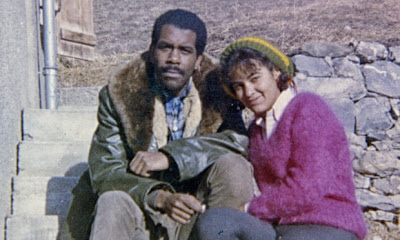
PHOTO: William Melvin Kelley and wife Aiki on a honeymoon trip to Switzerland in December 1963. Photograph: The Estate of William Melvin Kelley
by Sarah Hughes
October 27, 2018
The Guardian (UK)
 WILLIAM MELVIN KELLEY IN 1967
BOOKS BY WILLIAM MELVIN KELLEY (1937-2017):


He was a rising star of the American literary scene whose debut novel, a dark satire on race and America, was acclaimed in 1962 when he was just 24. Now the all-but-forgotten William Melvin Kelley looks set to be a publishing sensation again, just over a year after he died aged 79. This week will see the reissue in Britain of A Different Drummer, Kelley’s critically lauded debut, which saw the ambitious young author compared to everyone from James Baldwin to William Faulkner. Kelley is credited with being the first person to use the term “woke” in a 1962 article for the New York Times headlined “If You’re Woke You Dig It”, and has been hailed by the New Yorker as the “lost giant of American literature”.Now his family hopes that there will be renewed enthusiasm for his back catalogue. Kelley published three further novels and a collection of short stories in the space of a decade before turning his back on the US literary scene and moving his family to Jamaica in pursuit of a different life.“Drummer is really the beginning of a whole world,” his widow, Aiki Kelley, told the Observer. “His later work is often called experimental and difficult but I would say that it’s funny and smart and interesting. He didn’t write like anyone else.”Jon Butler, the managing director of Quercus, which will publish A Different Drummer in the UK on 1 November, following a seven-way auction for the UK rights, agreed. “Reading Drummer is a bit like finding a bit of buried treasure,” he said. “It’s about the thrill of finding that you’re in on a secret early and being able to tell everyone else why it is that they should read it.”The hype around Kelley’s debut began after journalist Kathryn Schulz stumbled upon a first edition novel by African-American poet Langston Hughes with an inscription to Kelley written in it. Intrigued as to who Hughes was effusively praising, Schulz wrote an appraisal for the New Yorker earlier this year that praised Kelley’s “impressive range”, noting the comparisons in the 1960s to Isaac Bashevis Singer and James Joyce. Schulz concluded that the key to A Different Drummer’s power lay in the way it imagined “an alternate universe where African Americans wield not less power, but more”.PHOTO: Kelley celebrating his 38th Birthday in Bull Bay, Jamaica, with daughters Cira and Jesi and wife Aiki. Photograph: Estate of William Melvin KelleyWhat is most intriguing about Kelley’s work is the way he chooses to express that power. A Different Drummer, written at the height of the civil rights era when racist segregation laws were still in effect, tells the story of a young African-American farmer named Tucker Caliban who wakes up one morning, salts his fields, slaughters his horse and cows, burns down his house and leaves his unnamed southern state. The rest of the African-American population soon follow him. It is a wholesale rejection of a way of life made all the more powerful by the way in which Kelley’s tale unfolds.“Kelley’s genius was to write the whole book from the point of view of the white townsfolk left behind,” said Butler. “Their stunned attempts to grapple with this refusal to stick around under the yolk is a scorching indictment of the establishment’s inability to engage with inequality and that still speaks to us today, particularly in the age of Black Lives Matter.”So why then did this young author, who seemed set for literary fame and fortune, fade from the public eye? The answer, in part, is that it was a conscious decision, and one which has intriguing parallels with Kelley’s best-known novel. “We were followers of Malcolm X,” said Aiki. “The way he thought really impressed us, the construction of his ideas, the questions he asked. Then Malcolm was assassinated and everything fell apart.“Kelley covered the trial of Malcolm’s killer and in the court the judge made him stand up to illustrate a point. He came home that night and said: ‘I’m a black man with a beard. I’m marked. We’re out of here.” The family moved to Paris, “where we were living when we heard Dr King had been assassinated”, and spent time in Rome, “where we learned that [Robert] Kennedy had been shot. At that point we knew that we didn’t want to raise our family in America.”The young couple and their two daughters, Jesi and Cira, moved to Jamaica, where they would stay for the next nine years. Aiki said: “The only thing we knew how to be was artists, so we did that every day.“Kelley wrote and I made art and we taught the children. We always knew that the one thing we didn’t want to be was middle class – we had both grown up in that world and were reacting against it – so we always said we’d be very rich or very poor. As it turned out we were mostly very poor, but it was an adventure.”Returning to New York in the late 1970s after their visas had expired, they found a different world. “We had been away a long time and publishing had changed,” said Aiki. “It was more about money and sales. Kelley couldn’t get back in the rhythm.”Their existence remained precarious until 1989 when an old friend, who had long supported Kelley’s work, helped him land a job at Sarah Lawrence College, where he would teach until his death. “I think in some ways he was happy that things turned out that way because he liked his life and he had a great fear of money,” said Aiki. “He did ask me towards the very end if I felt he failed us, but my answer was absolutely not. We had a wonderful life.”As to what he would have made of the interest in his work, his daughter Jesi laughed. “He would have been very amused,” she said. “And then he would have said it’s been a long time coming. When things were really tight he would say to us: ‘Don’t worry, I‘m sitting on a goldmine.’“He always felt that public attention would eventually swing back round to him, so I really do feel that he’s up there now looking down and seeing all this attention and laughing, thinking, ‘Didn’t I say that would happen? I was right.’”
by Sarah Hughes
October 27, 2018
The Guardian (UK)
WILLIAM MELVIN KELLEY IN 1967BOOKS BY WILLIAM MELVIN KELLEY (1937-2017):
He was a rising star of the American literary scene whose debut novel, a dark satire on race and America, was acclaimed in 1962 when he was just 24. Now the all-but-forgotten William Melvin Kelley looks set to be a publishing sensation again, just over a year after he died aged 79. This week will see the reissue in Britain of A Different Drummer, Kelley’s critically lauded debut, which saw the ambitious young author compared to everyone from James Baldwin to William Faulkner. Kelley is credited with being the first person to use the term “woke” in a 1962 article for the New York Times headlined “If You’re Woke You Dig It”, and has been hailed by the New Yorker as the “lost giant of American literature”.Now his family hopes that there will be renewed enthusiasm for his back catalogue. Kelley published three further novels and a collection of short stories in the space of a decade before turning his back on the US literary scene and moving his family to Jamaica in pursuit of a different life.“Drummer is really the beginning of a whole world,” his widow, Aiki Kelley, told the Observer. “His later work is often called experimental and difficult but I would say that it’s funny and smart and interesting. He didn’t write like anyone else.”Jon Butler, the managing director of Quercus, which will publish A Different Drummer in the UK on 1 November, following a seven-way auction for the UK rights, agreed. “Reading Drummer is a bit like finding a bit of buried treasure,” he said. “It’s about the thrill of finding that you’re in on a secret early and being able to tell everyone else why it is that they should read it.”The hype around Kelley’s debut began after journalist Kathryn Schulz stumbled upon a first edition novel by African-American poet Langston Hughes with an inscription to Kelley written in it. Intrigued as to who Hughes was effusively praising, Schulz wrote an appraisal for the New Yorker earlier this year that praised Kelley’s “impressive range”, noting the comparisons in the 1960s to Isaac Bashevis Singer and James Joyce. Schulz concluded that the key to A Different Drummer’s power lay in the way it imagined “an alternate universe where African Americans wield not less power, but more”.PHOTO: Kelley celebrating his 38th Birthday in Bull Bay, Jamaica, with daughters Cira and Jesi and wife Aiki. Photograph: Estate of William Melvin KelleyWhat is most intriguing about Kelley’s work is the way he chooses to express that power. A Different Drummer, written at the height of the civil rights era when racist segregation laws were still in effect, tells the story of a young African-American farmer named Tucker Caliban who wakes up one morning, salts his fields, slaughters his horse and cows, burns down his house and leaves his unnamed southern state. The rest of the African-American population soon follow him. It is a wholesale rejection of a way of life made all the more powerful by the way in which Kelley’s tale unfolds.“Kelley’s genius was to write the whole book from the point of view of the white townsfolk left behind,” said Butler. “Their stunned attempts to grapple with this refusal to stick around under the yolk is a scorching indictment of the establishment’s inability to engage with inequality and that still speaks to us today, particularly in the age of Black Lives Matter.”So why then did this young author, who seemed set for literary fame and fortune, fade from the public eye? The answer, in part, is that it was a conscious decision, and one which has intriguing parallels with Kelley’s best-known novel. “We were followers of Malcolm X,” said Aiki. “The way he thought really impressed us, the construction of his ideas, the questions he asked. Then Malcolm was assassinated and everything fell apart.“Kelley covered the trial of Malcolm’s killer and in the court the judge made him stand up to illustrate a point. He came home that night and said: ‘I’m a black man with a beard. I’m marked. We’re out of here.” The family moved to Paris, “where we were living when we heard Dr King had been assassinated”, and spent time in Rome, “where we learned that [Robert] Kennedy had been shot. At that point we knew that we didn’t want to raise our family in America.”The young couple and their two daughters, Jesi and Cira, moved to Jamaica, where they would stay for the next nine years. Aiki said: “The only thing we knew how to be was artists, so we did that every day.“Kelley wrote and I made art and we taught the children. We always knew that the one thing we didn’t want to be was middle class – we had both grown up in that world and were reacting against it – so we always said we’d be very rich or very poor. As it turned out we were mostly very poor, but it was an adventure.”Returning to New York in the late 1970s after their visas had expired, they found a different world. “We had been away a long time and publishing had changed,” said Aiki. “It was more about money and sales. Kelley couldn’t get back in the rhythm.”Their existence remained precarious until 1989 when an old friend, who had long supported Kelley’s work, helped him land a job at Sarah Lawrence College, where he would teach until his death. “I think in some ways he was happy that things turned out that way because he liked his life and he had a great fear of money,” said Aiki. “He did ask me towards the very end if I felt he failed us, but my answer was absolutely not. We had a wonderful life.”As to what he would have made of the interest in his work, his daughter Jesi laughed. “He would have been very amused,” she said. “And then he would have said it’s been a long time coming. When things were really tight he would say to us: ‘Don’t worry, I‘m sitting on a goldmine.’“He always felt that public attention would eventually swing back round to him, so I really do feel that he’s up there now looking down and seeing all this attention and laughing, thinking, ‘Didn’t I say that would happen? I was right.’”
Topics