Tuesday, December 3, 2024

Prominent Journalist Heather Digby Parton On the Real Meaning of Trump's Electoral Victory and the Hegemonic Role Of the National MAGA Antidemocratic Coalition in American Politics Today


AMERICA IS A FASCIST STATE

Fascism is a far-right, authoritarian, and ultranationalist political ideology and movement, characterized by a dictatorial leader, centralized autocracy, militarism, forcible suppression of opposition, belief in a natural social hierarchy, subordination of individual interests for the perceived good of the nation or race, and strong regimentation of society and the economy.

Opposed to anarchism, democracy, pluralism, egalitarianism, liberalism, socialism, and Marxism fascism is at the far right wing of the traditional left–right spectrum.


AMERICA IS A ROGUE STATE

A nation or state regarded as breaking international law and posing a threat to the security of other nations. 


https://www.salon.com/2024/11/06/donald-won-the-vibes-now-americas-anti-democratic-coalition-seeks-vengeance/
 

COMMENTARY 

Donald Trump won the vibes. Now America's anti-democratic coalition seeks vengeance

Will the Resistance have the energy to fight back all over again?

by Heather Digby Parton

November 6, 2024
Salon


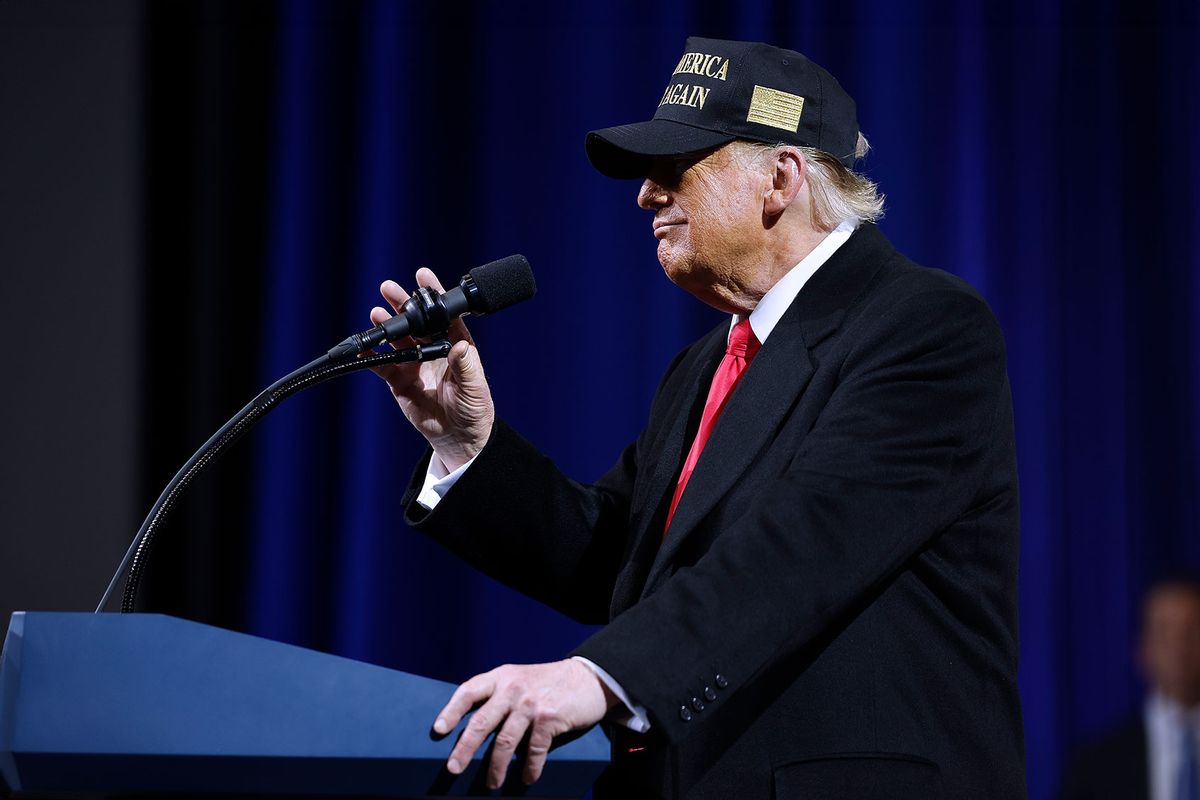
PHOTO: Republican presidential nominee, former President Donald Trump speaks during a campaign rally at the Atrium Health Amphitheater on November 3, 2024 in Macon, Georgia. (Chip Somodevilla/Getty Images)

Donald Trump has once more won the presidency. It's as shocking as it was the first time and even more terrifying. We should have seen this coming from all the polling which showed that the race was tied nationally and in the swing states. Of course it was possible. But I think a lot of us, myself included, once again fell for the illusion that America is too fundamentally decent to elect someone like Trump. We were wrong.

In 2016 that starry-eyed naivete led to the deep despair that we all felt when Trump eked out a win over Hillary Clinton. And in 2020 we believed that dream was vindicated when Joe Biden turned the tables and eked out a win over Trump. And here we are again, caught in a swirling vortex from which we can't seem to escape.


This anti-democratic coalition has a deep, entrenched grievance with the modern world and they use politics to express it.

The funny thing is that until recently I had assumed that the contest was going to be political trench warfare again and the result would be very close. It has seemed to me for a while that we're in an ongoing war between two coalitions that can be defined as pro-democracy and anti-democracy and they have roughly equal political strength. The razor-thin margins in Congress and these incredibly tight presidential races bear that out.

Yes, Donald Trump is the leading figure in this fight as the man who best articulates the anti-democratic coalition's impulses but he also hinders them with his crudeness and lack of discipline. Meanwhile, the pro-democracy coalition is diffuse and leaderless but is helped by the fact that it's less crazy. Joe Biden managed to pull it out in 2020 in the middle of a global pandemic when there were just enough people in the right states to recognize that Trump wasn't up to dealing with it. He was also a white man, which clearly makes that choice easier for some people. (It cannot be a coincidence that the rank misogynist brute, Donald Trump, beat the two highly qualified Democratic women he ran against.)


Related
Election 2024: In a shocking victory, Donald Trump has once again been elected president

I knew all this. And I assumed 2024 would be a tough race for Biden to win although I thought he would probably be able to do it because he managed to "deliver" on so many of his promises, particularly on the economy, which many smart people assured me was the key to winning over voters. Surely, the people would start to see that inflation had abated, the job market was great and that interest rates were coming down, right? All that new manufacturing in the swing states had to count for something. But when it became clear that he could not campaign effectively and he turned it over to his vice president, who seemed to electrify the pro-democracy coalition, I began to believe that this time it would win decisively. I was fooling myself.

Donald Trump bungled the worst health crisis in a century, was found guilty of fraud and civilly liable for defamation and sexual assault. He is currently under indictment for stealing classified documents and attempting a coup in 2020. He acted deranged and demented on the campaign trail and it changed nothing. When he said he could shoot someone on 5th Avenue and not lose any votes, he was right. There is literally nothing he can do to make his faithful followers move away. And that's because it's really not about him — it's about them.

Trump has solidified his grip on nearly half the voters in this country because, as journalist Lindsay Beyerstein tweeted last night, "he created a conspiracist permission structure to ignore or deny all the facts and focus on hate." Our modern information ecosystem, the social media and cable news silos have allowed him to construct an alternate reality for the Republican Party and they eagerly accept it because it feeds their sense of fear and loathing of the other. And it isn't just the kooky QAnon conspiracy types — Trump managed through sheer repetition to convince otherwise normal people that his first term was a golden age of peace and prosperity and that the country today is a dystopian hellscape because the price of eggs is higher than it was five years ago.

On some level, these people know that's all nonsense and Trump knows it too. This anti-democratic coalition has a deep, entrenched grievance with the modern world and they use politics to express it. "This is happening all over the world," The Atlantic's Tom Nichols wrote of the anti-incumbent wave elections, "among people who think that others are *unjustly* living better than they are - even while they themselves are living well."


Related
Live updates: Salon's latest 2024 elections news

Nichols added, "resentment and false nostalgia (and affluence and boredom) are deadly threats to democracy, as we're about to learn."

It's not about policy no matter how much people insist that it is. We know this because in places like Missouri voters just passed initiatives for abortion rights, an increase in the minimum wage, and paid sick leave, all Democratic policies, while overwhelmingly voting for a Republican senator and president who both strongly oppose these things. This is about aesthetics and attitudes. A majority of Americans want an autocratic strongman show and Trump and the Republicans are happy to give it to them.

The anti-democracy coalition under Trump is on the verge of fascism. He and many in his party are already there. We know this because we know their plans. We've all been discussing Project 2025 and Agenda 47 and Schedule F for months now. Trump's mass deportation policy may never come to full fruition but they will certainly make an example of some people if only to entertain the base. Recall how much they loved those migrant flights to Martha's Vineyard and the like a year or so ago. Some televised knocking down of doors and throwing crying women and children onto buses ought to give them a thrill (a double thrill when the Democrats get hysterical about it.)

Here's Trump promising RFK Jr. "a good time" messing around with the public health system:

We know about Trump's plans for the economy and since his tariff obsession is his only economic and foreign policy idea, it's unlikely that even his business buddies will be able to talk him out of it. Foreign allies are no doubt meeting with their national security people as we speak, implementing plans to distance themselves from the United States, knowing Trump's affinity for autocrats like Russia's Putin and Hungary's Orbán. America's adversaries are licking their chops. They know Trump is a pushover.

But the vengeance policy is what's going to animate Trump the most. His enemies list is long and he will make sure they pay. It's what he lives for:

Here's a message from one of the people mentioned as a possible attorney general or White House counsel in a second Trump term:

We survived Trump's first term, (although his erratic rhetoric and policies during COVID did result in many unnecessary deaths.) But everyone knows by now that this second term is not going to be the same. The Republican establishment has been purged of dissenters and Trump will have only MAGA loyalists in his inner circle. Trump's new "government gfficiency" czar Elon Musk is already promising that there will be "hardship" (not for him, of course) as they slash the government safety net that so many Americans depend upon. Everything from environmental regulations to abortion rights to free speech is on the chopping block. And who will stop them?

Can we survive it again? Probably. But it's going to be much harder. The question is whether the Resistance has the energy to do it all again or will it pull back and just watch it all burn out of sheer exhaustion? After all, they tried their best. They ground out many wins between 2016 and today. But in the end they lost it all again. What's next? 


Ta-Nehisi Coates On What Constitutes Truth and What Determines Lies in Palestine Today From the Standpoint of the United States And Its Central Role in the Perpetuation Of The Deadly Genocide Taking Place There Today

Ta-Nehisi Coates: I Was Told Palestine Was Complicated. Visiting Revealed a Simple, Brutal Truth 


Democracy Now!

November 28, 2024 


As the war on Gaza spans a second year, we continue our conversation with the acclaimed writer Ta-Nehisi Coates. His new book, _The Message_, is based in part on his visit last year to Israel and the occupied West Bank, where he says he saw a system of segregation and oppression reminiscent of Jim Crow in the United States. "It was revelatory," says Coates. "I don't think the average American has a real sense of what we’re doing over there — and I emphasize 'what we're doing' because it's not possible without American support." Democracy Now! is an independent global news hour that airs on over 1,500 TV and radio stations Monday through Friday. 

Watch our livestream at democracynow.org Mondays to Fridays 8-9 a.m. ET. 


Prominent Constitutional and Civil Rights Attorney, Scholar, Activist, Public Intellectual, Labor Organizer, Teacher, and Author Sherrilyn Ifill On How and Why Crucial Questions of Race and Gender Have Yet Again Been Stupidly and Arbitrarily Separated From Those of Class in American Society in the 2024 Presidential election

 
Why Have Race & Gender Been Erased from Analysis of the Presidential Election? Part 1
 
by Sherrilyn Ifill
December 1, 2024
 

How should we analyze the meaning of the re-election of Donald Trump? What factors about this election can help us navigate the very dangerous and challenging time we face in our nation? It’s complicated of course. Many factors bear on the outcome of any election, and this one was no different. Most of us rely on the analysis provided by those whose job it is to analyze difficult political moments to make sense of what we don’t understand. We listen (sometimes incessantly) to the conclusions reached by political pundits - those who have covered national elections, run campaigns and been deeply engaged in observing and analyzing politics for years, sometimes decades. Most who are part of this cohort of political experts have very particular knowledge and expertise born of this experience.

But they also have very particular blind-spots.

That may be why we have been subjected to the most tortuous post-election analysis of the most consequential election of the modern era. Think pieces began dropping the day after Trump soundly defeated Vice President Harris, and led the Republicans to recover the House and Senate. Armed with (notoriously tricky) exit polls and vibes, we learned that Trump had won because “ Women Didn’t Let Trump Down, Men Did.” That Democrats have yet to learn how to talk to the working class. That Democratic elites had misjudged the significance of the economy. That Harris had talked too much about trans people and used the term “Latinx” (she hadn’t) That Harris, the Vice President of the United States as well as a candidate, made a fatal error in not bending her schedule to appear on Joe Rogan’s podcast. That Harris didn’t distance herself enough from Biden. That the Democratic party must stop relying on “identity politics.” That Bernie Sanders would have won.

Others described the significance of the election as a Damascus Road moment for the Democratic Party, suggesting that the Party should be torn down and rebuilt. We are also learning more about the outsized role of Elon Musk - his money, his social media platform, and his advisor’s funding of false flag ads to turns voters away from Harris. 


But with shockingly few exceptions, two glaringly obvious factors have been virtually ignored by writers of post-election think-pieces in the nation’s leading journals. Understanding the reason for this omission tells us as much about the significance of this election for the future of this country, as the outcome of the election itself.

For the first time in our nation’s history a Black and Indian woman was the major party candidate for President of the United States. She was the graduate of an Historically Black College. She had served as the Attorney General of the largest state in the country. She had served in the United States Senate where, in addition to serving on the Senate Judiciary Committee, where she put on a blistering a cross-examination of Attorney General nominees Jeff Sessions and Bill Barr, and SCOTUS nominee Brett Kavanaugh. She served on the Senate Intelligence Committee, where she had access to critical and classified documents and intel about America’s enemies and allies. She was the first Black and Indian woman Vice President. She represented the country at international conferences and meetings in Asia, Africa, and Europe. Drawing on her bona fides as a prosecutor, she famously declared Vladimir Putin “a war criminal”at a security conference in Munich. She endured a rocky first year of public appearances and interviews in the States. But Harris caught fire in rallying women after the Supreme Court’s decision striking down Roe v. Wade. She barnstormed across the country and encouraging women to believe that “we will not go back.” And finally, with no advance notice and a runway of only 3 months until Election Day, she took up the campaign for the presidency, after President Joe Biden was pressured by his party to leave the race.

Her campaign was impressive. Tireless, upbeat, joyful, and buoyed early-on by a fundraising juggernaut that began with a grassroots Zoom fundraising campaign by Black women, and by elite donors Harris corralled in the first 24 hours after Biden’s withdrawal. Outfoxing Leader Nancy Pelosi, former President Barack Obama, and a legion of Democratic leaders who hoped for an “open primary” in August to decide on a nominee to face Trump, Harris showed grit, strategy, and that she was what Pelosi in an interview with Ezra Klein described archly as politically “astute.”

She delivered a debate knock-out performance that left Trump running from a scheduled follow-up meeting. Harris seemed to have found Trump’s Achilles’ heel, mocking his rallies, besting him on policy, confronting him with the reality of women harmed by the Dobbs decision, and reminding voters that Trump would remain focused on only one thing: himself.

Harris knew she would have to address race. She has identified as Black and Indian her entire life. In her primary campaign debate against Joe Biden in 2016, she famously floored him by describing her experience as a school girl desegregating an elementary school in Berkley California. She was almost obsessively loyal to her alma mater, Howard University – the nation’s premier historically Black college which was founded during Reconstruction to educate Black students. There were a never-ending supply of memes showing her dancing with Black marching bands, getting’ down at the 50th anniversary of Hip Hop celebration at the White House, strolling with members of her Black sorority, Alpha Kappa Alpha. She was unapologetically Black and had no intention of down-playing it.

She leaned also into being a woman. The Supreme Court’s Dobbs decision remained her core rally cry, and many hoped that this would finally shake loose the support that a majority of white women had given Trump in 2016 and 2020.

But she knew in this era of anti-affirmative action and anti-DEI zeal, she would need to reassure the white electorate that she was not running solely on her dual identities as a woman of color. She was asked often about it. And she was firm in repeatedly saying that she was not asking voters to support her because of her race and gender. She insisted instead that she would have to “make the case” to voters in seeking their support.

She didn’t lead with race, but it was always there. We could no more ignore that Harris is a Black and Indian woman, than we could ignore her beauty (which raised its own issues). As art historian and Harvard Professor Sarah Lewis powerfully explores in her new book The Unseen Truth: When Race Changed Sight in America, Americans can’t “not see” race precisely because we have been trained to see race almost everywhere.  
 
https://news.harvard.edu/gazette/story/2024/09/unseen-truth-shows-the-real-picture-behind-caucasian-ideals/

Moreover, Harris’ opponent, former President Trump, wanted you to see her race. He questioned her racial identity – suggesting, during an interview at the annual meeting of the National Association of Black Journalists - that she had only recently identified as Black (all evidence to the contrary). He insulted her with the particular insults he has long used to denigrate Black women - “low i.q.,” “dumb as a rock,” “lazy as hell,”

https://www.politico.com/news/2024/07/23/trump-kamala-harris-attacks-00170601 - and asked the crowd at one rally in North Carolina “does she drink? Is she on drugs?” 
 
He insisted that Harris had “played the race card on a level you rarely see” in the 2020 primaries.

https://www.nbcnews.com/politics/2024-election/republican-attacks-kamala-harris-center-race-gender-dumb-dei-candidate-rcna162570

Trump posted a photo of Harris with her mother’s family, dressed in Indian attire to his Truth Social account.

https://www.yahoo.com/news/trump-posts-photo-kamala-harris-174900438.html

guccounter=1&guce_referrer=aHR0cHM6Ly93d3cuZ29vZ2xlLmNvbS8&guce_referrer_sig=AQAAAF5kCIkq1u0pUCgWgXGMj57TEx5XVmeRI9W2r45szwCndy30l7ZmOcrLugcf85ar-9_DGrxQUdjT0KruC68PtWwK6yc3EI3YSUdc9kiyr3MQ_JudyZlDxTRNHoeIaPphoI2BV80Gv-0My7CxtAnNk4DP8HTBkTb8DhqlpFDcYjcA

His inclination to use curse words was often unleashed when speaking about Harris, calling her at one point late in the campaign “a shit Vice President.” 
 
https://www.nbcnews.com/politics/2024-election/trump-unleashes-torrent-personal-attacks-harris-calling-worst-lazy-hel-rcna176599 .

When an attendee at one his rallies shouted out that Harris was, in essence, a prostitute, Trump laughed and said, “this place is amazing.” https://www.washingtonpost.com/politics/2024/11/03/trump-insult-worked-corner-rally-harris/

He shared a tweet grotesquely suggesting that Harris committed sex acts to advance her career (rather than by attending law school, passing the bar, and winning a citywide election for District Attorney, and a statewide election, twice to serve as Attorney General and U.S. Senator, before becoming Vice President). https://www.yahoo.com/news/crude-sexist-misogynistic-trump-shares-143322052.html

Trump’s supporters also wanted voters to see Harris’ race. Multiple Republican members of Congress called Harris “a DEI Vice President.”

https://www.cbsnews.com/news/republicans-attack-kamala-harris-dei-hire/

Right wing influencer Charlie Kirk, who manages the Turning Point juggernaut of organizations that mobilize young Republicans across college campuses, and who is largely credited with securing Trump’s win, called her a “DEI pick.” Sebastian Gorka, the right wing figure recently nominated by Trump to serve as a counter terrorism expert in the National Security Administration called Harris a “DEI hire.” In an appearance on CNN he made it even more plain, calling Harris “a disaster whose only qualifications are having a vagina and the right skin color. She’s a DEI hire, right?” “She’s a woman! She’s colored! Therefore, she’s got to be good.”

https://www.washingtonpost.com/politics/2024/08/02/trump-attacks-harris-race-gender/


And despite all of this, race and gender have figured almost nowhere in the major stories in national news outlets where the outcome of the election has been dissected.

The stupefying choice of a majority of white voters to support Trump again – despite his 34 felony convictions, his liability for sexual assault, his attempt to intimidate the judge in his New York defamation trial, his attacks on the Judge’s clerk, the televised revelations by election workers Shaye Moss and Ruby Freeman about how Trump targeted and endangered them, the publicly released recording of Trump demanding 11,000 votes from the Georgia Secretary of State in 2020, and the refusal of 44 members of Trump’s former senior White House team including his Vice President to endorse him, is the story of American democracy at a crossroads. It is the story of this election.

Frankly, Trump’s performance during the final three weeks of the campaign alone was disqualifying. Clearly out of gas, he took to “time outs” during his rallies – asking his aides to play music from his personal playlist, while he swayed to the music for more than 30 minutes. As his performances grew even more embarrassing, and his rallies smaller, Trump became even more vicious. He called former Speaker of the House Nancy Pelosi “sick and crazy.” He mouthed calling Pelosi the “b-word,” to the howling delight of his supporters, and insisted that Pelosi could “go to jail” for ripping up the copy of his address at the end of the 2019 State of the Union address. He said that people could be jailed for criticizing the Supreme Court. He insisted that members of the media should be jailed for their unflattering coverage of him. Trump insisted that his opponents, Rep. Adam Schiff (D-CA), former Speaker Nancy Pelosi and “radical left lunatics” are the “enemy within,” who should be “handled by the National Guard or even the military.”

https://www.cnn.com/2024/10/20/politics/trump-enemy-from-within-schiff-pelosi/index.html

Of the January 6th rally and attack on the Capitol, Trump said, it was a “day of love,” adding, “there was a beauty and love to it that I’ve never seen before.”

In what should have been a nail-in-the-coffin set of collective revelations, Bob Woodward’s latest book revived interest in earlier interviews in which Trump’s senior defense team deemed him unfit to serve. Gen. Mattis, Trump’s former chair of the Joint Chiefs described Trump as “the most dangerous man he’d ever met.” His former Chief of Staff General John Kelly confirmed that Trump spoke admiringly of Hitler and “fit the definition” of a fascist.

https://www.nytimes.com/2024/10/22/us/politics/john-kelly-trump-fitness-character.html

His former Defense Secretary Mike Esper said that Trump was “unfit” to serve, and “a threat to democracy.”

https://www.msnbc.com/rachel-maddow-show/maddowblog/trumps-former-pentagon-chief-calls-threat-democracy-rcna133014

And yet still, despite these historic and unprecedented warnings, a majority of white voters – men and women – chose Trump to lead this country and to be the leader of the free world. The sheer recklessness of the decision speaks volumes about the priorities of a majority of the white electorate in our country.

This is the 2024 election story. And it is one we had best understand if we ever hope to recover this country from its dangerous embrace of authoritarian leadership. Why have a majority of white voters turned their backs on democracy? Is it because of the cost of bacon and eggs or Bounty paper towels, as former NBC anchor Brian Williams recently insisted in a rant on late night television? Is this what history will recall about the fall of American democracy? This is not 2008 when Americans were losing their homes, or even 2020 when COVID and COVID closures were so powerfully affecting every American family. And weren’t Black voters also paying more for bacon and eggs?

Why were Black voters, a majority of whom are working class, and in whose favor our democracy often does not work, willing to place democracy ahead of economic concerns? Why were Latina voters not led by the price of Bounty? Why did a majority of Jewish voters cast their ballots for democracy, even in the face of Trump’s muscular statements of support for Israel? And why for the last three successive elections have a majority of white voters put their electoral power behind a man so manifestly unqualified in character and experience, and who has openly expressed such anti-democratic intentions for our country?


Why haven’t these questions been the focus of post-election analysis?

Stay tuned for Part 2 (available to paid subscribers only).

The Horrific White Supremacist Legacy of the Electoral College System And Its Ongoing Relentless and Utterly Devastating Impact on What Tragically Passes For 'American Democracy' Today

 
The Electoral College’s Racist Origins


More than two centuries after it was designed to empower southern white voters, the system continues to do just that.

by Wilfred U. Codrington III
April 1, 2020
Brennan Center For Justice
 
Associated Press
 

Advance Constitutional Change

Electoral College Reform

This piece was originally published by the Atlantic.

Is a color-blind political system possible under our Constitution? If it is, the Supreme Court’s evisceration of the Voting Rights Act in 2013 did little to help matters. While black people in America today are not experiencing 1950s levels of voter suppression, efforts to keep them and other citizens from participating in elections began within 24 hours of the Shelby County v. Holder ruling and have only increased since then.

In Shelby County’s oral argument, Justice Antonin Scalia cautioned, “Whenever a society adopts racial entitlements, it is very difficult to get them out through the normal political processes.” Ironically enough, there is some truth to an otherwise frighteningly numb claim. American elections have an acute history of racial entitlements—only they don’t privilege black Americans.

For centuries, white votes have gotten undue weight, as a result of innovations such as poll taxes and voter-ID laws and outright violence to discourage racial minorities from voting. (The point was obvious to anyone paying attention: As William F. Buckley argued in his essay “Why the South Must Prevail,” white Americans are “entitled to take such measures as are necessary to prevail, politically and culturally,” anywhere they are outnumbered because they are part of “the advanced race.”) But America’s institutions boosted white political power in less obvious ways, too, and the nation’s oldest structural racial entitlement program is one of its most consequential: the Electoral College.

Commentators today tend to downplay the extent to which race and slavery contributed to the Framers’ creation of the Electoral College, in effect whitewashing history: Of the considerations that factored into the Framers’ calculus, race and slavery were perhaps the foremost.

Of course, the Framers had a number of other reasons to engineer the Electoral College. Fearful that the president might fall victim to a host of civic vices—that he could become susceptible to corruption or cronyism, sow disunity, or exercise overreach—the men sought to constrain executive power consistent with constitutional principles such as federalism and checks and balances. The delegates to the Philadelphia convention had scant conception of the American presidency—the duties, powers, and limits of the office. But they did have a handful of ideas about the method for selecting the chief executive. When the idea of a popular vote was raised, they griped openly that it could result in too much democracy. With few objections, they quickly dispensed with the notion that the people might choose their leader.

But delegates from the slaveholding South had another rationale for opposing the direct election method, and they had no qualms about articulating it: Doing so would be to their disadvantage. Even James Madison, who professed a theoretical commitment to popular democracy, succumbed to the realities of the situation. The future president acknowledged that “the people at large was in his opinion the fittest” to select the chief executive. And yet, in the same breath, he captured the sentiment of the South in the most “diplomatic” terms:

“There was one difficulty however of a serious nature attending an immediate choice by the people. The right of suffrage was much more diffusive in the Northern than the Southern States; and the latter could have no influence in the election on the score of the Negroes. The substitution of electors obviated this difficulty and seemed on the whole to be liable to fewest objections.”

Behind Madison’s statement were the stark facts: The populations in the North and South were approximately equal, but roughly one-third of those living in the South were held in bondage. Because of its considerable, nonvoting slave population, that region would have less clout under a popular-vote system. The ultimate solution was an indirect method of choosing the president, one that could leverage the three-fifths compromise, the Faustian bargain they’d already made to determine how congressional seats would be apportioned. With about 93 percent of the country’s slaves toiling in just five southern states, that region was the undoubted beneficiary of the compromise, increasing the size of the South’s congressional delegation by 42 percent. When the time came to agree on a system for choosing the president, it was all too easy for the delegates to resort to the three-fifths compromise as the foundation. The peculiar system that emerged was the Electoral College.

Right from the get-go, the Electoral College has produced no shortage of lessons about the impact of racial entitlement in selecting the president. History buffs and Hamilton fans are aware that in its first major failure, the Electoral College produced a tie between Thomas Jefferson and his putative running mate, Aaron Burr. What’s less known about the election of 1800 is the way the Electoral College succeeded, which is to say that it operated as one might have expected, based on its embrace of the three-fifths compromise. The South’s baked-in advantages—the bonus electoral votes it received for maintaining slaves, all while not allowing those slaves to vote—made the difference in the election outcome. It gave the slaveholder Jefferson an edge over his opponent, the incumbent president and abolitionist John Adams. To quote Yale Law’s Akhil Reed Amar, the third president “metaphorically rode into the executive mansion on the backs of slaves.” That election continued an almost uninterrupted trend of southern slaveholders and their doughfaced sympathizers winning the White House that lasted until Abraham Lincoln’s victory in 1860.

In 1803, the Twelfth Amendment modified the Electoral College to prevent another Jefferson-Burr–type debacle. Six decades later, the Thirteenth Amendment outlawed slavery, thus ridding the South of its windfall electors. Nevertheless, the shoddy system continued to cleave the American democratic ideal along racial lines. In the 1876 presidential election, the Democrat Samuel Tilden won the popular vote, but some electoral votes were in dispute, including those in—wait for it—Florida. An ad hoc commission of lawmakers and Supreme Court justices was empaneled to resolve the matter. Ultimately, they awarded the contested electoral votes to Republican Rutherford B. Hayes, who had lost the popular vote. As a part of the agreement, known as the Compromise of 1877, the federal government removed the troops that were stationed in the South after the Civil War to maintain order and protect black voters.

The deal at once marked the end of the brief Reconstruction era, the redemption of the old South, and the birth of the Jim Crow regime. The decision to remove soldiers from the South led to the restoration of white supremacy in voting through the systematic disenfranchisement of black people, virtually accomplishing over the next eight decades what slavery had accomplished in the country’s first eight decades. And so the Electoral College’s misfire in 1876 helped ensure that Reconstruction would not remove the original stain of slavery so much as smear it onto the other parts of the Constitution’s fabric, and countenance the racialized patchwork democracy that endured until the passage of the Voting Rights Act of 1965.

What’s clear is that, more than two centuries after it was designed to empower southern whites, the Electoral College continues to do just that. The current system has a distinct, adverse impact on black voters, diluting their political power. Because the concentration of black people is highest in the South, their preferred presidential candidate is virtually assured to lose their home states’ electoral votes. Despite black voting patterns to the contrary, five of the six states whose populations are 25 percent or more black have been reliably red in recent presidential elections. Three of those states have not voted for a Democrat in more than four decades. Under the Electoral College, black votes are submerged. It’s the precise reason for the success of the southern strategy. It’s precisely how, as Buckley might say, the South has prevailed.

Among the Electoral College’s supporters, the favorite rationalization is that without the advantage, politicians might disregard a large swath of the country’s voters, particularly those in small or geographically inconvenient states. Even if the claim were true, it’s hardly conceivable that switching to a popular-vote system would lead candidates to ignore more voters than they do under the current one. Three-quarters of Americans live in states where most of the major parties’ presidential candidates do not campaign.

More important, this “voters will be ignored” rationale is morally indefensible. Awarding a numerical few voting “enhancements” to decide for the many amounts to a tyranny of the minority. Under any other circumstances, we would call an electoral system that weights some votes more than others a farce—which the Supreme Court, more or less, did in a series of landmark cases. Can you imagine a world in which the votes of black people were weighted more heavily because presidential candidates would otherwise ignore them, or, for that matter, any other reason? No. That would be a racial entitlement. What’s easier to imagine is the racial burdens the Electoral College continues to wreak on them.

Critics of the Electoral College are right to denounce it for handing victory to the loser of the popular vote twice in the past two decades. They are also correct to point out that it distorts our politics, including by encouraging presidential campaigns to concentrate their efforts in a few states that are not representative of the country at large. But the disempowerment of black voters needs to be added to that list of concerns, because it is core to what the Electoral College is and what it always has been.

The race-consciousness establishment—and retention—of the Electoral College has supported an entitlement program that our 21st-century democracy cannot justify. If people truly want ours to be a race-blind politics, they can start by plucking that strange, low-hanging fruit from the Constitution.

Saturday, November 30, 2024

The Eternal Legacy of Edward Said and the Ongoing 'Question of Palestine': "The Ground Zero of A Liberated World"

Edward Said & The Question of Palestine
Southbank Centre, November 20 2024

The Palestine Festival of Literature


November 27, 2024


VIDEO:  

https://www.youtube.com/watch?v=hPWiBgbkSJ8 


The Royal Festival Hall, London To mark Fitzcarraldo Editions' republication of Edward Said’s classic text "The Question of Palestine", we were honoured to bring together Jehad Abusalim (via video), Tamim Barghouti, Budour Hassan, Saree Makdisi, Max Porter, Jacqueline Rose, Wadie Said, Avi Shlaim and Ahdaf Soueif - hosted by Aimee Shaalan, at the Royal Festival Hall in London to speak to our current moment within the long history of the Palestinian struggle. They consider what The Question of Palestine has become today, and the painful contradiction that Said himself would observe: that Palestinian gains in international moral and cultural standing since the book’s publication have done nothing to prevent the continuous losses of land and life; and that the establishment of Palestinian histories and narratives in the broader public imagination has led not to equality, but to dehumanisation and death on a scale previously unimaginable.

THE ETERNAL REDEMPTIVE POWER OF KNOWLEDGE, ART, AND EXPERIENCE IN THE (REAL) WORLD: EDWARD SAID (1935-2003) AND MAHMOUD DARWISH (1941-2008)


EDWARD SAID
(1935-2003)
 

Mahmoud Darwish’s farewell to Edward Said:


I CANNOT quite say goodbye to Edward Said, because he remains so present among us and alive in the world. He was our conscience and our ambassador to the world, who never tired of resisting the new world order and defending equity, humanity and the sharing of civilisations and cultures. But he has finally tired of the long and absurd fight with death. For 12 years he was heroic in his battle with illness, heroic in his constant creative renewal, through writing, music, chronicling the humanist spirit, continuing the vital quest for meaning and essence and the intellectual appeal for rigour.

Ask Palestinians to name their greatest source of pride and they will tell you immediately: Edward Said. Our cultural history has known no genius to equal his, so plural yet so unique. For the foreseeable future, he will remain the pioneer who brought the name of his homeland out of the political sphere into universal cultural consciousness. Palestine fathered him, yet his fidelity to the values of justice that are so terribly undermined in his homeland and his defence of its children’s rights to life and liberty make him one of the symbolic fathers of the new Palestine.

Edward Said was an indivisible whole. The man, the critic, the musician, the thinker, and the politician were brought together in him, never contradicting each another. He was a charismatic personality with worldwide fame, a rare example of someone both an intellectual and a star, both elegant and eloquent, deep, scathing, and yet a gentle aesthete of life and language.

We are uneasy at saying farewell to him because we want to deny his absence. The universe converges on Palestine for a precious moment. His family now is the world. Our loss is shared, and so is our sorrow. He set Palestine at the heart of the world and brought the world into the heart of Palestine.
 
 
MAHMOUD DARWISH
(1941-2008)


http://panopticonreview.blogspot.com/…/mahmoud-darwish-grea…

FROM THE PANOPTICON REVIEW ARCHIVES

(Originally posted on August 10, 2008):

Sunday, August 10, 2008

Mahmoud Darwish 1941-2008: Great Poet, Critic, and Activist

All,

The world has lost one of the greatest and most profound poets of the past century, the extraordinary Palestinian poet Mahmoud Darwish. A legendary and iconic cultural and political figure of the Palestinian people (who traditionally deeply cherish, honor, and appreciate the art of poetry) Darwish wrote over 20 volumes of vastly popular and critically acclaimed poetry and his work was translated into over 20 languages throughout the world. Darwish was instrumental in making a global audience conscious of the heroic struggles of the Palestinian people for independence from Israeli colonial occupation and the ongoing fight for sovereignty and statehood This is a major loss but the tremendous legacy Darwish has left for people everywhere who revere art, freedom, and justice will never die.

Kofi

https://www.nytimes.com/…/11/world/middleeast/11darwish.html

Middle East

Mahmoud Darwish, Leading Palestinian Poet, Is Dead at 67
by ETHAN BRONNER

August 10, 2008
New York Times


PHOTO: Mahmoud Darwish: 1941-2008

JERUSALEM — Mahmoud Darwish, whose searing lyrics on Palestinian exile and tender verse on the human condition led him to be widely viewed as the pre-eminent man of Palestinian letters as well as one of the greatest contemporary Arab poets, died Saturday night in Houston after complications from heart surgery. He was 67.

Mr. Darwish, a heavy smoker, was known to suffer from health problems. Still, his death was received among Palestinians with shock and despair.

Mahmoud Abbas, the Palestinian president, declared three days of mourning on Sunday, saying that Mr. Darwish was “the pioneer of the modern Palestinian cultural project,” adding, “Words cannot describe the depth of sadness in our hearts.”

Yasir Abed Rabbo, secretary of the executive committee of the Palestine Liberation Organization, said, “No one could have imagined that Mahmoud’s voice could disappear.”

The Palestinian Authority will give Mr. Darwish a state funeral in the West Bank on Tuesday, the first since Yasir Arafat died in 2004.

Twice divorced with no children, Mr. Darwish had the straight hair, wire-rim glasses and blue blazer of a European intellectual and was, paradoxically for someone seen as the voice of his people, a loner with a narrow circle of friends. He was uncomfortable in public, where he was widely recognized, but he cared deeply about young Arab writers and published their work in the Ramallah-based journal that he edited, Al Karmel.

And while he wrote in classical Arabic rather than in the language of the street, his poetry was anything but florid or baroque, employing a directness and heat that many saw as one of the salvations of modern literary Arabic.

“He used high language to talk about daily life in a truly exceptional way,” said Ghassan Zaqtan, a Palestinian poet and a close friend. “This is someone who remained at the top of Arabic poetry for 40 years. It was not simply about politics.”

Nonetheless, politics played a major role in Mr. Darwish’s life and work. Born to a middle-class Muslim farming family in a village near Haifa in what is today Israel, Mr. Darwish identified strongly with the secular Palestinian national movement long led by Mr. Arafat.

Palestinians in Ramallah, West Bank, held a vigil on Sunday in honor of Mahmoud Darwish, who died Saturday in Houston. Credit Abbas Momani/Agence France-Presse — Getty Images

Mr. Zaqtan and Mr. Abed Rabbo said he was the author of Mr. Arafat’s famous words at the United Nations General Assembly in 1974: “I come bearing an olive branch and a freedom fighter’s gun. Do not let the olive branch fall from my hand.”

He also wrote the Palestinian declaration of independent statehood in 1988 and served on the executive committee of the P.L.O. But he quit in the early 1990s over differences with the leadership and moved firmly out of the political sphere, lamenting the rise of the Islamist group Hamas and what he viewed as the bankruptcy of Palestinian public life.


Mr. Darwish first gained a following in the 1960s for his frank political poems, and to some extent they remain the source of his fame. Among his best known was “Identity Card” from 1964, in which he attacked Israel’s desire to overlook the presence of Arabs on its land:

“Write down!/I am an Arab/ and my identity card number is 50,000/I have eight children/And the ninth will come after a summer.”

It ends: “Therefore!/Write down on the top of the first page:/I do not hate people/Nor do I encroach/But if I become hungry/The usurper’s flesh will be my food/Beware .../Beware ... /Of my hunger/And my anger.”

There were other harsh political works in the following two decades, but those who knew Mr. Darwish said he had often expressed little pride in them, preferring his more personal and universal poems. He told The New York Times in a 2001 interview in Paris: “Sometimes I feel as if I am read before I write. When I write a poem about my mother, Palestinians think my mother is a symbol for Palestine. But I write as a poet, and my mother is my mother. She’s not a symbol.”

During the war that led to Israel’s independence, Mr. Darwish and his family, from the Palestinian village of Al Barweh, left for Lebanon. The village was razed but the family sneaked back across the border into Israel, where Mr. Darwish spent his youth.

Politically active fairly early, he was arrested several times and was a member of the Israeli Communist Party. He left in 1971 and lived in the Soviet Union, Tunisia, Egypt, Lebanon and France.

After Mr. Arafat set up the Palestinian Authority in the West Bank and Gaza in the mid-1990s, Mr. Darwish came to live in Ramallah, where he rented a house. He said he never really felt at home there — he made clear that exile for him was increasingly an emotional rather than a purely political dilemma — and wrote more comfortably when in Europe.

He maintained a wide circle of literary acquaintances, including Israelis, and he said he fully supported a two-state solution.

His work earned him a number of international literary awards and was translated into more than 20 languages, more than any other contemporary Arab poet, according to Mahmoud al-Atshan, a professor of Arabic literature at Bir Zeit University in the West Bank.

There was at first some question of where he would be buried, as some close to him sought to persuade Israel to let him be buried in the area of his home village. But the mayor of Ramallah said Mr. Darwish would be buried in Ramallah, the effective Palestinian capital of the West Bank.

A version of this article appears in print on , on Page B6 of the New York edition with the headline: Mahmoud Darwish, 67, Leading Palestinian Poet. Order Reprints| Today's Paper

Published work by Mahmoud Darwish

Poetry:


Asafir bila ajniha (Wingless birds), 1960

Awraq Al-Zaytun (Leaves of olives), 1964

Ashiq min filastin (A lover from Palestine), 1966

Akhir al-layl (The end of the night), 1967

Yawmiyyat jurh filastini (Diary of a Palestinian wound), 1969

Habibati tanhad min nawmiha (My beloved awakens), 1969

al-Kitabah 'ala dhaw'e al-bonduqiyah (Writing in the light of the gun), 1970

al-'Asafir tamut fi al-jalil (Birds are Dying in Galilee), 1970

Mahmoud Darwish works, 1971. Two volumes

Mattar na'em fi kharif ba'eed (Light rain in a distant autumn) 1971

Uhibbuki aw la uhibbuki (I love you, I love you not), 1972

Jondiyyun yahlum bi-al-zanabiq al-baidaa' (A soldier dreaming of white lilies), 1973

Complete Works, 1973. Now al-A'amal al-jadida (2004) and al-A'amal al-oula (2005).

Muhawalah raqm 7 (Attempt number 7), 1974

Tilka suratuha wa-hadha intihar al-ashiq (That's her image, and that's the suicide of her lover), 1975

Ahmad al-za'tar, 1976

A'ras (Weddings), 1977

al-Nasheed al-jasadi (The music of human flesh), 1980. Joint work

Qasidat Bayrut (Ode to Beirut), 1982

Madih al-zill al-'ali (A eulogy for the tall shadow), 1983

Hissar li-mada'eh al-bahr, 1984

Victims of a Map, 1984. Joint work with Samih al-Qasim and Adonis in English.

Sand and Other Poems, 1986

Hiya ughniyah, hiya ughniyah (It's a song, it's a song), 1985

Ward aqal (Fewer roses), 1985

Ma'asat al-narjis, malhat al-fidda (Tragedy of daffodils, comedy of silver), 1989

Ara ma oreed (I see what I want), 1990

Ahad 'asher kaukaban (Eleven planets), 1992

Limaza tarakt al-hissan wahidan (Why did you leave the horse alone?), 1995. English translation 2006 by Jeffrey Sacks (ISBN 0976395010)

Psalms, 1995. A selection from Uhibbuki aw la uhibbuki, translation by Ben Bennani

Sareer El-Ghariba (Bed of a stranger), 1998

Then Palestine, 1999 (with Larry Towell, photographer, and Rene Backmann)

Jidariyya (Mural), 2000

The Adam of Two Edens: Selected Poems, 2001

Halat Hissar (State of siege), 2002

La ta'tazer 'amma fa'alt (Don't apologize for what you did), 2003

Unfortunately, It Was Paradise: Selected Poems, 2003. Translations by Munir Akash, Caroyln Forché and others

al-A'amal al-jadida (The new works), 2004. A selection of Darwish's recent works

al-A'amal al-oula (The early works), 2005. Three volumes, a selection of Darwish's early works

Ka-zahr el-lawz aw ab'ad (Same as almond flowers or farther), 2005


Prose:

Shai'on 'an al-wattan (Something about the homeland), 1971

Wada'an ayatuha al-harb, wada'an ayuha al-salaam (Farwell, war, farwell, peace), 1974

Yawmiyyat al-hozn al-'aadi (Diary of the usual sadness), 1973

Dhakirah li-al-nisyan (Memory for Forgetfulness), 1987. English translation 1995 by Ibrahim Muhawi

Fi wasf halatina (Describing our condition), 1987

al-Rasa'il (The Letters), 1990. Joint work with Samih al-Qasim

Aabiroon fi kalamen 'aaber (Bypassers in bypassing words), 1991

Fi hadrat al-ghiyab (In the presence of absence), 2006


See poem entitled "Under Siege" by Mahmoud Darwish following the obituaries:

Palestinians plan big funeral for poet DarwishSunday by Mohammed Assadi
August 10, 2008

RAMALLAH, West Bank (Reuters) - Mahmoud Darwish, whose poetry encapsulated the Palestinian cause, will get the equivalent of a state funeral in the West Bank on Tuesday -- an honour only previously accorded to PLO leader Yasser Arafat.

Tributes for Darwish poured in on Sunday, a day after the 67-year-old writer died from complications following heart surgery in a U.S. hospital in Houston, Texas.

"He translated the pain of the Palestinians in a magical way. He made us cry and made us happy and shook our emotions," said Egypt's vernacular poet Ahmed Fouad Negm.

"Apart from being the poet of the Palestinian wound, which is hurting all Arabs and all honest people in the world, he is a master poet," Negm told Reuters in Cairo.

Darwish's funeral in Ramallah will be the first sponsored by the Palestinian Authority since Arafat died in 2004.

Palestinian President Mahmoud Abbas declared three days of national mourning. People held candle-lit vigils on Saturday and Sunday in the darkened streets of Ramallah, where Darwish's poems were read aloud and some mourners wept.

French Foreign Minister Bernard Kouchner said his country shared Palestinian admiration for "this great figure whose poetry, which reflects nostalgia and liberty, speaks to us all.

"Mahmoud Darwish knew how to express the attachment of an entire people to its land and the absolute desire for peace. His message, which calls for coexistence, will continue to resonate and will eventually be heard," Kouchner said in a statement.

The poet, born in territory now Israel, had made his home in the West Bank city since returning in the 1990s from a long exile during which he rose to prominence in Arafat's Palestine Liberation Organisation (PLO).

"The Palestinian question, in Mahmoud Darwish's poetry, was no longer a legend, but the story of people made of flesh, blood and feelings," said Zehi Wahbi, a friend of Darwish and a Lebanese television presenter and poet.

For Arab League Secretary-General Amr Moussa, Darwish was "the voice of Palestinian civilisation, with its pains, sadness and ambitions".

Widely seen as the Palestinian national poet, Darwish's writing was much translated.

Several of his books were translated into Israel's vernacular, Hebrew, though the nationalist message of his work was largely shunned in the Jewish state, where a plan in the 1990's to teach his poetry in state schools was quickly shelved.

Darwish won new generations of admirers with work that evoked not just the pain of Palestinians displaced, as he was as a child, by the foundation of Israel 60 years ago, but also subtle paradoxes and broader human themes.

He enjoyed a following across the Arab world, where he had the kind of readership contemporary poets in English and other European languages, eclipsed by novelists, can only dream of.

"He turned the Palestinian cause into songs that transcended the cause and all other Arab issues," said Abdel-Rahman al-Abnoudi, a prominent Egyptian poet and a friend of Darwish.

Darwish gave voice to Palestinians' dreams of statehood, helping to craft their 1988 declaration of independence.

He penned the words Arafat spoke at the United Nations in 1974: "Today I have come bearing an olive branch and a freedom fighter's gun. Do not let the olive branch fall from my hand."

(Additional reporting by Allyn Fisher-Ilan in Jerusalem, Thomas Perry in Beirut, Alaa Shahine in Cairo and Tamora Vidaillet in Paris; Writing by Alistair Lyon, edited by Richard Meares)


Palestinian Poet Mahmoud Darwish Is Dead at 67
August 9, 2008
by THE ASSOCIATED PRESS

GAZA CITY, Gaza Strip (AP) -- Mahmoud Darwish, a Palestinian cultural icon whose poetry eloquently told of his people's experiences of exile, occupation and infighting, died Saturday in Houston. He was 67.

The predominant Palestinian poet, whose work has been translated into more than 20 languages and won numerous international awards, died following open heart surgery at a Houston hospital, said Nabil Abu Rdeneh, a spokesman for Palestinian President Mahmoud Abbas.

Born to a large Muslim family in historical Palestine -- now modern-day Israel -- he described his people's struggle for independence while also criticizing both the Israeli occupation and the Palestinian leadership. He gave voice to the Palestinian dreams of statehood, crafted their declaration of independence and helped forge a Palestinian national identity.

''He felt the pulse of Palestinians in beautiful poetry. He was a mirror of the Palestinian society,'' said Ali Qleibo, a Palestinian anthropologist and lecturer in cultural studies at Al Quds University in Jerusalem.

Darwish first gained prominence in the 1960s with the publication of his first poetry collection, ''Bird without Wings.'' It included the poem ''Identity Card'' that defiantly spoke in the first person of an Arab man giving his identity number -- a common practice among Palestinians when dealing with Israeli authorities and Arab governments -- and vowing to return to his land.

Many of his poems have been put into music -- most notably ''Rita,'' ''Birds of Galilee'' and ''I yearn for my mother's bread'' -- and have become anthems for at least two generations of Arabs.

He wrote another 21 collections, the last, ''The Impression of Butterflies,'' in 2008.

Qleibo described Darwish's poetry as ''the easy impossible,'' for Darwish's ability to condense the Palestinian narrative into simple, evocative language -- breaking away from the more traditional heavy, emotive and rhythmic verse of other Arab poets.

Darwish wrote the Palestinian Declaration of Independence in 1988, read by the late Palestinian leader Yasser Arafat when he unilaterally declared statehood. The declaration was symbolic and had no concrete significance.

Darwish's influence was keenly felt among Palestinians, serving as a powerful voice for many.

''He started out as a poet of resistance and then he became a poet of conscience,'' said Palestinian lawmaker Hanan Ashrawi. ''He embodied the best in Palestinians ... even though he became iconic he never lost his sense of humanity. We have lost part of our essence, the essence of the Palestinian being.''

Last year, Darwish recited a poem damning the deadly infighting between rival Palestinian groups Hamas and Fatah, describing it as ''a public attempt at suicide in the streets.''

Darwish was born in the Palestinian village of Birweh near Haifa, which was destroyed in the 1948 Mideast war that led to Israel's independence. He joined the Israeli Communist Party after high school and began writing poems for leftist newspapers.

''When we think of Darwish ... he is our heart, and our tongue,'' said Issam Makhoul, an Arab lawmaker and veteran member of the Israeli Communist Party.

Darwish left Israel in the early 1970s to study in the former Soviet Union, and from there he traveled to Egypt and Lebanon. He joined the Palestine Liberation Organization, but resigned in 1993 in protest over the interim peace accords that the late Palestinian leader Yasser Arafat signed with Israel. Darwish moved to the West Bank city of Ramallah in 1996.

His work is widely admired on the Arab and Palestinian street. In Israel, it evokes different feelings.

In 2000, Israel's education minister, Yossi Sarid, suggested including some of Darwish's poems in the Israeli high school curriculum. But Prime Minister Ehud Barak overruled him, saying Israel was not ready yet for his ideas in the school system.

In 1988, a Darwish poem, ''Passing in Passing Words,'' was read by then-Israeli Prime Minister Yitzhak Shamir inside Israel's parliament as an example of the Palestinians' unwillingness to live alongside Jews. The poem suggested that Darwish called for Jews to leave the region.

Adel Usta, a specialist on Darwish's poetry, said the poem was misunderstood and mistranslated.

''He created a national Palestinian identity that no other poet could achieve,'' Usta said.

Darwish married and divorced twice. He does not have any children.

Siham Daoud, a fellow poet and longtime friend of Darwish, said he traveled to a hospital in Houston, Texas, ten days ago for the surgery and asked not to be resuscitated if it did not succeed. She said Darwish had a history of heart problems, and had been operated on twice in the past.

Akram Haniyeh, Editor-in-Chief of the Al Ayyam newspaper and a close friend of Darwish, was by Darwish's bedside in Houston. He said Darwish underwent an operation on Wednesday and there were complications.

Mahmoud Darwish, poet of the Palestinians, dies Sat Aug 9, 2008 By Mohammed Assadi and Ali Sawafta

RAMALLAH, West Bank, Aug 9 (Reuters) - Mahmoud Darwish, whose poetry his fellow Palestinians embraced as the voice of their suffering, died on Saturday after heart surgery in Texas.

President Mahmoud Abbas declared three days of national mourning to honour the 67-year-old writer who, a close friend said, never came round from a major operation two days earlier.

"The passing of our great poet, Mahmoud Darwish, the lover of Palestine, the pioneer of the modern Palestinian cultural project, and the brilliant national leader, will leave a great gap in our political, cultural and national lives," Abbas said.

"Words cannot describe the depth of sadness in our hearts," he added. "Mahmoud, may God help us for your loss."

The death of a man whose life and words were tightly bound up in a struggle for a Palestinian national rebirth that seems little closer now than when his first work was published in 1960 immediately triggered a wider outpouring of popular emotion.

As news from Houston filtered through, people, some weeping, gathered round candles in the darkened streets of Ramallah. The poet had made his home in the West Bank city since returning in the 1990s from a long exile during which he rose to prominence in Yasser Arafat's Palestine Liberation Organisation (PLO).

Palestinian television interrupted programmes to air film of Darwish, the "national poet", reading from his work. Officials said his body would be flown back for burial in Ramallah.

He won new generations of admirers with work that evoked the pain of Palestinians displaced, as he was as a child, by the establishment of Israel 60 years ago, but also did not shrink from criticism and touched on broader human themes, like love.

An intensely private man who largely lived alone, he enjoyed a mass following across the Arab world, where he had the kind of readership contemporary poets in other languages only dream of.

Palestinians at home and abroad spoke of intense, personal feelings of bereavement. "His death is a loss to the Palestinian people, to the Palestinian cause and to freedom-loving people around the world," said Ahmad Ibrahim, a banker in Ramallah.

Philosophy professor Abdel-Rahim al-Sheikh was choked with emotion: "I cannot speak now. My soul is not helping me."

EXILE

Just last month Darwish packed out a hall for a reading in Ramallah and millions watched on television an event to mark the 60th anniversary of the Palestinian "Nakba", or catastrophe.

In 1948, Darwish was among that half of the Arab population of Palestine driven from their homes, in his family's case near the port of Haifa. They later returned to live in the area.

Jailed several times, Darwish left in 1971 for the Soviet Union. Exile in Cairo, Beirut, Tunis and Paris followed.

In 1988, Israel's parliament debated one work which incensed Israelis who saw an attack on the existence of the Jewish state -- though Darwish said he wanted an end only to their occupation of the West Bank and Gaza Strip: "So leave our land. Our shore, our sea. Our wheat, our salt, our wound," he had written.

"Take your portion from our blood and go away".

In 2000, an Israeli minister proposed adding Darwish to the school curriculum -- but the proposal went no further.

Darwish served on the executive committee of the PLO but broke with Arafat when the two disagreed over the 1993 Oslo accords on establishing a Palestinian state alongside Israel.

Fifteen years on, negotiations appear to most observers to be going nowhere. Violence, a split between Abbas and his Islamist rivals in Gaza and continued Israeli settlement in the West Bank leave few Palestinians hopeful of a viable state.

Last month, Darwish, a heavy smoker who had twice before undergone major heart surgery, spoke to Reuters of his fading health and his gloomy assessment of the world he would leave.

His last works are imbued with a sarcastic humour and a sense of both Israelis and Palestinians, however antagonistic, bound irredeemably together to share an uncertain future.

"Sarcasm helps me overcome the harshness of the reality we live, eases the pain of scars and makes people smile," he said.

"History laughs at both the victim and the aggressor."

In a new poem called "The Written Script", Darwish related a dialogue between a victim and his enemy who fall into a pit:

He saw Israelis bent on suicide, taking Palestinians with them, if the occupation of the West Bank went on: "A killer and his victim die together in one hole," he says in the piece.

Another recent poem "The Dice Thrower", told how Darwish saw death coming yet he clung to life: "To Life I say: Go slow, wait for me until the drunkenness dries in my glass.

"I have no role in what I was or who I will be.

"It is chance and chance has no name.

"I call the doctor 10 minutes before the death, 10 minutes are sufficient to live by chance." (Additional reporting by Wafa Amr, Joseph Nasr and Houston bureau; Writing by Alastair Macdonald)

Poem by Maumoud Darwish
Under Siege

Here on the slopes of hills, facing the dusk and the cannon of time

Close to the gardens of broken shadows,

We do what prisoners do,

And what the jobless do:

We cultivate hope.

***

A country preparing for dawn. We grow less intelligent

For we closely watch the hour of victory:

No night in our night lit up by the shelling

Our enemies are watchful and light the light for us

In the darkness of cellars.

***

Here there is no "I".

Here Adam remembers the dust of his clay.

***

On the verge of death, he says:

I have no trace left to lose:

Free I am so close to my liberty. My future lies in my own hand.

Soon I shall penetrate my life,

I shall be born free and parentless,

And as my name I shall choose azure letters...

***

You who stand in the doorway, come in,

Drink Arabic coffee with us

And you will sense that you are men like us

You who stand in the doorways of houses

Come out of our morningtimes,

We shall feel reassured to be

Men like you!

***

When the planes disappear, the white, white doves

Fly off and wash the cheeks of heaven

With unbound wings taking radiance back again, taking possession

Of the ether and of play. Higher, higher still, the white, white doves

Fly off. Ah, if only the sky

Were real [a man passing between two bombs said to me].

***

Cypresses behind the soldiers, minarets protecting

The sky from collapse. Behind the hedge of steel

Soldiers piss—under the watchful eye of a tank—

And the autumnal day ends its golden wandering in

A street as wide as a church after Sunday mass...

***

[To a killer] If you had contemplated the victim’s face

And thought it through, you would have remembered your mother in the

Gas chamber, you would have been freed from the reason for the rifle

And you would have changed your mind: this is not the way

to find one’s identity again.

***

The siege is a waiting period

Waiting on the tilted ladder in the middle of the storm.

***

Alone, we are alone as far down as the sediment

Were it not for the visits of the rainbows.

***

We have brothers behind this expanse.

Excellent brothers. They love us. They watch us and weep.

Then, in secret, they tell each other:

"Ah! if this siege had been declared..." They do not finish their sentence:

"Don’t abandon us, don’t leave us."

***

Our losses: between two and eight martyrs each day.

And ten wounded.

And twenty homes.

And fifty olive trees...

Added to this the structural flaw that

Will arrive at the poem, the play, and the unfinished canvas.

***

A woman told the cloud: cover my beloved

For my clothing is drenched with his blood.

***

If you are not rain, my love

Be tree

Sated with fertility, be tree

If you are not tree, my love

Be stone

Saturated with humidity, be stone

If you are not stone, my love

Be moon

In the dream of the beloved woman, be moon

[So spoke a woman

to her son at his funeral]

***

Oh watchmen! Are you not weary

Of lying in wait for the light in our salt

And of the incandescence of the rose in our wound

Are you not weary, oh watchmen?

***

A little of this absolute and blue infinity

Would be enough

To lighten the burden of these times

And to cleanse the mire of this place.

***

It is up to the soul to come down from its mount

And on its silken feet walk

By my side, hand in hand, like two longtime

Friends who share the ancient bread

And the antique glass of wine

May we walk this road together

And then our days will take different directions:

I, beyond nature, which in turn

Will choose to squat on a high-up rock.

***

On my rubble the shadow grows green,

And the wolf is dozing on the skin of my goat

He dreams as I do, as the angel does

That life is here...not over there.

***

In the state of siege, time becomes space

Transfixed in its eternity

In the state of siege, space becomes time

That has missed its yesterday and its tomorrow.

***

The martyr encircles me every time I live a new day

And questions me: Where were you? Take every word

You have given me back to the dictionaries

And relieve the sleepers from the echo’s buzz.

***

The martyr enlightens me: beyond the expanse

I did not look

For the virgins of immortality for I love life

On earth, amid fig trees and pines,

But I cannot reach it, and then, too, I took aim at it

With my last possession: the blood in the body of azure.

***

The martyr warned me: Do not believe their ululations

Believe my father when, weeping, he looks at my photograph

How did we trade roles, my son, how did you precede me.

I first, I the first one!

***

The martyr encircles me: my place and my crude furniture are all that I have changed.

I put a gazelle on my bed,

And a crescent of moon on my finger

To appease my sorrow.

***

The siege will last in order to convince us we must choose an enslavement that does no harm, in fullest liberty!

***

Resisting means assuring oneself of the heart’s health,

The health of the testicles and of your tenacious disease:

The disease of hope.

***

And in what remains of the dawn, I walk toward my exterior

And in what remains of the night, I hear the sound of footsteps inside me.

***

Greetings to the one who shares with me an attention to

The drunkenness of light, the light of the butterfly, in the

Blackness of this tunnel!

***

Greetings to the one who shares my glass with me

In the denseness of a night outflanking the two spaces:

Greetings to my apparition.

***

My friends are always preparing a farewell feast for me,

A soothing grave in the shade of oak trees

A marble epitaph of time

And always I anticipate them at the funeral:

Who then has died...who?

***

Writing is a puppy biting nothingness

Writing wounds without a trace of blood.

***

Our cups of coffee. Birds green trees

In the blue shade, the sun gambols from one wall

To another like a gazelle

The water in the clouds has the unlimited shape of what is left to us

Of the sky. And other things of suspended memories

Reveal that this morning is powerful and splendid,

And that we are the guests of eternity.

Translated by Marjolijn De Jager

Submitted by C.K.

Mahmoud Darwish

Copyright 2008 The Associated Press

Posted by Kofi Natambu at 7:00 PM

Labels: 20th century poetry, cultural history, Language and Culture, Mahmoud Darwish, Palestine, Self Determination