Tuesday, May 20, 2025

IMPORTANT NEW BOOKS:

The Afterlife of Malcolm X: An Outcast Turned Icon's Enduring Impact on America
by Mark Whitaker
Simon & Schuster, 2025


[Publication date: May 13, 2025] 
 

Published to coincide with the hundredth anniversary of his birth, the first major study of Malcolm X’s influence in the sixty years since his assassination, exploring his enduring impact on culture, politics, and civil rights.

Malcolm X has become as much of an American icon as Abraham Lincoln, John F. Kennedy, or Martin Luther King. But when he was murdered in 1965, he was still seen as a dangerous outsider. White America found him alienating, mainstream African Americans found him divisive, and even his admirers found him bravely radical. Although Ossie Davis famously eulogized Malcolm X as “our own Black shining prince,” he never received the mainstream acceptance toward which he seemed to be striving in his final year. It is more in death than his life that Malcolm’s influence has blossomed and come to leave a deep imprint on the cultural landscape of America.

With impeccable research and original reporting, Mark Whitaker tells the story of Malcolm X’s far-reaching posthumous legacy. It stretches from founders of the Black Power Movement such as Stokely Carmichael and Huey Newton to hip-hop pioneers such as Public Enemy and Tupac Shakur. Leaders of the Black Arts and Free Jazz movements from Amiri Baraka to Maya Angelou, August Wilson, and John Coltrane credited their political awakening to Malcolm, as did some of the most influential athletes of our time, from Muhammad Ali to Kareem Abdul-Jabbar and beyond. Spike’s movie biopic and the Black Lives Matter movement reintroduced Malcolm to subsequent generations. Across the political spectrum, he has been cited as a formative influence by both Barack Obama—who venerated Malcolm’s “unadorned insistence on respect”—and Clarence Thomas, who was drawn to Malcolm’s messages of self-improvement and economic self-help.

In compelling new detail, Whitaker also retraces the long road to exoneration for two men wrongfully convicted of Malcolm’s murder, making The Afterlife of Malcolm X essential reading for anyone interested in true crime, American politics, culture, and history.


REVIEWS:


“Whitaker traces Malcolm’s influence through a fascinating array of figures from the 1970s to the present day, from boxer Muhammad Ali to Public Enemy and Spike Lee. Readers will relish this sweeping and singular work.”—Publishers Weekly (Starred Review)

"Apart from providing a fascinating detective story, Whitaker documents the sometimes surprising ways in which Malcolm X remains a model of Black resistance—as, for example, an opera that “became a vehicle for making Malcolm newly relevant to the ‘Black Panther’ generation,” as well as the renewed interest in him with the rise of the Black Lives Matter movement. A complex, thoughtfully written book that ably lives up to its title."—Kirkus (Starred Review)

“The Afterlife of Malcolm X is a sumptuous, essential book."—Minnesota Star Tribune

"The Afterlife of Malcolm X is an expansive and inspiring portrait of a man whose fiery desire to drive action has propelled American culture forward."—Amazon Editors Best Books of May 2025

"Incisive.... Engaging....The Afterlife of Malcolm X really tells two stories....One is a work of cultural history....The other is a legal thriller."—LA Times

“Enthralling…often breathtaking.”—Chicago Review of Books

“Malcolm X still haunts and inspires this nation — in ways we often fail to understand. Now, finally, Mark Whitaker puts together the missing puzzle pieces to present a full and mesmerizing picture of the man’s life and legacy. The Afterlife of Malcolm X is an indispensable work that sheds new light on American society and of its most compelling figures.” — Jonathan Eig, author of the Pulitzer Prize-winning King

“Whitaker traces the vast streaks of light left by ‘our black shining prince’ across space and time since the shock of his cruel and brutal murder at the Audubon Ballroom in New York in February 1965. The lives Malcolm X has touched, generation to generation, from Eldridge Cleaver to Amiri Baraka, Kareem Abdul-Jabbar to Spike Lee, Public Enemy to Black Lives Matter, make for an impressive and wide-ranging cultural history. At the same time, Whitaker reveals the stories of reporters and filmmakers who have dedicated themselves to finding justice not only for Malcolm but for those who did and did not take his life. His legacy lives on.”—Henry Louis Gates Jr., New York Times bestselling author of The Black Church

“Whitaker's deeply researched and astonishingly revelatory biography, explains Malcolm's eloquent endurance: 'he grabbed on to my frustrations and turned them into logic.' Whitaker's biography is true to its protagonist.”—David Levering Lewis, Pulitzer-prize winning author of W.E.B. Du Bois

“A fine piece of historical writing and reporting about the changing memory of Malcolm X and its impact on modern America. A must-read for anyone interested in the cultural politics of civil rights since the 1960s.”—Julian E. Zelizer, New York Times bestselling author of Myth America

“With deep insight and intellectual rigor Mark Whitaker chronicles the at times paradoxical evolution of Malcom X’s legacy in popular and political culture. A major achievement.”—Peniel Joseph, award-winning author of The Sword and the Shield


ABOUT THE AUTHOR:


Mark Whitaker is the former editor of Newsweek and the first African American to lead a national newsweekly. He then served as Washington Bureau Chief for NBC News and Managing Editor of CNN Worldwide. Whitaker’s memoir My Long Trip Home was a finalist for the Los Angeles Times Book Prize. His social histories Smoketown: The Untold Story of the Other Great Black Renaissance and Saying it Loud: 1966—The Year Black Power Challenged the Civil Rights Movement were both named among the best nonfiction books of the year by The Washington Post.
 

The Project: How Project 2025 Is Reshaping America
by David A. Graham
Random House,  2025
 
[Publication date:   ‎ April 22, 2025]

REVIEWS:

“Whittles [Project 2025] down to an easily manageable summation, providing a handy and necessary reference guide for concerned citizens . . . Concise and well-reasoned, Graham’s critical handbook uncovers the players and the plays orchestrating this revolutionary political movement that will impact the nation well beyond the four years of Trump’s second term.”—Booklist, starred review

“A close look at the ultra-rightist Project 2025, now playing in a capital near you . . . [Project 2025] has four chief aims: to restore the man-headed family, dismantle the ‘administrative state,’ close the border and defend the nation’s sovereignty, and ‘secure our God-given individual rights to live freely. . . .’ Essential reading for anyone trying to make sense of the Trumpian maelstrom.”—Kirkus Reviews
 

ABOUT THE AUTHOR:

David A. Graham is a staff writer at The Atlantic, where he covers politics and national affairs. He won the Toner Prize for Excellence in National Political Reporting for his coverage of the 2020 presidential election. Before joining The Atlantic, he reported for Newsweek, The Daily Beast, The Wall Street Journal, and The National.

Excerpt. © Reprinted by permission. All rights reserved.
Section I

The Ways and Means


When the public first learned about Project 2025, most of the attention focused on the specific policy ideas it laid out—plans that would upend many aspects of life in the United States, from bedrock rights to the structure of the economy. These proposals are radical and sweeping, and they deserve close attention, but without the ability to make them happen, they’re only worth the pixels they’re published in. What sets Project 2025 apart from so many campaign promises and makes it important to take seriously and comprehend is its detailed scheme for execution.

The concept of a policy blueprint for a future presidency is not novel. As the federal government has become larger and more complex, administrations of both parties have relied on outside groups to create frameworks for governing—useful information so that when a president actually takes the Oath of Office on January 20, they can spend the first hundred days of their term getting things done instead of staffing up and figuring out priorities.

The prototype for this kind of project was created prior to Ronald Reagan’s administration. The Heritage Foundation, which had launched in 1973 to marry pro-business, small-government views with cultural conservatism, published a document in 1980, also called Mandate for Leadership. Aimed at the people who would work for the next Republican president, it envisioned how he might abandon the moderate politics of the post–World War II GOP in favor of something more conservative. It worked: Mandate for Leadership was embraced by aides to President-elect Reagan and became, as The New York Times put it, “the manifesto of the Reagan revolution.” By Heritage’s count, 60 percent of its recommendations became policy within Reagan’s first year in office.

Heritage has continued to produce policy agendas, and although none has had the same impact as the first, other organizations have taken notice. In September 2000, the neoconservative think tank Project for a New American Century published “Rebuilding America’s Defenses.” After the September 11 attacks a year later, the document’s ideas and contributors became central to the George W. Bush administration’s Global War on Terror. When Barack Obama was elected, in 2008, he was still new to Washington, and the Center for American Progress helped provide staffers and ideas for his administration. “Not since the Heritage Foundation helped guide Ronald Reagan’s transition in 1981 has a single outside group held so much sway,” reported Time.

Heritage, meanwhile, had lost some luster. In 2012, Tea Party stalwart Jim DeMint resigned from the Senate to take over the foundation, but the Tea Party movement and DeMint’s stewardship both burned themselves out within a few years. DeMint’s successor, Kay Coles James, clashed with Trump allies, and in October 2021, Kevin Roberts was named president. Within months, he’d convened the beginnings of what would become Project 2025 and hired Paul Dans, who had worked as a personnel official in the Trump White House, to head it up. Work began in early 2022.

To ensure that Project 2025 wasn’t just a parochial project, Roberts directed Dans to look outside Heritage and gather a wide range of contributors from across the right wing, making Heritage a convener for the whole Make America Great Again movement. Hundreds of figures from conservative groups contributed to the final product, representing many different shades of Trumpism.

Heritage saw Project 2025 as a way to reclaim its Reagan-era prominence. The 922-page policy document at its center bears the same name as its forebear. “The book literally put the conservative movement and Reagan on the same page, and the revolution that followed might never have been, save for this band of committed and volunteer activists,” Dans writes.

But Project 2025 diverges in essential ways from its predecessor, and not just because the policy vision is very different from Reagan’s. One big innovation was to create a sort of shadow government ready to plug into the executive branch on Day One of the new administration. This is a role that has historically been handled by presidential administrations themselves, but Project 2025 kicked off even before a president had been nominated so they’d be ready on January 20, 2025.

“We need a big-picture vision, and Donald Trump sets that forth, but we also kind of need the actual instruction manual, how to get things done,” Dans explained to Steve Bannon in 2024. This meant that Project 2025 would not only need to lay out detailed policy ideas, but also search out and train the people expected to implement them. The fourth prong of Project 2025, a playbook for the first six months of the administration, was never made public, but Vought hinted at its content in a 2024 speech: “We have detailed agency plans,” he said. “We are writing the actual executive orders. We are writing the actual regulations now, and we are sorting out the legal authorities for all of what President Trump is running on.”

The Men Behind the Curtain

The two most important figures for understanding Project 2025 are Paul Dans, who directed the project, and Russell Vought, who is listed as an author but is widely understood to be the driving intellectual force behind the project. The two men share the convictions that (in a Reagan-era dictum) personnel is policy and that the nuts and bolts of government are overlooked, but they arrived there on very different paths.

Dans holds the more traditionally elite résumé but is the outsider of the pair. He has the stout build of the lacrosse player he once was, and he carries himself with a somewhat guarded awkwardness—approaching, but not quite reaching, amiability. In interviews, he speaks with gauzy nostalgia about a happier American past. In his own telling, he’s the classic MAGA voter: a disaffected son of a liberal Catholic family who wised up to the failings of Democrats and moved right. “I come from a pure-blooded deplorable mix,” Dans said on a podcast for American Moment, a Project 2025–aligned group, in 2023. He said his parents were drawn to Washington by the idealism of the Kennedy era and met there. He grew up in the D.C. area, then enrolled at MIT, where he studied economics and earned a master’s in city planning.

Dans then attended law school at the University of Virginia, where he became involved with the Federalist Society, the conservative legal group. It was not a propitious time to lean right, even at a place like UVA, and the Federalist Society was not yet the Supreme Court–dominating juggernaut it would become in the Trump era. “It was a winter, if you will, for conservatives,” he recalled in the American Moment interview. “Clinton had come into office. This was the forty days out in the wilderness.”

So when Dans graduated, he decided not to enter government and instead worked for white-shoe law firms in New York City. His most notable work came as part of an epic battle between Chevron and the crusading lawyer Steven Donziger, who had sued the oil company over environmental damage in Ecuador. Dans was part of a team that obtained damaging footage of Donziger, filmed for a documentary, that eventually led to his disbarment.

Dans remained interested in politics. He indulged in the “birther” fantasy that Barack Obama was not born in the United States—“I had some serious academic questioning about the birthplace of a former president,” he told the American Moment hosts, with a smirk—and when Trump emerged as the most prominent proponent of birtherism, Dans became a fan. He was crushed when Trump considered but passed on a presidential bid in 2012 and was an early fan of his 2016 campaign.

After Trump’s unlikely victory, Dans hoped his elite résumé and steadfast Trump support would put him on a fast track into the administration. Instead, he found himself shut out and concluded that the problem was that he was too MAGA. “I think the question number one [on the job application] was, Have you previously served in government?” he recalled. “That would be, well, who? Everyone can do the math backwards. That’s a Bush appointee.”

Dans finally caught a break in 2018, when he met James Bacon, a college student working in the administration. Appealing to the much-younger man for help must have been humbling for Dans, well into his career, but it got him an administration job working on homelessness policy at the Department of Housing and Urban Development. At HUD, he developed a healthy skepticism of career civil servants, but he had even more disdain for political appointees whom he found insufficiently committed to the cause.

“Our folks came in and they were clueless and lazy in a lot of cases,” he told the American Moment hosts. “There is obstruction [by civil servants], to be sure, but I think it’s more that the politicals kind of let themselves get led around by the nose, and that starts by not wanting to do the hard work.”

 
No Race, No Country: The Politics and Poetics of Richard Wright
by Deborah Mutnick
The University of North Carolina Press, 2025

[Publication date: May 13, 2025]
 

No Race, No Country presents a major reconsideration of the breakthrough African American author Richard Wright’s work and life. It challenges standard evaluations of his reputation as an autodidact, his late novels, his travel books, and his political commitments after he left the Communist Party USA. Deborah Mutnick engages a wide range of Wright’s work throughout his career, providing a nuanced perspective on his complicated gender politics and his serious engagement with Marx’s notions of historical materialism, alienation, and commodity fetishism. Adding to a small but growing number of studies of his ecological consciousness, it also examines both his closeness to nature, especially during his youth and late in life, and his early mapping of a racial geography of the “second nature” of the sociocultural world that overlaps with and transforms the natural world. Finally, it joins a recent surge in scholarship on Wright’s later nonfiction as a progenitor of Black radical internationalism in the 1960s and 1970s.


REVIEWS:


“In No Race, No Country, Deborah Mutnick powerfully unearths new detailed research that puts to rest the political and narrow-minded clichés that have dominated the attitudes and critical analyses of Richard Wright’s life and work for at least six decades. The success of this text emerges as no small task. Offering a painstakingly new appraisal of the life-long conjoining of Wright’s iconoclastic Marxist ideology, a serious close reading of his works in the context of his comments on those works, his struggle against racism, and the connection between his national and global political activity, this text emerges as an invaluable resource from which to trace the confluence of Wright’s personal experiences, creative ingenuity as well as his political, ideological, and global commitments. ”With the lyrical voice of an empathetic storyteller who has taken a comprehensive journey through Wright’s life, creative vision, and egalitarian dream, Deborah Mutnick offers a gift that coerces readers and scholars to view Richard Wright as an impassioned augur. After reading No Race, No Country, we have little choice except to revisit anxiously our understanding of Richard Wright’s intellectual prowess and political profundity."—Joyce Ann Joyce, author of Richard Wright’s Art of Tragedy

“A tour de force in historical materialist literary criticism, Deborah Mutnick’s No Race, No Country grounds fresh and compelling readings of Richard Wright’s oeuvre in a deeply dialectical appreciation of the role played by Marxism, communism, and anti-imperialism in both his life and his creative process.”—Barbara Foley, author of Wrestling with the Left: The Making of Ralph Ellison’s Invisible Man

“One of the very best projects on Richard Wright I have ever read.”—James Smethurst, author of Behold the Land: The Black Arts Movement in the South

“Deborah Mutnick has done a masterly job of buttressing recent revisionist scholarship on Wright through her use of new archival material.”—Bill V. Mullen, author of James Baldwin: Living in Fire

“In No Race, No Country, Deborah Mutnick powerfully unearths new detailed research that puts to rest the political and narrow-minded clichés that have dominated the attitudes and critical analyses of Richard Wright’s life and work for at least six decades. The success of this text emerges as no small task. Offering a painstakingly new appraisal of the life-long conjoining of Wright’s iconoclastic Marxist ideology, a serious close reading of his works in the context of his comments on those works, his struggle against racism, and the connection between his national and global political activity, this text emerges as an invaluable resource from which to trace the confluence of Wright’s personal experiences, creative ingenuity as well as his political, ideological, and global commitments. With the lyrical voice of an empathetic storyteller who has taken a comprehensive journey through Wright’s life, creative vision, and egalitarian dream, Deborah Mutnick offers a gift that coerces readers and scholars to view Richard Wright as an impassioned augur. After reading No Race, No Country, we have little choice except to revisit anxiously our understanding of Richard Wright’s intellectual prowess and political profundity.” — Joyce A. Joyce, author of Richard Wright’s Art of Tragedy

“This much-needed book makes a number of impressive contributions. It is certainly the best reading of Wright’s novel The Man Who Lived Underground and the haikus he produced late in his life. In short, I rate this as one of the very best projects on Richard Wright I have ever read.”—James Smethurst, author of Behold the Land: The Black Arts Movement in the South

“A tour de force in historical materialist literary criticism, Deborah Mutnick’s No Race, No Country grounds fresh and compelling readings of Richard Wright’s oeuvre in a deeply dialectical appreciation of the role played by Marxism, communism, and anti-imperialism in both his life and his creative process.” — Barbara Foley, author of Wrestling with the Left: The Politics of Invisible Man\

Book Description:

Restoring Richard Wright to the American literary canon


ABOUT THE AUTHOR: 
 
 
Deborah Mutnick is Professor of English and former Director of Writing at the Brooklyn campus of Long Island University, and is the current Co-Director of LIU Brooklyn Learning Communities (LIUBLC). Chief among her current interests are the digital humanities, oral history, ethnography, public writing, and university-community partnerships that bring the resources of universities to communities and vice versa, enabling students and faculty to engage in research, writing, and creative projects in a wide range of social contexts. Related to this work, she is researching and writing about the relevance to 21st century America of the Federal Writers’ Project created in the 1930s as part of the Works Progress Administration.
 

Blue-Collar Empire: The Untold Story of US Labor's Global Anticommunist Crusade
by Jeff Schuhrke
Verso, 2024

[Publication date: September 24, 2024]
 
How the CIA used American unions to undermine workers at home and subvert democracy abroad

Blue-Collar Empire tells the shocking story of the AFL-CIO’s global anticommunist crusade—and its devastating consequences for workers around the world.

Unions have the power not only to secure pay raises and employee benefits but to bring economies to a screeching halt and overthrow governments. Recognizing this, in the late twentieth century, the US government sought to control labor movements abroad as part of the Cold War contest for worldwide supremacy. In this work, Washington found an enthusiastic partner in the AFL-CIO’s anticommunist officials, who, in a shocking betrayal, for decades expended their energies to block revolutionary ideologies and militant class consciousness from taking hold in the workers’ movements of Europe, Latin America, Africa, and Asia.


REVIEWS:
 

"In this comprehensive and consequential study, Jeff Schuhrke sheds light on the often nefarious international agenda of the AFL-CIO. During the Cold War, as Schuhrke documents, the top leaders of the U.S. labor establishment, driven by fervent and indiscriminate anti-communism, helped sabotage nascent union movements in countries across the globe. In doing so, the AFL-CIO undermined cross-border working class unity and bolstered multinational corporate power. Blue-Collar Empire thus offers much vital information and insight, both for scholars seeking to understand the rise and decline of the 20th century labor movement, and for union activists working today to build (or re-build) international networks of solidarity."
—Toni Gilpin, author of The Long Deep Grudge: A Story of Big Capital, Radical Labor, and Class War in the American Heartland

"In this highly readable and engaging book, Jeff Schuhrke explores the disastrous history of American labor's role bolstering U.S. imperialism in Latin America and elsewhere. He explains that Cold War anti-Communism was not the only key to the AFL-CIO's own "foreign policy." Equally crucial were the ideological linkages that put a liberal brand of industrial pluralism close to the heart of the modernization theory celebrated by the State Department and the CIA. Thus, in trying to transplant a North American version of "free" collective bargaining to the oligarchic regimes of Latin America, U.S. trade unions, whether funded by the CIA or not, found themselves complicit with repressive elites that could tolerate neither left wing insurgencies nor conservative enterprise-based trade unionism."
—Nelson Lichtenstein, author of A Fabulous Failure: the Clinton Presidency and the Transformation of American Capitalism

"For too many years, too many unions followed the State Department like sheep, supporting lethal, union-member-killing anti-communist policies abroad in the hope of keeping at least a small seat at the table. Jeff Schuhrke’s eye-opening new book, Blue-Collar Empire, is an indispensable history of this devil’s bargain, a chilling lesson why, as a new, different kind of labor movement awakens, unions must never fight for economic justice at home while denying it to those abroad."
—Greg Grandin, author of the Pulitzer Prize–winning The End of the Myth

"An important contribution to how we got here and how we can move forward."
—Joe Allen, Counterpunch

"Labor journalist and historian Jeff Schuhrke’s first book, Blue-Collar Empire, dives into American labor unions’ role in Cold War-era interventions across Asia, Latin America, and Africa, and their lasting impacts today."
—Isabela Escalona, Workday Magazine

"Schuhrke expertly guides the reader through the dizzying array of committees, confederations, agencies, institutes, centers and foundations set up by the AFL-CIO and the U.S. government over the decades to split (or directly suppress) militant labor movements and undermine pro-worker governments around the world. He also provides concise, and often heartbreaking, accounts of their “accomplishments” in various countries."
—Jonathan Kissam, UE News

"Blue Collar Empire is a testament of the power of union internationalism. It shows us that U.S imperialism and with that militaristic industries are not just tertiary issues for workers. Workers throughout history and across borders have longed for peace, solidarity and with that the resistance to war is central to unionism."
—Aminah Sheikh, Spring Magazine

"An invaluable contribution to the field, essential for curious novices and specialists alike.."
—Henry De Groot, Cosmonaut

"If you have ever heard the derisive term “AFL-CIA,” you will want to read Jeff Schuhrke’s new book. In Blue Collar Empire, Schuhrke, a long time labor journalist and scholar, lays out the entire disturbing history of the American labor movement’s decades of close involvement in anticommunist crusades around the world. The reality of the AFL-CIO’s ties with the Cold War, the CIA, and America’s bloody foreign policy is, I assure you, much more astounding than you might think."
—Hamilton Nolan

"There is an opening to begin to discuss and learn from the history detailed by Jeff Schuhrke in Blue Collar Empire allowing us to view anti-communism differently…as a tool of class domination which has ruled our country for the last 75 years. This book should be required reading in labor studies classes. More importantly, it should be read by all of us trying to understand developments in our labor movement during the last generation."
—Gail Lindenberg, New York Labor History Association

"Schuhrke has done a truly remarkable job simply telling us in detail about the AFL and the AFL-CIO operations around the world during these years. He has weaved together a sprawling, extremely complicated chain of events that extend around the world, and over roughly a 50 year period ... A tour de force, this book should be read by every trade unionist and people studying US global operations over these years."
—Kim Scipes, Counter Currents

"Schurhke provides us with the most comprehensive account of the insidious AFL-CIO/CIA co-operation since George Morris’s long-out-of-print classic, CIA and American Labor"
—The Morning Star 


ABOUT THE AUTHOR:


Jeff Schuhrke is a labor historian, journalist, union activist, and assistant professor at the Harry Van Arsdale Jr. School of Labor Studies, SUNY Empire State University in New York City. He is a frequent contributor to In These Times and Jacobin, and his scholarship has been published in Diplomatic History and Labor: Studies in Working-Class History. 
 
 
PLAY HARDER: The Triumph of Black Baseball in America
by Gerald Early and National Baseball Hall of Fame and Museum
Ten Speed Press, 2025


[Publication date: April 29, 2025]
 
An authoritative exploration of how Black Americans have shaped baseball from its emergence after the Civil War to the Negro Leagues and Jackie Robinson’s breaking of the color barrier, up to today’s game—by award-winning author Gerald Early in collaboration with the National Baseball Hall of Fame.

No sport has been more associated with America’s sense of itself, with its identity, than baseball. No sport has been so inextricably bound with America’s traditions—with its notions of democracy and fair play—than baseball. And no professional sport in America has been as dramatically connected to social change as Major League Baseball when it became racially integrated the moment Jackie Robinson took the field with the Brooklyn Dodgers on April 15, 1947.

Play Harder comes at a time when the history of Black baseball has become especially relevant—following MLB's recent recognition of the Negro Leagues as major leagues and the effort to incorporate statistics from the Negro Leagues into those for all players. Before Robinson, as Play Harder shows, Black athletes played baseball as far back as the 1800s even before the establishment of the Negro Leagues. But once founded in 1920, the Negro Leagues gave Black Americans an inroad to baseball that would be enduring and profound. The leagues were an instrument of community building during a time when discrimination separated Black people from all white enterprises, including baseball, and they paved the way for racial integration that Black players hoped would come.

Play Harder showcases the Black stars of the game—those from baseball’s early years such as Moses Fleetwood Walker and Rube Foster; Negro Leagues stars like Satchel Paige and Cool Papa Bell; Jackie Robinson and those who crossed the color line after him, like Hank Aaron and Willie Mays, followed by Frank Robinson and Curt Flood; and the stars who ushered in today’s game, such as Reggie Jackson, Dave Winfield, Barry Bonds, and Ken Griffey, Jr. Playing out against the cultural and political events of 150 years, the story bears witness to the richness of this country's diversity while remaining clear-eyed about the racial injustice endured by Black Americans. In the end, Play Harder celebrates the triumph of some of baseball’s greatest players and their remarkable contributions to the game we know and love today.
 
ABOUT THE AUTHOR:

Gerald Early is the Merle Kling Professor of Modern Letters at Washington University in St. Louis. He specializes in writing about African American literature and culture, sports, jazz, and the cultural history of the United States. He won the 1994 National Book Critics Circle Award for nonfiction for The Culture of Bruising: Essays on Prizefighting, Literature, and Modern American Culture. His latest book, written in collaboration with the National Baseball Hall of Fame and Museum is Play Harder: The Triumph of Black Baseball in America. He is also the editor of the Sammy Davis Jr. Reader and the Muhammad Ali Reader. He is also the editor of the Common Reader, the online journal of Washington University.


Monday, May 19, 2025

Fascism in America, Part 4: The Sheer Hatred, Greed, Cruelty, Indifference, Ignorance, and Rank Stupidity That Motivates and Drives It And What Must Be Done To Fight and Defeat It

https://www.nytimes.com/2025/05/18/nyregion/times-square-black-woman-statue.html

Times Sq. Sculpture Prompts Racist Backlash. To Some, That’s the Point.

A 12-foot bronze statue of an anonymous Black woman has become a lightning rod in a fraught American debate about race, representation and diversity.

Listen to this article · 8:23 minutes

Learn more


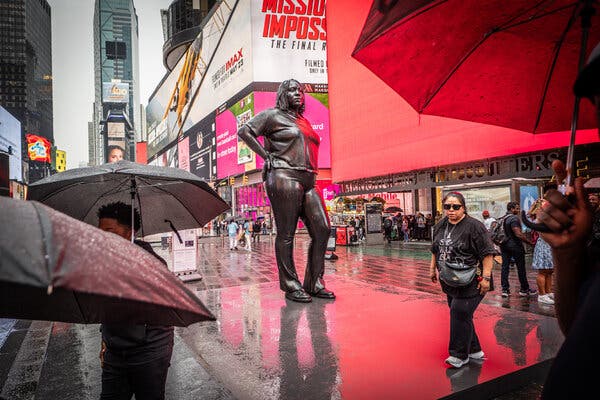
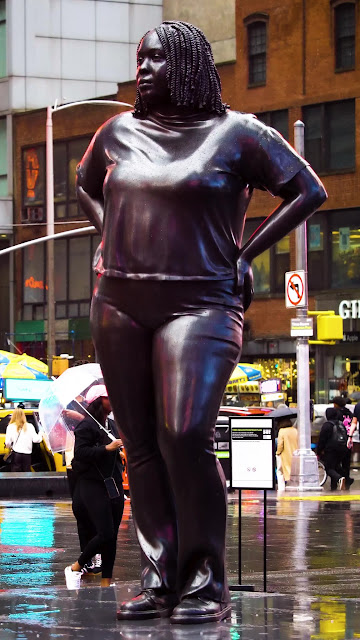
Thomas J Price’s sculpture, “Grounded in the Stars,” was installed temporarily in Times Square last month. Credit: Graham Dickie/The New York Times

by Andrew Keh
May 18, 2025
New York Times


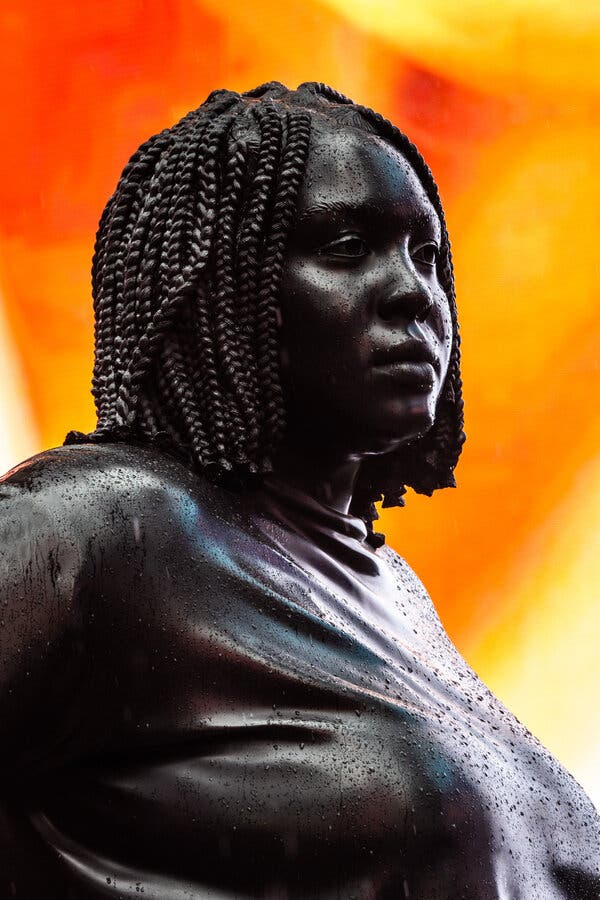
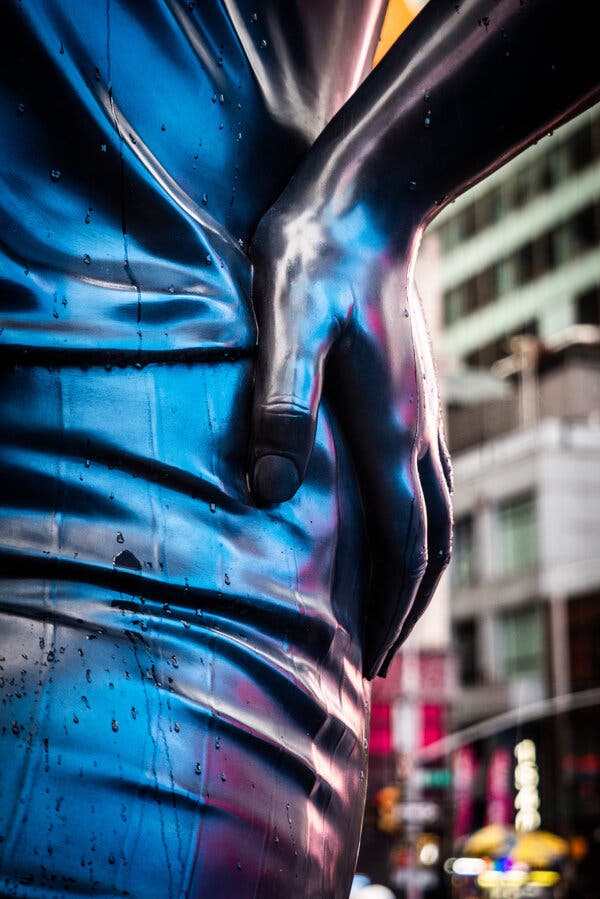
The bronze sculpture is intentionally unassuming, depicting an anonymous Black woman, casually dressed, with a neutral expression on her face and her hands on her hips.

But as soon as the 12-foot statue was erected last month in Times Square, it touched off a roiling debate — one that reflects both a long-simmering argument over public monuments, and a very 2025 political dispute about diversity and race in America.

A columnist for Fox News wondered why a statue of an “angry Black lady” had been displayed in the same city where a contentious monument of Theodore Roosevelt had been removed a few years back, while a writer for The Federalist described the work as “leftist cultural warfare.”

“This is what they want us to aspire to be?” Jesse Watters, the Fox News host, recently asked on his show. “If you work hard you can be overweight and anonymous?” He added, “It’s a D.E.I. statue.”

As the conversation has intensified, criticism has emerged from several angles: from those seeking to preserve the country’s historical monuments; from people wondering if the piece employed stereotypical imagery; from critics calling its message and execution ham fisted. But social media has been overrun with commenters, often anonymous, hurling overt racism and sexism.

To the artist and the organizers of the public exhibition, the backlash — however unsavory — effectively justifies the sculpture’s existence at a time when the Trump administration and its allies are targeting all manner of things involving nonwhite people as “D.E.I.”


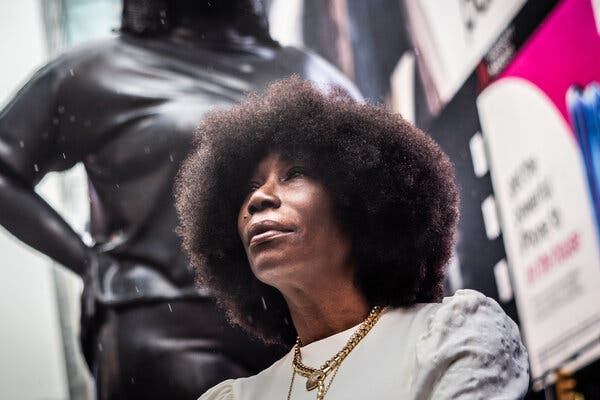
Elma Blint of Brooklyn is a fan of the sculpture and made a special trip to see it in person. Credit: Graham Dickie/The New York Times

The piece, “Grounded in the Stars,” was produced in 2023 by Thomas J Price, a London-based sculptor whose work in recent years has directly critiqued the traditions of public monuments and portraiture.

The statue was installed on April 29 by the Times Square Alliance, which periodically invites contemporary artists to exhibit work in the bustling plaza. The piece will remain there through June 17.

A placard displayed alongside the piece declares its intent: The work challenges the conventional wisdom of “who should be immortalized through monuments.” The text points out, too, how the sculpture presents a contrast to the two permanent monuments — “both white, both men” — that stand nearby.

Sign up for the Race/Related Newsletter Join a deep and provocative exploration of race, identity and society with New York Times journalists. Get it sent to your inbox.

“What has ensued is a fairly impressive amount of debate and exchange and critical dialogue,” said Jean Cooney, the director of the Time Square Alliance’s arts program, “the kind you hope a public artwork will provoke.”

It was a timely provocation. While debates about monuments have bubbled up across the United States essentially since the country’s inception, they have intensified over the past several years amid reinvigorated movements for racial justice and the backlashes to those efforts.

Patricia Eunji Kim, an art historian at New York University, said that monuments inspired widespread emotional investment because they posed questions about how to spend public money, how to shape public spaces and how to project a collective heritage.

“I understand why there is such a backlash, because the stakes are so high in that sense,” Ms. Kim said.

But critics of “Grounded in the Stars” may not have noticed that the piece is not actually a monument, at least not in the conventional sense.

It was first exhibited two years ago in Los Angeles at Hauser & Wirth, an international gallery that is currently hosting an exhibition of related works from Mr. Price at one of its New York locations. The sculptures, according to a release from the gallery, “amplify traditionally marginalized bodies and redress structures of hierarchy, inviting questions about who we choose to celebrate in art.”

With its dark bronze material, towering height and contrapposto figure, the sculpture has read to some as a traditional monument, when it is in fact an artwork about monuments.


Credit: Graham Dickie/The New York Times


Credit: Graham Dickie/The New York Times

“Are there no notable Black women who actually exist to celebrate?” wrote David Marcus, a columnist for Fox News. “How about a giant Condoleezza Rice, or a somewhat more diminutive Simone Biles?”

The hubbub around the statue, for some, also reflected the changing tenor of social discourse in the second term of President Trump.

The term D.E.I. (a reference to the diversity, equity and inclusion initiatives of recent years) has become a political lighting rod under Mr. Trump, and the administration’s efforts to eradicate the concept have taken on bizarre forms, such as the temporary deletion of Jackie Robinson’s biography from a Department of Defense website.

Others saw the blast of racism that greeted the sculpture online as further evidence of an increasingly coarsened climate. Last month, a white woman in Minnesota garnered a groundswell of public support, and amassed almost a million dollars in donations, after directing a racial slur at a Black child on a playground.

On platforms like X, comments about Mr. Price’s work have included A.I.-generated racist caricatures of Black women, vicious stereotypes and crude derision.

“We live in a political climate right now where out-loud racism is now excused left and right, in addition to insidious systemic racism, and people feel emboldened to say racist things all the time,” said TK Smith, a curator and cultural historian based in Atlanta.

Evidence of this evolution, for some, has existed right in Times Square.

Just six years ago, the Times Square Alliance temporarily installed a similarly monumental statue by the artist Kehinde Wiley, who rose to stardom for his aristocratic portraits of contemporary Black people. The work, “Rumors of War,” depicted a Black man in a sweatshirt and jeans heroically astride a horse, in the style of a Confederate monument.

“I don’t recall a single negative piece about that artwork,” said Ms. Cooney, who organized that exhibition as well.


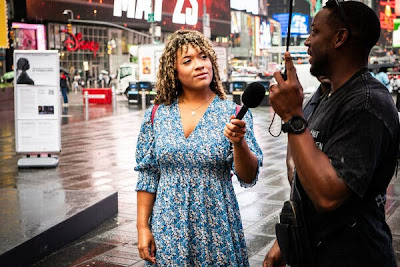
Savannah Craven Antao, a conservative content creator, conducted man-on-the-street interviews with passers-by to get their opinions on the sculpture. Credit: Graham Dickie/The New York Times

But such art is always at risk of being misconstrued. Michele Bogart, a historian of public art in New York City, said a person encountering an artwork in a gallery was often privy to its intent — and likely open to learning more.

“But when its placed in Times Square, nobody is obligated to try to understand,” she said.

Ms. Bogart also bemoaned what she perceived as the disappearance of arts education and a general oversimplification of ideas about representation among the general public as contributing to the toxic tone of this discourse.

“People are not attuned to aesthetics,” she said.

Vocal online critics of the sculpture have also included Black people, who have knocked Mr. Price for presenting what they see as a disrespectful image of Black women, or for leaning into stereotypes about them.

But Elma Blint, a jewelry designer from Brooklyn, who visited the work on Friday, offered an opposing view, saying the figure looked “like every Black woman in my family” and suggesting its detractors were uncomfortable with the idea of a Black woman taking up space.

Mr. Price, who declined to comment for this article, addressed this debate by posting a comic strip to his Instagram account. The first panel shows two Black women gazing up at the sculpture.

“I love this,” one says.

“Wow, I hate this,” the other responds.

In a 2020 essay for Time magazine, Mr. Price wrote that his work aimed to show “that if you’re a Black person being represented in sculpture, you don’t have to be an athlete, or strike a pose, or fulfill an expectation.”

Within the art world, this kind of conceptualization might risk being discounted as an almost banal insight, and some in the industry have viewed the broad palatability of Mr. Price’s work as a factor in his commercial success.

But out on the street, as the discourse has shown, his point is not so smoothly digested.

“He definitely struck a vein,” Mr. Smith said. “We are dealing with wounds that are not healed. And we can’t heal them if they’re not spoken about.”

Video


Credit:  By Graham Dickie/the New York Times


ABOUT THE AUTHOR:


Andrew Keh covers New York City and the surrounding region for The Times.

See more on: Donald Trump


VIDEO:  

https://www.anativeson.org/p/05162025-weekly-wrap-up

Weekly Wrap Up
by Eddie Glaude, Jr.
May 16, 2025
Substack

Summary


In this Weekly Wrap Up, Eddie discusses various pressing issues, including Trump's recent Middle East trip, the humanitarian crisis in Gaza, executive overreach in the U.S., the assault on birthright citizenship, the implications of the current budget on social safety nets, and the importance of moral conscience in free speech. He emphasizes the need for individuals to speak truthfully and uphold their moral commitments, especially in the face of political and social challenges.

A Native Son is a reader-supported publication. To receive new posts and support my work, consider becoming a free or paid subscriber.


Continue Reading…

Trump Administration and Foreign Policy:

Trump's Middle East Visit (New York Times, May 16, 2025)

Birthright Citizenship:

Trump and Birthright Citizenship (Common Dreams, May 15, 2025)

Supreme Court and Birthright Citizenship: Key Takeaways (New York Times, May 15, 2025)


Supreme Court and Birthright Citizenship (New York Times, May 15, 2025)

Education and Civil Rights:

Louisiana Republicans and the Last Vestiges of School Desegregation (New York Times, May 16, 2025)

Trump's Cuts to Medicaid Work Requirements (Washington Post, May 16, 2025)

NYU Withholds Diploma Over Student's Gaza Speech (CNN, May 16, 2025)

Moskowitz on NYU Grad Speaker's Pro-Palestine Speech (The Hill, May 16, 2025)

Maryland Police Custody Autopsies Audit (New York Times, May 15, 2025)

NJ Transit Strike (New York Times Video, May 16, 2025)

Ras Baraka and Newark ICE Trespassing (New York Times, May 15, 2025)

https://www.bbc.com/news/articles/ckgxydg11ego

NYU withholds diploma of graduate who condemned Gaza war
by Jake Lapham
May 15, 2025
BBC News


Washington DC

Getty Images A stock style image showing signs hanging on a building saying 'NYU' 

 Getty Images

New York University (NYU) has withheld the diploma of a student who used his graduation speech to accuse the US of supporting "genocide" in Gaza.

Undergraduate Logan Rozos told the crowd on Wednesday that he condemned the "atrocities currently happening in Palestine", drawing cheers and some boos.

An NYU spokesperson accused Mr Rozos of lying about what he had planned to say in the address in order to "express his personal and one-sided political views".

Pro-Palestinian advocacy on college campuses has become heavily politicised in the US, as the Trump administration cracks down on what it has called antisemitism at elite institutions, stirring a fraught debate about free speech.

NYU said it "strongly denounces" and was "deeply sorry" for Mr Rozos' remarks, adding: "This moment was stolen by someone who abused a privilege that was conferred upon him."

The college spokesman, John Beckman, said Mr Rozos' diploma would be withheld while NYU pursued disciplinary action against him.

After being introduced on stage, the undergraduate said he had been "freaking out about this speech", but that he felt compelled to speak out.

"The genocide currently occurring is supported politically and military by the United States, is paid for by our tax dollars and has been live-streamed to our phones," he said.

"I condemn this genocide and complicity in this genocide," Mr Rozos added in remarks that lasted about two-and-a-half minutes.

He did not specifically mention Israel, which emphatically denies accusations of genocide in Gaza, or Jewish people.

A since-deleted profile of Mr Rozos on NYU's website indicated he studied cultural criticism and political economy at a small liberal arts school within the campus.

In another online profile, Mr Rozos is described as an "actor, artist, and gay Black trans man".

NYU is one of 10 universities being investigated by Trump's antisemitism taskforce for incidents on campus since the Israel-Gaza war began in October 2023.

NYU was not, however, among 60 universities that were sent letters by the Department of Education warning of "enforcement action" if it did not protect Jewish students.

The US president's son, Barron, is a student at NYU, enrolled at its Stern School of Business.

Arguably the university under the most pressure from the administration is America's oldest, Harvard.

Trump has cut more than $2.6bn (£2bn) in funding, a decision that the university argues will hamper critical disease research.

Harvard has filed a lawsuit claiming the action is unlawful. It has also rejected a list of demands that the Trump administration said was designed to curb alleged discrimination.

Separately, several foreign students who took part in pro-Palestinian activism on US campuses have been detained in recent months.

The Trump administration alleges they have expressed support for Hamas, which the US, EU and UK designates as a terrorist group, and called for their deportation.

Lawyers for the students say they are exercising their right to free speech, accusing the government of "open repression of student activism and political speech".

 
Anxiety at US colleges as foreign students are detained and visas revoked
Who is Mahmoud Khalil, Palestinian student activist facing US deportation?
Harvard University sues Trump administration to stop funding freeze
US releases Mohsen Mahdawi, detained Columbia student activist
Dozens of pro-Palestinian protesters arrested at Columbia University


Israel-Gaza war
Antisemitism
United States

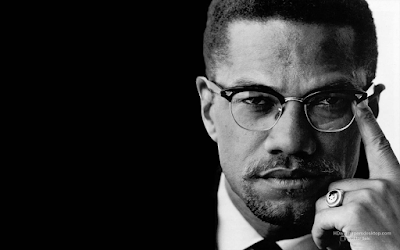
LONG LIVE MAY 19, 1925: TODAY IS THE 100th BIRTHDAY OF MALCOLM X--Let's Truly Celebrate and Seriously Honor His Extraordinary Legacy In As Many Ways As We Can And Share The Wealth of His Vision and Commitment

2025 IS THE CENTENNIAL YEAR FOR FIVE MAJOR 20TH CENTURY FIGURES ALL BORN IN 1925: 

John A. Williams, Frantz Fanon, Patrice Lumumba, Medgar Evers, and Malcolm X

JOHN A. WILLIAMS
b. December 5, 1925—d. July 3, 2015

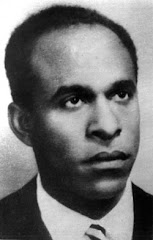
FRANTZ FANON
b. July 20, 1925—d. December 6, 1961

PATRICE LUMUMBA
b. July 2, 1925—d. January 17, 1961

MEDGAR EVERS
b. July 2, 1925—d. June 12, 1963

MALCOLM X
b. May 19, 1925—d. February 21, 1965


IN TRIBUTE TO AND CELEBRATION OF THE LIFE AND WORK OF MALCOLM X (El-Hajj Malik el-Shabazz)

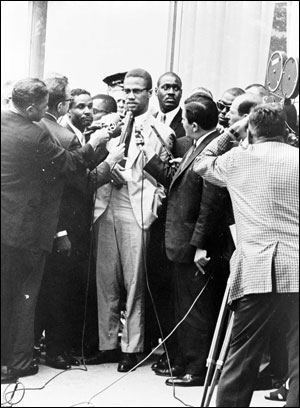
Malcolm X’s press conference in the United States after returning from Mecca in 1964:

VIDEO: 


   MALCOLM X (1925-1965)
"In my view Malcolm X remains the most intellectually and socially significant, advanced, and innovative individual African American political leader since W.E.B. Du Bois (1868-1963) because he represented and embodied not only a deep, analytical understanding of and profound insight into the myriad dialectical complexities and contradictions of African American life and culture, but he also understood and expressed in a particularly nuanced and organic manner just how the specific ideological and cultural dynamics of race and class in the United States affected the tone and identity of national liberation struggles both here and abroad. In addition Malcolm's deeply rooted disaporic connections to international Third World and Pan African movements in the colonial and postcolonial contexts of European and American hegemony over Africa, Latin America, and Asia--and the pervasive revolutionary anticolonial struggles against such domination and control in these societies--played a major role in also making Malcolm one of the leading global activists on behalf of anti-imperialist movements..."
--Kofi Natambu, The Panopticon Review, May 19, 2010: A Tribute to Malcolm X on His 85th Birthday

“We are living in an era of revolution, and the revolt of the American Negro is part of the rebellion against oppression and colonialism which has characterized this era...It is incorrect to classify the revolt of the Negro as simply a racial conflict of Black against white, or as a purely American problem. Rather, we are today seeing a global rebellion of the oppressed against the oppressor, the exploited against the exploiter.”
--Malcolm X, February 18, 1965

Malcolm X: His Life and Work
by Kofi Natambu
Alpha Books, 2002

[Critical Lives of the 20th Century series]

http://panopticonreview.blogspot.com/…/tribute-to-malcolm-x…

https://panopticonreview.blogspot.com/…/a-tribute-to-malcol…

FROM THE PANOPTICON REVIEW ARCHIVES

(Originally posted on May 19, 2010):


Wednesday, May 19, 2010

A Tribute to Malcolm X on His 85th Birthday

All,

Malcolm X was born Malcolm Little on this day in Omaha, Nebraska in 1925 and was assassinated at the age of 39 on February 21, 1965 in New York's Harlem. In between those two events Malcolm lived one of the most complex, profound, dynamic, and iconic lives of the 20th century and had--as he continues to have--a tremendous impact and influence on millions of people throughout not only the United States but the entire globe. How he managed to accomplish this massive feat despite the extremely severe and pervasive racist oppression and exploitation routinely inflicted upon all African Americans of his generation--and the decided lack of official social, economic, and cultural status especially accorded those like Malcolm who fiercely organized masses of people to oppose and resist such treatment--is one of the major accomplishments of modern African American history and marks Malcolm's revolutionary contributions to global political, spiritual, and cultural thought and activism as one of the most important and powerful legacies of any individual in the world during the 20th century. In my view Malcolm remains the most intellectually and socially significant, advanced, and innovative African American political leader since W.E.B. Du Bois because he represented and embodied not only a deep, analytical understanding and insight into the myriad dialectical complexities and contradictions of African American life and culture, but he also understood and expressed in a particularly nuanced and organic manner just how the specific ideological and cultural dynamics of race and class in the United States affected the tone and identity of national liberation struggles both here and abroad. In addition Malcolm's deeply rooted disaporic connections to international Third World and Pan African movements in the colonial and postcolonial contexts of European and American hegemony over Africa, Latin America, and Asia--and the pervasive revolutionary anticolonial struggles against such domination and control in these societies--played a major role in also making Malcolm one of the leading global activists on behalf of anti- imperialist movements.

In 2002 I published a historical and political biography on Malcolm entitled 'The Life and Work of Malcolm X.' What follows below is the introduction to that text. It is in the spirit of great love and solidarity that we make these gestures in celebration of Malcolm's 85th birthday. May his extraordinary work and stellar personal example continue to lead and inspire us all.

Kofi


THE TRUE GENIUS OF MALCOLM X
by Kofi Natambu


“I know that societies have often killed the people who have helped to change those societies. And if I can die having brought any light, having exposed any meaningful truth that will help to destroy the racist cancer that is malignant in the body of America--then, all the credit is due to Allah. Only the mistakes have been mine."
--The Autobiography of Malcolm X (as told to Alex Haley), 1965

“It is incorrect to classify the revolt of the Negro as simply a racial conflict of Black against white, or as a purely American problem. Rather, we are today seeing a global rebellion of the oppressed against the oppressor, the exploited against the exploiter.”
--Malcolm X, Barnard College, February 18, 1965

We live in an age of profound dishonesty, fear, hatred and timid equivocation. A dangerously facile cynicism, coupled with a soul-numbing infantilism has infected our society, rendering us seemingly powerless to productively affect or direct our lives. Too often ignorance and a smug reliance on easy orthodoxies of all kinds lend an illusory quality to our collective despair, lost as we often are on the beaches of loneliness and indecision. What’s worse is that so many of our so-called “leaders” lack any genuine intellectual, political, ethical, or moral energy to propose directions, methods, and ideas that require much more than adolescent posturing or punitive edicts. Opportunism and careerism rule the day, informed as they are by the insipid “pay me” principle, which ensures that ‘incidental’ things like integrity, discipline, compassion, generosity, and intelligence--the kind that gives one the opportunity to think, reflect, and act instead of foreclosing those possibilities—won’t deeply inform and provide ballast for our insights and desires.

Which brings me to Malcolm X, also known as Malcolm Little, ‘Detroit Red’, ‘Satan’ and finally, El Hajj Malik El-Shabazz. The black man with many names, green eyes and red hair who didn’t live to see the age of forty but who lived a multitude of lives anyway. The black man from Omaha, Lansing, Detroit, Boston, and New York who lived to befriend, work with, inspire, confound, educate, learn from, and transform people and cultures and political and economic and cultural and religious systems and values on three continents, and who lived to tell his/their/our stories. The black man who spoke a bewildering number of languages from African American swing, bebop, and blues tonalities, in all of their ultra hip vernacular modes and dimensions to the mellifluously flowing nuances & inflections of Arabic, Creole, Yoruba, and Chinese stews fermenting with the ancient elixirs of their myriad linguistic, spiritual, and cultural traditions.

You see, Malcolm sought at all times and under every conceivable circumstance to know, and so knowledge returned the favor. Knowledge, whose handmaiden is faith, is something Malcolm “knew” well because experience was valuable to him, and he never took what it could reveal to him for granted. Even in the ugly basement of his own temporary confusions and stupidities, frustrations and disappointments, Malcolm always sought to know, to “truly understand and examine” that which he had been told was (or was not) “real.” He wasn’t content to find an easy niche and lie there, swatting flies and muttering everyday homilies. He understood, which is to say, appreciated the effort, time, and commitment that it took to “know” and “understand” anything, anyone, anywhere. He wanted always, to know more, and think more, and express more, and give more, and create more and expect more, and feel more, and experience more. It wasn’t enough for him to merely embrace an idea, action, or stance. He “knew” better. He had been taught by everyone and everything he had ever encountered to always critically question what he was “being told.” Not in order to checkmate some hapless opponent ‘Homer Simpson’ style, but to ask, endlessly and creatively, and forcefully, and quietly and loudly and gently and brusquely ASK not merely who, what, when, where, and how, but the “heavy duty” WHY(?)

Malcolm realized it would always take more than he was able or willing to give but he freely gave anyway, knowing that his ego or his pain or his ignorance or his fear would be inadequate. But because he gave, and believed in giving, and knew and understood the limitations of fame, money, “suckcess,” and “identity” he was able, always, to supplant his former achievements and establish, build, work for, and embody still higher and different accomplishments. Malcolm wasn’t ‘hemmed in’ by politics or religion or ideology. He understood that in order to “live what you teach” and aspire to learning more required that one become a student of life. What made Malcolm so important is that he never lost faith in his ability to change, and be changed by, the world. But not merely the world we inherit but the world(s) we make and change and know and then (re)make again and again. Malcolm represented what Amilcar Cabral, the West African revolutionary meant when he said “Tell no lies, claim no easy victories.” He also knew why Frantz Fanon added “Every generation must, out of relative obscurity, discover its mission, fulfill it or betray it.” And oh yeah, this one: “To whom much is given, much is expected.” Malcolm also knew that what is “true” is not necessarily “real” or vice versa. There were no “virtual realities” for him. No ‘Survivor’-induced lies from the deadly jungles of corporate gangsters & advertising executive suites for him. Only the “true” and the “real” in an exquisitely dialectical and yes yall, dialogical dance would ever suffice for Malcolm X, the known, but unknown one. As Miles Davis once said “Hate is like Love--they both build momentum.” The ‘X’ in Malcolm’s life was the algebra of possibilities to know and then gradually, inevitably “not know” so that knowledge and activity could find some new and fresh ways to connect and reconnect, combine and recombine in finally more useful and interesting ways. The ‘X’ is the African American in the diaspora finding his/her way “back home” to the selves that were always already “black” and will be again and again no matter what ‘colors’ we’re compelled to be. That, for Malcolm and his ‘X’ is what made it possible for him to insist on the eternally real and true core of the matter, which was and is and always will be our ‘Human Rights’, our Human Being Hood. He didn’t mean this in any pollyanna, namby-pamby, let’s-all hold-hands-and pretend-we’re-all-the-same-suckers-singing-songs-together manner either. No. His aim was simultaneously much higher and deeper than that. ‘Freedom is for the Free’. Which is to say, for those willing to pay the price. The price is always our very lives as in “You know the stakes is high.” Malcolm told us this truth over and over again. And no man or woman can possibly give or take away that freedom--unless we “allow” them to.

That is the TRUE genius of Malcolm X. He realized the sheer simplicity, which is to say, bone-crushing difficulty of what it means to be a “genius” and share that great capacity for love, thought, and action with the world/whirl. Malcolm looked & saw that genius is not something we are but something we do. That is his profound legacy to “his people” which is finally anyone who “really & truly” wants to be free & is more than willing to “pay the price.” The last words of his Autobiography quoted at the start of this soliloquy remind us so eloquently of his actual legacy to those of us who are not afraid to make a contribution to not merely the ‘concept’ of liberation, but the living, breathing necessity of it. That’s real & true...like Malcolm himself. This book is an attempt to recognize and express that fact.

Kofi Natambu
May 23, 2001
Oakland, California


MALCOLM X AT THE OXFORD UNION IN DECEMBER, 1964:


Malcolm X: Complete audio recording of Oxford University Debate December 3, 1964

http://www.youtube.com/watch?v=fmrOOFJ12_I


"The most important thing we can learn to do today is think for ourselves."
--Malcolm X, 1964

https://www.ft.com/con…/78dbceb2-7fb0-11e4-adff-00144feabdc0

Non-Fiction

‘The Night Malcolm X Spoke at the Oxford Union’,
by Stephen Tuck

A vivid reconstruction of the black revolutionary’s visit to Oxford


Review by Christopher Phelps
December 12, 2014
Financial Times

On December 3 1964, the black revolutionary Malcolm X graced the Oxford Union’s end-of-term debate in support of the proposition, “Extremism in the defence of liberty is no vice.” It was a sly pairing of motion and advocate. Not only did the media routinely dismiss Malcolm X as an extremist but the phrase had first been uttered by Barry Goldwater, that year’s ultraconservative Republican nominee for the American presidency, who maintained that a federal guarantee of civil rights in public accommodation would be an unconstitutional constraint on the liberty of business owners to serve whomever they pleased.

Somehow Oxford’s students did not vote to declare extremism a virtue. Nevertheless, the clear rhetorical victor was Malcolm X. “Extremism” was a word, he maintained, used to stigmatise bold proponents of freedom and equality such as the Congo’s recently assassinated leader Patrice Lumumba. His closing passage quoted Shakespeare, with Hamlet’s “to be or not to be” soliloquy cast as a rebuke of moderation and a call “to take up arms against the sea of troubles”.

The Night Malcolm X Spoke at the Oxford Union is a vivid reconstruction of this moment by Stephen Tuck, a professor of history at the University of Oxford. In the late 19th-century era of Cecil Rhodes, the university had prided itself on its ability to turn the brightest imperial subjects from India, the West Indies and Africa into “brown Englishmen”. Instead, English racism and academic condescension made many of them nationalists who returned home to lead resistance movements.

By the 1960s, even as anti-colonial independence swept over Africa, Asia and Latin America, immigrant students of colour at Oxford faced severe difficulty in securing housing. It was against this backdrop that Eric Anthony Abrams, a Jamaican law student and president of the Oxford Union, would invite Malcolm X to speak.

Out of institutional loyalty, perhaps, Tuck is prone to overstate the significance of the debate in Malcolm X’s thought; most of what he said at the Oxford Union was not new and long before this appearance he was critical of Britain’s role in world affairs. Tuck handles Malcolm X’s Muslim faith deftly but his emergent socialism, developed on visits to such African nations as Ghana, is barely mentioned.

Prior biographies by Manning Marable and George Breitman, therefore, remain indispensable. But Tuck is unrivalled in his ability to parse details such as Malcolm X’s refusal to wear a bow tie to dinner (he associated the accessory with the Nation of Islam, from which he had recently broken). The Night Malcolm X Spoke at the Oxford Union is both a lucid portrait of Malcolm X at the height of his powers and a piercing exploration of the history of race in Britain — one that speaks every bit as much to our present-day circumstances as to the radicalism of 50 years ago.

The Night Malcolm X Spoke at the Oxford Union, by Stephen Tuck, University of California Press, 2014

RRP£14.95/$23.95, 288 pages
 

ABOUT THE AUTHOR:

Christopher Phelps is associate professor of American Studies at the University of Nottingham


MALCOLM X
(b. May 19,1925--d. February 21, 1965)


Speech by Malcolm: "To Mississippi Youth," December 31, 1964. Published in the book 'Malcolm X Speaks: Selected Speeches and Statements', ed. George Breitman, pp. 137-146.

"If you form the habit of going by what you hear others say about someone, or going by what others think about someone, instead of searching that thing out for yourself and seeing for yourself, you will be walking west when you think you're going east, and you will be walking east when you think you're going west. This generation, especially of our people, has a burden, more so than any other time in history. The most important thing we can learn to do today is think for ourselves."

--Malcolm X


From the following speech given December 31, 1964 in Harlem, NY to 37 black teenagers from Mississippi who had been chosen and sponsored by SNCC to attend a youth conference in New York during their Christmas vacation in recognition of their outstanding Civil Rights work in their hometown of McComb, Mississippi

MALCOLM X TALKS TO YOUNG PEOPLE
Pathfinder Press
March, 1965 

(First edition)


Excerpts from the famous pamphlet by Malcolm:

"The young generation of whites, Blacks, browns, whatever else there is -- you're living at ... a time of revolution, a time when there's got to be a change.... And I for one will join in with anyone, I don't care what color you are, as long as you want to change this miserable condition that exists on this earth."

"It is the teenagers ... all over the world, who are actually involving themselves in the struggle to eliminate oppression and exploitation.... The young people are the ones who most quickly identify with the struggle and the necessity to eliminate the evil conditions that exist."

"In America the Black community in which we live is not owned by us. The landlord is white. The merchant is white. . . . And these are the people who suck the economic blood of our community."

"We are not for violence in any shape or form, but believe that the people who have violence committed against them should be able to defend themselves.... I have never said that the Negroes should initiate acts of aggression against whites, but where the government fails to protect the Negro he is entitled to do it himself.”

[In Africa] "I'm from America but I'm not an American. I didn't go there of my own free choice.... [I am] one of the victims of Americanism, ... one of the victims of a very hypocritical system that is going all over this earth today representing itself as being qualified to tell other people how to run their country when they can't get the dirty things that are going on in their own country straightened out."

[In Africa] "When we find a Black man who's always receiving the praise of the Americans, we become suspicious of him.... Because it has been our experience that the Americans don't praise any Black man who is really working for the benefit of the Black man."

"It is impossible for capitalism to survive, primarily because the system of capitalism needs some blood to suck. Capitalism used to be like an eagle, but now it's more like a vulture. It used to be strong enough to go and suck anybody's blood whether they were strong or not. But now it has become more cowardly, like the vulture, and it can only suck the blood of the helpless."

http://www.brothermalcolm.net/

https://www.alkalimat.org/brothermalcolm/whathesaidarchive.html

"My alma mater was books, a good library... I could spend the rest of my life reading, just satisfying my curiosity"

"Early in life I had learned that if you want something, you had better make some noise."—Malcolm X


TRANSCRIPT:


Malcolm X, "To Mississippi Youth," December 31, 1964. From Malcolm X Speaks: Selected Speeches and Statements, ed. George Breitman, pp. 137-146.

"One of the first things I think young people, especially nowadays, should learn is how to see for yourself and listen for yourself and think for yourself. Then you can come to an intelligent decision for yourself. If you form the habit of going by what you hear others say about someone, or going by what others think about someone, instead of searching that thing out for yourself and seeing for yourself, you will be walking west when you think you're going east, and and you will be walking east when you think your going west. This generation, especially of our people, has a burden, more so than any other time in history. The most important thing that we can learn to do today is think for ourselves….

I myself would go for nonviolence if it was consistent, if everybody was going to be nonviolent all the time. I'd say, okay, let's get with it, we'll all be nonviolent. But I don't go along with any kind of nonviolence unless everybody's going to be nonviolent. If they make the Ku Klux Klan nonviolent, I'll be nonviolent. If they make the White Citizens Council nonviolent, I'll be nonviolent. But as long as you've got somebody else not being nonviolent, I don't want anybody coming to me talking any nonviolent talk. I don't think it is fair to tell our people to be nonviolent unless someone is out there making the Klan and the Citizens Council and these other groups also be nonviolent….

If the leaders of the nonviolent movement can go into the white community and teach nonviolence, good. I'd go along with that. But as long as I see them teaching nonviolence only in the black community, we can't go along with that. We believe in equality, and equality means that you have to put the same thing over here that you put over there. And if black people alone are going to be the ones who are nonviolent, then it's not fair. We throw ourselves off guard. In fact, we disarm ourselves and make ourselves defenseless. . .

[W]e of the Organization of Afro-American Unity realized the only time the black man in this country is given any kind of recognition, or even listened to, is when America is afraid of outside pressure, or when she's afraid of her image abroad. So we saw that it was necessary to expand the problem and the struggle of the black man in this country until it went above and beyond the jurisdiction of the United States. . . .

And today you'll find in the United Nations, and it's not an accident, that every time the Congo question or anything on the African continent is being debated, they couple it with what is going on, or what is happening to you and me, in Mississippi and Alabama and these other places. In my opinion, the greatest accomplishment that was made in the struggle of the black man in America in 1964 toward some kind of real progress was the successful linking together of our problem with the African problem, or making our problem a world problem. Because now, whenever anything happens to you in Mississippi, it's not just a case of somebody in Alabama getting indignant, or some- body in New York getting indignant. The same repercussions that you see all over the world when an imperialist or foreign power interferes in some section of Africa-you see repercussions, you see the embassies being bombed and burned and overturned-nowadays, when something happens to black people in Mississippi, you'll see the same repercussions all over the world.

I wanted to point this out to you because it is important for you to know that when you're in Mississippi, you're not alone. As long as you think you're alone, then you take a stand as if you're a minority or as if you're outnumbered, and that kind of stand will never enable you to win a battle. You've got to know that you've got as much power on your side as the Ku Klux Klan has on its side. And when you know that you've got as much power on your side as the Klan has on its side, you'll talk the same of kind of language with that Klan as the Klan is talking with you. . . .

I think in 1965, whether you like it, or I like it, or they like it, or not, you will see that there is a generation of black people becoming mature to the point where they feel that they have no more business being asked to take a peaceful approach than anybody else takes, unless everybody's going to take a peaceful approach.

So we here in the Organization of Afro-American Unity are with the struggle in Mississippi one thousand percent. We're with the effort to register our people in Mississippi to vote one thousand percent. But we do not go along with anybody telling anybody telling us to help nonviolently. We think that if the government says that Negroes have a right to vote, and then some Negroes come out to vote, and some kind of Ku Klux Klan is going to put them in the river, and the government doesn't do anything about it, it's time for us to organize and band together and equip ourselves and qualify ourselves to protect ourselves. And once you can protect yourself, you don't have to worry about being hurt. . . .

You'll get freedom by letting your enemy know that you'll do anything to get your freedom; then you'll get it. It's the only way you'll get it. When you get that kind of attitude, they'll label you as a "crazy Negro," or they'll call you a "crazy nigger"—they don't say Negro. Or they'll call you an extremist or a subversive, or seditious, or a red or a radical. But when you stay radical long enough, and get enough people to be like you, you'll get your freedom….”

Malcolm X’s American press conference at the airport after returning from Mecca in 1964:

VIDEO: 

Malcolm X - Return From Mecca Interview - May 21, 1964:

VIDEO: https://www.youtube.com/watch?v=Hv80w3rCUC8

 
PHOTO: Malcolm X speaking to a large crowd of people at a public rally on 125th St. and Lenox Avenue in Harlem, NYC,1963

MALCOLM X SPEAKING:

Be peaceful, be courteous, obey the law, respect everyone; but if someone puts his hand on you, send him to the cemetery.

Education is the passport to the future, for tomorrow belongs to those who prepare for it today.

I believe in a religion that believes in freedom. Any time I have to accept a religion that won't let me fight a battle for my people, I say to hell with that religion.

I believe in human beings, and that all human beings should be respected as such, regardless of their color.

I don't even call it violence when it's in self defense; I call it intelligence.

I'm for truth, no matter who tells it. I'm for justice, no matter who it's for or against.

If you don't stand for something you will fall for anything.

If you have no critics you'll likely have no success.

If you're not ready to die for it, put the word 'freedom' out of your vocabulary.

In all our deeds, the proper value and respect for time determines success or failure.

My Alma mater was books, a good library... I could spend the rest of my life reading, just satisfying my curiosity.

Nobody can give you freedom. Nobody can give you equality or justice or anything. If you're a man, you take it.

Sitting at the table doesn't make you a diner, unless you eat some of what's on that plate. Being here in America doesn't make you an American. Being born here in America doesn't make you an American.

Time is on the side of the oppressed today, it's against the oppressor. Truth is on the side of the oppressed today, it's against the oppressor. You don't need anything else.

Usually when people are sad, they don't do anything. They just cry over their condition. But when they get angry, they bring about a change.

You can't separate peace from freedom because no one can be at peace unless he has his freedom.


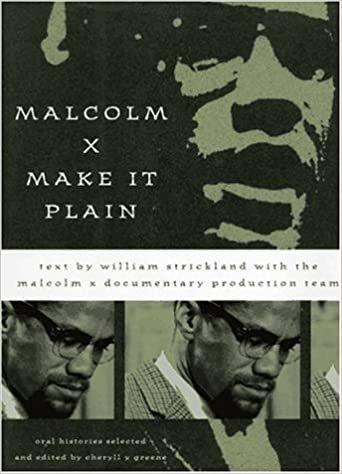
A SELECTED BIBLIOGRAPHY OF BOOKS BY AND ABOUT MALCOLM X: 1963-2009

Carson, Clayborne (1991). Malcolm X: The FBI File. New York: Carroll & Graf. ISBN 0-88184-758-5.

Clarke, John Henrik, ed. (1990) [1969]. Malcolm X: The Man and His Times. Trenton, N.J.: Africa World Press. ISBN 0-86543-201-5.

Clegg III, Claude Andrew (1997). An Original Man: The Life and Times of Elijah Muhammad. New York: St. Martin's Griffin. ISBN 0-312-18153-1.

Cone, James H. (1991). Martin & Malcolm & America: A Dream or a Nightmare. Maryknoll, N.Y.: Orbis Books. ISBN 0-88344-721-5.

DeCaro, Jr., Louis A. (1996). On the Side of My People: A Religious Life of Malcolm X. New York: New York University Press. ISBN 0-8147-1864-7.

Dyson, Michael Eric (1995). Making Malcolm: The Myth and Meaning of Malcolm X. Oxford: Oxford University Press. ISBN 0-19-509235-X.

Evanzz, Karl (1992). The Judas Factor: The Plot to Kill Malcolm X. New York: Thunder's Mouth Press. ISBN 1-56025-049-6.

Helfer, Andrew; Randy DuBurke (2006). Malcolm X: A Graphic Biography. New York: Hill and Wang. ISBN 0-8090-9504-1.

Karim, Benjamin (1992). Remembering Malcolm. with Peter Skutches and David Gallen. New York: Carroll & Graf. ISBN 0-88184-881-6.

Kondo, Zak A. (1993). Conspiracys: Unravelling the Assassination of Malcolm X. Washington, D.C.: Nubia Press. ISBN 0-9618815-1-13.

Lincoln, C. Eric (1961). The Black Muslims in America. Boston: Beacon Press. OCLC 422580.

Lomax, Louis E. (1987) [1968]. To Kill a Black Man. Los Angeles: Holloway House. ISBN 0-87067-731-4.

Lomax, Louis E. (1963). When the Word Is Given. Cleveland: World Publishing. OCLC 1071204.

Malcolm X (1992) [1965]. The Autobiography of Malcolm X. with the assistance of Alex Haley. New York: One World. ISBN 0-345-37671-4.

Malcolm X (1989) [1970]. By Any Means Necessary: Speeches, Interviews, and a Letter by Malcolm X. George Breitman, ed. New York: Pathfinder Press. ISBN 0-87348-150-X.

Malcolm X (1989) [1971]. The End of White World Supremacy: Four Speeches by Malcolm X.

Benjamin Karim, ed. New York: Arcade. ISBN 1-55970-006-8.

Malcolm X (1990) [1965]. Malcolm X Speaks: Selected Speeches and Statements. George Breitman, ed. New York: Grove Weidenfeld. ISBN 0-8021-3213-8.

Malcolm X (1991) [1968]. The Speeches of Malcolm X at Harvard. Archie Epps, ed. New York: Paragon House. ISBN 1-55778-479-5.

Marable, Manning (2009). "Rediscovering Malcolm's Life: A Historian's Adventures in Living History". in Marable, Manning; Aidi, Hishaam D. Black Routes to Islam. New York: Palgrave Macmillan. ISBN 1-4039-8400-X.

Natambu, Kofi (2002). The Life and Work of Malcolm X. Indianapolis: Alpha Books. ISBN 0-02-864218-X.

Rickford, Russell J. (2003). Betty Shabazz: A Remarkable Story of Survival and Faith Before and After Malcolm X. Naperville, Ill.: Sourcebooks. ISBN 1-4022-0171-0.


Sales, William W. (1994). From Civil Rights to Black Liberation: Malcolm X and the Organization of Afro-American Unity. Boston: South End Press. ISBN 0-89608-480-9.


Terrill, Robert (2004). Malcolm X: Inventing Radical Judgment. Lansing, Mich.: Michigan State University Press. ISBN 0-87013-730-1.


Further reading:

Alkalimat, Abdul. Malcolm X for Beginners. New York: Writers and Readers, 1990.

Asante, Molefi K. Malcolm X as Cultural Hero: and Other Afrocentric Essays. Trenton, N.J.: Africa World Press, 1993.

Baldwin, James. One Day, When I Was Lost: A Scenario Based On Alex Haley's "The Autobiography Of Malcolm X". New York: Dell, 1992.

Breitman, George. The Last Year of Malcolm X: The Evolution of a Revolutionary. New York: Pathfinder Press, 1967.

Breitman, George, and Herman Porter. The Assassination of Malcolm X. New York: Pathfinder Press, 1976.

Carew, Jan. Ghosts In Our Blood: With Malcolm X in Africa, England, and the Caribbean. Chicago: Lawrence Hill, 1994.

Cleage, Albert B., and George Breitman. Myths About Malcolm X: Two Views. New York: Merit, 1968.

Collins, Rodney P. The Seventh Child. New York: Dafina; London: Turnaround, 2002.

Davis, Thulani. Malcolm X: The Great Photographs. New York: Stewart, Tabon and Chang, 1992.

DeCaro, Louis A. Malcolm and the Cross: The Nation of Islam, Malcolm X, and Christianity. New York: New York University, 1998.

Doctor, Bernard Aquina. Malcolm X for Beginners. New York: Writers and Readers, 1992.

Friendly, Michael. The Assassination of Malcolm X. New York: Carroll and Graf, 1992.

Gallen, David, ed. Malcolm A to Z: The Man and His Ideas. New York: Carroll and Graf, 1992.

Gallen, David, ed. Malcolm X: As They Knew Him. New York: Carroll and Graf, 1992.

Goldman, Peter. The Death and Life of Malcolm X. Urbana: University of Illinois Press, 1979.

Jamal, Hakim A. From The Dead Level: Malcolm X and Me. New York: Random House, 1972.

Jenkins, Robert L. The Malcolm X Encyclopedia. Westport, Conn.: Greenwood Press, 2002.

Kly, Yussuf Naim, ed. The Black Book: The True Political Philosophy of Malcolm X (El Hajj Malik El Shabazz). Atlanta: Clarity Press, 1986.

Leader, Edward Roland. Understanding Malcolm X: The Controversial Changes in His Political Philosophy. New York: Vantage Press, 1993.

Lee, Spike, with Ralph Wiley. By Any Means Necessary: The Trials and Tribulations of The Making Of Malcolm X. New York: Hyperion, 1992.

Maglangbayan, Shawna. Garvey, Lumumba, and Malcolm: National-Separatists. Chicago, Third World Press 1972.

Marable, Manning. On Malcolm X: His Message & Meaning. Westfield, N.J.: Open Media, 1992.

Natambu, Kofi. Malcolm X: His Life & Work. Alpha Books, 2002

Shabazz, Ilyasah. Growing Up X. New York: One World, 2002.

Strickland, William et al.. Malcolm X: Make It Plain. New York: Penguin Books, 1994.

Terrill, Robert, ed. The Cambridge Companion to Malcolm X. Cambridge: Cambridge University Press, 2010.

T'Shaka, Oba. The Political Legacy of Malcolm X. Richmond, Calif.: Pan Afrikan Publications, 1983.

Wolfenstein, Eugene Victor. The Victims of Democracy: Malcolm X and the Black Revolution. London: Free Association Books, 1989.

Wood, Joe, ed. Malcolm X: In Our Own Image. New York: St. Martin's Press, 1992.
 

"The Ballot or the Bullet"
Speech delivered at King Solomon Baptist Church
Detroit, Michigan - April 12, 1964  


Malcolm X in 1964

Malcolm X was one of the most dynamic, dramatic and influential figures of the civil rights era. He was an apostle of black nationalism, self respect, and uncompromising resistance to white oppression. Malcolm X was a polarizing figure who both energized and divided African Americans, while frightening and alienating many whites. He was an unrelenting truth-teller who declared that the mainstream civil rights movement was naïve in hoping to secure freedom through integration and nonviolence. The blazing heat of Malcolm X's rhetoric sometimes overshadowed the complexity of his message, especially for those who found him threatening in the first place. Malcolm X was assassinated at age 39, but his political and cultural influence grew far greater in the years after his death than when he was alive.

Malcolm X is now popularly seen as one of the two great martyrs of the 20th century black freedom struggle, the other being his ostensible rival, the Rev. Martin Luther King Jr. But in the spring of 1964, when Malcolm X gave his "Ballot or the Bullet" speech, he was regarded by a majority of white Americans as a menacing character. Malcolm X never directly called for violent revolution, but he warned that African Americans would use "any means necessary" – especially armed self defense – once they realized just how pervasive and hopelessly entrenched white racism had become.1

He was born Malcolm Little in 1925 in Omaha, Nebraska. His father, Earl, was a Baptist preacher and follower of the black nationalist Marcus Garvey. Earl Little's political activism provoked threats from the Ku Klux Klan. After the family moved to Lansing, Michigan, white terrorists burned the Littles' home. A defiant Earl Little shot at the arsonists as they got away. In 1931, Malcolm's father was found dead. His family suspected he'd been murdered by white vigilantes. Malcolm's mother, Louise, battled mental illness and struggled to care for her eight children during the Great Depression. She was committed to a state mental institution when Malcolm was 12. He and the other young children were scattered among foster families. After completing the eighth grade, Malcolm Little dropped out when a teacher told him that his dream of becoming a lawyer was unrealistic for a "nigger."2

As a teenager, Malcolm Little made his way to New York, where he took the street name Detroit Red and became a pimp and petty criminal. In 1946, Malcolm Little was sent to prison for burglary. He read voraciously while serving time and converted to the Black Muslim faith. He joined the Nation of Islam (NOI) and changed his name to Malcolm X, eliminating that part of his identity he called a white-imposed slave name.

Malcom X was released in 1952 after six years in prison. With his charisma and eloquence, Malcolm rose rapidly in the Nation of Islam. He became the chief spokesman and field recruiter for NOI leader Elijah Muhammad. As historian Peniel Joseph describes it, NOI's unorthodox interpretation of Islam was mixed with a doctrine of black personal responsibility and economic self-sufficiency, along with "theological fundamentalism, anti-white mythology, and total racial separation as the means to black redemption."3 Wearing impeccable suits, maintaining an air of fierce dignity and adhering to a strict code of moral propriety, Malcolm X was a living demonstration of how the NOI could save a wayward people from racial submission and personal self-destruction. The Nation dismissed the conventional civil rights movement – with its protest marches and demands for equal rights legislation -- as impotent and misguided. As Malcolm X declared in this speech, the only effective solution to racial inequality was black economic and social separatism.

As Malcolm X's national prominence grew, so did a rift between him and Elijah Muhammad. Malcolm X far overshadowed his mentor in the public sphere. He also grew disillusioned by Elijah Muhammad's scandalous personal behavior; the Messenger fathered several children through affairs with his secretaries. The conflict deepened when Muhammad suspended Malcolm X for saying that President John F. Kennedy's assassination represented "the chickens coming home to roost" because of the war in Vietnam.4 Finally, in March 1964, Malcolm X left the Nation of Islam and charted his own course of militant, black nationalism.

On April 12, 1964, one month after splitting with the NOI, Malcolm X gave his "Ballot or the Bullet" speech at King Solomon Baptist Church in Detroit (he'd given the address nine days earlier in Cleveland, but the Detroit version is regarded by some scholars as definitive).5 It was the fullest declaration of his black nationalist philosophy. Mainstream black ministers in Detroit tried to block Malcolm X from using the church, saying "separatist ideas can do nothing but set back the colored man's cause." But the church hall had already been rented out for the event.6

"The Ballot or the Bullet" became one of Malcolm X's most recognizable phrases, and the speech was one of his greatest orations. Two thousand people – including some of his opponents -- turned out to hear him speak in Detroit.. President Lyndon Johnson was running for reelection in 1964, and Malcolm X declared it "the year of the ballot or the bullet." He outlined a new, global sensibility in the fight for racial justice: "We intend to expand [the freedom struggle] from the level of civil rights to the level of human rights."

Malcolm was now free of the NOI's ban on members participating in the mainstream civil rights movement. He encouraged black militants to get involved in voter registration drives and other forms of community organizing to redefine and expand the movement.7

The day after his Detroit speech, Malcolm X embarked on an overseas tour that included a life-changing pilgrimage to the Muslim holy city of Mecca. Known as the Hajj, the pilgrimage must be carried out at least once in a lifetime by every able-bodied Muslim who can afford to do so. The racial diversity he experienced in the Middle East, especially among Muslims, led him to discard his strict notions of black separatism for a wider, more inclusive movement against white supremacy and colonialism. In the summer of 1964, Malcolm X announced a new effort, the Organization of Afro-American Unity (OAAU).

In the last months of his life, Malcolm X's conflict with the Nation of Islam grew increasingly bitter. Elijah Muhammad and the NOI had a long history of using violence and intimidation against members who strayed. In February, 1965, Malcolm X's home was firebombed. He publicly blamed the Nation of Islam and predicted he would be killed. Malcolm X was shot to death on February 12, 1965 as he prepared to speak at an OAAU rally at the Audubon Ballroom in New York. Three black men, all members of the NOI, were convicted and sent to prison for the murder.

In an editorial after his death, The New York Times described Malcolm X as "an extraordinary and twisted man, turning many true gifts to evil purpose."8 Actor and activist Ossie Davis eulogized him as "our own black shining prince."9 In death, he became a seminal figure to an increasingly militant generation of young African Americans, a beacon for activists in the 1960s Black Power and Black Arts movements.

In assessing Malcolm X's impact, theologian James Cone wrote: "More than anyone else he revolutionized the black mind, transforming docile Negroes and self-effacing colored people into proud blacks and self-confident African-Americans."10 By the end of the 20th century, Malcolm X was recognized in mainstream culture as a hero of the civil rights era. The militant radical whose image once provoked fear and hatred among many white Americans was celebrated in mainstream movie theaters, on Black History Month posters in elementary school classrooms, and on a 1999 postage stamp issued by the United States government.


Mr. Moderator, Rev. Cleage, brothers and sisters and friends, and I see some enemies. [laughter, applause] In fact, I think we'd be fooling ourselves if we had an audience this large and didn't realize that there were some enemies present.

This afternoon we want to talk about the ballot or the bullet. The ballot or the bullet explains itself. But before we get into it, since this is the year of the ballot or the bullet, I would like to clarify some things that refer to me personally, concerning my own personal position.

I'm still a Muslim. That is, my religion is still Islam. [applause] My religion is still Islam. I still credit Mr. Muhammad for what I know and what I am. He's the one who opened my eyes. [applause] At present I am the minister of the newly founded Muslim Mosque Incorporated, which has its offices in the Theresa Hotel right in the heart of Harlem, that's the black belt in New York City. And when we realize that Adam Clayton Powell, is a Christian minister, he has Abyssinian Baptist Church, but at the same time he's more famous for his political struggling. And Dr. King is a Christian minister from Atlanta Georgia, or in Atlanta Georgia, but he's become more famous for being involved in the civil rights struggle. There's another in New York, Rev. Galamison, I don't know if you've heard of him out here, he's a Christian minister from Brooklyn, but has become famous for his fight against the segregated school system in Brooklyn. Rev. Cleage, right here, is a Christian minister, here in Detroit, he's head of the Freedom Now Party. All of these are Christian ministers [applause] …all of these are Christian ministers but they don't come to us as Christian ministers, they come to us as fighters in some other category.

I am a Muslim minister. The same as they are Christian ministers, I'm a Muslim minister. And I don't believe in fighting today on any one front, but on all fronts. [applause] In fact, I'm a Black Nationalist freedom fighter. [applause] Islam is my religion but I believe my religion is my personal business. [applause] It governs my personal life, my personal morals. And my religious philosophy is personal between me and the God in whom I believe, just as the religious philosophy of these others is between them and the God in whom they believe. And this is best this way. Were we to come out here discussing religion, we'd have too many differences from the out start and we could never get together.

So today, though Islam is my religious philosophy, my political, economic and social philosophy is black nationalism. You and I – [applause] As I say, if we bring up religion, we'll have differences, we'll have arguments, and we'll never be able to get together. But if we keep our religion at home, keep our religion in the closet, keep our religion between ourselves and our God, but when we come out here we have a fight that's common to all of us against a enemy who is common to all of us. [applause]

The political philosophy of black nationalism only means that the black man should control the politics and the politicians in his own community. The time when white people can come in our community and get us to vote for them so that they can be our political leaders and tell us what to do and what not to do is long gone. [applause]

By the same token, the time when that same white man, knowing that your eyes are too far open, can send another Negro in the community, and get you and me to support him, so that he can use him to lead us astray, those days are long gone too. [applause]

The political philosophy of black nationalism only means that if you and I are going to live in a black community – and that's where we're going to live, 'cause as soon as you move into one of their….soon as you move out of the black community into their community, it's mixed for a period of time, but they're gone and you're right there all by yourself again. [applause]

We must, we must understand the politics of our community and we must know what politics is supposed to produce. We must know what part politics play in our lives. And until we become politically mature, we will always be misled, led astray, or deceived or maneuvered into supporting someone politically who doesn't have the good of our community at heart. So the political philosophy of black nationalism only means that we will have to carry on a program, a political program, of reeducation – to open our people's eyes, make us become more politically conscious, politically mature. And then, we will – whenever we are ready to cast our ballot, that ballot will be cast for a man of the community, who has the good of the community at heart. [applause]

The economic philosophy of black nationalism only means that we should own and operate and control the economy of our community. You would never have found—you can't open up a black store in a white community. White man won't even patronize you. And he's not wrong. He got sense enough to look out for himself. It's you who don't have sense enough to look out for yourself. [applause]

The white man, the white man is too intelligent to let someone else come and gain control of the economy of his community. But you will let anybody come in and control the economy of your community, control the housing, control the education, control the jobs, control the businesses, under the pretext that you want to integrate. Nah, you're out of your mind. [applause]

The political … the economic philosophy of black nationalism only means that we have to become involved in a program of reeducation, to educate our people into the importance of knowing that when you spend your dollar out of the community in which you live, the community in which you spend your money becomes richer and richer, the community out of which you take your money becomes poorer and poorer. And because these Negroes, who have been misled, misguided, are breaking their necks to take their money and spend it with the Man, the Man is becoming richer and richer, and you're becoming poorer and poorer. And then what happens? The community in which you live becomes a slum. It becomes a ghetto. The conditions become rundown. And then you have the audacity to complain about poor housing in a rundown community, while you're running down yourselves when you take your dollar out. [applause]

And you and I are in a double trap because not only do we lose by taking our money someplace else and spending it, when we try and spend it in our own community we're trapped because we haven't had sense enough to set up stores and control the businesses of our community. The man who is controlling the stores in our community is a man who doesn't look like we do. He's a man who doesn't even live in the community. So you and I, even when we try and spend our money on the block where we live or the area where we live, we're spending it with a man who, when the sun goes down, takes that basket full of money in another part of the town. [applause]

So we're trapped, trapped, double-trapped, triple-trapped. Any way we go, we find that we're trapped. Any every kind of solution that someone comes up with is just another trap. But the political and economic philosophy of black nationalism…the economic philosophy of black nationalism shows our people the importance of setting up these little stores, and developing them and expanding them into larger operations. Woolworth didn't start out big like they are today; they started out with a dime store, and expanded, and expanded, and expanded until today they are all over the country and all over the world and they getting some of everybody's money.

Now this is what you and I – General Motors, the same way, it didn't start out like it is. It started out just a little rat-race type operation. And it expanded and it expanded until today it's where it is right now. And you and I have to make a start. And the best place to start is right in the community where we live. [applause]

So our people not only have to be reeducated to the importance of supporting black business, but the black man himself has to be made aware of the importance of going into business. And once you and I go into business, we own and operate at least the businesses in our community. What we will be doing is developing a situation, wherein, we will actually be able to create employment for the people in the community. And once you can create some employment in the community where you live, it will eliminate the necessity of you and me having to act ignorantly and disgracefully, boycotting and picketing some cracker someplace else trying to beg him for a job. [applause]

Anytime you have to rely upon your enemy for a job, you're in bad shape. [applause] When you — and he is your enemy. You wouldn't be in this country if some enemy hadn't kidnapped you and brought you here. [applause] On the other hand, some of you think you came here on the Mayflower. [laughter]

So as you can see, brothers and sisters, today – this afternoon it is not our intention to discuss religion. We're going to forget religion. If we bring up religion we'll be in an argument. And the best way to keep away from arguments and differences, as I said earlier, put your religion at home, in the closet, keep it between you and your God. Because if it hasn't done anything more for you than it has, you need to forget it anyway. [laughter, applause]

Whether you are a Christian or a Muslim or a nationalist, we all have the same problem. They don't hang you because you're a Baptist; they hang you 'cause you're black. [applause] They don't attack me because I'm a Muslim. They attack me 'cause I'm black. They attacked all of us for the same reason. All of us catch hell from the same enemy. We're all in the same bag, in the same boat.

We suffer political oppression, economic exploitation and social degradation. All of 'em from the same enemy. The government has failed us. You can't deny that. Any time you're living in the 20th century, 1964, and you walking around here singing "We Shall Overcome," the government has failed you. [applause] This is part of what's wrong with you, you do too much singing. [laughter] Today it's time to stop singing and start swinging. [laughter, applause]

You can't sing up on freedom. But you can swing up on some freedom. [cheering] Cassius Clay can sing. But singing didn't help him to become the heavyweight champion of the world. Swinging helped him. [applause]

So this government has failed us. The government itself has failed us. And the white liberals who have been posing as our friends have failed us. And once we see that all of these other sources to which we've turned have failed, we stop turning to them and turn to ourselves. We need a self-help program, a do-it-yourself philosophy, a do-it-right-now philosophy, a it's-already-too-late philosophy. This is what you and I need to get with. And the only time – the only way we're going to solve our problem is with a self-help program. Before we can get a self-help program started, we have to have a self-help philosophy. Black nationalism is a self-help philosophy.

What's so good about it – you can stay right in the church where you are and still take black nationalism as your philosophy. You can stay in any kind of civic organization that you belong to and still take black nationalism as your philosophy. You can be an atheist and still take black nationalism as your philosophy. This is a philosophy that eliminates the necessity for division and argument, 'cause if you're black, you should be thinking black. And if you're black and you not thinking black at this late date, well, I'm sorry for you. [applause]

Once you change your philosophy, you change your thought pattern. Once you change your thought pattern you change your attitude. Once you change your attitude it changes your behavior pattern. And then you go on into some action. As long as you got a sit-down philosophy you'll have a sit-down thought pattern. And as long as you think that old sit-down thought, you'll be in some kind of sit-down action. They'll have you sitting in everywhere. [laughter]

It's not so good to refer to what you're going to do as a sit-in. That right there castrates you. Right there it brings you down. What goes with it? What – think of the image of someone sitting. An old woman can sit. An old man can sit. A chump can sit, a coward can sit, anything can sit. Well, you and I been sitting long enough and it's time for us today to start doing some standing and some fighting to back that up. [applause]

When we look at other parts of this Earth upon which we live, we find that black, brown, red and yellow people in Africa and Asia are getting their independence. They're not getting it by singing, 'We Shall Overcome." No, they're getting it through nationalism. It is nationalism that brought about the independence of the people in Asia. Every nation in Asia gained its independence through the philosophy of nationalism. Every nation on the African continent that has gotten its independence brought it about through the philosophy of nationalism. And it will take black nationalism to bring about the freedom of 22 million Afro-Americans, here in this country, where we have suffered colonialism for the past 400 years. [applause]

America is just as much a colonial power as England ever was. America is just as much a colonial power as France ever was. In fact, America is more so a colonial power than they, because she is a hypocritical colonial power behind it. [applause] What is 20th — what, what do you call second-class citizenship? Why, that's colonization. Second-class citizenship is nothing but 20th slavery. How you gonna to tell me you're a second-class citizen? They don't have second-class citizenship in any other government on this Earth. They just have slaves and people who are free! Well, this country is a hypocrite! They try and make you think they set you free by calling you a second-class citizen. No, you're nothing but a 20th century slave. [applause]

Just as it took nationalism to remove colonialism from Asia and Africa, it'll take black nationalism today to remove colonialism from the backs and the minds of twenty-two million Afro-Americans here in this country. And 1964 looks like it might be the year of the ballot or the bullet. [applause]

Why does it look like it might be the year of the ballot or the bullet? Because Negroes have listened to the trickery and the lies and the false promises of the white man now for too long, and they're fed up. They've become disenchanted. They've become disillusioned. They've become dissatisfied. And all of this has built up frustrations in the black community that makes the black community throughout America today more explosive than all of the atomic bombs the Russians can ever invent. Whenever you got a racial powder keg sitting in your lap, you're in more trouble than if you had an atomic powder keg sitting in your lap. When a racial powder keg goes off, it doesn't care who it knocks out the way. Understand this, it's dangerous.

And in 1964, this seems to be the year. Because what can the white man use, now, to fool us? After he put down that March on Washington – and you see all through that now, he tricked you, had you marching down to Washington. Had you marching back and forth between the feet of a dead man named Lincoln and another dead man named George Washington, singing, "We Shall Overcome." [applause]

He made a chump out of you. He made a fool out of you. He made you think you were going somewhere and you end up going nowhere but between Lincoln and Washington. [laughter]

So today our people are disillusioned. They've become disenchanted. They've become dissatisfied. And in their frustrations they want action. And in 1964 you'll see this young black man, this new generation, asking for the ballot or the bullet. That old Uncle Tom action is outdated. The young generation don't want to hear anything about "the odds are against us." What do we care about odds? [applause]

When this country here was first being founded, there were thirteen colonies. The whites were colonized. They were fed up with this taxation without representation. So some of them stood up and said, "Liberty or death!" I went to a white school over here in Mason, Michigan. The white man made the mistake of letting me read his history books. [laughter] He made the mistake of teaching me that Patrick Henry was a patriot, and George Washington – wasn't nothing non-violent about ol' Pat, or George Washington. "Liberty or death" is was what brought about the freedom of whites in this country from the English. [applause]

They didn't care about the odds. Why, they faced the wrath of the entire British Empire. And in those days, they used to say that the British Empire was so vast and so powerful that the sun would never set on it. This is how big it was, yet these thirteen little scrawny states, tired of taxation without representation, tired of being exploited and oppressed and degraded, told that big British Empire, "Liberty or death." And here you have 22 million Afro-Americans, black people today, catching more hell than Patrick Henry ever saw. [applause]

And I'm here to tell you in case you don't know it – that you got a new, you got a new generation of black people in this country who don't care anything whatsoever about odds. They don't want to hear you ol' Uncle Tom, handkerchief-heads talking about the odds. No! [laughter, applause] This is a new generation. If they're going to draft these young black men, and send them over to Korea or to South Vietnam to face 800 million Chinese… [laughter, applause] If you're not afraid of those odds, you shouldn't be afraid of these odds. [applause]

Why is America – why does this loom to be such an explosive political year? Because this is the year of politics. This is the year when all of the white politicians are going to come into the Negro community. You never see them until election time. You can't find them until election time. [applause] They're going to come in with false promises. And as they make these false promises they're going to feed our frustrations, and this will only serve to make matters worse. I'm no politician. I'm not even a student of politics. I'm not a Republican, nor a Democrat, nor an American – and got sense enough to know it. [applause]

I'm one of the 22 million black victims of the Democrats. One of the 22 million black victims of the Republicans and one of the 22 million black victims of Americanism. [applause] And when I speak, I don't speak as a Democrat or a Republican, nor an American. I speak as a victim of America's so-called democracy. You and I have never seen democracy – all we've seen is hypocrisy. [applause]

When we open our eyes today and look around America, we see America not through the eyes of someone who has enjoyed the fruits of Americanism. We see America through the eyes of someone who has been the victim of Americanism. We don't see any American dream. We've experienced only the American nightmare. We haven't benefited from America's democracy. We've only suffered from America's hypocrisy. And the generation that's coming up now can see it. And are not afraid to say it. If you go to jail, so what? If you're black, you were born in jail. [applause]

If you black you were born in jail, in the North as well as the South. Stop talking about the South. As long as you south of the Canadian border, you South. [laughter, applause] Don't call Governor Wallace a Dixie governor, Romney is a Dixie Governor. [applause]

Twenty-two million black victims of Americanism are waking up and they are gaining a new political consciousness, becoming politically mature. And as they become – develop this political maturity, they're able to see the recent trends in these political elections. They see that the whites are so evenly divided that every time they vote, the race is so close they have to go back and count the votes all over again. Which means that any block, any minority that has a block of votes that stick together is in a strategic position. Either way you go, that's who gets it. You're in a position to determine who'll go to the White House and who'll stay in the doghouse. [laughter]

You're the one who has that power. You can keep Johnson in Washington D.C., or you can send him back to his Texas cotton patch. [applause] You're the one who sent Kennedy to Washington. You're the one who put the present Democratic administration in Washington, D.C. The whites were evenly divided. It was the fact that you threw 80 percent of your votes behind the Democrats that put the Democrats in the White House.

When you see this, you can see that the Negro vote is the key factor. And despite the fact that you are in a position to be the determining factor, what do you get out of it? The Democrats have been in Washington, D.C. only because of the Negro vote. They've been down there four years. And they're – all other legislation they wanted to bring up they've brought it up, and gotten it out of the way, and now they bring up you. And now they bring up you! You put them first and they put you last. Because you're a chump! [applause] A political chump.

In Washington, D.C., in the House of Representatives there are 257 who are Democrats. Only 177 are Republican. In the Senate there are 67 Democrats. Only 33 are Republicans. The party that you backed controls two-thirds of the House of Representatives and the Senate and still they can't keep their promise to you. 'Cause you're a chump. [applause]

Any time you throw your weight behind a political party that controls two-thirds of the government, and that party can't keep the promise that it made to you during election-time, and you're dumb enough to walk around continuing to identify yourself with that party, you're not only a chump but you're a traitor to your race. [applause]

What kind of alibi do come up with? They try and pass the buck to the Dixiecrats. Now, back during the days when you were blind, deaf and dumb, ignorant, politically immature, naturally you went along with that. But today, as your eyes come open, and you develop political maturity, you're able to see and think for yourself, and you can see that a Dixiecrat is nothing but a Democrat – in disguise. [applause]

You look at the structure of the government that controls this country, is controlled by 16 senatorial committees and 20 congressional committees. Of the 16 senatorial committees that run the government, 10 of them are in the hands of southern segregationists. Of the 20 congressional committees that run the government, 12 of them are in the hands of southern segregationists. And they're going to tell you and me that the South lost the war? [laughter, applause]

You, today, are in the hands of a government of segregationists. Racists, white supremacists, who belong to the Democratic party but disguise themselves as Dixiecrats. A Dixiecrat is nothing but a Democrat. Whoever runs the Democrats is also the father of the Dixiecrats. And the father of all of them is sitting in the White House. [applause] I say, and I'll say it again, you got a president who's nothing but a southern segregationist [applause] from the state of Texas. They'll lynch in Texas as quick as they'll lynch you in Mississippi. Only in Texas they lynch you with a Texas accent, in Mississippi they lynch you with a Mississippi accent. [cheering]

The first thing the cracker does when he comes in power, he takes all the Negro leaders and invites them for coffee. To show that he's all right. And those Uncle Toms can't pass up the coffee. [laughter, applause] They come away from the coffee table telling you and me that this man is all right [laughter]. 'Cause he's from the South and since he's from the South he can deal with the South. Look at the logic that they're using. What about Eastland? He's from the South. Why not make him the president? If Johnson is a good man 'cause he's from Texas, and being from Texas will enable him to deal with the South, Eastland can deal with the South better than Johnson! [laughter, applause]

Oh, I say you been misled. You been had. You been took. [laughter, applause] I was in Washington a couple of weeks ago while the senators were filibustering and I noticed in the back of the Senate a huge map, and on this map it showed the distribution of Negroes in America. And surprisingly, the same senators that were involved in the filibuster were from the states where there were the most Negroes. Why were they filibustering the civil rights legislation? Because the civil rights legislation is supposed to guarantee boarding rights to Negroes from those states. And those senators from those states know that if the Negroes in those states can vote, those senators are down the drain. [applause] The representatives of those states go down the drain.

And in the Constitution of this country it has a stipulation, wherein, whenever the rights, the voting rights of people in a certain district are violated, then the representative who's from that particular district, according to the Constitution, is supposed to be expelled from the Congress. Now, if this particular aspect of the Constitution was enforced, why, you wouldn't have a cracker in Washington, D.C. [applause]

But what would happen? When you expel the Dixiecrat, you're expelling the Democrat. When you destroy the power of the Dixiecrat, you are destroying the power of the Democratic Party. So how in the world can the Democratic Party in the South actually side with you, in sincerity, when all of its power is based in the South?

These Northern Democrats are in cahoots with the southern Democrats. [applause] They're playing a giant con game, a political con game. You know how it goes. One of 'em comes to you and make believe he's for you. And he's in cahoots with the other one that's not for you. Why? Because neither one of 'em is for you. But they got to make you go with one of 'em or the other.

So this is a con game, and this is what they've been doing with you and me all of these years. First thing, Johnson got off the plane when he become president, he ask, "Where's Dickey?" You know who Dickey is? Dickey is old southern cracker Richard Russell. Lookie here! Yes, Lyndon B. Johnson's best friend is the one who is a head, who's heading the forces that are filibustering civil rights legislation. You tell me how in the hell is he going to be Johnson's best friend? [applause] How can Johnson be his friend and your friend too? No, that man is too tricky. Especially if his friend is still ol' Dickey. [laughter, applause]

Whenever the Negroes keep the Democrats in power they're keeping the Dixiecrats in power. This is true! A vote for a Democrat is nothing but a vote for a Dixiecrat. I know you don't like me saying that. I'm not the kind of person who come here to say what you like. I'm going to tell you the truth whether you like it or not. [applause]

Up here in the North you have the same thing. The Democratic Party don't – they don't do it that way. They got a thing they call gerrymandering. They maneuver you out of power. Even though you can vote they fix it so you're voting for nobody. They got you going and coming. In the South they're outright political wolves, in the North they're political foxes. A fox and a wolf are both canine, both belong to the dog family. [laughter, applause] Now, you take your choice. You going to choose a northern dog or a southern dog? Because either dog you choose, I guarantee you, you'll still be in the doghouse.

This is why I say it's the ballot or the bullet. It's liberty or it's death. It's freedom for everybody or freedom for nobody. [applause] America today finds herself in a unique situation. Historically, revolutions are bloody, oh yes they are. They have never had a bloodless revolution. Or a non-violent revolution. That don't happen even in Hollywood [laughter] You don't have a revolution in which you love your enemy. And you don't have a revolution in which you are begging the system of exploitation to integrate you into it. Revolutions overturn systems. Revolutions destroy systems.

A revolution is bloody, but America is in a unique position. She's the only country in history, in the position actually to become involved in a bloodless revolution. The Russian Revolution was bloody, Chinese Revolution was bloody, French Revolution was bloody, Cuban Revolution was bloody. And there was nothing more bloody than the American Revolution. But today, this country can become involved in a revolution that won't take bloodshed. All she's got to do is give the black man in this country everything that's due him, everything. [applause]

I hope that the white man can see this. 'Cause if you don't see it you're finished. If you don't see it you're going to become involved in some action in which you don't have a chance. We don't care anything about your atomic bomb; it's useless, because other countries have atomic bombs. When two or three different countries have atomic bombs, nobody can use them. So it means that the white man today is without a weapon. If you want some action you've got to come on down to Earth, and there's more black people on Earth than there are white people. [applause]

I only got a couple more minutes. The white man can never win another war on the ground. His days of war – victory – his days of battleground victory are over. Can I prove it? Yes. Take all the action that's going on this Earth right now that he's involved in. Tell me where he's winning – nowhere. Why, some rice farmers, some rice farmers! Some rice-eaters ran him out of Korea, yes they ran him out of Korea. Rice-eaters, with nothing but gym shoes and a rifle and a bowl of rice, took him and his tanks and his napalm and all that other action he's supposed to have and ran him across the Yalu. Why? Because the day that he can win on the ground has passed.

Up in French Indochina, those little peasants, rice-growers, took on the might of the French army and ran all the Frenchmen, you remember Dien Bien Phu! The same thing happened in Algeria, in Africa. They didn't have anything but a rifle. The French had all these highly mechanized instruments of warfare. But they put some guerilla action on. And a white man can't fight a guerilla warfare. Guerilla action takes heart, take nerve, and he doesn't have that. [cheering] He's brave when he's got tanks. He's brave when he's got planes. He's brave when he's got bombs. He's brave when he's got a whole lot of company along with him. But you take that little man from Africa and Asia; turn him loose in the woods with a blade. A blade. [cheering] That's all he needs. All he needs is a blade. And when the sun comes down – goes down and it's dark, it's even-Stephen. [cheering]

So it's the, it's the ballot or the bullet. Today, our people can see that we're faced with a government conspiracy. This government has failed us. The senators who are filibustering concerning your and my rights, that's the government. Don't say it's southern senators, this is the government. This is a government filibuster. It's not a segregationist filibuster, it's a government filibuster. Any kind of activity that takes place on the floor of the Congress or the Senate, that's the government. Any kind of dilly-dallying, that's the government. Any kind of pussy-footing, that's the government. Any kind of act that's designed to delay or deprive you and me, right now, of getting full rights, that's the government that's responsible. And anytime you find the government involved in a conspiracy to violate the citizenship or the civil rights of a people in 1964, then you are wasting your time going to that government expecting redress. Instead you have to take that government to the world court and accuse it of genocide and all of the other crimes that it is guilty of today. [applause]

So those of us whose political and economic and social philosophy is black nationalism have become involved in the civil rights struggle. We have injected ourselves into the civil rights struggle. And we intend to expand it from the level of civil rights to the level of human rights. As long as you fight it on the level of civil rights, you're under Uncle Sam's jurisdiction. You're going to his court expecting him to correct the problem. He created the problem. He's the criminal! You don't take your case to the criminal, you take your criminal to court. [applause]

When the government of South Africa began to trample upon the human rights of the people of South Africa they were taken to the U.N. When the government of Portugal began to trample upon the rights of our brothers and sisters in Angola, it was taken before the U.N. Why, even the white man took the Hungarian question to the U.N. And just this week, Chief Justice Goldberg was crying over three million Jews in Russia, about their human rights – charging Russia with violating the U.N. Charter because of its mistreatment of the human rights of Jews in Russia. Now you tell me how can the plight of everybody on this Earth reach the halls of the United Nations and you have twenty-two million Afro-Americans whose churches are being bombed, whose little girls are being murdered, whose leaders are being shot down in broad daylight? Now you tell me why the leaders of this struggle have never taken [recording impaired ] [their case to the U.N.?]

So our next move is to take the entire civil rights struggle – problem – into the United Nations and let the world see that Uncle Sam is guilty of violating the human rights of 22 million Afro-Americans right down to the year of 1964 and still has the audacity or the nerve to stand up and represent himself as the leader of the free world? [cheering] Not only is he a crook, he's a hypocrite. Here he is standing up in front of other people, Uncle Sam, with the blood of your and mine mothers and fathers on his hands. With the blood dripping down his jaws like a bloody-jawed wolf. And still got the nerve to point his finger at other countries. In 1964 you can't even get civil rights legislation and this man has got the nerve to stand up and talk about South Africa or talk about Nazi Germany or talk about Portugal. No, no more days like those! [applause]

So I say in my conclusion, the only way we're going to solve it: we got to unite. We got to work together in unity and harmony. And black nationalism is the key. How we gonna overcome the tendency to be at each other's throats that always exists in our neighborhood? And the reason this tendency exists – the strategy of the white man has always been divide and conquer. He keeps us divided in order to conquer us. He tells you, I'm for separation and you for integration, and keep us fighting with each other. No, I'm not for separation and you're not for integration, what you and I are for is freedom. [applause] Only, you think that integration will get you freedom; I think that separation will get me freedom. We both got the same objective, we just got different ways of getting' at it. [applause]

So I studied this man, Billy Graham, who preaches white nationalism. That's what he preaches. [applause] I say, that's what he preaches. The whole church structure in this country is white nationalism, you go inside a white church – that's what they preaching, white nationalism. They got Jesus white, Mary white, God white, everybody white – that's white nationalism. [cheering]

So what he does – the way he circumvents the jealousy and envy that he ordinarily would incur among the heads of the church – whenever you go into an area where the church already is, you going to run into trouble. Because they got that thing, what you call it, syndicated … they got a syndicate just like the racketeers have. I'm going to say what's on my mind because the preachers already proved to you that they got a syndicate. [applause] And when you're out in the rackets, whenever you're getting in another man's territory, you know, they gang up on you. And that's the same way with you. You run into the same thing. So how Billy Graham gets around that, instead of going into somebody else's territory, like he going to start a new church, he doesn't try and start a church, he just goes in preaching Christ. And he says anybody who believe in him, you go wherever you find him.

So, this helps all the churches, and since it helps all the churches, they don't fight him. Well, we going to do the same thing, only our gospel is black nationalism. His gospel is white nationalism, our gospel is black nationalism. And the gospel of black nationalism, as I told you, means you should control your own, the politics of your community, the economy of your community, and all of the society in which you live should be under your control. And once you…feel that this philosophy will solve your problem, go join any church where that's preached. Don't join any church where white nationalism is preached. Why, you can go to a Negro church and be exposed to white nationalism. 'Cause when you are on – when you walk in a Negro church and see a white Jesus and a white Mary and some white angels, that Negro church is preaching white nationalism. [applause]

But, when you go to a church and you see the pastor of that church with a philosophy and a program that's designed to bring black people together and elevate black people, join that church. Join that church. If you see where the NAACP is preaching and practicing that which is designed to make black nationalism materialize, join the NAACP. Join any kind of organization – civic, religious, fraternal, political or otherwise that's based on lifting the black man up and making him master of his own community. [applause]


1. Malcolm X, By Any Means Necessary: Malcolm X Speeches and Writings (Atlanta, GA: Pathfinder Press, 1992), 59.
2. Malcolm X and Alex Haley, The Autobiography of Malcolm X (New York: Onew World Books, February 1992), 43.
3. Henry Hampton, Steve Fayer and Sarah Flynn, "Malcolm X, Our Shining Black Prince" in Voices of Freedom, (New York: Bantam Books, 1990), 243.
4. The New York Times, "Malcolm X Scores U.S. and Kennedy," December 2, 1963, 21.
5. Peniel E. Joseph, Dark Days, Bright Nights: From Black Power to Barack Obama (New York: Basic Books, 2010), 36; Waiting 'Till the Midnight Hour – A Narrative History of Black Power in America (New York: Henry Holt, 2006), n. 322.
6. "Malcolm X's Detroit Date Sparks Battle of Ministers," The Afro-American, Baltimore, Maryland, April 11, 1964.
7. Joseph, Dark Days, Bright Nights, 83.
8. "Malcolm X," New York Times, February 22, 1965, 20.
9. Ossie Davis, Life Lit by Some Large Vision: Selected Speeches and Writings (New York: Atria Books, 2006), 153.
10. James Cone, "Malcolm X: The Impact of a Cultural Revolutionary," The Christian Century 109:38 (December 1992), 1189-1194.

American Public Media  (c) 2025
 

SOME IMPORTANT BOOKS BY AND ABOUT MALCOLM X:


 No photo description available.