Monday, January 6, 2025

WELCOME TO FASCIST AMERICA: A Historical Timeline (1880-Present)

 
Fascism in North America
 
The political ideology of fascism has a long history in North America, with the earliest movements appearing shortly after the rise of fascism in Europe.

According to claims made by scholars Gavriel D. Rosenfeld and Janet Ward, the origins of fascism in the United States date back to the late 19th century, during the passage of Jim Crow laws in the American South, the rise of the eugenicist discourse in the U.S., and the intensification of nativist and xenophobic hostility towards European immigrants. During the early 20th century, several groups were formed in the United States. Contemporary historians have classified these groups as fascist organizations; one of them being the Ku Klux Klan (KKK).[20] During the 1920s, American scholars frequently wrote about the rise of Italian fascism under Benito Mussolini, but few of them supported it, however Mussolini's fascist policies did initially gain widespread support among Italian Americans.[21][22] During the 1930s, Virgil Effinger established the paramilitary Black Legion, a violent offshoot of the KKK that sought to establish fascism in the United States by launching a revolution against the federal government. Although it was responsible for a number of attacks, the Black Legion was small in size and ultimately petered out.[23]

According to Noam Chomsky, in his 2003 book Hegemony or Survival: America's Quest for Global Dominance, the rise of fascism in Europe during the interwar period raised concerns in the U.S. but European fascist regimes were largely viewed in a positive light by the American ruling class, including government officials, businessmen, and other members of the elite. Chomsky argued this was due to the fact that fascist interpretations of ultranationalism allowed a nation to gain a significant amount of economic influence in the Western world and permitted a nation's government to destroy leftists and labour movements.[24] William Philips, who served as the American ambassador to Italy, was "greatly impressed by the efforts of Benito Mussolini to improve the conditions of the masses" and found "much evidence" in support of the fascist argument that "they represent a true democracy in as much as the welfare of the people is their principal objective".[25] Phillips found Mussolini's achievements "astounding [and] a source of constant amazement", and greatly admired his "great human qualities". United States Department of State officials enthusiastically agreed with Phillips' assessment, praising Italian fascism for having "brought order out of chaos, discipline out of license, and solvency out of bankruptcy", as well as Mussolini's "magnificent" achievements in Ethiopia during the Second Italo-Ethiopian War.[25]
 
German American Bund (1936–1940)


Bund parade on East 86th St., New York City (October 1939)
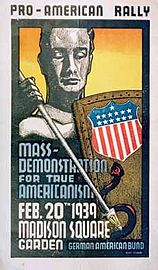


Poster for Bund rally at Madison Square Garden (1939


The German American Bund was the most prominent and well-organized fascist organization in the United States. It was founded in 1936, following the model of Hitler's Nazi Germany. It appeared shortly after the founding of several smaller groups, including the Friends of New Germany and the Silver Legion of America, founded in 1933 by William Dudley Pelley and the Free Society of Teutonia. After March 1, 1938, membership in the German-American Bund was only open to American citizens of German descent.[26][27] Its main goal was to promote a favorable view of Nazi Germany. The Bund was very active, providing its members with uniforms and encouraging participation in "training camps".[28] The Bund held rallies with Nazi insignia and procedures such as the Hitler salute. Its leaders denounced the administration of President Franklin D. Roosevelt, Jewish-American groups, Communism, "Moscow-directed" trade unions and American boycotts of German goods.[29] They claimed that George Washington was "the first Fascist" because he did not believe that democracy would work.[30]

The high point of the Bund's activities was their rally at Madison Square Garden in New York City on February 20, 1939, with around 20,000 people in attendance.[31] The anti-Semitic Speakers repeatedly referred to President Roosevelt "Frank D. Rosenfeld", calling his New Deal the "Jew Deal", as well as denouncing the Bolshevik-Jewish American leadership.[32] The rally ended with violence between protesters and the Bund's "storm-troopers".[33] In 1939, America's top fascist, the Bund's leader Fritz Julius Kuhn, was investigated by the city of New York, and was found to be embezzling the Bund's funds for his own use. He was arrested, his citizenship was revoked, and he was deported. After the War, he was arrested and imprisoned again. In 1940, the U.S. Army organized a draft in an attempt to bring citizens into military service. The Bund advised its members not to submit to the draft. On the basis of this piece of advice, the Bund was outlawed by the U.S. government, and its leader, Fritz Julius Kuhn, fled to Mexico.


Father Charles Coughlin (right) on the cover of Time magazine {1934}
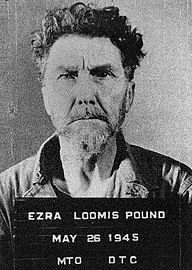


The poet Ezra Pound in prison (1945)

Father Charles Coughlin

Father Charles Coughlin was a Roman Catholic priest who hosted a prominent radio program in the late 1930s, on which he often ventured into politics. In 1932, he backed and welcomed the election of President Franklin Roosevelt, but the two had a falling out after 1934. His radio program and his newspaper, "Social Justice", denounced Roosevelt, as well as the "big banks" and "the Jews". When the United States entered World War II, the U.S. government took his radio broadcasts off the air, and blocked his newspaper from the mail. He abandoned politics, but continued to be a parish priest until his death in 1979.[34]
Phillip Johnson

The American architect-to-be Philip Johnson was a correspondent (in Germany) for Coughlin's newspaper between 1934 and 1940 (before beginning his architectural career). He wrote articles that were favorable to the Nazis and critical of "the Jews", as well as taking part in a Nazi-sponsored press tour, in which he covered the 1939 Nazi invasion of Poland. He quit the newspaper in 1940, was investigated by the FBI and was eventually cleared for army service in World War II. Years later he would refer to these activities as "the stupidest thing[sic] I ever did ... [which] I never can atone for".[35]

Ezra Pound

The American poet Ezra Pound moved from the United States to Italy in 1924, and he became a loyal supporter of Benito Mussolini, the founder of a fascist state. He wrote articles and produced radio broadcasts that were critical of the United States, international bankers, Franklin Roosevelt, and the Jews. His propaganda was poorly received in the U.S.[36] After 1945, he was taken to the United States, where he was imprisoned for his actions on behalf of fascism. He was placed in a psychiatric hospital for twelve years, and was released after a campaign was launched on his behalf by American writers. He returned to Italy, where he died in 1972.


White supremacy and fascism

In the view of philosopher Jason Stanley, white supremacy in the United States is an example of the fascist politics of hierarchy, because it "demands and implies a perpetual hierarchy" in which whites dominate and control non-whites.[39]

Donald Trump and fascism
 
Main article: Donald Trump and fascism
See also: Alt-right, Political positions of Donald Trump, Racial views of Donald Trump, Radical right (United States), and Trumpism

Some scholars have argued that the political style of Donald Trump resembles the political style of fascist leaders. Such assessments were first made during Donald Trump's 2016 presidential campaign,[40][41] continuing over the course of the first Trump presidency as he appeared to court far-right extremists,[42][43][44][45] including his attempts to overturn the 2020 United States presidential election after losing to Joe Biden,[46] and culminating in the 2021 United States Capitol attack.[47] As these events unfolded, some commentators who had initially resisted applying the label to Trump came out in favor of it, including conservative legal scholar Steven G. Calabresi, and conservative commentator Michael Gerson.[48][49] After the attack on the Capitol, Robert O. Paxton, a historian of fascism, went on to state that Trump is a fascist, despite his earlier objection to using the term in this way.[50] In "Trump and the Legacy of a Menacing Past", Henry Giroux wrote: "The inability to learn from the past takes on a new meaning as a growing number of authoritarian regimes emerge across the globe. This essay argues that central to understanding the rise of a fascist politics in the United States is the necessity to address the power of language and the intersection of the social media and the public spectacle as central elements in the rise of a formative culture that produces the ideologies and agents necessary for an American-style fascism."[51] Other historians of fascism, such as Richard J. Evans,[52] Roger Griffin, and Stanley Payne, continue to disagree that fascism is an appropriate term to describe Trump's politics.[47] Jason Stanley argued in 2018 that Trump uses "fascist techniques to excite his base and erode liberal democratic institutions".[53]

In 2017, the Hamburg-based magazine Stern depicted Trump giving a Nazi salute, and compared Trump to neo-Nazis and members of the Ku Klux Klan.[54] In the book Frankly, We Did Win This Election,[55] authored by Michael C. Bender of The Wall Street Journal, it details that John F. Kelly, the White House Chief of Staff, was reportedly shocked by an alleged statement made by Trump that "Hitler did a lot of good things". Liz Harrington, Trump's spokesperson, denied the claim, saying: "This is totally false. President Trump never said this. It is made-up fake news, probably by a general who was incompetent and was fired."[56] Kelly further stated in his book that Trump had asked him why his generals could not be loyal like Hitler's generals.[57][58] According to the Ohio Capital Journal, quoting his roommate politician Josh McLaurin, U.S. Vice President-elect, J. D. Vance, was said to have wondered whether Trump was "America's Hitler".[59] Harvard University professor of government Daniel Ziblatt also drew similarities between Hitler's rise and Trump's. [60] Trump has further been compared to Indian Prime Minister Narendra Modi,[61] and former aide Anthony Scaramucci also compared Trump to Benito Mussolini and Augusto Pinochet.[62]

In a July 2021 piece for The Atlantic, George W. Bush's former speechwriter David Frum wrote that "Trump's no Hitler, obviously. But they share some ways of thinking. The past never repeats itself. But it offers warnings. It's time to start using the F-word again, not to defame—but to diagnose."[63] From The Guardian, Nicholas Cohen wrote: "If Trump looks like a fascist and acts like a fascist, then maybe he is one. The F-word is one we are rightly wary of using, but how else to describe the disgraced president?"[64] New York Magazine asked, "Is It Finally Time to Begin Calling Trumpism Fascist?"[65] Dana Milbank also believed the insurrection qualified as fascist, writing in The Washington Post, "To call a person who endorses violence against the duly elected government a 'Republican' is itself Orwellian. More accurate words exist for such a person. One of them is 'fascist.'"[66] Dylan Matthews writing in Vox quoted Sheri Berman as saying, "I saw Paxton's essay and of course respect him as an eminent scholar of fascism. But I can't agree with him on the fascism label."[47]

The Guardian further reported on Trump's "stand back and stand by" directive during the 2020 United States presidential debates to the Proud Boys, and made note of the fact that he had made "positive remarks about far-right and white supremacist groups."[56] During the 2020 Presidential Debate, Biden asked Trump to condemn white supremacist groups, specifically the Proud Boys.[67] Trump's response was interpreted by some as a call to arms.[68][69][70] The United States House Select Committee on the January 6 Attack public hearings explored the relationships which existed between the Oath Keepers, the Proud Boys, and Trump's allies, with evidence of coordination in the run-up to the Capitol attack.[71] In August 2022, President Biden referred to the "extreme MAGA agenda" as "semi-fascism".[72] In the Battle for the Soul of the Nation speech on September 1, 2022, Biden criticized the "extremism" and "blind loyalty" of Trump supporters, calling them a threat to democracy. He added that he did not consider a majority of Republicans to be MAGA Republicans.[73][74][75] On March 13, 2023, journalist James Risen reported that it was discovered that January 6 Capitol attack attendee Hatchet Speed, was planning to kidnap Jewish leaders, including the leaders of the Anti-Defamation League, and the philanthropist George Soros. Speed was working as a Pentagon Analyst at the time of Risen's investigation of his planned attack. Reportedly, he has praised Hitler as "one of the best people there has ever been on the earth".[76]

During the 2024 election, Trump's former chief of staff John Kelly stated that Donald Trump had frequently praised Hitler, including by saying "you know, Hitler did some good things, too," and wanting generals like that of Nazi Germany.[77] In a podcast with The New York Times, Kelly also stated that "[Trump] certainly falls into the general definition of fascist."[78]


Tuesday, December 31, 2024

Some Final Reflections on the 2024 Presidential Election and the Politics of Race, Class, and Gender Within the American Electorate

by Kofi Natambu
December 31, 2024
The Panopticon Review


Eight weeks ago on November 5, 2024 the national voting public of the United States of 154 million citizens--the second largest number of voters in a presidential election in American history next to the previously record setting total of 155 million in 2020--re-elected the former 45th president from 2016-2020, Donald J. Trump, as the new 47th president of the United States in an especially bilious national election rife with the most notoriously egregious, despicable, and vile public displays of overt racism, raging misogyny, rampant xenophobia, blatantly fascist propaganda, and endlessly demagogic and manipulative misinformation campaign ever spewed by a leading presidential candidate in the modern era (i.e. since 1945).

Meanwhile the Democratic Party led by President Joe Biden dramatically collapsed upon itself following the personal struggles of its standard bearer and his subsequent inability to properly perform his duties on the campaign trail due to the now clearly visible cognitive and physical decline of Biden as a result of the various demands on the rapidly aging candidate. This crisis led to a national decline in confidence with respect to the President’s overall performance and thus clearly jeopardized his chances to win re-election. As this problem rapidly metastasized in the summer of 2024 and was exposed to the entire nation in a disastrous nationally televised debate with Trump on June 27, 2024, the Democratic Party went into an immediate tailspin with various members of its caucus in Congress as well as among its party leadership hierarchy and elites and its major donor class demanding that he now step aside from his leading role for the good of both the party and the nation.

As a result Biden was forced to do what he had been evading for at least two years and that is formally step down as the incumbent 2024 Democratic Party presidential candidate and choose a viable alternative to replace him on the ballot. Given the stark options of deciding on allowing the party to go ahead with plans to hold a now very late and sure to be chaotic and clearly disruptive 'open primary' during the Democratic Party  convention in late summer, early fall leading into the general election in November or simply choose to nominate his own vice president as his open successor to replace him in the electoral campaign to defeat Donald Trump, Biden chose the latter option and insisted on making his VP Kamala Harris his pick to replace him on the ballot. Despite some inevitable grumbling and dissension within the party over the complicated ideological and administrative dynamics of allowing Biden to choose Harris the general party quickly closed ranks around Vice President Harris given the new time constraints and obvious limitations imposed on President Biden's candidancy in the wake of this mounting conflict. As a result Biden subsequently announced his nomination of Harris to the media on July 21 some three weeks after the national/global debacle of his own televised debate meltdown of June 27. The die was now cast for VP Harris to use the now remaining 107 days before the election to mount a major national campaign for the presidency under what were extremely challenging and frankly daunting circumstances.
Further the fact that the general Democratic Party itself was still not entirely clear on which specific strategic, tactical, and goal oriented directions, policies, and programs it wanted to fully commit to and struggle on behalf of in fighting for what it deemed to be a massive existential and practical task of "saving democracy” and thus putting forward a decisive alternative agenda of directly engaging and decisively defeating what the "clear and present danger" of the openly fascist politics and criminally licentious, illegal, and unconstitutional behavior by Trump, the GOP, the MAGA mass movement and its cultlike Trumpian voter base actually is and represents. In addition this entailed the DP politically combatting the many far rightwing think tanks and large dark money PACS and its supporting institutions as well as an ever widening range of local, state and federally based organizations which are dedicated to such ominous clearly fascist programs and agendas as Project 2025.
The net result of these deep seated political, cultural, and ideological realities tied of course to the larger economic and social forces that rule/dominate the political economy and much of civil society is that as always the racial, gender, and class dynamics of American society in 2024 going into 2025 are as starkly conflicted, divided, and crisis filled as ever with 87% of the national black electorate voting overwhelmingly for Harris just as they have for every single Democratic Party candidate except once since 1952, while as always 60% of all white American voters voted for Trump (and as white voters nationally have voted exclusively for every single Republican candidate since 1952 except ONCE in 1964).

What was surprising about the national vote this time around and ultimately proved even more disturbing generally speaking was the 46% of Latino American voters overall (50% of them male) who voted solidly for Trump. This vote indicated that there is a very pronounced gender split/division within the national Latino American vote where nearly 70% of Latinas voted for Harris. Since a whopping 83% of the national electorate are now represented by white and Latino voters overall and these respective national groups of voters are the top two electoral groups of American voters in terms of baseline percentages in the country as a whole these results do not auger well for at least the immediate future of the country going into the next two to three electoral cycles in 2028, 2032, and 2036.

What remains true whether we want to fully and honestly acknowledge and directly engage the fundamental facts and foundational contradictions in the body politic or not is the one glaring reality that cannot be swept under the rug no matter what the often truly clueless and self absorbed pundits and conventional Democratic and Republican party affiliated hacks say or think otherwise):

HALF of the national electorate (over 77 million people which is the second highest number of votes for any candidate in American history) openly and resoundingly voted for a fascist for President and thus a fascist government in this election. This result is far more than merely 'problematic' about what it says and signifies about the society we're actually living in today and no hopelessly fetishized and utterly reductive notion of a mythologically heroic and strangely immutable "(white) working class" is gonna save any of us any time soon (and please remember that the great majority of this segment of the national electorate along with the middle class has been voting for the Republicans at both the presidential and congressional levels since 1968 which is the major reason why out of the seven (7) Presidents who have been elected and re-elected since 1952 five (5) of them are reactionary white supremacists, corporate capitalist shills, imperial militarists, and raging sexists/misogynists from the GOP. 
Their names from 1952-2024 we should never forget are Dwight D. Eisenhower, Richard M. Nixon, Ronald W. Reagan, George W. Bush, and DONALD J. TRUMP)...


HAPPY NEW YEAR EVERYBODY!


NOTE: To access previous commentaries on 'some final reflections on the presidential elections of 2020, 2016, and 2012' please click on the following links:

Monday, December 23, 2024

THE PANOPTICON REVIEW PRESENTS TWENTY OUTSTANDING BOOKS OF 2024

Please Note: The following list of books is not organized according to any personal hierarchy of the relative value of each individual book. Rather it is a list that seriously considers ALL of the books listed here to be of equal intellectual and cultural value and interest, albeit for different reasons. The bottomline on this list is that each one of these books is extraordinary and invaluable in their own right and represents some of the very best writing published in the United States in 2024.
--Kofi Natambu, Editor  

The Black AntiFascist Tradition:
Fighting Back From Anti-Lynching To Abolition
by Jeanelle K. Hope & Bill V. Mullen
Haymarket Books, 2024


Ella Baker And The Black Freedom Movement:
A Radical Democratic Vision
by Barbara Ransby
The University of North Carolina Press, 2024
(Second Edition)


Deluge:
Gaza and Israel From Crisis To Cataclysm
Edited by Jamie Stern-Weiner
OR Books, 2024 

We Charge Genocide:
American Fascism and the Rule of Law
by Bill V. Mullen
Fordham University Press, 2024


The Myth of American Idealism:
How U.S. Foreign Policy Endangers the World
by Noam Chomsky and Nathan J. Robinson
Penguin Press, 2024
 

The Message
by Ta-Nehisi Coates
One World, 2024

Living Space: John Coltrane, Miles Davis, and Free Jazz, From Analog To Digital
by Michael E. Veal
Wesleyan University Press, 2024

The Rebel's Clinic:
The Revolutionary Lives Of Frantz Fanon
by Adam Shatz
Farrar, Straus, and Giroux, 2024
Dis// Integration:
2 Novellas, & 3 Stories & A Little Play
by William Melvin Kelley
Vintage Books, 2024
 
Defectors: The Rise Of the Latino Far Right
And What It Means For America
by Paola Ramos
Pantheon Books, 2024
 
Claudia Jones:
Visions Of A Socialist America
by Denise Lynn
Polity, 2024
 

Building the Black City:
The Transformation Of American Life
by Joe William Trotter, Jr.
University of California Press, 2024
Erasing History:
How Fascists Rewrite The Past
To Control the Future
by Jason Stanley
Atria, 2024


James: A Novel
by Percival Everett
Doubleday, 2024
 
The United States Governed
by Six Hundred Thousand Despots
by John Swanson Jacobs
(Edited by Jonathan D.S. Schroeder)
The University of Chicago Press, 2024
 
Frantz Fanon: Combat Breathing
by Nigel C. Gibson
Polity, 2024
You Can't Please All: Memoirs, 1980-2024
by Tariq Ali
Verso, 2024

  
The Killing of Gaza: Reports On A Catastrophe
by Gideon Levy
Verso, 2024
 

Rooted:
The American Legacy of Land Theft And the Modern Movement For Black Land Ownership
by Brea Baker

One World,  2024


Darkening Blackness: Race, Gender, Class,
and Pessimism in 21st Century Black Thought
by Norman Ajari
Polity, 2024
 
HONORABLE MENTIONS: 
I Dare Say: A Gerald Horne Reader
by Gerald Horne
Edited by Tionne Alliyah Parris
OR Books, 2024
 
 
Metaracism:
How Systemic Racism Devastates Black Lives
And How We Break Free
by Tricia Rose
Basic Books, 2024
 
 
I Just Keep Talking: A Life in Essays
by Nell Irvin Painter
Doubleday, 2024

We Are The Leaders We Have Been Looking For:
The W.E.B Du Bois Lectures
by Eddie Glaude, Jr.
Harvard University Press, 2024
 
 
Illiberal America: A History
by Steven Hahn
W.W. Norton and Company, 2024
 
Yale and Slavery: A History
by David W. Blight
Yale University Press, 2024

The Unseen Truth:
When Race Changed Sight in America
by Sarah Lewis
Harvard University Press, 2024
 
We Refuse:
A Forceful History of Black Resistance
by Kellie Carter Jackson
Seal Press, 2024
 
Towers Of Ivory and Steel:
How Israeli Universities Deny Palestinian Freedom
by Maya Wind
Verso, 2024
 
Medgar & Myrlie:
Medgar Evers and the Love Story That Awakened America
by Joy-Ann Reid
Mariner Books, 2024
 
Madness: Race and Insanity in A Jim Crow Asylum
by Antonia Hylton
Legacy Lit, 2024
The Racket:
A Rogue Reporter vs. The American Empire
by Matt Kennard
(Second Edition)
Bloomsbury Academic, 2024


The White Bonus:
Five Families and the Cash Value Of Racism in America
by Tracie McMillan
Henry Holt and Company, 2024
  
Remember, You Are A Wiley: A Memoir
by Maya Wiley
Grand Central Publishing, 2024
 
Salvage: Readings From The Wreck
by Dionne Brand
Farrar, Straus, and Giroux, 2024

Any Day Now: Toward A Black Aesthetic
by Larry Neal
David Zwirner Books, 2024


NOTE: THE PANOPTICON REVIEW HAS THUS FAR PRESENTED TWENTY OUTSTANDING BOOKS ANNUALLY FROM 2010-2024

PLEASE CLICK ON THE FOLLOWING INDIVIDUAL LINKS TO ACCESS THE LISTINGS OF EACH CALENDAR YEAR:
 

Friday, December 20, 2024

Prominent Public Intellectual, Philosopher, Scholar, Political Theorist, Sociologist, Teacher, And Activist Wendy Brown On the Presidential Election and the Structural Breakdown and Corruption of the U.S. Political System and the Very Idea of Democracy

PHOTO:  Wendy Brown
Image: Wikimedia Commons


Philosophy, Politics


The Violent Exhaustion of Liberal Democracy

A conversation with Wendy Brown on the U.S. presidential election, the exclusions liberal democracy is built on, and why we must aim at more than restoring its mythical former splendor.

Wendy Brown

Francis Wade

Democracy, Elections, Environment and Climate, Interview

by Francis Wade
October 21, 2024
Boston Review


Events of the past decade have prompted frenzied discussion of the state of democracy across the globe. In countries across Europe, Latin America, and Asia—as well as, of course, in the United States—far-right political figures with outwardly antidemocratic stances have won office. Their misogyny and xenophobia, their promotion of violence, and their dismissal of the climate emergency haven’t dented their support but rather secured it. In a number of cases, including Viktor Orbán in Hungary and Narendra Modi in India, they have been reelected several times over by sizable majorities. Meanwhile, the “only liberal democracy in the Middle East,” as Israel’s Benjamin Netanyahu likes to say, is controlled by the far-right Likud party and executing a genocide in Gaza and an expanding war in Lebanon.

Attempts to diagnose the so-called crisis of democracy have led in several directions: to the explosion of economic inequality and a widespread loss of faith in the ability of public institutions to deliver for everyone; to changes in party systems that allow radical groups to enter the mainstream; to the internal contradictions of liberalism and the bordered nation-state itself, opening the door to strongmen leaders. The list goes on.

But while the concern tends to focus on declining faith in democracy—a phenomenon as old as the system itself—less attention goes to a deeper, more pressing problem. Among liberals, democracy remains the political institution par excellence, and yet, says political theorist Wendy Brown, not only is it in an exhausted form; it is wholly unsuited to the challenges posed by ecological breakdown, and indeed is hastening it. In this interview, Brown and I discuss the crisis of democracy in all its forms, as well as a counter-conception of democracy she has been developing that seeks to orient our politics away from its destructive human-centeredness, toward connection and repair.
—Francis Wade

Francis Wade: Let’s start with an event close to home for you, both in a literal and intellectual sense: the coming U.S. elections, and what its outcome will say about the so-called “crisis of democracy” in the United States (and elsewhere). A win for the Democrats—and at this moment, such a win is deeply uncertain—would mark two straight defeats for Trump and likely be received by liberals as proof that the crisis is receding, just as it seemed to do with, for instance, Lula in Brazil. What would you say to that?


Wendy Brown: Nothing would be more dangerous than treating a win for the Democrats as proof that the crisis of democracy is receding.

First, even if Harris wins, nearly half of American voters will have voted for fascism. Those who deem the fascist label hyperbole note that many hold their noses while voting for their imagined economic interests or voting against loathed liberals. But this framing ignores the willingness of millions to abide not only a violently ethnonationalist, racist, and misogynist regime, but one that would shred what little remains of liberal democratic principles and institutions. They are voting for fascism.
“Nothing would be more dangerous than treating a win for the Democrats as proof that the crisis of democracy is receding.”

Second, Trump is symptom, not cause, of the “crisis of democracy.” Trump did not turn the nation in a hard-right direction, and if the liberal political establishment doesn’t ask what wind he caught in his sails, it will remain clueless about the wellsprings and fuel of contemporary antidemocratic thinking and practices. It will ignore the cratered prospects and anxiety of the working and middle classes wrought by neoliberalism and financialization; the unconscionable alignment of the Democratic Party with those forces for decades; a scandalously unaccountable and largely bought mainstream media and the challenges of siloed social media; neoliberalism’s direct and indirect assault on democratic principles and practices; degraded and denigrated public education; and mounting anxiety about constitutional democracy’s seeming inability to meet the greatest challenges of our time, especially but not only the climate catastrophe and the devastating global deformations and inequalities emanating from two centuries of Euro-Atlantic empire. Without facing these things, we will not develop democratic prospects for the coming century.

Sure, we would sigh with relief if Trump and Vance (the scarier one) are defeated this time around. But liberal democratic institutions—courts, majority rule, separation of powers, and more—are in tatters, democratic values are literally absent in half the population, democratic culture has been devastated by neoliberal reason, and the financing and arming of an unfathomably brutal genocide and ecocide in the Middle East by the Biden-Harris administration has soured a generation of young progressives on electoral politics.

Democrats, real democrats, need to ask whether “liberal democracy,” more than simply attacked by the right, might be a historically exhausted form, both for representing the demos and for addressing our gravest predicaments. If so, what follows?

FW: You’ve lately been developing a counter-conception of democracy that you call “reparative democracy.” What do you mean by this? And what led you to it?

WB: My thinking about reparative democracy emerges from the twin crises of democracy and ecology imperiling all planetary life today, however unevenly. It aims to bring democracy into direct engagement with the deep and lasting damages of colonial capitalist modernity, an epoch built on fossil fuels, unsustainable practices of production and consumption, extreme geopolitical inequalities, and wretched forms of destruction and exploitation for both human and nonhuman life. Such direct engagement with long histories and their effects on all possible futures isn’t part of the temporal orientation and practices of liberal democracies or democratic subjects. It requires some serious transformations of both, which we will want to talk about. But for now, the big points are these: if we are to sustain the commitment to collective self-rule promised by democracy, we must reorient it for this engagement and transformation. Conversely, if we are to have ecologically viable and just futures, democracy must be remade for reparative purposes.

Because it’s easy to misunderstand, let me just say what reparative democracy is not. It is not about restoring liberal constitutional nation-state democracy to a mythical former splendor. That is, it is not about recuperating extant democracy as if it was once fine and only now is broken. Nor is it primarily concerned with reparations to peoples and places brutalized or exploited under past regimes. Rather, my argument is that the democratic ethos and practices we require today must be relentlessly and radically reparative in relation to past and present damaging modes of life, especially over the past two centuries. This orientation breaks sharply with the notions structuring liberal democracy, including progressivism, anthropocentrism, and individual interests and rights as the essence of political freedom. So it radically transforms what democracy means and entails, including its ways of relating to past and future, its ways of casting the human and of relating human and nonhuman life, and its understandings of where democracy resides and matters.

The idea of reparative democracy emerged from both practical and theoretical concerns. Practically, liberal nation-state democracy centered on individual rights and interests is not just threatened by authoritarian and neofascist mobilizations. For many reasons, it’s unsuited to contemporary powers and predicaments, especially but not only the climate emergency. Theoretically, while many are thinking about repair these days, I have been especially influenced by Andreas Folkers’s formulation of the reparative in a critical theory of what he calls “fossil modernity.” For Folkers, the very nature of critique is altered by the ongoing damages—which he calls residuals—of intensive fossil fuel use. These include fouled land and water, a heating planet, extinction chains, and more. No longer can critique be premised on overcoming the past or on an open future. Both modernist conceits have collapsed. Instead, what I would call “honest” critique must be oriented by seeking to limit and repair (forward) the damages of fossil modernity. I extend Folkers’s appreciation of residuals to the politics of Euro-Atlantic modernity, especially empire, and adapt it for reparative democracy.

FW: The Ancient Greek conception of democracy was people-oriented by definition, and it accordingly instituted a range of separations and subordinations: of the “civilized” from the “uncivilized,” the city from the outside, humans from nature, and so forth. Various transformations to human life in the period since have intensified that separation, not least the effort by the industrializing West from the eighteenth century onward to gain greater mastery of nature so that it would better serve human “progress” and “freedom.” So is it fair to say that democracy posed a grave ecological threat from the get-go?


WB: Most good political thinking about ecological damage centers capitalism as the culprit. Certainly the reign of capital—with its need for growth based on artless and wasteful consumption, its powering by fossil fuels (coal, then oil), its valorization of profit over any other value, and more recently the capture of state projects, including decarbonization, by private finance—has been a planetary disaster. And in every way, it has roughed up the Global South more than the North. We can’t overstate the need for a different political economy for a habitable and just future.

However, Western anthropocentrism is older and deeper than capitalism, which is why socialism is insufficient for addressing the climate emergency and cratering biodiversity. As you say, democracy in the West emerges at the site of ancient Greek oppositions between polis and oikos, politics and economy, city and outside lands—freedom always aligned with the former and in opposition to the latter. This means democracy is founded in a sequester of politics from life, both social and earthly. Political freedom in the West is founded in consequential political and ecological exclusions.

The foundational splitting of politics from everything arrayed under “necessity” and “nature”—nonhuman life as well as human production and reproduction—delivers both a very limited demos and an irresponsible form of rule, or kratia, one cut off from and self-authorized to violate the sources of its own sustenance. This suggests that Western democracy, its very ontology, might be co-responsible with the voraciousness of capitalism for histories of damage to human and nonhuman life, which are now at an emergency pitch.


FW: You’ve previously cited the work of the political ecologist Pierre Charbonnier, who writes in Affluence and Freedom (2021) that “we inherit a world that no available political category is designed to manage.” It’s long been clear that liberal democracy places no constraints on our destructive impulses, and in fact seems to feed them, so can you say a little on how and where reparative democracy departs from it?


WB: Reparative democracy, as I’m thinking about it, is not a set of institutional arrangements, though it would bear on them. Rather, it is an ethos or orientation, one which refigures democratic principles, practices, and subjects. This ethos includes overcoming the foundational opposition between humans and “nature” just discussed. However, it also involves transforming the damaging methodological individualism and “presentism” of liberal democracy—its focus on what individuals want right now rather than our interlinked and common past, present, and future.

Reparative democracy would tether the demos to both the nonhuman and to histories of damage bearing on the future. This challenges liberalism’s centering of justice on rights and distribution, replacing them with sustenance and regeneration amidst interdependence. Freedom would also lose its presentist and autonomous character. To mobilize human capacities for democratic ecological repair, both personal and political freedom would have to take shape as relational, responsive, and responsible, with past and future always on their horizons.

Reparative democracy also entails a transformation of political equality. Those who can and cannot represent themselves by speaking must not count differentially. Listening, and listening differently to those who do not speak one’s own language, would have to supplant speech as the ultimate citizen practice. And, concentrations of economic and social power must be vigilantly restrained from either amplifying or suppressing any part of this expanded democratic subject and constituency. Still, political equality is about more than counting or who counts, and it exceeds measure by individual units. Political equality in a reparative mode must be responsive to deep histories of inequalities and violences—racial, gendered, regional, hemispheric, and between human and nonhuman—that bear on discursive norms and agendas in democratic spheres. Political equality also requires more effectively enfranchising life forms that democracy has not previously bothered with—earthworms and coral reefs, forests, wetlands, and bee colonies.

Framed philosophically, reparative democracy is rooted in that deep ecological materialism called for by Bruno Latour. Such materialism comprises not only modes of production and reproduction, or agency discovered in “things,” but all constellations of interdependent planetary life, human and nonhuman, shaping past, present, and future. Similarly, reparative critique does not merely “grasp things by their root,” as Marx puts it in his account of materialism. Rather, the soil nourishing the root, the historical residuals within that soil, and the conditions for its regeneration, must be grasped and addressed.

FW: How does it work in practice then? Are there contemporary examples of, as you put it earlier, “direct engagement with long histories” on a scale that suggests a kind of reparative social compact in the making?

WB: There are instances of reparative democracy all over the world. Some are fleeting and partial; others are more sustained. Many emerge from the indigenous and the young, who do not need to be told that human and nonhuman life are interdependent, that the world is in an emergency state, and that constitutional liberal democracy is both incapable of addressing that emergency and itself an exhausted form. 
 
“#StopCopCity brings into relief why ordinary political channels routinely fail the future so resoundingly.”

One contemporary example can be found in #StopCopCity in Atlanta, Georgia. Cop City is the oppositional nickname for a planned militarized police training facility that involves clear-cutting forests abutting Atlanta’s poorest and Blackest neighborhoods. The $100 million project is largely privately funded and driven by the needs and demands of the global corporations and finance networks (investment banks, law, insurance, and consulting firms) at the heart of Atlanta’s current growth and wealth generation. The city government kowtowed to these global economic powers to repeatedly endorse the project, spurning local public opposition that spans local and national racial justice organizations; ecological and conservation groups; lawyers guilds; area schools; neighborhood, church and community associations; abolitionists; and anarchists. These groups have not only fought together, they have learned from and protected one another. Black community organizations defend white anarchist tree sitters, and many anarchists have allied with liberals seeking to stop the facility with legal maneuvers. The state has responded with outsized military force and juridical harshness, charging occupiers and demonstrators with outlandish crimes and threatening scandalously long prison sentences.

#StopCopCity melds ecology with racial justice aims and opposes economies of destruction of human and nonhuman life and wholly bought political representation. It also foregrounds all the painful and damaging histories on this patch of land: from the dispossession of early indigenous inhabitants to slave-based cotton farming and to carceral institutions that harbor racialized and gendered abuses. The movement constantly draws attention to the dangers of deforestation and “forest fragmentation” and to the neighborhoods, already suffering from neglect and traumatized by racialized policing, that will be most impacted by the loss of forest tree canopy and the presence of a militarized police training site.

Altogether, these features make #StopCopCity simultaneously an instance of reparative democracy and a demonstration of why it is so essential. It brings into relief why ordinary political channels routinely fail the future so resoundingly. The movement is a powerful critique of liberal democracy today—institutional corruptions and erosions, its privileging of capital interests, its blinding individualism, its ferocious repression of protest, and its radical exclusion of nonhuman worlds.


FW: Your 2015 book Undoing the Demos warned of the peril that neoliberalism posed to both democracy and “the meaning of citizenship itself.” It argued that no area of life was now spared from “capital enhancement,” that “neoliberalism is the rationality through which capitalism finally swallows humanity.” The picture it painted of our future was bleak. How does your thinking on reparative democracy today speak to the arguments you set out a decade ago?

WB: Neoliberalism contributed profoundly to the crisis of actually existing democracy from which theories and practices of reparative democracy emerge. Its elevation of markets to the highest form of truth and governing displaced democratic principles ranging from political equality to legislated justice. Its privatization or extractive private financing of every public good compounded its devastation of working- and middle-class prospects that turned millions in a hard-right direction. Its conversion of everything and everyone to market behavior did not spare the political sphere, which has become steadily more ruthless and less oriented by the common good, and features increasingly quotidian corruption of political institutions for partisan ends. Neoliberalism escalated the capture of law and especially of rights—that essential liberal democratic icon—to amplify the wealth and power of the powerful (from mega-churches to the mega-rich to mega-corporations) and diminish the power of the people in politics and policy.

So, yes, neoliberalism is part of the story of cratering liberal democracy.

But only part. Even as it saturates everything, neoliberalism does not explain everything, and it does not carry the whole weight of liberal democracy’s mounting failures and exhaustion. Ecocide has been intensified by deregulated capital and states increasingly subordinated to institutional finance but is older and bigger than these. Racist gerrymandering and voter suppression is an old story. And while the Global South has been slugged harder than the North by neoliberal austerity, big finance, and exploitative manufacturing and extractivist practices, modern Euro-Atlantic democracy carried empire in its belly and carved the earth accordingly. 
 
“Even as it saturates everything, neoliberalism does not explain everything. Ecocide is older than deregulated capital and institutional finance.”

As I suggested earlier, reparative democracy arises from the consequential exclusions, violences, and individualist and presentist orientation of modern democracy across its liberal, social, and socialist variants. Neoliberal effects make these uniquely vivid but are not singularly causal.

FW: Recognition of the interdependency of human and nonhuman life seems central to your concept, but it’s on display at the #StopCopCity protests in large part because of—and say if you disagree—the very particular set of circumstances being opposed: destruction of already diminished forest cover in the service of greater state militarization, in close proximity to communities that have long felt the effects of state violence. So I wonder, how, in the absence of Cop City–like circumstances, recognition of that interdependency, or that human-nature connectedness, might be engineered, especially in modern secular and individualist societies that lack the core emotional and spiritual bonding (for instance, of ancestor worship or other forms of veneration of place) that have historically tethered humans to the nonhuman world?


WB: I’m enough of a materialist to know it is impossible to engineer any kind of consciousness in the absence of conditions that would incite and foster it. Put the other way around, given liberalism’s human-centeredness and individualism, and capitalism’s alienation of us from the source or production of almost everything we need and consume, what hope is there of appreciating our deep imbrication with all planetary life or becoming creatures who easily share, or have cares beyond, their own lives?

The answer, of course, rests in the effects of the multiple crises that touch everyone on the planet, however differently: crises of climate change, extinction chains and biodiversity collapse, water availability, breathable air, pandemics, forever chemicals, and microplastics everywhere. All of these confront us directly with the perils of treating nonhuman life or “nature” as mere exploitable resource. All bring us face to face with the disastrous conceits of Euro-Atlantic modernity: individualism, boundless growth and consumption, fossil fueled energy, “conquering” nature, Europe and Other.

These crises are conditions for curiosity, learning, reorienting, transforming. (Of course they are also conditions for denialism, hoarding, and violent barricading.) However, even with these conditions, a deep grasp of our interdependency, and a politics that addresses it, are not automatic; they have to be developed. For reparative democracy oriented by the ecological emergency, for example, we need new ways of envisioning and hearing the nonhuman and our place within it. Sound theory, and especially bioacoustics, has much to teach us here. So also do some parts of indigenous cosmologies and ways of knowing.


FW: This brings me back to something you said earlier, that “listening . . . would have to supplant speech as the ultimate citizen practice.” For millennia, rational speech or language has been understood as a key signifier of politically able actors—in other words, without rational language, you can’t do politics; because only we humans are thought to possess it, we are the only true political creatures. And it seems that no amount of research into, for instance, the democratic practices of certain animals has been able to shift that. As others have explored in work on “political listening,” this view has helped drive the lasting separation of humans from nonhumans. You said just now that “we need new ways of envisioning and hearing the nonhuman.” How do we do that?


WB: Yes, we conventionally identify speech as the premier political action, and free speech as an icon of democracy. We also believe this comes to us from ancient Athens. In fact, the notion of isegoria, one of the three pillars of Athenian democracy, translates as the equal right to speak and be heard in the Assembly. It is a political right of all citizens to persuade the collective power that is the people. Isegoria identifies practices of speech and listening that are constitutive of democracy, not derivative from it. It could not be further from the liberal notion of saying whatever, wherever, because you have a personal right of expression. It’s not a personal right to speak but a political right to be heard, shared equally by all citizens.
“Imagine if we all actually listened to cries of pain and grief at the site of contemporary genocidal violence!”

Listening as well as political persuasion have been scraped out of liberal free speech politics. This compounds the problem of what I am suggesting we need in the Anthropocene, an epoch in which our imbrication with all earthly life, and capacity to destroy it, is so vivid. Listening, not speaking, is one of our most powerful forms of learning this imbrication and developing a politics appropriate to it. All life listens for survival, as a means of detecting food, water, danger, or degraded conditions. Many species—from bees and plants to worms and whales—also listen in order to coordinate among themselves for food, shelter, defense. Call it politics, if you will.

Humans need to learn to listen better for exactly these purposes, for our survival and to coordinate among ourselves, in the context of earthly life. But we have such limited hearing, have filled the world with so much noise (and then slapped on noise-cancelling headphones to block it), and have so degraded the importance of listening compared to speech in political life, that revalorizing and training our listening capacities seems nothing short of revolutionary. Fortunately, the rich fields of sound studies and animal and plant science, along with digital technologies of many kinds, are our friends here.

Together these help us to hear and to understand what we are hearing, including pain, poisoning and death in human and nonhuman worlds. Imagine if we all actually listened to cries of pain and grief at the site of contemporary genocidal violence! Books like Karen Bakker’s The Sounds of Life, Brandon LaBelle’s Acoustic Justice, Eva Meijer’s When Animals Speak, and Robin Wall Kimmerer’s Braiding Sweetgrass open these doors. Donna Haraway, Anna Tsing, and the Latourian School contribute. The point is to develop an ecological ear that most indigenous communities had, and also to learn from nonhuman communications how to listen better. As Bakker writes, with digital bioacoustics “we can listen not only to turtles but also like turtles.” This technology “reveals subtleties that might escape human listeners.” Becoming such listeners facilitates enfranchising “nature” as part of us—a far better strategy than allocating nature human rights to obtain political protection.

Becoming listeners could deprovincialize the cares of democrats, allowing us to orient toward conditions for thriving beyond our personal or national borders. Nothing could be more important in a time of ecological emergency and the persistent violence of colonial modernity.
 
 
ABOUT THE PARTICIPANTS:


Wendy Brown

Wendy Brown is UPS Foundation Professor in the School of Social Science at the Institute for Advanced Study. Her latest book is Nihilistic Times: Thinking with Max Weber.


Francis Wade

Francis Wade is a London-based journalist covering political violence, identity, borders, and displacement. He is author of Myanmar’s Enemy Within: Buddhist Violence and the Making of a Muslim Other.