The following three articles are by the renowned journalist, critic, author, public intellectual, and political analyst for the Atlantic magazine Adam Server who famously coined the phrase “the cruelty is the point” (which also became the title of his outstanding, critically acclaimed, and award winning first book from 2018) which vividly describes and critically examines the fascist attitudes, values, policies, positions, and behaviors deeply rooted in white supremacy, anti nonwhite immigrant nationalism, and rampant xenophobia within the notorious Donald Trump/MAGA + GOP regime
https://www.theatlantic.com/ideas/2026/11/maga-party-demographic-shift/689286/
Ideas
Even Where MAGA Won, MAGA Lost
A vision of a multicultural America emerges from this election.
by Adam Serwer
November 5, 2026
The Atlantic
Saul Martinez / Getty
Listen
[Sign up for Inside the Trump Presidency, a newsletter featuring coverage of the second Trump term.]
One of the biggest Republican wins in an otherwise-terrible midterm night for the GOP was the victory of the Trump-supporting Byron Donalds in Florida’s race for governor. Donalds will become the first Black governor of that state. If you could resurrect Jefferson Davis and tell him that the governor of Florida will be a Black Republican married to a white woman, he would crawl straight back into his coffin.
That this was MAGA’s big win in a night of defeats is remarkable, given the movement’s hostility toward diversity, and its nostalgia for an America where rigid race and gender hierarchies were enforced by the state. Even where Republicans won, in other words, President Trump’s racially exclusive conception of American citizenship lost. Trump could browbeat corporate America into eliminating DEI programs; he could threaten colleges to let in fewer students of color; he could direct the full power of the federal government toward deporting immigrants. But he could not will away the America that actually exists.
The America that emerges from the midterm elections is not the monochrome world of Madison Avenue ad campaigns from the 1950s. It is a diverse country, made up of many different kinds of people, all of whom are American. The victories of Keisha Lance Bottoms in Georgia, Aaron Ford in Nevada, and David Crowley in Wisconsin, in addition to that of Donalds, mean that there will be more Black governors than ever in U.S. history. In Texas, where Mexican Americans were subject to legalized forms of racial discrimination until the mid-20th century, Gina Hinojosa will become the first Hispanic governor. Xavier Becerra is the first Hispanic governor to be elected in California, and Deb Haaland will become New Mexico’s first Native American governor. Peggy Flanagan of Minnesota will become the first Native American woman elected to the U.S. Senate. And Abdul El-Sayed of Michigan will become the first Muslim U.S. senator.
Read: Repudiation
This happened despite the president, and the many Republicans who followed his lead, trying to make the midterms about a familiar theme: the country being invaded by strange people who do not belong here, let alone in the halls of power.
President Trump and others called El-Sayed a “jihadist,” and Vice President Vance said he should “show a little gratitude to the country that gave him everything.” (Like Vance, El-Sayed was born here.) After El-Sayed won, he told Trump, “I know you struggled with my name. You can just go on and call me Senator.” Republicans fearmongered about “Sharia law” before losing every major statewide office in the Lone Star State. In Minnesota, candidates attacked Somalis, running spots about “Somali gangs” taking over. During a speech in Ohio, Trump went after the Minnesota Democrat Ilhan Omar: “She comes in from a country without laws, without police, without military, without—all they do is shoot each other.” He continued, “They come into the United States of America, and they tell us how to run our country. We’re not going to stand for it.”
Trump won in 2016 and in 2024 while leaning into this strategy of scapegoating ethnic and religious minorities, which convinced many politicians and media figures that the strategy was deviously effective, or at least that it didn’t turn too many people off. After all, in 2020 and 2024, Trump grew his coalition, gaining support among Black and Hispanic voters as well as white ones. But the strategy could not overcome the economic headwinds Trump himself created with tariffs and the arguably illegal, inarguably ill-advised war in Iran. Many voters in 2024 also believed that Trump would focus immigration enforcement on criminals, instead of on a violent and indiscriminate campaign that would involve schoolchildren and their families hiding in their homes and masked gunmen shooting Americans dead in the streets.
I am not going to make the same mistake as the Trump Republicans after 2024 did and declare a permanent realignment of the U.S. electorate toward my policy preferences. Economic mismanagement and the war were clearly the primary drivers of Democratic success. What these wins do say, however, is that the real America is not the “Real America” of conservative fan fiction inspired by the years 1945 to 1964. Real Americans are not just those whose ancestors came over on the Mayflower, or whose ancestors served in the Revolution or Civil War, or who describe themselves with pathetic euphemisms such as “Heritage American.” As Abraham Lincoln once said, newcomers who believe in the principle that “all men are created equal” have “a right to claim it as though they were blood of the blood, and flesh of the flesh, of the men who wrote that Declaration; and so they are.”
As soon as the returns made the extent of the bloodbath clear, MAGA personalities began blaming the nation’s diversity for Republicans’ losses. The conservative podcaster Benny Johnson posted, “In 1970, the White population in Texas was 89%. In 2000, it was 50%. Now it’s less than 39%. Demographics is destiny.” The Trump adviser Laura Loomer declared, “America was always intended to be a majority White country. Not a cesspool for third world minorities. America was founded as a Christian country. Not a Muslim country.”
Idrees Kahloon: Why Republicans lost so big
“Democrats imported millions of foreigners, handed them a bunch of free shit, and then registered them to vote,” the account of the influencer Chaya Raichik posted on X. “If we ever want to win again we need deportations and denaturalizations ramped up on steroids or our country will forever be lost to the communists.”
Contrary to Johnson, demographics is not destiny—if it was, Texas would have flipped a long time ago and Trump would not have won there by double digits in 2024. Millions of nonwhite Americans have conservative beliefs, and most of them would be happy to vote for Republicans who treated them as Americans instead of invaders. As for Loomer, not only was America explicitly not founded as a Christian country, but we also fought a civil war over whether it was a white country—and the side taken by Loomer lost. Raichik’s call for ethnic cleansing is grotesque, but it nonetheless illustrates how those on the extreme right see the problem, which is that there are Americans who are not white whose votes count as much as theirs. You cannot call for people to be exiled because of their ethnic background and expect them to vote for you.
In September, Trump said, “America does not belong to those who hate it. America belongs to those who love it.” But the way MAGA talks about the America that actually exists—as opposed to the one it imagines once existed—doesn’t sound like love at all. Whether or not Americans believe in multiculturalism, we are multicultural. One is an ideology; the other is a fact.
gift article
THIS STORY IS FREE TO READ
Blanche Bruce would have been proud.
Kent Nishimura / AFP / Getty
How the attention economy turned on Republicans
Explore More Topics:
Donald Trump, Republican Party
Scott Colom Is Mississippi’s First Black Senator in 150 Years
Blanche Bruce would have been proud
by Adam Serwer
November 12, 2026
The Atlantic
USA Today Network / Reuters
[This article was featured in the One Story to Read Today newsletter. Sign up for it here.]
One fall afternoon in Liberty, Mississippi, in 1961, a white Democratic former congressman and state legislator named E. H. Hurst shot Herbert Lee in the head. Hurst was angry that Lee, who was Black, had been trying to register other Black Mississippians to vote. An all-white jury accepted Hurst’s claim that he had acted in self-defense because Lee came at him with a tire iron. Donald Trump, now the sitting president of the United States, was 15 years old.
This was how “negro law” worked in Jim Crow Mississippi, which was essentially a police state. Although many laws were race-neutral in their language, “in a society in which race mattered above all else, ‘negro law’ determined who was punished for what,” the historian Neil McMillen wrote in Dark Journey, his 1989 history of Mississippi. In the 1940s, the NAACP was “virtually forced to operate underground,” because in 1920, the state legislature had made it illegal to “possess or distribute” material that would “disturb relations between the races.” As late as 1961, a white man could shoot a Black man in broad daylight and get away with it. When the Black reporter Simeon Booker arrived in 1955 to cover the lynching of Emmett Till for Jet magazine, he wrote that he witnessed “not only raw hatred, but state condoned terror.”
This apparatus of state-condoned terror was still active into the 1960s. As Thomas Ricks writes in Waging a Good War, his history of the civil-rights movement as a nonviolent military campaign, when the legendary civil-rights organizer Bob Moses went down to Mississippi he was “assaulted and jailed repeatedly, sometimes simply for speaking to white people as equals.” In 1963, Moses and other organizers survived a drive-by shooting. He later wrote to the Student Nonviolent Coordinating Committee that Mississippi was extremely dangerous—“we were just like sitting ducks” and “people were just going to be wiped out.”
Adam Serwer: Even where MAGA won, MAGA lost
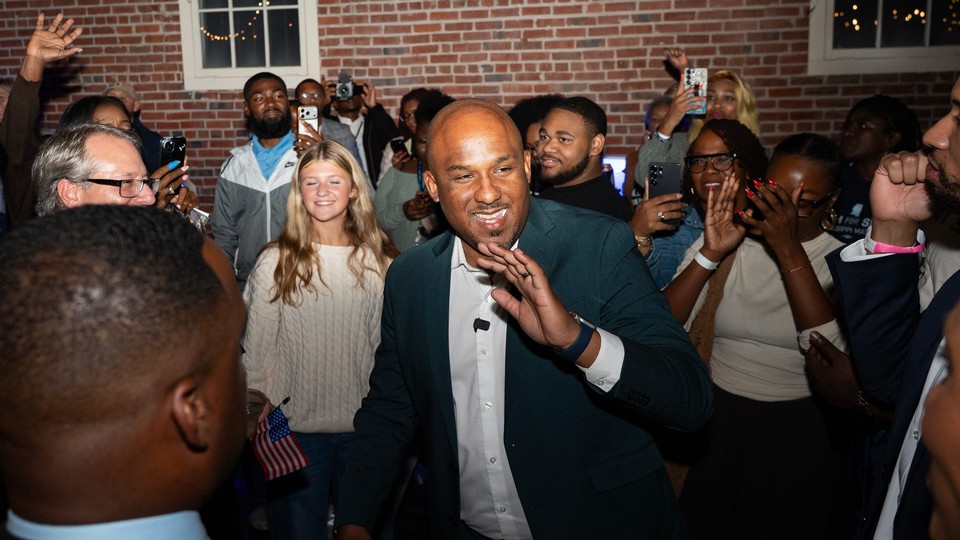
The point of all this terror was to prevent what happened yesterday, when the Democrat Scott Colom defeated Cindy Hyde-Smith to become the first Black U.S. senator from Mississippi since Reconstruction. Hyde-Smith attended a segregation academy as a child—private schools set up in the South to circumvent the Brown v. Board of Education ruling to integrate public schools. She had previously blocked Colom’s appointment to the federal bench. On Election Night, Hyde-Smith declared victory, saying, “I blocked Scott Colom from being a federal judge, and you blocked him from being a U.S. Senator.” That was a little premature.
“In Mississippi, our prayers often change the course of history,” Colom said in his victory speech last night. “It’s not something that I did, y’all. It’s something that we did. All I did was have the courage to imagine a night like this.”
The last Black man to have served as a U.S. senator from Mississippi, Blanche Bruce—back then senators were appointed by the state legislature—was born enslaved in 1841. His mother was enslaved, and his father was her master in the eyes of the law. One of Bruce’s votes was against the Republican-supported Chinese Exclusion Act, which he explained as a vote of conscience and solidarity, “representing as I do a people who are considered essentially disqualified from the privileges and immunities of American citizenship.”
Before the turn of the 20th century, Mississippi was majority-Black. State-tolerated (or state-encouraged) terror led many Black Mississippians to flee north during the Great Migration. Today, Mississippi still has the highest proportion of Black residents of any state. Before the Voting Rights Act was passed in 1965, law and violence kept Black Mississippians disenfranchised; after, racially polarized voting would place a hard ceiling on the aspirations of every Black candidate in this red state. The last Democrat to represent Mississippi in the Senate was John Stennis, an avowed segregationist who, as a prosecutor in the 1930s, led the prosecution of three Black men who had been tortured into confessions, a case that led the Supreme Court to rule in 1936 that such confessions are inadmissible under the Fourteenth Amendment.
This is all to say, as one famous Mississippian put it, that “the past is never dead. It’s not even past.” Mississippi today is not the Mississippi of Dark Journey, but we are living in a world inextricably shaped by it. Multiracial democracy in America is young; it emerged only in the lifetimes of the people who are still currently governing the country. It is younger than the president. It is younger than most of the justices on the Supreme Court. And it has been under assault. The past decade has seen a relentless attack on its foundations from people who remember the time before multiracial democracy as a golden age. It was not a golden age in Mississippi, not for people like Herbert Lee, or Bob Moses, or Fannie Lou Hamer.
Conservatives have undone or undermined many of the laws and constitutional amendments passed to ensure that Black Americans could exercise their rights as full citizens. The Supreme Court has slowly chipped away at the Voting Rights Act, most recently ruling in Louisiana v. Callaisthat racist voting restrictions are constitutional if they are passed with partisan, rather than racist, intent. This standard would permit many Jim Crow–era laws that were superficially race-neutral but racist in intent. As McMillen observed, in pre-1965 Mississippi, “Much of the exclusionary process was necessarily left to the discriminatory application of otherwise racially neutral law.” (If lawmakers want to disenfranchise Democratic voters, and those voters just happen to be Black—by coincidence, of course!—that’s fine.)
Many Republican-controlled states in the South responded to the ruling by gerrymandering Black-majority districts out of existence. At the time, the former Trump campaign manager Brad Parscale gleefully speculated that “if states are aggressive, we could see a healthy majority in the House perpetually.” Republicans might never have to worry about courting Black voters again.
Black Americans responded to this assault on the foundations of their freedom with terrific fervor in the midterms. Black-voter turnout in the South appears to have surged last week to a hair below levels usually seen when a president is on the ballot. That, along with increased white support for Democrats, helped put previously deep-red states like Mississippi into contention.
Adam Serwer: Texas Republicans get washed
The next Congress will have seven Black U.S. senators—Colom, Raphael Warnock of Georgia, Tim Scott of South Carolina, Juliana Stratton of Illinois, Lisa Blunt Rochester of Delaware, Angela Alsobrooks of Maryland, and Cory Booker of New Jersey—the most ever in history. There will be five contemporaneous Black governors in the United States in 2027, with Wes Moore in Maryland, Keisha Lance Bottoms in Georgia, Byron Donalds in Florida, David Crowley in Wisconsin, and Aaron Ford in Nevada. Before this election, there had been only three such elected governors: Moore, Douglas Wilder from Virginia, and Deval Patrick of Massachusetts. The first Black governor of any state, P. B. S. Pinchback of Louisiana, who inherited the office in 1872 after his running mate was impeached, required the intervention of the Grant administration to prevent a white-supremacist uprising in Louisiana. He was in office for 39 days. There would not be another Black governor in America for more than a century.
The fact that Black voters defeated efforts to limit their political power does not make such efforts morally acceptable or justifiable, of course. As Jamelle Bouie wrote in The New York Times this week, “That Americans of all stripes can overcome obstacles to voting does not mean that they should have to. And high Black turnout does not obviate the need for legislation to secure the right to vote.”
Bruce would be proud of Colom, I think, albeit initially confused as to why he was running as a Democrat. It took a century from Reconstruction to the civil-rights movement to restore the rights of Black voters, and far less time before politicians and justices began to curtail them again. Yet the project of snuffing out Black aspirations to equal citizenship will always fail. It failed in 1875. It failed in 1965. And it failed in 2026, with Callais. It will always fail, even if it takes a hundred years. Or a hundred and fifty.
Ideas
The Trolls’ Comeuppance
How the attention economy turned on Republicans
by Adam Serwer
November 10, 2026
The Atlantic
 Kent Nishimura / AFP / Getty
The easiest way to get attention online is to post the most outrageous, controversial take possible. That encourages other people to do the same, until you’re trying to outbid one another with the most extreme take. It’s called “take inflation.” Social media encourages take inflation, and take inflation morphs our politics because it can create a false sense of consensus around ideas that seem popular online but are not in real life.
A few years ago, Democrats were struggling with the effects of take inflation. Certain left-wing ideas popular online, such as decriminalizing border crossings, were fringe offline. In 2019, my now-colleague Jonathan Chait presciently argued that Joe Biden would win the Democratic primary despite his age because he was the least-online candidate and therefore unlikely to support such policies.
That was before the world’s richest man, Elon Musk, bought Twitter, renamed it X, and turned it into a platform that spreads racist and misogynist ideas, such as the “Great Replacement” theory and the disenfranchisement of women. This reversed the dynamic Chait identified in 2019: It is now politicians on the right who find their perceptions skewed by what draws approval on social media and their efforts to tailor their personas to appeal to that audience. If you’re looking for an explanation for why conservatives were shocked that Democrats routed Republicans in the midterms, flipping seats and states that haven’t gone blue in generations, this is a good place to start.
When Musk first took over Twitter, I worried that Americans would become trapped in an “algorithmic cage”—that right-wing ownership would allow Trump allies to control what Americans saw and heard, and as a result, shape their understanding of reality. I did not anticipate that conservatives would trap themselves in that cage.
Adam Serwer: Elon Musk’s free-speech charade is over
The Twitter takeover went wrong for conservatives in two ways. The first is that they posted more and more toxic content in an effort to drive engagement. The second is that they had no idea how unpopular that toxic content had become; both influencers and politicians mistook engagement for approval. Political influencers and parties’ incentives can align. In the end, however, the former is looking for engagement and the latter for votes, and those interests can diverge—leaving politicians chasing engagement while not realizing they are shedding voters.
If you were spending hours on X, you might have believed that most Americans were delighted by cruel memes celebrating deportations, or that affordability issues were a “hoax,” as President Trump kept insisting, or that a “red wave” was inevitable.
In October, the GOP nominee for Texas Railroad Commissioner, Bo French, said that a photo of South Asian students cheering at a football game was an example of how “Americans have been displaced by foreigners.” The post went viral, French got a lot of attention for it, and few of his colleagues spoke out to condemn it, during a campaign season in which Texas Governor Greg Abbott accused his Democratic opponent of wanting to impose “Sharia law.”
Lines such as these were popular with an audience of racist mediocrities who spent the last few days of the campaign posting memes idolizing the fictional character Anakin Skywalker, one of the main antagonists of Star Wars. One MAGA poster said Skywalker, who becomes a mass murderer after rightly being denied a promotion, was emblematic of “the white male experience.” If you say so!
In his book on the attention economy, The Siren’s Call, Chris Hayes observes that social media takes something essential to the human experience—our desire for attention and recognition—and monetizes it. As Hayes argues, one person—Donald Trump—above all others has successfully exploited the dynamic of trading persuasion for attention, and he has many imitators. The tactic often doesn’t work out for those imitators, however.
In Ohio, for example, Vivek Ramaswamy, the Republican nominee for governor, got a lot of attention for an ad that accused his Democratic opponent, Amy Acton, of lying about being abused as a child by her stepfather. The ad featured Acton’s mother, who had fled the state with the stepfather after he was indicted. This is the kind of attack that might have played well on X, and many Republicans, including Trump, defended it. But the allegations were backed up by contemporaneous documentation, and outside the containment zone of the online cesspool, the ad made Ramaswamy look despicable to most Ohio voters. Trollish dunking that’s celebrated on social media has a habit of spilling over into the real world, but it doesn’t always have the effect the trolls are hoping for.
“Being willing to court negative attention at the cost of persuasion is really Donald Trump’s one simple trick for hacking attention-age public discourse,” Hayes writes. But the attention economy is not always so easily controlled. Republican candidates had reason to believe that expressing contempt for ethnic and religious minorities was politically effective enough to overcome their disadvantages in other areas. But dialing up the bigotry did not help them this time, and they lost their races—in many cases to women and candidates of color. In Texas, for example, voters rejected the entire Republican slate, turning the state blue after three decades of Republican dominance.
Read: How Texas turned blue
Now, for the first time in history, the Texas “big three” will all be women: The incoming Texas speaker of the House is Senfronia Thompson, the lieutenant governor–elect is Vicki Goodwin, and the governor-elect is Gina Hinojosa, with Thompson and Hinojosa the first Black and Hispanic women in their respective positions. This would have been surprising if you were spending all of your time on X and thinking that Americans were clamoring for ethnic cleansing and the repeal of the Nineteenth Amendment.
I do not mean to dismiss the power inherent in controlling these platforms. Even if X’s influence on the mass public is limited, because so many mainstream institutions and figures have remained on the platform, it can skew their perceptions of what is popular, just, or wise, and by extension their decision making.
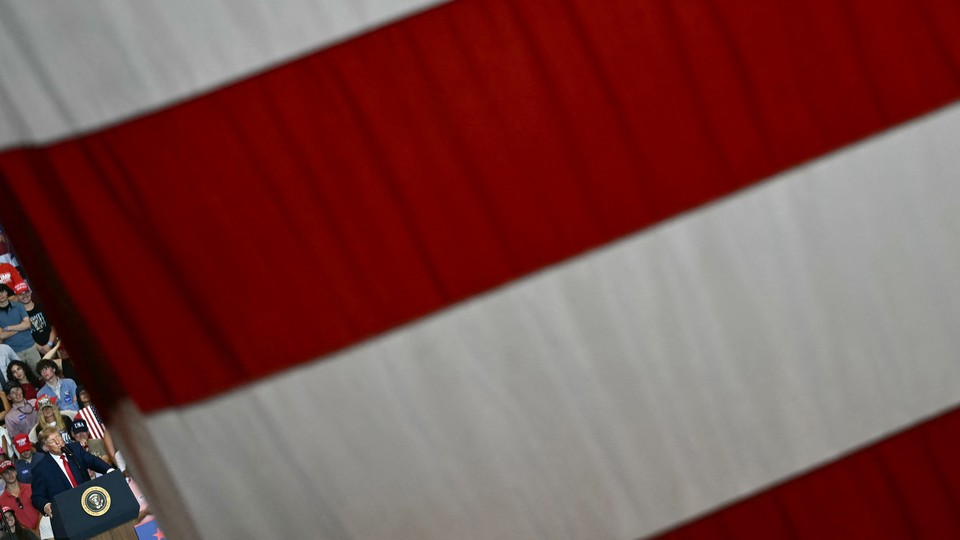
This is one reason the Trump administration is such a mess: To Trump, everyone’s job is to create content their audience will like, not to consider the wisest or best policy. This is why you have Secretary of Defense Pete Hegseth and Health and Human Services Secretary Robert F. Kennedy Jr. posting workout videos while mismanaging a war and encouraging measles outbreaks. This administration is less about achieving tangible policy goals than about creating the perception that those goals have been achieved and the libs owned through content designed for the more morally depraved audiences on X, or for the validation-obsessed president himself.
Still, Musk’s capture of the social network has normalized far-right ideas, especially among status-chasing elites. For Musk, that benefit might outweigh the cost. For Republicans seeking elected office, it might not be such a boon. It definitely wasn’t last week.
ABOUT THE AUTHOR: