https://www.axios.com/2026/11/05/black-voters-democrats-2026-midterms-trump
Politics & Policy

Why it matters: Democrats feared the Supreme Court's decision weakening the Voting Rights Act would threaten their political future in the South. Instead, Black voters helped deliver historic Democratic victories in Texas and Georgia, with a potential upset brewing in Mississippi.
By the numbers: Roughly nine in 10 Black voters backed Democratic House candidates Tuesday, according to the AP Voter Poll.
Only about one in 10 Black men backed Republicans.
For context, a separate 2024 national House exit poll found Black voters favored Democrats 84%–14%. Black men split 75%–24%, while Black women backed Democrats 90%–8%.
State of play: Two Democrats who faced questions about their support among Black voters won crucial Senate races.
Michigan: Progressive Democrat Abdul El-Sayed defeated Republican Mike Rogers, becoming the nation's first Muslim senator. A late-October poll showed El-Sayed drawing 87% support among likely Black voters.
Texas: Democrat James Talarico defeated Republican Ken Paxton after courting Black voters who overwhelmingly backed Rep. Jasmine Crockett in the Democratic primary. An August Texas Southern University poll showed Talarico leading Paxton 79%–12% among likely Black voters.
Zoom in: Talarico built commanding margins in Harris County, home to Houston, and Dallas County, both home to large Black electorates, according to AP county-level returns.
Zoom out: Black voters helped elect former Atlanta Mayor Keisha Lance Bottoms as the first Black woman governor in U.S. history.
About nine in 10 Black men voted for Bottoms, compared with roughly three-quarters who supported Kamala Harris in Georgia in 2024, according to the AP Voter Poll. Black women's support remained around 90%.
In majority-Black Clayton County, Bottoms received nearly 86,000 votes — about 13,600 more than Democrat Stacey Abrams received in the 2022 governor's race, AP reported.
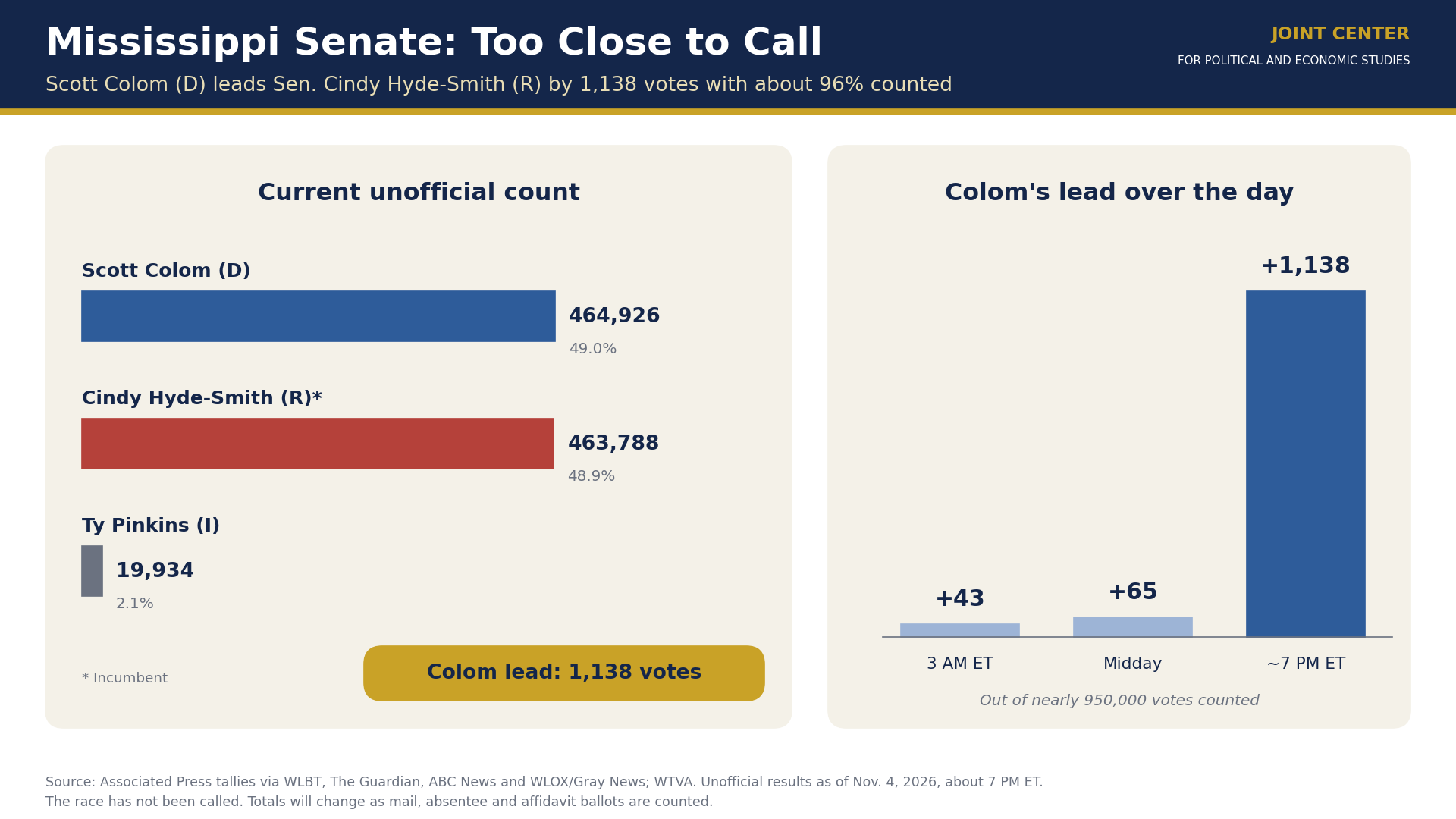
In Mississippi's U.S. Senate election, Democrat Scott Colom built commanding leads over Republican incumbent Sen. Cindy Hyde-Smith in heavily Black Hinds County, home to Jackson, and majority-Black Claiborne and Jefferson counties, according to unofficial overnight returns.
Colom held a narrow statewide lead Thursday morning, with thousands of ballots outstanding and the race still uncalled.
The intrigue: Florida Republican Byron Donalds became the state's first Black governor, but most Black voters backed Democrat David Jolly.
About one-quarter of Black men voted for Donalds, compared with just one in 10 Black women, according to the AP Voter Poll.
Between the lines: Election returns don't prove a nationwide surge in Black turnout or establish that anger over civil rights rollbacks motivated voters. But early voting offered signs of heightened Black participation in Georgia.
Black voters accounted for 32.4% of Georgia's early ballots, up from 30.2% in 2022, according to an Atlanta Journal-Constitution analysis. The figures don't establish whether the overall Black turnout rate increased.
Voting rights concerns may also have motivated some Black voters.
A Democratic-aligned August Data for Progress survey in Mississippi found 43% of Black voters more enthusiastic than usual about the midterms, compared with 31% of white voters.
Another 53% of Black voters said politicians making voting harder, gerrymandering and spreading false election claims made participation feel more important.
Worth noting: Yolanda Renee King, the 18-year-old granddaughter of Martin Luther King Jr., cast her first ballot Tuesday in Atlanta.
The bottom line: Democrats needed Black voters to win.
Tuesday's results suggest they held together a coalition that looked vulnerable after 2024 — potentially giving Black voters more leverage heading into 2028.

Listen
The 2026 Midterm Elections produced several historic wins, including gains in Black representation in gubernatorial offices and the Senate. At the same time, Black representation may decrease in the House. Our overview is below.
This will be updated as races are called. The most recent update happened at 12:05 pm ET on Nov. 6, 2026.
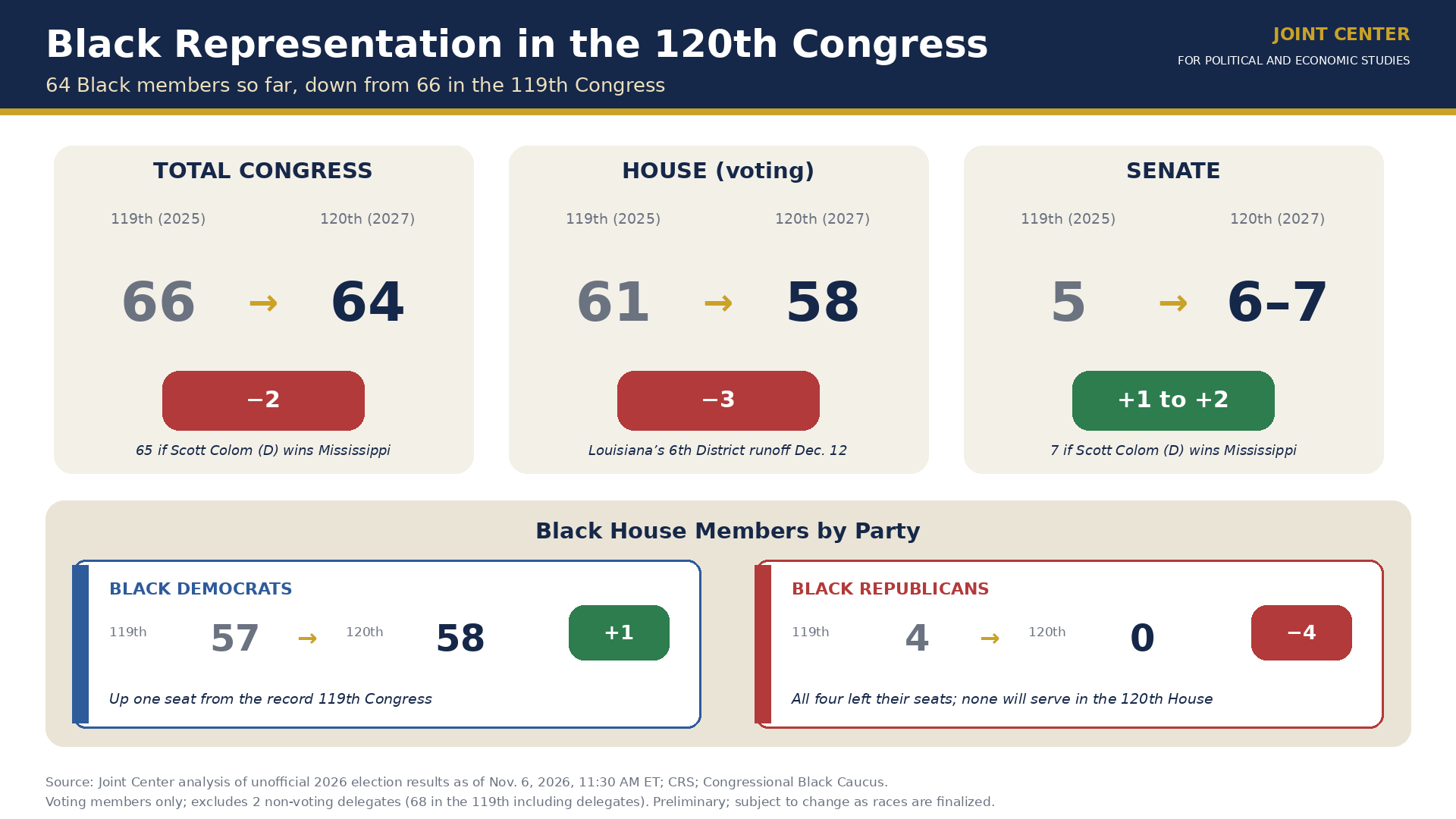
120th Congress: 60 Black members of Congress so far, down from 65. That’s 58 voting House members and 6 to 7 senators. Both totals leave out the two non-voting delegates.
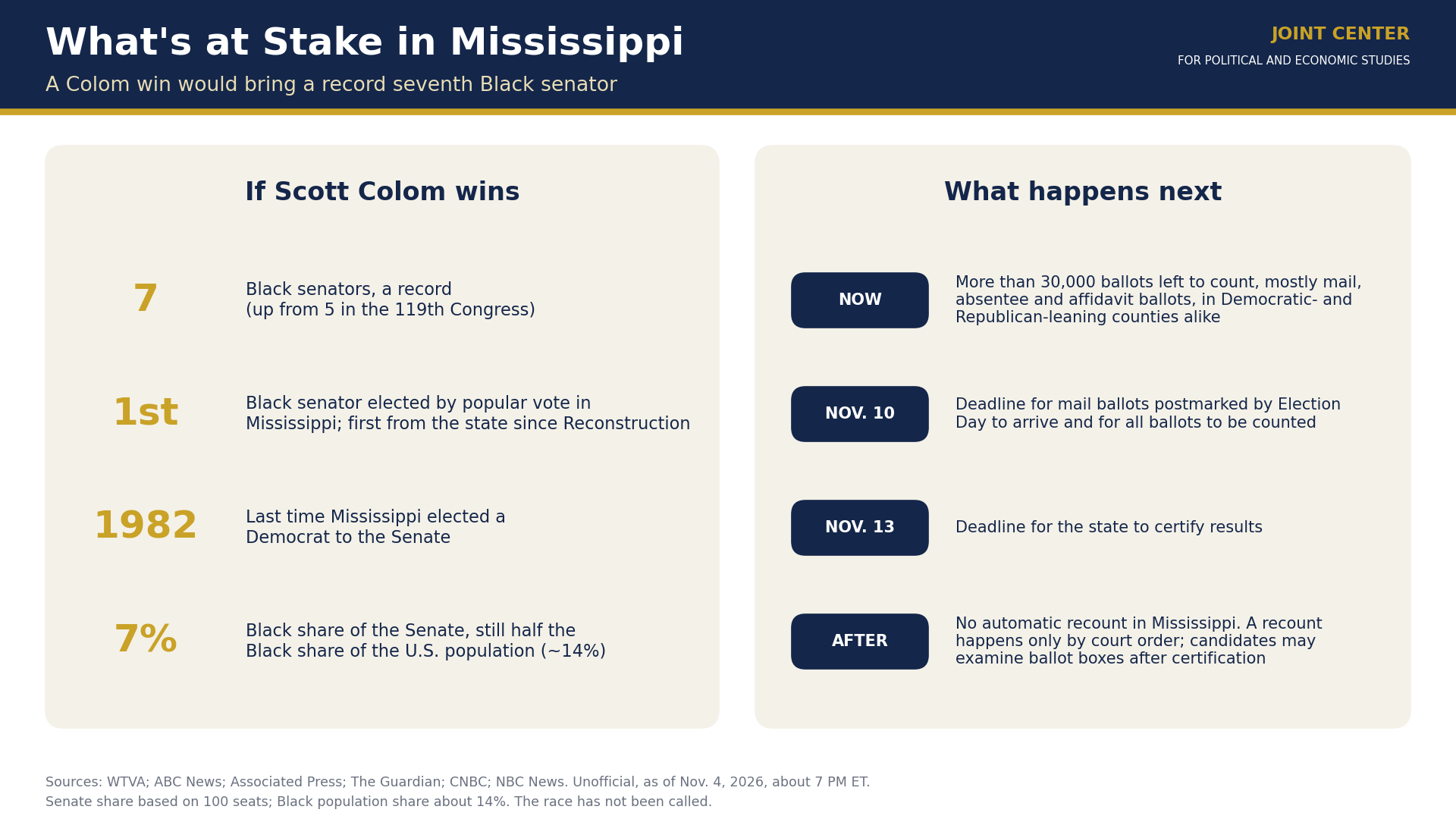
Senate: 6 to 7, which is a record number of Black representation in the Senate, however, this would only make the Senate 6% to 7% African American, while African Americans are about 14% of the population.
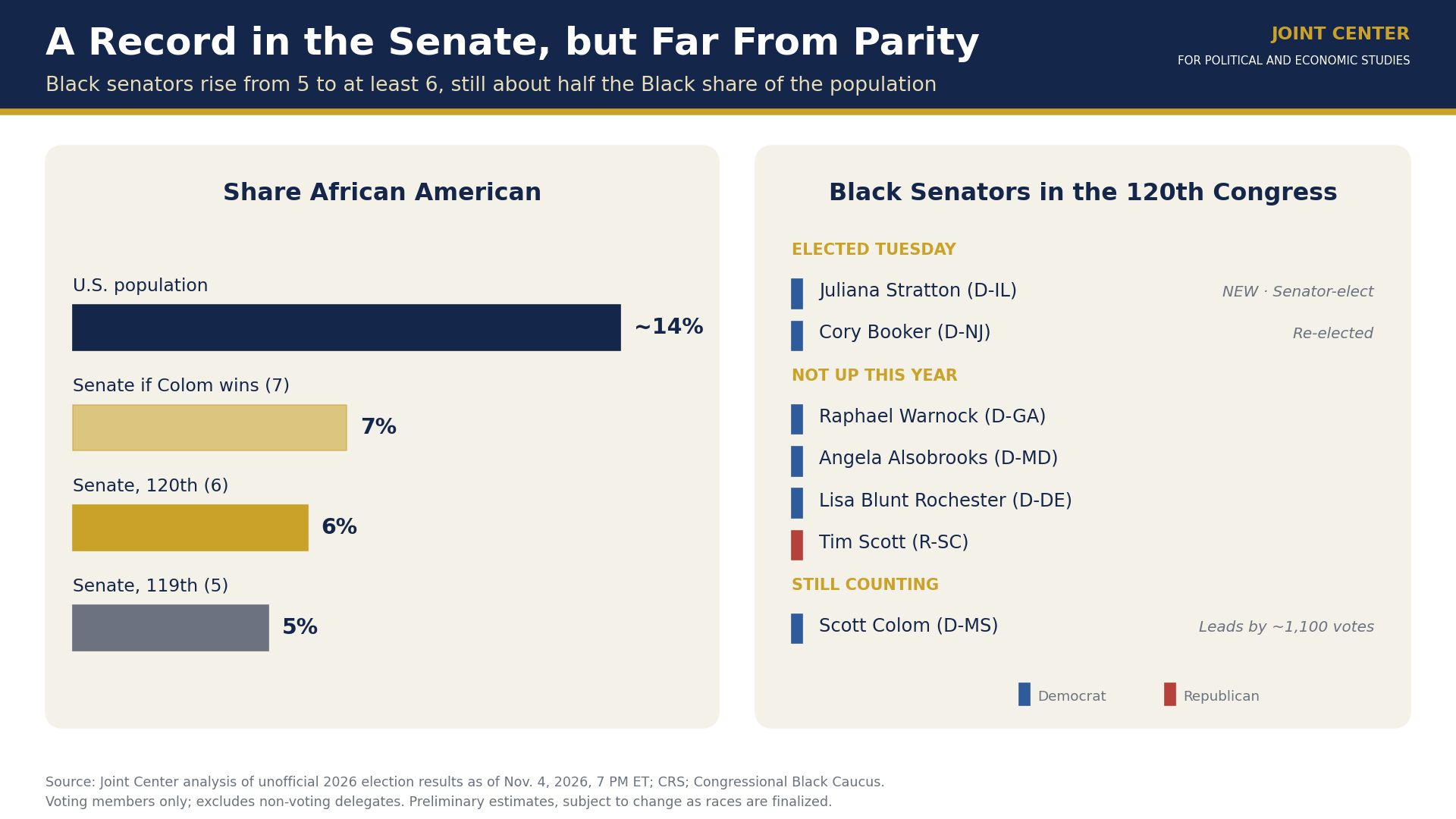
- Elected Tuesday: Senator-elect Juliana Stratton (D-IL), the only new member, and Senator Cory Booker (D-NJ), re-elected.
- Not up this year: Senators Raphael Warnock (D-GA), Angela Alsobrooks (D-MD), Lisa Blunt Rochester (D-DE), and Tim Scott (R-SC).
- Black senators go from 5 to 6, but the results of the Mississippi Senate race are still underway, so the total of Black Senators could rise to 7 if Scott Colom (D) wins.
House: 58 voting members, down from 61.
Starting point (119th Congress): 58 Black lawmakers in total, including 2 delegates. That’s 5 senators and 61 voting House members.
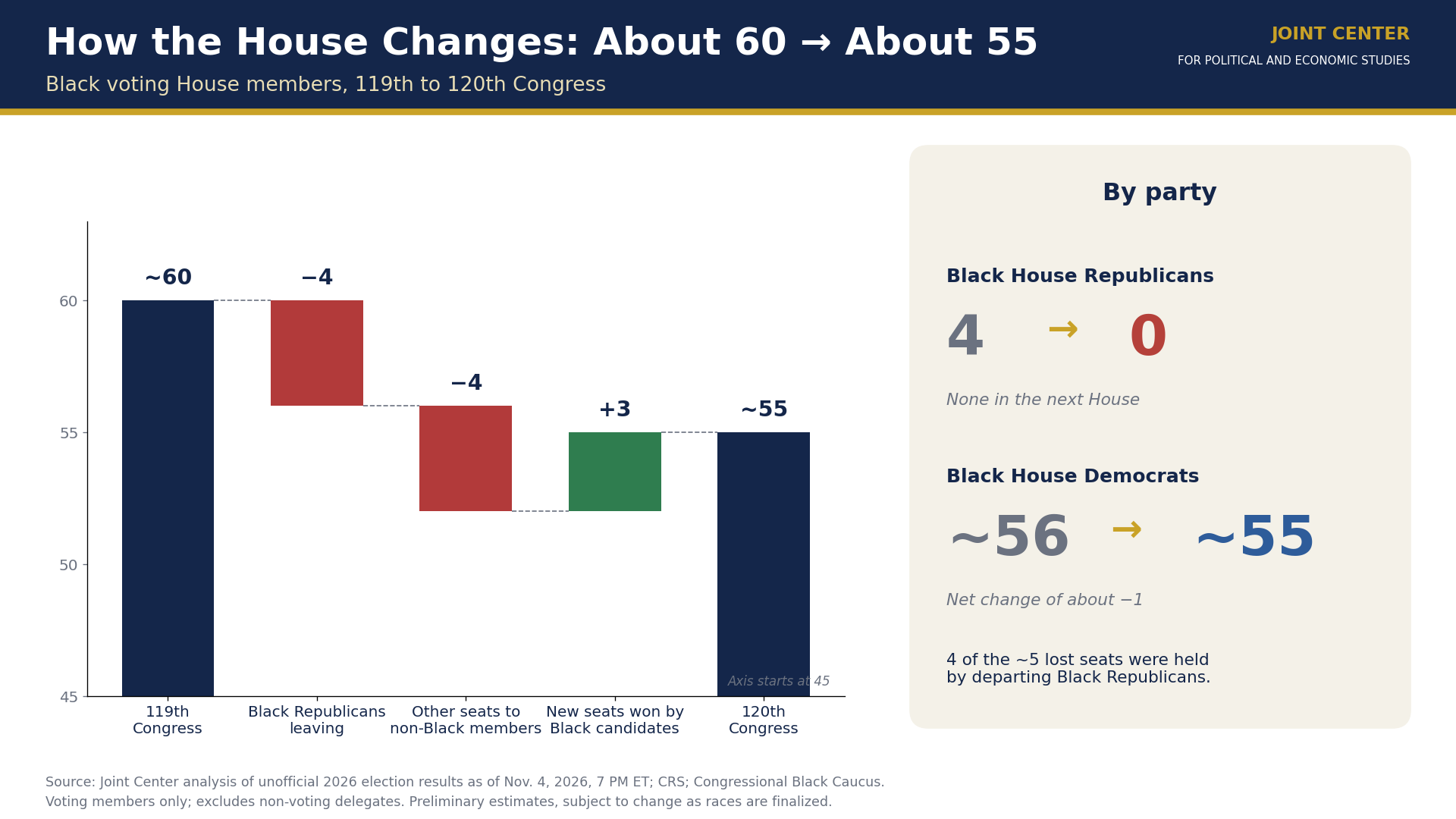
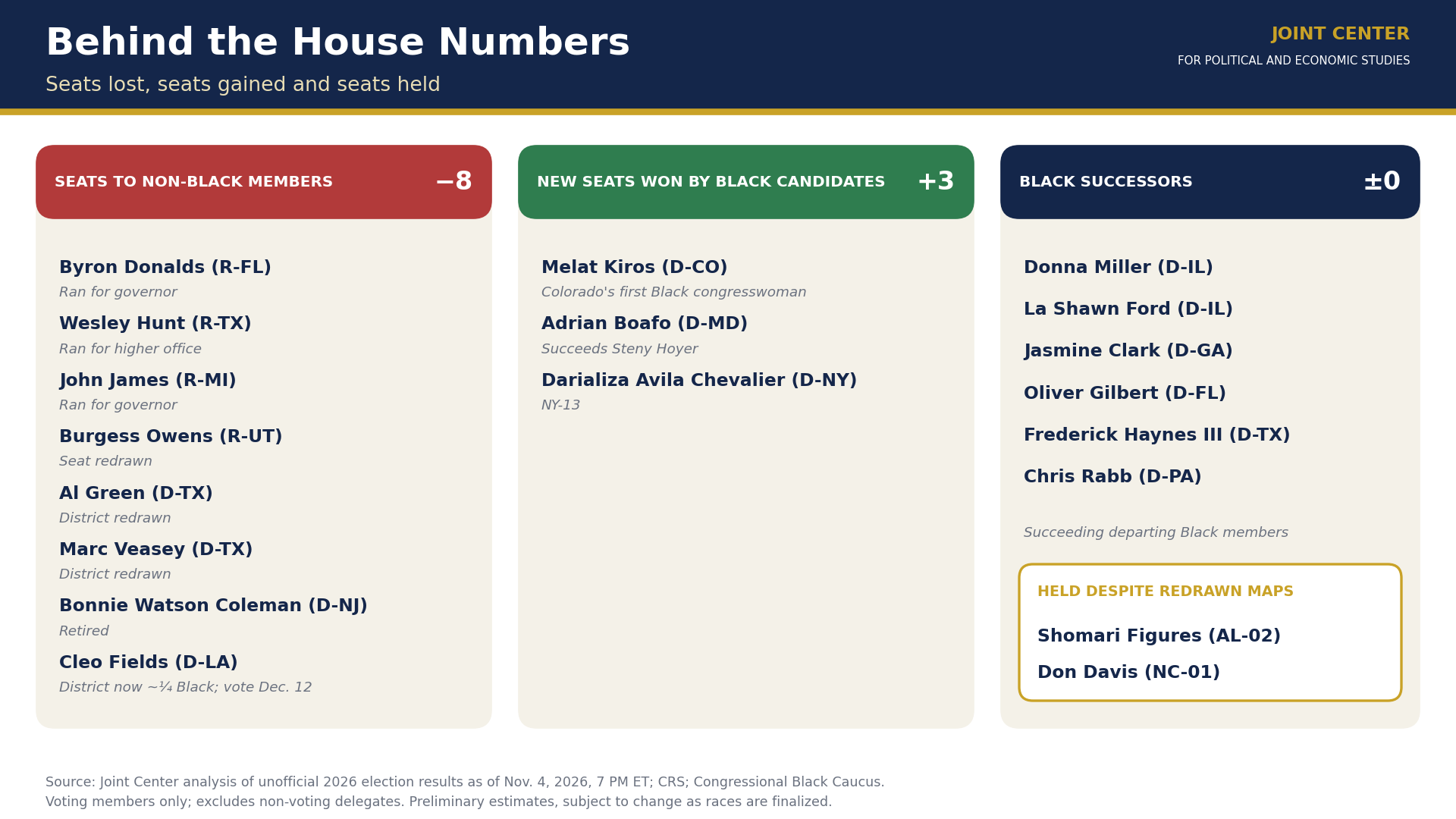
Seats moving to non-Black members (−8):
- All 4 Black House Republicans: Congressmen Byron Donalds (R-FL), Wesley Hunt (R-TX), and John James (R-MI) ran for higher office, and Congressman Burgess Owens (R-UT) seat was redrawn.
- Al Green (D-TX), whose districts were redrawn. Leticia Gutierrez won the seat.
- Bonnie Watson Coleman (D-NJ), who retired. Adam Hamawy (D-NJ) won the seat.
- Cleo Fields (D-LA). That seat won’t be decided until Dec. 12, but the district is now only about one-quarter Black.
New seats won by Black candidates (+5):
- Melat Kiros (D-CO), the first Black woman Colorado has sent to Congress.
- Adrian Boafo (D-MD), who replaces Steny Hoyer (D).
- Lakesha Womack (D-NC)
- Cyril Jefferson (D-NC)
- Donavan McKinney (D-MI)
Black successors to departing Black members (no net change):
- Donna Miller (D-IL)
- La Shawn Ford (D-IL)
- Jasmine Clark (D-GA)
- Oliver Gilbert (D-FL)
- Frederick Haynes III (D-TX)
- Chris Rabb (D-PA)
- Colin Allred (D-TX)
- Darializa Avila Chevalier (D-NY)
Held despite redrawn maps: Shomari Figures (AL-02) and Don Davis (NC-01).
Net: About 61 − 8 + 5 = 58 voting House members, a loss of about 3. All four Black Republicans left, while Black Democrats gained one seat from the record high representation of the 119th Congress in 2025.
Governor Races:
Five Black governors were elected Tuesday. That’s more than double the number ever elected in U.S. history, from three to seven. Before this election, no two elected Black governors had served at the same time. In January, five will.
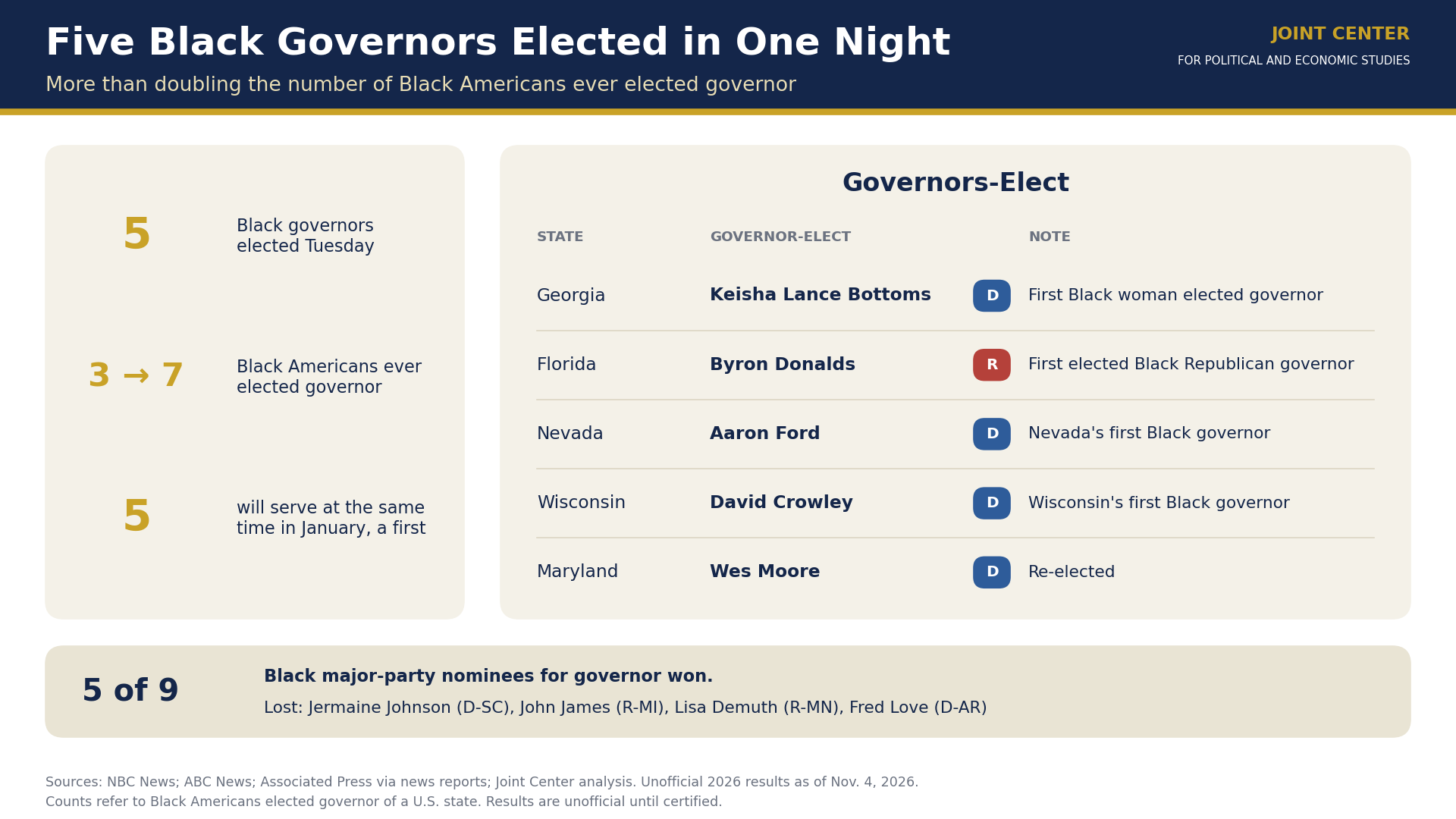
Lost: Jermaine Johnson (D-SC), John James (R-MI), Lisa Demuth (R-MN), and Fred Love (D-AR). This makes 5 of 9 Black major-party nominees who won.
In history
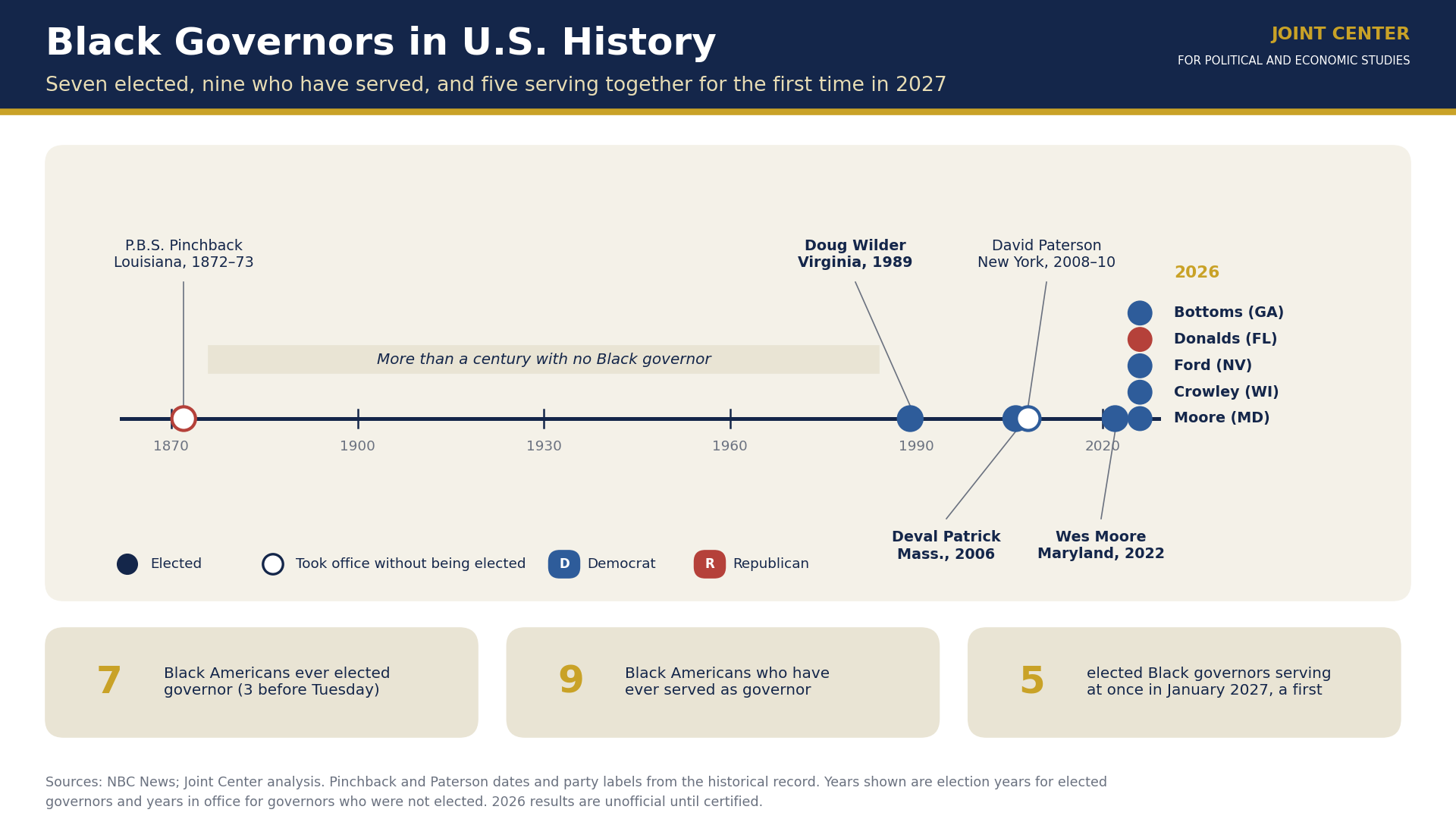
- Ever elected: 7. Before Tuesday, there were three: Governors Doug Wilder (D-VA, 1989), Deval Patrick (D-MA, 2006), and Wes Moore (D-MD, 2022). Bottoms, Donalds, Ford, and Crowley bring it to seven.
- Ever served: 9. Two Black governors took office without being elected: P.B.S. Pinchback (LA, 1872-73) and David Paterson (D-NY, 2008-10).

Trump’s elevation of Stephen Miller a middle finger to millions of voters
David Smith in Washington
Architect of Trump’s far-right immigration agenda is now most powerful unelected figure in government – it suggests White House is moving to a war footing
Saturday 7 November 2026
The Guardian

PHOTO: Stephen Miller outside the White House in October. Photograph: Annabelle Gordon/Reuters
Donald Trump just gave the middle finger to millions of American voters.
Any other president who suffered the kind of drubbing at the polls that Trump did this week might have felt at least a sliver of humility – and perhaps even an obligation to work with the new opposition in Congress.
But not for the first time in his political career, Trump veered in the opposite direction. On Friday he made Stephen Miller, condemned by Democrats and civil rights groups as a white nationalist, one of the most powerful unelected officials in Washington by naming him White House chief of staff.
What happens after the ‘blue wave’? Your questions on the US midterm election results answered
Read more
Miller is the architect of Trump’s far-right, nativist immigration agenda. He is, therefore, arguably the architect of the blue wave that engulfed Republicans in Tuesday’s midterm elections as voters – including many Latinos – expressed their disgust. Yet instead of firing Miller, Trump promoted him.
It was a declaration of war. Miller, 41, is a longtime proponent of the presidential authority that Trump has spent the past two years expanding at the expense of Congress. In 2017 he declared: “The powers of the president to protect our country are very substantial and will not be questioned.”
Now Republicans’ catastrophic defeat is likely to leave Trump more reliant on unilateral executive action than ever to advance his domestic agenda.
“In a lot of ways Stephen Miller has been the id to Trump’s authoritarian impulses and machinations,” Kurt Bardella, an adviser to Democrats in Texas, said. “I have to imagine that anointing this person chief of staff – the most powerful non-elected position in all of government – is a signal that they intend to double down on that authoritarianism.
“You’re going to see a lot of executive orders, unilateral action and stress testing of the checks and balances system continue for the final two years of his presidency.”
Trump’s second term has presented a concerted effort to dismantle those checks and balances that have traditionally constrained the occupant of the White House. He has signed 292 executive orders in less than two years, more than in his entire first term and a record pace for a modern presidency.
He has bypassed Congress on military action and tariffs, withheld congressionally approved spending, deployed the National Guard against the will of state authorities, politicised the justice department, punished critics and challenged judicial independence. Congress, dominated by Republicans reluctant to confront him, offered little resistance.
But this week’s landslide, the biggest in a midterm election since Watergate, puts Democrats back in charge of the House of Representatives and Senate. That the elections were free and fair, and that Trump did not dispute the result, was itself a victory for democracy.
Democrats will now seek to rein in the president and block his legislative agenda, bringing them into direct conflict with Miller, who was already a hugely powerful deputy chief of staff at the White House and now takes over from Susie Wiles.
Miller has been a champion of the Iran war and prominent voice on many of the president’s other priorities, including countering diversity initiatives and targeting transgender rights. He is reportedly one of a small group of White House staffers who approve all executive orders.
He is best known for driving the immigration crackdown in Trump’s second term, setting a target of 3,000 arrests per day – far above levels under previous administrations. He has pushed Immigration and Customs Enforcement (ICE) to target anybody in the country illegally, not just those with criminal records.
There are limits on what Democrats can do to stop the immigration drive since the One Big Beautiful Bill Act included major increases for Immigration and Customs Enforcement (ICE) that will keep it funded for the rest of Trump’s term.
Even so, they will now chair House committees with the ability to launch investigations, issue subpoenas and hold high profile hearings. Along with ICE, they might scrutinise Jeffrey Epstein files and the department of government efficiency (Doge). They have also vowed to look at how Trump and his family have become wealthier since he returned to office.
The appointment of the pugnacious Miller as Trump’s consigliere suggests that the White House is moving to a war footing. He is likely to marshal a team of lawyers and attack Democrats by accusing them of weaponising the deep state against the president. As a frequent guest on the conservative Fox News network, he will also wage war in the court of public opinion.
“Trump’s decision to elevate Stephen Miller means that he’s spoiling for a fight with Democrats and they’re going to just rely on executive action to try and push their agenda through,” said David Cohen, a political science professor at the University of Akron in Ohio, who studies the American presidency and White House staffing.
Cohen added: “It’s a White House that doesn’t seek out cooperation with Congress. It’s their way or the highway, essentially, and it’s possible Stephen Miller is relishing this because he’s a believer in the unitary presidency and executive presidential action and he views this as a way where he can expand the powers of the presidency.”
Trump is not the first president to seek to consolidate authority. Arthur Schlesinger Jr’s 1973 book The Imperial Presidency warned that an accumulation of presidential power threatened the constitutional separation of powers.
In 1989 the American Enterprise Institute thinktank published The Fettered Presidency, a counterpoint arguing that legal and congressional constraints had unduly weakened the executive. It helped inspire a modern conservative drive to expand presidential authority, which accelerated under George W Bush and was subsequently exploited by Barack Obama as congressional gridlock made legislating increasingly difficult.
The combination of Trump and Miller, however, takes the concept of an American Caesar to a new extreme – and flies in the face of the verdict delivered by the electorate on Tuesday.
“It’s a step that I find hard to fathom except as the president giving the middle finger to the American public,” said Bill Galston, a senior fellow in governance studies at the Brookings Institution thinktank in Washington.
“In the same way that he ransacked the state of Texas for the very worst senatorial nominee imaginable, now he’s done the same thing with the chief of staff position. This is simply outrageous.”
Explore more on these topics
Donald Trump
Democrats
US politics
US midterm elections 2026
Trump administration
Republicans
analysis