“...At every level of domestic and foreign policy, the ghosts of fascism are evident, offering a glimpse of what horrors await us as the twenty-first century unfolds. At the level of foreign policy, blood gushes from the bombs, artillery, and tanks of rogue states in Gaza and Ukraine. Biden tells us that bringing diplomatic solutions to the dreadful warfare in Ukraine and the Middle East are less important than the profits and jobs created by death machines that constitute the defense industries feeding both wars. War culture and the language of hate fill the airwaves legitimating violence as a form of political opportunism. The cruel language and practices of human degradation and destructiveness now feed a growing fascist politics in the U.S. Fascist demagogues now boast about their racial fantasies, unchecked adoration of violence, and their aggressive lawlessness. What Ingmar Bergman once called “The Serpent’s Egg,” a metaphor for the birth of fascism is about to hatch.
In a world shaped increasingly by emerging authoritarianism, it has become increasingly difficult to remember what a purposeful and substantive democracy looks like, or for that matter, what the idea of democracy might suggest. Democracy as an ideal, promise, and working practice is under assault, just as a number of far-right educational, market, military, and religious fundamentalisms are gaining ascendancy in American society. Increasingly, it becomes more challenging to inhabit those public spheres where politics thrives—where thinking, speaking, and acting subjects engage and critically address the major forces and problems bearing down on their lives. In this new moment in history, which too often resembles the nightmares of a fascist past with its banning of books, erasing of history, attack on trans people, and support of white nationalism and supremacy, the question of how society should imagine itself or what its future might hold has become more demanding given the eradication of social formations that place an emphasis on truth, social justice, freedom, equality, and compassion.
Historical and social amnesia have become the organizing principles of U.S. society. Lies morph into the celebration of violence and language become part of the machinery of social death, relegated to the sphere of consumer culture, and devoid of an ethical grammar that is banished to zones of political and social abandonment.
Subjectivity, identity formation, and the longing for community have become powerful elements of a politics of aggression. An ocular—image-based culture celebrates human misery, turns monsters into political celebrities who preach a language that accelerates the death of the unwanted, powerless, and what Judith Butler calls the ungrievable. The mainstream media normalizes alleged leaders in the fields of politics, entertainment, and education who thrive on the energies of the dead, weak, and disposable. Yet, what is often missed is the spread of fascist ideology, fear, rhetoric, symbols, and demonstrations that circulate in lesser political circles and at the level of everyday life in the United States. All of which speaks to how deeply embedded authoritarianism, violence, and the mobilizing passions of fascism are in American society and culture. Three recent examples speak to the dark current of fascist politics in the United States…As Bergman noted in a previous era, the abyss of fascism “looms menacingly.” Bergman’s words resonate with a fascist politics that now draws on the culture of everyday life and in doing so spreads its ideologies, values, social relations, and culture of cruelty in institutions, practices, policies, and experiences of domination that take on the hue of being commonplace, wrapped in the discourse of freedom, victimhood, gated mentalities and gated borders.
For the playwright and poet, Bertolt Brecht, “the serpent’s egg” suggests that beneath seemingly democratic societies lie dark, dangerous and volatile forces waiting to be unleashed by the dynamics of capitalism. For Brecht, no one can tell the truth about fascism without speaking out against the horrors of capitalism. The horrors of fascism lurk in the shadows of everyday life, and as Brecht observes “If anyone wishes to describe Fascism and war, great disasters which are not natural catastrophes, he must do so in terms of a practical truth. He must… write the truth about evil conditions, one must write it so that its avertible causes can be identified. If the preventable causes can be identified, the evil conditions can be fought.”[8]
Writing about the truth must begin by recognizing how the snake of fascism lays its eggs—the serpent’s eggs, which are often hatched in the limelight of the spectacularized image of ocular politics where their impending danger is overlooked. The challenge is to acknowledge how the seeds of fascism emerge in the shadows of everyday speech, practices, and social relations. The microaggressions of fascism are too often treated as if they reside solely in the theatricality of the overly dramatic, the exaggerated spectacle, or in the realm of self-serving attention-gripping mass hysteria. What is overlooked is the power of everyday practices in their overly stylized and calculating shock value, which slowly become normalized and accelerated, legitimized and expanded making the efficacy of the unspeakable a core element of everyday life. What is often dismissed as a minor public spectacle morphs into the horror of absolute evil in a world led by barbarians. In the current historical period, the eggs of the serpent are about to hatch keeping alive both its threat to end democracy, renew the legacy of colonialism, and once again let loose the politics of disposability, elimination, and death. Susan Sontag was right in her insistence on the need “to detect fascist longings in our midst.” Fascism now mobilizes people’s feelings in order to win them over either to the arena of hate and bigotry or to depoliticize them. Once we lose sight of how the dynamics of power hide in the language of the everyday. Fascism will arrive not with a thunderous bang but with the waving of the flag and the stench of death. The serpent’s egg will have hatched, and the lights will go out.”
—Henry A. Giroux, “Everyday Fascism: Brecht’s Warning About the Serpent’s Egg”, Counterpunch, March 13, 2024
In a world shaped increasingly by emerging authoritarianism, it has become increasingly difficult to remember what a purposeful and substantive democracy looks like, or for that matter, what the idea of democracy might suggest. Democracy as an ideal, promise, and working practice is under assault, just as a number of far-right educational, market, military, and religious fundamentalisms are gaining ascendancy in American society. Increasingly, it becomes more challenging to inhabit those public spheres where politics thrives—where thinking, speaking, and acting subjects engage and critically address the major forces and problems bearing down on their lives. In this new moment in history, which too often resembles the nightmares of a fascist past with its banning of books, erasing of history, attack on trans people, and support of white nationalism and supremacy, the question of how society should imagine itself or what its future might hold has become more demanding given the eradication of social formations that place an emphasis on truth, social justice, freedom, equality, and compassion.
Historical and social amnesia have become the organizing principles of U.S. society. Lies morph into the celebration of violence and language become part of the machinery of social death, relegated to the sphere of consumer culture, and devoid of an ethical grammar that is banished to zones of political and social abandonment.
Subjectivity, identity formation, and the longing for community have become powerful elements of a politics of aggression. An ocular—image-based culture celebrates human misery, turns monsters into political celebrities who preach a language that accelerates the death of the unwanted, powerless, and what Judith Butler calls the ungrievable. The mainstream media normalizes alleged leaders in the fields of politics, entertainment, and education who thrive on the energies of the dead, weak, and disposable. Yet, what is often missed is the spread of fascist ideology, fear, rhetoric, symbols, and demonstrations that circulate in lesser political circles and at the level of everyday life in the United States. All of which speaks to how deeply embedded authoritarianism, violence, and the mobilizing passions of fascism are in American society and culture. Three recent examples speak to the dark current of fascist politics in the United States…As Bergman noted in a previous era, the abyss of fascism “looms menacingly.” Bergman’s words resonate with a fascist politics that now draws on the culture of everyday life and in doing so spreads its ideologies, values, social relations, and culture of cruelty in institutions, practices, policies, and experiences of domination that take on the hue of being commonplace, wrapped in the discourse of freedom, victimhood, gated mentalities and gated borders.
For the playwright and poet, Bertolt Brecht, “the serpent’s egg” suggests that beneath seemingly democratic societies lie dark, dangerous and volatile forces waiting to be unleashed by the dynamics of capitalism. For Brecht, no one can tell the truth about fascism without speaking out against the horrors of capitalism. The horrors of fascism lurk in the shadows of everyday life, and as Brecht observes “If anyone wishes to describe Fascism and war, great disasters which are not natural catastrophes, he must do so in terms of a practical truth. He must… write the truth about evil conditions, one must write it so that its avertible causes can be identified. If the preventable causes can be identified, the evil conditions can be fought.”[8]
Writing about the truth must begin by recognizing how the snake of fascism lays its eggs—the serpent’s eggs, which are often hatched in the limelight of the spectacularized image of ocular politics where their impending danger is overlooked. The challenge is to acknowledge how the seeds of fascism emerge in the shadows of everyday speech, practices, and social relations. The microaggressions of fascism are too often treated as if they reside solely in the theatricality of the overly dramatic, the exaggerated spectacle, or in the realm of self-serving attention-gripping mass hysteria. What is overlooked is the power of everyday practices in their overly stylized and calculating shock value, which slowly become normalized and accelerated, legitimized and expanded making the efficacy of the unspeakable a core element of everyday life. What is often dismissed as a minor public spectacle morphs into the horror of absolute evil in a world led by barbarians. In the current historical period, the eggs of the serpent are about to hatch keeping alive both its threat to end democracy, renew the legacy of colonialism, and once again let loose the politics of disposability, elimination, and death. Susan Sontag was right in her insistence on the need “to detect fascist longings in our midst.” Fascism now mobilizes people’s feelings in order to win them over either to the arena of hate and bigotry or to depoliticize them. Once we lose sight of how the dynamics of power hide in the language of the everyday. Fascism will arrive not with a thunderous bang but with the waving of the flag and the stench of death. The serpent’s egg will have hatched, and the lights will go out.”
—Henry A. Giroux, “Everyday Fascism: Brecht’s Warning About the Serpent’s Egg”, Counterpunch, March 13, 2024
https://www.counterpunch.org/2024/03/13/everyday-fascism-brechts-warning-about-the-serpents-egg/
Everyday Fascism: Brecht’s Warning about The Serpent’s Egg
by Henry Giroux
March 13, 2024
Counterpunch

HENRY A. GIROUX (b. September 18, 1943)

BERTOLT BRECHT (1898-1956)
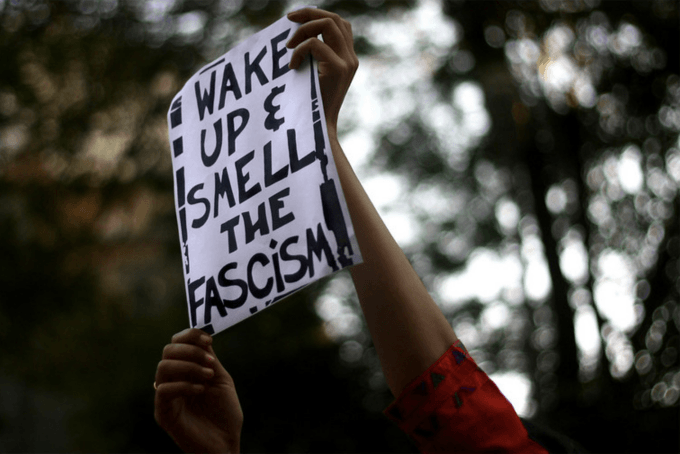
Photograph Source: Abhisek Sarda – CC BY 2.0
And therefore think him as a serpent’s egg
Which hatch’d, would as his kind grow mischievous;
And kill him in the shell”
– Brutus in Shakespeare’s 'Julius Caesar'
The brilliant scholar, Paul Gilroy, once stated that we live at a time when the “horrors of the past are much closer to us than we like to imagine.” [1] Gilroy’s words are more resonant today than they were when first written. At every level of domestic and foreign policy, the ghosts of fascism are evident, offering a glimpse of what horrors await us as the twenty-first century unfolds. At the level of foreign policy, blood gushes from the bombs, artillery, and tanks of rogue states in Gaza and Ukraine. Biden tells us that bringing diplomatic solutions to the dreadful warfare in Ukraine and the Middle East are less important than the profits and jobs created by death machines that constitute the defense industries feeding both wars. War culture and the language of hate fill the airwaves legitimating violence as a form of political opportunism. The cruel language and practices of human degradation and destructiveness now feed a growing fascist politics in the U.S. Fascist demagogues now boast about their racial fantasies, unchecked adoration of violence, and their aggressive lawlessness. What Ingmar Bergman once called “The Serpent’s Egg,” a metaphor for the birth of fascism is about to hatch.
In a world shaped increasingly by emerging authoritarianism, it has become increasingly difficult to remember what a purposeful and substantive democracy looks like, or for that matter, what the idea of democracy might suggest. Democracy as an ideal, promise, and working practice is under assault, just as a number of far-right educational, market, military, and religious fundamentalisms are gaining ascendancy in American society. Increasingly, it becomes more challenging to inhabit those public spheres where politics thrives—where thinking, speaking, and acting subjects engage and critically address the major forces and problems bearing down on their lives. In this new moment in history, which too often resembles the nightmares of a fascist past with its banning of books, erasing of history, attack on trans people, and support of white nationalism and supremacy, the question of how society should imagine itself or what its future might hold has become more demanding given the eradication of social formations that place an emphasis on truth, social justice, freedom, equality, and compassion.
Historical and social amnesia have become the organizing principles of U.S. society. Lies morph into the celebration of violence and language become part of the machinery of social death, relegated to the sphere of consumer culture, and devoid of an ethical grammar that is banished to zones of political and social abandonment.
Subjectivity, identity formation, and the longing for community have become powerful elements of a politics of aggression. An ocular—image-based culture celebrates human misery, turns monsters into political celebrities who preach a language that accelerates the death of the unwanted, powerless, and what Judith Butler calls the ungrievable. The mainstream media normalizes alleged leaders in the fields of politics, entertainment, and education who thrive on the energies of the dead, weak, and disposable. Yet, what is often missed is the spread of fascist ideology, fear, rhetoric, symbols, and demonstrations that circulate in lesser political circles and at the level of everyday life in the United States. All of which speaks to how deeply embedded authoritarianism, violence, and the mobilizing passions of fascism are in American society and culture. Three recent examples speak to the dark current of fascist politics in the United States.
First, I want to highlight the words of right-wing activist Jack Posobiec who in “his welcome speech at this year’s conference of the Conservative Political Action Conference (CPAC,) stated: “Welcome to the end of democracy. We are here to overthrow it completely. We didn’t get all the way there on January 6, but we will endeavor to get rid of it and replace it with this right here.” He then held up a cross necklace and continued: “After we burn that swamp to the ground, we will establish the new American republic on its ashes, and our first order of business will be righteous retribution for those who betrayed America.”[2] This is fascism on steroids and yet it got little media coverage and when it did it was dismissed as a kind of rogue extremism. In actuality, it simply echoes a central ideology of MAGA Republicans.
Another example of how the embers of fascist politics have turned into a firestorm of authoritarian rhetoric and is downplayed or ignored in the mainstream media is visible in the ongoing rhetoric of the ignorant buffoon Mark Robinson who is running for the governorship of North Carolina. In the mainstream media, despite his extremist rhetoric, he is treated as a normal candidate even though he has referred to transgender and homosexual people as maggots and filth, stating that they “are equivalent to what the cows leave behind”[3] After a mass shooter in 2016 murdered 49 people at a gay nightclub in Orlando, Florida, Robinson posted on Facebook “I would pray for the souls of all those killed…However, homosexuality is STILL an abominable sin and I WILL NOT join in celebrating gay pride.” He has stated that he wished for the days when women could not vote and called mass shootings “karma” for abortion. He has said that Christians must take control of public schools because children are being abused by teachers who are telling children “about transgenderism, homosexuality, and any of that filth.”[4] Robinson’s remarks make clear that willful ignorance is a precondition for fascist politics, and that a culture of cruelty and hate has become a normalized tool of political opportunism.
The third example draws upon the current authoritarian assault on higher education which is far worse than anything that could have been imagined with the election of Ronald Reagan in 1980. In light of this assault, how could the media largely ignore New College in Florida hiring Bruce Gilley, who has authored a book called The Case for Colonialism. Beyond the racist affirmation in book form supporting the genocidal legacy of colonialism, he has also stated publicly that “the transgender flag [is] a symbol of narcissistic sexual reductionism and the mutilation of children,” and that “virtually every indigenous leader in Canada is an identity fraud.” [5] Without any critical understanding of history, he has endorsed a video by the Blackwater mercenary company founder Erik Prince calling for putting “the imperial hat back on” to govern “pretty much all of Africa.”[6] There is more at work here than the hiring of a far-right colonialist parading as a professor, there is a clarion call alerting to how higher education is being transformed into indoctrination centers and rabid disimagination machines. James Baldwin was certainly right in issuing the stern warning in No Name in the Street that “Ignorance, allied with power, is the most ferocious enemy justice can have.”[7]
These events closely resemble Bergman’s notion of “The Serpent’s Egg,” an instructive metaphor for illuminating the conditions that gave rise to fascism. As Bergman noted in a previous era, the abyss of fascism “looms menacingly.” Bergman’s words resonate with a fascist politics that now draws on the culture of everyday life and in doing so spreads its ideologies, values, social relations, and culture of cruelty in institutions, practices, policies, and experiences of domination that take on the hue of being commonplace, wrapped in the discourse of freedom, victimhood, gated mentalities and gated borders.
For the playwright and poet, Bertolt Brecht, “the serpent’s egg” suggests that beneath seemingly democratic societies lie dark, dangerous and volatile forces waiting to be unleashed by the dynamics of capitalism. For Brecht, no one can tell the truth about fascism without speaking out against the horrors of capitalism. The horrors of fascism lurk in the shadows of everyday life, and as Brecht observes “If anyone wishes to describe Fascism and war, great disasters which are not natural catastrophes, he must do so in terms of a practical truth. He must… write the truth about evil conditions, one must write it so that its avertible causes can be identified. If the preventable causes can be identified, the evil conditions can be fought.”[8]
Writing about the truth must begin by recognizing how the snake of fascism lays its eggs—the serpent’s eggs, which are often hatched in the limelight of the spectacularized image of ocular politics where their impending danger is overlooked. The challenge is to acknowledge how the seeds of fascism emerge in the shadows of everyday speech, practices, and social relations. The microaggressions of fascism are too often treated as if they reside solely in the theatricality of the overly dramatic, the exaggerated spectacle, or in the realm of self-serving attention-gripping mass hysteria. What is overlooked is the power of everyday practices in their overly stylized and calculating shock value, which slowly become normalized and accelerated, legitimized and expanded making the efficacy of the unspeakable a core element of everyday life. What is often dismissed as a minor public spectacle morphs into the horror of absolute evil in a world led by barbarians. In the current historical period, the eggs of the serpent are about to hatch keeping alive both its threat to end democracy, renew the legacy of colonialism, and once again let loose the politics of disposability, elimination, and death. Susan Sontag was right in her insistence on the need “to detect fascist longings in our midst.” Fascism now mobilizes people’s feelings in order to win them over either to the arena of hate and bigotry or to depoliticize them. Once we lose sight of how the dynamics of power hide in the language of the everyday. Fascism will arrive not with a thunderous bang but with the waving of the flag and the stench of death. The serpent’s egg will have hatched, and the lights will go out.
Notes:
[1] Paul Gilroy, “The 2019 Holberg Lecture, by Laureate Paul Gilroy: Never Again: refusing race and salvaging the human,” Holbergprisen, [November 11, 2019]. Online: https://holbergprisen.no/en/news/holberg-prize/2019-holberg-lecture-laureate-paul-gilroy
[2] Ben Goggin, “Calls to ‘fight’ and echoes of Jan. 6 embraced by CPAC attendees,” NBC News (February 23, 2024). Online: https://www.nbcnews.com/politics/2024-election/jack-posobiec-jan-6-2024-cpac-rcna140225
[3] Kira Lerner, “Hitler-quoting candidate wins North Carolina Republican gubernatorial primary,” The Guardian(March 6, 2024). Online: https://www.theguardian.com/us-news/2024/mar/05/mark-robinson-north-carolina
[4] See: Pic.twitter.com/aXjCPFKTs0
[5] Ryan Quinn, “New College of Florida Hires Professor Who Champions Colonialism,” Inside Higher Education(March 8, 2024).
In a world shaped increasingly by emerging authoritarianism, it has become increasingly difficult to remember what a purposeful and substantive democracy looks like, or for that matter, what the idea of democracy might suggest. Democracy as an ideal, promise, and working practice is under assault, just as a number of far-right educational, market, military, and religious fundamentalisms are gaining ascendancy in American society. Increasingly, it becomes more challenging to inhabit those public spheres where politics thrives—where thinking, speaking, and acting subjects engage and critically address the major forces and problems bearing down on their lives. In this new moment in history, which too often resembles the nightmares of a fascist past with its banning of books, erasing of history, attack on trans people, and support of white nationalism and supremacy, the question of how society should imagine itself or what its future might hold has become more demanding given the eradication of social formations that place an emphasis on truth, social justice, freedom, equality, and compassion.
Historical and social amnesia have become the organizing principles of U.S. society. Lies morph into the celebration of violence and language become part of the machinery of social death, relegated to the sphere of consumer culture, and devoid of an ethical grammar that is banished to zones of political and social abandonment.
Subjectivity, identity formation, and the longing for community have become powerful elements of a politics of aggression. An ocular—image-based culture celebrates human misery, turns monsters into political celebrities who preach a language that accelerates the death of the unwanted, powerless, and what Judith Butler calls the ungrievable. The mainstream media normalizes alleged leaders in the fields of politics, entertainment, and education who thrive on the energies of the dead, weak, and disposable. Yet, what is often missed is the spread of fascist ideology, fear, rhetoric, symbols, and demonstrations that circulate in lesser political circles and at the level of everyday life in the United States. All of which speaks to how deeply embedded authoritarianism, violence, and the mobilizing passions of fascism are in American society and culture. Three recent examples speak to the dark current of fascist politics in the United States.
First, I want to highlight the words of right-wing activist Jack Posobiec who in “his welcome speech at this year’s conference of the Conservative Political Action Conference (CPAC,) stated: “Welcome to the end of democracy. We are here to overthrow it completely. We didn’t get all the way there on January 6, but we will endeavor to get rid of it and replace it with this right here.” He then held up a cross necklace and continued: “After we burn that swamp to the ground, we will establish the new American republic on its ashes, and our first order of business will be righteous retribution for those who betrayed America.”[2] This is fascism on steroids and yet it got little media coverage and when it did it was dismissed as a kind of rogue extremism. In actuality, it simply echoes a central ideology of MAGA Republicans.
Another example of how the embers of fascist politics have turned into a firestorm of authoritarian rhetoric and is downplayed or ignored in the mainstream media is visible in the ongoing rhetoric of the ignorant buffoon Mark Robinson who is running for the governorship of North Carolina. In the mainstream media, despite his extremist rhetoric, he is treated as a normal candidate even though he has referred to transgender and homosexual people as maggots and filth, stating that they “are equivalent to what the cows leave behind”[3] After a mass shooter in 2016 murdered 49 people at a gay nightclub in Orlando, Florida, Robinson posted on Facebook “I would pray for the souls of all those killed…However, homosexuality is STILL an abominable sin and I WILL NOT join in celebrating gay pride.” He has stated that he wished for the days when women could not vote and called mass shootings “karma” for abortion. He has said that Christians must take control of public schools because children are being abused by teachers who are telling children “about transgenderism, homosexuality, and any of that filth.”[4] Robinson’s remarks make clear that willful ignorance is a precondition for fascist politics, and that a culture of cruelty and hate has become a normalized tool of political opportunism.
The third example draws upon the current authoritarian assault on higher education which is far worse than anything that could have been imagined with the election of Ronald Reagan in 1980. In light of this assault, how could the media largely ignore New College in Florida hiring Bruce Gilley, who has authored a book called The Case for Colonialism. Beyond the racist affirmation in book form supporting the genocidal legacy of colonialism, he has also stated publicly that “the transgender flag [is] a symbol of narcissistic sexual reductionism and the mutilation of children,” and that “virtually every indigenous leader in Canada is an identity fraud.” [5] Without any critical understanding of history, he has endorsed a video by the Blackwater mercenary company founder Erik Prince calling for putting “the imperial hat back on” to govern “pretty much all of Africa.”[6] There is more at work here than the hiring of a far-right colonialist parading as a professor, there is a clarion call alerting to how higher education is being transformed into indoctrination centers and rabid disimagination machines. James Baldwin was certainly right in issuing the stern warning in No Name in the Street that “Ignorance, allied with power, is the most ferocious enemy justice can have.”[7]
These events closely resemble Bergman’s notion of “The Serpent’s Egg,” an instructive metaphor for illuminating the conditions that gave rise to fascism. As Bergman noted in a previous era, the abyss of fascism “looms menacingly.” Bergman’s words resonate with a fascist politics that now draws on the culture of everyday life and in doing so spreads its ideologies, values, social relations, and culture of cruelty in institutions, practices, policies, and experiences of domination that take on the hue of being commonplace, wrapped in the discourse of freedom, victimhood, gated mentalities and gated borders.
For the playwright and poet, Bertolt Brecht, “the serpent’s egg” suggests that beneath seemingly democratic societies lie dark, dangerous and volatile forces waiting to be unleashed by the dynamics of capitalism. For Brecht, no one can tell the truth about fascism without speaking out against the horrors of capitalism. The horrors of fascism lurk in the shadows of everyday life, and as Brecht observes “If anyone wishes to describe Fascism and war, great disasters which are not natural catastrophes, he must do so in terms of a practical truth. He must… write the truth about evil conditions, one must write it so that its avertible causes can be identified. If the preventable causes can be identified, the evil conditions can be fought.”[8]
Writing about the truth must begin by recognizing how the snake of fascism lays its eggs—the serpent’s eggs, which are often hatched in the limelight of the spectacularized image of ocular politics where their impending danger is overlooked. The challenge is to acknowledge how the seeds of fascism emerge in the shadows of everyday speech, practices, and social relations. The microaggressions of fascism are too often treated as if they reside solely in the theatricality of the overly dramatic, the exaggerated spectacle, or in the realm of self-serving attention-gripping mass hysteria. What is overlooked is the power of everyday practices in their overly stylized and calculating shock value, which slowly become normalized and accelerated, legitimized and expanded making the efficacy of the unspeakable a core element of everyday life. What is often dismissed as a minor public spectacle morphs into the horror of absolute evil in a world led by barbarians. In the current historical period, the eggs of the serpent are about to hatch keeping alive both its threat to end democracy, renew the legacy of colonialism, and once again let loose the politics of disposability, elimination, and death. Susan Sontag was right in her insistence on the need “to detect fascist longings in our midst.” Fascism now mobilizes people’s feelings in order to win them over either to the arena of hate and bigotry or to depoliticize them. Once we lose sight of how the dynamics of power hide in the language of the everyday. Fascism will arrive not with a thunderous bang but with the waving of the flag and the stench of death. The serpent’s egg will have hatched, and the lights will go out.
Notes:
[1] Paul Gilroy, “The 2019 Holberg Lecture, by Laureate Paul Gilroy: Never Again: refusing race and salvaging the human,” Holbergprisen, [November 11, 2019]. Online: https://holbergprisen.no/en/news/holberg-prize/2019-holberg-lecture-laureate-paul-gilroy
[2] Ben Goggin, “Calls to ‘fight’ and echoes of Jan. 6 embraced by CPAC attendees,” NBC News (February 23, 2024). Online: https://www.nbcnews.com/politics/2024-election/jack-posobiec-jan-6-2024-cpac-rcna140225
[3] Kira Lerner, “Hitler-quoting candidate wins North Carolina Republican gubernatorial primary,” The Guardian(March 6, 2024). Online: https://www.theguardian.com/us-news/2024/mar/05/mark-robinson-north-carolina
[4] See: Pic.twitter.com/aXjCPFKTs0
[5] Ryan Quinn, “New College of Florida Hires Professor Who Champions Colonialism,” Inside Higher Education(March 8, 2024).
https://www.insidehighered.com/news/faculty-issues/academic-freedom/2024/03/08/new-college-florida-hires-scholar-who-defends
[6] Ibid. Ryan Quinn.
[7] Toni Morrison, ed. James Baldwin, Collected Essays: No Name in the Street (New York: Library of America, 1998), p. 437.
[8] Bertol Brecht, “Writing the Truth-Five difficulties,” Revolutionary Socialism.com (March 2015, 1935). Online: https://revolutionary-socialism.com/en/writing-the-truth-five-difficulties/
[6] Ibid. Ryan Quinn.
[7] Toni Morrison, ed. James Baldwin, Collected Essays: No Name in the Street (New York: Library of America, 1998), p. 437.
[8] Bertol Brecht, “Writing the Truth-Five difficulties,” Revolutionary Socialism.com (March 2015, 1935). Online: https://revolutionary-socialism.com/en/writing-the-truth-five-difficulties/
ABOUT THE AUTHOR:
Henry A. Giroux currently holds the McMaster University Chair for Scholarship in the Public Interest in the English and Cultural Studies Department in Hamilton, Ontario Canada and is the Paulo Freire Distinguished Scholar in Critical Pedagogy. His most recent books include: The Terror of the Unforeseen (Los Angeles Review of books, 2019), On Critical Pedagogy, 2nd edition (Bloomsbury, 2020); Race, Politics, and Pandemic Pedagogy: Education in a Time of Crisis (Bloomsbury 2021); Pedagogy of Resistance: Against Manufactured Ignorance (Bloomsbury 2022) and Insurrections: Education in the Age of Counter-Revolutionary Politics (Bloomsbury, 2023), and coauthored with Anthony DiMaggio, Fascism on Trial: Education and the Possibility of Democracy (Bloomsbury, 2025). Giroux is also a member of Truthout’s board of directors.