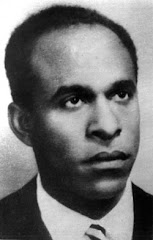
John A. Williams, Frantz Fanon, Patrice Lumumba, Medgar Evers, Malcolm X, and Robert F. Williams

JOHN A. WILLIAMS
b. December 5, 1925—d. July 3, 2015

FRANTZ FANON
b. July 20, 1925—d. December 6, 1961

PATRICE LUMUMBA
b. July 2, 1925—d. January 17, 1961

MEDGAR EVERS
b. July 2, 1925—d. June 12, 1963

MALCOLM X
b. May 19, 1925—d. February 21, 1965

ROBERT F. WILLIAMS
b. February 26, 1925–d. October 15, 1996)
John A. Williams (1925-2015) was a great and profound writer and one of my all time literary heroes. It's a tragedy that he was never really given full credit for the highly versatile and dynamic creative range and incisive originality, as well as stunning intellectual and emotional power of his work while still alive. Perhaps in death we can all do a much better and far more accurate assessment of just how valuable and important his masterly command as artist was to the rest of us who remain deeply inspired, informed, and moved by his extraordinary vision, craft, and insight.
THANK YOU MR. WILLIAMS for all that you accomplished and tried to accomplish in a stellar career and life.
Kofi

July 6, 2015
New York Times
“Night Song,” his second novel, published in 1961, caught the attention of critics with its compelling picture of the jazz world of Greenwich Village and the retrospective ruminations of its hero, a dying saxophonist. “He gets close enough to the good novel about jazz that has never yet been written to make one hope he may write a good novel about something,” the British magazine The Spectator said in its review.That novel was “The Man Who Cried I Am,” a look at 30 years of American history through the eyes of a dying black American writer living in Europe who reflects on his life and on his troubled marriage to a Dutch woman. Eliot Fremont-Smith, in his review for The New York Times, called it “a compelling novel, gracefully written, angry but acute, committed but controlled, obviously timely, but deserving of attention for far more than that.” In “The King God Didn’t Save: Reflections on the Life and Death of Martin Luther King Jr.” (1970), Mr. Williams argued that Dr. King, suffering from hubris, was essentially a dupe, bought off with small concessions by the white power structure and blocked from effecting meaningful change.
“He did not understand that it had armed him with feather dusters,” Mr. Williams wrote. “He was a black man and therefore always was and always would be naked of power, for he was slow, indeed unable, to perceive the manipulation of white power, and in the end white power killed him.”
The negative portrayal, so soon after his assassination, dismayed many of Dr. King’s supporters.
By the late 1960s, Mr. Williams had earned a dual reputation, as a scathing critic of endemic racism in the United States and as a writer who, despite the constant comparisons to Ralph Ellison and James Baldwin, had been denied the credit due his talent.
“John Williams has so far been luckless,” John Leonard wrote in The Times in 1967. “That peculiar mechanism which transforms writers into celebrities, and their books into preferred stock, just hasn’t worked for him.”
Over time, some of the fire abated — “I’m still angry, but you can’t just be angry all the time,” Mr. Williams told Publishers Weekly in 1976 — but his reputation as a supremely talented but undervalued writer remained unchanged.Over time, some of the fire abated — “I’m still angry, but you can’t just be angry all the time,” Mr. Williams told Publishers Weekly in 1976 — but his reputation as a supremely talented but undervalued writer remained unchanged.

“The Man Who Cried I Am” (1967) was a look at 30 years of American history through the eyes of a dying black American writer living in Europe.
After the war, he completed high school and enrolled at Syracuse University, where he earned a bachelor’s degree in English in 1950. Unable to break into journalism, he spent time as a foundry worker, a supermarket vegetable clerk and a case worker for the Onondaga County welfare department. He moved to New York City in 1955, working sporadically as publicity director for a vanity press and as director of information for the American Committee on Africa, an organization founded to support African liberation movements.
In 1958, he became the European correspondent for both Ebony and Jet magazines. In the mid-1960s, he reported for Newsweek from Africa and the Middle East and from Europe for Holiday magazine.
“Night Song” plunged Mr. Williams into a literary tempest when the American Academy of Arts and Letters, impressed by the book, unanimously recommended him for a fellowship at the American Academy in Rome. In an unprecedented decision, the Rome academy rejected the selection, offering no explanation. Mr. Williams said he believed himself to be the victim of a false rumor that he was about to marry a white woman. He was offered a $2,000 grant instead, which he rejected.
A prolific writer, Mr. Williams published in a variety of genres. He wrote a travel book, “This Is My Country Too” (1965); a biography of Richard Wright and a picture history of Africa, both for young-adult readers; and, with his son Dennis, the biography “If I Stop I’ll Die: The Comedy and Tragedy of Richard Pryor” (1991).
In the early 1970s, he was an editor of the periodic anthology Amistad, devoted to critical writing on black history and culture.
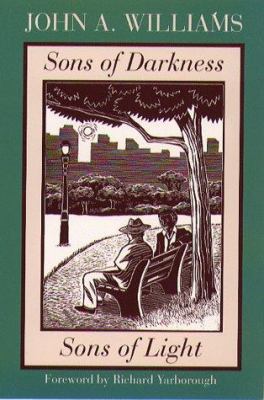
His novels include “Sissie” (1963), which narrates the life of a Southern domestic worker as seen through the eyes of her two estranged children, and “Sons of Darkness, Sons of Light” (1969), a thriller about a civil rights activist who turns to murder after losing faith in nonviolence.
Mr. Williams confounded critics with “The Junior Bachelor Society” (1976), an unexpectedly heartwarming story about a group of middle-aged black men who return to their hometown to honor their football coach and mentor. It was made into a mini-series, “The Sophisticated Gents,” which was broadcast on NBC in 1981. His own favorite was “!Click Song” (1982), a screed against the publishing industry and the travails that await black writers.
Mr. Williams taught at several colleges and universities, most recently Rutgers in Newark from 1979 until his retirement in 1994. He lived in Teaneck, N.J.
In addition to his son Dennis, Mr. Williams, whose first marriage ended in divorce, is survived by his wife, Lorrain; two other sons, Adam and Gregory; a sister, Helen Musick; four grandchildren; and two great-grandchildren.
Mr. Williams never much cared for the comparisons to Ellison and Baldwin. The tendency to group black writers together, he theorized in an essay for Saturday Review in 1963, was a way to ensure that only one at a time could become successful. He regarded his peers as E. L. Doctorow, John Updike and Norman Mailer.
“I do have faith in myself and my abilities to write,” he told The Washington Post in 1976. “I believe very much in what I have to say. I’m too old to start wavering now.”
Correction:
July 7, 2015
An earlier version of this obituary misstated the given name of the subject of a biography by Mr. Williams. He was Richard Wright, not James Wright.
A version of this article appears in print on July 8, 2015, Section B, Page 15 of the New York edition with the headline: John A. Williams, 89, Dies; Wrote About Black Identity. Order Reprints | Today’s Paper
https://panopticonreview.blogspot.com/2023/11/the-revolutionary-and-pioneering-impact.html
Sunday, November 26, 2023
The Revolutionary and Pioneering Impact of the Classic 1967 Novel THE MAN WHO CRIED I AM by the groundbreaking African American writer John A. Williams (1925-2015)
Black Writers in Paris, the FBI, and a Lost 1960s Classic: Rediscovering The Man Who Cried I Am

November 9, 2023
VIDEO:
https://www.youtube.com/watch?v=A5RaE-fk0gs
The
expatriate literary scene in Paris that flourished around Richard
Wright and James Baldwin produced brilliant writing, intellectual
ferment, and bitter rivalries—all of it, and much else from that
turbulent time, thrillingly explored in John A. Williams’s explosive
1967 novel, The Man Who Cried I Am, a lost classic newly published in
paperback by LOA. Merve Emre (The Personality Brokers), Adam Bradley
(The Anthology of Rap; One Day It’ll All Make Sense), and William
Maxwell (F.B. Eyes: How J. Edgar Hoover’s Ghostreaders Framed African
American Literature) join LOA LIVE to explore this panoramic novel of
Black American life in the era of segregation, civil rights, and
paranoiac Cold War politics—Bradley enlists it in “the new Black
canon”—and what it can tell us about the anxious world Williams moved in
and our own politically unsettled moment.
Library of America president and publisher Max Rudin moderates.
ABOUT THE AUTHOR:
John
Alfred Williams (1925–2015) was an African American author, journalist,
and professor of English at Rutgers University. He won the American
Book Awards Lifetime Achievement award in 2011. Born born in Jackson,
Mississippi, in 1925. He earned a degree in English and Journalism from
Syracuse University in 1950 (after service in the navy). After the
publication of his first novel The Angry Ones in 1960 John A. Williams
went on to have a distinguished literary career, including the
publication of his second novel Sissie, and the classic 1967 bestseller,
The Man Who Cried I Am.
Williams
professional career included teaching at the College of the Virgin
Islands, the City College of New York, Sarah Lawrence College and was a
professor of English at Rutgers University of the Virgin Islands, the
City College of New York, Sarah Lawrence College and he was a professor
of English at Rutgers University.
Williams
received the Syracuse University Centennial Medal for Outstanding
Achievement. He is also a member of the Nation Institute of Arts and
Letters. Williams also won the 1998 American Book Award for Safari West.
Williams was the author of 21 fiction and non-fiction books.
Posted by Kofi Natambu at 6:30 AM
Labels: Adam Bradley, Black expatriates, CIA, FBI, John A. Williams, King Alfred Plan, Library of America, Merve Emre, The Man I Cried I Am, William Maxwell
Selected bibliography
Novels
The Angry Ones, Norton, 1960, 9780393314649; The Angry Ones: A Novel. Open Road Media. February 2, 2016. ISBN 978-1-5040-2591-1.
Night Song, Farrar, Straus and Cudahy, 1961; Night Song: A Novel. Open Road Media. February 2, 2016. ISBN 978-1-5040-2572-0.
Sissie, Farrar, Straus and Cudahy, 1963; Chatham Bookseller, 1975, ISBN 9780911860535
The Man Who Cried I Am, Little, Brown, 1967; The Man Who Cried I Am: A Novel. Library of America. November 7, 2023. ISBN 978-1598537611.
Sons of Darkness, Sons of Light, Little, Brown, 1969; Eyre & Spottiswoode, 1970, ISBN 9780413446206
Captain Blackman, Coffee House Press, 1972, ISBN 9781566890960 Captain Blackman: A Novel. Open Road Media. February 2, 2016. ISBN 978-1-5040-3264-3.
Mothersill and the Foxes, Doubleday, 1975, ISBN 9780385094542
The Junior Bachelor Society, Doubleday, 1976, ISBN 9780385094559
!Click Song, 1982 ISBN 9780395318416; !Click Song: A Novel. Open Road Media. February 2, 2016. ISBN 978-1-5040-3304-6.
The Berhama Account, New Horizon Press Publishers, 1985, ISBN 9780882820095
Jacob's Ladder, New York: Thunder's Mouth Press, 1987; 1989, ISBN 9780938410768
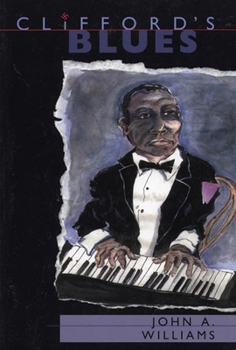
Clifford's Blues, Coffee House Press, 1999, ISBN 9781566890809; Clifford's Blues: A Novel. Open Road Media. February 2, 2016. ISBN 978-1-5040-3305-3.
Non-fiction
Africa: Her History, Lands and People: Told with Pictures. Rowman & Littlefield. 1962. ISBN 978-0-8154-0258-9.
This Is My Country Too (New American Library, 1965)[16]
The King God Didn't Save: Reflections on the Life and Death of Martin Luther King, Jr. (1970)
The Most Native of Sons: A Biography of Richard Wright (1970)
Flashbacks: A Twenty-Year Diary of Article Writing (1973)
If I Stop I'll Die: The Comedy and Tragedy of Richard Pryor (Thunder's Mouth Press, 1991)
Poetry
Safari West: Poems (Hochelaga Press, 1998)
Letters
Dear Chester, Dear John: Letters between Chester Himes and John A. Williams (compiled and edited with Lori Williams), Wayne State University Press, 2008, ISBN 9780814333556
Conversations with John A. Williams
by Jeffrey Allen Tucker (Editor)
University Press of Mississippi, 2018
[Publication date: March 15, 2018]

One
of the most prolific African American authors of his time, John A.
Williams (1925-2015) made his mark as a journalist, educator, and
writer. Having worked for Newsweek, Ebony, and Jet magazines, Williams
went on to write twelve novels and numerous works of nonfiction. A vital
link between the Black Arts movement and the previous era, Williams
crafted works of fiction that relied on historical research as much as
his own finely honed skills. From The Man Who Cried I Am, a roman à clef
about expatriate African American writers in Europe, to Clifford's
Blues, a Holocaust novel told in the form of the diary entries of a gay,
black, jazz pianist in Dachau, these representations of black
experiences marginalized from official histories make him one of our
most important writers.
Conversations
with John A. Williams collects twenty-three interviews with the
three-time winner of the American Book Award, beginning with a
discussion in 1969 of his early works and ending with a previously
unpublished interview from 2005. Gathered from print periodicals as well
as radio and television programs, these interviews address a range of
topics, including anti-black violence, Williams's WWII naval service,
race and publishing, interracial romance, Martin Luther King Jr.,
growing up in Syracuse, the Prix de Rome scandal, traveling in Africa
and Europe, and his reputation as an angry black writer. The
conversations prove valuable given how often Williams drew from his own
life and career for his fiction. They display the integrity, social
engagement, and artistic vision that make him a writer to be reckoned
with.
ABOUT THE EDITOR:
Jeffrey
Allen Tucker, Rochester, New York, is associate professor in the
Department of English at the University of Rochester. He is author of A
Sense of Wonder: Samuel R. Delany, Race, Identity, and Difference and
coeditor of Race Consciousness: African-American Studies for the New
Century.
Posted by Kofi Natambu at 6:30 AM
Labels: Adam Bradley, Black expatriates, CIA, FBI, John A. Williams, King Alfred Plan, Library of America, Merve Emre, The Man I
https://panopticonreview.blogspot.com/2023/11/the-ultimate-meaning-of-king-alfred.html
Monday, November 27, 2023
The Ultimate Meaning of the King Alfred Plan: John A. Williams, White Supremacy, the American Novel, Global Capitalism, and the Role of Literature as Historical Critique and Social Analysis
https://www.newyorker.com/books/second-read/how-a-fictional-racist-plot-made-the-headlines-and-revealed-an-american-truth
Second Read
How a Fictional Racist Plot Made the Headlines and Revealed an American Truth
by Merve Emre
December 31, 2017
The New Yorker

PHOTO: For the late writer John A. Williams, the fictitious documents of the King Alfred Plan, from his novel “The Man Who Cried I Am,” weren’t fake news but a conduit to a deeper truth. Photograph by Anthony Barboza / Getty

In 1968, the African-American novelist John A. Williams published his third novel, “The Man Who Cried I Am,”
a bitter, beautiful, and feverish depiction of the failed promises of
the civil-rights era. The novel, which was a best-seller and went
through six printings, narrates the lives of two writers, one of whom,
Max Reddick, is a journalist whose career path resembled Williams’s own.
Like Max, who had served in the Army during the Second World War,
Williams had enlisted in the Navy, where he was almost killed—not by the
enemy but by a gang of white American sailors. Both men later worked as
beat reporters for New York magazines. Their shared suspicion of the
subtle, yet omnipresent, racism of the white creative class and the
black integrationists who mimicked its liberal politics led both of them
abroad—first to Europe, then to Africa at the height of the Black Power
movement.
The
novel’s other central character, Harry Ames, is a celebrated black
American writer of social-protest fiction who so closely resembled
Richard Wright that the lawyers at Little, Brown expressed some concern
that the author’s estate would sue. And yet there are elements of
Williams’s own story in Harry’s, too. Like Harry, Williams had been
nominated for a prestigious writing prize—the American Academy in Rome’s
Rome Prize Fellowship—only to have it withdrawn without explanation. As
Williams recalled, he had lost the fellowship after a racially charged
interview with the academy’s director, an incident that seemed proof to
him that most of the “good, white moderate people of the North and
South” were privately “anti-Negro,” for to be so publically was “no
longer fashionable.” “The vast silence—the awful, condoning silence that
surrounded the affair fits a groove worn,” he reflected. “The rejection
confirms my suspicions, not ever really dead and makes my ‘paranoia’
real and therefore not ‘paranoia’ at all,” he wrote in an article in
Nugget. “That is the sad thing, for I always work to lose it.”
“The
Man Who Cried I Am” is a novel about the kind of paranoia that proves
to be entirely justified, a theme that culminates in its penultimate
chapter, in which Harry, living in self-imposed exile in Paris, dies
under suspicious circumstances. Before his death, we learn, he had
recently discovered a briefcase containing “the King Alfred Plan”: a
series of leaked documents outlining the measures that the U.S.
government would adopt if the racial unrest and discord of the
mid-nineteen-sixties turned into civil war—an “Emergency” that would
involve “all 22 million members of the Minority.” “The Minority has
adopted an almost military posture to gain its objectives, which are not
clear to most Americans,” the plan read. “It is expected, therefore,
that, when those objectives are denied the Minority, racial war must be
considered inevitable.” The plan, which was named after the first
Anglo-Saxon king of England, detailed how the government would
“terminate, once and for all, the Minority threat to the whole American
society, and indeed, the Free World.”
In
the first draft of the novel, Williams unveiled the King Alfred Plan in
what his editor, Harry Sions, described as a “James Bondish note” that
Harry Ames had written to Max, and which Sions deemed “not quite
convincing.” “The reader must feel that it damn well could be true and
indeed well may come true,” Sions added, encouraging Williams to revise
the end of the novel to resemble “one of a number of contingency plans
which I’m sure our government must have in certain events, and which
would be put in motion under specific circumstances, like an overall
war.” In response to Sion’s notes, Williams designed six pages to
imitate classified government documents, which included a memo from the
National Security Council rationalizing the plan, a crude map from the
Department of the Interior highlighting the regions where the “Minority”
would be detained, and a bullet-pointed timetable from the Secretary of
Defense outlining how the “Minority” would be subject to “vaporization
techniques” or deported to Africa. In the novel’s final chapter, Max
reads the plan over the telephone to a black nationalist named Minister Q
(a stand-in for Malcom X), urging him to revolt against the state.
Max’s discovery, Williams writes in the final pages of the novel, gave
“form and face and projection” to American racism. His worst suspicions
were finally confirmed.
Jacksonville, Ferguson, Beavercreek,
Waller County, Baltimore, and Staten Island are not named on the maps or
timetables of Williams’s pages—but the themes of “The Man Who Cried I
Am,” today a largely forgotten novel, continue to resound. There is
something contemporary, too, in the way that Williams’s fictional King
Alfred Plan took hold of the public imagination upon its publication, in
1967. That year, there were uprisings in Boston, Philadelphia, Detroit,
Newark, Milwaukee, and Tampa, in which black men and women were
assaulted by the police. The federal government was known to be
surveilling black leaders, and, according to Williams, many activists
were already convinced that the F.B.I., C.I.A., and local
law-enforcement agencies were conspiring to neutralize the Black Panther
Party and other radical organizations. As Williams’s agent, Carl D.
Brandt, observed, the plan, when combined with the novel’s fictional but
accurate portraits of Wright, Williams, Martin Luther King, Jr., and
Malcolm X, as well as its faithful reporting on the Kennedy White
House’s half-hearted desegregation initiatives and the rise of the Black
Power movement, appeared “entirely credible in the light of current
events as well as within the terms of necessity for the plot of the
novel.”

IMAGE: The fictional King Alfred Plan outlined the measures that the U.S. government would adopt if the racial unrest and discord of the mid-nineteen-sixties turned into civil war. Courtesy of the Department of Rare Books, Special Collections and Preservation, University of Rochester River Campus Libraries
Williams,
who had worked for a time in P.R., had an innate sense of what might
today be termed viral marketing. The summer before the book’s
publication, Little, Brown sent promotional materials—an excerpt of the
King Alfred Plan alongside details of the book’s publication, all in a
manila folder labelled “CLASSIFICATION: TOP SECRET”—to two thousand
booksellers and jobbers. Williams thought that the King Alfred Plan
could make more of an impact if presented without the references to the
novel, and urged his publishers to take out a one-page ad in the Times
to publish the plan without any reference to what it was or where it was
from. Williams was “enormously distressed” when he learned that his
publishers had balked, both because it seemed to him a missed
opportunity to make a splash and because he sensed that the mere act of
speculating about the plan’s authenticity had an almost revolutionary
potential. For Williams, the documents weren’t fake news but a conduit
to a deeper truth. “I don’t believe it is cheap publicity,” he wrote.
“The concentration camps do exist. I have since learned that the Federal
government does have such a contingency plan. We know that the Army and
National Guard as well as the local police are undergoing riot
training. What in the hell is cheap about the truth?”
In
a schedule that he put together for his sales manager, Patrick McCaleb,
Williams suggested that Little, Brown “get the plan in its CIA folder,
perhaps, to representatives of the Soviet bloc nations, either press or
diplomats.” He wanted copies to go “the embassies of every nation
mentioned in the plan” and to “make sure the Germans got a copy.” He
also wanted “copies to go in some mysterious fashion to Dick Gregory,
James Meredith, Claude McKissick, and Stokely Carmichael,” the black
activists who Williams believed would “make the most noise.” The plan
had to look like it had no point of origin. “Secrecy can be power, and
there is power in secrecy,” Williams wrote to Sions.
In
mid-October, Williams asked Little, Brown for a hundred copies of the
plan—ones that made no mention of his novel—and began leaving them in
subway cars in Manhattan. According to Williams’s friend, the journalist
Herbert Boyd, “The ploy worked so well that soon after black folks all
over New York City were talking about ‘the plan’—a fictitious plot that
many thought was true.” As photocopies circulated, readers themselves
edited the plan’s visual presentation to enhance its authentic
appearance and reproduced their versions of the plan in oppositional
black newspapers. Portions of the plan were redacted; the map was
enhanced to include color-coördinated keys and city names where the
concentration camps were located; patterned code names such as “REX-84,”
short for “Readiness Exercise 84,” were affixed to the documents. The
plan migrated north to Boston and west to Chicago, where members of
activist groups, unsure whether it was real or fictional, read it at
meetings, sometimes aloud, and interpreted how its designs reflected the
history of black oppression in America. According to the Black
Topographical Society of Chicago, the plan was key to understanding
everything from racist hiring practices to how superhighways were
“always routed through black ghettoes to facilitate eventual military
operations against those communities.”
In
1970, Clive DePatten, a nineteen-year-old from Des Moines who had
joined the Black Panther Party following a violent altercation with the
police, appeared in front of the House Internal Security Committee to
testify to the existence of a plan to exterminate blacks that he had
encountered in an activist publication. According to an account in the
Hartford Courant, the congressmen let DePatten finish his testimony
before informing him that the F.B.I. had already investigated the King
Alfred Plan, in 1969, and had “found it to be lifted from a novel, ‘The
Man Who Cried I Am,’ by John A. Williams, a black himself.” DePatten
nevertheless insisted on its truth. “Even if it actually is fictional,
events in the black community are paralleling those set out in the King
Alfred Plan,” he said. The urban-renewal projects of the
nineteen-fifties and sixties had corralled black Americans “into the
ghettoes,” he argued, where they were as vulnerable to state brutality
as interned Japanese-Americans during the Second World War or Jewish
prisoners in Nazi concentration camps. “It is a plan of fear,” the
Republican congressman William J. Scherle said at DePatten’s testimony.
“If you want to believe it, sure, it will scare the hell out of you.”
Through
the early nineteen-seventies, many other people and organizations
testified to the truth of the plan before the government: ex-Army spies,
who claimed that it was an open secret; the A.C.L.U., which claimed
that the Reverend Jesse Jackson was under surveillance by the
government. The government was dismissive of all their concerns. Just as
Williams had found the American Academy in Rome’s silence proof enough
of their racism, they found in this response all they needed to confirm
their sense that Williams’s fictional documents bespoke an American
truth.
Posted by Kofi Natambu at 1:19 AM
Labels: African American history, American Literature, Cold War politics, Cultural critique, Ideology and Art, John A. Williams, King Alfred Plan, Merve Emre, The Man who Cried I Am
LIBRARY OF AMERICA
Moby-Reddick: Merve Emre on John A. Williams’s Great American Novel

John A. Williams in 1962 (Carl van Vechten / Library of Congress) and illustration from early edition of Moby-Dick by Augustus Burnham Shute (Public Domain)
Hailed by Chester Himes as “a blockbuster, a hydrogen bomb” when it was published in 1967, John A. Williams’s The Man Who Cried I Am is at once a panoramic novel about systemic racism and a deeply personal transmission from the heart of the Parisian Black literary expat scene. Centering on Max Reddick, novelist, journalist, presidential speechwriter, and authorial alter ego, the book weaves the global history of Black American experience in the decades after World War II—complete with characters based on Richard Wright, James Baldwin, Martin Luther King, Jr., and Malcolm X—with a propulsive, high-stakes plot that freely mixes elements of thriller, satire, and roman à clef.

Merve Emre (merveemre.com)
At the heart of the book lies the King Alfred plan, a top-secret government document outlining preparations “to terminate, once and for all, the Minority threat to the whole of the American society” in the event of widespread racial unrest. Part fiction-within-fiction, part viral conspiracy theory, part gonzo marketing stunt, this dangerous memo is but one point of contact between reality and invention in a novel replete with such transgressions—guerilla raids—against the prevailing myths of white supremacy in the era of the civil rights movement and the Cold War.
In a conversation with LOA, Merve Emre, who wrote the introduction to our recently published paperback edition of Williams’s masterpiece, discussed the novel’s astonishing scope, its nuanced examinations of race and gender, and why she’d teach it alongside Moby-Dick.
LOA: Who was John A. Williams? What biographical experiences informed the creation of The Man Who Cried I Am?
Merve Emre: John A. Williams was born in 1925 and grew up in Syracuse, New York. He had a fairly happy childhood until, at seventeen, he enlisted in the still-segregated Navy and was deployed to the South Pacific. It was there, during World War II, that he first confronted the possibility of his own death. It was not presented to him by the fighting, but rather by his encounters with white naval officers, who at one point pulled him aside and, as a joke, they said, put a gun to his head and threatened to pull the trigger.

When Williams returned to the United States after the war, he enrolled in college on the GI Bill. After he graduated in the early 1950s, he moved to New York and started to write novels while working as an ad man and publicist. His first few novels were minor successes, often marketed by his white publishers as books fixated on the anger of Black men in America.
This was a form of tokenization that Williams deeply resented: the fact that if you were a Black man writing in the United States, you had to stand not just for all Black people, but also for the most violent feelings that they were believed to harbor. He wanted badly to find a way out of this bind, whereby the Black writer had to not only be representative of his race, and only his race, but also the representative of his race’s history of oppression and nothing more.
When he wrote The Man Who Cried I Am, Williams put all of that fury that he was, in a sense, trying to deny or to avoid into the narrative style of the novel—which is why, I think, we have a work that burns so hot for so long. It is a tremendously intense, tremendously outraged novel, one whose anger is at times very much about race and racial oppression, but at other times about the great difficulty of being a human in history, which one moves through in various states of muddle and mystification.
LOA: The novel is filled with discussions of race, white supremacy, the differences between Black people and white people. But at the same time, in the psychology of the book, those notions are constantly being punctured and complexified. Could you speak to the subject of race in The Man Who Cried I Am and how that compares to other writers of Williams’s era who tackled the topic of anti-Black racism in their work? How does Williams do it differently?
ME: It is impossible to read The Man without thinking of two texts by authors who appear in the novel: first, Richard Wright’s Native Son, and second, James Baldwin’s response to Native Son, “Everybody’s Protest Novel.” Williams is entering the obviously Oedipal argument between these two writers, in which Wright wrote a novel that testified to some of the historical and social determinants of a Black man’s character, which Baldwin had critiqued for how it did a disservice to the individuality of Black people by allegedly reducing them to the social and political conditions established by white supremacy.
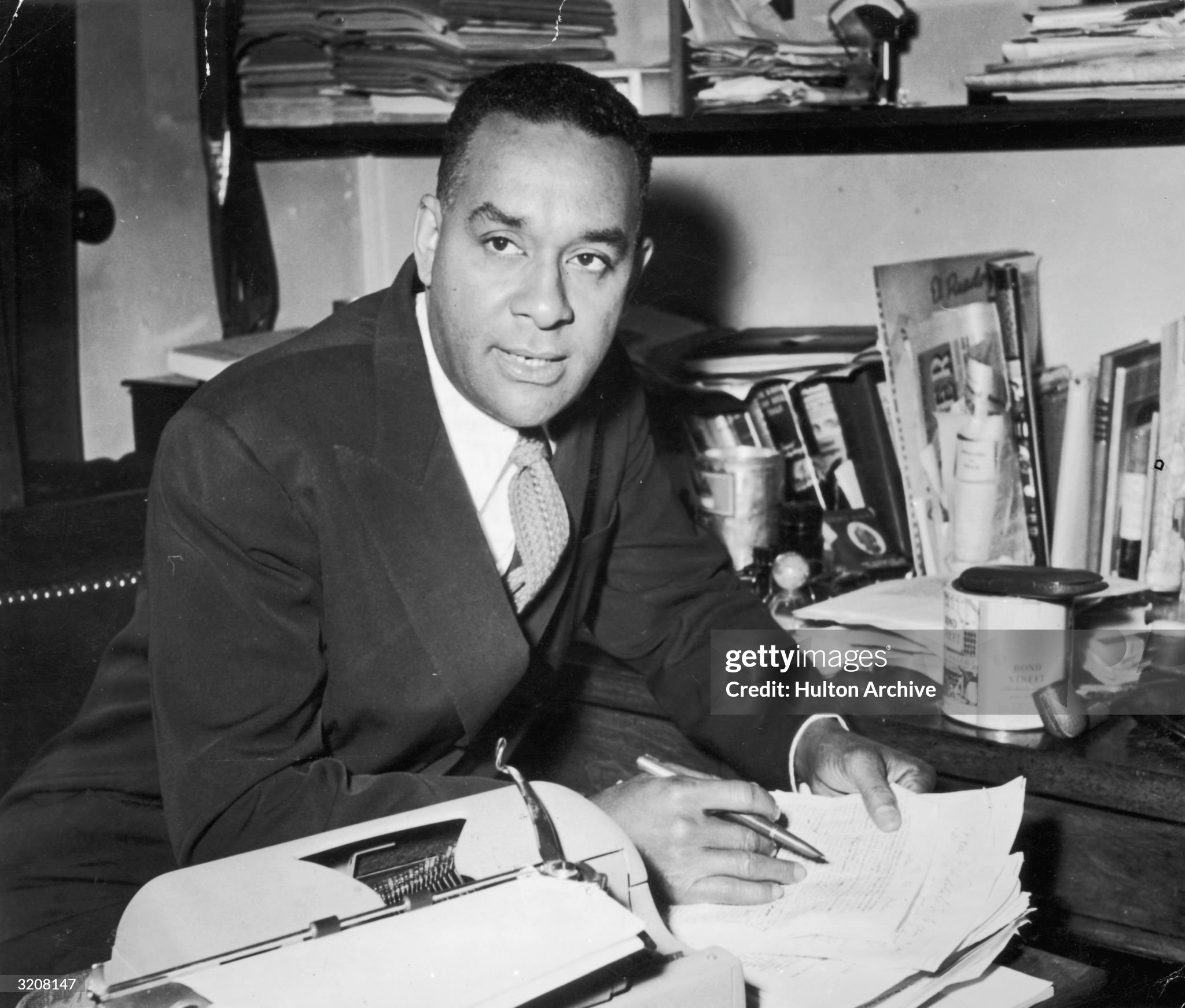
Williams is wading into that two-decade-long controversy, as if to say, “Here’s how you write a novel that recognizes the centrality of race, class, and gender to the psychology of an individual character while demonstrating that that same psychology will resist any attempt to reduce it to these factors alone.” The Man Who Cried I Am is extraordinarily anxious about masculinity, about Blackness, and about Americanness. It’s mobilizing all of those identitarian categories and showing how they have shifted from 1945 to the novel’s present of the mid-1960s. But at the same time, it is insisting that any individual whom we seek to typify by means of those categories will always have a particular story. Whatever man we choose to center in that story will have his own way of crying, “I am.”
The key to the novel is how it tries to thread the needle between Wright and Baldwin. It insists that, to do so, the novel will need to be very big, very expansive. It will need to switch, as this one does, from social realism to reportage to detective story to paranoid thriller to roman á clef. It will have to do all of this heavy lifting with genre to make sure its protagonist can never feel entirely known or typed, because what it means to be a Black American man in a 1940s roman á clef will be different from what it means to be a Black American man in a 1960s paranoid thriller.
LOA: In addition to the vast geographic and temporal scope, there are also many remarkable passages that get us out of the plot and into Max Reddick’s mind as he contemplates the historiography of racism and his own place in it. There’s the constant refrain of being the man to meet the historical moment, but there’s the sense that the only way to do that is to look far back into the past.
ME: Max Reddick is by profession a journalist, but his consciousness is much more that of the philosopher of history. He is always trying to understand the relationship between the individual—and, in particular, an individual with reformist or revolutionary aspirations who believes he has a strong understanding of the historical conditions in which he’s operating—and the institutions that would seek to assimilate the individual to the status quo.
To make that historical consciousness evident, Williams has to depict the extraordinary eventfulness of the ’40s, the ’50s, and the ’60s, across North America, Europe, Asia, and Africa, but he also has to depict the analysis of that eventfulness. One way the novel uses its massive frame to its great advantage is by letting us inhabit Max’s thoughts for long stretches of time; there are even sentences when it shifts from close third-person omniscient narration to an almost first-person direct address. The narrative style is saturated by Max’s vocabulary, by his judgments. When you come to know that voice well, when you become sufficiently familiar with its rhythms, you see how the narrative is trying to move us through Max’s time while also allowing him, implicitly, to interpret the time he’s moving through for us, to synthesize the different, but related, developments that are taking place across the world.
WATCH: John A. Williams and Samuel F. Yette discuss the topic of genocide on the Black Journal television show in 1971:
VIDEO:
https://www.youtube.com/watch?v=KxJadyqYPkI
LOA: Despite the novel’s scale, it’s still rooted in individual relationships. There’s the role of male rivalry, artistic and sexual, that runs through the book. Meanwhile the romances between men and women expose a different relation to power, political access, and sexual freedom. How do these friendships, acquaintanceships, affairs, and marriages comment on or contradict the politics of The Man Who Cried I Am?
ME: Williams’s characters, like most of us, want to imagine that their personal relationships or private lives stand apart from the social and the political in a way that is protective and restorative. We like to think that our best, or most important, relationships give us a sense of who we are, or we can be, outside the sight of the world. In the novel, the moments when the characters are negotiating the intimacy of their relationships are literally set in isolated locations. When Max and his mentor-slash-rival Harry Ames go hunting, for example, they are alone in the woods, not in Harry’s house, where they can be spied on by his wife or house guests, or in the cafés of Paris, where they can be spied on by the U.S. government. They appear to exist, for a moment, in a world apart.
Similarly, when Max and Margrit, his white Dutch wife, go on their honeymoon, they’re on a relatively unpopulated island in the Pacific. Yet then there’s a reference to B-52s flying overhead, as if to remind them—and us—that there is no world apart from the social and the political. Even to conceive of your marriage or your friendship as a place apart is already to put it into relation to society, because that’s how the relationship’s autonomy derives its value—from being a place where you can pretend that the problematics of race or gender or sexuality or nationality don’t matter. There’s always a crushing disappointment in realizing how unsustainable that fantasy is. If, in this novel, one of the primary tensions is between the individual and the institutions to which he belongs, then the secondary tension is between who the individual is in the view of the public and who the individual can be in his or her intimate relationships.

John A. Williams and Chester Himes in New York, 1968 Lori Williams / University of Rochester: Rare Books and Special Collections)
That tension is particularly fraught in the novel’s romances, because these are where Max hopes the most ardently to get away from Blackness as something that determines him. It’s also where the disappointment of realizing he can’t get away from it is the most acute. The first of Max’s two main romances in the novel is with a young Black woman named Lillian whose parents are members of the upwardly mobile Black bourgeoisie. They don’t understand why she wants to marry a writer; they don’t think he’ll be able to provide for her, and Max feels a great deal of anxiety about that. Max feels tremendous anger at himself for not compromising—for not wanting to give Lillian the life of bourgeois uplift—and at Lillian, for being so committed to her parents’ vision and expectations that she ends up securing the conditions of her own death.
The second romance is Max’s marriage to Margrit. She begins the novel; she ends the novel; she is the person Max goes to when he knows he is dying and needs to impart vital information Harry has left him to someone. She’s the person he trusts. When they get married, he believes their love will be able to overcome the fact that he’s Black and she’s white. But in the three years of their marriage before they end up estranged from each other, his history, his anger, gets in the way of the mutual understanding he seeks with her from the beginning. Max is keenly aware of what his marriage to a white woman represents. And he marries her at precisely the moment that Minister Q, a character based on Malcolm X, is rising to public attention by preaching not integration and peaceable coexistence, but instead for African Americans to return to Africa and to promote the creation of a pan-African union.
One of the interesting things about the novel is its thinking about how one’s racial politics can scale. What are the politics of marrying into a bourgeois family and how are they or how are they not analogous to reformist or integrationist politics? What are the politics of an interracial marriage and how are they or how are they not analogous to the politics of countries marrying one another in a global or an international alliance? A marriage and a global political consortium are two entirely different beasts, and to not recognize that—or to recognize it but not be able to live the truth of that difference—is part of what Max struggles with throughout the novel.
EXPLORE: FBI documents studying Richard Wright, compiled by William J. Maxwell for F.B. Eyes: How J. Edgar Hoover’s Ghostreaders Framed African American Literature (2015)
https://panopticonreview.blogspot.com/2023/11/john-williams-on-his-literary-career.html
Monday, November 27, 2023
John
A. Williams On His Literary Career during the 1960s and the larger
social and political context of his seminal 1967 novel The Man Who Cried
I Am
https://www.c-span.org/video/?171391-1/phillis-wheatly-awards
C-SPAN broadcast
July 19, 2002
Phillis Wheatly Awards
Three black authors were recognized for greatly affecting the black community in the first annual Phillis Wheatly Award ceremony. John A. Williams is the author of many novels, including The Man Who Cried I Am. Albert Murray was recognized for his many works, including The Omni-Americans. Sonia Sanchez received an award for her many poems and books, including Wounded in the House of a Friend.
John A. Williams Acceptance Speech - The King Alfred Plan:
This video is a “highlighted excerpt” from the entire awards program recorded by C-SPAN2 BookTV.
VIDEO:
https://www.youtube.com/watch?v=dX8v-ksSjB8
African American Literature Book Club
Learn More about John A. Williams' Work Here:
https://aalbc.com/authors/author.php?...
The 1st Phillis Wheatley Awards Ceremony, hosted by QBR the Black Book Review took place in 2002. Significant black authors including John A. Williams, were honored. Williams was introduced by another important writer, Robert Fleming. Williams' acceptance speech was a retrospective of his career, addressing the 1960s context of the Black struggle for civil rights. He also gets into the infamous King Alfred Plan.
More about Robert Fleming:
https://aalbc.com/authors/author.php?...
This video is a “highlighted excerpt” from the entire awards program recorded by C-SPAN2 BookTV.
View the entire awards ceremony at:
https://www.c-span.org/video/?171391-...
Labels: C-Span broadcast, John A. Williams, Phillis Wheatly Awards, the 1960s, The Man Who Cried I Am
Selected bibliography
Novels:
Night Song, Farrar, Straus and Cudahy, 1961; Night Song: A Novel. Open Road Media. February 2, 2016. ISBN 978-1-5040-2572-0.
The Man Who Cried I Am, Little, Brown, 1967; The Man Who Cried I Am: A Novel. Library of America. November 7, 2023. ISBN 978-1598537611.
Captain Blackman, Coffee House Press, 1972, ISBN 9781566890960 Captain Blackman: A Novel. Open Road Media. February 2, 2016. ISBN 978-1-5040-3264-3.
!Click Song, 1982 ISBN 9780395318416; !Click Song: A Novel. Open Road Media. February 2, 2016. ISBN 978-1-5040-3304-6.
Clifford's Blues, Coffee House Press, 1999, ISBN 9781566890809; Clifford's Blues: A Novel. Open Road Media. February 2, 2016. ISBN 978-1-5040-3305-3.
Non-fiction
The King God Didn't Save: Reflections on the Life and Death of Martin Luther King, Jr. (1970)
The Most Native of Sons: A Biography of Richard Wright (1970)
Flashbacks: A Twenty-Year Diary of Article Writing (1973)
If I Stop I'll Die: The Comedy and Tragedy of Richard Pryor (Thunder's Mouth Press, 1991)
Poetry
Letters


“What’s Past is Prologue…
https://www.thecrimson.com/article/1971/5/19/an-interview-with-john-a-williams/
An Interview with John A. Williams
May 19, 1971
The Harvard Crimson
JOHN A. WILLIAMS, author of The King God Didn't Save (Doubleday, 1970), was born near Jackson, Mississippi, grew up in Syracuse, New York, and like fellow black novelist, John O. Killens, began writing while he was a soldier in a Jim Crow regiment in the Pacific. Williams, along with Killens, Ellison and others, was strongly influenced by Richard Wright, who was also from Mississippi, and like Wright, Williams has traveled and lived in Africa and Europe. Perhaps it is because of this common background and experience that he has obtained a particular understanding of Wright, and is the author of a perceptive biography of him, The Most Native of Sons.
The King God Didn't Save, a controversial biography of Martin Luther King. Jr., is Wliliams' tenth book. The others include five novels, The Angry Ones, Night Song, Sissie, The Man Who Cried I Am, and. Sons of Darkness, Sons of Light. His last two novels have dealt particularly with the increasing level of violence and irrationality in the attitudes and actions of white America and the effect of this on black people everywhere.
This interview took place at the Boston University Afro-American Studies Department in Brookline where Williams delivered a guest lecture.
You once said "Writing is a craft or profession or rite of stupidity that can bring oblivion swifter than anything else I know." In light of the reaction to "The King God Didn't Save" which definition seems the most accurate?
Well, I don't know, it’s--some people have called it stupid, and some people have predicted that I was headed for oblivion. What was the other thing?
Craft or profession.
Well, it wasn't a profession either. It was something that I felt compelled to do; because I see certain things I don't wish to see in the black movement that people are involved in, and that is, to deal with things in the same superficial manner that white people deal with things, to never probe beneath the surface to get at the gear, the mechanisms of things. So I did the book and it may well be that all of these things will fall upon my head. But I'm only sorry I did it in terms of the unease that it's caused my family and, I suppose, me too. But these are things that pass. It wasn't as though what has happened is totally unexpected. I expected it to be something about what's it's been like.
Could one say that your book is also about the God King didn't save?
The God King didn't save-that's fair enough, yeah. In that section that involved Protestants, Catholics and Jews, our three major religious organizations, the feeling I tried to set down is that, in spite of all the professions of religiosity, that these groups are more politically involved than in any other consideration. I think I did say that this man came along talking about religion, dealing with religion, and he was met with violence. As far as I'm concerned, religion had its last opportunity to flourish or reflourish . . . when Martin Luther King was alive.
Had King lived, what directions might he have followed?
I think his last year or so pointed him in the direction of less reliance upon the aid and assistance of the Federal government, but more on his own charisma. The Poor People's March of course is a primary example, and he had been, as James Foreman said it, in the armpit of the Federal government. Jim had been trying to get him out from under that so he could do his own thing without being monitored and advised. I think he, King, was getting into that. Unfortunately, he was monitored in other ways. And King was not the only one. Since the book has come out, I don't suppose not a month goes by when somebody doesn't tell me about some other pictures or some people in pictures that I hadn't even heard about before. So, apparently the surveillance of King was infinite, let's say. But I think . . . well, try to put yourself in the situation. Here you are, a charismatic leader, and perhaps more than that. Perhaps the bona fide leader by virtue of having received the Nobel prize, by virtue of commanding audiences wherever you go. Here you've been doing what any other man does given the opportunity-human response to human invitation, if you will. Suddenly these people come up and say, well, we've been bugging you, and wiretapping you, and we've been photographing you, and you better stop it. Well, at that point, the man has to make a choice whether he is going to be concerned about himself, his family, his children-that's five people-or millions of black people, not only millions of black people in 1967, but millions of black people for all the rest of time. I think he probably made a choice to go with the masses.
Do you see anyone filling his gap today?
WELL, I don't see anybody, I think I sort of predicted in the book that Jesse Jackson would be groomed next, and last fall or winter, Time magazine did a cover story on Jesse. I don't think we are ever going to have a leader who comes down--I'm using this advisedly because it is totally impossible for black people to have one leader--King was assigned to us by the white power structure, and we took him. We took Malcolm. And they got rid of Malcolm and we were left with King and several other lesser deities. But I don't think we'll ever see a leader assigned to us again from that route of publicity . . . because we've learned that when leaders are bred in the fashion of King and Malcolm X that something very terrible happens to them ultimately. They can be assassinated in the press or assassinated for real.
In the book you deal with the power of the media . . . How are we to deal with it?
I have to agree with you that the media can make or break or cripple or assassinate anybody it chooses to, not only black but white as well, polka-dot. I don't foresees in the immediate future any high-level black editors on powerful American newspapers or magazines. By that I mean decision-making levels. I don't see black people getting into that in my lifetime. The system's so tied up that we almost have to forget it for now. Guys your age and, my little boy, Dennis' age may ultimately arrive at those levels, but you have to ask your selves, what is it going to cost you? What kind of compromise are you going to make. Yet if we throw television in with newspapers, you see that we're in a totally untenable position. The black press is as nothing, and it's very difficult to speak to a brother or sister through the white press.
An Interview with John A. Williams
May 19, 1971
Page 2 of 2
Even with the magazines we have now, we lack a national publishing force.
That's really what we need, a national publication, maybe more than one.
What about "Muhammad Speaks?"
That’s a treacherous paper in many, ways. I've known a few guys who worked for them. They've never been critical since they left, but I guess I was turned off because of what they did with the King book. I'm not sure that the guy that wrote the piece had ever read the book. I suspect that he hadn't. When The Man Who Cried I Am came out I was a saint. I could do no wrong. Now this book-not only do I work for the CIA, but I'm probably just coming back from an all-expense, CIA-paid tour of Europe and sitting down at a gold-plated typewriter. I would hope that the readers would find that a bit ridiculous, but those are the extents that publications of this kind go to when the readers allow them to. Muhammad Speaks and the Panther paper are not the answer to the kind of publications we need.
Towards the end of the book you said, "To what Constitutional, to what moral authority do the black, the poor, and the young now appeal? This book is basically addressed to that point . . ." Then a few lines later you said, "There is no reliable authority." Do you think there are any useful values that can be derived from the African experience and applied to this moral void?
Yeah, I think that there are values that can come out of Africa, and very positive ones. I would on the other hand be reluctant to accept these as the over all cure; because I feel we've been on this toboggan and you have to get off where the damn thing stops. You know, if it's 50,000 miles from Africa then that's where you have to get off and do your thing. If you can reach back and bring some good from Africa to where this thing has stopped-beautiful.
The authority that people must appeal to, as far as I'm concerned, is totally lacking from contemporary society. It seems to me that we are in a time when before much longer the people must protest. I'm not only talking about black people, but white people who are getting tired of these damn taxes. I'm talking about white people who are getting tired of shaky business ventures because of this silly war we're in. I'm talking about all kinds of people that are tired of the direction we seem to be moving in. Well, if this means revolution in the streets like the French Revolution, and I'm talking about a real revolution with all of the attendant gore . . . then it will have to come. What we've been trying to do unsuccessfully since before the Civil War . . . is to create this relationship with the white under-classes, but they've been duped away from it. But I think that there will probably be some kind of revolution-fractured, with whites doing their thing and blacks doing their things, but all directed toward government, toward change. The terrible thing about that is that when that is done, then you're going to have the blacks and whites at each others' throats again because they didn't unite in the first place. Once more, I-think the out-look is very pessimistic.
In an article in the December '70 issue of "Black World" you said that the tradition of black communications needed to be molded anew. What forms would you like to see it take?
I THINK I'd like to see more rapport between older black writers and younger black writers. I think the publishing industry has had us in such a bag-you know, we're gonna give you this as an advance, but you don't tell lob how much you got cause we didn't give him this much. And the critics like Jimmy Baldwin, but they hate Ernie Gaines, and it'd be a disaster if them two cats got together. And all the rest of that, which is nonsense. I mean, you view the white literary establishment: Styron, Roth, Ma???, Updike, all of those cats, well, maybe they get together and maybe they don't, but the fact is they got their signals all so together, that it's not necessary. But we don't. We need to clean up some of this garbage and verbiage that has been built up between the black generations. We need to explain to ourselves our own writers. Explain that Ishmael Reed is a fantastic satirist as well as brilliantly knowledgeable of all facets of black people. That Bill Kelley has finally come around. . . . The publicity made it appear to be so impossible that young guys like Kelley and Reed could ever get together; because Kelley went to Feilston School and Harvard or wherever the hell he went. But that's crap. Kelley is in the same bag with Ishmael Reed, with me, with Baldwin, with Ellison, because we're black. Our problems deal with our approaches to our experiences, the way we can command or demand advances so we can support our families, and these are way out of line with the advances white writers get. Things of this nature.
There seems to be a movement towards the past afoot, particularly among whites. A return to Jeffersonian concepis of necrophilia. In the past, these periods when America seemed to be doing an intellectual about-face have always coincided with a loss of black people's rights, a breaking of what seemed to be a progressive trust. Do you see any way of counteracting this trend?
I really don't know or foresee any hopeful trends. This is not basically our fault, I think that black people, in terms of political clout and education are doing as much as they possibly can: because most of these things are dependent upon public money-whether it be state or federal. As always the burden is on white America, and even today white America as a mass is not terribly interested in what happens to us. The business with pollution and environment and so on and so forth. I think white youth veered to this business much too quickly for there to have been any real sincerity in what they seemed to have been involved in with us in the early sixties. And this is where you have to go, to the white youth; because the older people are cliche-set in their ways All they want to do is just hold the damn until they die, and let it become somebody else's problem. But if they can begin manipulating their children to perhaps necessary, but in terms of the immediate needs of this country, ethereal goals; then when the kids reach their ages, it's going to be the same thing all over again. I'm just not that hopeful on the white side that anything good is going to come.
In an interview in the "Paris Review," Ralph Ellison said the search for identity is, "THE American theme. The nature of our society is uch that we are prevented from knowing who we are." Do you agree with that, and do you see any particular reflection of it in the situation of black Americans?
This is most true of black people, and maybe only true of black people. You know, we've had a great deal of recent political awareness of ethnic political potential, and I'd say the Jews are a foremost example of awareness of the ethnic limitations and the exercise of that ethnic power. Ellison's statement is mostly true of black people, and I would disagree with his seeming contention that it's a problem for all Americans. It's not. I think that even Indians or Spanish-speaking Americans are more positive of their identity than are we: because they have languages to fall back on. We are saddled with this old American English and that's all there is to it.

https://panopticonreview.blogspot.com/2023/11/the-ultimate-meaning-of-king-alfred.html
Monday, November 27, 2023
The
Ultimate Meaning of the King Alfred Plan: John A. Williams, White
Supremacy, the American Novel, Global Capitalism, and the Role of
Literature as Historical Critique and Social Analysis
https://www.thecrimson.com/article/1971/5/19/an-interview-with-john-a-williams/
An Interview with John A. Williams
May 19, 1971
The Harvard Crimson
JOHN A. WILLIAMS, author of The King God Didn't Save, was born near Jackson, Mississippi, grew up in Syracuse, New York, and like fellow black novelist, John O. Killens, began writing while he was a soldier in a jimcrow regiment in the Pacific. Williams, along with Killens, Ellison and others, was strongly influenced by Richard Wright, who was also from Mississippi, and like Wright, Williams has traveled and lived in Africa and Europe. Perhaps it is because of this common background and experience that he has obtained a particular understanding of Wright, and is the author of a perceptive biography of him, The Most Native of Sons.
The King God Didn't Save (Doubleday, 1970), a controversial biography of Martin Luther King. Jr., is Wliliams' tenth book. The others include five novels, The Angry Ones, Night Song, Sissie, The Man Who Cried I Am, and. Sons of Darkness, Sons of Light. His last two novels have dealt particularly with the increasing level of violence and irrationality in the attitudes and actions of white America and the effect of this on black people everywhere.
This interview took place at the Boston University Afro-American Studies Department in Brookline where Williams delivered a guest lecture.
You once said "Writing is a craft or profession or rite of stupidity that can bring oblivion swifter than anything else I know." In light of the reaction to "The King God Didn't Save" which definition seems the most accurate?
Well, I don't know, it’s--some people have called it stupid, and some people have predicted that I was headed for oblivion. What was the other thing?
Craft or profession.
Well, it wasn't a profession either. It was something that I felt compelled to do; because I see certain things I don't wish to see in the black movement that people are involved in, and that is, to deal with things in the same superficial manner that white people deal with things, to never probe beneath the surface to get at the gear, the mechanisms of things. So I did the book and it may well be that all of these things will fall upon my head. But I'm only sorry I did it in terms of the unease that it's caused my family and, I suppose, me too. But these are things that pass. It wasn't as though what has happened is totally unexpected. I expected it to be something about what's it's been like.
Could one say that your book is also about the God King didn't save?
The God King didn't save-that's fair enough, yeah. In that section that involved Protestants, Catholics and Jews, our three major religious organizations, the feeling I tried to set down is that, in spite of all the professions of religiosity, that these groups are more politically involved than in any other consideration. I think I did say that this man came along talking about religion, dealing with religion, and he was met with violence. As far as I'm concerned, religion had its last opportunity to flourish or reflourish . . . when Martin Luther King was alive.
Had King lived, what directions might he have followed?
I think his last year or so pointed him in the direction of less reliance upon the aid and assistance of the Federal government, but more on his own charisma. The Poor People's March of course is a primary example, and he had been, as James Foreman said it, in the armpit of the Federal government. Jim had been trying to get him out from under that so he could do his own thing without being monitored and advised. I think he, King, was getting into that. Unfortunately, he was monitored in other ways. And King was not the only one. Since the book has come out, I don't suppose not a month goes by when somebody doesn't tell me about some other pictures or some people in pictures that I hadn't even heard about before. So, apparently the surveillance of King was infinite, let's say. But I think . . . well, try to put yourself in the situation. Here you are, a charismatic leader, and perhaps more than that. Perhaps the bona fide leader by virtue of having received the Nobel prize, by virtue of commanding audiences wherever you go. Here you've been doing what any other man does given the opportunity-human response to human invitation, if you will. Suddenly these people come up and say, well, we've been bugging you, and wiretapping you, and we've been photographing you, and you better stop it. Well, at that point, the man has to make a choice whether he is going to be concerned about himself, his family, his children-that's five people-or millions of black people, not only millions of black people in 1967, but millions of black people for all the rest of time. I think he probably made a choice to go with the masses.
Do you see anyone filling his gap today?
WELL, I don't see anybody, I think I sort of predicted in the book that Jesse Jackson would be groomed next, and last fall or winter, Time magazine did a cover story on Jesse. I don't think we are ever going to have a leader who comes down--I'm using this advisedly because it is totally impossible for black people to have one leader--King was assigned to us by the white power structure, and we took him. We took Malcolm. And they got rid of Malcolm and we were left with King and several other lesser deities. But I don't think we'll ever see a leader assigned to us again from that route of publicity . . . because we've learned that when leaders are bred in the fashion of King and Malcolm X that something very terrible happens to them ultimately. They can be assassinated in the press or assassinated for real.
In the book you deal with the power of the media . . . How are we to deal with it?
I have to agree with you that the media can make or break or cripple or assassinate anybody it chooses to, not only black but white as well, polka-dot. I don't foresees in the immediate future any high-level black editors on powerful American newspapers or magazines. By that I mean decision-making levels. I don't see black people getting into that in my lifetime. The system's so tied up that we almost have to forget it for now. Guys your age and, my little boy, Dennis' age may ultimately arrive at those levels, but you have to ask your selves, what is it going to cost you? What kind of compromise are you going to make. Yet if we throw television in with newspapers, you see that we're in a totally untenable position. The black press is as nothing, and it's very difficult to speak to a brother or sister through the white press.
An Interview with John A. Williams
May 19, 1971
Page 2 of 2
Even with the magazines we have now, we lack a national publishing force.
That's really what we need, a national publication, maybe more than one.
What about "Muhammad Speaks?"
That’s a treacherous paper in many, ways. I've known a few guys who worked for them. They've never been critical since they left, but I guess I was turned off because of what they did with the King book. I'm not sure that the guy that wrote the piece had ever read the book. I suspect that he hadn't. When The Man Who Cried I Am came out I was a saint. I could do no wrong. Now this book-not only do I work for the CIA, but I'm probably just coming back from an all-expense, CIA-paid tour of Europe and sitting down at a gold-plated typewriter. I would hope that the readers would find that a bit ridiculous, but those are the extents that publications of this kind go to when the readers allow them to. Muhammad Speaks and the Panther paper are not the answer to the kind of publications we need.
Towards the end of the book you said, "To what Constitutional, to what moral authority do the black, the poor, and the young now appeal? This book is basically addressed to that point . . ." Then a few lines later you said, "There is no reliable authority." Do you think there are any useful values that can be derived from the African experience and applied to this moral void?
Yeah, I think that there are values that can come out of Africa, and very positive ones. I would on the other hand be reluctant to accept these as the over all cure; because I feel we've been on this toboggan and you have to get off where the damn thing stops. You know, if it's 50,000 miles from Africa then that's where you have to get off and do your thing. If you can reach back and bring some good from Africa to where this thing has stopped-beautiful.
The authority that people must appeal to, as far as I'm concerned, is totally lacking from contemporary society. It seems to me that we are in a time when before much longer the people must protest. I'm not only talking about black people, but white people who are getting tired of these damn taxes. I'm talking about white people who are getting tired of shaky business ventures because of this silly war we're in. I'm talking about all kinds of people that are tired of the direction we seem to be moving in. Well, if this means revolution in the streets like the French Revolution, and I'm talking about a real revolution with all of the attendant gore . . . then it will have to come. What we've been trying to do unsuccessfully since before the Civil War . . . is to create this relationship with the white under-classes, but they've been duped away from it. But I think that there will probably be some kind of revolution-fractured, with whites doing their thing and blacks doing their things, but all directed toward government, toward change. The terrible thing about that is that when that is done, then you're going to have the blacks and whites at each others' throats again because they didn't unite in the first place. Once more, I-think the out-look is very pessimistic.
In an article in the December '70 issue of "Black World" you said that the tradition of black communications needed to be molded anew. What forms would you like to see it take?
I THINK I'd like to see more rapport between older black writers and younger black writers. I think the publishing industry has had us in such a bag-you know, we're gonna give you this as an advance, but you don't tell lob how much you got cause we didn't give him this much. And the critics like Jimmy Baldwin, but they hate Ernie Gaines, and it'd be a disaster if them two cats got together. And all the rest of that, which is nonsense. I mean, you view the white literary establishment: Styron, Roth, Ma???, Updike, all of those cats, well, maybe they get together and maybe they don't, but the fact is they got their signals all so together, that it's not necessary. But we don't. We need to clean up some of this garbage and verbiage that has been built up between the black generations. We need to explain to ourselves our own writers. Explain that Ishmael Reed is a fantastic satirist as well as brilliantly knowledgeable of all facets of black people. That Bill Kelley has finally come around. . . . The publicity made it appear to be so impossible that young guys like Kelley and Reed could ever get together; because Kelley went to Feilston School and Harvard or wherever the hell he went. But that's crap. Kelley is in the same bag with Ishmael Reed, with me, with Baldwin, with Ellison, because we're black. Our problems deal with our approaches to our experiences, the way we can command or demand advances so we can support our families, and these are way out of line with the advances white writers get. Things of this nature.
There seems to be a movement towards the past afoot, particularly among whites. A return to Jeffersonian concepis of necrophilia. In the past, these periods when America seemed to be doing an intellectual about-face have always coincided with a loss of black people's rights, a breaking of what seemed to be a progressive trust. Do you see any way of counteracting this trend?
I really don't know or foresee any hopeful trends. This is not basically our fault, I think that black people, in terms of political clout and education are doing as much as they possibly can: because most of these things are dependent upon public money-whether it be state or federal. As always the burden is on white America, and even today white America as a mass is not terribly interested in what happens to us. The business with pollution and environment and so on and so forth. I think white youth veered to this business much too quickly for there to have been any real sincerity in what they seemed to have been involved in with us in the early sixties. And this is where you have to go, to the white youth; because the older people are cliche-set in their ways All they want to do is just hold the damn until they die, and let it become somebody else's problem. But if they can begin manipulating their children to perhaps necessary, but in terms of the immediate needs of this country, ethereal goals; then when the kids reach their ages, it's going to be the same thing all over again. I'm just not that hopeful on the white side that anything good is going to come.
In an interview in the "Paris Review," Ralph Ellison said the search for identity is, "THE American theme. The nature of our society is uch that we are prevented from knowing who we are." Do you agree with that, and do you see any particular reflection of it in the situation of black Americans?
This is most true of black people, and maybe only true of black people. You know, we've had a great deal of recent political awareness of ethnic political potential, and I'd say the Jews are a foremost example of awareness of the ethnic limitations and the exercise of that ethnic power. Ellison's statement is mostly true of black people, and I would disagree with his seeming contention that it's a problem for all Americans. It's not. I think that even Indians or Spanish-speaking Americans are more positive of their identity than are we: because they have languages to fall back on. We are saddled with this old American English and that's all there is to it.
https://panopticonreview.blogspot.com/2023/11/the-ultimate-meaning-of-king-alfred.html
Monday, November 27, 2023
The Ultimate Meaning of the King Alfred Plan: John A. Williams, White Supremacy, the American Novel, Global Capitalism, and the Role of Literature as Historical Critique and Social Analysis
https://www.newyorker.com/books/second-read/how-a-fictional-racist-plot-made-the-headlines-and-revealed-an-american-truth
Second Read
How a Fictional Racist Plot Made the Headlines and Revealed an American Truth
by Merve Emre
December 31, 2017
The New Yorker
PHOTO: For the late writer John A. Williams, the fictitious documents of the King Alfred Plan, from his novel “The Man Who Cried I Am,” weren’t fake news but a conduit to a deeper truth. Photograph by Anthony Barboza / Getty
In 1968, the African-American novelist John A. Williams published his third novel, “The Man Who Cried I Am,” a bitter, beautiful, and feverish depiction of the failed promises of the civil-rights era. The novel, which was a best-seller and went through six printings, narrates the lives of two writers, one of whom, Max Reddick, is a journalist whose career path resembled Williams’s own. Like Max, who had served in the Army during the Second World War, Williams had enlisted in the Navy, where he was almost killed—not by the enemy but by a gang of white American sailors. Both men later worked as beat reporters for New York magazines. Their shared suspicion of the subtle, yet omnipresent, racism of the white creative class and the black integrationists who mimicked its liberal politics led both of them abroad—first to Europe, then to Africa at the height of the Black Power movement.
The novel’s other central character, Harry Ames, is a celebrated black American writer of social-protest fiction who so closely resembled Richard Wright that the lawyers at Little, Brown expressed some concern that the author’s estate would sue. And yet there are elements of Williams’s own story in Harry’s, too. Like Harry, Williams had been nominated for a prestigious writing prize—the American Academy in Rome’s Rome Prize Fellowship—only to have it withdrawn without explanation. As Williams recalled, he had lost the fellowship after a racially charged interview with the academy’s director, an incident that seemed proof to him that most of the “good, white moderate people of the North and South” were privately “anti-Negro,” for to be so publically was “no longer fashionable.” “The vast silence—the awful, condoning silence that surrounded the affair fits a groove worn,” he reflected. “The rejection confirms my suspicions, not ever really dead and makes my ‘paranoia’ real and therefore not ‘paranoia’ at all,” he wrote in an article in Nugget. “That is the sad thing, for I always work to lose it.”
“The Man Who Cried I Am” is a novel about the kind of paranoia that proves to be entirely justified, a theme that culminates in its penultimate chapter, in which Harry, living in self-imposed exile in Paris, dies under suspicious circumstances. Before his death, we learn, he had recently discovered a briefcase containing “the King Alfred Plan”: a series of leaked documents outlining the measures that the U.S. government would adopt if the racial unrest and discord of the mid-nineteen-sixties turned into civil war—an “Emergency” that would involve “all 22 million members of the Minority.” “The Minority has adopted an almost military posture to gain its objectives, which are not clear to most Americans,” the plan read. “It is expected, therefore, that, when those objectives are denied the Minority, racial war must be considered inevitable.” The plan, which was named after the first Anglo-Saxon king of England, detailed how the government would “terminate, once and for all, the Minority threat to the whole American society, and indeed, the Free World.”
In the first draft of the novel, Williams unveiled the King Alfred Plan in what his editor, Harry Sions, described as a “James Bondish note” that Harry Ames had written to Max, and which Sions deemed “not quite convincing.” “The reader must feel that it damn well could be true and indeed well may come true,” Sions added, encouraging Williams to revise the end of the novel to resemble “one of a number of contingency plans which I’m sure our government must have in certain events, and which would be put in motion under specific circumstances, like an overall war.” In response to Sion’s notes, Williams designed six pages to imitate classified government documents, which included a memo from the National Security Council rationalizing the plan, a crude map from the Department of the Interior highlighting the regions where the “Minority” would be detained, and a bullet-pointed timetable from the Secretary of Defense outlining how the “Minority” would be subject to “vaporization techniques” or deported to Africa. In the novel’s final chapter, Max reads the plan over the telephone to a black nationalist named Minister Q (a stand-in for Malcom X), urging him to revolt against the state. Max’s discovery, Williams writes in the final pages of the novel, gave “form and face and projection” to American racism. His worst suspicions were finally confirmed.
Jacksonville, Ferguson, Beavercreek, Waller County, Baltimore, and Staten Island are not named on the maps or timetables of Williams’s pages—but the themes of “The Man Who Cried I Am,” today a largely forgotten novel, continue to resound. There is something contemporary, too, in the way that Williams’s fictional King Alfred Plan took hold of the public imagination upon its publication, in 1967. That year, there were uprisings in Boston, Philadelphia, Detroit, Newark, Milwaukee, and Tampa, in which black men and women were assaulted by the police. The federal government was known to be surveilling black leaders, and, according to Williams, many activists were already convinced that the F.B.I., C.I.A., and local law-enforcement agencies were conspiring to neutralize the Black Panther Party and other radical organizations. As Williams’s agent, Carl D. Brandt, observed, the plan, when combined with the novel’s fictional but accurate portraits of Wright, Williams, Martin Luther King, Jr., and Malcolm X, as well as its faithful reporting on the Kennedy White House’s half-hearted desegregation initiatives and the rise of the Black Power movement, appeared “entirely credible in the light of current events as well as within the terms of necessity for the plot of the novel.”
IMAGE: The fictional King Alfred Plan outlined the measures that the U.S. government would adopt if the racial unrest and discord of the mid-nineteen-sixties turned into civil war. Courtesy of the Department of Rare Books, Special Collections and Preservation, University of Rochester River Campus Libraries
Williams, who had worked for a time in P.R., had an innate sense of what might today be termed viral marketing. The summer before the book’s publication, Little, Brown sent promotional materials—an excerpt of the King Alfred Plan alongside details of the book’s publication, all in a manila folder labelled “CLASSIFICATION: TOP SECRET”—to two thousand booksellers and jobbers. Williams thought that the King Alfred Plan could make more of an impact if presented without the references to the novel, and urged his publishers to take out a one-page ad in the Times to publish the plan without any reference to what it was or where it was from. Williams was “enormously distressed” when he learned that his publishers had balked, both because it seemed to him a missed opportunity to make a splash and because he sensed that the mere act of speculating about the plan’s authenticity had an almost revolutionary potential. For Williams, the documents weren’t fake news but a conduit to a deeper truth. “I don’t believe it is cheap publicity,” he wrote. “The concentration camps do exist. I have since learned that the Federal government does have such a contingency plan. We know that the Army and National Guard as well as the local police are undergoing riot training. What in the hell is cheap about the truth?”
In a schedule that he put together for his sales manager, Patrick McCaleb, Williams suggested that Little, Brown “get the plan in its CIA folder, perhaps, to representatives of the Soviet bloc nations, either press or diplomats.” He wanted copies to go “the embassies of every nation mentioned in the plan” and to “make sure the Germans got a copy.” He also wanted “copies to go in some mysterious fashion to Dick Gregory, James Meredith, Claude McKissick, and Stokely Carmichael,” the black activists who Williams believed would “make the most noise.” The plan had to look like it had no point of origin. “Secrecy can be power, and there is power in secrecy,” Williams wrote to Sions.
In mid-October, Williams asked Little, Brown for a hundred copies of the plan—ones that made no mention of his novel—and began leaving them in subway cars in Manhattan. According to Williams’s friend, the journalist Herbert Boyd, “The ploy worked so well that soon after black folks all over New York City were talking about ‘the plan’—a fictitious plot that many thought was true.” As photocopies circulated, readers themselves edited the plan’s visual presentation to enhance its authentic appearance and reproduced their versions of the plan in oppositional black newspapers. Portions of the plan were redacted; the map was enhanced to include color-coördinated keys and city names where the concentration camps were located; patterned code names such as “REX-84,” short for “Readiness Exercise 84,” were affixed to the documents. The plan migrated north to Boston and west to Chicago, where members of activist groups, unsure whether it was real or fictional, read it at meetings, sometimes aloud, and interpreted how its designs reflected the history of black oppression in America. According to the Black Topographical Society of Chicago, the plan was key to understanding everything from racist hiring practices to how superhighways were “always routed through black ghettoes to facilitate eventual military operations against those communities.”
In 1970, Clive DePatten, a nineteen-year-old from Des Moines who had joined the Black Panther Party following a violent altercation with the police, appeared in front of the House Internal Security Committee to testify to the existence of a plan to exterminate blacks that he had encountered in an activist publication. According to an account in the Hartford Courant, the congressmen let DePatten finish his testimony before informing him that the F.B.I. had already investigated the King Alfred Plan, in 1969, and had “found it to be lifted from a novel, ‘The Man Who Cried I Am,’ by John A. Williams, a black himself.” DePatten nevertheless insisted on its truth. “Even if it actually is fictional, events in the black community are paralleling those set out in the King Alfred Plan,” he said. The urban-renewal projects of the nineteen-fifties and sixties had corralled black Americans “into the ghettoes,” he argued, where they were as vulnerable to state brutality as interned Japanese-Americans during the Second World War or Jewish prisoners in Nazi concentration camps. “It is a plan of fear,” the Republican congressman William J. Scherle said at DePatten’s testimony. “If you want to believe it, sure, it will scare the hell out of you.”
Through the early nineteen-seventies, many other people and organizations testified to the truth of the plan before the government: ex-Army spies, who claimed that it was an open secret; the A.C.L.U., which claimed that the Reverend Jesse Jackson was under surveillance by the government. The government was dismissive of all their concerns. Just as Williams had found the American Academy in Rome’s silence proof enough of their racism, they found in this response all they needed to confirm their sense that Williams’s fictional documents bespoke an American truth.
Labels: African American history, American Literature, Cold War politics, Cultural critique, Ideology and Art, John A. Williams, King Alfred Plan, Merve Emre, The Man who Cried I Am

JOHN A. WILLIAMS (1925-2015)
Selected bibliography
Novels
The Angry Ones, Norton, 1960, 9780393314649; The Angry Ones: A Novel. Open Road Media. February 2, 2016. ISBN 978-1-5040-2591-1.
Night Song, Farrar, Straus and Cudahy, 1961; Night Song: A Novel. Open Road Media. February 2, 2016. ISBN 978-1-5040-2572-0.
Sissie, Farrar, Straus and Cudahy, 1963; Chatham Bookseller, 1975, ISBN 9780911860535
The Man Who Cried I Am, Little, Brown, 1967; The Man Who Cried I Am: A Novel. Library of America. November 7, 2023. ISBN 978-1598537611.
Sons of Darkness, Sons of Light, Little, Brown, 1969; Eyre & Spottiswoode, 1970, ISBN 9780413446206
Captain Blackman, Coffee House Press, 1972, ISBN 9781566890960 Captain Blackman: A Novel. Open Road Media. February 2, 2016. ISBN 978-1-5040-3264-3.
Mothersill and the Foxes, Doubleday, 1975, ISBN 9780385094542
The Junior Bachelor Society, Doubleday, 1976, ISBN 9780385094559
!Click Song, 1982 ISBN 9780395318416; !Click Song: A Novel. Open Road Media. February 2, 2016. ISBN 978-1-5040-3304-6.
The Berhama Account, New Horizon Press Publishers, 1985, ISBN 9780882820095
Jacob's Ladder, New York: Thunder's Mouth Press, 1987; 1989, ISBN 9780938410768
Clifford's Blues, Coffee House Press, 1999, ISBN 9781566890809; Clifford's Blues: A Novel. Open Road Media. February 2, 2016. ISBN 978-1-5040-3305-3.
Non-fiction
Africa: Her History, Lands and People: Told with Pictures. Rowman & Littlefield. 1962. ISBN 978-0-8154-0258-9.
This Is My Country Too (New American Library, 1965)[16]
The King God Didn't Save: Reflections on the Life and Death of Martin Luther King, Jr. (1970)
The Most Native of Sons: A Biography of Richard Wright (1970)
Flashbacks: A Twenty-Year Diary of Article Writing (1973)
If I Stop I'll Die: The Comedy and Tragedy of Richard Pryor (Thunder's Mouth Press, 1991)
Poetry
Safari West: Poems (Hochelaga Press, 1998)
Letters
Dear Chester, Dear John: Letters between Chester Himes and John A. Williams (compiled and edited with Lori Williams), Wayne State University Press, 2008, ISBN 9780814333556
https://www.washingtonpost.com/archive/entertainment/books/1991/09/22/richard-wright-the-legacy
RICHARD WRIGHT: THE LEGACY OF A NATIVE SON
Review by John A. Williams
September 22, 1991
The Washington Post
EARLY WORKS
Lawd Today!
Uncle Tom's Children
by Richard Wright
Library of America. 936 pp. $35
LATER WORKS
Black Boy (American Hunger)
The Outsider
by Richard Wright
Library of America. 887 pp. $35
WHEN
Native Son, Richard Wright's most famous novel, was published in March
1940, reviewer Peter Monroe Jack wrote that he believed the book could
just as well have been called "the Negro American tragedy" because of
its rough comparison to Dreiser's novel -- though Jack noted that
Wright's "injustice is a racial, not merely a social, one." More than a
half-century later, Native Son, now republished with four other works by
Wright in a new, two-volume Library of America edition, remains a
powerfully blunt novel. This new edition does not include the Dorothy
Canfield Fisher introduction, which helped to prepare readers for the
shock awaiting them at the novel's opening; now there is no ushering in,
no cushion to soften the impact of that first, allegorical scene when
Bigger awakens and flattens a big black rat with a skillet. Here he is,
with a name to chew hard on, Bigger Thomas.And Bigger restored. Not far
past the opening scene are the three-and-a-half pages that Wright's
publishers, Harper & Brothers, suggested he excise so Native Son
would be more seriously considered for adoption by the Book-of-the-Mouth
Club. (The BOMC did buy it and, later, Black Boy as well.) These pages,
which include an account of masturbation in a movie theater and a
discussion of interracial sex, tend to minimize whatever sympathy the
reader feels for Bigger at this early point in the novel.
There
are seven other restorations in this definitive edition. The
gate-keepers of earlier days, at least as far as Wright's works were
concerned, were circumspect, maybe even fearful, about politics, race
and sex. Some of these concerns, however, now reflect more awkwardly
upon the gate-keepers than upon Wright's forays into "street language,"
his discussions of communism, a character's thoughts or statements about
sex.
What
I remember most when I first read Native Son at 14 or 15 was its
relentless power. It was undoubtedly the most powerful book I had read
up to that time. It prepared me for Chicago, near which I was to be
stationed for Navy boot camp and Hospital Corps training early in 1943. I
had relatives, Mississippians too, who lived in the neighborhoods and
on the streets Wright describes in the novelNative Son and Black Boy are
now required reading in grades 7-12 in many public schools and some
colleges, but many African-American parents object because they feel the
books lack positive characters. Nonetheless, whatever a parent-reader
may think of Wright's work, it is clear to me that he was positive
beyond any doubt whatsoever about the negative effects of racism on
black men, women and children. Only in The Long Dream (1958), the last
of Wright's novels to be published in the U.S. -- Island of
Hallucinations, finished in 1959, has been brought out only in sections
here -- is there physical escape from racism by the character Fishbelly.
Wright's view that racism is almost universal, though somewhat modified
by his opinion that colonized and neo-colonized peoples should depend
less on their traditional pasts and ought to model themselves after
Western democracies, is clearly stated in his nonfiction political
works, Black Power (1954), The Color Curtain (1956) and White Man,
Listen! (1957). Thus Wright would be amazed to see how "colored" Europe
has become since his death, but not at the concurrent rise of racism
there.
The
power in Native Son is, paradoxically, vested in Bigger Thomas's
absolute powerlessness: He is the minus end of a battery that, when
improperly connected, cannot carry anything but negative and sometimes
explosive current. Through him, Wright is so intent on examining every
impact of racism, that he creates a character multitudes of white people
instantly recognize as the black man of their imagination, the figure
that they know in their hearts was formed by a system whose inherent
inequities they never truly opposed. This power is also present in
Wright's earlier short fiction, "Uncle Tom's Children," and in the first
novel he wrote, Lawd Today! (The exclamation point has been restored,
as have been the excised portions in other works by Wright included in
these two volumes.)
Originally
called "Cesspool," Lawd Today! was rejected by eight publishers. After
Native Son was published with great success, Wright, according to some
of his biographers, ceased offering the earlier book for
publication.Black Boy, Wright's autobiography, met with even more
success in 1945. William Faulkner, who considered Wright to be
"potentially an artist," wrote to him that Black Boy "will accomplish
little of what it should accomplish, since only they will be moved and
grieved by it who already know and grieve over this situation." In
short, the autobiography overwhelmingly verified that the system of
oppression worked. American Hunger was originally part two of Black Boy.
It deals with Wright's life in the North and is a dissection of the
Communist Party's failure to engage the black community. The BOMC
editors may have felt sensitive about this section, which Wright had
titled "The Horror and the Glory." Like Lawd Today!, American Hunger
would be published posthumously.
Lawd
Today! came out in 1963, three years after Wright died. Its portrait of
one catastrophic day in the life of Jake Jackson seems a trial run for
the creation of Bigger Thomas. Though Jake is Bigger alive and grown up,
both are at once filled with a fear and rage they are unable to
articulate. Their exercise of violence is shaped by their fear. Bigger
feels confident when he is violent. So does Jake. They are black man and
black boy lunging through the low Chicago skyline during the crushing
days of the late 1930s.
The
power evoked in that single day in Jake's life is so overwhelming that
we do not need another one; we do not want another day of such
destruction and self-destruction. Bigger Thomas in Native Son heads to
his death knowing that something in the universe changed when he killed.
Jake knows no such thing. At the end of his day, drunk again, he beats
up his wife just as he did in the morning and is just as broke as he was
then. All he knows when he awakes from his stupor is that he will do
that day exactly what he did the day before.
Attach
Jake Jackson and every protagonist in the collection Uncle Tom's
Children to the list of Bigger's antecedents and Bigger more clearly
embodies Wright's conviction that the first step toward the positive is
being unerringly certain about the absolutely corrosive effect of the
negative -- "bigotry" or "prejudice" in Wright's time, racism today.
Then Uncle Tom's Children, Lawd Today! and Native Son become sections of
the same curriculum and Cross Damon in The Outsider can be the only,
chilling, option if all these Biggers survive. Damon, who like Jake
works in the Central Post Office, exists outside a society that has been
unresponsive to his needs, which are more complex than those of
Wright's other characters. He is a manipulator, a conscienceless killer
beyond the bounds of rationalism. AS A BLACK male writer, like Chester
Himes and many others, there is the natural assumption that I was
influenced by Wright. I may well have been by his work and vision, but I
do not know. Certainly his power with language had an impact. And
though I was born in Mississippi, I grew up in Syracuse, N.Y., my
father's home since 1803. There, a black boy could pop a white boy
without being lynched, and a black man could answer a racial insult with
a solid punch and have little fear (not none) that he'd be torn apart
by a mob; and black women could tell white women they were doing too
much work for too little money. There, my boyhood neighborhood was an
astounding ethnic mix. There, schools and teams were integrated from
kindergarten through high school. But though there may have been
differences in our particular situations, we shared a common experience
as black men in America.
Labels: Adam Bradley, Black expatriates, CIA, FBI, John A. Williams, King Alfred Plan, Library of America, Merve Emre, The Man I Cried I Am, William Maxwell


The Legacy of Frantz Fanon
by Hamza Hamouchene
March 13, 2015
London
Frantz Fanon died a few months before Algeria’s independence in July 1962. He did not live to see his adoptive country becoming free from French colonial domination, something he believed had become inevitable. This radical intellectual and revolutionary devoted himself, body and soul to the Algerian National liberation and was a prism, through which many revolutionaries abroad understood Algeria and one of the reasons the country became synonymous with Third World revolution.
With the weight of its recent past and in particular its long struggle for independence that served as a model for several liberation fronts across the globe and given its assertive diplomacy and audacious foreign policy in the 60s and 70s, the Algerian capital was to become a Mecca for all revolutionaries. As Amilcar Cabral announced at a press conference at the margins of the first Pan-African Festival held in Algiers on 1969: “Pick a pen and take note: the Muslims make the pilgrimage to Mecca, the Christians to the Vatican and the national liberation movements to Algiers!” Fanon would have been surely proud of that moment of Algeria’s and Africa’s history. The festival was impregnated with a revolutionary fervour and with his ideas around a combative culture that is fuelled by people’s daily struggles. The radical atmosphere of a few days in July was captured in an important and powerful film by William Klein: The Pan-African Festival of Algiers, 1969, which attests that this Pan-African gathering was not only a slogan or a generous utopia but also a genuine meeting of African cultures in unison in their denunciations of colonialism and fight for freedom.
Political leaders like António Agostinho Neto and Cabral saw culture at the heart of their concerns because they associated it with liberation which they theorised as a form of political action. They strongly echo Fanon’s words in The Wretched of the Earth: “A national culture is not a folklore, nor an abstract populism that believes it can discover the people’s true nature. It is not made up of the inert dregs of gratuitous actions, that is to say actions which are less and less attached to the ever-present reality of the people….It is around the people’s struggles that African-Negro culture takes on substance and not around songs, poems or folklore.” [i]
It is worth bearing this in mind when we think about the role and the conception of culture today. Is it simply a culture that entertains people and diverts them from the real issues? Or is it a culture that speaks to the people and advances their resistance and struggles? Is it an independent and free culture that fosters dissent and criticism or is it a folkloric one that comes under the suffocating patronage of some authoritarian elites?
Fanon had high hopes and strongly believed in revolutionary Algeria and his illuminating book “Studies in a Dying Colonialism” (or as it is known in French L’An Cinq de la Révolution Algérienne) attests to that and shows how liberation does not come as a gift . It is seized by the masses with their own hands and by seizing it they themselves are transformed. He strongly argued that for the masses, the most elevated form of culture, that is to say, of progress, is to resist imperialist domination and penetration. For Fanon, revolution is a transformative process that will create ‘new souls’. [ii] For this reason Fanon closes his 1959 book with the words: ‘The revolution in depth, the true one, precisely because it changes man and renews society, has reached an advanced stage. This oxygen which creates and shapes a new humanity – this, too, is the Algerian revolution.’ [iii]
Fanon’s concern with what the masses do and say and think and his belief that it is the masses, and not leaders nor systems, who make and determine history, is at the centre stage in his books. It is crucial to analyse Fanon’s testimony because it illustrates how, in the midst of the worst disasters, the masses find the means of reorganising themselves and continuing their existence when they have a common objective. In that respect, Fanon’s descriptions of the conduct of the masses is of great importance as they show how the masses go on living and how they go forward. [iv]
This focus and vivid attachment to the wretched of the earth, their lives and their struggle is put in opposition to an instinctive aversion to a national bourgeoisie that will betray the masses, halt liberation and set-up a national system of tyranny and exploitation, reminiscent of the colonial counterpart. Fanon rightly observed how nationalist consciousness can very easily lead to ‘frozen rigidity’, merely replacing the departed white masters with coloured equivalents.
Understanding Africa: Fanon today
More than five decades after his death, the question seems to be: why Fanon is relevant now? Rather than, is he relevant at all? It would be instructive to explore how this revolutionary would think and act in the face of contemporary issues in Africa and the world.
Fanon’s work, written five decades ago still bears a prophetic power as an accurate description of what happened in Algeria and beyond. Reading Fanon’s words and especially ‘The Pitfalls of National Consciousness’ his famous chapter in The Wretched of the Earth (based on his reflections on his West African experiences as well as his concerns about the Algerian revolution),[v] one cannot help being absorbed and shaken by their truth and foresight on the bankruptcy and sterility of national bourgeoisies in Africa and the Middle East today; bourgeoisies that tended to replace the colonial force with a new class-based system replicating the old colonial structures of exploitation and oppression. Today we can see states across the formerly colonised world that have ‘bred pathologies of power’ as Eqbal Ahmad has called them, giving rise to national security states, to dictatorships, oligarchies and one-party systems. [vi]
What has become of Algeria today with oil money playing an enormously important role in pacifying the population and paying for a bloated and ubiquitous security force corresponds to what Fanon feared. His vision and politics were and are not to the taste of the ruling class and that’s why he is marginalised today and reduced to just another anti-colonial figure, stripped of his incandescent attack on the stupidity and on the intellectual and spiritual poverty of the national bourgeoisies.
As Edward Said argued, the true prophetic genius of The Wretched of the Earth is when Fanon senses the divide between the nationalist bourgeoisie in Algeria and the FLN’s liberationist tendencies. He was the first major theorist of anti-imperialism to realise that orthodox nationalism followed the same track hewn out by imperialism, which while it appeared to concede authority to the nationalist bourgeoisie was really extending its hegemony.[vii] Fanon put it to us bluntly: ‘History teaches clearly that the battle against colonialism does not run straight away along the lines of nationalism.’[viii] He then warns us that we must take a rapid step from national consciousness to political and social consciousness if we really wish our countries to avoid regression and uncertainties.
In this state of affairs the national bourgeoisie dispense with popular legitimacy and turns its back more and more on the interior and the realities of uneven development and is only interested in exporting the enormous profits it derives from the exploitation of people to foreign countries. Today’s events confirm this assertion as we can see a scandalous and endemic corruption and ‘legalised’ robbery in Algeria, Nigeria, Egypt, Ben Ali’s Tunisia and South Africa, only to mention a few.
In Algeria for example, an anti-national, sterile and unproductive bourgeoisie is getting the upper-hand in running state affairs and in directing its economic choices. This comprador elite is the biggest threat to the sovereignty of the nation as it is selling off the economy to foreign capitals and multinationals and cooperating with imperialism in its ‘war on terror’, another pretext for expanding the domination and scrambling for resources.[ix] It is a bourgeoisie that renounced the autonomous development project initiated in the 1960s and 1970s, and as Fanon eloquently put it is ‘incapable of great ideas and inventiveness and does not even succeed in extracting spectacular concessions from the West, such as investments which would be of value for the country’s economy.’[x] In the contrary, it now offers one concession after another for blind privatisations and projects that will undermine the country’s sovereignty and will endanger its population and environment – the exploitation of shale gas for example.[xi] Today, Algeria – but also Tunisia, Egypt, Nigeria, Senegal, Ghana, Gabon, Angola and South Africa among others – follows the dictates of the new instruments of imperialism such as the IMF, the World Bank and negotiates entry into the World Trade Organisation. Other African countries are still using the CFA franc, a currency inherited from the times of colonialism and still under the control of the French Treasury. Fanon would have been revolted at this bêtise and sheer mindlessness. How can we go on being submissive to imperialism bowing to every folly to satisfy foreign capital?
Fanon had predicted this ominous situation and the shocking behaviour of the national bourgeoisie when he noted that its mission has nothing to do with transforming the nation but rather consists of ‘being the transmission line between the nation and capitalism, rampant though camouflaged, which today puts on the masque of neo-colonialism.’[xii] This is where we can appreciate the lasting value of employing Fanon’s critical insights when he describes for us the contemporary postcolonial reality, a reality shaped by a national bourgeoisie ‘unabashedly…anti-national,’ opting he adds, for an abhorrent path of a conventional bourgeoisie, ‘a bourgeoisie which is stupidly, contemptibly and cynically bourgeois.’[xiii]
That is exactly what happened in Algeria and other countries in Africa. These regimes are content with the role as the Western capitals’ business agent and are only preoccupied with filling their pockets as rapidly as possible, ignoring the deplorable stagnation into which their countries sink further and deeper. Fanon would have been shocked by the ongoing international division of labour where we Africans ‘still export raw materials and continue ‘being Europe’s small farmers who specialise in unfinished products.’ [xiv]
Fanon’s critique of tourism, which he regarded as a quintessential post-colonial industry, must be revisited and pondered over. He condemns the fact that nationalist elites have become ‘the organisers of parties’ for their Western counterparts in the midst of overwhelming poverty for their populations. Bereft of ideas and cut off the people, these elites he argues, will in practice set up their countries as ‘the brothel of Europe.’[xv] This is not just a Caribbean experience; it has become the experience of many countries in Africa such as post-apartheid South Africa, Tunisia, Egypt and Morocco.
In these poor, under-developed countries, where the rule is that the greatest wealth is surrounded by the greatest poverty, the army and the police constitute the pillars of the regime; an army and a police force (another rule which must not be forgotten) which are advised by foreign experts. The strength of the police and the power of the army are proportionate to the stagnation in which the rest of the nation is sunk. By dint of yearly loans, concessions are snatched up by foreigners; scandals are numerous, ministers grow rich, their wives doll themselves up, the members of parliament feather their nests and there is not a soul down to the simple policeman or the customs officer who does not join in the great procession of corruption.[xvi]
This raging passage from The Wretched is a fairly accurate portrayal of the situation in many African countries where repression and suppression of freedoms are the rule – helped of course by foreign expertise – and where greedy elites institutionalise corruption and serve foreign interests.
Fanon was one of only a few radical intellectuals to point out the dangers of a ‘carefully nurtured’ nativism, to borrow Edward Said’s words, on a socio-political movement like decolonisation.[xvii]From nationalism, we pass to ultra-nationalism, then to chauvinism and finally to racism and tribalism. This is seen in several exclusionary and dogmatic ideologies like Arabism, Senghor’s Négritude, and the appeals to pure or authentic Islam, which had disastrous consequences on the populations. Again take the example of Algeria, where cultural diversity was ignored for a narrower culturalist conception of Algerian identity, when the Berber dimension of the Algerian cultural heritage was marginalised and reduced to folkloric manifestations, when the elite engaged in a sclerotic arabisation policy, when it developed a conservative interpretation of religion and a reactionary vision of the role of women in society by adopting Islamist-appeasing social measures such as the notorious and retrograde Family Code of 1984.
Edward Said noted that more effort seemed to be spent in bolstering the idea that to be Syrian, Iraqi, Egyptian, or Saudi is a sufficient end, rather than in thinking critically, even audaciously about the national program itself.[xviii] Identity politics assumes the primary place, and ‘African unity takes off the mask and crumbles into regionalism inside the hollow shell of nationalism itself.’[xix] Fanon argued for going beyond the first steps of nativist assertive identity towards true liberation that involves a transformation of social consciousness beyond national consciousness.[xx]
Fanon’s vision of the future Algeria, which he shared with his mentor Abane Ramdane, the architect of the revolution, was a secular democratic society with the primacy of citizenship over identities (Arab, Amazigh, Muslim, Jewish, Christian, European, White, Black, etc): ‘in the new society that is being built,’ Fanon wrote in Studies in a Dying Colonialism, ‘there are only Algerians. From the outset, therefore, every individual living in Algeria is an Algerian…We want an Algeria open to all, in which every kind of genius can grow.’[xxi] He did not forget the role of women in the new society when he said that every effort has to be made to mobilise men and women as quickly as possible and admonished against ‘the danger of perpetuating the feudal tradition which holds sacred the superiority of the masculine element over the feminine.’ [xxii] Fanon demonstrated in an essay he wrote in his 1959 book entitled ‘Algeria Unveiled’ how women were essential elements in the Algerian revolution and how the necessities of combat gave rise to new attitudes and new modes; ‘the virtually taboo character assumed by the veil in the colonial situation disappeared almost entirely in the course of the liberating struggle.’ [xxiii]
Alternatives: A second Fanonian moment?
Alas, such a generous vision of a pluralist society is yet to be achieved and this is the second Fanonian moment of decolonisation, a moment that breaks away with the hierarchies, divisions and regionalisms constituted by imperialism by embracing a universal humanism (that will include men and women), and by building regional and international solidarities.
The sad contemporary reality that Fanon described and warned against five decades ago gives little doubt that were he alive today, Fanon would be hugely disappointed at the result of his efforts and those of other revolutionaries. He turned out to be right about the rapacity and divisiveness of national bourgeoisies and the limits of conventional nationalism but he did not offer us a prescription for making the transition after decolonisation to a new liberating political order. Perhaps, there is no such thing as a detailed plan or solution. Perhaps he viewed it as a protracted process that will be informed by praxis and above all by confidence in the masses and their revolutionary potential in figuring out the liberating alternative.
However, Fanon alerts us that the scandalous enrichment of this profiteering caste will be accompanied by ‘a decisive awakening on the part of the people and a growing awareness that promised stormy days to come.’[xxiv] So we can see Fanon’s rationality of revolt and rebellion, suddenly made absolutely clear by the Arab uprisings in 2011. What has started in Tunisia and then Egypt’s Tahrir Square has become a new global revolt, spreading to Spain and the Indignados movement, to Athens against the vicious austerity measures, to the urban revolt in the UK, to the massive student mobilisation to end education for profit in Chile, to the Occupy movement against the 1%, to the revolt in Turkey, Brazil and so on. The popular masses in all these countries rebelled against the violence of the contemporary world offering them only growing pauperisation, marginalisation and the enrichment of the few at the expense and damnation of the majority.
Countries like Egypt and Tunisia were long praised for the ‘wonderful’ achievements of their economies with high economic growths that do not reflect at all the abject poverty and the deep inequalities entrenched in those countries. The masses erupted into the political scene, discovered their political will and power and beginning again to make history. As the Egyptians said of January 25th, the start of their revolution, ‘When we stopped being afraid, we knew we would win. We will not again allow ourselves to be scared of a government. This is the revolution in our country, the revolution in our minds.’[xxv] Egyptians and Tunisians did not only revolt to demand democracy and freedom but they rebelled for bread and dignity, against the oppressive socio-economic conditions under which they lived for decades. They rose up to challenge the Manichean geographies of oppressor and oppressed (so well described by Fanon in The Wretched), geographies imposed on them by the globalised capitalist-imperialist system.
What can Fanon tells us about what happened in Egypt since 2011 with the military coup and the undergoing counter-revolution? Fanon would probably say: ‘The bourgeoisie should not be allowed to find the conditions necessary for its existence and its growth. In other words, the combined effort of the masses led by a party and of intellectuals who are highly conscious and armed with revolutionary principles ought to bar the way to this useless and harmful middle class.’[xxvi]Liberals, Islamists or military Generals, what’s the difference? All of them belong to a sterile bourgeoisie aligned with the demand of global neoliberal capitalism.
Fanon would also repeat to us an important observation he made on some African revolutions (including the Algerian one), which is their unifying character sidelining any thinking of a socio-political ideology on how to radically transform society. This is a great weakness that we witnessed yet again with the Egyptian revolution. ‘Nationalism is not a political doctrine, nor a programme’, says Fanon.[xxvii] He insists on the necessity of a revolutionary political party that can take the demands of the masses forward, a political party that will educate the people politically, that will be ‘a tool in the hands of the people’ and that will be the energetic spokesman and the ‘incorruptible defender of the masses.’ For Fanon, reaching such a conception of a party necessitates first of all ridding ourselves of the bourgeois notion of elitism and ‘the contemptuous attitude that the masses are incapable of governing themselves.’[xxviii]
For Fanon, the “we” was always a creative “we”, a “we” of political action and praxis, thinking and reasoning. [xxix] For him, the nation does not exist except in a socio-political and economic program ‘worked out by revolutionary leaders and taken up with full understanding and enthusiasm by the masses.’[xxx] Unfortunately, what we see today is the antithesis of what Fanon strongly argued for. We see the stupidity of the anti-democratic bourgeoisies embodied in their tribal and family dictatorships, banning the people, often with crude force from participating in their country’s development and fostering a climate of immense hostility between rulers and ruled. Fanon, in his conclusion of The Wretched, argues that we have to work out new concepts through an ongoing political education that gets enriched through mass struggle. Political education for him is not merely about political speeches but rather about ‘opening the minds’ of the people, ‘awakening them, and allowing the birth of their intelligence.’[xxxi]
This is perhaps one of the greatest legacies of Fanon. His radical and generous vision is so refreshing and rooted in the people’s daily struggles that open up spaces for new ideas and imaginings. For him, everything depends on the masses, hence his idea of radical intellectuals engaged in and with people’s movements and capable of coming up with new concepts in a non-technical and non-professional language. Just as for Fanon, culture has to become a fighting culture, education has to become about total liberation too. He says, ‘If nationalism is not made explicit, if it is not enriched and deepened by a very rapid transformation into a consciousness of social and political needs, in other words into humanism, it leads up a blind alley.’ [xxxii] And that’s what we need to bear in mind when we talk about education in schools and universities. Decolonial education in the Fanonian sense is an education that helps create a social consciousness and a social individual.
For Fanon, the militant or the intellectual must not take shortcuts in the name of getting things done as this is inhuman and sterile. It is all about coming and thinking together, which is the foundation of the liberated society. And this is not only abstraction as he gives us concrete examples from the Algerian revolution, writing of how the creation of production/consumption committees among the peasants and FLN gave rise to theoretical questions about the accumulation of capital: ‘In those regions where we have been able to carry out successfully these interesting experiments, where we have watched man being created by revolutionary beginnings’, because people began to realise that one works more with one’s brain and one’s heart than with one’s muscles and sweat. [xxxiii] He also tells us about another experience in Studies in a Dying Colonialism in an essay on the radio, ‘the voice of Algeria.’[xxxiv] He describes a meeting in a room where people are listening to the radio with the militant (teacher) in their midst. This form of the classroom he wrote about is a democratic space where the teacher is an informed discussant, not a director and where the purpose of political education is self-empowerment.
An intellectual or a militant cannot be truly productive in their mission of serving the people without being committed to radical change, without giving up the position of privilege (careerism) and without challenging the divisions that prevail under capitalism: leader vs. the masses, mental vs. manual labour, urban vs. rural, centre vs. periphery and so on. For Fanon, the centre (capital city, official culture, appointed leader) must be deconsecrated and demystified. He argues for a new system of mobile relationships that must replace the hierarchies inherited from imperialism.[xxxv] In order to achieve liberation, the consciousness of self, a never-ending process of discovery, empathy, encouragement and communication with the other must be unleashed. That is one of the fundamental lessons that we must heed when we build grass root social movements that are diverse, non-hierarchical and intersectional.
Fanon was not a Marxist but he strongly believed that capitalism with imperialism and its divisions enslave people. Moreover, his precocious diagnosis of the incapability of the nationalist elites in fulfilling their historical mission demonstrates the continuing relevance of Fanon’s thought today. In spite of his own failure -his early death at the age of 36 might be to blame here- to put forward a detailed ideology of how to go beyond imperialism and orthodox nationalism and achieve liberation and universalism, he surely managed to provide us with crucial tools to work it out for ourselves: his illuminating conception of education always influenced by practice and also transformative, striving to liberate all mankind from imperialism. This is the living legacy of a revolutionary and a great thinker.
Hamza Hamouchene is an activist and President of the Algerian Solidarity Campaign based in London.
Notes
[i] The Wretched of The Earth, Frantz Fanon, Penguin, 1967, p188-189.
[ii] The phrase ‘new souls’ was borrowed from Aimé Césaire.
[iii] A Dying Colonialism, Frantz Fanon, Grove Press, 1967, p181.
[iv] A deeper analysis is provided in “A Dying Colonialism”.
[v] The Pitfalls of National Consciousness, Chapter in The Wretched of the Earth, p119-165
[vi] The Neo-Fascist State: Notes on the Pathology of Power in the Third World, Eqbal Ahmad, Arab Studies Quarterly 3, No.2 (Spring 1981), p170-180.
[vii] Edward Said, Culture and Imperialism, Vintage, 1994, p328.
[viii] The Wreteched of The Earth, Fanon, p119.
[ix] Is Algeria an Anti-Imperialist State, Hamza Hamouchene, Jadaliyya, October 2013.
[x] The Wretched of The Earth, Fanon, p141.
[xi] Algeria, an Immense Bazaar: The Politics and Economic Consequences of Infitah, Hamza Hamouchene, Jadaliyya, January 2013.
[xii] The Wretched of The Earth, Fanon, p122.
[xiii] Ibid, p121.
[xiv] Ibid, p122.
[xv] Ibid, p123.
[xvi] Ibid, p138.
[xvii] Culture and Imperialism, Edward Said, p371.
[xviii] Ibid, p361-362.
[xix] The Wretched of The Earth, Fanon, p128.
[xx] Ibid, p165.
[xxi] A Dying Colonialism, p32 and p152.
[xxii] The Wretched of The Earth, p163.
[xxiii] A Dying Colonialism, Frantz Fanon, 1967, p61.
[xxiv] The Wretched of The Earth, p134.
[xxv] A quote by Ahmad Mahmoud in an article by the Guardian, “Mubarak is still here, but there’s been a revolution in our minds, say protesters”, Chris McGreal, 5th Feb 2011.
[xxvi] The Wretched of The Earth, Fanon, p140.
[xxvii] Ibid, p163.
[xxviii] Ibid, p151.
[xxix] 50 Years Later: Fanon’s Legacy, Nigel C Gibson, Keynote address at the Caribbean Symposium Series “50 Years Later: Frantz Fanon’s Legacy to the Caribbean and the Bahamas, December 2011.
[xxx] The Wretched of The Earth, Fanon, p164.
[xxxi] Ibid, p159.
[xxxii] Ibid, p165.
[xxxiii] The Wretched Of The Earth, Fanon, p154.
[xxxiv] A Dying Colonialism, Fanon, p69-97
[xxxv] Culture and Imperialism, Edward Said, p330.
http://readingfanon.blogspot.com/2016/06/cedric-j-robinson-making-of-black.html

Frantz Fanon
1925-1961
Homage to Frantz Fanon
by Aimé Césaire
[Présence Africaine, no. 40 (1962); translated by Connie Rosemont]
Frantz Fanon is dead. We expected this for many months, but against all reason, we were hopeful. We knew him as such a determined person, capable of miracles, and as such a crucial figure on the horizon of men. We must accept the facts: Frantz Fanon is dead at age 36. A short life, but extraordinary. Brief, but bright, illuminating one of the most atrocious tragedies of the 20th century and detailing in an exemplary manner the human condition, the condition of modern man. If the word “commitment” has a meaning, then it is embodied in the person of Frantz Fanon. He was called “an advocate of violence, a terrorist.” And it’s true Fanon appointed himself the theoretician of violence, the sole weapon of the colonized against the barbarism of colonialism.
However odd it seems, his violence was non-violent; the violence of justice, of pureness, uncompromising. His revolt was ethical, his approach one of generosity.
He did not simply join a cause. He gave himself to it. Wholly. Without reserve. Without measure. With unqualified passion.
A doctor, he knew human suffering. As a psychiatrist, he observed the impact on the human mind of traumatic events. Above all, as a “colonial” man he felt and understood what it was to be born and live in a colonial situation; he studied this situation scientifically, aided by introspection as much as observation.
His revolt was in this context. As a doctor in Algeria, he witnessed the unfolding of colonial atrocities, and this was what gave birth to rebellion. It wasn’t enough for him to argue in defense of the Algerian people. He united himself with the oppressed, humiliated, tortured and beaten down Algerian. He became Algerian. Lived, fought and died Algerian. A theoretician of violence, doubtless, and yet more so of action. Because he had an aversion to mere talk. Because he had an aversion to compromise. Because he had an aversion to cowardice.
No one was more respectful of ideas, more responsible to his own ideals, more exacting of life he imagined as a practical ideal.
It is thus that he became a combatant, and a writer, one of the most brilliant of his generation.
On colonialism, the human consequences of colonization and racism, the key text to read is Black Skin, White Masks. On decolonization, again by Fanon, The Wretched of the Earth.
Fanon died and one reflects on his life; his epic side as well as his tragic side.
The epic side is that Fanon lived to the very end his destiny of a champion of liberty, mastering to the heights his sense of identity with humanity and that he died a fighter for Internationalism.
At the actual moment when he himself was entering the “great darkness,” at the brink of which he was reeling, he understands: “Come Comrades, it is better to change our thinking. To shake off and leave behind the great darkness into which we have plunged. . . . It is necessary to invent, to discover . . . for Europe, for ourselves, and for mankind, . . . to develop a new way of thinking, to try to bring forth a new humankind.”
I don’t know of anything more moving or greater than this lesson of life coming from a deathbed.

(1913-2008)
FRANTZ FANON SPEAKING:

"When we revolt it’s not for a particular culture. We revolt simply because, for many reasons, we can no longer breathe”
"Each generation must, out of relative obscurity, discover its mission, fulfill it, or betray it.”
https://jacobinmag.com/.../humanism-frantz-fanon…
The Revolutionary Humanism of Frantz Fanon
by Peter Hudis
December 26, 2020
Jacobin

PHOTO: Frantz Fanon (1925-1961) is a Martinican philosopher, psychiatrist, and revolutionary who wrote on race and racism. (Frantz Fanon Archives)
The philosopher, psychiatrist, and revolutionary militant Frantz Fanon was a key figure in the struggle against European colonialism. Fanon’s innovative thinking on racism and its relationship to class oppression still speaks vividly to the present.
The renewed protests against racism and police brutality over the last year have supplied a fresh impetus for thinking about the nature of capitalism, its relationship to racism, and the construction of alternatives to both. Few thinkers speak more directly to such issues than Frantz Fanon, the Martinican philosopher, psychiatrist, and revolutionary who is widely considered one of the twentieth century’s foremost thinkers on race and racism.
Fanon had direct experience of French colonial rule, from the Caribbean to North Africa, and brought that experience to bear on his intellectual work. He played an active role in the Algerian revolutionary movement that struggled for independence in the 1950s, but he warned that independent African states would simply replace the colonial system with a national bourgeoisie unless they followed the path of social revolution.
Some of Fanon’s key works have been available in English translation for many years. However, the recent publication of over six hundred pages of Fanon’s previously unavailable writings on literature, psychiatry, and politics makes this a fitting moment to reexamine his thought anew.
Denaturalizing Racism
Born in 1925, Fanon grew up in French-ruled Martinique in the Lesser Antilles. He originally thought of himself — as was true of many others at the time — as French and not “Black.” That began to change when he enlisted as a soldier in the Free French Forces during World War II. The experience brought the racism of French “civilization” painfully home to him.
Returning to France in the late 1940s, Fanon immersed himself in the literature of Négritude, a French-speaking black pride movement. At the same time, he absorbed the latest European intellectual developments such as phenomenology, existentialism, psychoanalysis, and Marxism. This led to his first book, published in 1952 when Fanon was only twenty-six: Black Skin, White Masks.
Fanon’s great breakthrough in Black Skin, White Masks was to analyze racism in sociogenic terms, denying it any natural basis. Skin color may be biologically determined, but the way that we see and interpret it is conditioned by social forces which are outside of our control.
This phenomenon is so pervasive that race and racism come to appear as “natural,” transhistorical phenomena. For Fanon, such mystification cannot be stripped away by mere enlightened critique since it is deeply rooted in objective social realities and must be challenged at that level.
In recent decades, the “social construction of race” has become such a cliché that the radical implications of Fanon’s theoretical breakthrough are easy to miss. If race is socially constructed, it follows that specific social relations are responsible for its birth and perpetuation. What might those relations be? Fanon insists that they are economic:
The true disalienation of the black man implies a brutal awareness of the social and economic realities … the Black problem is not just about Blacks living among whites, but about Blacks exploited, enslaved, and despised by colonialist and capitalist society that happens to be white.
However, this did not mean that race is secondary to class, or that the struggle against racism was subordinate to the fight against capitalism. A phenomenon is not exclusively defined by its origin. Racism takes on a life of its own and defines the mental horizons of individuals long after some of its economic imperatives have faded from the scene. Fanon therefore insisted that “the black man must wage the struggle on two levels,” objective and subjective. Any “unilateral liberation is flawed, and the worst mistake would be to believe their mutual dependence automatic.”
Unfortunately, that “mistake” characterized the dominant forms of Marxism in Fanon’s time: they saw racism as (at best) a secondary consideration, while failing to produce a credible Marxist theory of racialization. For this reason, despite his firm opposition to capitalism, Fanon never associated with any existing Marxist tendency. As Sylvia Wynter summarizes Fanon’s novel position: “A solution will have to be supplied both at the objective level of the socioeconomic, as well as at the level of subjective experience, of consciousness, and therefore, of ‘identity.’”
From Object to Subject
For Fanon, the positive affirmation of identity was a critical moment in the development of self-consciousness. The liberation of black people as subjects hinged on the recovery of a sense of selfhood and dignity that has been robbed from them by the “white gaze.” Taking pride in the racial attributes denigrated by society in people of color would be a crucial way of challenging the naturalization of social relations that underpins racism.
Fanon developed this perspective through a critical engagement with Hegel’s Phenomenology of Spirit. He argued that mutual recognition was impossible in a society defined by the racial gaze, since it meant that people of color were viewed as things: “I found that I was an object in the midst of other objects.”
This was the central issue for Fanon: racism does not merely deprive its victims of economic resources and social status. It also dehumanizes and depersonalizes them, leaving Blacks to “inhabit a zone of non-being, an extraordinarily sterile and arid region, an incline stripped bare of every essential from which a genuine new departure can emerge.” This produced an inferiority complex, a sense of lesser human worth. Those he called the “wretched of the earth” could transcend this only by securing recognition of their humanity, based on a positive affirmation of their racial or national characteristics.
Recognition is a much-misunderstood term in Fanon’s work. In modern political thought the phrase “politics of recognition” refers to mutual acknowledgement of the “equal rights” of citizens. All contractual relations, whether in politics or economics, involve recognizing the rights of the other party. Fanon did not speak of recognition in this sense at all.
He had no illusion that racism could be overcome by pleas for formal equality, since as he saw it, people of color were not perceived to be fully human and were thus written out of the social contract. He criticized those who sought recognition within existing society, viewing this as an effort to “become white,” whose practitioners remained subject to an inferiority complex.
Fanon aimed for a much deeper kind of recognition, one that would acknowledge the human dignity and worth of the marginalized and oppressed. Achieving that goal, he boldly stated, “implies restructuring the world.”
Fanon’s approach therefore offers an alternative to the way that debates on race, class, and identity often line up in the left today. He opposed the kind of abstract revolutionism that conceived of the proletariat as the guarantor of liberation while downgrading the importance of the struggle against racism. He also rejected the version of identity politics that looked for self-expression and solace within the structure of existing capitalist relations. This was especially evident in his work as a psychiatrist.
Sociotherapy
Fanon began studying psychiatry in Lyon in the late 1940s, and he originally submitted the text of Black Skin, White Masks as his PhD dissertation in 1951. His academic supervisors quickly rejected the work for its unconventional content. Fanon responded by turning in a technical study on the psychiatric implications of Friedreich’s Ataxia — a neurological degeneration of the spinal column.
The dissertation, which has only recently been published in English, is the last place one might expect to find a discussion of social relations. Yet Fanon’s insight on the sociogenic character of racism shone through here as well. He insisted that mental illness, while it might have organic origins, was “always psychic in its pathogeny.”
Fanon refused to reduce even neurological illnesses to their biological component. He was interested in the psychic toll they took on the living individual, guided in his approach by an implacable humanism:
The [individual] human being ceases to be a phenomenon from the moment that he or she encounters the others’ face. For the other reveals me to myself. And psychoanalysis, by proposing to reintegrate the mad individual within the group, establishes itself as the science of the collective par excellence. This means that the sane human being is a social human being: or else, that the measure of the sane human being, psychologically speaking, will be his or her more or less perfect integration into the socius.
This perspective would guide Fanon over the next eight years in the time he spent working at a series of psychiatric clinics, first in France, then in Algeria and Tunisia, where he practiced — initially under the tutelage of François Toquelles — “sociotherapy.” This meant liberating patients from prison-like conditions and seeking to integrate them into society.
Fanon and his colleagues made use of techniques such as occupational therapy, having patients produce newspapers and plays, and allowing them to freely associate with each other in the institution. In the course of this work, Fanon was still prepared to administer pharmaceutical drugs, and he even deployed shock therapy. But he did so while seeking to create a humanist environment that treated the patient as a person.
An openness to human possibilities grounded this approach, both in Fanon’s work as a psychiatrist, and in his later role as a revolutionary activist. His dissertation quoted a comment from Jacques Lacan:
There is an essential discordance within human reality. And even if the organic conditions of intoxification are prevalent, the consent of freedom would still be necessary.
If an “essential discordance” defines our nature, it cannot be overcome; in this perspective, alienation must be viewed as an integral part of human existence. Fanon responded by asking: “Would it not be better to leave open a discussion that involves the very limits of freedom — that is to say, of humanity’s responsibility?”
The opening pages of Black Skin, White Masks contained a vivid declaration: “Man is a ‘Yes’ resounding from cosmic harmonies.” Fanon conceived of freedom as a “world of mutual recognitions,” insisting that a desire “to touch the other, feel the other, discover each other” was an essential part of humanity’s very being.
The Algerian Revolution
After practicing psychiatry for several years in France, Fanon moved to Algeria in 1953, where he took up a position at the Blida-Joinville hospital, outside of Algiers. He did not make this move for political reasons, knowing little of Algeria at the time, and having had minimal contact with African liberation movements.
Fanon quickly discovered a “Manichean” society where the French settlers, about 10 percent of Algeria’s population, lived in a different world from its Arab and Kabyle masses. The latter were subjected to discrimination that was far more brutal than anything he had experienced in the Antilles. When the Algerian revolution broke out in November 1954, led by the newly formed National Liberation Front (FLN), Fanon embraced the movement’s aims and its advocacy of armed struggle.
Fanon now combined his psychiatric work with involvement in a revolutionary movement. He secretly hid FLN militants in the hospital and provided therapy to victims of rape and torture. He also became increasingly active in political debates within the FLN.
However, the links between Fanon’s psychiatry and his politics ran deeper than this. As Robert Young has observed, Fanon drew an analogy between societies under colonial rule and mental patients in need of treatment:
The revolution was the necessary form of shock that would enable the reconstruction of the colonized society . . . Fanon’s politics of freedom were closely modeled on, and derived from, his therapeutic practice.
Fanon conducted a series of detailed studies of Algerian society and culture in the 1950s, discussing the role played by religion in Muslim countries, the radically different sense of time that distinguished North Africans from Europeans, and the way that family and clan communities in Algeria were increasingly defining themselves by reference to a broader national community.
He looked in particular at the frequent refusal of the colonized to confess to having committed a crime, even in the face of clear evidence of their guilt:
We might be able to approach this ontological system that escapes us by inquiring whether indigenous Muslims really think of themselves as engaged in contractual agreements with the social group that now exerts power over them. Do they feel bound by the social contract? . . . what would the significance be of the crime, trial, and sentence if they did not?
As Fanon pointed out, confession depends on prior recognition, something that was missing in the colonial context: “There can be no reintegration if there has not been integration.” Since the social contract excluded the colonial population, they felt no obligation to abide by its legal or juridical norms.
The refusal to confess, he concluded, was an act of revolt. The failure of the system to recognize the humanity of colonized people impelled them to press for the complete uprooting of existing institutions, not mere reforms. The colonized subject — from the Arabs and Kabyles in Algeria to Blacks in sub-Sahara Africa or Black Americans in the US — would therefore be the vanguard force in battles for social transformation, according to Fanon.
Stretching Marxism
Fanon contrasted the revolutionary praxis of the colonized with the passivity and betrayals of the European Left. The French Socialist and Communist Parties supported the war of French imperialism against the Algerian revolution, which led to over half a million deaths.
A Socialist premier, Guy Mollet, presided over the violent clampdown in Algeria, while the Communist deputies in the French parliament voted in favor of war credits, despite their formal commitment to Leninist anti-colonialism. With the important exception of figures such as Jean-Paul Sartre, there was little active support for Algeria’s revolution from even the most radical sections of the European Left. This led Fanon to become increasingly critical of the paradigm that defined much of Western thought.
These considerations were central to Fanon’s last and most famous book, The Wretched of the Earth. He began writing the book after learning that he had incurable leukemia and died shortly after it appeared in 1961. Scholars often overlook the fact that The Wretched of the Earth does not completely turn its back on Europe. Instead, Fanon set out to critically rethink dimensions of European thought, including Marxism.
Fanon insisted that a Marxist analysis “should always be slightly stretched when it comes to addressing the colonial issue.” In Marx’s analysis of capitalist accumulation in Europe, the development of capitalism had torn peasants from the “natural workshop” of the land and transformed them into urban proletarians, who in turn would become a massive, compact, and revolutionary force through the concentration and centralization of capital. Fanon saw that this process was not being repeated in Africa.
The destruction of the continent’s traditional communal property forms did not lead to the formation of a massive, radicalized proletariat, since the colonialists did not industrialize Africa but rather underdeveloped it through the brutal extraction of labor power and natural resources. The peasantry remained the greater part of the population, while the working class in towns and cities was relatively small and weak. Because of this, Fanon argued that the peasantry and the lumpenproletariat would serve as the principal force of the revolution, not Africa’s nascent working class.
Some writers have criticized Fanon for exaggerating the role of the peasantry and overlooking moments when labor movements did play an important role in the African independence struggles of the 1950s and ’60s. While there is some justice in these criticisms, it is worth noting that Fanon agreed with Marx’s view that a social revolution could be successful only if it was the product of “the self-conscious, independent movement of the immense majority.”
Fanon, like Marx before him, rejected the notion that a successful revolution could be achieved by a minoritarian working class that was led — in practice or at least in theory — by a “disciplined and centralized” vanguard party. He was trying to sketch out a path for Africa’s revolutions that would not repeat the mistakes of revolutions that had preceded them.
A New Humanism
The most important contribution of The Wretched of the Earth lay in its prophetic warning of the fate that might befall the African revolutions if the struggle for independence did not develop into a social revolution — one that would establish what Fanon called “a new humanism.” Fanon was a passionate supporter of national liberation through armed struggle, but not as an end in itself.
By taking the form of a national struggle, he argued, the Algerian movement had avoided racial exclusiveness, bringing together Arabs, Kabyles, and Black Africans — as well as those white Algerians who were willing to surrender their privileges. However, he predicted that these struggles would fall prey to the machinations of the national bourgeoisie, unless they made a rapid transition to the phase of social transformation after independence.
By this Fanon meant a vision of development that would stand in opposition to Western-style capitalism as well as the top-down Soviet model of industrialization. He wanted the revolutionary masses to create a decentralized society in which they would have effective and not merely nominal control of its economic and political processes. For this reason, he came to oppose the form of organization being adopted by virtually all of the African revolutions (including the Algerian one): “The single party is the modern form of the bourgeois dictatorship — stripped of mask, make-up, and scruples, cynical in every aspect.”
Fanon contrasted the rich capitalist countries, in which “a multitude of sermonizers, counselors, ‘mystifiers’ intervene between the exploited and the authorities” to prevent a head-on clash, with colonial states where “direct intervention by the police” would “ensure the colonized are kept under close scrutiny, and contained by rifle butts.” The experience of recent years shows that the gap between the colonized world of which Fanon wrote and countries like the US has narrowed considerably. The buffers between the authorities and the exploited in the US are rapidly dissolving, while the racist animus that has pervaded every stage of this country’s history is now manifesting itself on a level not seen since the reversal of Black Reconstruction.
In light of the failed and unfinished revolutions of the last century, what remains critical is Fanon’s idea that successfully uprooting oppressive economic and political structures also requires us to transform the most intimate human relations, beginning with the way that we perceive each other in a racialized society. As Raya Dunayevskaya once put it: “It is not the means of production that create the new type of humanity, but the new type of humanity that creates the new means of production.”
ABOUT THE AUTHOR:
Peter Hudis is professor of philosophy at Oakton Community College and the author of Frantz Fanon: Philosopher of the Barricades.
https://www.marxists.org/subject/africa/fanon/pitfalls-national.htm
“The Pitfalls of National Consciousness”
From: The Wretched of the Earth (1961)
Chapter 3
by Frantz Fanon

First published: in Great Britain by Macgibbon and Kee in 1965;
Transcribed: by Dominic Tweedie.
National consciousness, instead of being the all-embracing crystallization of the innermost hopes of the whole people, instead of being the immediate and most obvious result of the mobilization of the people, will be in any case only an empty shell, a crude and fragile travesty of what it might have been. The faults that we find in it are quite sufficient explanation of the facility with which, when dealing with young and independent nations, the nation is passed over for the race, and the tribe is preferred to the state. These are the cracks in the edifice which show the process of retrogression that is so harmful and prejudicial to national effort and national unity. We shall see that such retrograde steps with all the weaknesses and serious dangers that they entail are the historical result of the incapacity of the national middle class to rationalize popular action, that is to say their incapacity to see into the reasons for that action.
This traditional weakness, which is almost congenital to the national consciousness of under-developed countries, is not solely the result of the mutilation of the colonized people by the colonial regime. It is also the result of the intellectual laziness of the national middle class, of its spiritual penury, and of the profoundly cosmopolitan mould that its mind is set in.
The national middle class which takes over power at the end of the colonial regime is an under-developed middle class. It has practically no economic power, and in any case it is in no way commensurate with the bourgeoisie of the mother country which it hopes to replace. In its wilful narcissism, the national middle class is easily convinced that it can advantageously replace the middle class of the mother country. But that same independence which literally drives it into a comer will give rise within its ranks to catastrophic reactions, and will oblige it to send out frenzied appeals for help to the former mother country. The university and merchant classes which make up the most enlightened section of the new state are in fact characterized by the smallness of their number and their being concentrated in the capital, and the type of activities in which they are engaged: business, agriculture and the liberal professions. Neither financiers nor industrial magnates are to be found within this national middle class. The national bourgeoisie of under-developed countries is not engaged in production, nor in invention, nor building, nor labour; it is completely canalized into activities of the intermediary type. Its innermost vocation seems to be to keep in the running and to be part of the racket. The psychology of the national bourgeoisie is that of the businessman, not that of a captain of industry; and it is only too true that the greed of the settlers and the system of embargoes set up by colonialism has hardly left them any other choice.
Under the colonial system, a middle class which accumulates capital is an impossible phenomenon. Now, precisely, it would seem that the historical vocation of an authentic national middle class in an under-developed country is to repudiate its own nature in so far as it is bourgeois, that is to say in so far as it is the tool of capitalism, and to make itself the willing slave of that revolutionary capital which is the people.
In an under-developed country an authentic national middle class ought to consider as its bounden duty to betray the calling fate has marked out for it, and to put itself to school with the people: in other words to put at the people’s disposal the intellectual and technical capital that it has snatched when going through the colonial universities. But unhappily we shall see that very often the national middle class does not follow this heroic, positive, fruitful and just path; rather, it disappears with its soul set at peace into the shocking ways — shocking because anti-national — of a traditional bourgeoisie, of a bourgeoisie which is stupidly, contemptibly, cynically bourgeois.
The objective of nationalist parties as from a certain given period is, we have seen, strictly national. They mobilize the people with slogans of independence, and for the rest leave it to future events. When such parties are questioned on the economic programme of the state that they are clamouring for, or on the nature of the regime which they propose to install, they are incapable of replying, because, precisely, they are completely ignorant of the economy of their own country.
This economy has always developed outside the limits of their knowledge. They have nothing more than an approximate, bookish acquaintance with the actual and potential resources of their country’s soil and mineral deposits; and therefore they can only speak of these resources on a general and abstract plane. After independence this under-developed middle class, reduced in numbers and without capital, which refuses to follow the path of revolution, will fall into deplorable stagnation. It is unable to give free rein to its genius, which formerly it was wont to lament, though rather too glibly, was held in check by colonial domination. The precariousness of its resources and the paucity of its managerial class forces it back for years into an artisan economy. From its point of view, which is inevitably a very limited one, a national economy is an economy based on what may be called local products. Long speeches will be made about the artisan class. Since the middle classes find it impossible to set up factories that would be more profit-earning both for themselves and for the country as a whole, they will surround the artisan class with a chauvinistic tenderness in keeping with the new awareness of national dignity, and which moreover will bring them in quite a lot of money. This cult of local products and this incapability to seek out new systems of management will be equally manifested by the bogging down of the national middle class in the methods of agricultural production which were characteristic of the colonial period.
The national economy of the period of independence is not set on a new footing. It is still concerned with the ground-nut harvest, with the cocoa crop and the olive yield. In the same way there is no change in the marketing of basic products, and not a single industry is set up in the country. We go on sending out raw materials; we go on being Europe’s small farmers who specialize in unfinished products.
Yet the national middle class constantly demands the nationalization of the economy and of the trading sectors. This is because, from their point of view, nationalization does not mean placing the whole economy at the service of the nation and deciding to satisfy the needs of the nation. For them, nationalization does not mean governing the state with regard to the new social relations whose growth it has been decided to encourage. To them, nationalization quite simply means the transfer into native hands of those unfair advantages which are a legacy of the colonial period.
Since the middle class has neither sufficient material nor intellectual resources (by intellectual resources we mean engineers and technicians) it limits its claims to the taking over of business offices and commercial houses formerly occupied by the settlers. The national bourgeoisie steps into the shoes of the former European settlement: doctors, barristers, traders, commercial travellers, general agents and transport agents. It considers that the dignity of the country and its own welfare require that it should occupy all these posts. From now on it will insist that all the big foreign companies should pass through its hands, whether these companies wish to keep on their connexions with the country, or to open it up. The national middle class discovers its historic mission: that of intermediary.
Seen through its eyes, its mission has nothing to do with transforming the nation; it consists, prosaically, of being the transmission line between the nation and a capitalism, rampant though camouflaged, which today puts on the masque of neocolonialism. The national bourgeoisie will be quite content with the role of the Western bourgeoisie’s business agent, and it will play its part without any complexes in a most dignified manner. But this same lucrative role, this cheap-jack’s function, this meanness of outlook and this absence of all ambition symbolize the incapability of the national middle class to fulfil its historic role of bourgeoisie. Here, the dynamic, pioneer aspect, the characteristics of the inventor and of the discoverer of new worlds which are found in all national bourgeoisies are lamentably absent. In the colonial countries, the spirit of indulgence is dominant at the core of the bourgeoisie; and this is because the national bourgeoisie identifies itself with the Western bourgeoisie, from whom it has learnt its lessons. It follows the West-em bourgeoisie along its path of negation and decadence without ever having emulated it in its first stages of exploration and invention, stages which are an acquisition of that Western bourgeoisie whatever the circumstances. In its beginnings, the national bourgeoisie of the colonial countries identifies itself with the decadence of the bourgeoisie of the West. We need not think that it is jumping ahead; it is in fact beginning at the end. It is already senile before it has come to know the petulance, the fearlessness or the will to succeed of youth.
The national bourgeoisie will be greatly helped on its way towards decadence by the Western bourgeoisies, who come to it as tourists avid for the exotic, for big-game hunting and for casinos. The national bourgeoisie organizes centres of rest and relaxation and pleasure resorts to meet the wishes of the Western bourgeoisie. Such activity is given the name of tourism, and for the occasion will be built up as a national industry. If proof is needed of the eventual transformation of certain elements of the ex-native bourgeoisie into the organizers of parties for their Western opposite numbers, it is worth while having a look at what has happened in Latin America. The casinos of Havana and of Mexico, the beaches of Rio, the little Brazilian and Mexican girls, the half-breed thirteen-year-olds, the ports of Acapulco and Copacabana — all these are the stigma of this depravation of the national middle class. Because it is bereft of ideas, because it lives to itself and cuts itself off from the people, undermined by its hereditary incapacity to think in terms of all the problems of the nation as seen from the point of view of the whole of that nation, the national middle class will have nothing better to do than to take on the role of manager for Western enterprise, and it will in practice set up its country as the brothel of Europe.
Once again we must keep before us the unfortunate example of certain Latin American republics. The banking magnates, the technocrats and the big businessmen of the United States have only to step on to a plane and they are wafted into sub-tropical climes, there for a space of a week or ten days to luxuriate in the delicious depravities which their ‘reserves’ hold for them.
The behaviour of the national landed proprietors is practically identical with that of the middle classes of the towns. The big farmers have, as soon as independence was proclaimed, demanded the nationalization of agricultural production. Through manifold scheming practices they manage to make a clean sweep of the farms formerly owned by settlers, thus rein-forcing their hold on the district. But they do not try to introduce new agricultural methods, nor to farm more intensively, nor to integrate their farming systems into a genuinely national economy.
In fact, the landed proprietors will insist that the state should give them a hundred times more facilities and privileges than were enjoyed by the foreign settlers in former times. The exploitation of agricultural workers will be intensified and made legitimate. Using two or three slogans, these new colonists will demand an enormous amount of work from the agricultural labourers, in the name of the national effort of course. There will be no modernization of agriculture, no planning for development, and no initiative; for initiative throws these people into a panic since it implies a minimum of risk, and completely upsets the hesitant, prudent, landed bourgeoisie, which gradually slips more and more into the lines laid down by colonialism. In. the districts where this is the case, the only efforts made to better things are due to the government; it orders them, encourages them and finances them. The landed bourgeoisie refuses to take the slightest risk, and remains opposed to any venture and to any hazard. It has no intention of building upon sand; it demands solid investments and quick returns. The enormous profits which it pockets, enormous if we take into account the national revenue, are never reinvested. The money-in-the-stocking mentality is dominant in the psychology of these landed proprietors. Sometimes, especially in the years immediately following independence, the bourgeoisie does not hesitate to invest in foreign banks the profits that it makes out of its native soil.
On the other hand large sums are spent on display: on cars, country houses, and on all those things which have been justly described by economists as characterizing an under-developed bourgeoisie.
We have said that the native bourgeoisie which comes to power uses its class aggressiveness to corner the positions formerly kept for foreigners. On the morrow of independence, in fact, it violently attacks colonial personalities: barristers, traders, landed proprietors, doctors and higher civil servants. It will fight to the bitter end against these people ‘who insult our dignity as a nation’. It waves aloft the notion of the nationalization and Aricanization of the ruling classes. The fact is that such action will become more and more tinged by racism, until the bourgeoisie bluntly puts the problem to the government by saying ‘We must have these posts’. They will not stop their snarling until they have taken over every one.
The working class of the towns, the masses of unemployed, the small artisans and craftsmen for their part line up behind this nationalist attitude; but in all justice let it be said, they only follow in the steps of their bourgeoisie. If the national bourgeoisie goes into competition with the Europeans, the artisans and craftsmen start a fight against non-national Africans. In the Ivory Coast, the anti-Dahoman and anti-Voltaic troubles are in fact racial riots. The Dahoman and Voltaic peoples, who control the greater part of the petty trade, are, once independence is declared, the object of hostile manifestations on the part of the people of the Ivory Coast. From nationalism we have passed to ultra-nationalism, to chauvinism, and finally to racism. These foreigners are called on to leave; their shops are burned, their street stalls are wrecked, and in fact the government of the Ivory Coast commands them to go, thus giving their nationals satisfaction. In Senegal it is the anti-Sudanese demonstrations which called forth these words from Mr Mamadou Dia:
“The truth is that the Senegalese people have only adopted the Mali mystique through attachment to its leaders. Their adhesion to the Mali has no other significance than that of a fresh act of faith in the political policy of the latter. The Senegalese territory was no less real, in fact it was all the more so in that the presence of the Sudanese in Dakar too obviously manifested for it to be forgotten. It is this fact which explains that, far from being regretted, the break-up of the Federation has been greeted with relief by the mass of the people and nowhere was a hand raised to maintain it.” (Mamadou Dia: Nations africaines et sohdarite mondial, Presses Universitaires de France, p. 140.)
While certain sections of the Senegalese people jump at the chance which is afforded them by their own leaders to get rid of the Sudanese, who hamper them in commercial matters or in administrative posts, the Congolese, who stood by hardly daring to believe in the mass exodus of the Belgians, decide to bring pressure to bear on the Senegalese who have settled in Leopoldville and Elizabethville and to get them to leave.
As we see it, the mechanism is identical in the two sets of circumstances. If the Europeans get in the way of the intellectuals and business bourgeoisie of the young nation, for the mass of the people in the towns competition is represented principally by Africans of another nation. On the Ivory Coast these competitors are the Dahomans; in Ghana they are the Nigerians; in Senegal, they are the Sudanese.
When the bourgeoisie’s demands for a ruling class made up exclusively of Negroes or Arabs do not spring from an authentic movement of nationalization but merely correspond to an anxiety to place in the bourgeoisie’s hands the power held hitherto by the foreigner, the masses on their level present the same demands, confining, however, the notion of Negro or Arab within certain territorial limits. Between resounding assertions of the unity of the continent and this behaviour of the masses which has its inspiration in their leaders, many different attitudes may be traced. We observe a permanent see-saw between African unity, which fades quicker and quicker into the mists of oblivion, and a heart-breaking return to chauvinism in its most bitter and detestable form.
“On the Senegalese side, the leaders who have been the main theoreticians of African unity, and who several times over have sacrificed their local political organizations and their personal positions to this idea, are, though in all good faith, undeniably responsible. Their mistake — our mistake — has been, under pretext of fighting ‘Balkanization’, not to have taken into consideration the pre-colonial fact of territorialism. Our mistake has been not to have paid enough attention in our analyses to this phenomenon, which is the fruit of colonialism if you like, but also a sociological fact which no theory of unity, be it ever so laudable or attractive, can abolish. We have allowed ourselves to be seduced by a mirage; that of the structure which is the most pleasing to our minds; and, mistaking our ideal for reality, we have believed it enough to condemn territorialism, and its natural sequel, micro-nationalism, for us to get the better of them, and to assure the success of our chimerical undertaking”. (Mamadou Dia, op. cit.)
From the chauvinism of the Senegalese to the tribalism of the Yolofs is not a big step. For, in fact, everywhere that the national bourgeoisie has failed to break through to the people as a whole, to enlighten them, and to consider all problems in the first place with regard to them — a failure due to the bourgeoisie’s attitude of mistrust and to the haziness of its political tenets — everywhere where that national bourgeoisie has shown itself incapable of extending its vision of the world sufficiently, we observe a falling back towards old tribal attitudes, and, furious and sick at heart, we perceive that race feeling in its most exacerbated form is triumphing. Since the sole motto of the bourgeoisie is ‘Replace the foreigner’, and because it hastens in every walk of life to secure justice for itself and to take over the posts that the foreigner has vacated, the ‘small people’ of the nation — taxi-drivers, cake-sellers and shoeblacks — will be equally quick to insist that the Dahomans go home to their own country, or will even go further and demand that the Foulbis and the Peuhls return to their jungle or their mountains.
It is from this view-point that we must interpret the fact that in young, independent countries, here and there federalism triumphs. We know that colonial domination has marked certain regions out for privilege. The colony’s economy is not integrated into that of the nation as a whole. It is still organized in order to complete the economy of the different mother countries. Colonialism hardly ever exploits the whole of a country. It contents itself with bringing to light the natural resources, which it extracts, and exports to meet the needs of the mother country’s industries, thereby allowing certain sectors of the colony to become relatively rich. But the rest of the colony follows its path of under-development and poverty, or at all events sinks into it more deeply.
Immediately after independence, the nationals who live in the more prosperous regions realize their good luck, and show a primary and profound reaction in refusing to feed the other nationals. The districts which are rich in ‘ground-nuts, in cocoa and in diamonds come to the forefront, and dominate the empty panorama which the rest of the nation presents. The nationals of these rich regions look upon the others with hatred, and find in them envy and covetousness, and homicidal impulses. Old rivalries which were there before colonialism, old inter-racial hatred come to the surface. The Balubas refuse to feed the Luluas; Katanga forms itself into a state, and Albert Kalondji gets himself crowned king of South Kasai.
African unity, that vague formula, yet one to which the men and women of Africa were passionately attached, and whose operative value served to bring immense pressure to bear on colonialism, African unity takes off the mask, and crumbles into regionalism inside the hollow shell of nationality itself. The national bourgeoisie, since it is strung up to defend its immediate interests, and sees no farther than the end of its nose, reveals itself incapable of simply bringing national unity into being, or of building up the nation on a stable and productive basis. The national front which has forced colonialism to withdraw cracks up, and wastes the victory it has gained.
This merciless fight engaged upon by races and tribes, and this aggressive anxiety to occupy the posts left vacant by the departure of the foreigner, will equally give rise to religious rivalries. In the country districts and the bush, minor con-fraternities, local religions and maraboutic cults will show a new vitality and will once more take up their round of excommunications. In the big towns, on the level of the administrative classes, we will observe the coming to grips of the two great revealed religions, Islam and Catholicism.
Colonialism, which had been shaken to its very foundations by the birth of African unity, recovers its balance and tries now to break that will to unity by using all the movement’s weaknesses. Colonialism will set the African peoples moving by revealing to them the existence of ‘spiritual’ rivalries. In Senegal, it is the newspaper New Africa which week by week distils hatred of Islam and of the Arabs. The Lebanese, in whose hands is the greater part of the small trading enterprises on the western seaboard, are marked out for national obloquy. The missionaries find it opportune to remind the masses that long before the advent of European colonialism the great African empires were disrupted by the Arab invasion. There is no hesitation in saying that it was the Arab occupation which paved the way for European colonialism; Arab imperialism is commonly spoken of, and the cultural. imperialism of Islam is condemned. Moslems are usually kept out of the more important posts. In other regions the reverse is the case, and it is the native Christians who are considered as conscious, objective enemies of national independence.
Colonialism pulls every string shamelessly, and is only too content to set at loggerheads those Africans who only yesterday were leagued against the settlers. The idea of a Saint Bartholomew takes shape in certain minds, and the advocates of colonialism laugh to themselves derisively when they hear magnificent declarations about African unity. Inside a single nation, religion splits up the people into different spiritual communities, all of them kept up and stiffened by colonialism and its instruments. Totally unexpected events break out here and there. In regions where Catholicism or Protestantism predominates, we see the Moslem minorities flinging themselves with unaccustomed ardour into their devotions. The Islamic feast days are revived, and the Moslem religion defends itself inch by inch against the violent absolutism of the Catholic faith. Ministers of state are heard to say for the benefit of certain individuals that if they are not content they have only to go to Cairo. Sometimes American Protestantism transplants its anti-Catholic prejudices into African soil, and keeps up tribal rivalries through religion.
Taking the continent as a whole, this religious tension may be responsible for the revival of the commonest racial feeling. Africa is divided into Black and White, and the names that are substituted — Africa south of the Sahara, Africa north of the Sahara — do not manage to hide this latent racism. Here, it is affirmed that White Africa has a thousand-year-old tradition of culture; that she is Mediterranean, that she is a Continuation of Europe and that she shares in Graeco-Latin civilization. Black Africa is looked on as a region that is inert, brutal, uncivilized — in a word, savage. There, all day long you may hear unpleasant remarks about veiled women, polygamy and the supposed disdain the Arabs have for the feminine sex. All such remarks are reminiscent in their aggressiveness of those that are so often heard coming from the settler’s lips. The national bourgeoisie of each of these two great religions, which has totally assimilated colonialist thought in its most corrupt form, takes over from the Europeans and establishes in the continent a racial philosophy which is extremely harmful for the future of Africa. By its laziness and will to imitation, it promotes the ingrafting and stiffening of racism which was characteristic of the colonial era. Thus it is by no means astonishing to hear in a country that calls itself African remarks which are neither more nor less than racist, and to observe the existence of paternalist behaviour which gives you the bitter impression that you are in Paris, Brussels or London.
In certain regions of Africa, drivelling paternalism with regard to the blacks and the loathsome idea derived from Western culture that the black man is impervious to logic and the sciences reign in all their nakedness. Sometimes it may be ascertained that the black minorities are hemmed in by a kind of semi-slavery which renders legitimate that species of wariness, or in other words mistrust, which the countries of Black Africa feel with regard to the countries of White Africa. It is all too common that a citizen of Black Africa hears himself called a ‘Negro’ by the children when walking in the streets of a big town in White Africa, or finds that civil servants address him in pidgin English.
Yes, unfortunately it is not unknown that students from Black Africa who attend secondary schools north of the Sahara hear their schoolfellows asking if in their country there are houses, if they know what electricity is, or if they practise cannibalism in their families. Yes, unfortunately it is not unknown that in certain regions north of the Sahara Africans coming from countries south of the Sahara meet nationals who implore them to take them ‘anywhere at all on condition we meet Negroes’. In parallel fashion, in certain young states of Black Africa members of parliament, or even ministers, maintain without a trace of humour that the danger is not at all of a reoccupation of their country by colonialism but of an eventual invasion by ‘those vandals of Arabs coming from the North’.
As we see it, the bankruptcy of the bourgeoisie is not apparent in the economic field only. They have come to power in the name of a narrow nationalism and representing a race; they will prove themselves incapable of triumphantly putting into practice a programme with even a minimum humanist content, in spite of fine-sounding declarations which are devoid of meaning since the speakers bandy about in irresponsible fashion phrases that come straight out of European treatises on morals and political philosophy. When the bourgeoisie is strong, when it can arrange everything and everybody to serve its power, it does not hesitate to affirm positively certain democratic ideas which claim to be universally applicable. There must be very exceptional circumstances if such a bourgeoisie, solidly based economically, is forced into denying its own humanist ideology. The Western bourgeoisie, though fundamentally racist, most often manages to mask this racism by a multiplicity of nuances which allow it to preserve intact its proclamation of mankind’s outstanding dignity.
The Western bourgeoisie has prepared enough fences and railings to have no real fear of the competition of those whom it exploits and holds in contempt. Western bourgeois racial prejudice as regards the nigger and the Arab is a racism of contempt; it is a racism which minimizes what it hates. Bourgeois ideology, however, which is the proclamation of an essential equality between men, manages to appear logical in its own eyes by inviting the sub-men to become human, and to take as their prototype Western humanity as incarnated in the Western bourgeoisie.
The racial prejudice of the young national bourgeoisie is a racism of defence, based on fear. Essentially it is no different from vulgar tribalism, or the rivalries between septs or confraternities. We may understand why keen-wined international observers have hardly taken seriously the great flights of oratory about African unity, for it is true that there are so many cracks in that unity visible to the naked eye that it is only reasonable to insist that all these contradictions ought to be resolved before the day of unity can come.
The people of Africa have only recently come to know themselves. They have decided, in the name of the whole continent, to weigh in strongly against the colonial regime. Now the nationalist bourgeoisies, who in region after region hasten to make their own fortunes and to set up a national system of exploitation, do their utmost to put obstacles in the path of this ‘Utopia’. The national bourgeoisies, who are quite clear as to what their objectives are, have decided to bar the way to that unity, to that coordinated effort on the part of two hundred and fifty million men to triumph over stupidity, hunger and inhumanity at one and the same time. This is why we must understand that African unity can only be achieved through the upward thrust of the people, and under the leadership of the people, that is to say, in defiance of the interests of the bourgeoisie.
As regards internal affairs and in the sphere of institutions, the national bourgeoisie will give equal proof of its incapacity. In a certain number of under-developed countries the parliamentary game is faked from the beginning. Powerless economically, unable to bring about the existence of coherent social relations, and standing on the principle of its domination as a class, the bourgeoisie chooses the solution that seems to it the easiest, that of the single party. It does not yet have the quiet conscience and the cairn that economic power and the control of the state machine alone can give. It does not create a state that reassures the ordinary citizen, but rather one that rouses his anxiety
The state, which by its strength and discretion ought to inspire confidence and disarm and lull everybody to sleep, on the contrary seeks to impose itself in spectacular fashion. It makes a display, it jostles people and bullies them, thus intimating to the citizen that he is in continual danger. The single party is the modern form of the dictatorship of the bourgeoisie, unmasked, unpainted, unscrupulous and cynical.
It is true that such a dictatorship does not go very far. It cannot halt the processes of its own contradictions. Since the bourgeoisie has not the economic means to ensure its domination and to throw a few crumbs to the rest of the country; since, moreover, it is preoccupied with filling its pockets as rapidly as possible but also as prosaically as possible, the country sinks all the more deeply into stagnation. And in order to hide this stagnation and to mask this regression, to reassure itself and to give itself something to boast about, the bourgeoisie can find nothing better to do than to erect grandiose buildings in the capital and to lay out money on what are called prestige expenses.
The national bourgeoisie turns its back more and more on the interior and on the real facts of its undeveloped country, and tends to look towards the former mother country and the foreign capitalists who count on its obliging compliance. As it does not share its profits with the people and in no way allows them to enjoy any of the dues that are paid to it by the big foreign companies, it will discover the need for a popular leader to whom will fall the dual role of stabilizing the regime and of perpetuating the domination of the bourgeoisie. The bourgeois dictatorship of under-developed countries draws its strength from the existence of a leader. We know that in the well-developed countries the bourgeois dictatorship is the result of the economic power of the bourgeoisie. In the under-developed countries on the contrary the leader stands for moral power, in whose shelter the thin and poverty-stricken bourgeoisie of the young nation decides to get rich.
The people who for years on end have seen this leader and heard him speak, who from a distance in a kind of dream have followed his contests with the colonial power, spontaneously put their trust in this patriot. Before independence, the leader generally embodies the aspirations of the people for independence, political liberty and national dignity. But as soon as independence is declared, far from embodying in concrete form the needs of the people in what touches bread, land and the restoration of the country to the sacred hands of the people, the leader will reveal his inner purpose: to become the general president of that company of profiteers impatient for their returns which constitutes the national bourgeoisie.
In spite of his frequently honest conduct and his sincere declarations, the leader as seen objectively is the fierce defender of these interests, today combined, of the national bourgeoisie and the ex-colonial companies. His honesty, which is his soul’s true bent, crumbles away little by little. His contact with the masses is so unreal that he comes to believe that his authority is hated and that the services that he has rendered his country are being called in question. The leader judges the ingratitude of the masses harshly, and every day that passes ranges himself a little more resolutely on the side of the exploiters. He therefore knowingly becomes the aider and abettor of the young bourgeoisie which is plunging into the mire of corruption and pleasure.
The economic channels of the young state sink back inevitably into neo-colonialist lines. The national economy, formerly protected, is today literally controlled. The budget is balanced through loans and gifts, while every three or four months the chief ministers themselves or else their governmental delegations come to the erstwhile mother countries or elsewhere, fishing for capital.
The former colonial power increases its demands, accumulates concessions and guarantees and takes fewer and fewer pains to mask the hold it has over the national government. The people stagnate deplorably in unbearable poverty; slowly they awaken to the unutterable treason of their leaders. This awakening is all the more acute in that the bourgeoisie is incapable of learning its lesson. The distribution of wealth that it effects is not spread out between a great many sectors; it is not ranged among different levels, nor does it set up a hierarchy of half-tones. The new caste is an affront all the more disgusting in that the immense majority, nine-tenths of the population, continue to die of starvation. The scandalous enrichment, speedy and pitiless, of this caste is accompanied by a decisive awakening on the part of the people, and a growing awareness that promises stormy days to come. The bourgeois caste, that section of the nation which annexes for its own profit all the wealth of the country, by a kind of unexpected logic will pass disparaging judgements upon the other Negroes and the other Arabs that more often than not are reminiscent of the racist doctrines of the former representatives of the colonial power. At one and the same time the poverty of the people, the immoderate money-making of the bourgeois caste, and its widespread scorn for the rest of the nation will harden thought and action.
But such threats will lead to the re-affirmation of authority and the appearance of dictatorship. The leader, who has behind him a lifetime of political action and devoted patriotism, constitutes a screen between the people and the rapacious bourgeoisie since he stands surety for the ventures of that caste and closes his eyes to their insolence, their mediocrity and their fundamental immorality. He acts as a braking-power on the awakening consciousness of the people. He comes to the aid of the bourgeois caste and hides his manoeuvres from the people, thus becoming the most eager worker in the task of mystifing and bewildering the masses. Every time he speaks to the people he calls to mind his often heroic life, the struggles he has led in the name of the people and the victories in their name he has achieved, thereby intimating clearly to the masses that they ought to go on putting their confidence in him. There are plenty of examples of African patriots who have introduced into the cautious political advance of their elders a decisive style characterized by its nationalist outlook. These men came from the backwoods, and they proclaimed, to the scandal of the dominating power and the shame of the nationals of the capital, that they came from the backwoods and that they spoke in the name of the Negroes. These men, who have sung the praises of their race, who have taken upon themselves the whole burden of the past, complete with cannibalism and degeneracy, find themselves today, alas, at the head of a team of administrators who turn their back on the jungle and who proclaim that the vocation of their people is to obey, to go on obeying and to be obedient till the end of time.
The leader pacifies the people. For years on end after independence has been won, we see him, incapable of urging on the people to a concrete task, unable really to open the future to them or of flinging them into the path of national reconstruction, that is to say, of their own reconstruction; we see him reassessing the history of independence and recalling the sacred unity of the struggle for liberation. The leader, because he refuses to break up the national bourgeoisie, asks the people to fall back into the past and to become drunk on the remembrance of the epoch which led up to independence. The leader, seen objectively, brings the people to a halt and persists in either expelling them from history or preventing them from taking root in it. During the struggle for liberation the leader awakened the people and promised them a forward march, heroic and unmitigated. Today, he uses every means to put them to sleep, and three or four times a year asks them to remember the colonial period and to look back on the long way they have come since then.
Now it must be said that the masses show themselves totally incapable of appreciating the long way they have come. The peasant who goes on scratching out a living from the soil, and the unemployed man who never finds employment do not manage, in spite of public holidays and flags, new and brightly-coloured though they may be, to convince themselves that anything has really changed in their lives. The bourgeoisie who are in power vainly increase the number of processions; the masses have no illusions. They are hungry; and the police officers, though now they are Africans, do not serve to reassure them particularly. The masses begin to sulk; they turn away from this nation in which they have been given no place and begin to lose interest in it.
From time to time, however, the leader makes an effort; he speaks on the radio or makes a tour of the country to pacify the people, to calm them and bemuse them. The leader is all the more necessary in that there is no party. During the period of the struggle for independence there was one right enough, a party led by the present leader. But since then this patty has sadly disintegrated; nothing is left but the shell of a party, the name, the emblem and the motto. The living party, which ought to make possible the free exchange of ideas which have been elaborated according to the real needs of the mass of the people, has been transformed into a trade union of individual interests. Since the proclamation of independence the party no longer helps the people to set out its demands, to become more aware of its needs and better able to establish its power. Today, the party’s mission is to deliver to the people the instructions which issue from the summit. There no longer exists the fruitful give-and-take from the bottom to the top and from the top to the bottom which creates and guarantees democracy in a party. Quite on the contrary, the party has made itself into a screen between the masses and the leaders. There is no longer any party life, for the branches which were set up during the colonial period are today completely demobilized.
The militant champs on his bit. Now it is that the attitude taken up by certain militants during the struggle for liberation is seen to be justified, for the fact is that in the thick of the fight more than a few militants asked the leaders to formulate a dogma, to set out their objectives and to draw up a programme. But under the pretext of safeguarding national unity, the leaders categorically refused to attempt such a task. The only worthwhile dogma, it was repeatedly stated, is the union of the nation against colonialism. And on they went, armed with an impetuous slogan which stood for principles, while their only ideological activity took the form of a series of variants on the theme of the right of peoples to self-determination, borne on the wind of history which would inevitably sweep away colonialism. When the militants asked whether the wind of history couldn’t be a little more clearly analysed, the leaders gave them instead hope and trust, the necessity of decolonialization and its inevitability, and more to that effect.
After independence, the party sinks into an extraordinary lethargy. The militants are only called upon when so-called popular manifestations are afoot, or international conferences, or independence celebrations. The local party leaders are given administrative posts, the party becomes an administration, and the militants disappear into the crowd and take the empty title of citizen. Now that they have fulfilled their historical mission of leading the bourgeoisie to power, they are firmly invited to retire so that the bourgeoisie may carry out its mission in peace and quiet. But we have seen that the national bourgeoisie of under-developed countries is incapable of carrying out any mission whatever. After a few years, the break-up of the party becomes obvious, and any observer, even the most superficial, can notice that the party, today the skeleton of its former self, only serves to immobilize the people. The party, which during the battle had drawn to itself the whole nation, is falling to pieces. The intellectuals who on the eve of independence rallied to the party, now make it dear by their attitude that they gave their support with no other end in view than to secure their slices of the cake of independence. The party is becoming a means of private advancement.
There exists inside the new regime, however, an inequality in the acquisition of wealth and in monopolization. Some have a double source of income and demonstrate that they are specialized in opportunism. Privileges multiply and corruption triumphs, while morality declines. Today the vultures are too numerous and too voracious in proportion to the lean spoils of the national wealth. The party, a true instrument of power in the hands of the bourgeoisie, reinforces the machine, and ensures that the people are hemmed in and immobilized. The party helps the government to hold the people down. It becomes more and more clearly anti-democratic, an implement of coercion. The party is objectively, sometimes subjectively, the accomplice of the merchant bourgeoisie. In the same way that the national bourgeoisie conjures away its phase of construction in order to throw itself into the enjoyment of its wealth, in parallel fashion in the institutional sphere it jumps the parliamentary phase and chooses a dictatorship of the national-socialist type. We know today that this fascism at high interest which has triumphed for half a century in Latin America is the dialectic result of states which were semi-colonial during the period of independence.
In these poor, under-developed countries, where the rule is that the greatest wealth is surrounded by the greatest poverty, the army and the police constitute the pillars of the regime; an army and a police force (another rule which must not be forgotten) which are advised by foreign experts. The strength of the police force and the power of the army are proportionate to the stagnation in which the rest of the nation is sunk. By dint of yearly loans, concessions are snatched up by foreigners; scandals are numerous, ministers grow rich, their wives doll themselves up, the members of parliament feather their nests and there is not a soul down to the simple policeman or the customs officer who does not join in the great procession of corruption.
The opposition becomes more aggressive and the people at once catch on to its propaganda. From now on their hostility to the bourgeoisie is plainly visible. This young bourgeoisie which appears to be afflicted with precocious senility takes no heed of the advice showered upon it, and reveals itself incapable of understanding that it would be in its interest to draw a veil, even if only the flimsiest kind, over its exploitation. It is the most Christian newspaper The African Weekly, published in Brazzaville, which addresses the princes of the regime thus:
“You who are in good positions, you and your wives, today you enjoy many comforts; perhaps a good education, a fine house, good contacts and many missions on which you are delegated which open new horizons to you. But all your wealth forms a hard shell which prevents your seeing the poverty that surrounds you. Take care.”
This warning coming from The African Weekly and, addressed to the henchmen of Monsieur Youlou has, we may imagine, nothing revolutionary about it. What The African Weekly wants to point out to the starvers of the Congolese people is that God will punish their conduct. It continues: ‘If there is no room in your heart for consideration towards those who are beneath you, there will be no room for you in God’s house.'
It is clear that the national bourgeoisie hardly worries at all about such an indictment. With its wave-lengths tuned in to Europe, it continues firmly and resolutely to make the most of the situation. The enormous profits which it derives from the exploitation of the people are exported to foreign countries. The young national bourgeoisie is often more suspicious of the regime that it has set up than are the foreign companies. The national bourgeoisie refuses to invest in its own country and behaves towards the state that protects and nurtures it with, it must be remarked, astonishing ingratitude. It acquires foreign securities in the European markets, and goes off to spend the week-end in Paris or Hamburg. The behaviour of the national bourgeoisie of certain under-developed countries is reminiscent of the members of a gang, who after every hold-up hide their share in the swag from the other members who are their accomplices and prudently start thinking about their retirement. Such behaviour shows that more or less consciously the national bourgeoisie is playing to lose if the game goes on too long.
They guess that the present situation will not last indefinitely but they intend to make the most of it. Such exploitation and such contempt for the state, however, inevitably gives rise to discontent among the mass of the people. It is in these conditions that the regime becomes harsher. In the absence of a parliament it is the army that becomes the arbiter: but sooner or later it will realize its power and will hold over the government’s head the threat of a manifesto.
As we see it, the national bourgeoisie of certain under-developed countries has learned nothing from books. If they had looked closer at the Latin American countries they doubtless would have recognized the dangers which threaten them. We may thus conclude that this bourgeoisie in miniature that thrusts itself into the forefront is condemned to mark time, accomplishing nothing. In under-developed countries the bourgeois phase is impossibly arid. Certainly, there is a police dictatorship and a profiteering caste, but the construction of an elaborate bourgeois society seems to be condemned to failure. The ranks of decked-out profiteers whose grasping hands scrape up the bank-notes from a poverty-stricken country will sooner or later be men of straw in the hands of the army, cleverly handled by foreign experts. In this way the former mother country practises indirect government, both by the bourgeoisie that it upholds and also by the national army led by its experts, an army that pins the people down, immobilizing and terrorizing them.
The observations that we have been able to make about the national bourgeoisie bring us to a conclusion which should cause no surprise. In under-developed countries, the bourgeoisie should not be allowed to find the conditions necessary for its existence and its growth. In other words, the combined effort of the masses led by a party and of intellectuals who are highly conscious and armed with revolutionary principles ought to bar the way to this useless and harmful middle class.
The theoretical question that for the last fifty years has been raised whenever the history of under-developed countries is under discussion — whether or not the bourgeois phase can be skipped — ought to be answered in the field of revolutionary action, and not by logic. The bourgeois phase in under-developed countries can only justify itself in so far as the national bourgeoisie has sufficient economic and technical strength to build up a bourgeois society, to create the conditions necessary for the development of a large-scale proletariat, to mechanize agriculture and finally to make possible the existence of an authentic national culture.
A bourgeoisie similar to that which developed in Europe is able to elaborate an ideology and at the same time strengthen its own power. Such a bourgeoisie, dynamic, educated and secular, has fully succeeded in its undertaking of the accumulation of capital and has given to the nation a minimum of prosperity. In under-developed countries, we have seen that no true bourgeoisie exists; there is only a sort of little greedy caste, avid and voracious, with the mind of a huckster, only too glad to accept the dividends that the former colonial power hands out to it. This get-rich-quick middle class shows itself incapable of great ideas or of inventiveness. It remembers what it has read in European textbooks and imperceptibly it becomes not even the replica of Europe, but its caricature.
The struggle against the bourgeoisie of under-developed countries is far from being a theoretical one. It is not concerned with making out its condemnation as laid down by the judgement of history. The national bourgeoisie of under-developed countries must not be opposed because it threatens to slow down the total, harmonious development of the nation. It must simply be stoutly opposed because, literally, it is good for nothing. This bourgeoisie, expressing its mediocrity in its profits, its achievements and in its thought, tries to hide this mediocrity by buildings which have prestige value at the individual level, by chromium plating on big American cars, by holidays on the Riviera and week-ends in neon-lit night-clubs.
This bourgeoisie which turns its back more and more on the people as a whole does not even succeed in extracting spectacular concessions from the West, such as investments which would be of value for the country’s economy or the setting up of certain industries. On the contrary, assembly plants spring up and consecrate the type of neo-colonialist industrialization in which the country’s economy flounders. Thus it must not be said that the national bourgeoisie retards the country’s evolution, that it makes it lose time or that it threatens to lead the nation up blind alleys. In fact, the bourgeois phase in the history of under-developed countries is a completely useless phase. When this caste has vanished, devoured by its own contradictions, it will be seen that nothing new has happened since independence was proclaimed, and that everything must be started again from scratch. The change-over will not take place at the level of the structures set up by the bourgeoisie during its reign, since that caste has done nothing more than take over unchanged the legacy of the economy, the thought and the institutions left by the colonialists.
It is all the easier to neutralize this bourgeois class in that, as we have seen, it is numerically, intellectually and economic-ally weak. In the colonized territories, the bourgeois caste draws its strength after independence chiefly from agreements reached with the former colonial power. The national bourgeoisie has all the more opportunity to take over from the oppressor since it has been given time for a leisurely tête-á-tête with the ex-colonial power. But deep-rooted contradictions undermine the ranks of that bourgeoisie; it is this that gives the observer an impression of instability. There is not as yet a homogeneity of caste. Many intellectuals, for example, condemn this regime based on the domination of the few. In under-developed countries, there are certain members of the elite, intellectuals and civil servants, who are sincere, who feel the necessity for a planned economy, the outlawing of profiteers and the strict prohibition of attempts at mystification. In addition, such men fight in a certain measure for the mass participation of the people in the ordering of public affairs.
In those under-developed countries which accede to independence, there almost always exists a small number of honest intellectuals, who have no very precise ideas about politics, but who instinctively distrust the race for positions and pensions which is symptomatic of the early days of independence in colonized countries. The personal situation of these men (bread-winners of large families) or their background (hard struggles and a strictly moral upbringing) explain their manifest contempt for profiteers and schemers. We must know how to use these men in the decisive battle that we mean to engage upon which will lead to a healthier outlook for the nation. Closing the road to the national bourgeoisie is, certainly, the means whereby the vicissitudes of new-found independence may be avoided, and with them the decline of morals, the installing of corruption within the country, economic regression, and the immediate disaster of an anti-democratic regime depending on force and intimidation. But it is also the only means towards progress.
What holds up the taking of a decision by the profoundly democratic elements of the young nation and adds to their timidity is the apparent strength of the bourgeoisie. In newly independent under-developed countries, the whole of the ruling class swarms into the towns built by colonialism. The absence of any analysis of the total population induces onlookers to think that there exists a powerful and perfectly organized bourgeoisie. In fact, we know today that the bourgeoisie in under-developed countries is non-existent. What creates a bourgeoisie is not the bourgeois spirit, nor its taste or manners, nor even its aspirations. The bourgeoisie is above all the direct product of precise economic conditions.
Now, in the colonies, the economic conditions are conditions of a foreign bourgeoisie. Through its agents, it is the bourgeoisie of the mother country that we find present in the colonial towns. The bourgeoisie in the colonies is, before independence, a Western bourgeoisie, a true branch of the bourgeoisie of the mother country, that derives its legitimacy, its force and its stability from the bourgeoisie of the homeland. During the period of unrest that precedes independence, certain native elements, intellectuals and traders, who live in the midst of that imported bourgeoisie, try to identify themselves with it. A permanent wish for identification with the bourgeois representatives of the mother country is to be found among the native intellectuals and merchants.
This native bourgeoisie, which has adopted unreservedly and with enthusiasm the ways of thinking characteristic of the mother country, which has become wonderfully detached from its own thought and has based its consciousness upon foundations which are typically foreign, will realize, with its mouth watering, that it lacks something essential to a bourgeoisie: money. The bourgeoisie of an under-developed country is a bourgeoisie in spirit only. It is not its economic strength, nor the dynamism of its leaders, nor the breadth of its ideas that ensures its peculiar quality of bourgeoisie. Consequently it remains at the beginning and for a long time afterwards a bourgeoisie of the civil service. It is the positions that it holds in the new national administration which will give it strength and serenity. If the government gives it enough time and opportunity, this bourgeoisie will manage to put away enough money to stiffen its domination. But it will always reveal itself as incapable of giving birth to an authentic bourgeois society with all the economic and industrial consequences which this entails.
From the beginning the national bourgeoisie directs its efforts towards activities of the intermediary type. The basis of its strength is found in its aptitude for trade and small business enterprises, and in securing commissions. It is not its money that works, but its business acumen. It does not go m for investments and it cannot achieve that accumulation of capital necessary to the birth and blossoming of an authentic bourgeoisie. At that rate it would take centuries to set on foot an embryonic industrial revolution, and in any case it would find the way barred by the relentless opposition of the former mother country, which will have taken all precautions when setting up neo-colonialist trade conventions.
If the government wants to bring the country out of its stagnation and set it well on the road towards development and progress, it must first and foremost nationalize the middle-man’s trading sector. The bourgeoisie, who wish to see both the triumph of the spirit of money-making and the enjoyment of consumer goods, and at the same time the triumph of their contemptuous attitude towards the mass of the people and the scandalous aspect of profit-making (should we not rather call it robbery?), in fact invest largely in this sector. The intermediary market which formerly was dominated by the settlers will be invaded by the young national bourgeoisie. In a colonial economy the intermediary sector is by far the most important. If you want to progress, you must decide in the first few hours to nationalize this sector. But it is clear that such a nationalization ought not to take on a rigidly state-controlled aspect. It is not a question of placing at the head of these services citizens who have had no political education. Every time such a procedure has been adopted it has been seen that the government has in fact contributed to the triumph of a dictatorship of civil servants who had been set in the mould of the former mother country, and who quickly showed themselves incapable of thinking in terms of the nation as a whole. These civil servants very soon began to sabotage the national economy and to throw its structure out of joint; under them, corruption, prevarication, the diversion of stocks and the black market came to stay. Nationalizing the intermediary sector means organizing wholesale and retail cooperatives on a democratic basis; it also means decentralizing these cooperatives by getting the mass of the people interested in the ordering of public affairs. You will not be able to do all this unless you give the people some political education. Previously, it was realized that this key problem should be clarified once and for all. Today, it is true that the principle of the political education of the masses is generally subscribed to in under-developed countries. But it does not seem that this primordial task is really taken to heart. When people stress the need to educate the people politically, they decide to point out at the same time that they want to be supported by the people in the action that they are taking. A government which declares that it wishes to educate the people politically thus expresses its desire to govern with the people and for the people. It ought not to speak a language destined to camouflage a bourgeois administration. In the capitalist countries, the bourgeois governments have long since left this infantile stage of authority behind. To put it bluntly, they govern with the help of their laws, their economic strength and their police. Now that their power is firmly established they no longer need to lose time in striking demagogic attitudes. They govern in their own interests, and they have the courage of their own strength. They have created legitimacy, and they are strong in their own right.
The bourgeois caste in newly independent countries have not yet the cynicism nor the unruffled calm which are founded on the strength of long-established bourgeoisies. From this springs the fact that they show a certain anxiety to hide their real convictions, to side-track, and in short to set themselves up as a popular force. But the inclusion of the masses in politics does not consist in mobilizing three or four times a year ten thousand or a hundred thousand men and women. These mass meetings and spectacular gatherings are akin to the old tactics that date from before independence, whereby you exhibited your forces in order to prove to yourself and to others that you had the people behind you. The political education of the masses proposes not to treat the masses as children but to make adults of them.
This brings us to consider the role of the political party in an under-developed country. We have seen in the preceding pages that very often simple souls, who moreover belong to the newly born bourgeoisie, never stop repeating that in an under-developed country the direction of affairs by a strong authority, in other words a dictatorship, is a necessity. With this in view the party is given the task of supervising the masses. The party plays understudy to the administration and the police, and controls the masses, not in order to make sure that they really participate in the business of governing the nation, but in order to remind them constantly that the government expects from them obedience and discipline. That famous dictatorship, whose supporters believe that it is called for by the historical process and consider it an indispensable prelude to the dawn of independence, in fact symbolizes the decision of the bourgeois caste to govern the under-developed country first with the help of the people, but soon against them. The progressive transformation of the party into an information service is the indication that the government holds itself more and more on the defensive. The incoherent mass of the people is seen as a blind force that must be continually held in check either by mystification or by the fear inspired by the police force. The party acts as a barometer and as an information service. The militant is turned into an informer. He is entrusted with punitive expeditions against the villages. The embryo opposition parties are liquidated by beatings and stonings. The opposition candidates see their houses set on fire. The police increase their provocations. In these conditions, you may be sure, the party is unchallenged and 99.99 per cent of the votes are cast for the governmental candidate. We should add that in Africa a certain number of governments actually behave in this way. All the opposition parties, which moreover are usually progressive and would therefore tend to work for the greater influence of the masses in the conduct of public matters, and who desire that the proud, money-making bourgeoisie should be brought to heel, have been by dint of baton charges and prisons condemned first to silence and then to a clandestine existence.
The political party in many parts of Africa which are today independent is puffed up in a most dangerous way. In the presence of a member of the party, the people are silent, behave like a flock of sheep and publish panegyrics in praise of the government of the leader. But in the street when evening comes, away from the village, in, the cafes or by the river, the bitter disappointment of the people, their despair but also their unceasing anger makes itself heard. The party, instead of welcoming the expression of popular discontentment, instead of taking for its fundamental purpose the free flow of ideas from the people up to the government, forms a screen, and forbids such ideas. The party leaders behave like common sergeant-majors, frequently reminding the people of the need for ‘silence in the ranks’. This party which used to call itself the servant of the people, which used to claim that it worked for the fail expression of the people’s will, as soon as the colonial power puts the country into its control hastens to send the people back to their caves. As far as national unity is concerned the party will also make many mistakes, as for example when the so-called national party behaves as a party based on ethnical differences. It becomes, in fact, the tribe which makes itself into a party. This party which of its own will proclaims that it is a national party, and which claims to speak in the name of the totality of the people, secretly, sometimes even openly organizes an authentic ethnical dictatorship. We no longer see the rise of a bourgeois dictatorship, but a tribal dictatorship. The ministers, the members of the cabinet, the ambassadors and local commissioners are chosen from the same ethnological group as the leader, sometimes directly from his own family. Such regimes of the family sort seem to go back to the old laws of inbreeding, and not anger but shame is felt when we are faced with such stupidity, such an imposture, such intellectual and spiritual poverty. These heads of the government are the true traitors in Africa, for they sell their country to the most terrifying of all its enemies: stupidity. This tribalizing of the central authority, it is certain, encourages regionalist ideas and separatism. All the decentralizing tendencies spring up again and triumph, and the nation falls to pieces, broken in bits. The leader, who once used to call for ‘African unity’ and who thought of his own little family wakes up one day to find himself saddled with five tribes, who also want to have their own ambassadors and ministers; and irresponsible as ever, still unaware and still despicable, he denounces their ‘treason’.
We have more than once drawn attention to the baleful influence frequently wielded by the leader. This is due to the fact that the party in certain districts is organized like a gang, with the toughest person in it as its head. The ascendancy of such a leader and his power over others is often mentioned, and people have no hesitation in declaring, in a tone of slightly admiring complicity that he strikes terror into his nearest collaborators. In order to avoid these many pitfalls an unceasing battle must be waged, a battle to prevent the party ever be-coming a willing tool in the hands of a leader. ‘Leader': the word comes from the English verb ‘to lead’, but a frequent French translation is ‘to drive’. The driver, the shepherd of the people no longer exists today. The people are no longer a herd; they do not need to be driven. If the leader drives me on, I want him to realize that at the same time I show him the way; the nation ought not to be something bossed by a Grand Panjandrum. We may understand the panic caused in governmental circles each time one of these leaders falls ill; they are obsessed by the question of who is to succeed him. What will happen to the country if the leader disappears? The ruling classes who have abdicated in favour of the leader, irresponsible, oblivious of everything and essentially preoccupied with the pleasures of their everyday life, their cocktail parties, their journeys paid for by government money, the profits they can make out of various schemes — from time to time these people discover the spiritual waste land at the heart of the nation.
A country that really wishes to answer the questions that history puts to it, that wants to develop not only its towns but also the brains of its inhabitants, such a country must possess a trustworthy political patty. The party is not a tool in the hands of the government. Quite on the contrary, the party is a tool in the hands of the people; it is they who decide on the policy that the government carries out. The party is not, and ought never to be, the only political bureau where all the members of the government and the chief dignitaries of the regime may meet freely together. Only too frequently the political bureau, unfortunately, consists of all the party and its members who reside permanently in the capital. In an underdeveloped country, the leading members of the party ought to avoid the capital as if it had the plague. They ought, with some few exceptions, to live in the country districts. The centralization of all activity in the city ought to be avoided. No excuse of administrative discipline should be taken as legitimizing that excrescence of a capital which is already over-populated and over-developed with regard to nine-tenths of the country. The party should be decentralized in the extreme. It is the only way to bring life to regions which are dead, those regions which are not yet awakened to life.
In practice, there will be at least one member of the political bureau in each area and he will deliberately not be appointed as head of that area. He will have no administrative powers. The regional member of the political bureau is not expected to hold the highest rank in the regional administrative organization. He ought not automatically to belong to the regional administrative body. For the people, the party is not an authority, but an organism through which they as the people exercise their authority and express their will. The less there is of confusion and duality of powers, the more the party will play its part of guide and the more surely it will constitute for the people a decisive guarantee. If the party is mingled with the government, the fact of being a party militant means that you take the short cut to gain private ends, to hold a post in the government, step up the ladder, get promotion and make a career for yourself.
In an under-developed country, the setting up of dynamic district officials stops the progress whereby the towns become top-heavy, and the incoherent rush towards the cities of the mass of country people. The setting up early in the days of independence of regional organizations and officials who have full authority to do everything in their power to awaken such a region, to bring life to it and to hasten the growth of consciousness in it is a necessity from which there is no escape for a country that wishes to progress. Otherwise, the government big-wigs and the party officials group themselves around the leader. The government services swell to huge proportions, not because they are developing and specializing, but because new-found cousins and fresh militants are looking for jobs and hope to edge themselves into the government machine. And the dream of every citizen is to get up to the capital, and to have his share of the cake. The local districts are deserted; the mass of the country people with no one to lead them, uneducated and unsupported, turn their backs on their poorly-laboured fields and flock towards the outer ring of suburbs, thus swelling out of all proportion the ranks of the lumpen-proletariat.
The moment for a fresh national crisis is not far off. To avoid it, we think that a quite different policy should be followed: that the interior, the back-country ought to be the most privileged part of the country. Moreover, in the last resort, there is nothing inconvenient in the government choosing its seat elsewhere than in the capital. The capital must be deconsecrated; the outcast masses must be shown that we have decided to work for them. It is with this idea in mind ‘that the government of Brazil tried to found Brazilia. The dead city of Rio de Janeiro was an insult to the Brazilian people. But, unfortunately, Brazilia is just another new capital, as monstrous as the first. The only advantage of this achievement is that, today, there exists a road through the bush to it.
No, there is no serious reason which can be opposed to the choice of another capital, or to the moving of the government as a whole towards one of the most under-populated regions. The capital of under-developed countries is a commercial notion inherited from the colonial period. But we who are citizens of the under-developed countries, we ought to seek every occasion for contacts with the rural masses. We must create a national policy, in other words a policy for the masses. We ought never to lose contact with the people which has battled for its independence and for the concrete betterment of its existence.
The native civil servants and technicians ought not to bury themselves in diagrams and statistics, but rather in the heart of the people”. They ought not to bristle up every time there is question of a move to be made to the ‘interior’. We should no longer see the young women of the country threaten their husbands with divorce if they do not manage to avoid being appointed to a rural post. For these reasons, the political bureau of the party ought to treat these forgotten districts in a very privileged manner; and the life of the capital, an altogether artificial life which is stuck on to the real, national life like a foreign body ought to take up the least space possible in the life of the nation, which is sacred and fundamental.
In an under-developed country the party ought to be organized in such fashion that it is not simply content with having contacts with the masses. The party should be the direct expression of the masses. The party is not an administration responsible for transmitting government orders; it is the energetic spokesman and the incorruptible defender of the masses. In order to arrive at this conception of the party, we must above all rid ourselves of the very Western, very bourgeois and therefore contemptuous attitude that the masses are incapable of governing themselves. In fact, experience proves that the masses understand perfectly the most complicated problems. One of the greatest services that the Algerian revolution will have rendered to the intellectuals of Algeria will be to have placed them in contact with the people, to have allowed them to see the extreme, ineffable poverty of the people, at the same time allowing them to watch the awakening of the people’s intelligence and the onward progress of their consciousness. The Algerian people, that mass of starving illiterates, those men and women plunged for centuries in the most appalling obscurity have held out against tanks and aeroplanes, against napalm and ‘psychological services’, but above all against corruption and brain-washing, against traitors and against the ‘national’ armies of General Bellounis. This people has held out in spite of hesitant or feeble individuals, and in spite of would-be dictators. This people has held out because for seven years its struggle has opened up for it vistas that it never dreamed existed. Today, arms factories are working in the midst of the mountains several yards underground; today, the people’s tribunals are functioning at every level, and local planning commissions are organizing the division of large-scale holdings, and working out the Algeria of tomorrow. An isolated individual may obstinately refuse to understand a problem, but the group or the village understands with disconcerting rapidity. It is true that if care is taken to use only a language that is understood by graduates in law and economics, you can easily prove that the masses have to be managed from above. But if you speak the language of every day; if you are not obsessed by the perverse desire to spread confusion and to rid yourself of the people, then you will realize that the masses are quick to seize every shade of meaning and to learn all the tricks of the trade. If recourse is had to technical language, this signifies that it has been decided to consider the masses as uninitiated. Such a language is hard put to it to hide the lecturers’ wish to cheat the people and to leave them out of things. The business of obscuring language is a mask behind which stands out the much greater business of plunder. The people’s property and the people’s sovereignty are to be stripped from them at one and the same time. Everything can be explained to the people, on the single condition that you really want them to understand. And if you think that you don’t need them, and that on the contrary they may hinder the smooth running of the many limited liability companies whose aim it is to make the people even poorer, then the problem is quite clear.
For if you think that you can manage a country without letting the people interfere, if you think that the people upset the game by their mere presence, whether they slow it down or whether by their natural ignorance they sabotage it, then you must have no hesitation: you must keep the people out. Now, it so happens that when the people are invited to partake in the management of the country, they do not slow the movement down but on the contrary they speed it up. We Algerians have had occasion and the good fortune during the course of this war to handle a fair number of questions. In certain country districts, the politico-military leaders of the revolution found themselves in fact confronted with situations which called for radical solutions. We shall look at some of these situations.
During the years 1956-7, French colonialism had marked off certain zones as forbidden, and within these zones people’s movements were strictly controlled. Thus the peasants could no longer go freely to the towns and buy provisions. During this period, the grocers made huge profits. The prices of tea, coffee, sugar, tobacco and salt soared. The black market flourished blatantly. The peasants who could not pay in money mortgaged their crops, in other words their land, or else lopped off field after field of their fathers’ farms and during the second phase worked them for the grocer. As soon as the political commissioners realized the danger of the situation they reacted immediately. Thus a rational system of provisioning was instituted: the grocer who went to the town was obliged to buy from nationalist wholesalers who handed him an invoice which clearly showed the prices of the goods. When the retailer got back to the village, before doing anything else he had to go to the political commissioner who checked the invoice, decided on the margin of profit and fixed the price at which the various goods should be sold. However, the retailer soon discovered a new trick, and after three or four days declared that his stocks had run out. In fact, he went on with his business of selling on the black market on the sly. The reaction of the politico-military authorities was thorough-going. Heavy penalizations were decided on, and the fines collected were put into the village funds and used for social purposes or to pay for public works in the general interest. Sometimes it was decided to shut down the shop for a while. Then if there was a repetition of black marketeering, the business was at once confiscated and a managing committee elected to carry it on, which paid a monthly allowance to the former owner.
Taking these experiences as a starting-point, the functioning of the main laws of economics were explained to the people, with concrete examples. The accumulation of capital ceased to be a theory and became a very real and immediate mode of behaviour. The people understood how that once a man was in trade, he could become rich and increase his turnover. Then and then only did the peasants tell the tale of how the grocer gave them loans at exorbitant interest, and others recalled how he evicted them from their land and how from owners they became labourers. The more the people understand, the more watchful they become, and the more they come to realize that finally everything depends on them and their salvation lies in their own cohesion, in the true understanding of their interests and in knowing who are their enemies. The people come to understand that wealth is not the fruit of labour but the result of organized, protected robbery. Rich people are no longer respectable people; they are nothing more than flesh-eating animals, jackals and vultures which wallow in the people’s blood. With another end in view the political commissioners have had to decide that nobody will work for anyone else any longer. The land belongs to those that till it. This is a principle which has through explanation become a fundamental law of the Algerian revolution. The peasants who used to employ agricultural labourers have been obliged to give a share of the land to their former employees.
So it may be seen that production per acre trebled, in spite of the many raids by the French, in spite of bombardments from the air, and the difficulty of getting manures. The fellahs who at harvest-time were able to judge and weigh the crops thus obtained wanted to know whence came such a phenomenon; and they were quick to understand that the idea of work is not as simple as all that, that slavery is opposed to work, and that work presupposes liberty, responsibility and consciousness.
In those districts where we have been able to carry out successfully these interesting experiments, where we have watched man being created by revolutionary beginnings, the peasants have very clearly caught hold of the idea that the more intelligence you bring to your work, the more pleasure you will have in it. We have been able to make the masses understand that work is not simply the output of energy, nor the functioning of certain muscles, but that people work more by using their brains and their hearts than with only their muscles and their sweat. In the same way in these liberated districts which are at the same time excluded from the old trade routes we have had to modify production, which formerly looked only towards the towns and towards export. We have organized production to meet consumers’ needs for the people and for the units of the national army of liberation. We have quadrupled the production of lentils and organized the manufacture of charcoal. Green vegetables and charcoal have been sent through the mountains from the north to the south, whereas the southern districts send meat to the north. This coordination was decided upon by the F.L.N. and they it was who set up the system of communications. We did not have any technicians or planners coming from big Western universities; but in these liberated regions the daily ration went up to the hitherto unheard-of figure of 3,200 calories. The people were not content with coming triumphant out of this test. They started asking themselves theoretical questions: for example, why did certain districts never see an orange before the war of liberation, while thousands of tons are exported every year abroad? Why were grapes unknown to a great many Algerians whereas the European peoples enjoyed them by the million? Today, the people have a very clear notion of what belongs to them. The Algerian people today know that they are the sole owners of the soil and mineral wealth of their country. And if some individuals do not under-stand the unrelenting refusal of the F.L.N. to tolerate any encroachment on this right of ownership, and its fierce refusal to allow any compromise on principles, they must one and all remember that the Algerian people is today an adult people, responsible and fully conscious of its responsibilities. In short, the Algerians are men of property.
If we have taken the example of Algeria to illustrate our subject, it is not at all with the intention of glorifying our own people, but simply to show the important part played by the war in leading them towards consciousness of themselves. It is clear that other peoples have come to the same conclusion in different ways. We know for sure today that in Algeria the test of force was inevitable; but other countries through political action and through the work of clarification undertaken by a party have led their people to the same results. In Algeria, we have realized that the masses are equal to the problems which confront them. In an under-developed country, experience proves that the important thing is not that three hundred people form a plan and decide upon carrying it out, but that the whole people plan and decide even if it takes them twice or three times as long. The fact is that the time taken up by explaining, the time ‘lost’ in treating the worker as a human being, will be caught up in the execution of the plan. People must know where they are going, and why. The politician should not ignore the fact that the future remains a closed book so long as the consciousness of the people remains imperfect, elementary and cloudy. We African politicians must have very clear ideas on the situation of our people. But this clarity of ideas must be profoundly dialectical. The awakening of the whole people will not come about at once; the people’s work in the building of the nation will not immediately take on its full dimensions: first because the means of communication and transmission are only beginning to be developed; secondly because the yardstick of time must no longer be that of the moment or up till the next harvest, but must become that of the rest of the world, and lastly because the spirit of discouragement which has been deeply rooted in people’s minds by colonial domination is still very near the surface. But we must not overlook the fact that victory over those weaknesses which are the heritage of the material and spiritual domination of the country by another is a necessity from which no government will be able to escape. Let us take the example of work under the colonial regime. The settler never stopped complaining that the native is slow. Today, in certain countries which have become independent, we hear the ruling classes taking up the same cry. The fact is that the settler wanted the native to be enthusiastic. By a sort of process of mystification which constitutes the most sublime type of separation from reality, he wanted to persuade the slave that the land that he worked belonged to him, that the mines where he lost his health were owned by him. The settler was singularly forgetful of the fact that he was growing rich through the death-throes of the slave. In fact what the settler was saying to the native was ‘Kill yourself that I may become rich’. Today, we must behave in a different fashion. We ought not to say to the people: ‘Kill yourselves that the country may become rich.’ If we want to increase the national revenue, and decrease the importing of certain products which are useless, or even harmful, if we want to increase agricultural production and overcome illiteracy, we must explain what we are about. The people must understand what is at stake. Public business ought to be the business of the public. So the necessity of creating a large number of well-informed nuclei at the bottom crops up again. Too often, in fact, we are content to establish national organizations at the top and always in the capital: the Women’s Union, the Young People’s Federation, Trade Unions, etc. But if one takes the trouble to investigate what is behind the office in the capital, if you go into the inner room where the reports ought to be, you will be shocked by the emptiness, the blank spaces, and the bluff. There must be a basis; there must be cells that supply content and life. The masses should be able to meet together, discuss, propose and receive directions. The citizens should be able to speak, to express themselves and to put forward new ideas. The branch meeting and the committee meeting are liturgical acts. They are privileged occasions given to a human being to listen and to speak. At each meeting, the brain in-creases its means of participation and the eye discovers a landscape more and more in keeping with human dignity.
The large proportion of young people in the under-developed countries raises specific problems for the government, which must be tackled with lucidity. The young people of the towns, idle and often illiterate, are a prey to all sorts of disintegrating influences. It is to the youth of an under-developed country that the industrialized countries most often offer their pastimes.
Normally, there is a certain homogeneity between the mental and material level of the members of any given society and the pleasures which that society creates for itself. But in under-developed countries, young people have at their disposal leisure occupations designed for the youth of capitalist countries: detective novels, penny-in-the slot machines, sexy photographs, pornographic literature, films banned to those under sixteen, and above all alcohol. In the West, the family circle, the effects of education and the relatively high standard of living of the working classes provide a more or less efficient protection against the harmful action of these pastimes. But in an African country, where mental development is uneven, where the violent collision of two worlds has considerably shaken old traditions and thrown the universe of the perceptions out of focus, the impressionability and sensibility of the young African are at the mercy of the various assaults made upon them by the very nature of Western culture. His family very often proves itself incapable of showing stability and homogeneity when faced with such attacks.
In this domain, the government’s duty is to act as a filter and a stabilizer. But the Youth Commissioners in under-developed countries often make the mistake of imagining their role to be that of Youth Commissioners in frilly developed countries. They speak of strengthening the soul, of developing the body, and of facilitating the growth of sportsmanlike qualities. It is our opinion that they should beware of these conceptions. The young people of an under-developed country are above all idle: occupations must be found for them. For this reason the Youth Commissioners ought for practical purposes to be attached to the Ministry for Labour. The Ministry for Labour, which is a prime necessity in an under-developed country, functions in collaboration with the Ministry for Planning, which is another necessary institution in under-developed countries. The youth of Africa ought not to be sent to sports stadiums but into the fields and into the schools. The stadium ought not to be a show place erected in the towns, but a bit of open ground in the midst of the fields that the young people must reclaim, cultivate and give to the nation. The capitalist conception of sport is fundamentally different from that which should exist in an under-developed country. The African politician should not be preoccupied with turning out sportsmen, but with turning out fully conscious men, who play games as well. If games are not integrated into the national life, that is to say in the building of the nation, and if you turn out national sportsmen and not fully conscious men, you will very quickly see sport rotted by professionalism and commercialism. Sport should not be a pastime or a distraction for the bourgeoisie of the towns. The greatest task before us is to understand at each moment what is happening m our country. We ought not to cultivate the exceptional or to seek for a hero, who is another form of leaden. We ought to uplift the people; we must develop their brains, fill them with ideas, change them and make them into human beings.
We once more come up against that obsession of ours — which we would like to see shared by all African politicians — about the need for effort to be well-informed, for work which is enlightened and free from its historic intellectual darkness. To hold a responsible position in an under-developed country is to know that in the end everything depends on the education of the masses, on the raising of the level of thought, and on what we are too quick to call ‘political teaching’.
In fact, we often believe with criminal superficiality that to educate the masses politically is to deliver a long political harangue from time to time. We think that it is enough that the leader or one of his lieutenants should speak in a pompous tone about the principle events of the day for them to have fulfilled this bounden duty to educate the masses politically. Now, political education means opening their minds, awakening them, and allowing the birth of their intelligence; as Cesaire said, it is ‘to invent souls’. To educate the masses politically does not mean, cannot mean making a political speech. What it means is to try, relentlessly and passionately, to teach the masses that everything depends on them; that if we stagnate it is their responsibility, and that if we go forward it is due to them too, that there is no such thing as a demiurge, that there is no famous man who will take the responsibility for everything, but that the demiurge is the people themselves and the magic hands are finally only the hands of the people. In order to put all this into practice, in order really to incarnate the people, we repeat that there must be decentralization in the extreme. The movement from the top to the bottom and from the bottom to the top should be a fixed principle, not through concern for formalism but because simply to respect this principle is the guarantee of salvation. It is from the base that forces mount up which supply the summit with its dynamic, and make it possible dialectically for it to leap ahead. Once again we Algerians have been quick to understand these facts, for no member of the government at the head of any recognized state has had the chance of availing himself of such a mission of salvation. For it is the rank-and-file who are fighting in Algeria, and the rank-and-file know well that without their daily struggle, hard and heroic as it is, the summit would collapse; and in the same way those at the bottom know that without a head and without leadership the base would split apart in incoherence and anarchy. The summit only draws its worth and its strength from the existence of the people at war. Literally, it is the people who freely create a summit for themselves, and not the summit that tolerates the people.
The masses should know that the government and the party are at their service. A deserving people, in other words a people conscious of its dignity, is a people that never forgets these facts. During the colonial occupation the people were told that they must give their lives so that dignity might triumph. But the African peoples quickly came to understand that it was not only the occupying power that threatened their dignity. The African peoples were quick to realize that dignity and sovereignty were exact equivalents, and, in fact, a free people living in dignity is a sovereign people. It is no use demonstrating that the African peoples are childish or weak. A government or a party gets the people it deserves and sooner or later a people gets the government it deserves.
Practical experience in certain regions confirms this point of view. It sometimes happens at meetings that militants use sweeping, dogmatic formulae. The preference for this shortcut, in which spontaneity and over-simple sinking of differences dangerously combine to defeat intellectual elaboration, frequently triumphs. When we meet this shirking of responsibility in a militant it is not enough to tell him he is wrong. We must make him ready for responsibility, encourage him to follow up his chain of reasoning and make him realize the true nature, often shocking, inhuman and in the long run sterile, of such over-simplification.
Nobody, neither leader nor rank-and-file, can hold back the truth. The search for truth in local attitudes is a collective affair. Some are richer in experience, and elaborate their thought more rapidly, and in the past have been able to establish a greater number of mental links. But they ought to avoid riding rough shod over the people, for the success of the decision which is adopted depends upon the coordinated, conscious effort of the whole of the people. No one can get out of the situation scot free. Everyone will be butchered or tortured; and in the framework of the independent nation everyone will go hungry and everyone will suffer in the slump. The collective struggle presupposes collective responsibility at the base and collegiate responsibility at the top. Yes; everybody will have to be compromised in the fight for the common good. No one has clean hands; there are no innocents and no onlookers. We all have dirty hands; we are all soiling them in the swamps of our country and in the terrifying emptiness of our brains. Every onlooker is either a coward or a traitor.
The duty of those at the head of the movement is to have the masses behind them. Allegiance presupposes awareness and understanding of the mission which has to be fulfilled; in short, an intellectual position, however embryonic. We must not voodoo the people, nor dissolve them in emotion and confusion. Only those under-developed countries led by revolutionary elites who have come up from the people can today allow the entry of the masses upon the scene of history. But, we must repeat, it is absolutely necessary to oppose vigorously and definitively the birth of a national bourgeoisie and a privileged caste. To educate the masses politically is to make the totality of the nation a reality to each citizen. It is to make the history of the nation part of the personal experience of each of its citizens. As President Sekou Toure aptly remarked in his message to the second congress of African writers:
Individual experience, because it is national and because it is a link in the chain of national existence, ceases to be individual, limited and shrunken and is enabled to open out into the truth of the nation and of the world. In the same way that during the period of armed struggle each fighter held the fortune of the nation in his hand, so during the period of national construction each citizen ought to continue in his real, everyday activity to associate himself with the whole of the nation, to incarnate the continuous dialectical truth of the nation and to will the triumph of man in his completeness here and now. If the building of a bridge does not enrich the awareness of those who work on it, then that bridge ought not to be built and the citizens can go on swimming across the river or going by boat. The bridge should not be ‘parachuted down’ from above; it should not be imposed by a deus ex machina upon the social scene; on the contrary it should come from the muscles and the brains of the citizens. Certainly, there may well be need of engineers and architects, sometimes completely foreign engineers and architects; but the local party leaders should be always present, so that the new techniques can make their way into the cerebral desert of the citizen, so that the bridge in whole and in part can be taken up and conceived, and the responsibility for it assumed by the citizen. In this way, and in this way only, everything is possible.
A government which calls itself a national government ought to take responsibility for the totality of the nation; and in an under-developed country the young people represent one of the most important sectors. The level of consciousness of young people must be raised; they need enlightenment. If the work of explanation had been carried on among the youth of the nation, and if the Young People’s National Union had carried out its task of integrating them into the nation, those mistakes would have been avoided which have threatened or already undermined the future of the Latin American Republics. The army is not always a school of war; more often, it is a school of civic and political education. The soldier of an adult nation is not a simple mercenary but a citizen who by means of arms defends the nation. That is why it is of fundamental importance that the soldier should know that he is in the service of his country and not in the service of his commanding officer, however great that officer’s prestige may be. We must take advantage of the national military and civil service in order to raise the level of the national consciousness, and to detribalize and unite the nation. In an under-developed country every effort is made to mobilize men and women as quickly as possible; it must guard against the danger of perpetuating the feudal tradition which holds sacred the superiority of the masculine element over the feminine. Women will have exactly the same place as men, not in the clauses of the constitution but in the life of every day: in the factory, at school and in the parliament. If in the Western countries men are shut up in barracks, that is not to say that this is always the best procedure. Recruits need not necessarily be militarized. The national service may be civil or military, and in any case it is advisable that every able-bodied citizen can at any moment take his place in a fighting unit for the defence of national and social liberties.
It should be possible to carry out large-scale undertakings in the public interest by using recruited labour. This is a marvellous way of stirring up inert districts and of making known to a greater number of citizens the needs of their country. Care must be taken to avoid turning the army into an autonomous body which sooner or later, finding itself idle and without any definite mission, will ‘go into politics’ and threaten the government. Drawing-room generals, by dint of haunting the corridors of government departments, come to dream of manifestoes. The only way to avoid this menace is to educate the army politically, in other words to nationalize it. In the same way another urgent task is to increase the militia. In case of war, it is the whole nation which fights and works. It should not include any professional soldiers, and the number of permanent officers should be reduced to a minimum. This is in the first place because officers are very often chosen from the university class, who could be much more useful elsewhere; an engineer is a thousand times more indispensable to his country than an officer; and secondly, because the crystallization of the caste spirit must be avoided. We have seen in the preceding pages that nationalism, that magnificent song that made the people rise against their oppressors, stops short, falters and dies away on the day that independence is proclaimed. Nationalism is not a political doctrine, nor a programme. If you really wish your country to avoid regression, or at best halts and uncertainties, a rapid step must be taken from national consciousness to political and social consciousness. The nation does not exist except in a programme which has been worked out by revolutionary leaders and taken up with fall understanding and enthusiasm by the masses. The nation’s effort must constantly be adjusted into the general background of underdeveloped countries. The battle-line against hunger, against ignorance, against poverty and against unawareness ought to be ever present in the muscles and the intelligences of men and women. The work of the masses and their will to overcome the evils which have for centuries excluded them from the mental achievements of the past ought to be grafted on to the work and will of all under-developed peoples. On the level of underdeveloped humanity there is a kind of collective effort, a sort of common destiny. The news which interests the Third World does not deal with King Baudouin’s marriage nor the scandals of the Italian ruling class. What we want to hear about are the experiments carried out by the Argentinians or the Burmese in their efforts to overcome illiteracy or the dictatorial tendencies of their leaders. It is these things which strengthen us, teach us and increase our efficiency ten times over. As we see it, a programme is necessary for a government which really wants to free the people politically and socially. There must be an economic programme; there must also be a doctrine concerning the division of wealth and social relations. In fact, there must be an idea of man and of the future of humanity; that is to say that no demagogic formula and no collusion with the former occupying power can take the place of a programme. The new peoples, unawakened at first but soon becoming more and more clear-minded, will make strong demands for this programme. The African people and indeed all under-developed peoples, contrary to common belief, very quickly build up a social and political consciousness. What can be dangerous is when they reach the stage of social consciousness before the stage of nationalism. If this happens, we find in under-developed countries fierce demands for social justice which paradoxically are allied with often primitive tribalism. The under-developed peoples behave like starving creatures; this means that the end is very near for those who are having a good time in Africa. Their government will not be able to prolong its own existence indefinitely. A bourgeoisie that provides nationalism alone as food for the masses fails in its mission and gets caught up in a whole series of mishaps. But if nationalism is not made explicit, if it is not enriched and deepened by a very rapid transformation into a consciousness of social and political needs, in other words into humanism, it leads up a blind alley. The bourgeois leaders of under-developed countries imprison national consciousness in sterile formalism. It is only when men and women are included on a vast scale in enlightened and fruitful work that form and body are given to that consciousness. Then the flag and the palace where sits the government cease to be the symbols of the nation. The nation deserts these brightly lit, empty shells and takes shelter in the country, where it is given life and dynamic power. The living expression of the nation is the moving consciousness of the whole of the people; it is the coherent, enlightened action of men and women. The collective building up of a destiny is the assumption of responsibility on the historical scale. Otherwise there is anarchy, repression and the resurgence of tribal parties and federalism. The national government, if it wants to be national, ought to govern by the people and for the people, for the outcasts and by the outcasts. No leader, however valuable he may be, can substitute himself for the popular will; and the national government, before concerning itself about international prestige, ought first to give back their dignity to all citizens, fill their minds and feast their eyes with human things, and create a prospect that is human because conscious and sovereign men dwell therein.